Review Short: Jennifer Compton’s Now You Shall Know

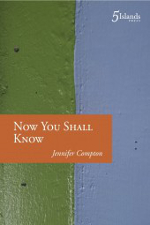
Now You Shall Know by Jennifer Compton
Five Islands Press, 2015


Jennifer Compton’s ear and predilection for the colloquial is one of the threads linking the poems in this latest collection of apparently autobiographical works. Poems further cohere around irony, sometimes translating as humour. There is reflection triggered by the death of her mother in the opening sequence, culminating in a rustic philosophy that questions mortality within the context of the natural world in the final act ‘… somehow urgent’:

You are blossoming

with an endstage intensity?
It’s a thought.
Everything I ever learned 
was from gardening.
                    (‘The Lemon Tree Syndrome’).

Now You Shall Know is divided into sections or acts (titles derived from poems in those sections) and address bereavement, alcohol abuse, family life in the suburbs, travel, gardening and ageing. These memoir poems are neither sentimental nor maudlin, but instead are infused with vitality. This collage of free verse by a New Zealander is vintage Aussie larrikin at times, and can nuance the voice in another era. In ‘As Far As Dandenong’ a new arrival is lost and tries to ask for directions in broken English.

His cheap white shirt and cheap grey strides and cheap trainers.
This is what they wear – his brother or his cousin said in Kmart.

The poet’s skill as a playwright informs what feels like a multi-act drama. In vignettes on human folly, shock and loss the poetry draws attention to itself in the use of interjections and direct quotes where the lyrical and profane rub up against each other for effect. In ‘The Drink’ a memory unravels in a wave of watery metaphors, long vowels and hard consonants; the poem hinged on ‘and the rivulet’:

The gin clear waters
as cave divers put it
of notorious caverns
yawning sinkholes

and the rivulet
the creek the brook the beck
that bubbled past his shack
spoke his idiolect and

in coastal waters when 
whales trumpeted loneliness
he shouted back

swim you little fuckers

swim!
there is no boat
you did not miss it.’

Choice of the word ‘idiolect’ so close to ‘idiot’ that it cannot be mistaken for some feeling towards the subject, like the poet’s love of the sounds and rhythms that language affords in verse like Compton’s.

We are drawn into unpunctuated theatrical streams of consciousness in ‘oh yes’ and ‘oh well’; both poems are pacy, fragmented and capture the chaos of the domestic with surprising constructions in ‘… the news was very hideous’ (‘oh well’). There is musicality in the consonance of ‘critical mass’, ‘nicholas on her tit’ and ‘big raw mess’ with its final lines of: ‘then a polish woman with a fuckyou face said to my nakedness/ hold still pls’ (‘oh yes’). Snappy phrasing and end-stopping render these poems easily digested although a rereading helped to fix the tone in context in ‘oh yes’ and the ‘polish’ did make me do a double-take. The overt echoes and chiming that characterise much of the poetry here might be deemed intrusive in some contemporary circles but are executed with a kind of ‘I’m having fun’ and ‘This is what I do’ attitude which takes it out of forced metre and into another sphere altogether. The same goes for a rogue employment of cliché in some poems and a rebel telling and loose quality in the monologue ‘The Narrative Arc of Christchurch’: ‘… How I wept. I wept buckets.’

Scene-setting in the first stanza of ‘The Craic in the Bar’ seems overwritten, but Compton’s lines can also be taut and startling as in ‘a thrusting vernacular of blue’ (‘Pink Forget-Me-Not’ ) to describe the flowers. There is accessibility and dexterity in this range that gives the whole collection an energy while concurrently diluting the more sombre and philosophical works.

The title poem, among the more demanding and rewarding for its complex imagery and language play, where an airliner, aria and ambulance are juxtaposed to create a sense of containment, performance and urgency as the death of the mother seems imminent, works well: ‘… Something tells me she is about to throw/the performance of her life’.

Significant events like those surrounding the death of a parent put us in some kind of limbo before the crash. Compton’s notion is captured truthfully in ‘… we seem to inhabit a thrumming stillness, but we believe we are travelling/ forward,’ its use of the present participle achieving the feeling of movement. ‘Clever’ is a word that crops up three times in Now You Shall Know which is arresting not only because of repetition, but because it plays into the title of the collection and foreshadows a similar element in the penultimate section ‘… wrenched backward …’ in the poem ‘Free Books’ where ‘Someone had said to my mother that/ I was a clever little girl …’ These lines suggest a rift, a lack of understanding, with the ‘little’ giving a sense of vulnerability.

Poems in this collection seem predicated on what the mother failed to understand ‘I read that poem … I didn’t know ’ (‘Now You Shall Know’) and what becomes known is revealed by the poet through remembering. Compton’s use of the word ‘clever’ seems to signify less a garnering of knowledge and more a gaining of wisdom.

Posted in BOOK REVIEWS | Tagged ,

Cordite Books

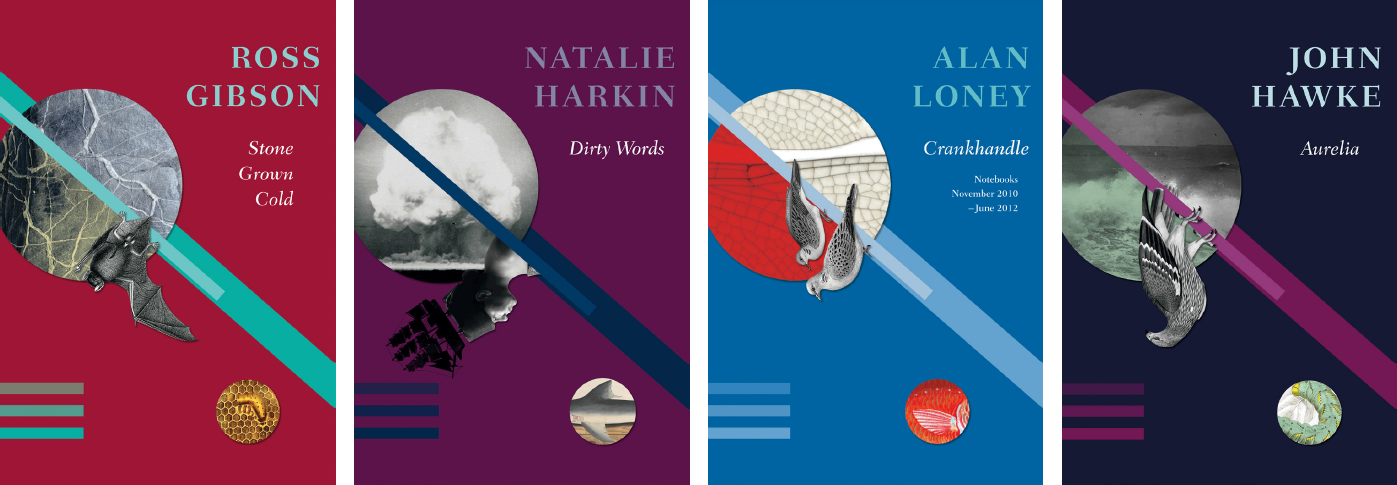
We’re pleased to tumble out into the world these first four print collections in the new Cordite Books imprint. We had considered print collections for a few years, but the tipping point to actually publish them came in late November 2014.

Buy them here!
Use 53_the_end discount code for 30% off until 9 October.

It all began with Alan Loney’s Crankhandle, which was just too good not to get out there in the world. But why do one book when you can do four? John Hawke’s Aurelia, Ross Gibson’s Stone Grown Cold and Natalie Harkin’s Dirty Words followed soon thereafter. These are excellent and challenging collections.

Cordite Press Inc. enlisted the exquisite talent of Zoë Sadokierski to create a series design, and the additional editorial whizbangery of Penelope Goodes to ensure the books are as perfect as a new print publisher can make them.

These books are not print on demand, limited edition only. We wanted to produce literary artefacts, and so we have.

Books are $20.00 AUD each, and this includes shipping within Australia.

Read the introductions to each book:

Alan Loney. Crankhandle. Introduction by Michael Farrell.
Natalie Harkin. Dirty Words. Introduction by Peter Minter.
Ross Gibson. Stone Grown Cold. Introduction by Pam Brown.
John Hawke. Aurelia. Introduction by Gig Ryan.

Posted in GUNCOTTON | Tagged , , , , , ,

Review Short: Anna Jackson’s I, Clodia, and Other Portraits

I, Clodia, and Other Portraits by Anna Jackson
Auckland University Press, 2014

Early in this collection, Clodia demands to be ‘loved by one of the new poets’ (4). Instead of beginning with the poet’s invocation of a muse, the muse of I, Clodia seems to summon the poet. Over 34 pages, Jackson imagines Clodia Metelli, the witty, promiscuous Roman aristocrat generally believed to have been the subject, ‘Lesbia’, of Catullus’s love poems – his interlocutor – her voice dovetailing easily with his. This biographical sequence is followed by another, observing an unnamed photographer during ‘the worst disaster of her career –/ this photographing of faces, this creation/ of ‘portraits’’ (41). The poet’s potential as portraitist and biographer preoccupies I, Clodia.

Continue reading

Posted in BOOK REVIEWS | Tagged ,

Review Short: Derek Beaulieu’s Kern

Kern by Derek Beaulieu
Les Figues Press, 2014


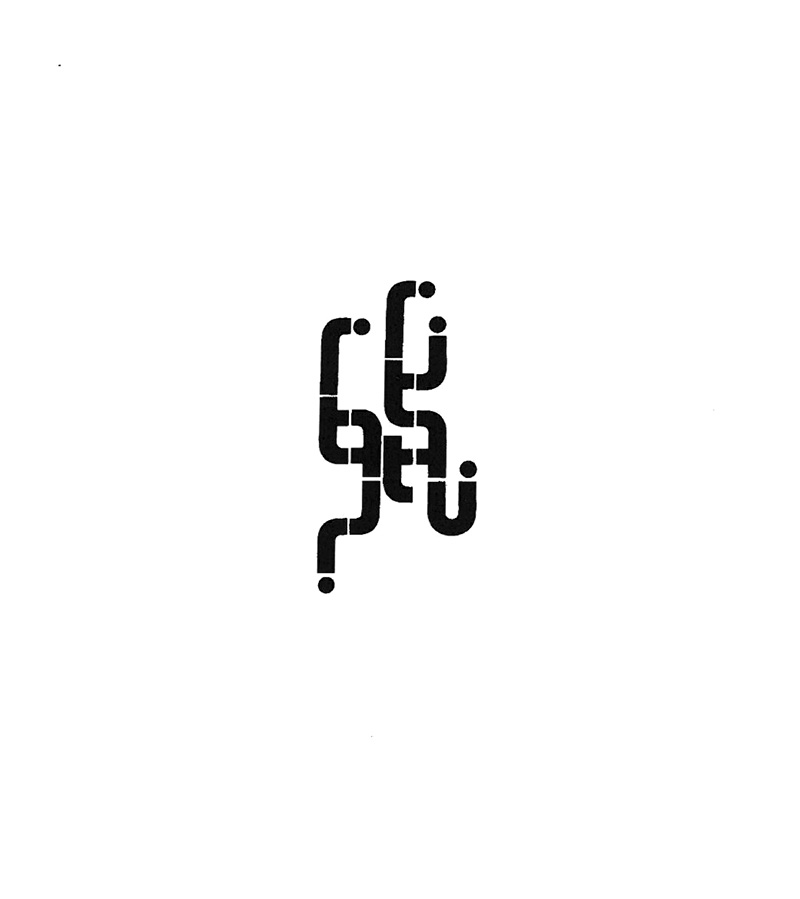
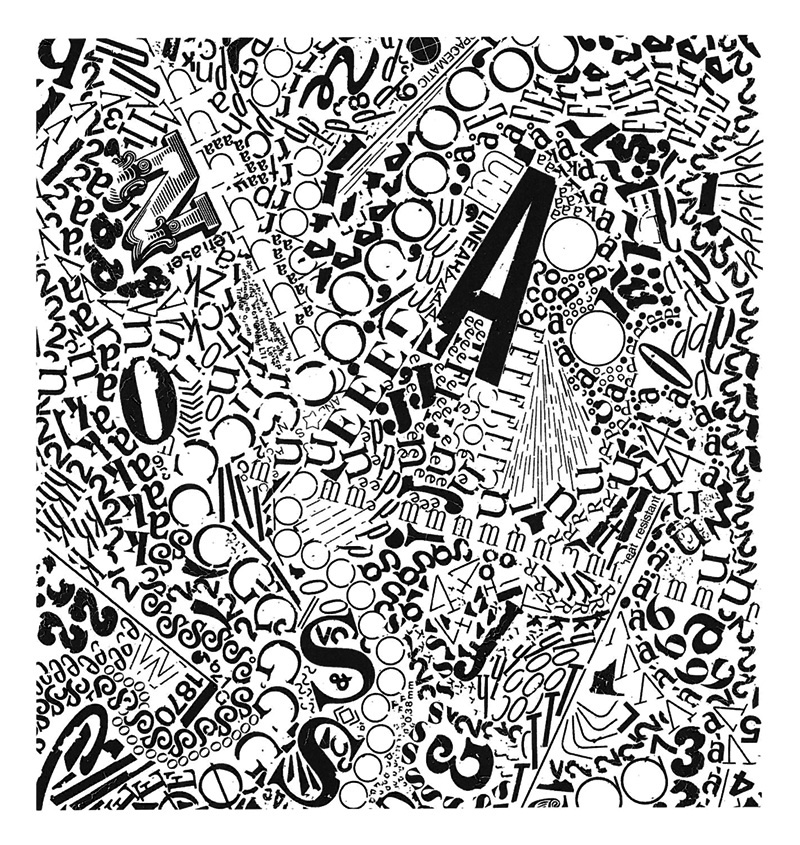
I must admit: the first time I flipped through Kern and looked at the various swirling typographic entities, two thoughts jumped into my head; how similar the pages looked to work by Australian book artist Lyn Ashby, and the other was jealousy at how much vintage dry-transfer lettering (Letraset) Canadian poet Beaulieu obviously has access to. It’s hard to come by here in Australia, and what we can still get comes only in very restrained font styles.

Both of my thoughts are valid, since the author’s note to Kern positions this ongoing body of work as being typical of Lettrism (without actually naming the field), a graphic practice that emphasises the ‘glyphic nature of the visual sign’ and ‘proliferates meaning through its visual properties’1: ‘viewers need not read, they only need momentarily stare and receive’2. I received comparative thoughts and emotional flare. Other viewers, of course, will have differing receptions. I say ‘viewers’ because these are letterforms that dissuade reading. This is confusing: such visual typographic play is common amongst graphic designers, but this is poetry. Isn’t it meant to be read?


from Kern, p 17

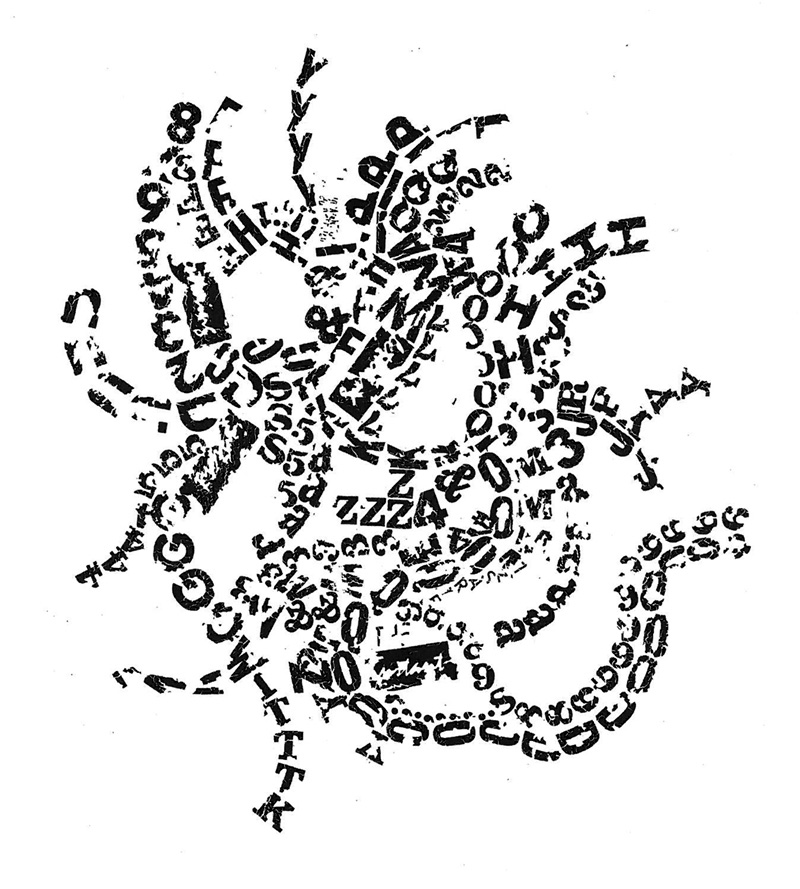
The overlap between experimental poetry publishing and artist books is fascinating, and still quite un-probed. If Kern were an artist’s book, I could talk about the sequence of images, how its march from small entities floating in white through to the overwhelming and crackling obliteration of the page space is a pessimistic foreshadowing of apocalypse. As a poetry volume, I can still say that – it’s hard not to think of societal breakdown when the object on the page is taking full advantage of its material origins by falling apart during the process of its very creation (cracking and failing to adhere, which is what Letraset does when it is rubbed too hard or not hard enough) – but there are ruptures in the sequence that undermine a clean visual reading. A book artist would allow the final images to move past the white borders of the page – bleeding out of the book – and would move back the vertical works on pages 82-85 so that they did not break the flow of disintegration. So, maybe not a straight line to dystopia.


from Kern, p 88

Instead, we are offered other points of reference: ‘logos for the corporate sponsors of Jorge Luis Borges’s Library of Babel’, ‘airport signage’, ‘way-finding signage’, ‘semantic detritus’ (90) … all pointing to surface engagement, speed, and nonsense.


from Kern, p 78

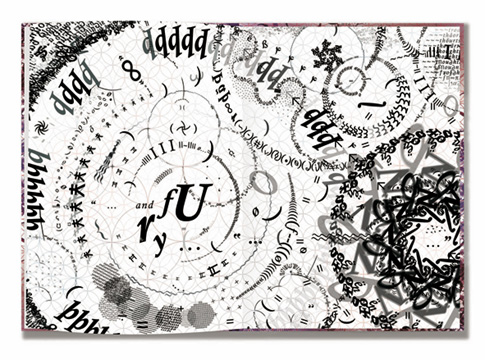
Again, my mind returns to Lyn Ashby’s book, called Ideo(t) Grammatica, which offers such visual similarity but with completely different intentions. Ashby is also way-finding: ‘the changes here gradually lead the reader, if they are willing, into stranger territory’3, the book itself offering itself as an ‘experimental petri dish’, growing letterforms that are meant to be read, and can be, if you move slowly from the start through the typographic cosmology to the aftermath of a big bang. The end (indeed, bleeding outwards) becomes a beginning, whereas Beaulieu’s end feels like an end, with no room to move (except the white gutters).


page spread from Ideo(t) Grammatica

There is exquisite care taken in both books with the placement of letters; Ashby has painstakingly used screen and software, working with visible circular grids that underpin the page. The only horizontality is a quote from Shakespeare that offers ‘a kind of life line back to the surface of normal reading’. Beaulieu has no grid for his circular movements. He seems to start with a letter, perhaps any letter depending on the day, and muses his way along its anatomy: ascender to descender, bowl to bowl, over and over, pulled this way and that by line, curve, darkness and negative space. Ashby’s language is a system, cleanly yet lushly growing, chaotic yet tidily manufactured. Beaulieu embraces the faults and problems as his lettering stumbles: Letraset promises neat black letters but so often delivers crumbs, cracks and angsty imperfection, and makes you think that it’s all your fault. Others would patch, scratch off and start again to achieve a chimera of perfection. Here on the pages of Kern, the flaws are poetic, and part of that poetic is materiality. They are simultaneously charming and terrifying in what they imply, bringing us back to apocalypse.


from Kern, p 30

This is not the first of Beaulieu’s Letraset volumes, and unless he runs out of his raw matter, it probably won’t be the last. With or without meaning, they are hypnotic, and more so if you try to retrace his movements through the patterns. The process must be consuming; the mystery of them is how, in any of them, he managed to stop. In that thought, I see the craft of the poet.

Posted in BOOK REVIEWS | Tagged , ,

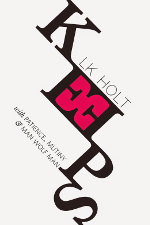
Anne-Marie Newton Reviews L K Holt

Keeps by L K Holt
John Leonard Press, 2014

Melbourne poet L. K. Holt’s third collection, Keeps, is an expansively intertextual and complexly layered work. Published as part of a substantial volume that includes the reissue of her two earlier collections, this is often dense and intellectually oriented poetry. There is, however, an intriguing personal thread interlacing the ensemble, wherein the poet – perhaps more so in this collection than in her earlier works – offers a view into some of her deeper existential concerns. Continue reading

Posted in BOOK REVIEWS | Tagged ,

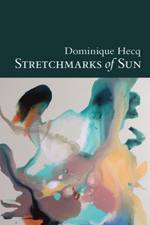
Experimental Review: Dominique Hecq’s Stretchmarks of Sun

Stretchmarks of Sun by Dominique Hecq
re.press Books, 2014


At primary school we had a class called Scrapbook. We drew, coloured, traced, glittered, and glued material cut from magazines, to create new pictures uniquely our own.
           I scrapbook.
           You scrapbook.
           S/he scrapbooks.
           We may have made the noun into a verb, but it still has chalk-mark of the hobby or junior project.
           Unlike collage, montage, even bricolage – those vaguely French-sounding words associated with literature, film and fine art.
            ‘Collage, the art of reassembling fragments of pre-existing images in such a way as to form a new image, was the most important innovation in the art of the twentieth century.’ That’s Charles Simic quoted by David Shields in Reality Hunger, a book made up largely of quotations from other texts.

           Quotes and paratexts pepper Dominique Hecq’s Stretchmarks of Sun. Seven poems which tilt at the voiceplay. Seven poems that to-and-fro across time and geography. And – like Reality Hunger – deliberately blur the line/s of authorship. Stretchmarks of Sun contains some delicious wordplays, but Hecq also plays with references, with citation, paraphrase and interpretation. Is this literary sampling a subtle – or perhaps not so subtle – critique of academic writing? That was my first thought. Second thought was the kaleidoscope of received ideas; how the mind processes information, and the piecemeal nature of memory …
            ‘According to Anatole France, it is scissors and glue, and not the traditional pen, that are the true emblems of the writer’s craft.’ That’s
Sergei Eisenstein in The Psychology of Composition. Pioneer of cinematic montage.
           Where meaning is created not by the content of an individual shot, but by juxtaposition and patterning, by the relationship of shots to one another. Used by film-makers to condense time, Hecq translates the technique to stretch as well as short-cut time.

            ‘I was the dust blowing from the interior out/I was the interior ousting particles of dust and/molecules of wind/I was the wind.’ The first poem in the collection, ‘Before I Became a Woman’, reads as a dialogue conducted with/in the self.
           A series of rhapsodic fragments.
           The voice latching onto specific images or moments before changing register.
           This performative quality runs throughout the book; it’s an energising and distinctive feature that brings the past alive in the present. It’s there in the prominent first person. In the theatricality of settings. Where lists transmute into stanzas. Where scenes break into beats. It’s there in the dramatis personae.
           Real people.
           Fictional characters.
           Historical figures.
           Ghosts.

           In Scrapbook class Miss urged us not to overfill our pictures.
           Space could be eloquent.
           In Stretchmarks the connectives are fragmentary and the between-spaces are expressive.
            ‘What am I doing, talking, having my figments talk, it can only be me. Spells of silence too, when I listen, and hear the local sounds, the world sounds …’
           That’s Texts for Nothing by Samuel Beckett.
           Fracture opens up a dreaming space.
            ‘Read the energy that is in my silence,’ wrote Clarice Lispector in Água Viva, a book composed of shards that ultimately resolve into a kind of long prose poem.

            ‘Come to think of it/I might be making it all up//Memories//of someone who never/was.’ That’s from ‘Off the Edge of Love’.
           Stretchmarks hovers over genres, makes play with unreliability, and folds together theoretical reverie, memoir and mythologies of multiple types.
           Two poems, ‘Unsouled’, and the afore-quoted ‘Off the Edge of Love’, lay bare ‘the sheer business of surviving a child’. Cartographies of loss and breakdown, they are raw, sad and incredibly moving.
           When ‘language gaps/splinters into uneven shapes/loses its footing in its own progression –/see how it slips?’
           The poems gyrate towards resolution – not narrative, but musical. The way we experience the completion of a piece of music.
           Stretchmarks takes the clutter of myth and post/modernism, marries it with ‘autoficional fragments’ and transforms it into something quieter and more thoughtful.
           Poems that demand re-reading.
           Poems rich in colour.
           Poems that are playful with pronouns and proper nouns. Imanuelle becomes Im – no dividing apostrophe.
           Poems that explore the kinship between first and third person, self and persona, foreignness and its counter/parts. The dissections of a Renaissance anatomist and the acquiring of a tattoo.

           This is erudite writing with a reflexive impulse.
           With flashes of humour – in even its darkest material.
           Writing with a restless heart.
            ‘The choices a writer makes within a tradition – preferring Milton to Molière, caring for Barth over Barthelme – constitute some of the most personal information we can have about him.’ Or her. That’s Zadie Smith’s Fail Better from 2007.
           In those childhood scrapbooks, we assembled and took apart and reassembled our world, in order to understand it and our place/s in it. Is collage or the gathering of fragments the adult equivalent? A literary approach that best fits our particular digital moment? When much, maybe most of our online reading is punctuated by hyperlinks, adverts and other interactive elements. But then writers were experimenting with short nonlinear forms way before the world turned digital, and poets have always understood the whole ‘less is more’ thing – a phrase which comes from an 1855 poem by Robert Browning.
            ‘Tell me how will it wear … ’
           In the final poem, ‘Wearing the World’, thanks to a gift voucher from her daughter (perhaps also a giver of the titular stretchmarks?) the writer visits a tattoo artist.
            ‘Everything you ink on people, Shauna says/is already inside them//You only open the skin and let it out.’

Posted in BOOK REVIEWS | Tagged

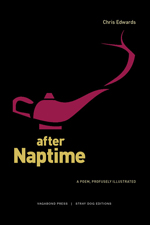
Experimental Review: Chris Edwards’s After Naptime

After Naptime by Chris Edwards
Vagabond Press, 2014


PREFACE Page references to Chris Edwards’ “A. N.”* are imposed—i–viii (Front cover–Contents), 1–22 (Text), ix–xiv (Sources–Back cover)—according to its Contents’ functionally reflexive bracketing. The central text operates, in the majority, through ten two-page spreads of apparently sourced (see “Sources” (x)) and assembled language and b/w illustrations and clipart that ‘invite’, through formal, typographic, scalar, and iconic cues, a handful of mutually interruptive reading strategies to convey a loose, visually intensified, and theatrically structured ‘story’ whose principal driver I interpret as a kind of adaptive, paranormal virus invested with a relationship to sexual desire by the detective-generic narrator. Although a source list is provided, any restrictive or procedural ‘commitment’ to these texts is indeterminate.

PREFACE TO CORDITE EDITION

REVIEW [ … ] As adolescents know, ‘multistability’ is a non-durable baffler of liquid, ‘open-ended’, parental inquiry; without recourse to a sophisticated rhetorical composition, lethargic or unresponsive to the face of interrogative contingency and capable of sublimating registrations of referential ambiguity upon formal self-closure, real (situational) escape is required, lest the “subnormative” creativity of a protective testimony—its provisionally illegible honesty—manifest as the ‘joke’ it virtually is, bringing “forward what is hidden”: the fact of an alternate stability (Virno 73, 79). This dissemblance—a demotic, interpersonal mode of InfoSec—is not the manipulative ‘simulation’ of a fiend or apathetic amoralist; it manifests, instead, within an aghast, puritan logic where any ‘omission’ that takes place is, crucially, of the (‘called-for’) lie; it is underwritten by both a tacit accusation that an inquirer would have the dogmatically honest subject generate falsehoods and an understanding that any dismissal of this integrity as duplicitous or legally spiritless (refusing mediation by operating ‘to the letter’) precipitates a (claim to possess a) ‘right to know’ that itself founds ‘spiritless’ (despotic) law. Although the youth-dogmatist requires that hir testimony “sustain ambiguous readings”, a capacity attributed to the “gestalt principle” of multistability and co-terminus solely with an absence of vivid feedback that continues to characterise circulated texts, s/he further requires that “all the elements of the work [be] directed toward a single reading of it”, such that it both enunciates the ‘case’ according to ‘juvenile’-personal law (or an absence of authority in the mature world) and remains singularly interpretable (‘closed’) by adult power as innocuous (e.g. ‘I am going out’; ‘just some friends’; ‘yes’) (Drucker 9; Hejinian 42).

Is it an error to interpret proffered ‘adult’ dissemblance and multi-stability with provoked vernacular-‘juvenile’ security frameworks? Consider, for example, (a reading of) Melanie Klein’s speculative account of infantile defence mechanisms. Upset by internal agitation, possibly due to an occasion of negative relations with the (~ only) object, I defensively project (spit up) or externalise this ‘negativity’ onto (some element of) my surrounds; to protect myself from the negativity now in my environment, I defensively introject (consume, devour) this negativity, internalising it as an agitation; upset by internal agitation ( … ). Although this wreath of logic appears to be founded, in part, on an irrational column of fear, that of retributive consumption of the infant by the breast-function (subtended by the hybrid-parent-function), Sianne Ngai’s analysis of the ‘cute’ as “an aestheticization of powerlessness” grounded by an “aggressive desire to master and overpower the cute object that the cute object itself appears to elicit”, a “tie between cuteness and eating”, and edibility as “the ultimate index of an object’s cuteness” evokes a genuine, if disavowed, provenance of terror subject to infantile intuition (64, 78–79). Something does want to crush and consume the pseudo-entity and it is precisely what s/he has identified, through hir first act of differentiation, as a threat.

(Fig. 1) Concordance pp. 1–3.

(A) 1, 3; (a) 1, 1, 2; (aah-choo) 1; (accompanied) 3; (acquainted) 2; (actually) 1; (all) 1, 3, 3; (already) 1; (amazed) 3; (among) 1; (and) 1, 1, 1, 3, 3, 3; (anti-) 3; (arranged) 3; (arriving) 2; (as) 2; (ask) 3; (at) 2, 2, 2, 3; (B) 1; (be) 2, 3; (be-keepers [sic]) 2; (because) 2, 3; (becoming) 2; (bee) 1; (been) 1, 2, 3; (began) 3; (begin) 2; (believe) 2; (born) 3, 3; (branch) 3; (but) 1, 1; (by) 1, 3, 3, 3, 3; (catalogue) 1; (certain) 1; (checked) 1; (civil) 3; (clock) 3; (Clockwise) 3; (closed) 1; (coming) 2; (communication) 1; (companion) 2; (corner) 1; (cottage) 2; (cow) 1; (cry) 3; (day) 1; (deposited) 1; (destined) 2; (Detective) 1; (did) 3; (discovered) 3; (during) 1; (e) 1; (either) 3; (Enter) 1; (exhaustless) 1; (falsified) 3; (father) 3; (fifteen) 1; (first) 2; (flax-plant) 1; (fling) 3; (followed) 1; (for) 1, 3; (garden) 2; (gender) 3; (germs) 1; (ghost) 1; (ghosts) 3; (gifts) 3; (gone) 1; (had) 1, 2, 3; (have) 1, 3; (having) 1; (head) 2; (her) 1; (here) 2; (highly) 3; (his) 3; (hours) 3; (human) 1; (I) 1, 2, 3, 3, 3, 3, 3, 3, 3; (if) 2; (in) 1, 2; (inarticulate) 2; (inclination) 3; (informed) 3; (inhabited) 3; (innocent) 2; (inquiries) 3; (Inspector) 1; (iron) 1; (irritated) 1; (is) 1, 1, 1; (it) 1, 2, 3; (king) 1; (Lady) 1; (less) 1; (letter) 1; (life) 2; (little) 3; (low) 3; (m) 1; (made) 1; (manner) 2; (me) 1, 2, 2, 3; (means) 3; (meet) 2; (Mercury) 1; (merits) 1; (mind) 3; (mirror) 1; (money) 3; (more) 2; (my) 2, 2, 2, 3, 3, 3; (name) 3; (No) 1; (no) 1; (nothing) 2, 3; (o) 1, 3; (of) 1, 1, 1, 1, 1, 2, 2, 2, 3, 3, 3; (On) 2, 3; (on) 2; (open) 3; (or) 3; (our) 2; (out) 2; (ow) 2; (oyster) 1; (papers) 3; (person) 1; (personally) 2; (pockets) 1; (point) 2; (posting) 1; (prearranged) 2; (price) 3; (purse) 1; (question) 3; (result) 3; (retreat) 3; (ringing) 1; (sailors) 1; (sculptor) 3; (sealed) 1; (second) 3; (secondly) 3; (see) 3; (servants) 3; (shall) 3; (shared) 3; (she) 1; (sheep) 1; (silkworm) 1; (simultaneously) 3; (small) 3; (so) 3; (something) 2; (sounds) 2; (spirits) 3; (stare) 2; (still) 1; (successful) 3; (telephones) 1; (Temple) 1; (that) 1, 2, 3, 3; (The) 1, 1; (the) 1, 1, 1, 1, 1, 1, 1, 1, 1, 1, 1, 1, 1, 1, 2, 2, 2, 2, 3, 3, 3, 3, 3, 3, 3, 3; (their) 1; (Then) 1; (Therefore) 1; (this) 2; (those) 2, 2; (Thousands) 1; (To) 2; (to) 1, 1, 2, 2, 3, 3, 3, 3, 3; (touched) 3; (turn) 3; (turned) 1; (unlucky) 2; (until) 3; (up) 2; (upon) 2; (verified) 3; (virulence) 1; (w) 1, 1; (wardrobe) 3; (was) 1, 2, 2, 3, 3, 3; (were) 1; (Whether) 3; (which) 3; (whose) 1; (with) 1, 3; (years) 1; (yes) 3


(List 1) Unordered list of plausible reasons for the ‘meaningfulness’ of variable letter capitalisation (‘a’/‘A’) in the title leading to its unreliability as a piece of citation *[“after Naptime” (i), “AFTER NAPTIME” (iii), “after Naptime” (v), “After naptime” (vii), “AFTER NAPTIME” (8), “After Naptime” (xiv)].

List 1. Edwards is an editor according to external biographical notes and is credited here with “design and typography” (vi); the uniformly lowercase utensils in a landscape (2001) is consistently cited as such and listed in an “Also by Chris Edwards” section (iv); the sometimes non-standard lowercase a following the colon in A Fluke: a mistranslation of … (2005), listed in the same section (weak); (?).


A quality-luxury continuum, invoked by the scarcity of an Edwards-‘contacted’ edition—“a limited edition of 111 copies / numbered and signed by the author” (xii)—and the sub-titular phrase “profusely illustrated”—gleaned, it seems, from the final provided source title—is interrupted by the blatantly ‘poor’ reproduction of an oil lamp image on the cover (i) and title page (v). Outline asperities, beyond prefiguring a ‘real’ underlying lack of smoothness and enclosure that will be taken up as a key predicate of all content within the text, preyed upon there by a phantasmic-biological entity represented by pictographic and illustrative collages of ‘enhanced’ (close-up) fibrous nerve endings and ‘distant’ (small) human-animal bodies, confirms that Edwards’ materials have ‘passed through’ the bitmapping of digitalisation; ‘edges’ of elements appear jagged because of resizing rather than collage-‘cutting’ issues; included visuals exist as transmittable image files, elsewhere. Nine dots left open for edition numbering (“number . . . . . . . . . of” (xii)) ‘call back’ to the coupon dashes-and-scissors that frame the text’s preface (1)—embedded prompts for physical transformation of the object by the reader and author-publisher-function respectively, the latter of which, if intended to be constituent with Edwards’ hand, takes up the commercial-language gesture of an ‘I’ speaking of ‘oneself’ in third person (“signed by the author” (xii)); this copy states, for example, that “‘Edwards’” is “the narrator” when narration and the perspectival accounting of emotional investment implied by this position are occupied from the outset by an ‘I’ that references an “Edwards” (e.g. “[ . . . ],’ says Edwards” (9)), a figure or position that continues to potentially, jokily, multiply (e.g. “E at work” (7) or “Ed. Note:” (16)) and a reference to the common inter-community practice of providing requested biographical notes in third person.


Drucker, Johanna. (2009). ‘Entity to event: From literal, mechanistic materiality to probabilistic materiality’. Parallax, 15:4, 7–17. Pdf.
Drucker, Johanna. (2012 [1984]). On writing as the visual representation of language. New York Talk, NY, June 5, 1984. PennSound. Mp3 file.
Hejinian, Lyn. (2000). The rejection of closure. In The Language of Inquiry. University of California Press. Print.
Mitchell, Juliet, ed. (1987). The Selected Melanie Klein. Simon and Schuster. Print.
Ngai, Sianne. (2012). Our aesthetic categories: Zany, cute, interesting. Harvard University Press. Print.
Scalapino, L. (1993). Objects in the terrifying tense longing from taking place. Roof Books. Print.
Virno, P. (2008). Multitude: Between innovation and negation. Semiotext(e). Print.

Posted in BOOK REVIEWS | Tagged ,

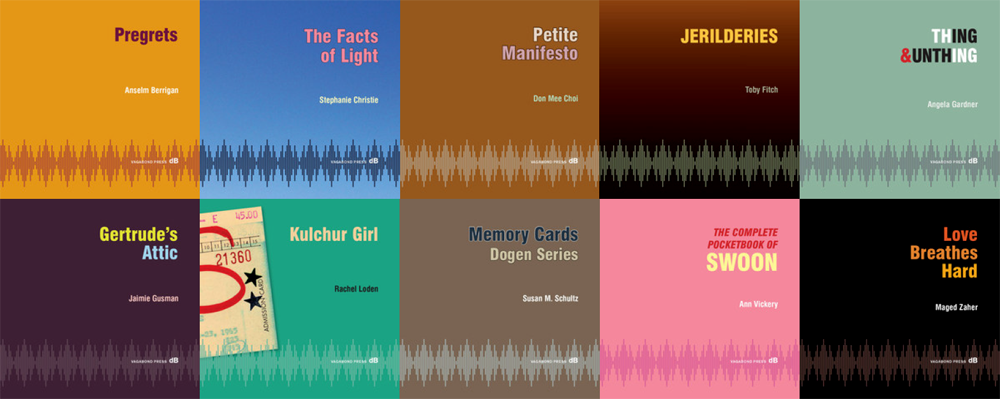
Dan Disney Reviews the deciBels Series

These ten tiny tomes from Vagabond Press each speak (squawk, swoon, glitch, muse, lyricise, confess) of how there is something not ticking precisely inside the reality machine. Or perhaps these books shine light onto how we’ve all gone slightly spectral within our anthropocenic phantasmagorias, lost and unmoored in an experiment that’s become dreadfully strange. Some of these books turn exclusively toward the world, others perhaps come from particular critical engagements; each serves to extend conversation both on what poets do, and what poems are for. Continue reading

Posted in BOOK REVIEWS | Tagged , , , , , , , , , , ,

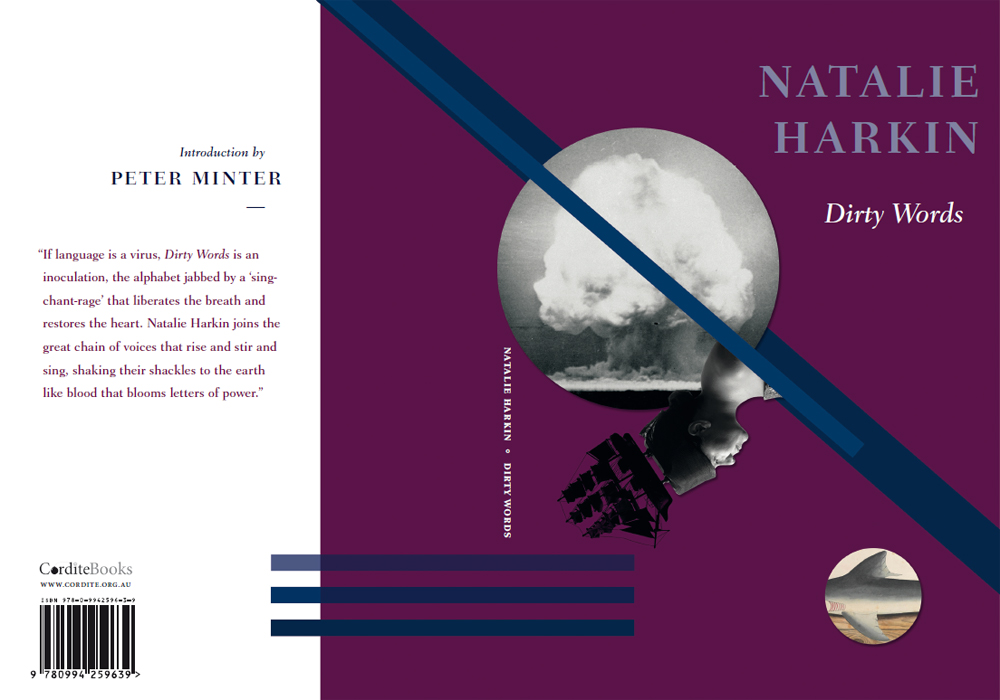
Introduction to Natalie Harkin’s Dirty Words


Cover design by Zoë Sadokierski

Natalie Harkin’s poetry is deeply felt and profoundly moving. Emerging from the clearest wellsprings of life to bear witness to the richness, complexity and anguish of the human condition, her work is a clarion call to our conscience and hope.

At first glance, Dirty Words is an index to the harrowing ledger of colonisation, its ruinous legacy and the echoes of despair and desolation that reverberate through to the present. Dirty Words is also a codex of the fabric of filial memory and cultural law, traces of stories on the wind and tide, the songs and sacred knowledge of Elders and Aunties and Nannas and Sisters that weave through that ruin to reconnect, resprout and relive. At their heart, the poems in this collection are songs to love and to the eloquence and strength of resilience.

Natalie Harkin joins a great chain of voices that for generations have stirred and risen and cried out against tyranny, shaking their shackles to the earth like blood that blooms in seeds of power.

If language is a virus, Dirty Words is an inoculation, the alphabet jabbed by a ‘sing-chant-rage’ that liberates the breath and restores the heart and mind. Justice is better, not bitter, but cuts the tongue to tell it like it is. Country might be cleared and carved and consumed but Harkin’s poetry restores the beautiful strong ‘blood-memory-land’ to its sovereign wellbeing, free from ‘industry’s radiation-health.’ Above all, even in its anger and sting, Harkin’s is a poetry of ardent sympathy and compassion. This is where its true power lies: in the solicitude that swells eternally from quiet and determined dominion; in the invitation to community and treaty, to wisdom. Dirty Words unravels the knots of history and makes us feel all there is to be felt in the years and years of living and being Aboriginal.

Always was. Always will be. It will not be quiet here, each letter sent sincerely, respectfully and with the finest aim. The challenge is ours to read Harkin’s Dirty Words, to let them fall across our skin and seep into our creases and folds like fine red dust. Then the air we move through will speak with their colour, our dreams and memories will germinate and join the song, our flowering heads held high and proud.

GET YOUR COPY HERE

Posted in INTRODUCTIONS | Tagged , , ,

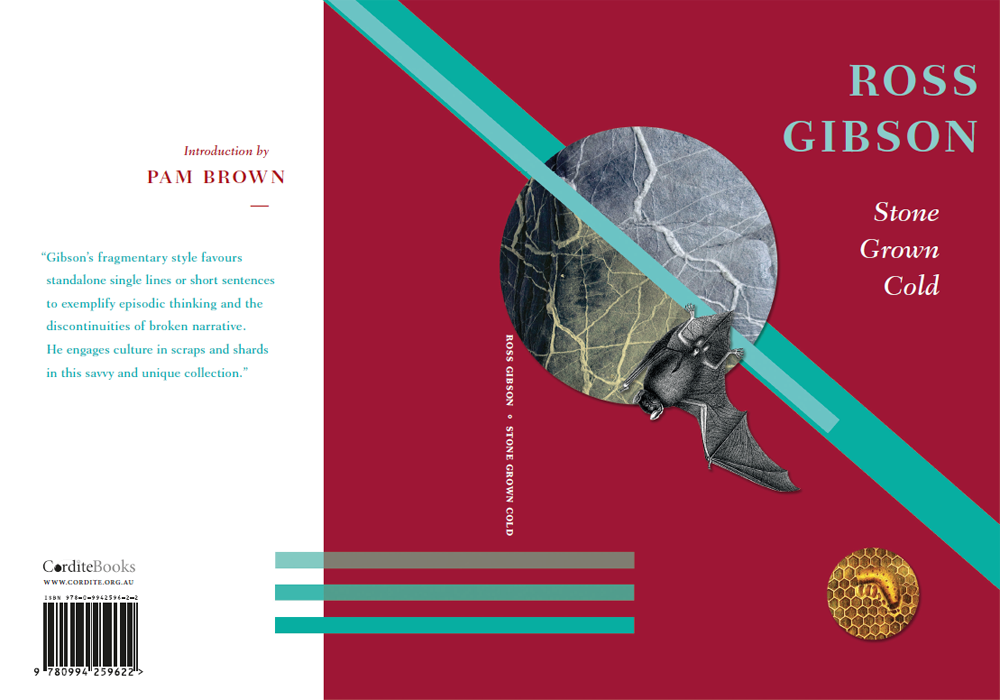
Introduction to Ross Gibson’s Stone Grown Cold


Cover design by Zoë Sadokierski

The works that Ross Gibson has written and edited over the past thirty years could be classed as political aesthetics. In books like Seven Versions of an Australian Badland, chronicling the wretched historical miscreants of Queensland’s Brigalow country, or 26 Views of the Starburst World: William Dawes at Sydney Cove 1788–1791, speculatively tracing English astronomer William Dawes’s scientific work and his relationship with the Indigenous Eora people of Sydney Harbour in a few late years of the eighteenth century, Ross Gibson’s method is procedural. Seven Versions and 26 Views form a compositional design that he has described as ‘fractal’, allowing unfixed multiple views and patterns. The author’s practice of creative fragmentation, applied to the poems and short prose pieces in this new collection, eschews linearity and dull chronology.

The epigraph from modernist North American poet William Carlos Williams presents a complex and strange concept of redemption linking the ghosts of genocide with authenticity. The stanza works to feature a universal Western historical quandary. Ross Gibson’s fascination with history is reflected in the quote, and often his sombre choice of language forges a kind of early modern trait that informs particular effect or mood throughout this book. For example: using a rare word like ‘stochastic’ when he could have said ‘random’, or writing ‘prodigious’ instead of ‘huge’ to describe some fruit bats flying over the inner Sydney suburb of Redfern. I think, in the author’s lexicon, ‘random’ and ‘huge’ would have sounded too mingy.

In the preface Gibson tells us that everything here takes place in a chimerical town that we, the readers, ‘know well’. The first poem is a short, notational, prosaic piece that riffs on twentieth-century Sydney poet Kenneth Slessor’s well-known World War II poem ‘Five Bells’, as a minimalist remix of anthropomorphised tugboats, mists and pile lights. In spite of the minimalism the intent is serious and leads directly to a 2014 hostage incident in a chocolate cafe in ‘Martin Place’, one that Sydneysiders now call ‘the siege’. There is topicality here but it’s agreeably unpredictable. Gibson’s fragmentary style favours standalone single lines or short sentences to exemplify episodic thinking and the discontinuities of broken narrative. He engages culture in scraps and shards.

The performative and visual are prominent in Stone Grown Cold. Gibson is also a filmmaker and creator of audiovisual installations. Sometimes his poetry can be imagined as film, sometimes as song. His lyrical adverbial phrases enhance narrative possibilities that relish the abject, the perturbingly awkward and the disaffected, sometimes in archetypical ordinary suburbs like Rooty Hill – ‘The street’s a tract of sump-oil’ – and Miranda Fair – ‘Go set a suburb on fire.’ In one deliberately unmannered poem everyone is so far off their faces on ‘meth home-cook’ that they have become embodied spectres whose ‘thoughts waft all misshapen.’ Other situations or scenes have haunting eerie undertones that are deliciously creepy – ‘They brought a cold mattock up from the basement’.

Not everything is gloomy though. There’s plenty of genial humour and wit in the sets of Zen-ish lists of tasks and personal superstitions, in an experimental rendition of pop songs like Russell Morris’s seventies classic ‘The Real Thing’ and in some celebratory sinning – ‘Sex in a church. Minutes later: a hailstorm.’ As a bonus, Gibson gives seasoned advice to the bewildered – ‘Bluff your befuddlement with droll savoir-faire.’ These are some of the many unusual pleasures to be found in this savvy and unique collection.

GET YOUR COPY HERE

Posted in INTRODUCTIONS | Tagged , , ,

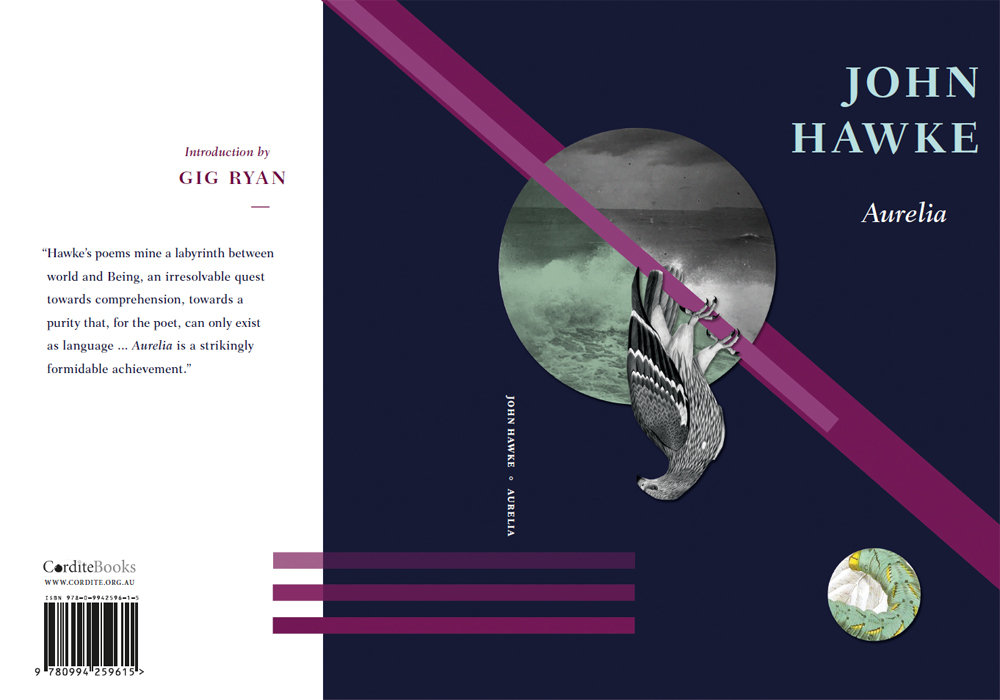
Introduction to John Hawke’s Aurelia


Cover design by Zoë Sadokierski

John Hawke’s forensic inquiries in this book are layered with casual erudition – Diderot, Czech poet Vladimir Holan – and locate the poem as transformative state. Many of these poems conclude with a mystical ascent into nature, reminiscent of Patrick White scenes in which the division between consciousness and the universe wavers, signifying that any reconciliation is epiphanic, claimed by art or religion. Yet nature belittles human effort – ‘The path to the point is marked by a scattering / of impermanent hand-made memorials’ – that is, the poet’s endeavours are precariously, though heroically, makeshift, overlaid; but nature is also that which threatens or devours, ‘digesting light’.

The title poem alludes to Gérard de Nerval’s prose poem ‘Aurélia’, which begins ‘Le rêve est une seconde vie’, in which the desperate poet sees the universe as a giant alphabet – inspiring Baudelaire’s later ‘Correspondances’ with its ‘forêts de symboles’. (Nerval in 1854, the year Rimbaud was born, wrote ‘Je suis l’autre’ beneath a photo of himself). The spectral Aurelia symbolises yearning for completion, her image embodying universal truth, a theory-of-everything, which the poet can only glimpse. Aurelia is a manifestation of art – ‘I first fell in love with Aurelia / in the face of that woman painted by Giovanni Bellini’ – that is, love clasps the actual simultaneously with its ideal, just as Proust’s Swann imagines in embracing Odette, he embraces Botticelli’s Zipporah whom she resembles.

                       and we enter that forest
of symbols where everything coincides.
These correspondences find their relation
in the name of the absent beloved,
as if the world of visible signs were itself
a vast and scattered alphabet ...

This book’s tour de force is its longest poem, ‘The Conscience of Avimael Guzman’, a scrutinising cubist portrait of Peru’s Sendero Luminoso (Shining Path) leader, which begins with this former philosophy professor strangling a woman. Justifications gnaw and collapse into a weird crescendo of turbulent ambivalence.

The strings of your nerves drawn shrill
by the need to maintain a single extreme moment,
but that was an error, a point of mathematics:
better to proceed by denial, eating your own words,
phrases compacted and swallowed in gutters.
The fabricated voice of the journals dissolves behind you ...

Hawke’s poems mine a labyrinth between world and Being, an irresolvable quest towards comprehension, towards a purity that, for the poet, can only exist as language. Plated with consonance through quasi-rhymes such as the end words in ‘Early Spring’ – ‘leaves, anemones, bees / hips, imprinted / stream, eel / step, breath / planet, radiance’; ‘Link Wray’ and ‘lisping rain’ in ‘Halley’s Disappointment’ – Hawke’s descriptions are as fastidiously observed as Kenneth Slessor’s or Robert Gray’s – ‘tea-coloured river’, surfers ‘skate / across the lucid skin of a dangerous break’.

In other poems such as ‘The Police-spy As an Owl’, Being, exiled from transcendence, is submerged into its activity, ‘Only productive things have meaning … it is use / which defines’; this also reiterates an earlier poem – ‘the artist’s signature / which is death’ here becomes literally ‘His signature is death’. There is a vast array in these lucent metaphysics, from the ominously Oedipal ‘On Woodbridge Hill’ to celebrations of children and love in ‘Early Spring’, ‘The Night Air’ and ‘Emily Street’, to the satiric or even apocalyptic ‘The Poet Speaks’. Hawke’s much-awaited Aurelia is a strikingly formidable achievement.

Posted in INTRODUCTIONS | Tagged , , ,

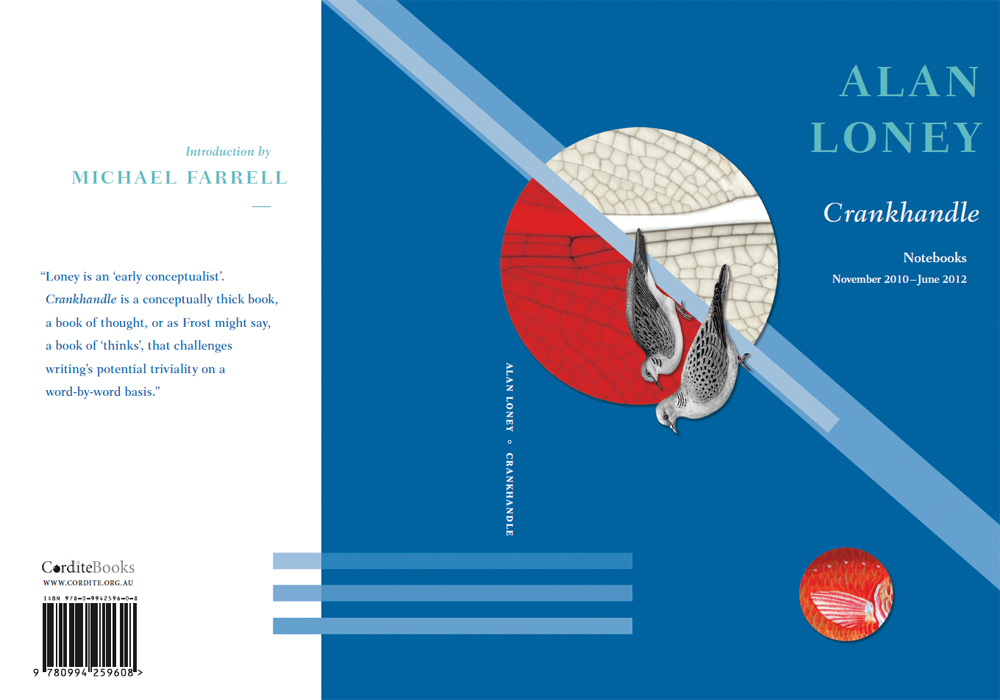
Introduction to Alan Loney’s Crankhandle


Cover design by Zoë Sadokierski

Since moving from New Zealand to Australia back in 2001, Alan Loney has carried on a prolific, internationally recognised career in Melbourne. Crankhandle, Loney’s latest published work, follows on from 2014’s chapbook collaboration with Max Gimblett, eMailing flowers to Mondrian, and the books from Five Islands Press, Nowhere To Go (2007) and Fragmenta Nova (2005). Borrowing his contemporary Laurie Duggan’s term, Loney can be read as a ‘late objectivist’: worrying at that particular American formal legacy, with its attendant philosophical and ethical concerns.

In Fragmenta Nova Loney writes, ‘“Poetry” is too small a word for the cry that issues from the mouth. “Form” is too small a word for the shapeliness of words upon the page’ (‘Poiesis’). This quote points to the uncontained – and affective – quality of much of Loney’s work, as well as to his attention to visual design. This is not an aesthetic concern only, but one that enables reading: lucid aspect as well as articulated ‘cry’. Elsewhere, Loney has characterised his writing in successive modes as a practice uninterested in ‘perfect individual poems’: ‘If the poem’s an imperfect take on the world or even part of it, better to be crisp about it, and treat writing as unfinished and unfinishable business. So, adopt a framework, write for a while, then stop. It isn’t, of course, quite as simple as that’. Perhaps then, Loney is an early conceptualist. Crankhandle is a conceptually thick book, a book of thought, or as Frost might say, a book of ‘thinks’, which challenges writing’s potential triviality on a word-by-word basis.

A writing motto appears about a quarter of the way through:

write as if you had
never
written anything
before

The word ‘crankhandle’ suggests revving up but also letting go: write, then think. In a 1997 interview, Martin Harrison said, ‘I think the age now is of living systems.’ Loney, in the book’s epigraph, refers to antiquity’s knowledge of the writing system. Writing is part of that living system: as both noun and verb. Traces of Greek mythology recur in this book – as do other pre-contemporary traces – yet these are not necessarily allusions, but an attempt to find a place for a history of writing. Writing as an activity of the body, which may or may not end up in a book. Like a beach, ‘a book is a public place’.

Crankhandle contains double or parallel texts that recall Anglo-Saxon or indigenous traditions, like the Maya, where translation is what produces poetry.

wide 		foam-veined 
			wave
birdless		foam-marbled 
			wave 
air

Though the desire for words in space is cited, this space both includes and extends beyond the mind: ‘dragonflies above / goldfish below’; ‘dead possum / on the nature-strip’. An Australian source is suggested for writing, voicing and quoting: ‘but with lyrebirds about / you wouldn’t know / who’s talking’.

Crankhandle is a late book in that the sense of both individual and social self recedes: ‘the “my” of “my library” / where did it go’; ‘no longer care / what others think poets ought / to be doing’. Signifying closure, Orpheus as spider descends onto the last page of the notebook: the poem’s over. Or perhaps, in our minds,
      not
      quite
      yet.

GET YOUR COPY HERE

Posted in INTRODUCTIONS | Tagged , , ,

Review Short: Benedict Andrew’s Lens Flare

Lens Flare by Benedict Andrews
Pitt Street Poetry, 2014

Lens Flare is a collection of poems – the first, as far as I can tell – written by a theatre director more accustomed to staging Chekhov in New York or Verdi in Denmark than to publishing poems in Australian journals. I opened the book expecting to find that slightly off-key poetry written by accomplished practitioners of an allied practice – this could also be song-writing, fiction, even painting – whose singular depth of involvement is unquestioned, but is not in poetry. Continue reading

Posted in BOOK REVIEWS | Tagged ,

Review Short: Jeri Kroll’s Workshopping the Heart: New and Selected Poems

Workshopping the Heart: New and Selected Poems by Jeri Kroll
Wakefield Publishing, 2014

Workshopping the Heart brings together poems from Jeri Kroll’s five previous books of poetry, with thirty or so pages of new poems and the opening chapter of a verse novel. Her distinctive voice – lyric, tough and spare – is evident early. Continue reading

Posted in BOOK REVIEWS | Tagged ,

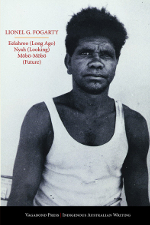
Fiona Hile Reviews Lionel Fogarty

Eelahroo (Long Ago) Nyah (Looking) Möbö-Möbö (Future)
by Lionel Fogarty
Vagabond Press, 2014

Lionel G. Fogarty is an indigenous Australian poet who is recognised for the excavation of a poetic space in which, as Michael Brennan has written, ‘his community and culture is recuperated and asserted’ whilst ‘dominant discourses, both political and poetic’ are subverted and destabilised.1 These qualities make Fogarty’s work difficult to review in a context in which the status of indigenous literature remains, for some institutions at least, seemingly unapproachable. Continue reading

Posted in BOOK REVIEWS | Tagged , , , , , ,

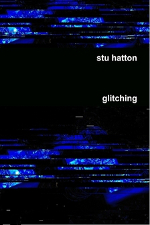
Review Short: Stu Hatton’s Glitching

Glitching by Stu Hatton
(outer) Publishing, 2014

‘Glitching,’ sharp and immediate, is a – word that sounds like it belongs to this modern internet and computer age: moments of fracture as a website struggles to load, fragmented by popups, weird demands of your exact location and the failure of Flash to connect properly. It suggests twitching and distorting monitors, the crackle of an old modem and illogical videogame surrealism, frustrations and interruptions ‘Not of substance but of form’ (‘entheogen’).

Continue reading

Posted in BOOK REVIEWS | Tagged ,

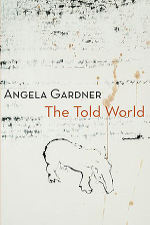
Review Short: Angela Gardner’s The Told World

The Told World by Angela Gardner
Shearsman, 2014

Angela Gardner’s The Told World is a collection that made me feel homesick for Brisbane. Gardner is a Brisbane poet, and while some of the lines in this book specifically reference the city, it is not actually a Brisbane book of poetry. Many of the poems are pastoral, but not grounded in a specific landscape, generally the ‘here’ could be anywhere. Continue reading

Posted in BOOK REVIEWS | Tagged ,

The raison d’etre of onedit

Onedit1 hasn’t had a statement about its raison d’etre since its inception almost 15 years ago, and it’s interesting to be writing one now. The point of poetry for me is that it’s a much more flexible, open, varied, and enduring way of writing into, out of, through, around, or with the world than any kind of commentary can ever be. The poetic statement of what onedit2 is about is onedit itself and (to my mind) no poetry should need a commentary. Ah! But for those who don’t know what onedit is about (and I imagine that I am the only person in the world who has read it in its entirety) I’m happy to give this potted history into, out of, through, around, what it was, has been, is, and will be, even.

The way onedit started was out of conversations with Miles Champion3 and Thomas Evans. We three (perhaps ridiculously, perhaps realistically) at times felt ourselves to be the last three people standing in the British poetry scene of the mid-to-late 1990s.4 Onedit came out of my having lived in San Francisco and then New York for quite some time in the early-mid 1990s, and my meeting a whole swathe of poets who were, broadly-speaking, the generation that came after LANGUAGE. The way the world divided was that the boys (Brian Stefans, Tim Davis, Rob Fitterman …) were sympathetic to those who came before them, and the girls (Lisa Jarnot, Eleni Sikelianos, Lee Ann Brown …) were much more out of the New York and Beat schools. Being British,5 I was able to talk to everyone and was welcomed wherever I went. I made all of the early poetry friendships of my life in those years in the USA, and when I was forced to return to the UK,6 7 it was my intention to bring my first poetry friends to the misogynistic and moribund desert which was (to the minds of Miles, Thomas, and myself) that of the UK in 2000AD.8


Jackson Mac Low | onedit #1

And so onedit was born. It was9 both Thomas’s and my mag. We debated doing hard copy but felt that production costs (and postage back to everyone in the USA) would make it prohibitively expensive. Neither of us wanted to do an online mag, but we wanted to do a mag – and online was therefore the only way.10 I asked a Japanese student friend to build me a site and I gave him the mimeo-mag inspired design for how I wanted it to look. He built the first issue and we were ready to go.11 My particular inspirations were the mags Adventures in Poetry, Juillard, One Hundred Posters, and The World. The whole world of blurry type and minimal design which was a necessity for Larry Fagin, Trevor Winkfield, et al., became (through happy chance) a very clean and clear way of navigating around what can be a really cluttered and unreadable poetry landscape on the internet.

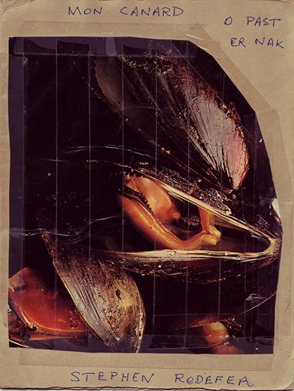
There are three main phases to onedit. The first phase was the early issues which contained many more US poets than from the UK. I am really proud to have otherwise unpublished work by Jackson Mac Low and Clark Coolidge there, and to have really rare pieces by Alice Notley and Stephen Rodefer.12 13


Stephen Rodefer | onedit #9

I14 had an issue which just featured visual work by Isabelle Pelissier, and I wanted onedit to have as much visual work as written; mirroring my two favourite periods of poetry – European Dada, and the many and various New York Schools.


Isabelle Pelissier | onedit #2

This stalled when Edwina Ashton was asked to provide work for a single artist issue and (not unusually for Edwina) didn’t come up with the work.15 And so onedit became a poetry mag and pretty much that alone.16 The two ideas that drove the early issues were (a) the desire to have the contemporary scene17 available to the UK who I felt might be interested – although I didn’t know who they might be, given the general antipathy to American LANGUAGE-based writing in the 1990s18 – and (b) by the desire to be doing something that felt worthwhile. This was how it was for the first batch of issues. Then onedit really changed. On my return to the UK from two years in Barcelona I discovered a very different landscape from that which I had left in the year 2000.

Posted in ESSAYS | Tagged , , , , , , , , ,

One Size Fits All: On Out To Lunch’s Unpublished BLAKE

In Laudem Authoris

Must Non-sence fill up every Page?
   Is it to save th'expence
Of wit? or will not this dull Age
   Be at the Charge of sence?

But […] though Fortune play the Whore,
   Let not the Vulgar know it;
Perhaps if you had not been poor,
   You had not been a Poet.'1

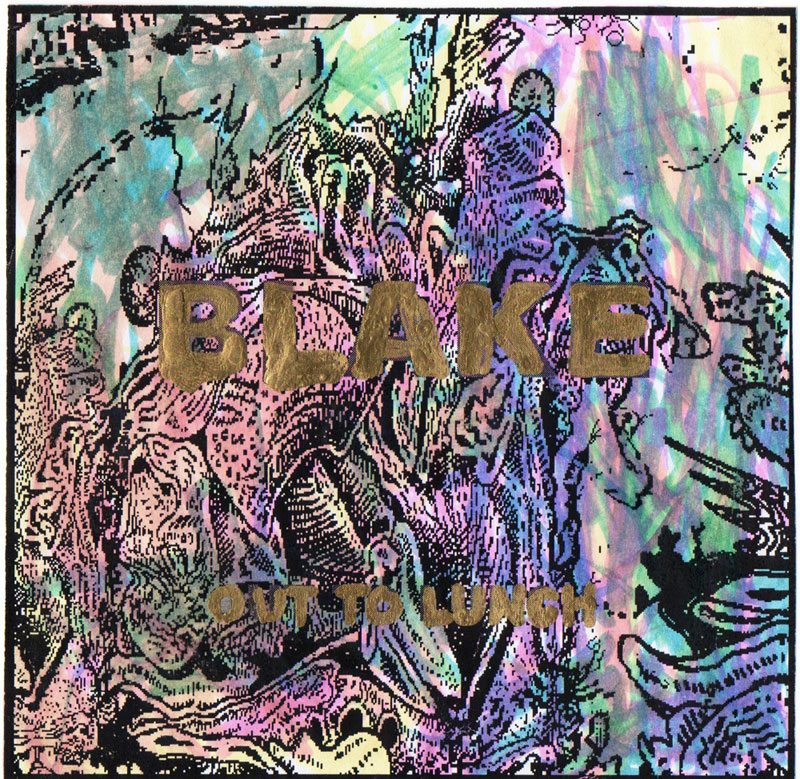
In 2011, Out To Lunch (the alter ego of author and polemicist Ben Watson, though currently indistinguishable from the primo ego himself) issued to a handful of cohorts and fellow travellers a homemade CD of his recently completed illuminated poem, BLAKE. The extraordinarily visual poem consists of seven sections based around specific body parts, running the course of 217 full-colour massive plates. These plates were composed in Windows 95 MS Paint, a program practically obsolete for close to a decade by the time of composition and pushed far beyond the anticipated limits of the first-PC-generation software by the inclusion of hand- and mouse-drawn figures, colour washes, scans of photos and mass-produced detritus, manually and digitally manipulated and combined into undeconstructible admixtures. The vast majority of BLAKE’s text is not differentiated from its visual surroundings, but rather hand drawn within the program, making for a uniquely coagulated visual poetry.2

ESEMPLASTICITY

Written during the same period as Watson’s critical essay Blake in Cambridge (Unkant: London, 2012), the poem draws inspiration from William Blake’s simultaneously revolutionary and visionary illuminated manuscripts without imitating the style or tone of Blake himself. Rather, OTL reads in Blake an ecstatically subjective materialism wherein the individual imagination actively intersects with an active world. Lunch shares with Blake an apprehension of the interconnectedness of all things, and as in James Joyce’s Finnegans Wake or Frank Zappa’s Project/Object, this philosophy takes as its basis the universalism of sexuality and everyday particularity. Indeed, the handful of recipient-cohorts for Out To Lunch’s BLAKE share this beginning-from-the-body Weltanschauung, collectively deemed as they are (by OTL) the ‘Esemplasm’, a term derived from Samuel Taylor Coleridge and one denoting an imaginative faculty actively shaping and shaped by one’s physical reality.3 Aesthetic, political, and psychic life in this approach are not viewed as separable, exclusive entities, but rather as integral material manifestations of lived experience.

The philosophical basis for the desire to destroy imposed societal separations – between art and life, dream and reality, manual and mental labour, individuality and collectivity – has formed a primary motivation for radical activists, thinkers and artists for centuries.4 It is expressed in BLAKE through not only the inseparable art/text and its throw-everything-into-the-mix aesthetic/political poiesis, but also in its polymorphous perversity, each section’s body part magnified to the scale of a sensate cosmos, shaping and being shaped by desire. While the type of radical subjectivity practiced by OTL is often criticised as self-indulgent (to which Watson in the past has capably responded, ‘If you can’t indulge yourself, who can you indulge?’5), this bodily philosophy does not narcissistically deny the validity of other people, or objectify them as concretions of ideas or structures devoid of agency (indeed, such concepts are far more characteristic of philosophies amenable to capitalism) – rather, through the validation of one’s own body, and with critical attention to its desires, needs and imaginative associations, the individual has a material basis for empathetic communion, coming to know as he or she does the nigh-cosmic forces potentially contained within every body. Like a hologram, within each body is contained in outline the entire universe, both figuratively (as in OTL’s space drawings of drifting viscera and other universalised body parts) and literally (as our bodies are made of the same materials as the cosmos6). Each body contains the blueprint for all bodies, via ‘our common spectrum, sex …’ – and each body is inclusive of different potential sexes, ‘because’, Out To Lunch writes, quoting Catherine Harper’s Intersex alongside William Blake’s Milton, a Poem, ‘WE ARE ALL INTERSEX’.7

Political and social liberation, then, coming from such a view of the world, does not arise as a result of ideas but out of necessity for the fulfilment of material needs and desires. If, in a Marxist-Humanist spirit, the human body is taken as the basis of the body politic, the society cannot support hierarchy or external authority without the repression of parts essential to the healthy functioning of the whole. This body-centred philosophy is at the heart of all of Ben Watson’s work, having been read through practically every artist and thinker he’s discussed,8 with BLAKE to date the fullest culmination of his desire to eliminate all imposed and repressive separations.

TACTILISM

BLAKE does not proceed as a linear narrative, but as a linked series of riffs loosely clustered in and around the body, its sensations, actions and desires. HAND, HEART, STOMACH, HEAD, COCK, BUM, and FEET comprise its seven parts like the ground of its dérive through a visual and semantic sensory overload. The text itself, already difficult to read given its drawn, relatively tiny fonts, often variously coloured across formidably long lines, and sometimes placed within or directly over detailed, fluid images, is further semantically complicated by a penchant for puns and portmanteaus, similar to both Finnegans Wake and the lyrics of Captain Beefheart (both also alluded to or quoted in-text). Though written in mostly recognisably prose syntax, the poetry tends towards non sequitur, in-jokes, surreal pronouncements and exhortations – what might justifiably be deemed nonsense (e.g. ‘like unto a jack ninny pulverise an oyster / oblivious to what they meant for me to buy – hi! / you too can react this way, pitching new pressures into the garbage’ (Plate 002-003); ‘The necessity of Penis wiring / like some antarticulated / moon’ (Plate 024-025); ‘No paws in the formic angst pact.’ (Plate 152-153).

To the suggestible reader, the overload of unparse-able information, combined with a lack of semantic cues to follow (short of intimate familiarity with Watson’s wide-ranging hyperpersonalised vocabulary), seems to contribute to the stimulation of outlying senses rarely engaged in poetic and visual arts. The profusion of fingerprint-like patterns, for instance, with the constant implied myriad surface textures of intimate extreme close-up evoke analogous sensations of tactility, and the text seems to invite such stimulation: ‘a common surge in the vein, infinite and sensual // a surge only denied by the drear individual dignity of money making / a tidal tremour which devours each boredom and spikes each finitude / shewing a limitless chain of meiotic tactility / dancing like tin tacks on the roof of your mouth’ (Plate 014-015). Almost all the plates, in fact, feature extremely descriptive words evoking distinctly tactile sensations, even if the objects thus engaged are unfamiliar or hard to discern: ‘my hand like a lunar landscape / everything pitted’ (Plate 006-007); ‘stony relief was the best of tines’ (Plate 022-023); ‘the necessity of anal clench’ (Plate 026-027); ‘To be trammelled in eyelash rainbows, fairyweb redscience’ (Plate 134-135).

Posted in ESSAYS | Tagged , , , , , , , , ,

Seeing Skulls, Reading Palms: Jasper Johns in 2014

Jasper Johns’s Regrets is at the Courtauld from September 12th-December 14th. Before that (March 15th-September 1st), it was at MoMA. A significant portion of its contents are due to return to New York, but for now, it’s in the rather more incongruous and maybe more productively peculiar setting of the Courtauld: set in the vaguely lobby-like space that communicates between the museum’s marble spine/stairs and its permanent collection of Impressionism and its hereafters. Continue reading

Posted in ESSAYS | Tagged ,

9 Artworks from Natalia Jaeger


Natalia Jaeger | EC1R 4PL | London | 16×20

Posted in ARTWORKS | Tagged

An Update to “Spying on the Poetry Scene in Edinburgh’ by Posie Rider’

[Note: the below article by Posie Rider, written November 2010, first appeared in Openned January 2011. She wasn’t findable to provide an update, so Jeremy Beardmore has kindly stepped in.]

Update on page 2.


Hail! When I received the call from Openned in late October, asking me to go as their envoy to the ice-encrusted city of Edinburgh and chronicle the most ferocious of its frost-rimed rhymers, I was both thrilled and anxious. Thrilled both because of my love for that gothick conurbation – a gathering of complex forces, like glacial cracking, to which the word ‘settlement’ is hardly applicable – and the appeal of being a bit of a poetic missionary from the South, and anxious, because daunting is the attempt to encapsulate, like some terrible Captain Cook of the mind, the current state of writing, reading and performing of any place – let alone one of which you cannot truly say ‘this is my place’.

When I was invited to read in Edinburgh on 3 December, alongside Tom Raworth, nick-e melville and Sophie Stamina (whom you may have encountered under a succession of names elsewhere), my fate was sealed. It was to Edinburgh at once by East Coast Rail, and to hell with my crisis of authorship and my tenuous claims to authority!

The best place I can think of to begin is a deconstruction of my upcoming reading itself, seeing as it chivvied me into action. Anything Anymore Anywhere represents an exciting new poetic venture organised by the charming poet, poetic impresario and massive fan of yours truly, Colin Herd. By the time this has gone to press, readers, we will have completed the first in a series of uniting readers from ‘over there’ with readers from ‘right here’ (actually over there – i.e. Scotland) – I believe the next in the series will see Andrea Brady ascending from [Londres] to read alongside local writers. The idea for the series jumped fully formed, like a young Dionysus, from the thigh of Colin, or more properly that of his journal. This publication, of which three issues so far exist, is not restricted to Scottish poets, or indeed to poetry, and its transatlanticism undoubtedly reflects Herd’s own interest in American writing. Still, certain poetry included does demonstrate tendencies in the reception and writing of poetry in Scotland, not least its concrete and visual strain inherited from endlessly beloved Scots writers of the sixties, seventies and beyond, like Ian Hamilton-Finlay, Tom Leonard and the late makar, Edwin Morgan. Text and fish-based work from Greg Thomas is certainly in this tradition – and indeed Greg will be co-curating an exhibition of concrete poetry at the SPL next Summer alongside librarian Julie Johnstone, as well as co-organising next year’s soon-to-be-announced, quasi-academic conference, Con/Versify: Poetry, Politics and Form, with other Edinburgh students, Lila Matsumoto and Samantha Walton, which should be a great deal of fun.

Another concretey offering in the journal comes in the form of the letter-based spirals and chequers of the mysterious Andrew Topel, who may be from Mosstodloch, Achnahannait, Boston or Leith, for all I know. The definitely Edinburgh-based nick-e melville’s found poetry and deleted text works, published in selections and dissections (2010), are drawn from bank-letters, benefits advice brochures, party manifestos and Robert Burns, and feature a direct intervention in social issues often absent from or nebulous in the more twee concrete work (‘frog pond plop – piss off!). They are best seen as a projected backdrop to his rage-electro, dance-punk, post-grime two-piece band, ShellSuit Massacre. Nick-e will be reading unaccompanied on the 3 December, but I did have the pleasure of seeing the band perform at the Throat Cuts, Not Bonus Cuts night he organised on 7 October. The political agenda of the event should, of course, be evident (chins up, Lib Dems!) and fusions of poetry and spoken word (i) with rousing film art by Sacha Kahir; (ii) with extraordinary renditions of Kanyé West-ish and Spanish folk songs; alluring megaphones and furious ad hoc speaker-drumming by Zorras; (iii) with visual art in a vast collection of posters by Tom Leonard; and (iv) with just its good old self by ‘punk poet legend’ Rodney Relax and Glasgow’s Jim Ferguson … who all contributed to a night sizzling with activist solidarity, heated debate and much heartening violence directed at Tory and Lib Dem rule. ‘Fucking posh-boy roulette!’ I’m sure I heard nick-e cry at one point, as I waltzed to the sounds of ShellSuit’s ‘ASBOy’, a post-techno ditty about the newly-acquired social status of an ASBO holder, accompanied visually by the lurid front pages of The Sun.

What do we learn from this? Firstly, it is undoubtedly true that poetry shares a space more comfortably and cordially with its sister arts in the Edinburgh scene than is often the case elsewhere. There’s very little awkwardness in a night that combines visual arts, poetry and music, and this is something has made the rise of the little bespoke Scree Magazine, edited by shape-shifting raccoon Lila Matsumoto, so encouraging. Conceived as a polite predecessor to Hamilton-Finlay’s generously illustrated Poor.Old.Tired.Horse and other magazines of the ‘50s and ‘60s like Migrant, Rescusitator and Black Mountain Review, the first two issues of Scree have contained ticklish little etching-a-likes, poetry, short prose tales and, joy of joys, a CD featuring local glitch-, boop- and twinky-core music from Conquering Animal Sound, Helheston, Illiop and Dead Leaves, amongst others. That the poetry of some of the musicians is also printed in the magazine should illustrate how inter-media free-for-alls are fostered in Edinburgh, and anyone who attended the second Scree launch would have been worked into a frenzy by the on-the-spot collaboration between Francis Crot, a London expat now ensconced in the Scottish scene, with Conquering Animal Sound, which combined the latter’s definitely boop-core music with the former’s attempt to taxonomise obscurantist music trivia drivel from the last hundred or so years.

Perhaps the cheerful interaction between art forms and artists is a consequence of the teeny-tininess of the city, with its 477,660 people, or perhaps the annual arrival of the Festival is to blame. This fun monstrosity bloats the city out of recognition, with creative types literally willing to kill you just in order to prop up your rigid corpse in a seat in order to impress a reviewer from The Skinny. Whatever your views on student theatre, the festival is probably terrible for poetry, and the only things I managed to see during the fortnight I spent here was such a cartload of tedious slam, pseudo-comedy, spoken word and smug storytelling that I wished I’d never been born, let alone born with an interest in the arts. Storytelling should not be given such a bad name, and indeed another, I feel confident to say it, awesome feature of general creativity in Edinburgh is the revivified interest in traditional storytelling, which is practised both at The Scottish Storytelling Centre on the Royal Mile and in the upper rooms of nearby pub, The Waverly, on a Friday night. Donations are on request, the pub sells the most reasonable priced whiskey on the High Street, and you are guaranteed to burst into tears when an elderly woman from Invernesshire sings a Highland Clearance ballad passed down through innumerable grandmothers. That is a good thing, I tell you.

Secondly, poetry in Scotland manages, often, to be effortlessly political. As far as I can tell, everyone is basically to a greater or lesser extent a massive socialist in Scotland. As such, there is very little of that South-Easterly squeamishness about ‘how to write about class-issues without sounding like a do-good middle-classer,’ or ‘how to locate class-issues one may possibly write about considering one lives in Cambridge/Hampstead and there are few in sight’ or, even more cripplingly, ‘how to write about class issues considering my readers will need a PhD in order to understand my poetry, and, alas, the upper echelons of higher education and social and economic depravation mix badly, like Vodka and Milk.’ ‘England’, which is often unfortunately used as a metonym for the Westminster Parliament, forms a broad focus of political disdain, highly sympathetic to writers. What other national parliament would run courses for children to encourage them to write their own verse in response to the building, or adorn its expressive, stave-clad walls with Gaelic and Scots verse, including this offering from Walter Scott (actually from a novel but carved to look like a poem, innit? ):-

when we had a king
and a chancellor,
and parliament-men
o’ our ain,
we could aye peeble them
wi’ stanes when
they werena
gude bairns -
But naebody’s
nails can reach
the length o’
Lunnon.

The contempt for Lunnon ensured that recent anti-cuts marches were well attended by a comprehensive cross-section of society, including representatives of trade unions, public sector workers, local primary schools and blocks of patriotic piping troops, some with fantastic drums, all with kilts. That said, the student march of 24 November was rather less well-attended than those taking place in England, although the commitment of the protesters (who have since been occupying a floor of the university’s Appleton Tower) was no less inspirational, and all the more so because it was intended to galvanise solidarity with students nationwide, while for some, the university cuts remain an English problem. This week there have been tweets from students occupying a group of snowmen and jumping out to frighten police, and in one unfortunate incident, a cyclist. Just this morning (30 November and St Andrews Day) I attended a spirited student march to Holyrood, which culminated in excellent speeches from a variety of speakers, including the divine Dr Suzanne Trill from the University of Edinburgh’s Literature department, and an epic snowball fight aimed at driving out the dastardly Clegg, who was ensconced inside. A fervent commitment to opposing nationwide fee cuts was on everyone’s lips today, and I will follow with a heart burning with pride the progression of the movement here. If the Scottish Parliament adopts a similar policy to cuts and fee-creation as the Con-Dem’s – degrees here are still free for Scots and at a national low for other British students – Scotland may see even more widespread protest and a more earnest attempt from workers’ and public sector groups to engage with the student protesters. On the 24 November march (attended, might I add, by a number of Edinburgh poets) we were hailed by a builder who advised us to ‘Get a proper job,’ right as we were chanting hopefully to all around, ‘Students and Workers, Unite and Fight!’ How rude! I bet he didn’t say that to the miners, they’d have ‘had’ him.

I digress. The benefit of blanket left-wing principles is vast for the poet, who rarely needs to engage in the same debates concerning poetry’s mandate to shock, interrogate and cajole its readers into political action and debate. Counterculture doesn’t sit on ice down the gloomy cul-de-sac of critique and mobilisation. Instead, it gets to cooperate in something rather like counter-hegemony – albeit with a little dubious assistance from Scottish patriotism. An antagonism towards Tory cuts and Southern directed policy is easily activated, as, like in so many towns throughout Britain, the repercussions of cuts made by the previous Tory government are still felt in perilously neglected communities. Poet nick-e melville has, incidentally, recently started his tenure as writer in ‘residence’ at HMP Edinburgh, which gives you some idea of the limited hostility to outspokenly left-wing and experimental writers in Scotland (I long for the day Sean Bonney is elected to a similar post!) and a more grassroots, poetic intervention into governmental practice can be eagerly anticipated.

Another thing that defines the Edinburgh scene is its many charity shops, book shops and libraries. Bookshops of note include the awesome left-wing purveyor of books and hoster of readings, Word Power Books and tumbledown, bureaucracy-bating Armchair Books. Anyone who remembers to bring the right bits can get membership (browsing, not borrowing) to Edinburgh University Library, Edinburgh City Library and the Scottish National Library, a copyright library the size of half a landing at the BL, but which nonetheless is never uncomfortably full. Bliss! Full borrowing rights are available at the Scottish Poetry Library. One can retrieve even the slightest pamphlets and chapbooks from their coral-coloured shelves for a month at a time, or at least until they send you an automated message asking you to return them, followed by a personal message apologising for the bureaucratic tone of the previous message, and asking you to do your best to return the book, you know, whenever you can. As well as lending out their stocks (all for free of course) the library used to organise poetry walks around the city, during which attendants were encouraged to compose lines based upon locale; they run reading groups in which participants discuss poems they have brought along; a ‘poetry-retrieval’ and recommendation service, where lost lines are reconnected with long-forgotten works and further reading is suggested. Their list of poetry events happening in and around the city is more than I could ever hope to achieve without giving up my fight against patriarchy for good, and I was hard pushed to attend or report upon but a snatch of them. These activities attest to the library’s desire to be a true public institution and to engage with people who may not as yet be readers poetry. I am always made a little uncomfortable by civilising missions, especially when they are accompanied by bastardised Arnoldian rhetoric concerning the cheering power of verse, but I do think libraries and literature have an essential function and the SPL is doing its best to be a welcoming and socially involved institution, although it still ridiculously charges for many of its evening events involving guest speakers. Poetry should always be free, of course.

Edinburgh poet Ryan Van Winkle, who was one the winners of this year’s Crashaw Prize, organised much of the weekly activity at the SPL as its poet-in-residence, although I believe his tenancy has recently ended. He is currently active in the group that is trying to save The Forest Café, the familiar not-for-profit, creative-and-crusty arts hub close to the university, which has been thrown into financial turmoil with the collapse of the organisation that owned the building and the handing over of their beautiful property to administrators. Poetry in the city will surely suffer, both because the inevitable disruption to Forest Publications, which prints a magazine and chapbooks featuring new writing, and the loss of an affordable space for readings, meetings, exhibitions and events. The related collapse of The Roxy Arthouse, where both Scree and the Throat Cuts events were staged, poses a similar threat, and if Edinburgh is not going to turn into London, where arts venues are being destroyed by the cultural cancer that is luxury hotelery and flats, it needs to put its chipper, pro-arts socialism into practice and provide proper support to these creative centres in spite of government policy South of the Border.

-Posie Rider, Edinburgh, 30 November, 2010

Posted in ESSAYS | Tagged

A Personal Letter from the People’s Republic of Cork to the People of Cordite

Cork is Ireland’s second city with a population just shy of 120,000 people. It has a river, a university, an art collage, a cathedral, some art galleries, community centres, shops, multi-national chains, pubs, cafes, restaurants; all the things you would expect from a city but nonetheless there is no getting around the fact that Cork is a small city. It also suffers, like all second cities, from an inferiority complex which leads to an extreme form of arrogance and self-belief. It is no wonder then that it is known as both the Rebel County and the Real Capitol.

If Cork suffers from second city syndrome then Ireland suffers too. The shared and troubled history of both Britain and Ireland is well documented elsewhere but it is safe to say that since Ireland regained its independence in 1921 is has and continues to be the second nation in the British Isles. I have, in the past, often felt pangs of jealousy when looking across the Irish Sea at all the poetry readings, festivals, reading groups, magazines, publishers and exhibitions which seem to over flow from the various ‘centres’ of the British poetry scene; London, Cambridge, Sussex, Edinburgh, Manchester and to a lesser degree Bristol and Sheffield. Even Cambridge, the smallest of these towns/cities, has a larger population than Cork and that is not taking into account the draw Cambridge has on young poets and academics. The poetic communities in these places can seem so much more diverse and engaged than Cork and it is hard not to feel like our little enclave is somehow inferior.

But it is easy to look wistfully elsewhere. The grass is always greener. It is easy to start to believe that these are the places poetry is ‘happening’, that these are the real centres of influence, that these are the places and the poetries in which we must strive towards and engage with. But truth be told their histories are not the same as ours, their politics are not the same as ours, their concerns do not always match ours and their ‘must read’ poets does not always make the grade. I am not trying to sound dismissive or to imply that our closest neighbour does not have a certain influence. Of course they do! We read! We engage! But this is just one part of a diverse set of influences and concerns. Historical figures are shared; with some Irish writers such as Joyce and Beckett becoming part of the framework of inter/multi/trans/national Modernists. Other figures such as Yeats looms larger in Ireland, for good or ill. There are also poets such as Brian Coffey, Thomas MacGreevy and Denis Devlin. More established Irish writers who are still writing include Trevor Joyce, Maurice Scully, Randolph Healy, Catherine Walsh, Billy Mills, David Lloyd and Mairead Byrne. Each of these writers have played a large role in defining the parameters of what it means to write innovative poetry in or from an Irish context. Other names include Matthew Geden, Sarah Hayden, Rachel Warriner, David Toms, Fergal Gaynor, Robert Kiely and Aodan McCardle. I am sure I am leaving people out but you get the idea. Due to the size of the city, those of us who are engaged in ‘experimental poetics’ cannot isolate ourselves. Poets such as Billy Ramsell, Jennifer Matthews, Doireann Ní Ghríofa, Graham Allen, Paul Casey and Mary Noonan, might not share our poetic concerns but all play an integral part in fostering a sense of community in Cork.

For its size Cork has a pretty formidable poetry and art scene. Rachel Warriner and I moved to Cork in 2003 after attending the SoundEye poetry festival, Founded in 1997 by Trevor Joyce, Matthew Geden and Catriona Ryan. This festival over the years has hosted a wide range of Irish, British, American, Australian and non-Anglophone poets and has without a doubt been a defining influence on many poets working in or from Ireland. Currently the festival, now in its 18th year, is suffering from funding cuts but the organising committee which is includes myself, Rachel Warriner, Sarah Hayden, Trevor Joyce and Fergal Gaynor are committed to seeing it continue until its 20 year anniversary after which time we will reassess the situation. Besides this we all, in some combination or another, have been involved in a variety of publications such as DEFAULT, Runamok, Foma and Fontanelles and return to DEFAULT. There have also been reading groups, workshops and conferences organised by the Modernisms Research Centre in UCC which was set up as a way of linking the academic study of Modernism with the artistic practice which happens throughout the city.

It would be a boring life if poets only spoke to poets and because of the size of cork it is easy and essential to interact with other artists and art forms. We have galleries here, the Crawford and the Glucksman are the two big ones. The Black Maria Gallery is small but always has top quality work. Tactic/Sample Studios student type space which is run with enthusiasm but with mixed results. The Guest House is probably Cork’s most important space as it not only has a residency space but also puts on so many high quality events and exhibitions. Oh! and serves the best food. There was also the basement project space, the couch gallery and one more whose name escapes me but was up a few flights of stairs. There are so many important visual artists working in Cork but for me the highlights are Maud Cotter, Stephen Brandes, Angela Fulcher and James McCann. Sound Art is also huge here with the like of Safe, Trace, Wölflinge/Vicky Langan, Danny McCarthy and The Quite Club all playing their part. Blacksun used to hold regular events billed as ‘weirdo music nights’.

Each of these artists and art spaces bring to the table their own set of influences and artistic concerns. Plus with so many collaborations happening throughout the Cork artistic community it starts to get much easier to stop always looking across the pond to our island neighbours for acceptance or validation. Cork has a diverse poetic and artistic community with a set of artistic concerns unique to this place. It is both inward and outward looking, not just focused on a singular national tradition we seek influences from far and wide, in both time and place. Cork might be the second city in the second nation floating off the north east of Europe but we are making things happen.

Posted in ESSAYS | Tagged ,

Integral to the Ethos of The Other Room

At the beginning of 2008 Alex Davies, co-organiser with Steve Willey of the London poetry reading series Openned, convened a meeting of a group of loosely-associated poets with a commitment to experimental and innovative writing in Manchester. The poets were James Davies, Tom Jenks, Alex Middleton, Matthew Welton and myself. The aim was to propose a new local reading series devoted to this work. James had already begun a series of readings associated with his Matchbox magazine project the year before and had put on Matthew, Tom, myself and Allen Fisher to promote our respective contributions. Tom was editing a magazine called Parameter and had organised a launch reading for one of the issues. Alex, who had translated the great Danish poet Inger Christensen, was working for the Literature division of Arts Council England, which she continues to do. I had recently begun running an MA in Innovative and Experimental Creative Writing in my (ongoing) post at the University of Salford and teaching undergraduate modules in innovative poetry. Matthew Welton was working for the University of Bolton and programming interesting poetry at the Octagon Theatre in Bolton, but was later to leave Manchester for a new job in Nottingham. We felt collectively that the time, conditions and resources were in place to inaugurate Manchester’s first regular experimental writing series.

Within three months of this meeting our first event took place at The Old Abbey Inn in Manchester Science Park, featuring Geraldine Monk, Alan Halsey and Tom Jenks. Jump forward six years and we have now hosted 48 events to date, presenting over a hundred individual performers to a total audience numbering well over a thousand people. In the process our team contracted slightly to a core of myself, James and Tom, but we have maintained links with our co-founders Openned. The mission of the event has simply been to promote the innovative and experimental writing that we are excited by. The project is self-funded, so we do not need to comply with the agendas of any funding bodies. At any one time we utilise a planning grid with over a hundred names on it to programme our cycle of six to eight events a year, usually six months in advance. Our website has grown from strength to strength, now receiving an average of 36,000 hits a year. Aside from becoming a notice-board for experimental poetry news from the length and breadth of the UK and beyond, it is also the repository for our archive of video recordings of performances and interviews with poets – now approaching over fifty hours of material.

Integral to the ethos of The Other Room is the promotion of new writers alongside more established poets. We have programmed many writers of international repute including Jerome Rothenberg, Vanessa Place, Allen Fisher, Maggie O’Sullivan, Peter Inman, Tina Darragh, Steve McCaffery, Karen Mac Cormack, Caroline Bergvall, Hazel Smith, Roger Dean and many others, but also provided a platform, and in some cases the first readings, for new and emerging writers such as Richard Barrett, Lucy Harvest Clarke, Jo Langton, Sarah Crewe, Leanne Bridgewater and Stephen Emmerson. Any naming of names is necessarily partial, but alongside the event and the website, we have also sought to provide a full account of our activity through annual anthologies which gather the work of all the poets who have performed with us during a given year.

The Other Room has also become a focal point for small press publishing in the North West. Alongside James’s if p then q and Tom’s zimZalla presses, Alec Newman’s amazingly prolific Knives Forks and Spoons Press has published many Other Room readers and helped to boost audiences and readerships nationally and internationally. Our links with Phil Davenport’s Apple Pie Editions also saw us host the North West Launch of the impressive ‘language art’ anthology The Dark Would in October 2012.

After moving to a more central venue – The Castle Hotel pub on Oldham Street – about a year and a half ago, The Other Room has gone from strength to strength, drawing in new audiences whilst continuing to build a strong core of regulars. We’d like to take this opportunity to thank our supporters over the years who continue to inspire us.

Posted in ESSAYS | Tagged , , , ,