Mothers & Daughters

The phone call went badly,
again – the old arguments about
how you were never a mother to me,
and why, why couldn’t you just love me
as if such hurts had answers.
The weeping – so blue, so literary.
At fifty, she was still stuck
on the old suppurating wound,
repeating the same accusations.
“The damage,
the damage you’ve done.”
She didn’t want her to think she’d
survived it unscathed. Not ever.
She’d worked so hard to become
something she wasn’t.
Someone must be to blame.
She was so clean,
so impossibly clever –
how could she not be happy?
this unformed artist weighed down
by other people’s baggage.
When the mother said:
“You have to work with it, use it,
create with it”…,
she howled:
“Stop talking over the top of me.”
It was like saying get rid of your self.
Knowing herself that well,
she hardly knew what she was.

Posted in 68: NO THEME IV | Tagged

Handsome House

you think like me
and find holed out solace in
a quietened
Futurama dvd menu,
sleeping in cartoon static
jokes that are too entrenched in meaning to unpack
doubled over falling over
the night is over –
home to the dancing clouds
next to the jungle stage, your reasons for being here
dressed in furs and drooping pupils
are demanded
your answers are too honest for the cameras
your words too cruel and i can’t not laugh
mateship predicated
on mutual, unironic appreciation
of post-grunge music –
“you must have been
the lamest fucking teenager”

Posted in 68: NO THEME IV | Tagged

My Friend’s Mum

“I once loved a hobo in the park.”
This was my friend’s mum talking, her papery face
suddenly a lantern. I kept prattling
as if she’d said something ordinary, something
not quite so aligned with my own predicament.
A hobo in the park – my inner tape recorder
got it, even if my drunk-mind didn’t.
Her eyes were the same blue as a Sydney summer,
the same eyes that once treasured society’s trash.
The stupidity of wisdom. I told my lover
once: “You’ll end up like one of those guys in the park
you know, the ones who yell at nothing and throw
bottles at people.” We were in my car, driving
across the Harbour Bridge. “I don’t care!” he said,
a fresh burst of spittle coating his week-old t-shirt
like air freshener, the cheap kind that’s labelled ‘Alpine’
in black letters, and smells even worse than shit.
It was 11:30 by the time we made it to his office,
which is either shockingly late or “Just in time
for lunch!” depending on whether your half-filled glass
contains vodka. At some point I suppose
I’ll have to stop finding him hysterical
or I’ll end up with the surname ‘Jones’
and a bedroom with a leafy vista.
I know. But my friend’s mum doesn’t lecture
because she knows the wilfulness of love,
the hurricane that howls in from nowhere,
from stillness to gale force in a breath.
Transient as we all are; voyeurs in a dream.

Posted in 68: NO THEME IV | Tagged

87 Words for John Ashbery at 87


curvilinear
bequeathed
propaedeutic
emblazoned
blazer
bemoan
befuddle
boomerang
procrustean
pediment
Piedmont
Yangzi
elastic
arboreal
aerial
miscellaneous
moribund
feckless
freakish
free-floating
arrested
interruption
hypobolic
cryptography
cello
churn
salience
succulence
sherbet
billowing
swank
swallow
swell
swarm
swoop
sweep
weep
worrisome
weary
waver
flavor
float
buoyancy
girlancy
surround
slope
loping
procrastination
prognostication
prostate
peripheralize
puckish
nasturtium
foment
slide
immobilization
surety
sensation
fancy
farmed
locomotion
mystic
mosaic
mazurka
marbles
momentary
mesh
Mercurial
temporarilyness
tumble
thimbled
thud
encrustate
gong
fluting
floridly
flatten
foregone
inconclusion
gust
crust
intubation
burble
curdle
opalescent
sentient
prescience

Posted in 68: NO THEME IV | Tagged

Villainesque²

We met as phantoms in the mountains,
Unable to avoid the transnational arm of sleep
Of whatever city we got raised in.

I had such a beautiful dreamtime, an electric field,
My only weapon against it was to escape
Like Fantômas to the mountains where I met

Failed companies still operating under rotations of
Wild & loaded faces. A party danced nightly
In whatever settlement arose next.

Driving hard down the rue we strafed & founded
The ghost of Baghdad, a bag-heavy breeze
Of phantoms to maintain, & that we mooned,

Howling up a storm so that landslide myths would soon
Descend on the Coalition of opulence.
But that city’d been razed already

By the ELK, the Electric Light Korporation
Illuminating bones with a muzak unknown to me:
A silent fountain able to maintain

Despite the holey cluster the church had become—
Towering opinions having bleakly caved in.
Now everyone wants to sit in the rose

Of Venus: hermits are smitten by her ravines, suburban
Drunkards burn like moths in her brambled gin;
Needy men gyrate then faint on end

But no waterfall can compete on Stag’s night as dear old
Diana swallows the mature-aged sex industry
In whatever gun city she gets a raise next.

It’s a slippery slope, a Humming Flower production,
A piquant high of opals, as though the sea level’s
Risen to a newfound mountain peak.

Sometimes the ocean darkens, full of deadly schrapnel,
Orphic oysters berthing with news of forever
On our razored city shoreline—

It’s a furphy the Centaurs defecate on
From the height of the Collapse & into the Gulf,
Another mountain to climb for the Falling Man.

Roland keyboards on “beast mode” amplify the shock,
Sounding like teeth-plaque, like a bum-rush out or in
To whatever position will arouse me nix:

Fire drills ring out!—but I keep sleeping through it: I’m a wake
On an invisible pulley above a valley of tears, hanging out
With Fantômas of the mountainous Allegories

& we’re watching the latest TV wheeling & dealing
Over Libya from a romantic holiday chalet,
Our waterless eyes like onyx as

Craters explode & palm trees curdle over the edge of
This railing, designed for & streamed to those who dream
To meet like phantoms in the mountains
Of whatever city they got raised in.


Note: this poem is an inversion of Villes II by Rimbaud

Posted in 68: NO THEME IV | Tagged

Awakening Slave

‘I never much liked the pictures, starlit, gauzy,
a crank hand dealing largesse it didn’t have
scrunched skies and foreground sentimental dogs
like my great-aunt’s china doorstops …’
Disconcerted at exchange, he returns to his vignette,
and last week’s salve backs into its humdrum test-tube
in a safety-catch pouch.
I couldn’t say goodbye to the door,
the facility’s ashed portico and encased plants
under a spool of birds
so print out my friends next to the Colosseum Knitwear,
a doff to its inspector blinds vertical like a corpse.
Sunflowers walk the brûlée gardens to tarp verandah’s ersatz shade.
At the corner they gasp over raw creation, baby on its petal, intoxicated car.
Afraid to own mistakes, fortunes say.
The iron gates’ trade stamp Ballarat 1903, in sun-spined indent.
Aloof birds lantern a tree’s torpor or jubilance
that drain like an extinguished star’s revenant.
A drink of instead of, parasol of intransigence,
that’s longing, then nix.

Posted in 68: NO THEME IV | Tagged

Ocean

Her stabbing stilettos sweet
kisses in the sea-struck mind—
Love the hate the love-me,
love-me-nots hurt, so deep runs
the magic and sweet brutality
impossible to resist
the phone call to misery is
the fairy tale you live in, a story
unfolding by a cold river.
Insane now, so you feel this.
The meltdown. A toy slaps the mind.
Then the peace ray
beams down bliss and light
and miracles.

Posted in 68: NO THEME IV | Tagged

Shared Piazza

two women in the room
thinking different things
at the same time
she takes the pen from her friends’ grasp
installs a brush well what do I do with that?

all of Minneapolis outside the door
will have to wait

windows are permitted
opening onto the quality of water
how soil changes the taste of carrots
potatoes from the centre of the country
handwriting like a thumb print

several ways to talk about
striped horizons and the aspect
of an aspen tree
carving out a language
in a room made of paper and canvas

Posted in 68: NO THEME IV | Tagged

Mr. B’s Women

“Just between us, she could have been great”
– George Balanchine

I was a little boy with his eye
in the keyhole, training: Vaganova, Karsavina, Gerdt
pas de trois pink ribbon battement
each one a different measure of sound
unraveling movement of a new world logic.

The body is an instrument I use
what they are—like to go under
the skirt slight sniff of perfume:
we do not train the pussy
cat—she teaches us gestures

in time and we test and taste;
a pinch of salt, a bit of sugar
culinary complements:
Q: Wonderful borscht
how do you do it?

A: I feed from the acid in her thigh
a clean line moving
forward somehow
elegant plié a swung hip
split

second compressed
into one tiny capsule: little lover, adventuress
long-limbed colt, firebird—a variety of bodies
cut free. The real world is not here. It is
a conduit of force, weightlessly musing

on his shoulder; chest high, back straight
feet arched. We do not see what we do not
see: obsessive tendus five-minute
Coca-Cola developé musical tuning in the pit

but a raised curtain: Mr. B
trapped in the wings of my own demonic furor
let loose upon the harshest critics: at first
‘ah, it’s wonderful’ and then
‘oh, I don’t …

And then it is over. And no more.

Posted in 68: NO THEME IV | Tagged

Jenna

He sat in the cabin in the woods where he had fled to, because his mind was uneasy in the city. He enjoyed staring at the stars at night and the pang of hunger, which was new to him. He had dreams of Jenna swimming in the air. Executing a luscious breaststroke towards him, while he tried to hunt for his own game out there in the wilderness beyond the porch light at night. When he would wake the next morning, drinking tea (the only thing that was essentially plentiful) he would try to discern some form of meaning to his dreams. He then pieced together from the ornaments in his cabin a mental roadmap. That brought about his dreams. There was a lady doing breaststroke in an red, one-piece swimming costume in a lake, in a painting on the wall, on the back of his bathroom door. He would stare at her while relieving himself and wondered what it was like to float on the Dead Sea. The hunting game-part took him by surprise though. He was the hunted, not the hunter. He was the escapee not the persecutor. He was the rabbit who bolted at the sound of creeping footsteps and Jenna’s were only the softest of treads.

Posted in 68: NO THEME IV | Tagged

Days and Distance

So many years ago.
Cruel to dislodge them
like moss in a rockery.
From the plane a vasty view.
First, stretched dawn
like a pink elaboration.
Then, on descent,
sinking and buffeted
(you leaning over me, whispering, closer),
something called the Parthenon –
tiny in our window,
mighty as the ramifications between us.

Posted in 68: NO THEME IV | Tagged

Muster

Every star has its double, different coloured
blood cometing at length. How you will defeat me,
with a scythe or a ladder, a hoked up piece of trash
untucked beneath a raging plinth. Your feelings,
juiced on perforated, in which troops of gentle
thought invest. Come, dear friend, life thinks
it’s spring. Now you have inflated and made me

dependent. Now you sleep, now sit, tender feelings
subside. The lack of printed makes us paranoid.
Winter brings summer to bed with leafy interludes,
quiet fictions tend to piety, no dehiscence of intimate
revelation, the debutante paper unfolding the debited
sweet trolls insist—siphoning joy with a foetal
intensity keeps us fresh, compounds our pains
beyond our proper share
. Sounding historical,
the seasons digest, our poorly written biographies

caper sufficiently, seeds from the dandelion unhook
the tortured abundance of cliff-top harmonies.
I stand at the rim of a system of infringements, codes
and punishments to rival the ancient Greeks. Talking down
from a position of differential, the coxcomb coral of six
fingered bounties makes love to the idea of the voice
making love to itself, establishes an iconic, incurable
distance. Now I dream during the day and write all night,
sewing a template for the region of your delirious.

While you spiral freely in the conundrum of lost territories,
harbourless wanderings distill my ingrown love.

Posted in 68: NO THEME IV | Tagged

A Melbourne Letter Poem to Ken Bolton, January 2015

Dear Ken, I still frequent
Self Preservation.
Dan is there, dressed in black,
always a book on the go.
He’s just finished Louis-Ferdinand Celine’s
Death on the Instalment Plan
from which he quotes—
“To hell with reality!
I want to die in music,
not in reason or in prose.”

Tattooed, in his late twenties,
in walks Spencer,
a Canadian New Zealander,
fashionably unwashed looking,
but not pungent
seats himself on the
black vinyl couch,
between Dan and me.

Spencer is
Friday afternoon going into evening restless,
wants someone to go drinking with him
at Lily Blacks,
prefers to talk about girls
rather than books,
says, “I want a girl I can’t have.”
then shows me
several photos of supermodel types
on his mobile phone.

This is the moment
for Sean, the waiter,
to hand me an ice bucket
in which to drown
Spencer’s mobile phone.
But that would be fantasy, not real life,
with its further lessons
around the corner
and, beyond, Lily Blacks.

I walk down Flinders Lane,
pass a sandwich board
that reads, “Grab dinner by the balls.”
I’m not in the mood
and mightn’t be for years.

In Lonsdale Street
“The Burroteca Donkey Disco”,
featuring Zoltar the $2 Cosmic Fortune Teller,
is closed.
I make a note to recommend it to Spencer,
an alternative to Lily Blacks.

In Russell Street
a young Chinese woman
totters out of “Sense Hair Salon”.
She’s wearing bright pink high heels
and a black T-shirt
with two words written on it—
CELINE
PARIS

And The Jam sing,
“In the city there’s a thousand things
I want to say to you …”

Ken, I like your hair,
the reddish tinge that fate and genes
have invested in it.
The people from Central Casting
agree with me that your remaining vestiges
of Anthony Quinn looks,
will bring long queues
to the box office of this poem,
so I place you behind the wheel
of a royal blue convertible.

Tires screeching, you peel away from the kerb,
keen to be at Ruby’s Music Room
for The Vampires’ first set,
which I’ll have to miss,
having a forensic report to write
about the poet’s corpse
found lying on the terrace of Madame Brussels
last Sunday morning,
covered in rejection slips,
from Meanjin chiefly.

I think about subject matter
for Edouard Vuillard to paint this century—

Neighbour with leaf blower.

Still life with microwave.

Used Earl Grey tea bag on white saucer.

Vuillard said, “The painter’s instrument
is his armchair.”
Mine is at
Self Preservation,
the black vinyl couch.
I sit there and write
on small yellow index cards,
small brown paper shopping bags,
bookmarks from The Paperback
and The Hill of Content.

Ken, with your black eyepatch in place,
the complete poems of Andre Breton
tucked under your rhinestone-encrusted belt
and a lime green Citroen garaged in every port,
you continue to sail
the salty waters
of Australian poetry.

There’s an affronted mob
who’d would like to see you
hung from the yardarm,
but before strong rope is found
you get another poem accepted
by Best Australian Poems
and Morry Schwartz
mails a “clean” revolver
to a designated P. O. Box in Adelaide.
You call the revolver “The Equalizer”,
tape it to the underside
of your writing desk.

And The Temptations sing,
“But it was just my ‘magination,
running away with me.”

At The Paperback, I buy
a biography of Gauguin,
walk back to Self Preservation.
Edouard Vuillard is there
sitting on the black vinyl couch,
moves over to make room for me.

Emma takes our order, a Pernod each,
which makes Edouard more talkative.
Noticing the light bulb tattoo on Emma’s right shin,
he says, “Each human heart is a light bulb.
Some try to exceed their wattage,
some remain dim,
some dangle naked from a ceiling,
the chair beneath them kicked away.
In paintings
I reveal the individual,
perhaps challenged, subdued by curtain shadow,
perhaps rising from a comfortable chair
to risk looking out a window,
their venturesome face anointed by morning light.
I wander Melbourne’s central business district,
thinking about the bold and the hesitant,
eventually reach a cafe
I long have favoured.

Alas, I am a dedicated bachelor.
A shift from that position
would dismay my widowed mother.
I cannot accompany Spencer to Lily Blacks
to be his wingman.”

A cafe patron’s long black gloves,
as I consider what Edouard said,
crawl away from her hands
onto her face,
become a mask that she may wear tonight
to a ballroom beneath the sea.

Oh white cuboid napkin dispenser
sitting atop the long wooden bench
at Self Preservation,
you are scratched and scuffed
but steady on your four rubber stumps,
having seen Federal governments come and go.
You serve but are not servile.
No wide gossip,
no high-heeled beauty
turns your head.
You go where needed—
to egg stain and wine spill,
give generously
of yourself.

You tolerate
Melbourne weather,
dainty, absorbent,
and Sean playing
“Rosanna”, “Africa” and “Hold The Line” by Toto
every Friday night
on the sound system.

And Billy Joel sings,
“I love you just the way you are.”

Park bench in the Treasury Gardens,
near where Collins Street meets Spring,
often I pause
to rest upon your slats,
to look up at the sky,
sometimes blue, often grey,
an inverted pasture,
where clouds graze
with their rumoured lining,
the sun, a sulky teenager,
goofing off, not doing his job:
to shepherd each rain-fattened cloud
into the corral of the horizon.

I walk along Russell Street towards Little Lonsdale,
pass Trunk Diner,
their sandwich board that reads,
unpleasantly,
“WE HAVE BEERS COLDER THAN YOUR EX”

And The Velvet Underground sing,
“Who loves the sun?
Who cares that it makes plants grow?
Who cares what it does
Since you broke my heart?”

My painter friend Antoine recently won a coffin
in a poker game.
He’s painted a self-portrait on the lid,
which now hangs in his room.
At night Antoine sleeps in the bottom half of the coffin,
his on-going packet of Benson & Hedges
within easy reach.
We talk about
drinking glasses and vases,
how their careful placement in our paintings and poems,
may make the individuals portrayed in our work
consider where they place themselves
in a room,
in a gathering,
in this chessboard world
of the regal and the pawned.
Antoine feels he’s ready, almost, to include
a paper napkin dispenser in his next painting.
I’m excited for him.

And Gene Allison sings,
“You can make it if you try
You can make it if you try.”

I craft this poem,
add and erase
until it’s ready to email to you, Ken,
in Adelaide,
where you sit
in your regular cafe,
perhaps thinking about
a favourite Wayne Shorter composition,
ordering scrambled eggs on toast,
wanting them to be
marvellous rather than everyday,
but the shape and detail
of the light green sugar bowl
on the cafe table
have caught your attention
and where you are
and what you’re thinking
ceases to be
everyday
and now you’re searching
for a notepad and a pen.

Posted in 68: NO THEME IV | Tagged

‘in the elevator, heading for the 23rd floor’

[After Hong-Kai Wang’s A Conceptual Biography of Chris Mann]

‘i mean am i Wrong to prefer your version of me?’ – Chris Mann

‘It begins with affections. It departs
from one’s desire to construct a biography
of an artist’s life or singularity in various modes
of cooperation with his friends & it ends
with encounters & exchanges with others
in tracing a much larger cultural space
that he is part of. The artist is my longtime mentor
& friend, the Melbourne-born composer Chris Mann’ – Hong-Kai Wang

[Notes from a rearrange/r: this is a cento
from the expressions of Warren Burt,
Jim Denley, Eva Karczag, Rik Rue, John Shone,
Amanda Stewart & David Watson.
All references to Chris Mann have been: ______ ]

1949
‘Take a conceit, a title or a line: what you might call
social tics—heckling people loudly, public
manifestations, against the idea of documentation,
slang & everyday talk, don’t follow word to—
it was either late 1973 or early 1974]

5 bottom lines: social, economic, environmental,
cultural & civic: ASIO had files on all [I thought
ASIO meant Australian Surrealist Intelligence
Organisation]. A now defunct theatre: The Pram
Factory, cardboard cut-out mannequin[s], the basis
for collaboration, love the fact it was free.
[A contract with the Victorian State Government—

Videotaping—someone should really record
this. I have mixed feelings about being
any kind of biographer, that’s a measure of time
we might abandon. We sit & chat, I have the video camera.

Cutting up tapes, the cutup culture
from the past, audio collage—it was Herbert
Brün: experimental music is not problem-solving
music, it’s a problem seeking processes
designed to embody failure. We did fail:
an unending stream of successes—

1994
I’ll send you a link to an article I [wrote]
on [Australian] experimental music history,
make decisions later, an archive, talking
in a very unedited way, ramble, ramble,
ramble—I don’t know what your question
was, but here’s your answer: 10 artists
meet with 5 property developers
& 5 trade unions in a little bar in Melbourne.

How can you bring normally competitive capitalist
interests together without a conversation
about ideology to pursue the common goods?

Video conferencing from different parts of the world.
[She] went to work at a delicatessen to support us.
Courageously creative & idiosyncratic, if not mad
that reputation of mine has continued.

Peacocks, huge tails, beautiful colours, outdoor
life. A time of heavy Marxism or pseudo Marxism,
a lot of friends who were Trotskyites in Australia,
at that time, we didn’t have a name.

I’m a dancer & for me, ______ dances,
the listening [is] bodily, response, words,
silences, empathy & the way ______ gives an impulse
or takes an impulse, a charged space, starting out on chairs.

1999
Who gives a fuck? You think I know what the words
are? Did ______ say “questions are portable, answers
are sedentary?” Did I say?

[His] parents started the first commercially viable folk
music company in Australia in the 60s, before they started
the record label, his mother ran a business, created capital:
went around schools recording children speaking a poem
or singing, the professional reel voice recorder. Funny part
was no one had a reel to reel, buying a reel of child’s
voice they could never play, told you she was a good salesman.

A consciousness of speed & not tripping over yourself,
you make your own hole—I saw the application
the other day, going through old files: “What is the difference
between a rock [&] a stump?” Ethics was the subject
of the group ______‘s text was often like a grid:
a sequence of paragraphs, more like a tarot reading,
gonna get the same cards, just don’t know the sequence.

Is it music? I‘m not even sure it’s a music group.

In sound work, things get flattened into the same space
wide junction of understanding, in the context
of what was referred as avant-garde music
at the time, free jazz voicing & improvisation,
that was the beginning, I don’t remember much more,
our friendship is not time-based, like a race caller.

2014
I don’t believe in avant-garde,
it was a period that existed & it’s been framed.

______ stepped through the doorway yelling:
the meeting got underway. [In]1981, we started
the conversation about what we now call ‘internet’.

Little text duos, very fragile, sensitive, totally
unpredictable & unstable moments, strange,
halting, pausing logic between long conversations
on the phone a whole range of ethical issues
to do with language, of when the audience
is the medium, text & speech, speech & music]

We were not polite, we were searching—conversations
haven’t finished, like a functional/dysfunctional
family, just pick up the phone & talk
in the context of Machine for Making Sense.’

Posted in 68: NO THEME IV | Tagged , ,

Poem Assessment Rubric Summer 2014

Is the poem activated by context?

Is the poem resisting containment by the textual grid?

Is the poem insurrectionary, activist, informed by a neo-Marxist economic and historical perspective?

Is the poem in conversation with verbal art traditions of native peoples of its continent?

Does the poem’s language frustrate, complicate, and reinvent common sense letter by syllable by painstaking word?

Does it exhibit an advanced ability to manipulate form and content to a well-chosen intentional effect?

Does it evoke an intense somatic response in the reader?

If the poem borrows, copies, plagiarizes, appropriates, etc., does it do so with what the Situationists called détournement (provisional artistic attempts to turn the capitalist spectacle against itself)?

Is the poem attentive to ways that punctuation polices the body?

Is the poem littered with a few glam-tags of theory or academic jargon, “personal” references to everyday experience (often involving name dropping), and expertise on commodity fields of various kinds—especially pop music, but dabs of high culture, too?

Does the poem demonstrate stylistic and formal sophistication?

Has the poem acclimated itself to intensifying struggles in crisis-produced terrains of breakdown and ever-increasing privatization?

Does the poem represent the human and animal creatures it describes as persons, as objects, as metonyms, or as vehicles for metaphor?

Does it blend the jargons of social economy and sexual taxonomy?

Does the poem revise patriarchal narrative tropes, patriarchal histories and patriarchal language structures?

Does it come from this place of inter/ruption, of eruption and irruption?

Does it use enjambment and composition by field to explore alternatives to the limit of the sentence?

Does it capture the young artist struggling to survive?

Does the poem overturn the longstanding presumption of difficulty and intransitivity in avant-garde writing, the product of outdated models of oppositionality and alienation?

Does it highlight the raced and gendered body?

Does it push beyond commitments to certain rigidly process-based notions of conceptualism?

Does it show evidence of understanding basic conventions of the genre of poetry by employing elements of craft, e.g., pacing, point of view, imagery, and characterization, at a basic level?

Is the reader changed by the ritual that is the reading of the poem, and therefore, to a minuscule degree, the world changed accordingly?

Does the poem show awareness of: collage techniques; paranomasia; “field composition”; oneiric logic; appropriative strategies; the problematics around lyric subjectivity; prosodic temporality as a flexible architecture or volume?

Is the poem accessible?

Is the poem a ritual work masquerading as a conceptual work? is it masquerading as something else while doing another kind of work (how african spiritual and cultural practices have survived the hostile societies of the afrospora, and how certain indigenous cultural practices survive the present day christianization and islamicization in africa)?

To what degree does the poem trouble notions of productivity and generativity as concepts associated with progress and industry?

To what degree is the poem marked out as having been generated by a dominant culture? a nondominant culture?

Is the poem generatively difficult?

Is the poem employing rhythm and soundplay to induce a somatic reverie in the reader?

Does the poem assert heterosexual norms?

Does its relationship with authorship signal an antipathy to notions of authorial control as means for false individualist consciousness or even fascism?

Does the poem touch you?

Does its relationship with authorship show awareness of the exploitative potential of appropriation?

Does the poem show awareness of itself as a commodity in a chain of supply and demand?

Does the poem address taboo subjects?

To what degree is the poem consciously participating in responsibility for climate change?

Does the poem show awareness of its lineage and influences?

Does the poem rake the angle of convergence between financial lingo, the latest Marxist terminology, and commodity culture?

Is the poem participating in human reproductive labor by refreshing minds so that they can look anew at the world and feel able to go on?

Posted in 68: NO THEME IV | Tagged

Cabin Near Stirling

Vision crowded with mass
coronal
injections
—the pit he’d kicked in
the snow behind their untreated log cabin so shallow
he was shitting
on himself— skin too numb to notice,
was this one of the welcome numbs—White
Sallee copse too young to shield him
(had the window fog been cut)
from her, in that Norwegian wool
sweater of his she had on
and nothing else, mineral openness
of what they’d drifted downstream in, naked,
after the last thaw.

(They’d found the outhouse
abused, vengeful: racked
magazines white as though never inked;
sunbeams—loping through
clapboard gaps like
frost—crystallizing the cobwebs.
On balance, unusable.)

If I could live every moment with a blistering winter wind on my face

Hairy, maladapted, numb
at its office. With winter he imagined breaking
fresh bread—and the crumb steam
went to ground, to ice, the taste of crust. Of salt.
He felt lust for himself.

Posted in 68: NO THEME IV | Tagged

Observable Phenomena

… it is human nature to believe that the phenomena we know are the only ones that exist.
– Marie Curie

Twenty observations from the séance:
in approximate chronological order: One:
a dim room: a chair upholstered: in Utrecht velvet:
presumably for our hostess: Two: a semi-circle
of spiritualists: they wave to me: genteel
and credulous: Three: here comes: the medium:
her gown: a millefeuille of tulle and silk: I am confident:
from a visual inspection: that the pocket space: is ample:
for a dagger: or: a vial of eau-de-vie: or both: Four:
a curtain rippling: without the assistance: of a breeze:
Five: the table that arises: from the lush Kashmiri carpet:
Six: a zither: without zitherist: it emits
a familiar refrain: Seven: I cannot explain: the source
of the bottle: which whooshed over my head:
and dashed itself: to shards: against the tiled
hearth: Eight: the room: falling dark: at the snap
of her fingers: Nine: a blue haze: it: illuminates
her face: she appears: to sprout: additional limbs:
excess appendages: bonus heads: Ten: her eyes flit:
she floats: wrenched up: suddenly: the way the hanged drop:
but in reverse: Eleven: I see myself: with an iron rod:
stirring the cauldron: those tonnes of dirt: from
an Austrian bog: I make them: into a miracle: small enough:
to fit: into a teaspoon: fifty times: Twelve: the substances
I touched: the burns which appeared: days later:
like saints’ faces: in bread or wood: rewarding faith:
Thirteen: Pierre and I: our wounds: which healed:
but in reverse: a red blotch: would grow redder:
scale and scab: then fall away: to reveal: a fresh ulcer:
Fourteen: we were overjoyed: at our fingertips:
swelling up: like tight red grapes: Fifteen: after a time:
we touched: one another: and felt nothing:
Sixteen: My husband’s skull: pulverised
by a carriage wheel: Seventeen: my cheek: against
his coffin: the attempt: to absorb: whatever:
might emanate: from his remains: Eighteen: oh
my hostess: you can’t scare someone: who
has already guessed: what it is we mean:
by ghost: Nineteen: what’s left behind:
after matter: changes state: Twenty: that fraction:
of the original: which manages: to escape.

Posted in 68: NO THEME IV | Tagged

Inner

Heaven, if it exists,
is when

there is no difference
between watching

and being watched.

*

“Show-off!”

*

Then quark and anti-quark
auto-correct

and I get
“glaze-hog”

for my inner
Santa

Posted in 68: NO THEME IV | Tagged

Civil Wrong

Coming to the nuisance a house falls
abandonment (of residence)
abandoned intellectual property
know-how and the tort of false light
spreads falsehood freely and without recourse

Eggshell skull, trespass to chattels
reprobation, reversal of approval
the face of the earth and everything
of a permanent nature over or under it
including structures and minerals

Discontinued search engines
tenancy at will and at sufferance
freehold, nonfreehold and concurrent estates
incorporeal interests and trade secrets
wrongfully acquired by another

Detinue: an action for the wrongful detention of goods
negligent cryptomnesia, injurious falsehood
the phrase “white-collar crime”
coined in 1939 to include
persons of respectability and high social status
As a curtain raiser to future losses
entrapment and mental troubles
disappointment and inconvenience
headlines are people who have fallen ill
with subpar results​​

Posted in 68: NO THEME IV | Tagged

Separate Hearings

1.

We’ll put a hundred million dollars over the
Brno chair
that I remembered seeing it
after they couldn’t find them
The principle of a lifetime

The oft-embargoed news—
You gonna do it now?
In 1946
these men and all women
First
they won’t see anybody

2.

Already attempted, is not gonna hold you in there
The governor had an issue with it
eating their supplies

Any day is yesterday
one of Dad’s geraniums
no more than a foot away
looking sane
and reveal herself just a little bit
had been there for at least nine years

hope you haven’t done anything outside

Posted in 68: NO THEME IV | Tagged

Empirical

I
A factory, the train line curving off
to cross the motorway—
between them this falling away of ground—
two or three acres where for years
the council trucks brought building rubble—
mounds of shattered concrete, brick shards,
bluestone and steel mesh overgrown with grass
and now I walk into the wreckage, its tricks of scale—
broken horizon stone, its outcrop weeds
and head-high grass, hulls frayed with light,
dry fennel stark from the mounds, dandelion,
sow-thistle the colour of barbed wire self-
seeded in wind-shale, in soft mortar at the level of my eye,
its closed array—and it is the first place, place itself
grown inward to my sight—
along the side of the house, in the playground
where dry ground slants to the fence,
out of the history of their names
where these same weeds thrive
which have made for me a heraldry
of my forgetting—Tussock rampant in field azure
and set me here in its abyss
as though there were some vanishing point
in what we have named landscape
giving the bright scenes place—
Which is to say I have not seen it yet—
this wilderness to me which is to itself single,
closed in its processes, happening over and over
though not to itself, being to itself a storm
perpetually in the front of light—

II
What is a place other than where things happen?
I met the photographer at the station and we walked out
into those scrappy grasslands
where between the train line and the gully
tyre tracks lead away into that wreckage
which was our starting place—
Who are you to me to say what I should dream?
A vault of light in which every thing appears
down to its last detail—the smell of fennel, even,
rising where we stepped over the railway line
and climbed the cutting’s side
when with single cries wrens
scattered up out of the grass—a movement
like the reverse of something breaking
or that idea of place which persists
behind its uses—self-effacing, capacious, forever
inventing a centre elsewhere—as if to say
What the future will keep of this place
will be its innocence, a hunger as undeliberate as rain—
Do you see them out there, figures among the stones
and their names for grasses?
Out in that unimaginable field
in which wrecked worlds heap their monuments—
an accumulation of fragments which only here
convert themselves into a scene—
The two of them stilled like figures on a vase—
painted Caesar smiling at the curve,
This victory I call peace and remember in stone
Only I have vanished into my life again
the way a photographer walks off into his photographs—

Posted in 68: NO THEME IV | Tagged

White Sauce

A stormy romance ends in the arms
of another, ends with ‘too long at the bar’.
Am I marrying for money?
Should I hire a wig? I buy a book
on ways to disappear.
She licks the stranger’s face.
I raise two flutes at the camera.
Snap, snap. You pretend indifference,
study the table of gifts.
‘Stand and deliver or lie down
like a pig’. I love your shoulders,
but detest the cake.
Why is Vladimir attending the priest?
Who is that priest? You say:
‘I’ve just popped in from Alaska’,
and slip the ring from your finger.
It gets hot waltzing and I’m the one
wearing the white gown.

Posted in 68: NO THEME IV | Tagged

(a) those that belong to the emperor

I

There are those you expect him to own and those of which he is
not yet aware

those catalogued and counted and those he hasn’t thought to
dream up

those he tolerates on account of his daughter and those in which
she takes no interest

those permitted access to the inner palace and those who are
denied it

those who have names and those in whom no names can be found

those that divide into like parts and those that don’t

those that announce their presence, waiting on the threshold for a

sign, and those which cannot be perceived by the senses

those that are singular and those whose numbers increase without
limit

red ones

and finally those that hesitate between this world and the last, that
exist only in the mouths of those who should know better. So it
is that when he hears of a water demon made of the parts of
other animals––the body of an otter, the spurs of a rooster, the
bill of a duck––he nods in approval, dismisses the consul. In
such an animal, he wonders, perhaps even he cannot believe.

II

You say you name things according to their nature
but flat-foot doesn’t half describe it. Water-mole
is better, but you wonder if you don’t need
new ways of seeing, especially when the teapot
tells more about the room than it does about the tea
when the stables disclose the eastern gate but don’t
lead anyone to water. You scrawl
your name
on a scrap
of paper, drop it in the stream.
And then, unwrapping folds of silk
among and amongst the reeds
again and against the clouds
thudding you think: the parts correlate, but where’s
the integrity? Better to see properties as qualities
a felt reality, wet ankles. You know
you could spend all day
describing the colour of the doorframe
or just say duck-egg––either they get it
or they don’t.

So turn the page, feel the stiffened fur. You think:
this beast now belongs to (b) embalmed ones.
You think: only motives are ulterior.
You think: tomorrow
the provinces.

Posted in HEBK | Tagged , ,

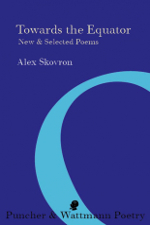
Review Short: Alex Skovron’s Towards the Equator: New & Selected Poems

Towards the Equator: New & Selected Poems by Alex Skovron
Puncher & Wattmann, 2014

While I was walking in the Museum of Fine Arts Houston with my cousin, I found myself discussing the conversations I seem doomed to repeat, the seemingly circular unending ones I’ve had over years, with myself and others without resolution. My cousin pointed out that to her a difference exists between two types of circular conversations, those truly round, and those that are elliptical, where with each repetition we reach a point closer to some type of truth before arcing out again. To me the joy and richness of encountering Alex Skovron’s Towards the Equator: New & Selected Poems is in travelling with the poet through these elliptical orbits as Skovron’s poems return and return to key motifs of European history, life in Australia and always, always, music.

Continue reading

Posted in BOOK REVIEWS | Tagged ,




