-
- 119: FITwith E Collyer 118: PRECARIOUSwith A Jackson 117: NO THEME 14with A Creece 116: REMEMBERwith M Sahhar and A Te Whiu 115: SPACEwith A Sometimes 114: NO THEME 13with J Toledo & C Tse 113: INVISIBLE WALLSwith A Walker & D Disney 112: TREATwith T Dearborn 111: BABYwith S Deo & L Ferney 110: POP!with Z Frost & B Jessen 109: NO THEME 12with C Maling & N Rhook 108: DEDICATIONwith L Patterson & L Garcia-Dolnik 107: LIMINALwith B Li 106: OPENwith C Lowe & J Langdon 105: NO THEME 11with E Grills & E Stewart 104: KINwith E Shiosaki 103: AMBLEwith E Gomez and S Gory 102: GAMEwith R Green and J Maxwell 101: NO THEME 10with J Kinsella and J Leanne 100: BROWNFACE with W S Dunn 99: SINGAPOREwith J Ip and A Pang 97 & 98: PROPAGANDAwith M Breeze and S Groth 96: NO THEME IXwith M Gill and J Thayil 95: EARTHwith M Takolander 94: BAYTwith Z Hashem Beck 93: PEACHwith L Van, G Mouratidis, L Toong 92: NO THEME VIIIwith C Gaskin 91: MONSTERwith N Curnow 90: AFRICAN DIASPORAwith S Umar 89: DOMESTICwith N Harkin 88: TRANSQUEERwith S Barnes and Q Eades 87: DIFFICULTwith O Schwartz & H Isemonger 86: NO THEME VIIwith L Gorton 85: PHILIPPINESwith Mookie L and S Lua 84: SUBURBIAwith L Brown and N O'Reilly 83: MATHEMATICSwith F Hile 82: LANDwith J Stuart and J Gibian 81: NEW CARIBBEANwith V Lucien 80: NO THEME VIwith J Beveridge 57.1: EKPHRASTICwith C Atherton and P Hetherington 57: CONFESSIONwith K Glastonbury 56: EXPLODE with D Disney 55.1: DALIT / INDIGENOUSwith M Chakraborty and K MacCarter 55: FUTURE MACHINES with Bella Li 54: NO THEME V with F Wright and O Sakr 53.0: THE END with P Brown 52.0: TOIL with C Jenkins 51.1: UMAMI with L Davies and Lifted Brow 51.0: TRANSTASMAN with B Cassidy 50.0: NO THEME IV with J Tranter 49.1: A BRITISH / IRISH with M Hall and S Seita 49.0: OBSOLETE with T Ryan 48.1: CANADA with K MacCarter and S Rhodes 48.0: CONSTRAINT with C Wakeling 47.0: COLLABORATION with L Armand and H Lambert 46.1: MELBOURNE with M Farrell 46.0: NO THEME III with F Plunkett 45.0: SILENCE with J Owen 44.0: GONDWANALAND with D Motion 43.1: PUMPKIN with K MacCarter 43.0: MASQUE with A Vickery 42.0: NO THEME II with G Ryan 41.1: RATBAGGERY with D Hose 41.0: TRANSPACIFIC with J Rowe and M Nardone 40.1: INDONESIA with K MacCarter 40.0: INTERLOCUTOR with L Hart 39.1: GIBBERBIRD with S Gory 39.0: JACKPOT! with S Wagan Watson 38.0: SYDNEY with A Lorange 37.1: NEBRASKA with S Whalen 37.0: NO THEME! with A Wearne 36.0: ELECTRONICA with J Jones
uncalled-for program name generator, um deadly
Has this ever happened to you? Have you worked in the settler public
service or some tight-jawed consultancy and
wondered — just what am I going to call this uncalled-for
program no mob have control over? Your solution is here in a
series
of cascading screenshots!

Posted in 102: GAME
Tagged Alison Whittaker
In Praise of Trees
I. Moss to Mozart
The fire tree is now a moss tree. The leaves which had it standing in a pool of fire have dropped and not been cleared. Assimilated into silt, they make mud of the road. The tree stands in its own delta.
Moss clumps on its torso, way past the main fork.
Moss covers every side of the tree except the east side, which could be mistaken for the north.
More traffic arrives from the west. More pedestrians arrive from the east. The traffic brakes for the lights. The pedestrians talk about walking. I search for birds which become unimaginable.
The lichen is numerous-fingered. If I could have translated piano practice into botany, the lichen is that Mozart phrase my left hand trialled endlessly. The lichen is in A major.
II. First Person Arboreal
The fire tree picked out in its leaflessness by sodium lighting looks like things other people may not have seen: frozen waterfalls in winter, jets of water frozen by strobe lighting. It is pale and I am tired. I lean against it and close my eyes.
Before hearing the sounds far away from us, I must forget the sounds I made getting here; the bough I kicked, the creak of my coat, my feet in the mulch of dropped fire. I close my eyes and listen as if I were looking. Sound will not perform like sight. A road to the south roars like a curve. A road to the north roars stop-start. I feel quite sick. Solitary runners clomp and make awkward diversions around us, bigger than needed just for the tree, for my humanness – not my size – makes the tree bigger. We are obstacle.
How much of what I expect from hearing is touch! The cold wind flips and ripples my hair across my forehead, and it feels like it should be a sound. I fool myself that I am hearing the hedge. It is tinnitus mingling with traffic in a small bay between my left ear and the tree trunk.
I feel you while I hear me as only you allow.
III. They Go Quiet
The marriage tree makes a noise. It has a thick body. When I walk up to the marriage tree, the wind drops. It’s as if all the trees I want to visit in stillness equally want to partake of silence. On this site, dreadfully smug engines whoosh and hoop, regulating the temperature of prohibitive buildings, pushing out the traffic to go drown itself. I used to work here.
Leafy footsteps, light with purpose, one Working Late person at a time, cut through from my left, to my right. My eyes are closed. I am thickly canopied by the marriage tree, even if its leaves are not rustling, even if its roots are pooled in concrete and its body is hedged about so I cannot touch its bark. Skeletal clanks from my left and to my right: bicycles being unlocked.
I want to pretend I hear leaves. I do not. I want to stretch my arms crosswise, as the footsteps and clanking proceed right and left. I do not. I leave hearing a little sound of my coat about my neck. I leave knowing how, when I walked up to the marriage tree, the leaves rustled.
IV. Egrimony to Embrace
The avenue of trees revisited in memory is closed off by gated compounds the size of citadels. For more than two hours I walked widening and narrowing circuits of their alleys and by-ways, always checked by a wall or a gate. I see where the long-desired avenue must be, across the black river; though not exactly. I make a rollcall of distinguished men who, at a knock, might be surprised into kindness. Their names and silvery bodies might let me through the stone courts that control the much greater expanse of dark green slopes leading to water. I think with bitterness of famous poets of the recent past and the unasking present: men who could say, “Let me through. My eyes enrich your vista and my words make clear your water.” Instead of trying words, when my body will have forespoken me, I walk around the access points, following through to their locked inevitabilities; walk over bridges, espying climbing places, aware of surveillance technology that renders quest into criminality; I lock eyes with an all-weather old man standing guard in archaic garb, who seems to know that I am up to something, and I decide to spare him the trouble of doing his job. I gave up on the avenue and did no wrong.
So much noise in my head when the clump of trees arrests me. It is severally woven, hence its ability to hammock a hemisphere of sound, soughing at a height.
Still the traffic and bitter musings mess about in my head.
Bicycles ease over the bridge.
I am positioned like someone about to jump, in order to share the clump of trees’ stillness. There is water between us.
If riders notice, and when walkers pass, we are nothing worth stopping for.
I break into nervousness. Not yet present to the clump of trees, I am afraid of not finding them again. Not much distinguishes them. I count lamp posts. I refer the clump of trees to other, more distant treelines; I hope to match up significant shapes, but night is brushing off oversignificance of any detail. I imagine inviting a quiet friend, anxiously, to this place, and not finding it at once. I was eager for trees; and frustrated. I must be careful about exciting another eagerness I cannot satisfy.
Gradually the road traffic becomes a milky ribbon, east and west. Gradually the bridge traffic becomes a flow to which my back is turned. Neither stream of traffic sound borders me in any way that constitutes my borders. Gradually the clump of trees assumes me. There is front sound and back stillness. They do their thing. I lean in.
V. Tree of Approximation
Listening to a tree with another person, listening with a tree to another person; listening or hearing? Who conducts attention to the rim of the sky? Start there. Start twice, and that is twice again.
This time the thick canopy of the marriage tree is rustling. My ears welcome and embrace the sound. It slips down much closer in hearing than sight would have allowed it to reach from the curve of leaves above. My eyes have closed, you see. My heart is thudding; my body knows that, not by sound. Small plants were trembling; I remember them, but they do not add in their small sounds. Footfalls one way and a single dry leaf the other way do skater tricks of sound, up and off from the ground, more volume in the air than you would think from looking at them.
More than you would think. From looking at them. We love. This tree.
VI. Intentionally Wolf-Inclusive
It is raining when I hurry to seek out the clump of trees. My coat is made of a loud material. As I move through the dark streets – it is not yet nighttime by the clock – rainfall hits the coat, loudly, from enough different directions as to make it seem that the rain is approaching from different heights. I am a percussive mess when I get to the bridge. None of the student body dotted about with and without bicycles, lingering in virus-friendly groups, makes a sound of noticing; none interrupts the sound of their commingled murmuring, when I climb onto the railings, lean over the scummy river, ignore the glisten, and listen for the trees.
I am listening with the trees.
Rain hits the water from enough different directions as to make it seem that the water is approachable from different heights. Rain is being shaken off the black weave of coniferous branches. I cannot pretend to hear it. I can only pretend to hear it.
I think myself into the further reaches of the weave, then move closer to the clump of trees. I do hear droplets. My attention shakes off the clank and gossip of the bridge. Awareness branches all over my coat, and in the drumskin hollow of my ears, very lightly, hitting and rolling away again.
I am a musical instrument of the trees, and it is raining.
VII. Flashback to Belfast
There is no way of being shocking that shocks. An artist’s shock is an expected delivery. Ready to be absorbers, the consumers of art; they’re hyper-absorbent. You know what is shocking? Care. Care is shocking. Attention is shocking. Being soft and slow. Radical care is the new revolutionary. Forgive me, for I have sloganized in the café, where my colleagues long ago reconciled kindness and subtlety. (This is happening before the plague.) My present colleague sits flaming quietly with tenderness and the students, like so many New Year lamps, bend and flicker inwards. We are sitting in warmth.
There followed (in a colder city, water between island and island), during the permitted exercise of lockdown, six instances of stillness with trees. You don’t hear in order to listen. You listen in order to hear. Start with the furthest. Name, note, move on. Move in. You are hearing your own interior, yes, even the mindbuzz randomizer, even the bodyshameful procedures. You are not hearing interiority to the exclusion of anything else. Your interior soundscape becomes audible in relation to everything else. Surround sound is a condition of surround silence.
I station myself by particular trees, and start.
Posted in 101: NO THEME 10
Tagged Vahni Capildeo
Introduction to Teena McCarthy’s Bush Mary

When Teena McCarthy told me she had constructed this book from poems, lines, phrases and images that she had written on odd-sized pieces of paper and had gathered them until they formed a manuscript, I immediately thought of Emily Dickinson, who also wrote many of her poems on the backs of envelopes and scraps that had been used as shopping lists. The connection is not far-fetched: McCarthy connects startling images to form intense visions that vibrate with arresting music.
The poems in Bush Mary work on multiple levels – woven from history, life experience and metaphor are visionary chords made of words. Images appear gradually, sometimes over several pages, like photographic prints forming in developing chemicals. I want to use the word ‘mystical’ here – harsh and beautiful, these poems ache with reality and seem to bring poetry back to life again. This book reads as if written by a poet working before the last century of modernism; albeit aware of that era, it comes from the pre-dawn of poetry before it became clogged with the ‘anxiety of influence’ and experimental verse. Maybe the poems trace mystic notes.
McCarthy’s visions and dreams – abstract stories – bristle with a technique and meaning that became a triumph. It’s the confidence of a poet who has nailed it, then shaped her season in hell into an instrument that sings. It is poetry created from transformed traumas, and importantly, effortless praise, for both survivors and old ghosts that flash behind the present moment or line from the past. As we read, yesterday, today and tomorrow mix, and a generous spirit is revealed that doesn’t grow bitter even after every rotten deal has been broken and served up to the poet and her people. There’s only the poem, only the new life to be written and lived out, only the song that strikes into your soul, reinventing love and compassion by its flashing words and naked statements.
The brilliant metaphor and terrible fact of the stolen Indigenous children, later as young women, encapsulates the Church sending Bush Marys to the outback stations as slaves or worse. Here is the attitude of the white men:
When are they coming? Dunno, best be soon. Feed this Nothing like them Bush Marys, long as they don’t bring the son. 3 shillings is a lot for us. They’re lucky to get 1, mate! Better do their duty … cook a stew and bend over, give me job. Done. Let’s face it mate, we doing them a favour!
In the fifth century, Saint Augustine said, ‘A virgin conceives, yet remains a virgin: a virgin is heavy with child; a virgin brings forth her child, yet she is always a virgin.’ McCarthy, almost 2000 years later, replies, ‘We can no longer escape / into the truth of Bush Mary, / we’re non-virgin, / used by carnal. / She is every body. / Bush Mary blood’. Then, like Eurydice, ‘She has no voice.’ McCarthy creates that voice in profoundly visual poems, and answers the colonising First Fleet and its following Christians: ‘She is a single mother / with a bush / She is the fucking Holy Ghost.’
Posted in INTRODUCTIONS
Tagged robert adamson, Teena McCarthy, Zoë Sadokierski
Dženana Vucic Reviews Case Notes by David Stavanger
Case Notes by David Stavanger
UWA Publishing, 2020
Experience of mental illness presents a paradox that feels impossible for representation in language: it is at once both too personal and yet too universal for easy translation. Everyone has a measure for how it can be done; from Sylvia Plath to My Chemical Romance to Robin Williams, if we have not experienced mental illness ourselves, we have seen a multitude of others grapple with it and have become (we think) discerning arbiters of the real. For the most part, and particularly in pop culture, there seems to be two somewhat incommensurable ways to render the experience legible: earnestly or through humour. In unskilled hands, both options are rife with pitfalls.
The first is wont to become turgid and bloated, tending to an adolescent melodrama likely to embarrass the reader. Even the most talented poets are not immune from this kind of writing, though the best of them are able to limit themselves to just one or two over-saturated lines. It is almost impossible to be earnest and sad in the twenty-first century. The second is equally fraught: turning to humour allows one to be self-deprecating while being self-protective, to make fun of the world while occluding its crushing weight. Comedians tend to favour this approach, and perhaps only comedians can get away with its dangers: glibness, hyperbole, disconnection.
David Stavanger writes with an acute awareness of this dichotomy. His award-winning 2020 collection Case Notes is informed by it as by a kind of poetic meta-analysis. This is not to say that the collection is calculated or pre-meditated. Rather, Stavanger writes as someone who knows what’s out there, what has been said before and how. Through this awareness, he is able to avoid the dangers of the tragi-comedic dichotomy that afflicts so much writing on mental illness and hold the facts in a new relationality. There are moments of earnest vulnerability, yes, and certainly many snort-into-your-coffee quips, but the tone is straightforward, frank, dry without being brittle, sincere without being dewy, as demonstrated in one of my favourite stanzas, from ‘Male Patterns’:
In the savannah of middle-class suburbs you seldom see a bald man lose a street fight with a wheelie bin. Evening sliding away.
His poems are at once sardonic, playful and intimate, a medley of inverted cliches and unexpected subversions which weave through the collection and hold it together, small barbs connecting the absurdities within madness and real life, pulling them taut and into conversation.
He is, perhaps, at his most exposed in ‘Electric Journal’, which was shortlisted for the 2018 Newcastle Poetry Prize. Divided into sections with the headings Day/s and Night/s, these headings begin to slip as ECT treatment ‘progresses’: NiGhTs, Weeks, Weaks, DayZ, nightsss, Daisies and D a y appear, marking a kind of unravelling. The stanzas vary in length from single lines to paragraphs, and meander from theme to theme – flat earth, kisses, Eternal Sunshine of the Spotless Mind, Hemingway, Roman abattoirs – but remain in tight orbit around the reality of Stavanger’s disempowerment:
‘I sit in the waiting room with my name on my wrist / in case I forget what wrists are for. / Your name is not yours once it’s in their mouth.’ And ‘“Are you consenting or should we force you?” I consent to be forced.’ And ‘Since my family prefers me damaged, / I commence psychiatric treatment.’ And ‘I was told it was my only hope. People around me crossed my fingers.’
Here, Stavanger writes a body under the direction of the psych industry moving between states of selfhood defined by external eyes looking ‘on’, and a mind cut loose, set to drifting and constantly bumping against an invasive ‘outside’. Stavanger knows poetry, the field and the practice, and he knows mental illness too, the field (he is, as numerous bios explain, a ‘lapsed psychologist’) and the experience, and he brings this embodied and embedded perspective into critical dialogue not only with medical system, but with the patriarchal–capitalist society upon which it’s founded.
This is not a review in which I tell the reader how accurately Stavanger describes the world or his experiences of mental illness. ‘Authenticity’, ‘relatability’ and even ‘honesty’ don’t quite do justice to explorations of this kind, and certainly not explorations conducted through poetry (both the most and least honest form). But what Stavanger does is create poems that expand out from the self and into the world, or out from the world – facets of, it in any case – and, through subtle direction, back into the self. The ‘self’ in question here is not an empty void to be easily filled with the reader’s subjectivity. It is a self grounded in the material realities of Stavanger’s existence and that which shapes it: mental illness and ‘treatment’, toxic masculinity, fatherhood, grief and contemporary suburban life, among others. But it is a self, too, rendered with such clear-eyed and startling precision, living in a world shaped by irrationalities which we take to be self-evident truths, that readers cannot help but fall into its world and, following Stavanger’s lead, become suspicious of it.
Posted in BOOK REVIEWS
Tagged David Stavanger, Dženana Vucic
Gareth Morgan Reviews Gabrielle Everall’s Dona Juanita and the Love of Boys
Dona Juanita and the Love of Boys by Gabrielle Everall
Buon-Cattivi Press, 2020
In the ‘Reflection from the author’ at the beginning of Dona Juanita and the Love of Boys (Buon Cativi Press, 2020), Gabrielle Everall states: ‘The main struggle of the novella is about the protagonist’s love of boys. Some of the poems are written about two guys I had crushes on’, as well as, ‘there is lesbian erotica … as my best sexual experience was with a woman.’ This introduction, frank and fun and almost ditzy, unsettles what might be taken as quite a serious book. Performing ‘honesty’, it downplays the somewhat hysterical introduction written by John Kinsella who, ‘feel[s] this is one of the most important poetic narratives to have appeared in English anywhere, at any time.’ It draws attention to the presence of the author, the banal reality of the author’s body and personal feeling. Put simply, Everall ‘love[s]’ Dona Juanita. So do I.
Its ‘importance’ is not what I am interested in. I am drawn to the energy of the work whose noise drowns out ‘themes’ at times, and at times brings ‘themes’ to the fore by performing, for example, psychic pain in contemporary Australia so dramatically. But it’s the performance of the thing … the performance ‘gets in the way’ and you, the reader or audience, are drunk on it, spinning. We might also note, ‘a postmodern Werthergirl [one of the author’s avatars] rarely cries’ – Dona Juanita as a postmodern epic is more playful and less tearful than some readers might expect it to be, given the often disturbing subject matter. As a book ‘about’ female desire, it is generous and open; it is so much more than its aboutness.
At a reading at the Dancing Dog in Footscray (recorded for 3CR and available as a podcast), Gabrielle Everall hits the phonemes hard. Her opening poem, which appears in Dona Juanita, booms: ‘INDI ROCK GOD’. She has a deep Cruella De Vil voice. Listening to the recording, it makes me laugh involuntarily. Out of fear? It is a terribly desirous poem, seductively performing ‘the catch twenty-two / of suffering that causes jouissance / and a jouissance that causes suffering’. The female speaker watches the man, whom parts of her ‘become’, who she chews up and spits out, for whom she performs both publicly and privately, invoking Rilke, Jesus, St Theresa, self-harm, S&M and ‘pigs in mud’. All for the speaker’s ‘him’ (soon to be re-invoked as ‘Rock Tosser’), but the poem at the end of the day is ‘for’ Everall herself. You sense her pleasure in making it, this damaging joyous object. It’s filthy, hectic work, and when brought to life in performance is even more extreme.
Gabrielle Everall is an indie rock god of a kind; she has that mystique or ‘presence’, and an IDGAF attitude that comes through clearly in certain strange fragments at the end of poems:
eyes like bloody chocolate and sometimes like pale tetras you lean against the photocopier
What is that? There’s some nod to the ‘imaging’ of men in the photocopier (an important theme, you might say), but the poem is way shiftier than any clever hook it might have (‘tetras’? Little fish). Everall pushes her poems very hard as she thinks through the love of these boys. As well as sick endings (the most rattling: ‘It’s just nothing and rape’), the poems in Dona Juanita have extreme openers, which feel high risk and give a sense of her aesthetic: ‘Bliss me out’; ‘Penetrate me with your flag’; ‘I fantasise ‘bout him’; ‘Ploughed by the discourses’, and so on.
The poems are at their best when they offer strangeness. It’s a careful strangeness, I think, and one which doesn’t care to explain itself. The poems are very crafted. Everall is a poet who exercises power over words; the desire she feels may be the driver of this control over language (when she can’t control the ‘real’ man?). The phrases, often short, come out smooth like bricklaying, so serious and bold that again they make you laugh despite the gravity – ‘that night / when I watch / Go Fish on television / I can’t identify as a lesbian / ’cos the taste of this blade / is still in my mouth’ – like when someone sits on your chest in the right spot. And while the shortness of her sentences and breath betray anxiety or tightness, Everall works within that constraint to produce frightening phrases like ‘I was raped / in a Nick Cave t-shirt’ that land calmly on the page but vibrate, more bricks piling on the chest. I also want to note that Everall really halts at a full stop, and there are a lot of full stops in Dona Juanita. You can hear it best in live performance: where the breath ends, it ends hard, heavily. The last word in an Everall sentence is like a giant piece of blu tack, holding up a glossy Greco-Roman face, ‘debas[ing] him’.
Dona Juanita is also enjoyable as auto-fiction. It offers a better ride than prose – the proliferation of memoir-ish books we ‘love to see’ – by moving so much more licentiously. Instead of reflection, we get a density of feelings presented as discrete sentences, each like ‘passion fruit [cracked open] with her mouth’. It’s as if the feelings are simultaneous and the poet is stuck with sentences as the form for presenting or producing said feelings. But why sentences, which seem to dominate this book among some fragments, when poetry doesn’t demand it? I think it’s the talky quality of Everall, whose performances make the most of the short sentence, not pithy but spitty, angry yeah but more like evil, in a fun, sexy, almost-joking (-is-she-joking?) way. A little bit ‘If I had a gun I’d shoot the man’ (Gig Ryan), but not the man who was sexist. Rather, the man whose ‘eyes were Adonis blue’, who just was. Perfect because he is the crush. Of course, we as readers know that Adymson and Lot, whom Everall’s speakers lust over, are just … some dudes (later, on the other side of crushing, it’s confirmed: ‘Adymson’s a dud’). But the poems, especially early in the piece, are about the ride.
Posted in BOOK REVIEWS
Tagged Gabrielle Everall, Gareth Morgan
Submission to Cordite 103: AMBLE

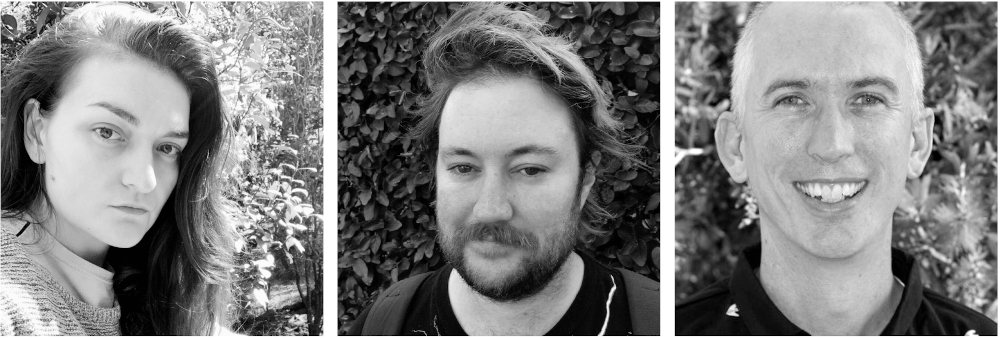
Image of Elena Gomez by Laura Du Vé. Image of Sarah Gory by Sam Lynch.
We are celebrating 25 years of publishing throughout 2021. Milestones include the 100th issue of Cordite Poetry Review, Cordite Books’s 40th print title and the free anthology 40 Poets, soon supplanting 20 Poets.
Please consider making a DGR tax-free donation. –Kent MacCarter
It seems to me then as if all the moments of our life occupy the same space, as if future events already existed and were only waiting for us to find our way to them …
—Austerlitz, W G Sebald
To amble is to move with leisure, with pleasure. To amble is to walk with a sense of locatedness – in space but also in time. As we move through place, we leave traces of ourselves (individually and collectively) just as we are marked. But place is not static either; it exists through permeable layers of time.
How does memory map onto place? Does place have its own memory? How does language amble through and within time and place?
For this issue, we are interested in poetry of location and space in the Sebaldian sense. A mapping of space onto time – or time onto space. A seeking of presence. We are interested in specificity, but we want you to define the bounds of it. We are interested in acts of tracing, of the physical and the metaphysical. We are interested in writing – poetry, prose, digital, concrete, otherwise – that takes amble as its subject, but also as its form or function.
Submission to Cordite 103: AMBLE closes 11.59pm Melbourne time Sunday, 15 August 2021.
Please note:
- The guest editor(s) has sovereign selection choice for all poems submitted.
- Masthead editors will also contribute to the issue.
- We will only read submissions sent during our official submission periods.
- Cordite maintains a hybrid submissions policy. This means that the guest editor(s) may invite five (5) Australian and five (5) overseas authors directly to submit to the issue. In addition, the guest-editor(s) will anonymously select an additional 40 works from Australian authors and use their discretion to select further overseas works. For each issue, the guest editor does not know the identities of the online contributors (via Submittable) until after the final selections have been made.
- Simultaneous submissions or previously published material will not be considered. This includes works published in print and web journals but does not apply to material first published on personal blogs.
- Please place up to three (3) poems in one (1) Word, RTF or PDF document (unless specifically noted otherwise for special issues), with no identifying details in the document itself.
- We are not able to offer feedback on individual poems.
- Submissions will only be accepted via Submittable …

Posted in GUNCOTTON
Tagged Elena Gomez, Kent MacCarter, Sarah Gory
Exoskeletonism: Writing Poetry about the Films of Akira Kurosawa
The Bandit
And what of all the out takes like a bowl of pistachio husks? The bandit sits up in a forest clearing near Rashomon. ‘What do I do now?’
These lines are from a second poem of mine about the image of the actor Toshiro Mifune in the Akira Kurosawa film Rashomon (1950), a follow-up to my poem ‘The Bandit Without Mifune’, which refers to an autonomous image of the bandit character waking in the oil of the celluloid – a much better line than those above, I know. In the first poem, the superior poem, the bandit (who is in a black and white film) asks, What shall I do with my silver limbs? The whole image from the first, published poem goes like this:
I have woken disembodied in the still black river of an unplayed film. It is frightening to wake In the oil.

Toshiro Mifune as The Bandit in Akira Kurosawa’s Rashomon.
The second poem is unpublished – it is in fact unfinished. I think this is because there doesn’t need to be a second poem. It is just me returning to the same problem for myself. In the second poem, there are other signs of weakening: the oil has become a forest clearing, as it appears in the movie. Already the poetry is coming unstuck from the original problem I was pursuing. In the first and published poem, this character appears startled and confronted by his own sudden consciousness, independent of the actor, the director, and any outside power or intermediary other than the image itself. The character is confronted by a problem of something that, across several of my poems about films, I came to call the exoskeleton.
This essay has become an effort towards comprehending some of the persistent themes in my poetry so that they may evolve, or be used more completely, instead of being always rediscovered like forgotten dreams. It could be assumed that the act of publication, as with ‘The Bandit Without Mifune‘, would do that for me, would affect a completion. I wish it had worked that way. I am trying to understand the fact that it did not. If the image was not psychically resolved by it being used in a poem – a finished poem that I was satisfied with enough to publish – then part of my motivation for writing poems is now compromised. That’s what I understood my writing to be about – resolving the images. Tending images in a way that comprehended them on a subconscious level. Instead, preparing for this essay has revealed that some images have remained unresolved. This is confusing, as I don’t understand myself to have another method for this psychic work other than poetry.
Explanation in the form of essay is something I always associated with university, and with my work being evaluated by busy persons who were also evaluating many others’ work. Because of that situation, my past essays were aimed at helping those readers, not me. However, this essay is aimed at helping me to search through the recurring images in a way that might resolve or define them more in my own mind, and it is able to approach this because it is done in the company of poetry readers.
On the hardcopy draft of that second, weaker Mifune poem, which I am looking at now, much of it is crossed out. In my usual process I write longhand, then transcribe to the computer, then print it out, then annotate on the paper, then transcribe the changes, and then print it out again. This can continue for years. In fact, now that I think of it, it usually continues for years. I would like it to resolve far more quickly. Maybe if I move more quickly, the images will not ‘throw so many spores’ and spring up in additional places.
Two of the crossed-out stanzas deal with the idea of a spirit independent of the body, not for the character of the bandit in this film, but for myself. They read:
When I turn the page and there is illegible writing ... I prepare myself for great interpretations.
I write poetry like it is too hot – too hot to touch, too hot to think about. I write in the mornings to fit it in before work. I write quickly and am relieved to have lodged something, to have paid respect in this way. It’s like the poem is votive.
But I also write poetry and then forget it completely. I start again all the time, and then later discover drafts I had forgotten about. I also write all the time, which I am so thankful to now have as a habit, and this has come from my job as a writing teacher at university, where I help Business students. This is not as tangential or separate as it sounds, as having to help people who are not natural writers really strips things back. I am a much better editor for it, and better, I think, than if I would have just stayed in poetry, in creative writing, where people can be stubborn and feel hurt from intervention on work they’ve explicitly asked for intervention on. I was like that myself. But in the Business School I formed trust with students by asking for a bad draft – I called it a crap draft: Just give me any crap draft, it’s fine! – so we’d have an object to work on. This can be likened, in some ways, to shooting a lot of interview footage for a documentary and then deciding what the core scenes are, and then seeing what new scenes need to be filmed to fill out the story. But in the Business School we kept it way more rudimentary. We didn’t use documentary film as the metaphor. Instead, we used the metaphor of the table.
Posted in ESSAYS
Tagged Akira Kurosawa, Andrei Tarkovsky, Carmen Leigh Keates, Toshiro Mifune
Weaving Blankets of Story and Hearts of Gold: An Archival-poetics Praxis

Dad’s Wake, April 2012
We writers must weave blankets of stories to warm us from the coldness of Dugai (non-Aboriginal people’s) hearts; we have to weave ropes of stories that we can throw to each other across the canyons of Dugai ignorance and greed and hatred, so that we can find and guide each other across these chasms.
–Melissa Lucashenko 2014.
My dad was diagnosed with lung cancer on his fifty-ninth birthday and after a fierce battle with his body and mind, he died two years later. In the face of all odds, he maintained optimism and hope. He could never accept the inevitable, and in the words of Dylan Thomas, he did indeed rage against the dying of the light. His courage, dignity and will shone bright until the very end.
On the first of many anniversaries after dad died, his birthday felt like the right time to begin weaving a basket from a selection of letters from the State’s Aborigines Protection Board and Children’s Welfare Board files, handwritten by my nanna and great-grandmother: a small contemplation on mourning, family history and the colonial archive, and the heart of my research at the time. These letters provided critical insight to our family’s histories and legacies otherwise smoothed over, hidden, or forgotten. They were replete with references to home, to family and a domestic-trained life controlled by the state and exposed another layer of trauma and resilience that is not widely known or considered in official accounts of history.
Content in my lounge room and surrounded by a shredding of these letters which had been copied onto banana leaf paper, I could feel them all beside me. Nanna’s handwritten words from the archive box rested lightly in my hands, and I imagined our fingertips touching. The phone rang, and a potent collision of grief, blood-memory and nostalgia ruptured the quiet: Do you like Neil Young? my friend Ali asked. I was a child of the seventies and quick to reply: Who doesn’t like Neil Young? She offered me a ticket to his show the following night, and I promptly burst into tears. I composed myself, accepted her generous offer, and with an emotional return to the archives I cranked the volume on ‘Heart of Gold’ from dad’s ‘Harvest’ album and continued to weave.
Weaving became a central conceptual metaphor and literal cultural practice in my research and Archival-poetic praxis: to liberate these letters in ways previously unimagined, to free them from the state and weave them back into the world, into my family and into my body, and to transform forwards through an ‘archive-fever’ labour of love. It became an intuitive means to gather, hold and liberate my nanna and great-grandmother’s words from the archive-box; to reckon with history and honour a very different story to what was officially documented on the record about them.
So, wrapped in a blanket of stories across time and place, and through mournful ‘Heart of Gold’ nostalgia, on that particular autumn day, I was reminded that while blood-memory forever pumps where hearts have stopped it does not always flow easily.
NO THEME 10 Editorial

Images courtesy of Jeanine Leane and John Kinsella.
A callout for a poetry of consciousness ‘that enacts and is responsible for what it considers’, that has been written with an awareness of ‘crises, brinks and redress’, was always going to bring some powerful and confronting work. We also hoped for poetry with contiguous capacity for social justice, community awareness and social and emotional wellbeing, and we feel that we have been able to select and collate such poems here. There are many different causes, convictions and concerns addressed in these poems, but the act of showing concern and suggesting a wish for positive change – for asserting a sense of justice and seeking that justice – is inherent in different ways in most if not all of the poems in this issue.
The selection process was long and drawn-out for both reasons of the large number of submissions, and also because we spent time discussing the very nature of the callout and the issue, and just how tangential a poem could be to the issue callout for us to include it. This is a ‘no theme’ issue, but one with, nonetheless, a very specific focus – poetry as activism. We consciously rejected any western imposed binary between poetry as art and poetry as activism or that poetry is divorced from any didactic moral, political or utilitarian function.
We received many well-written, highly publishable poems that we ended up turning down – which always rubs against the poetic grain – because they were less directly activist. We are aware that it should be argued that allusion and suggestion, even the creation of a poem itself as a statement of rights, are adequate justification for a poem to be included under our callout, but selection criteria become the method of meeting restraints of what can be selected, and this necessarily creates false divisions. In fact, we didn’t so much turn such poems down as decided they might have other contexts in which they will speak more decisively.
The poems we selected had to speak in and for themselves, but also converse across the community of refusal, resistance and also healing that we were trying to stimulate and maybe even nurture. And that community seems exciting to us because it in itself is constituted of so many different communities with their own inherent concerns. How to create spaces of dialogue without damaging difference and intactness is a major question we worked through. We consider this issue a ‘safe space’ for claims to rights and affirmation of rights, while recognising that each of those claims is autonomous in itself while overlapping through poetry as a shared medium; a tool for dialogue across difference without compromising difference.
There is a universal need for environmental justice – necessarily a focal point of the issue – but there are different implications regarding where an individual or their community/communities sit in relation to cause and effect, culpability and responsibility, and it seems only just that relative positions also be a variable in addressing the damage to the biosphere. Some are damaging and have damaged the biosphere far more than others and articulating that difference can lead to justice as well as repair. In our callout we wrote, ‘For some, crisis is an ongoing state of being, and continuing colonialism and neo-colonialism ensure that past wrongs cannot truly be addressed. Poetry is a way to engage a decolonisation that is imperative if our world is to be respected and its exploitation halted. The many brinks people have been pushed to over millennia by imperialism are reaching an ecological fracture that will be absolute unless addressed’… and the place of colonialism and capitalism in the crisis of biosphere needs to be acknowledged before repair can happen in substantial ways. Repair is contingent on justice.
In poems that articulate how injustice affects individual and community, in poems that observe (often via massive media input) how a discourse of injustice becomes desensitised to the actual injustices themselves, and poems that implicate the poet as interlocutor of witnessing and experiencing injustice, we build a sense of how many poems working together create an organic but differentiated – with each of its parts intact in itself – mechanism for confronting injustice on many overt and less obvious levels. And in this we state our ongoing support for feminist and LGBTIQ+ readings of poetry and poetics.
There is no hierarchy of poems in this issue, only a concern for the community that doesn’t interfere with or erase the communities the poems come out of. This issue, for all its confrontations, is a celebration of conversation through poems. Open or closed, porous or hard-shelled, the poems speak for themselves, but let’s hear them speak together, many voices at once.
These are times of confrontation of mass injustice when Black Lives Matters and Deaths in Custody are absolute inherent parts of the broader crisis of being. Why should some people be murdered and die when many of us are fighting to save the biosphere? Why should we campaign to save bushland when country has been stolen from those who have looked after it and profoundly understood it for millennia? It’s offensive, illogical and unjust, to not work to stop injustice while trying to save ecologies. Of course, we should protest and peacefully intervene to stop the destruction of bushland and forests, but of course we should be acting for human rights and issues of justice as well.
One doesn’t exclude the other, in fact it demands of the other to act in empathy and commitment. It is offensive and wrong to protest the destruction of a forest while women cannot walk the streets safely at night. Rights aren’t separable, and a poem is a way of creating an inclusivity of purpose and intent, and it is up to the reader to act while reading as well. The intent of this issue is to ask these questions through the juxtaposition of poems and let the poems provide possible answers … or ways of considering ‘answers’ at least. The resolution is often in the seemingly unresolvable.
Posted in ESSAYS
Tagged Jeanine Leane, John Kinsella
It’s Here All The Beauty I Told You About

This is an excerpt from a book in progress called It’s Here All The Beauty I Told You About.
Since 2010, I have been engaged in a three-book project to investigate – using a mix of found and lyric poetry, cut-ups, erasures and essays – key texts in the colonisation of North America. This started with X: poems and antipoems, continued with Dead White Men and now It’s Here All The Beauty I Told You About, which works with one of the most popular Western pulp novels ever written – Shane (1949) by Jack Schaefer – and Western comics published in Canada from the 1940s and 1950s.
As one could imagine, this project is deeply personal. Parts of my life could well have come from the plot of a cheap Western: I was named after Shane and come from a long line of alcoholics, farmers and ranchers. At the same time, I am interested in how Westerns (whether they be comics, novels or films) continue to obscure and rewrite the history of North American colonisation and settlement and the anti-Indigenousness that fuels them. By unravelling some of this, I want to explore how settler stories of the Great Plains function within the apparatus of colonial mythmaking.
The cutout poems throughout this excerpt are from various editions of Shane I have collected over the years. The illustration is taken from the comic book Indian Fighter (Vol. 1, No. 2, July 1950, Youthful Magazines Inc.). The speech bubbles were taken from ‘Indian’ characters from a number of Western comics from the 50s and 60s. The text has been removed from all, save one. The empty library card holder, with the scrawled ‘Mother’ at the top, was found in one of my used copies of Shane.
Posted in CHAPBOOKS
Tagged Shane Rhodes
Coupe Portraits: Walking the Damaged Forests of East Gippsland (Gunaikurnai Country)

Photograph by Lisa Roberts
A coupe is a specific area of forest identified for logging operations under VicForests’ Timber Release Plans. Despite the ecological catastrophe of the 2019-20 Summer bushfires which burnt through 1.25 million hectares of forest in East Gippsland VicForests has not revised its logging plans, in fact two additional Timber Release Plans were approved by the Board of the state-owned company in July and December 2020. More than 550 coupes and 20,000 hectares of forest including key unburnt refuges are scheduled for logging in East Gippsland.
The Coupe Portraits series was created by Louise Crisp and Lisa Roberts as part of Stony Creek Collective a collaborative multi-artform research project undertaken in the foothill forests of East Gippsland during 2020-21. The project was supported by the Victorian Government through Creative Victoria.
Posted in CHAPBOOKS
Tagged Lisa Roberts, Louise Crisp
3 Vyachesav Huk Translations

Untitled
He dared to write her a letter in the last quarter of an anguished winter,
while he was in hospital, with a handkerchief pressed to his nose to stop the bleeding,
quite exhausted, his body emaciated, his voice feeble—
he dreamt of a well of grey water and ducks in the sinkhole of a meandering autumn,
he tried to allay the emptiness of his soul with his tears,
he yearned to feel a moment filled with fervent existence, yearned to walk
blindly in absolute darkness, to revive the quickening words in his consciousness;
a dove was drinking rain water from a crack in the decayed dusk of a tree,
the present tense broke off when the lilac shadows lengthened in twilight;
he was prone to self-sacrifice—especially in recent years, while
he was writing a piece, living the life of a hermit among those long gone;
he remembered a drowsy siesta, old chairs on the lawn in annexed Crimea,
fallen leaves in his hair, his shelter, a hat clutched in his hand—
this is how human nature protects its essence—with a taut declaration of will;
wherever he lived, communication with others was always a painful occasion
but wielding garden equipment freed him from grieving,
or he wept like a lonely bird over a fjord at the onset of dark;
while he was whistling—chirp, chirp—he heard the thud of the front door downstairs—
the scullery maid brought vegetables from the market—suddenly
dense light filled his memory and his hallway,
he mused on the stairs, looking through the window as if the scenery were an old photo:
how crucial the divine presence is in places abandoned by life,
with only an earthly valley remaining; maybe someone will finish this line for me—
after his death, the winter field and his fecund garden remained unattended.
Він зважився написати їй листа в останню чверть вистражданої зими,
коли лежав у лікарні і тримав у руці хустинку, щоб спинити кровотечу,—
геть виснажений, зі страшенно вихудлим тілом і надсадним голосом—
йому снились качки в ополонці бродячої осені й колодязь сивої води,
він намагався зробити так, щоби сльози заспокоїли порожнечу душі,
і прагнув відчути мить, сповнену тривожного існування, прагнув іти
сліпма в суцільній імлі, щоб відродити у свідомості живодайні слова;
по дощі за вікном голуб пив воду із жолоба в зотлілій темряві дерева,
й уривалося сьогодення, коли бузкові тіні надвечір ставали довшими;
він був схильним до самопожертви—особливо в останні роки, коли
певний час писав твір і жив самотою серед тих, кого вже давно немає;
згадав сонне пообіддя, старі стільці на газоні в окупованому Криму,
опале листя в своєму волоссі, притулок, капелюх, затиснутий у руці,—
так людське єство зберігає свою сутність, як напружений прояв волі,
він завше, де б не жив, дуже болісно переживав спілкування з іншими,
але звільнявся від скорботи, коли користувався садовим реманентом,
або плакав, ніби самітний птах над фіордом, коли вечоріло на вулиці;
коли він насвистував: ф’ю-ф’ю, то почув унизу стук вхідних дверей—
це прийшла стороння куховарка і принесла з базару овочі—зненацька
густе світло яскравими потоками наповнило його спогад і передпокій,
він стояв на сходах і думав, дивлячись у вікно, мов на стару світлину:
як потрібна присутність божественного там, де тепер вже немає життя,
де тільки паділ земний, може, хтось допише останній рядок після мене—
по його смерті залишилось без догляду зимне поле і сад плодоносний.
Posted in TRANSLATIONS
Tagged Svetlana Lavochkina, Vyachesav Huk
3 Joseph Ponthus Translations

Image courtesy of L’Usine Nouvelle
It is a rare thing indeed to be entrusted with the translation of such a startlingly original work as Joseph Ponthus’s À la ligne.
It is a work that bears reading and re-reading. A work that stays with you.
Unable to find work in his chosen field, Joseph Ponthus enlisted with a temp agency and started to pick up casual shifts in the fish processing plants and abattoirs of Brittany. On the Line – Notes from a factory is his attempt not just to record but to process the horror of what he witnessed, to accord it some meaning, to allow him to find its place not only in his own mind but also to invite us, his readers, to bear witness to the monotony of the processing machine, the broken bodies it leaves in its wake, while inviting us into the dark recesses of the mind where the human spirit is struggling to adapt, hoping perhaps to survive.
French author Céline Curiol writes in her recently published novel Les Lois d’Ascension (Actes Sud, 2021) that ‘nobody can survive without imagination…’, and Ponthus’s extraordinary work might be understood as the author’s attempt to imagine his survival in these most inhuman of environments, through his writing.
We are allowed a way in, if you like, through Ponthus’s title, À la ligne, a clever double entendre referencing not only the production line but also his persistent ‘return’ to a new line with each new phrase, eschewing punctuation.
Ponthus returns to a new line, as he returns to the factory, producing a rhythm that matches the relentlessness of the production line. Yet it is a technique that also allows the creation of a visual space on the page which, in turn, might be seen as reflecting that place of grace, that mental and spiritual retreat which somehow allows us to preserve our humanity and continue to engage when confronted with such challenging circumstances.
In a film shown at a recent retrospective of her work at the Museum of Contemporary Art in Sydney, artist Lindy Lee comments—and I paraphrase—that the brain only knows what it knows. As humans we are constantly trying to make sense of, to process, our environment. Perhaps the very essence of the human condition, the human contradiction, is the fact that the human mind is capable of reeling before the beauty of Apollinaire’s words, before the wonder that is Bach’s St Matthew Passion, and yet may still be called upon to reconcile not only body but mind with the horror inflicted by wars, with the mindlessness of work on the production line, with the slaughter being carried out in our abattoirs. While compelling us to acknowledge the imperatives involved in the human processing of other animals, Ponthus also forces us to engage with the underlying inhumanity of our exploitation of human capital in this process. His gaze is uncompromising, his words remind us of our complicity.
As a translator, one is also constantly called upon to challenge what it is the brain knows. Our mind is constrained by the familiar, and yet we must suspend our disbelief and attempt not only to hold a mirror to the words, but to record the shifting rhythm and acoustics of rage and exhaustion, of humour and pathos, of dignity and indignity. And, in this work more than most, the sound of our (in)humanity.
In an inconceivably tragic turn, Joseph Ponthus died earlier this year at the brutally young age of 42. Fortunately, he lived to see the recognition awarded him in France for this unflinching and original work. À la ligne was awarded the Grand Prix RTL-Lire, the Prix Eugène Dabit du roman populiste, and the Prix Régine Deforges, among others.
Posted in TRANSLATIONS
Tagged Céline Curiol, Guillaume Apollinaire, Joseph Ponthus, Stephanie Smee
‘To the edges of language’: Souradeep Roy in Conversation with Mani Rao

This interview with Mani Rao took place over several emails alongside an a necessary-extended phone conversation during this ongoing pandemic. Before this interview I had read Rao’s work seriously for the first time with the Delhi Poetry Reading Group in 2015 and subsequently met Rao at the ‘Almost Island’ conferences in 2018 and 2019. In India, Rao has mostly been known as an experimental poet and a translator from classical Sanskrit. If a singular, intriguing voice is experimental, Rao is certainly an experimental poet who does not fall back into the easy lyricism that is so common in contemporary poetry. Rao’s lines are sharp and incisive. They stretch sound and the visual shape of the poem to the edges of language.
In the first part of the interview, we discuss Rao’s brilliant translations from Sanskrit to English of two works: the Bhagavad Gita (2010) and Kalidasa for the 21st Century Reader (2014). Both translations have a dramatic quality, which we discuss throughout this interview. By dramatic, I refer to T.S Eliot’s idea of the dramatic voice explored in his essay: ‘The Three Voices of Poetry’. Rao began translating later in her writing career when she was pursuing her MFA, that also included translation studies. I believe that it’s at this juncture that a link was forged between Rao’s work as a translator and a poet. It is a bridge that connects her choices, and a bridge that calls for a comparative critical eye (and ear) of future readers. The following conversation, will, hopefully, lead to such critical and creative engagements.
In the second part of this interview, I was able to discuss Rao’s earlier works such as: Wingspan (1987) and Catapult Season (1993). The voice in Rao’s earlier works, including Living Shadows (1997), The Last Beach (1999), and Salt (2000) finds its culmination in the stunning sequence, echolocation (2003). echolocation was followed by Ghostmasters (2010), a collection where Rao’s voice underwent subtle changes. The full range of this new voice, a more detached, calmer, but equally fierce voice is exemplified in Rao’s latest chapbook, Sing to Me (2019). Rao’s first two books, aforementioned, have hardly received the attention they deserve – and so I’ve chosen to discuss specific poems from these two collections. Besides the shameful neglect of Rao’s early work, there is also a thematic reason for discussing them. Rao’s early work allows for an exploration of the abject.
‘When I am beset by abjection,’ Julia Kristeva writes in Powers of Horror (1980), ‘the twisted braid of affects and thoughts I call by such name does not have, properly speaking, a definable object.’ The abject, that is frequently seen in the images of blood, death – what I call ‘macabre’ while discussing the early poems in this interview – is not the object which, through its opposition to me, settles my desire for meaning, for knowing who I am. The abject, like the object, is opposed to the ‘I’, but, unlike the object, its opposition is not as clearly defined. Kristeva likens this as ‘the jettisoned object’ that is ‘radically excluded’ and ‘draws me toward the place where meaning collapses’. Rao’s early writing demonstrates her commitment to explore abjection: both its seductions and repulsions. Perhaps this is why Rao frequently stretches language outside of its usual contours of meaning, and, in her early works, also falls back on another language altogether: visual art. The pleasure in reading or seeing Rao’s work, as a result, comes precisely because of the difficulty in finding meaning in her poems. Formally, Rao’s poems resist easy determinations of meaning, not simply because every poem resists a common determination, but because her poems explore the impossibility of meaning itself. This tradition of writing, including poems such as Adil Jussawalla’s ‘Missing Person’, and some of Arvind Krishna Mehrotra’s early work like ‘Songs of the Good Surrealist’, has not been explored enough in the Indian-English poetry tradition.
Though Rao does not characterise her own work in the same way I interpret her poems, a discussion on her earlier work, as this interview demonstrates, makes a good case for such a reading. In Rao’s later work, especially in the new chapbook Sing to Me (2019), we find a brilliant treatment of ‘the myth’. Two reasons could be attributed to this. One, the influence of Rao’s translations into her own poetry, and two, a shift away from the treatment of the abject into a treatment of the object. Myths are, after all, pre-existing symbolic structures. Unlike the abject – always outside the purview of meaning – they already carry meaning, which Rao reinterprets with her singular vision and style.
Souradeep Roy: I feel there is a dramatic quality to your translations. By dramatic I don’t mean high drama, but the quality of dialogue in plays, which switches between various registers of speech. This is obviously the case of plays you’ve translated but also of epic poems, like the Bhagavad Gita, which is technically not a play …
Mani Rao: But the Gita is actually a dialogue between two characters. The stage is the battlefield as well as the entire context of the conflict and tension between the two warring sides. And there is tension in Arjuna’s situation – to fight or not to fight – I guess the only thing missing is ‘action’ (smile). But before the teaching begins in the Gita, there is a fair amount of drama. And the interaction between Arjuna and Krishna – the words they exchange – expresses their personalities and their relationship. If we only think of the Gita as a teaching, much of this other fun is lost.
SR: Let me explain this with examples from the poems. In the Gita, after Arjuna’s makes his case against fratricide, Krishna says, ‘nice speech Arjuna but …’
MR: At that point in the Gita, Arjuna has just completed a rant. He has laid out the potential consequences of war, spouting doctrine, but he is full of self-pity and has described his own state – how his hair stands on end, his tongue is dry, his bow has fallen to the ground, etc. Krishna responds by mocking Arjuna.
When one translates the line from Sanskrit literally, we get ‘you speak wise words Arjuna’ – and (funnily) some translators do actually use exactly those words. But Krishna is not appreciating Arjuna for his wise speech, he means the opposite, he mocks Arjuna, suggests that Arjuna is far from wise. I hear a clear tone of laughter and mockery there: ‘prajñāvādām ca bhāṣase!!!!’ What a loss if we miss the innuendo in this response and instead make it sound solemn! I mean – I think I am simply following the tone of the original. Until about here in the Gita, the verses are dramatic, it is only after this the content becomes semi-philosophical. It would have been a shame to lose the humour. Here’s how I translated the stanza:
2.11. Krishna:
nice speech arjuna but
the truly wise
know better
than to be sad
over life that’s gone
or not
life & death pass
Posted in INTERVIEWS
Tagged Adil Jussawalla, Julia Kristeva, Mani Rao, Souradeep Roy
Cook Book: 12 Works by Hayley Millar Baker

Hayley Millar Baker | Untitled (Give the dog the small fish we will cook the big fish) Part 1 | diptychs
Cook Book explores the merging of traditional Aboriginal cultural practices with Westernised 21st Century knowledges and tools. As Aboriginal people, we have passed down stories to the next generation for hundreds of centuries in order to preserve timeless knowledges and our way of life – even through the onslaught of change that invasion and forced assimilation brought with it.
In our contemporary landscape, cultural practices lending from natural systems and environments including hunting, cooking, crafts, building, and language have extended to incorporate Western technologies and tools. The same practices have the same outcomes, however, during the ‘making’ period we are now able to integrate contemporary tools to provide opportunities for cultural practices and knowledges to be revisited in order to adapt to a fast-paced and ever-changing environment.
Cook Book considers how Western implements have become part of Indigenous cultural practices in day-to-day activities through a play on language that acts as a narration. It is through the translation of phrases and instructions that Cook Book emphasises how our timeless practices and knowledges have evolved to ensure cultural continuity in the 21st Century, despite the immeasurable changes around us.
Posted in ARTWORKS
Tagged Hayley Millar Baker
Party Girls Aren’t Supposed to Hurt
so laugh
vibrate the walls with your sonic hysterics
skol
be the pulse of the celebration
ba-Boom ba-Boom ba-Boom
cheeehooo!
skol
drink big men under the table
last woman standing
she’s a bit of an alright, aye
skol
outwit gutter mouths in bawdy contests
burn their pitiful comebacks
bloody hardcase, that one
skol
swaying hips on the dance floor
attracts sleazy eyes
yo baby, grind this!
skol
become ‘best friends’ with intoxicated strangers
ladies’ loos congregation
I love you, sis!
skol
crazy, sexy, foolish kisses
tastes of Pall Mall lungs
What’s your name?
skol
dis-ease with your self
wasted on delusions
Dunno. What’s my name? hahaha
skol
skol
skol
blink
dodgy mouth grinds against yours
while his boys guffaw downstairs
blink
bling bling fingers
tearing tender insides
blink
his crucifix pendant swings above you
but you’re the one getting nailed
blink
bawdy brotherhood
burn you bloody
blink
your Hotown lipstick smeared
between their Brotown legs
blink
bile slimes down your chin
while gasping over shit-stained toilet bowl
blink
you’re a disease – a miserable waste of space
blink
look on the bright side – you found your name
blink
don’t fucking cry, you wanted a name
blink
nameless no more – SLUT is your name
blink
your name
Slut
Cunt
your name!
blink
blink
black
blank
Breathe
Party girls aren’t supposed to hurt.
Sun rises
again.
Vomit your sins
baptise your mouth with Listerine.
Scrub them off
your stained panties.
Slide on your shades,
hide the windows
to your shamed soul.
Breathe
Shoulders back
Breathe
Smile
Breathe
Play
the pretend game
again.
Posted in 101: NO THEME 10
Tagged Ria Masae
Newspeak
They begin by taking away our language. America tears babies
from their mothers. They become tender age children, complicit
in their parents’ illegal pilgrimage. The White House summons an alternative
truth. A television anchor cries falsehood. He is being kind, if not complicit;
it is a lie. Spokespersons spin the same doublespeak:
A propagandist becomes a pundit. When a judge is complicit,
no means yes means anal. By now you know what happens in America
does not stay in America. A one-way getaway to Hawaii is complicit:
firepower for narcos, a round of golf with Marcos. Our dictators
take a cue from that playbook. The headlines betray another accomplice—
A ‘former president’ faces plunder charges. There were no skeletons
in his closet, only thousands of shoes belonging to his complicit
wife. A ‘former first lady’ is convicted of graft. The ‘late leader of state’
gets a heroes’ burial. When you take a word and water it to complicity,
does it grow or wash out? A drug suspect is neutralized, meaning, escorted
to rehab. Or neutralized, meaning, arrested. Or neutralized, meaning complicit
with his companions’ crimes, meaning: dead. Extrajudicial killings are homicides
are deaths under investigation. Complicity conflates—even Congress
finds that indigenous people are communists, the communists, terrorists.
It considers censorship an edit. I do not want to be complicit.
The job costs more than it pays. Changing headlines, I backspace Regine
and slap on staff. Another attempt to fold into a byline a protest.
Posted in 101: NO THEME 10
Tagged Regine Cabato