November heartbeat

I’m holding a chicken
heartbeat thudding in my hands
under endless cloths of white
November’s balm creeping down my back
to the tail end of 9-and-a-half
my memory incubator-ripe
when we cremated the papier mâché
because it was too hideous
and now we are enlightened
about the devastating things
like the tooth fairy’s handwriting,
the brush of the word tit
used in a serious way,
when Daddy said the internet said that
a teepee can be made to inhabit approximately five hens
if constructed out of seven bamboo sticks, rope and netting
well it turns out that Lowest Prices really are
Just The Beginning.
whereas the airport is the end point
a terminal of all histories
and expenses are silent
rattling behind us in little rectangles
as we brought elsewhere to home
the hallway peppered by that
black and brown sequined scent
mixed with Johnson’s Baby Oil
and subcontinental mothballs
it is possible to celebrate and grieve in one day
but it is not possible to celebrate your grief
and vice versa
both the soft body and strong hand coexist
like mud slotted between couch crevices
and fate will play out in sepia tones
my grandmother
watching her son in the backyard,
a man with a thin fire in his hand
tipping God’s Name out of his mouth
and onto the dandelions
the backs of his arms
glowing maroon in the sun
like the first cherries
she knew how to eat
despite never having them before
spitting the pips out bone-clean
no sinew, no reddened gum
just pure unbridled grace
some would call it diabolical
all of us sitting at lunch-dinner
tucking into murgir mangsho and bhaat
like there was no tomorrow
But she was old anyway. They were all old.
swallowing that chicken’s heart was a statement then
not a mistake
the soft concrete raging inside my organs
is an outcry
beating against my spine
like a bruised orange

Posted in 111: BABY | Tagged

Passing

time on the same earth
as Ingrid Bergman:

143 days

12 hours

30 minutes

39.32 per cent
of 1982

what audacity of that naked hello,
just needing someone to dictate the mood

anything i could do for her
is in the soil now

& anyway i was on Eisenstein time—
perfect for the embryonic brain

that’s left to the question
of what might be borrowed, here & there

& who should be thanking who
for those narrow halcyon days

Posted in 111: BABY | Tagged

I and Eucalyptus 13

If yellow eucalyptus sap looks like a duck, where’s the quack? Weed whacker, maybe, interrupts the duck’s drip, which I catch as image before another sap drip forms. They’re all real to him, the characters that emerge from lines of paint on the road. Why does this duck bill drip its yellow glob on green and black below? Its palette’s visible more to the camera’s eye than to mine; it filters out ambient colors, leaving only black. But approach the tree and its duck and you see a world refracted. The first sentence of this meditation quacks like a duck. I am he as he is I and we are all together. Presence is not what is evanescent and passes but what confronts us, waiting and enduring. Eucalyptus duck teases me with its slow motion. Look hard enough, and each drop carries an image of you in your red cap, standing on a green lawn, grasping your phone. Becoming Christmas ornament or tropical icicle. Somehow more pleasing not to see these excess images, to wait for the duck to return to dropness, for the tree to untangle from its wild spectrum. If you put too much red in your photos, the observer will be overwhelmed. But if you like red, you’ll swim in it, like a duck on a still pond, thin layer of algae quivering.

On each end of the Temple’s tile roof, two new golden birds. I’m told they are phoenixes, but the maintenance guy says they look more like fighting chickens. They stare at each other, raising their golden feathers. Somewhere, plastic Buddha places his bets on these two. A photograph morphs into story, especially after humidity bends its edges, removes a boundary, opens the border for crossing into memory-land. Like a kid’s game, where you spin the wheel, move your tiny car across a line of squares, and hope to win at Life. When I remember the game, I don’t play it backwards, but forwards again. I don’t remember how it ended or what I won or lost. I find paper money in the cemetery, huge denominations, Hell Money. Bills are fictions already, like banks, even when there’s a run, but this one overspends its symbolism. If you burn it, it returns to its owner. Heaven has high rents, like Hawai`i, but you buy a view there, away from the mounds of red clay, the wrinkled tarps, the coffin carriers on wheels. Artificial flowers are forbidden, though you find them run up against the bushes that mark an end to this carefully tended place. But seriously, I’ve never seen a duck in the cemetery, only in the culvert running parallel to the road I walk on. A tree crowned with egrets. A mongoose rushing into the bushes. The line of cats that watches us warily for signs of food. A woman in Aiea feeds them in a wooden shed by the parking lot. “No recreational use of the parking area,” a sign reads. The karaoke place next door is empty, but a sign demands silence.

Posted in 111: BABY | Tagged

Night comes quickly

I am sitting on the verandah, in the warm Queensland wind, reading Intimacies by Katie Kitamura. The light starts early here and is almost silver. We are visiting my sister-in-law for the first time since her husband died. Bill from next door walks up to the gate: Is that your chicken? he asks. A little fat, brown hen pecking around on the verge outside the house. My sister-in-law does own chickens, so the question is not absurd. Kitamura writes that humans don’t look at each other with intimacy anymore because of what photography and film have done to our sense of connection. Bill is not accusing, he is curious, hoping to help. We all spend some time trying to corral the visiting chicken into the yard, keep her safe until we can find out where she is from. We have no luck. Later, we walk across wet grass, rattling buckets of pellets, to coax the chickens who do live here back into their pen for the night. They get chopped up pecans on their feed. They eat what we eat, plus their special chicken food. A few of them are getting old. My sister-in-law hopes they will die of their own accord. If they don’t, and they’re sick, you drown them or hit them on the head. It’s hard, the drowning, sad at first, she says, and then they relax. During our stay she shows us her prowess with the ride-on mower. In the coolness of dusk she walks us through her garden. We settle in for the evening. Her shy adopted cat yowls at us, these strange visitors.


              Night comes quickly here. We chat over cups of tea. The chickens sleep.

Posted in 111: BABY | Tagged

Sharon Olds admits in interview: “almost never” gets writer’s block, writes poems “when they come to me”

Oh! That’s a big bird!
What is it?
Is that a pigeon?
I can’t see it
from here.
It’s a hawk!
It’s a buteo.
Right up on the porch
rail of that building.
See where I’m pointing?
Look at the brick
building and then go up
to the upper-left
corner of it.
It’s a big hawk.
Such a hawk head.
You can see that?
Your eyesight is
amazing.
No, it’s not.
It’s just that it’s a hawk.
What does it mean
that we’ve been visited
by a hawk?
It means
there’s one more
hawk in New York City
than I knew about.
Now it appears
to be looking
up. I would think
when it’s up
high like that
it would look
down for a
rat.
Hawks fly downward
at their prey
and they go at, like,
two hundred miles an hour
and it’s called a stoop.
That’s a verb.
Hawks stoop
onto their prey…
Look at that tail going
flit,
flit.
Wait—
that’s what peregrine falcons do!
Maybe
it’s a peregrine falcon!
Hey,
we could talk
right here.
Why don’t you bring
your recorder over?
Okay, so we were talking
about revision.
I actually wanted to ask—
Don’t get too close
to the window too fast.
I don’t want to scare it.
It’s a really little tree.
The tree wiggles
when the hawk
moves.
This hawk is in
a tiny bonsai.
They often shift
their weight
when they’re about
to fly.
Oh, don’t fly
darling.
Don’t
fly
yet.

This found poem was taken brick for brick from an interview with Sharon Olds by Jessica Laser from
the Paris Review in New York City (Summer 2023 issue)

Posted in 111: BABY | Tagged

Grey

.across the long grey-blue limpid line of
coast, smell of fire.

the mother reaching— —
and turning now
and still and whitely into light—

((and the child-
ren
now one voice calling
one

noise))

.at first lick all loveliness—gone.
.at.first.touch— —

—grey of Scotland, grey of dusk-gone-dark-
just, grey of heather shallow in the bay
and on the dunes, grey of lavender-ash where
blooms were sucked into the immortal
crime, grey of what was done and not done
enough, grey of babies’ turning, turning to
their mother’s black-grey eyes, grey of last look,
grey of grace of death, of not-black not-white
not-living not-dead, last of all grey of dawn,
grey of the long and silent day when
they are not heard here
again
ever.

At evening and in the bay, the constant
grey that takes the vision, takes the breath
away
as if a ship in mist, as if a mother
turning—

voice tenderest tendril
last of all
last plume
the voice calling
still heard, still carried—

—as air inside the head, inside the ear,
for years, for all the years of anyone
who stood by watching the fire—
the day that lasted years—
and watched the turning and did not know
then
it doesn’t end. Every mother turns, every mother
thinks—Is that my child?

Posted in 111: BABY | Tagged

Birth of Astroboy

Midmorning Sunday the mall
is dead. Too young to be hungover
in bed we hang on the rotunda steps
like temple monkeys in the sun.
We chip in—score a stick,
smoke up in the alley,
pass the pipe from lips
to lips, smuggle a backpack
of Macca’s into the art-house cinema
where Astro Boy’s dad is mad
his son won’t grow up. Man—
he doesn’t know shit.

Posted in 111: BABY | Tagged

In the orbital hysteria

A dangerous moon wades low in an empty sky, the magpie shudders…

Frank Hull’s attempts at composing haiku were amateur. He was Aboriginal and the song- lines of his ancestry too fluent for the syllable breaks of a craft with origins in Japan. The 68 year-old rocked gently in a wheelchair on the verandah of his government subsidised unit. Cycloptic glow from the night’s satellite gazing upon everything sleeping with unease. Dreams in the cold pandemic fingers of uncertain shadows. Nightmares ripe for harvest.

Shivering magpie covered in tungsten night-shade, oblivion waits…

The argument of a young couple sent shards of black glass dancing in the autumn breeze. Their bunkering unable to save them momentarily. Grief sharing. All modes of hypothermia festering. Broken love in an air of financial woes. The flexible impatience of banking institutions reaching critical mass. It wasn’t even Frank Hull’s business, but in this post-meridian appeal, the moon low in an orbital calendar, gravity squeezing-out every black snake of frustration for humanity to sieve and slither.

The low-flying moon——

Sudden impact of a death-bird shrill collided with Frank Hull’s concentration. His arthritic claws dug into the notepad in his lap. The wandering lark of a Curlew. The systemic curses of imminent death in which Frank Hull was accustomed. A spirit from elsewhere; cold and hungry crossing the old man’s wake. He dropped his pen onto the concrete floor. Frank Hull knew more than anyone that the anti-matter of his Dreaming would always overcome an era of plague.

He reached for his pen and snapped the balance in his wheelchair. Frank Hull fell hard to the floor. Scuttled. Night-hawk furies danced before his eyes, as the moon looked on. He was not even lucky enough to catch himself in this unexplained reckoning; let alone to be caught by the invisible wraith of COVID-19…

Posted in 111: BABY | Tagged

Babe

When you took my hand that first night
we were walking along the red brick mall
from the pub to the teller
at the foot of the old State Bank
that had just collapsed
– not literally or right then
but dissolved a full year ago
except the dark draped pall
remained, resistant to kicking feet.
Almost in an effort to blast it all loose
the building from teller to neon top
had been rebranded BankSA –
new leaf, remaining live limb
bought out by Advance Bank
which would soon itself be gobbled up …

not that we knew or would know any of this;
I didn’t have a clue, wrapped up as I was,
oblivious, like a child.
Everything seemed in bloom that night.

A few weeks later you called me Babe
and, startled, I didn’t know what to do
so I called you Babe back
wasn’t sure if it would stick
wasn’t sure if we would stick.
Five years on I had to admit –
it was de facto – it had moved in
just as we had with each other
in the bush, literally babes in the woods.

Later when we had actual babes
we would keep the same spots
for one another, duplicate names
and even in the deepest shades
of adult place: churches, banks and trades
we would draw on it like a fresh spring
and it blossomed into pyjamaed slang
loose morning mumbles, riffed streams,
wood-fired steam, evening pre-sleep dreams.

Finally, by your final hospital bed
holding your hand as you quivered a touch,
certain words said, others rote
many unsaid, a few that couldn’t be approached
but there was one, just one.

A few months on, mornings of staring
at tree limbs and coffee mugs,
a new Medicare card in the mail:
three numbers unchanged
just yours taken off
and the rest pulled together:
1 3 4
like flesh and skin in a facelift
pulling a cover over the hole
to make like you were never there
but I remember the sequence
and know something isn’t right.
I want to re-add you in pen –
that favourite Sharpie marker of yours
permanent like you
and I will not write your name
I will write your real name.
What will they do –
will they not let me claim?

Posted in 111: BABY | Tagged

Unexpected Arrival

The agony of spring when it is trespassed by other seasons,

discolouring the weather. A bud

rejoins another branch, then all along its boughs

a natural mirth among the seeds

rupturing closer to a mutter.


Say it’ll last for another week or so, but this year

our grounds are empty

the short-lived have no onlookers

and by now, it will begin to oxidise

stubbornly into green

the summers more humid this time, more volatile

than the last.


And as I wake up this morning, clusters of

snow, dust, snow—

the ash inseparable from its confetti

dance to the ground.

Posted in 111: BABY | Tagged

Be Not Afraid, or Whatever

God’s worst angel, smoking behind the servo
again. Could drop a lit redhead into a gas puddle
and watch the whole afternoon open up
like a white flower. Kaboom. Everyone
gets to go home early. It’s 2008;
he’s on the annunciation beat. Tough work—
who wants a kid in these conditions? Last year
a truck tore the roof off the station and no one
has bothered to fix it. Metal struts cut up
the sky, like a cross left standing in a blast zone.
Rain falls in people’s hair, their tanks. And yes,
the angel is in my hometown: red dirt, population
under six thousand, expensive petrol. I know
what you’re thinking—he’s here for me, this is
a confessional. He’s here for some girl I knew,
this is a bit of stolen valour. The angel rolls a sneaker
against the slope of blood-coloured earth
that leans down to the pumps. Actually, he’s here
to steal cheap pregnancy tests from the IGA.
No one believes him these days, when he tells them:
buy bibs. Or says the Holy Ghost will come
on you.
That’s in the New International Version.
Honest! A girl threw coffee at him about it, last time.
So: tests. A pack of five, slipped right off the shelf.
Why the cheap ones? Well, optics are everything
and poverty’s a good look on God. Widow’s mite.
Bethlehem hay. $14.95 Clearblue™
rapid indicator. Could just lob one through a window
or leave one under a pillow—skip the whole
wet scene. Rain shrouds the grass, the heads
bent over pumps. The angel thinks shroud
and means burial clothes. What’s a swaddle if not
the infant of a winding cloth? What did he say to Mary
if not you are going to suffer and suffer and suffer.
You are going to bring a baby into a terrible world.
You are going to know the exact weight
of his corpse.
What does he say to Mary if not
hey, do you want a cigarette? It might be your last,
for a little bit.

And yes, the angel sees me walking home
from school, huddled under the parcel of books
on my back. We have nothing for each other today—
my huge ambivalence for children, his dislike
of hymns and onionskin. Eighty kilos. That’s average
for a 33-year-old male. A little less if he hasn’t eaten
a few days. This year, my life feels thin
as a psalm. I have chosen what to carry. And yes,
the angel throws me the whole pack, anyway.

Posted in 111: BABY | Tagged

Three three-minute paragraphs

Go at the six, turning, the nap stretches to 90 minutes, go at the six, turning, the garden gate left open open onto the grassy lane where the cats gather in the morning, evening, cat hour, a mysterious thing, go at the six, the neighbour, the happiness and candour, well the child mirrors, the child’s glee fills us, and the child mirrors, if you think so, so, so while tasks gather under leaves, the child sleeps, and you’d say what else is more important, and the and the emails gather and a new press is invented in the time it takes to pour a cold coffee onto the sofa while the child is sleeping and the rocking chair creaks a steady rhythm as we recall yesterday’s dream. . . a shopping centre, a gathering spot. . .


A feeling in the chest named euphoria named love that expands and does not contract that wants to expand the gliding of the rocking chair here we are I am typing into the light while the child sleeps and the cupboard in the next room has spilled onto the floor as I work on organising and I work on going through these pages stored presents sleeping bags sheets wrapping paper what else it’s getting organised oh on this day which is rainy small things feel like triumphs that is partly why I’m giddy the domestic sphere is reinvigorated manage to get the clothes off the line and folded wow yes we have done it again can you believe it how splendid is this what a day for tasks while the sweetest child rolls on the mat and gurgles and practices coordination hand using the muscles that she’ll need to crawl it’s just simple but it’s an exquisite now, it’s golden


Whatever rocking hood you hear a knee folded over a thigh, a foot that has long grown cold resting against the cool floorboards, a whisper of breath flicks in, out, holding our attention, briefly, small comforts, mild discomforts, joy of a new order, a new nap routine is implemented. Take the news of the day to the panini shop, warm and loud at lunch rush, pieces of potato, eggplant, a child in a high chair eating tomato penne, their older sibling dressed in hi-vis, the parents drink red wine and outside a man plays guitar with a glass of brandy and a waiter who claps
Posted in 111: BABY | Tagged

Introduction to Alex Creece’s Potty Mouth, Potty Mouth

BUY YOUR COPY HERE

Alex Creece’s Potty Mouth, Potty Mouth is a reckless, glorious, grotty revolution. It’s an insubordinate ‘kissyface of cobwebs’ that sticks it to capitalism, heteronormativity and the patriarchy.

The poems tap into our senses: the reader sees the visual cyber ‘0NLY 5CR34M’; hears the ‘amphibian alchemy’ of ‘galumphs’ and ‘la-di-da-di-das’; smells public transport’s cocktail of cologne ‘fighting for atmospheric dominance’; tastes the dirt gnawed off garden gloves, the ‘sick ickness’ of dry-retching, the hocked phlegm and chew of a spit ball; and feels the etch of ‘friction-burnt knees’ and ‘pores scrubbed raw but never unfilthy’.

One thing this text doesn’t – rightfully – shy away from is queerness. Through ‘high glitching lavender lechery’, Creece proves to be the death of the wholesome ingénue, and is defiantly not ‘the kind of gay that fits comfortably within a Kmart catalogue.’ These poems subvert traditional tales of womanhood via dyke culture by ‘reliving the gnaRled guts of a girlhood’ and confessing to us, ‘My coming out story is the ballad of Earring Magic Ken.’

Quotably horny and delightfully vulgar, Potty Mouth, Potty Mouth reeks of dirty talk via stream of consciousness slide-worthy DMs. The poem ‘God Wants You to Come!’ is a mash-up collage from pornography and religious magazines, which implores, ‘BE BAPTISED. FAPWORTHY for the Lord.’ While ‘The Last 37.5mg’ asks ‘what if I left the vibrator gently buzzing in my nightstand / hornet’s nest of horniness.’

Creece’s words surge with anti-capitalist, anti-authoritarian sentiments: ‘I pick my wedgie as I pass the fanciest mansion.’ The poem ‘Acne’ describes the cologne-stenched rich folks waiting for the author’s death so they ‘can build a McMansion from my body’, while zits are purported to be ‘a bubble of billionaires oozing from the craters in my face.’ Pimples are also seen as defiance and aliveness – ‘Acne is when I let myself live’, Creece writes. ‘I just want skin. Bad skin. And I want for that to be okay.’

This book tells us it’s okay to simultaneously desire deviance and defiance, while also wanting to retreat between the lines of poems. In psych wards full of ‘the brain zapz and psyche scraps’ where it’s ‘your duty to have fun’, Creece asks us, ‘how do I grow here?’ Especially when, in the inescapable shadow of the aftermath of rape, ‘I know now I was never / deranged, / only degraded to the point where I cannot / metabolise my own history.’

Potty Mouth, Potty Mouth examines the watchfulness and freedom of dirt, earth and garden, through the lens of a climate change conscious narrator who proclaims, ‘I want to plant enough trees to offset my existence.’ While in ‘Mindblind’, we are offered the haunting image of ‘a Milo tin / in the apocalypse. / Comforting, but for whom?’
It’s a dirty, dykey, 90s-nostalgic text that, through existential and self-referential lines, asks us to question our inner grimy gremlin. This work is a ‘potty-mouth shitfaced double-knot’ of a book from the ‘cuntrarian gullet’, and I am glad these poems never washed their mouths out with soap.

Posted in INTRODUCTIONS | Tagged , ,

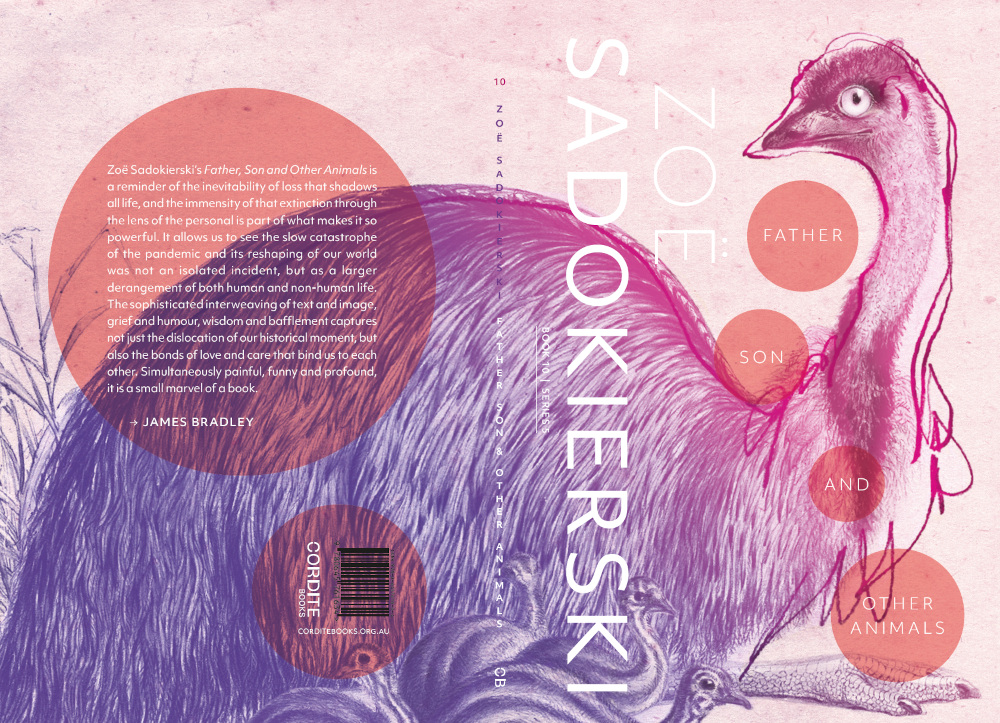
Introduction to Zoë Sadokierski’s Father, Son and Other Animals

BUY YOUR COPY HERE

Zoë Sadokierski’s Father, Son and Other Animals opens with a moment of disconnection, as she describes her father’s tendency to retreat into himself when they are together, disappearing into imaginary golf practice. ‘Sometimes when I’m talking to Dad, he’s not there. I look over and see that he’s gone.’ In keeping with the book’s broader interplay of humour and darker concerns, Sadokierski uses it as an excuse for a moment of black comedy. ‘When he’s like this, I could say anything,’ she continues. ‘Dad, I’m really struggling being a working parent. I’m drinking at breakfast.’ But, like the animal skull he later presents her, her father’s distraction prefigures the larger absence that will eventually overtake him, transforming the scene into a sort of memento mori, a reminder of the inevitability of loss that shadows all life. And, no less importantly, it suggests a larger kind of extinction, one summoned up by the mute images of feathers and bones sketched alongside the words.

This refraction of the immensity of loss and extinction through the lens of the personal is part of what makes Father, Son and Other Animals so powerful. In the same way its sections move from historical events to the minutiae of parenting during the pandemic, the glancing and fragmentary nature of its structure, and the marrying of word and image, allow it to give shape to the inner dimensions of unsettlement and loss that define life in the Anthropocene.

Some of these dimensions concern an awareness of non-human and more-than-human presences, and the unsayable grief of the gaps their disappearance leaves in the world. Father, Son and Other Animals allows us to glimpse the degree to which the slow catastrophe of the pandemic and its reshaping of our world was not an isolated incident, but part of a larger derangement of both human and non-human life that is being driven by human activity.

Sadokierski is eloquent about the fears and uncertainties of parenting in a time of crisis, capturing the degree to which parenthood is a process of unsettlement in which we are unmade and reassembled, our former selves suddenly out of reach and strange to us. Likewise, children reveal themselves to be fundamentally unknowable, their lives as inaccessible to us as those of our parents.

These ideas echo through the book, reflecting off each other in unexpected and often startling ways. An accident during a swim in Sydney Harbour offers a reminder with the corporeality of the body, underlining the murderous potential of the axe wielded in the burglary in an earlier section. A description of the fate of the dwarf emu collides with the loss of a plastic KeepCup in a nature reserve. The unthinking violence of the natural world is balanced against the smaller detonations of family life. And shadowing all of them is the unspoken brutality of Indigenous dispossession.

I want more books with the complexity and intelligence of Father, Son and Other Animals. Not just because we’re going to need them if we’re to find ways of processing and commemorating the transformation of the world, but because we need to find ways to live and celebrate as well as to mourn and rage. The book’s sophisticated interweaving of text and image, grief and humour, wisdom and bafflement does just that, capturing not just the dislocation of our historical moment, but also the bonds of love and care that bind us to each other. Simultaneously painful, funny and profound, it is a small marvel of a book.

Posted in INTRODUCTIONS | Tagged ,

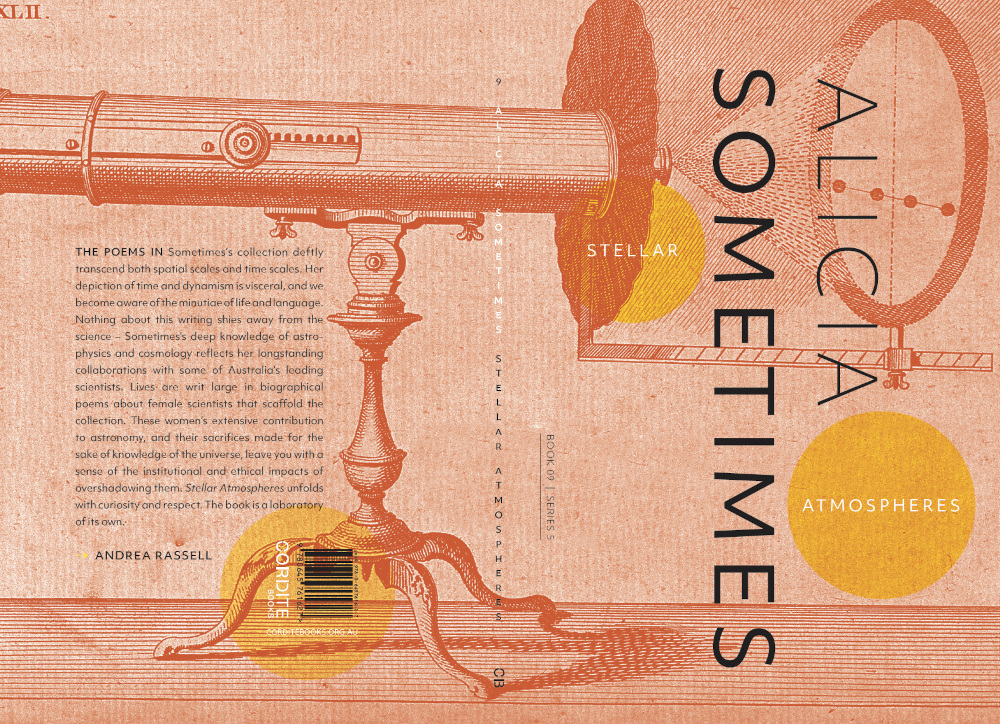
Introduction to Alicia Sometimes’s Stellar Atmospheres

BUY YOUR COPY HERE

I feel a sense of delight at the idea of an artist surreptitiously working in a science lab. There is something mischievous, rambunctious, even anarchistic about it. The idea of intervention. I have always thought that the disciplines that exist under the broad umbrellas of science and art are in some ways artificial necessities for the organisation of various institutions. Of course, science and art embody different ways of knowing, of epistemological knowledge-making, but there are forms of art that bleed together with scientific practice more so than two disciplines thought of as sciences – consider the techniques used in optical microscopy and cinematography (both lens based practices), versus geology and biomedical science (rocks versus the messy stuff of humans and disease).

When poetry turns its reflective gaze onto astronomical phenomena, concepts and language, what emerges is a profound connection of science to the human condition, a way of experiencing scientific phenomena in ways that cannot be experienced through scientific perspectives alone. The subjective is acknowledged, unveiled, celebrated.

The poems in Sometimes’s collection deftly transcend both spatial scales and time scales. From one line to another we careen across the universe. We fast-forward from the first picosecond of stuff forming in the universe to a Christmas card, millennia later. Her depiction of time and dynamism is visceral – things froth and whizz and quiver in a temporospatial-grammatical practice. We become aware of the minutiae of a life, and of a language, against both vast and infinitesimal phenomena in the universe.

Lives are writ large in Stellar Atmospheres. Biographical poems about female scientists scaffold the collection. These women’s extensive contribution to astronomy, and the sacrifices they made for the sake of knowledge about the universe, leave you with a sense of the institutional and ethical impacts of overshadowing these scientists. These poems unfold with curiosity and respect rather than malice.

Nothing about this writing shies away from the science – Sometimes’s deep knowledge of astrophysics and cosmology reflects her longstanding collaborations with some of Australia’s leading scientists. The book is a laboratory of its own, at times taming, liberating or penetrating the science. It probes the linguistic choices that astronomy has made.

Instruments, biographies, bodies: celestial and human. Poems gather forms, shapes and grammar for phenomena that cannot be directly observed even when our senses are augmented by complex technoscientific systems.

Astronomers rarely look up at the sky
Instruments detect invisible signals

Scientists and engineers design the human perception of these signals using graphs, visualisations and sound, but Sometimes contributes a unique poetic-linguistic translation of astronomical phenomena. Nebulae and supernovae are transmitted to the reader as ‘blue stencils in space’ and ‘brilliant dancers’. A red giant is evoked via Rothko:

Now he stands before this ache of colour
in fluster, blushing deferential-cranberry

Sometimes has written the celestial subjectively – or is it the subjective celestially? – and smears the lines between the practices of cosmology, poetry, and astrophysics. After reading this collection, it seems to me like poetry is as valid a method of interrogating the universe as any other.

Posted in INTRODUCTIONS | Tagged , ,

Jennifer Mackenzie Reviews Grace Yee and Adam Aitken

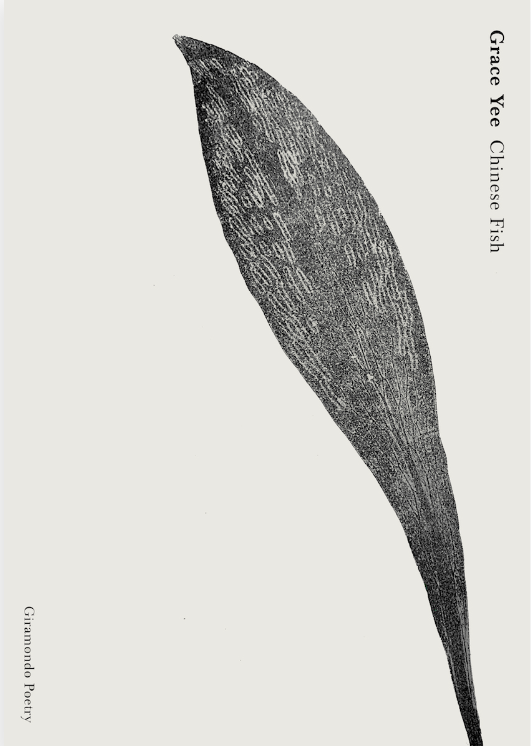
Chinese Fish by Grace Yee
Giramondo, 2023

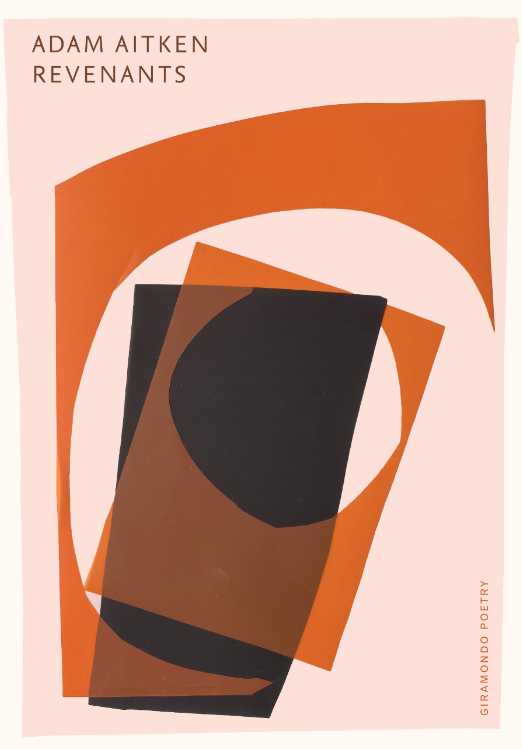
Revenants by Adam Aitken
Giramondo, 2023


“The limits of my language are the limits of my world.” During the excitement of multiple events and literary get-togethers at the Ubud Writers Festival this year, the Indian poet, Sudeep Sen, brought to my attention Wittgenstein’s well-known quotation from the Tractatus of 1922. It seemed particularly apt as multiple languages, overheard in the daily comings and goings around festival sites, lit up many a conversation. The potency and limits of language seemed a good place to start in considering these two collections, Grace Yee’s Chinese Fish (Giramondo 2023) and Adam Aitken’s Revenants (Giramondo 2022), where language constricts and amplifies, in Yee’s case moulding the plasticity of objects into gorgeously caught form, and in Aitken’s, with his ironic, sardonic dip into an aesthetic alert to Wallace Stevens, capturing the air and breath of (in particular) colonial disquiet and reverberation.

Grace Yee’s Chinese Fish is one of the most elaborately structured collections of poetry I’ve come across in some time. In a remarkable account of a multi-generational Chinese family and their experience of migration to an insular New Zealand, where racial prejudice was both legislated and part of common discourse, a number of expertly used structural devices assist in presenting poetry of captivating clarity. In the first instance, the collection is presented chronologically, and divided into ‘chapters’ that carry a number of structural devices within them. Each section begins with a short preface, usually either in the voice of colonial condescension, or in the voice of the most prominent character, Ping. The voice of Ping appears in short and clipped lines which are both comic and full of pathos, thus giving her a tender agency. Wittgenstein’s contention appears most relevant here, where the introduction into the text of Cantonese and Taishanese languages amplifies the cultural context, hinting at another world outside the constrained life lived under the umbrella of familial and settler expectations. The issue of amplification is an interesting one, its significance varying with cultural norms and linguistic ability. In Chinese Fish, the resonance of first language/s act as a counterweight to a pompous, uneducated colonial voice intoning its way through the book, eliciting horror and dark comedy to chilling effect:

                    For these immigrants
                   from the impoverished
                                           unsanitary
                              villages of China,
where beggars and vagabonds are numerous,
                            and lepers particularly wretched,
                                       where the coast is infested
                                                   with pirates, children
            kidnapped and sold, and whole families
                                                                 live on boats,
                                        New Zealand is a paradise.

(17)

Typographically, the employment of grey text to denote institutionally mandated discrimination, is very effective. Also very effective is the use of graphic features, such as large text featuring the language of sales brochures and representing the allure of consumer goods:

                         LOVINGLY
                        LAMINATED
                         Draw-Leaf Tables
                         An Easy Solution
                     For Unexpected Guests
                       Lifetime Guarantee

(22)

The imagery itself thrives within the felicity of organisation. Several sections celebrate the move to a new house, each better than the last, and are a delight to read:

Stan buys Ping a red-brick house in a sea of gravel and rocks the size of golf balls in a brand new
housing estate. The front door is horizontal panes of frosted glass ribbed like the washboard in the
laundry, the bathroom a stainless steel shower base, the living room a glazed hearth, the bedrooms
fawn-striped walls embossed with sprigs of wheat, red-faux-velvet curtains for all the world to see. 

(28)

The employment of Ping as the central character in Chinese Fish gives the narrative devices a cohesive impetus. She is a woman left to navigate between two oppressive walls, between the expectations laid upon her from within her own family, and the racist attitudes of an insular society laying out no welcome mat. We first meet her in Hong Kong giving birth to Cherry. She is rendered defenceless, all agency co-opted by female relatives. At home with the baby, Grandfather disapproves of the young mother wearing pedal pushers. When she asks if she may go out:

      Grandfather snorts. Go then…go!...and put some clothes
on! He’s noticed the mother’s brand new pedal-pushers, the ones
she bought last week from Wing On

(12)

Once settled in New Zealand, husband Stan is revealed as a hard worker, but a drinker and gambler who is brusque, inconsiderate, and ultimately unfaithful. Ping finds herself in a silent, isolated suburbia reminiscent of that so evocatively displayed in Clara Law’s excellent film, Floating Life (1996):

       It’s night and all that can be seen are the black roll of
flatlands, coniferous shadows, rows of squat box bungalows,
rooves pitched low […]

    […] Ping steps out into a million-starred hush – no traffic horns
sizzling woks banging cleavers clacking mah-jong tiles […]

                                                            […] seven-thirty in the evening, her
kitten heels sinking in the dew-soaked lawn, the whole world
asleep.

(18)

Within this isolation, Ping works in the family fish and chip shop to the point where it becomes both a badge of honour but also a danger to her life:

        when my mother dressed to go out
she would spend hours setting her hair
and powdering her face and she’s put her feet
in pretty sandals, that her crusty black heels
were on show didn’t seem to bother her in the slightest.
I think they were her parting shot, a way of saying
as she left the place: yes, I do look nice, don’t I?
but look how hard I have to work for it.  

(54)
When the doctor says, Stan, your wife’s blood pressure
is dangerously high she needs to be on complete bed-rest,
Ping shuffles out to the car in her dressing gown, the peonies
on her slippers unravelling.  

(80)

To be oppressed by custom can often lead to inculcated attitudes being imposed on offspring, for instance when daughter Cherry finds herself being denied much-needed glasses:

Mister H., the optometrist: Your daughter needs to wear her
               glasses all the time.
Ping: Nooooo – she’s OK.
Mister H.: Mrs Chin. She can’t read the biggest letters on the
              chart without them..
Cherry: I can’t see without them –
Ping: Then better not see.  

(94)

Although Chinese Fish may sound very grim (and it certainly is, in part) the writing has a lightness of touch that enables a number of humorous strategies to be brought into the work. It is a joyous celebration of the materiality of a life, of the chaotic sights and smells of a family life which is loud, disorganised, and adept at adapting its rituals to a society that is silent, organised, and judgemental. I particularly enjoyed the admittedly terrifying antics of Baby Joseph, who punches a hole in the wall of kindly Missus A’s house, and who chases the neighbourhood bullies, the Macallisters, with a meat cleaver when they attempt to steal his kite:

       Cherry stamps her feet, stomps home, runs into Baby
Joseph tearing out into the street, face pre-tantrum red, clutching
Ping’s meat cleaver.
              Joseph! What are you doing?
              I’m gonna get them!
               Give me the knife!
                It’s my kite!

(67)

Grace Yee has succeeded in illuminating a certain way of life, a life devoted to material improvement within boundaries established for a minority group by the dominant culture. Documentary depiction of racist restrictions formulated in official regulations, newspaper fulminations in letters to the editor such as the one from “A STERLING KIWI,” and personal interactions in suburb and school are successfully employed to create what is essentially a verse novel of original structure (29). The plasticity of the language and the focus on the material suggests the legacy of William Carlos Williams but drawing its strength from documentary textual inclusions rather than through the resonance of what could be called the immanence of image central to much poetry.

Posted in BOOK REVIEWS | Tagged , ,

Caitlin Maling Reviews Dennis Haskell, Maree Dawes, Amy Lin and Miriam Wei Wei Lo

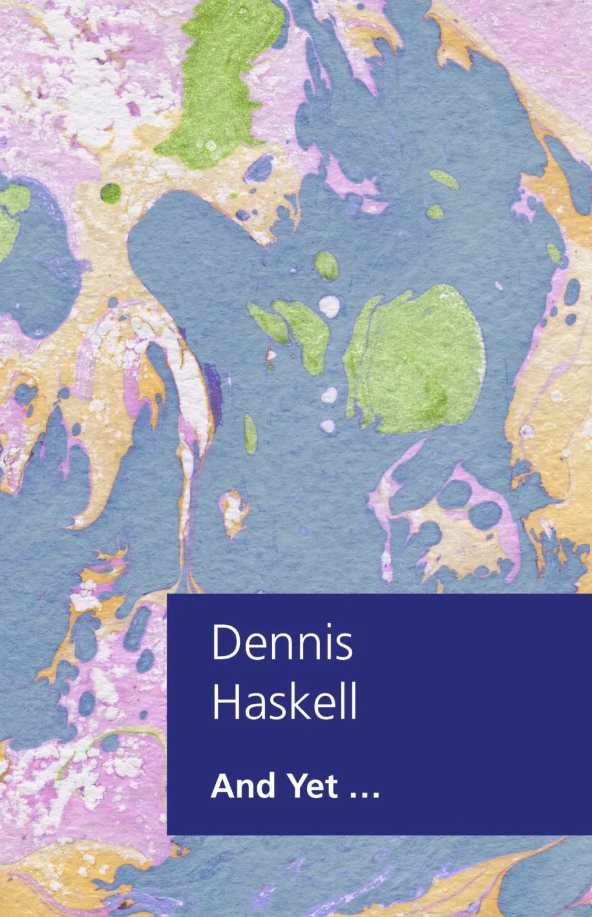
And Yet… by Dennis Haskell
WA Poets Publishing, 2020

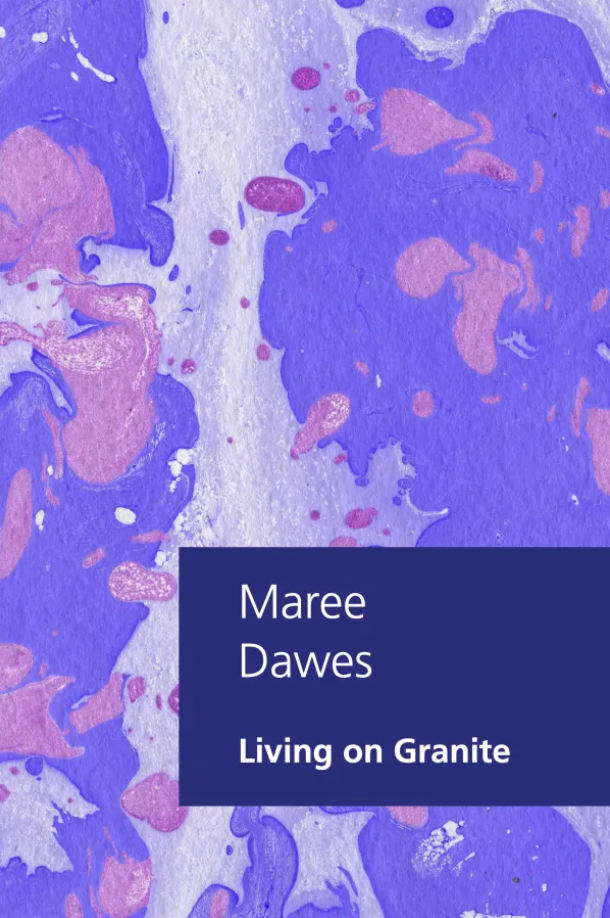
Living on Granite by Maree Dawes
WA Poets Publishing, 2022


Infinite Ends by Amy Lin
WA Poets Publishing, 2023

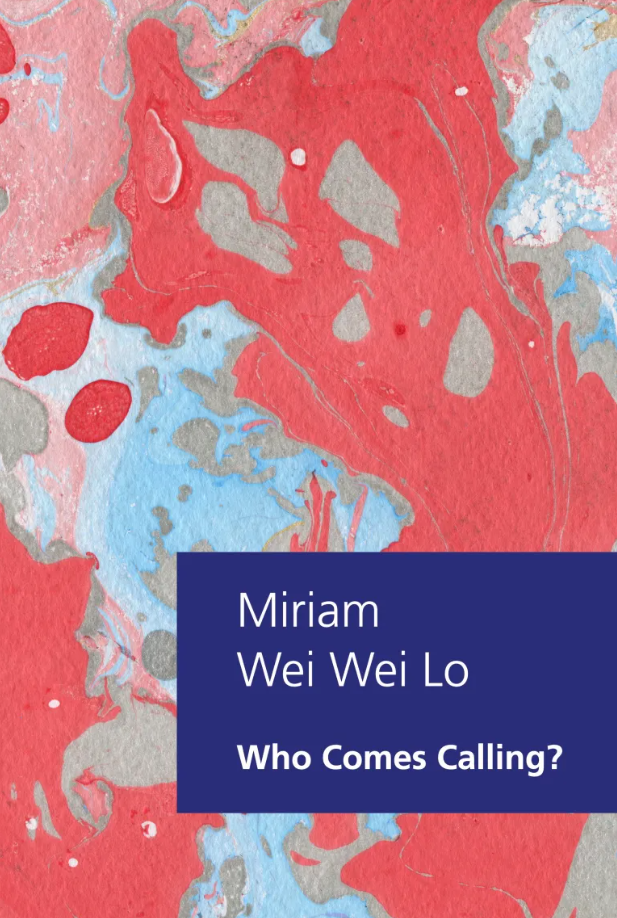
Who Comes Calling? by Miriam Wei Wei Lo
WA Poets Publishing, 2023


It’s a flourishing time for Western Australian poetry and publishing. We have seen the well-publicised launch of Terri-Anne White’s press Upswell (responsible for Scott-Patrick Mitchell’s 2023 Prime Minister’s Literary Award’s shortlisted Clean) as well as the retention and success of UWA Publishing (who are currently bringing us the collected works of John Kinsella), while existing houses Magabala Books (home to Charmaine Papertalk Green, Ambelin Kwaymullina, and Elfie Shiosaki) and Fremantle Press (Andrew Sutherland’s 2022 Paradise: Point of Transmission having just been shortlisted for the Small Press Network Book of the Year) go strength-to-strength. Amongst these larger independent presses, smaller concerns have been making an impact: Roland Leach’s Sunline Press released the slim-but-mighty anthology of single-page poems by WA poets Cuttlefish this year, while the Green Leaves / Red River publication project by Centre for Stories (who also publish the journal Portside) in partnership with Red River Press, based in Delhi, has thus far produced five of an anticipated eight volumes, including the 2023 stand-out Flow by Luoyang Chen. Individual WA poets have also found successful homes in interstate presses. 2022 brought books from Giramondo by Tracy Ryan and Lucy Dougan, 2023 saw the launch of Lisa Collyer’s How to Order Eggs Sunny Side-Up and Natalie Damjanovich-Napoleon’s If There is a Butterfly that Drinks Tears with the newly formed imprint Life Before Man (of Gazebo Books, also publishing Alan Fyfe’s anticipated 2024 poetry debut), while Madison Godfrey’s Dress Rehearsals, out with Joan (an imprint of Allen and Unwin) has been nationally celebrated since it was launched in February. And we are currently awaiting Kerry Greer’s 2023 debut The Sea Chest with Recent Work Press, while from Puncher & Wattman Marcella Pollain’s The Seven-Eight Count of Unstoppable Sadness and Morgan Yasbincek’s Coming to Nothing are being launched end of this month.

WA Poets Publishing was formed prior to 2020, according to promotional materials, as a way of countering a “scale back in poetry publishing opportunities in Western Australia” and has become an integral part of the current proliferation of poetry publications. The publishing arm of WA Poets Inc. – which also organises the Perth Poetry Festival (of which I was a 2023 featured poet) and many other annual events – is a house deeply embedded in the local poetry scene. The current volunteer editorial panel comprises Jean Kent (a rogue non-WA based outlier), as well as Barbara Temperton, Lucy Dougan, and Dennis Haskell (all three of whom serve/served in editorial capacities for the preeminent WA literary journal Westerly). At time of writing, WA Poets Publishing have published five volumes of poetry under the heading of a “Master Poets Series,” three under “Emerging Poets,” and several anthologies curating poems from their major competitions. This review focuses on four of the five publications put out under the Master Poets Series (the fifth, Barbara Temperton’s Ghost Nets is the subject of another review).

The distinction between the Emerging and Master Poets selections is not always clearly delineated. Two of those branded “Emerging” are publishing their first long-form collection, while Fran Graham’s A Gentle Outward Breath is her second (after On a Hook Behind the Door, 2011, Ginninderra Press). While in the Master Poets series three of the contributors have published three or more books, Miriam Wei Wei Lo’s 2023 Who Comes Calling? is her second book (after Five Island Press’ 2004 Against Certain Capture, a second edition of which was published in 2021 with Apothecary Archive) and Amy Lin’s 2023 Infinite Ends is her debut collection. What defines a Master Poet then, rather than an emerging, might be found somewhere between the longevity of publishing career, the public reception of that career (Masters citing many awards) and, presumably, the qualities of the poetry itself. Somewhere then between the adjective form of master – showing very great skill/proficiency – and the verb form “mastered” – to have a complete understanding of. It is also tempting to read into it the noun ‘Master,’ in the sense of these being the Western Australian poetic Masters, the model poets to whom others aspire. In terms of reading all the collections put out with the heading of Master Poets within the particular context of them being aggregated under WA Poets Publishing, I wanted to ask how does Western Australia appear in these collections? How do they extend our understanding of Western Australian poetry? What confluences and distinctions might arise between them?

Dennis Haskell, the author of the first of the published volumes, 2020’s And Yet… meets with all possible definitions of master. Previously having published eight volumes of poetry and fourteen critical volumes, his bio also includes the note that in 2015 he was made a Member of the Order of Australia for “services to literature, particularly poetry, to education and to intercultural understanding” (ii). And Yet… as Haskell’s ninth volume and the first in the Master Poets continues with some of Haskell’s familiar interests, faith, art, and grief in particular becoming themes which will echo to varying degrees through the other three poet’s volumes. While the later volumes each have an introductory statement by the poet, Haskell’s gets straight down to business after an epigraph from Celan: “Only one thing remained reachable, close and secure amid all losses: language. Yes, language” (v). Haskell has an assured ear, particularly when it comes to the use of rhyming quatrains, either sonnets or in longer forms, where rhyme becomes almost a gentle container for the losses the poet contemplates:

Another birthday over, I add a number;
experiences cleave to me
as naturally as rings surround a tree;
yet some fierce moments make me number

(‘Holding’ 6)

What is “Western Australian” here is not a function of language or poetics, but a series of places offered as contextual locators, shorthand for points of departure, rather than subjects themselves, such as in ‘Revisiting St John of God Hospital Subiaco,’ where “[t]he corridors looked serene / and everything was as it had even been” (7).

The following volumes differ from Haskell’s in the ways we might expect from them, being different poets with different poetics and foci. They also differ paratextually in how they approach acknowledging place and people. All collections after Haskell have a one-to-two-page introduction by the author and the biographies have expanded from the usual paragraph to a discursive statement of almost a page. Dawes, Temperton, Wei Wei Lo, and Lin acknowledge either in their biographies or acknowledgements sections which First Nations’ Countries they are on, largely Minang Noongar and Whadjuk Noongar boodjar. Noongar language also appears in these volumes to varying degrees, mostly in the form of proper nouns for places, species, and seasons. Barbara Temperton sought permission for her language use from “members associated with the Wagyl Kaip Southern Noongar Region, Southwest of WA” and the “Wangka Maya Language Centre, Port Hedland WA” (80-81). Maree Dawes cites having checked her use of language against the “Noongar Word List from Sharing Noongar Culture, South West Aboriginal Land and Sea Council (noongarculture.org.au)” (81). The consistent use and awareness of First Nations’ languages by non-Indigenous poets from Western Australia is potentially a point of particularity.

Posted in BOOK REVIEWS | Tagged , , , ,

Elena Gomez Reviews Broede Carmody and Holly Isemonger

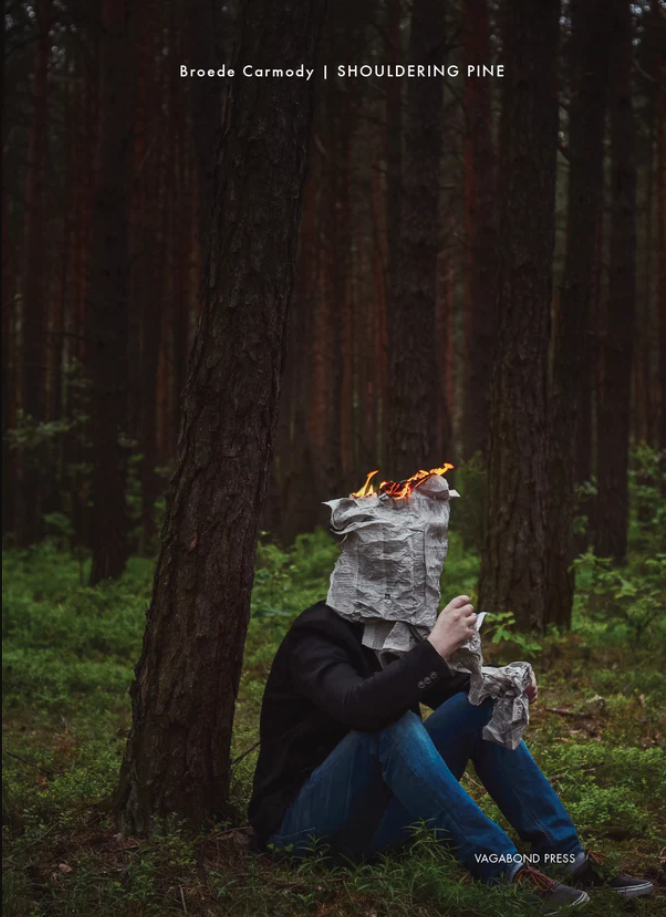
Shouldering Pine by Broede Carmody
Vagabond Press, 2023

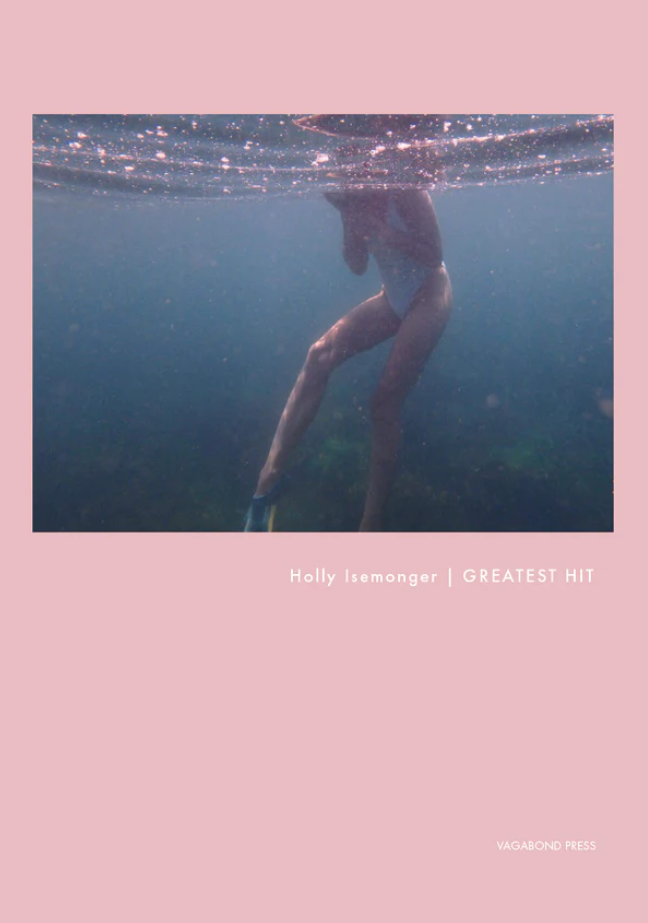
Greatest Hit by Holly Isemonger
Vagabond Press, 2023


A book-length poem can offer the best of two worlds: the thematic and spatial breadth and depth of an epic-style length on the one hand, the delineation of units and fragments via the physical space of the page on the other. The poem can be read as one long piece, but also becomes chunks, giving the reader gentle permission to find their own flow without the designation of titles or sections. Broede Carmody’s second book of poetry, Shouldering Pine, uses this book-length form to construct the tensions and connections between its emotional and geographical spans as it takes the reader through a sort of loose, meditative journey. The speaker of Carmody’s poem is often driving out of Melbourne and through country Victoria, with a European interlude. They are anxious in the general anxiety disorder sense (typed out by “the Melbourne GP” “with two fingers” (12; 12)), and in the eco-catastrophic sense – “Sometimes it feels like I’m speaking with a bird’s throat. The bird is underwater” and “Have I told you how campfire smoke / reminds me of home but also / preparing to flee grassfire?” (13; 55). These articulations of anxiety, though refracted through the personal subjective experience, suggest a sense of an emotion that is both lonely and widely felt. Eco-grief and eco-anxiety, terms emerging from research by Finnish scholar Panu Pihkala in the late 2010s, are today increasingly researched and widely understood emotional responses to climate disaster. Braided together is also the grief and anxiety of the bushfire-pandemic period that began in the 2019/2020 summer, leading into Melbourne’s series of lockdowns. There are also the echoes of elegy for a deceased friend (never named but likely referring to the much-loved and much-missed writer Kat Muscat, who died in 2015). This braid forms a sort of through line in the book, among smaller threads of scenes travelling and camping with friends and tense conversations with lovers. The otherwise sublime images of landscapes are peppered with discomfort at the settler position on stolen land – after noticing the imprint of sheep’s feet in dirt, the speaker immediately goes on to name this unease:

This wasn’t meant to be a colonial poem.
This poem can’t be anything but a colonial poem.

(9)

This is seemingly the limit of the colonial settler position of the poem, and it’s hard to tell whether it is part of the speaker’s own thinking or has become a reflexive, almost self-conscious response to the poems’ contemporary pastoral leanings. Rivers and mountains make frequent appearances in Shouldering Pine but the settler position never quite returns. The overwhelming mood turns to defeat: “Sometimes I wonder if we’re better off just giving up” (21).

Despite exploring these uncomfortable emotions, the poem’s opening sets up a sharpness that seems to accompany the work throughout: the poem opens with the speaker at what seems to be a campsite, pricking chestnuts with a knife. Later the scene comes more into focus; “split open a burr / & not all the nut will come out,” and “We scratch soil / like we would a wound,” while “The city’s spine begins to puncture the horizon” (8; 9; 12). This sharpness gives way to a softening that reveals itself in gentle epigrams, often ending a page, such as with the lines:

There is so much empty space in ourselves.
If you think about it, even cities are full of stillness. 

(14)

Chestnuts are mostly grown in the north-west of Victoria. Another poet who wrote about mountains and land was the Galician poet Uxío Novoneyra, whose poems of the Courel contain many chestnuts (the chestnut tree is found in Galicia). It’s a small touchstone but one that reveals how Carmody’s close attention to such a seemingly minor detail of place can link his work to poems across time and space. And besides, these secret and often unintentional codes, these words and images that allow poems passage to each other via readers, are often precisely why reading poems can become expansive, distracting, delightful. That said, the voice in Carmody’s poem is ultimately more attuned to the human subject than Novoneyra. The lines in Shouldering Pine often hold weight and depth: of complex feeling; of a quietly dying world. But occasionally they alert us to a sense of play, too, where “pre-dawn peeling away, skin after rock climbing” turns peeling away into a sort of hinge phrase; despite the comma, I imagined it’s the rock climbing that peels skin away, too (15). These little turns within or across lines inject some energy into otherwise still poems, though occasionally the jolt feels a little left-field such as when the speaker, reflecting on how “It was his collarbones that undid me,” follows this with “Normally, humidity bounces off alpine air” before returning to the collarbones-owner’s jaw (24). Another epigram here ties together romantic desire and the natural environment: “Like mountains, we learned to make our own weather” (24). It’s a move that reminds us that the speaker is attentive to many things at once, and not necessarily interested in disentangling them.

The line a couple of pages later, “Sometime a hawk is just a hawk / even if you don’t look up,” causes this reader to pause longer than feels comfortable (26). Eventually, taking away the quest for meaning and noticing only the tone, its gentle wryness becomes a little more enjoyable. There’s something about it that teases us, lifts a little out of the sometimes heavy or sad world to remind us that we are silly little humans, trying to understand our place and make sense of the world around us, and we never know if we’re getting it right or not. But this is followed by another epigram that pits the loneliness of a city of five million people against “acres & acres / of pine tree plantation,” which falls a little flat (28). Despite this, there’s an overwhelming sense of the visual pleasures that attend hitting the road with friends or lovers, fanging it out of Melbourne and into rural Victoria (even if we occasionally think about slipping off the Hume). One particularly vibrant passage begins: “Post-turbulence I hug the road’s blue / curve. Mid-morning melt— / lakes twisting other lakes” (35). The speaker, driving perhaps, listens to their passenger’s description of the surroundings and they become “as calm as folding linen / sheets into clean straight / lines” (35). Further down, the speaker reflects on “The way water refracts light & / insects but also swallows them. You flick / me across the sauna like paint” (35). Here, the passage takes on lyric imagery and makes ample use of simile, moving away from the slightly more bare-bones narrative or reflective sections of the poem. It becomes like an aria in the contrast of colour it presents – there’s “a scribble of trees” and “A reindeer bows into slush” (35; 35).

This is a book that searches for a sense of beauty in the grim events of the past few years, though it doesn’t shy away from the uncomfortable and unresolvable grief and anxiety that hangs around, no matter how closely we pay attention to the sublime beauty of nature. After all, as the speaker wonders at one point: “If the natural world sets the human mind at ease, how come so many regional & rural kids die before their 21st birthday?” (22). And anyway, as we are reminded towards the end of the poem:

Just because a place is /

beautiful doesn’t mean you won’t slip
down an abandoned mine
shaft. We’re all panning

for specks of something.

(47)
Posted in BOOK REVIEWS | Tagged , ,

Keri Glastonbury Reviews Grace Heyer, Panda Wong, Rory Green and Siân Vate

Slow Loris Series 4
Puncher & Wattmann, 2021

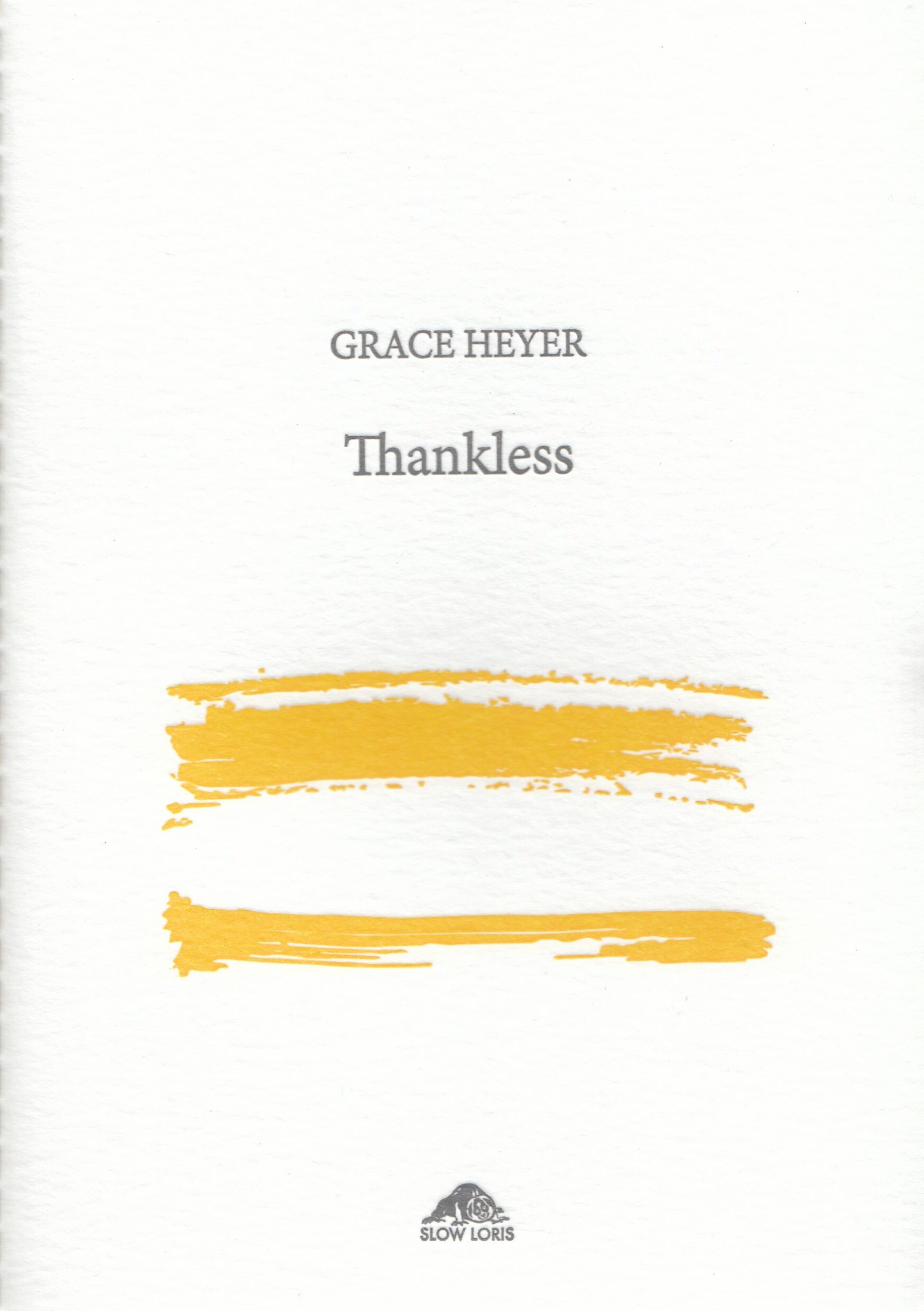
Thankless by Grace Heyer
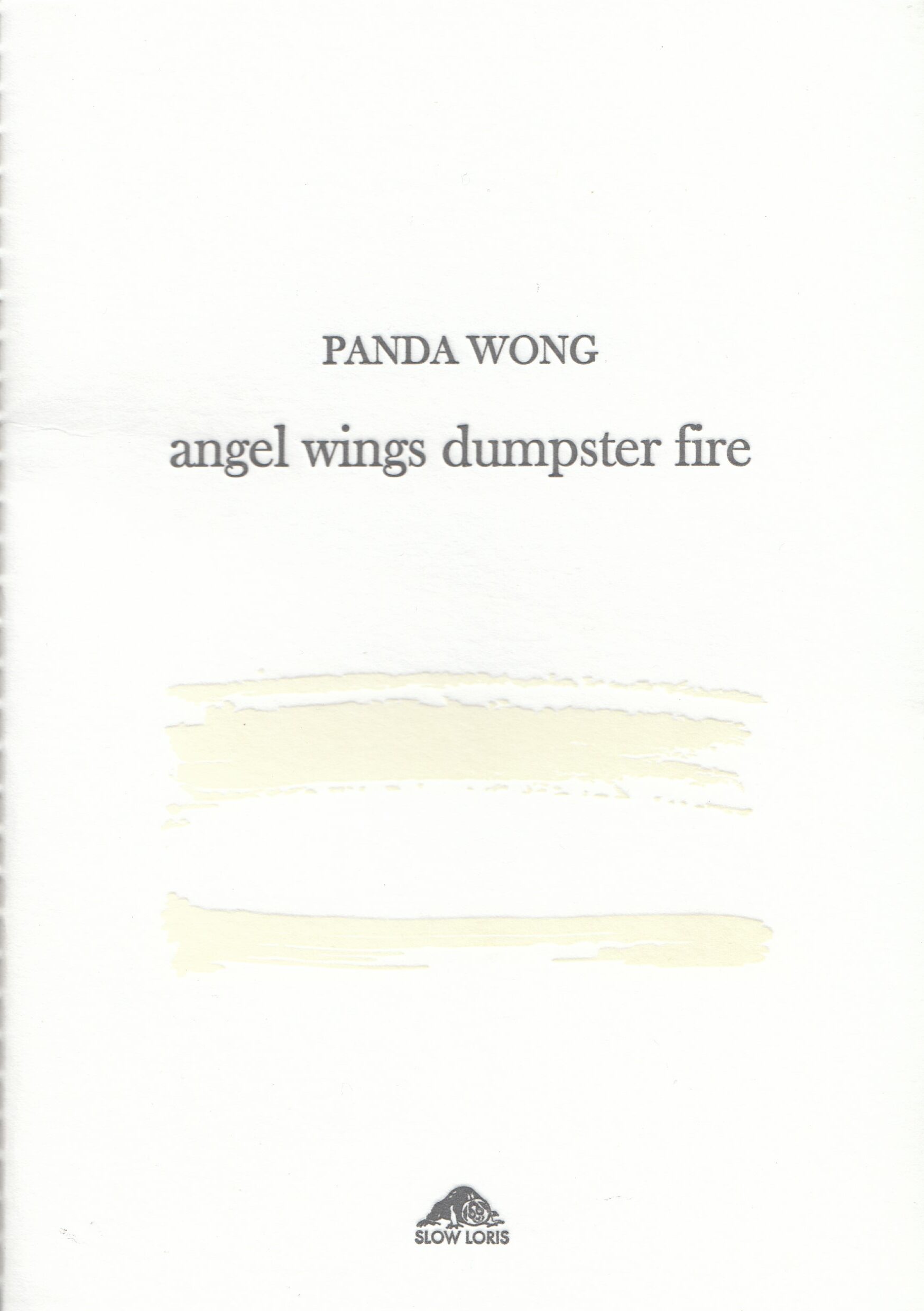
angel wings dumpster fire by Panda Wong
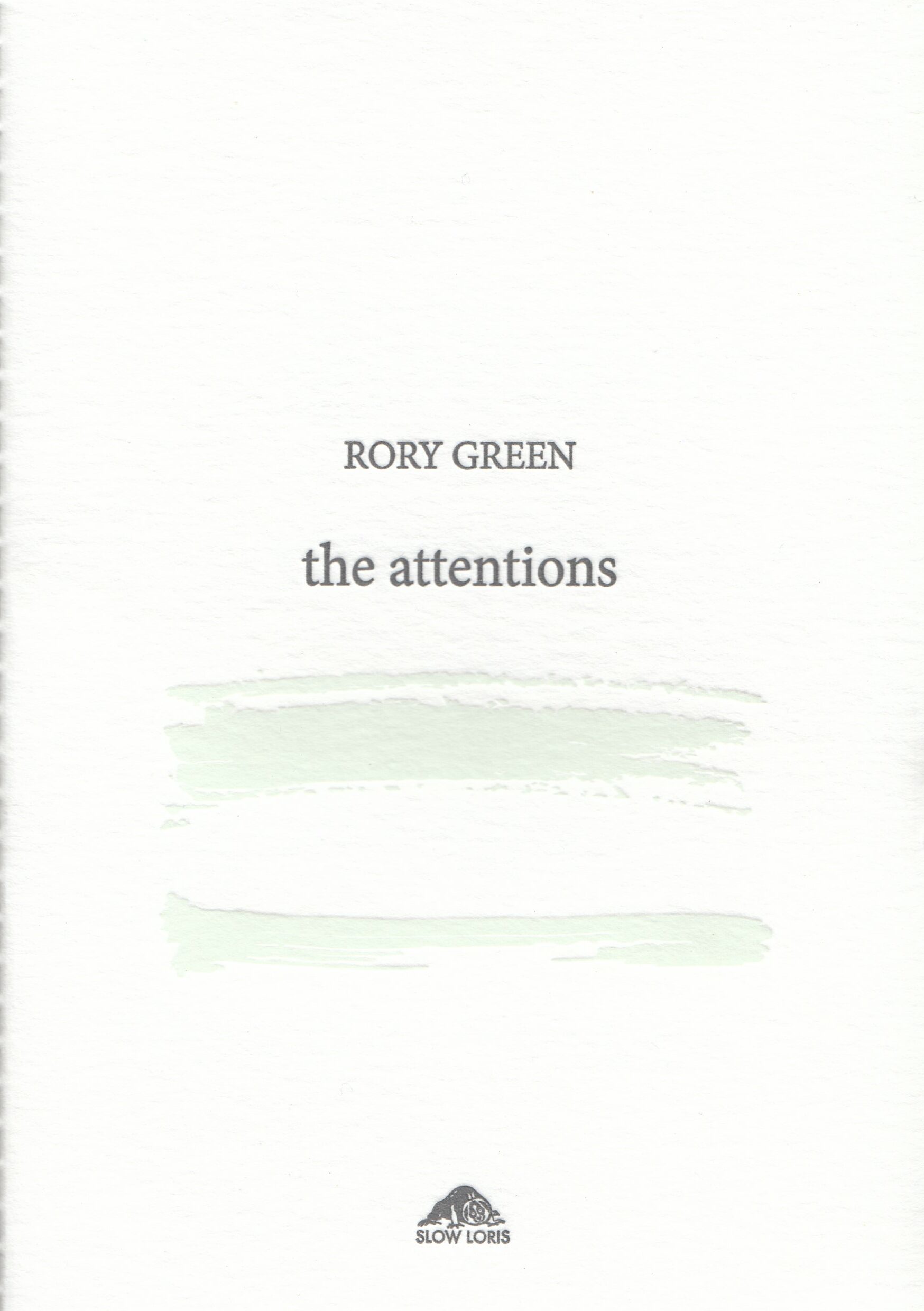
the attentions by Rory Green
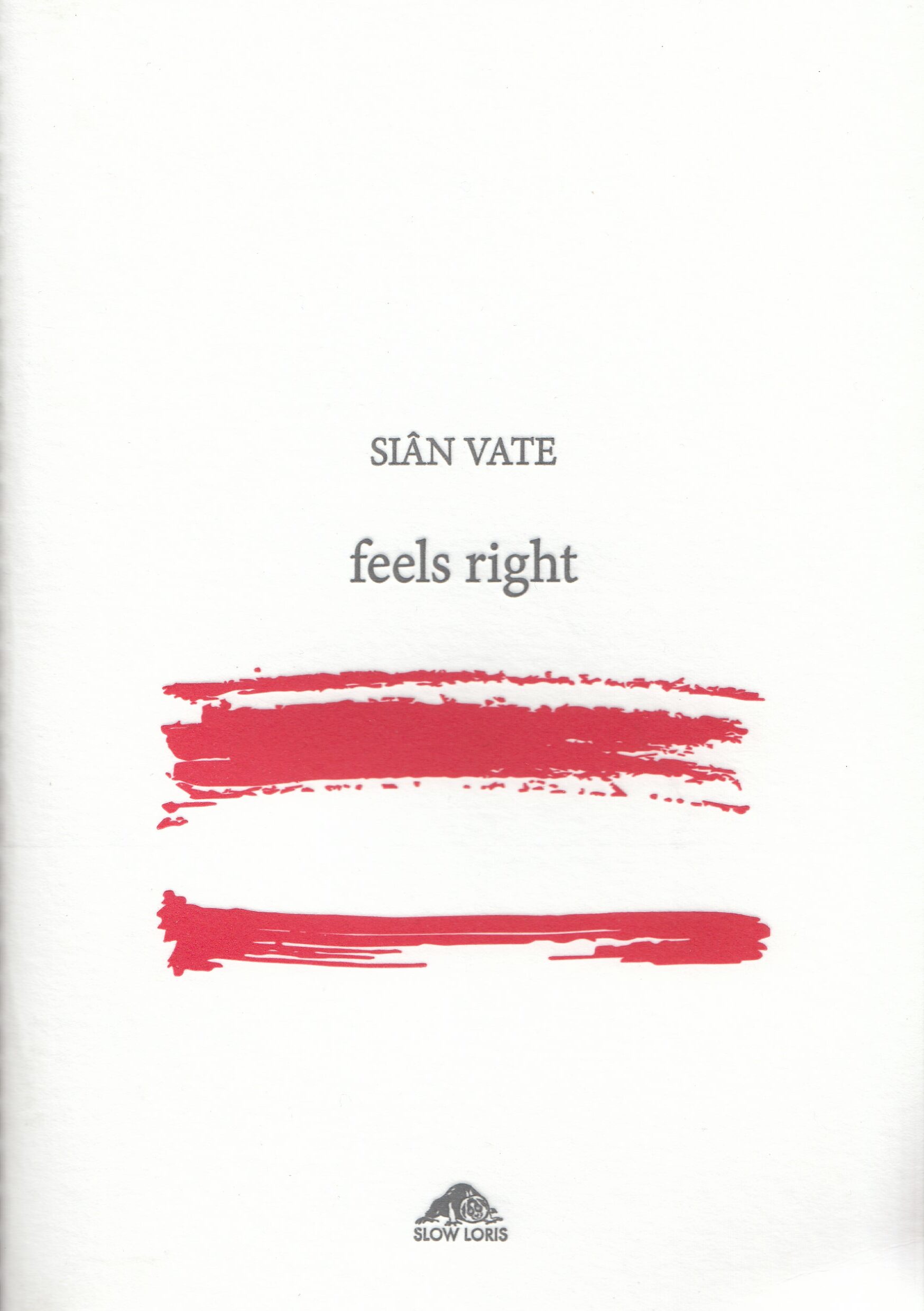
feels right by Siân Vate


Slow Loris Series 1 slouched onto the scene back in 2018, as a Puncher & Wattmann chapbook series edited by then Newcastle-based (now Bega-based) poet Chris Brown. Akin somewhat to the EP, the slew of titles now accruing on the website remind me of browsing through record bins as an adolescent: Daniel Swain’s You Deserve Every Happiness, But I Deserve More (Series 2, 2019) or Duncan Hose’s Testicles Gone Walkabout (Series 3, 2020) give an indication of the pith and pitch of this welterweight form. Distinctive in design, with splashes of colour across textured cardboard and a saddle stitch spine, Slow Lorii (plural?) retain something retro about them. Next to earn their stripes for Series 5, due later this year, are: Will Druce, Amelia Zhou, D Perez-McVie, Ella O’Keefe, and Louis Klee.

Grace Heyer, Thankless

Grace Heyer was a joint winner (with Ella O’Keefe) of the 2018 David Harold Tribe Poetry Award – a significant achievement for an emerging writer. Ella O’Keefe (who has lived in both Sydney and Melbourne) has always struck me as more of a cosmopolitan, than metropolitan poet, with her phenomenological mobility. Grace Heyer’s biography remains enigmatic; she is a “poet from rural New South Wales” who “lives with her two daughters and a growing number of cats” (back cover). In many ways Heyer is the more post-confessional poet, while coming to us from an unknown, possibly pastoral, locale. Yet, continuing the seemingly endless iterations of ‘city poet’ Frank O’Hara in Australian poetry, she writes:

I think I’ll be happy if I read O’Hara’s anti
love poems because the baby is asleep and
I want to drink and write and be uselessly
sublime

(8)

Heyer’s voice has the feminist grist of a Barbara Baynton protagonist, a young mother and baby in ‘the bush’ (reading Bukowski).

[…] love lets no one sleep in if it can help it—mewling
through the flyscreen before it’s properly
dark     shit to do first thing and the heart won’t
build itself

(9)

There’s a domestic, rather than eco-, ‘sublime’ to Heyer’s poetic that alludes to past traumascapes, family fractures, alcoholism, births, deaths, and recurring biblical metaphors: “poet is the air inside the O word / from the rib of another” (3). The title, Thankless, seems in direct reference to women’s work. Heyer’s precision with phrasing reminds me of Kerri Shying’s Elevensies from Series 1, and both poets regionalise O’Hara’s ‘go on your nerve’ poetics, with this line from Heyer encapsulating her particular edge-play with the everyday:

Yours said I didn’t need another cigarette
and made me a toasted sandwich

(11)

Heyer dispenses with poem titles and instead bolds the first line of each poem, which has a somewhat similar effect to Shying’s use of the middle line as the title in the elevensies form. Both Shying and Heyer play with vernacular elliptically, a way of using direct language indirectly. Needless to say, writing from a regional area is no impediment to urbanity, to inventive use of punctuation and form, and to writing female experience. The second person address is used often in Thankless, and it can be hard to decipher if the poems are directed at a lover, a mother, a sister, or the self – which makes the collection flow like a guttural genealogy.

Panda Wong, angel wings dumpster fire

Written in pandemic-infused 2021, Panda Wong’s angel wings dumpster fire is a paternal elegy, presented as a blistering post-script to the eulogy she read at her father’s funeral four year’s prior, when: “my demeanour was sentimental. my energy was goblin” (10).

Part poetic personal essay, Wong considers death in the contemporary mediascape, where funerals are crowdfunded, held over Zoom, and an “AI start-up is recreating dead loved ones as chatbots” (6). Her references are a pastiche of the pop cultural: the Kardashians to Rebel Wilson through to the auteurism of Sophie Calle and Apichatpong Weerasethakul. The notes that follow the poems also reflect a metonymy of sources: citing news websites about people finding late loved ones on Google Maps alongside Lauren Berlant and Kathleen Stewart. Wong operates like a rag-picker, a restless spirit fossicking through materiality and immateriality, chimney sweeping ash from the internet as a form of ritual burn.

This is transgeneric poetry, delivered with rapid fire urgency and an intermingling of ways of knowing (scientific and poetic). The intergenerational is important here; the experience of witness and following how far vectors of transmutation might travel. The Bee Gees are Wong’s soundtrack to her father’s death. For me and my mother, it was Air Supply. With distance comes the aftereffect of memory and “the desire to see you blossoms in my gut like a gastrointestinal orchid” – which goes to prove that perhaps you can make a purse from a sow’s ear (12). Wong’s syncopated style reminds me of Jamie Marina Lau’s microfiction:

                                                    […] the Chinese shop on
Russell Street that always has a row of maneki neko in the
window. their waving arms are never in synch.

(17)

Wong does something zine-like with her chapbook and creates an artefact. She includes personal photographic snapshots of her father, as well as her father and mother, which create the analogue intimacy of a memorial pamphlet (without the generic funeral home language). It’s a performance of form which incites ritual: “this poem is for you. I’ll burn it too…” and “I live on in the dregs of your afterglow” (17; 20). The spectacle of the internet, “people putting different precious items in industrial blenders,” is considered alongside Mallarmé: where grief “without a shape to take, it leaks everywhere” (20; 20).

Posted in BOOK REVIEWS | Tagged , , , ,

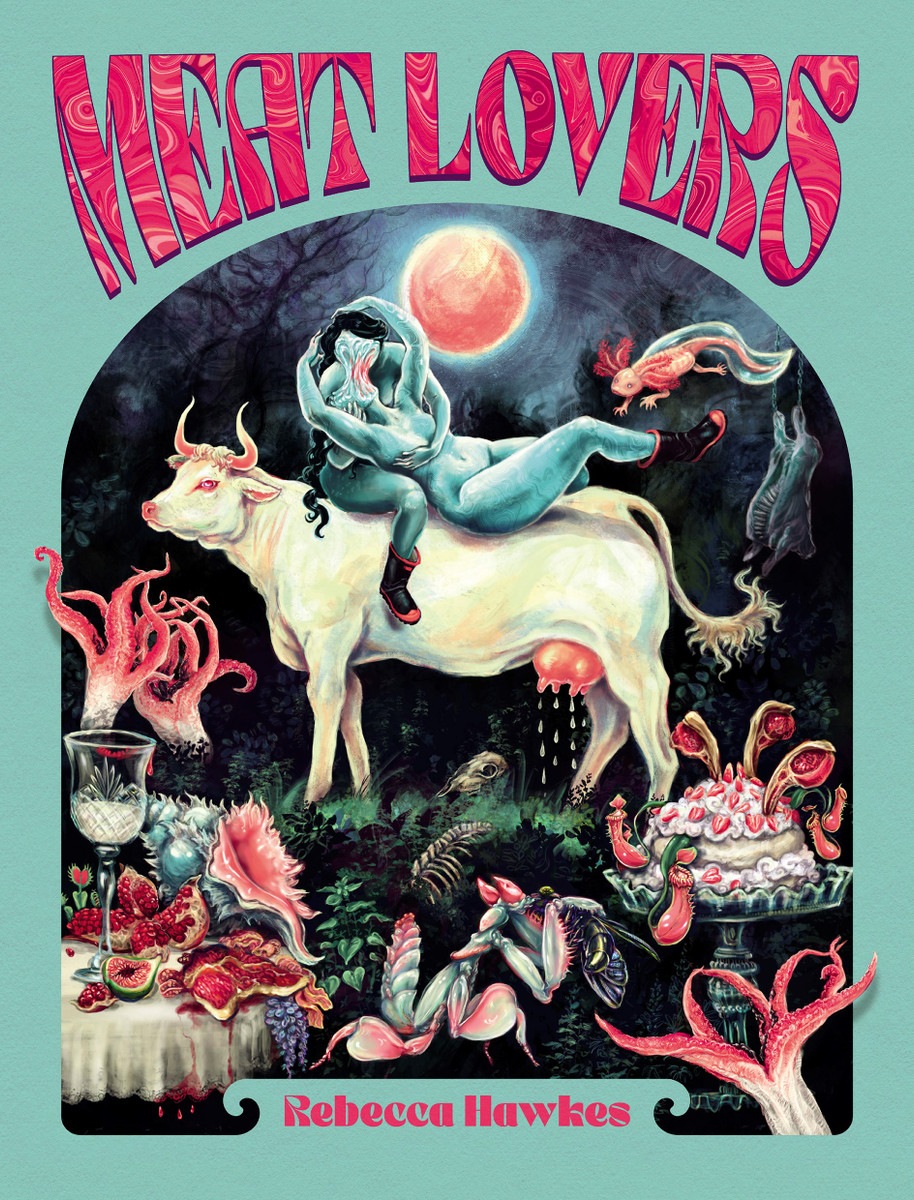
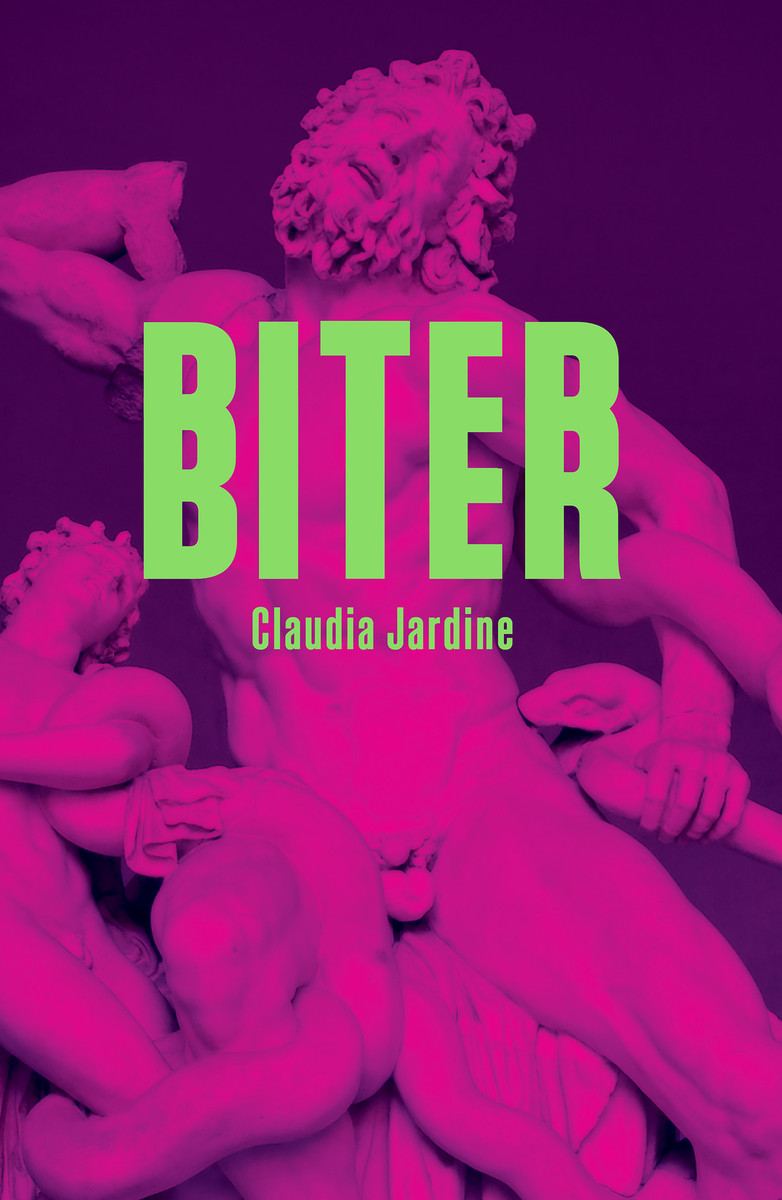
Elese Dowden Reviews Rebecca Hawkes and Claudia Jardine

Meat Lovers by Rebecca Hawkes
Auckland University Press, 2022

Biter by Claudia Jardine
Auckland University Press, 2023


In her Cordite essay ‘What Blooms Beneath a Blood-Red Sky: A Year in Aotearoa Poetry,’ Rebecca Hawkes, author of Meat Lovers writes:

Poetry is so hot right now, the bright young rhapsodists proclaim (if largely to a devoted audience of each other). Are we just saying, we’re hot now, evidencing the glow-up since high school, the already-anxiety of what it will mean for our newness to fade when we’ve truly emerged and the first-book fetish fades?

(2023)

Good question. Hawkes, queer Pākehā poet and painter, raised in Canterbury and living in Wellington, concludes that no, the poets will always be babes, and maybe she’s right. Poetry is hot right now in Aotearoa and it’s hot in Melbourne too. From my own Pākehā observations across the Tasman in Melbourne, there exists an emerging class of largely millennial writers in Aotearoa revelling Dionysiacally in their post-high school ‘glow-up.’ Claudia Jardine, a Pākehā and Maltese musician, poet, and author of Biter, is also a member of this gleaming cohort.

Nearly all of Aotearoa’s best contemporary writers are alumni of the International Institute of Modern Letters (IIML), based at Victoria University of Wellington, with Tayi Tibble, Chris Tse, Hera Lindsay Bird, Tusiata Avia, Eleanor Catton, and Rebecca K. Reilly among them. The IIML was established as an institute of Victoria University in 2000 with funding from US casino owner, businessman, and Iowa Writer’s Workshop graduate Glenn Schaeffer.

There is a definitive style arising from these IIML peer groups so curiously funded by American casinos (just as the Iowa Writer’s Workshop was funded by the CIA). Tinfoil hats aside, funding for the arts is rarely in perfect accordance with the conclusions we draw from art itself. But it’s worth considering: what interest might American capital have in guiding the flows of poetry in Aotearoa New Zealand?

Aotearoa New Zealand is a tiny country. This is not an understatement. I heard recently that the nation’s gross domestic product is half that of the state of Victoria, so if you think the Australian literary scene is modest, think again. Fellow poet and bookseller Ender Başkan writes in Overland, in his review of my review of Sick Leave co-director and poet (and not NZ politician) Gareth Morgan’s When a Punk Becomes a Spunk (2022), that reviewing is a difficult task.

You are navigating risk, you don’t want to piss your colleagues off, you want to build links, be positive because the scene is small and there are finite organs to publish in or perform with, limited funding. Which is to say that robust debate requires the safety of density—or tenure—a density we might often lack.

(“Poetry can already be free”, 2023)

This is my fifth literary review to date, and I find myself again writing in uncomfortably close proximity to the writers I review. Rebecca Hawkes and Nikki-Lee Birdsey published my first poem in Sweet Mammalian. Hawkes and I are mutuals on both Instagram and Twitter. Hawkes also appeared in one of Claudia Jardine’s music videos. They thank each other in the acknowledgements of their respective books, alongside a number of other IIML graduates.

Heeding Başkan’s caution, I approach this review carefully. In Naarm, or so-called Melbourne, as in Aotearoa, it feels imperative to engage in critical thought about our social standpoints when producing art, and to entertain our own possible investments as a safeguard against the furthering of the naturalised fascism of enduring colonialisms. Başkan prompts further: “Australia is being settled every day. Can anyone who has settled downplay a part in unsettling Australia?” (2023).

Poet and critic Jasmine Gallagher writes that “New Zealand art and poetry is increasingly marked by a form of New Sincerity” (“New Sincerity in New Zealand Poetry”, 2019: 122). She theorises New Sincerity as a cultural reaction to postmodernism, “away from cynicism, irony and scepticism towards a poetics of recovery, hope and sincerity” (2019). I wonder how much this style pertains to the increased access to global publishing afforded by the internet, and the “first-book fetish” acknowledged by Hawkes in her Cordite essay (2023).

The way we express ourselves online has in turn seeped into the way we write offline (if there is such a thing in 2023). There is an immediacy to typing thoughts into a blank field against the blinking cursor of the present, and writing with a pen or pencil doesn’t feel the same. Form influences content, and vice versa.

I can think faster and more freely when I type than when I handwrite, and anything I write on a screen is more widely circulated than anything I say or write by hand. Never before in global history have we been able to overshare so rapidly. Never before have there been so many prescriptions for speed. New Sincerity is a culmination of several world-historic shifts in literature’s form and content, in turn arising from our preoccupation with relentless micro-blogging and the changing conditions of experience.

The rise of internet culture has increased the possibilities for propaganda and power. It has also increased access to publishing, beginning with blogging and arguably never ending, given most forms of social media are essentially new forms of micro-blogging. Perhaps this, combined with the pressures of academic publishing, is where the first-book fetish comes from. In an age where anyone can publish a digital chapbook from their living room, the speed of print publishing makes us impatient.

Where previously poets in Aotearoa weren’t widely read outside of New Zealand, the internet age has provided the opportunity for global readership. Just ask Tayi Tibble, whose poem ‘Creation Story’ was published in The New Yorker earlier this year (2023). Hawkes’ work, too, is set for a North American reception, given her recently awarded (and well-deserved) Fulbright scholarship to pursue a Master of Fine Arts at the University of Michigan.

Stemming from this new reception for contemporary New Zealand poetry is an excitement and a naivety which has shifted away from the cultural emulation of the British empire towards North American modes proliferated in part by micro-blogging and the world wide web. Arguably New Zealand’s most canonised millennial poet, Hera Lindsay Bird’s writing has become emblematic of this IIML style. Oscillating gently between ironic self-contempt and surrealist Tumblr confessional, Bird’s work represents a certain mid-2010s affect which continues to bleed into the tone of young poets in Aotearoa New Zealand.

Opening her self-titled poetry book, The Spinoff agony aunt Bird writes in ‘WRITE A BOOK’:

Now I have a Masters degree in poetry and no longer wet myself
But I still have to die in antiquated flowers
Does this make me sentimental
Well, who’s to judge
You can get away with anything in a poem
As long as you say my tits in it
But it’s a false courage to be so………… modestly endowed
And have nothing meaningful to say

(2016: 7)

Rebecca Hawkes has something meaningful to say about tits, though she says it a little more sincerely than Bird, with a delightfully perverse flavour of South Island farmgirl sentimentality. Hawkes’ debut book of poetry contains 40 odd poems, separated into two parts entitled ‘Meat’ and ‘Lovers.’ Meat Lovers opens with a visceral conundrum in ‘The Flexitarian’: the poet is trying to be a good vegetarian, but finds herself in “the PORK section,” fondling “sheets of pig skin through their clingfilm” (11; 11).

As far as openers go, this one is queer lady-millennial as fuck: cast as objects under patriarchy, we are perturbed by our own bloody desire for the other. Hawkes discovers a strange horror tucked inside the plastic tray: a nipple, serving as a complex symbol for nourishment and sex, perhaps in service of posthuman mammalhood. The poet tries to cut the nipple out. She scores it and scrubs it raw, but ultimately succumbs to her bloodlust, cooking the nipple and burning her tongue.

What I like about Hawkes’ poems is the generosity with which she allows the reader to witness her coming-to-terms-with. This is a poet who is willing to interrogate the uncomfortable, in equal parts gentle and jarring. This slightly deranged demeanour lends well to a fresh treatment of the problem of meat. ‘Is it cruelty,’ for example, opens with “If the sheep has a broken leg?”, immediately enjambed by a line break which gives way to a series of short, uneven stanzas of questions (29). The poem refuses to look away, finally asking:

If the sheep tries to get up but can’t?
Can they walk away from it?
Can they still go swimming?

(29)

This and some of the other poems in Meat Lovers are difficult to stomach, but that’s a good thing. Poetry can be a portal to the sublime by breaking the little binaries in our brains and providing us with new possibilities. Hawkes does this by evoking a Mid-Canterbury settler posthumanism, drawing us into a truly mammalian bucolic where she blurs human subjectivity against various dichotomies to form her own ethics of ambiguity.

This is one of the most masterful features of the book, and identification with the non-human may well be a feature of an antipodean New Sincerity. Hawkes takes up the position of the dairy cow In “Hardcore Pastorals VII.”, originally published in 2021 as poem “VII.” in Cordite Poetry Review as part of Hawkes’ online chapbook Hardcore Pastorals.

The poem begins, “I am an astoundingly beautiful cow and I know my fate”:

and although you have not yet solved your problem of meat
you are something like me I think in kinship
you upright wolves you wet-eyed feeling fiends
sisters sisters sisters sisters
your tiny hearts swelling like bladders
take your place in the herd of dying things
let us jump all the fences and piss in the rivers
yes you already eat of these fields
now get down on all fours and graze

(53)

While poems about cows are not necessarily new, Hawkes’ particular identification is. She forces readers to examine their existing ideas about the inner life of cows, and challenges these inherited western representations of the animal. The farm is born to sustain the colony, and in the fenced-off paddocks we find everywhere the subjugation of nature by culture in a locked dialectical binary. By going ‘hardcore’ on the pastoral, Hawkes helps us to ask: is the colonial pastoral ever really about cows and wheat, or is it merely power masking its own illegitimacy through romantic obscurity?

Posted in BOOK REVIEWS | Tagged , ,

Christopher Brown Reviews Pam Brown and Nicholas Powell

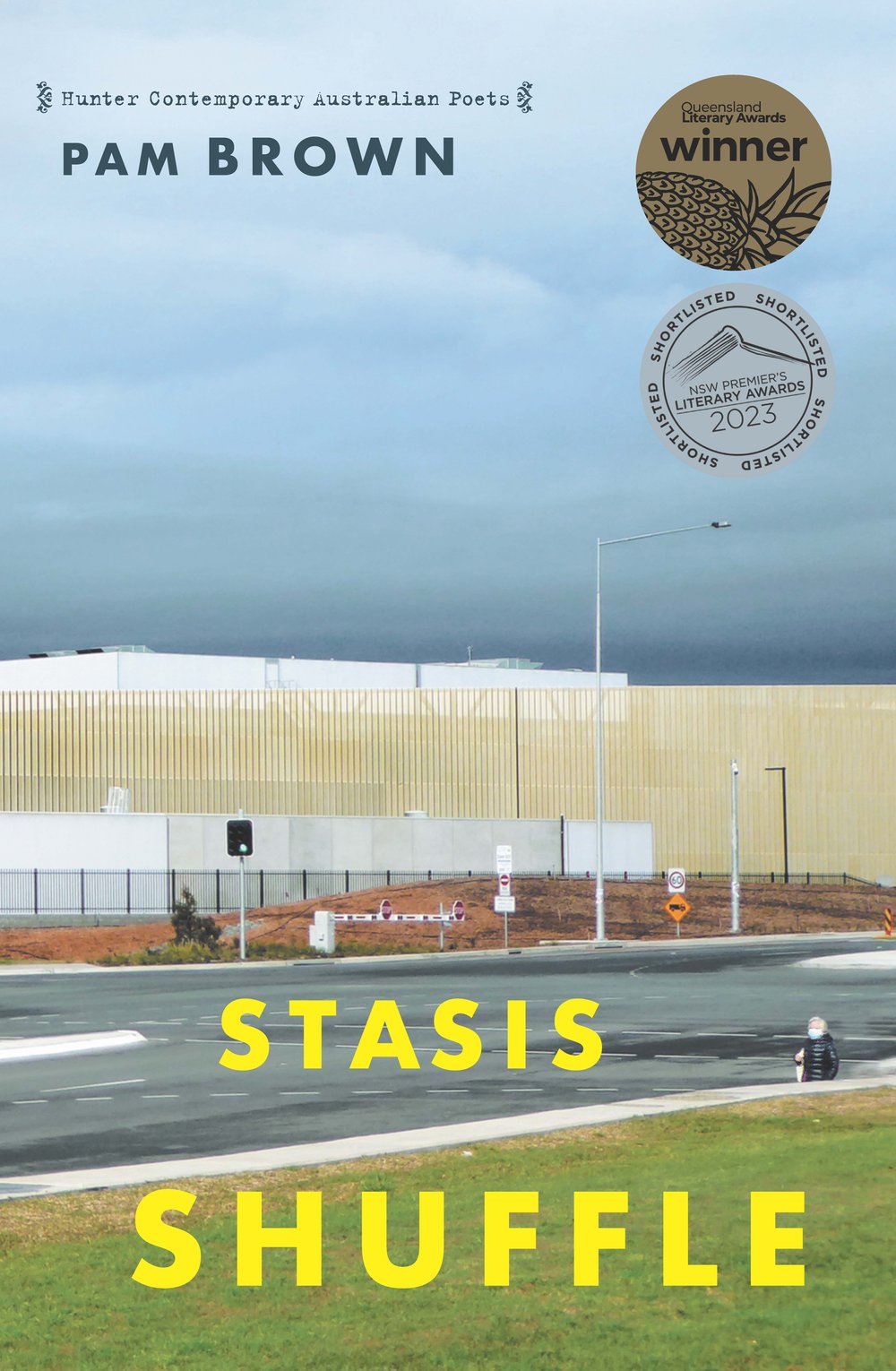
Stasis Shuffle by Pam Brown
Hunter Publishers, 2022

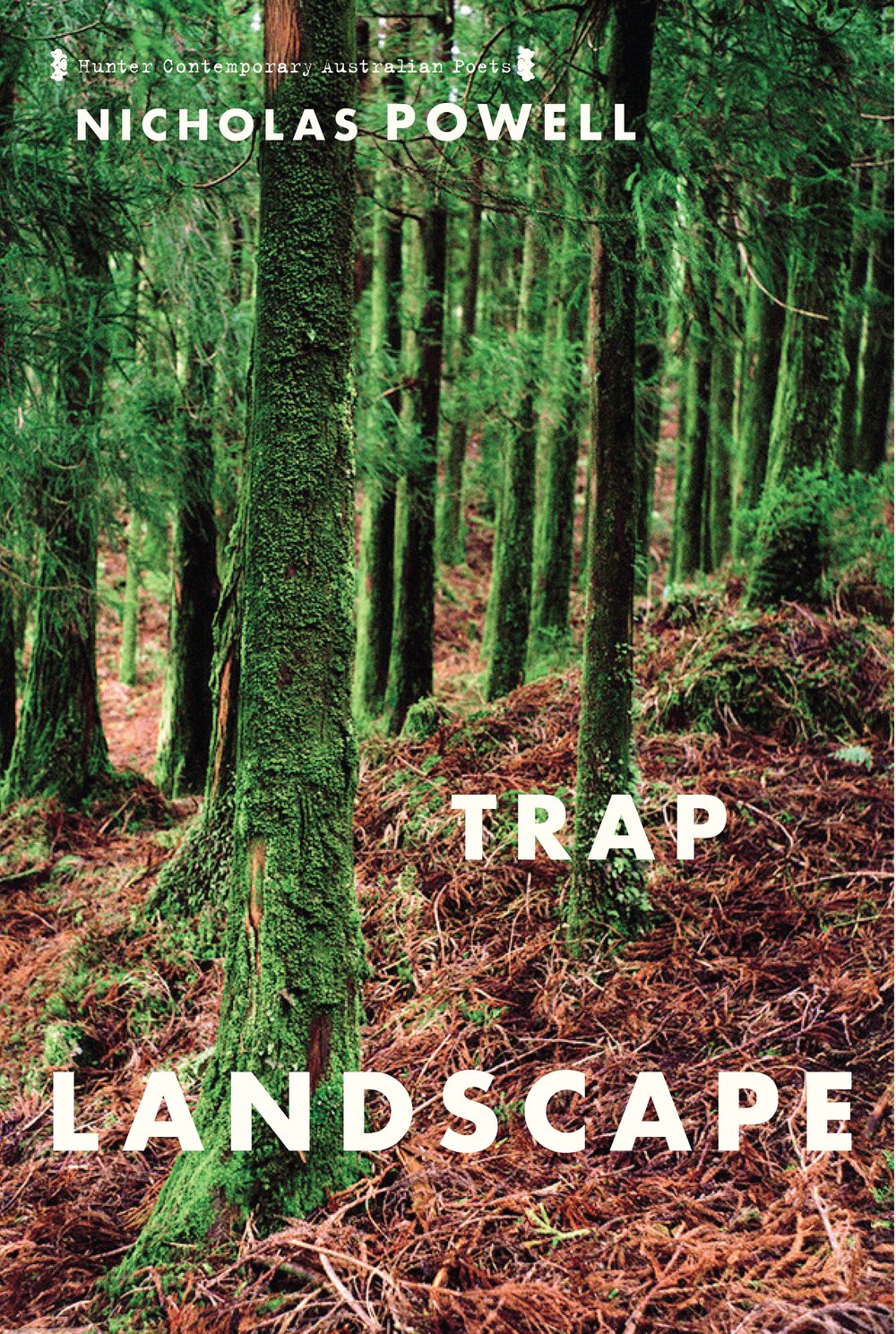
Trap Landscape by Nicholas Powell
Hunter Publishers, 2022


The last poem of Pam Brown’s Stasis Shuffle, ‘(fundamentals)’ begins with the lines: “make a distinction / between imagery / & reality” (103). As much as the distinction in question evokes the verisimilitude of the fake, a need to separate unreliable image from truth, Stasis Shuffle’s interest in reality and authenticity goes deeper. The lines above resonate with the book’s cover, a photo of an urban landscape so carefully constructed that the photo (especially its forward half) might be taken for a planner’s sketch or impression. Myth’s claim to truth has been an important part of Brown’s work, though a focus here is the way the real world comes to relate as something less than authentic.

In ‘(best before)’, Brown writes:

my feeling is
           the planet is losing its real
(like 
       everyone knows)

(11)

Beginning with the personal and possessive, such words imply a primacy of individual expression alongside matters of the planetary and existential. Alternately, if the kinds of things that everyone knows signal resignation, they can do with reiterating. The idea of the real is extended in ‘(last known location)’:

r.i.p

icon 
of blankness
       embracing 
inauthenticity

you will be 
         missed

(99)

This balances a timely scepticism (“blankness”, “inauthenticity) with an image of misguided reverence, idolatry. It’s the inauthentic in this case with which the world is enamoured. Brown critiques a culture of individualism in ‘(mme nhu)’:

how many eyes 
        go to the gym
its wall mirrors 
                       colliding 
         with lust

(34)

And this critique might be considered with the following on ecology, “earthmovers that never said, ‘sorry rhizome’,” if we think of self-sameness as monoculture (14). Together such examples suggest totalising political structures, according to which “the systemic management / of culture” occurs as much from a self-regulatory within, as from a governmental without (20).

Consumerism and digitalisation are presented as cultural forms toward the degraded experience of the real, which in ‘(next time)’ is mediated, literally diluted, juxtaposed to the sensory real of the poem:

        you licked a saltbush
        out in the scrub –
that’s the photo

that the taste
         wasn’t that good
isn’t ‘revealed’

(17)

As with the decontextualising image/photo, the passage

it beggars
           belief
that
ipad streaming
was all they did
beneath the campanile

(‘(I can hear your aargh from here)’,44)

ironically engages the diminished status of high culture yet points to the relocation of experience to digital contexts, with the effect that “there’s no history / there’s (only) allegory” (‘(best before)’, 8). It’s here in part, in a context of experiential inauthenticity, that the title Stasis Shuffle gathers meaning, suggesting a recombination of existing elements, perpetual sameness attended by superficial change, production and reproduction, “old […] faking new,” the kind of change implied by the streetscape on the cover (65). Stasis Shuffle’s 2021 publication coincided with COVID-19 shutdowns in Australia and internationally, with their impact on world production, and as much as the title calls to mind an unchanging political reality, it also hints at a welcome stasis, one “liberated / from the drudgery / of usefulness,” as ‘(best before),’ quoting Walter Benjamin, puts it (3). In this perspective

everyone
                   should just
                   leave
                   everything
&
  I do mean
  every thing
                   alone

(‘(I can hear your aargh from here)’, 46)

Brown’s work has often questioned poetry’s social efficacy. (See for example ‘susceptibility song’ from 2018’s click here for what we do, and its ambivalence around poetry’s agency for change.) While Brown writes “not a poet for nothing” in ‘(best before),’ the idea of liberation from usefulness alludes to poetry itself as a non-productive activity (4). Untethered from economic or cultural duty, poetry becomes a site where “nobody’s governing” – permissive, potentially anarchic – a sense conveyed in Brown’s tonal ease and delightfully irruptive logic (“eat barking dog”, “drink / your shingles / if all else fails”) (‘(best before)’, 4; ‘(plastic & tragic)’, 27; 27). There’s an air of abandon, a trust in impulse, intuition:

life’s more fun
                  when you
                  don’t know
what the hell
 you’re doing

(29)

Brown begins the poem ‘Might as well’ from her 2015 collection Missing up with the lines: “born in parenthesis / raised in an interstice” (42); she writes in click here for what we do of “interstitial thinking” (‘Susceptibility song’, 86). As if to consolidate an early conceptualisation of process, Brown parenthesises each of Stasis Shuffle’s poems’ titles – locating the poem at the gaps and apertures of systemic culture, while implying clarification, revision, an imposition of terms and conditions on the otherwise culturally acceptable or legitimate. In this revisionist space Brown can assert a value for poetry. If the phrase “daydreaming […] good for you” in (39) ‘(mme nhu)’ tends to the political, values for poetry are further communicated in ‘(the real)’ (39; 32). The images of Jack Spicer and experimentalism

    evil boy genius
             jack spicer
desired
    a peculiar derangement
            of experiment

(32)

critique the masculine, intellectual exceptionalism – a tradition of literary experimentation, and within which Brown herself can be said to write – it’s the ending that’s most interesting:

jack was right
            when he said
the imagination
pictures
the real

(33)

The underline highlights a concession, but a conditional, an ironic one, something like a backhanded compliment (he was right, for once). Poetry diminishes myth, as well as poetry’s myth-making (“not every / mundanity makes into a poem”) (‘(looks like)’, 85). But in ‘(the real),’ the rewriting of myth progresses to a truth or ontology (the nexus of imagination and reality) yet caveated by “the imagination” and “pictures,” whose connotations of the dream-like, and cinematic, shadow any transparent idea of the real.

Many of the poems in Stasis Shuffle use the divided shapes and forms for which Brown is well-recognised; there are also some key variations. The stepped lines of ‘(next time)’ and ‘(drinks)’ share a visual likeness with the poems around them. Their enjambment, line-by-line grammar, and reflective parenthesis build, however, to a more firmly cumulative impact. ‘(drinks)’ seems most notable in this sense. Picking up about halfway through, it reads:

kept up, & alert
              by an urgent
contingency
      &     (possible)  opportunism
that could be
  slowly dismantled
        by the friendship machine
or even
       (boring perhaps to some)
the very isomorphism
       agamben or derrida
or
   some other lacanian or other
warned us against
  before
              we desublimated
into a cool, casual enjoyment
             (though not without
                      emotional labour)
        of
        too many drinks

(59)

The later section ‘(pressure’s on) six mini double sonnets’ reflects further variation, only whereas ‘(drinks)’ extends the fragment through sustained grammatical impulse, the poems here reduce it. Lines are mostly stand-alone phrases:

memory seafoam
hidden expectations
keen accomplice
no provocation
exercise yard
ecco runners
pressure’s on

(72)

There’s the feeling of speed, at odds with or in response to the stasis of the title. Brown writes in ‘(fundamentals),’ “it’s insane it’s fast / it’s fun,” which perhaps sums up the spirit of ‘(pressure’s on)’ (105).

It’s fun but there’s also a keen discipline at work here. In their unstinting documentation of the moment, Brown’s poems read like maps of exemplary (sustained) concentration, both individually, and then together, as a rich and extraordinary oeuvre.

Posted in BOOK REVIEWS | Tagged , ,

Submission to Cordite 112: TREAT

Ok, who’s up for a treat? Who couldn’t use a treat in these difficult times?

What, for you, counts as a treat? Where do you find joy, delight or amusement?

What subject or topic do you want to treat with the respect (or mockery) it deserves?

Who are you treating how? What gifts are you giving? What terms do you want to discuss or negotiate? Who or what would you like to heal or cure?

This is your invitation to treat Cordite readers to seriously good poems that engage with, respond to or explore the meaning(s) of ‘treat’.


This podcast sheds some insight on how Cordite Poetry Review (and Cordite Books) works.

Submission to Cordite 112: TREAT closes 11.59pm Melbourne time 4 February 2024.


Please note:

  1. The guest editor(s) has sovereign selection choice for all poems submitted.
  2. Masthead editors will also contribute to the issue.
  3. We will only read submissions sent during our official submission periods.
  4. Please place up to three (3) poems in one (1) Word, RTF or PDF document (unless specifically noted otherwise for special issues), with no identifying details in the document itself.
  5. We are not able to offer feedback on individual poems.
  6. Submissions will only be accepted via Submittable …

submit


Posted in GUNCOTTON | Tagged ,

Will Druce Reviews Michael J. Leach and Theodore Ell

Natural Philosophies by Michael J. Leach

Recent Work Press, 2022

Beginning in Sight by Theodore Ell
Recent Work Press, 2022


Published by Recent Work Press in 2022, the following two debut collections of poetry I’ve had the pleasure of spending time with are both stylistically and gestationally distinct from one another. Natural Philosophies by Michael J. Leach is an eclectic mixture of poetic experiments that nobly attempt to marry science and medicine with art and poetics. Theodore Ell’s Beginning in Sight, gracefully vintaged in its composition and heavily focused on the primacy of the visual, is a haunting and considered meditation on time as it unfolds beneath the eye.

Natural Philosophies is Michael J. Leach’s debut full-length collection of poetry, and emanates the excitement and enthusiasm of a poet who has, in discovering musical instruments, not only taken up learning the piano but the guitar, oboe, trumpet, flute, and marimba. While the themes of Leach’s book revolve mainly around the intersection of health-related bioscience and poetics – in particular applying his pharmacoepidemiological background to this encounter – the poetic forms he employs in the treatment of his subject-matter are diverse and eclectic. The pleasure which Leach takes in exploring such a variety of instruments is the central joy of this book – from concrete poems, ekphrasis, a villanelle, a variety of ekphrastic poems, and several variations of the acrostic to dual-stanza poems and sets of haiku. It is easy to tell that Leach is having abundant fun, which in its own way is deeply refreshing to witness. Leach has great empathy for readers who identify with feeling alienated by the use of specialised language and goes to great lengths to cater for his audience. The medical, pharmaceutical, and health-system lexicon Leach employs in many of his poems attempts to cushion language that can be difficult to navigate and discern as non-doctors.

While it is of course common for volumes of poetry to contain notes on their poems to acknowledge intertextual references, obscure terminology etc., Leach’s ‘Notes’ section contains an 8-page appendix that offers at times a play-by-play break down of more or less every poem in the book. With this exhaustive reference section Leach is more or less offering to do all the work a curious and enthusiastic close-reader would otherwise have taken pleasure in doing for themselves. Perhaps this is due to Leach’s concern that these poems may be overly strenuous for the target audience to interpret, or perhaps the concern is that they may be ‘asymptomatically’ read by some kind of ‘free-reader’ out there who Leach is worried may not uncover the ‘right’ mandible/cranium/femur when they do not fervently excavate for his true intention. Leach politely assists us in our efforts, freely or unfreely, to understand what he has decided is happening in his poems and, for example, which Bass Strait Leach he is referring to in his concrete wave-poem ‘Back to the sea’ when he describes “salty, curvaceous waves direct from Bass Strait” (the one north of Tassie FYI) (30).

Leach does not leave us stranded and alone with poems such as ‘Frida Kahlo’s Backbone,’ which before reading Leach’s notes, I could only assume was the miraculous ekphrastic discernment of the meat of Kahlo’s biography from her 1944 painting The Broken Column.

Frida Kahlo was born in July, 1907 in old Coyoacán, Mexico. She was six years old going on 47 when polio struck her down. She survived with a shrivelled leg and threw herself into sports. Proud parents stoked the bright fire of young Frida’s quick mind. At 18, Frida was in a motor car crash that fractured her to pieces. Though she was lucky to be alive, her life goals burned to ash. Frida went from aspiring doctor to patient trapped in body casts. (36)

While the poem is positioned as an ekphrastic response, it seems more like a chronologically ordered recount of important events in the painter’s life, embellished by a kind of Wikipedia format. The poem captures (according to Leach in his notes) the overlap between health and the arts that Kahlo’s paintings reflect. Perhaps Leach did indeed garner Kahlo’s biography purely from her self-portrait… in which case the poem is very impressive. Enthusiastic about concrete poetics, Leach page-centres the poem to emulate the appearance of a spine – a device he, again, faithfully lets us know about in his notes. As has become evident, Leach has made the job of reviewing the book at all somewhat difficult given that the books’ potential readers are able to garner more or less all the information I am passing onto them about Leach’s poems from Leach’s own handily attached notes. In this sense, the book has been self-reviewed, or self-treated, in advance, as it were. Leach provides a service for those readers confused by the symptoms of their reading and unable to address what perhaps has caused them to read the book in the first instance. We are left to feel a little like the patient with type 2 diabetes that Leach describes in his poem ‘The Second Type’ to whom the following line is addressed after being told to exercise and eat better; “I hand you a booklet while you stare at me” (45). Leach’s attached how-to booklet on his poems, unlike the one handed to his patient, does the ‘exercise’ of reading the poems for us, when presumably many poetry readers would prefer the exercise of interpreting these poems for themselves.

Leach’s poetry in this collection is at its strongest when it is most simple and least explained. A moving example is the closing poem of the book titled ‘Maternal Memories’ which explores the grief of Leach’s loss of his mother under the deeply estranged and emotionally abstract circumstances of the pandemic:

During this rare moment
with my baby sister,
I look her in the face –
lacrimal secretions
in familiar eyes
reflect mine
as we draw ever closer
to our final destination.

Here I am –
an off-duty statistician
wholeheartedly believing
in the beautiful spirituality
of synchronicity.

(63)

The only note Leach leaves us for this poem is a concise definition of the acronym DNA, as the rest of the poem rather poignantly needs no explanation – indeed it speaks for itself and Leach seems to be cognisant of this. Whatever allowed Leach to be confident enough to let this poem speak for itself is hopefully where we will see his poetic practice travel to next.

Posted in BOOK REVIEWS | Tagged , ,

Dominic Guerrera on as First Nations Literary Editor


Image by Thomas McCammon

We are honoured to announce that Dominic Guerrera has joined Cordite Poetry Review as First Nations Literary Editor.

Dominic Guerrera is a Ngarrindjeri, Kaurna and Italian person who resides on Kaurna Yarta. Dominic’s artistic practice includes Poetry, Pottery and Photography. Currently works as a First Nations Producer for Regional Aboriginal artists, has guest produced and curated several writers festivals and art exhibitions and is currently undertaking a Masters in Gender Studies.

In 2021, Guerrera was the recipient of the Oodgeroo Noonuccal Indigenous Poetry Prize for his poem ‘unwelcome to country’.

Posted in GUNCOTTON | Tagged ,