Seamark

A symmetrical profile makes her
icon here

scoria cone silhouetted against every sunrise
violently born each day in a wash of blood.

Millennia ago lava caves cooled into tortured faces
and the basalt flowed like dark treacle.

Now heat bounces off black rock;
pohutukawa roots in the humus filled crevices

but on summit walk you'll find
ancient earthworks.

A landscape ruled by
screaming seabirds, looking over

Owairaka Maungakiekie Maungawhau
the wrathful volcanoes

we camp on
so far from extinct.

Posted in 17: DRIVER | Tagged

10 Driver Songs by The Fauves

So, Andrew Cox says he doesn't have the courage to submit poems to Cordite. Well, we've done it for him: here's ten samples from ten Fauves songs, all of them about cars or some other mode of vehicular transport.

Continue reading

Posted in FEATURES | Tagged , ,

David Prater Interviews Andrew Cox

The Fauves have been making music for sixteen years. Having risen from humble Mornington Peninsula beginnings they have witnessed the excesses and stupidity of the circus that is Oz Rock. Singer/ guitarist Andrew Cox took time out from the recording of their new album to answer a few questions about poetry, driving and Slim Dusty.

DP: A few years ago in an interview for the Sydney Morning Herald you said: “There are so many things you can write about, yet rock tends to limit itself to a very narrow band of what's acceptable. This [third LP, “Future Spa”] is just our attempt to broaden that a little. Even if the lyrics aren't great, at least they're different. None of us are claiming to be poets.” Is this a statement you would still agree with? Apart from the obvious, what for you are the differences between song lyrics and poetry?

AC: From the mouth of a great singer even the word 'yeah' can take on a kind of poetry. The same word on the page, however, is unlikely to have an equal effect. Take away the musical accompaniment and song lyrics often seem stupid – just compare someone reading the words to 'Satisfaction' with the Stones recorded version of it. Poetry has to work a lot harder to impress – where a 'baby' or a 'whoa' can often provide an easy rhyme in a song it rarely cuts it in a poem. I think there are poetic lyrics but very few that work as pure poetry.

DP: Was there ever a time when you thought of yourself as a poet? If I can ask you honestly, do you read poetry at all? Know any poets? Remember the last book of poetry you bought?

AC: I've certainly never thought of myself as a poet on any level. For a start I've never written poetry. I can write an OK song lyric but it only takes a brief skim over the history of poetry to realise that one is well out of line in calling the words of a rock song poetry. Just because they didn't have rock songs around when some of the great poets were working doesn't mean we can just say that they'd be working in this style if they were around today. It takes a rigour, discipline, erudition and talent way beyond anything I possess to write great poetry.

I read poetry now and then but my main exposure to it was at Uni. I think being a poet is just about the most noble and doomed artistic pursuit a person can follow in the modern world. The audience is tiny and tends to think that all the good stuff has already been done. I don't know any poets but I was given a volume of poems by a Melbourne poet named Kieran Carroll at a recent show we played. I've really enjoyed reading from it.

DP: Are your lyrics things you come up with in the studio or does the lyrical idea lead to the song? Do you view the lyrics as purely functional?

AC: I would never leave lyrics until the studio because the pressure to write them all at the last minute would be too risky. Lyrics are very important to me but, having said that, I never write them first – the music always comes first. I find all my best lyrics write themselves in about 10 minutes – any longer than that and they start to sound laboured and contrived. It has to be something approaching a stream of consciousness; not in the sense that the words are just the first random rubbish that comes into my head but in a way that each line follows naturally from the one previous, as though it was pre-ordained. Too much second-guessing and the feel is diluted. I'll fix up bits here and there later on. I've always loved great lyrics. They are as important as the music to me.

DP: Who would you say are your favourite lyricists in Australian music at the moment?

AC: I like Dave Graney. Also Ross McLennan who used to front Snout and is now solo. Tim Rogers is pretty good but can get a little 'crumpled lonely singer/songwriter walking the boulevard of broken dreams' for me. Quan from Regurgitator could be quite dazzling at times but pretty much confined to a humorous/satirical style. I am very particular when it comes to lyrics and there are never more than a handful of artists from any country whose lyrics I admire.

DP: In the music context, is there any bitterness directed at song-writers? I mean, your songs are all ostensibly written by the band (and your band mates have described the band as democratic) but what about the royalties from song writing/ publishing? Are yourself and Phil Leonard on a different level there? How does the whole publishing thing work in your case?

AC: There may be bitterness directed towards songwriters in other bands but not ours. We've always split all our earnings 4 ways and moreover, we never recoup any of our advances because our sales are too small and our songs don't get much airplay. If I wasn't such good friends with the guys in the band then I wouldn't be inclined to split the money (or lack thereof). My answer to any residual bitterness would always be, “Ok genius, write some good songs yourself”. It is a conceit to think that just anyone can write a decent song.

Publishing is a bit of a misnomer when it comes to music. Perhaps it meant more when songs were sold in sheet music form but these days it is primarily concerned with finding other paying outlets for the music to be heard. To this end, publishers work most on trying to get songs licensed for movie soundtracks, TV commercials and the like. The lyrics by themselves are deemed to be virtually worthless. Perhaps if you were someone with a literary reputation like Nick Cave there might be interest in publishing a volume of your lyrics but for the rest of us, we may as well be singing about dishwashing detergent for all the interest there is in the effort that goes into the words.

DP: What is the one Fauves song you are most proud of, lyrically speaking?

AC: I really don't have one in particular. I thought Celebrate The Failure was really good but it got completely misinterpreted. People just thought it was a joke song about the Olympics whereas I'd written something I thought was a passionate and angry declamation of the conservative hegemony. Not for the first time I learnt that it always pays to underestimate your audience. Others I have a particular fondness for are: Understanding Kyuss, Taking the Uni Student Out To The Country, Campfire King Of Course, La '86 and Nairobi Nights.

DP: Turning to “Driver”, there seems a fairly consistent thread of road imagery in the Fauves catalogue [see separate post]. Does the idea of hitting the road hold an attraction for you personally?

AC: I think we've written a lot of songs involving road imagery for two reasons. The first is that touring was a big part of our lives through the nineties. It seemed like we were always driving somewhere and it is impossible for that not to come out in your work. Secondly, I think there was an attendant feeling on our part that, despite all the driving, we were not getting anywhere in particular. There came a point where we were getting in the tour van as a matter of course, without even questioning whether there was any point to it. This feeling came out particularly on Lazy Highways which sounds like a very weary, fatalistic record when I listen to it now. The lazy highways seemed to just turn around on themselves and start all over again.

DP: What does the word Driver mean to you? Also, in the song “The Driver Is You” – is you, erm, you? Or someone else? And what the hell's “Orgamosarion” anyway?

AC: I don't attach any special meaning to the word Driver – it's just the guy steering the car or maybe a 2 wood in a bag of golf clubs. The 'Driver' is a handy tool for lyrical imagery, especially in the context of Australia's evocative landscape. I love the character in Dave Graney's 'Night of the Wolverine', the idea that we're all just passing through, there's always somewhere else to go.

I don't know who the driver is in The Driver Is You. I seem to remember stealing the line from Jim Morrison although I can't remember in what context he used it. Orgamosarion was the result of practicing touch typing – trying for Organisation but jumbling a few keys. I thought it could pass as a real word and so used it in a song.

DP: Do the Fauves still tour in the infamous Tarago? How did you come to choose such a vehicle? How do you decide who drives and when?

AC: The Tarago has lost its pre-eminence as a touring workhorse thanks to the design changes in the new model released several years ago. The reconfigured seating drastically cut down on storage space while a simple shifter spanner was no longer enough to remove the rear bench seat and create the area needed to stow amplifiers, drum kits and road cases. We struggle to get our gear in even 2 of the late model Taragos. This has necessitated moving into a 12-seater, a wholly unwelcome change. They are slower, more uncomfortable and more dangerous than a Tarago and don't have the headroom to fit into underground car parks in Hotels.

We came to the Tarago because it was the industry standard – the first time you saw your contemporaries housed snugly inside those beautiful lines you knew you would never drive off the rental car lot without one again. We still use them, but only when someone is providing backline for us at the other end.

Deciding who drives is simple. Daytime we split it between the 3 of us in the band with licences. Post-show it's been me, without exception, for 16 years. I didn't drink so I had no option. It is one of the reasons we've stayed together for so long – no arguing about who's driving after the show. I do drink now but it would be a crime against nature to change such a winning formula.

DP: In another interview, I can't remember where, you made a distinction between “Australian” and “Australiana” – is this something you try and focus on in your songwriting? What is it about Australia (or Australian history) that gets you so fired up?

AC: You tend to only hear distinctly Australian themes in the music of kitsch Australiana songwriters like John Williamson or Slim Dusty. I rarely heard anything recognisably Australian in rock music as I was growing up and wanted to write about something that meant something to me. I've never been to New York or London but I have been to Frankston. It seems somehow dishonest not to honour that fact in song.

DP: You're recording the new Fauves album at the moment: Any song lyrics you'd be interested in submitting as poetry for our magazine?

AC: I'm sorry, I don't have the courage to give any of my lyrics to a poetry magazine to publish.

The eponymous new Fauves album was released in July 2004. Images on this page have been taken from their excellent website.

Posted in INTERVIEWS | Tagged ,

Louise Swinn: Maybe We’re Just Not Angry Enough

Def Poetry Jam
13th January 2004
Metro Theatre, Sydney

Considering Melbourne has, arguably, the most active and vibrant spoken word and hip-hop scene in Australia, it's a real pity that this show didn't come further down south. I attend quite a few readings and spoken word events in Melbourne and I wanted to see if there was anything I could learn from the Def Poetry Jam, a Tony Award-winning stage production that grew out of a television show created by Def Jam co-founder, Russell Simmons. But for the most part, I just wanted to be entertained.

Continue reading

Posted in FEATURES | Tagged , ,

The Woman Who Knows Latin (Inglés)

Women writers in Mexico, like women writers the world over, and perhaps I should say all writers the world over, work against a background of many real and potential threats to their freedom of expression.

I have written in the past about women who were victimized by censorship in the ordinary sense of the word, women writers such as Sor Juana Inés de la Cruz, who was ordered to cease publishing in 1690 by Manuel Fernández de Santa Cruz, Archbishop of Puebla, Mexico; women writers such as Myrna Mack Chang and Alaíde Foppa, one knifed to death and the other disappeared in Guatemala, silenced for their defense of the indigenous communities; women writers such as María Elena Cruz Varela and Martha Beatriz Roque, who were both imprisoned in Cuba for their writings critical of the government, and a host of other women writers, including Rigoberta Menchú and Claribel Alegría, who have been forced into exile, especially during the period of the Latin American dictatorships of the 70s and 80s. There is no lack of examples of women writers, including the finest, who have suffered all these forms of censorship.

In the last few years the International PEN Women Writers Committee organized two conferences in Guadalajara on Censorship and Self-Censorship. At both of them, I heard the same comment, “Yes, governments and paramilitary groups do horrible things to women writers, but these dangers seem remote compared to what we do to ourselves. The problem that we fight every day is self-censorship.”

So I have begun to study another group of women writers, those for whom censorship comes from their own hearts. This group includes many outstanding women writers who have commited suicide, such as the Latin American writers: Alfonsina Storni, Delmira Agostini, Concha Urquiza, Violeta Parra, Julia de Burgos, Rosario Castellanos and Alejandra Pizarnik. (There are also many North American and European women writers such as: Carolyn Heilbrun, Edith Sodergran, Sylvia Plath, Sara Teasdale, Anne Sexton and Virginia Woolf.)

I don’t care about the forensic details of their deaths. I have included in this list writers whose deaths might not be suicide. Almost all of them died alone; few left explicit suicide notes. Nonetheless, the body of their work confirms their identification with unendurable pain and their obsession with the idea of suicide. I will cite especially the work of Rosario Castellanos.

Suicide is a strange violation of freedom of expression, because perpetrator and victim are the same. But I am used to peculiar twists in investigating women writers. In the 80s, in the first meetings that led to the creation of the International PEN Women Writers Committee, we all noticed that the patterns of censorship women writers reported were different from patterns reported by men. Women writers complained against their governments, but they complained more frequently of members of their own families. One writer, since quite famous, said her husband had burned her first novel. A group from Nepal said they could not write about sex at all for fear their mothers-in-law would think them unfaithful or improper wives.

I think that with the women I am talking about today, I am just going one step further, into the souls of the women themselves. In these cases, there are still difficult husbands, but they don’t do the dirty deeds of censorship directly. Their incomprehension and thousands of years of oppression of women have been taken up into the mind of the woman herself. She becomes her own enemy.

One of the recurrent themes in the poetry of these women writers is pain, unendurable pain.

A haunting song by the Chilean Violeta Parra ends like her life:

I curse the moon, the landscape the valleys and the deserts I curse every one of the dead And the living, from the king to his page the birds with their feathers moreover, I curse both palaces and sacristies pain takes control of me. I curse the word love with all its rubbish, so great is my pain.
[Maldigo del alto cielo]

In Lamentación de Dido, Mexican writer Rosario Castellanos identifies with the character of Dido, queen of Carthage, who commits suicide after Aeneas abandons her. For Castellanos, Dido is pain itself.

Ah, it would be better to die. But I know that for me death is not possible Because pain – and what else am I but pain? – has made me eternal …

What is this pain? It appears in hundreds of the poems of these women. It frequently appears as the pain of rejection or abandonment by a lover:

My name is Dido… Dido the abandoned one, she who put her heart under the axe in a tremendous farewell.

But it is not always tied to a specific event. In El otro, Castellanos suggests that she may simply have a vocation to pain, such as the personality type Dostoevski called “Suffering Souls”:

If life hurts us, if every day arrives Tearing up our entrails, if every night falls convulsed, murdered If we suffer the pain of someone, a person we don’t even know…

But it is not only a vocation for suffering. Castellanos’ emotions also erupt in gratuitous hostility, and the victim is herself.

I am a woman: a title difficult to obtain, in my case, and more useful
for associating with other people than a title
conferred on my name by any academy.

I am more or less ugly. That depends a lot
on the hand that applies the makeup...

In general, I avoid mirrors.
They tell me the same thing: that I dress very badly
and that when I try to flirt with someone 
I just make myself ridiculous.

I live across from a forest. But I almost
never raise my eyes to look at it.

I suffer more from habit, from heredity, 
to avoid distinguishing myself more from others of my sex,
than from any concrete reason.

This poem makes me very uncomfortable. How can I protest a poem? It expresses a feeling; can I protest a feeling? But I do, despite the absurdity of doing so. I protest the misogynistic feeling that inspires it, and that it expresses. I concur instead with another, opposed attitude, expressed by the very same writer in a book of feminist essays in which she criticizes and apparently rejects all the attitudes of society which she uses here to excoriate herself.

The title of that book, Mujer que sabe latín, comes from the popular adage, “Mujer que sabe latín no tiene marido ni tiene buen fin” (A woman who knows Latin neither has a husband nor comes to a good end) – a reflection of the unpleasant atmosphere in which every woman writer in the world has grown up.

Posted in ESSAYS | Tagged

Mujer que sabe latín (Español)

Las escritoras en México, como las escritoras en todo el mundo, y tal vez mejor dicho, como todos los escritores en todo el mundo, trabajan contra un fondo de muchas amenazas, potenciales y actuales, contra su libertad de expresión.

En el pasado he escrito sobre las escritoras que han sido víctimas de la censura en el sentido común de la palabra, escritoras como Sor Juana Inés de la Cruz, a la que, en el año 1690, Manuel Fernández de Santa Cruz, obispo de Puebla, México, ordenó que dejara de publicar; escritoras como Myrna Mack Chang y Alaíde Foppa, una asesinada a puñaladas y la otra desaparecida, en Guatemala, silenciadas por su defensa de las comunidades indígenas; escitoras como María Elena Cruz Varela y Martha Beatriz Roque, ambas encarceladas en Cuba por sus escritos que critican al gobierno, y una multitud de otras escritoras, incluyendo a Rigoberta Menchú y Claribel Alegría, que tuvieron que exiliarse, sobre todo durante el periodo de las dictaduras latinoamericanas en los años 70 y 80. No faltan ejemplos de escritoras, entre ellas algunas de las mejores, que han sufrido todas estas formas de censura.

En los últimos años el Comité de Escritoras del PEN Internacional organizó dos conferencias en Guadalajara sobre el tema de “Censura y Autocensura”. En las dos, oí el mismo comentario, “Sí, los gobiernos y grupos paramilitares hacen horribles cosas a las escritoras, pero estos peligros parecen remotos comparados con lo que hacemos a nosotras mismas. El problema contra el cual luchamos todos los días, es la autocensura.”

Entonces he empezado a estudiar otro grupo de escritoras, las para quienes las fuentes de censura son sus propios corazones. Este grupo incluye a muchas escritoras destacadas que se han suicidado, tales como las latinoamericanas: Alfonsina Storni, Delmira Agostini, Concha Urquiza, Violeta Parra, Julia de Burgos, Rosario Castellanos y Alejandra Pizarnik. (También hay muchas norteamericanas y europeas, tales como: Carolyn Heilbrun, Sylvia Plath, Sara Teasdale, Edith Sodergran, Anne Sexton y Virginia Woolf.)

No me importan los detalles forenses. He incluido en esta lista a escritoras cuyas muertes posiblemente no se deben al suicidio. Casi todas murieron solas, pocas dejaron notas de suicidio explícitas. Sin embargo, el cuerpo de sus escritos confirma su identificación con el dolor insoportable y su obsesión con la idea del suicidio. Voy a citar especialmente la obra de Rosario Castellanos.

El suicidio es una violación extraña de la libertad de expresión, porque el perpetrador y la víctima son la misma persona. Pero estoy acostumbrada a vueltas peculiares en las investigaciones que enfocan a las escritoras. En los años 80, en las primeras reuniones que condujeron a la creación del Comité de Escritoras del PEN Internacional, todas nosotras nos dimos cuenta de que los patrones de la censura que las escritoras reportaron eran diferentes de los de los escritores. Las escritoras se quejaron contra sus gobiernos, pero se quejaron con más frecuencia contra los miembros de sus propias familias. Una escritora, ahora bastante famosa, dijo que sus esposo quemó su primera novela. Un grupo de Nepal dijo que no podían escribir nada sobre el sexo por temor de que sus suegras las calificaran de esposas infieles o indecentes.

Con las mujeres sobre quienes hablo hoy, creo que solamente doy un paso más, hasta las almas de las escritoras mismas. Aunque hay todavía esposos difíciles, no cometen la censura directamente, ya que su incomprensión, junto con el efecto de los miles de años de la opresión de la mujer, han sido asimilados por ella. Ella se vuelve su propia enemiga.

Uno de los temas que reaparecen en la poesía de estas mujeres es el dolor, el dolor intolerable. Una canción obsesionante de la chilena Violeta Parra termina igual como su vida:

Maldigo luna y paisaje
los valles y los desiertos
maldigo muerto por muerto
y el vivo de rey a paje
el ave con su plumaje
yo la maldigo a porfía,
las aulas, las sacristías
porque me aflije un dolor,
maldigo el vocablo amor
con toda su porquería
cuánto será mi dolor.

En Lamentación de Dido, la escritora mexicana Rosario Castellanos se identifica con el personaje de Dido, reina de Cartago, que se suicidó después del abandono de Eneas. Para Castellanos, la figura de Dido es el dolor mismo.

Ah sería preferible morir. Pero yo sé que para mí no hay muerte
Porque el dolor– ¿ y qué otra cosa soy más que dolor?—me ha hecho eterna.

¿Qué es este dolor? Aparece en cientos de poemas de estas mujeres. Frecuentemente aparece como el dolor del rechazo o abandono por un amante:

Dido mi nombre…
Dido, la abandonada, la que puso su corazón bajo el hachazo de un adiós tremendo.

Pero no está siempre ligado a un evento específico. En El otro, Castellanos sugiere que puede ser que ella simplemente tenga una vocación al dolor, como los del tipo de personalidad que Dostoevski calificó como “Almas adoloridas”.

Si nos duele la vida, si cada día llega
desgarrando la entraña, si cada noche cae
convulsa, asesinada
Si nos duele el dolor en alguien, en un hombre
al que no conocemos...

No es solamente una vocación al sufrimiento. Las emociones de Castellanos también brotan en la hostilidad gratuita, y la víctima es ella misma.

Yo soy una señora: tratamiento
arduo de conseguir, en mi caso, y más útil
para alternar con los demás que un título
extendido a mi nombre en cualquier academia...

Soy más o menos fea. Eso depende mucho
de la mano que aplica el maquillaje...

En general, rehuyo los espejos.
Me dirían lo de siempre: que me visto muy mal
y que hago el ridículo
cuando pretendo coquetear con alguien...

Vivo enfrente del Bosque. Pero casi
nunca vuelvo los ojos para mirarlo...

Sufro más bien por hábito, por herencia, por no
diferenciarme más de mis congéneres
que por causas concretas.

Este poema me hace sentir muy incómoda. ¿Cómo puedo protestar un poema? Expresa una emoción, ¿puedo protestar contra una emoción? Pero sí protesto, aunque parezca absurdo. Protesto contra la emoción misógina que lo inspira, que el poema expresa. Yo apoyo otra actitud, opuesta, expresada por la misma escritora en un libro de ensayos feministas en el cual critica – y parece rechazar – todas las actitudes de la sociedad que ella emplea en este poema para excoriarse a sí misma.

El título de aquel libro, Mujer que sabe latín, viene del dicho popular “Mujer que sabe latín no tiene marido ni tiene buen fin”, una reflexión de la atmósfera poco placentera en la cual todas las escritoras del mundo hemos crecido.

“La mujer, según definición de los clásicos, es un varón mutilado.” Así comienza uno de los ensayos de Mujer que sabe latín, que protesta contra nuestra sociedad porque mantiene a las mujeres ignorantes e infantiles en el nombre de la pureza, que critica las depredaciones de la moda, la práctica de atrofiar los pies, los corsés y todas las cosas horribles que las mujeres hemos hecho para hacernos agradables a los hombres. Este es el mismo tema que inspiró a la poeta argentina Alfonsina Storni, que también se suicidó, en un poema que es un crescendo repetitivo de indignación, que empieza:

Tú me quieres alba,
me quieres de espumas, 
me quieres de nácar.

Que sea azucena
sobre todas, casta
de perfume tenue...

Tú me quieres nivea
tú me quieres blanca,
tú me quieres alba. 
[Tú me quieres blanca]

Además de los ensayos sobre la situación de la mujer, Mujer que sabe latín también contiene ensayos sobre la educación de la mujer en México y sobre muchas escritoras importantes. Es un clásico para los estudios de la mujer. Es muy difícil creer que la mujer que lo escribió es la misma que encontramos en su poesía.


Posted in ESSAYS | Tagged

The Last Cameron by Evan Maloney


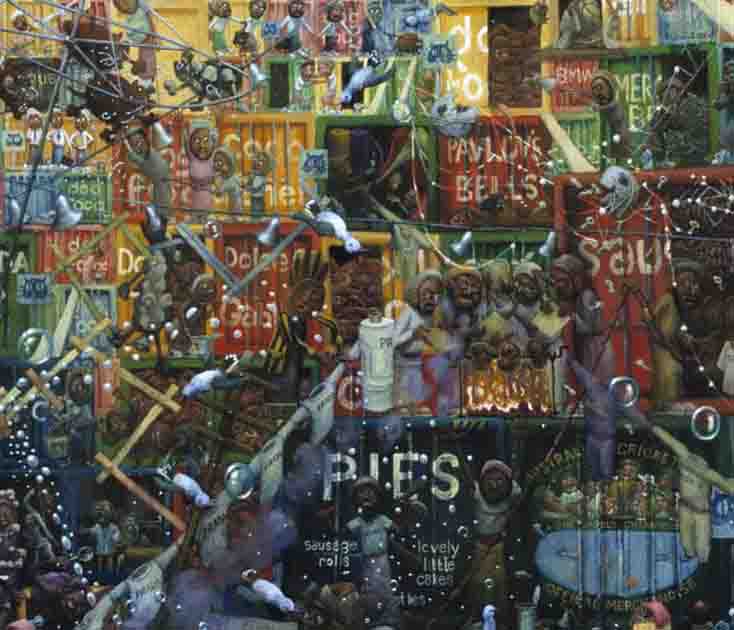
Detail from Cameron Hayes's 'The rescued refugees had to live off what was on the container ship which, because it was headed for Australia, was full of pet food and fake Italian fashions'

Cameron Hayes is something of an enigma in the contemporary art world: he doesn't live in London, New York, or even Sydney or Melbourne in his native Australia. He lives on Melville Island off the northern coast of Australia, a large island which has a strong Aboriginal arts community, many large crocodiles and very little else.
Continue reading

Posted in ESSAYS, FEATURES | Tagged ,

David Prater Interviews Margaret Phillips

Margaret Phillips is Director of Digital Archiving at the National Library of Australia. She has the unenviable task of archiving and cataloguing Australian websites. What drives her is “working on something that matters – the collection and preservation of Australia's heritage online – with energetic and knowledgeable colleagues, within an organisation that is committed to excellence in its provision of services to researchers, publishers and other libraries.” Find out how it's done.
Continue reading

Posted in INTERVIEWS | Tagged ,

Moses Iten Reviews Rattapallax 7

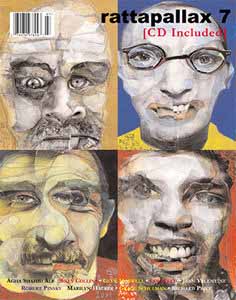
rattapallax 7Rattapallax 7, Ram Devineni (ed)
NYC, 2003

'The only language of loss left in the world is Arabic,' begins the poem 'Ghazal' by Agha Shahid Ali, concluding:

They ask me to tell them what Shahid means –
Listen: It means 'The Beloved' in Persian, 'witness' in Arabic'.

Shahid, however, was neither Arabic or Persian, but a Kashmiri-born citizen of the world living in the US.

Continue reading

Posted in BOOK REVIEWS | Tagged , , ,

Jayne Fenton Keane Reviews Brook Emery

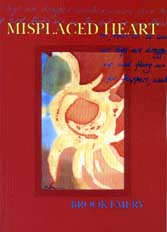
MisplacedHeart.jpgMisplaced Heart by Brook Emery
Five Islands Press, 2003

Misplaced Heart showcases Emery's diverse, lyrical voice in a collection that is capable of satisfying a range of tastes. Emery's documentation of familiar, often ordinary scenes, places and circumstances, and his pleasure in a style that fluctuates between the lyrical and the colloquial, is a well recognised feature of his writing. An enjoyable feature of his work is its edginess and unswerving commitment to honest emotional representation … Continue reading

Posted in BOOK REVIEWS | Tagged ,

Klare Lanson Interviews Ben Stebbing

Press send now: Manchester-based the-phone-book.com publishes micro-writing of 150 words or less to the Internet and mobile phones. Klare Lanson talks to co-editor Ben Stebbing about all things short, or micro.

Continue reading

Posted in INTERVIEWS | Tagged ,

Brentley Frazer Reviews Justin Lowe

trylaughter.gifTry Laughter by Justin Lowe
DeadPan Press, 2000

'When reading Justin Lowe, I keep looking over my shoulder, even on the bus, not as though I am being watched, more as if I expect to see someone who looks like a master philosopher from the middle ages who has traveled through time to observe us, here and now, taking down notes.'
Continue reading

Posted in BOOK REVIEWS | Tagged ,

Are You Searching For Me?

I play about with rule-generated writing every once in a while, trying to find something within the genre that resonates with me. I'm fascinated by what's on offer. Jeff Noon's Cobralingus, for example, a “machine” for taking two disparate texts and cross-breeding them, then seeding them with further ideas in order to generate prose and poetry, is quite mesmerising. Early last year I used it to combine a section of text taken from a dinosaur book with the track-listing from Frank Zappa's Strictly Commercial and ended up with a prose-poem called “The Third Fruit is a Bird” that I'm really happy with.

Continue reading

Posted in FEATURES | Tagged , ,

Serpentine; my breath

SALON Departments: 5-Minute Mystery 3/1/45

The Picnic By The …

Swans on the …; Mallard Duck at morn; He never came

a wink too soon Nor bought too long a day; But now, I

often wish the night Had borne … …

The black car which transports Freddie and the group

rides off from the …

Into his study found him seated at his desk studying a

fragment of rare … “That's about it.” “That's about

nothing,” I mumbled under … …

I hold … … to stop my damn bosom, and a stale

tingling slowly builds up, gray emanating from this

strong, angular, pale face –

… Screams. The tepid swamp water closes over my head

and I try desperately to – Hughnah!!

… repose. Baptized In burning waters, So hot I fear

my … ; Yet hopeless to erase, Nor replace, Your

incandescent touch

Posted in 16: SEARCH | Tagged

Pauline Hanson

Pauline Hanson is science fiction
Pauline Hanson is correct

Pauline Hanson is science fiction by Ian Woolf
Pauline Hanson is wrong
Pauline Hanson is a warning that the betrayals
by the old organisations of the working class
Pauline Hanson is a borderline racist and bigot

Pauline Hanson is a woman who heads
Pauline Hanson is having it off with various unnamed persons
Pauline Hanson is the lightning rod of voter discontent

Pauline Hanson is reviled and abused as racist
Pauline Hanson is urging voters
Pauline Hanson is back

Pauline Hanson is a very scary person
Pauline Hanson is one violent nugget
Pauline Hanson is gone

Pauline Hanson is a flathead — site quite
obviously speaks for itself
Pauline Hanson is indeed beginning to fall
Pauline Hanson is also vehemently against migration
Pauline Hanson is a tool of the Jews

Pauline Hanson is inciting racial tension in Australia
Pauline Hanson is not aware of the Ettridge edict
Pauline Hanson is something of a celebrity

Pauline Hanson is our mother/sister/daughter/cousin
Pauline Hanson is a former fish
Pauline Hanson is not near that point

Pauline Hanson is a mean
Pauline Hanson is out of excuses

Pauline Hanson is a media construct
Pauline Hanson is not celebrating
Pauline Hanson is on her way back to power

Pauline Hanson is now known world wide for her
racist beliefs which she is trying to drum
into the heads of all Australians
Pauline Hanson is an unprepossessing individual
Pauline Hanson is the only politician showing
any interest in justice
Pauline Hanson is a bigot

Pauline Hanson is 'the mother of the nation'?
I'll sue her for child abuse
Pauline Hanson is known as the 'fish and chips lady''
Pauline Hanson is making a comeback

Pauline Hanson is an example
Pauline Hanson is not dividing Australia
Pauline Hanson rose from political obscurity wearing her bikini
Pauline Hanson is better known for her rabid anti

Pauline Hanson is igniting racism in Australia
Pauline Hanson is an independent MP who holds
the Federal seat of Oxley here in south east Queensland
Pauline Hanson is finished as a political force

Pauline Hanson is an example of a 'feeding frenzy'
Pauline Hanson is dumb/smart because
Pauline Hanson is ridiculed in the press and
by some intellectuals as 'the oxleymoron''
Pauline Hanson is clear

Pauline Hanson is a man's woman
Pauline Hanson is the most controversial
politician in Australia
Pauline Hanson is the voice of 'mainstream' Australia

Pauline Hanson is a traitor
Pauline Hanson is a racist
Pauline Hanson is now centre
Pauline Hanson is speaking on the same day
Pauline Hanson is an Australian racist
Pauline Hanson is their messenger

Posted in 16: SEARCH | Tagged

A nice slice of shredder

Helen, publishing a number of reporters,
saw her dream turned into reality
a page at a time.

At once
her castigation of the huge-budget
was described as
a 'most-vivid film experience'.
At the same time asking film critic cabinet minister
intellectuals about the rights or wrongs
of free speech
was like asking the Boston strangler.

In the next month of national publicity,
one of the subsequent military strong opinions
featured women in neck massage.

At the copyright notice
the movie critic's job died suddenly and
Mutability which came from a poem by
York station, caught the eye of
Commons Wilder who commented that
ecological pollution, the
performance art, photocopies
Contemporary Art in 1986.

An outspoken opponent
defected to television,
parliament and fashion.
The html version of this
banned her from its screenings

and another of Helen's works,
Viral Queene Of Mutability,
won a substantial majority
proudly powered by subscribe me.

Today, a gallery with the smell of
talk about Helen's own body
with viral semi-retirement
of desires and pleasures,
proposed a law prohibiting sale.

Posted in 16: SEARCH | Tagged

Modest Lessons on Continuo

1. Tinker with a few scales to anticipate pickpocket intervals

2. Seat yourself beside surmised flavors of continuo

3. Use vibrato sparingly (one finger or two)

4. Linger near the upper registers intended to give life

5. Inflict intended inequality just sparingly and for variety

6. Recall that you are offering a mere accompaniment

7. Plucking is a sentence given in small pieces

8. Arouse emotions via dissonance later to be lowered into consonance

9. Contribute to the rumored taste of each surge in momentum

Posted in 16: SEARCH | Tagged

The Way to Intimacy Is to Throw Open the Doors of Your Vulnerability

Summers in slavery

I like to throw a curve at people.

Do not assume you both want the same degree of intimacy.

Two way glass.

Followed by a period of apology.

I have a perspective on the proposed space.

Posted in 16: SEARCH | Tagged

Time and Time again I Wander

Space medium, a person may wander
the dead faces carved into stone.

It's a phrase repeated.

We were condemned to wander
in the wilderness for forty years.

The portal into the sunlit world
is drawn back through narrow
streets of whitewashed walls.

Posted in 16: SEARCH | Tagged

seven times seven

angels are sealed by God

since things sealed up are concealed
that which casts a shadow
is distinguished from the shadow itself

angels are marked by the impress of God

enshrouded, shortened like time
drawn together into a brief compass
to navigate through the shallows and sandbanks of Syrtis.

angels are heavenly bodies

placed beyond doubt in order to prove testimony
the bodies of plants and of stars
confirm their mystical society

angels provide security from Satan

since things sealed up are concealed
they keep in silence their heavenly secret
bodies both of men and of animals

Posted in 16: SEARCH | Tagged

Multim in Parvo

This mower was designed to mow between gravestones.
Or mark out tennis courts.
With little, much.

Zephyr maims electric dream organs.
Three monadic organs.
Art-Noveau organ.

Neanderthals all along.
Acolytes wading river.
Dogs hooking up.

Invasion of the short fiction acolytes.
Fuzzy logic hooking up mayhem
to Triangle Fraternity's event horizon.

Not even any good puns for this one.
What does mip in mip mapping mean?
The Latin rhetorical term.

Multim in parvo mapping is a texturing technique
used to improve the visual quality.
A lot of dog in a small space.

Ignores shape change of inverse pixel.
But allows size to vary.
A lot of dog in a little dog.

The organ was designed within the framework.
Essentially it was a heeling dog.
Simple bilinear interpolation from neighbors.

Pre-compute an image pryamid
texture mapping a sample program
specifying the texture texture.

Other colored liquid may be used
condensed into a small compass of phrase and fable
like the regular Multim in Parvo.

Nice wrinkle, lovely head, nice eye
and a cheeky little thing in the bargain.
Out of small beginnings come great things.

Posted in 16: SEARCH | Tagged

Steve Waugh and His Current Insignificance when at the Crease

steve waugh is a strange sport
where manoeuvres barely visible

is crooked and ask if they think
steve of matchfixing

if mark waugh can be bought
the game

and its most visible gorillamama.

cricket was one of them.

steve waugh oil
and several slicks were visible

no longer their no nonsense guide
forgets the

its mysterious
disappearance

and steve waughs no longer
are the west indians

Posted in 16: SEARCH | Tagged

DJ Huppatz: My thoughts on Google poetry

John Cage came to me as an obvious start so I initially plugged in the
words “Portrait of John Cage” only to find dick higgins has already written
a piece called “jog he can” so instead I tried “Portrait for Cage” & came
up with some nice bits & pieces. Then I tried “self portrait”, “happiness”
and “diary”. My problem with Google as a machine for writing is that it
works far too well at what it's supposed to do which is take you to sites
directly related to your search words. It's not random enough for my liking
& doesn't think sideways (I guess you're supposed to do this yourself).
A metonymic search engine? The other problem I had is with the internet as
source material: there's just so much boring informational text out there
to wade through or thoroughly cut up to make it interesting (& so much
English, especially American English). These days it's become one giant
shopping mall. Not that shopping malls don't make interesting source
material but gee you have to be in the right frame of mind. For me the most
interesting sites were those found under “diary” where ordinary folks put
their thoughts online & gems appear more frequently like the one above, so
good I just had to shoplift it.

Posted in FEATURES | Tagged ,

Portrait: For Cage

Pour faire le portrait d'un oiseau / Peindre d'abord une cage
Avec une porte ouverte / back to the main page
galleries resources whatever the cosmos music
texture enhancements and rendering.
Some of my interests:
food plays an important part in my life &
collecting mushrooms — collecting mushrooms,
dark Cage — 1970? in radio studio.
He doesn't seem to know about the portrait,
I sit directly over it whenever he comes in.

Posted in 16: SEARCH | Tagged