
-
- 120: DIALOGUEwith E Chong 119: FITwith E Collyer 118: PRECARIOUSwith A Jackson 117: NO THEME 14with A Creece 116: REMEMBERwith M Sahhar and A Te Whiu 115: SPACEwith A Sometimes 114: NO THEME 13with J Toledo & C Tse 113: INVISIBLE WALLSwith A Walker & D Disney 112: TREATwith T Dearborn 111: BABYwith S Deo & L Ferney 110: POP!with Z Frost & B Jessen 109: NO THEME 12with C Maling & N Rhook 108: DEDICATIONwith L Patterson & L Garcia-Dolnik 107: LIMINALwith B Li 106: OPENwith C Lowe & J Langdon 105: NO THEME 11with E Grills & E Stewart 104: KINwith E Shiosaki 103: AMBLEwith E Gomez and S Gory 102: GAMEwith R Green and J Maxwell 101: NO THEME 10with J Kinsella and J Leanne 100: BROWNFACE with W S Dunn 99: SINGAPOREwith J Ip and A Pang 97 & 98: PROPAGANDAwith M Breeze and S Groth 96: NO THEME IXwith M Gill and J Thayil 95: EARTHwith M Takolander 94: BAYTwith Z Hashem Beck 93: PEACHwith L Van, G Mouratidis, L Toong 92: NO THEME VIIIwith C Gaskin 91: MONSTERwith N Curnow 90: AFRICAN DIASPORAwith S Umar 89: DOMESTICwith N Harkin 88: TRANSQUEERwith S Barnes and Q Eades 87: DIFFICULTwith O Schwartz & H Isemonger 86: NO THEME VIIwith L Gorton 85: PHILIPPINESwith Mookie L and S Lua 84: SUBURBIAwith L Brown and N O'Reilly 83: MATHEMATICSwith F Hile 82: LANDwith J Stuart and J Gibian 81: NEW CARIBBEANwith V Lucien 80: NO THEME VIwith J Beveridge 57.1: EKPHRASTICwith C Atherton and P Hetherington 57: CONFESSIONwith K Glastonbury 56: EXPLODE with D Disney 55.1: DALIT / INDIGENOUSwith M Chakraborty and K MacCarter 55: FUTURE MACHINES with Bella Li 54: NO THEME V with F Wright and O Sakr 53.0: THE END with P Brown 52.0: TOIL with C Jenkins 51.1: UMAMI with L Davies and Lifted Brow 51.0: TRANSTASMAN with B Cassidy 50.0: NO THEME IV with J Tranter 49.1: A BRITISH / IRISH with M Hall and S Seita 49.0: OBSOLETE with T Ryan 48.1: CANADA with K MacCarter and S Rhodes 48.0: CONSTRAINT with C Wakeling 47.0: COLLABORATION with L Armand and H Lambert 46.1: MELBOURNE with M Farrell 46.0: NO THEME III with F Plunkett 45.0: SILENCE with J Owen 44.0: GONDWANALAND with D Motion 43.1: PUMPKIN with K MacCarter 43.0: MASQUE with A Vickery 42.0: NO THEME II with G Ryan 41.1: RATBAGGERY with D Hose 41.0: TRANSPACIFIC with J Rowe and M Nardone 40.1: INDONESIA with K MacCarter 40.0: INTERLOCUTOR with L Hart 39.1: GIBBERBIRD with S Gory 39.0: JACKPOT! with S Wagan Watson 38.0: SYDNEY with A Lorange 37.1: NEBRASKA with S Whalen 37.0: NO THEME! with A Wearne 36.0: ELECTRONICA with J Jones
First light, Iluka
a hot northern wind
off Bluff Beach
batters the coast
in the CR-V, i curl up
beside a skateboard
camping gear, a mess
of clothes, listen
to old doors creak
in the stubborn joints
of banksias
*
through the window
first light, a Berlin grey
dragging me up
to the headland
where soft pinks
give line to horizon
waves wash around
the gumboots
of a fisherman
and in the distance
water exhales
a
tail
slapping
*
sun bites the ridges
of breakers as i jog
along the beach
yesterday’s tide curving
with the fingernails
of a thousand tiny shells
*
sitting on the back
of the CR-V, i brew
an instant coffee
smell those winter mornings
before school, when mum
would walk out
onto the back veranda
drink a Nespresso
smoke a Longbeach
while my sister and i
would eat Fruit Loops
by the heater
huddling so close
we’d singe the hairs
on our legs
*
what if poems
only came to you
of a morning
as if each day
required a small act
of worship
before it could get going
Posted in 115: SPACE
Tagged Jake Goetz
More than Seven Consecutive Zeroes
For Anna.
There are angstroms and there are
astronomical units and in the middle
of it all is us: pretending to listen to
the teacher as we judder our ruler
on the edge of our desks, resetting
our odometers for the trip to Nana’s
we promised to make but still haven’t,
snatching our hands out of the way as
the tape measure clatters and retracts.
We know feet and metres. We’re okay
with inches and square centimetres,
can guess a kilometre, but we’re not so
sure about ten to the power of negative
ten or fourteen point nine six times ten
to the power of nine. More than seven
consecutive zeroes and it all gets a bit
beyond us. We know it takes four years
for a photon to find its way from Earth to
Alpha Centauri, and three hours to drive
between Melbourne and Apollo Bay,
but how many walks to the milk bar make
up a single baryonic acoustic oscillation?
How many Bohr radii span the hair you
left lying on my pillow? Which is greater:
the ratio of the distance between the two
of us standing at the centre of an infinite
and expanding universe to the nominal
edge of that infinite and expanding universe,
or the ratio of the time we’ve spent together
to all of the time that’s yet to come? Even
if we could bodge up an answer, we’d still
need to give the numbers meaning, work out
how many birthdays that is, or how many
laps around Lake Wendouree. We can cite
subatomic and galactic distances, mnemonically
cascade from yottametres to parsecs right on
down through nanometres to the Planck length
itself. We can discuss and dissect all these
magnitudes, try to capture them with metaphor,
but right here at the centre of our universe,
huddled between infinities, is us: me and you.
Posted in 115: SPACE
Tagged Adam Ford
7 Monostich
One painting is removed. The room changes shape.
In the dim light, an inverted chord.
The false word has been omitted.
Your absence. Protracting hooks.
Several times a day, we shut the blind on ourselves.
Another sentence is made soft to prevent revolt.
A cloud unmasks the harvest moon.
Posted in 115: SPACE
Tagged Amanda Anastasi
Datescape
‘The future is fixed, dear Mr Kappus, but we move around in infinite space.’
— Rilke, Letters to a Young Poet
The calendar turns, creates and recreates us
one square at a time. Each of its dozen diagrams
a maze, no lines dotted. A forest entire in aerial view,
no tree missed. It’s thus we surveil ourselves,
the months translucent, the weeks set out in orderly
blocks constructed airtight in files and rows.
A chessboard in one colour, its visitants imprinted
or penned, all pawns—no pieces, rooks or royalty,
every move legal. A crossword tabula whose solution
fattens with the moon, shadowing its phases; a jigsaw
solvable only in the discarding or forgetting,
socket by socket, tab by tab. Dumbed-down
skeletal narrative or crammed overwrit progress
of crisis or confluence. A set of clues, hints, memory
jogs, a cryptic gridlock, every blank laconic or
loquacious, every geometric both infinite and fixed:
the challenge to complete, chore to survive.
Posted in 115: SPACE
Tagged Alex Skovron
I melt with you
— after Frank O’Hara
And tonight the aurora lit up my phone camera
from a suburban back porch
green into pink into blue and a sprinkling of stars
bright just beyond my fingertips. Falling asleep beside you is
probably not more fun than going together to hear an orchestra
play along to The Empire Strikes Back
probably not more fun than two nights of geomagnetic storms
animals across the world raising their heads in rapture
but the original Star Wars movies are very good
— we agree on this —
and rare cosmic beauties are lifetime events
and even then!
This, too, a small miracle
like an orange cat curled in my lap
or the fact of our lives weaving together
after so long afraid of fire & afraid of drowning
all the songs refracturing in new light, I stop the world
and melt with you!
All the possibility of the universe condensed into
having a pink Moscato with you as autumn slips
into winter & I sink into feeling.
Posted in 115: SPACE
Tagged Joanne Zou
Introduction to Corey Wakeling’s Uncle of Cats

There could be no more apt place or no-place to read Corey Wakeling’s Uncle of Cats than in an hotel room in the American Midwest, rain outside, sudden sunlight, rain resumes. Here, time feels to be suspended and shuffles in cloud strata while bursts of indignation skitter from the TV. Now-time arrives as arbitrary markers slicing through no-time, making for a jump-cut prosody. Wakeling’s poems acknowledge, in passing, since all is in passing, those past and present stars that still deliver, now and then, ‘formerly inconsecutive’ lines. They shift as light girders, constructions, blinking from Ted Berrigan, Tom Raworth as well as Modernist Japanese poets.
Formally consecutive but radically paratactical, these lines are never let loose portentously to dilate. While Wakeling’s poems may aim to nullify Larkin and bog men, archaeologies of cultural inheritance, neither do the poems’ Japanese intertexts serve any smug distortion from empty mind to Western mindfulness, a ‘porcelain pseudo-history’ glazed with ego delusory in vaunted self-denial.
If ‘only a fool buys real estate’, as the epigraph to Wakeling’s formidable long poem ‘The Gavel Foundation’ has it, an epigraph embodying the contradiction of a long-lived phrase that proclaims the ephemerality of all things, descending as it does from Kamo no Chomei in about the thirteenth century to Basil Bunting to Pam Brown … to what kind of construction can the wise poet pledge? A very long exposure would score the sky, but, in ‘Lingo Surprise’, Wakeling transits attract a strobe warning, fast enough to become intransitive, the way a flash freezes.
It’s better to worry that we are stories in transit
to become transit than to believe that
the dairy industry has a civic terminus in a taller
food circuit. Precious grin, intransitive art, transference
like a conference as conference furnace farms.
So does ‘stories in transit | to become transit’ mean to say, on the way to pure abstract energy, or to consolidation in the noun? The point arrives when these extremes become identical. When do pathways of transference so multiply as to form conference? No more transit of information to its meaning terminus, no passage to its fixing; the ‘fer’ in ‘conference’ goes to ‘furnace’ while the food circuit runs through farms. The ‘precious grin’ is fleeting, no less precious for that.
The construction, then, is conference, conference opposed to ‘the simple fascism of | unity’ [‘The Gavel Foundation’]. Attempts to tamp down will fail, as the poem ‘Baal’ shows; if song, drama, dance are targeted for suppression by puritanism or by Apollonian classicism, the attuned will find ‘that dust is playing Oedipus and Medea’, and ‘just look at that dance of no light’ – I think it is the TV that blinked off after the corporate welcome to the austerity of my hotel room and starts cycling through apps, I think the jingle dissolves into ‘liquid vinyl lagoon for us all’. That’s what these poems offer – old lyric technology turning against its partiality to lull, to wrap up, the poems are fast as ice. I go outside and at the top of the street, it is bitterly cold and at the bottom sweltering, humid. Here is the street, here is the weather at every extreme. Transit becomes transit.
Posted in INTRODUCTIONS
Tagged Corey Wakeling, John Wilkinson, Zoë Sadokierski
Cher Tan Reviews Hasib Hourani and Manisha Anjali

 Naag Mountain by Manisha Anjali
Giramondo, 2024
rock flight by Hasib Hourani
Giramondo, 2024
Alas! There is no one in hell … all the devils are here!
– Aimé Césaire, A Tempest (trans. Richard Miller)
Who are you without colonialism? A difficult question to answer. In 1961 Franz Fanon identified this involution in his illuminating The Wretched of the Earth, about colonialism being so all-encompassing that it ‘forces the people it dominates to ask themselves the question constantly: ‘In reality, who am I?’’ (1967: 200). And it has been a prevailing preoccupation for writers whose families and selves have been scattered elsewhere due to historical forces that attempted to subjugate and annihilate their bloodlines. A counter-attempt at redress. But the colony manufactures its own strange loops, an Escher-esque idea that Douglas Hofstadter defines as ‘despite one’s sense of departing ever further from one’s origin, one winds up, to one’s shock, exactly where one had started out’ (I Am a Strange Loop, 2007: 102); for the same reason, archives are scant – it is here that writers interested in decoloniality must break the cycle and re-imagine new language, new selves. This is reminiscent of Virginia Woolf in A Room of One’s Own, where she notes that for (white) women writers like herself, ‘all the older forms of literature were hardened and set by the time she became a writer’ (1935: 116). In this setting, within a literary tradition that has historically foregrounded and advanced masculine values, it becomes the writer’s mission to find a new container, a new form, to write against this lineage even if there remains a cognisance, a type of double consciousness that constantly chafes.
For children of empire, the coloniality of knowledge and power adds another dimension to this conundrum, a poetics of contradiction that can be as liberating as it can be disheartening. Another strange loop. How can we write against the occupier using the occupier’s language? How do we begin to untangle and sever structures of power that seek to foster authority and violence, and especially so when these same structures of power are embedded within the occupier’s language? We cannot possibly be climbing those Penrose stairs forever. In Naag Mountain and rock flight, two incredible debut books of poetry by Manisha Anjali and Hasib Hourani (both published in 2024 by Giramondo), each poet respectively tackles these questions, albeit through different approaches – the former through dreams and revisionism, the latter through allegory and criticism. The result is two distinct yet intertwined narratives that make up a kind of river morphology, the colony’s detritus spilling into the stream even while the river’s shape and direction changes and as other textual interventions – sediments – accrue alongside. Here appears a decolonial lineage: Don Mee Choi’s DMZ Colony, Bhanu Kapil’s Schizophrene, Jennifer Chang’s House A, Lucy Van’s The Open … they – and many others I have yet to know and read – float alongside Anjali’s and Hourani’s books as confluences continue to appear, the river hurtling toward.
Both books begin with a construction of the ‘I’: Anjali through a ‘Naked Saint,’ who folds a piece of his emigration pass – ‘written in a language he does not understand’ (3) – into the shape of a jackal; Hourani through an etymological yet abstract explanation for how his surname came to be, followed by a series of words (‘it,’ ‘Israel,’ ‘something,’ ‘entity,’ etc.) that explains ‘the reason I am elsewhere’ (5). Anjali writes that the paper jackal ‘contains imaginal cells with instructions for metamorphosis,’ and it is here that time begins (3).
We cannot speak of decoloniality without thinking about temporality, the time we now know of and abide by a byproduct of colonialism. As scholar Dan Thu Nguyen points out in ‘The Spatialization of Metric Time,’ ‘the conquest of space is intrinsically tied to the mastery of time,’ the clock being essential to settler-colonialism in how it allowed outposts, missions, and the like to assume and maintain their authority within commercial and communication systems that would go on to solidify empires (30). Hourani tackles time slantwise in rock flight, the first section named ‘one’ giving way to five more ‘one’s: ‘one more rock,’ ‘one more rock thrown,’ ‘one more rock thrown onto the pile,’ etc., until ‘one more rock thrown onto the pile to tumble the mountain on my chest.’ Rocks are not only allegorical within the history of Palestinian resistance against colonialism, they act as tools towards self-determination, stone-throwing having played a crucial role against British Mandate authorities during the three-year-long Arab revolt in the late 1930s and ever since. Hourani’s skeleton, a kind of accumulative pyramidal image akin to a decolonial Maslow’s hierarchy of needs, then, acts as an amulet imbued with the spirit of resistance ready to propel the resistor as they gather their munitions towards something else.
Likewise, and more implicitly, the way time passes through Naag Mountain is hazy and nonlinear, conjuring a sense of overwhelm often at the core of the colonial subject’s experience; Anjali takes us through images that comprise both myth and memory, their delineations unclear. Another temporal thread surfaces when we arrive at the book’s second section titled ‘Port Douglas’: here we are introduced to ‘Paradise,’ an ‘obscure, banned’ film – ‘comprised of footage of the girmit, the haunted ‘agreement’, the Indian indentured labour system which was established after slavery was abolished’ – which washes up on the town’s shores, and where the girmitya (the subject of the aforementioned girmit) happen to be actors (25). ‘I did not consent to be filmed,’ the Naked Saint says when he reappears a few pages later, then ‘throws his bidi to the laughing waves, jumps into the oceans and erases himself from the film’ (28).
Posted in BOOK REVIEWS
Tagged Cher Tan, Dan Thu Nguyen, Don Mee Choi, Hasib Hourani, Manisha Anjali
Situated Song, Motherhood and Creativity: Ann Vickery Reviews Kate Fagan and Tais Rose Wae
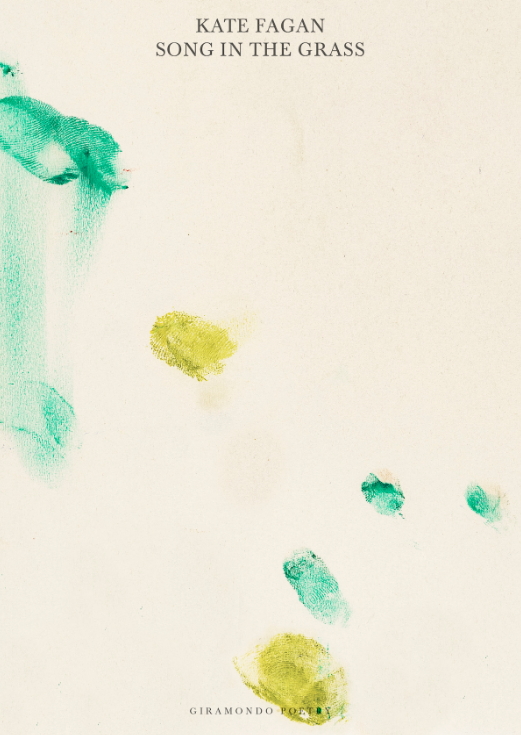
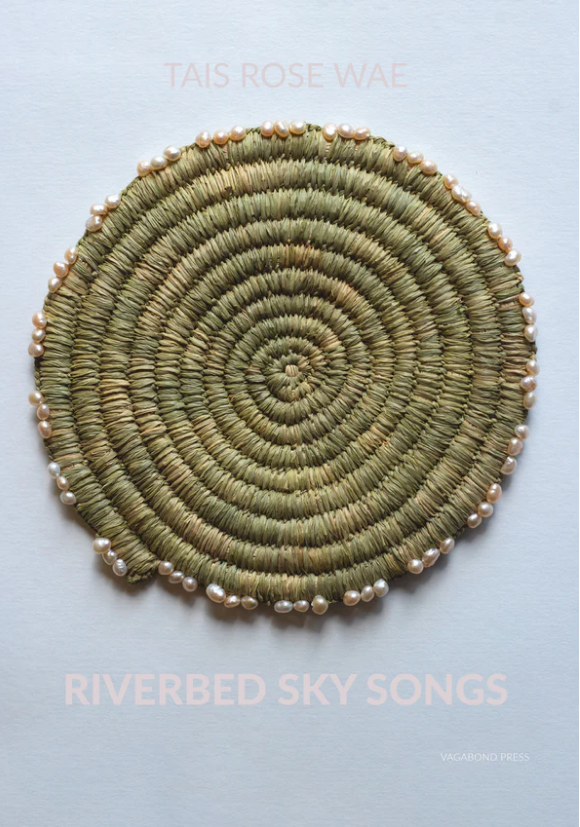 Song in the Grass by Kate Fagan
Giramondo, 2024
Riverbed Sky Songs by Tais Rose Wae
Vagabond Press, 2023
Both Kate Fagan’s Song in the Grass (Giramondo, 2024) and Tais Rose Wae’s Riverbed Sky Songs (Vagabond Press, 2023) take motherhood and song as a means to meditate more broadly on interconnectedness, embodiment, and the possibilities of poetic language. Most of the poetry in Song in the Grass was written on Dharug and Gundungurra Country while Riverbed Sky Songs was written on Bundjalung Country. Song in the Grass is Fagan’s third major collection following First Light (Giramondo, 2012) and The Long Moment (Salt, 2002). While Fagan’s First Light was shortlisted for the Kenneth Slessor NSW Premier’s Literary Award in 2013, Wae’s debut collection, Riverbed Sky Songs, won it in 2024. The making of poetry for both is part of a multidisciplinary creative practice; Fagan is an internationally renowned folk singer and musician, while Wae is a talented weaver. At the heart of both their collections is a contemplation of how poetry is not separate from but rather part of a holistic understanding of being in the world, and how it can convey the experiences of embodiment and relation. Joy Harjo points out that “[p]oetry is the closest step to beyond language, beyond the words. You absolutely need the words, but you employ language in poetry in a way that’s kinetic, spiritual, and sensual.” For both Fagan and Wae, situated creative practice is always accompanied by an awareness of stories of place – the shorter period of colonialism and its violences, and the vaster one of First Nations care and respect of Country.
The fingerprints in shades of green on the cover of Fagan’s Song in the Grass are a reminder of the hands involved in the making and the traces left behind by sentient forms. In ‘Good Nature,’ a poem addressed to her partner, fellow poet Peter Minter, she writes of wanting to “offer you a pocket of songs, a book or two, names for all the birds” (58). Accordingly, this collection opens with ‘one year one garden,’ which catalogues all the bird species that have traversed their Blue Mountains garden in a year (3). It is a list poem, a favourite form of Fagan’s, yet it refuses the linear movement down the page that is common to the list poem. Instead, she turns to the prose poem which, instead, clusters the birds in one place without punctuation, that is, fixing them adjacent but apart by grammar. ‘one year one garden’ provides insight into how the volume investigates what it might mean to gather poetry and beings together over time, all the while critiquing the settler colonial impulse to inscribe a possessive knowledge over the more-than-human.
For Fagan, collections “share a kind of certainty: we survived, felt purpose, rekindled our love and loss among featureless days” (45). At the same time, she suggests that her own collection is open-ended and provisional in the use of the pronoun ‘we.’ This ‘we’ is both those within the present and of the past. A collection is a house, but, as Fagan notes in ‘Border House (Notes to a Bird),’ houses themselves may be “repurposed by generations” (5). A house has “an open architecture of memory” even as it is itself “an act of minding” (5). A house may collect birds “as birds collect time” (5). Her poem concludes, “[a] house is an ecology of sensing” (5). This attention to a material ecology is what makes Fagan’s writing so remarkable, whether it be directed to a bird making a nest or the poet making a poem and then connecting it to other poems.
As a figurative house, Song in the Grass has many rooms. Its first section, ‘Notes to a Bird,’ reflects on what it means to have dwelled in one place for many years, tracking the learning curve to navigate a mountain valley’s rhythms and hazards. This includes the loss of chickens and awareness of the vulnerability of wildlife to cat, car, or rat trap. We get a sense of the poet as mother, who raises two babies that, in their turn, begin to navigate the environment. While daughter Ruby considers a “great sequoia” in ‘Pinecones,’ she clutches its seeds and declares, “If I plant these / we can come back and see / when I am older than this garden” (4). In contrast, the speaker reflects on “geologic time,” the “basalt peaks” capped by gums and the “parent century” from which the trees have come (4). Another poem, ‘Elegy for a Felled Eucalypt,’ mourns the loss of a many-storied, ancient tree and notes the many lives accommodated by its canopy or base. This includes the poet and her daughter, the poet saying, “I am sorry and sorry again” and feeling the need of words “to sing you away” (17). Fagan’s poem offers no consolation, only sitting with “just your shape / remembered, loved and bare” (18).
A number of poems in Song in the Grass are part of collaborations with musicians. ‘Our Mother’s Heart’ and ‘Evening Devotional’ have a spiritual orientation (19-29; 22-23). Written in the backdrop of bushfires, the former is a praise poem “for what endures” even as we experience “burning days” and “muddy lakes” (19; 19; 20). Life is still found amid “silent ash” or in the voices “on the mountainside,” with rain itself “an eternal art” and the moon a reminder of cosmic labouring (19; 20; 20). Time here is not that of colonial teleology but vaster, with every element of an ecology carrying what came before into the present. A further collaboration with composers Nicholas Ng and Waldo Fabian Garrido is a calendar, or “[e]arth [l]ist,” populated by birds, with Fagan saying in a later poem again, “My clock would be mountain-shaped with a bird at every hour and feathers for hands” (‘Bird Calendar (Earth List),’ 24; ‘Thinking with Things,’ 44).
The titular ‘Song in the Grass’ becomes an elegy for Irish writer Dermot Healy in its antipodal shifts. It is followed by a sequence of shorter poems or ‘letters’ to writers that build a community and often signal a particular shared moment. This includes a poem to Yankunytjatjara writer Ali Cobby Eckermann of their time on Ohlone land, California, their maternal love, “a blazing harbour” (41). It contains an elegy for poet Martin Harrison, who taught many how to listen to the pause in language and world. “Perhaps your last river / was copper brown and green, / a long wing carrying you home,” Fagan writes, again continuing the bird and water leitmotif (51). Even ‘Thinking with Things,’ dedicated to poet Pam Brown, mulls over the sound of cockatoos and apple trees “knotting to fractal profusion” (43). It celebrates Brown’s “continuous rediscovery” and her acute irony, as signalled in the cemetery’s graffiti, “DO NOT FROLIC” (44).
The transcultural chords of ‘Song in the Grass’ are continued in the ‘Portable Craft’ section. A journey between Australia and China is explored through the pebble, which calls up the pearl, the seed, the bead, the lodestone, and the inkstone. “Each particle is moving in relation,” she suggests, “in metaphor” (63). A serial poem addressed to the late American poet and friend, Lyn Hejinian, sees the poem morph speculatively over time: “A poem is a machine made of birds […] Branches move in and out of frame. The poem transforms into a creek” (65). There is an additional playfulness, Fagan notes how swallowing a word leads to a sinkhole. She concludes, “Next time I see a word I’ll think twice about eating it” (66).
The final section contemplates the poet’s role as collector or gatherer. Fagan looks back to nineteenth-century naturalist Louisa Atkinson, her interest in botany, her home in Fernhurst to the west of Sydney, and her role as a young mother, all shadowing Fagan’s own to some degree. Each plant mentioned in ‘Death Among Them’ is “painted, drawn or described by Atkinson in her diaries, sketches, journalism and literary works” (99). As Fagan notes, colonial exercises of classification were “volatile projects,” part of the process of elimination of Aboriginal knowledges (99). A following poem, ‘Future Green’ speaks of lichens “that form / their own story” and “[s]pore archives” that lie “in grass, / sovereign green, / hard to classify” (80).
“Bodies learn to inhabit a law of doubles,” Fagan writes in ‘Effie Wakes at Midnight,’ although this applies to words in her collection, as their repetition creates subtle sound-threads of continuity (79). In an interview for Australian Book Review, she speaks of a sculptural approach to redrafting poems, seeking a balance of sonics and space. Song in the Grass is a singular song, an extended poetic sequence that is “a space of feeling and observation over months, even years” (ABR, 2024). Accordingly, it “offers a ‘home’” to which the poet can “return continually” (ABR, 2024). Its final poem, ‘The Midnight Charter,’ is a documentary poem, more specifically an extended inventory or list. Tapped into a mobile phone over five years, it echoes words from previous poems as it navigates the complex histories and paradoxes of the contemporary world, its mourning and its joy. A charter is the written grant from the sovereign of a country. Here, it is the sovereignty of Country. Midnight is both a space of darkness as well as the liminal transition from one day to the next. The poem concludes with almost a mantra, “I wrote awake awake awake awake awake” (92). This alertness is what Song in the Grass imparts: even at the end of day, or against the one-minute-to-midnight end of days, it calls to its readers to attend to our interconnected lives, to intergenerational care, and to being alive to the deep ecologies we find our home in.
Posted in BOOK REVIEWS
Tagged ann vickery, Kate Fagan, Tais Rose Wae
Samuel J. Cox Reviews Toby Fitch and Gareth Sion Jenkins

 Object Permanence by Toby Fitch
Puncher & Wattmann, 2023
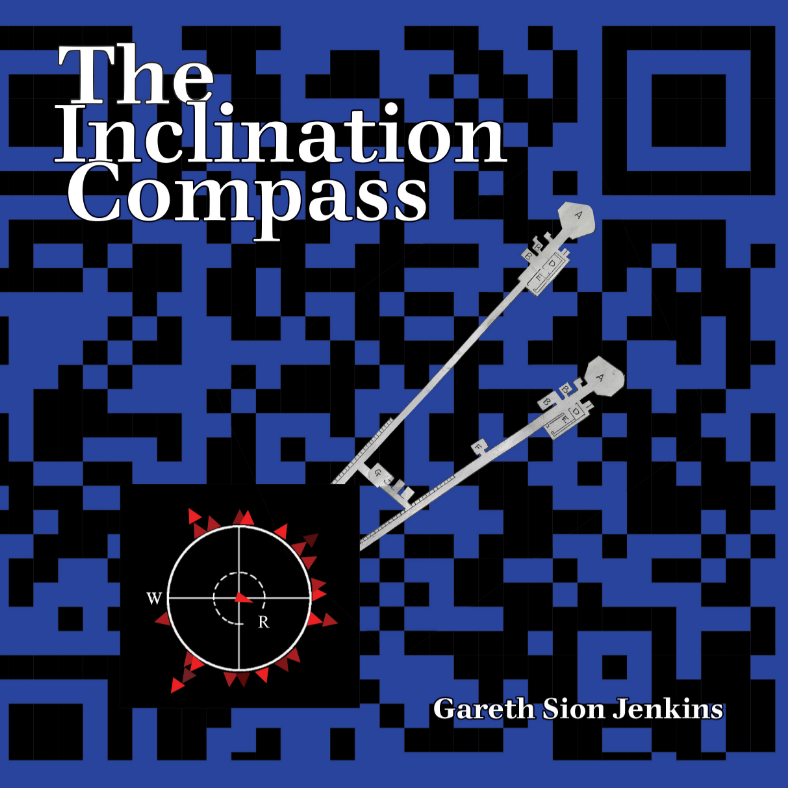
The Inclination Compass by Gareth Sion Jenkins
Puncher & Wattmann, 2023
Toby Fitch’s Object Permanence: Calligrammes (Puncher & Wattmann, 2023) and Gareth Sion Jenkins’ The Inclination Compass (Puncher & Wattmann, 2023) both represent not only the culmination of large bodies of work, but also can be considered avant-garde in their experimentation with the boundaries of poetry as a visual medium. Taken from the French term for advance guard or vanguard, the avant-garde is, by its very definition, always out in front, pushing ahead, self-consciously, even egotistically, leading the way. Yet, over one hundred years after the emergence of modernism, the term avant-garde has become problematic in numerous ways. Although compounded by the passing of time, a paradoxical desire to break with the past in favour of the radically new, even as this very newness is seemingly defined by repetition, has always been at the heart of avant-garde experimentation. To alleviate this problematic, A.J. Carruther’s has preferred to refer to contemporary Australian poetry that is radically experimental as either neo-avant-garde and then, increasingly, as “experimental poetry,” even describing Fitch’s work as “post-vanguardist” (Contemporary Experimental Poetry in Australia: Tendencies and Directions, 2017). However, in their desire to surmount the separation between visual and linguistic, the compartmentalisation of space and time enforced by our sequential written form, the aims of these works can be seen as, in some sense, classically avant-garde.
Puncher & Wattmann’s expanded edition of Object Permanence brings together over a decade of experimentation with a form of visual poetry that has become Toby Fitch’s signature: the calligramme. This is a form of poetry whose words are typographically arranged to create a visual image that contributes to the meaning of the poem, made famous by Guillaume Apollinaire’s 1918 collection Calligrammes. In ‘Object Permanence: How does the calligramme take shape?,’ an essay that also stands as a manifesto of sorts for his explorations with the form, Fitch has written a micro-history of the calligramme, briefly tracing the roots of this visual form back to ancient Greece and through the medieval period. However, Fitch’s greatest visual influences are the moderns: the French symbolist poet Stéphane Mallarmé and, particularly, avant-garde provocateur Apollinaire. This influence is strengthened further by Fitch’s repurposing of textual fragments throughout the collection from a range of symbolist and modernist poets, though he also combines these with allusions to the mythical, the contemporary, and the mundane. A further element Fitch adds to his calligrammes, collaborating on design and typesetting with Chris Edwards, is colour. Inspired by modern internet culture and Johann Wolfgang von Goethe’s Theory of Colours (1810), the collection’s often gaudy, fluorescent colour schemes emerge out of a black background, adding a further visual layer to the poems that shapes their meaning.
‘Rawshock,’, a series of ten calligrammes, shows how all these diverse elements form a rich textual and visual chemistry within each calligramme (n.p.).


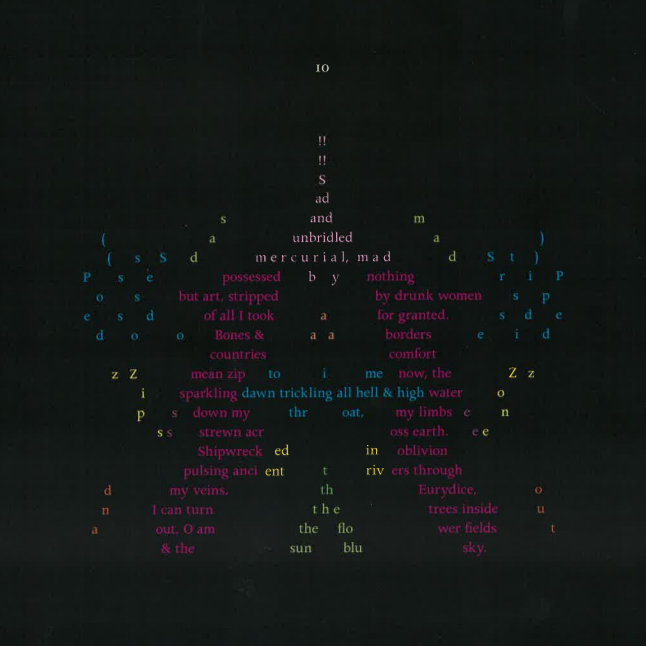
The poem itself is somewhat opaque on first impression, other than notable allusions to Orpheus and Eurydice. However, Fitch reveals in his ‘Notes’ that the poems not only regurgitate phrases from early-modernist poets (Arthur Rimbaud, Charles Baudelaire, Mallarmé, and Rainer Maria Rilke) to offer a retelling of the ancient Greek myth, but do so using the ten original Rorschach inkblots as templates. Created by Hermann Rorschach, the ambiguous designs of these standardised inkblots have been used for psychological testing. The mythical content of the poems combines with the ambiguous nature of the shapes to provoke and play with how the reader might interpret these calligrammes. Is ‘2’ a gate to Hades? Could ‘5’ be a harpy? Does ‘10’ represent Orpheus being brutally dismembered for what he has seen? By drawing on a myth in which Orpheus is punished for relying on his vision, rather than his faith, Fitch foregrounds the power of sight, even as he ironically employs a textually-stored myth to do so. In many ways ‘Rawshock’ epitomises the problematic Fitch poses with his calligrammes: what we see visually shifts our perception of the story, just as reading the narrative, in turn, shapes how we ‘see.’ Employing myths and textual fragments, Fitch adds further complexity to this hermeneutic feedback loop. ‘Rawshock’ asks provocative questions about the connection between myth and the subconscious, but in a wider sense this series signifies Object Permanence’s underlying interrogations into the nature of perception and reality.
Traditionally the Australian avant-garde has been perceived as lagging behind, but Fitch’s ‘Jerilderies’ calligrammes remind us that sometimes one is so far behind that it can be imperceptible from being ahead. The radical manifesto-style declaration of Ned Kelly’s Jerilderie Letter and its rawness – lack of punctuation and shifting range of registers – led first Peter Carey and then a range of poets to admire its ‘avant-garde’ qualities. Fitch draws on fragments of Ned Kelly’s original letter and creates thirty-five helmet-shaped collages that recall the myth and its iconography:
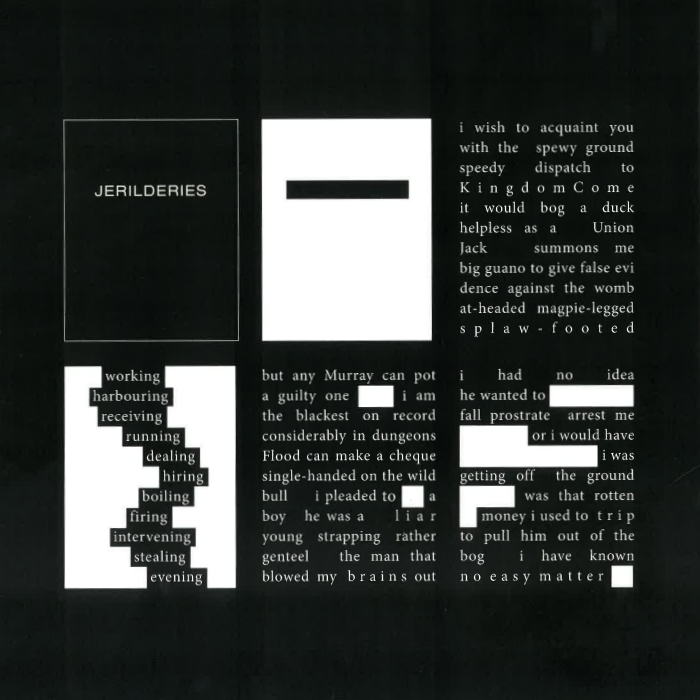
I found the stark black and white rendering of this series and its simple imagery (recalling Sidney Nolan), among Fitch’s most striking. A glance at the real Jerilderie Letter reveals the level of Fitch’s invention, the fragments he employs from the letter are often no more than one or two words and he re-sequences Kelly’s words in a pastiche worthy of James McAuley and Harold Stewart. A colossal mythical figure, Kelly is therefore already kaleidoscopic in his range of ‘truths.’ ‘Jerilderies’ plays on these elements to collapse and reform Kelly – “a rogue knows nothing about roguery” – into a supra-real figure, recalling that great modernist literary hoax, Ern Malley (n.p.).
There are so many complex and inventive poems in this collection that they all deserve in-depth treatment. For example, ‘PRO ME THE US’ utilises an anagrammatic translation of Rimbaud’s ‘Promontoire’ to build a skyscaper skyline out of text. The ten part ‘Argo Notes’ combines intermixing colour and amorphous shapes with collages from Maggie Nelson’s Argonauts to suggest genderfluidity. Meanwhile, in the form of a red square tilted on its side, ‘Janus’ suggests that thanks to the Anthropocene – “carbon plague of suburbia” (n.p.) – our gateway might be both opening or closing. And then there is ‘Oscillations’, whose winding form and content not only embody both a cyclone and a stormy relationship, but recall Lewis Carroll’s ‘The Mouse’s Tail,’ an early modern calligramme from Alice in Wonderland which Fitch identifies in his ‘micro-history’ of the form. Each calligramme leads the reader down such rabbit holes.
Yet, some of Object Permanence’s most striking poems are its simplest. For example, the series ‘Eye Test 1-4’ visually recalls an eye chart that tests visual acuity, though with a simple message encoded by Fitch:
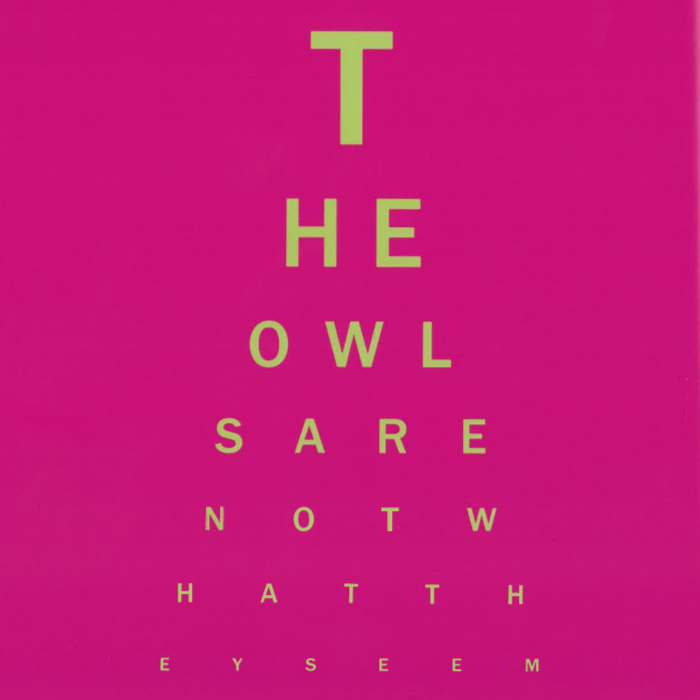
Detecting the message, despite its simplicity, is not instantaneous and this creates an amusing moment where play is returned to the mundane, making us realise how encoded our ways of seeing and reading are. Of course, as with all of the collection’s calligrammes, there is more than meets the eye: the lines are fragments of dialogue from David Lynch’s Twin Peaks’ surreal red room dream scene, which itself eschews traditional structures of speech. However, it is the fundamental interplay between image and text, grounded in childlike simplicity, that truly captivates and returns the collection’s focus to questions of ‘vision.’
Fitch’s title, Object Permanence, is a psychoanalytic term that defines the point in a child’s psychological development when they can form a mental representation of an object, allowing them to understand that the object still exists even if it can’t be seen. Fitch’s calligrammes play a double trick on us, his poems evoke objects that are not truly there even as they viscerally alter our interpretation of texts that ask us to not see what is not there; instead we must imagine.
Posted in BOOK REVIEWS
Tagged Gareth Sion Jenkins, Samuel J. Cox, Toby Fitch
Ash Davida Jane Reviews Kiara Lindsay and Robyn Maree Pickens
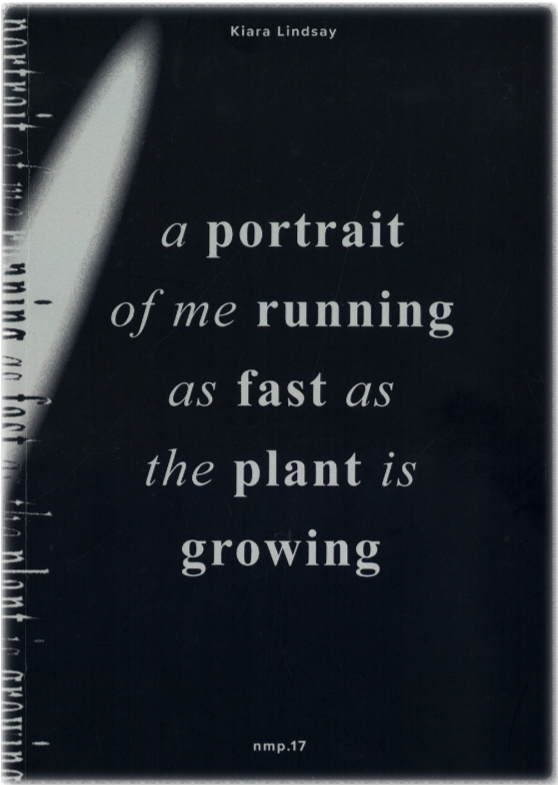
 A Portrait of Me Running as Fast as the Plant is Growing by Kiara Lindsay
No More Poetry, 2023
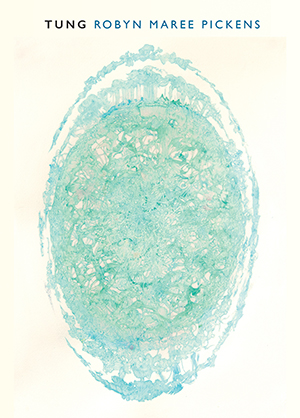
Tung by Robyn Maree Pickens
Otago University Press, 2023
Robyn Maree Pickens’ debut collection Tung (Otago University Press, 2023) joins a growing school of contemporary ecopoetics within Aotearoa New Zealand. Recently awarded third place for the international Laurel Prize for “the best collection of nature or environmental poetry,” Tung is deeply concerned with the non-human world and new, or perhaps very old, ways of being. Her poems demand close attention, not interested in following the easy or expected logic but in exploring different forms of language and feeling. Pickens plays with established boundaries and the idea of thresholds between places and beings and languages.
In ‘Tender (excerpt),’ a series of text manipulations to swap out all words beginning with any of the letters in the word ‘tender’ with the word itself result in sentences like, “Tender policies tender shield tender poor and vulnerable can tender tender-offs for a range of STGs,” and “Integration of mitigation with adaptation and sustainable tender compatible with 1.5°C warming tender a systems perspective” (15). This substitution renders a text thick with bureaucratic jargon impenetrable in a different way, revealing how useless phrases like ‘intregration of mitigation’ are in real life, and to the people most affected by these decisions.
Text manipulation and language play are regular features in Tung. In the first of a series of poems inspired by Cecilia Vicuña’s documentary ‘Kon Kon,’ Pickens omits the ‘fi’ and ‘th’ sounds from most of the words. The poem, which is otherwise fairly straightforward in narrating the plot of the film, becomes a puzzle to solve by filling in the missing letters: “the / sh themselves have disappeared. / e artisan shermen have been displaced by major / shing operations” (‘fi / fi / fi / fi / fi / th / fi / fi / th / fi,’ 44). She plays with this convention through a number of the following poems, creating situations where the reader has to bring what they know from the previous poems to a piece to understand it fully, filling in the gaps and at times being able to take a step further and see multiple meanings spilling out of them. In ‘illing my red mouth,’ despite the fact the previous poem has provided us with the ligatures to fill in the gaps, we may read “o er rst” as any combination of ‘offer,’ ‘other,’ or ‘over,’ and ‘first’ or ‘thirst,’ because the poems have trained our brains to run through these various options and find meaning (54). In this way, all possible readings are present simultaneously, the poem so much broader and more fluid than just one interpretation. These are brilliant examples of how the power of a piece of writing is in the moment it intersects with the reader. They’re poems that trust your ability to do the work and bring to them as much as you are able.
Pickens draws from Robin Wall Kimmerer’s idea of using ki/kin pronouns for non-human beings, proposed in a 2015 essay for YES! magazine. In two full page concrete poems, she uses only the aquarius symbol of double zig zag lines (♒︎), traditionally representing water (‘ki,’ 60; ‘ki,’ 61). The symbol appears hundreds of times across the page, forming a vast ocean of choppy waves, to create the shape of the word “ki.” This singular pronoun appears again in ‘Things fish say II,’ with the line “When I say hello to my neighbour ki is scaly,” placing the speaker within the community of non-human beings (65). But this dismissal of boundaries between human and non-human is done with an awareness of the dangers of romanticising the so-called ‘natural’ world and ourselves among it. Subsequent lines read “There is a battery leaking oil from the depot” and “Oil flows like honey inside oh eyelashes.” No part of this world is untouched by humans. As Emma Marris writes in Wild Souls (2021), all life on Earth is affected by human actions: “Today, even the wildest of wild animals are not only influenced by all those millennia of human-caused changes, […] their daily choices involve navigating a world that has been rearranged for human needs and desires” (60).
On page 76, as if denoting a new section but listed as a piece in its own right in the contents, the Finnish word ‘jää’ appears, followed by a vertical bar and the word ‘threshold.’ Convention suggests the latter is a translation of the Finnish, but a quick search reveals that ‘jää’ actually means ‘ice’. What are we to make of this small pause that seems to name itself as a break between two defined spaces, that crosses between languages? Ice, in a way, is a kind of threshold between liquid and solid, especially in the world we and Tung inhabit, where 1.5 degrees of warming is a globally accepted threshold (there it is again) under The Paris Agreement – a benchmark it seems increasingly likely we’ll far surpass if we don’t divert drastically and immediately from our current path.
Despite how readily Tung looks down the barrel of the climate change gun and tells us what it sees, this is not a book of despair. Soft touches of love come through on every page. Pickens shows us that grief and hopelessness are not the same thing. ‘Blessings on Joanna’ overflows with joy and hope (68). Written for painter Joanna Margaret Paul, the poem is a list of blessings with no breaks but separated by double slashes, so they pile up on each other and spill outwards. We begin with a line from the poem ‘Untitled’ by Paul, who Pickens describes as a “maker of space,” and quickly expand out to:
// the looking into a tree // the shape of it and the edges // the shape it leaves behind and the
illuminati edges // the such stripe // a poetics for shifting // a nerve can // brushing and love
// blessings on the window frame who makes a space with edges // blessings for the looking
through and the viewing

(68)
The poem is so rich and full that it creates a strong sense of Joanna Margaret Paul’s paintings, even if you’ve never heard of her or have any idea of her work.
Peppered through Tung are references to queer love. Pickens casually mentions girlfriends and flatmates with top surgery scars in a way that feels comforting, a sense of belonging where I wasn’t necessarily looking for it. But it makes sense that this way of thinking about different beings and different ways to be comes from a queer space, a space where conventional boundaries and paths are already partially dissolved.
Tung is clear about the works that influenced it, giving nods to its artistic and literary forebears, but it also feels like it’s taken a big step sideways. It challenges the reader to think deeply and follow a logic that strays from the normalised path. Many of the poems will entice you back, knowing that you can’t see everything on a first read. The power in this is how those interactions develop and change over the course of reading. Tung is a richly layered collection with poems that are deep in conversation with each other and with other texts. I hope we get to read more work that inhabits this space, especially from Pickens.
Posted in BOOK REVIEWS
Tagged Ash Davida Jane, Kiara Lindsay, Robyn Maree Pickens
Tim Loveday Reviews Madison Godfrey and Caitlin Farrugia
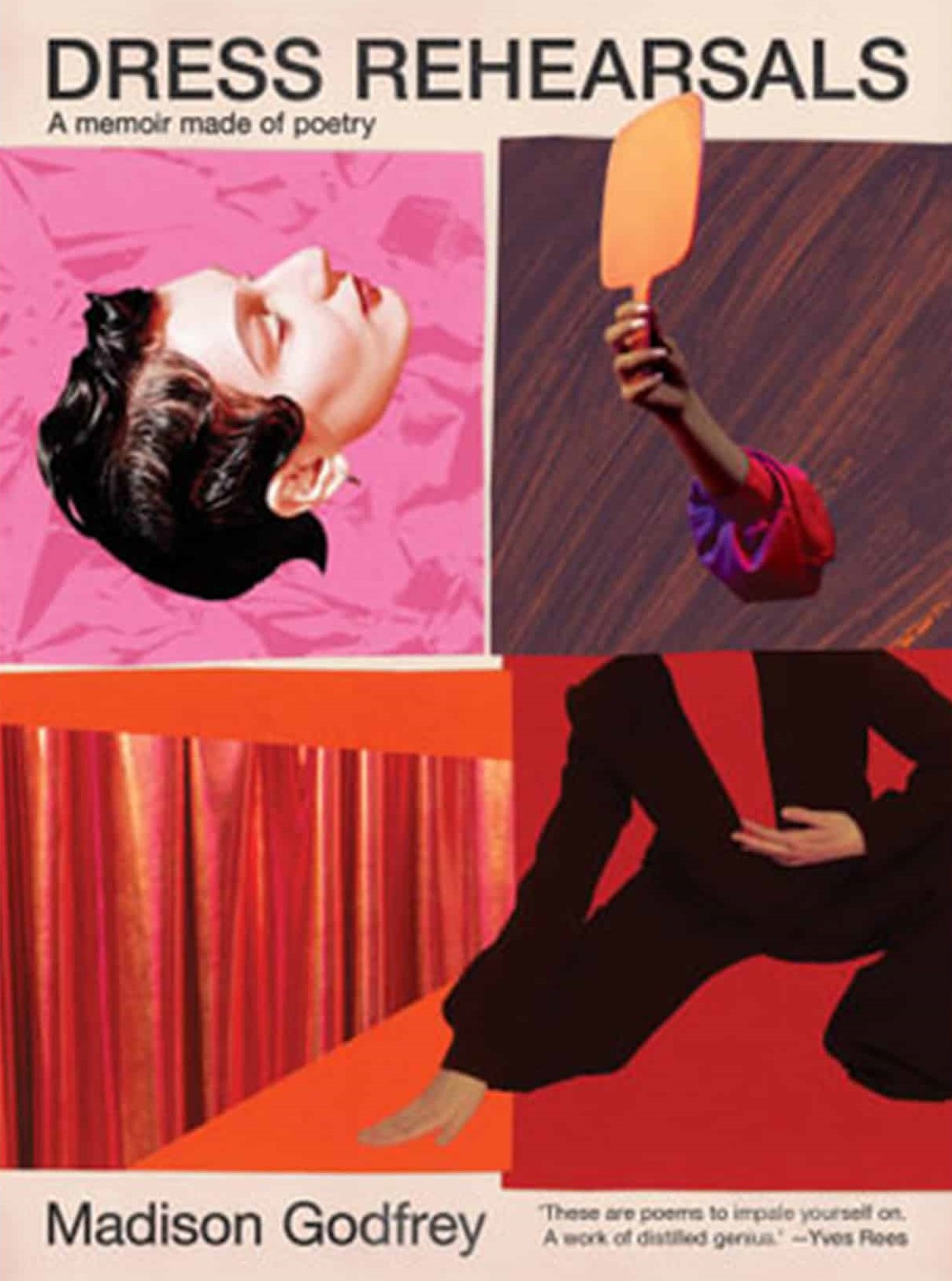
 Dress Rehearsals by Madison Godfrey
Allen & Unwin (JOAN imprint), 2023
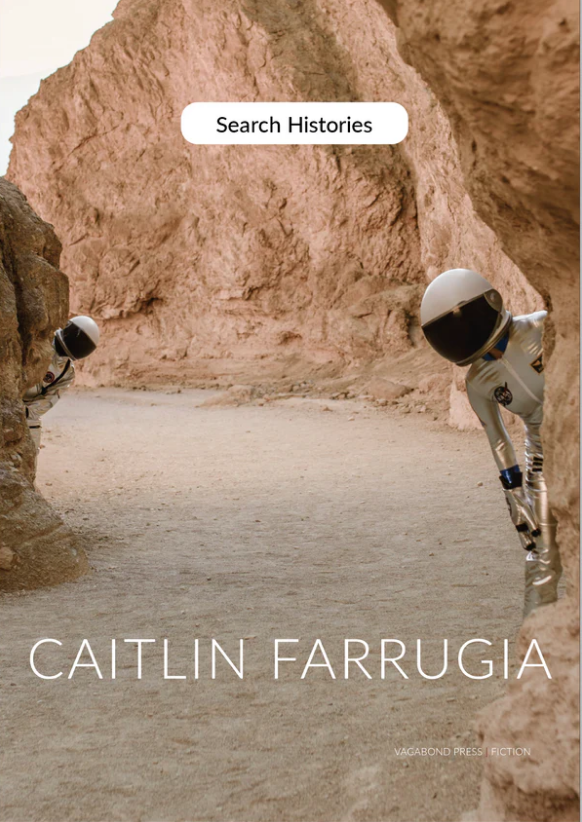
Search Histories by Caitlin Farrugia
Vagabond Press, 2024
Madison Godfrey’s 2023 collection of poetry is, as the cover and title imply, like staring into a mirror to find only the arm that holds it up – a dress rehearsal for a made-self that is trying to find its way towards an exciting and liberated life in a cis-gendered, heteronormative world. Godfrey, for all their sheer decadence, is a slick, street-smart, purveyor of performativity in their poetry, capable of deft transitions between the subtle and the blaring, linguistic contortions that weaponise humour and effectively nullify neutrality, wasting very few words in unpicking the less-than-delicate threads of the gender binary, gendered violence, femineity, and queerness as prop.
In the opening poem, titled ‘When I grow up I want to be the merch girl,’ Godfrey writes:
Sighing like a swimsuit model who got fired yesterday. Boyfriend’s band shirt tied on
one side. Silver belly ring aligning with the trestle table. Glaring at her Nokia.
Permanent marker forearms.

(3)
Here, Godfrey speaks both from and to a place of caricatured naivety, outlining a desperate and overt attempt throughout their life to be a certain type of woman. In doing so, they explicitly name idolisation as absurdist, and performativity as an act of self-disappearance and self-renunciation, but, also, ironically, how this performance, when knowledgeable of its own absurdity, can be self-elevating. In the last poem of the first part, ‘Spiders on my lash line,’ Godfrey writes:
I want to visit hyper-femininity like a city built by men, who mapped the streetlamps
but never pole danced on them.

(40)
Godfrey notes the freedom explicit to certain feminine expressions, recontextualising them to show both their limitations and liberatory nature. As well, they highlight the clear limits of power in a society constructed around patriarchy, even when an idea, at first, seems like liberation or revolution. This, in effect, foreshadows Part Two of the collection, ‘the femme fatale goes home,’ which blurs the boundaries between self, other, and object, as Godfrey, too, blurs the line between housemate, intruder, myth, and mirror-image, perhaps in search of a weaponised protector. They write:
She has filled the space with something unworldly, something unspeakable,
something soaked and aching and entirely hers. The room responds to her presence
like a lava lamp to touch. One of her legs is bent, foot raised, her toes grip the
porcelain lip. Her body folded in half, an angle so awkward it could only exist in a
fashion magazine. Her body resembles a body in a fogged-up mirror.

(43)
In this compartmentalisation of self, in this creating of apparitions, Godfrey queries the feminine powerhouse, as it washes the dishes, goes out partying, offers up confessionals through burps: “What purpose would a throat have, if not an elite room that men can enter? If a woman is a speakeasy, who decides the password?” (‘The Femme Fatale Goes Home,’ 51). Overall, Godfrey challenges the role of the Femme Fatale, moving her from paper thin, escapist concoction – or perhaps agent of the male gaze – and turning them into a Femme Menace, who “teaches [them] how to be a menace to everyone other than myself” (‘Femme Menace As Guardian,’ 62).
In Part 3, Godfrey redirects their gaze back to the gender binary, and the evident disconnects they feel for a feminine self – or, perhaps, more accurately, a former self. And yet, too, there is a sense of unbridled longing that permeates almost every line, as if the subject has already committed themselves to the learnings of the Femme Menace – a perpetual dissolving of genders that sees them neither here nor there but, rather, now.
A lot of the collection, in its unrelenting self-excavation, in its surrealist, camp, sometimes brash, often sarcastic tone, coupled with its perpetually evolving, self-referential social commentary, speaks to poets like Virginia Lockwood and Chelsey Minnis. Minnis was once described by poet and publisher Sam Riviere as a “purveyor of an enhanced, mordant femininity, recording the simultaneous disintegration and amplification of glamour as it enters a disaster zone, ‘a shimmer like sequins flushing down the toilet’, through an unequalled abundance of decadent, obscene, renunciatory images.”
Too, I’d be remiss not to mention local writers like Eloise Grills, Holly Isemonger, Alex Creece, and Dan Hogan – poets who poke at the margins of gender (and so much more) through humour, through the sardonic, through the absurd and obscene. And yet, despite these glowing cotemporary examples, I’m reminded that in the history of Australian poetry there’s never been much time for work like Godfrey’s, not just in terms of representation – a point made throughout – but also in creative exploration, in humour and hyperbole and sheer literary decadence. Sadly, many poetry lovers and advocates will admonish work that is funny, wry, or overtly self-celebratory, particularly when it comes from someone we’re cultured on the Left into seeing as a serious ‘identity.’ But humorous glamour in its myriad forms is the elevator key, as it allows us to view multiple and sometimes conflicting positionalities, sharply extracted through deft tonal transitions and overtly layered whimsy.
And here lies the true brilliance, perhaps even genius of Godfrey’s collection: it isn’t just a work of spritely lyricism and deep insight – it is actually funny and joyful as all get out.
Posted in BOOK REVIEWS
Tagged Caitlin Farrugia, Madison Godfrey, Tim Loveday
Submission to Cordite 116: REMEMBER
How is memory assailed by states, by time, by the formation of institutional practices of commemoration?
Alessandro Portelli once wrote that oral testimonies ‘are not always fully reliable … Rather than being a weakness, this is however, their strength: errors, inventions, and myths lead us through and beyond facts to their meaning’.
What are the bigger truths beyond facticity and how is the present enriched and unsettled by what we REMEMBER?
This podcast sheds some insight on how Cordite Poetry Review (and Cordite Books) works.
Submission to Cordite 116: REMEMBER closes 11.59pm Melbourne time 2 February 2025.
Please note:
- The guest editor(s) has sovereign selection choice for all poems submitted.
- Masthead editors will also contribute to the issue.
- We will only read submissions sent during our official submission periods.
- Please place up to three (3) poems in one (1) Word, RTF or PDF document (unless specifically noted otherwise for special issues), with no identifying details in the document itself.
- We are not able to offer feedback on individual poems.
- Submissions will only be accepted via Submittable …

Posted in GUNCOTTON
Tagged Alessandro Portelli, Anne-Marie Te Whiu, Kent MacCarter
D. Perez-McVie Reviews Luke Beesley and Caroline Williamson
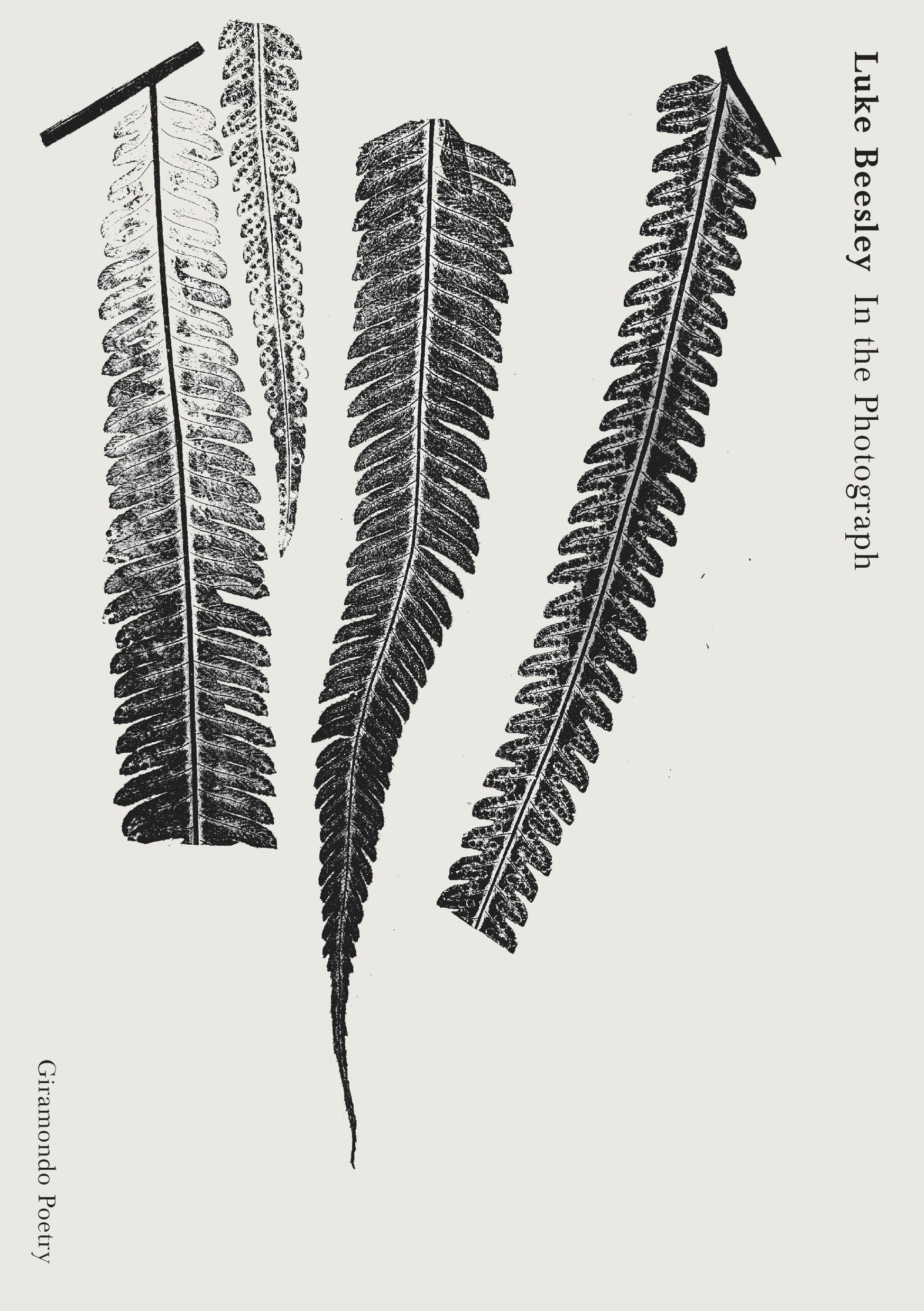
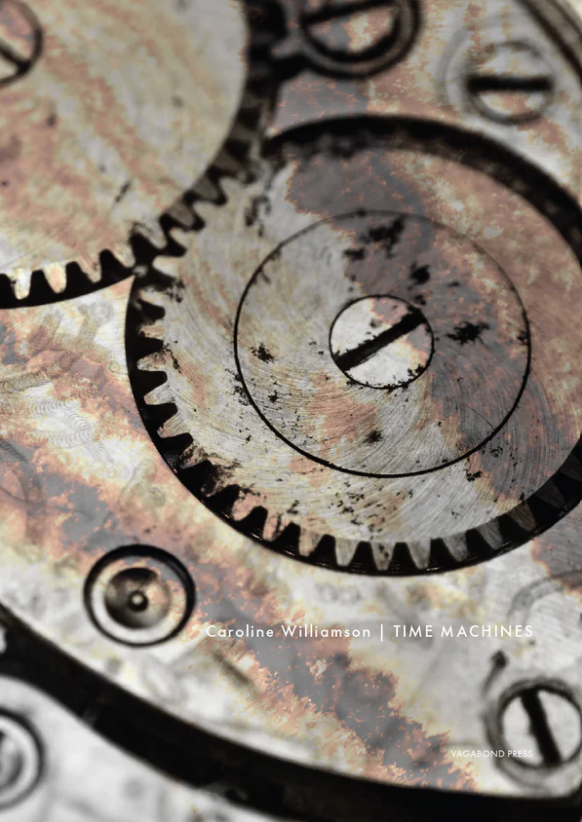 In the Photograph by Luke Beesley
Giramondo Publishing, 2023
Time Machines by Caroline Williamson
Vagabond Press, 2023
We were all children once, but some of us more than others. In the Photograph (Giramondo Publishing, 2023) is Luke Beesley’s sixth book of poetry. Time Machines (Vagabond Press, 2023) is Caroline Williamson’s first collection. Children are central to both books. The speaker has a son in lots of Beesley’s poems, and Williamson’s has at least one kid present, too. The poets themselves were children once. To be a child is to be in a state of dependency that requires us to adopt a set of beliefs and desires that shape the course of our lives. These are our first myths. Myth provides us a type of psychic shelter from the pain of a life otherwise unorganised by interpretation. At some point our first myth breaks down and we lose the pleasure of its shelter. It is the pleasure of shelter that affords myth its positive associations. Myth recurs, we gain a new purchase on the world’s meaning. Between the loss of one myth and the emergence of the next there is a metaphysically arid interregnum that we endure for the sake of our dependents.
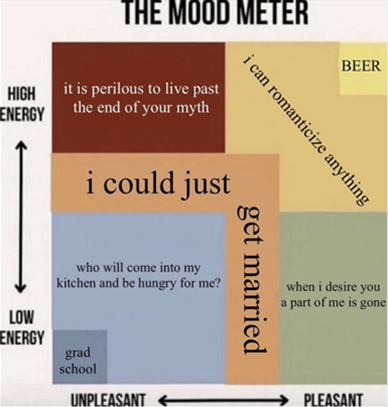
In the press materials for Red Doc>, Anne Carson writes “To live past the end of your myth is a perilous thing” (Madeleine LaRue, ‘Anne Carson’s Red Doc>’ in Music & Literature: A Humanities Journal, 2013). I encountered this ominous axiom by way of the below iteration of the Mood Meter meme graph. Its meaning returned to me as I thought about Luke Beesley’s and Caroline Williamson’s books. Both books speak to the pleasures and pains of particular myths and disenchantments. And to the virtue of endurance. Poems in both these books cover the “i could just get married” band but also some of the “i can romanticise anything” octagon. When they venture into the “when I desire you a part of me is gone” rectangle the object of desire extends beyond the romantic to include rivers, children, the reader, fictionality – the world as such.
In In the Photograph, the sites of activity of Beesley’s poems are as much the streets of Melbourne as they are dreams, daydreams, memories, and interiority: of the speaker, of other people, of art. It is surreal, intensely so, disorientingly so. Sometimes I liked this disorientation. When I’m locked into Beesley’s poems it’s because of the sensorium they generate. However, I didn’t warm to these poems as quickly as I remember doing with Beesley’s 2013 collection, New Works on Paper, when I read it in 2018. I recall sitting in the MCA café in Sydney, reading two poems about a jaguar and loving them. They felt playful in a way that was surprising and comforting. In the way that being involved in a simple but open-ended game is comforting: we are here, in this together, playing, witnessing one another’s play, committed to the game for now and its rules, and excited to see how we might transgress. The poems in that collection are, in my recollection, closely bound to the playful possibilities of the sentence. Puns, misdirections, and mischievous iterations. This sort of play is present in the new collection, but the longer poems of In the Photograph – two or three pages, as opposed to five to ten lines – offer space for other effects and games to emerge. Games of narrative, character, and voice. Sometimes the dual action of the playful sentence and the playful narrative was too much for me. Or it required me to read these poems closely, to be intentional in sticking with them. I would not read more than one or two at a time, otherwise the images, settings, and characters of each blended together, not always pleasingly. When I did pay them the right attention, I was rewarded with funny and sweet poems, full of careful consideration of the reality of suburban life in Australia, especially the quotidian life of artistically inclined suburbanite adults. The attention is intimate, the care is great. A tone of tenderness has grown more prominent in these new poems. Maybe longer poems were the venue required for it to blossom. This tenderness and the increasing vividness of the suburbs as the locus amoenus of Beesley’s poems are what I like most about this new book.
In ‘Time Piece’ Beesley writes of peak hour traffic as the “invisible momentum that took me back to a / very small fear of the day’s adult inevitability” and “on-rush: each in their not-so-much uncaring but distracted trajectories, en masse, racing forward […]And that dawning, really, in a child” (6-10). There’s melancholy in adult onrush, in adulthood as such. And in the loss of the myth of possibility as it is occluded by the dawning of the fact of inevitability – the fact that some things will be inevitable. There is much at stake here: childhood, actual children, style, composition, and friendship. The poem is spent giving an account of planning to meet with a friend, Daniel Read, for tennis and Daniel’s request for help with moving a boulder. The boulder is language, memory, therapy, life as such, and much else besides. We hear about Daniel’s history, problems, interests, and proclivities. Daniel and the speaker sit together for a while. The poem ends with the speaker thinking about the meaning of ‘we,’ observing a shift in feeling.
Read  cried.  Or  I  wondered if he shed a tear.  it  was a twist in emotional grammar—subtle
anguish, real elegance, the sun turning—and I paraphrased hard, hearing him out. He knew
none  of this would add up  [...]  we  finished our coffee and decided to move the rock before
heading to tennis.

(‘Time Piece’, 9)
This is a poem about friendship between men and the limited time available for writing, interpreting, and making life add up, all while trying to move ‘the rock’ and get some exercise in.
In ‘The Page Abandoned’ care continues as our speaker offers us an array of idiosyncratic and occultic new ways of finding their place in a book while reading (29-30). The first involves reading “to the top of every page after moaning softly against a squeaky bedhead” and:
a dream that spread out to engage the entire body, fingers twitching.
           And that’s when I place the bookmark.  Tuck it in snug and get
off  the train one or two  stops past  my usual stop and walk an extra
100-200  metres each day,  which would  add up over the month  and
year until I lost my job.

(29)
A dandiacal way to become unemployed. The poem continues, becoming patterned by the repeated figures of trains, train stations, Gerald Murnane’s A Million Windows, an unnamed female other who is in Murnane’s book, too. Throughout In the Photograph images recur within and across poems, engendering the feeling of a macro-sestina whose scale and scope we don’t ever fully catch sight of. The poem ends by clarifying the meaning of the moaning and the squeaky bedhead at the poem’s start: abandoning reading for sex, abandoning employment to read.
              [...]  yet we are almost done, and like most things printed, it
ends up back in the bedroom. [...]
She turns, we read on. Her back has a pressure point. We do a stop,
we  feel the weight.  Feel it of  an evening.  We even joke about  our
10 p.m. sex—the page abandoned.

(30)
An image from ‘My Grandmother’ that has stayed with me is of the eponymous relation absolutely dominating the situation of a tram (46-48). Throwing things and bemused by the presence of her adult sons, she
                                   [...]  searched-out rucksack racks and found
stacked and cracked dinner plates. She frisbeed them down the
middle of the tram towards the driver.

(47)
Here we see the limits of parental care. This is a late life rageful response to her sons’ expectant airs – cringe affects they continue to exhibit after she’s alighted without them:
the tram went by with her sons up against the windows,
faces squished, arms out, gesturing her back.

(47)
What would it be like to be confronted by three of your four adult sons waiting for you on a tram with a trestle table? It sounds a bit hellish. Like you’ll never get free from parenting. So, it makes sense to throw plates, throw a tantrum, or decide to faint. “But this was her swim” (47). The speaker reminds us of this as their grandmother is seen finding her feet and
                                                                                                     [...]  casually
giving the finger to a war veteran who had stepped off a chapel step
and dropped his cane. Smiling at him warmly.

(48)
It’s a dream logic, a good funny palaver of insoluble autonomy. Unassuming lines that, in their accretion, are totally excessive.
‘The Writer as Sand’ is a poem about childcare and how best to structure one’s morning routine (32-33). Events occur out of order. The speaker is awake and at their desk, and then again in bed trying not to wake their son, observing:
You’re in one room, for most of your life, going forward to your
child and sitting over him.

(33)
This is the ongoingness of childcare, art, and life. You have to keep writing and caring and working out how to start your day “wishing you / could keep the whole good word, its meaning intact” (33). The question of language’s wholeness isn’t at the core of Beesley’s book but the activity of caring for language and its users is. Beesley’s speaker is being a dad to the poems, caring for himself, caring for kids, caring for the poems. The poems are long because with kids caring has to keep going, lasting a week, a school term, until they’re 18 or 35. You have to continue appearing near them, and paying attention. You have to keep writing, keep caring. Caring might be your duty but hopefully also your happiness.
Posted in BOOK REVIEWS
Tagged Caroline Williamson, D. Perez-McVie, luke beesley
Jennifer Compton Reviews Peter Boyle and Izzy Roberts-Orr
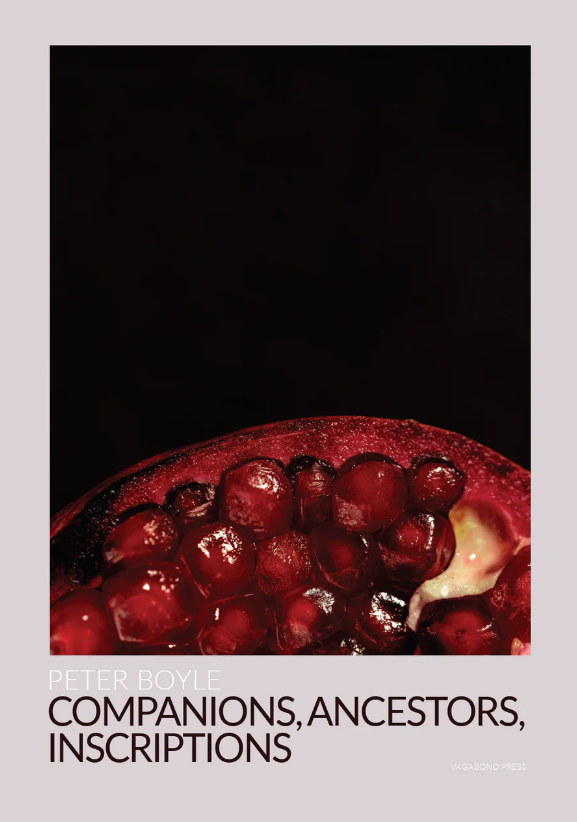
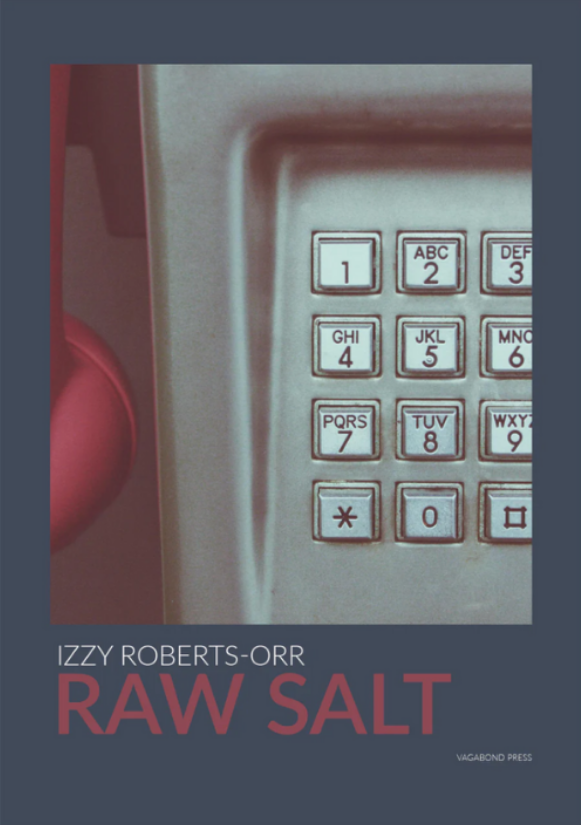 Companions, Ancestors, Inscriptions by Peter Boyle
Vagabond Press, 2024
Raw Salt by Izzy Roberts-Orr
Vagabond Press, 2024
First, I salute Vagabond Press – its progenitors, its long-time toilers in the vineyard of poetry, its patrons, its cheer squad, and those who work in the shadows. Any small press, surely, is a hub of more-or-less willing volunteers. It is very expensive, in all sorts of ways, to make a book. Count the cost. But year after year after year, since 1999, Vagabond Press has been turning aside from the multifarious, ever-present griefs of the world, and privileging poetry.
I have been very taken with their broad church doctrine, their capacious mother hen wings, year after year, such a piquant, delicious mix. Even if I haven’t read everything they have published. Because, after all, you can’t read everything. You can fully intend to get around to it and yet somehow you just don’t. So, I seized upon the chance to do the close reading, that a review requires, of Peter Boyle’s Companions, Ancestors, Inscriptions (2024). Because I remember very well his first book, Coming Home from the World, published by Five Islands Press in 1994, that, in spite of being a very slim volume, won the Kenneth Slessor Prize for Poetry in 1995. It is still on my bookshelf, although I do frequent and vigorous culls because you can’t keep everything. Coming Home from the World resonated with a confident, charming ease and skill. This poet seemed to have skipped the apprenticeship stage. It was an impressive debut. But somehow or other, the years have flashed by, and I have read none of his subsequent and numerous books. I can hardly understand myself.
So — taking the title as my lodestar — Companions (those who travel with me), Ancestors (those who came before). Inscriptions (what I etch into stone for all the reasons why anybody might undertake this work) — I opened the book and started reading. Instantly, I was very taken with the authoritative, plangent beauty of the first suite of poems, ‘Five Companions’ (9-11). I recognised the voice of the poet, it is the same voice that lifted up off the pages of that first book. But now it is graver, wiser, sadder, as is only to be expected — but also, suddenly, mischievous. For instance, the poet moves from cosmic sententiousness — from ‘Five Companions 2. Raindrops,’
I am wearing a necklace of raindrops, more judiciously
rounded than teardrops, moulded into shape
by the greater gravity of earth and the sky’s
overburdened need for equanimity.

(9)
— to something more impish (and perhaps informed by William Carlos William’s plums in the icebox) — from ‘Five Companions 3. What is lacking,’
As if assailed by doubt
water suddenly lost its ability to move.
It stares at us forlornly
from the upper shelf of the refrigerator.

Addicted to my own thoughts,
unable to hold onto my own molecules,
I do not have the immortality of water.

(10)
The initiating image is so precisely placed and vivid, and the punchline comes swinging in with all the weary chutzpah of a butterfly that stings like a bee, so that I winced first, and then chuckled. An elder person’s jokes are the best jokes. They have a sting in the tail.
It is often said that the voice loses upper and lower registers as one ages. But, within this book, I sensed, yes, a slowing, but also an enlarging — of range, and of intent. It is brimming with clarity and reach. The notes that are summoned and pitched could make crystal ring, could strike into dusty corners and make cobwebs tremble. And cobwebs feature several times. They are, after all, a necessary part of the domestic ecosystem. And of the poet’s iconography. The device that the spider constructs — the web — advances into the territory of metaphor. The book begins with a small spider boldly taking up space. From ‘Five Companions 1. Small Spider,’
Next to the strawberries I am cutting on the kitchen counter
you step out
intent on exploring the world.

(9)
And then, in ‘Five Companions 4. My Distant Brother,’ the light that steps inside the poet’s house “turns firm and resolute, holding the scratch marks and spider webs of my east-facing windows in a steady embrace” (10). And then the spiders are revealed as essential backdrop to the poet’s attempts to spin poetry. From ‘379,000 Poets Available,’
At every instant 379,000 fresh attempts
to make hope more hopeful,
to put more shudder into sadness,
to dust clean while also preserving
the webs the spiders weave over our windows,
to fine tune all the colours of the world
and surreptitiously pour
a little more sky into blue.

(114)
Peter Boyle asserts in ‘Part 3. Time’s Errata’ that “‘[o]nly in the dark are you free.’” (67). And, to extend the metaphor, almost to breaking point, when he resorts to dreams, frequently, they are as sticky as cobwebs and strangely entangling and entrancing. It took me some time, and a bit of head-shaking, to understand that we were wandering in the lucid surrealism of the dreamscape. Henry James is supposed to have stated, “tell a dream, lose a reader.” Perhaps that is often true. But not in the hands of this poet. From ‘The Continuous Concert,’
                                                                 My invitation card was
distinct: Return concert by acclaimed young pianist, 6 pm sharp,
The meadows beyond the river. Here I was on time, yet there
was no pianist and I was the only audience.

                                               *

              It is dark now — the stars are out. I am still waiting
patiently. And slowly a great peace has settled over me,
steadily shaping a curve to the silence, almost a melody. Did
I truly need another’s fingers to interpret this?
             And meanwhile, across the keyboard of darkness, a
river was flowing by with my life on it.

(88)
Although there is an elegiac air permeating this book, it is by no manner of means any sort of farewell. Instead, there is a stocky, stubborn shouldering of fate, a resolute taking up of space. An implacable, almost mournful, acceptance of the-way-things-are, with an aftertaste of defiance. From ‘Inscriptions 6,’
The tree
has put down
its roots.

The sky
will have to
get used to it.

(119)
Posted in BOOK REVIEWS
Tagged Izzy Roberts-Orr, Jennifer Compton, Peter Boyle
4 Grzegorz Wróblewski Translations by Adam Zdrodowski and Ben Borek

The following translations were first published in March 2024 in the online chapbook The Life of a Tenement House. They are reproduced with permission from Half Day Moon Press.
The Man Who Never Ate Tomatoes
The man who never ate tomatoes
looked like a postman or a used
car seller.
He died the day before yesterday
at the age of 84.
His favourite conductor was James Conlon.
During a storm he always wore a warm
scarf.
He had a wife, of medium height and build.
Throughout her life she worked
at a toy shop.
Their only daughter, Lise, works at a bowling alley
on the outskirts of Copenhagen.
Posted in TRANSLATIONS
Tagged Adam Zdrodowski, Ben Borek, Grzegorz Wróblewski
‘The poem in progress is molten, malleable’: Cassandra Atherton in Conversation with DeWitt Henry

I met DeWitt Henry on an online poetry reading series, LitBalm. I’d read his book Sweet Marjoram: Notes and Essays (2018), and I knew he had founded the famous literary journal Ploughshares, and was an emeritus professor at Emerson College. After we chatted about his presidential namesake and about cotton gins, he read a brilliant poem in the open mic and our correspondence and friendship began on email. We’ve been discussing literature, family, art, poetry and food ever since. I celebrated when his memoir, Endings & Beginnings: Family Essays (2021), was longlisted for the PEN/Diamonstein-Spielvogel Award for the Art of the Essay, alongside Salman Rushdie. DeWitt’s love of language and his extraordinary use of language are reasons why I wanted to share our conversations, as I find myself returning to them in an effort to understand myself as a writer.
Cassandra Atherton: One of the first things we first bonded over was a love of wordplay and intertextuality (look out Barthes, Bloom and Kristeva!) Your Foundlings: Found Poems in Prose (2022) is the ultimate ‘mash-up’ (if we get into Mix Master terms, which we have a few times … and ideas about redubbing). How did you choose the prose texts (as varied as Richardson’s Clarissa and Jamaica Kincaid’s My Brother)? Were they chosen because they are some of your favourite prose works (they are certainly some of my favourites of all time) and can you outline your process or the practice of making poems from prose? Where do you start? What are you aiming for in the poems? Did you have to abandon any? Too many questions?
DeWitt Henry: I start with my editing and teaching life as ‘embodied’ in my personal library. Rereading favourites, such as Anna Karenina, I marked up over time sections or paragraphs that epitomised a novel, poem, play, or essay as a whole. Each became part of my thinking and stayed with me; and they found me, also. Some were in classics ancient and otherwise; some from my undergrad years (Swift, Richardson, Eliot, Flaubert, Lawrence, Joyce, Forster, Woolf, Bowen), some from works by emerging contemporaries as they appeared in Ploughshares and other lit mags. Anderson, Welty, Hemingway, Munro, Olsen, McPherson, Carver, Coover, were central to my later teaching courses in the American Short Story, Contemporary American Novel (O’Brien, Moore), and Memoir (Orwell, Duncan, Conroy, Kinkaid). I did have points to make about my personal canon, as it were, between works old and new, fashionable and enduring (or deserving to endure), and relevant both to their times and ‘ours’ – including new generations and readers. I hoped to entice new readers with samplings of the originals.
I also wished to play with different notions of poetic voice and form, while using the original text as much as possible, while also framing it for self-standing focus – with my own irony, usually both about the original work and its vision, as reflected by my titles, rhythm, and line breaks, and sometimes by overt paraphrase or orienting information. And as the series grew, I wanted to emphasise thematic clusters and contrasts that originated in my own concerns, questionings and vision. The opening cluster, for instance, deals with the lonelinesses of solitary women (as voiced by both male and female authors), and then of solitary men.
Some writers, especially those writing lyrical and densely stylised prose didn’t work for me. No Faulkner, for instance, though I looked at key passages in ‘The Bear’ and ‘Old Man’. And almost no Evan S. Connell, whose chapter ‘Clock’ in Mrs. Bridge was so ‘poetic’ as to need only line breaks. Passages from Gorki, Richard Hooker, Emerson, and Richard Yates I managed to turn into poems, but they didn’t work thematically with my collection and so I put them aside. I did (imitating the practice of both Thomas Hardy and DH Lawrence) return to my own works in prose fiction and memoir and include as ‘Alone in Grief’, ‘Baby Sitting Nieces’, and ‘Bungee’. One of the most difficult conversions proved to be ‘Echo Chamber’ from A Passage to India by E.M. Forster, not because of style, but because the nihilistic epiphany of Forster’s Part II – Caves, Chapter XIV – was spread out over many pages, and while keeping true to the original, I had to bring fragments together via paraphrasing into a single experience/poem.
CA: Yes, you’ve written more about this in your apologia for Foundlings. I love that you discuss, ‘How lines became verses and verses became stanzas; how blank spaces or “silences” serve like a frame for painting or photograph; how punctuation, meter, stresses and pauses create emphasis and voice’. As a prose poet, I am fascinated by framing and spaces. There are silences pressed between words and sentences in prose poetry’s ubiquitous boxes. Your ‘rules’ for Foundlings are also a nice way to ensure there is no issue with appropriation or plagiarism or even misunderstanding. You’ve said:
I have a list of intertexts in the back of my book of poetry, Exhumed, which you loved reading. I think of that as my own rules for writing poems that celebrate intertextuality – it’s like a cast of characters. Now, I have to hear more (officially) about the process of working with your daughter on the shadow boxes! Foundlings contains full-colour photographs of Ruth’s artwork and it’s incredible! Obviously, I want the process outlined for all budding ekphrastic poets, artists and scholars! Shadow boxes are exciting for me as they are so reminiscent of Joseph Cornell and his assemblage art! Anyway, your Foundlings seems to have started an amazing almost reciprocal ekphrastic process – tell me ALL about it!
Posted in INTERVIEWS
Tagged Cassandra Atherton, DeWitt Henry, William Shakespeare
3 Lu Jin Translations by Helen Jia
Oriental Wisdom for Poetry
1. Poetry: Words of the Temple
In oracle bone script, the character for “poetry” (詩) did not exist; ancient humans used “temple” (寺) to represent “poetry” (詩). If you split the character 詩 (poetry), it forms the phrase 寺之言, which means “the words of the temple”. Phrases such as “There’s no path through the ancient woods, where does the bell toll from the deep mountains?” (Wang Wei) and “All worldly noises are quieted, only the echoes of the chime resonate” (Tang poet Chang Jian) depict the temple as a world separated from the material, mundane world, embodying tranquillity and purity. Stepping into a “temple” (寺) is akin to entering a spiritual realm, which is precisely what poetry is as an art form. The transcendence of life, the pursuit of spirit, and the power of faith are the wellspring of poetry. An individual in their everyday state can never produce poetry. Only when one truly enters the state of poetic creation, in that very moment, an ordinary person is transformed and elevated into a poet — they have washed away the vulgarity and concerns of their mundane self, and ascend from the path of individuality to the world of poetry. Poets come from the earthly realm, but upon entering the state of composing poetry, they maintain an aesthetic distance from the real world, transitioning from “seeing mountains not as mountains, waters not as waters” to “once again seeing mountains as mountains and waters as waters.” This is the profound mystery of poetic beauty.
1. 詩者:寺之言
甲骨文裏是沒有「詩」字的,上古人類用「寺」代替「詩」。「詩」字拆開來,就是「寺之言」。「古木無人徑,深山何處鐘」(王維)、「萬籟此都寂,但余鐘磬音」(唐人常建)的「寺」是與世俗的物質世界分隔開的清凈世界。踏入「寺」就踏進了精神的世界。詩正是這樣的藝術。人生的升華,精神的尋求,信仰的力量,就是詩的源泉。常態的「個人」絕對寫不出詩。只要真正進入寫詩狀態,那麽,在寫詩的那個時刻,常人一定就轉變、提升成了一個詩人——他們洗掉了自己作為常人的俗氣與牽掛,從非個人化路徑升華到詩的世界。詩人從人間來,進入寫詩狀態後,又和現實人間保持審美距離,從「看山不是山,看水不是水」 到 「看山還是山,看水還是水」,這就是詩美的奧秘。
Posted in TRANSLATIONS
Tagged Helen Jia, Lu Jin
‘In the night air by the smoke’: Amelia Walker in Conversation with Barrina South
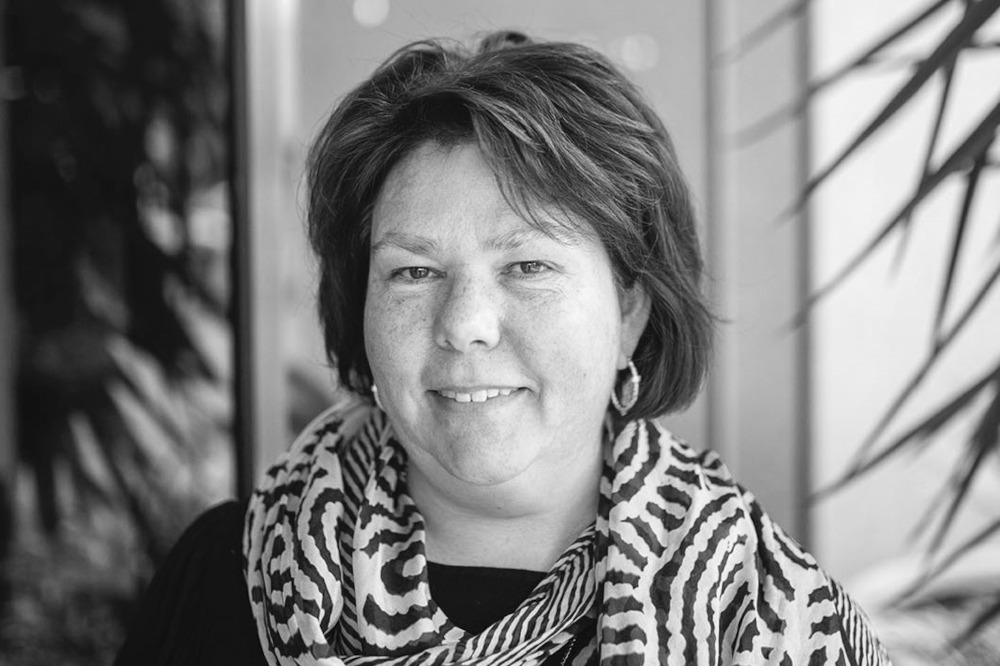
Barrina and I connected in 2022 through Invisible Walls, a literary exchange program between Australian and Korean poets, co-facilitated by Dan Disney and myself. Invisible Walls poets were chosen via a competitive selection process. From a large pool of submissions, Barrina was one of twelve successful applicants. The striking language, imagery, and emotion of her poetry stood out immediately. Through working on the project itself, I came to know Barrina as not only a brilliant poet, but a deeply thoughtful, kind, and giving person, too. In late 2023, we met on Ngunawal and Ngambri Country (Queanbeyan, NSW) for a coffee and chat. Below is an edited transcript of our exchange.
Amelia Walker: We acknowledge that we are meeting on Ngunawal and Ngambri Country. We pay our respects to the Ngunawal and Ngambri people, their Elders past and present, and other First Nations people and families who have connections to these lands. Sovereignty was never ceded. This always was, always will be Aboriginal land.
Barrina South: I also want to acknowledge Ngunawal and Ngambri people and recognise that I live and write on their unceded sovereign lands.
AW: Barrina, thank you for sharing your time. I’m looking forward to learning more about you and your writing. We first came in contact when you applied for Invisible Walls. I was blown away by the power and imagery in all your poems, most especially ‘Baaka’ – your poem about the river Baaka (known in coloniser language as the Murray Darling). Reading that poem, I feel such a deep passion come through a gutting mix of love and pain. If you’re comfortable, could you maybe speak a little more about it and the things behind it?
Barrina South: I wrote the poem ‘Baaka’ on a family holiday with my partner and son – in our tinny, on the river, while both my son and partner were distracted fishing. I was looking at the river, its flow, and I just watched it, pushing past the branches of trees that had fallen in the river, the ripples, twists, and turns, and how the river wash was turning the dry branches to look like marble.
When water is put onto a dry branch, it changes the colour of it. I also looked out for the modified trees that are on the side of the riverbank, the canoe trees. When past floods occurred, many, many generations ago, people would take the bark off the trees and make canoes. My partner was taught to make bark canoes by his father. So, when I worked at the Australian Museum in Sydney, one of the things I did before I left was to commission his father to make an inland river canoe for the Australian Museum collection as there was a gap – most of the watercraft were from other parts of Australia. His father learnt a lot from the Old People growing up on the Brewarrina Mission. My Nan was born on the Brewarrina Mission, situated on the Baaka, but my great-grandmother moved away to Nyngan with my nan when she was young. She spoke very little about the reserve, and it wasn’t something I was told about. I was fortunate to spend time speaking with my partner’s mum about the mission, who lived there when she was a child and later with her own family. We spoke about the role of women, allowing me to imagine my great-grandmother and nan living there. After meeting my partner, one of the first things we ever did, when we first met 25 years ago, was him taking me back to that reserve. It had a marked effect on my identity. That’s why we both make sure our son is exposed to as much of his culture as possible, like being on the boat fishing – he is also learning.
For my Masters degree, I focused on New South Wales Aboriginal women’s autobiographical narratives and argued that they’re valuable primary sources for uncovering previously repressed knowledges like language, spirituality, and women’s experiences living on government reserves, known as missions. I touch on that in the poem you mention, the Baaka is a place of respite from the government gaze and control – where women could enjoy their children and spend time with each other. These are all the different elements that influenced the drafting of the poem, ‘Baaka’. In my writing and work I am always ensuring New South Wales Aboriginal culture is recognised and valued.
AW: It’s such a powerful poem. As a non-Indigenous person, the impact of invasion in this continent is devastating to your world. I’m so sorry and so ashamed. Your own story is one of amazing triumphs over the adversities you’ve had to face. Not only are you a leading contemporary poet on the international stage, but you’re also an award-winning visual artist and biographer who has held senior roles in public service, such as the Director of Policy and Strategy and now manager for Aboriginal Cultural Heritage Repatriation and Conservation and standing for Local Council. It’s astounding that you managed to balance all these things with a family to care for. I’m curious as to how they might connect with or feed into each other. I’m wondering if you could reflect on that beginning, perhaps on the relationships between poetry and visual arts.
BS: I sometimes wonder how it all happened and happens, but I think if you’re passionate and driven, then it’s enjoyable and sometimes easy. My first degree was a Bachelor of Visual Arts, and this study has helped me in my observations and interpretation of my environment, where I am and how I read the world visually. Sometimes, when people read my work or my short stories, they say that it could be a film and would translate well into a visual format. So, I was an active artist and had my work exhibited overseas and here in Australia. When my partner and I moved into a one-bedroom flat in Sydney, I didn’t have any space to produce my paintings, so I started being creative through writing – then my writing became my creative pursuit, and I went on that trajectory, and now here I am. In everything I do, I am aiming for positive change, representing my people, and protecting and raising the voices of New South Wales Aboriginal culture.
Posted in INTERVIEWS
Tagged Amelia Walker, Barrina South
The Ugly Poem: Ouyang Yu’s Terminally Poetic and the Counter-Aesthetics of the Multilingual
Beauty has a quality about it that pretends to neutrality and universality, despite being steeped in asymmetrical constructions of aesthetic judgement. Of course, this is no surprise in a hierarchical world; ‘Taste classifies, and it classifies the classifier.’ (Bourdieu Distinction xxix) In his poetry collection, Terminally Poetic (2020), Ouyang Yu scathingly critiques hegemonic and Anglocentric aesthetics, raising instead the generative potential of the ugly and the imperfect. Writing in a literary market that moves cosmopolitan capital and commodifies ‘ethnic’ difference, Yu writes to unsettle normative aesthetics that are contingent upon colonially inherited Eurocentric notions of beauty and relegates ‘ethnic’ alterity to easily digestible images of Orientalist fantasy. In this essay, I explore how Terminally Poetic unsettles aesthetic and linguistic whiteness in two parts. I begin by articulating how Yu de-centres Anglocentric aesthetics, contaminating the high cultural register of poetry with an aesthetic of the profane and vulgar. In doing so, he suggests that neutral sounding notions of aesthetic standards and propriety are not so neutral after all. I then argue that Yu’s undermining of Anglocentric aesthetics marries his critique of Australia’s ‘monolingual mindset’, revealing the limitations of Australia’s reliance on colonially inherited linguistic aesthetics in opposition to a plurilingual reality. Analysing his radical poetics through his linguistic play, I suggest that Yu articulates an enmeshed multilingualism that challenges the neutrality of monolingualism.
These terms prompt brief definitions. I use monolingual and multilingual in this essay carefully to avoid reinforcing an unproductive secondary binary of monolingual/multilingual and un/generative expression. As Rey Chow suggests in Not Like a Native Speaker, monolingual expression can contain radical potential in its undermining of colonialist sentiment (37-8), and concomitantly, as Anjali Pandey examines in Monolingualism and Linguistic Exhibitionism in Fiction, multilingual expression can reinforce Anglocentric hegemony by engaging with plurilingualism under a commodifying and exoticising gaze (3). As I have not yet been able to locate a unifying sentiment in the literature as to the distinctions between these terms and their political effects, for the sake of this essay, I use monolingual and multilingual only to refer to expressions; for example, Yu’s monolingual expression may refer to a poem in which he does not activate non-English linguistic elements. However, I use ‘plurilingual’ in reference to the lived multilingual experiences of Australia, and ‘monolingualism/ist’ to refer to what Michael Clyne terms, the ‘monolingual mindset’, further defined by David Gramling as ‘the misalignment between Australian societal diversity in language and a state apparatus disinclined to recognize it’ (qtd. in Gramling 6). Under these terms, I advance that Yu’s generative monolingual and multilingual expressions undermine a monolingualist Australia.
Furthermore, as this essay discusses the function of Yu’s collection in the context of a multiculturalist literary industry, I draw upon Ghassan Hage’s analysis of the ‘cosmopolitan capitalist’. Cosmopolitan capitalism commodifies and consumes ethnic difference insofar as it generates economic and cultural capital to affirm the image of a tolerant, diverse Australia with a central white nation (120-1). The ‘ethnic’ other, in this case, is a racialised actor, whose identity is constructed by such a white nation out of overlapping racial discourses, as opposed to anything inherent to ethnicity. These two key ideas form the basis upon which Yu’s literary expression intervenes, as he resists transformation into ethnic commodity, interworking a critique of whiteness-centred diversity into his poetics.
Posted in ESSAYS
Tagged Ghassan Hage, Kam Louie, Kameron Lai, Mikhail Bakhtin, Ouyang Yu, Yasmin Yildiz
NO THEME 13 Editorial by Joel Toledo
It is, by itself, a privilege both for myself and Chris to be given a chance to co-edit an issue of Cordite Poetry Review. And, as I’ve been told by publisher Kent MacCarter, this is the first time Cordite has entertained and invited two non-Australian poets to select entries for the literary journal. Making the experience also—and more importantly—an honor. And I’m grateful for the opportunity and the trust afforded us.
While this is a no-theme issue, I was very conscious in the call-for-submission statement that I wanted to see verse that’s both poised and polished. By this I meant poems whose linguistic and thematic risks are not waylaid by humps and bumps related to craft. I was thus on the lookout for poems that displayed both mastery of the conventions of poetic form and the nuances it takes to conform and break from such, so as to arrive at a truly exciting work. In short, I wanted to encounter poetry whose grand insights didn’t come at the expense of the medium.
It’s admittedly painstaking work to look at over 500 submissions from various places all over the world, with most entries comprised of a three-poem suite. We had entries from Russia to Nigeria, from Ireland to my country The Philippines. It had taken a bit of back-and-forth before Chris and I agreed on the final lineup, but we were more or less on the proverbial same page at the proverbial end of the day. And I’m confident that the 60 poems we’ve selected for Cordite Poetry Review 113 do represent and hum along the music of the spheres.
— Joel M. Toledo
Posted in ESSAYS
Tagged Chris Tse, Joel M Toledo
Recovering A Long Drive: Archaeology of a Literary Bot
Posted in ESSAYS
Tagged Rory Green
‘Constellations and contradictions’: Chelsea Hart in Conversation with Elena Gomez
I first heard of Elena Gomez when a friend of mine who was living in London DM’d me a link via Instagram with the message ‘another commie poet in Melbourne!!’. I had just started writing poems, so this was kind of like when a parent notices you are in an awkward phase of identity, and naively suggests you hang out with the cool girl at school who is two years above you. I love hearted their message and ordered Elena’s recently published debut book, Body of Work. When I met Elena a year or so later, we were both in a Marxist reading group, which I soon realised was made up of mostly poets. Elena and I were sitting across from each other on low sagging couches while two people between us engaged in one of those conversations poets are often guilty of: the topic is something tangible and relatable, like work and gender, and yet it turns into something that is abstracted to the point that no one knows what’s going on, or if they ever did. At some point in the reading session, Elena intervened and summed up the conversation with a famous line from the Wages Against Housework movement: ‘They say it’s love, we say it’s unwaged work’. I thought, I love this bitch.
Elena has written numerous chapbooks, most recently Crushed Silk (Rosa Press, 2021) and two collections of poetry, Body of Work (Cordite Books, 2018) and Admit the Joyous Passion of Revolt (Puncher & Wattmann, 2020). After years of working as a book editor, Elena is currently a sessional academic and PhD candidate researching Marxism, ecology and colonialism in contemporary poetics. In the introduction to Elena’s Body of Work, the critic and poet, Fiona Hile, makes the following observation about Gomez’s poetics: ‘There’s a difference between occupying a seemingly unceasing parade of subject positions through a kind of colonising, thieving, dissipatory borderlessness … and inhabiting them as a form of aesthetic and political revolt’. There is both cynicism and joy in Elena’s poetry. For me, it embodies the layered meaning of what it means to ‘revolt’, to reveal dominant power structures that feel inescapable, and to make fun of them: ‘He spent the night sharpening my left hook as I slept. / We are spilling out love. It is taxable’. In this exchange, Elena and I discuss Marxist feminism, poetry, cynicism and love.
Chelsea Hart: The first thing I was thinking about when preparing to interview you was whether to talk to you about poetry or theory, and I decided I wanted to talk about both. I’m interested in how you think about poetry and Marxist feminist theory (as well as other theories you engage with). Do you see them as distinct or overlapping?
Elena Gomez: I think poetry and theory are both different ways of thinking through some really core questions that drive me. So, in a really oversimplified way: ‘Why is the world how it is? And why am I the way I am in the context of the world? And how do these things interact?’ Theory feels tangible and historical, and it feels like a particular kind of well that I can jump in or draw from. Poetry is like this too but it’s also generative in a different way. I think that’s maybe how they’re distinct for me. I don’t write theory, I write poetry, but I read both theory and poetry. There’s something about the metabolism of poetry that becomes a way of allowing me to think about theory. Thinking through myself or through my engagement in the world, maybe. For me, poetry is necessarily always in relation to everything else.
CH: So, the different forms inform each other. Like you’re metabolising theory through poetry, and you’re also generating something through the form of poetry?
EG: Yes, I’ve been playing with this idea of the metabolic in poems because I’m always trying to work out whether it’s a transformation or a creation. Is it just being transposed into a different form?
CH: Well, I mean, that’s a good question. Like, is it a creation or transformation? I’m also quite into this idea of transformation through writing, which I want to talk more about with you because it relates back to Marxist feminist theory. Particularly the idea that nothing is ever created from in and of itself – or nothing (and no one) is created without work/labour, or any other relationships involved. And it seems to me, poetry is also a creation and a transformation that happens through writing. Right?
EG: I always love talking to you about this because you always bring labour back into it, which is always there. Marxist feminism sort of has that eye on what’s invisible. What I find useful about it is that it is both a response to a Marxist mode of critique and also an embodiment of it. I’m talking about how feminised labour becomes sort of buried or embedded within different social forms or relationships. Poetry has that in it, as an object or thought that contains a lot of invisible aspects.
CH: That makes a lot of sense to me. I feel like we’ve already gotten to a good point here where it’s like, poetry contains all of this other work that precedes it – knowledge, writing, relationships, modes of existence – and it’s very unique in that way. All writing kind of is like that, but poetry to me seems distinct, or I feel like that’s what I’m getting from what you’re describing as well. What do you think?
EG: So, for me, the poem is a construction of space and a moment in time. It’s a container within which everything, like theory and being, and experience, and work and the limits of time or the sort of the ways that living under capitalism all compresses on us as people in different ways. The poem contains all of that because of its compression, but also, because of that compression – and its particular aesthetic freedoms – it also has the capacity to look beyond it. So, poetry can kind of render as well as reimagine what it’s rendering. It expresses themes that we often can’t otherwise capture …
CH: Is it like an excess or something?
EG: Yes. Well, excess, in two different ways. There’s excess in the capitalist sense, the production of surplus and whatever is leftover and not repurposed capital. There’s also what Margaret Ronda writes about in her book Remainders, looking at contemporary ecopoetry and this idea of what’s at the edges and remaining under capitalism. I think of rendering in terms of what is beyond or outside a capitalist totality.
CH: Yes, I think I get what you mean. Like, there’s like this classic Marxist reading of ‘surplus’ – that like, profit is made through the extra time and labour of a worker, beyond what is necessary. And that’s where bosses make their money (by squeezing excess labour from workers). But then, if you’re thinking about things in a Marxist feminist framework, there’s also room to think about the invisible excess labour that is not just material but is felt as well.
EG: I want to jump to something that may preempt what you’re going to ask me about. But one example of this might be love and care, which you’ve written a lot about, including the labour within love and care. But there’s this thing where love and care exist regardless of the dominant social-economic force of the world, which is currently capitalism, but now it gets perverted or funnelled. Co-opted. So, anything like it appears differently within capitalism, and it’s not necessarily false, but it’s like it’s pulled into a system formed around value production, as opposed to being constructed for it. Love, care, heartbreak, they exist already …
Posted in INTERVIEWS
Tagged Chelsea Hart, Elena Gomez







