
Collecting and Curating an Antipodean Anthology: The Poesy of Louisa Anne Meredith

The long-winded title page of Louisa Anne Meredith’s last volume, Bush Friends in Tasmania (1891), attests to her eclectic experience as a prose-writer, poet, botanist and illustrator. It reads:

Last Series
Bush Friends
in
Tasmania

Native Flowers, Fruits and Insects, Drawn from Nature
with
Prose Descriptions and Illustrations in Verse

by
Louisa A. Meredith

Recipient of Prize Medals for Botanical Drawings in Exhibitions of London, Sydney, Melbourne, and Calcutta; Hon. Member of Royal Society, Tasmania; Author of ‘Romance of Nature;’ ‘Our Wildflowers’ (English); ‘Notes and Sketches of New South Wales;’ ‘My Home in Tasmania;’ ‘Some of My Bush Friends in Tasmania’ (1st Series); ‘Grandmamma’s Verse Book for Young Australian;’ ‘Tasmanian Friends and Foes, Furred Feathered,’ &c., &c., &c.

Macmillan & Co.,
London and New York.
Vincent Brooks, Day and Son,
Gate Street, Lincoln’s Inn Fields.
London.

This cv-like title page portrays Meredith as a prolific and accomplished author-artist. Judging from the title page, it seems that Meredith’s career was extensive and varied – covering flora and fauna, image and text, prose, poetry, drawing and painting, science and art, primer and travelogue. The inordinate number of commas and semi-colons protract her wide-ranging experience across various forms, genres and disciplines, while the triplet of &c. implies that a complete inventory of her accomplishments is impossible – or at the very least beyond the scope of the single folio page on which the title-page is printed. Such density of information prompts the question: where to begin? Or, how to read Meredith’s work?

Taking my cue from this variegated cv, I explore Meredith’s role as an avid anthologist, that is, a gatherer of posies both floral and poetic. Through a close reading of Meredith’s chapter on the Tasmanian laurel, I argue that Meredith’s practise of collecting and curating Australian flora is inextricably intertwined with her attempt to propagate a ‘home-grown’ colonial poetics and pitch herself as poet-laureate of Tasmania.

Read etymologically, the word anthology comes partly from the Greek words for flower (anthos) and collection (logia): literally, a gathering of flowers.1 However, in a more metaphorical sense anthology can also refer to a collection of epigrams or poems.2 By the eighteenth and nineteenth centuries, botanical metaphors were cropping up everywhere and ‘books of pressed plants […] and anthologies of poems began to stand in for one another, crisscrossing disciplinary boundaries’.3

With its bower-bird-like accumulation of flowers translated into names, descriptions, images and poems, Meredith’s Bush Friends typifies the cross-pollination between literature and botany that was so popular in eighteenth and nineteenth century anthologies.4 Meredith’s chapter on the Tasmanian laurel displays the multimedia formula of Bush Friends as a whole wherein each chapter presents a botanical illustration followed by a prose description of the plant/s and a poem.5 In the prose section of the chapter, Meredith elaborates on the provenance of the illustration and the inspiration for the poem which came to her in the form of a botanical specimen. The laurel-specimen in question, Meredith explains, was ‘brought to [her] very carefully, in a tin box’ by an ‘old and valued friend, the late Dr. Joseph Milligan, F.R.S., F.G.S., &c., &c.’ (13). With the image of the ‘tin box’ Meredith ties her artistic practice to the botanical culture of collecting. Moreover, Meredith’s anecdotal reference to her friendship with the surgeon-naturalist Joseph Milligan – secretary of the Royal Society of Van Diemen’s Land between 1848 and 1860 and fellow of the Linnaean Society from 18506 –, signifies her connection to an expansive network of botanists in the colonies.7 Meredith’s work thus follows the logic of the anthology, intertwining art and science to create its floral conceit.

According to Meredith’s assessment, the so-called Tasmanian laurel is ‘well named Laurel’ (13), although she paradoxically proceeds to illustrate the ways in which the name does not quite work. Despite some superficial similarities, Meredith observes that ‘in fruit it bears no affinity to the European laurel’ (14). In response to the unexpected features of the Tasmanian laurel, Meredith must use similes and analogies to describe its flowers, ‘large as Apple blossoms, of a thick Camellia-like texture’ (14); its leaves, ‘somewhat resembling that of the Columbine’ (14); and its form, ‘a little in the manner of the Rhododendron’ (14). Each of these similes attempt to integrate the Tasmanian laurel into a system of associations familiar to Europeans.8 However, these comparisons are limited, as evinced by Meredith’s tentative use of the terms ‘somewhat’ and ‘a little’. In the oscillation between resemblance and difference Meredith prefigures the themes of incompleteness and insufficiency taken up in the poem that forms the third and final part of the chapter on the Tasmanian laurel.

For a poem titled ‘Incompleteness’ Meredith’s poem looks and sounds decidedly finished. The poem is arranged into five elegiac stanzas – quatrains in iambic pentametre, rhyming ABAB – displayed on a single page. The regular rhythm of the lines and consistent rhyme scheme give the poem an audible symmetry that presents the poem as a harmonious whole. Apart from a few instances of enjambment where the sense overflows into the next line, Meredith usually end-stops each line (and always each stanza) with a piece of punctuation. An exception is when the speaker invokes those ‘who wove / the fragrant Bay-leaves for the victor’s brow’ (lines 5-6), a reference to the ancient practise of crowning heroes and acclaimed poets with laurel wreaths.9 And as my head / Is always youthful, let the laurel always / Be green and shining!’ (Metamorphoses, line 59-66).] Here, the line-break after ‘wove’ draws a metaphorical connection between weaving and reading poetry whereby the lines of verse are the weft and the reader’s gaze is the shuttle moving back and forth across the page.10 On the whole, however, Meredith opts for grammatical closure and avoids loose ends. So, while the title of the poem suggests that the overarching theme is incompleteness, the poem itself aspires to completeness at least on the level of form.

Posted in ESSAYS | Tagged , , ,

DIY Dick: The Infinite Invention of the Transmasculine Dick

I do not long for a dick. This comes easily to me, I don’t say it defensively. I am lucky to not long for a dick because I was assigned male at birth. As the story goes, when the doctor spilled my freshly birthed body into my mother’s arms, she held me and looked up, dopy, exhausted, into my father’s eyes and said ‘Robbie, what’s wrong with his penis?’ He replied ‘Kim, it’s a girl.’ This was obviously a lie. The correct answer was there is so much wrong with my penis. I was assigned fucked up dicked at birth. My mother says she was so used to birthing boys at this point that she assumed my vulva, swollen and red from the constriction of birth, was a penis. But that version of a dick – the engorged vagina – is exactly the type of dick, one of them, I have now and is, in fact, everything I want in a dick.

My mother is the person who has struggled most with catching up to my transition, or keeping in step with it, though she tries or wants to. I am far enough along now that I no longer try to do anything about it. When I call my parents and I hear her say, away from the mouthpiece, ‘Robbie, she wants to talk to you’ I just want to say to her, ‘girl, you knew before everyone’.

My dick is shaped like the absence of a dick and so it is both the biggest and smallest dick in the world. Amazing.

In Athenian plays there are these short kings named satyrs. Small, hairy, grotesque men who help Dionysian heroes with their quests. They drink heavily and try to fuck the nymphs and they have constant, enormous erections. As they appear on pottery their erections are about a third of the length of their bodies. As figures, they are intended to remind audiences of their civic duties, by contrast. But though they are objects of revulsion, they are also never punished. They knock about, small frivolous animals and at the end they are rewarded with wine and indolence. They’re like trans men. They’re weird little guys who chose the wrong sized strap, but people love ‘em.

Transmascs are the only people I consistently ogle, unable to stop myself. Not if I am introduced to one by a friend or if I know them already just from around, from the backgrounds of social media, but if I encounter one in the wild, by total surprise, I’m so excited by it that the excitement turns into desire, charged curiosity, the charge spilling out. I was moving house recently and one of the removalists asked to use my bathroom. When I went in afterwards to clear my cabinets I noticed he’d left the toilet seat up and I was so overcome by the mark of trans dick left behind that I had to go outside and take a deep breath. At the end of the encounter as I went to pay him, I couldn’t stop looking down at his dick, the conspicuous bulge of the packing transmasc, always just a little bit hard. The satyrian erection.

I have never packed. I bought a packer once online but I got the skin tone wrong. It looked ridiculous, blindingly pale against the rest of my skin. I tried to stain it but it was during lockdown and all I had on hand was betadine solution – it didn’t really take and just came out looking old and grimy. It was an STP and I kept taking it into the shower with me in the morning to practice; but in the mornings my bladder was too full, I couldn’t control it properly and so I never used it. Too risky. Didn’t really want to piss myself. When I packed even just walking around my room, I felt silly. The dick was too present. Too firm, too bulging. I’m not a big dick guy, I decided.

I’m sorry to make you read about my dick, I know it is a bit cringe to think so much about your dick. Why are you, as a man, making people think about your dick. I guess I’m just thinking about it because when I started transitioning, a dick had nothing to do with it. I never thought about the fact that I didn’t have one. It was just this concept: I didn’t really feel like a woman, trying to be one often led to a strange, immobilising feeling of failure, what if I just let go of that? And then when I let go of it, I also let go of all this shame about my body. My body felt new, clean, not clean like purity or innocence but clean like anything was possible now.

I was a late bloomer, and even though this is hugely irrelevant now – who cares? – I have embarrassment about it still, sometimes. I feel a little behind everyone else, less experienced, less cool about sex. When I was around 20 I think, my brother and his partner and I, once a week, gathered at my parents house for dinner. I sought their advice a lot. Every week I’d announce to them, “Well, I still don’t want to have sex,” And they’d explain that it was fine if I didn’t want to have sex but also it really wasn’t that big a deal if I just wanted to give it a go. When I told them that I found hard penises a bit aggressive–looking and intimidating, my brother and his partner set up a tumblr called accessible–penises.tumblr.com. It was all images of penises looking approachable, usually they were soft, sometimes covered in glitter or paint. It was meant as a sort of exposure therapy.

Obviously, I don’t think it was the ‘aggression’ of hard penises that had delayed my desire for sex. It wasn’t anything to do with anyone else’s genitals. I just hadn’t worked out what I wanted from my own, how I wanted them to be, what I wanted to do with them or make with them.

When I didn’t want to have sex, other people’s naked bodies seemed so far away. Even just the concept of them. They didn’t occur to me, except occasionally as a necessary thought, and even then the reality of the nakedness was distant – out in the cosmos or the quantum field or whatever, the space where our furthest thoughts intermingle. The reality that other people’s naked bodies had always been around, not far away at all, right next to me with just the layers of clothing between us is absurd now to think about, how present it was and yet how unaware of it I was, how disconnected.

To me, air travel is horny. It’s very 1960s of me. Whenever I am in the boarding gate of an airport or on the plane, everyone is sexy. Their bodies so close, and such bodies.

Now, when I find myself gripped with desire, the clothing seems so thin, no obstacle at all really to invited touch, no disaster or humiliation waiting on the other side. So what changed?

Posted in ESSAYS | Tagged

Beyond The Warp: Occult Poetics in H D and Robert Duncan

Modernist poetry has a fascination with occult knowledge. It is prevalent in American poet Robert Duncan’s unclassifiable book on Hilda Doolittle, the poet known as H.D. (1886-1961). Duncan’s book is simply titled The H.D. Book, and until it was published in 2011, it had a cult status as one of the great lost works of post-war American poetics. Sections of the text circulated in small poetry magazines, photocopies of which were passed furtively from hand to hand. The H.D. Book was never published in Duncan’s lifetime (1919-1988) and was composed between 1959 and 1964. At the heart of the book is what appears to the 21st century reader as a strange communion between magic and communal politics. Duncan writes, ‘The joy and the splendour exist in magic reciprocity – a property that is not capital; an increment that is not usury.’1 This definition of poetry as a ‘magic reciprocity’ is not mere metaphor. Duncan really believed in occult internationalism.

Modernist Poetics and the Occult

Duncan’s internationalist vision of the political capacities of poetry might appear strange coming from a text whose reputation is founded on Duncan and H.D.’s obsession with occult knowledge. What does Duncan’s politics have to do with the somewhat uncomfortable fact that many of the great modernist poets were fellow travellers not just of Trotsky but of Madame Blavatsky, the advocate of the syncretic Theosophical movement; or that poets such as W.B. Yeats, attended séances and believed in the possibilities of communing with the dead?

For her part, H.D. promoted poetic telepathy and projected herself into poems as a sibylline figure in arcane communion with ancient Greek gods and medieval angels. She wrote in 1919 of the power of her ‘over-mind’ which, ‘seems a cap, like water, transparent, fluid yet with definite body, contained in a definite space. It is like a closed sea-plant, jelly-fish or anemone.’2 These ‘long feelers’ reach down from the head and into ‘the love regions’ and allow the poet to attain a state of ‘vision of the womb’.3 Today such evocations of visionary power are banished to the category of unfortunate excesses, that part of modernism least amenable to politics, at least to a politics that is not immediately flagged as reactionary or suspect. As we are keenly aware in our own time, fascism has its occult followers, as evidenced by Aleksandr Dugin and his Eurasianist movement. 4

Duncan is not the only writer who has sought to tease out the confluence of arcane practices and experimental literature in the early part of the 20th century. While his book remains one of the earliest examples, there is an increasingly large body of scholarship interested in mapping the relationship between modernist literature and the flowering of occult thought. The better scholarship on this theme provides a historical picture of the ideological and sociological conditions which gave rise to poetic interest in magic and ritual. Exemplary in this respect is Leon Surette’s study of occult themes in Pound, Eliot and Yeats, and Eileen Gregory’s remarkable study of H.D.’s Hellenism.5 But occult modernist scholarship has certain internal structural limitations. These texts have a tendency to reduce the connection between the literary and the spiritual to mere historical proximity. For example, Surette begins with the notes for Eliot’s ‘The Wasteland’, where he finds references to James Frazer’s The Golden Bough (1890) and Jane Harrison’s Progolomena to the Study of Greek Religion (1903), demonstrating that anthropological studies of the folktale were part of the same historical conditions which inspired poetic experimentation with myth and ritual in industrial modernity. 6

While such methods are certainly valuable, something is lost in their meticulous tracing of historical genealogies. We rarely, if ever get, a sense of the wider political stakes of the occult revival, for example the influence of empire on the development of syncretic spiritualist movements, which emerged in the wake of the near annihilation of the spiritual traditions of colonised people. And neither do we ever get a real sense of the why? Why did poets and writers seek out esoteric traditions to inform their poetic practice? How did their engagement differ from the longstanding relationship between poetry and spirit within Western literature? We can talk about ‘secularisation’, we can talk about the ‘Death of God’, we can talk about the ‘disenchantment of nature’ in the dialectic of Enlightenment until we’re green in the gills, but we are still missing something. We miss how occultism as a broader cultural field, and as a practice, coincided in some important ways with poetry as a practice and way of life in the early 20th century.

Duncan’s H.D. Book stands out because it is primarily concerned with how H.D.’s interest in the occult is entwined with her poetic practice. He writes:

I am not a literary scholar, nor a historian, not a psychologist, a professor of comparative religions nor an occultist. I am a student of, I am searching out, a poetics.7

In his search for a poetics Duncan provides an account of H.D.’s work that is deeply personal, meticulously researched, and which links this research to the question of poetic method. What is revealed in his palimpsestic book is why H.D. found possibilities for poetic expression in the reading, study and poetic incorporation of mystical materials. Occultism, like poetry, is a way of life which suggests an intimate relationship between everyday experiences and spiritual forces. While H.D. may evoke angelic hierarchies, she is just as attuned to the capacity for revelation in a sea poppy.8 At heart, both practices understand language as a fundamental source of spiritual illumination.
This is evoked in Duncan’s notion of H.D.’s incantatory relationship to poetic language or, what Pound calls, ‘the increment of association’ within the word.9 Language is a social practice that is fundamentally collective. It is informed by histories of use and is the repository of accumulated social knowledge. Poetry is a mode which attends to the grain of language, bringing out the history of associations – both lexical and social – within specific words. It is this associational quality which gives the modernist occult its political capacities. For Duncan and H.D., the poetic word is profoundly opposed to private property. Property is understood as not only an economic relation but a semiotic and psycho-sexual regime of repression and containment. To release the associational possibilities lying dormant in the word is the labour of Duncan’s occult-poet. It is also the power of H.D.’s work. So how do these associational possibilities of the word emerge? How does language as a property in common manage to outflank the property relation in occult poetics?

Posted in ESSAYS | Tagged , , ,

NO THEME 13 Editorial by Chris Tse

Editing this issue of Cordite Poetry Review with Joel has felt a bit like a global cultural exchange, one that has expanded and enriched our respective literary worlds in unexpected and enriching ways. I’ve relished the opportunity to read and think deeply about the poems submitted for consideration, and to get a glimpse of what is occupying the hearts and minds of poets in Australia and beyond. Unsurprisingly, there is much common ground despite our geographical differences.

As I read through the submissions, I was constantly reminded that poetry has a funny way of knitting disparate parts of the world closer together, so it’s a thrill to be able to read the poets and poems we selected alongside each other to see what conversations might be started, or what poetic tensions might give rise to a shift in the timeline.

Although this is a themeless issue, it’s inevitable that readers will find connections lurking between the poems, like little strings of light leading them towards a resolution or closure. The poets in this issue share an appreciation for words and how they can make and unmake meaning – they interrogate the world with curiosity and hard-earned wisdom, touching on subjects as varied as indigeneity, climate crisis, literary tradition, family secrets and gender, to name but a few. Whether the poems “Do something lovely / or vicious / or both”, they nonetheless remind us in their own ways that life is neither easy nor commonplace, and that we are all doing what we can to navigate our way through an unpredictable world.

As Joel has said, it’s been an honour to be trusted with steering this issue safely to shore. We hope you’ll find something in these 60 poems to delight, amuse, fortify or haunt you.

— Chris Tse

Posted in ESSAYS | Tagged ,

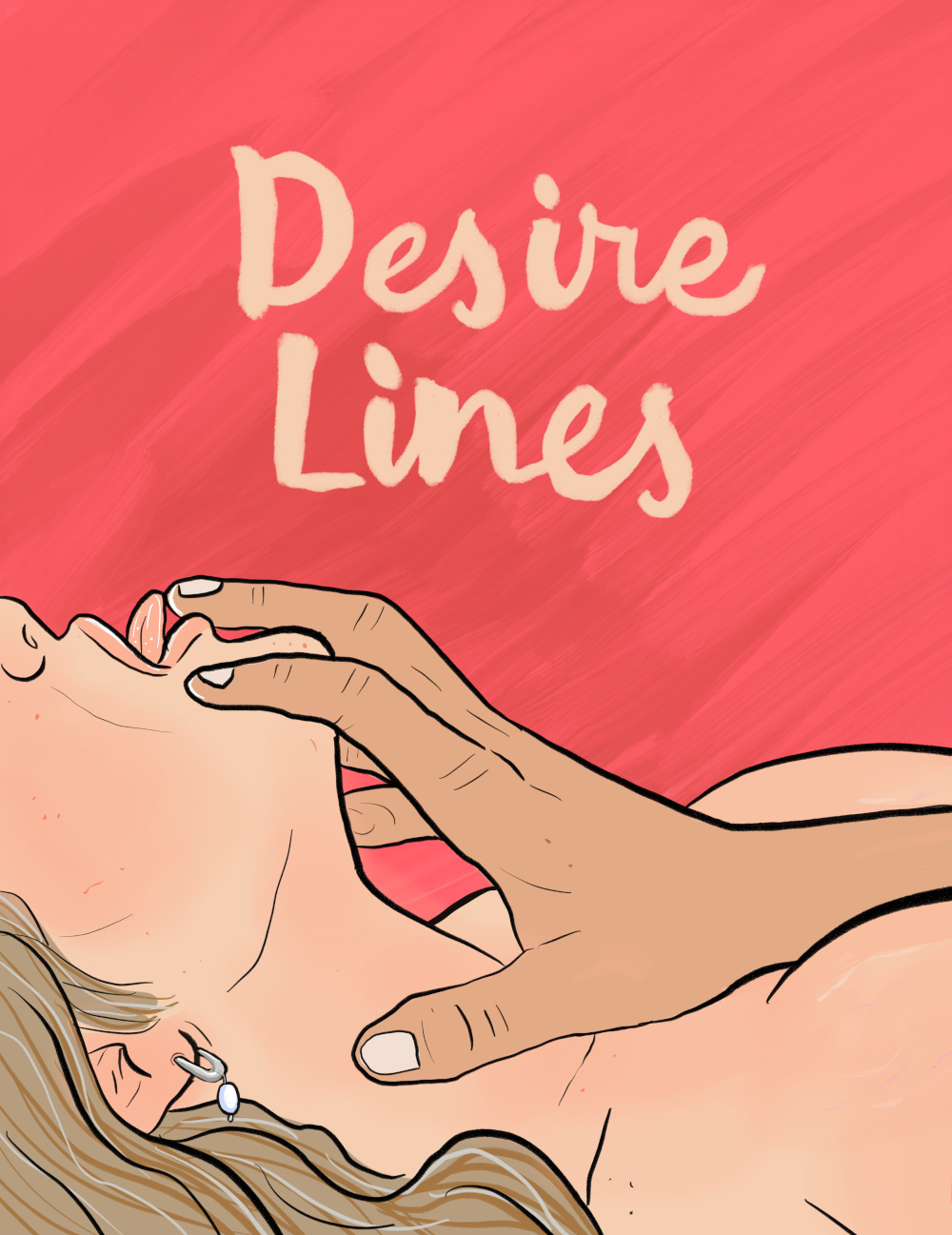
Desire Lines

Posted in ARTWORKS, CHAPBOOKS | Tagged

15 Artworks by Peta Clancy


Peta Clancy | ‘Fissures in Time 1’ | 2017 | 91 x 124cm | Pigment Inkjet Print | Image courtesy the artist and Dominik Mersch Gallery/small>

Posted in ARTWORKS |

Wilful ignorance on a Sunday afternoon

Part I

the charred cadaver rotates and rotates, on a spit borrowed from the pappous down the street.

melting icesheets, slowdown in China, asylum seekers drowned in the Aegean Sea.

oh, look—little corella. Nah, nah, that’s gotta be a cockie.

the ice-blocks bob and clink, clink, clinketty clink in prettiest pink sangria.

Part II

dad used to say the bird’s eye is a window to providence or some shit like that.

the backdrop of suburbia can be discerned against the faint whir of the machine.

identity is experienced only as some never-uttered yardstick to measure the world by.

the baby soft soles of his feet poke out from the ends of his jeans.

Posted in 114: NO THEME 13 | Tagged

& the wolf & the hermit crab

& on this occasion on some beach
you picked up the shell intrigued
& you wanted to see a hermit crab naked
because you’d never seen that before
& sometimes you ask me why I don’t talk
& you pull & pull words out of my mouth
like teeth like you pulled & pulled
that crab out of its shell
but it wouldn’t let go
it wouldn’t let go until
by sheer force
I shut up
& it ripped in half
& you felt sorry & sorry
just as you did after blowing my house down
& you can’t help your huff & puff
how it never runs out
& I can’t help my quiet way
& now I want to scuttle all the way home
but I have no house & there are birds in the sky
& I wish I didn’t need a shell
but that is the nature of hermit crabs
though wolves might wonder why & why

Posted in 114: NO THEME 13 | Tagged

Fool’s Gold

From the new house, we saw tall, bendy gum trees
and hilly paddocks dotted with cows.

I made Sylvie a birthday cake
from my worn Women’s Weekly cookbook.
She made matching paper crowns for us to wear
as we collected kindling in the wispy rain.

The sun blushed and slunk away.
Sam set up a fire pit with rickety chairs from the tip.
We made billy tea and damper in the glowing coals.
The milky way twinkled.

It snowed on the last day of winter. Fairy wrens
danced in the drifting flurries.

Time was measured by the thwacks of Sam chopping wood.
Wattle flowered the crisp air.

Leo the budgie died and
Sam buried him in the backyard on a cold night.
We threw daisies on the tousled dirt.

We picked three bucketsful of blackberries
grown rampant in the dry following the rain.
Our mouths were stained purple and our socks
were prickled by farmer’s friends.

We fossicked for sapphires in the creek
but only found fool’s gold.

Posted in 114: NO THEME 13 | Tagged

A Map With No Meridian

Before the flood comes it will simplify
the argument of rock
the way we cover old belongings
with a unifying sheet
In the dark of the tent
she brought out words from sleep–
Daughter horsehair peninsula peninsula

A dazed morning draws attention to a crab
lugging a bit of drainpipe around on its body. It scrapes
the slabground and does not suggest a shell. I once read about

our landform on a piece of paper written by nobody,
the words on the page were the size of droplets on a mirror–
anyone can live
anywhere

and I remember this mostly when I sit down on the grass to eat.
Then the light switches on. The stacks of oil drums
reveal themselves against

those years of cooled lava. Everything
shakes like a mirage, and I see her run to her daughter.
This journey was for nothing when
anyone can live in a pod,
a bunker, a bit of land,
and a map is something
you receive in halves.

Posted in 114: NO THEME 13 | Tagged

On Falling

Leaves fall, blazing.
Fortune’s wheel; zeniths and nadirs.
De Casibus. Downfall. Comedown.

Lucifer’s fall, wings clipped.
“Hurled headlong flaming
from the Ethereal Sky,” sings Milton.
Fall of man; original lapse.

Down the rabbit hole, Alice.
Horatio’s vertigo on tower’s edge:
“The very place puts toys of desperation /
Without more motive, into every brain.”

From imagination’s heights.
blind Gloucester’s pratfall.

Hanged man’s fall, to end of rope.
The jumper’s from Trade Center,
tumbling; from fire into void.
Icarus’s, with melting wings.
The runner’s, tripped by root.

Galileo’s Law. Dropped together,
a feather and hammer (air resistance, excepted)
should hit the ground at once.

The tandem skydive from 15,000 feet.
Neophyte and instructor are
harnessed together for dear life.
Goggles for wind. Jump suits rippling.
For 60 seconds “more like flying than falling,”
before ripcord’s pull; then five minute’s
float to ground.

On Youtube, headset cams record
two daredevils in gliding suits.
They leap, one after the other,
from a mountain peak into updrafts,
soar down over cliffs and ridges,
until far below a valley greatens.
Leonardo’s dream turned sport.

Flight is careful falling.

Bungee cord’s elastic limit,
rescue’s heave, then down,
then up, resilience fading.

Falling in love.
Fallen soldiers; civilizations.
Dow falls, stocks lessen.

The precious bowl, escaped,
turns in mid-air beyond reclaim.

Our planet drifts, spinning.
Astronauts ricochet from padded walls.

The Runner picks himself up;
walks stiffly, keeps jogging.

The fallen king discovers
wisdom, humility, compassion.

Springs buds return.

My wife revises, “Down will come baby, cradle and all”
to “Down will come baby, into Mommy’s arms.”

Posted in 114: NO THEME 13 | Tagged

Frightened wolf / Sheep in the bay

The inlet water of the Chesapeake was held at a clarity, degrees before freezing. It could not, would not harden into a floor. Its bully in the Atlantic threw punches along the coastline. Our father demanded we paddle along the lake on New Year’s Day. My brother pushed into his kayak before us with a feigned excitement. At least my knees could see the sky, untucked in a canoe. His legs were tight in the boat’s pocket. Play is rarely a unanimous kind of fun. The bow of my brother’s boat hit ours. Once was all it took. We tipped over until my father and I were submerged. I knew the game turned sour as my lips came up for air, puckering from the salt laying sediment against my face. He, my brother, jumped in. I was heavy in winter clothing. Hypothermia begins with a fault in the bones. The inlet sought to shatter, but in truth it sought to snap off what it held hostage. Our father swam towards shore, not a word to us, not a promise for help, just his back to his children, the tips of his fingers seeking the plush of deadened grass.

Posted in 114: NO THEME 13 | Tagged

Eighth View of the Southern Cross

Easter Island, 1500 AD

The five stars tremble through the branches
of the last tree on this island. At dawn,
my loyal axe will cut it down to raise
the final moai of my ancestors
and the long gone dead will smile.
But there will be no wood for platforms
to one day lift me huge and rocky
like the eyes that talk to the sky,
my cold stone back to the living sea,
my painted eyes scorching the bare earth.
I tremble, too, but the ancestors call my axe.

Posted in 114: NO THEME 13 | Tagged

This Is How It Ends

After she says let me fill your collarbone with water, you think bodies are islands.
You wait for the shores to drown.

––

You are swimming and swimming –
in October, in the ocean, in a dream, in a poem, in a song. Fast friends,
days and nights agree not to keep you a secret.

––

Your father says I’ll be here tomorrow, and his shadow stays exactly where you marked it.

––

A name sits on your tongue and thrills you.
You call, somebody turns. The second becomes the stillest hour.

––

You live in a country where the government ran out of bullets. Each time fear arrests a heart,
somebody flies a kite. Children, bakers, fools, the village follow suit. As if to proclaim that
sometimes we are protected from the vastness of the sky.

––

No mouth is left to dry.

––

Days and everything they hold flee you.

Trace of birds, blur of trees, ripple deforming
your face in the puddle.
A sentence with the word hilarious in it.

The lack of need to record it.

––

You kneel. You trace beads of rosary, and a song
stands inside your throat.

Even the wind and the space it fills are sacred.

––

Your friends tilt their heads back.
The air is laughter.

Posted in 114: NO THEME 13 | Tagged

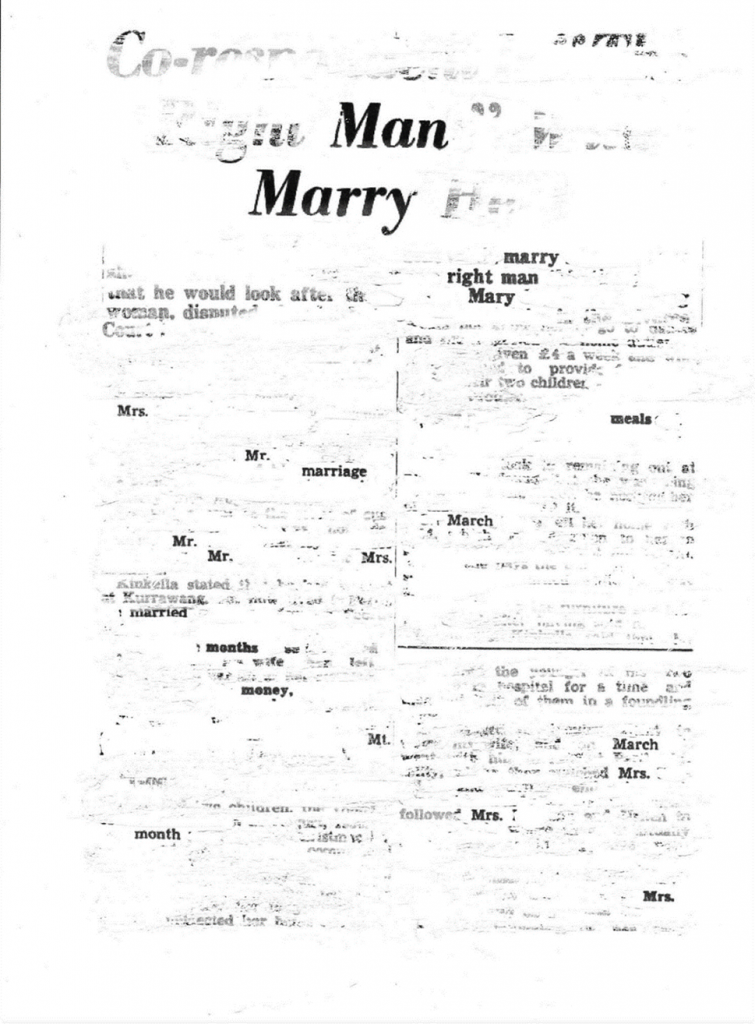
Marry Right Man Mary


Reference: Co-respondent is “the right man;” will marry her. (1936, September 7).
The Daily News (Perth, WA: 1882 – 1955), p. 2 (Final). http://nla.gov.au/nla.news-article82531019

Posted in 114: NO THEME 13 | Tagged

Sydney Poem

I.

With the release of his hoof from the pitted step
crushed frangipani petals spring,
wet with perfume, to broken pyramids,
stained-glass rubble.
He gangles his way down the steps,
vast rounded thighs shifting like drunk
whales courting. The fawn blinks in the new century
and he casts his leer out to Middle Harbour
where he heard you were out in the sun,
dear companion,
roaming this joyous city of the dead.

II.

I almost broke my neck
hopping down the steps at Potts Point
because I heard you were floating,
wide-eyed and tendons sliced, past Goat Island and out
to the humpback bridge
to the pearly xenomorph of sharpened curves
past the galleries where every piece of painted plywood
both adopts and subverts the
iconography of power
to interrogate the nexus
of capital and the state
(if they didn’t, would we survive the shock?)
and poets mutter under their breath
on the light rail:
things looked bland.

III.

Lines rise to the surface like bodies
washing up at the Gap and like bodies
washing up at the Gap most of them aren’t mine:
RATS IN PARADISE
shriek the gorgeous new apartments shitting
on the earlier bird’s views. There’s a bit of everything
poured into these steel
and watery glitters. Joe Lynch decanted himself in 1927
not – as Brennan lamented – onto a cranium
but into a poem. Shaking his massive legs in the sun
he clops down Writers Walk, too huge,
too wrong, stumbling over
one of AD Hope’s chiselled iambs.
Lunch is drunk in that Sydney way
of investment bankers at the Quay,
sluicing their misgivings out to sea
to boil up as clouds and piss
back down on you and me.

IV.

Emerging
from the Opera House underpass for a second
everything is just what we were promised:
fistfuls of sudden sunlight knock out
your vision, glory in the skies,
a faint smell of sewerage
and shirts brighter than a song.
For a second it’s goodbye,
as the sun fills your mouth
and you spin out by the crushed light
of the Heads,
singing to the glass sky.

Posted in 114: NO THEME 13 | Tagged

HELSINKI SESTINA

Even in summer, it is difficult to think of cane toads abiding in Helsinki.
In this Nordic city, flies are scarce. I can’t imagine an amphibian predator
beefing up sufficiently to hibernate through winter, even if the freeze
did not still its heart, that pump sometimes stolen, in lust for vivisection,
by Australian water rats that carve out the organs with surgical precision.
They gorge, they scurry, large as cats, from the river banks after the floods.

Beekeepers struggle to recover when toads invade hives following floods.
Mackay is a sugar town built on a swamp. That much it shares with Helsinki,
where bees may be kept in parks. Bears lack the necessary skill, precision,
to extract honey safely. The Eurasian jay remains the chief bee predator.
Stung bears yowl like cats waking from ether while undergoing vivisection.
Bears are not to be crossed when feeding, laying on fat before the freeze.

Back in Mackay, the hunters bag the toads to take them home to freeze.
Some drive at them with golf clubs. Divots rise from tees soft after floods,
but toads have been known to land live on par three greens. Vivisection
is frowned upon by the ethics committee of the University of Helsinki,
but desperate measures prevail against the toad that poisons all predators
other than the water rat. Pleasure derived by some is practiced precision.

Introduction of the toad, presumed to focus diet, with exclusive precision,
on the cane beetle, was a blunder causing those bold agronomists to freeze,
too late to backtrack, to reverse their SUVs across the cane toad predator
plague released on native fauna, rafted across the country by the floods.
Away on the other side of the world, at the end of summer in Helsinki,
I dream of execution. Unconstrained, toad in hand, I opt for vivisection.

How the toad inspires sufficient hatred for those who abhor vivisection
to lose their scruples can best be understood studying the art of precision
archery. Placing a shaft between the shoulders is prohibited in Helsinki,
and is an illegal discharge of a firearm (unless the archer shouts “Freeze!”)
even in suburban Brisbane, that city so severely ravaged by the floods
that brought toads as big as dinner plates to feed their water rat predator.

For Australians, feral cats rate second to the toad as most hated predator
of native fauna, and it was toads and cats that were subject to vivisection
in physiology experiments, in medical schools, before activists, in floods
of indignation against poor, cruel science, lacking in purposeful precision,
through the Animal Care and Protection Act 2001, brought about a freeze
on vivisection in Queensland, which is not in any way relevant to Helsinki.

Ranidaphobic, the predator travels, seeking refuge and solace in Helsinki,
dreams amphibian vivisection, contemplates winter cold enough to freeze
the Queensland floods, gives thanks for physicians with skill and precision.

Posted in 114: NO THEME 13 | Tagged

if you want a daughter and don’t mind that she’s a little off

Make a cage and call it ribs.
Make it of whatever you have. Wires, or animal bones.
Place inside a raspberry for the heart
and press it until the juice comes out, red.
If it’s the wrong season for raspberries, use a stone,
and below it put some kind of waiting vessel.
The head can be a rounded vase, the hair flowers.
Fold cheekbones out of paper, and polish marbles for the eyes.
She’s better off without a mouth,
but give her shells for ears, a spoon for a nose,
and use crochet hooks for fingers, so she can be useful.

Give her soft limbs of folded bedsheets and prop her up
in your window, so people will see what you have done.

Posted in 114: NO THEME 13 | Tagged

Techno and Hall Passes

Layered kicks one
with high pass filter
slapping one
with low pass filter
thumping
Bass syncopated
Saturated, running
Into next bar, tappy little
speed rims, touch of

Anna Torv lips pursed oversized button up.

Soft cymbals panned,
reversed with a whip-sharp
clap reverb
ballooning
eight bars of high hat
coming in, phaser
subtle, boosted air
lifting and cutting through the
weight of

Zan Rowe sultry voice saying that’s fucked.

Build-up of snares
Snapping and rolling into
Break down, a deepening
atmosphere, delays
on gritty synths, notes
lingering, last beats
spilling out, feathering
into white noise and
whispers of

Anna and Zan cradling wines wall seat dive bar.

Posted in 114: NO THEME 13 | Tagged

In which I haunt scholar poet William Empson

William Empson stands at the basin to shave.
His face in the small mirror becomes
a series of surmountable practical problems for the hand and eye.
Every visitor describes his digs as ‘squalid’
but in this imagined moment he stands in a rhombus of sunlight
steam rising from the water.
Scents of soap and an orange only beginning to mould.

William Empson, I want to write about a Lake.
I thought of you, who wrote “lack of conversation
makes it hard to write anything”.
I’m making this fictional visit to talk it over.

How do I write about a place that’s stolen
from the people who know it and live with it still
through cedar and whales cut and made away
cattle occupying land
the violent outrages
Mr Throsby, the 40th of Foot
his majesty’s blankets
the trawling and dairying
the spoiling of the water
sand dug up and stirred into concrete
children taken
pea picking race hate
acacia planted for a tannery
breakwaters the new suburb without a sewage system
slag poured into the saltmarsh?
The rubbish traps across the creeks catch plenty.

William Empson is only half-listening
as he stands in sunshine that suggests warmth, but doesn’t provide it
with the idea of a drink already lapping at his mind.
It’s only when he’s softened by the concentration needed to soap and scrape
fine bubbles of lather, the pleasure of hot water on a cold morning
that he decides to wait
for his walk to the lecture hall
to work out how to make the letter he’s writing to the TLS
funnier, less hurt, and attend to
my hovering presence, a ghost from the future.

William Empson meets my eye in the mirror while he pats dry his face
and quotes from his book, Some versions of Pastoral, written in 1935
the year before the Windang Bridge was built across the lake mouth.
The pastoral is “felt to imply a beautiful relation between rich and poor”.
The pastoral is “any work about the people but not by or for them”.
The pastoral is a process of “putting the complex into the simple”.

The pastoral, a gilty frame that leaves out labour, sex, milk, nest hollows, undergrowth, a shoulder smashed by musket fire,
dried fish, strips of calico, tobacco, overseers, avoiding the lobsters, drowning in sawdust, cockles, butter shipped to old gold
mountain, a woman growing grain, the incinerator on the island, banqueting, the cop’s pleasure boat, the man who needed
to get away, coal, a delegation to Macquarie Street, goats, absconders, miners, machinists, drivers, shopgirls; favouring
instead the poeting Bishop D’Arcy Irvine’s “white boats”, “purple hills”, a “flat sheet of water” and “the busy town” in
“mellow light”.

William Empson puts his spectacles back on.
The shaving water, grey and scummed, drains and runs through pipes into the River Soar.
William Empson’s soap and stubble will be – was – dispersed and digested
by the microscopic lives of the river, but he does not think of this as he swings on his coat
feels for tobacco in the pocket, picks up his papers and lets himself out.
William Empson has had enough of me. I can take what I need and leave what I don’t.

I’ll take his delight in ambiguity, fluid misquotation, I’ll take his naming of the lie of the beautiful relation and bring it to the
plaques and inscriptions, the paintings, poems and photographs, the stories repeated, the works performed, the plans and
programs, the lie, bright and sharp in some guises, in others, heavy scattered churning settling.

Posted in 114: NO THEME 13 | Tagged

Ravioli

I used to think there was loneliness
in the fabric of the American soul;
a matter of great distances,

an aspect of being scattered
across boxes of drywall and vinyl siding,
being conveyed in velvet-steel cages—

I felt there were traces of solitude
so I read Travels with Charley to see
what Steinbeck discovered, on the road.

Aloneness, then, was a presupposition:
reared at a distance, without siblings,
counting migrant friends on thumbs.

When someone learns I’m an only child,
their face flickers like a smiling flipbook,
depicting: “that explains a few things.”

I figured they caught a glimpse
of this far-off mark on my skin
like a long, straight scratch on the moon.

“I want to be your one and only,” I croon
once again, to a faceless every-mannequin
who too remarks: “that explains a few things.”

Somehow I began to think
I would be repaid for it all,
as if I held some holy IOU.

Reading Travels with Charley back then,
huddled aside, isolated, telling nobody—
something essential had been jumbled.

Yet, Steinbeck: he was rarely alone
on his journey, sharing each meal,
coupling words to unsaid feelings.

A red sun sets over the Atlantic
saying, pain knows no nation
and closeness is fleeting.

Tony makes me ravioli. I mumble—
“Something in here is broken.”

But Tony knew. He is broken too.
Long, straight scratches on the moon—

astronomers call them lineae.
I’m just glad they have a name.

Posted in 114: NO THEME 13 | Tagged

Laverton Ghost

They are gone now. Fled, banished in death or exile, lost, undone.
– Cormac McCarthy

see him now wandering still
through the Truganina marsh
in tattered tracksuit, broken baseball cap,
bad walking cane scratching at the paths
before the slow shuffle
of his tiny, duct-taped runners.

he was here before I was, before my folks migrated.
they used to say he was stuck out of time;
this old geezer forever on the one route
from West Altona across the swamps to Laverton
then back again, every day – rain, hail, or shine.
they called him the Ghost.

I’d hang out with the neighbourhood kids
on the Reschke Court cul-de-sac, skateboards in tow.
at the mouth of the street you’d see
the Ghost cross: this tiny, clunky thing
wobbling to and fro, the way a child
pretends to walk a toy figurine.

the younger kids, the meaner ones
would skate after the Ghost, wheeling behind.
they’d taunt him, chucking bark bits and bottle caps:
50 points if ya knock off his hat!
he’d brush away the barrage like it was houseflies
and press on, undisturbed.

here the rumours grew of the Ghost’s past.
Colin Sheedy spotted the Starry Plough
embroidered on the sleeve of his bomber jacket,
so told us all he was an Irish National
loyal to the Ursa Major, haunted by the Troubles
thoughts now doused in blood of the dead.

but then Nick Portello reckons he saw
a genuine Hell’s Angels tattoo on the Ghost’s neck;
Nick’s old man, up in Pentridge, had one.
we didn’t buy that the Ghost was a bikie,
he was of a horse and cart era
and to me, he just seemed too gentle.

my Dad drank with the fogies at the bottle-o
and they all thought the Ghost was a crim in hiding.
Mum was more sympathetic. she thought him
to be Saint Roch reincarnated, and he trekked
that route across the swamp each day
because he was looking for his lost dog.

I’d see him, riding around the streets at dusk,
the loneliest time in Laverton back then.
it’d be 40-something degrees and the ghost would be
wrapped up in his scruffy black garb;
his ashen moustache trembled and dripped with sweat.
his old, squirreled eyes set on the path ahead.

see progress shove itself into the unlikely nook,
unwanted, refused. the suburb then sprawled
and the train station was refurbished;
the Māori and poor whites were edged out
and those old bogan loons of Bruno’s bottle-o
were nipped by creatures and cancer.

all this change around so that Laverton
soon caught up to the 21st century.
blocks of medium density dwelling
for the new, rosy families.
the bottle-o evolved to a cheeky café
and the pot-holed roads were remade.

still there would be the skyline of Melbourne
seen from the top of the station’s overpass.
and there would be a graceful cool change
come in off the swamp to break the stifled air,
and the dusk streets still retained the peace
of scattered kids whose imaginations flared.

and you’d think along with the old vanguard
that the Ghost would be gone,
but there he was, come up from a
graveyard of construction,
tottering that bad cane, the slight breeze
that rocked his tiny frame.

nowadays, though, he moved slow;
He was stuck out of time, said Mum.
he was alone, more so. those that taunted him either
moved away, went to prison or died.
in the streets the Ghost would pause to rest.
just stand there still, and rest.

the milk bar, post office and Polish butcher
were all abandoned, boarded up and chained.
back in the day, the wood and shutters
would have been tagged in crude graffiti scrawls
thrown up by the silly, vulgar gangs of yore
I’d have been part of them.

I’d visit my father at the nursing home.
docile and hunched in a reading chair,
brushing bent fingers over the page of a book
I recognised from childhood.
in the shaft of warm windowlight
the few stray hairs on his head glinted.

I’d come to know quite a few people
buried at the Altona Memorial Park, a resting place
surrounded by freeways and warehouses.
we laid my mother there.
the priest’s prayer boomed over
the blow of a Kenworth’s dual-exhaust.

now he was all but bone, the Ghost.
pure relic of the streets and swamp.
he exchanged his walking route for the train.
on the platform, he’d hear
a horn sound and wince in fright
as though it was a trumpet of death.

he was always marching on, persistent.
you’d see it fixed on his face.
his perseverance was so humble. no jonesing
for grog or junk, that manic desperate gait.
he was craving home, I reckoned.
a place to be still, and feel good.

I would like to imagine he had
someone waiting for him after his treks.
he’d wander against the fiery sky, wreathed in smog
push through the front gate at final light
and be seated at a table before a plate,
across from someone who loved him.

ordinary legend of no real weight or gravitas
whose rumours diminished a small, dignified life;
to have haunted the mind of a suburb
and not even know it, a fixture of the streets
as much as the architecture, now gone
in a past that slowly fades with us.

Posted in 114: NO THEME 13 | Tagged

Easter Weekend, Saint Kilda

Deathwish bar and tattoo parlour personnel in their themed tees
stand shopfront to review an El Camino Chevrolet
and brace of Hogs. The deep end of Acland Street.
You see a skateboard matador who turns a V8 off loose jeans,
you pass the sign for tarot and an impromptu boxing clinic,
pass Italians, fish n chips and four éclair shops, Readings
booksellers impasto gelato smear and palette knife
scrapings of dog, walk on past ghosts of genuflecting seniors
whose spook bowls indulge their biases on grown-over greens
where co-op veggie beds are raising ropey sunflowers
and scrap metal whimsy to keep out rough sleepers,
coming at last to Luna Park’s impassable tramline knot,
the giant mouth Edvard Munching dental tools awhirr.
Look through the rollercoaster formwork to the pink sun
setting on a fake west coast. A number 16 tram departs
like a spat pill while patron Saint Paul looks on from his mural
on the Espy, harmonising guilt-cred with nostalgia for 13
hours on a bus, the Cross, this promenade both he and I prefer.

Posted in 114: NO THEME 13 | Tagged

Prove that you are human

Select all squares with crossings.

The blue wheel goes round.

This park looks familiar
and I had a bicycle just like that.
I wonder where the motorbike rider is going?
Maybe to his long-lost mother’s house.
They’ve only just rediscovered each other
after a lifetime of separation.

Select all squares with traffic lights.

That woman sitting on the bench
behind the stop sign,
she’s a refugee who’s spent years
trying to prove she’s human.

Select all squares with clouds.

including clouds with silver linings
and clouded judgements.
Every square has clouds.
Is that a metaphor?

Prove that you are a human.

Do something lovely
or vicious
or both.

Select all images with stairs.

The young man going up those back stairs
is on his way to a click farm,
a windowless building in
a street without a minimum wage.
He’s paid a pittance to plant
likes and follows and five-star reviews.

To continue, type the characters
you see in the picture.

What language is this?
Those twisted cat scratchings
look like my failed drafts.

The blue wheel goes round
and round.

‘I’m not a robot.’

Please believe me.

Posted in 114: NO THEME 13 | Tagged