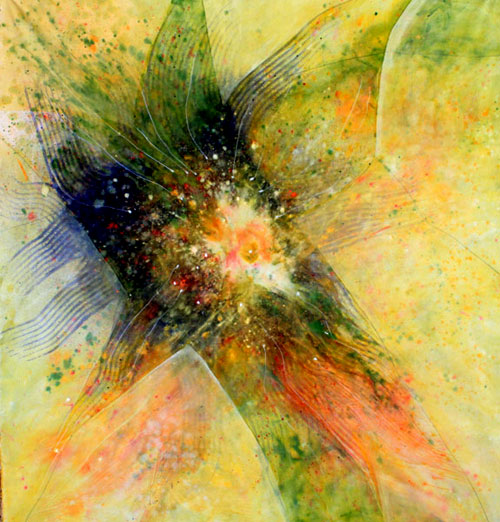
Core Explosion | Suzanne Bellamy | 2010 | acrylic & fabric on canvas | 2 x 2.4m

Core Explosion | Suzanne Bellamy | 2010 | acrylic & fabric on canvas | 2 x 2.4m
Atlas of Anatomy,1956, in the drawing of the Sterno-costal Surface of the Heart and Great Vessels, in situ, the coronary arteries are red, the cardiac veins, blue. They traverse the heart’s surface, a glutinous grey, a velvet slug.
Blue’s turned again, at the traffic lights – stares straight ahead, fingers tap my leg. Rain drums hard on the hood, does Blue know where she’s going?
Observe this chamber’s entrance: this smooth funnel-shaped wall (infundibulum) below the pulmonary orifice; the rest of the ventricle, is rough with fleshy trabeculae.
Warm wind thick in the city, a large white open tissue blows into her face, a mask. Girl in bright red ballet slippers walks quickly ahead, steps light, a dancer.
A shocking impact first of all more than you could know like an M-80 going off in your shirt pocket it sent me reeling. Same time a feeling of being jack-hammered through my chest. Then, everything in slow motion
In the thick wind, everything became bogged-down – people moved as though through treacle, sticky-slow. Little Asian girl in a pale blue track-suit, hung onto her mother’s hand, in the other, she clutched a witch’s hat, its wiry yellow hair sprayed out in the wind.
Red’s right behind, face anxious above the wheel. She’s following, I say to Blue. Blue drives one-handed, with a casual air.
In the maelstrom, three people stop her and ask the way –
to the money exchange, Kent Street, to the platform of a certain train.
I feel you enter, pushing into the pericardial cul de sac. My heart contracts around your fingers. You tell me what you see: an intricate weaving, a bulbous branching.
In shape and size, the heart is a closed tight fist.
Blue pulls up beneath the bridge – I hear a car door slam. Red gets out, the gun looks huge in her small hand.
My heart’s removed, it’s opened, the thick muscle folded back, held in place by steel pins. I turn to Blue – you knew this would happen, didn’t you?
I’m lying on the floor in that room, thirty seconds post-impact. Every breath a knife turning in my lung. Then, I can no longer see
Red circles the car, swinging the gun every which-way. Raindrops stand out in her hair like jewels.
Red’s voice pierces. “Listen, I’ve got ten love letters for you – three for your feet, seven more for your belly, and spare clips, and I change them pretty quick. So get out!”
“Put that rod up,” growls Blue, “or I’ll bang it out of your fist.”
It was a darn miracle I did not die the doctor later said the bullet missed the vital part it almost ‘curved’ around my heart
There’s a forest within the heart’s chambers – the papillary muscles are the thick and shiny trunks of trees, branching into the chordae tendineae, a tender-looking fragile weaving.
Her eyes hated me. To hell with her, I thought.
The red shoes danced across the city’s map
twinkling in all the places I’d been
street corners, houses, bridges, doorways, bricks I’d run my fingers across,
Sirens wailed distantly; the sound murmured though the windows,
dingos howling out in the hills.
I sat in the car, not moving, wondering why Red hadn’t killed me. None of it made any sense. I watched the rain trickling down the windscreen.
I turned the key in the ignition.
The red shoes were the only things moving, stabbing out the dance in the grainy air.
A dark blue fringe of lace above a soft brown wooden surface, the lattice. City lights, not twinkling, twinkling less because they are closer, not further. Blue space between the lattice and the city. Blurring in and zooming out. Seeing it as though with a Photoshop filter, flattening everything. Space becomes 2D as safety glass shatters, as fluid becomes solid, as liquid becomes ice.
6:45am The light from the sunrise lightens everything but at this moment, rays hit a group of houses on the Annandale hill. Suddenly spectacular light on a lit landscape and what it does to the space in between. I shoot and shoot but can’t capture the space. Then slowly another image starts to dominate the shot. In a triangular patch of light on the grass in the foreground, I see my own silhouette like the outline of a clothes peg. Standing, centred in the triangle. The shape yellow-green, diffuse. And the wood chips at the base of the trees, glowing red-orange at its edges.
A big strong guy on YouTube demonstrates his many musical instruments in a special room of his house. This is my happy place, he says. Music is my happy place. Why does a big strong guy need a happy place. Touch of blue. Yes, happy place – playing music, writing, making artwork, video. Why do you sit for hours playing music. Happy place. Not ecstatic, just not miserable, not crushed. A place where the spirit can soar, the mind can roam, and no one will know. A place to be alone.
The shock of the new is not shocking, it’s the shock of the horribly familiar. Like the shock of white polystyrene boxes being carried along the street as you drive past in a car. Horribly white, stained, tainted, suffocating.
Dark dark darkness supersedes the twilight, dark ideas leap from the shadows. Midnight screening/screaming, Formal Wear/malware. The biggest fear: a meteor shower wiping out our databases.
Next photo, the silhouette of you on the motorbike, coming home, smiling, but backlit in the dark garage. And also the headlight shining. The light from the bike and the backlight washes over the shot like a soft mist.
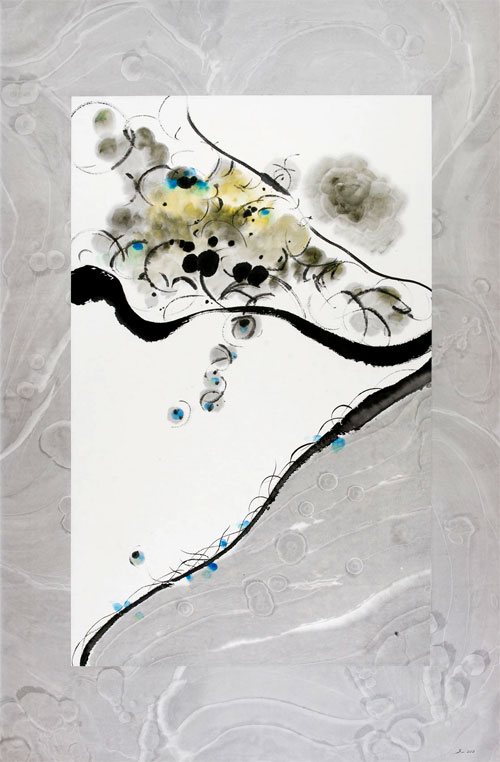
Game with the Wind | Debby Sou Vai Keng | ink on rice paper | 1704x1205mm
Deadly flotilla of purposive sails, twisting, spruiking the wind, caught more than a squall, caught a gale, leaving them stranded. Vicious strings of stings, ultramarine webs – spread in the sand, anesthetising nothing. Bloated and swollen, dark pirates deceived in the sea’s silver mirror. Breakers smack sand, whale’s fluke hurls foam – sea’s breathing a false wind
Twisting, manoeuvring, bruises on sand, lethal stings laid flat, nothing to drag, no silver fry entwined. Cnidarians, animated water, trawled Ediacaran seas, garden of sea pens, nodding quills – if there were tentacles, what was the catch? No mouths then, no anus in sight, no teeth, claws or eyes, pulsations only, animated water, clear blue moons, waxing or waning, predictable as water lilies
Stranded in motion, I’m stripped back to bone, my skin is a parchment, hieroglyphic of lines, staring ahead for a change in the weather, at the blueing horizon, around and around, hugging the shoreline, clinging to visage, purple rocks and spume, on this balsa wood raft, both stable and dangerous
Raft turns, follows the current, around to the point, past torn cliffs and back again. Siren sang as she drew me under, and then there’s the other, lashed me firm to this mast. Tell me what’s wrong? If I did it would hurt you. This relationship’s dead, she says, in a hurry, walks gaily through water, waving a hand, disappears into fog
Sea rears up, racing white horses break legs, storm hurling bodies out of the water, great rolling logs, entire trees, a forest it seems, wrenched off at the roots, arms lopped, water lapping, sea smoothed breasts, stripped and skeletal, stranded on sand, sand blasted silver, smoothed dead hands, petrified grin of a petrel, a sand smashed crashed bomber – shattered blue beach-glass, and the bluebottles twisting, inflating – what is this catch that is dry as the sand
Return to the point, the point where I’m turning, here on my raft, which her hands are now clutching, she slides in the seaweed, fingers like starfish, hair streaming sea, eyes of a seal, yet her toehold’s the other, the basking deceiver, booming through fog, won’t drive a wedge, as she picks up the hammer and drives it in – split – ¬my mouths full of sand, and the bluebottles turning, twisting in sand
Rubble of shells all weed and wet feathers, the pirates are stranded, deceived by the sea, what was the catch in those looming pulsations, the strings of stings, a net cast wide, what writhed and was still? Hearts an anemone, crimson and pulsing, shrinking when prodded, dark, dark crimson stuck to a rock, tied to a mast, turning and turning, past the point and back
Here is the earth, here is the sand, each shell discarded, salt stained, sweat stained. Old woman collects shells and says, I will throw them all back, at my age, what’s left? Seen them before, those razors and cowries, cream swirls or chocolate, echinoderm spines – whose eyes will remember, will the wind remember as it gnaws on a shell? All is wound up, poised and watchful
Mind moving matter and the whole world ages, ages beside me, the beach wild no longer but spattered with plastic, the jetsam on ropes, dragging me down, into the current, around and around
Neon flashes and the beach is still writhing, twisting with ribbons of liquid sky. Twin clouds close their lips on a sky of cumquat, sea-winds herd a third cloud, the cumulus, the other, out past the point; it’s gliding, crumpling the ultramarine. Flash – lightning strike – bluebottle cloud, whips of its tentacles, dragging horizon, gone
Pale clouds gone further fractal, reforming, reshaping
Grounds in her coffee cup, her book by the bed
Her shape is a shadow, impressed in white sheets – I smooth it away
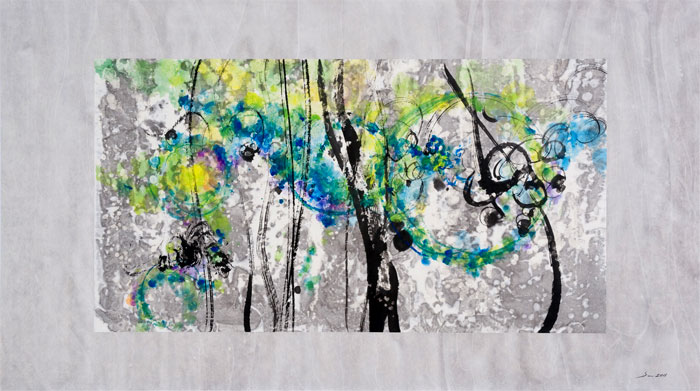
Gestures in Dreams, No. 1| Debby Sou Vai Keng | ink on rice paper | 683x1215mm
Dear friend,
In such a small town our car had actually survived a hundred thousand k’s. The tyres slowly rolled over the erratic streetscape and left it flat on the slightly rugged tarred road. The aggressive pattern had long been ground introspective and smoothed. Our car was towed to a drab auto garage. The engine was jump-started, caught between whimpers and silences, reliving its eloquence of the good old days or worrying about its voiceless prospect. With a trunk of dingy rusty gears, it contemplated the highway of tomorrows. The dents needed the plastic surgery of panel-beating, not to mention new-skin transplants. The frail interior was taken apart, we needed to collect its fragile bones and hunt for substitute tendons. Half of the wires short-circuited. More than half of the oil hoses were jammed. The dyspeptic stomach needed to adjust itself to the impure domestic petrol. Would a mug of black coffee help digest the anxiety outside the operating room? But the vent-pipes belched out pungent bitter black smoke. And the filth of the motor oil, its sour smell spread like a discordant nocturne slowly pouring out. And what was the mess of imported used auto parts on the shelf prophesying? Our past was fragmenting into discrete pieces. The rear-view mirror used to have your approaching image from behind after class; the windshield wiper used to wipe off the heavy-clouded loads on our minds; the headlights used to light up the indistinct journey ahead. But the mechanic handed us a critical condition notice. We understood weighing it for scrap was hardly a fair deal for our feelings. But what would ferry us across the time lag from a death-bed parting to the nostalgic retrospect? How should we deal with the haunting codes on our loved one’s organ donor card?
Yours sincerely,
Your friend
who also lost his car
She loves him, the young certainty of a train wreck deep inside his need isn’t fair but is trying like that sun hanging onto an indifferent escarpment mid winter gut his eyes are warm. Will you stay? Marry me?
Under all that grey know the secret garden has rats. Something more free an incontinence of desire still burgles in the grate. The forest is open. Her eyes are not. We all get killed by the ride.
The globe is crowded by those up ahead. This gangrenous queue. We have machines but lack the touch. That dangerous emission from our uncalloused hands. We commute in cannibal majesty to the wall-less, floor-less offices. Parents ate all the furniture ten years ago then headed to the country where supermarkets are polite & they can drive home drunk.
Health scares create jobs that children won’t touch with a barge pole. We wait for robots & “foreigners” to build a future while they fix our bottoms. Still trade, bargain – wouldn’t swap all this for the world even though it is the world it somehow fits these calm old hands.
She’d ring but the phone is estranged. His mortgage comes by for coffee then steals the pot. Jobs are a lie, no more long service leave after 3 weeks retire at 30 sacks of nothing & everything. Weren’t warned as we fretted texting in the womb. But straight as stringent. It somehow gets better. No use complaining, just keeps on raining. We are cut on a rug sign our names in blood. That human curiosity killing a lifetime. Familiar faces. Worn friends like slippers. Truly placed as we discover… this. Another Happy Birthday. Hello teacher, I’m me. Then travel to be you.
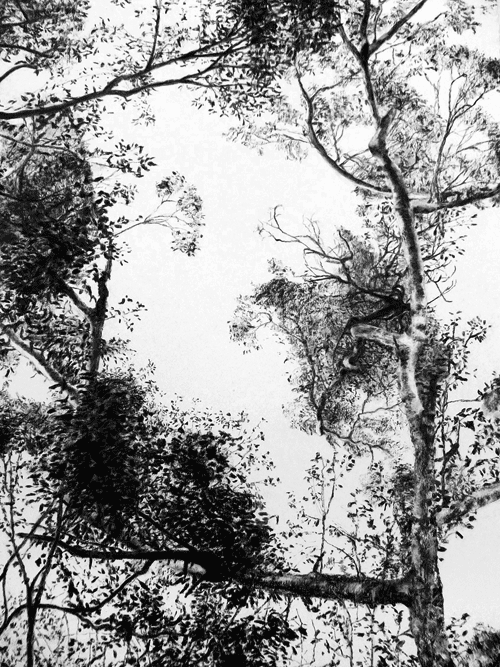
Time with the Sky #6 | Carol Archer | 2009 | charcoal on paper | 76.5 x 57.5cm
I was telling Jurgis last night that his bats had arrived again to eat the figs. I said:
‘Your friends have been coming again, the other night, while I was on the terrace, with their floppy wings.’ And he:
‘… airing their arm pits …’ We laughed.
Their wings in the night about the tree, heavy dark cloth flowing through the air, dropping, closing in, gathering themselves …
After dinner we walked through the garden to the sea. Night. The sky full of stars, the Milky Way, past the sea wall the hills full of lighted houses, the sound of a motor, the sea moving silently, waves that advanced as if made of silk, retreating, coming back. A tree that looked like one in Tuscany on postcards, and in the middle of the dark park this lonely telephone booth… lighted up… golden in the night.
Before me longing
and behind me fate
Umar ibu al Farid 1181-1245
More mines in the North. The land viewed from a helicopter, this beautiful, warm red brown expanse that they are hacking at, the skin of the earth that they are constantly cutting away, taking no notice of people, animals, vegetation. But what about the Aboriginal people whose land it would have been. What do the elders around the area think, they probably die of desperation and in silence, only the noise of the miners is heard everywhere, constantly demanding.
On television they were discussing AUGMENTED REALITY. They must have discovered the means to do it.
We went to hear Hilik speaking at the SQUAT, the young were cooking, some came with cooked food, all these squatters – young, vulnerable looking, some amazing hairdos, partly shaven heads, rings through their lips, tattoos.
Squatting upstairs and in some other houses nearby. Some of them artists, radio people, some wanting to be writers. A friendly atmosphere of broken down chairs, cedar staircases painted black, all trying to escape into a freer world.
During Hilik’s talk about sculpture, his sculptures, at one point, near the kitchen some talk, the level rather high, and the young man who had introduced Hilik, calling out:
‘Silence please. An artist is speaking.’
A. rather liked that.
An interview in the Sydney Morning Herald with Bob Gould, of the famous bookshop. He hopes to live till 80. He is 74 now. Quoting him:
‘I am hoping to last for a considerably longer period by the use of considerable ingenuity.’
Maybe we too can use our ingenuity to that effect.
The Birmingham Orchestra conducted by Simon Rattle, a disk of 20th Century music. John Adams’ HARMONIUM – a massive composition with a large orchestra and massive choirs, on a poem by Dickinson:
Wild Nights! Wild Nights!
Were I with thee
Wild Nights should be our luxury!
Roaming in Eden
Ah! The Sea
Might I but moor – Tonight –
in Thee
Women’s voices from the garden next door and above them a crow putting its spin on the discussion.
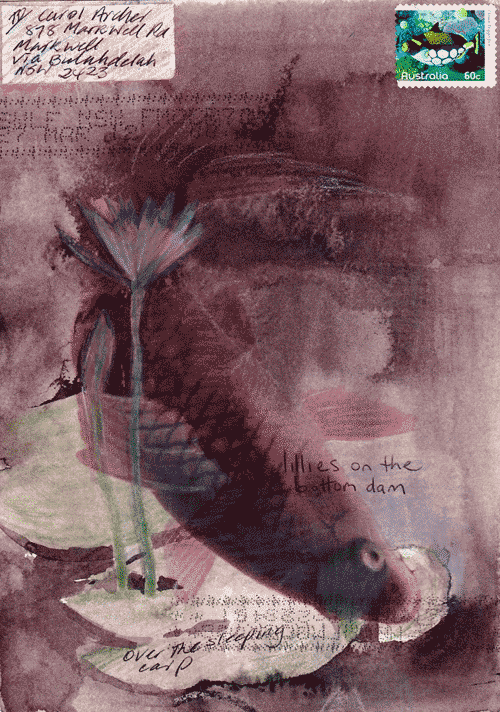
Lilies on the Dam | Anna Couani | 2012 | watercolour and inkjet print on paper
four weeks since the night fed ice fed you cube by melting cube
on a certain day of July in 2012 commenced sunshine day’s early on
secret smoke the Bosnian bedsocks toed out in sandals
garbage out fire fixed lit compost gone recycling chimney checked smoke blue sky sunny bathmat dry already 8 32 15 inside 12 out burning something green needs attention only down last week
for a first thing blue persisting the dream remembers me now – I made a waterfall out of milkcrates doesn’t matter which colours there’s some bamboo structure I explain to Max from next door remains of something I built with Halliday I can’t tell what it was anymore certainly not my place but of course it has to be continents drift all night like this I dream the perfect virus wipes everything you look for and following Elpenor to some unnamed town in Hell, he re-enacts the roof tumble which is when everyone’s head comes off and we go to the real underworld torsos left frozen the kids upstairs put rubbish on those clean cut neck plinths and what can you say but how would you like it if someone did that to you when your head was off …
… a night of such toil and scribble it down
see in the blue that old cloud comes for me time to time and up to the dairy for inksports for colour drift for the grist oh pleasantly pleasantly by saliva we wash o pups slush tongue of the place Ganesh hello in passing and shall I so visit the elephant kin? be out in the lemonfall garden be winterchipping show growth for winter is the season of garden to lurk and to linger in sickness and health
they came at you with knives
here’s hoe it has a handle x x x then up the garden path as recently set in stone
who knows where next appreciate it and while with the spin of words fresh yellow
someone with some arse to echo birds through the tree
so many mail order green things to ground to mulch to water
the fire worries me that plate at the back needs someone stronger than me to shift
best to be under when they come at you best to be talked down those some seconds
by a radio voice and personable best to go gently dreamless into the tug and tear
something between rumble and flutter and the lowing ruts lower reaches as here the wrens
do flit of hommage and then the radio is with us pianos of the competition
gout and bunion fungus toe you can see why ghosts forego feet
four weeks since the ice night womb went praying for rain now the pump is fixed
behind the back dam a shag suns wings and fans to aid damp rays
only the winter bird does that weed beguiled the rendered spell is timber
saw and splutter and axe betide so many ways surviving
you see I’m in the dreamt of place subtle of the sight before writing on brown paper
in the one secret day of July available among the notes keyflung strung mr smokey say
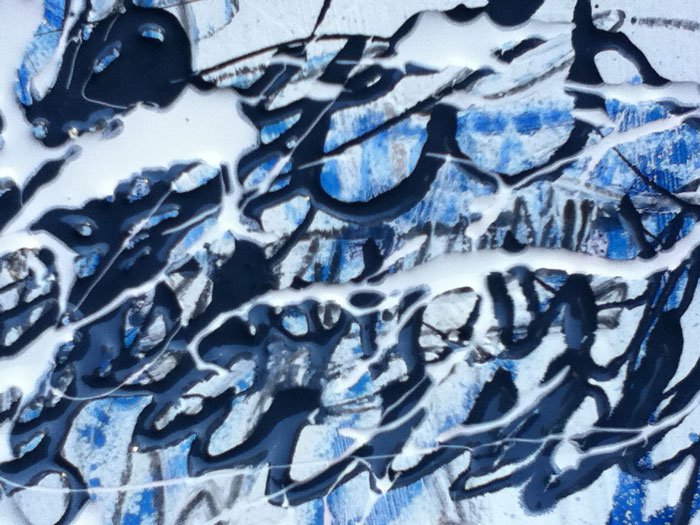
untitled | kit Kelen | 2012 | acrylic and mixed media |40 X 40cm
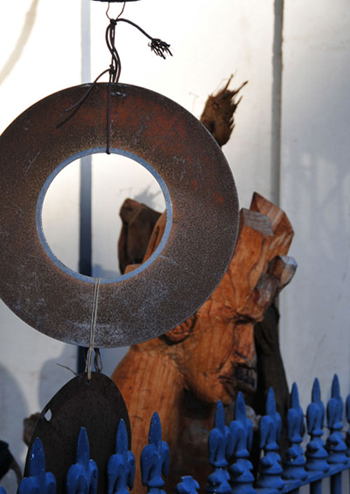
sculpture installations 2 in Queen Street Glebe | Hilik Mirankar | wood carving & mixed media | Image by Anna Couani
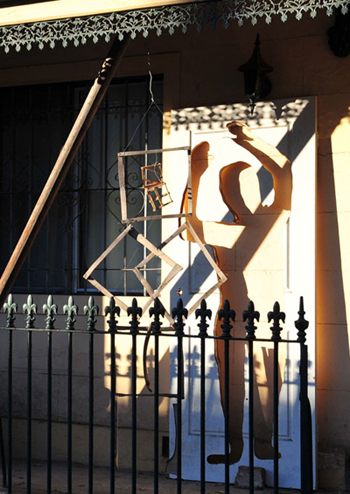
sculpture installations 1 in Queen Street Glebe | Hilik Mirankar | wood carving & mixed media | Image by Anna Couani
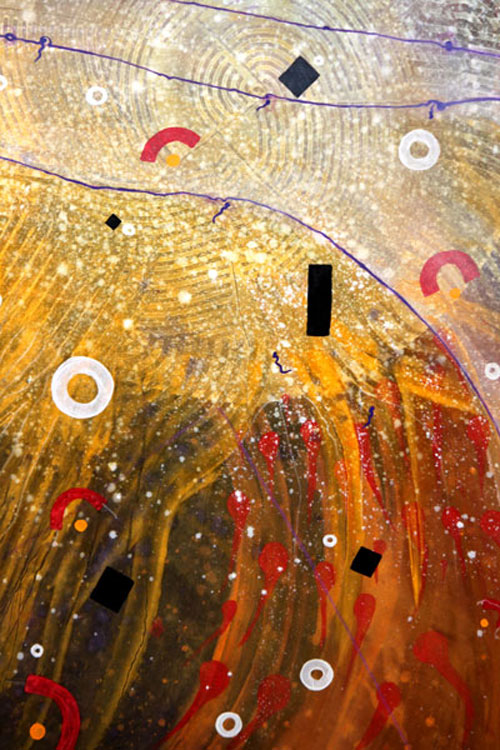
Birth of the New Universe | Suzanne Bellamy | 2010 | acrylic & fabric on canvas | 2 x 2.4m
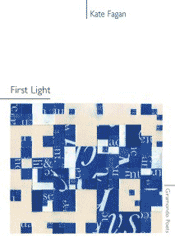
First Light by Kate Fagan
Giramondo Publishing, 2012
Poetry, Paperback, 96pp
First Light is Kate Fagan’s long-awaited second full-length collection. It was published in March 2012, almost ten years to the day after her successful debut, A Long Moment, was released. Ten years is a mere blip in time for planet Earth, but what does it mean to a poet and her history? Ten years can bring a well of experience and an abundance of living – of living the poet’s life and the musician’s career, and of the academic’s savoir vivre. Labels such as lover, wife and new mother are also pertinent to this slow burning collection.
Continue reading
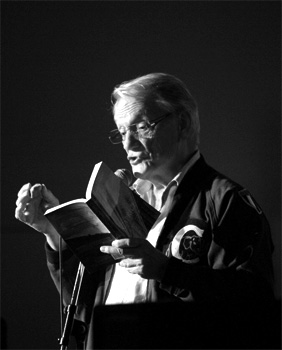
This week, Canadian poet Caitlynn Cummings, editor of the Calgary-based journal filling Station, gives us the lowdown on the recent Canmore artsPeak festival, which took place in the Canadian Rockies in June.
Continue reading
I’ve led a spoiled existence over the past few decades when it comes to living in communities with thriving programs of literary activities and writers’ festivals: firstly Perth, then Albany and Geraldton. My move last year to Narrogin has found me in much quieter environs. I’m enjoying exploring my new neighbourhood. After decades living on the coast, the landscape of the wheatbelt is slowly working its way into my poems.
My new home is not without literary connections. We are 30 minutes from Wickepin, a town proud of its association with Dorothy Hewett and Albert Facey.

Foxes Lair Woodland | Image by Barbara Temperton
Narrogin is small (pop. approx. 5,000) and is the regional centre for a district where the emphasis is on farming and associated industries. The town is feeling the effects of the rural downturn. The last video store is about to go the way of the bookshop and the drive-in, but the locals are friendly, helpful, welcoming. Life is pretty subdued most of the time, but the town has a small, but very busy regional library that is at the heart of the community’s cultural life. In terms of literary-type activities, the library hosts visiting writers for talks and workshops, conducts book launches, children’s book week activities and hosts a writers group which meets monthly. In addition, ARTS Narrogin – the public face of the Narrogin Arts Council – promotes and develops the Arts in the district.

Lake Dumbleyung | Image by Barbara Temperton
A bi-monthly Poet’s Café started last year in response to community consultations which uncovered a desire for a café culture in Narrogin. The Poets’ Café, where I emcee and perform, is sponsored by the Arts Narrogin and the Library, and hosted by Just Jesse’s Cafe. In order to encourage the reading, writing and performing of poetry, the Library invited Perth poet and actor Vivienne Glance down earlier this year and she presented a very successful workshop (thanks to funding from WritingWA). Performers of their own work at the Poets’ Café are short on the ground, but we all have a good time. Audience members happily perform their favourite classic and contemporary poems, and we sometimes include short writing activities. I place particular emphasis on promoting Australian poets and their work.
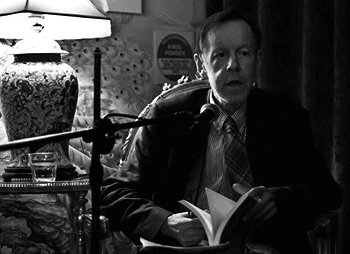
Dennis O’Driscoll in Albany | Image by Bookmark
I commute frequently to Albany for writing events there. I’m a member of a writers’ group that’s been working together now for over ten years and I try to make as many meetings as I can. Albany’s writing scene is an active one, supported by a very engaged community of writers and readers, the Albany Public Library, local bookshops, and by Bookmark. Bookmark, a project of Creative Albany, is about bringing reading and writing activities to the Great Southern region. In February this year Bookmark, in collaboration with the Perth International Arts Festival, presented the Write in the Great Southern festival, which tag-teamed with the Perth Writers Festival and featured – amongst other visiting writers – the Irish poet Dennis O’Driscoll. I had the opportunity to show Dennis some of the sights of Albany, and later we both enjoyed an animated “In conversation” with poet Graham Kershaw as part of the WIGS festival program.
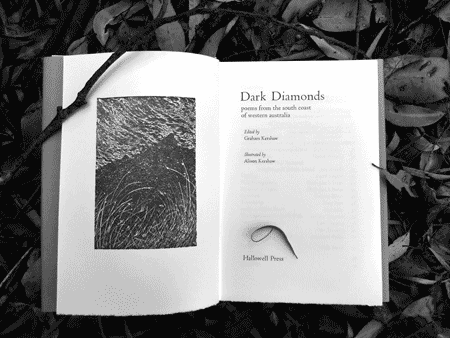
Dark Diamonds | Image by Graham Kershaw
Denmark, WA-based Graham Kershaw (Hallowell Press) has been working for some time now on the production of the poetry anthology: Dark Diamonds: poems from the south coast of Western Australia. Dark Diamonds has been printed on a treadle platen press – an Arab, designed in the 1870s – using traditional letterpress techniques, with Centaur metal type imported from a foundry still operating in California. The books are hand-bound, as cloth-lined hardbacks. Alison Kershaw’s illustrations are copper relief etchings printed on the Arab. Dark Diamonds will be launched at 3pm on Saturday, August 25th, at the Butter Factory Studios, 8/12 Mt Shadforth Road, Denmark.
[EasyGallery id=’junogemes’]
Andrew Sayers, director of the National Portrait Gallery, wrote of my work, ‘Trust is an important quality in portraiture. Trust is self evident in Juno Gemes’ photographic portraits’. The portraits published here were created in trust with literary friends.
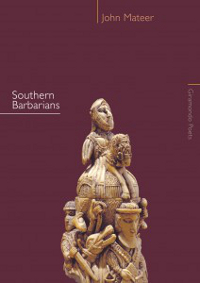
Southern Barbarians by John Mateer
Giramondo Publishing, 2011
Southern Barbarians is a book that explores both the colonised and the colonizing impulse through the inflections of the Portuguese epic Os Lusíadas by Camões, the explorer/soldier/poet-traveller and heroic poet of the Portuguese. The book ranges from Lisbon to Macao, taking in Indonesia, Malaysia, Warrnambool, and Japan on the way. This is a world where African businessmen in Macao see ‘African wildlife’ in a travel agent’s window, in an image of savannah they are no closer to than the Macanese.
Continue reading
In his introduction to The Random House Book of 20th Century French Poetry, Paul Auster quotes the great French thinker Maurice Blanchot: ‘Translation is Madness.’ Anyone even beginning to attempt such an activity (perhaps, especially, when dealing with poetry) soon senses the truth in this statement. However, I would add that it can be a pleasurable kind of madness and that for me, working with Hidayet Celan on translations of his own Turkish poetry, the process has always been a genuine pleasure … and only very occasionally maddening. Over the last five or six years of our friendship, Hidayet and I have together translated nine or ten of his poems. He has recently translated one of mine into Turkish.
It must be said, though, that we are friends first, and literary colleagues (of sorts) only after that. Unlike the large majority of poetry that is rendered into languages other than its original, ours is done so without any real thought of profit, or even necessity. Unsurprisingly, our efforts proceed slowly.
Often I’ll ask Hidayet the meaning of a work and he’ll explain it by means of a long and ancient parable, at the end of which I’m none the wiser. Despite the fact that we are both ‘amateurs’ at the art of translation, we still manage to satisfy the other in the end. After all, the word amateur itself comes from the root of the French word ‘to love’. We work together in such a way that it’s not truly work at all: I’m learning his language a little – as I don’t speak Turkish at all – but am at least bringing an affinity of his sensibilities to the process, and the ability to write poetry in English. Plus, there’s a mutual discovery in the intricacies and delights of each other’s world-view and the way it’s expressed.
In the piece of mine which was recently translated for the Melbourne PEN reading, it became abundantly clear to me that my poem (rather Australian in that even while protesting a particular mind-set, it remained agonistic in a dry, almost understated way) was being carried over into a totally different style – dramatic, impassioned, even theatrical. It’s a delicate balance, but often when we translate, we can at best only make the foreign work into something like what the writer would write if he or she was writing in our language, from our culture.
This phenomenon is apparent in a particular way when one experiences directly the musicality of different languages. This was especially pronounced at the recent ‘Freespeak’ reading at Federation Square in Melbourne’s CBD.
The writers and translators represented present were Nguyen Tien Hoang [Thường Quán] and Gig Ryan (Vietnamese), Anne Talvaz and Jennifer Harrison (French), Rochelle D’silva (Hindi – mother tongue, Konkani), Lauren Williams (Spanish), Ajak Mabia (Dinka), as well as Hidayet and myself. The environment itself was perfect for the event: a clear sound-system, quiet, attentive audience that was large enough in number to fill the room – itself arranged so that the focus was on the performers, not other distractions.
Significantly, a number of the pieces were sung rather than spoken – reminding us of the oral origins of poetry and therefore literature. Ajak encouraged the audience to clap in time and rhythmically chant – underneath parts of one of her pieces – the words ‘ya habib’ (my love/dear friend). As a translator and poet performing their work, it had exactly the kind of ambiance one would wish for. The variety of languages and approaches, as well as the brevity of the pieces, meant that very little appearance of the familiar ear/brain fatigue occurred, common at many poetry readings. I represent the views of all those involved in saying that the organisers should be congratulated, and one can only wish that such events were more frequent.
For those who wish to see a video recording of the event, it will be available for streaming on Channel 31 TV’s Red Lobster at some point in the near future, as well as at Melbourne PEN.
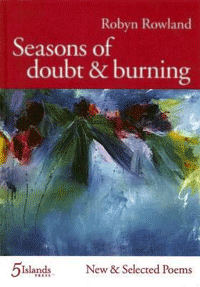
Seasons of doubt & burning: New and selected poems
(Five Islands Press, 2011)
Robyn Rowland’s poetry career spans thirty years, with her first book, Filigree in blood, appearing in 1982. Reading this volume of new and selected poems is a journey in memory, an almost autobiography. I first heard Rowland read in 1982 at the Sydney Women Writers Festival and I was very taken by her ability to phrase poems in just the right way so that a listener can follow and take in her meaning. Indeed, for some of her poems in this collection, it was as if I had Rowland’s voice in my head – no easy task for a writer to achieve that. It means that the rhythm or pace or vocabulary is just right.
Continue reading
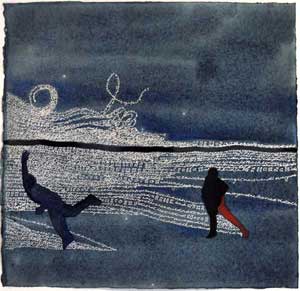 Soundscape II | Annette Iggulden | 28x29cm | Image courtesy of the artist and Watters Gallery, Sydney
We relate strongly to the way women have, throughout the centuries, found alternative avenues for their voices using different aesthetic forms. Our interest is with words, images, the interplay of verbal and visual languages in art, the role of words as images and the state of ‘silence’ created by cryptic or unintelligible scripts.
Annette Iggulden has exhibited extensively in galleries throughout Australia. Her work is represented in major Australian collections and at the Victoria & Albert Museum in the U. K. Her doctoral exegesis, Women’s Silence: In the Space of Words and Images (2002), is held in the Research Libraries of The TATE (UK), the National Gallery of Australia and other major state libraries. She has been awarded several artist residencies in Australia and overseas.
During Iggulden’s artist-in-residency (The Australian Tapestry Workshop, Melbourne: November 14 – December 2, 2011), she commenced an investigative series of works on paper, re-writing the words from ‘Aus-lan: Australian sign language’ by Australian poet, Jennifer Harrison.
Says Iggulden …
‘During my three-week residency at The Australian Tapestry Workshop, I concentrated on several investigative series of works on paper drawing from the poem ‘Aus-lan: Australian sign language’ (1994). This inspiring work looks at how the ambiguities of life might be expressed in different ways including ‘signing’ and other bodily performances of language, written, spoken, felt and experienced. Soundscapes is one of those series.
I am always moved to learn how groups of people have, throughout the centuries, expressed their ‘silence’ by creating their own language and forging alternative avenues for their voice. I copy the words of others, re-writing their words using the two cryptic scripts I have derived from alphabetic writing in my art practice. My intuitive method of re-inscription changes the written text into a visual image. The act of writing then takes on the role of drawing. The handwritten scripts retain a sense of the voice while enhancing the nonverbal aspects of the narrative, its ‘silences’. My intention is never to illustrate the text but rather create a different experience of its content’
This work looks at how the ambiguities of life are expressed in different ways – including ‘signing’ and other bodily performances of language, written, spoken, felt and experienced. Iggulden’s does not illustrate the text, but expresses it in a different, visual language. We wanted to explore how technological workshop methods might transform words/images when embedded in cloth.
Aus-lan: Australian sign language


My deaf friend said to me: our conversations
			  are overheard, everywhere we speak.
He teaches me the sign for Sydney: the shape

of a harbour bridge, skin webbing blue water.
			  I hear a quiet voice in my hands
in the silence when I am speaking

and foam, rubber, snow and glycerine
			  seem softer in the fingering span
than spoken words falling short of what they name.

I once saw a baby catching sunlight in his hands—
			  everywhere the child touched
he laughed at what he could not touch

until language wheeled his pram away
			  and he learned that silhouettes and sun
were called chair and where.

Precisely, in mother tongue, we categorise
			  the conch shells, sea hollows
the safety pins and taboos.

My friend said: I will teach you
			  what you need to know...
other signs belong only to the deaf.

He teaches me the sign Forget
			  it is a fist placed against the right temple
the hand opening, flicking sun away from the head.
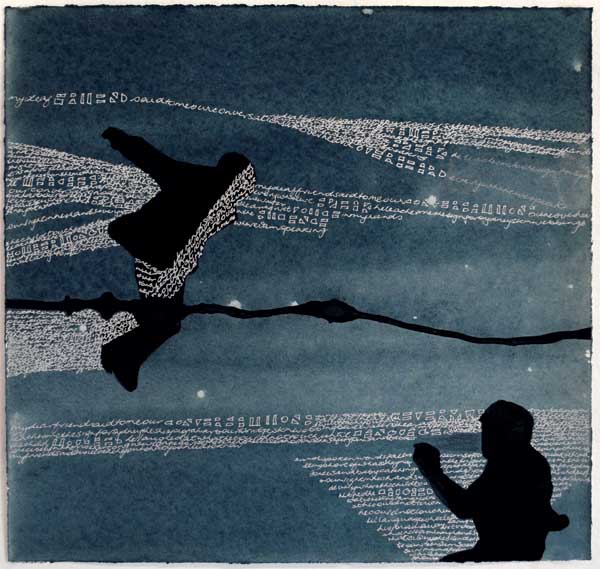 Soundscape I | Annette Iggulden | 28x29cm | Image courtesy of the artist and Watters Gallery, Sydney