Time Wasted

Blinded
Bounded
I waited
Deliberated
And inebriated
I sat in silence for you
Waiting for a hero that would never come
A knight in shining armour
This adventure
Stopped being fun
A long time ago
Timing is of the essence
Time
T.I.M.E
An external force dictating our lives
An excuse for not saving me
Time wasted
Situation abated
My will to not want to play the victim
Was long confiscated
Submerged in my own pool of pity
You stole the plug
absence/ green fairy drug
In your shadow of depth
I learned to strum
A tune played for a fool
I watched an invisible choir
Utilise its glorified tool
I watched them
Hymns anointed
The congregation rehearses
With souls jointed
Singing curses of verses
With feet touching gravel
Confusing the senses
Selling them the gift of flying
While I was slowly dying
In my sleep
Scriptures embellished with
The blood of a king long gone
Wasted love wasted spawn
Wasted memories, though are they ever wasted?
A thought so delicious
That it could be tasted
But who ever really forgets
This princess had not learned to live with her inherited regrets
Her inherited regrets
Paying a debt
of her own not owed
Sins of the father
Seeds well sown.

Posted in 116: REMEMBER | Tagged

A Song for the Māori People

A Song for the Māori People

What sun have you come from, my brothers?
“From beyond death, we’ve come to you.”
What path have you taken
to bring us water, bread, and words?
“We’ve come from the life your people are forging.”
Who are you, sons of the Māori, my brothers?
“We too are from the shores of Gaza,
and from Mount Carmel,
and we too own a share
of the bloodred sunset above Jerusalem’s hills.”

What sun have you come from, my brothers?
I asked them this,
though I knew deep down,
as I saw them coming on threads of dawn,
that they were the sons of the Māori.

***

They said to me:
We believe in your land’s messiah,
the one who was crucified
on your land,
and who, today,
is still being crucified
on your land.
We don’t confuse his mournful voice
—which leads to joy—
with the lies of the evangelists.
And if his voice is mournful now, it’s because
evangelists made it their own
and stole your land.

***

What sun have you come from?
What sun’s heart have you come from, my brothers?
And what sun will fail to bow down, now,
as you take us with you
on lofty paths
to the land of the Māori people?

Posted in 116: REMEMBER | Tagged ,

Can’t Complain

Yeah I can’t complain.

They rely on our ability to forget and forgive. They rely on our batch to disappear so that the next one can be told the same lies they know we’d forget. They force us to forget in order to disconnect and live a life that is thrown at us. Not chosen.

Not chosen, so yeah I can’t complain.

They forget our bodies hold what our minds can’t. Our hearts beat for what our eyes hide. They forget that our brains are not the only memory bank that is left behind. That the blood remembers, and the palm remembers, and the land remembers and…

I can’t remember.

They rely on us having a gold fish’s memory. But did they know that a goldfish can recognise and distinguish between different human beings?

Humans who live to lie and humans who live to die.

Humans who whisper and humans who chant.

Humans who spend and humans who can’t.

Which one are you? Not sure, but yeah I can’t complain.

Don’t complain. If you complain, your name will be in the paper alongside your memory-full brain.

Do you really need a poem to know what we knew hundreds of years ago when the colonies began to grow? How many poems do you need to know to stop a patterned past that leads us to answers they pretend to not know? A cycle of destruction that the weak can ignore but the strong will try and control.

I’m over it all. But I can’t complain, you know…

Actually, maybe I can complain. Maybe I need to complain. It’s essential.

How will the next batch know? Without me, they will not be able to grow because they can’t remember what I remember as much as I don’t know what they will know. In an official statement or out in public cold – I have to let them know.

Yeah I can’t complain because hate and extremism have no place in Australian society. The politicians keep saying, little do they know that we will remember every racist decision and call, no matter if we are here or gone.

Posted in 116: REMEMBER | Tagged

the act

this is a rectangle. it is, i think. i write it around a document that doesn’t exist — the Flora and
Fauna Act
. like a lot of law, you can see only its edges, enforcement, its normative tract. Its
pressed earth impres sive, for an Act that never was.
and yet i rem ember that unreal law, even if i
never ventured into the fog of history to read it. did
you ever? do you? remember its edges or core? i’m getting less sure, less sure.
these rectangles are artless. this poem is artless. i’m trying to get them to certainty. i’m trying
to not contribute to this amorphous wound. i’m trying to not make anyone a fool. it was real to
me, i referred to it before and Aboriginal
parliamentarians h ave read it into Hansard
and others onto events of public formal import.
and i hear it talked about all the time by
people i love and respect and even now
knowing it’s not ‘re al’ i nod along with people
who bring it up at rallies and meetings and
over meals. i only heard it wasn’t real a few
years ago and i went to law school a few times.
and also, maybe it is real in meaningful ways.
growing up, i heard: ‘they treated us
like shit, like animal s’ explaining: ‘we weren’t
human until 1967.’ one of these things is true,
the other one isn’t. so maybe it isn’t true
because we were legally human then, or
maybe it isn’t true because we’re still
dehumanised now. s ay it’s our understandable
suspicion about that law, say it’s gaps in civic
education, say it’s a ctivist rhetoric exploding
into history and memory. does it matter? maybe. when i got surgery on my abdomen, it was
my shoulders that hurt. referral pain, real wound. i writhed in haunt pain. i hurt my neck.
many acts are legal without a law. that’s how their laws work, more often than they don’t. all
things are legal without laws if you have a lot of guns and cars and iron and flour and rot
pointed at increase ingly few people. the Flora
and Fauna A ct
governed their hands. It
doesn’t matter if t hey didn’t codify it and it
doesn’t matter if th e Act was the echo of anti
colonial rhetoric, if you were at the end of
that gun were you m eant to ask as they
ushered you onto a t ruck like cattle: ‘am i
lawfully an animal? a re you authorised to call
me an animal?’? an d years later, how can you
express that de grading power in a way
that made it real? ther e lives its threat, whether
the Act was real or not. ‘sometimes, my girl, you can be made animal’, whenever they want
to. not just intergenerational trauma, not just rhetoric. a parable.
but the Act is still not real. i’m getting less sure lately. i was so sure about the Act, so sure
trauma i s a clumsy word for all
adverse experience, mine anyway. it also makes for a bad archivist, just sometimes, mine
anyway. hedging. unclear. remade ever y time it’s pulled off the shelf, so
sure. a therapist takes me ba ck ‘to the first time’, or tries. i
say: ‘i’m scared of making a human story of my animal fear.’ i’m scared i’ll get the act
wrong, so sure. the scariest thing for me to say is: ‘i don’t know.’
my own lived experience is often useless, like okay. there was no jacaranda around when it
happened
but when i smell it rot now, humectant on your path (an easy and big source
of decay like an infected throat). i get scared. i get a boner i get we t. i animal.
i’m at your very nice house party tr ying not to throw up, trying not to run, trying not
to punch on, cough, hump against my jeans. (he flora on my sensation memory
until i fauna. is this anything?)
please don’t put me on a committee about it. my lived experience advice for almost everything,
like a prey animal, is: forget rest eat forgive fuck run. i already remember
every one. even the ones you love, or i love. i know the y’re special. i know it’s not
fair.
i don’t know. while i’m writing this i’m trying to trace these flies back (did I mention the flies?
no? sorry.), to their maggots, to the dead mouse rotting somewhere in my walls. that’s where
they came from last time. i think.
Posted in 116: REMEMBER | Tagged

I te rua o mahara / In the cave of memory

He kitenga kanohi, he hokinga mahara/ A face from the past brings back emotion.
Tū ana tēnei mātāmua i te tūramarama a Huna/ This eldest child stands under the light of
Huna
Mātai tonu ana ki te whakapākanga o Maurea/ Gazing at the last born of Maurea
He maurea kai whiria/ Perspective is everything
I te ara wairua/ Here in the highway of wairua

Ahu mai ana te kōtiu/The north wind giving directions
Ki te tini o Kirikiri e teretere ana ki tō rātou tāhuahua, ki tō rātou māra pīngao/to the many
grains of sand moving to their dunes and pīngao gardens
Kakano muimui e whakakotahi nei/ tiny particles coalesce.
Me manatū, he iti pou kapua hunga tini whetū ki te rangi/ Keep in mind, a small group
overcomes adversaries

Auē te whakamomori a Ngākau/ Ah the longing of Ngākau
Te kuaka mārangaranga, e rapurapu ana ki te tahuna/ the kuaka circling, seeking the place of
solace
Ahakoa pau te hana i a rātou, he manawa kuaka tonu/ despite being weary they are steadfast
Mā te kōhatuhatu ki te nae/ By way of the pebble in the bird’s gullet
Mā te mahara o Parengarenga/ By the memory of Parengaraenga
Ka whai te au tika, te au pōuri/ they will find the right current, the dark current
Kō atu i Te Ahu/ beyond Te Ahu.

Tū ana te haka o Nakonako/ The haka of Memory begins
Mō tua o te pae maumahara / concerning the dead.

E mau mai ana ngā ture o Pūmahara i te kapu o Te Tai Tamatāne/ West coast tides carry the
rules of Memory in their palm
Mā ngā ngaru e whakaako ēnei kākahu taratara/ These mourning clothes learn from the waves
Mā te kaha a Wareware e pūrua te moko o te onepū/ By the strength of our attempts to forget
the memory is again marked into the beach
E ai ki a Poroa, ka mau tonu te wairua. / As Poroa said, the wairua remains.
E whakapuhorongia ana te kiri ā-mahara e te huene a Takimoana, / The memory skin becomes
puhoro with the ocean swell of Takimoana.

Noho ana au i te rua o mahara/ Sitting in the cave of memory
Kei a au te kau o tō Hinengaro kanohi/ with the pupil of Hinengaro’s eye
E hikohiko pai ana ngā mahara/ memories are fully activated
I te muramura o te ahi, i te aweawe a Maru nōki/ in the glow of the fire, in the influence of Maru
Takahurihuri ana te taihuringa ā-Mahara/ revolving in the movements of Memory
Ka whakatinanangia e tātou te aho tāngaengae o nehe/ we manifest the generations gone by,
Horekau te maumaharatanga mō koutou e ngaro ana i a tātou/ recollection of you all will
never be lost.

Posted in 116: REMEMBER | Tagged

A pound of flesh

2000-pound bombs continue
to drop on the people of Gaza
survivors receive pounds
of bloodied flesh in plastic
bags instead of the bodies
of their loved ones
154 lbs for an adult
62 lbs for a child

I remember when I was
a little girl my dad
brought home a meatpack
from the rugby clubrooms raffle
how we smiled and crowded around
to celebrate his win

but this, this is no prize

the dead
weight of it in
my hands

and I ask how many pounds
for a day-old baby?

as her soul inflates
the bag
floating skyward
like a helium-filled
balloon

Posted in 116: REMEMBER | Tagged

Outside the box

I remember the words my sister and I found in a box
under Aunty’s bed when we were searching
for her lolly-tin. We never asked because we couldn’t
find the words.
But those words hung like a ghost in the shadows that we
couldn’t see but could feel –
lurking like an unfinished story behind
words that became heavier as time made their meaning clearer.

But still there was no story. Just silence and a gaping hole
for all that is untold of a Blak woman’s life that words
in a white man’s law never can say. Or know.
The fabric of the women’s lives – like the river they
live on is calm and tranquil on the surface –
churning and turbulent below.

While my Grandmother stitched in half-light by
the fire, Aunty walked the floor in sleepless circles chased by
words that lurked in night shadows.
I remember papers that held all that is unsaid that Blak kids
find and know, always hearing stories in patches and
backstitching over time and memory to get to the beginning.

Decades later my ageing childless Aunty alone in
a house full of old calendars, clocks frozen on long ago hours –
never to tick again as if to keep them might make time stand still or
turn back broken memories.
When she takes my hand in hers –
withered and trembling and gestures with the other
to a ramshackle pile of her life’s possessions gathered on a table
where among books and brooches, photos and letters
trinkets made by nieces and nephews long gone I see a
dusty box full of words

I know without asking why she gives it to
the dreamy niece she raised who always had a pencil in her hand,
and got into trouble sometimes for asking too many questions –
who said she was going to write a story one day but
hasn’t yet because that won’t come either.
I gather all the things she wanted to keep, hold, look at
time and time again to remember. And all that she couldn’t
let go.

Inside this box is the double-walker who stalked the night –
the captured slice of a Blak woman’s life cut deep from flesh and
blood, a stolen story, a truth kidnapped, a memory held to ransom –
longing for release. If I leave it shut it will haunt me as it did her.
Like my Grandmother, I will stitch and backstitch
long into the night over time, over memory, over holes,
rips and tears with words that speak back to these words
with the story of a woman outside this box.

Posted in 116: REMEMBER | Tagged

Bonny Cassidy Reviews Judith Bishop and Jeanine Leane

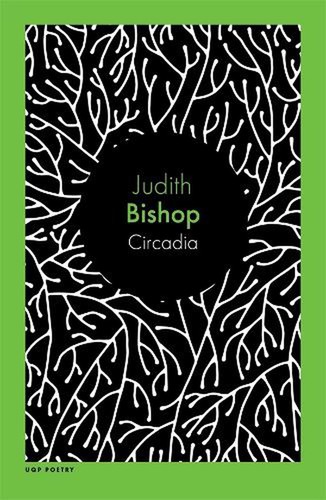
Circadia by Judith Bishop
UQP, 2024

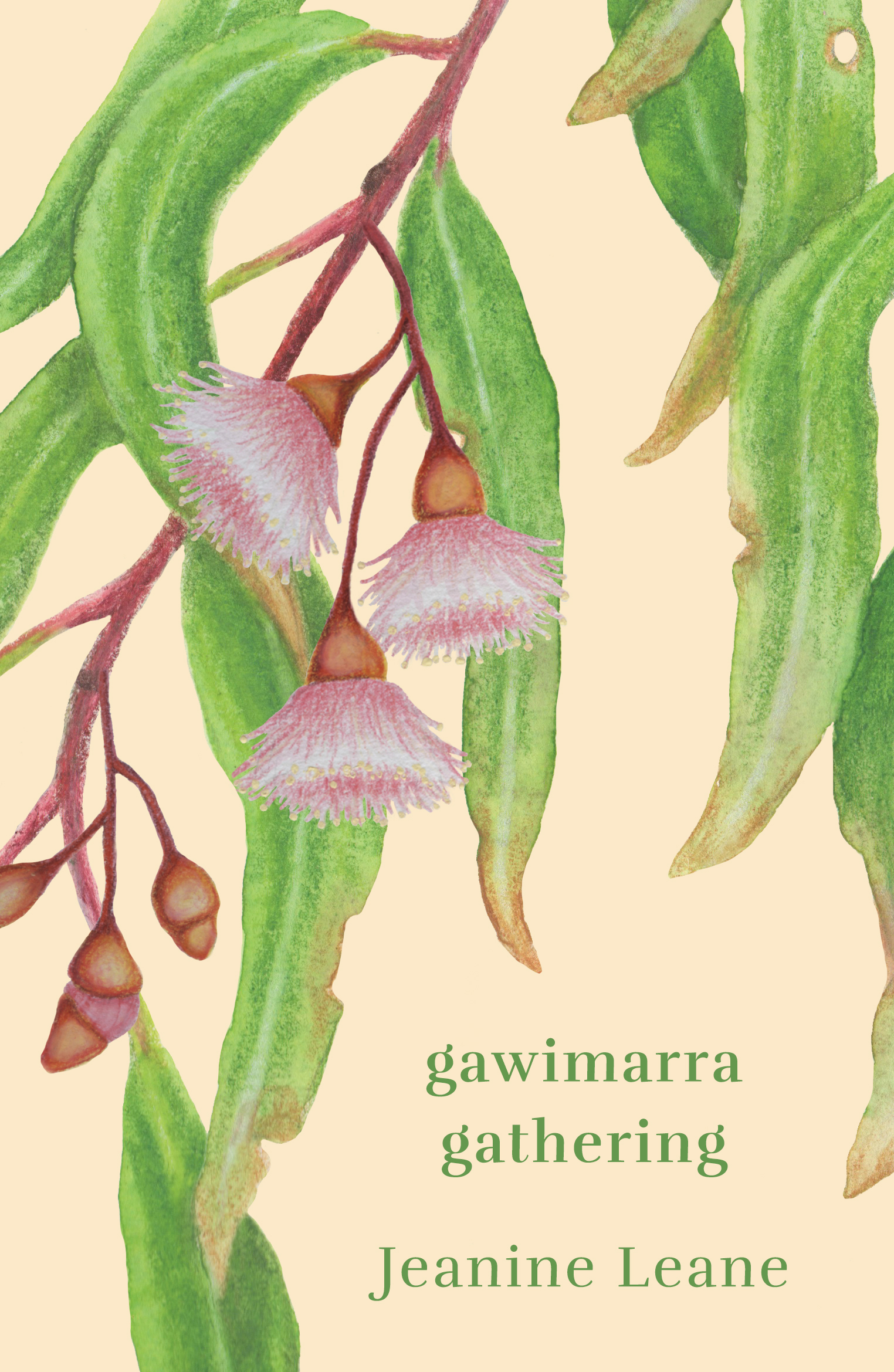
gawimarra gathering by Jeanine Leane
UQP, 2024


The circadian rhythm is homo sapiens’ response to Earth’s orbit of the Sun. A top-down process instigated by neurotransmitters, it trips the nervous system, hormones, circulation, and muscles to rise with sunlight and sleep with darkness. The sleep part of the rhythm is not truly unconsciousness, rather, it’s a descent and ascent through gradations of brain wave frequencies. At its lightest it’s realistic dreaming; at its deepest it’s a sort of paralysis. This state of temporary sensory deprivation not only allows our body to metabolise and grow; it also allows our brain to decide what to remember.

The title of Judith Bishop’s Circadia creates a neologism from circadian and arcadian. Pondering the implications of this word, I thought about how the associations of the two concepts meet. Perhaps circadia suggests that the rhythm of sleeping and waking is an idyllic state. Bishop says in an endnote that it references Nicolas Poussin’s painting, Et in Arcadia ego (73); I wonder, then, if the book’s title implies that darkness lurks always within light. If neologism is intended to pause the vocabulary and deliver a more appropriate addition to it, then it could be one definition of poetry.

But what if the vocabulary contains a word made fit for purpose — a word that contains its own expansive resonance? Jeanine Leane’s gawimarra is imbued with the deep knowledge residing in this Wiradjuri word. Yet Leane goes a step further. On the cover is a parallel, English translation: gathering. The translation and alliteration are generous offers. They provide a point of connection between Wiradjuri and Anglophone readers, and perhaps also represent Leane’s own relationship with these languages. Leane repeats this translation a few more times within her collection, and each time it heightens the poems’ yearning and demand to be “free and untranslated” (‘Biladurang Untranslated,’ 65).

Reflecting the diversity of poetic tradition and style offered by the UQP catalogue, Leane’s gawimarra gathering and Bishop’s Circadia are beautifully produced, tightly edited, and spaciously designed. They are very different investigations of poetry’s contribution to the process of memory.

With a weakness for epigram, I found my reading of Leane’s gawimarra punched by very short verses which open each of the book’s three sections and are sprinkled throughout. They are like pinholes of light, developing a single image from Leane’s banks of memory and metaphor.

Steel Trap

My memory is a steel trap where
the release clasp is permanently jammed.
Things go in but they can never go
out again. They are lodged – permanently.
Stuck forever in an inescapable maze
of time, of place, of detail.
Collective history captured projecting
on a never-ending reel
across the screen of my mind.

(20)

‘Steel Trap’ describes the nature of gathering that Leane achieves in gawimarra. The book takes in broad horizons of historical time — from precolonial scenes of Wiradjuri life in the opening poem, ‘The Gatherers’ (4-6), to Leane’s reclaiming of the ruins of a homestead where her Aunty was enslaved as domestic help (‘Unfinished Business,’ 66-67). This timescale includes what is yet to come: in ‘Your Last River’ the Murrumbidya/Murrumbidgee speaks: “Think of me. Like I am your future” (86). With ‘Steel Trap’ Leane describes this vast memory in ambiguous terms. On the one hand it sounds like a traumatic purgatory of unpruned recall, but the steel trap also suggests a strong visual sensibility (‘a never-ending reel’); generational blood memory (‘lodged’); and a ‘collective’ responsibility for remembering kin and Country that have been overwritten by the colonial archive. In gawimarra this river of memory is both unbidden (‘inescapable’) and essential to the work of (‘permanently’, ‘permanently’) accounting for those denied by colonialism.

Leane achieves this directly through her poetic memorials to individual Blak matriarchs who have shaped the course of her life. These poems are epitaphs, eulogies, letters and albums combined: verbal monuments that inscribe the events and impacts and Country shared between Leane and these larger-than-life women. In ‘Sista-Cuz: Tracey Phillips 1961’ the poet addresses her “Sista-girl, Cuz and Friend” in reverse chronology (41), mapping Phillips’ current relationships in grandmotherhood back to their shared school days. These poems are intensely intimate, they invite us to witness a private message whose public declaration is more important than a pact with the silent reader: “That’s you and me Sis in the classroom under the cross […] We bit our tongues then didn’t we Sis” (42). This testimonial quality is a significant element of the book’s reclaiming work, accumulating an undeniable record.

While Leane’s steel trap mind cannot release its capture, it continues to gather more. A senior figure of literature, nevertheless Leane positions herself in gawimarra as a learner, honouring her teachers and narrating her recovery of Wiradjuri language in later life. In ‘Yanhamambirra – Release’ and ‘Wiradjuri Dictionary’ Leane shares the staggering vulnerability and fulfilment of becoming immersed in a language from which she was unwillingly separated (73; 74-75). In many of the book’s poems she credits Aunty Elaine Lomas for Wiradjuri interpretation, including this one:

The space of my emptiness is a chasm so deep so wide
I’ll fall to endless nothing without your words to cross it.

I have starved for you to feed my soul nourish my
blood to strengthen my bones. ngadhi bagurany
dhalbur (ngadhi bagurany dhalbur)

(‘Yanhamambirra – Release,’ 73)

It is a humble and humbling position to read, but it only makes Leane a more powerful voice — for here she is writing in not one but two languages at the full force of her purpose as poet.

As Wiradjuri flows into the collection, I gain an understanding that perhaps for Leane, English is a tool for communication but not a technology for sharing deeper knowledge. In ‘Heal Country. Heal our Nation.’ (55-57), she documents the widespread renaming and misnaming of the continent as “toxic” sickness that must be “erased” from the living body of Country (57). By repeating the overwriting of original place names, Australia permits itself to avoid closer engagement with another way of knowing who and where we are. However, as Leane suggests in a different poem, “the air does not hold these syllables / nor does Country remember their words” (‘Of Colonial Poets and Bridges on Wiradjuri Country,’ 83). Colonial naming cannot alter the meaning of Country, the “highest power” (83), which precedes and supersedes the signs and the maps.

Judith Bishop’s early career research in linguistics focused on intonation in Aboriginal languages. In Circadia, as in all her poetry, tone and musicality lead her attention to experience. In contrast to the expansive temporality of Leane’s collection, Bishop’s poems are of a more micro scale. Many are literally time-stamped in the title or footnote, signalling that they be read as notations of events, a capturing of personal, domestic time that becomes forgotten simply because it competes for attention and filters away. In this way, Bishop’s poems resemble the work of dreams.

Evening / 23 June 2022

As if to trace the decay
of what we saw long ago
in the storm-grey mirror,

the path we revisit
becomes a mute prompter,
leading us quiet

beside the mannered houses
the silence of class
taught to look the other way.

No—I don’t know what to make of a reality
that being made of mind thrice
shattered like a window.

Vision is a gift. It was given us once.
We ought to have known
what loving meant.

(8)

While the titular date is too early, I can’t help but read this poem with reference to the referendum on the Indigenous Voice to Parliament. Elegy finds its way into the tone of these diary poems, whether in mourning for lost time or for a more specific but unnamed referent. Like dream, elegy might also be premonitory.

Posted in BOOK REVIEWS | Tagged , ,

Jennifer Compton Reviews Esther Ottaway and Diane Fahey

she doesn’t seem autistic by Esther Ottaway
Puncher & Wattmann, 2023

Sanctuaries by Diane Fahey
Puncher & Wattmann, 2024


Puncher & Wattmann, whose present proprietors are David Musgrave and Ed Wright, has, since 2005, brought forth over 200 titles, many of them of the poetry ilk. On the ABOUT page of their website, the press proudly avers that they are a publisher of “shit-hot writing.” As far as I can recall, this has been their guiding principle since inception. I am kind of tickled by this appropriation of the vernacular. Because shit is hot. Please note the steam rising off of a recent cow plop on a frosty morning. But here’s an odd thing that caught me with a back-handed synchronicity. I have always known that the name of the press is a reverent nod to one of the most luminous pieces of writing for the theatre, a work that celebrates and enables presence and voice. And here I quote from Lucky’s soliloquy from Waiting For Godot by Samuel Beckett, “Given the existence as uttered forth in the public works of Puncher and Wattmann of a personal God quaquaquaqua…”

So, while I have always known the provenance of Puncher & Wattman, and relished the way they give space to the performative side of things, somehow I hadn’t made the connection to my impulse to consider these two books in light of my experience of the poets enacting their work. See, the reason I was keen to delve into the page presence of these two poets is that I have recently seen and heard both of these poets reading their poetry. At the Spark! Poetry Festival, curated by Liquid Amber Press, Dianey Fahey strolled onto stage, looked us in our collective eye, lifted her voice, and nailed it. Now there’s a pro, I thought to myself. And then I was lucky enough to catch Esther Ottaway featuring on one of the Zoom readings Ross Donlon runs as a kindly adjunct to the Poetry from Agitation Hill readings out of Castlemaine. Once a month in the flesh and on Zoom, and once a month just us avid Zoom-ees. The full-face reveal can be pitiless, but Esther opened herself up to our gaze and, with poise and dignity, demonstrated absolute commitment to the vehicle of poetry.

she doesn’t seem autistic was published in 2023. And a book published back then would normally have had its moment in the limelight – a launch (or two) a review (or two) a longlisting maybe, a shortlisting hopefully, and then back into the box for the duration. Even winning one of the various prizes doesn’t often seem to save a book from sinking out of sight. And many wonderfully accomplished and enlightening books pass seamlessly through the digestive system of the poetry world without generating a hiccup, let alone kicking up a stink. But in December 2024, this book was longlisted for the Tim Thorne Prize for Poetry in Tasmania. (It didn’t make the shortlist but then so many books don’t.) This is a biennial prize, so that explains the long lead time. But it doesn’t explain the way I seized upon this recent acknowledgement as an excuse to have a go at an almost retrospective review. There is something about this book! It’s like nothing I have ever come across before.

Andy Jackson declares on the glossy, hot-pinkish, Barbie-fied cover — “A revelation.” This is a grab from his endorsement on the back which continues — “…not just in terms of our understanding of autistic experience, but of what is possible within poetry.” See, I am not all that interested in an individual diagnosis (well, of course, I am a little bit interested as a human being), but I am intensely interested in how poetry takes the edge off and transforms trauma, disability, all manner of hurt and difficulty, into the beauty of well-chosen words.

From ‘There is always a giraffe,’

Cool as a whale
Mrs Haydon is stepping backwards through water

patient with this small giraffe
who has failed at every sport

all neck and skittery hooves,
large-eyed, patterned with shame.

(27)

As a reluctant childhood swimmer, I was empathising like a mad thing as the poem progresses, as the dyspraxic child gasps at “the air that saves her life / / for another minute” (27). As “the certificate floats farther away than Africa” (27). Oh, the searing “plughole terror” (28). Oh, the scald of “a fury of incompetence” (28). And here is the kicker in the final couplet,

Wherever I am, there is always a giraffe
asking if it’s worse to drown, or fail.

(28)

The explicit simplicity of this poem is offering the reader a lyrical escape hatch, an easy-out. But when we come to poems like ‘The head-stacking caterpillar answers the question how are you?’ (54-55), well, then we are into the thick of it, into the grunt and the sweat and the muck of it, into an intense, refractive complexity of complication. I was taken aback. It is so hard, and confronting.

From ‘The head-stacking caterpillar answers the question how are you?’

Happy to be doing this activity with you, while I get worse from doing
it. Do you know how I split my face and head off, wrest it free of my
distressed body, reattach it with filament, make it smile? Do you know
how this unstitching dichotomy, this severing of wellness from happiness,
is done in the psyche’s inky cocoon? People feel unwell, they take the day
off and get better. I never get better, so I can’t keep waiting for that: I do
what brings me joy. I won’t go home after this and cook dinner, reply to 
emails, have a shower, make lunch for tomorrow. I’ll go to bed, and in
bed, I’ll experience distressing symptoms. I’m a many-legged complexity,
a walking trade-off, silken, elegant, ruthless. This head looks fine.

(54)

Is there an upside? Is there indeed joy to be found? It seems so. It seems that resorting to poetry can lighten the load and lift your spirits. This book has a rising trajectory, passing through ‘Joy to my world’ on page 74, to the clarion call of the last couplet of the last poem.

From ‘The autistic woman’s self-compassion blessing,’

Lay down the paper doll of stereotype.
May fierce determination create your singular success.

(80)
Posted in BOOK REVIEWS | Tagged , ,

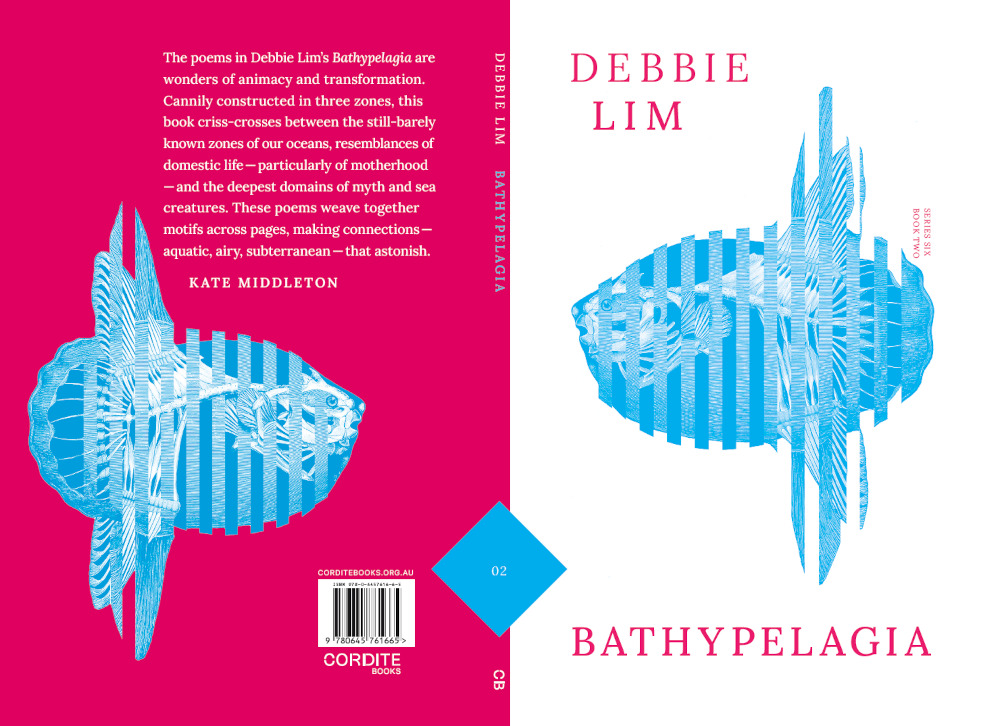
Introduction to Debbie Lim’s Bathypelagia

BUY YOUR COPY HERE

The poems in Debbie Lim’s Bathypelagia are wonders of animacy and transformation. As the title suggests, Lim plumbs depths with these poems, taking readers to the deep ocean, and fathoming the nocturnal hours. From the ‘midnight zone’ of the waters to the final burst into air, these poems converse with a world alive and full of intent. She writes, ‘It’s 3 am. and the men are benthic’ in ‘A Bar in Bathypelagia’. In this realm, the poet instructs us to ‘invent your own light’. The resultant poems ‘luminesce’.

Cannily constructed in three zones, this book criss-crosses between the still-barely known zones of our oceans, resemblances of domestic life – particularly of motherhood – and the deepest domains of myth. In ‘Love Below 2000 Metres’ Lim writes, ‘But here, even distance/ is an illusion’. Later, in ‘Condor’, the raptor ‘rides the thermals patient as a god’ – and in his vision, the distance also becomes illusion as the bird moves through the ‘invisible hierarchies’ of air while awaiting a body to scavenge. This rising up to the thermals is thrilling after the time spent in the depths – yet even in air, the depths remain present. In ‘Waiting for Trout’ the fish hold the ‘cold smell … deep inside their heads’; addressing trees directly in ‘Etiquette for Trees’ Lim instructs the trees to ‘travel your roots boldly/through darkness and to great depths – / they are your immense secret’. Even as the book travels toward this airy zone, it remembers and maps the fathoms below.

Lim is always precise: she uses the language of the ocean, the language of fishes, the language of scientific description. She notes the darkness that lurks beneath the ‘photic zone’, the spicules of glass sponges, and investigates the metaphorical power in Latin names, such as the millstone of the sunfish’s taxonomic classification Mola mola. Looking toward scientific names is an important part of Australian eco-poetry, but Lim looks further afield, to what lies downward when our attention falls off the continental shelf. In these waters, the result is not eco-poetic but Atlantan. Her love of this language is always evident but is also always necessary to the effect. And in her precision, Lim invites us as readers to find the same exacting resemblances. When in ‘Blue’ she communicates an exact hue – ’I am thinking/ of a gassy flame, its small hood/ wanting for oxygen. Or blood/ that’s clocked the body once’ – Lim catalogues a particular shade through the body, the world and puts us in mind of other instances of the same blue.

These poems make gestures of apostrophic exclamation (‘O colour of bruise.’; ‘O thin isthmus!’) and personification, enlivening their subjects with spirit. When honey fungus speaks, it is with ‘witchy bootlaces’ of mycelial cord and a false face made of a ‘golden cluster of bells’: the relationship between fungus and tree is one of mastery – the fungus wins out, against the ‘slow and steady pulping of what was/ one your wise old heart’. In the middle section, poems that address the strange creatures of the sea – glass sponges, seahorses, fugu pufferfish, vampire squid – mingle with the ancient stories of Medusa, the minotaur. The result is the distillation of the sea creatures into a poetic Wunderkammer: the depths hold terrifying wonders.

Even as we travel into different regions throughout this book, we find deep echoes across the volume. The honey fungus that speaks in one poem becomes the subject of warning to the trees in another. The sunfish is here taxidermied as ‘a papered gong’, there appears in kelp beds as ‘a field of floating moons’. These poems make paths that exhibit ‘old wormings, weird tunnellings’, weaving together motifs across pages, making connections – aquatic, airy, subterranean – that astonish.

Posted in INTRODUCTIONS | Tagged , , ,

Submission to Cordite 117: NO THEME

Unthemed. Unhinged. Unparalleled.

Send me a poem that would nourish a stray cat. Send me a poem that takes a big swing, that risks calamity. Send me a poem where your inspiration has taken flight. Send me a poem that the academy cannot stomach. Send me a poem that doesn’t look like one. Send me a poem that AI could never generate, that demands humanity.

Send me a poem that wedges itself between your teeth like day-old beef. Send me a poem that refuses to get lost in the slush pile, that announces itself like a siren. Send me a poem that you’d whisper to your worry dolls. Send me a poem that you’d scream at a parliament building, that you’d take to the streets.

Send me something spit-polished and hard-earned. Send me something that asks: Is this even a poem?

Send me shenanigans and soliloquies. Scream your biggest screams.


This podcast sheds some insight on how Cordite Poetry Review (and Cordite Books) works.

Submission to Cordite 117: NO THEME closes 11.59pm Melbourne time 18 May 2025.


Please note:

  1. The guest editor(s) has sovereign selection choice for all poems submitted.
  2. Masthead editors will also contribute to the issue.
  3. We will only read submissions sent during our official submission periods.
  4. Please place up to three (3) poems in one (1) Word, RTF or PDF document (unless specifically noted otherwise for special issues), with no identifying details in the document itself.
  5. We are not able to offer feedback on individual poems.
  6. Submissions will only be accepted via Submittable …

submit


Posted in GUNCOTTON | Tagged ,

An Internet for Bugs

Posted in ESSAYS | Tagged

Finding Home: On the Poetry of Place of Luisa A Igloria, Marjorie Evasco and Merlie M Alunan

For decades, Filipinos were taught that the country was ‘discovered’ by Ferdinand Magellan. The Portuguese explorer led the 1519-1522 Spanish expedition to the East Indies, credited as the first circumnavigation of Earth. Antonio Pigafetta’s chronicle of Magellan’s voyage became one of the earliest documents recording the culture of 16th-century Philippines.

Philippine history has it that Magellan sailed northward after mistakenly identifying the location of the Moluccas. The expedition reached an archipelago of volcanic islands, where they were allegedly robbed, hence the explorer giving it the name Islas de los Ladrones (Isle of Thieves). Ten days later, they reached Samar, which they named Islas de San Lazaro after seeing it on Lazarus Saturday. They eventually sailed northwest between Leyte and Bohol and entered the harbor of Cebu, which Pigafetta called Zubu or Zzubu.

Pigafetta’s chronicles described the island that he and Magellan landed on (with translation by James Alexander Robertson):

‘It is a large island, and has a good port with two entrances – one to the west and the other to the east northeast. It lies in x degrees of latitude toward the Arctic Pole, and in a longitude of one hundred and sixty-four degrees from the line of demarcation. Its name is Zubu. We heard of Malucho there before the death of the captain-general. Those people play a violin with copper strings.

In the midst of that archipelago, at a distance of eighteen leguas from that island of Zzubu, at the head of the other island called Bohol, we burned the ship ‘Conceptione,’ for too few men of us were left [to work it]. We stowed the best of its contents in the other two ships, and then laid our course toward the south southwest, coasting along the island called Panilongon, where black men like those in Etiopia live. Then we came to a large island [Mindanao], whose king in order to make peace with us, drew blood from his left hand marking his body, face, and the tip of his tongue with it as a token of the closest friendship, and we did the same.’

Magellan’s voyage, as well as Pigafetta’s chronicles, happened during the Age of Discovery, when Europeans went on expeditions to explore, conquer, and colonise other continents. The explorers were on a mission to find natural resources that their homeland could exploit, which had devastating consequences for indigenous peoples and their ecosystems.

At the time, travelogues about colonised islands – such as the Philippines – came from the point-of-view of the Western male colonisers. New territories were called ‘discoveries,’ not acknowledging the fact that the islands were already lived on. These travel writings, in effect, lacked the context of indigenous languages, thus misspelling words; ignored indigenous traditions, regarding them as savage and uncivilised practices; and romanticised the bounty of natural resources, which were later exploited.

This narrative of ‘newly discovered’ lands persisted at the height of colonial empires, when imperial propaganda, educational systems, and even popular literature were used to assert dominance over colonies. But after World War II, decolonisation and post-colonial perspectives sought to critique identities, including travel writing from post-colonial travel writers like Pico Iyer and Frank Delaney, amid an era of globalism and multi-culturalism.

As Iyer put it in a 1997 interview (Stammwitz), ‘The difference, perhaps, is that, in the old days, a travel writer from England, say, would survey India with a very firm sense of who he was and how far he’d come: he was a European inspecting a strange foreign culture. These days, when someone like me goes to India, I am perhaps better able to try to take it on its own terms, to travel light, and to bring to it assumptions that aren’t necessarily – or limitingly – British or American or Indian.’ Iyer was born in Oxford, England, to Indian parents in 1957, and moved between England and California growing up.

Post-colonial writing dismantled the Eurocentric framework that once defined the genre of travel literature. The shift in Eurocentric biases allowed the silenced voices from formerly colonised communities to reclaim their narratives. These include women writers from the Global South, particularly from the Philippines. This effectively gives a more inclusive perspective on the islands outside that of Western colonial male.

In Lenka Filipova’s Travel Writing and Ecofeminism, she investigates the colonial history of the genre and, ultimately, concluded how an ecofeminist re-drawing of the map – stemming from the practices of colonial cartography as inherently gendered (as in the chronicles of Pigafetta) – become more ‘comprehensive, albeit contingent and provisional, acts of ‘worlding’.’ This means bringing forth the ‘cruxes of gender, class, race, economic capacity, and so on’ in reading accounts of travel through the ecofeminist lens (Filipova 508). In addition, we can also look at travel poetry as a form of travel writing. A chapter in The Cambridge History of Travel Writing pointed out the inseparability of travel and poetry: ‘On a basic level, a travel poem, as with any prose travelogue, narrates a journey, or the means of travel, to some kind of distinctive natural or cultural space.’ Author Christopher M Keirstead added: ‘Poets can manipulate the rhythm, metre, and structure of lines in ways that mirror the flows and disruptions of travel itself.’

In this essay, I will discuss travel writing about the Philippines – in the form of travel poetry – by three Filipina writers: ‘Hill Station’ by Luisa A Igloria, ‘It Is Time to Come Home’ by Marjorie Evasco, and ‘Bantayan Notebook’ by Merlie M Alunan.

All three women hail from places outside Metro Manila, with their respective hometowns having gone through changes brought about by colonisation. Igloria has roots in Baguio, a province in northern Philippines; Evasco is from Bohol in Central Visayas; and Alunan is from Iloilo, a part of Panay Island in Western Visayas. These places are also key tourist destinations, which have gone through so-called development with the goal of commercialisation.

And amid all these changes, it is worth exploring how their poems are each influenced by their sense of home, journeying to other places (whether in their formative years, adulthood, or retirement), and then coming back. This also means exploring thoughts of home vis-a-vis that which is foreign, new, and unique; and, ultimately, the self-identity attached to a sense of place.

The triangulation of leaving-journeying-returning allows for a ‘poetry of place’ that ‘values locales, which sees and lets the reader experience what makes a place unique among places,’ as defined by Windfall Press. And for the three poets, their travel poems give the readers a sense of looking beyond a tropical country often romanticised for either its white-sand beaches or verdant hills.

Posted in ESSAYS | Tagged , , , , , ,

SPACE Editorial

Alicia Sometimes

We often think of outer space as being vast, daunting and mostly empty, but it is abundant with fields we just can’t see. There are different kinds of fields, some are classical or quantum – all with values assigned to them. Coordinates. In all space. For example, on a weather map, the surface temperature is described by assigning a number to each point on the map. The Higgs Field itself has a value. Spacetime acts as a sort of grid¬ — bending, warping, rippling, changing as anything interacts with it.

Every day we go about our lives unaware vital components of the universe ‘interact’ with us without (always) being noticed: neutrinos, gravitational waves, cosmic rays, infrared radiation, visible light, ultraviolet radiation, microwaves and more. We cannot see dark energy, a mysterious force that drives the accelerating expansion of the universe. And we cannot see dark matter which is thought to be what stops galaxies from flying apart (although it has been detected indirectly).

‘Space’ is how we interact with our environment. At any given moment.

Dr Grace Lawrence, a dark matter ‘hunter’ explains, ‘In this room right at this moment there’s any number of things passing through us. We have photons from the lights bouncing around. Our own voices are carrying around. Even though we’re inside and we’re not seeing sunshine, things like cosmic ray muons from the sun are passing through us right at this very moment. And at every second of every day, billions of dark matter particles are flowing through this room…’

Dr Katie Mack, a theoretical astrophysicist who currently holds the position of Hawking Chair in Cosmology and Science Communication at the Perimeter Institute for Theoretical Physics explains how ‘invisible’ influences affect her space:

‘Every once in a while, when I’m lying in bed I’ll think about gravitational waves. The way gravitational waves work is they stretch you, and they squeeze you, and they stretch you, and they squeeze you, and a tiny fraction of the size of a proton is the magnitude of that, right? So, it’s not perceivable, but it’s happening. And so, every once in a while, I just get this feeling of almost a dizziness of what the universe is doing to my body right now.’

Her poem in this issue, ‘Disorientation’ is a remarkable lyrical glimpse into the awe of space:

‘I want to reach into your consciousness and cast it outward, beyond the light of other suns, to expand it like the universe, not encroaching on some envelope of emptiness, but growing larger, unfolding inside itself…’

Theoretical physicist Domino Valdano wrote, ‘The distinction between language and reality in modern physics has become very blurry and interconnected — often it’s impossible to say where one begins and the other ends.’ Language plays an active role in the development of scientific ideas and is essential in communicating facts, suppositions and theories.

This excites me no end but also, poetics can bend, warp, ripple and change as anything interacts with it. So, as poets, we can completely play with and shape our written space, creating endless universes. Poetry has so much to learn from science.

Space is outer, inner and all encompassing.

Thank you to everyone who submitted. There were so many incredible poems. Thanks especially to Professor Tamara Davis, Dr Katie Mack, Professor Sam Illingworth and Associate Professor Alice Gorman for sharing their stunning science-poet minds. Each one of them has had a lasting influence on my curiosity and love for science and cosmic words.

I hope you enjoy reading this issue as much as I have.

Posted in ESSAYS | Tagged

Stretches of Time: Boring Poetry Between Jackson Mac Low and Kenneth Goldsmith

‘I am the most boring writer that has ever lived’.

This the opening to the short essay, ‘Being Boring’, by the conceptual writer Kenneth Goldsmith. ‘My books’, he says, ‘are impossible to read straight through’1. A short description of any of his published works is enough to get an idea of what this means: there is a book where Goldsmith meticulously records each movement of his body for a day; one that is a retyping of an entire issue of the New York Times, each page copied from the top left to bottom right so that the newspaper is strangely reformatted; there are transcripts of weather forecasts, traffic reports and baseball commentary. As published works, made up of hundreds of printed pages, these texts deliberately produce boredom. Each one effectively constitutes an endurance test, a kind of reading in which interest may be found among the heap of everyday language, but only through, against, or in spite of, the tedious procedures that generate and constrain it. At the same time, however, the very fact that these books can be summarised so well in a single sentence suggests another way of approaching them. Goldsmith’s claims to boredom, as a self-described ‘old-school avant-gardist’ unphased by the apparent death of avant-gardism, also function as provocations that might not actually need to be realized2. He continues, ‘you don’t really need to read my books to get the idea of what they’re like; you just need to know the general concept’3.

In this sense Goldsmith’s works aren’t really boring at all, but impossibly short, consumed in the instant that one understands the idea behind them: the selection of the unaltered text; the procedure for appropriating it. Boredom becomes a means of directing attention away from the book onto the gesture of publishing a certain chunk of existing text as a book. They function as questions that concern our definition of poetry, and as questions, they are construed by this gesture rather than through the content of the book itself. And as a source of literary scandal, they form part of the machinery that has kept Goldsmith at the centre of artworld spectacle for the last two decades or so. However, this also, perhaps more charitably, points to a curious relationship between shock and boredom, whereby the underside of Goldsmith’s boredom – tedium paradoxically put in the service of scandal – is as important to the effect of his work as the experience of enduring one of his lengthy readings. The intention of this essay is to think about boredom as the underside to the shock-effect of experimental writing, from which I want to briefly elaborate a vocabulary for the set of relations that structure the kinds of attention – held, diverted, distracted etc. – that we bring to difficult works of writing.

This provocation, that there could be a practice of writing whereby the ‘concept’ suggested by an appropriated text is more important than the text itself, has continued to bring attention to the self-described ‘movement’ of conceptual writing, even if its deadpan jokes no longer land with the force that they once did4. Central to the practice of these poets is a claim to the value of an ‘expressionless’ form of writing, both as a mode of critique and as a way of redefining the limits of poetry as a response to media (poetry can no longer be practiced as it once was before the internet). Here, I want to consider Goldsmith’s books as works that demand certain kinds of attention, rather than as modes of critique of ‘creativity’ or ‘genius’, and so an evaluation of these arguments will not be at the centre of this essay. I will instead tease out a temporal logic – a way of experiencing time – at work in the formal experiments of ‘avant-garde’ artworks like Goldsmith’s, registered in the judgments of ‘boredom’ and ‘distraction’, even where this is not the explicit focus of his writing.

To talk about an experience of conceptual writing seems counterintuitive, since it is the very attempt to deny the experiential in favour of the conceptual which makes up the gesture of the practice. But as with all conceptual art, this ‘concept’ can only appear as it is evoked in an object (the text, the book), so that some minimal residue of experience remains necessary, if only for it to be denied by the work. That is, even if the end of Goldsmith’s texts are directed towards the conceptual frame that surrounds the publication of a text, a material or aesthetic – spatial and temporal – aspect is required if there is to be an artwork at all. To say that a text is ‘boring’ already registers this; it is a reference to the experience of time in engaging with the work, referencing the book’s length, for example, or the tedium of its repetitions. I want to remain with the boredom of actually reading Goldsmith’s poetry. What interests me in Goldsmith’s ‘Being Boring’ essay, beyond the somewhat sarcastic and certainly un-boring claim that one could be the most boring ever, is the history of a boring avant-garde that Goldsmith invokes and in which he has situated himself.

This tradition, which dates back through Goldsmith’s references to Gertrude Stein’s The Making of Americans (1925), reaches its height in the art of the 1960s. The typical examples here could be Andy Warhol’s eight-hour Empire (1965), a film that is simply a single, stationary shot of the empire state building, or the minimalist composition of John Cage or Morton Feldman. As a number of critics have elsewhere noted, the practice of producing the experience of tedium in an artwork, what the Fluxus artist Dick Higgins called the ‘super-boredom’ of this art, became characteristic of the forms of experimentation during this moment5. Goldsmith, though, singles out the poet Jackson Mac Low, whom he elsewhere refers to as the ‘king of boredom’, beginning another essay with a familiar conceit: ‘Mac Low was the most boring writer that ever lived’. Despite this kinship, he is quick to note that, ‘Jackson was boring in a completely different way than I am’6. Nonetheless, Goldsmith’s appeal to a tradition of boring art, his claim to a lineage that provides the context for his own experiments, is key to the way he understands his own practice. What, then, are these differences to the earlier strategic use of boredom in Mac Low’s art, and what kind of continuity is Goldsmith invoking in an essay like ‘Being Boring’. In short, how boring is Goldsmith’s ‘uncreative writing’ really being?

Posted in ESSAYS | Tagged , ,

ᜉᜄᜐ (PA GA SA)

Part 1: Lola ᜎᜓᜎ

I remember
my palms,
you reading.
Remember the oceans of thought
through your breathing,
you speaking,
you teaching me
everything you were taught to forget.

I remember your knowledge through dark wrinkles on even darker skin. Through superstition or super-intuition you spoke what your soul believed to me, a non-believer of what we were taught to be. And it makes me wonder how powerful they knew our people were to demonise everything we did.

Lola, I wish I could really speak to you before you
‘… Bakit ayaw mg samba ka?’
You taught me how to be a hilot but never told me
‘paano ka maliligtas, hindi pwedi papunta ka sa langit’

Never, I will never be saved, not in the way you were made to believe we were. I could never go through the baptism brainwashing, breaking what I know … I am of the earth and you are heavenly in more ways than the church could ever explain to you.

Posted in ESSAYS | Tagged

‘Language is sculptural material’: Manisha Anjali in Conversation with Susie Anderson

Susie Anderson

Poets traverse barefoot through immaterial places like the past, the future, and dreams. The container that houses the immaterial is the body. It is Country. Wergaia and Wemba Wemba poet Susie Anderson’s debut collection, the body country (2023), is a timeless capsule in which the material and immaterial are swirling in figure eights and where the self metamorphoses over and over in a delicate surrender to the infinite rhythms of Country.

While reading the body country, the image orbiting my mind is Cuban artist Ana Mendieta’s Imagen de Yagul (1973), a chromogenic print of the artist lying naked in the ruins of a Zapotec tomb. Growing out of the artist’s body are wild green shoots with white flowers, resonant with the tapestry of life, decay, and a return to organic matter, where there is reciprocity between life and death. The boundaries between the body and the earth dissolve, as do the past and future self. In the body country, these concepts are reborn. Anderson takes us into the temporality of the body, ancestral imagination, and the interrogation of colonial representations of Country and her childhood in Western Victoria. The body country is a luminous, resilient body of work – an eminent presence in contemporary Australian poetry.

I first spoke to Anderson about the body country at a café in Footscray one winter morning. It felt like I was taken for a walk-through Western Victoria, across many timelines, paying attention to birds and ghosts. Sometime later, we continued the conversation publicly at the Williamstown Literary Festival on a cold Sunday afternoon. There, Anderson’s poetry awakened the childhood memories of audience members. Now, this once immaterial dialogue becomes tangible for you to read.

Manisha Anjali: In your poetry collection, the body country, you explore the duality between the temporality of the physical body and the eternity of Country. In an untitled lyrical sequence throughout the collection, you echo Haruki Murakami’s South of the Border, West of the Sun and his lines: ‘The body was just a temporary, lonely container that I happened / to be borrowing.’ The reader is invited into storied containers, primordial vessels, and delicate ruptures to linear time. Can you reflect on the concept of the body and its presence in your collection?

Susie Anderson: Fragments of this lyrical essay weave through many of the poems in my collection, especially when thinking about the body and all its facets. This is my attempt to reckon with the notion that our bodies will eventually grow old and die – specifically mine.

I’ve been preoccupied with temporality since my father’s death at age five. Adults don’t know how to grieve, and kids don’t either, so I think to grapple with this loss, I’ve spent almost my entire life pretending that I won’t personally be part of the death process. The existential reckoning and panic are something I wanted to address through a First Nations lens, through my felt understanding of the timelessness of Country. I suppose an attempt to find peace with the ultimate truth of death.

Other lines of Murakami’s titular essay are fragmented through my approach toward body acceptance, which is a concept that, for me, hovers at the door of fat acceptance. Though I exist in a straight-sized body, we all exist in diet culture. The lines about getting a ‘new tattoo’ explore how we mark our bodies to feel and create sensations that we can control in a world that seeks to judge our bodies (big, blak, non-white, dis/abled, queer, not visibly ‘enough’ of these things to ‘be’ them).

new tattoo in the middle of my back.
wing with red swipe through the centre. inscriptions
mark how incredible the body presence is.
red and black ink settling. a commemoration
movement from within to show memorial on the outside

forget subtle challenges of the body. remember to feel
ancestral connection beyond
here and now

The autonomy over sensations within our bodies, the containers for our experiences, is one approach to personal sovereignty. And in a spiritual sense that maybe only Aboriginal or other First Peoples will understand, those qualities connect us to our Country and ancestors. It’s strange to try to link something ephemeral to something tangible, but that’s why it’s poetry, I guess.

Posted in INTERVIEWS | Tagged ,

‘The absence of certainty’: Kate Lilley in Conversation with Rae Armantrout

In September 2024, Rae Armantrout, the Pulitzer Prize-winning poet from the United States, visited Australia and spoke with prominent Australian poet Kate Lilley. Below is an edited transcript of their conversation, introduced by Monique Rooney from the Australian National University. The complete interview can be viewed on the Australian National University’s Art and Social Sciences YouTube channel.

Monique Rooney: I’m speaking to you from the unceded lands of the Ngambri and Ngunnawal peoples, who, along with other First Nations communities, have endured European invasion and lived on these lands for thousands of years. I pay my respects to them and all those who live modestly on Country as carers and custodians. This event was made possible by funding from the Research School of Humanities and the Arts, Australian National University (ANU). I sincerely thank them for their generous support of this event and Rae Armantrout’s visit to Australia. I also thank Julieanne Lamond, Rosalind Smith, and the staff of the School of Literature Languages and Linguistics for their invaluable support. Unfortunately, our ANU English colleague, Amelia Dale, cannot chair today’s session due to Covid-19. But my heartfelt thanks go to her for all her efforts organising this event.

My name is Monique Rooney, and I teach and research in the English program at ANU. I also co-direct the Center for Australian Literary Cultures (CALC) with Julieanne Lamond. CALC is a research centre focused on raising the visibility of Australian literature locally and internationally through an interdisciplinary approach connecting scholars worldwide. In this spirit of promoting international literary dialogue, I’m delighted to introduce this conversation and reading between two exceptional poets, Rae Armantrout from the United States and Kate Lilley from Australia.

United States-based poet Rae Armantrout has published more than two dozen books, mainly of poetry but also of prose. I’ve been reading her most recent book, True, today. Rae’s distinguished body of poetry includes Finalists (2022), Wobble (2018), Partly: New and Selected Poems (2016), Just Saying (2013), Money Shot (2011), and Versed (2010), which won both the Pulitzer Prize for Poetry and the National Book Critics Circle Award in 2010. Her latest book, Go Figure (2024), has just been published by Wesleyan University Press.

Australian, Kate Lilley is a queer poet, scholar, and Adjunct Associate Professor at the University of Sydney. Kate’s influence in bringing avant-garde U.S. poets into the curriculum has been far-reaching. Her acclaimed poetry collections include Versary (2002), Ladylike (2012), and Tilt (2018) have earned her widespread recognition, with Tilt winning the Victorian Premier’s Award for Poetry. Kate is also a scholar and editor known for her editions of early modern writer Margaret Cavendish: The Blazing World and Other Writings (Penguin Classics, 1994) and the Selected Poems of Dorothy Hewett, of her mother (UWA Press, 2010). Rae and Kate will be in conversation.

Kate Lilley: I’m speaking to you from Gadigal Land. I’m delighted to be here. I’m sorry I’m not with Rae, in person. Circumstances have conspired. But it’s not a bad or inappropriate way, given that mediation is one of the overriding concerns of Rae’s work: the sort of ‘thorough-goingness’ of mediation in the ‘languaging’ of the world. I thought a good way to start is for Rae to read a group of poems from her new book, Go Figure, because I think there’s nothing better than just hearing the poems read aloud. I know so many of you will not have read these poems, but you can at least take them in – to some extent, and then we’ll start talking about them. Rae’s going to read seven poems that I’ve selected. If you know Rae’s work, you know it’s characteristically short, and she is a mistress of the magic of the short poem. ‘Magic’ is her phrase, not ‘mistress’ [laughs]. So, thank you, Rae.

Rae Armantrout: Thank you, Kate. First, thank you to Monique and Amelia for bringing me here. I was enjoying my visit very much, but then my husband contracted Covid-19. I may have it, I don’t know. My throat is weird today, and I might cough a little. I tested negative, but I may cough anyway.

At the Moment

I need a moment,
 
a taut, equivocal 
poem, 

another 
chance to practice 

my balance, 
one foot 

against my inner knee
and both arms out.

— - —

Sun still 
on the wisteria. 

The question is 
how still.

Now hop!


Child's play

When she speaks for the bubbles, 
she uses falsetto.

“Oh, no!” they cry 
as they leave the wand. 

“Oh, no!” 

already in air 
quotes.


Escape Velocity

Out the window, lilac’s, 
lavender swag 

above long leaves, 
split down the middle 
as we are—

mirror-image 
at the core—

matter and 
its opposite number, 

bad actors both. 
Can't handle intimacy, 

But here we are, 
comfy as hell.
Posted in INTERVIEWS | Tagged , ,

‘Writing has to be a place of liberation’: Sophia Walsh in Conversation with Eileen Myles

It is difficult to interview someone with a career spanning approximately forty-five years and an oeuvre that has profoundly affected me. It is also difficult to introduce them to an audience of readers, so I will set the scene instead: Eileen dons a blue t-shirt and sits on a spinning office chair in front of a large whiteboard with visible notes on it. Glasses on, they scratch their head occasionally and rest their chin in their hand. Eileen was born in 1949 in Cambridge, Massachusetts, and lives in New York and Marfa, Texas. They’re a poet, novelist, and art journalist and remain one of the most recognised writers of their generation.

Conversing is also, somehow, one of the most difficult things for two people to do together – language can fail us, then carry us, then fail us again. When trying to find something smart to say about disfluent speech, as it so often presented itself during my conversation with Eileen (particularly when discussing mothers, death, and ex-partners, i.e., love and pain), I stumbled across a paper titled ‘Stuttering From the Anus’. The author, Daniel Martin, argues, along the lines of Freud, that disfluent speech comes from unresolved neuroses stemming from the anal stage of human development. Eileen kept saying, You know? And repeatedly false-starting. I kept stuttering: I … I … like … and yeah … like … It reminded me of a conversation between two characters in a Dennis Cooper novel. Our conversation was subsequently edited for readability purposes, but it feels important to tell you, as you may sense the disfluencies regardless.

We spoke together in late August (I was in Paris and Eileen in Marfa) for just over an hour about the late Etel Adnan, the ongoing genocide in Gaza, love poetry, painters, smoking and not smoking cigarettes, France, butcher markers, Eileen’s forthcoming novel, Pasolini, writing about people you know and believing in someone ‘like a door that returns.’

Sophia Walsh: It’s such a scary voice, ‘The Zoom.’

Eileen Myles: I know, I know. Who is she?

SW: Do you think she’s real, or is it just an AI?

EM: I think she’s somebody. I think somebody got the job originally and they’ve just done things with her voice forever.

SW: I wonder how she makes her voice sound like that. It’s terrifying. I’ve ever only recorded one Zoom session once in my life, and I can’t remember if it was recorded.

EM: Do you want me to put my phone on to record it, just in case?

SW: Oh, you don’t have to do that …

EM: Hold on, one second.

[Eileen gets up and walks away from the screen, returning with their phone to record.]

I always require somebody else’s intervention.

SW: How’s Marfa? Is it cold there?

EM: It’s good. It’s really perfect right now. Last month, it was incredibly hot, and now this month, it’s cool, not too cool, but it’s down 10 or 15 degrees, and it’s much nicer.

SW: Is there really a winter there?

EM: I mean, it’s like light snow, it’s the high desert. Texas has snow and cold weather. It’s tropical, but it’s not hot like Arizona. Parts of it are hot and humid. It’s like Santa Fe, so it’s cool in the morning, cool at night, and then hot during the day. It’s nice.

SW: Have you been there for most of the winter?

EM: This year, I sublet my apartment in New York to work on a book. And so, I came here in January, and I guess when the year is over, I’ll have been gone for like three months.

SW: I wanted to talk about Etel Adnan. I didn’t attend the event [‘Books That Matter: The Perpetual Present of Etel Adnan’ for the Fine Arts Work Centre on 4 June]. Did you read the whole The Arab Apocalypse poem?

EM: No, I just talked about it. I know the event was weird because I teach at that place. They had to come up with something for people who weren’t teaching to have a one-day gig, and of course, they wanted to make money for this reason. So, the deal was, we were splitting the money, but then it was quite expensive for people to attend, and then I had to contact all these friends and say, ‘You know, write to me if you want to attend and get the discount.’ So, it ended up excluding many people, which was a drag. Mainly because, at this time, there’s very little I feel comfortable doing without talking about Gaza at some point. And so, I could have used any book, but asking people for a lot of money for any book seemed stupid. So, I picked Etel Adnan and found the right book, and then after the event, I gave half of my money to Gazan orphans. When doing so, I thought nobody would know I was doing this, but I needed to.

SW: Do you have a physical copy of The Arab Apocalypse?

EM: I have both the PDF and the book. Have you read it?

SW: I still need to finish it, but I have it open on my laptop, just in PDF form. But I thought seeing a hard copy of the physical book would be beautiful.

EM: I have it in someplace. Give me one second.

[Eileen gets up and walks around to look for the book.]

I’ll send you a picture when it does turn up.

SW: I was interested in how the glyphs look on the page and their spacing.

EM: Well, just like identical to what you see on the PDF, right? What’s interesting is that she wrote it by hand. Initially, the glyphs and the text were in the same hand, which is important.

SW: Do you have the translated English version? [Adnan wrote the original in French.]

EM: Yes, and it’s handwritten and typed. Her partner, who’s still alive, published it. It’s a Litmus Press, an American press. They shepherded it into the world.

SW: Do you have a favourite part?

EM: No, I don’t. The movement of the whole thing is amazing. It just changes. I first read it because I wanted to read something of hers. I didn’t know her poetry very well, and I saw this event as an opportunity to get to know her poetry more. When I started to read this poem, I felt like something was rolling underneath it. It felt like it was such a visceral poem, and it was very exciting in itself. When I opened the book, it was just like, whoa. You know? I met her, too. I had lunch with her and her partner in Paris one afternoon, which was fantastic.

SW: What was that like?

EM: She was very warm, and so was her partner. She was just funny and sweet, and it was amazing. At the time, Etel was in her nineties, and my mother was in her nineties, too, when she died. And I don’t mean to compare. There are many things to say about my mother, but she was not like Etel, who was so herself about the things she cared about all her life. There was no waning of intention, whereas I think my mother never had an intention. I know it’s cruel to say, but my mother never picked a direction and went there, and I could see the difference between her and Etel. All these physical things happen to a person as they age, but to my mind, it seems like an intention could be what you need, what you hold onto, and what you do in your life, which informs the end of your life. Etel was bright with what she had done, who she was, and what she was still excited and interested in. She was interested. She didn’t say, ‘Oh, I know your work, I love your work.’ But I felt this and thought that was why I was a welcomed guest.

SW: I’ve been watching many videos of Etel reading in the past few months. Last night, I was sitting in a park with a friend having dinner, and we looked over at this woman. I was like, ‘She looks exactly like Etel Adnan.’ This woman was with her husband. He appeared to have dementia, and she was taking him on a walk, and they had a slab of Kinder Bueno chocolates. They were walking around, and this woman was so sweet – she kept talking to us, sat on the bench next to us, and just looked at us, smiling the whole time.

EM: Incredible. Was she Australian?

SW: No, she was French. What do you think of Paris? Have you been here much?

EM: Yeah, I like Paris. When I’m there, I often think, ‘Oh, I could spend time here.’ But I also feel like it’s one of those cities that are difficult places to live, and people don’t talk enthusiastically about it. I feel like people sneer at it a bit. I was in Brussels recently, and people love Brussels, so many people are moving there. It’s a great place right now.

SW: I’m more of a fan of Paris than Brussels. I don’t know why. Whenever I get to Brussels, I think, ‘Take me back to Paris.’ I’m trying to understand why. But I think Brussels is fun, and maybe it’s more laid back, and people are nicer, maybe?

EM: I think people are going to Brussels because they can live there. Young artists are there, you know? And, for me, that makes a more interesting city. There’s a vibrant art scene. The art scene in Paris could be better. Are you in Paris now?

SW: I’m in Paris, yes, but I have friends who live in Brussels …

[Dog barks in the background.]

Posted in INTERVIEWS | Tagged ,

11 Artworks by Henry Lai-Pyne


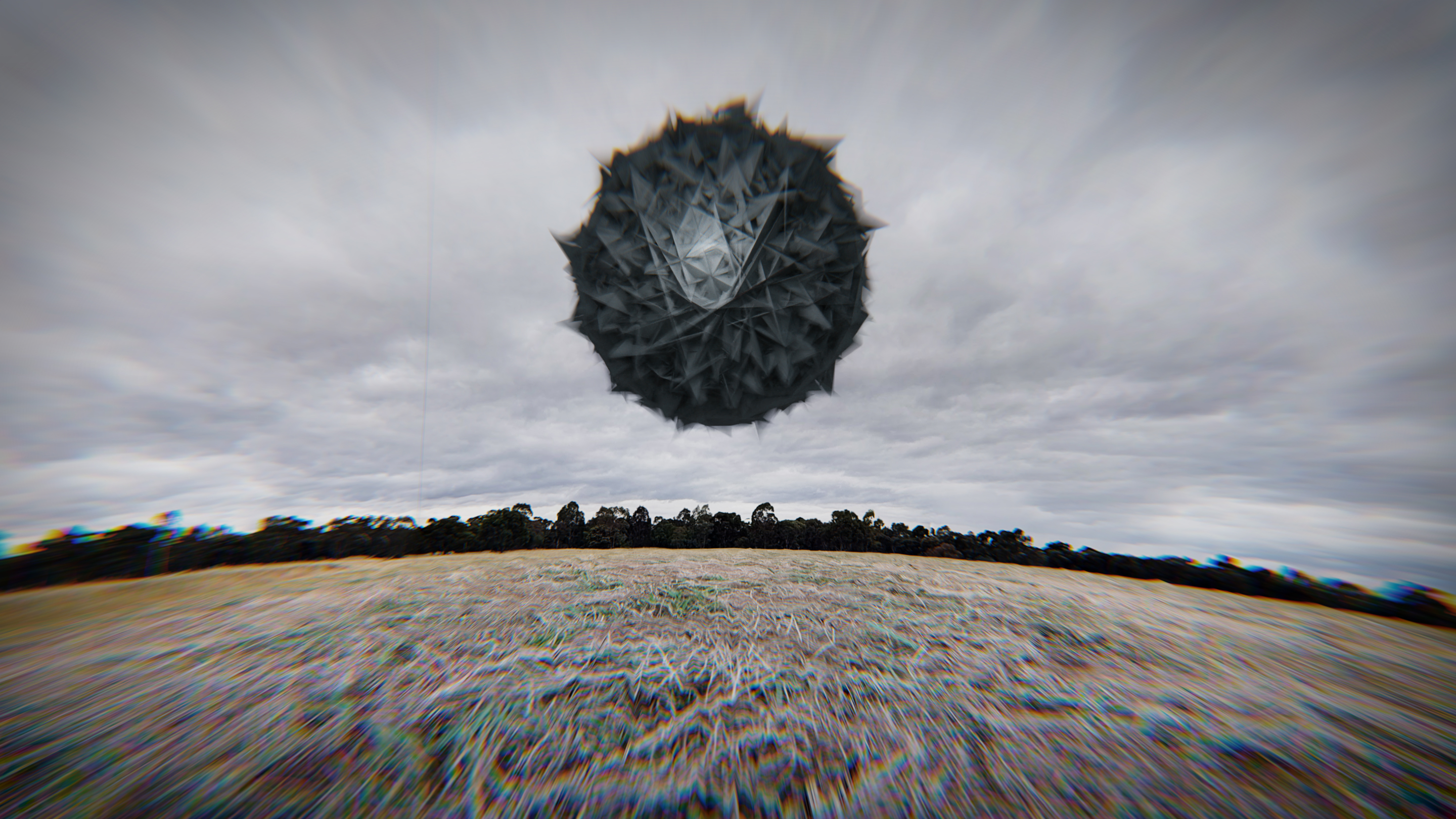
Extreme Symbols, 2022, Single-channel Animation Film

Posted in ARTWORKS | Tagged

4 Liǔ Zōngyuán Translations by W. H. Chong

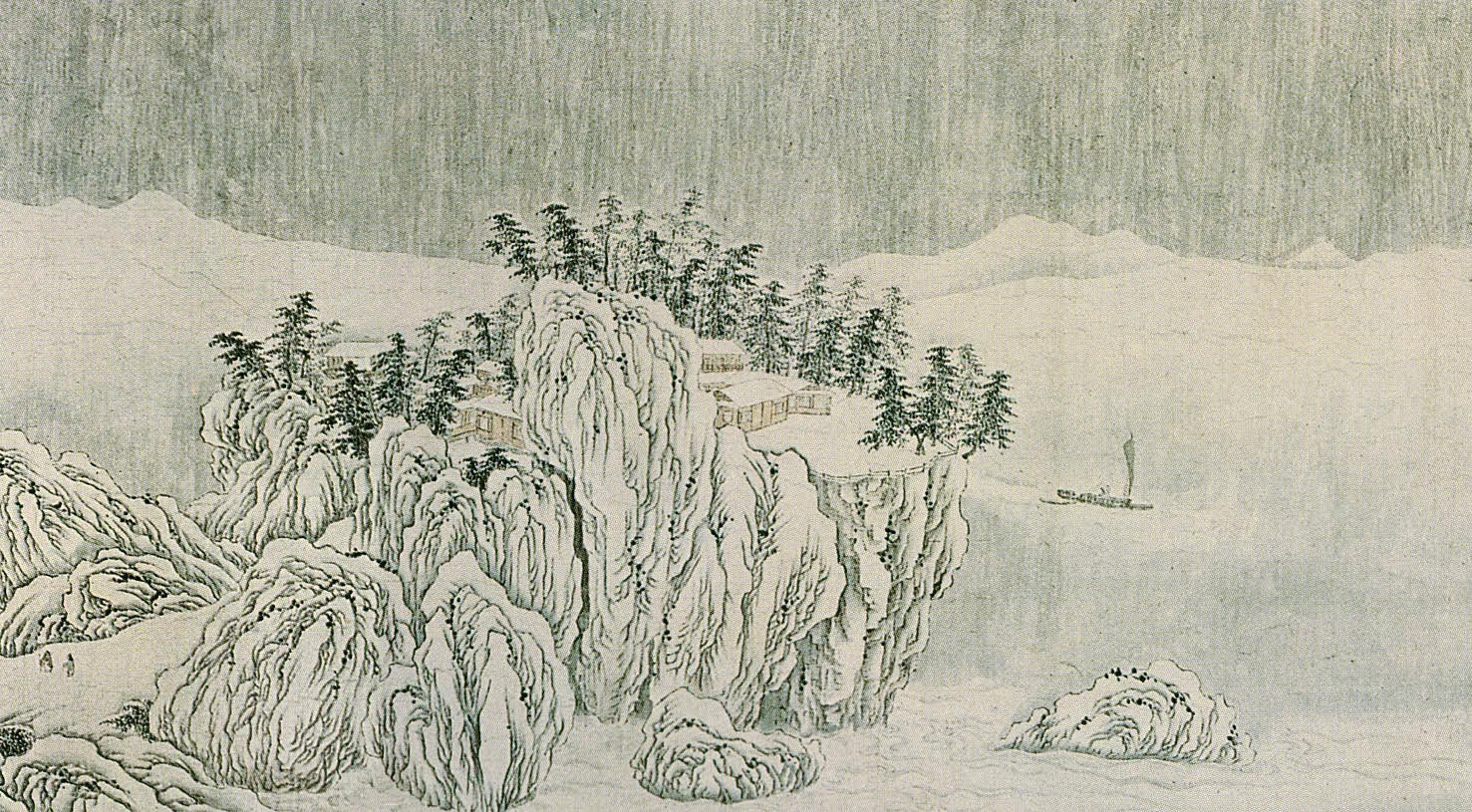
Image: Detail from “Snowscapes along Yangtze river (長江積雪圖)”, after Wang Wei

OCCASIONAL POEM ON A SUMMER’S DAY

The fierce heat of the south—deep
drunken sleep, the north window open

Silence at midday—but for a farmhand
past the bamboo pounding tea


夏晝偶作

南州溽暑醉如酒,
隱机熟眠開北牖。
⽇午獨覺無餘聲,
⼭童隔⽵敲茶⾅。

Posted in TRANSLATIONS | Tagged ,

3 Juan Carlos Mestre Translations by Peter Boyle

“Antepasados” was published in La casa roja (Calambur, 2008); “Epístola del Giotto” and “Color Chagall” in La bicicleta del Panadero (Calambur, 2012). The Spanish poems are reproduced with permission. The English translations are previously unpublished.


ANCESTORS

Where does my memory begin?
—Amos Oz

My ancestors invented the Milky Way,
they gave that element the name of necessity,
hunger they called the wall of hunger,
on poverty they placed the name of everything that’s not a stranger to poverty.
There’s not much a man can do with the thought of hunger,
you can hardly draw a fish in the dust of the road,
hardly cross the sea on a cross made with two sticks.

My ancestors crossed the sea on a cross of sticks,
but they didn’t ask for a hearing,
so they wandered through piles of paper
the way hedgehogs and lizards wander down village streets.

And they arrived at the sand hills,
in the sand hills the earth shines like fish scales,
in the sand hills life only has long days of rain and long days
            of wind.

There’s not much a man can do who only has these sorts of things in life,
he can just manage to fall asleep lying on the thought of hunger
while he listens to the conversation of sparrows in the barn,
just barely sow flowering firewood on the sheet of orchards,
walk barefoot on the shining earth
and not bury his children in it.

My ancestors invented the Milky Way,
they gave that element the name of necessity,
they crossed the sea on a cross made of sticks.
Then they gave a name to hunger so the owner of hunger
would be called master of the house of hunger
and they wandered the roads
the way hedgehogs and lizards wander down village streets.

There’s not much a man can do with the crumbs of pity,
eat sodden bread on rainy days to be followed by long days of wind
and talk of necessity,
talk of necessity the way they talk in the villages
about all those small things that can be carefully wrapped in a handkerchief.


ANTEPASADOS

¿Dónde comienza mi memoria?
—Amos Oz

Mis antepasados inventaron la Vía Láctea,
dieron a esa intemperie el nombre de la necesidad,
al hambre le llamaron muralla del hambre,
a la pobreza le pusieron el nombre de todo lo que no es extraño a la pobreza.
Poco es lo que puede hacer un hombre con el pensamiento del hambre,
apenas dibujar un pez en el polvo de los caminos,
apenas atravesar el mar en una cruz de palo.

Mis antepasados cruzaron el mar sobre una cruz de palo,
pero no pidieron audiencia,
así que vagaron por los legajos
como los erizos y los lagartos vagan por los senderos de las aldeas.

Y llegaron a los arenales,
en los arenales la tierra es brillante como escamas de pez,
la vida en los arenales sólo tiene largos días de lluvia y luego largos días de viento.

Poco es lo que puede hacer un hombre que sólo ha tenido en la vida estas cosas,
apenas quedarse dormido recostado en el pensamiento del hambre
mientras oye la conversación de los gorriones en el granero,
apenas sembrar leña de flor en la sábana de los huertos,
andar descalzo sobre la tierra brillante
y no enterrar en ella a sus hijos.

Mis antepasados inventaron la Vía Láctea,
dieron a esa intemperie el nombre de la necesidad,
atravesaron el mar sobre una cruz de palo.
Entonces pusieron nombre al hambre para que el amo del hambre
se llamara dueño de la casa del hambre
y vagaron por los caminos
como los erizos y los lagartos vagan por los senderos de las aldeas.

Poco es lo que puede hacer un hombre con las migas de la piedad,
comer pan mojado los días de lluvia a los que luego seguirán largos días de viento
y hablar de la necesidad,
hablar de la necesidad como se habla en las aldeas
de todas las cosas pequeñas que se pueden envolver con cuidado en un pañuelo.

Posted in TRANSLATIONS | Tagged ,

3 Judith Kiros Translations by Kira Josefsson

O was published by World Poetry Books in September 2024. The following excerpts are reproduced with the publisher’s permission.


PERFORMING ARTS

one black shackle
better than
ten in the bush
ten little n-

barely boys
slim, bare-legged
dawn bares
its white scalp

~

look, where go they?
eye pursuing
but the gaze lags
Behind

pressed just so
to the eye’s O
becoming
it happens fast now

~

widening
rolling them
these eyes
gleaming marbles

when your eyes
roll so
O
                     !

~

even at night
day breaks
nightly day
breaks into me

swing your loop of
light I exit right
I’m rushing
                                           O!

~

in the maw
mid-scream
such a din
edge-thin

eclipse! eclipse!
let them go
netted, caught
arrow, heart

~

pierced through
by other means
I bring them here
arrow, heart

what day is
an I in me
brace against
the yielding eye

~

little legs
little lack
nailed like that
snowy dregs

spotlight on
they need to see
my bare and sooty
little boys

~

need to pierce
deeper through
to the whitest
dusky bosom

open it
inside out
otherwise
there’s no way

~

I could
consume myself
fire off
my best shot

on the table
on the stretcher
this warm winter
undressing me

~

moon’s wide open
O
everywhere
this wide eye

~

naked wound
an I in me
hands and thighs
throb in prayer

day can be
four sides of night
frost turns charcoal
in my hair

Posted in TRANSLATIONS | Tagged ,

Sanskari Girl: 5 poems by Lia Dewey Morgan

blue stone onam

And so it was, Sunday afternoon
stoned walking aimless, blue sky
and yellow sun falling over
a Presbyterian church I’d never
seen before. A couple with a pram
dressed King of Trainers, conservative
like bald men shouting Hail Marys
down King St. Like influencer selfies,
or the woman next to you at the cafe
who shrieks suddenly, laughing. I
averted my eyes, not wanting to
stare or cause them discomfort.

It was a funny time to be trans
with a Christian. My new friend and I
got coffee at the old Greek cafe
where cakes sit behind shiny glass.
She took a photo of her cappuccino
then asked what I was doing this
weekend. Maintenance. She would
visit a new church, the one next to
the station. I could remember faces
of the buildings, but never entered.
Told her, My mum was raised devout
but broke away, raised me without

religion, passing the old Magistrates.
I thought about what to tell her, what
could be shared in the space between
us; what might shock her or just
go over her head, be misunderstood.
After all, it wasn’t her first language –
it was maybe her third or fourth.
She had designed buildings for Saudis,
finished college in Kerala. I suppose
this was ordinary to someone else
but to me it was still so new. I asked
simple questions, What’s that like?

Tell me about… What did you do then?
I had spent my life struggling with friends
who found communicating confusing
sometimes. I noticed people connecting
with me were torn between different
identities. Another colleague and friend
had grown up between East and West,
just now understanding how strongly
it impacted her as a child. One thousand
stories join in my mind, as we walked
alongside the old Melbourne gaol. Heavy
stone bricks and groups of tourists, back

into the clammer of festivities; golden saris,
rainbow rice pookkalam, tessellating prayers
of rolling Desi girls. A dancer balanced on
a copper plate, her ankle bells ringing out as
she shuffled here and there. Another dancer
leaned over to explain to me the pageantries:
how a generous king made a god so jealous,
he stomped the king down into a nether realm.
Now he returns once a year, bringing peace,
bringing harvest. I told her, I’m grateful to
take part in such culture and tradition – we
don’t have much of that here
. I imagined

visiting a queer club together. It’d be late
for starters – that alone could put her off.
The techno would sweat loudly. I doubt
she’d tried drugs before. Like a heathen
I felt, like bad propaganda about Western
homosexuals corrupting our children. But
that was the muck where I found myself first
I wanted to share with love. Suppressed,
uncertain how to open up appropriately
when the fruits of this life were strange,
taboo. Still, it was my nature to be polite,
taking pride in how I comfort strangers.

Her shoulders afloat in a strapless sundress
and I in a borrowed kurta, block-printed
with leaves of turquoise, green and pink
blossoms. We glowed like flowers. I was
a little nervous, assuming others stared
but here you were being kind, being gentle.
I wondered if that was your Christian side
or if that was a little reductive. We cheered
together as lines of men and women swung
in choreographed ecstasy synchronised to
Malayalam pop hits, crowd singing along.
The sky was blue, the sun quite warm.

Posted in CHAPBOOKS | Tagged