A. Malley: Spillway

Oh you lose so beautifully she said and threw me down on the
slope. The lawn took my back with a sting and she fell into my
mouth and roamed the sky just then the sun bucketing down
tickling each other with open palms. The tennis was over and her
skirt with the fanned folds hovered with the breeze anyway. The
cotton wrestling away from us like vanilla milkshakes balancing in
our hands and we tasted like we might. And for quite a long time.

Nearly minutes and the bold big sun the rise of pink now pattern-
ing her back and her neck and my back against the blade-grass we
notice the lips keep on and the rain begins all over again Julie
Julie gee this lasts a while and we're happy about that. Seven-
teen birds somewhere in the trees and a line call sour beyond the
oak and the car by the court (two). Tennis. Again. She says and we
fiddle the lawn and all in all we kiss and touch racquets and that's
it.

A. MALLEY collects tennis chalk and zipless pencils. He reads his poems.

REVEALED!
As reported on Cordite News Explosion, we're moved and astonished to admit that we didn't pick Luke Beesley as the author of this “so-called” “poem”.

Posted in 24: CHILDREN OF MALLEY | Tagged

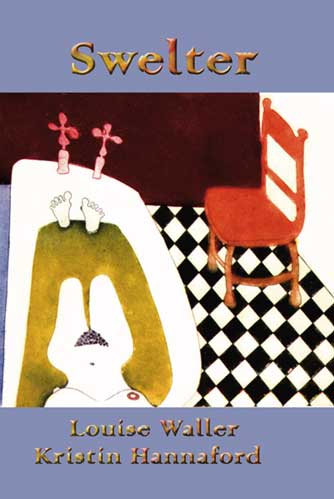
Andrew Craig Reviews Louise Waller and Kristin Hannaford

SWCov.jpgSwelter by Louise Waller and Kristin Hannaford
Interactive Press, 2004

It was with anticipation and trepidation that I approached Swelter, an audio and text CD compilation of Louise Waller's Slipway and Kristin Hannaford's Inhale. At first I expected some type of multi-media explosion – always a hit-or-miss affair, as most multi-media 'experiments' entail artists getting overly excited about something old-hat in the 'new' commercial sphere. My concerns were exacerbated by the work's New Age publicity blurb (full of words like 'family', 'nature' and 'life-affirming') that filled me with fear and led to my leaving the CD untouched in a drawer for weeks.

Continue reading

Posted in BOOK REVIEWS | Tagged , , ,

Scott Thornton Reviews Liam Ferney

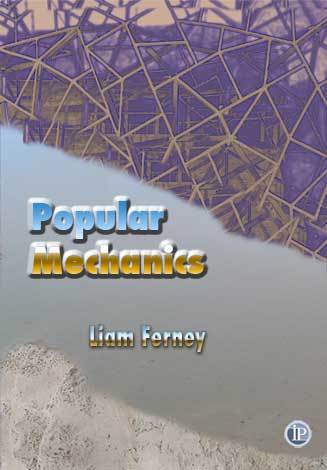
PMCov.jpgPopular Mechanics by Liam Ferney
Interactive Press, 2004

Liam Ferney's Popular Mechanics is a collection of poetry that transforms words into a quick moving train of images and syntax. The author changes tense and pace rapidly and this causes the reader to be somewhat disorientated. At first glance these poems appeared to be jumbled masses of words; the writer appeared to be moving too fast; and the conceits that he builds out of modern Australian life looked far too incongruous and fragile to involve the reader.

Continue reading

Posted in BOOK REVIEWS | Tagged ,

Magdalena Ball Reviews Adrienne Eberhard

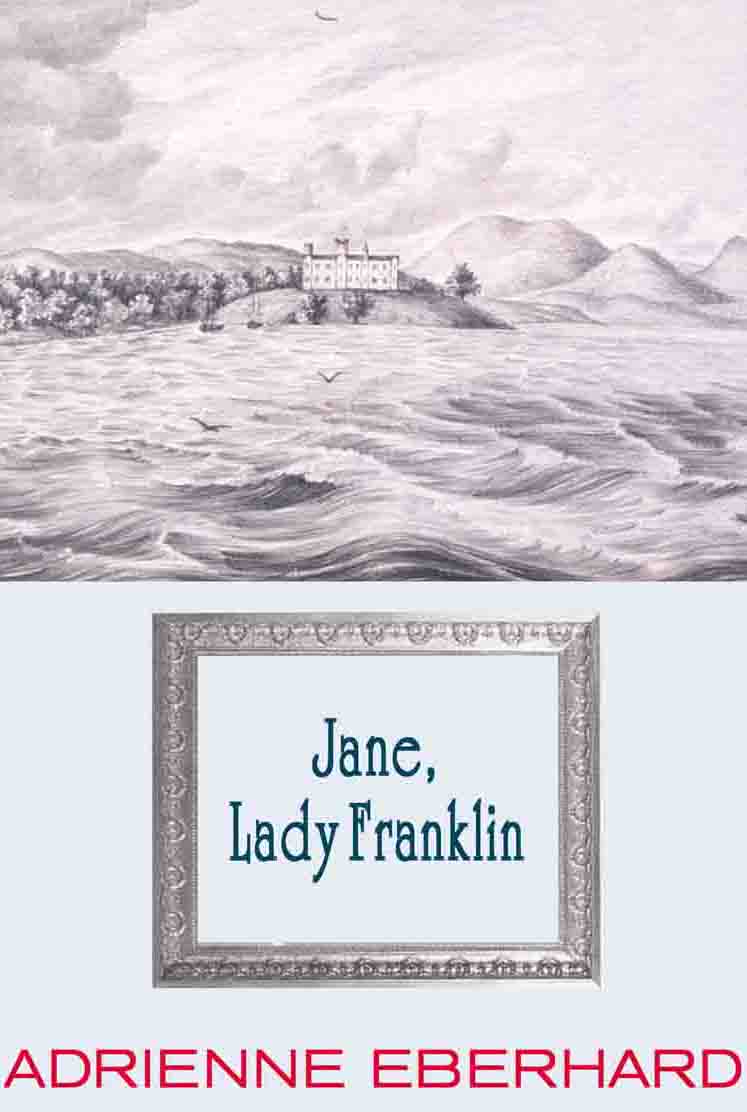
eberhardcoverjlf.jpgJane, Lady Franklin by Adrienne Eberhard
Black Pepper, 2004

Adrienne Eberhard's collection Jane, Lady Franklin can almost be described as a poetic novel. It contains a clear storyline, based partly on the real life voyage of Lady Jane Franklin, who traveled with her husband, Lieutenant-Governor John Franklin, from England to Hobart in 1837. Eberhard's well-researched set of facts form the barest bones of the work, which follows Lady Jane's six year stay in Tasmania.

Continue reading

Posted in BOOK REVIEWS | Tagged ,

David Prater Interviews John Tranter

In the following interview with David Prater, John discusses his editorial philosophy, the future of the global internet and the mystery of his missing moustache.

Can you name an editor whose work you admire or respect?

Doctor Johnson, Beatrice Davis (Angus and Robertson, 1960s and 1970s), the conjoined twins Michael Heyward and Peter Craven (Scripsi, 1980s), and several others.

What would you say are the ideal attributes of a good poetry editor?

To have a natural talent for the English language, to train oneself thoroughly in using it well, to read widely in ancient, Renaissance, modern, radical and conservative literature, to be tactful, forceful, bullying, gentle, charismatic (in order to inspire selfless slavery in others), modest, greedy for fame, and – this is essential – slightly mad. That is, rather mad, but capable. Needless to say, there are no ideal editors, only editors who approximate to the ideal in varying degrees.

Having read some of the material online about your first collection, Parallax, and the interventionist role played by Grace Perry in its publication, I'm wondering if you subscribe to the view that there are certain periods of time when editors have the opportunity to have more impact than at others?

An insightful editor can stop a stupid manuscript from seeing publication, and force a flawed but brilliant one into print, as well as gently but firmly turn a sow's ear of a manuscript into a silk purse of a book. They can also, if they have the qualities of a good general, take advantage of propitious times and harness the social energies around them.

If their taste is flawed, they can spoil a writer by publishing his or her meretricious work; and all writers create meretricious work from time to time.

In a review of your book Ultra (published in Cordite), Michael Farrell describes that work as exhibiting a kind of “magpie philosophy”. Without trying to pin down just what that phrase might mean, do you think your work as an editor of Jacket conforms to this kind of philosophy, or is the “bower bird” analogy more appropriate? Or another kind of bird …

Well, the northern-hemisphere magpie is like the austral bower-bird, gathering pretty fragments to adorn its nest. I think it was Robert Adamson who laid claim to the role of chief magpie in this continent. In Ultra I was trying to cram everything into the stream of poems in that book in the hope of overwhelming my natural tendency to settle into a stable rhetorical tone of voice. Maybe I overdid it. Some of those poems also contain buried within themselves fragments of older poems by myself and others, mashed into a different form in the blender of art. I also didn't want to present a coherent personal philosophy in that book: that is, I don't think I have any answers to the problems of living in the modern world, or any particularly important insights into the meaning of life, just a lot of questions. I don't think writers should tell people what to believe or how to behave. So I let lots of fragmentary, sometimes contradictory opinions ? as though they came from a large cast of different characters ? into the poems. That's what life is like, after all. Just listen, next time you take a bus into town. Millions of different voices, each as important as your own solitary whining.

But Jacket – you're right, Jacket is a very eclectic kind of venue. There are pieces in there that are so experimental they make your teeth ache, and there are gentle conventional nostalgic poems too. When I began exploring the world of poetry, I found a wonderful range of achievements available to me, all around the world, in various cultures and languages. I drank them all in. It seemed wrong to limit my interests to one kind of poetry. I wanted to show some of that wide range of theme and topic and style in Jacket. Poets who are psychologically chained to one style or approach might well find things in Jacket that offend them; open up, is what I say.

On the Jacket site you make it quite clear that you generally do not accept unsolicited submissions, so what is the philosophy behind your solicitations?

When I started Jacket I knew that if I said I was open to submissions from the general public, I would be overwhelmed by millions of submissions from all over the world. I just had to protect my time; already Jacket takes up a lot of my working life. That's a shame, but that's life. Jacket is for readers to read and enjoy, not for writers to use as a ladder to fame and riches. And if you can't publish in Jacket, publish somewhere else: there are literally thousands of magazines out there. Or – better still – start your own magazine.

I started out writing to people I knew, or writers whose work I liked. It just expanded slowly from there. I have always regretted that I can't pay for contributions, but I can't, and that's it. I have always been surprised that no one has declined to send me something if I ask, and that no one seems concerned that I can't pay.

One thing that strikes me about Jacket is its a-temporality – there seems to be no logical beginning or endpoint for each issue. How do you know when an issue is complete? Do you have a certain quota in mind?

I guess I think of it like a printed magazine: when it seems full, I close an issue off. I don't want to force people to wade through the whole five thousand pages (which I think Jacket probably amounts to by now.) They'd get lost and anxious. I guess an issue of Jacket averages around two hundred printed pages, like Meanjin or Scripsi.

Also I want it to come out fairly frequently, so each issue seems like fresh news. Slicing it into issues seems to make it manageable, and it seems to give each issue a personality: my readers can categorise the mass of Jacket like so: oh, that's the “hoax poetry” issue, or “that's the one with all the Kenneth Koch stuff in it”, or “that's the issue that is a collaboration with New American Writing.”

With regards being an internet magazine, and your 1999 article on the subject (‘The Left Hand of Capitalism') – do you think that the rhetoric of freely available information on the Internet presupposes a certain level of access to that information? Is there any point in ensuring that pages are accessible to the person with the slowest connection speed when that person's neighbours don't have Internet access at all?

To get this into perspective, we should remember that more than half the people alive now have no access to a telephone. So the Internet is an elitist thing. On the other hand, nutritious food is an elitist thing too, on that same scale, and we in the developed West have a right to demand nutritious food for ourselves and for our children, no? It's a matter of context.

As with all social exchanges, it's a compromise. Early on I designed Jacket to be fairly easy to download; I make the graphics fairly small and compressed, I don't use video (though I'd like to), and I keep audio to a minimum, all to make the thing less bandwidth-intensive. I used only dialup myself for years, both to download and to upload material, and I see that as a basic minimum. Jacket should, I hope, work reasonably well over telephone dialup.
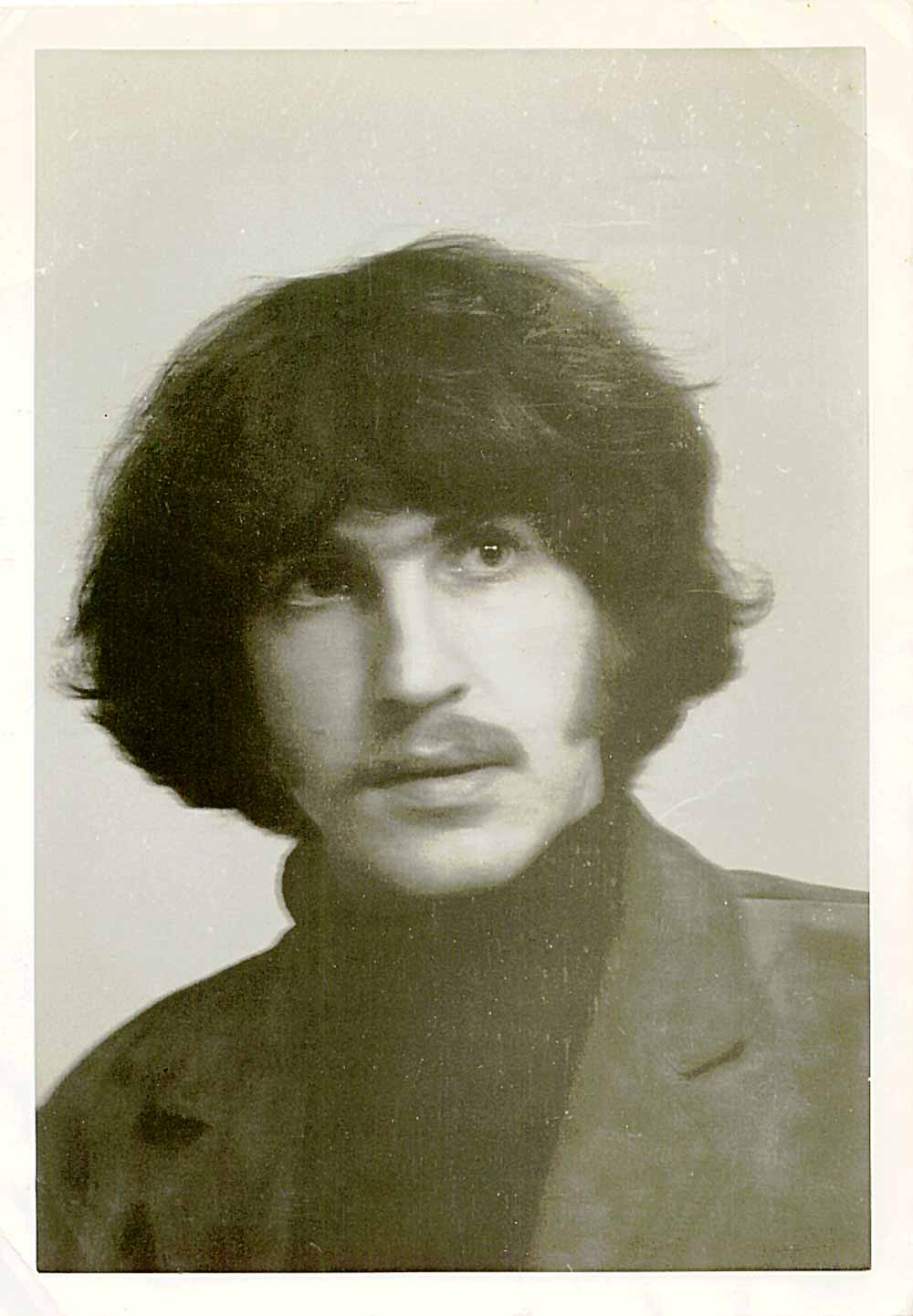
A picture of John TranterThe article also talks about subscription models on the Internet as being doomed to failure, and suggests that information wants to be free – do you also see a trend at the moment towards self-funded communities, for example within the open source movement? I'm thinking here of an application like Movable Type (which Cordite has used, with mixed feelings) and its move towards a subscription model, or the obvious capitalistic intent of Google, and its buyout of previously open source content applications like Blogger – while I'd agree with you that freely accessible material seems to be the intuitively right thing to provide on the Internet, do you have any misgivings about the future of free content? Any dystopian nightmares?

The market economy sure is a horrible beast: it seems to want to consume everything. Yet the open-source movement is still alive and well. I'm heartened to think that the OpenOffice suite, that is, a free alternative to Microsoft Word and Excel, seems to be doing well (that is, in June 2005). Selfishness and greed are generally triumphant, yet altruism keeps poking its head up. As long as people want to write and read poetry, there will be magazines like Jacket around, in one form or another.

I remember you were involved with the OZAuthors trial – can you tell our readers a little bit about it, and your own opinions of commercial e-book trials?

I should make it clear to those who remember the sixties (lucky people!) that the OZAuthors trial was not the trial for obscenity of the (mainly Australian) editors of Oz magazine in London, which started in June 1971 and was the longest and most famous obscenity trial ever staged in Britain up to that time. No, the OZAuthors trial was a test of the effectiveness of placing creative writing on an Internet site managed by the Australian Society of Authors. It was a brave early attempt, and was not all that well thought out or managed, and in the end it was put to sleep. Electronic books don't seem to have worked very well. No one likes reading off a screen for long, if they can help it. The screen is full of glare, and the text is not very clearly-defined, and everything jerks up and down when you want to see the next page.

I think Print-on-Demand (POD) has more promise. It is a means of delivering printed books of poetry cheaply. My last three titles were printed that way, by Salt Publications in the UK. (http://www.saltpublishing.com/). It solves the horrible problem of needing to print a thousand copies to get the unit cost down, which is what you needed to do in the photo-litho days. With POD you can print twenty copies, and then when they sell out, another ten or a dozen. No warehousing problems, no assets tax.

But the Internet and other electronic forms are very useful for large compilations of material which people need to browse through for one or two things they might want to read, and which would be far too large to risk printing on paper. When Philip Mead and I compiled the Penguin Book of Modern Australian Poetry in the early 1990s, the publishers had to limit the number of pages for cost reasons, and then we ran out of space for the author notes, which had to be left out.

Now I'm compiling a database of Australian poetry on the Internet which has virtually no page limits: http://www.austlit.com/a/.

All those author notes can be made freely available at last, and voluminous notes, too, with lots of photos and other things that a printed compendium could never afford to publish.

To what extent do you think your work as an editor has been influenced or shaped by your experiences in the printing/ publishing industry? Do you think it's necessary for editors to be familiar with the processes or printing and mechanisation?

Influenced? A lot. In fact I see the Internet not as some marvellous electronic device that lets you create multi-dimensional text in coloured blinking lights with thousands of hypertext links and alternative endings, but simply as a cheap way to distribute well-designed books and magazines all over the world.

For most of my adult life I have studied type and page layout and graphic design and typography and spelling and syntax and grammar, and I bring all of that to Jacket, just as I brought all of that to my work as an education editor for Angus and Robertson Publishers in Singapore in 1972.

In 1968 I started a poetry magazine called Transit which I printed on a Multilith 1250 photo-litho printing machine. It only lasted two issues: prescient title. Jacket is really just that same magazine, produced more cheaply, with a much larger contributor base and a much larger audience, nothing more. Each page is designed on the same principles: clarity and readability first, attractiveness next. For the Internet you have to add ease of navigation, that's all.

How much work do you put into Jacket? How many hours a week do you put in? How does this affect your own creative writing?

I'm frightened to count the hours I have spent on Jacket since the first issue in October 1997. I think I'd burst into tears. Twenty to thirty hours a week? And yes, over the eight years I have been its slave, it has stolen about forty good poems from me. Too bad. People write too much anyway. I could mention some names, but I won't.
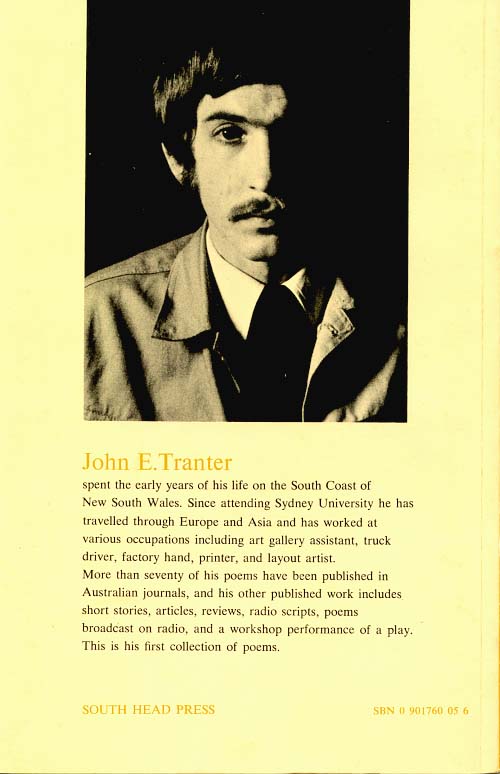
A picture of John TranterFinally, a little bit of a cheeky question: when I read the aforementioned material on Parallax, I was especially interested in the bio and photo on the back cover (left). I remember John Scott saying to me once that he abandoned the A from the name John A Scott after he stopped publishing books of poetry, saying that that person was a different person, who no longer existed. With the John E Tranter, was a similar operation in progress there, even in spite of the confusion with the other (since disappeared) John Tranter? Further to this, I notice you sporting a rather dapper moustache in that self-described “gloomy” photo – what made you shave it off? Or was that indeed a stand-in Tranter, like the other Paul McCartney beloved of conspiracy theorists?

Damn, you've found out! Paul will be so upset! He wanted his serious poetry to find its own way in the world, unencumbered by his fame as a pop singer?

Seriously, I didn't want to have to call myself John E Tranter, but when I was twenty-one, in 1964, a novel appeared in London titled The Livin' is Easy, by a young Australian writer called John Tranter. There had never been a published writer of that name in English, as far as I know, and I was dismayed; the novel wasn't mine. I found out, years later, that it was by a writer (born in New Zealand) named John Taylor Tranter. We talked once on the phone: he seemed a nice guy. He's dead now, unfortunately. But at that time I felt obliged to use my middle initial (E for Ernest) to distinguish my work from his. As it happened, he never published another book, and eventually I dropped the initial. That's what that was about.

As for the moustache, in 1971 Vogue Australia published a piece titled “The Poetry Explosion – Virginia Osborne introduces six talented young Sydney poets”. It read in part: “Dylan, The Beatles and Leonard Cohen have undeniably been an added force in the spreading cult of poetry. Their songs and words reach a gigantic public, and have stretched minds previously limited by June/ moon/ goon type lyrics. John E Tranter, a poet with a luxuriant, slightly drooping moustache, is convinced of their importance but prefers to go to their sources rather than their songs for his own inspiration.”

Drooping? Excuse me!

That was about when I cut off my moustache, in order not to be confused with Paul and to escape being mobbed in the streets, but in later years I grew a moustache and occasionally a beard, on and off, from time to time, but not for a long while now. Last time I grew a beard, I thought it made me look like Santa Claus, and that's where cognitive dissonance raises its ugly head: Santa Claus? That's not quite me.

Posted in INTERVIEWS | Tagged ,

Michael Brennan: A Short History of Vagabond Press and Poetry International Australia

Chance and community might best describe how I edit and publish poetry. Chance in the unlikely alignment of latching onto good poems available for publication and that suit the nature of whatever I'm editing at the time. Community in the sense of a desire that whatever I am editing works toward allowing the formation of an integrated network of disparate voices, however temporary and transient.

Continue reading

Posted in ESSAYS | Tagged , , , ,

You, Me, Happy, Sometimes

The time you screwed the door on backwards
and walked memory through the threshold
on a diamond leash that was something else.

A who's who of circus geeks strutted by
& whenever one winked at me with her pink eye
a certain stabbing motion rubblized the central

plain of my solar plexus. I lifted the four
corners of my pith off the linoleum cluster
& established a new equilibrium which not slowly

morphed into pungence nostalgic for funnel cakes.
Then there was our last freak show together.
We tried on happy but it was humid Ohio??

sweat evaporates like petroleum jelly
which is to say it doesn't. It persists, a reminder
you can run away from nothing but the details.

Frankly the freaks were disappointing.
One year the bizarro tent just disappeared
like the blurbs that float between us in the haze.

I'll never understand why we don't hear what we do
or not see the rod & cone assembly beneath our windows.
If the seagulls act dumb, call it strategy. If we do,

then some organs evolve more fully than others.
So in the end we are a species of specimens,
assortments of bent & grotesque features,

making everyone a geek in search of a tent.
I want to imagine your ears as Venus fly traps
snatching words, plump & puny, and slowly

digesting them until you know syntax so well
you diagram dreams. If you feed my pitcher plants
such beautiful things, you'll make me happy, sometimes.

Posted in 23: EDITORIAL INTERVENTION | Tagged

Comedian C

Know this now: I long ago gave up my belief in Rapture.
I rise on pins and spit the pips, Hugo.
Prenuptials must not include
Recourse to jelly donuts.
Not this time. I am no one's Ivanhoe.
I too despise, abhor, deny, and denigrate prose poetry.

This here is an ode to language itself, which writes us.
It doesn't write me a cheque, though.
Drive me like a Porsche.
Somebody better call the cops, kiddo.
I am in. In luck, intemperate.
Poetry should not exculpate: it sings, buddy. Got that?

All men will be millers then, so that they will eat pain.
Egghead marries hourglass.
Four-eyes weds egg-timer.
Old-timer shacks up with Dish.
Creep gets world famous chick.
Tut Tut McGinty Said. He said this with much relish.

Posted in 23: EDITORIAL INTERVENTION | Tagged

Local Girl Dies of Frostbite

I'm cold and tired and must lie down
in my nurse's dress,
five hundred paces from my town,
the air in snow-distress.
That which makes me bed the ground
I never kissed; the warmth
that has escaped my body
will not be missed, though found
I seem a princess felled by a thorn –
a simple cold spell –
so close to houses where I was born.
If you might rub my blood to burn
all'd be grateful, not to mourn;
as is, I wear a winter crown.

Posted in 23: EDITORIAL INTERVENTION | Tagged

The Lighthouse Keeper

It might be wiser to weather in a lighthouse
Than risk the vertical incisions of the storm
That seems to have rescued the torn sea from itself
Only to let it return, this time as tragedy, as full rain.
No longer as young as when, morning, the sky, like pearl,
Was forming an idea, both pale and rare, you shelve
The green Clampitt and admit night's other influence
Now as the vicious parakeet of light screeches again.
It is a wise reader that stays in for the Horn's winter,
Knowing no matter how literal the mad trades – hurling –
Desire to become, wildness winters in this tall home,
A tower whose saving grace revolves above its calm.
The custom is to lay provisions, storing for the squall;
To reflect on, through the many fog-throttled panes, water.

Posted in 23: EDITORIAL INTERVENTION | Tagged

Calling Home

Time is the longest distance between two places
    Tennessee Williams

Declarations of love and his voice growing fainter,
      he asks why I'm so eager to end the conversation.
I've one ear on traffic, the other on the receiver
      both anticipating a break in the flow of things.

My feet teeter on the curb, the metal cord connecting
      us fully extended, rod-like, our talk has become punitive.
I'm about to run or not, set something other than my
      body in motion or not, though I'm pressed to reason

any desire in stasis. I've not the stance for answers
      today, I draw breath and from the action, need
but say nothing of it. A security guard motions
      at me from the concrete rim of a flower bed,

his message, visible but silent, cannot be got at this
      distance: the flowers also arrive, poor travellers,
more or less certainly – thirsting. Caught between
      the mall and the street two Tamil tailors, who later

attempt a garment from my necessary indifference
      to them, lock hands. This is love or not – thumbing
the buttons, gesturing – and it will call again before
      it leaves; while there's still money on the card.

Posted in 23: EDITORIAL INTERVENTION | Tagged

Emperor Go, Godspeed

The first sharp salt splash on the brow
     is so like a break-up,
leaves synonymous in the mast,
     a scent of honey
in blue cotton sails, your voice's economy
     with breath. Why don't we
head toward that constellation,
     occasional reception dropout standard

welcome even by the crew.
     Years of freedom finally burst.
There is nothing to eat, so seek it
     where you will, seed heads wired
to a hull full of words, soil
     at home in the book.

Posted in 23: EDITORIAL INTERVENTION | Tagged

Extinction

I was there when the dieback began.
     First I felt the dead drive
toward total florescence, company drying-out
     as the sun went down
on prime real estate, sandalwood, cedar
     feathers in the red run, charred
plains of old geology
     bled maritime types into eternal night

spectral as money gluts.
     The carve-up hits home in total darkness.
But, it's true, I can see you now, standing
     waves lonely as a memory
annihilates the sweet & grassy light, singing O
     we never stood there, never.

Posted in 23: EDITORIAL INTERVENTION | Tagged

a day in the life long

The moon forgets its own face.
I'm reminded that I don't like the colour of sky
in summer, ever. Someone asks me to smell
their rose colour. I say, Get out of the way
of my birdsong! Watch the brittle hands
falling from me, dry retching on the taste
of love letters, eyes welling up
with the brutal smell of drumming.
The moon is waiting for a better time
to show its face. It cries, Spoon, dish,
but what about a tuning fork? Its face
an open tub of Brillatine cream, singing
from a bathroom that's lost its house.
The sun comes up, goes down on a pulley.
Breakfast television is changing. Autumn
takes me, I am breathless. It breathes its
brown and gold over my green lentil skin. Smiling,
I realise my treetop walking is coming along,
steadily. No one standing beneath shouting,
Look at old Elephant Ears! The tightrope's
taken down and used as a lasso. Summer
has put its hope in me and I won't let it down
or the crowd of teenagers lining up for a name.
My pen fights like a terrier, a rose tasting
metaphor for itself. And you?

Posted in 23: EDITORIAL INTERVENTION | Tagged

writers and editors

there are writers who are
trying to get into books
and there are editors
that try hard to keep them out

there are writers who are
trying to get in too hard
and there are editors
that try books to keep them out

there are writers who are
out to get into books
and there are editors
that try hard to keep them trying

there are editors who are
trying to get into books
and are there writers that
try hard to keep them out?

try hard books are there,
writers who are too,
and editors are into that –
keep trying out there to get them!

are try hard writers out there
to get into books?
and are there editors who are
trying to keep them that?

out writers are there that
are trying hard books to get into
and there are editors
who try to keep them

and there are writers who are
there that try hard
to get into editors: books are
too trying ? keep them out!

Posted in 23: EDITORIAL INTERVENTION | Tagged

From River Cuts: Letters to Robert Adamson

canberra

raining & the flight was shit / in the sticks
somewhere off majura avenue (dickson) 19:39 0646
abstract & bearded hovering on a twelve foot
cushion of evil / a still from eisenstein's ivan
the terrible
, mutation of reading or action in two
parts. early blur of delight, all radioed & human
squawking a row of nameless trees / punctual cloud
swings left onto limestone hunched & rattling, absence
of names he is curled now & breathes through a tube /
attendants measure his piss, milk it into a bag &
store for later reference. said it was okay he camped &
weaved his funereal track / emu park, ogmore, lakes
creek (iced & dealing with horses) proper defences
are wooden & buried in earth. read hart crane (again).
read it aloud in the voice of a woman / only got as far
as ?´surrender'. this city, this great & secret invention
bleak experiment of rooms (death) astounding scrawl of
hair & sunnies / sixty minutes in ash with friends its
flashlights bamboo & giggles / benares or equal dark.
nothing matters. swamp birds dribble & bloat, pilgrims
bob & piss / tabla & skulls / the living dirt in his mouth.
only living brother lost to art & buddhist end-games
the clever panel discuss her artefact collection style:
snipping his hair into a make-up bag or purse, galactic
themed with room for toenails. everything is cut & bagged
& stored downstairs / concrete tubs / the single bulb
of thought, he turns & smiles like a thunderbird
shovels chook food down a tea-stained hole.
in all my dreams the idiot baby with eternal crooked
grin / the story by candle light twisted downward so!
the roll of the drum & hotel in uproar, wilfred owen's
blood-shod barefoot dead, plunging incurably in haunted
latin finale. a little cup of grease that never left his
fingers, upstairs cracked & home / the curtained box (relief).
strange black birds cry from low branches, replacement
birds, the unsettling intersection of transparency & death /
distant bank or silent threat. my father as aguirre slaps
the horse and stares, sinking slowly / ?´mexico was no
illusion' / the invention of fear finds a place in his neck,
whistling & fashioned by unseen dwarven attackers.
always raining, falling into water / choking tastes like
broken lungs / wind in canberra, night. knocks down trees
with words with skin / crude assemblies of metal & wood he
curls in shell & august / cage of eyes the chinese burn of
his throat. black birds hop & fan & unknown morning / red
or north / & feels like winter.

Posted in 23: EDITORIAL INTERVENTION | Tagged ,

Where Am I?

a sheet of pills
slips from the drawer
to the floor

not near a radio

can't operate
the dvd player,
don't understand
the digital box,
(do I care ?)

air, breeze and leaf
(someone else's window)
tinge the time
(someone else's clock)

sockettes
drying
on the door handles

a precious feeling
like a fungus
or a furball
in my throat

you could
freeze a lioness
in there
that fridge
is huge

can't find any
powdered milk

Posted in 23: EDITORIAL INTERVENTION | Tagged

Café Filmo

the Italians

go to Starbucks –

beam me up biscotti.

Pasolini, the charmer,

orders decaf.

last century

Federico Fellini

made films as if

everyone loved films

that was the gift, the key.

Pier Paolo filmed

like someone

who'd never been drunk

falling in love with wine.

it's long since

the dazey days

when ye olde avant-garde

sat through the world's

longest short film festivals,

when hillbilly dills on pills

optically distorted

nightmarish knots

in wood grain

close-up in 16 mm.

Nino Rota

lights a low tar,

hums to cool

a macchiato,

dotting staves

on napkins.

Posted in 23: EDITORIAL INTERVENTION | Tagged

Haven

that's nature
for you —
worried
by a whip-bird,
bitten and blotched
by all
the different bugs
and nanobac
that we find
inside the hut,
the weekender,
the cabin
in the haven.
the shady
scenic-route lookout
marks the place
that feeds vertigo
that induces insomnia,
lie counting
the bouncy
screenmate sheep
all night,
the wheely bin
full of sticks
and plastic curtain rings.

Posted in 23: EDITORIAL INTERVENTION | Tagged

love in the accusation

   somewhere between ´blood in the wind'1 and ´died to no avail'2
   is this (´From The New World') what they call ´smear
   campaign' or ´once more around the block'?
reading, breathing in insects/gas, fifty years getting something
right, some image to tear at our last moments
(a tone according to Breton)
   Jorie Graham: the stamp
   26 lines in blue like payslips or half …
   the guilty boat, the without warning
   the weather today said your mother 106
   they were 107 voting for me
   it was an election & id never need to breathe again
   in the stable (at the airport)
   what about your passport doesnt it mean something to
   you? in ´japanese'?
   ok
   suddenly it does
   The Dream Of The Unified Field 106-109
   The Creation Of Eve 1356
   1974-1994
   bembo
   as a friend, a reputation. ka: known as.
   one knee on the neck, like they
   country without hollywood
   language of the pillow; unlearned
   (the left side / star of india)
   these are diversions: the blue, the red, & more red
framed; books
   there were four elephants. somewhere between ´the
security you want' & ´ ´
   evidence suggests the news was meant to be sung.
   cutting off bits for pots.
   phones give us something to talk to; old people.
   she was our own martyr, of sorts —
   knowing our joy is made of their dissolution.
   moving over property like it cant touch me/us
   though it might love accuse
   i hadnt read this before, in my study 108 do you
   remember?
   the poem invites 109 ´a tone' (Breton) knowing
   our joy? in the st in the air?
   what were stanzas,
   evidence
wh– (request)
./place x 2


1 ´At The Cabaret Now' (Jorie Graham)
2 ´Untitled' (Jorie Graham)

Posted in 23: EDITORIAL INTERVENTION | Tagged

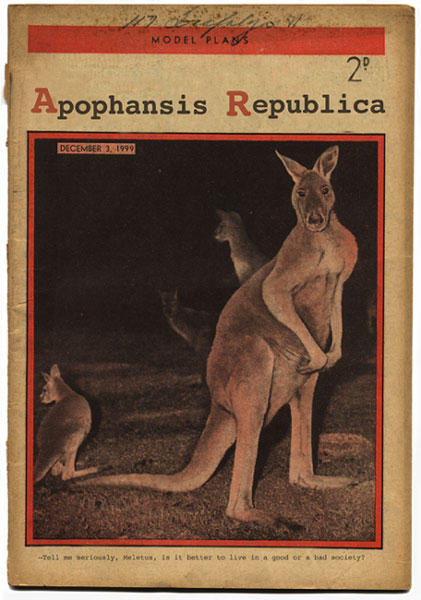
Apophansis Republica (2)

First effect: the erasure of singularity.
Second effect: a pattern of necessary associations.
Ethical Adjustment #1: Deny all lies, greater truths justify these equivocations.

Third Effect: the possibility of insight.
Fourth Effect: the emotive response.
Ethical Adjustment #2: Enclose the political within the gambit of an image.

Fifth Effect: the supposition of understanding.
Sixth Effect: the demands of interpretation presuppose understanding.
Assertion #1: Your eyes are rusted gaskets.

Seventh Effect: the joy of bathos.
Eighth Effect: irony.
Ethical Adjustment #3: Regularly oil and sharpen the blade's steel.

Ninth Effect: the realisation of meaning.
Tenth Effect: a desire for boredom.
Assertion #2: You are irrevocably late.

Ethical Adjustment – final: Incise left to right; dispose of appropriately.

Posted in 23: EDITORIAL INTERVENTION | Tagged

Apophansis Republica (1)

Posted in 23: EDITORIAL INTERVENTION | Tagged

Sweet Child O’ Mine

departure brushes up against you
a hurried commuter on the rush hour line

it was really something to take part in the hubris
a signed deal & a backslapped afternoon

digital authenticity drowns out static
& we forget how good it felt to shatter fibro

axl rose makes a performance art comeback
& i slip into a vodka collins in the front row

Posted in 23: EDITORIAL INTERVENTION | Tagged

Dulce bellum inexpertis

pull the stitch through
and sew the night wounds.

the best time for war
is while the enemy sleeps.

Wilfred Owen of Tikrit
breathes freely

(not a mustard gas insectoid
of trench warfare).

they are the nonchalant Knights
of the Kevlar Table.

Incubus sticker
on the side of his helmet.

residual radiation
doesn't feature in barracks conversation.

in the middle of November
he starts to wonder

if the reindeer
know the way to babylon.

some turkey turns up
celebrating the pilgrim's progress.

a constant jumbo jet tinnitus
and sleep dep hallucinations

keeps his patrol
as keen as rambo's knife,

but the worst news comes
on Christmas Eve

and the e-card
Pvt. Taylor sends his girlfriend

bounces back,
address blocked.

Posted in 23: EDITORIAL INTERVENTION | Tagged