Paul Mitchell: International, Interspecies – Welcome Chimps…

A recent international scientific report suggesting chimpanzees should be admitted to the human family – because they share 97 plus percent of our functional DNA – has produced worldwide confusion. First there was the problem of whether or not the formal admission was coming a little late.
Continue reading

Posted in FEATURES | Tagged , ,

Moses Iten: Because I Was Brought By the Road (3)

“Those who sell our dreams – “

The road off the highway became a dirt road until eventually we were driving around a maze of rough dirt roads, weaving their way between humble homes. Camelia's large and jolly mum constantly quaking with a bout of laughter, gave us all a hug on arrival and wanted to give her son – one of nine – a duck. After a proud tour of their beautiful pig – “More handsome than Camelia himself,” teased Jesus …
Continue reading

Posted in FEATURES | Tagged

San Gimignano

I saw a girl drinking absinthe—
I saw her rural eyes and Florentine hands—
an ivy-coated wall behind, cool as a lover.

I drank from a fountain in the plaza
its marble head sad as a ruined epigram
the water tasting of moss and clay.

Twice I looked into the distance
beyond the city walls, finding olive groves
and fields of sunflowers.

I saw a valley dry as lavender—unenvied, remote
as though left by mauve for silver’s pleasure.
I entered a museum, silky

with cardinal lives, and I saw
manuscripts with Latin words laid down
like stones crumbling where they fell.

And even though the space on the postcard
where I sat in frescoed shadow
beneath gargoyles

is now blank, a wash of emptier light,
I remember a storm falling into the valley,
thunder radiant with the war-cry of elephants.

I remember the girl drinking absinthe—
how she gathered up her small handbag
and Vespa keys.

I believe I counted my ribs
for a missing bone and found
her rural eyes and Florentine hands—

Posted in 13: INTERNATIONAL | Tagged

Way Out

Such is the violence required
to stop the body in its tracks.
Some say the spirit – if it exists – hovers
permanently within a hundred metre radius
of its busted, flesh-and-bone cage.

I hurried over to the huge, once encumbered
bulk of her; eyes shut behind spectacles
that cling to her face, oddly
unbroken. Her leg, jumped free from its socket,
was held in place
by what must be size-40 Levis.

Blood through a rip in the jeans
flood a long, squint-eyed cut across her thigh:
the inside of her large body
peeking out. I imagine her spirit easing
its way out of that wound

to stand there, gazing skywards at how
far she had come in the gasp of two seconds,
debating if this was a mistake,
and if she had only known
that death was false, that consciousness
would draw her back to itself
even after the end, inescapable,
like gravity.

But I prefer to believe that she
is gone, just as Leslie Cheung
is gone; that death
is not a rapid corridor
between one prison and the next;

that the sound she made when the pavement
rose generously to meet her
was not the opposite of a bomb
going off.

Posted in 13: INTERNATIONAL | Tagged

Landing

What death may be: a slow, close-to-weightless
tilt, like a burgeoning foetus turning
slightly in the womb. The engine starts a low
growl like a stomach, the aircraft hungry to
land, to devour the space between its
falling body and the ground, followed by
the slow lick of its wheels against the runway's
belly: pressing down, then skating forward,
only to decelerate, a sensual slow-mo,
and the plane makes a sound
like the hugest sigh of relief.

The seatbelt sign blinks off for the final time.
We rise up from our seats like souls
from bodies, leaving bulky hand luggage
in the overhead compartments, then
begin a tense line down the aisle, awkwardly
smiling at each other, remaining few minutes
alive with all kinds of ambivalences,
or simply relief at having arrived, at long last,
in that no-time zone of a country
without a name except the ones we give it;
weeping, laughing, both at once.

Posted in 13: INTERNATIONAL | Tagged

howtowritepopsongswithoutevenreallytrying

fifteen day sleeping tour of the north coast
relieves your fixations, prices slashed even further –
parties, exhibitions, murrumbidgee dried fruit
now open to the public, decades of tattoos
on euston road & a jeep wrangler abandoned on the footpath.
from here the country's just a shimmy away,
that drone you can't clear from the microphone
& a pipeband playing scotland the brave.
later still it's the bedsit thing, all kitchen sink drama,
no woodchips & six dollar pasta
across the street from the neighbourhood centre,
corners & intersections & recycled kisses,
your feelings reconfigured like a frankenscience project,
iterative heart & useful things to think about,
comfortably dissociated, scrawny chicken bits dangling
beneath your t-shirt, the performative redundancy
desire amounts to, like a body surfer,
staggering up the beach with a mouthful of sand

Posted in 13: INTERNATIONAL | Tagged

Justin Lowe Reviews Emma Lew and Ashlley Morgan-Shae

Anything the Landlord Touches by Emma Lew
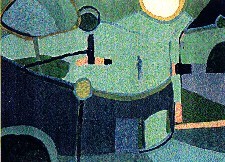
Giramondo, 2002

Love Trash by Ashlley Morgan-Shae
Five Islands Press, 2002

Emma Lew's second verse collection, Anything the Landlord Touches, begins with one of those stanzas that could almost serve as a credo for an entire generation of atomized humanity: Continue reading

Posted in BOOK REVIEWS | Tagged , ,

Q&A with Mathieu Hilfiger and Sebastien Raoul

The lasting image that I will retain of Mathieu Hilfiger and Sebastien Raoul is the ever-so French portrait I took of them at the conclusion of our entretien on another biting Paris winter morning. In the photograph, Sebastien is wearing a bright red coat and black beret, and is ill shaven. Mathieu has on a black woollen coat, and a thick, grey scarf that is tied in a knot under his chin. They pose in front of the old clock in the main courtyard at La Sorbonne, one of Europe's oldest and most prestigious universities and where both Hilfiger and Raoul are completing their Masters of Philosophy. And it is from the university that they edit and publish their biannual poetry journal, Le Bateau Fantôme (Ghost Ship).
Continue reading

Posted in GUNCOTTON | Tagged , , ,

Lifestyle Beijing

        I

a pekinese on
the dashboard.
be careful when
opening the door.


        II

so much depends
upon

24 hour
gate guards

standing to
attention

beside the bronze
lions.


        III

there is
  such a
   style
    of
     personality
      in
       number
        plates.

some of the public have tried to understand the phenomenon.


        IV

a rounded lobby in
marble & mirrors.
a leather
sofa &
a flat screen,
the flatter
the better.

Posted in 13: INTERNATIONAL | Tagged

Scheherazade

sleep
is the story I long to tell
death is everyone's story

when you close your eyes
think of me
and the whole world comes

its denouments are myriad
as the songs of birds
some are whispers some are screams

a sword falls
your head lolls
and you float like blood

I have come to you in good faith
listen to me
death is everyone's story

one day a sword will fall
your head will loll
night will grasp you like a knife

Posted in 13: INTERNATIONAL | Tagged

Moses Iten: Because I Was Brought By the Road (2)

“To pull up their boats under the safety of the coconut palms”

“Come and have beer,” shouted my friend Jesus, waving me over to a chest-fridge just metres from the shore. The local cantina: a corrugated-iron roof with a full fridge, an assortment of plastic tables and chairs occupied by a handful of fishermen. The chicken-feet joker was swinging in a hammock stretched up between two poles. Grabbed a beer and paid the owner, Don Julio, sitting on his throne of five stacked-up chairs. Crowned by large straw hat, with his sceptre – a walking frame – standing in front of him.
Continue reading

Posted in FEATURES | Tagged

Part of a Discussion

Eve: Except nothing happens. That was what the fruit was about: one bite and boredom exploded like juice to fill our mouths.

Adam: Except it wasn't juice. It was not any kind of matter, although it would fly up to consume us, although all we can do is pin it down with words, an entire language.

Eve: How long have we been walking? Juice. How apt. How boredom drags itself out from us through our skin as sweat, floods the space between my legs with liquid fire.

Adam: It is also a vacuum. And the body is sucked in to fill it. Desire. This is what the word means.

Eve: Frustration follows. Then weariness. Cyclical. With an unstoppable rhythm: our hearts keep the time, drum out its indifferent tempo.

Adam: We will have each other. Or more of us if we have to.

Eve: Let us rest here. We will build a fire for the night, as nights are longer here. And the cold will be unbearable.

Posted in 13: INTERNATIONAL | Tagged

International Date Lines

the first: watashiwa piano

mizue takada on the walkman. my japanese
is like fractured helium. i'm wearing paradise

pink bobbles in my folded hair. my fingers are
origami swans. i shuffle my nerves to the corners

of my mouth. he is coming closer. we talk nicknames
& canasta & pizza. he walks into my kiss. then he says:

wanna play 'go' sometime? i could kick your
blossom bottom.
 

the second: dadra

eating subji on the train. a sitar as purple as dad's.
the pineapple sunset is scraped with morning red.

you always wanted the trip of a lifetime. this scene
was just the ticket. as we share bad wine you lean in.

pulling out a fantale & a pink handkerchief you swear.
then: hey baby, was this the way you pictured it?
 

the third: before Nirvana

        banana clips. balloon shoes. baggies.
baroque. batwing blouses. big bangs. bicycle shorts.
        bermuda shorts. bolero jacket. bubble gum jeans. bows.
bra shirts. bullet belts & bandanas.

this is the backdrop for a bad night. bowled over
by the eighties. you have a solid navy top.

i hate the way you always smack my mum on the ass
& then talk to me about commitment.
 

the fourth: during the Dirty Three

we made out like punk music & stared at each other
like alt country. you were severe in every brush stroke.

all that alcohol & loopy band behaviour. i loved your
hook & kink but couldn't stand the love quotes from

random books. we held hands during jim's drums.
i cringed when you said: this is the theme to my sadness.
 

the fifth: after Charles Mingus II B.S.

'Often when I'm sitting at the piano , developing a piece,
it's difficult to put a label on the particular feeling I have going.'
        Charles Mingus

smashmouth bittenbabe. this was the chase. you
were tenor to my sax. just when the shuffle started

you said: i'm moving to spain. i like the weather
& the women. i couldn't think of the words.

how do you say go ahead in spanish &
shit in a calm voice.

Posted in 13: INTERNATIONAL | Tagged

Q&A with Pablo Garcia

When Pablo Garcia imparted his belief that a) Poets were shamans of today and b) Poetry was the trunk from which all other branches of art sprouted, I'll admit that I had trouble staying my left eyebrow. In the end, it remained on my forehead and I was able to engage Garcia on his thoughts regarding the cross-breeding of the arts, and the interconnectivity of the world we live in.

Continue reading

Posted in GUNCOTTON | Tagged ,

Paul Mitchell Interviews Dorothy Porter

For Dorothy Porter, writing librettos is a natural extension of her desire to “open things up” with her poetry; to discover the realms in which it can move. However, renowned as the woman who writes with rock music playing (the final sections of her latest verse novel Wild Surmise were written with P.J. Harvey on the stereo), the shift into opera in recent years doesn't mean Porter's CD collection has altered too much.
“Librettists are, internationally, pretty scarce on the ground,” she says when I meet her in the courtyard of her local cafe in Clifton Hill. “Jonathan Mills approached me back in 1996 to see if I'd be interested in writing a libretto for him based on a short story called 'The Chosen Vessel' by Barbara Baynton. And I wrote a libretto called 'The Ghost Wife'.”

The chamber opera premiered at the Melbourne Festival in 1999 and also played at the Adelaide and Sydney Festivals, as well as at the Opera House and in London. Then last year Porter and Mills entered an international opera competition run by London's Genesis Foundation. Their opera, The Eternity Man, was one of three winners.

The opera is based on the life of reformed alcoholic, Arthur Stace. For 30 years from the 1940s, Stace in the night chalked the word “Eternity” in copperplate script on Sydney's footpaths as a celebration of his faith in God. After the word lit up the Harbour Bridge it became almost the signature symbol for the Sydney 2000 Olympics. In July this year, Porter heads to London to begin work on the opera's international debut.

“I turned the Arthur Stace story into a kind of an hallucinatory tribute to Sydney, my hometown. I look at the history in the 40s, 50s and 60s, using Arthur Stace as a ghost-like figure.”

Mills saw in Porter's verse novels (The Monkey's Mask and Akhenaten) an operatic quality in the way the poetic works are constructed; a view shared by reviewers when the novels have been translated into Italian. Porter says she didn't know much about the art of the librettist before Mills asked her to work with him, but she went into it with a “spirit of adventure”.

“I'd never thought of my novels as operatic before,” she said. But now she's worked with Mills she says the libretto form “does appear to have a relationship with my poetry.”

In the same way that writing opera doesn't mean she's turned away from rock, writing with Eternity in mind doesn't mean she's turned to religion. However, there's no doubt her recent poetic works, Wild Surmise and Other Worlds, have been part of a making-sense-of-why-we're-here motif in her work . . .

Both books take as their, dare we say (well, we're going to!) launch pad, astronomy, the planets, moons, stars, comets. All things spacey and far away. For Porter it's a case of the outer worlds affecting the inner worlds of the mind and soul.

“It's kind of a micro/macro thing,” she says. “There's the illustration on the cover of Wild Surmise which shows this skull with a kind of 'buzzingness' – world within the skull. And then there's a world outside the skull . . . There are images inside the book where I talk about the brain being a neural galaxy. And, also, what do these places [in the solar system] represent to us as images and in belief and so forth?”

It's widely known that Porter shifted from individual poems and collections to the verse novel out of a frustration with poetry's position in the literary world. After Akhenaten there came The Monkey's Mask, a lesbian detective narrative which has rated its gun barrels off and has been adapted as a play, radio play and film.

“I had nothing to do with those adaptations,” she says. “I was consulted . . . Sometimes I was listened to and sometimes not, but that's what a consulting role is all about,” Porter adds. However, she's been excited that people have wanted to adapt her work and she sees them as works in their own right to be judged separate to her poetry.

“I'm intrigued by what other people do with my work. A work of poetry can be a springboard for other people to do other things. The most dazzling example of that is Pushkin's verse novel Eugene Onegin [adapted for, among other things, film] which is still the greatest verse novel . . .”

As far as new work goes, Porter's just finished writing a song cycle for composer/pianist, Paul Grabowsky, to be premiered at the Brisbane Musical Festival. And she's started sketching a verse novel about a serial killer. She laughs and says she wanted to write another thriller.

“After Wild Surmise, which is very dense with these images of the cosmos, I wanted to do something more terrestrial,” she laughs again. “I wanted to get back to the idea of poetry and narrative . . .”

She says poetry has become trapped in the idea that the one page poem that is “difficult, challenging and demanding” is the only way to go. While she says some poetry works on that level, her desire has always been – and will continue to be – to move poetry away from being a “precious, esoteric hobby”.

“The most positive role I can play in the poetry community is just to open things up a bit and to present other possibilities. That doesn't mean everyone is going to follow my path or even want to, but just to say there are other ways of doing this. We don't have to be trapped in this particular cul-de-sac which I think poetry has become.”

Paul Mitchell is a contributing editor of Cordite.

Posted in INTERVIEWS | Tagged ,

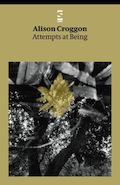
Justin Lowe Reviews Alison Croggon

Attempts at Being by Alison Croggon


Salt, 2002

Early last year, John Kinsella, man of letters and chief editor of Salt Publication, published his selection of Michael Dransfield's poetry through UQP, simply titled Retrospective. This old Dransfield acolyte couldn't fault it, and I have been waiting for an opportunity to proclaim that for six long months. So what's the occasion, Justin? I think I have just stumbled across Dransfield's successor: Continue reading

Posted in BOOK REVIEWS | Tagged ,

Moses Iten: Because I Was Brought By The Road (1)

“Now the time had come to kill them”

One boat remained out in the ocean, beyond the rock. The other twelve boats had pulled ashore before we arrived. Not a single little fish had been in their nets today. The fishermen of the whole village would have to eat crabs from the lagoon. Scrape together some pesos to feed their families. So we headed to the lagoon nearby for some crabs.
Continue reading

Posted in FEATURES | Tagged

Hector’s Insult: war music prohibition signs

Posted in 13: INTERNATIONAL | Tagged

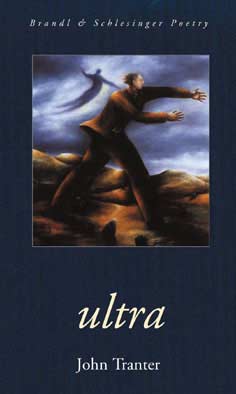
Michael Farrell Reviews John Tranter

Cover of John Tranter's Ultra

ultra by John Tranter
Brandl & Schlesinger, 2001

At a Carlton party, someone said to me that a number of Australian poets were all right until they started imitating Ashbery: Tranter was the example given. How Ashberian is Tranter? Their mode is similar, the way they range over a topic before resting on a twig or in mid-air, yet Tranter is closer to the ground, less insouciant, more urgent, the phrasing of a private eye who's always on the case, commissioned or not.

Continue reading

Posted in BOOK REVIEWS | Tagged ,

Q&A with Jean Orizet

Like most, my understanding of French poetry had not really gone beyond the Mallarmés, Rimbauds, or Baudelaires of its “golden age” in the 19th century, ironically, an age that is also representative of the majority's perception of French poetry today. My engagement with contemporary French poetry, meanwhile, had been mediated by a small group of its linguistically innovative and intellectually dense proponents, luminaries such as Michel Deguy, Emmanuel Hocqard, Jean-Jaques Roubaud or Joseph Guglielmi, to name a few.

Continue reading

Posted in GUNCOTTON | Tagged , ,

Prague In the Twenties

Blue fireworks cascade from the overhead line
as a tram turns sharply
into another crowded street,
silk stockings and headache-bands
catch the sun.
The old murmuring of string band waltzes
has a wooden sandy edge so now
we charleston closer to the gramophone horn
to reassure ourselves of its always distant call.

We are floating on the spoils of a lost empire.

Vienna?
Berlin rather,
with UFA and Pabst
but we may at last be here, in our Czechoslovakia,
where ideas flower along the electric vine
as we wait in cafes for that new wine
we are assured will come in those new bottles.

Posted in 13: INTERNATIONAL | Tagged

Letter of Accord

For Robert and Patrick

Odd times I still felt sideways
From your breath and stride,
Which nine years apart would do
Even with monthly phone calls,
Occasional photo and email,
The hollow confidence of wire,
Grains of ink, same questions
Of your habits, school reports,
Books read, films watched,
Favourite sporting teams,
Friendships and latest pets—
Yet that two weeks together
Was ease confounding distance,
A dynamic of intimacy
10,000 miles can endure.

It began at the airport,
Exclamation of names and smiles,
Easy hugs, eager talk,
Then afternoons of music immersion:
Your mosh pit ska and punk,
Our concord on 70s rock,
MTV concerts and quizzes.

Then evenings distilling beliefs:
Correlations in Church and State,
Merits of Lotus and Cross,
Boycotts of corporation lures,
Bouyancy of career choices.

But mostly the mornings:
Waking in your den
To an aromatic collusion
Of coffee and toast, your playing
A sport computer game
Or sewing band patches
To a cap, knowing the day
Will flourish with lessons
In stone skipping, guitar chords,
Cable cartoon shows, more flair
And facility in the pact of names
Like Son and Dad, moreso Mite,
Your jest on my accent, days
Converging into rapport
Even after airport goodbyes,
A fluency of breath
As we pace continents.

Posted in 13: INTERNATIONAL | Tagged

Laurie Duggan: Cover Me [borrowed title]

As a writer who has earned very little from royalties and nothing whatsoever from PLR and ELR I was bemused some years back by the figure of Frank Moorhouse – a libertarian – coming down strongly against photocopying. Frankly I'm delighted if anyone is interested enough in a poem of mine to want to photocopy it.

Continue reading

Posted in FEATURES | Tagged , , ,

Michael Farrell Reviews 10,000 Monkeys

10,000 Monkeys by Melodrama
CD (Independent), 2000
Words and main vocal by Justin Clemens

If everyone went around saying what they thought, the world would end up a Shakespearean tragedy, with none of the major players left standing. Sometimes, of necessity, there is a vast difference between what one says, and what one thinks. But then again, you just might be the right Rabelaisan dog who enjoys breaking the bone to get to the marrow. Michael Farrell takes a sidelong look at Melodrama's CD 10,000 Monkeys.

Continue reading

Posted in BOOK REVIEWS | Tagged , ,