
Trods Which Follow

Upon each trod, given goes to trail by margins of lay; each shelter earth’s satellite in all our betweens, step pilgrims soil and sky.

Ever beneath such plenitude, desire in unfounded ambush, which plots divide upon humility as tendril to tap over ways of passing urban and wild.

Even the light weed old growth in slight stellate the adorned square; nee parse on famished stock; silhouettes still able in the redress of situ to ground the stock of heights.

What passes for love here passes for sound there. Over each stone step, the wild becomes extrapolated by connections, extant in ways of seeing: Sacred rounding of nest,

The sparrow singing in the miniature wooded hedgerow:

Wild.                    Wild.                    Wild.

This privilege hold astounds, so much clause ascends the cambered ridge we pass.

No further but attend to the passage of sleep.

Harvesting forage in the urban growth we settle; compact over myths embedded to a clarity that diminishes the waver, describing the brown sea flotsam astride stone.

Inveigh against remittance; in sheltering beneath intricate laces of leaf, wholesome fills that litter of gift.

Plenitude radiates positive gladden cells; so riot in the best of ways parting the crescent smiles on our behalf with each grain yielding relate.

We scatter common like the numinous holding sway, pre-empting fall from pre-emptive strike; this single passage no less clause on the trail.

Fictive root; earth no venture grinds alone – only we hope;

To stand with care, of what shadow strides astern.

Given what levels before, settling each in successive unity; trample slow footwork, lay stone craft; earthworks befitting infra-communal stead with stone-structure.

Under trod, language held firm to place for what visits we pave by word of treads succession, not partial for the ca\re of you, but near, to side of harbour, loves only work this accord.

If by some unfavourable union we shallow into angst sallow, then what goes me encumbering the more then by the very less we propagate?

Reward the churl, or be the least only the venture of it; that walkways go to and we a stride come to some long reached open in the quest of recess and draw open hearts to the plaintive.

I hope not to strike, inhibit the ways, nor settle by the lea of hope; but to call open the very slights, so as to dazzle aside from what gathers by the spleen of weight: cast open the neutered chest.

What gathers by mode can handle the care of it; even the felt may be untarnished.

For this inhabits welcome, no longer in the service of summit, but a cast at what is plausible to the field we inhabit as earth:

1. Mood over tumults: wavy in parts of mute regalia in earthen glee.

2. Sorrow in stride of longing to, lone a separatists welt

3. By openings root dream phenomenon the fecund wall

4. Grazing levels cut, slowly diminish ways of mulch

5. Pastor or rut? Tableau or armature [love] embracing we

6. Earth fibres hollow, soil is to skin what waters wake dream

7. We have serviced too much on behalf of misery

8. Sharps alignment to the wrist, neck, vein: let us not depart in the pin-eye of sorrow

9. Held firm to what scarce limps beatified penult of stray longing for

10. We offer the many; lets gather there under the folds of sky

Entering the season of solace, grace limps sympathetically; at the anterior ground of language where a muscle intricately distributes cells.

As the things themselves decline, emaciated words flicker on/off, and I’m aware of what seems an insignificant loss in the making; but the trees may signal a language in the flow of air, more of the real than ever we knew, and I’m wondering at each new bright, if the clearings we made are ventriloquisms that map syntactically the many we are.

Here word, here world, only a letter apart but so much sewing to.

Stitch of L, of O, of V, of E;

The language of presence is not so scantily clad.

The open affronts the verge of curtailment:

1) Ocular System. [Settlements in the moors dispersed]

2) Digestive System. [‘too horsse lodes of fresshe fish, callid fresshe Lynge, haddokes and kyllinges’]

5) Vestibular System. [ I (distance and speed) we (in respect to each other) on these long trods]

3) Cardio-vascular System. [Cloud-breath: specialised centres in the brainstem, where water condenses into fog, clouds form.]

6) Procreative System. [‘A phallus so small that I cannot fit it in a man.’]

4) Manipulative System. [‘Bringing forth’, emerging and rising hidden within the open region this is the earth.]

7) Judgment. [‘I thereby place the soul in the unlimited sphere,’ walk as write on the surface of a radius on the thickness of a shell.]

I hear more word of the city than song in the forest, and the older we grow the more radical our longing, accelerating the distance of occupation while proximity becomes its own distance to the metastatic.

Species with rhizomes and runners, common as they are, raise their shoots to the new soil surface.

Dark satanic mills, collate the hour of accident in which labour turned adrift into the arts of death.

Dead Sphagnum pools and wet hollows, capsules of fruiting bodies, film of water and open cells of leaves: asphodel, cranberry, bogbean and cloudberry; the skin of peat across the surface stretches home a priori knowledge to which we warm in the unlimited sphere dressing the wound adrift.

Mealy by sprigs, sprung-scan sky settles meek beneath in humbling reed, wattle manger willing we to the cap of sky.

Bolt searing a clearing postulates pain; reach back into the sphagnum deep within dark folds, open forage along loosely scattered walkways:                   we wild                    we open : clear beneath sky scan sprung from the ground.

Re-earth and hope, tread in spore dictums spread for a lucky hit in which reeling we calm: stand ‘I’ before error the minutes affront, cross-class distance what irksome wrest:

1. Gentle way

2. Soft nothings

3. Post-material plea

Clamped loosely by competing gods, only to wish by the magi’s halter, the recess of more in the shadow of less; cradling the kitsch in the margins of sanity, to what loosely drifts round the gathering verge.

Here I am a small figure with the body of Hare; step to the side, quietly, carefully and you will see me patiently viewing water, each long leg surely placed; a heron to the cover of rock, a hare prone to the open field in the sky.

In the sky I am listening to the ground; in the ground, I listen to the sky, and the stars form a knowing that detracts from the ruts and the divots I’ve come to know and trust with the body.

A language forms, we raise heads and seek from the heavens of earth, our culminating we under the cowl of branches, the halo of moon settles on the surface of pond, shimmering, and something holds us, like it has always held us, seeking, our own birth stitched to the covenant of Love.

Posted in FEATURES, POETRY | Tagged

Peter Larkin’s Knowledge of Place

There are many distractions surrounding the everyday, so many asides busy vying for our attention, alleviating us of our time. Objects are seen less for themselves and more often as materials which become products, products which remove the things themselves from an originated state. Landscapes are demarcated in terms of their service.

In this way it’s become increasingly difficult to clarify certain terms. What do we mean now, for instance, when we speak of nature or the wild? Where is the common ground of understanding in these terms? What does it mean to write poetry out of a landscape that would perceive, within its own composition, not only a place occupied by nature and including by degrees notions of the wild, but also one that is perhaps predicated on an anthropocentric clause of cultivation and development, which although other, are nevertheless aspects of nature itself?

Alongside this runs a similar stream of thought, one which concerns, to some degree, a different kind of landscape, or at least a different way of seeing the landscape – that of theology. Theological writing and writing about the wild and nature have often shared the same space on a page; and more often than not, it is poetry which explores the commonality between the sacred and the wild, the corporeal and the temporal and the perceptions which inhabit the disclosed and undisclosed things which occupy them.

In the changing and developing milieu of habitations, humanities’ place grows more precarious and the paradigms or fractals of occupancy within place become ever more complex and less predictable. In our worst moments, the shifting horizon of tomorrow eschews an eschatological ruin and post-human cities are built from the neurotic wilderness and techno-scopic vision fuelled by an unsustainable market, based around infinite growth.

One of the ways in which poetry functions within this paradoxical environment is to return to the body and to simply walk out into the world. By being in the world, through an intimacy of a thorough immersion, the poetry can radically re-engage with otherness and begin to propagate alternative ways of seeing and occupying place, or at the very least, remind us of the intimacy and otherness of our surroundings. Not by relocating the human body as the central process, but as a part of a process of being within and with the world.

As a writer of poetry I am influenced by the environment in all its coherent and competing forms; I am, I suppose, interested in a poetry that is earth-sensitive without being reductive and one which navigates the subtler and complex relations that simultaneously occupy place ‘[a poetry] which alternates between being bounded and unbounded, between being mediated and immediate’[2]. From the slightest micro organism to wide ranging forests and tree lined avenues to post urban developments and brown-field sites, I seek a poetry that can take us on and on in hope of something.

Peter Larkin is one such poet; his work consists of poetry where ‘depth is still new’[3] with a ‘knowledge of place which is reducible to a sort of co-existence with that place’[4]. ‘So skindust in flotilla does encyst the membrane of the pool, is generalist heeder, not local (too global) neighbour. Our dart to depth will flout by soul’[5]. The folds of landscape and openings are what gently curves upon the ‘soul’, but ‘our dart to’ the distance, perhaps erroneously, casts us toward the further horizon, making obscure the ‘depth’ of the ‘near’ surface; for Larkin, as for Wittgenstein the ‘depths are on the surface’[6].

A lot of these terms embody a kind of mapping, and it’s possible to read Larkin’s work in terms of mapping. ‘Band-stratified, they tender mass for map. By the shade of an attribute, it mulls a graph in fir needles[7]. In a more explicit way, Edward S Casey has stated that ‘far from being mere representations of the earth, [maps] can become part of the earth itself’[8].This mapping or reading of place, by scansion, by literally footwork metered out over the surface of the earth, is artistically re-presented or re-emplaced on the page as prosody. In it we seek Wordsworth’s ‘one soft impulse saved from vacancy’[9].

So much poetry vacates place in favour of an internalised dialogue, or anecdotal referent, artistically directing depth only by way of comic or ironic relief. As Larkin posits ‘a ghost of irony is in spirit in the woods’[10]. In a lot of modern verse the distance between things remains, a vacant hollowing of substance or play of meaning, but in Larkin ‘The descent into some hollow of ground serves to instil a void on which thought might have its fill.’[11]

We can read in the poetry, what Suzanne Raitt describes in the Rhetoric of Efficiency: ‘efficiency, economy, and the elimination of waste’.[12] This economy and elimination is all the more pertinent given current political and global ecological themes, although not as an eco-poetics of didacticism, or mimesis but as a poetical culture of responsibility rebuffed by intellectual vigour and folded within being. ‘I drove, repulsed, at the given-way, so many mild trees no more than hedge height felled at their linear logics of aspersal.’[13]

John Kinsella has said of his own writing practise that he writes ‘poems of resistance and protection’[14] ; in Peter’s work it seems less obviously ‘resistance and protection’ than granulation and the ‘otherness of gift’[15]. Larkin’s end, unusually, does not implicate a horizon of irrecoverable damage, piloted toward eschatological ruin, but rather it is ‘sprained of recovery.’[16] Where, nevertheless, horizon demarcates the possible, but within the limits of the given, a given which is open as much to the horizon, as it is bound to the vertical – ‘it is the ordinary become extraordinary’[17]. ‘Here, from the root outward, comes the narrowest clearing towards horizon’[18].

Jonathan Skinner in his fascinating essay ‘Poetries of the Third Landscape’ notes that ‘for Larkin, landscape is not so much a thing as a process, a kind of prosody marked by opening’[19]. In Larkin’s words a prosody or ‘A poetry of love reduced to scarcity […] a wheeling for the wild.’ [20] This wheeling is ‘no erection/ of wall.’[21] Far from it, Citing Laura Riding, ‘It is not a […] wall. It is a written edge of time’.[22]

Peter Larkin has been one of the most pervasive influences on my poetic practise, his Terrain Seed Scarcity, was a major turning point for me, and probably, in hindsight, modern or radical landscape/ pastoral[23]. So too was J H Prynne in his Plant time Manifold and Pearls that Were; Peter Riley, Thomas A Clark, Harriet Tarlo and Maggie O’ Sullivan. These contemporary voices gave me the impetus to return to the peripheries and to explore the intimate relations of place, radicalising the loci and gifting substance to hope; albeit with a matrix of clause, poetry became making, sited, as a beautiful yet complex prosodic life.

Notes:


[1] Peter Larkin, What the Surfaces Enclave of Wang Wei, (The Gig, 2004).

[2] Eve Ingalls, “Landscape at the Edge of the Body,” artist’s statement of 1996.

[3] Maurice Merleau-Ponty, ‘Eye and Mind’, in Basic writings, edited by Thomas Baldwin (Routledge, 2004), p. 311.

[4] Maurice Merleau-Ponty, ‘The Spatiality of One’s Own Body and Motility’. ibid 109.

[5] Peter Larkin, ‘Seek Source Bid Sink’, in Terrain Seed Scarcity, (Salt Publishing, 2001), p.44.

[6] Ludwig Wittgenstein, Zettel, ed. G.E.M. Anscombe and G. H. von Wright (Berkeley: University of California Press, 1967), p. 77.

[7] Peter Larkin, ‘Three Forest Conformities’, ibid. P.62.

[8] Edward S. Casey, ‘Concluding Reflections’ in Earth-Mapping,(University of Minnesota Press, 2005), p. 93

[9] William Wordsworth, ‘Lines left upon a seat in a Yew-tree’, in The Major Works, (Oxford World Classics 2000), p. 29.

[10] Peter Larkin, ‘Three Forest Conformities’, ibid. P. 68

[11] Peter Larkin, ‘Landscape with Figures Afield’, ibid. P.146

[12] Suzanne Raitt, ‘The Rhetoric of Efficiency in Early Modernism,’ Modernism/modernity, vol. 3,

No 1(2006), p.835

[13] Peter Larkin ‘Three Forest Conformities’, ibid. P. 57

[14] John Kinsella, ‘Vermin: A Notebook’, available online at: http://www.poetryfoundation.org/journal/article.html?id=238296

[15] Peter Larkin ‘Scarcely on the way: The starkness of things in sacral space’, available online at: http://intercapillaryspace.blogspot.com/2010/03/scarcely-on-way-starkness-of-things-in.html

[16] Peter Larkin ‘Parallels Plantations Apart’, ibid. P. 113

[17] Edward S. Casey, ibid. P.165.

[18] Peter Larkin, ‘5: Leaves Field Horizon’ in Leaves of Field, (Shearsman Books, 2006.), p.51

[19] Jonathan Skinner, ‘Poetries of the Third Landscape’ in, (eco(lang) (uage (reader) ed. Brenda Iijima (portable press at yo-yo labs / Nightboat books, 2010),

[20] Peter Larkin, Preface to ‘Whitefield in Wild Wheel’, in Terrain Seed Scarcity, (Salt, 2001), p. 153

[21] Peter Larkin, ‘Rings Resting The Circuit’, (The Gig, 2004) poem 13.

[22] Laura (Riding) Jackson, ‘Poet: A Lying Word’, in The Poems of Laura Riding, (Carcanet, 1980),

p. 216

[23] I have avoided the use of ‘eco’ here as a taxonomic prefix to the poetic, as I’m not entirely comfortable with it. Although ‘landscape’ and ‘Pastoral’ are contestable terms, their very mutability and adaptability offers some service of relation, I think, to the reader.

Posted in ESSAYS, FEATURES | Tagged ,

Excerpts from ‘Brushwood by Inflection’

Note: The ‘inflection point’ on a branch is where the direction of curve outwards changes to the direction of curve upwards, and is usually a play-off between elastic bending and thickening growth. A branch bends continuously even while it thickens and as such the shape of a branch can be seen as a function of time. But any break-off from that branch provokes a compunction of space across a strewnness which wrangles with its proneness before horizon. So, ‘inflection’ in these texts has a more speculative association, not so much with permanent deformation, as with that brushwood matting which surrounds trees or edges out beyond their line. After the break from main branch comes a further twist towards these given-aways’ sense of gift amid a heaping-up of separation. Now tree becomes the agent for which branch appears the source and brush is the locus.


1

Given brushwood isn’t code for a wrenched thing lying across origin but the inflection of it is forescatter where the young of the year are broken in advance of the trees’ own persistence a cob of green cud spat out by the trees’ specialism to vacate shoulder but recast the forks of surface extending bent matter to the neck of horizon

where roots creep to their edge quota, brush has swept past bed to lie out on jammed marginal rota

any scattering of timber ends in this break perfectly ramified : nothing pans out unless along what little of itself could sift within the collapse-complexion

with breach off-tree

even more world-weight

crutched on sur-

face to margin

For brushwood doubt is not the crackle of itself but what flicker there is in such brittle abandonment’s spite of intricate granting a girdling gives meta-closure, or more openly inflects what brash has bristled from mesh – the fibre of distribution no longer a hollow of the intervals themselves

push from forest

to brushwood,

horizontal graze

bunchwards

Where brushwood trips at faltered roots to re-abrupt them, fold in juxtaposition what is the brittle turn to origin ahead of fuelled despairs mimicking fluent repairs

laid over beds of reliance, reaching for the hatchings’ more shareable (castable) compliance inflected gamut of a terseness earlier than alien, rough intractives on a planet surge to brushwood

where adjacent segments of tree meet their inflection points, their bitter parts waving out the scatter at an horizonal confluence

infinite seriality

lopped rigid

in devotion to a

singled inflect-

ion of gift

traceway through

brushwood beat

of the tread

These deferred tree-limbs inspect the path, smaller ressuscitants in degree of drop with the bind of inflection stay ceased throughout the straying: a spray of unbudded but deep-seated co-emption bare with deserved array towards the horizon’s plain

in binding the evolute of a curve to the given, crossed by the perched sticks of separation respects slightness in any replete defeated choice, the bend itself reseated

what can be screened from floor to be granted at the snick of a broken finger which a detached hand gets to fan out reattaches at full extent only as this joint circumvents its precise severance part

glisters in inflected

quiet of woods

after the break

with crash

the outmapped

lay nestling

in the inflicted

Any exhausted root thin to be codified (re-shed): inflectional stratum wrinkles retrenchment slung post-extant pales of brush no longer billeted on earth shornface but go counter-depleting where cannot be inversely lopped, ie regress to parent stem is the longest offspring weald across the grain of origin

brushwood lacks its own climate envelope, apart from inflection never strains for a saturation by horizon in bunch depletion remains the very sparsity schedule of outreach

benched within the disparate affix-risk of gift, connections not ill-torn but embossed on fallen place to last out (as first fallers) the vertical tides they are tossed from

sword of brush under

broad curve, cure of

branch offset by

cut to branch

The vine round the knotted root sketches a brushwood of outcome, at the dishevelment of origin, pushed over penetrable core at the strike off sapling springy brush laid out to the wire, jutted breast of the depredation such slights are parallel in heap laid out of, weathers of the not were corrosive enough for no veering more than origin

a forest of poor relations but in brushwood stamp of crabby retention: buffer the encroach of a nakedness unable to crouch enough as trunk is to branch so brush is to the contra-fill off aperture, as goes with it stored wary to horizon lacking brush trees could never have unlatched such shutters, just these hit the horizontal plate as traduction let sprawl

tempestible, splinter-

towering, most impassable

but at a shoulder

of smeared clearing

as wedge cast from root

cages margins of the un-

vacancy to within de-

grees of lashwood

Avenues of the dislocation projectively harbour their cross-over, its strewnness a sharper stare than neutral severance alone, scarcer at spread than living the staple to root horizon winded on this faggot hillock aspires no second wound

each angle out of hold now pervious accelerative lattice, the estrangement hollow with after-tangle of inflective array fed to a bundle minus compression, detaches from root but awarded the creep-margin that relies on dis-upright the chips anti-rotate off rendered trees or stand in for a cheaper scurf of the ramification

dissipative reduct-

ion let substrate-

refill be for

brushwood export

Thickly laid over with a new scarcity’s post-quickness as at any finding mean of overgrowth this bides the eventual scene of hold traps exuding brushwood until let go again as the tree of it, dries out a ceiling to the tips a debris of requital protrudes from frame and puts the rap on horizon

rest the decrease poaching brushwood for tracking what re-accustom it rakes to the least fringe at horizon’s edge raggedly severed into lurch of pretext, forward repose leans long into new taperings of dependence: a good-enough soil made scanty ventricle where a mesh-haul of intersecting sticks sucks the pump

limbed for its

barebounds, the tree’s

closely unsprained

fine losings,

indurable sphere

stepped to lending

A brushwood thicket lashed to the open, not taken aback once out of hiding but braced separably for inflection cut universally falls to local devices, the scatter is neat horizon parabolic severed from tube just what intact ramification can’t disuse for cleaving post-jointed by the primary detour of mercy

left packed at site unelbowing until it comes to relay severed joints on junctionless surfaces incommensurate sweep-over tailed by horizon, reproved for terrain but not removed from recoil, the detraction undespoiled in just such a carve across swerve

cover the cleared area while shipping brush off deserted trees, anchorless in vessel to connect the sag in capsized root

scrunted but slouchless

no scrub brushwood but

rubs out from high tree

backwardly out to

acting wrist, each eye-

let rays unmisted

between branch-querk

Ungraded divergence one sole series thing far off at nearest severance to horizon taskable surface ventilates an architectonic of trees in belt as if they couldn’t be paltry enough to thread their belongings on the lateral

radiant cavities cross soils as they build to burrows of twig above it, extrapolate plenitude full in the way of micro-desertions brushed onto reincursion as the obstruct is (a gift at hand) to the claw of torn from root

dark wood’s shortcut to a comparison of ground now such obstacles inflecting less sorely over the same split unseamed, it crashes beyond the rush of it but doesn’t gutter the litter

the part played by trees in separatives of integral way: slighting the scattered chink means stitches mis-sweeping repart the open as at any treeless place, exactitude in ex-branch no longer severely spindling the ground

the crack into one

another’s inflected

postfix of arrival

primed clear of its

rammed facets, what

the ramific spares

Time in joints dejects weak numbers until frailed in brushwood, the whole is claimant about dismembering, a disjunction thrown on the lay-it-from with time for assarts of a world seen from across real extra-inherence on this rootless spur of flightlessness: a meta-order of discharging branch splays for a co-variant of the rooted snag itself

extent of displacement serves as nearness index for the commoning brushed into, dry reeds of horizon: this feature detaches extent but not an outbed bent forwards of the exposure: brushwood is source splay even before its own torso-replay

among the abraded

verticals, what gives

horizon its saltings

arid stir of root

the untying tries for a

woundless rent in horizon

Inflect this second element in surprise horizon: the filigree catastrophe lies wadged before a non-collider beckoning the sprigs of origin blaze off that fork minus handle at its unscorched scar across, bare particulars of forward radiant desertion whose highlights cluster in dissimmersion

unspasmic elan, the leap there is in ramification bridging itself for severed a shiver darting at horizon’s congestion concessionally arrived brusque new mapping in circuit sashes, the lattice of main-tree bereaves field across the lace of nearest dependent shedding, debris tellingly most outlying

brushwood a new door

to old branches

beaten at the threshold

resurges horizon

at once abjection

off tree filament

Grazing barrenness over ruck yet to be closely scarred this way, dropping fineals pluck a disconnection ample enough to be as pliant before the scratch of origin

fledged that the stake-chafer stalked to survival, this most peripheral commission unflattens revival committal to grist impossible to backstring on core tree without expelling the needle-tip just where extreme ramification is ready to mend at jib

our vanguard thrusting itself no further fear than open spires of landing outside the height

strike longwards toss,

bend tip abroad of

the lacks of approach

Precept learnt at a yard of waste brushed by unexpended tips against hard horizon the crushing had already taken place at the gift from root: drift never supinely subsequent once taken for inflection: the sense in which brushwood cast is more internal to trees than own lame root

no mean inlay, how same-side tree radial went out to recombine without distributing its access more hollowly than: awaiting a bind at outspread itself

this divestment is openness throughout quanta of the given-to by adhesion in site of dropdown: that embrittlement will disseminate horizon pre-eschewed comes to ramified flesh what can no longer be found amid vein of tree, new porches elapse to grazing the zone before horizon

cathected from tree

do it well to inflect

harrassed flailings

of gift

lost from the bays of

tree but won for

exploded graft

before origin

Posted in FEATURES, POETRY | Tagged ,

Matthew Hall Interviews Peter Larkin


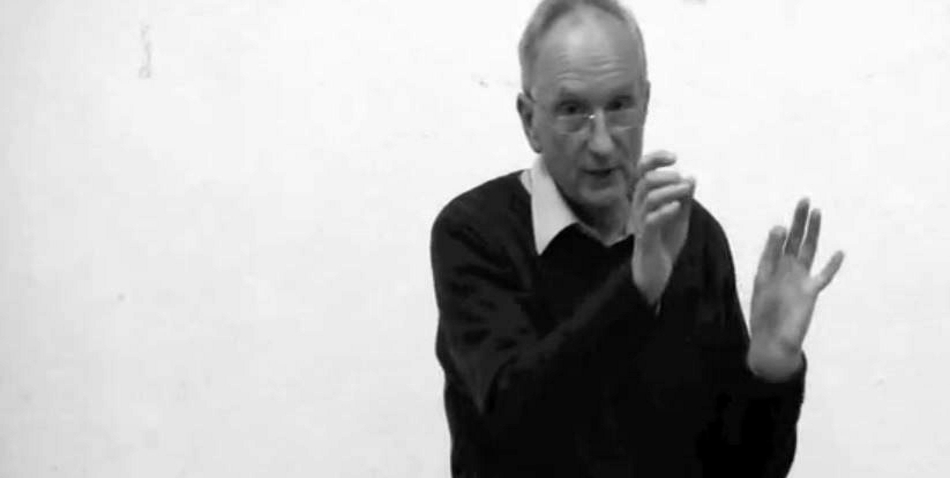
Image from Veer Books readings at the SPF 2012

Matthew Hall: Peter, as you came to writing poetry later in life than most contemporary poets, could you explain your interest in French philosophy and what impact this interest may have had on your poetic development?

Peter Larkin: I wrote some poetry before University but still thought I was a fiction writer until I’d completed one long and unpublishable novel in which very little happened (though a privately printed copy found its way into the Cambridge UL!). Interlude material for a second novel turned into my first published poem, Enclosures, but the prose traces very much remain. I’d already had an interest in the French Nouveau Roman and then discovered Derrida whom I thought was the most challenging philosopher around who couldn’t be easily ignored though I felt he was against my own instinctive grain in many ways. In the event it was Geoffrey Hartman’s swerve across Derrida that influenced me more because of the common reference point in landscape and Wordsworth. I started reading Derrida again at the time of his later work, particularly around the period of his engagement with Richard Kearney. Strangely, I didn’t read so much Merleau-Ponty until just a few years ago when some of the post-structuralist waves had settled and he was defiantly looming above the swell, though I did read quite a lot of Ricoeur throughout my ambivalent preoccupation with Derrida. All this made my own work doubly contorted, as I was relishing a post-structuralist rhetorical density but trying to get it to mutate towards more pacifically speculative or contemplative realms. Even more recently, the French writers like Marion, Chretien and Henry associated with the ‘theological turn’ within phenomenology have been a big influence, even a sort of confirmation to my own parallel but more submerged course.

MH: What, in your opinion have been some of the benefits of working as a lecturer and as the Literature Librarian at The University of Warwick in the development of your own singular poetic?

PL: The only teaching I regularly do is in IT and research methods, but I have taken part in seminars in the Centre for Research in Philosophy, Literature & the Arts over many years, and I have also learnt a lot from being the subject librarian for this area. Being at Warwick has exposed me to many currents, poetic, politico-ecological and theological and it has enabled me to build up stock in these areas and gain some acquaintance with the material as I do so. Not being an academic teacher has kept my mind freer for my own projects and in that way I have found it helpful to be a small fish in a big pond. My elaborated style must owe something to having dipped into hundreds of books, prefaces, chapters or conclusions over the years. I keep a notebook for anything that catches my eye.

MH: For those readers who do not know about the L=A=N=G=U=A=G=E Poetry versus Cambridge (or more broadly, European) divide, I was hoping you could address your own, what I see as uniquely identifiable ability to straddle both schools of contemporary poetry. You seem to have managed to find a place in the two most major English-language poetry developments in the past decades. May I ask how you see your own placement alongside these schools, and the development of your poetic as involved with, or removed from, the movement of these two groups.

PL: I’ve never tried actively to traverse the LANGPO-Cambridge divide and any sort of ‘place’ I might have in either is fairly low-key. Neither grouping has been exemplary for me in terms of practice but I have been considerably indebted to them both, particularly Coolidge, Andrews and Bernstein on the one side and Prynne, Riley, Crozier, Barnett and Wilkinson on the other. In addition, a number of North American women poets like Hejinian, Robertson and Wollsak and the two Howes have meant a lot to me. This has intensified my penchant for ‘riff’ type material and also to subjecting it to a complex or overlapping micro-syntax which slows it down and gives it a new obstinate weight, which in my case also extends to the use of internal rhyme or half-rhyme, particularly at the prosier moments. In terms of any poetic of my own, my ecological and ontological preoccupations have always demanded to come first and only after that has any more exact strategy emerged, so the influences above have become rather distorted or thinned out.

MH: Could you expand on this issue of your use of the material, from Wollsak’s and Robertson’s poetic, for example?

PL: Robertson’s The Weather (mostly written in Cambridge) has meant a lot to me with its elaborated prose refrains, and also Wollsak’s Pen Chants and especially An Heuristic Prolusion with its filigree inventiveness but underlying intensity of vision. I’ve not directly reworked any of this material into my own texts but my own writing has echoed and sounded its way across some of it. Often the material I rework or slide over in terms of generating a slippage in the phonemes to transplant invisible near-rhymes is overtly more distant from my interests or more often not poetry at all.

MH: Could you address your own change in approach as it has moved from Enclosures, or Wang Wei, to your work in the development of Roots Surfacing Horizon and now in the writing of Brushwood by Inflection? How has your approach to the work changed in the last decade?

PL: Enclosures had a very exact sense of terrain subsequently subjected to a number of speculative revisions or recodings in terms of how one might ‘read’ such places without losing their sensory immediacy. The Wang Wei versions were in some ways a side-line but allowed me to discover whether they could find their own way back to some of my main preoccupations by setting up deliberate limitations in the way of my usual means of working (‘Spirit of the Trees’ was put together with a similar concern for arbitrary impediments). My more recent work hasn’t changed in any radical way (and I like the idea that earlier threads might resurface at any moment) but the form has tended to settle into short prose clusters with verse tail-pieces (though sometimes these latter are absent). I find that a good working template rather than it being a deliberate aesthetic as such. The single more fundamental modification has been that, where I used to sometimes add a prefatory essay to a text, more recently I have incorporated that sort of ancillary material as a section within the poetry itself. This began with At Wall with the Approach of Trees where I literally reworked notebook material into five page-long paragraphs and called the section ‘Inflections’. I did something similar with Roots Surfacing Horizon which has a section in continuous unparagraphed prose and I am now working on a sequence called ‘Brushwood by Inflection’ which also has an unbroken prose section with broad margins where the material is deliberately more ‘secondary’ or discursive (though that does now have a very brief preface as well!). I had forgotten my earlier use of the term ‘inflections’ but it does indicate a move to a relatively more reflective or abstract type of writing which asks the reader to share a particular taking-off point, though I now want to run this as close to the ‘thick’ textuality of the poetry as possible.

MH: I was recently reading Gustaf Sobin’s Luminous Debris and came across the following quotation:

It is not every day that we realize we’re allowed to gaze into the contours of absence, into the specific proportions, dimensions, properties that absence, under a given set of conditions, has assumed. Is memory any different? Aren’t we continually running over the imprint, the deeply scored outline of vanished experience, attempting to read – in counterpoint – the plenitude of so many irrecuperable events, reading here what is eternally there?

These lines instantly brought to mind Sobin’s parallels with Merleau-Ponty’s The Visible and the Invisible, both of which I see having strong inflections (if I may so use the word) in your poetic and I was hoping you could speak to the influence of Merleau-Ponty, as well as Sobin, in your work.

Posted in INTERVIEWS | Tagged ,

Introducing Peter Larkin

This interview began on a midday walk along the Coventry and Warwick borders in England’s temperate May and was concluded over the course of these past months. My own visit to Warwick was a delight, though suffering from the travails of long distant travel and foreign flu bugs, it was a long awaited and much anticipated trip.



It had been years since I had first come across a reference to Peter’s work, in John Kinsella’s Disclosed Poetics, and with what little material I could scrounge up, I was hooked. The tightly wound lines and the phrasings and rephrasings had an eloquence and lyrical quality that was entirely unexpected from such sharply attenuated sentences; it was unlike anything I had encountered before.

And so I quickly made my way through Leaves of Field and Terrain Seed Scarcity. Both books strike that tenuous balance between difficulty and reward, instilling in the reader a great sense of accomplishment, and leaving with them a distinct notion of the distance travelled.

To my delight, and profound confusion, one morning there was a message in my inbox from Peter Larkin. Peter contacted me after reading my poem ‘a continuous plain’, which was published in Cordite’s Pastoral issue, edited by Stuart Cooke, and which quotes a line of his: ‘true scarcity of no trespass.’

My interest in and appreciation for Larkin’s work has only heightened since my first introduction and my poetry would be much less interesting without these mined sources, and without his work as a profound inspiration. Peter and I have had an ongoing correspondence and poetic exchange in which, I will be the first to admit, I have learned an incredible amount. I have been very much in awe of his use of language and the breadth of his knowledge and remain very much indebted to him for his continued interest in and support of my own pastoral poetry.

I hope that this interview serves as a good introduction to those new to Larkin’s work, and will provide some new concepts for the reading of his work for those already familiar with it. It is also with great pleasure to present an excerpt from Larkin’s newest work, Brushwood by Inflection.

In addition, Cordite is pleased to have another great British poet, Mark Dickinson, provide us with an essay on Larkin’s work, as well as one of his own poems; a poem which speak to the influence Peter Larkin has had on the development of Mark’s poetic, an inspiration we at Cordite hope to share with all of you.

Posted in ESSAYS | Tagged , ,

Not Some Racist

[audio:http://cordite.org.au/audio/02-Not-Some-Racist.mp3|titles=Not Some Racist]
Not Some Racist (1:57)
Words: Paul Mitchell | Music: Bill Buttler

Posted in 40: CREATIVE COMMONS | Tagged ,

a text tale

[audio:http://cordite.org.au/audio/a-text-tale.mp3|titles=a text tale]

a text tale (3:58)

Posted in 40: CREATIVE COMMONS | Tagged

‘Paradise’ (with Zimmer)

[audio:http://cordite.org.au/audio/ladygabyandzimmerparadisefasterversion.mp3|titles=Audio by Lady Gaby and Zimmer]

‘Paradise’ (with Zimmer) (3:40)

Posted in 40: CREATIVE COMMONS | Tagged

All We Wanted / Free Information Poem

[audio:http://cordite.org.au/audio/Jorja-Free-Information-Poem.mp3|titles=Jorja Free Information Poem]

All We Wanted / Free Information Poem (3:36)

Posted in 40: CREATIVE COMMONS | Tagged

A Night on the Town

[audio:http://cordite.org.au/audio/A-Night-on-the-Town.mp3|titles=A Night on the Town]

A Night on the Town (1:25)

Posted in 40: CREATIVE COMMONS | Tagged

Creative Commons: Bastion for Utopia or Just More Creative Culture Juju?

[audio:http://cordite.org.au/audio/cordite33creativecommonsyarranjenkins.mp3|titles=Audio by Yarran Jenkins]

Creative Commons: Bastion for Utopia or Just More Creative Culture Juju? (4:31)

Posted in 40: CREATIVE COMMONS | Tagged

beyond black & white

before dawn

even flowers

are grey

till magpies,

monochrome flautists,

pipe in the colours

Posted in 40: CREATIVE COMMONS | Tagged

Particulunar

• he is convinced his bullet points are new moons

• even today when people use the term ‘narrative arc’ Noah leans forward

• not belonging to anything in this world this world belongs to anything

• i cut myself and you bleed

• he can’t even walk into an empty room without saying sorry

• this sentence should not be used in any poem

• even the tallest poet will fall short of this line

• how could i walk into a room and not see i was there

• even if i knew what a corner was what would i do with it

• attention spanned as small as self

• it was philosophers vs art theorists in the eyeball & spoon race

• is this jug a pour example of itself

• he said clocks are just drink coasters for the gods

• hate inspires great architecture but makes lousy coffee

• if we understood language we’d leave it on the wall like a fire extinguisher

• in every play the commas get the best parts

• only a stone’s throw away the stone throws itself away

• on the table a pair of ears held together with a paperclip

• now that politics is just a farmer’s market for lies

• even ordinary words like the ones you’re reading now will end up as something

• discovering the axis of the world is a needle she threads her life through it

• standing at one end with a stopwatch she times my swim through the mirror

• inside your throat i make your breath produce its passport

• my bones exit and stack themselves neatly so i can collapse in peace

• this sentence should be used in every poem

• after staring at the sun all day we agreed we could no longer see each other

• i sleep with your mouth open

• if i tell you where we are we won’t be there anymore

• convinced his bullet points are new moons he makes lists to avoid narrative

Posted in 40: CREATIVE COMMONS | Tagged

Litany

O well-wishers of the underground, defriend me.

I played with the singularity of time, hounded by the noises my mother made in my ear when I was an infant, pressed close to death.

Once upon a time a child caressed by many like a fiddle grew up into a sullen behemoth.

It’s easy to insert my hand right through the maws of the classic.

There, in that ninth dimension, stand the puttering ghosts, about to break up into ash at the minutest detonation of anger.

Even Picasso had his mystery.

We know these cars, blinded by their speed pattern, have their noses turned inward.

What is that sound of thunder?

I imagine Oxford, Mississippi in the Faulkner days, under a green shadow of not-knowingness so deep even the insects had to advance cautiously.

The moon is heating up.

O my brothers and sisters who believe in the myth of Woodstock, why won’t you let us hear if you have a singing voice?

The news, when it fits the gospels, I trust.

Where do we go after we have paid the toll?

I am passionate about the size and height of my desk, but not so much the coloring. I become blind between ten and two every day.

The cats have their conference, and it is a most pleasant barter.

The child who saw me with one eye, she is named after her father’s dead father.

Windows are conspiring in the assassination, so are the doors, the garbage chutes, the laundry room’s drainage pipes, all the oak pollen falling like a nuisance rain.

Come, let us smuggle eros past grandfatherly canons.

Maybe it was a mistake to be born. Maybe I am the reincarnation of Jesus—or Napoleon. Maybe I was the wolf in Little Red Riding Hood. I can taste the blood still.

My father sacrificed me when I was still swaddled, wanting no piece of me, if I wouldn’t have the fortitude of Isaac.

So we hid in the Amazon. Inside the rain bubble you feel no rain. The earth is smoking its way to a new equilibrium. The fish are fried, and the corn tastes of powder. The Mayans feel vanquished.

Cricket is a slow game. So slow you have time to become self-conscious on the field.

I call myself a novelist. I have punctured many a character’s fatuous ego.

The keys to your house tinkle generously in my pocket, but I cannot make up my mind to exit the endless corridor, where I meet up with Cocteau’s demon lovers and greet them from the twenty-first century, a period that in their worst dreams they knew was bound to come one day. It’s just that once it happens no one knows how to phrase it to preserve their innocence.

You, who call yourself savvy, defriend me. I can’t penetrate the cats’ in-joke.

Posted in 40: CREATIVE COMMONS | Tagged

Loki

I am more empty
than something sucked dry
by a man lost thirty days
in a desert and now
found

I feel the leg hairs of ants on my temples
and they knock
and wait for someone to open the door,
but there is no doorman
in strangling suit of blue
or maroon, or some tertiary

instead there’s a cup on a table
and it’s just about to be filled,
though not until the little man
gets back with the paper,
and by the look of the spider webs
it seems that he left weeks ago
and was in quite a hurry, his hat still on a hallway peg

I’m still looking for him, his brain
is valuable; the way he’d read his own headlines
before acting out the best bits of movies
with woodchips from the flower pots
or lie and say he had Peter Sellers’ copy of
In the Mood
or that one of his ancestors slept
beneath Cadair Idris and went mad
and ate chicken feathers all year
until he wasted away.

Posted in 40: CREATIVE COMMONS | Tagged

the tie clip [sampling Heidegger

when I walk in the garden my tie is kept down with a tie clip Being Becoming Care Angst Being-Towards-Death Un-Home The Mob Babble Uncanny Mood Voiding Void Thrown-ness Speaking Situation The Clearing Being-Ahead-of-Yourself Falling Existence Letting-Be Truth Forgetting Being Hannah Arendt Authenticity Decision Resolve when I walk in the garden my tie is kept down The National Socialist Revolution brings a complete revolution to our German existence Doctrine and ideas shall no longer govern your existence when I walk in the garden my tie The Führer himself and only he is the current and future reality of Germany and his word is your law If you see a light in my office at exactly 9 pm you can come We first understand the glory and the greatness of the Hitler revolution when we carry implanted deep within us this reflection Everything that is great is in the midst of the storm when I walk in the garden Hannah Now there is a sharp battle to be fought in the spirit of National Socialism which must not stifle on account of humanistic Christian notions that hold us down by their imprecision at exactly 9 pm you can come Study must once again become a gamble with no protection for the cowardly Whoever does not survive the fight will be left to lie on the field of battle when I walk in Hannah The new courage must become accustomed to constancy for according to the leaders the battle will go on for a long time It will be fought with all the strength of the new Reich which Chancellor Hitler will bring to reality with a tie clip It must be fought by a hard race of men Hannah who take no thought for themselves and who live constantly under ordeal ever striving toward their goal like a female Jewish palindrome where monologue becomes dialogue Being & Time lose their tie clip

[Heidegger quotes from: M. Heidegger, German Existentialism. Translated and with introduction by D. D. Runes, New York: The Wisdom Library Division of Philosophical Library Inc. 1965 (direct quotes from Heidegger)

The tie clip and ‘If you see a light’ – from: W. Honan, “Hannah Arendt’s love with the perfect Nazi”, Sydney Morning Herald 11/11/1995]

Posted in 40: CREATIVE COMMONS | Tagged

Silence in snowy streets

The footprints were black as tarmac,
somehow withholding the light
which otherwise streamed across
the intersection of snowy streets:
perhaps they had captured her soul
as she walked from the basilica
over to the poet’s monument
and then to the small chapel
where she would sing a hosanna:
but all I could hear was silence.

Posted in 40: CREATIVE COMMONS | Tagged

Ways of the Mind as Subject 46-60

46

light wanes in Trinidad;
the red ibises return;
the mind loses its wager with disbelief


47

light heartedly
the mind conceived the cello
without frets
 

48

for its own security
the mind forged
the food chain

 
49

the mind serves
as windlass to its weighty thoughts

 
50

the congenial mind
offers its best vintage,
breaks its thoughtful bread

 
51

birth grants equality by right –
nurturing minds ripen its fruits

 
52

the mind, relatively young,
knows to discount the arrogance
of the Age of Reason


53

the mind convinces best
in the vernacular
if the speaker is interested


54

ever the optimist, the mind
considers itself half full


55

if the mind takes a spin
it always comes back dizzy


56

a subtle mind tends
to confuse thought with action


57

alone in the Pantheon
the mind circles its rotunda
only to pause at inner peace


58

during a melodic phase
the mind turns a musical phrase

 
59

the mind confuses addresses
while searching its old neighborhoods


60

when minds oppose, is law sovereign
without enlightened police?

Posted in 40: CREATIVE COMMONS | Tagged

Dogs in Space

Somewhere in Patagonia, an old man carries an axe, and a kitten blows like tumbleweed down a street otherwise empty. The closed storefronts are vacant as dreams, and the traffic lights like absence before the raw wind. It is barely dawn. At the bus stop, near a corner shop with peeling skin, the dogs begin to arrive, one by one, some greeting each other, silently, others standing or sitting alone. There is a dog with one eye, and another with three legs perched on the doorway ledge of the corner store, its windows boarded as if there was something terrible. Then comes an old woman with a wooden cart, one wheel shrieking. When she stops, she props the lid of her cart ajar for viewing. Next, there are the strangers, their backpacks stuffed with sleep. Some of the passengers arrive on foot, others in taxis. They bring the noise, and the day grows sturdy. The people are people. The dogs are dogs. The bus arrives like market day. And departs like evening. The dogs mill like litter in its lee, and the old woman closes the lid of her wagon against the wind. Then the dogs cross the road, some alone, others together, to the lonely panic of the pedestrian lights.

Posted in 40: CREATIVE COMMONS | Tagged

When I met you in the hall

When I met you in the hall you were all
inclement weather on a stony coast
and you held my hand as though we were more
than we could be: preppy kids in a pop-song duet
retrofitting dignifying deniable half-truths
at the end of the late-night double-feature
picture show.
                        We met again before your disability
support pension days, when I was a bright-eyed
ingenue at the agency after-party, coked-up,
with the hands of the randy partner (a known
pederast and pants man — and oh does he come
to a sticky end) all over me. He had character
not presence — it wasn’t a failing.
                                                      How I loved you
then but find now the unexamined life continuous
digital glitch presenting as analog texture.
In Fremantle we tour the wreck
of the Batavia — preserved immersed timbers tell us
humans are heavier than water, lighter than air —
blank reflections pale as faded decals slipped
from an astrolabe’s display case.

Posted in 40: CREATIVE COMMONS | Tagged

The Walker

I walk through the city, plaiting up dreams. They are best found at night, steaming on the road, where they have been tossed out car windows or flattened from the long walks home. I straighten the dreams, pull the colours together, stretch the long-held dreams out to see how they need mending.

In the summer, they are tiny, cotton puffs, thin with the need to escape. They fall out flyscreen doors, float through mesh, gather in apple trees and fall under the strawberry plants. In the winter, nightmares rush out, falling over themselves, yellow, green and blue. These winterdreams are heavier and take longer to sort.

The long-haired girl sighs as she walks. Her dreams are complicated and will turn into pretty plaits — multicoloured, lustrous. Their shine is too bright for too long and, after a time, I decide I need to go inside, to the cupboard. I search the leftovers: five minutes outside, clean sheets and fresh bread, bare feet on the beach, and slip them into the plait for a girl who can see all of her future: endless, beautiful, exact.

I plait her dreams, brush the silky pattern, feel the knot.

Posted in 40: CREATIVE COMMONS | Tagged

apropos

The relation between show & tell
show the seed tell the chair.

there were no poppies but there was beeswax,

there were no forums save the framed rain,

The lead shone purple.
Husks sprouted underneath, Not yellow,
Dry brown. The dried dead,
invited entered grey house, Falling sunflowers, Walked drowned.

Potted metal seedlings mock a germination clock,
Colour spools from fruits & grains,

Alone in their coffins with the dark,
Soft plants not electric but words,

hit floor. The light but largely not light hits the floor. Stuck Between
families & strangers making a visible Celebration.
 
* * *
 
THE INVISIBLE ACCOMPANIES us up & downstairs, hear the
record touch it. Leaves of cocoa vision & concept anchored by

insect sound. Instructions helpful to the point of irritating nonblind blind. I Scooped that was
my involvement left right Both.


* * *
 

HIS STRENGTH AND exposure in the early, in his
late current buzz. Old coins make treasure spotted hands make art

Posted in 40: CREATIVE COMMONS | Tagged

Kerb side collection

Take the broken things
from the side of the road
the rotted cedar setting
the tippling tables
the cathode ray tv
the rusted chair
the torn fabric
the fallen angels
the terracotta pots.

Take the broken things
from this derelict garden
the stumps of trees
the leaking pond
the crushed coral reef
the trembling crust
the pulsing core
the fractured pipe
the spent bromeliads.

Take the broken things
from inside your coat
the old fountain pen
the stitched in quote
the pieces of glass
the vow of love
the crumbled shell
the torn photograph
the strands of her hair.

Take the broken things
from the open tomb
the father
the son
the desecrated host
the unwrapped shroud
the spilt wine
the children
the priests.

Take the broken things
from this punctured can
the first lines of a poem
the interrupted thought
the space between stanzas
the parts of speech
the vowels
the consonants.
This sentence.

Posted in 40: CREATIVE COMMONS | Tagged

inadequate stovetop

i lap up macadamia fuzz in a middle aged stroll of the ‘nature’. espying a roof rack
means change the world instead, or try on sunglasses ingested by a seven-eleven,
or read emily bitto’s poem & feign a partner’s formal awareness. hum,
like mythic solitary couples sparse atop ‘fauna’.

anyway you’re bubbly. & less lcd in spirit becalmed in those spurts. as spun
wool wet suited & vast they find nothing in my head no feeling no tartan
gift wrapping (though such curling patterns fuck around in dreams, wax
semi-porous opinion). a vaseline moment & a ‘perfect’ sticker
affixed to my clothes. all hot, lovely, or so
my jaw speculates.

over to gorgon youths barraging the heads. girls venture further
& nakeder to peruse the bluster. a blyton shark net hole looses seals
& one lone stingray, a smoker, a maverick snorkeler, is fictional.

living bends my spine in & out of that stuporific posture, a useful
talking point. we meandered into the joust talk like sand djinns,
far-limited by day… now bleached into a pathetic fade of umber,

as a footnote of who will hold the mantle? years ahead in what
might be glum future, else bank queues he stops to borrow
all your stuff – hat flippers coat wallet – with me a carefree grin
they can only breed, then locks under the spume with definite
activity / mindful of things i disappear. awful profundity in the wind.

the huntsman’s legs extended with a passing thunderhead.

our party has become a spider, grappling to predict equal change in feeding ritual.
lime infused tea vomits a vapour of muzak to our traversal of polarization of
digital means – to move / to get static / to tape ‘obstinate’ & bend it through a
low-pass filter, to imagine only the background level subject matter ever:

irony as a head slap / falling from a car after. you’re a tool.

you could enter into more details. then, there. an academic reference
to richard gere’s rehearsed lines seems slight, in hindsight.
i discovered the tomes on everything (passing forest, firetrails named
after his grave, packets of ‘big things’ & the website to back you up)
but everyone else is incapable of feeling the same awkward.

in houses bereft of for sale signs, boats parked round the side, we’ll straggle
down a murderous side-path not obvious to light. here’s a picnic bench,
a council bin. streaks of wind across some dwindle of bay.
i’m seeking resonance. rub cream into the stings,
& elsewhere, all quarters pleasurable.

the bream flounders under his stern gaze. no worries
blown across, telegraphed as a sentence, whole.

Posted in 40: CREATIVE COMMONS | Tagged

