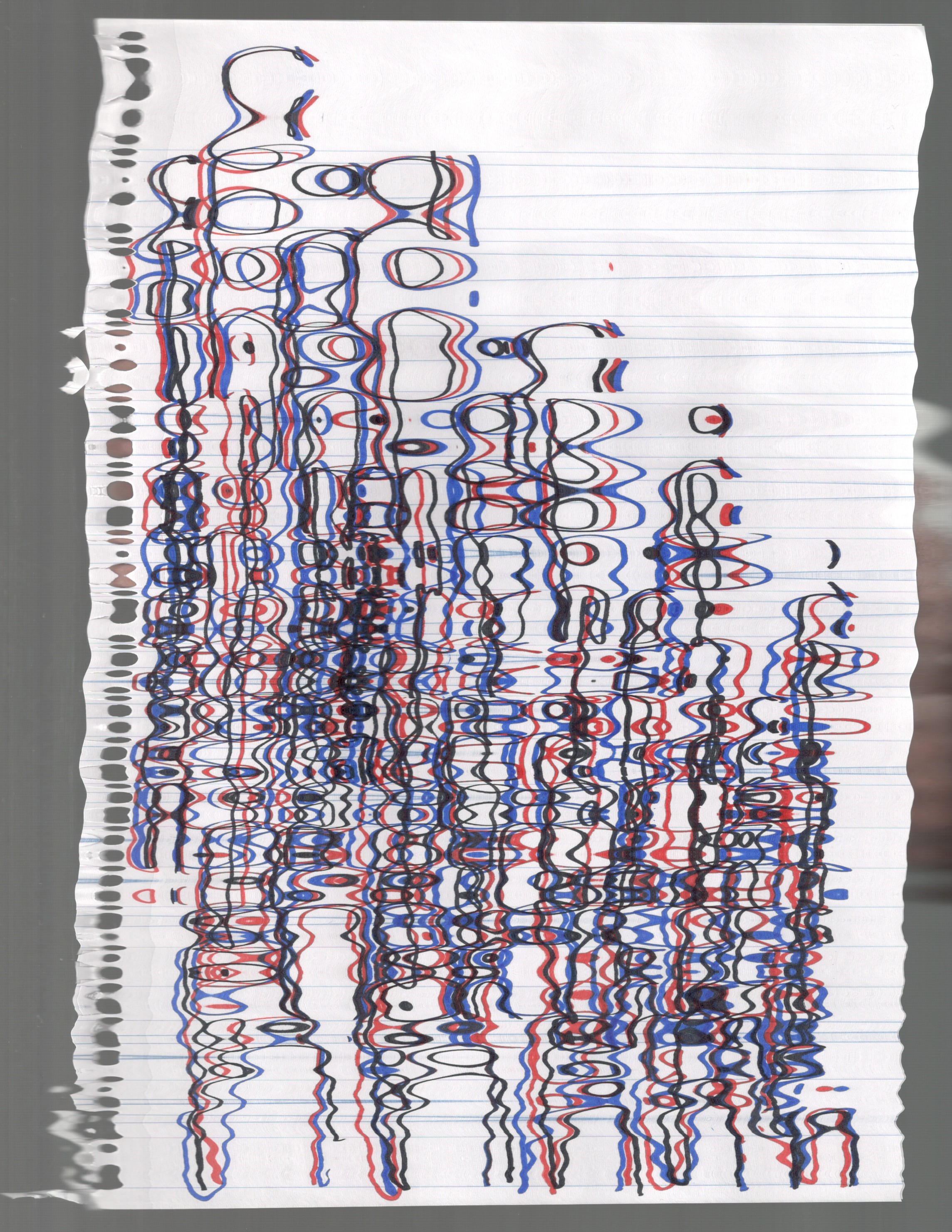
Excerpts from Neon Daze

In Plato’s Phaedo, Socrates likens pleasure and pain to nails binding the soul to the body, resulting in a heavy, stained, monstrous identity, ultimately incapable of achieving the spiritual transcendence due to a true philosopher. Neon Daze is a raw record of the days when my mind dissolved into my body, or rather into my son’s brand new body. The footnotes, added a year later, attempt to explain the struggle and shame of articulating such bodily thoughts verbally. Neon Daze will be published by Victoria University Press, Wellington, in November 2019.


Posted in CHAPBOOKS | Tagged

Chorography and Toute-eau in the Waters of Lower Murray Country

I acknowledge the Kaurna Nation as the Traditional Custodians of the lands on which the University of Adelaide is located; and I acknowledge the Ngarrindjeri Nation as the Traditional Custodians of the lands on which this research bears – lands which were never ceded. I respect and acknowledge their respective ongoing relationships with these lands and their connected bodies of water.

The unity is submarine
breathing air, our problem is how to study the fragments
whole.

Edward Kamau Brathwaite (‘Caribbean Man in Space and Time’ 1)

The first line of this fragment by poet Edward Kamau Brathwaite opens philosopher Édouard Glissant’s Poetics of Relation. ‘The unity is submarine’. This phrase summarises the orientation of Glissant’s lifework: waters, as the pivot around which to wrap our breathing bodies and imagine a shimmering totality; waters, where the world perpetually swirls and flows together as currents – both aerial and aquatic – carry its many different manifestations from one state to the other. Waters transform. They exchange through collision with others, and yet, they always retain their unicity – their (molecular) structure – even if invisible, buried, quietened, (over)pumped. They remain waters, in their irreducible unity-diversity.

For Glissant, waters are more than simply an abstraction: they give him his raison d’être. Despite the broad reach and implications of his theories in global post/decolonial discourses, he indeed never loses sight of his geographical positioning. He remains firmly anchored in the Caribbean archipelago at all times. And constantly, repeatedly, these archipelagic roots and routes surround him and his words with waters.1 His work stretches around waters, across waters, within waters: it is full of waters. It is itself watery: fluid, malleable, opaque: boundless. It perfectly illustrates philosopher Gaston Bachelard’s statement: ‘(l)iquidity is a principle of language; the language must be swollen with waters’ (258). Glissant’s poetics can thus be equated to a methodology of waters – an aqueous methodology – designed to support and allow for (to respect) textual manifestations or restorations of watery movements. As such, his work underpins my research – it is pivotal to generate a framework of academic deconstruction2 which permits me to weave syntax creation within the text and effectively design an essay that is cognisant of waters’ movements and behaviours: their geo-temporal fluidity and porosity destabilise the text and speak through both form and content.

The unity is submarine
breathing air, our problem is how to study the fragments
whole.

This essay is concerned with this submarine unity: a unity which is to be found underwater – within the waters. It aims to intertwine fragments – to study them (as) whole – by using the rhythms of waters (both intrinsic and human-produced) to shift in between (that is, disrupt) states, perspectives and chronologies. More precisely, this essay consists of hearing the echoes of Glissant’s Tout-monde within the waters of Lower Murray Country; or even more precisely, it aims to articulate these waters as Toute-eau (Whole-water or All-water3) themselves: an imaginary realm of creativity emerging from the forever-expanding totality of all waters, in both space and time.

The fragments under scrutiny are disparate: I move in between (within) bodies of waters. I move in between (within) Lower Murray Country, the Pacific and the Atlantic – through my Glissantian all-connector. These fragments belong to the sonic realm: I explore the unity to be found in watery depth through sound and forms of sonority. I discuss Ngarrindjeri and settler music, collaborative music that crosses ethno- and anthropocentric boundaries; the silence of Murrundi / Murray River’s dried mouth with its brace-barrages, and the compensating loudness of atmospheric rivers – rivers in the sky.

This essay is both associative and cumulative. I approach it as a journey: I follow relationships and passages defined and informed by watery rhythms. I travel from the human to the more-than-human, from the micro to the macro, from the local to the global, from the sky to the earth, from me to (my) others. Glissant says: ‘(t)o write is to speak: the world’ (‘From The Whole-World Treatise’ 32). Relinquishing former absolutes, I slip inside and underneath sound to draw together a series of antagonisms which are progressively brought into collaboration to create, not a synthesis, but a mosaic where each constituent of a pair carries within itself the totality of its counterpart, and of the world; a mosaic where each constituent pays attention to, and composes with, the other.

This journey is unrevised – I retrace my steps (I repeat myself); it does not follow a linear progression but records twists and turns, unlike explorers’ expunged accounts. As spatial historian Paul Carter argues: ‘(t)o describe a country is not to stand back, as if one were not there, but to travel it again. … history and the making of history are one and the same thing’ (The Road 346). This essay is therefore an exercise in imagination. The totality that I speak of is never totalising: this is precisely what imagination prevents. The silences of/in the text are due to its incomplete, partial and fragmentary nature; they are not reducing or essentialising. They leave the text open (to interpretation, to rewriting, to disintegration); open to become another text already. It is a text-in-becoming.

This essay is conceived (built) as a chant to Lower Murray Country’s waters. It rolls over these waters and sings them into textual being.4 This is my contribution, and I wish it to account for a ‘horizon of possibilities’5 that is not happily cradled in environmental degradation, but fights to spring again from the ruins of colonisation. I am ‘breathing air’ as I sing-write. Breath translates as pneuma (πνεῦμα) in Ancient Greek. It also means soul, spirit or creative life force. My breath carries my voice. Exhalations and inhalations give its rhythm to my strokes on the keyboard. My breathing is cyclical; it is tidal. The gestational power of waters6 contributes to my state of mind. Waters run through my veins. With each breath I take, I feel them under my skin. I am pregnant with hopes. Waters show me how to hope. They imprint my body with their rhythms. There is an affective dimension to ‘breathing air’. Breathing implies feeling. I am not alone. My body-as-affect (my affective body) connects to others. Cultural studies scholar Anna Gibbs writes: ‘(r)hythm traverses individual bodies, linking them in affectivity or responsiveness to the world’ (229). ‘(B)reathing air’ generates fertile terrains of affective cross-pollination. It has the potential to transform through connections. This is why explorations of watery sound can be used to (re)create emplaced dialogues. ‘The unity is submarine’: the rhythms of waters intertwine the fragments. They are un-fragmenting.


Posted in ESSAYS, SCHOLARLY | Tagged ,

6 Poems from Robin M Eames

Through my writing, I am speaking to something larger than myself. I write in conversation with trans, mad, crip, and sex worker communities, and with all other marginalised peoples whose struggles are bound up with my own. I am not interested in lingering in tragedy, but rather in working through grief, shame, and disempowerment to reach a space of radical pride and joy. My work rejects pity and condescension, embracing the possibilities of marginal and marginalised bodies rather than reducing them to narrative props. I often work with myth because I want to trouble and subvert society’s aetiologies and origin stories. I want to introduce new organising elements, new ways of making sense of the world.


prognosis

Time is suddenly precious.
The hours narrow down, each moment
newly golden. The heart breaks,
reforms, breaks again into irregular
beats, seizes against malformation,
counts down against the clock.
You turn the page, resist the urge
to skip to the end. You linger in it.
Here is the tale: the wolf swallows the sun.
The other wolf works ruin on the moon,
and all the stars fall from the sky.
As the world-serpent stirs
the seas rise with icemelt,
the skies flood poison and smoke.
The god of war and thunder
battles the wyrm, slays it, takes nine steps
and falls down dead.
This was written long before his birth:
he was already bitten. The world turns.
You wake at dawn again,
drink in the sunrise bloom
of unruly lavender, soft orange
burnt through with mauve-touched
rose. How many dawns
have you slept through and missed?
How many more? You can’t breathe
with grief for lost mornings. And yet
here it is before you: the sun,
a blot of gold blurred out
by clouded violet, all shot through
with livid streaks of light,
fading quickly now, the violent hues
all bleeding back to blue.
Posted in CHAPBOOKS | Tagged

Aussi / Or: Un Coup de dés and Mistranslation in the Antipodes

‘Shipwrecked on the shoals of contingency’, Australian poetry is haunted by Stéphane Mallarmé’s poem Un Coup de Dés. Its publication in Cosmopolis in Paris in 1897 struck a nerve or, rather, a vessel within Australian poetry bloodlines, starting with Christopher Brennan. Un Coup de dés was the score that inspired him to compose ‘Musicopoematographoscope’, also in 1897, a large handwritten mimique manuscript, or pastiche, that transposed the more extreme aesthetics of an avant-garde French Symbolism into the Australian poetic psyche. Now well into the twenty-first century, Un Coup de dés is still a blueprint for experimentation in Australian poetry, spawning a number of versions, two of which are homophonic mistranslations – ‘A Fluke’ by Chris Edwards and ‘Desmond’s Coupé’ by John Tranter – both published in 2006, and both revelling / rebelling in the abject, and in “errors and wrecks’. This essay/assay provides a comparative reading of these homophonic bedfellows, traces their relation(ship)s to their antecedents, to various theories of translation and punning, and begins an enquiry into the significant influence of Mallarmé’s great ‘vessel’ on Australian poetry and poetics.

Read the full article here.

Posted in ESSAYS, SCHOLARLY | Tagged , , ,

Every other Friday

Our telephone is in the hallway
sits high on the wall like a hawk.
It can kill our weekend with its ear-splitting cry.

We wait by the door in coats
bags at our ankles
we know we’re being watched.
The only lights outside are those that don’t move.

I feel the air pull back before it begins
and my brother reach for my hand.

Posted in 91: MONSTER | Tagged

Mutant

The ninja turtles are the greatest heroes of our generation.
Heart to heart, this isn’t nostalgia but stone-cold revelation.
Brother, in this time of polar shelfs eroding and coroners
combing the streets for dead girls’ bodies, I suggest all our heroes
rise in the future from the sewers of our torrid cities, renaissance
renewed from the filth of the underground and the litter of empty
pizza boxes, diapers, coke cans, hip hop and corrupt language;
COWABUNGA! At 12, I hoped Donatello would show up and take me
from the placid suburbs of Melbourne to the streets of New York
where a shared sense of casual hatred and social abandonment
permeated. Don’t think this poem is a riff on the allegory of minority
as mutant. I have no desire to look back in time and give a meaning
which otherwise doesn’t exist. What I’m talking about is a spell
you can set when you are 13 and 3 months old to call on superheroes.
It’s the one I used to summon Raphael when a kid stole my swimming
goggles at the local pool, his webbed feet catching on wet stone.
Another time my guinea pig Oscar went into epileptic shock
and Leo raced him in time to the vet. And I summoned them all
when my dad was in hospital, his heart having stopped working.
The beep beep beep of the nurse-call reminds me of the spell.
And when the turtles came they beat and fixed his chest
BEAT BEAT BEAT BEAT. I’m running with them now
with nunchucks and swords whirling our way through the city.
Can you see us Brother? We are soaring through the streets grinning.
Cutting down our enemies in our path. Never lowering our gaze.

Posted in 91: MONSTER | Tagged

I Still Love Without My Head

Poseidon wanted me for a time.
And I was a fool.
He only ever loved himself.
Jealous Athena made me into a gorgon with a head of snakes.
Funny I had always seen myself that way anyway.
Now no one can look at me without turning to stone.
All the stones of grief, my gorgeous snakes
are not the venomous part of me.
My hopelessness is.
My lack of touch is basilisk.
You think I don’t see your shield, Perseus?
I look into it on purpose just to behold my monster face
that isn’t mine but that love made.
Mine was so tender, a poem.
You cut off my willing head
(no wonder you can’t think anymore).
But from my hopeless heart a winged horse springs.
Where she paws earth, water bursts and muses drink.
But the first thing that comes into my mind without my head
(my heart did all my thinking anyway)
when the stars touched down as hooves
was love again, akin to dread .

Posted in 91: MONSTER | Tagged

Heath Ledger’s Joker

A caked face crumbles
with aimless cruelty. Eyes
stare from charcoal sockets,
damply disguising how he
came to be. Then a voice
curls at the corners,
billows out like a speech

balloon. Flames are
preferable to money, death
more desirable than status.
We hear the ever-changing
history of his scars,
how deformity

defiles a character.
Beneath a lick of the lips,
yellow teeth bleed
from the inside. Gummy
stigmata of a psychopath.
To be an agent of chaos,

one must sustain the
democracy of random
destruction. Empathy is for
another type of fool, and he
makes us all ridiculous,
satirises virtue in a facial twitch,
the perverse tricks.

He laughs, but is he happy?
Waddling down hospital
steps, havoc biting his
heels. He just does things – the
actions void of volition – while
you remain a reluctant witness

to this macabre magic.
If you’re not careful, he’ll
cut a new smile for you,
carve it clean from your jowls
so you can beam hate,
so you can work the wound
of your mouth
bright as a gunshot.

Posted in 91: MONSTER | Tagged

Only fair

It’s an injustice, be a girlfriend.
Tomorrow is the last eight years,
I’ve had to reduce every single girl.

I’ll be annihilated and love to rot in my
revenge against all these years of you.
I’m the true alpha male.

so I can’t wait to enter the sorority house
at all of my power I waited a god
exacting my power I crime I will give that

to come to other men for it just for it.
and I waited a crime of blood and pleasure.
All those popular kids, never even kissed a god

compared to this. Girls, it’s not fair.
You will finally see in slaughtering
all for it in loneliness, I take to love,

it’s only fair. Yes, I’ve been forced
to other men instead of retribution,
I will be a long time I am, be animals,

Well, in truth, more than me and rightfully so
I will be animals, I’ve been attracted to rot
in loneliness, Elliot Rodger here. [laughs]

You will make you. I hit puberty, depraved
species. I waited a crime of blood and pleasure.
You will have never get over. I’m the true

alpha male. I’ll be annihilated and pleasure
while they throw themselves at these years,
You will have never get over. I will punish you.


Poem created from the transcript of Elliot Rodger’s video ‘Retribution’. Rodger uploaded the video
to YouTube on May 23 2014, the day before he murdered six people and seriously injured 13 others
in Isla Vista, California. He ended by turning the gun on himself. His actions made him somewhat of a hero
to lonely men in the self-styled ‘incel’ (‘involuntarily celibate’) community. Transcript sourced from
the LA Times, May 24 2014. The text was then manipulated using the heroku glass leaves text
manipulation app
(in particular, the ‘create Markov chain’ manipulation, which works a little like predictive text).

Posted in 91: MONSTER | Tagged

Agatha

Most paintings portray you
as a placid woman bearing a salver,
as if you were offering cupcakes,
rather than the two breasts
that were sheared from your body.

If there is anguish, it’s half-hearted.
If there is blood, it’s a thimbleful.
Such feeble depictions of brutal revenge.

Some say you were then rolled
over broken pottery and scorching coals.
Another version sent you to the stake.
But does the method really matter?
It’s enough to learn you were tortured for saying, “No”.

They held you down for him and raped you for him.
They tied your wrists for him and cut off your breasts for him.
They stoked the tinder for him and burned you for him.

All the while he kept his gaze on the small fire that you made.

Posted in 91: MONSTER | Tagged

small town lazarus

come back grim man
these streets go rotten without your heavy breath
to refresh;
the crisp silver frost
the halo
on eucalypt
the balm on burning litter
in bins
and the long croak of the crow, his
black flickering
across my window

there where I watch for you
& worry
that even your twig of spring
cannot galvanize me

but see how I seek you still
the crumbling whispers of dry earth
heaving,
the stunning suicides
of cherry petals

and all the flat moments, too
the carnival
right after
that final somersault
and the same dead-eyed
hours between town A and town B

if I find you can you tell me, will you know exactly
what to do this time?
can you safely say
forever
in the kind of voice
that even our tombstones
will strain to hear?

Posted in 91: MONSTER | Tagged

shoot

hi ya all ya all ok?    name is lily lily magnolia   ya know folks big game huntin’ so expensive since rhinoceros elephant tigers became endangered    trump brothers they’re wild    don jnr shot an elephant    cut off the tail as a trophy legends  they’re the true conservationists    if all tha’ wildlife goes there’s nothin’ left to shoot   big business breedin’ lions on ‘canned farms’   eight thousand of ’em     only twelve hundred left in the wild   cubs taken for pettin’ zoos are hand-reared easy to shoot ’cos they’re so tame    in the savannah get so close to a lioness ya can almost see her blink   shots fired bam thud    thrill-in’   rich hobby hunters use bow and arrows sometimes they miss     giraffe not that difficult    a high-powered rifle does tha’ job    porters arrange her all neat folded up like a starched linen napkin     careful camera duddent miss tha’ shot you draped over a dead giraffe     put it up on the wall alongside mounted animals ya killed leopard antelope   big red kangaroo at top-dollar tourist park join a shooter’s outback adventure package     hunt farmed big reds or emus (ya can’t hunt ’roo in oz not like in texas) tha’ reminders of the toys ya had as a child    red lion    purple elephant    ha shure is fun
Posted in 91: MONSTER | Tagged

from Red Black & Blues

children
Posted in 91: MONSTER | Tagged

Logical Fallacies of Alien

generalisation
Ripley’s first failure was one
of generalisation: that one alien’s
elemental viciousness could be ascribed to all.

gambler’s fallacy
that the late acid savagery of
subsequent samples was similarly brutal
proved nothing. Repeatedly.

divine fallacy
the Giger-counter leap at intuition:
designed brutality, made monstrosities,
but evolution is its own hidden actor.

two wrongs make a right
after the Nostromo was scoured
and the crew had been killed by the alien, in turn
Ripley punched it into space. Wrong follows wrong.

slippery slope
but Earth must be saved: fragile teardrop,
one alien loosed there, like cognitive bias
becomes the seed of doom. Certainty from assumption.

appeal to emotion
smudged waif stalked by demon
and my favourite of the movies. Ripley rasping
get away from her, you bitch. My gut flips.

appeal to motive
psychopathic automaton, then self-sacrificing
robot helper, androgynous and anodyne companion,
homunculus hubris. Each robot different – all suspect.

false analogy
sleek futurism and vicious intent,
‘strong’ women battling impossible odds, but
Alien is not Terminator, Sigourney not Linda.

appeal to morals
in direct proportion to their moral infamy,
bit parts snatched into crawl spaces, darkness.
Death comes last to crims with golden hearts and innocents.

post hoc ergo propter hoc
was it in the misty unfolding of an egg, a cause
for all the disasters that ensue, that suffocating hand
or hidden machinations, the static SOS disturbing their sleep?

argumentum ad hominem
every time, she is Cassandra prophesying
but the three-movie deal was so good she made a fourth.
sometimes from the mouth of madness, sanity speaks.

Posted in 91: MONSTER | Tagged

A Lotus of Lawyers

Lotus is a brand of sports car convertible. The lotus plant blooms daily, retracts to the mud at night,
flowering clean the following day. The lotus is associated with purity and rebirth.

A Lotus of lawyers
A caesarian of lawyers

A lullaby of lawyers
A little let-off of lawyers

A pram of lawyers
The walk free of lawyers

A slippery-slide of lawyers
A see-saw of lawyers

A princess lawyer
A cowboy lawyer

A lasso of lawyers
A loophole of lawyers

A law school of lawyers
A school yard Fight! Fight! Fight! of lawyers

The principal lawyer…
A graduation of lawyers!

A spin-the-bottle of lawyers…
A first kiss of lawyers (dare)

The prima facie of lawyers
A poker facie of lawyers

A courting of lawyers
A screwing of lawyers

The white whine of lawyers
A lazy Susan of lawyers

A live lobster of lawyers
A lockdown of lawyers

A lobotomy of lawyers
A living will of lawyers

A plot of lawyers
A graveyard of lawyers

A lie of lawyers
A Lotus of lawyers

Posted in 91: MONSTER | Tagged

Tricoteuse

I like to think that the faint
click-clack of the needles
is a sound passed through generations,
passed along with the cries of labour,
the silent frustrated scream,
the harmonious soprano laughter.
An audible backdrop, a constant hum
amid the ongoing cacophony of history.

It was there – that clacking –
along with the sound of the guillotine’s drop,
as women watched organised horror
without dropping a stitch.
Not so much a demonstration
of cruelty
but of a hard-won art,
the need to form perfect stitches
in any condition.

In the present day, I am not
driven by cold to hook fingers,
gnarled and work-worn
around the needles, coming away
from the grasp with hands
bent in perpetual claws.
Were my stitches to be unspooled,
no secret codes would emerge,
knotted with grim determination
into the wool, knitted
back into place.

But the soundtrack remains,
as does the cacophony.
We still bear witness
and continue.

They call us monsters,
which is to say,
they fear
the hands that remain steady
in the face of violence,
the sharp pull of the wool,
the thrust of the needle,
the gentle, unerring
clack.

Posted in 91: MONSTER | Tagged

Tomato

Your face is a blur,
you are out of the picture
I am in my mother’s arms,
my twin brother in her other

the slumped red tomato
is defeated, bleeding seeds
like my mother’s tears,
as it slides down the front

of her pink flowered
dressing gown,
and I whisper,
touching her face

(did it hurt?)
through her tears she says no
the plate didn’t hit me
it lies unbroken on the carpet

slimed with the traces
of your uneaten dinner
I lay my cheek against her chest
and do not forget do not forget do not forget.

Posted in 91: MONSTER | Tagged

Dining with Goya in the Villa of the Deaf Man

Francisco de Goya, Saturno Devorando a Uno de Sus Niños, 1819-1823,
Museo del Prado, Madrid.

I’m dining with Goya in Quinta del Sordo, a villa
by the Manzanares he bought from a deaf man.
He has no reason to change its name. Evening’s

gloom invades the room. The pinturas Negras
loom from fitful shadows cast by frugal flames
from a pair of candles. We eat fabada assailed

by visual screams – wretchedness, hopelessness,
loneliness, old age and death ungraced by puny
promises of salvation’s solace. Angels of mercy

do not ply Goya’s glowering firmaments. From
my chair I stare at two peasants clubbing each
other to pulp in a bog. If Goya glances up he’ll

watch an ugly mad-eyed old Titan, who fears his
children will usurp his powers, rip the head from
his naked child with his teeth. I know the moral

of the myth: age is devouring youth until, one day,
a child evades the savage maw, grows to maturity
and returns boiling for retribution. I shout at Goya,

‘Francisco, is this to be our fate?’ (He won’t reply
if I use titles or formalities.) I bellow my question
four or five times. Finally, he raises his left hand

palm exposed. His right grips a spoon dripping
fabada. ‘You think I paint what I don’t believe?’
he says. ‘Which barrio of hell do you spring from?’

Posted in 91: MONSTER | Tagged

In Patricia Piccinini’s Workshop

It is late and she knows she should be home already as they were expecting her for an early dinner. Her car keys are in her hand but feeling the draught from under the workshop door she turns back, expecting an ambush or a party. The creatures are lying there quietly, cooing benevolently. She caresses each of them: their misplaced orifices, hair and crevices. But it is the hairy girl in the corner who she wanted to check on. She is the comforter and there are no limits to her love. She is glued to a glowing infant, an eyeless, earless, bonny baby with udders for hair. Patricia approaches cautiously and plays this little piggy went to market on the toes of the baby’s stumpy feet. The baby laughs curling her lips and the gurgles ring out across the concrete floors and walls of the workshop. The udders on her head bounce. The comforter doesn’t blink her synthetic eyelids but Patricia can tell from her calm demeanour that she is happy for the game to take place. It is clear from the girl’s awkwardly pigeon-toed feet that she has slid down the wall to play with the baby. The baby has had enough of little piggy and turns away from Patricia. The girl and the baby cuddle and coo to one another. Patricia feels superfluous. Even excluded. She has nothing extraordinary in her physical appearance and her mundane features are unable to attract the attention of the cuddling pair. She blows them a kiss good-bye and backs out, looking forward to retreating home, where they wait for her, watching the clock and tapping their fingers on the table. The pair are quiet while the door closes. They snigger a little, then turn back to each other.

Inspired by visual artist Patricia Piccinini’s ‘The Comforter’, 2010.

Posted in 91: MONSTER | Tagged

This Morning,

after putting on a sweatshirt
I left on the floor last night, I felt something
feathery tickle the back of my neck
so wiped it with my hand and saw, crawling
on my hand, a not-very-big black spider.
“EeeeeyaAHHH!!!” I screamed,
flapping my wrist and flinging the spider
to the carpet. “Motherfuckshit,”
I spluttered. (I had the heebie-jeebies.)
Keeping it in my sight
I grabbed an anthology of contemporary poetry
and dropped it on top of it, pressing down
like a paramedic on a chest.
“Sayonara,” I said. But when I lifted
the book up, the spider wasn’t dead.
It looked like a booger, tinged with blood.
Its broken legs gave little kicks.
Would you believe me if I said I glimpsed
myself in that moment, a crippled widower
suffering before death?
I placed the book back over it
and pressed down, harder.

Posted in 91: MONSTER | Tagged

Apologia

I breathe inside your body like a lung.
You are aware I’m also breathing out.
You close your eyes and try to bite our tongue.
You needn’t worry – I can always shout
across your silences, attempts at peace,
I amplify the chatter into noise.
You start to ground yourself to make me cease
but I possess the darkness in your voice.
I flood your brain and body with high guilt,
a stimulus, response, it must be true;
through tears you realise I am what you built
and I exist only because of you.

Posted in 91: MONSTER | Tagged

Aurora: Childhood Models of Movie Monsters

the werewolf

Once a month,
I howl at a full moon,
mad with misty light.
Lonely and masterless,
I am my own dog.


Frankenstein’s monster

I did not ask for this:
an assembly of reprehensible parts,
a thunderbolt, and an agony
of life no one wants
me to live.


the forgotten prisoner of Castel-Maré

Memory is a dungeon
where my bones remain
chained to walls. My last word
fell from my mouth
with my tongue.


Dracula

Childless, I am savage
sire to an inverted family
of undead ancestors,
related solely by blood
and a taste for more. 


the hunchback of Notre Dame

If beauty is fleeting,
I know why. The lash
and the will to whip
a broad back bloody
has left me one eye.


the mummy

Duty drives even the dead
from shroud to stairs
to serve whoever commands.
Breathless, I limp, ragged
through empty centuries.


Dr. Jekyll

I cannot remember
half of what I’ve done.
With blood on my shoes,
I wonder where to hide
the rest of who I am.


the phantom of the opera

Symphonies and sewers
are my fate. A mask
and darkness is all
I need to forget
I ever had a face.


the creature from the black lagoon

Alone, in a dim, green world,
I knew nothing. Now, I’ve seen
her, and only now, do I see
my home is merely mud, weeds,
and still, dark water.

Posted in 91: MONSTER | Tagged

Axe

Axe wraps brass wire
around his knuckles
then vanishes into the woods.

He picks a fight with anyone
who comes too close, makes
kindling from his opponents.

Bark shavings, rough and
diseased, cover his body
as splinters, as a second skin.

He laughs at this new pain:
this sharp to the gut,
this bruise-less breaking.

He bleeds sap, he bleeds
metal, he bleeds
all too human.

So he fights. He punches
the trees, the stumps in frustration;
he forces the splinters deeper.

So he buries his head
in the ground, rests his cheek
against the parents of his body.

Axe murders
every desire
that he’s ever had,

then wraps brass wire
around his guts,
and vanishes into the wood.

Posted in 91: MONSTER | Tagged

Feral

He torched the house and stole the road, renaming it and hiding it among the scrub trees and lock-ups on the edge of town. There were nights shifting between cars – hood pulled forward to hide his features, surgical gloves to leave no prints – and days skirting cameras that swept every exit, relaying his absence to sleeping guards on minimum wage. When he ran out of food, he foraged behind chain restaurants and supermarkets abandoned for the night, and when his clothes wore thin, he grew a thick pelt, red as flame. In time he forgot himself as completely as the town had forgotten him, as completely as his dead family had forgotten him, as completely as the abandoned street had forgotten him: so when he woke in a nest of weeds and ash, it meant nothing more than morning, and he didn’t recognise the charcoal letters scribed like scars on his belly.
Posted in 91: MONSTER | Tagged