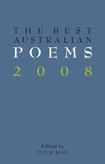
 The Best Australian Poems 2008 edited by Peter Rose
Black Inc., 2008
When an anthology purports to represent the best poetry of a time or region, it's fair to assume someone will question the validity of its publication. 'On what criteria is this judged?' some readers might wonder. 'Can poetry really have a best?' others will ask. 'Why wasn't I included?' a few may dare voice aloud. The word 'Australian' can be just as controversial. 'What does 'Australian' mean?'; 'Can these poets really speak for us?' The answers provided by The Best Australian Poems 2008 are indirect at best.
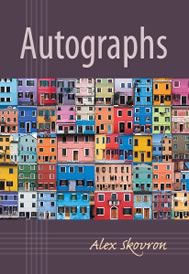 Autographs by Alex Skovron
 Female haiku writers can hardly be categorized either in the language-centered group or in the existential image group, as described in my previous post. Even if they are different from each other and have elements common to male contemporaries, thinking about the genealogy of women haijin seems more informative than mingling them together with male writers.
 Avant-garde haiku became bankrupt when its momentum was dissipated by the stabilization/conservative shift of the society around 1970, along with other radical movements in the literary and political arenas. Doubts about the form of haiku now came to be regarded as counterproductive. The basis for these doubts had been the desire to open up a common perspective that would embrace new possibilities for Japanese society as a whole, but the whole was now superimposed on individuals as something that had already been achieved, even if in a doubtful way.