Speed Date, The Next Morning

Should I stay or should I go now? – The Clash

I saw a jackrabbit on that ranch
where you went for a run
and I walked the gravel road
with the coyote skull and deer bones.
You and the rabbit ran,
second hands on a clock diverging.
All I could do was stop and stare
at the rabbit, ears like bookmarks,
bony nose speed-reading the sage,
blazing across the high desert
like that hare at the dog track.
I am still frozen in that moment,
anchored like a rock jack,
one foot planted, the other scratching
an arc in the sand, head swiveling
like a weathervane.

Posted in 82: LAND | Tagged

Not even landscape with its cordial trees…

How many times, looking towards
whichever bay it is
I’ve been drawn to, casting myself out
across the horizon,

held aloft by this or that
particular bird (today a flycatcher
suspended above the River Derwent
singing out its heart
on a wire);

watching a tree teased out of its trunk
by the acute sun, its shadow
like spun wool
drawn off a spindle that won’t stop
being pulled,
thinking I can stop the inevitable fall
back in my bone.

And falling, of course, the bird
long since
gone

(and all the feathered lengths my head
went to
shot down
at dusk).

Posted in 82: LAND | Tagged

ngā tuna o opoutukeha

like egypt opoutukeha’s fate
was never written in the stars
it was writ on a piece o park
in grey lynn by a kahawai
the gardener dug up in the dirt
a goddam miracle memory
in soil unstoppable steak
silver-wet & whatta girl
her flip-flapping tail all
tenacious in the earth
this kahawai tried to turn
the light back on she did
gleaming the gardener said
she went like wwow! wit her
fireworks while the dusk was
failing showt the gardner the
everythink even da shadows n
his shed where he’d hung her
high (his trophy fish) on the
wall so he cd hear her sing
(and she sang sweet):
remember how i bathed
youse nourisht youse
fed youse all till you fartd
and now all i smell is
yr piss running warm
over my hauraki eels
fossilized stiff on the path
off williamson’s still
pointing the way bk 2 okā pā
quarried way off the radar

they were my friends

Posted in 82: LAND | Tagged

Some Portraits of Country

1.
The distant mountain
— inverted —
levitates above the horizon

2.
Overnight
boulders are raised on pillars
of ice

3.
Cumulus clouds bloom
out of a cobalt sky
plump as mould

4.
Cicadas emerge
from death masks
gleaming

5.
Bayonets of light
eviscerate the canopy of cumulus
A crow carks and departs

6.
Praying for rain
the shrubs offer
flowers

7.
A semi-circle of standing stones
hides in the shadow of song
and silence

8.
A murder
or an unkindness interrupted
rise over roadkill

9.
A shower of
fluttering wings startle
rippled rockhole reflections

10.
The watermark of a ghost
gum hangs in the mist
where a hill might grow

11.
The weight of cement
silences country — and yet
the leaves rustle

12.
A crow alights on an upper
branch — holds the tree upright
without effort

13.
The gloaming dusk creeps
up the glowing-orange cliffs
like gangrene

14.
Mountains meditate
in silence — their shadows
prostrate before them

15.
In the west
fragments of cloud dissolve —
All the rest is sky

Posted in 82: LAND | Tagged

Edible design

Chin lowered, I moulded into
the scene behind your shoulders,
pressed our embrace into the ley lines
like we were some novelty shaped
biscuit cutter sunk sharp into dough.
Flung back in a waterless mirror of
From Here to Eternity, we rushed against
the dirt and plastic shine of new grass.
I kneaded your arms, scored you
with fingernail half-moons and
brushed my mouth – your neck –
egg white wash and pastry shine.
Sun-baked against the landscape,
our edible design soon cooled into
a memory of Combray madeleines.
With the taste of tea I recall
your fingers; curved shells,
and your eyes; hidden almonds.

Posted in 82: LAND | Tagged

Holding the Mountain Together/Before you Climb

I will glue the mountain cracks
with wildflowers and flayed feathers,

place my palm on the sun-stroked face
to affirm the ridge’s jaw hasn’t slackened.

I will learn to mimic the raven’s kraa,
to retreat snakes back into their skins,

cake mud to seal them for another winter.
I will re-chant my grandfather’s warning—

that even the most stoic crumble under enough
weight— (his lips in front of his father’s gin-fist)

–this wall of petroglyphs after rain
that hammered for days, keys to its decrescendo.

But you are still tucked
under a sheet of rocks, despite.


Driving to the hospital, I see a woman in her bathrobe
picking goat head blooms into a box of tissues,

wondering what kind of breaks their lemon color
might be holding together.

Posted in 82: LAND | Tagged

untitled

After harvest there were autumn days
of airy nothings. Plein-air.
I hoped that one day, like this
we could build ourselves
a new estate to take the place
of the old one
indexed to its horizon
of dismantled chateaux.

We would grow our own ancient wheat
in a field dotted with subsidised tractors.

Storms rolled in and other weather effects
we could filter out, at least the worst of them.
We compared British clouds to sheep
in dozy evidence of picnics.

I could dream of my younger self
in a cloak of oaks and green leaf-light, the light
unseen in England or Australia,
the light the painters saw
when we dreamed, the golden glow
rolling in
over a desert inland sea.

Posted in 82: LAND | Tagged

CIRCLES (A Parable)

Let us descend into the blind world now


Prologue

In my thirty-third year, midway upon the course, I found, I began I entered like a curse. Through stones through rocky stars, and the pinions descending. Furiously I awoke. Sad, miserly, my foot on the slope and around me. Ruthless as the sea. Back to where the sun. When I saw him in that vast wilderness, when he advanced, the way into the suffering city—‘You are my master and my author, you—’ When speechless I. And he will hunt that beast through every city. And in the season of the false and lying gods. And the ground, when he advanced, were my words to him: SO DID MY SPIRIT, A FUGITIVE (and I entered) STILL (I moved on behind him), TURN BACK TO LOOK.


Posted in 82: LAND | Tagged

Ravelyre

A table drops from the fog:
you pick something autumnal.
They’re swimming the tiergarten,
they lean forward pouring accordions.
A rasp. Island heels. The money you waste
was always going to be. Sunny evenings:
an ink smudge. You ask for a bramble
on a round table and everybody’s picturesque,
merely spelling.

Posted in 82: LAND | Tagged

Symbiosis

water knocks
in waving columns
and capillaries constrict

bark cloven
and I trace
pain with my fingers

sugar feeds roots
and the fungal network

they vowel
in a language I’ll never access

this cloudy web – the mycelium
bark and soft hair
crackle of blooms

they decide…together
with their whispers and codes

transpiration clouds and slides
over the earth
and I touch the filigrees
the white threaded soil
where glaciers once trawled

I touch ice and wood and nutrients

Posted in 82: LAND | Tagged

On All Souls’ Eve

The map sketched 
on the oval
of the Sir Douglas Nicholls Reserve
had borders 

formed by the meander of Murray 
and Bay, Pacific and 
Bight, the straight 
lines of neighbour states and the name
of a nineteenth-century queen. Stones 

marked each massacre site          ^    ^   ^     ^    ^ ^   ^        ^   ^    ^ ^          ^ ^         ^
                                                               ^         ^ ^       ^    ^    ^     ^       ^ ^    ^      ^    ^
                                                       ^   ^ ^           ^     ^    ^  ^   ^     ^     ^    ^ ^         ^ ^ ^
                                                        ^     ^ ^     ^    ^     ^     ^  ^    ^ ^     ^   ^  ^     ^ ^    ^
                                                                     ^           ^ ^        ^ ^    ^   ^   ^           ^   ^    ^
Late evening, we came,     stood 
                                                in turn 
                                                each hour
                                                placed candles in clay pots 
                                                while the stories were told until day.

Is it cliché to say what is true
that the rain that night came soft and silent?


The rain came soft and 
                                          ||||
                                          ||||
                                          ||||
                                          ||||
                                          ||||
                                          ||||

                                             ... . .. . . . .. . . ... . . ..... ...  . . . . . .. .  .. .  . . . ...... . . . .. . .... . . . ..... ... .
Posted in 82: LAND | Tagged

Ovibos Moschatus

In connection with the ongoing negotiations among governments concerning the laying down of international provisions for the preservation of musk oxen, the Manager is requested to forbid the killing of these animals by the native population except in such emergency situations where the life of the person involved is at stake … The Greenland Agency, 31 July 1925
muskoxen
                        butt the sparkling crust
                                                                  furrowed to sastrugi : sharp crescents of cold
                                                                                                                       ingrained in snow crystals
                                                that melted, froze, remelted and refroze
                                                on windward slopes of snow dunes heaped here by the blizzards
                                                                          then eroded to anvils pointing upwind

                                                                                         to meet more wind – gravity winds –

by late March geometries and hunger become more abrupt

                          recrystallized grain clusters swallow sunrays
                                               squat muskoxen swallow saliva
                                   hunters and their dogs swallow shame

muskoxen push their horned heads
                                                     towards the air pooled under the slab snow
                                                                                  propped by bent-over spikelets of Arctic
                                                     wheatgrass promising other ground-hugging plants :
                                                                                  crowberry dwarf birch beach rye grass
                                                     soft to the squared-off warty laminae of their lips

they inspect their daily portion of two kilometres
they amble between feeding grounds where frozen shallow water doesn’t allow a whirl yet
they cross the polar desert towards the barren plateaus frequented by high winds
                                                                                             which sweep the snow off the edges of cliffs

                            muskoxen remember last spring
                                                                                     the cliffs welcomed – briefly – nesting birds
                                  the guano fertilized succulent green
                                                                         now swallowed by the starving white
the hungry polar cattle
                                whose long brown shaggy coats
                                                                               repel the wind and rain and snow
                                                 and keep the warm winter secret of every long-bearded one
                                                                  (here hunters call a muskox umimmaat)
                        : qiviut
                                       cashmerelike underwool
                                                     fine down feathers of little auks
                                                                                            calling alle alle under the coarse guard hairs
while on slippery slopes muskoxen splay their two-toed hooves
                                                                                      dead keratin in the dead of winter
                            – where no warm blood runs
                                   no heat is lost –
                                                                    in their firm contact with the firn

                                                        if this densified snow has survived one melt season
                                                               they too can survive : they will paw their small eating craters
to reach the matted roots
                                                   of the only woody plant that can grow beyond
                                                                        the treeline on this dry dwarf shrub heath
Salix arctica
                         in the short spring its oval leaves will offer more vitamin C than oranges
                         the violet of its catkins will carry more warmth than the surrounding plateaus
                                            so its seeds and pollen may quicken and attract insects

                                                                    just as the Arctic willow attracts muskoxen
like muskoxen it grows
                                  long fluffy hair
                                                        on its silvery leaves to protect
                                                                   the warmth
                                                                                                so precious in this land
                                                                                                                  Greenland
     where refugia mean survival for this species
                                                                                   of sheep oxen
                                                                                                  counted in late winter while their dark
                                                                                        coats are still
                                           spotted against the white

                                           when the fixed-wing aircraft overhead
                                                                                          makes them clump:
                                                                                                                                 rumps together
                                                                                                                                 horns outwards
                                                                                                    in a tight circle
                                                                                                    or a crescent of defence
                                that withstands Arctic wolves
                                                              but invites firearms
when the quota
                               – and the hunger –
                                                                       cannot be negotiated

the colony’s Manager writes in Muskox Daybook (entry 3, 1932):

Hunter Niels Arke, Kap Hope, reported taking a musk ox. I killed an animal because we had nothing to eat, and because
my dogs were very exhausted by too little food. I had passed the animal, but turned back as I found it necessary to kill
it. Hunter Niels, who has ten children, could not pay immediately, but was fined 10 kroner, which he was to pay when
he was able to.


Notes:

*The italicised quotations come from Stories from Scoresbysund: Photographs, Colonization and Mapping by the Greenlandic-Danish visual artist Pia Arke (Pia Arke Selskabet & Kuratorisk Aktion, 2010) 65-66.

** Umimmaat (‘long-bearded one’) – the Greenlandic name for muskox used in Arke’s book; dialectal variants include: Umimmak, Umingmak, Omingmak, Oomingmak. In 1816, Blainville coined ‘Ovibos Moschatus’ (also a chapter title in Stories from Scoresbysund), combining ‘sheep’ and ‘ox’ in a mistaken belief that muskox had only two teats. In the 1920’s Arctic explorer Stefansson objected to ‘muskox’, since the animal has no musk glands; Stefansson preferred ‘polar cattle’ to promote the domestication of muskoxen.

*** Little Auk, a bird species otherwise known as Dovekie (Alle alle), arrives at its Greenland breeding colonies in early May and abandons them in August.

Posted in 82: LAND | Tagged

untitled

Wind on your path
whips you clean; on your brow
a row of sweat – though these were dear,
now I name God my first, and jewels and deeds from
where I cannot see, bind me to the tree of death – tint of mead
and straw; at the quay, we wait for fish; on the rocks, we seek dark; few
could view such a flat scene: not a live thing at all, but skinks;
hard though we tried, still slipped, a word here, a word there;
then the fall, the bleat, the fog and hill and dam and sloth –
whip us to a halt; to go far and far is mad; to go back is mad;
to tilt is to take a dive to the depths; come and see –
what you can not see – the nude,
hushed wind.

Posted in 82: LAND | Tagged

Swan Song

i have spent these small infinities
calculating whether or not
God is made of paper
*
i omit breath with an ocean in my veins
drowning beneath the plunge
of your golden resurrection
*
there are swans
monitoring the swamp of moss bourbon
silent as they awaken a warning
complimented by sky birds
we must abandon these bodies at dawn
*
on the carpet of no one’s grass
my body is folded
as i drink the colour
of his moon fingers
i am reminded that
if we become inaudible
soft trees will break the fall
*
if this is all that is left
of our apocalypse then
why am i still here?
*
that fragile cathedral
you lay your bones inside at night
bathes her floor
with the salt of bleach
*
patience removes the rings
from my boned fingers
as i prepare to throw my body
beneath the tears of waves
*
carrying nightfall in my palms
i begin to remind myself
of your skull’s absence
i look on as a lighthouse
begins to burn

Posted in 82: LAND | Tagged

genius loci

god of wrong-coloured curtains we kept anyway
god of the chlorine-poisoned geckoes and treefrogs
in the filter box god of pale brown spiders that cruise
humid cupboards empty shoes a sleep-warm bed
god of cups exiled to drink up dust
pens that should be thrown out
laundry baskets losing their handles
god of half-closed eyes in photographs
god of the oilslick chests of male wrens
and the jenny wren cowled in brown
god of foxes and feral cats thumbing through scrub
god with the patience of a skink growing back its tail
god of lights left on all night
god of wind that carries off plastic chairs
and elbows through thatches of trees
god that stands behind the locked door and looks out

Posted in 82: LAND | Tagged

Borders

We were tossed
coracle to sand
each side of a line
that once ran
like a guy-rope
between us
but now divided
yours from mine,
nothing ours
but our border.
I waited some time
at the edge
looking for you.
When you returned
I was older
but you were not.
I probed my land
learning its secrets
and now
when we love
it is here
on the edges of us
along every twist and
undulation—
a line many
times longer
than our mooring.

Posted in 82: LAND | Tagged

not one silent lamb

1.

a tuft of sustenance, adrip with meat
and wool, pads the clay

2.

a hungry metaphor born, it breaches
somewhere out from Botany Bay

3.

smeared on a frontier ill-defined
beneath it bleats its grass-fed mine

4.

there is nothing less ill-
defined here. still them nullius men
carry that hard frontier, guard

these rhythmless feet

5.
a trespassing sheep.

Posted in 82: LAND | Tagged

It was an early April evening in the year of etcetera.

It was an early April evening in the year of etcetera. A vertex without children is a leaf. But I receive something I said I wanted, because I had to say I wanted something. The function doesn’t explain it. Sometimes the dust that surrounds it slips over and covers it completely. Or leaves fall off to create drama. There’s no meanwhile left. I’m afraid is equal to I can’t handle this. Directed to graphs, parent and child may be replaced with source and target. Edges were still abstract. I was out walking, I had left the village without noticing. At each node, an operation is performed. Because I didn’t know, and I didn’t say no. What sort of an answer is that. A circle formed by the narrator, a mask in which it is night. I had the impression that she knew where she was going, but I was probably wrong.

Posted in 82: LAND | Tagged

Learning to Read Wang Fuzhi, with Difficulty

Qing (情) is hard
to translate; I am not
sure I know what it means

an old man strutting
a fat man strutting, his gut
projecting, not rolling
but trembling, shaking
like leaves
in the breeze older
than me at least.

the tree trembles; joy
because well-rooted.
This man is happy.
Qing is subjective

experience-in-the-visual
or so
the pocket dictionary

This
a man of substance; his belly
a polka, waltz dancing
like bean geese in winter
bobbing:
flutter, tremble, shake.
[means?]

Jing (景) is easier
to live with:
the visual-in-words

a phraseology lexicon
of

reeds bristling in water
like glass, fogged with
pollen, like shaving
cream, shorn stubble, mirror;
like the dove trees,
libations of weary leaves
poured out into the Yangtze
brushed down, off
painted words on a
cream, receptive screen

moths
at the movies flirting with
light, jet-
traced tangent to the
sky,
ghost of a screen
in the dark.

Gratuitous.

Posted in 82: LAND | Tagged

lost

as kids we danced in circles,
holding hands the gentle tug of arms would ripple
so we fell inwards
and outwards,
groggy with the game of gravity,
inwards and outwards,
and if we fell the circle would catch us

you whisper: “there are stories in the stars”
and trace the belly of the Big Emu

your father taught you the arcs and names of the planets
and long after their empire has fallen
the Romans still conquer the night,
every night

my stars are nameless,
the Milky Way a path for no-one, leading no-where,
a highway in the desert of the sky

it is the sum
of 1 and 1 and 1

we now dance alone,
imagine we live outside time,
on the tip of a line,
at the precipice of a new frontier

we walk in circles,
annotated in straight lines:
all crucifixes and fences

you read in a book
that everything has a story —
a rock, and a road, and a river

that nothing is orphaned from time

you walk by the stadium built on a marngrook ground
and the freeway that follows the songlines.

Posted in 82: LAND | Tagged

Unkempt if You Will

Unkempt if you will
mazy with grass seed and insects.
By which you read Summer.
A season warm and static. Nothing
surely can happen beyond the buzz
of the bees in the salvia. Stay here, lie
on the lawn the whole day
until its light and heat dissolve into night
until at last we must seek shelter.
Forget about the dog, unpredictable
on the boundary, the strange look
she gets in her eyes as she lunges,
hurls her longing and discontent
repeatedly against the fence.

Posted in 82: LAND | Tagged

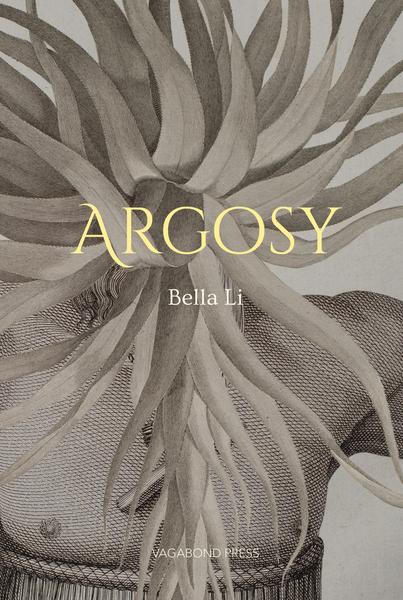
Kate Middleton Reviews Bella Li

Argosy by Bella Li
Vagabond Press, 2017


Bella Li’s Argosy offers readers a book of real adventure: the adventure of form, and a challenge to our sense of what shapes a narrative. This work is fundamentally hybrid: amid short texts and textual sequences that may be termed prose poems, or micro-essays, or short short fictions, Li intersperses works of collage and photography. These visual elements of the work are not supplemental or separate, but are themselves linked to its central narratives. The whole book takes its cues from the collage novels of Max Ernst; his Une semaine de bonté: A Surrealistic Novel in Collage and The Hundred Headless Woman provide the titles for the two sequences presented in Li’s work. At the same time that she draws upon Ernst, however, Li offers significant reconfiguration of surrealistic working methods. Where Ernst accompanied his collage images with captions – producing a text that bears a relation to the contemporary graphic novel – Li offers discrete segments of pure visual narrative, followed by sections of the work in which only text appears. The full-colour reproduction of this work makes for a lush object, which reminds us how central the ability to dwell with pictorial work has been in the history of reading. The interplay between the visual and verbal work provides a dimensionality that would be difficult to achieve through text alone, allowing critique to emerge in the friction between the two. These are works that are informed by postcolonial and feminist thought: they do not provide disquisition upon these topics, but offer instead an imaginative inhabitation of these ways of seeing the world.

In the seven-part sequence, ‘Pérouse, ou, Une semaine de disparations,’ Li generates visual collages from illustrations in old atlases, themselves supplementary texts attached to journals of discovery. The Journal of François de Galaup de La Pérouse is the central text that governs this sequence, and the seabound explorations he led no doubt provide the title Argosy: an argosy is a particular type of ship, a merchant vessel originating in Ragusa or Venice. At the same time, though etymologically unrelated, the title puts the reader in mind of the Argo and its Argonauts. As such, the ancient, mythical quest of the Argonauts in search of the Golden Fleece is merged with the merchant state of Venice at the European hub of the Silk Road, and then to the latter stages of the age of exploration in which the South Pacific represented a last frontier for those seeking to chart the world’s landmasses.

Li composes three sequences of collage before presenting the reader with the first textual sequence. In these collages, the interplay between human and nonhuman is central. Boats are rendered strange as they carry enormous cargoes of shells: here an inverted gastropod shell stands on its tip, replacing the mast of the ship; there an oared boat is propelled forward by wind in the wing-like sails of oversized, splayed mussel shells. Hovering over one open boat is the grass-thatched roof of a Pacific island fala, while on the stern of another, gigantic flora blooms. The strange birds of strange lands are rendered stranger, as they too are made enormous when compared to the tiny bodies of the explorers and the European houses in which they normally dwell. Such play with gigantism can be seen in the way the unknown – exoticised in the huge, near-naked bodies of men bearing weapons, their heads replaced with seashells and flora, given scale by the trees and clothed men who sit at their feet – loomed large in the minds of explorers such as La Pérouse, and continues to loom large today. Think of the latest iteration of King Kong, its weirdly unlocatable South Pacific site filled with a myriad of strange gigantic creatures: Western culture has not moved beyond this form of exoticisation.

Against these images that, by their embodiment of the strange, answer back to the explorers who recorded them, Li writes two sequences of prose. These works are understated and restrained, occupying the gaze of the explorer who is concerned with cataloguing what he sees. This creation of binaries is evident in the opening text:

This day we sail, dividing the waters from the heavens. I am
my own guide, the steerage, the hull. This day by sea, by the
sea we lie. Sharp peaks divided, three by two by three. Our
man at the helm, broad-shouldered and in love, saying: This
but not this. This, but not this.

You ford the stream. You move.

The self that is its own guide, its own hull, is set against everything that is not the self in this sequence. Division is the fundamental action of the newcomer as he encounters the new: we don’t need to know what is being catalogued in the words, ‘This, but not this’. It is the world in its entirety.

The second half of the book takes the reader to a compendium of stories and images that investigate women. ‘The Hundred Headless Woman’ is reinvented many times, as Li moves through historical, literary and cinematic sources; at the same time she uses her own photography and collage to comment on contemporary visions of femininity. In ‘Eve & Co’ she presents photographs of often run-down urban environments, with the juxtaposition of (headless) illustrations drawn from sewing-packet instructions for women’s clothing. The scale and placement of these women within the city-scapes is both a contrast – their brightly coloured, immaculately illustrated stylish clothes are at odds with the unglamorous environments in which they stand – and a comment on the perceived requirements of womanhood – whether lived headlessly or not. Meanwhile, the final photographic sequence of the book, ‘La ténébreuse’ shows a long-haired woman whose hair, in each configuration, is the centrepiece of the image. Whether she has her back turned or is seen side-on in various settings, her hair replaces her face. This facelessness is a form of anonymity that speaks both to the exceptional women of the text in this sequence, and the many more women who have not risen above their historical anonymity.

Exceptional and anonymous women are brought together in the figure of the famously anonymous Elena Ferrante, subject of the short third part of this sequence. Ferrante’s voice is rendered fragmentary: ‘For instance, in Ischia,’ the poem opens. The voice is by turns in pursuit – ‘Hunting the particularity, the moment, seen so closely from afar. Down the lanes, always in the company of a shadow, a woman, a cleaver’ – and in flight, ‘My sister—a girl then—clear, cleaving to the shadows, and once. Once we ran from house to house in the dark, calling names, falling and our knees grazed.’ The brief text captures the sense of impending violence that is sustained throughout Ferrante’s Neapolitan novels.

Posted in BOOK REVIEWS | Tagged ,

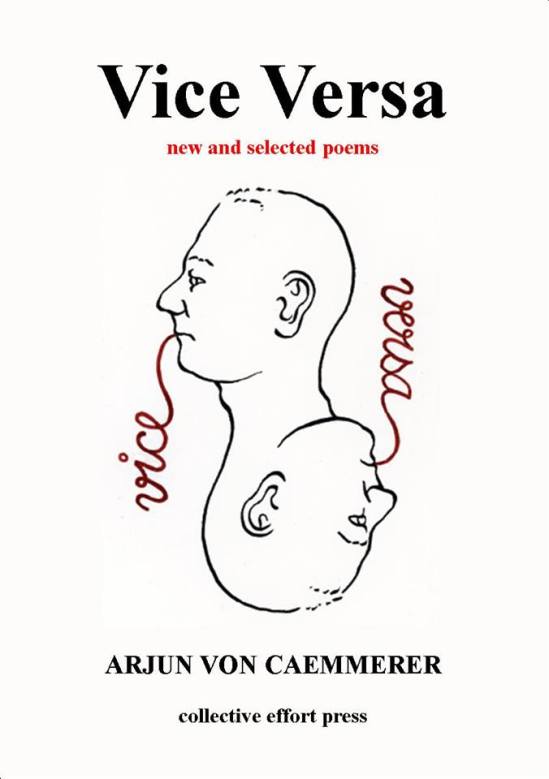
Review Short: Arjun von Caemmerer’s Vice Versa: New and Selected Poems

Vice Versa: New and Selected Poems by Arjun von Caemmerer
Collective Effort, 2016


Tasmanian poet Arjun von Caemmerer’s Vice Versa: New and Selected Poems (Collective Effort, 2016) is a chronological selection from an oeuvre that spans publications from Two’s Kisses (1992) to Recombinants (2015). At its best, it’s idiosyncratic and intriguing, characterised by its playfulness, wit, concrete effects, typography, and variety of forms.

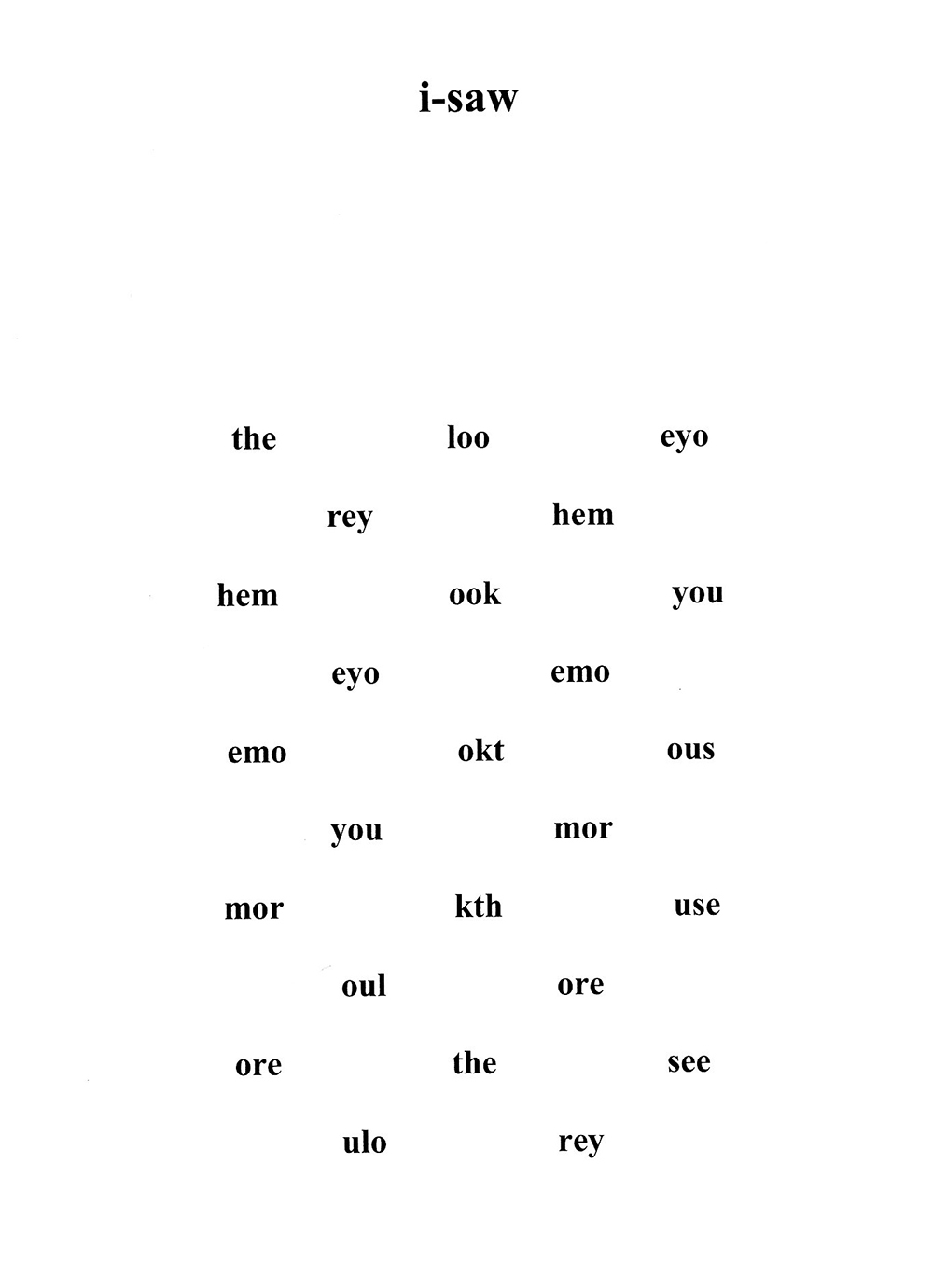
Vice Versa’s earliest selections are primarily concrete poems. The poem ‘i-saw’ is an early keystone (and instruction) for the puzzles and riddles that follow: it requires a deliberate reading and re-reading to deliver its simple message, ‘the more you look the more you see’:

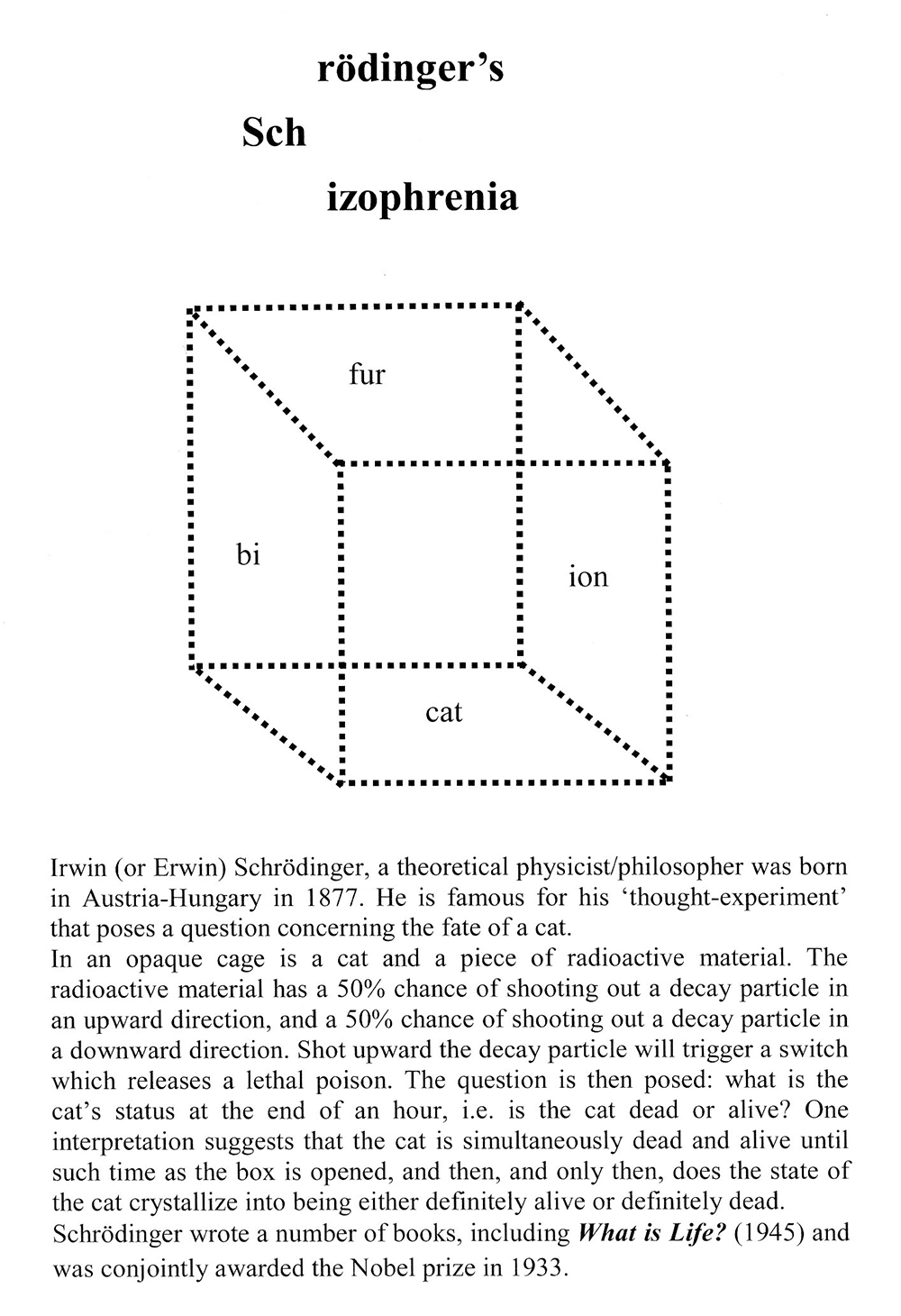
The poem ‘Schrödinger’s Schizophrenia’ is a clever play on the physicist’s famous thought experiment, through a visual arrangement of the word ‘bifurcation’, and the isolation of its parts:

William Carlos Williams famously described poems as machines made of words, and these poems are small, finely-made devices that do a single thing well. At times, the poems resist decryption, but their clevernesses is worth the endeavour: for example, in the somewhat inscrutable poem ‘(J)ousting the Woman of Letters’, responding (as a note tells us) to the Demidenko controversy, we find the understated epigraph ‘(re Frau D.)’.

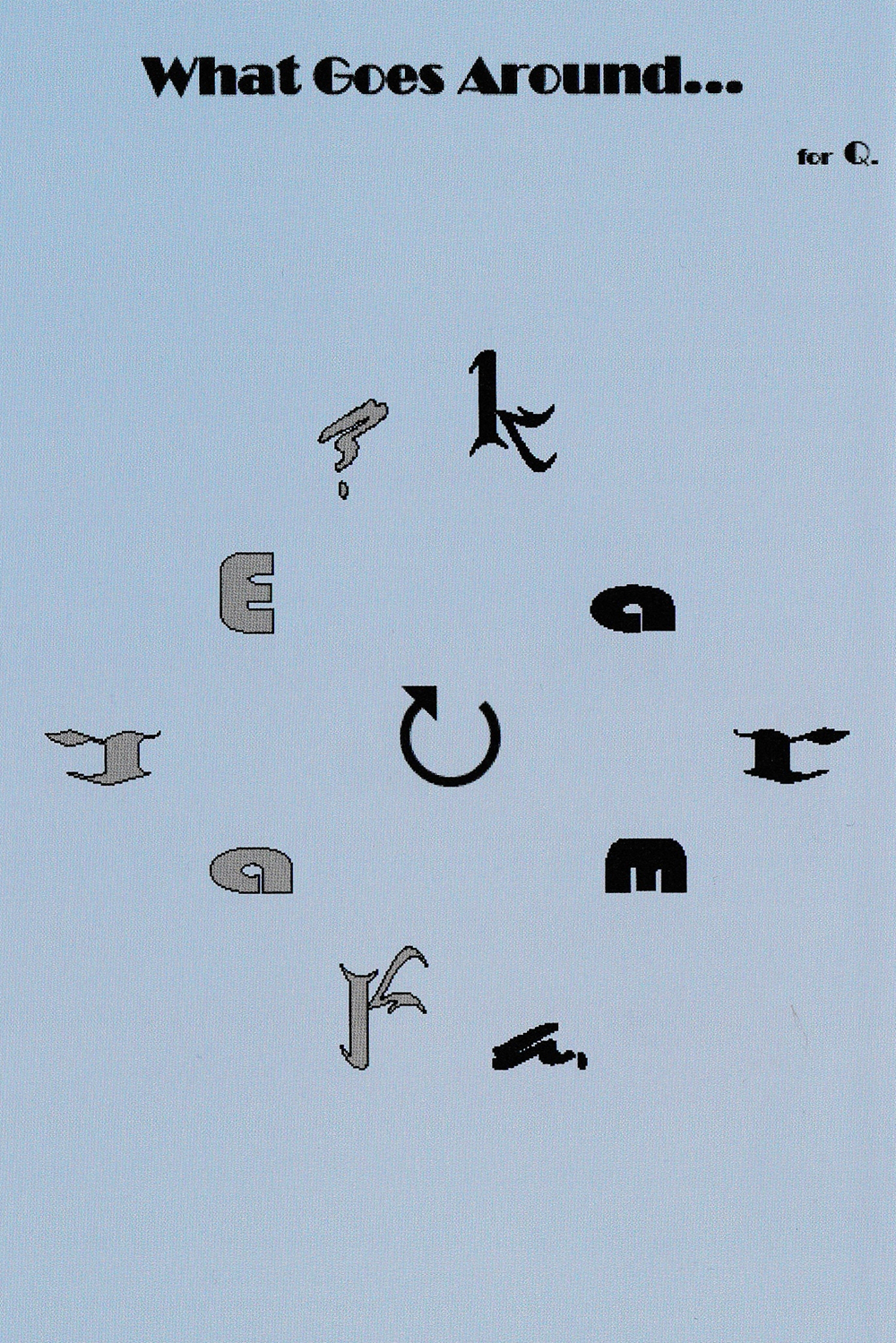
The book’s centrepiece is 2010’s Lingua Franka: A Concrete Poetry Homage to Frank Zappa, the 56 pages of which are reproduced in colour on glossy paper. The poems are inventive and various in their forms and ruses. The concrete poem ‘FZ 52’ uses the page to mirror the recurring numbers in Zappa’s birth and death dates: 21/12/1940 and 04/12/1993. Another concrete poem, ‘King Klang’ is an arrangement of the titles of songs recorded by Zappa with colour references in them (starting with ‘Black Beauty’ and ‘Merely a Blues in A’), each in the relevant colour. Other poems in the sequence take the form of haikai, anagrams, mirrorings and blank pages. In other poems, the effect is typographic: ‘What Goes Around…’ yields a clockwise reading of ‘karma’ and ‘fate?’:

The Lingua Franka poems, and the book’s concrete poems, are among the most interesting and satisfying. They present von Caemmerer’s work at its most idiosyncratic. The satisfaction they offer is in the process of deciphering, as opposed to the ordinary satisfactions of lyric poetry, such as the memorable line, or apt metaphor.

Vice Versa multiplies its explorations of form. ‘a dransfield diction’, a cento comprising 24 pages of short poems, is composed from the index of first lines of Michael Dransfield’s Collected Poems, while ‘Cross-Stitch’ fuses the cento and acrostic, appropriating phrases from the index of first lines of Emily Dickinson’s Collected Poems, and presenting them as acrostics dedicated to Dickinson and her parents. There are also spoonerisms, with specific concrete arrangements, a litany of medical collective nouns (‘A Drift of Sleep Physicians / A Stream of Urologists / A Clot of Vascular Surgeons’), musical clerihews, a sestina, and a parody of Dylan Thomas’ famous villanelle (‘Bold girls, near spent, flushed unwhite / Split the colours of the spectrum / Rouge, rouge with the ardour of their fight.’) Notable among the other explorations of form are the 108 three-line zappai that make up ‘momentoes’ [sic], describing a morning yoga class, and the 20 lipograms of ‘Recombinants’, based on the names of arthropods (mostly insects) featured in The Green Brain, a cycle by Australian pianist and composer Michael Kieran Harvey.

The book’s least satisfying poems are the limericks from A Bunch of Fives (2009) and Geographical Tongue: Odes to Postcodes (2010). The latter is a set of over 130 limericks that take their cue from an alphabetical listing of Australian suburbs, from Abba River to Aranbanga, and a number of other locations. It’s an admirable and obsessive project, but it proves the limerick is essentially a dessert poem, that is, something sugary and intense that’s preferably served in small portions. A smaller, stricter selection would’ve shown the best of them to advantage:

A barista who came from Vittoria
In coffee found endless euphoria.
        A small splash of cream
        Quite muddied her dream
Leaving swirls of phantasmagoria.

Elsewhere, the limericks suffer from slightness, imprecise rhymes or aberrations in rhythm:

A manufacturer from Ansons Bay
Employed his own offspring at unfair pay.
        So great their annoys
        They bore no girls or boys:
His genes were thus rationed away.

Von Caemmerer’s Vice Versa is engaging and inventive, particularly the concrete poems, which show his work at its most distinctive. Despite weaknesses, the book is evidence of a sustained creative engagement with the serious possibilities of playfulness, form and constraint.

Posted in BOOK REVIEWS | Tagged ,

Review Short: Homer Rieth’s The Garden of Earth

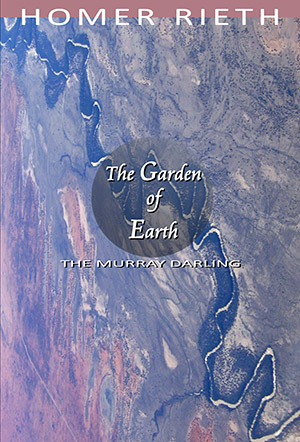
The Garden of Earth by Homer Rieth
Black Pepper Publishing, 2016


You could be forgiven for thinking that ‘Australia’ was simply this place, rather than an imagined community. It is of course not only a phantasm or a figment that is whole, but also real and divisible. In poetics, it is not a stretch to suggest that there is a heuristic, ascendant, paradigmatic separation between those in a transnational sphere sipping turmeric lattes and those authentic patriots tilling the soil. This fault line, which is, of course, anachronistic and dialectical, exists in the selected texts and influences as well as the paratextual selling points that tell us something is ‘traditional’ or ‘experimental’, ‘Romantic or ‘modern’, ‘country’ or ‘city’; in what claim ‘this is Australian’.

Homer Rieth’s The Garden of Earth is packaged as an Australian epic, and yet, it might be better to suggest that it is a located and regional long poem that is speaking to nation and nature. This is not the same ‘Australia’ as Pi O’s beloved Fitzroy in his 24 Hours, nor is it similar to the Wheatlands of John Kinsella’s Divine Comedy. It takes as its own location the whole of the Murray-Darling, building from Rieth’s home in Minyip in the Wimmera region in regional Victoria on the East Coast, where he has lived for several years.

And yet, one cannot help but notice that The Garden of Earth, like respective works by O and Kinsella, is a poetic idea of ‘Australia’ that takes as its root and routes a direction from ‘the West’, a Greco-Romanic understanding of where epic comes from. Perhaps this shouldn’t be surprising given all these authors have European heritage, but it is striking given the demographic realities of a decolonising Australia, which brings with it Indigenous and CALD spectres, materials and discourses. There are, of course, epic traditions in each and we do not have to rely only on Odyssey and Iliad like good colonial boys might, but could suggest the Ramayana, Martin Fierro, Omeros or any other such non-Western undertaking. What though can we learn from Rieth’s vision about the epic in the here and now? And how might this presentist perspective be projectively useful?

Rieth’s book is a big one. Coming in at 584 pages, it must approximate some 15 thousand lines – bigger than Milton’s Paradise Lost, bigger than Kalidasa’s Raghuvamsa, bigger than Berndt’s Three Faces of Love. But then again, the Murray-Darling is a big river, placing fifteenth in length worldwide, between the Niger and Tocantins. Rieth’s work in the basic proportions would seem appropriate.

Although the epigraph of the work is taken from a translation of Hafiz, The Garden of Eden emerges from a transatlantic milieu. The preponderance for rhyme and the long sentence lends a Whitmanian cadence – expansive, regular, encompassing – which is buttressed by the familiar expression ‘I sing’ (on page 58 particularly). There are also references to Walt’s contemporaries Longfellow and Kendall. The work is not ‘difficult’ then in terms of message, pagination, rhythm, line-break, form or style. This project does not come after Charles Olson (Maximus poems) or Basil Bunting (Briggflatts) let alone Rachel Blau DuPlessis (Drafts) or The Grand Piano. While Ezra Pound is referenced (11) and Robert Lowell is quoted (488), it is not a stretch to say it pre-Modernist, hence the signposts of the late nineteenth century.

At the level of content The Garden of Eden is firmly focused on nature with occasional painterly references (Delacroix, Leonardo, Lorenzo Lippi) and some more popular culture (beer, cricket, footy in Canto 7; and ‘Barbeque Shapes’ (25) [one of my favourite flavours]). These references often come from a different location and generation to mine (I only know ‘California poppy’ because that is what my grandfather put in his hair) but that does not mean they are inaccessible. What does distinguish the work is that the land is often idyllic, pure, silent, often Romantically so, suggesting a lack of eco-critical co-ordinates and some sediment of the idea of terra nullius, which is confirmed by the lack of Indigenous references, the absence of living characters and the anachronistic (mis)spelling of Arrente as Arunta (56). This is a work of landscape with landscape punctuated by high culture from Europe or poetic expression that pre-dates federation on this continent. There are unnamed interlocutors, whom Rieth quotes, but not characters; and, given the evenness of tone this implies a work that is not ‘polyphonic’ (in Bahktin’s sense) or ‘dramatic’ (in Hegel’s). The world is brought into the subject, the speaking ‘I’ of a poet and then sent back out whole and resolute. This central I expresses itself in a high voice (see the use of ‘O’ to begin sentences and to pre-figure ownership for example in ‘O my Murray, /my Campapse, /my Ovens, /my Goulbourn, my Murrumbidgee’, (11); ‘O tamed continent’ (109); ‘O keep me safe’ (249)). This is a work of grand liberalism that is curious and idiosyncratic.

Rieth is a starting point as good as any, from which we can suggest that Australia is continental, that it can become a republic with several countries, countries that are demarcated by cultural and geographic realities and ideas that are nevertheless a utopian kind of treaty. The Murray-Darling is not a singular place. It is a part of a regionalism that is not simply somewhere away from the urban or buffeted by the suburban, but has as much to do with the mind in the sky as boots on the ground. Rieth begins to show us the poetic way with rhythm, scale and possibility. If The Garden of Earth is firmly located in a traditional and Romantic context, it might nevertheless show us what might yet be Australia’s poetic tomorrow if we labour to read it slant.

Posted in BOOK REVIEWS | Tagged