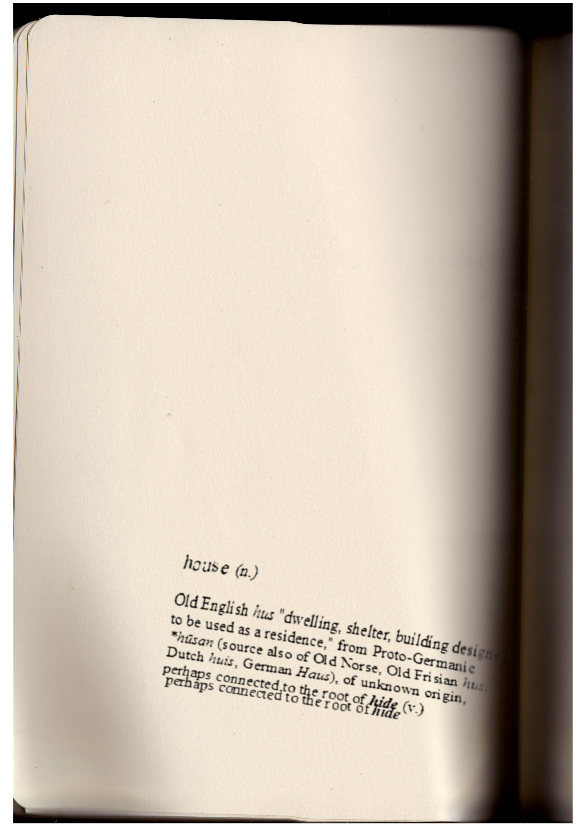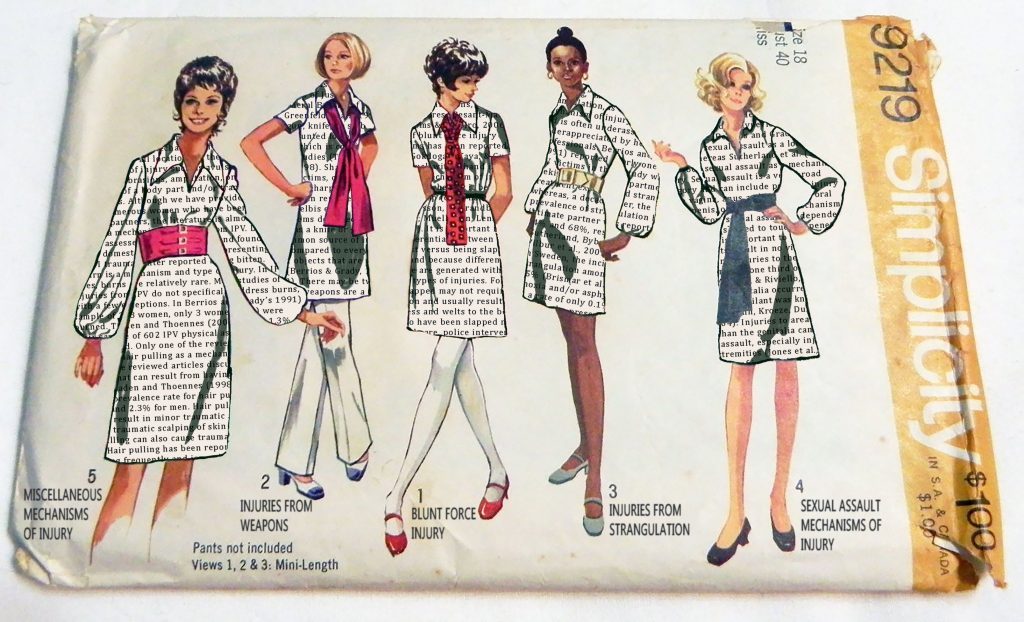
Source texts: Sheridan, D.J. and Nash, K.R., 2007, ‘Acute Injury Patterns of Intimate Partner Violence Victims’, Trauma Violence Abuse, vol.8, pp.281–289, and Simplicity pattern 9219, 1970.

Source texts: Sheridan, D.J. and Nash, K.R., 2007, ‘Acute Injury Patterns of Intimate Partner Violence Victims’, Trauma Violence Abuse, vol.8, pp.281–289, and Simplicity pattern 9219, 1970.
Addressed to Robert Lowell
The night attendant at the service station, garishly lit
when I had thought the world extinguished,
pumps $10 of fuel into our tank.
My plastic moneybox looks childish in the car’s backseat,
but the silver coins that spill from its plughole
perform an unexpected magic.
My mother has nothing, and I see how much it matters.
She parks the Toyota on the side of the highway beneath some gums,
their white trunks streaked by the comets of passing cars.
My sister and I have my favourite blanket, gilded with synthetic stars.
At break of day we enter the police station in our dressing gowns.
Two faceless men escort us home
where gravity has finally pulled everything down.
On the carpet are light fittings; the vacant box of the TV;
the roots of plants forced from hiding;
drawers and their contents (folded maps, loosened photographs);
volumes of an encyclopaedia, their hardbacks torn off.
A more comprehensive list is not necessary.
In truth, my room is not as damaged as I want it to be.
My sister’s has been carefully destroyed.
My father is discovered in his bed, eccentric and confused
as one of your old-timers.
But the police know to stay, while my mother picks through the debris
for a bankbook and some clothes, and then
the men in blue lead us away.
There is a brick house with bars on every window.
A room stuffed with bunks and a cumbersome wardrobe.
At the kitchen table, women stub ashen cigarette after cigarette
into a tin ashtray, battered as the moon,
playing show-and-tell with scars, picking over the ruins.
My sister has faith in another miracle of creation.
But I am a child, not a visionary, and I see our mother
has already surrendered to the diabolical romance of return.
My father, cleanly shaven, stands at the door.
Inside, the furious pull of the earth has gentled again,
allowing the furniture—what was left of it—to right itself.
The place looks enough like our home
and our father’s naked face enough like contrition.
We restore our toothbrushes to the bathroom shelf
where our father’s glistening razor sits.
If you were still alive today
And I could sit and talk with you
What would you tell me Great Nan?
Would you reveal something new?
There’s not much we know about you
Just that of your violent death
Was there blood in the Kija Sand?
As you took your dying breath
We would love to learn your story
To find out who you were
Not just “Maggie Full Blood”
As it was written, without a care
But day after day we hunger
And year after year we look
And search through worn out pages
And in every historical book
But if I could just sit and talk with you
Just a little, little while
Would you tell me your broken story?
And would I be angry and wild
I know some hearts would be mended
We have cried for so very long
To hear of your Kija story
The Country to which you belong
There’s blood in the Kija sand
It trickles through every grain
It’s the heart cry of our fallen
To a ghostly white skinned stain
It is a permanent reminder
Of a past full of blood and heat
And it is there as proof to all
That history should never repeat
I can’t pretend I can’t sleep
to get up and interrupt you
anymore
You’re not on the walls
or in the bathroom drawer
You don’t pour
milk into my mug
Dad does
(he adds extra Quik)
but he can’t
ponytail my hair
or boil breakfast eggs
You’re not cutting
carrots into sticks
or standing
like a thumb
in the mix
of other mothers
at the school gate
You left
empty shelves
where your books used to be
I don’t hear the kettle
boiling for your tea
I don’t hear you
singing at the sink
pink lips and rubber gloves
I can’t dip my fingers
in the suds
I can’t see
your curly words
on permission
slips
or on lunchbox lovenotes
underneath my ham and cheese
You don’t put
your hands
on your hips
You took your dresses
and
you left us
in boxes
Your voice
is on the end
of the phone
When you come home
you kiss me with
chewing-gum breath
leave
a lipstick print
on my cheek
And then you leave
I can still smell your perfume neck
At twelve, I wanted to be a paleontologist
digging up bones in the paddocks round here,
easing a scythe of jaw from the creek bank –
not Diprotodon, but horse. Still,
I remember the thrill carrying it home
through that raw suburb, layered now in my mind.
Those strange creatures that evolved there:
Mr F. tuning his finicky engines,
Mrs H. axing the heads off chooks
their beaks still gaping on the bloody stump,
Mr B., a grey floppy hat among bean rows,
Mrs P. parading in her negligee
and beating her son with a hose.
In bed at night I pegged ancient shallow seas,
looking for life stamped in stone,
the dream coins of fossil joy.
And now there’s not enough time,
I want another go –
Digging under this new estate,
a chaconne of grey mortgages,
I would excavate the swamp that was here:
a gift of water where blue cranes
teetered into their westering
and the moon behind them rose from the weeds.
I would sort and classify those sounds:
the dour claxon of the crane,
the crickets and frogs still calling
from the storm drain.
Shall I dig further?
Past the middens of the Kaurna,
proving their earlier claim,
exposing old theft and murder.
Where is my heartland?
What if I dug clear through the earth,
emerging in Skara Brae,
that Orcadian flint in my family?
What if I climbed from the harbour at Kirkwall,
entered that shop with the soundless bell,
stood at the bench where great-grandfather Flett
finesses ships’ chronometers and doesn’t look up?
His clock faces stilled to stone.
Would these people want me back?
Should one lie down with ancestor bone?
As the trishaw rolls to a stop,
I spy a girl standing on the footpath
in Rue Catinat, near the Continental,
twirling a hoop around her midriff,
spinning it with enough torque to hold it up—
the supple undulations of her stomach
propelling it round and round.
A dark curtain of black hair falls
across her face as the bracelets
on her wrists catch the sun. For a moment,
I see Mai in her nightgown as she runs
into our bedroom and leaps
at the mosquito net, tumbling across the bed,
all veiled and twisting, her giggles
announcing her presence like a pealing bell.
I have a sudden urge to throw a handful
of coins at this girl to buy her hoop,
even if I have to pay more than ten times
its worth so I can send it to my daughter.
But I can’t post it to Hanoi.
And what if she doesn’t remember me?
I haven’t explained my absence, why
I left in the middle of the rainy season,
how one evening I was lifting her up
to light the sticks of sandalwood incense
before our ancestor shrine and the next
day I had fled. She laughed when we saw
the sandpipers at Haiphong, wading
on the mudflats, their long bills
darting into the water like chopsticks
immersed in a steaming soup.
The sandpipers fly south to escape
the winter, before returning.
Yet two winters have now passed
since I last held my daughter.
the pane is cold to touch as I lean
searching the garden with starved eyes
are you in the vegetable patch
or among the rhododendrons?
breathing life into them.
can a garden feel lost?
neglected? alone? betrayed?
& this kitchen / the disorder
of the refrigerator hidden behind white facade
the smells of you / uncooked food
the unmade mess
is that the ghost of you in the corner
(staring out in windowless pain)?
I can’t bring myself to leave this doorway
& empty the dishwasher
packed with your hands.
I.
Those bitches at school can get fucked now
I’m an actress, I’ve made something of my life
lives alone in a bush hut without electricity
rats run over the food she leaves lying around
bags of clothes and a loaf of mouldy bread
stashed under the porch
fifteen hundred kilometres from Invercargill to Picton
takes the ferry, misses the connection in Rotorua
loses her bag forever in Tauranga
arrives frayed and worn as an intercity bus tyre
above our heads gulls sweep low along the beach
the sound of the ocean and rhythm of the waves
does little to lift the swelling angst –
was her medication in the bag?
a cosy room, clean sheets and comfy bed
hot roast dinner with all the trimmings
she devours it, takes a second helping
You’ve always been mean to me
she pecks at my crumbling composure
with therapists’ jargon
Are you sure you wanted to pick me up?
Did you have an issue with that?
buses to Auckland to catch her flight to London
leaves her passport under the bed in Nelson
the jumbled suitcase overweight with essentials
false boobs, high heels and beauty treatments
II.
she’s eight, we watch Fantasia for the third time that day
hiding behind the couch, her eyes wide
the Easter bunny a tormenter
at the fair she screams for silence
she’s a teenager, won’t touch door handles
Towels have a lot of bacteria
on the train the panicked call to Nan
she doesn’t know where she is
i.
Your face sometimes does that key change:
no one else can hear it, but I feel the floor sticky
with tired arguments that I’ve only just mopped up.
I turn away to the sink, where the water in
this dishrag smells of old bleach, its straightjacket
stale and stiff by tomorrow if I wring it tight.
Most of the time these days I stay mute, lips as tight
as an empty washing line, shoulders slumped beneath
the plughole, drinking dirty whirlpools, waiting
for the next slammed door you bring home.
My jaw concrete, fillings cracked, leaking
stale washing up liquid at the back of my throat, yet –
ii.
I feel it coming. The day I let these photo frames
be clouded with someone else’s bruises, watch
the tarnish bloom like dusty grapes in front of me
while I find my new reflection upside down,
swimming, stretched, in silver teaspoons,
clattering my ideas awake against my teeth –
I will hear scratching behind the kitchen cupboard
grow to an insistent clamour, then sink my
plumb line tongue, roaring deep, so you understand
what it is to be me. I will feel the water crash –
that moment when I smash these plates as easily
as waves, and make you watch me leave.
Complete strangers in the same house, I wish you like me,
as I chat, you are silent, nose ring, tattoo of a crossed out yellow star.
The acrid scent of finishing burns between us, you see.
I mean everyone needs work and they have to have money,
maybe for some party memberships, but also for food, your kids, the busted car.
Complete strangers in the same house, I wish you like me.
I was raised to answer each burning bush, confront each difficulty;
support for the widow, orphan and you know, the stranger, no matter how bizarre,
the acrid scent of finishing burns between us, you see.
It’s ingrained in me, even if you’d orphan my kind without mercy
or so my fantasies run as together we lift and move a heavy bar,
complete strangers in the same house, I wish you like me.
I want to explain this floor is messed up because I cooked oily
Latke’s and also dancing with my husband in heels made these scars
the acrid scent of finishing burns between us, you see.
But you turn away and I feel history is harder to get out than blood or tea
as you mask your ringed nose and turn on your machines’ roar;
complete strangers in the same house, I wish you like me,
but the acrid scent of finishing burns between us, you see.
She’s glad the cleaner comes each week to natter
about this and that as she busies round the house –
mainly inconsequential stuff, but it’s a change from him
and a distraction from the pain of crumbling bones,
the heart attack, and a gut intolerant of pills.
Her Buddhist friends drop round for tea and a chat
when she can’t get to pujas, or – if she’s fit enough
to trundle her trolley out – take her for coffee and a cake.
They always make her eyes conspicuously bright –
and the breaks give him some precious time to write.
My mother wants me to whatsapp her every morning. I do
and I send cash, though I’d rather silken, rose-colored clothing…
Woops, I have accidentally poured the wrong cereal for young sir.
We can always let you go, he swans (his got this from his dad).
Of course he has his penis, which he knows and does not know
at 6. Everyone should mollify, before he escalates.
His sister, too, who is 9 and as beautiful as Miriam Colón
without the comprehension or español – says Yeah.
When Columbus signed his pact with the Queen
she gave him the right to fill her coffers and did not ask
whether Taino parents were beloved of their children
or if the siblings killed one another like European royalty.
My husband whatsapps me about my mom. She is fine
he says, she ate a good bit of rice. With adobo? I wonder.
i slice the ribbed pork; blood seeps onto
plastic cutting board. my mum says, blunt
knives are safe. i am not a doctor, but surely
clean amputation is safer than dull chop,
pulling and tugging until the decayed
spine snaps off. in any case, we’ve never
done things the easy way. it will not taste
good if we do not bleed into the mix. the
same secret recipe everywhere – prodigal
child returns. i keep separating flesh
from marrow, but what else can i fix-
ate on if not the uncut umbilical cord.
the day i turned legal, i laid under a man.
watched as he jabbed needles into my
back. the ink says, i will never be you. still
i grow into your skin, the same dis-
jointed smile. still i hoard grievances the way
you hoard old toys. still i have the same night
mares – my fingers, locked on soft flesh
until skin spills open, a mess of seeds
and clots. shhh, don’t let the neighbours
stare. i look down and see wrinkled
hands, spider veins, shaky enough
to fear sharp edges. i do not want
a daughter. i know the iron i used
to defy you will be forged
strong enough to subdue her too.
Weak, wintery sunlight illuminates the fine layer
of dust that has
settled on every flat surface
and
crept into every crevice
like a malignant fungus
hell-bent on colonising my living room.
I pace.
Jeans too-tight over my bottom,
the flesh that wobbles round my middle is as foreign
to me as this wailing,
scrunch-faced
bundle in the rocker.
Utterly alien.
He smells
and the sickly, sweet smell of excrement
curdles and
flips my stomach.
The day s t r e t c h e s
into infinity.
The sonic boom of a plane,
laughing neighbours and the hum of traffic
meld into a symphony of a world
I cannot get to.
The colour
seeps
slowly away and
all is grey.
The seventh cup of tea is tepid
and acrid
with artificial sweetener
that pretends to
melt
excess flesh from my frame.
Babyweight,
is the euphemism,
as if it is a shameful secret
trembling under
loose t-shirts
and stretchy leggings,
desperate not to be found.
I remember when I drunk
my tea hot
and sweet with sugar,
I had idly
stroked my growing bulge,
joyful in my ignorance.
The nappy bag
is sulky with disuse.
The myriad of
confusing pockets
and
insulated compartments are just
too much to bear.
Too motherly.
Too someone else –
who is
coping.
My friends call and call.
I cannot speak
for fear.
There is only so much fakery
I can perform.
The mask of motherhood
is a diabolical one,
I slip it off between these walls,
and it chafes when I am out.
Day fades
into a dull evening as I sit.
Beige and grey,
my brain is
stultified.
Counting the minutes, the hours
until I do it
all
again.
In country towns
I search the faces of men: young and old
For familiar reflections
My grandmother never lived long enough to know me
Small brown woman, cheekbones look fist-proof in this sienna photo I carry
Where she once walked these streets in her cheap leather shoes
Flat sensible scraps scrimped together from the war effort
She and I both offspring of one rootless tyrant and many gentle wanderers
(like her fading old people, striding tall from camp to camp,
following the seasons like their old folks did)
Her thin dress swishes over our skinny brown body
She was not a lady who lunched
She made the food, set the tables, and cleared them away
But was never allowed to enjoy the fruits of her labour
Her hunger pains stab into me too
I live inside her, cradled between hipbones
An egg inside another (but Mum absorbs most of the shock so I don’t break)
We guide her true, because
They stole her from her mother being able to
We pull at her belly when she takes a wrong turn,
Talks to bad men and listens to their flattery
Do not deliver us to evil!
We rattle our cages, making her sick
But occupation is nine tenths of the law
He squats her womb with no invitation at all
Working her fingers to the bone
A broken back for stolen wages and a belly full of baby
Later on, when Mum smuggles me out
We go screaming into that good night
But the cheek of this man
Just a cheeky slap, here and there, then:
A fist cracks a cheek and knocks some teeth loose
She’s bleeding pus and pissing blood
Not just her own, but the blood of our ancestors
Clots up in her brain
But a woman’s work is never done
(to wash blood out of cloth: scrub with very cold water before using soap)
Laundry wrung out and hung up like white flags of surrender
Sunlight’s the best disinfectant
For shame
He cleaves her liver with well-placed knee
She bleeds pus and pisses blood for the last
Time
Ain’t nothing like pain to bring you back to the present
As we walk the grand streets of this small country town
I look from face to face for echoes of my face without a mirror
Listening out for whether my blood sings or boils
My aunt and uncle are coming
so in their honour I pile the books
against the walls, and hoover,
and stack the stairs with what
was on the floor — the angel oracle cards
with their almost-outsider art
which I bought for a pound and don’t regret,
the sellotape, the pens, the coins,
the takeaway menus,
the random post including
last year’s Christmas cards, the pack
of fridge magnets that haven’t made it
to the kitchen, a betting coupon,
stamps, receipts, the sort of crap
that other people have a drawer for
but I display for some reason
or at least don’t put away
and the reindeer paper napkins
that lie there all year
for when aunts and uncles come to visit
and because the lounge is full
when they’re here
I sit them in the hall,
thinking it’s tidy and sane,
not knowing what they say
on the drive home
about the state of the place, and me.
The line between bohemian
and not really coping is fine.
In the AM
Mama skypes you and me (whispering)
the digits to collect
pare from Western Union.
Transfer like we’re paying a fee
for care, ljubav,
being a family.
As if it lessens what you carry for us,
as if without it
you wouldn’t survive.
(Government burnt your business
a decade ago. You’re almost all
still here.)
Water has been out for a week but
not much leaving now,
except for his trucks.
Gas is skupo and the car leaks,
so we limit usage to twice a day.
(to town for washing
laundry and ourselves,
for feeding Baba
doručak and večera)
In-between one carton of cigarete and the next
you talk about our spending.
Always turning it around and out,
wasting as if we weren’t just pretending
to be cash pare.
You know we’re not bogati either and
admit your needs.
(laugh off lacking)
Around five you sneak out
for some pljeskavica and krompir,
enough to gather us.
(hope your explanation
is set for his return)
Set the sto, tell us our places, serve hrana,
yak about childhood, community, and
the necessity of crna kafa.
for Grandma Perez (1922-2018)
In your backyard, you planted
papaya, mango, breadfruit, coconut,
guava, and banana trees long before I
was born. After harvest, we walked
around the village, delivering a share
to every neighbor. When we returned,
you told me to rake the leaves and fallen
fruit into piles, where I learned that rot
is the other side of ripe, and death, too,
is a kind of blossoming. Decades later,
weeds and invasive vines strangle
your garden. Strangers dump their trash
into the unkept grass. You watch
television all day, as your body,
after hip and knee surgeries, mulches
in a wheelchair. I live thousands of miles
away from your tropical orchard of limbs
and veined roots. Dear Grandma, I
want to remember you standing
amongst the banana trees, the green
hands of their sagging clusters
raised to the sky in prayer, their hearts
opening to a season, during your lifetime,
in which we are always bountiful.
When I was a child,
I learned how to float
on my back by imagining
the pool as a bed.
The posture
trained to be soft and yielding.
Nowadays, a child in my country
learns how to drown
with his face on the pavement.
In a moment, he is soaring
through the humid air, over
the cans of his playmates.
When he lands, he slips
on the oil of night and kneels,
is given a cardboard sign as lifesaver,
then takes in the completeness of dirt.
He is salvaged, although no one
in my country wishes to be,
for it is never certain who is saved.
Whispers know that those
who have kept their heads above
the flood use the stiff sacrifices,
prop their elbows on the driftwood.
The water, it runs between
the asphalt,
it carries the stench of a body.
My nation is birthed from this tradition
of typhoons and of men
who shout over torrential voices:
I will save all of you,
Then bless the people
with the power of seeing death:
a new corpse
as a drop of rain, instead
of a monsoon.
If a body can sink so easily,
why should memory be different?
But we have not forgotten.
The way we say goodbye is ingat,
survive, swim well and stay intact,
I hope to see you in the morning light.
When you see the subsiding sun
lip and slip the west’s salty hip
only those who have not kissed
will not move their tongue
and remember.
Only those who have not lost
will turn away before that
last ecstatic slide
has take this night’s last light.
And those lost will grieve
so deep within their coil
that their tongue is struck
recoiled.
And for those who hold
of course your world is bold
and the leaving sun
a mere slipped disc
and the night a mild serenade.
Oh leaving light
remember that I
was last to remove my gaze.
And if you return
I may turn away
your arrival no match for your leaving.
You saw not my eye
as I saw yours,
you’ve seen it all before
but I, dying light,
kept my eyes where you left
the world this day
and my life.