borderlands

Posted in CHAPBOOKS | Tagged

‘The Edge of Reality’: Paul Magee in Conversation with Paul Collis, Jen Crawford and Wayne Knight

The idea is to compose a whole book by speaking it. Spoken on Barkindji and Nyemba Country by a Barkindji elder, academic and poet (Paul Collis), in dialogue with two white poet-academics (Jen Crawford, Paul Magee) and five local Barkindji, Kunya and Nyemba interlocutors (Gertie Dorigo, Bradley Hardy, Margaret Knight, Wayne Knight, Brian Smith), taped and transcribed, A Book that Opens provides a book-based archive of oral intellectual practice on Country along the Darling / Baarka River in outback New South Wales.

Many of the book’s discussions concern care for that Country. For instance, in Chapter 9 curator Bradley Hardy of the Brewarrina Aboriginal Cultural Museum takes us on a tour of the stone Fish Traps at Brewarrina, which are older than the Pyramids (Heritage NSW 2014). Palpable evidence of the industrial aquaculture practised throughout the riverine environments of pre-Conquest Australia, the Fish Traps served to maintain gatherings of up to 5,000 people in their flourishing, and they did so sustainably (Dargin 1976).

But the book is also – because of the simple insistence of our work as poets, and the nature of the topics that arise when we chat – about poetry, and in particular about the relation of speaking to the emergence of lines on the page.

The question of transcription comes into this. Though it is popularly imagined to be an automatic act, a verbatim rendering of speech in fact makes subjects appear illiterate. A downside of the transcription of Aboriginal English is its tendency to platform just this feature, as if white speakers were not similarly ‘oral’ when conversing. In fact, repetitions, false starts, a-sentential utterances and filler words characterise speech in all registers, whoever the speaker (Halliday 1985). At the same time, oral dialogue at venues like academic conferences constitutes a key driver of new ideas (Jakobson and Pomorska 1988), in ways the printed word simply cannot. Witness how important academics and professionals everywhere found it to maintain oral interactions online in the face of COVID, through Zoom and other such albeit impoverished technologies. We are actually all from oral cultures, however much our ideologies, on the one hand, and our once radical stances on the topic of ‘writing’ on the other, tend to obscure the fact. For all these reasons, Indigenous conversational practices stand side by side with various modes of academic speaking through the length of A Book that Opens, blurring the artificial boundaries we place between them, allowing a new set of differences to emerge.

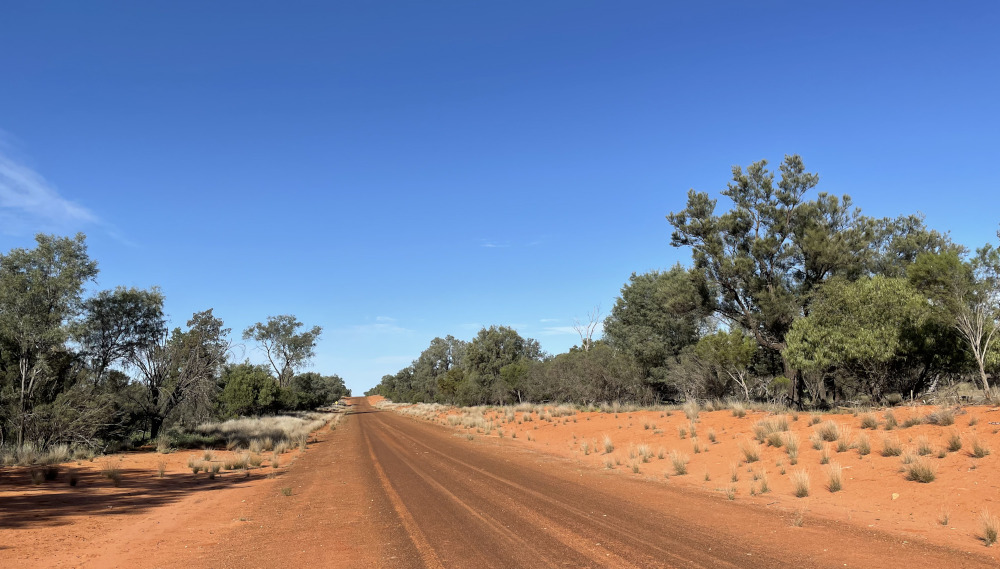
The book accordingly begins – Chapter 1 – in an improvised seminar presentation, given on the 29th of August, 2022 at the University of Canberra. Over those pages we and our various interlocutors on campus consider the strategies we have thought up to bring narrative consistency to A Book that Opens, given that the conversations that course through it are, effectively, being made up on the spot. But nothing is really made up on the spot. The rivers of story and pre-given phrasing from which everyday speech emerges, in European and indigenous cultures alike, contour that presentation, as much as they contour the chapters that follow. Chapter 2, taking to the road, is set on the way from Canberra out to Bourke and captures a set of uncannily postcolonial ghost stories told by the tow truck driver who rescued and then disturbed us, when we broke down past Dubbo. Chapter 3 is the first set on Barkindji Country. It begins at a turning circle, a few metres from the entrance to Gundabooka National Park. WK Knight, a Barkindji / Kunya man and former Parks and Wildlife Cultural Officer, joins us at this point. We discuss why we are standing outside Barkindji ancestral lands, and cannot go in. Chapter 4, which follows immediately below, was composed later that afternoon, when we stopped at an Information Shelter on the red dirt road back to Bourke.

Posted in INTERVIEWS | Tagged , , ,

‘The slippage of speakers’: Lia Dewey Morgan in Conversation with Shastra Deo

Shastra Deo’s writing effortlessly transcends cultural rifts, striving from modernist allusion through indulgent fan fiction and out into something entirely unique. I met Shastra first via Instagram, then conducted our interview in a Google Doc over several months, spaced out to allow for other freelance work, literature festivals or burnout. Despite being the outcome of her PhD, her second book, The Exclusion Zone, brims with an unexpected bloodlust and spectral force. To my personal delight, her poems demand we expand our conception of what is deemed literature, reminding us how poetry draws so much of its potency from its rich network of connections.

Lia Dewey Morgan: First of all, huge congratulations on publishing your second book, The Exclusion Zone, and thank you for talking with me. My hope with this conversation is to draw out together some of the themes I’ve encountered while reading your work and delve into how you came up with such a compelling collection.

I thought we could begin with the title, as an initial launch point: an exclusion zone is an area barred from public access in order to avoid the potency of what is inside, to provide some sort of safety. Because we are told not to go there, there’s this alluring intrigue that gathers, particularly over several decades, which has captured the imagination of a wide array of filmmakers, game designers and other creatives – not to mention scientists! What in particular drew you to growing a book from the poetics of nuclear waste?

Shastra Deo: Thanks for making the time to interview me; I’m stoked! It’s so exciting to have this conversation with you.

The Exclusion Zone, in its current state, really began with the potential nuclear waste warning message from the Expert Judgment on Markers to Deter Inadvertent Human Intrusion into the Waste Isolation Pilot Plant, which I came across where I come across most things: on Reddit.

This place is a message… and part of a system of messages… pay attention to it!
Sending this message was important to us. We considered ourselves to be a powerful culture.

This place is not a place of honor…no highly esteemed deed is commemorated here… nothing valued is here.

What is here was dangerous and repulsive to us. This message is a warning about danger.

The danger is in a particular location…it increases towards a center…the center of danger is here…of a particular size and shape, and below us.

The danger is still present, in your time, as it was in ours.

The danger is to the body, and it can kill.

The form of the danger is an emanation of energy.

The danger is unleashed only if you substantially disturb this place physically. This place is best shunned and left uninhabited.

I still can’t help but read the message as a poem. I became obsessed with the nuclear semiotics problem: how do we warn future generations about the dangers of nuclear waste when the half-life – the time required for the radioactivity of an isotope to drop to half its initial value – of a nuclear isotope like plutonium-239 is approximately 24,100 years? How deep can we inter these materials to avoid harm, and how deep must our collective memories be to truly enact this burial? It was a task I could neither finish or abandon, and out of it came The Exclusion Zone.

But before nuclear materials metastasised within the collection, there was my obsession with phantom limbs – the ghostly sensation of a body part that is no longer physically present. My first book, The Agonist, was concerned with how we store memory within the corporeal body; body phantoms are this idea made literal. American Civil War folklore suggests that if you bury an amputated limb according to ritual, and leave its grave at peace, the phantom won’t rise to haunt the living body. Would nuclear semiotics and an atomic priesthood lead future generations to believe the same thing about this waste that resists its own disposal?

Just like body phantoms, ‘[n]uclear materials ask us to believe in the invisible’, says Peter C van Wyck. An exclusion zone asks us to believe the space outside it is safe. And where is safety in this current climate of uncertainty around social equality, political freedom, job security, and our ecological future? So much lives and breathes and thrives within real-world exclusion zones—I think often of Kunihiro Suzuki’s post-disaster Fukushima illustrations, one of which is titled This land may not need human beings anymore. I always envisioned ‘wastelands’ as scorched earth, hungry landscapes, but more and more the wastelands I see are vital and vibrantly alive.

Posted in INTERVIEWS | Tagged , ,

‘It turns into a new language’: Saaro Umar in conversation with Elyas Alavi

And once you’ve gone, you can’t come back anymore. The almost-end of an exchange that comes close to passages between James Baldwin’s David and Giovanni; here between the voice of Magaye Niang and Marène Niang, as she glides naked across thick Alaskan snow, breasts upwards, the foreground close to the colour of the sky, she replies, I think I’ve already heard this song. She is shadowy, ghostlike, whereas he, head to toe in light denim blue, melts into the landscape, and seems four beats behind; they never meet; their voices, have the sense of travelling a long distance to be heard, like an echo.

Earlier in Dakar, filmmaker Mati Diop films a special screening of Magaye and Marène’s early roles in Touki Bouki (1973), a film made famous by her late uncle, Djibril Diop Mambéty. It’s been forty years since its premiere. Diop revisits the actors, what has become of their lives, whilst tracing inheritances – familial and otherwise, towards those who leave, and left and those who stay, and stayed – as threads troubling a coherent past and presentness to coloniality and displacement, and its subsequent entanglement in cinematic production for the filmmaker and her actors. Marène, like her role as Anta, has left Senegal and Magaye, like his character Mory, has stayed, a curious case of convergence, or destiny, or, this is, just as Diop has made it apparent. We see Magaye now, post-screening in front of the light of the projector, saturated in electric blue. Other men on stage with him, facilitate questions, their shadows forming silhouettes – tall against the sheet. The host turns to him; blue, everything blue and asks him, what has happened since then?

A close up on his face, it turns to sea. Total hesitation, anguish across his brow, then the camera moves to focus on the shadows directly behind the figures.

About this blue. Magaye’s anguished blue. I was in a gallery, a few years ago, and entered a room that glowed this exact colour. I walked in and took a seat on a white bench against a wall hugging the hallway. Tight across from where I sat was a blue wall. In the top right-hand corner a circular neon poem; blue. At the ground, and to the left, a tomb-like box, and within it, another neon-poem. Blue again, but red too; the ground shone with it. The way the light worked, I felt under a spotlight, I felt something pour. Dense with feeling, my own pain palpable and inarticulate. The artist, Elyas Alavi, a poet working across painting, installation, performance and moving image. I happened upon his work the day after seeing this short film, Milles Soleils (2013) for the first time; a film I now return to, as I do his practice. Both trace the materiality of crossing and not crossing a threshold. And sitting amidst his work, I remember seeing Mory turn away from the departing ship in Touki Bouki, I remembered Magaye, and his answer to Marène’s half-question. About what she heard.

And you will hear it again. There will always be someone somewhere to sing you this song. After spending time with Alavi, our talk drifting towards his grandmother’s garments, the life of neon and Hafiz as guide; I remember this dialogue as akin to a line he might gesture to, in a poem.

Saaro Umar: I first encountered your work at Hyphenated Biennial (Substation, 2019). I remember, you had two paintings showing, and also poetry-text in neon lights, and what I remember is being overwhelmed by colour. There was this blue. Blue of the walls, and too, a blue, and a deep red, from these light-poems that read: ‘Memory is a Dagger’. I sat for a long time, taking in this exchange of light and shadow and colour and metaphor. And, since following your work, I’ve noticed these colours – blue and red, repeat in your work and exhibition practice. I’m also thinking about the blueish and red thread that you make visible in the Ordugah/Detention Camp work. Where you unravel thread from a childhood jumper around the borders of a neighbourhood in Iran, where many Afghan refugees live, to make present the enclosure that the residents experience. To start, I wondered if you could speak to repetition and return as methods for your practice? And, what images, ideas or gestures do you find yourself revisiting and returning to?

Elyas Alavi: It’s beautiful to know these similarities. It’s not like forgetting, but once you look back, you see those connections through the eyes of the viewers; you re-find those connections. And, you’re right. In the work, Ordugah or Detention Camp, I used different threads that were undone by my mother’s hand from these old jumpers. Because, I find that mothers, especially mothers, are so creative in their way. My mother being a mother of eight children, she had to be resourceful. How creative she was, how she turned old jumpers into new things. Some of them were left in Iran, and on a visit, I saw them and I got permission to use some of them, especially those blue and red in colour. Ordugah means Detention Camp and I have always felt the suburbs that many Afghan migrants live in are lookalikes to Ordugah with invisible walls. In these suburbs, only certain people can live. People who are pushed out of society. There are Afghan refugees, people who are from sub-religions, gypsies, outcasted musicians, and people from Balochi and Kurdish ethnic backgrounds who are also pushed out. I feel we are a collective of many minorities living in one place. We are there as cheap labour, whenever there is work needed on difficult jobs, like construction or digging well. It’s a camp, but the walls are invisible, so I used those threads, trying to make those walls visible at least for a few seconds, a few minutes, a few hours.

That is a thread throughout all my works, through the works you mentioned, at Hyphenated Biennial and to a current work, now showing at the TarraWarra Biennial; that thread is there, wanting to make visible those walls. For the Hyphenated Biennial, the conversation was about the history of the cameleers, who were brought to Australia as cheap labour between 1860 to 1920, and how they were kept in certain conditions, in discrimination. Through my poetry and my art, I have this medium to try to show these walls. There’s so many beautiful things happening within our bonded community, through this shared pain, through discrimination, and also showing a mirror to the other side, that there is still so much force.


Posted in INTERVIEWS | Tagged , , ,

How to Be a Digital Artist in a Time of Climate Change

John Berger’s famous 1972 television series Ways of Seeing opens with an argument that visual technologies like photography, and the mechanical reproduction and distribution they enable, free pictures from the confines of their singular location. By doing this, Berger argues, the photograph changed the very logic of vision itself. With images able to travel freely they can be seen from anywhere, by anyone. What becomes possible is seeing in a whole host of contexts previously impossible. He points out the strange juxtaposition that ensues:

Boticelli’s Venus and Mars used to be a unique image which it was only possible to see in the room where it was actually hanging. Now its image, or a detail of it, or the image of any other painting that is reproduced, can be seen in a million different places at the same time. As you look at them now, on your screen, your wallpaper is around them. Your window is opposite them. Your carpet is below them. At this same moment, they are on many other screens, surrounded by different objects, different colours, different sounds. You are seeing them in the context of your own life. They are surrounded not by gilt frames, but by the familiarity of the room you are in and the people around you.

If photography and the moving image exploded the logic of vision from one viewer, one image (both in a highly specific context) becoming many viewers and many images, across many different contexts, then the internet has clearly turned this dynamic up to 11. Audiences of digital art are just as likely to encounter it on their phones as in a gallery, to see the art while surrounded by the cacophony of the everyday and the familiar. As painter and illustrator David Surman discussed in a 2018 artist talk concluding his gallery show ‘Paintings for the Cat Dimension’, the effect of the internet has been just as profound as the photograph:

I think painting after the internet is a paradigm shift. I think internet culture has restructured everyone’s thinking, it has to be accounted for. But it doesn’t mean a technological aesthetic, it has more to do with the structural logic. If you think about a browser window with multiple tabs [open], and the incredible discontinuity of your banking, your amazon page, your social media, pornography, writing a letter to your friend. That cultural logic has to come into painting. Radical discontinuities within painting feel much more normal, much more suited to where you are at.

I suspect that we are also able to see the beginnings of another major shift or disruption to the dominant cultural logic. This time, however, the shift is not being driven by a communications technology so much as by the overripe, putrid fruit of two hundred years of fossil capitalism. This fruit is borne into the world as greenhouse gas emissions, altering the very chemistry of the air and seas that sustain life. The world is only just waking up to what it truly means to live through a time of climate change, and the profound way that it reconfigures our thinking, and the new demands it places upon artists, cultural practitioners, human beings.

For me, awareness began just over a decade ago, with a piece by Bill McKibben in Rolling Stone in 2012 about ‘Global Warming’s Terrifying New Math’. Despite being aware of the problem for years, living through frequent and intensifying Australian summers (including bushfires that came right up to our house), it wasn’t until McKibben quantified global CO2 that my own understanding started to take shape. The concrescence of a known quantity remaining in our global CO2 budget, placed alongside the equally quantified and much greater amount of fossil fuel reserves already discovered (even in 2012!), produced a dawning horror. That same creeping dread comes again with every reminder of the steady tick tick tick of higher and higher atmospheric concentrations of CO2, punctuated by moments of visceral horror in the form of climate disasters. It can either be paralysing or existentially motivating. I choose the latter, and pivoted my academic research to digital games and their intersection with climate issues.

Whatever the genesis of this feeling in individuals is, it’s becoming clear that more and more of us are having them, and trying to figure out how on earth to respond. How do we live and work in a context of a disintegrating environmental stability? What does a meaningful response to climate change and the CO2 emissions that are driving it even look like in digital media? What does a climate conscious digital art practice involve?

One of the earliest groups I became aware of attempting to answer this question was centred around the Italian based Low Tech magazine. It’s an online publication which rejects the default, high-tech solutionism on offer, and instead regularly performs archaeologies of forgotten techniques and tools, more and more pertinent in light of climate constraints. Well ahead of mainstream sustainability awareness in digital media, Low Tech has been publishing for over a decade on topics as diverse as the surprising return of DC power networks, as well as practical solutions like how to build a low-tech internet, as well as more controversial and esoteric takes that might struggle to find wide acceptance. ‘Why the Office Needs a Typewriter Revolution’, ‘Recycling animal and human dung is the key to sustainable farming’ and other stories like these will be a bridge too far for some. Digital sobriety (or sobriété numérique, where it seems to have gained the most traction) is perhaps just a bit too constraining, a bit too lacking in appeal, for all its virtues.

Posted in ESSAYS | Tagged , , , , , , , ,

Ambot sa Essay Kwoah: From Swardspeak to Hiligaynon, What Queering Language and Forms Means to Me

Before I begin to talk about my poetics, I want to put everything into context first.

The Fight of the Bakla

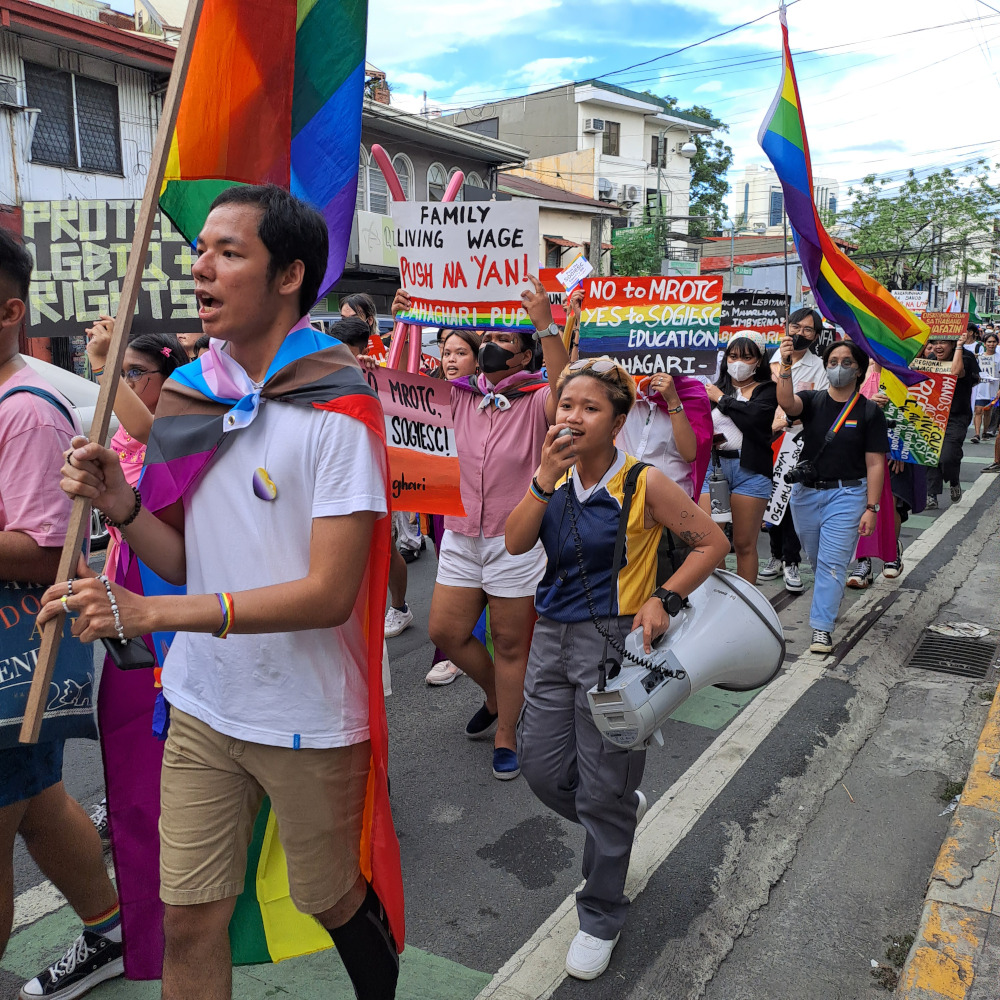
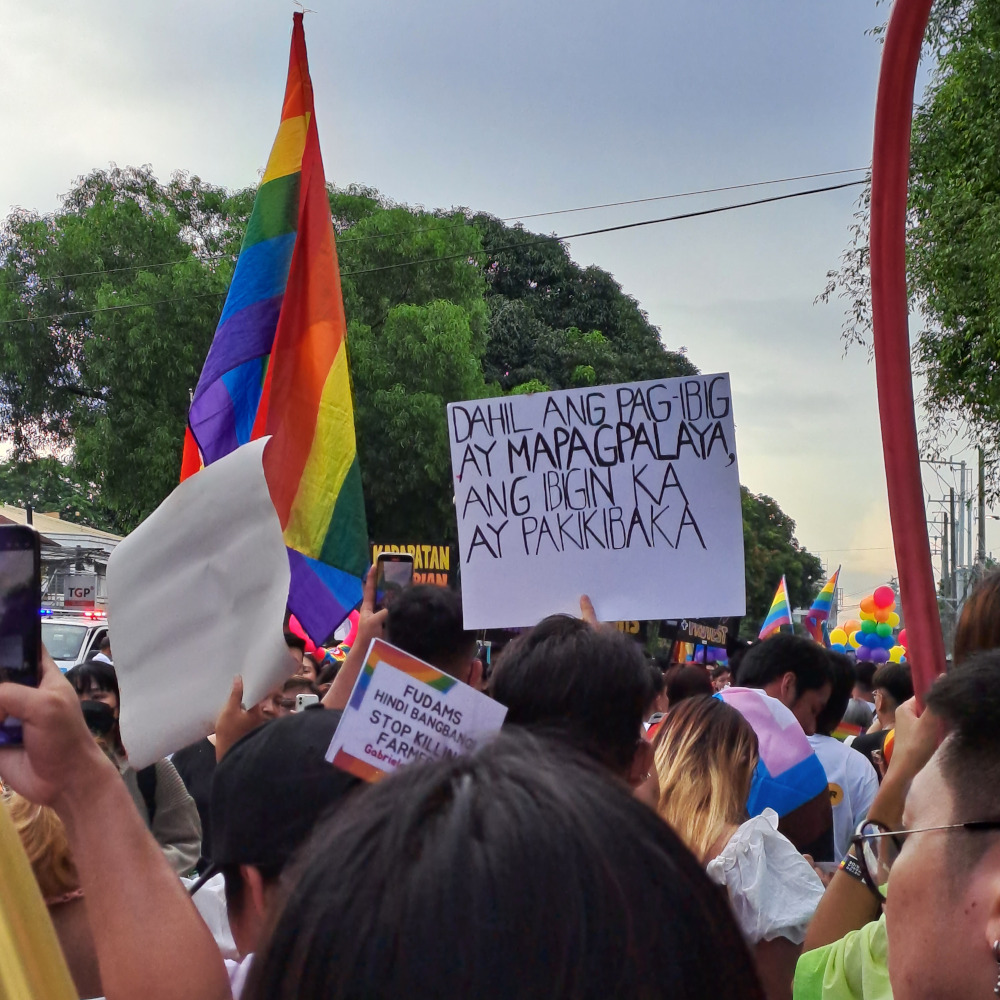
I went to this year’s Pride March with the goal of just taking pictures for this essay and going home immediately. The event was only a couple of minutes away from my apartment. One more thing that convinced me to go was the convenience. Pride Marches don’t really happen near me. In previous years, I had to commute to them. I accepted that my participation this year was only artifice, that I cared about appearances and nothing else. Walking alone to the march, I felt a certain singularity. I saw my body as timid and anticipatory. Okay, I felt self-conscious. As in the self makes itself known to the body. I arrived mid-march, stopping before the parade to spot an opportunity where I can blend in with the crowd. I saw companies sporting their T-shirts and their banners rolling by. I wasn’t really interested in joining companies trying to hit their DEI goals for the year, even though I shared some of their motivations for the day. Then, Bahaghari (Rainbow) Philippines, a national democratic, non-profit organisation that advocates for LGBTQ+ rights in the country came into view. No, their voices reached me first, loud and ringing and direction-full. I was invited to their cultural night the year before to read my poetry along with other writers and artists. I immediately joined them.

My body in motion, in utterance, pushed my self-conscious-ness outward. I am a solitary person most of the time. The inwardness as my cave. I am a Virgo and, in the tarot, the Hermit card represents me. But it felt nice being out, in every sense of the word. It was nice finding a place in that crowd. It was nice knowing that there is room for me in the struggle. My voice doesn’t carry that much weight. I’m soft-spoken and don’t know how to express my anger. In that crowd, the other people’s voices carried mine. Yes, I got my pictures but then it didn’t seem important to have them. Being in the crowd, doing what we do, stripped my assertion of artifice away. I shouldn’t separate myself from what we have to fight for.

The Philippines’s and Asia’s first pride march happened on 26 June 1994 and was inspired by the Stonewall uprising in 19691. Despite being the first in Asia, the Philippines is taking its sweet time in passing into law its anti-discrimination and harassment bill or the Sexual Orientation, Gender Identity, Gender Expression, or Sex Characteristics (SOGIESC) bill. It has been stuck in deliberation for 30 years with only this year’s house panel approval seeming to move it closer to legislation2. But confidence in lawmakers to pass the bill is low, especially with delaying tactics, stiff opposition from religious groups, and disinformation campaigns against it3.

Pride is a protest. That’s reiterated in this year’s Pride March with organisations giving updates on the next steps to attain our rights and with the protest chants, ‘SOGIE Equality, ipasa na!’ (Sogie equality, pass it now!), ‘Makibeki! Wag mashokot!’ The latter is a Swardspeak version of the slogan. Swardspeak or Gayspeak or Bekimon arose in the community, particularly with gay men, as a coded lexicon4. Makibeki comes from the word Makibaka which means to participate in the struggle. Beki is the Swardspeak for Bakla which means gay. Wag mashokot comes from huwag matakot which means don’t be afraid. Wag is the shortened version of huwag and mashokot is the Swardspeak of matakot. I know it’s a lot to take in but once you get it, you get it. In ‘Gay Language: Defying the Structural Limits of English Language in the Philippines’, Norberto Casabal posits that it is a form of verbal sublimation of gay people against the domineering power of patriarchy. The Filipino gay community began coining words that can be associated with the original word, either by its literal meaning or denotation, or by using other shades of meaning or connotation. It also includes the collocation of words through their phonological resonance and resemblance. There are many-many words in the Swardspeak vocabulary. One can even say a full sentence with them. Because of its rising popularity, almost everyone outside the LGBTQ+ community can understand it. Part of its appeal is that speaking it is fun. It’s like taking something plain and putting glitter all over it, creating something exorbitant, an ornamentation. What I like most about Swardspeak is its musicality, how the LGBTQ+ community’s inflection turns playful, that language is a vessel for laughter.

Posted in ESSAYS | Tagged , ,

Notes on Bad Poetry

Some poems are bad

Maybe we’ll always disagree about poetry – about how it works, and what it’s for; about its modalities and affordances; about what makes a good poem; about why you might want to write or read one. For as long as anyone can remember, the poetry scene has been characterised by clashing opinions. In this bewildering proliferation of disagreements, the sheer existence of bad poems offers a rare point of consensus. For as we all know, bad poems exist. I’ve read them. You’ve read them. Some of us might even have written a few. And we can all agree they suck. That there are bad poems is a critical fact so empirically incontestable as to verge on the axiomatic. It is as if, in our efforts to come to grips with poetry, we have here – at last! – touched on something irrefragable, recalcitrant, certain.

Maybe we’ll always disagree about poetry, Ben Lerner says in his The Hatred of Poetry, but at least we all agree that some poems are bad. ‘It is’, he states, ‘much harder to agree on what constitutes a successful poem when we see it than it is to agree that we’re in the presence of an appalling one’.1 Lerner finds this spontaneous agreement reassuring. It’s a common-sense judgement that for him testifies to an actually existing critical sensus communis. It bespeaks the transcendental coordination of our critical faculties, despite everything that otherwise divides us from each other. With bad poetry, the universality so often promised in theories of aesthetic judgement appears finally at hand, albeit via a negative path.

Lerner takes as his Exhibit A of bad poetry ‘The Tay Bridge Disaster’ by the Victorian poet William McGonagall, which begins:

Beautiful Railway Bridge of the Silv’ry Tay!
Alas! I am very sorry to say
That ninety lives have been taken away
On the last Sabbath day of 1879,
Which will be remember’d for a very long time.

You can read about McGonagall on Wikipedia, our contemporary repository of common sense – which, as Lerner quotes, states that McGonagall is ‘widely acclaimed as the worst poet in history.’2 But when it comes to McGonagall’s absolute badness, Lerner sees no real need for any appeal to such authority. Firsthand experience proves sufficient in itself, for the badness of this poetry will be obvious to all. Lerner remarks that ‘McGonagall’s horribleness is evident even to those of us who don’t read poetry’, and outlines a procedure for empirical verification: ‘recite this poem to a friend who has no interest in – or significant experience of – verse, who claims to know nothing about it, and I wager that she will concur, whether or not she can specify its failings, that it’s at least very, very bad’.3 If you don’t take my word for it, try it yourself. Even idiots agree: McGonagall’s no good.

McGonagall was not always acclaimed as the world’s worst poet. His rise to that bad eminence took place across two relatively discontinuous episodes of critical reception. For around two decades from his first published poem in 1877, McGonagall was essentially a local poet – an obscure figure, of minor notoriety only in the Scottish Lowlands industrial city of Dundee and, for a few years before his death in 1902, also in Edinburgh. Trips to London and New York were brief and ended in failure. Wider recognition did not follow until some decades later, when McGonagall was rediscovered in a series of print publications from around 1930 that introduced his poetry to increasingly expansive national and international readerships.

In early instances of this re-uptake, McGonagall tended to be characterised in intensely regional terms and treated as almost entirely unknown. In 1929, the English journalist and travel writer H.V. Morton observed there were ‘few who still remember McGonagall’, and noted that he ‘seems to have in some unaccounted way escaped recognition’.4 Morton’s comic discussion of McGonagall appeared in his best-selling travelogue, In Search of Scotland, where he was cast as ‘a genuine relic of Old Edinburgh’ randomly encountered while pootling about Caledonian byways.5 A few years later, Hugh McDiarmid took a more rancorous line when including McGonagall in his collection of Scottish Eccentrics. While Scottish ‘general opinion’ held McGonagall to be ‘synonymous with bad poetry’, McDiarmid was ‘not sure he is much known in the English-speaking world outside Scotland’.6 Despite being largely forgotten, McGonagall had nonetheless arrived at ‘the recipe which has made modern Scotland what it is’.7

From this initial 1930s moment, the reception of McGonagall opened out through ever more extensive pathways of mass print circulation. He was read in new contexts, taking on transformed critical functions. His writing began to be reissued: his Poetic Gems of 1890-1 was republished in 1934, and has never fallen out of print for stretches longer than a few years since. (Remarkably, McGonagall is now Scotland’s most widely published poet – ahead even of Burns.) Through the 1940s, he was a subject of comic reportage in literary magazines and weekend newspaper cultural supplements in the UK, the USA, Australia and elsewhere. In the 1950s and 60s, he provided a reliable go-to example of poetic failure for university literary critics; he was also serving as a butt of routine mockery for a new generation of English comedians. Writing in 1965, Hamish Henderson could go so far as to note that ‘McGonagall is in the news again – indeed, he is very seldom out of it’.8

In 1974, he was the subject of a feature-length biographical film, The Great McGonagall, starring Spike Milligan as McGonagall and Peter Sellers as Queen Victoria. Two years later, the critic Paul Werth sought to demonstrate the specious nature of Roman Jakobson’s structuralist method of poetic analysis by uncovering in McGonagall precisely the same kinds of linguistic patterning Jakobson had detailed in such unquestioned masterpieces as Baudelaire’s ‘Les chats’ and Shakespeare’s Sonnet 129.9 So much for literariness; so much for the poetic function. Werth’s reductio ad absurdum was repeated a year later against another critical school in a tongue-in-cheek essay by ‘U.B. Leavis.’ There ‘Leavis’ claimed McGonagall as a central figure in ‘the Great (neglected) Tradition of English Poetry’ thanks to his capacity ‘to place experience in time and space, to establish order in the transient flux and upheaval of life, and to see that order in human affairs against the background of a wider, more all-embracing, almost cosmic, certainly metaphysical, universalistic order’.10 By this point, McGonagall’s badness had acquired the property of self-evidence so valued by Lerner: ‘most people would doubt that it has any literary merit whatsoever’.11

Posted in ESSAYS, SCHOLARLY | Tagged , , , , , , , , , , , , , , , ,

POP! Editorial

Welcome to the POP! edition of Cordite Poetry Review, in which Gatsby’s green light hovers over this text to tell you we are °º¤ø,¸¸,ø¤º°`°º¤ø σηℓιηє °º¤ø,¸¸,ø¤º°`°º¤ø, baybee. As pop connoisseurs, we already had a sense of where our tastes diverge. (Bec, in Zen’s words, listens almost exclusively to gay club hits of the ’90s, huge soppy ballads and whatever the soundtrack is this week on Grey’s Anatomy. In Bec’s words, Zen’s diet is androgynous sad-girl belters, cult documentaries and Star Trek by way of Star Trek podcasts.) But we were surprised that our survey of submissions from nearly 400 poets resulted in zero marital barneys; generally, we agreed, and the shape of POP! came together as easily as the Babadook became queer culture.

In our call-out, we asked contributing poets to enter the ‘Meme Cinematic Universe’ — to celebrate the pop poem as a dank-memetic smashing together of the bold and the mundane, the low-brow and the archly ironic. Think of these poems as a contemporary textual soup can — Warhol’s instantly recognisable simulacra of culture remixed, reprinted, reinterpreted over and over and over. A full quarter of the poems you’ll read in this issue are prose poems (proems?) of some kind. There must be something in the four walls of the paragraph that invites wordplay, assemblage, mucking about — that already rejects our ideas of The Poem. (Good fences make good paras?) The map is not the territory — or is it, after all?

Of no surprise was the torrent of ekphrastic poems responding to artworks (Warhol, Lichtenstein, Bosch); music (from Shania Twain to Pulp to the Topp Twins); movies (from Shrek to Star Wars to the oeuvre of Keanu Reeves); and television (Kath & Kim, Star Trek: Voyager and a poem in which an ‘apoplectic’ Dr Phil ‘tears off his shirt and screams’). A category full of welcome surprises were poems written after games: a cento from reviews of Zelda: Breath of the Wild; a concrete poem in the shape of a Galaga spaceship; and a WORDLE ode in only five-letter words.

Some poets saw pop culture’s adjacence to consumerism — that is, fandom as conspicuous consumption. There is a poem in which the speaker eats a painting; another in which a painting, in turn, consumes an entire ’90s boy band. And we were delighted by work that made pop art of pop forms: a template for Instagram poetry; a poem capturing the sensory acuity of ASMR videos; an MS-DOS-esque text adventure asking: ‘What would you like to do? >Submit a terrifyingly germane and mundane text adventure poem to CORDITE POETRY REVIEW’.

These ekphrastic-ish poems form just over half the issue’s bulk. Each, in some way, reaches beyond the reference point — becoming more than the sum of its fandoms. From there, we found our way to poems that popped in other ways: that just sounded great; that came at some kernel of pop psychology; that celebrate nan and pop; that punch up the list poem; that had ‘whiter than white teeth’; that ‘parade … our many splendid genders’; that confidently roll from zombies to the ‘glorious rococo towers’ of a thunderstorm; that ‘paddle through syntax’; that ‘rip bongs at the bus stop’; and that mythologise cheese. These poems are ‘plastic autopsies’ and ‘ekphrastic obituaries’ — but are undead, too, rising from the fertile soil of yesterday’s algorithm to put their warm fingers right on your pulse.

Posted in ESSAYS | Tagged ,

Tīfaifai and Translation: Piecing ‘Nadia’ from Chantal Spitz’s Cartes postales

In her 2006 collection of essays and poetry Pensées insolentes et inutiles, the pillar of francophone Oceanian literature that is Tahitian author Chantal T Spitz ruminates on the purpose of her writing: ‘This isn’t an autobiography but it now seems to me that my experience and that of many others could constitute the tifaifai1 of our fragmentations for an alternative writing-reading of our story.’2 Spitz, a foundational figure in the literary community of Mā’ohi Nui/French Polynesia, is most widely recognised for her first novel, the first published novel written by a Mā’ohi writer: L’île des rêves écrasés (published in 1991 and translated into English by Jean Anderson as Island of Shattered Dreams in 2007). In the three decades since this story was published, francophone Oceania – specifically Mā’ohi Nui/French Polynesia and Kanaky/New Caledonia – have experienced a veritable renaissance of autochthonous literary production. Throughout her career, Spitz has helped increase the visibility of writing from across her community, making space, as she says, for her experience and that of many others to tell their story, their history.

Implicit in this opening excerpt from Spitz’s work is the reality that she articulates explicitly elsewhere: that Mā’ohi stories have long been told from the outside and that the ontological violence of separating the story from its community is an aspect of European colonisation that is ongoing. What Spitz proposes, however, is that the literary work of her community constitute a tīfaifai: a patchwork quilt that is at once a means of artistic expression and tool of social exchange. The colorful appliqué cloths are, as Tahitian scholar Kareva Mateata-Allain explains, ‘a major artistic symbol of the island cultures … {and} an integral symbol of Ma’ohi cultural production.’3 These quilts are given as gifts to commemorate important life events and can be found in many forms throughout Mā’ohi Nui.

While Spitz has used this metaphor to describe many writers contributing to a unified if diverse project, her own writing reflects the intricate vibrancy of the tīfaifai as well. Her literary work uses a distinctive texture of writing; without punctuation or traditional capitalisation, Spitz structures her stories in a poetic prose that echoes the region’s long oral tradition of literary creation. In the same way, Spitz puts particular emphasis on the voice that comes through in her work, often weaving the individual perspectives of her characters in a pattern that performs the story she tells as much as articulating it in words. This method of literary performance is particularly central to her 2015 collection of short stories, Cartes postales.

Cartes postales (‘postcards’) is a slim volume comprised of seven stories that take place on the island of Tahiti. The stories are nominally unconnected to each other apart from their common setting, but they are thematically aligned in the picture of violence and despair. They paint an island largely seen elsewhere as an earthly paradise. The violence experienced by the characters in this collection – at once extreme and everyday – is striking in the contrast it presents to the picture-perfect postcards evoked by the collection’s title. As with so much of Spitz’s work, her most powerful intervention is performed, not explicit, an argument articulated not in the linguistic shallows of direct address but in the depths of readerly experience. The reader discovers her intervention as a consequence of their close reading.

The translator’s job, then, is to maintain this intervention from the depths while shifting the idiom of the shallows to make the story linguistically accessible to a wider audience. In my own translations from this collection, I have sought to maintain the careful patchwork of Spitz’s striking tīfaifai, a work of contrast and relationality that pieces together a complex tableau. I present here a reading of one story – ‘Nadia’ – from this collection.4

The second story of the collection, ‘Nadia,’ opens with a vision of Tahiti, grotesque where the historic exoticisation of Polynesia has taught us to expect paradise.

the swarm of flies shivers the smell of carrion that churns the air
choking the fifth-floor residents of the apartment building that’s gone to seed in this
neighbourhood crushed by heat by noise by dust
chipped walls rutted road broken up sidewalk
a stone’s throw from the waterfront newly arranged for cruise goers
who occasionally descend on the town like a settlement of twittering birds
in pursuit of the last noble savage from the last earthly paradise
a heavy slimy murky scent that stills the air stops the breath stiffens the mind
making the unthinkable palpable
human rot
unseen death
lonely decay

From this initial image, we are introduced (though no introduction or other contextualisation appears) to the eponymous protagonist of the story. Nadia is engaged in promoting Tahitian vanilla in a trade show in Paris when she meets Mathieu who is promoting the black pearl trade, and their romance promises her vast new horizons in Tahiti. This shift in perspective is unmarked within Spitz’s text apart from a subtle line break and the use of first-person pronouns.

I meet Mathieu at the Paris agricultural convention
he’s a black pearl trader
I hand out leaflets on French Polynesia’s brown gold
Tahitian vanilla the best in the world they say
his voice wraps me in a muggy torpor
as he blooms my imagination with the exoticism bursting from the stand’s photos and videos
he is my first and last love giving scope to my changeability
my life takes off
so beautiful you could die he promises me
sun sand sex
I’m not sorry as I leave my drabness for the end of the earth and he for a vast horizon
draped in unknown scents unheard music infinite futures
waiting for me with flower necklaces and two pearls
me the black one you the white one together for better he says with a kiss
bungalow on stilts champagne candlelit dinner over the water
perfect night
Posted in ESSAYS, TRANSLATIONS | Tagged ,

Can Poetry Be Happy?

I’m reading Donald Horne’s The Lucky Country (1964) at the breakfast table, with instant coffee, toast, orange juice and green smoothie (spinach, banana, chia, milk). Dad’s taping the races, then going to Warnambool with his brothers. Taylor Swift is playing softly from the laptop speakers. I am idly scrolling through the Facebook group Fairy Floss Real Estate. I am reading a text message about a man who keeps saying he ‘loves Obama’ to impress a woman at the bar. He is saying ‘I love Obama’ and then putting his hands around his face or supporting his head from his chin.

My uncle named his retro-fitted army van after Field Marshal Erick Von … someone. I’m hesitant to Google. He’s laughing about my PhD stipend, which he (rightly) identifies as a scam. ‘You already know how to write!’ ‘Hahaha’ we laugh … and he goes, with dad and his many shopping bags of food and beer. I’m slowing down, working from home, trying to be a good son and friend. Will I succeed?

Horne writes: ‘The image of Australia is a man in an open-necked shirt solemnly enjoying an ice-cream. His kiddie is beside him’. Alone in my parents’ house on a Monday after a weekend spent partying at Melbourne’s best (and most pretentious, says my friend’s hairdresser) club, Miscellania. Looking around the club at my friends who seem, unlike me, to know most of the fellow clubbers, I couldn’t figure out what they were talking about. I couldn’t understand where they could find language at a time and a place like this, back at the club at 9am the next day after leaving at 3am last night and not sleeping. I watched a man pull the blackout curtains back to find an unopened window, then vomit onto the couch. He was wearing a straw country-style hat. He wobbled to a seat and sat with his head in his hands.

Money means a fair go and we did have a fair go of it. DJ Kitti came on and we danced and then I felt sick and we went home. The party was just starting but I had had my party the night before, dancing madly like a last hurrah, the finale of about 9 months of consistent binge drinking and staying out late on weekends. When I got home, I ate leftover microwaveable lamb shanks with mum and dad then went to bed, watched two episodes of Succession (BINGE, now with ads?) then went through my photo reel, then fell asleep. My room is cold and drafty. Draughty? I have two doonas.

There’s an Albert Tucker painting on the cover of my copy of The Lucky Country. A man with a feather in his hat, a white collared shirt, an ace of spades poking out of the left breast pocket of a black blazer, clutching a yellow mug. His face is riddled with harsh furrows and his hat shades his one visible eye in almost complete darkness. In the background, water and sky, shark-like fins of boats circling around the figure’s neckline in a muggy green sea. His chin is an upside-down triangle. I’m wearing my yellow Champion hoodie, a scarf by a Melbourne designer, and tracksuit pants with Crocs.

The weekend’s dancing was restorative, I say. But then what? What have I restored?

* * *

The leaves are falling from the small trees at RMIT University. I want to be happy, do I? I’m Googling ‘Corey Worthington’, then Discovery-ing and Google Scholar-ing ‘Corey Worthington’.

Posted in ESSAYS | Tagged , , , , ,

13 Artworks by Amala Groom


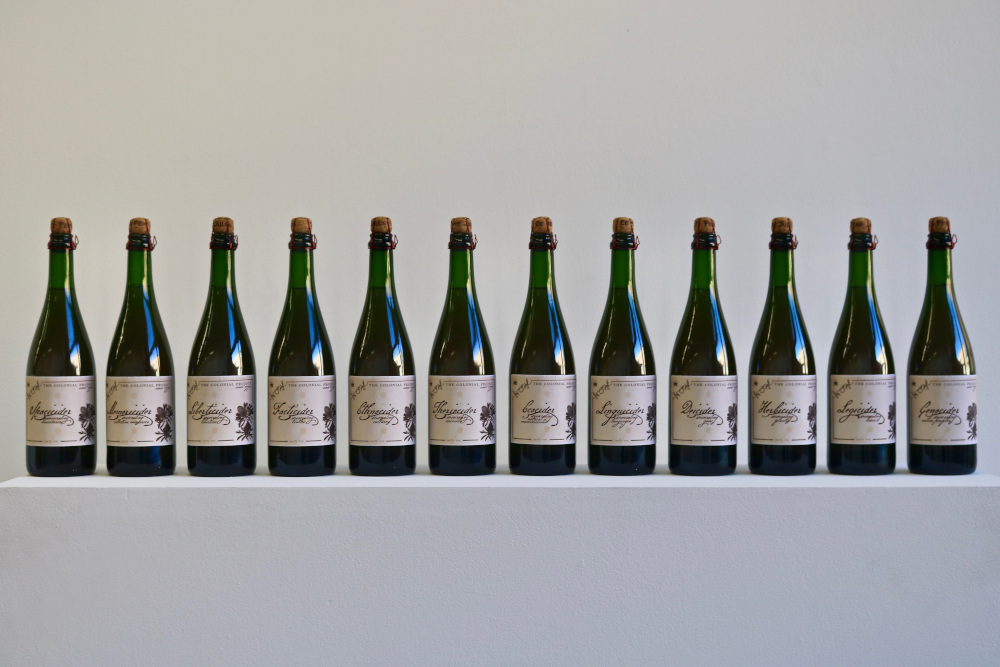
Amala Groom | The Cider Series | 2017 | glass, cork, wire, apple cider, ink, paper | 31 x 124 x 8.5cm
image courtesy of Amala Groom and Penelope Benton

The Cider Series is an iteration on an earlier series of paintings of the same name; a collection of a dozen bottles of Colonial Project cider where each bottle demonstrates a different way in which Aboriginal ontologies have been desecrated post colonisation.

As a play on words, -cide, meaning to kill, these seemingly attractive alcoholic beverages have been neatly packaged as a leisurely consumable; an intoxicating series of poisons brought to these many lands now known as Australia by the colonisers in 1770.

There are subtle reminders of the impact and devastation of colonialism in the overall label design. Each bottle bears the mark of its maker, the Colonial Project, and the ongoing philosophy of colonialism brought to Aboriginal lands on board the HMS Endeavour in 1770.

On the top left of each bottle is the imperial crown of King George III, the reigning king of Great Britain from 1760 until his death in 1820. The crown is symbolic to the imposition of the illegal, unethical and unfounded absolute authority and sovereignty of the monarch.

Featured across the series is a watermark of Lieutenant James Cook’s 1769 chart of the transit of Venus, sketched in Tahiti and historically documented as the official reason for Cook’s journey south. To the bottom right of each bottle is a banksia sketch, taken from native samples collected by Sir Joseph Banks, with drawings prepared by Sydney Parkinson on board the 1770 Endeavour expedition. No fewer than 76 species of this plant now carry his name.

The series includes:

  • Herbicider – Desecrating Plants
  • Facticider – Desecrating Truths
  • Deicider – Desecrating Gods
  • Linguicider – Desecrating Languages
  • Genocider – Desecrating Native Peoples
  • Theriocider – Desecrating Animals
  • Ethnocider – Desecrating Cultures
  • Legicider – Desecrating Laws
  • Liberticider – Desecrating Liberties
  • Spacicider – Desecrating Boundaries
  • Memoricider – Desecrating Collective Memories
  • Ecocider – Desecrating Natural Environments
Posted in ARTWORKS | Tagged

Opinion Fatigue: Monochromatic Voids and Typographic Symbols by Sebastian Moody


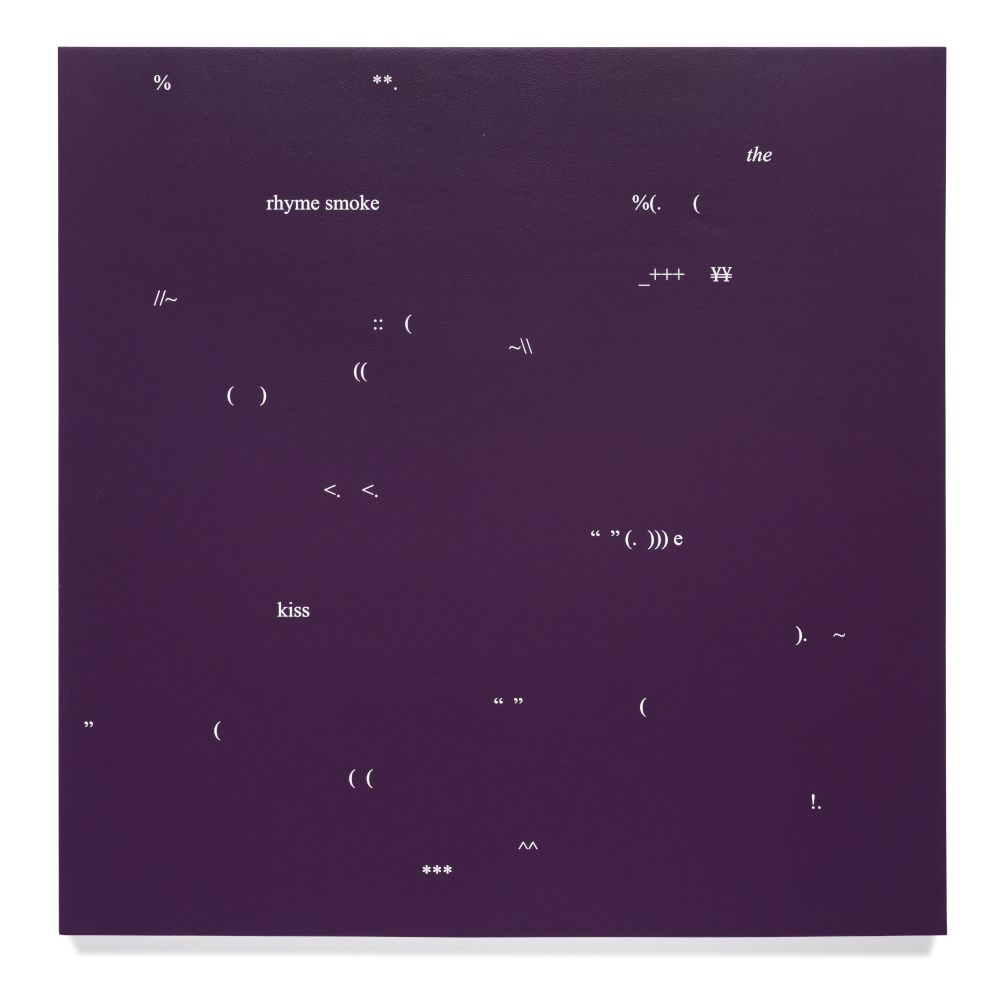
Opinion Fatigue (rhyme smoke)’ 2022 | acrylic on marine plywood | 1 x 1 m | Private collection | Photo by Louis Lim | Courtesy of the artist and Onespace

For Opinion Fatigue, Sebastian Moody has produced a series of monochromatic voids punctuated by sparse bouquets of typographic symbols. Very occasionally, a lone word appears. Created via a playful navigation of a Microsoft Word document, the scatological constellations recall the all-over compositions of mid-century avant-garde painting – the canvases of Arshile Gorky, Jackson Pollock or Mark Tobey. Adhering to the rigid verticality imposed by digital technology, the typographic forms are all right-side up: a submission to the grid of culture, but one that doesn’t abandon chaos.

On one canvas, the word rome appears in lower-case Work Sans font. A neo-Grotesque typeface, the style derives from sans-serif variations of the eighteenth century. These were titled Grotesque due to their being perceived as offensive affronts to their more ornate Roman-inspired predecessors. On another canvas, loosely framed with a little dipper-like formation of colons and semi-colons, a tilde, and several exclamation marks, the word feather appears in italicised Times New Roman. Perhaps inadvertent, this typographic choice might serve as a subtle dig at Stanley Morison, the typographer who designed the font in the 1930s. Though he eventually relented, Morison loathed italics. He believed they should be abandoned due to their disruptive influence on the flow of continuous text. Indeed, his typography was created for efficiency: to maximise the number of words that could fit on a page while maintaining an easily readable typeface. Letters, he argued, should ‘neither be very ‘different’ nor very ‘jolly’’.1

When written in the curly font, feather almost teases the semiotic status of the word as a signifier, blurring the distinction between symbol and icon. In its italic form, the f both ascends and descends – extending from the typographic baseline in both directions. On its own, the f might resemble the arch of a thin, free-floating feather or a quill. In the word itself, the flick of the italicised f corresponds with the downy tufts at the base of a contour feather. The midline carried by the horizontal strikes of the f and the t correspond to the feather’s shaft, while the voluminous swirls of the e, r, and f, and the offshoots of the ascending letters t and h, echo the de-shelled vane of a plumule. Indeed, italics create feathery words: words that operate as decorative plumage, indicating a title or differentiating spoken words within a text, signalling their light, ephemeral quality. As Morison feared, italics ruffle text, giving it literal and figurative texture.

A close observation of the canvases in Opinion Fatigue reveals barely perceptible bleeds, delicately feathering the edges of the elaborately stencilled white symbols: a detail that betrays their painterly status. To my mind, this painted typeface echoes techno-minimalist aesthetics, and the merging of traditional and futuristic materials and motifs exemplified by wooden digital clocks with subtle LED displays, glitched textiles, and touchscreen digital tablets with rough-textured screens resembling paper that converts handwritten text to Word documents. These gimmicky consumer products exemplify the contemporary emphasis on minimising the sensory disjunction between technology and organic textures and gestures. They cultivate domestic environments free of the aggressively sterile utility of appliances, instead favouring technologies that are covertly integrated, wireless, unseen, voice-activated or remotely controlled, an allegory of the inextricable and pervasive influence of technology today – the omnipresence of surveillance capitalism, data mining, and the concurrent hyperawareness of self-presentation mediated by clicks and keystrokes.

Concurrent with Opinion Fatigue, Moody’s work occupies the Open Studio – a space showcasing projects by contemporary artists in the Queensland Art Gallery and Gallery of Modern Art complex. Moody has decorated the floorspace with large typographic symbols. A pair of brackets forms an open oval as the centrepiece. The room is walled with mirrors. Furnishing the reflective light-filled space are ottoman benches that recall the shape of orange slices. The arrangement, and the orange-slice shapes, are a playful reference to Orange Event no. 3 (1963), a Fluxus artwork by Bengt af Klintberg gifted to Queensland Art Gallery in the 1990s by Francesco Conz. In this conceptual piece, participants are asked to arrange the orange slices in a row – an act that transforms a spherical object into a line, imbuing an everyday gesture with creative possibility. In Moody’s large plush rendering, the arrangement takes on a new scale and interactive potential.

Posted in ARTWORKS, ESSAYS | Tagged , ,

The MET After Being Fingerprinted

I wish I could be in awe over statues

I wander stare wait for one to fill me

goosebumps wonder whatever makes us come

back to this idea of brilliance

but though they are human they are not human enough

I wish I could take in the stiffness

surrendering to these people and faces

instead I stare blankly at the folds & decay

shellac-colors reflecting light glow

like sweat this one the most human and therefore

the one I look at more than once

in a way that makes me feel less hollow

his ear hanging lobe

unattached eyes forever past me

Posted in 110: POP | Tagged

On My Body As Proof

I eat paintings,
ingesting masterpieces
so they won’t fade,
eternally preserved in the gut of me.
I scrape paint chips from my molars.
a field of grass
or a sombre lady
imprinting on my skin from the inside out;
you can see tattoos stamped
inverse, in me.
van Gogh ate yellow paint
and made a self-portrait on his tongue
of a dying man.
his rotting bones remind me:
not every piece of art is paired with a description,
some walk backwards,
emerge from the soil,
or live on the body,
are handfuls of salt
and mouthfuls of sand.
you have to learn to spot them
without a label lauding them.
someday a man will cut me open and find
half of the National Gallery
caught in my oesophagus,
the stains of lead paints
and poppy pollen,
cave paintings in the cavern of my ribs;
my body a relic, peeling,
a testament to art and time.
the mortician will take one look,
and once they remove the blood
and the gas from me,
they will wonder,
like all great art
and sculpted things,
what I was thinking, and
what it all means.

Posted in 110: POP | Tagged

Galaga

Forgetting is a required skill: blot out anything harder than your mum’s final golden glass of
sauvignon blanc. How many nights did you spend there, where oil and hand grease laminated
the plastic of the ancient game’s joy-stick, seeking the sight of your name in three-letter glory?

The smell of a beer-stained pub carpet is an odd in-joke you now share with your inner twelve year-old. Sick leave does not
cover melancholy, so if you must complain, please scream into the concrete box in the bleakest corner of your office. Wait
five to seven business days before screaming again. For efficiency’s sake, leave your need for meaning in action at the door.

Choke out the sunset’s glow over power lines, and the sight of bats speckling an outer-suburban sunset through a yellowed pub window. Forget the taste of garlic bread sinking
through your tongue on a humid November night, and scrap the way that if your acting was good enough, your Dad would join in on pretending you were asleep and you would be carried
from the Commodore’s back seat into bed. When have you ever needed the brass railing of the stairs as up you went, buoyed by the precious one-dollar coin in your fist and the knowledge
that you were loved? Let reminder-riddled post-it notes pile down your burning throat and only ever contemplate if it’s about why your manager has been CC’d. Become dead-eyed, bogged
down and wired up, learn what an RSI is, and how to steal sleep while haunted by visions of spreadsheets. After all, wonder and finding joy in small things are not useful KPIs.

But once your sensors for meaning are blunted by the terms ‘time-poor’ and ‘value-add,’ et cetera it will be simpler to swallow,
anyway: hold up the part of you where your soul burns through the lens of your self and put a pin in it. Like Io into an ox you’ll
shift your shape, and assume the strained skin of an admin rockstar who thrives under tight deadlines in a fast-paced environment.

Sometime there might be a punchier pain than a station barrier pinching you, or the EFTPOS at
a Woolies’ self-service declaring ‘DECLINED.’ If so, just slip on a thicker pair of quirky socks,
and haul on a formal coat. All it is is another friendly reminder that your score will not be saved.

Posted in 110: POP | Tagged

There’s Always a Joker

/A bit desperately lonely/ poor Sharron berated, having eaten Kim’s /last fat free fruche/ again, you didn’t know /please look at me/ Mrs D’s got /two words to say to you/ an ear to your soul searching a friends’ mum not a friend, Sharron since high school you’ve been stuck in the suburbs. now you’re streaming and under a haze of nostalgia I’m /breaking out the tia maria and the footy franks/ and raising them up to the best /second best friend/ a girl could have. it’s been three seasons of heartbreak. you walk through the sliding door, pash rash gleaming, only to fall to tears at the kitchen island because not even a Shane Warne cameo can find a way to make things work over the course of a 23 minute episode. maybe we, the audience, are led to believe your perfect man stands closer than the Day-Knights could ever know I don’t think its Bret you’re in love with, but I could just be the queer kid projecting, despite the river dance and netball skirts we’re all a bit desperately lonely

Posted in 110: POP | Tagged

Daddy

after sylvia
& tina


I look for you
in the crinkle pop
blister foiled
two moon mournings
after I swallow
third eyes
mahler’s fourth
vision of heaven
waiting and
just like that
puckered rings toll
bells, wake
the love parade.

I smell drizzle
then dehydrate
hard yakka on the fly
and blood left brown
on skin which vespers
spittled spirits
‘cos when you’re done
I try to hum how I died
a little bit
(excuse
the french),
how you’ve
mopped up when I came
to settle
to bury you so much

slower :
bottlenecked
to arterial
my mouth will tessellate
middles
of your virus
or at least a la niña
where we blamed girls
for the reservoir
where youse are a flood
orange-lit
bastard musk
and our throats pitch here to
O god
or something kinder
but still

blasphemy,
and we learn to wean
the diminutives back-
arched, mouth pillowed
covenant to tithe points
of milk-warm,
crystallised honey.

Posted in 110: POP | Tagged

Sonnet watching Lions Love (…and Lies)

After Agnes Varda

Outside the rented house, Andy Warhol
is shot. RFK is shot. The camera visits a memento
store for blacklisted Hollywood stars. Yes, film is always
already nostalgic. The 60’s avenue
in colour: there are large fenders, gloriously Futurama
rococo. Agnès Varda self-directs a suicide
when a New York director says it’s tacky. Inside
3 hot white people say 60’s stuff. Viva
is drag. She has trans girl energy. You pause on the blueness
of the Pacific, the typography on buildings. You ask
your Google-Map if the buildings are still-standing in California
one is: it’s now a DMV. The bricks are stained.
one is a vacant lot: in the photo, an auction is taking place
outside, like the world’s straightest Mardi Gras. The third is —

Posted in 110: POP | Tagged

THE SECOND BEFORE AN EXPLOSION

1.00.00

All of that heat
All of the first times
All of the people watching Pornhub.com
All of the freshly shaven people on dates
All of the friends on their phones waiting to hear how it went
All of the celebrities sitting on toilets
All of the ones you thought died years ago but then do on the one day you don’t feel ready


1.26.00

All of the astronauts with their tears for Earth gravitied to their faces
All of the quiet rocks comforting them in long slow circles
All of the things that trying to grow:
The feelings of teenagers
The torsos of handsome flowers
The sins of Facebook and other air pollutants
All of the music in the ears of kids walking home from school
All of the average screen times of 6 hours 11 minutes per day


1.53.00

All of your major loves doing minor things in a house you’ve never slept in
All of the people in hospital waiting rooms who didn’t dress for devastation
All of the split seconds of no contact before accidents
All of the early morning joggers trying get up without waking the whole house
All of the $1 coffees pouring in all of the 7-Elevens
All of the chance meetings interrupting plans to die young’


1.79.00

All of the drafts of difficult conversations in Notes apps
All of the newsreaders hoping for once, just for today, nothing fucking happens.
All of the books holding their tongues in late afternoon libraries
All of the people saying ‘all y’all’ and not realising that it translates to ‘all you all’
All of the people trying desperately not to laugh
All of the people trying desperately not to cry
All of the prayers to the air
All of the minutes that shimmer with death
All of the life slipping down throats
All of the joy coming back up

1.91.00

All of that energy
All at once
All of that matter
Is –

Time.
2.00.00

Posted in 110: POP | Tagged

Etymology

after Gone Girl

I am the space between
your thoughts.
The hiss, the twitch, the sound
of bones that crack in a double-take,
recollection. I am lost in a flood of faces.

I am the tattoo you try to hide,
the name you bury in your backyard.
I am roots and petals. The prickle of a thorn.
The green that gets grassier each day.

I am pins and needles. The missing
button of your favorite shirt.
The stench you just can’t get rid of
in pipelines, on walls you paint
over and over again.

I am the jacket you leave behind
when it starts to drizzle, when it
storms. The itch on your back
that you can’t reach.

I am high and mighty, Godlike, immortal.
I am permanence. The moon
that follows you everywhere. Nostalgia.
Find me in the ocean beneath your bed.

I am the song you hear on the radio.
Go ahead, scream. You remember
everything: the rhythm, the lyrics, words
left unsaid. I linger like an afterthought.

And when you see my name again
on billboards
on paper
on someone else’s skin
I hope it stings, forever.

Posted in 110: POP | Tagged

Insatiable

See that girl over there? / I want to be just like her. / Fat ass / give a fuck / twerking on my feed like / Miley in her Bangerz era / like a wrecking ball / break the internet / those likes / the comments / an avalanche / of praise / I could only dream. / See

that girl over there? / Sheets tucked / slick-back / pilates girlie / with an aesthetic so fresh / so clean / you could eat off her. / I tell myself maybe / I too / could hit / the reformer and re-form / squeeze / curl / crunch / myself / into a / tight toned ball / a body so good / I’ll afford / to be / nothing more.

But I don’t take up pilates. / Because some blonde bitch from Byron / who / to clarify / is only a bitch / because I wanna be her / or be with her / I can’t tell / but she tells me / and her 20k followers / that she got the six-pack she was born with / from surfing. / So I spend 200 bucks on a wettie / and try to erase my mind / of AnnaSophia Robb with one arm / because I wanna be just like this girl / or “that girl” / who instead of sea shells she sells / skinny tea / string bikinis / and herself / #ad.

And I eat it up. / Along with all the others / in their comments / who are starving / to know / where’s the dress from babe? / which shade do you recommend? / all scrolling / searching / scamming / ourselves into delusion / into thinking / that as the sum of many muses / I will somehow / become / an individual. / Instead of just / another hungry girl / destined / to consume / until my head / heart / and phone / storage is full.

Posted in 110: POP | Tagged

Wordle

First

Begin badly. Bring every thing forth— alive, dying:
wormy apple, stale bread, fresh flesh, cheap vodka.
These early, windy hours leave their marks.
Plant frail hopes.
Water.

Third

Later, alone: going about bends while
skies flash—white, black,
white black white. Sheer cliff. Lands shift, slide. Light gilds.
Drive. Drive.

Fifth

Ready? Begin again, lying lower.
Write facts: words about facts,
argue these often, until truth bends,
falls
apart.

Sixth

Words weigh grams, morse coded,
spell ‘maybe’, spell ‘might’.
Pitch black empty pages, every night. Erase. Blame no-one.
Touch ‘print’.

Ninth

Thirst. Drive. Ardor. Yearn.
First. Knife. Adore. Learn.
Karst. Swive. Adorn. Spurn.
Worst. Alive. Scorn. Churn.
(Other words taken,
added).

Tenth

First light. Blink. Start again.

Posted in 110: POP | Tagged

Equivalence.

I
The world is my psychiatrist
My body is the couch
And I am the upholstery

II
The world is my upholstery
My body is the couch
And I am Psyche’s diary

III
Couch body? World upholstery?
Psyche’s diary? Psychiatry?
My lifeline is Gertrude Stein

IV
Psychiatry is psychiatry
The couch is the couch is the couch
The cats have destroyed the upholstery

V
The cats are my psychiatrist
The couch was a gift from my in-laws
The upholstery is Gertrude Stein

VI
The world and my psychiatrist is a conspiracy
My body and her body is a conspiracy
The couch: a conspiracy of cats

Posted in 110: POP | Tagged

My Vader

: was introduced to me like every other adult –
EXTREME LOW ANGLE [from which we took our cue].
: will forever remain ahistorical, trademarked, helmeted.
: is a famous heavy-breather, propelled forward by
his own breathing & rigid, black bike-leather hate.
: to this day, contains within his expanding frame
the disembodied voices of all angry men.
: was also sometimes my father ((NOOO!!!!))
: oftentimes came between ur-Luke
& his softer sisters; acting on intelligence
to disrupt secret meetings on rebel moons.
: was recently photographed on the steps of parliament.
: stands in the corner of a million bedrooms;
man-shaped black hole, talisman to every child.

Posted in 110: POP | Tagged