‘Often Said Apologetically’: Merryn Sommerville’s Child of the High Seas


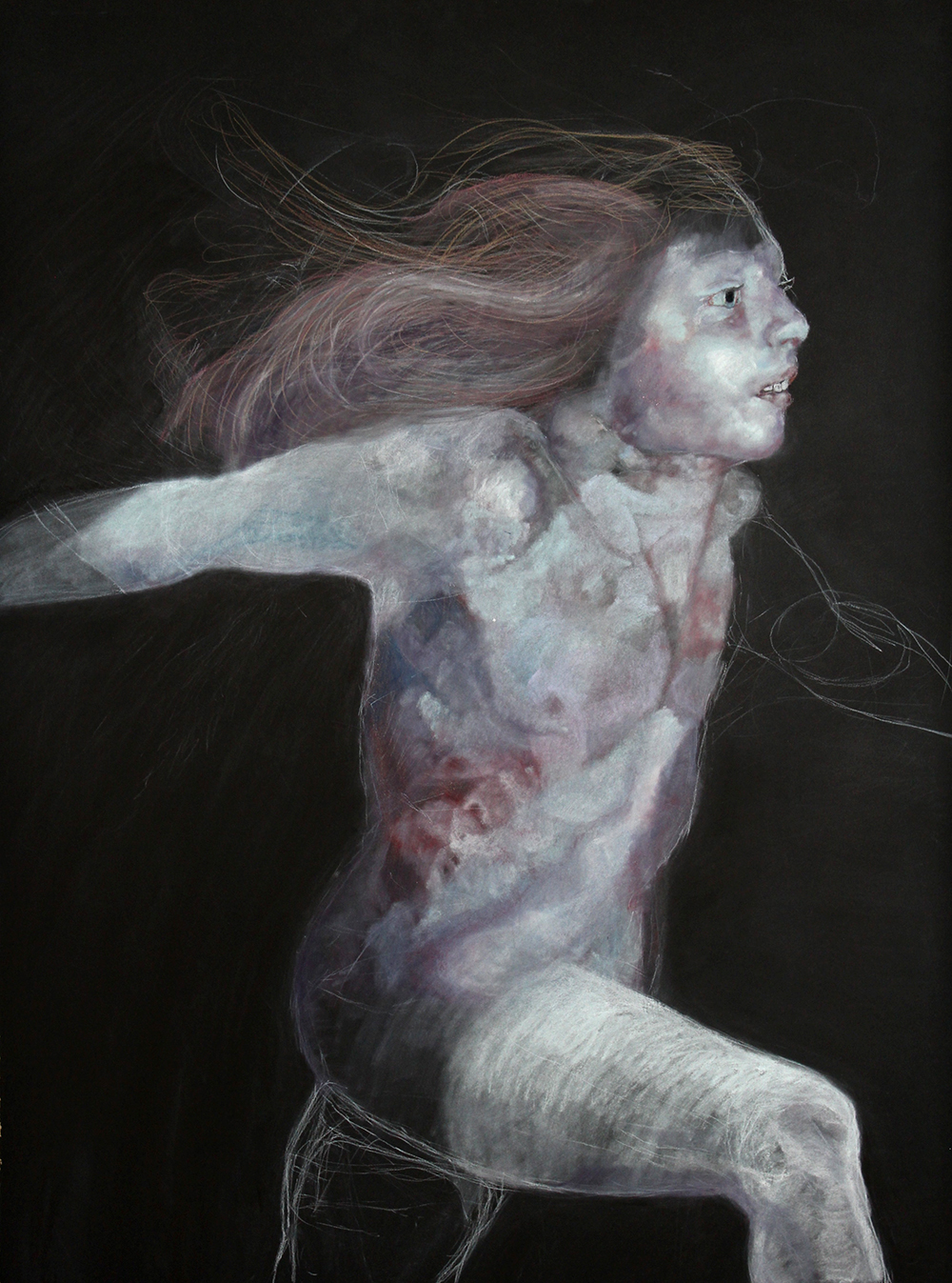
‘Ghosts I’ve met’ | Photograph by Merryn Sommerville | 2016 | Soft pastel, pencil on paper | 56 x 76cm

I’m not a story teller. I’ve never been interested in bringing context to my portraits. They float in a dark absence of context, in vivid expression and psychological space. I recall some years ago, a lively discussion with another creative. Their supposition was that one should be able to be isolated on a desert island – a cultural, social and historical vacuum – and in that lack of art knowledge and context, be able to intuit its quality. In other words, art should have an inherent quality and merit about it that speaks to the viewer. I think this common sentiment underestimates the strength offered uniquely in the visual arts. While other creative disciplines may rely on the knowledge of the audience to pick up on references, in my work, I don’t require them to. Instead, I rely on the preconceptions a viewer has been indoctrinated with through consistent imagery they’ve been exposed to in advertising, television and movies and to some extent, literature. The notion of childhood innocence and lack of autonomy was created socially, in conjunction with images of children in white; barefoot and connected with nature, pictured with animals that share psychological qualities. Our conception of children continues to be linked to their visual representation – a diversion from this, whether the viewer is aware of it or not, will be disconcerting. Art has the capacity to move a viewer towards a feeling while also mirroring the society that has shaped their reaction and view, and illuminating preconceptions they may not be aware that they have – illuminating insight through an emotional experience of the work.

Art is the understanding of the world that you and I occupy. It’s understanding the moral narratives, the colour associations, the social and visual history we have inherited, and the response an image may engender inside of the viewer. That is what excites me about the art I admire and the art I make.

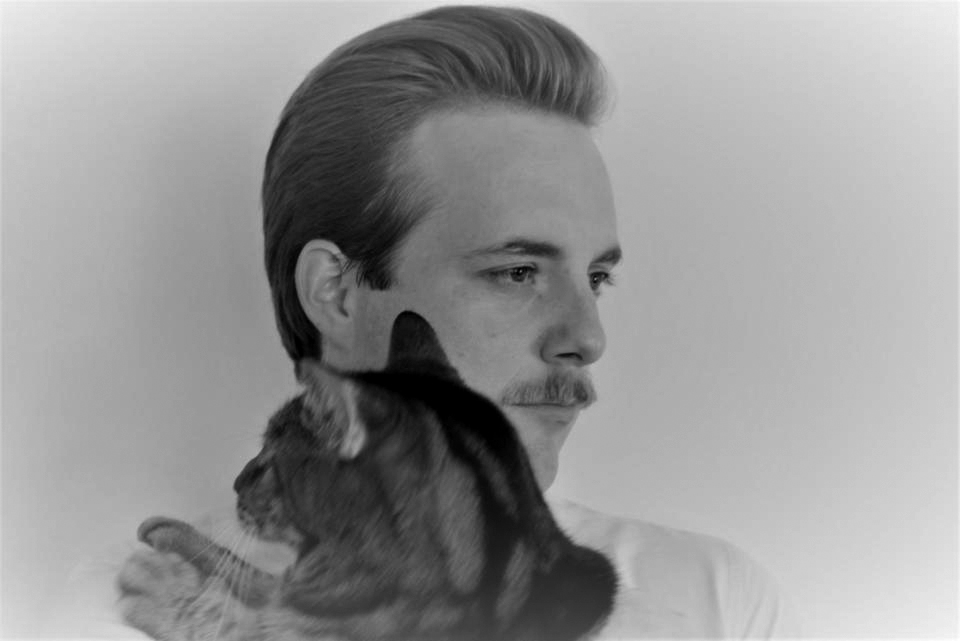
The subject of my work is one child, a family member in a seven-year series, and of her seven-year life. As a young woman of childbearing age, it might seem an obvious choice for me to draw children; there was a time in art history where women were limited to drawing domestic scenes of children and animals. But their social identity became synonymous with innocence and a lack of autonomy. It is this association and expectation of the depiction of children that has led many female artists (Marlene Dumas, Sally Mann and Cherry Hood) to use confronting portraits of children as a vehicle for unexpected emotion. I live for the remark ‘your work disturbs me, but I cannot explain why.’ This is often said apologetically. But the visual arts offer a pathway to communicate conflicting and ambivalent feelings and ideas that literal language cannot. A viewer’s reaction to a work often unfolds itself from the inside out, where emotion leads to insight.

Though I intend for the work to engage the viewer as they experience it emotionally and psychologically, it is also important to consider accompanying information to be consistent with the conceptual and atmospheric qualities of the work. I don’t want the title of the work to limit the way it is interpreted. However, particularly as an exhibition, I want the series to be able to offer more as it is revisited – to be more than just a visual communication, a succinct juxtaposition of ideas. For example, the February 2017 exhibition at Lindberg Galleries, Child of the High Seas. It draws its title from a collection of short stories for children on the subject of death, written by French writer Jules Supervielle. The title story, ‘Child of the High Seas’, is a haunting and ambivalent fable of a child who lives on an island in the middle of the ocean, with artefacts of a life yet no memory of it. This child is the echo of a child that once was, and is suspended in this situation as a manifestation of the intense grief a sailor felt for his late daughter. This story has influenced my work significantly. I discovered it through one of my greatest art influences, Joy Hester – in fact, I’m influenced by her entire circle of post-World War II portrait artists, The Angry Penguins. Hester named a drawing after Supervielle’s Child of the High Seas. As French poet Paul Valery noted in Things Left Unsaid, ‘Nothing more original, nothing more oneself than to feed on others. But one must digest them. The lion is made of assimilated lamb.’ We are all broadly created by the assimilated lamb that has been available to us in the society in which we live. Artistically, Hester digested the work of Supervielle, and seeing something of herself in it, created something new. I, in turn, have been granted with both Supervielle’s work, as well as what Hester gleaned from it.

And so we return to the matter of giving a title not only the exhibition as a whole, but in naming portraits individually. Each title is a disembodied fragment from poets that influenced Supervielle, giving a nod to a creative lineage that led me to Child of the High Seas. I isolated lines that relate to the corresponding themes of the short story and my work more broadly – death, and the way it transforms us as living beings, change, regret, absence, grief and gender. Also in these titles are references to the ocean, acting as a symbol, and a link to the exhibition title. Each line transformed through the context of its pairing with a portrait, drawing further meaning as a list of titles, and as an exhibition as a whole.

The works have a dialectical nature, and a tension between being disconcerting and appealing.

They also sit between categories when it comes to the disciplines of drawing and painting. They engage with colour, form and layering in the way that painting does. And yet, they also encompass the impulsiveness of sketched line and mark-making, the treatment of absence and negative space, as well as the celebration of organic, skin-like paper – all qualities characteristic of drawing. It is the immediate purpose for which it is being used that will define their category. If, in an exhibition of paintings, they would be paintings. So, too, if curated with drawings. However, contemporary art practices rarely land in one discipline, with many artists that could be described as sculptors / drawers or drawers using paint. Perhaps such distinctions are relevant predominantly for administrative purposes. Whether my portraits are described as drawings or paintings may depend on the person viewing them.

My luminous soft pastel portraits of a child emerge out of black paper. There is conflict between colour and form, absence and sketched line. At my inaugural exhibition at Lindberg Galleries (March 2-18, 2017), you will find yourself surrounded by these disconcerting figures. The colour palate is bruised, bodies are poised in strange positions, visceral fur crawling up shoulders. From some portraits, eyes will watch you intently. In others, there is an absence of eyes. Each work engages your personal baggage, thoughts, your feelings. As a series in exhibition, they will create the experience of different entities haunting you from all sides.
Posted in ARTWORKS | Tagged , ,

Tunnel Vision

SUPPORT SYD VICIOUS
CUT A SLUT

JESUS SAVES AT THE WALES

WHO ARE YOU IF YOU’RE NOT?

CREAMINESS CONTROLS YOU
OR YOU CONTROL THE CREAMINESS

screaming without words
she runs through the tunnel
straight at them
shock opening like flowers
on the faces of the oncoming
motorists
her purple dress is ripped
to the waist so it has
become skirt only
her bare round creamy breasts
assault the pity
& the rapist
behind the many
masks of ‘motorist’
her face is contorted in
the scream everything
in her life is concentrated
behind it

she is either stoned out of her mind
just raped
so hopeless in her life
that whatever happens
will be better
drivers make
stories up
to fit some fiction
to the picture

it is 12 o’clock noon tube
white fluorescent
inside the road tunnel
she is running on
into the citybound traffic
cars part noiselessly
around her the traffic
streams into the city &
her bare feet & bare
breasts & scream
continue outwards towards
rushcutters bay & later
on to rose
bay if she makes it

drivers leaving the tunnel
blink at the sunlight
her image is off
their eyes but she is running
inside them as they enter
the city
all day they wonder
did somebody
rape her? again?
did she find
shelter?

her feet were busted
by the road – they were
bleeding
did some christ-of-the-tunnel
get out of his car
& kiss & wash her feet? risking
causing a chain
of deaths

to do so?

she is gone… going home
through the tunnel
drivers see
SUPPORT SYD VICIOUS CUT A SLUT’s
become ‘feminised’:
SUPPORT C.S.R. ROT
SYD VICIOUS WITH SUGAR

& JESUS FUCKS AT THE WALES
WHO ARE YOU IF YOU’RE NOT
MY GREAT AUNT FANNY

a female
form
its flesh & rags
in fragments
sea-sucked
purple
is fished
out of the
gap-
wash by the calm
voice-of-the-evening-news
a fortnight later

Posted in 79: EKPHRASTIC | Tagged

Interview with Sidney Nolan (Ella O’Keefe edit)

Image courtesy of Art Gallery NSW

Hazel de Berg’s recordings take place in the homes or work spaces of the subjects rather than a recording studio. This allows something of these places into the recording whether birdsong, traffic or an r&b song playing in the background. In the recordings, de Berg remains enigmatic, the ghostly presence operating the machine.

Interview with Sidney Nolan (O’Keefe edit)

2017 edit by Ella O’Keefe

‘Sydney Nolan interviewed by Hazel de Berg in the Hazel de Berg collection’
Courtesy of the National Library of Australia, TRC 1/58
Special acknowledgement to Duncan Felton, NLA Oral History & Folklore Branch

Posted in INTERVIEWS | Tagged , ,

Is Contemporary Australian Poetry Contemporary Australian Poetry?

Poet, if you’re looking for your name in this essay, jump ahead a couple of pages. There I begin talking about poets collected in this anthology. Those of you interested in a review about contemporary Australian poetry, let’s begin here.

Contemporary Australian Poetry (CAP) – an anthology of Australian poetry at present, in other words – comes introduced as a ‘survey, and a critical review, of Australian poetry between 1990 and the present (2016)’. What kind of document to this significant time-period does CAP constitute, and what bearing does it have on the question of an Australian contemporary? Most importantly, how do we now read Australia differently? What new forms of reading has contemporary poetry inspired in this country?

i will reinvent the game
jon bon jovi comes to mind
i met him once in a dream there is a
spring in my step i will
move at speed across my crease
no the direction does not 
matter only the leap itself

(Nick Whittock, ‘Michael Slater 2’)

To begin, consider images of the modern leading up to Australian poetry’s contemporary moment. In the Australian Book Review, David McCooey notes that John Kinsella’s Penguin Anthology of Australian Poetry (Penguin, 2009) shows contemporary Australian poetry’s chief setting as being the suburbs: ‘this suburban scene is the stuff of modern Australian poetry’. Numerous critics agree. But let’s extend this argument further than setting. The suburban is a preeminent register of the Australian contemporary: of its inheritance of Fordist economic expansion in a country of exceptional space; and its inheritance of a threatened native cultural sovereignty, disregarded until 1960s constitutional land reform at the very same time that suburbia becomes ubiquitous. The suburban also reflects the inheritance of a pliable bourgeois majority without much cultural competition of a homogenous landowner class; as well as Australia’s remaining reliance upon the ghost of British imperialism and the fire of American neoliberalism to define its geopolitical membership in the post-war West. Alternative cultural positions are often defined by some form of opposition to these paradigms.

I feel two radically different and complex reservations about the idea that poetry could be more suburban, however, and thereby more relevant to a majoritarian audience in Australia.1 First, like McCooey, I think much Australian poetry already seems embedded in a suburban condition: from the most committedly literary, to works of light verse or popular fiction, and all the more so when suburban writers romanticise a rare location or imagine a political alternative to the present. Of course, not everyone lives in the suburbs, nor all poets. However, for reasons I will explain, the mainstream of Australian culture is embedded in a pervasively suburban condition.

Importantly, colonial formations of impenetrable wilderness, isolated pastoral districts, and privileged town and city centres are now fantasies, for the most part, given the vast majority of residence lying in suburbia, the sustained dominance of telecommunications over the discourse of the Australian public sphere, the surrendered economic and regional sovereignty of the rural to the international trade interests of a suburbanised majority, and the socio-economic and cultural generalisation categorising national belonging for subjects living thousands of kilometres away from each other.2 As a national question, then, suburbia is a cultural predicament always to be negotiated. Adopting it or otherwise is a moot point. In the twenty-first century, city and country are defined by cultural logics of suburban desire.

A second consideration is at odds with the first. A wager: the suburban condition of Australia is not what avowedly suburban writers such as Bruce Dawe have been writing about. Dawe’s suburban condition poses as modestly universal, with the human condition defined by a middle-class domestic sphere as the stage of general truths. Yet, this post-war economy called suburbia has in fact been the stage of cultural turmoil, self-parody, and contemporary crisis. Among many possible ways to convey this reality, consider the general connotation of shelter in Australian cultural imagination: the concept of home ownership, what is now an exclusive bourgeois fantasy, the battleground for heroic reality TV narratives, and the place where Australia’s youth enter a new Thatcheresque age of housing alienation. Such alienation drives characters as early as Barry Humphries’ suburban Jekyll and Hyde, Les Patterson and Dame Edna, or characters in Patrick White’s The Season at Sarsaparilla, as well as informs prominent twenty-first century examples such as Christos Tsiolkas’s The Slap, or TV show Kath & Kim.

Australian cultural life’s concerted engagement with the suburbs has meant radically different strategies than Dawe’s assumptions of modest universality. Instead, memorable writers of Australia’s suburban condition point to intercultural unrest, commoditisation, paradoxical prosperity, conflicts of connection and isolation, cultural indistinction, questionable belonging, and anxious compliance as its real conditions. Therefore, the supposedly direct encounter with a suburban identity seems to me to involve deception as a putatively direct engagement with an ambient condition. Or, when most consequential, to assess the condition of Australian culture as embedded in certain socio-political problems stemming from suburban life, involves a somewhat calculated performance.

As a cultural problem for poetry, a suburban condition is at once impossible to avow and ever present. Given the attention brought to the subject in Australian literary scholarship in the 1990s, especially by Andrew McCann and McCooey, and renewed interest at present in recent works of scholarship, the category of the literary itself in Australia means some negotiation of the suburban. The literary in Australia does not require a suburban intervention as it lies aloof in some urban ivory tower; from the most challenging to the most conventional, the suburban sits prestigiously at the table of Australian literary subjects.

Posted in ESSAYS | Tagged , , , , , , , , , , , ,

An Extra Oyster for the Doctors

Entrée: raw oysters on the shell. Price
on application but they will be raised high
on a bed of ice and lemon slices.

A dozen and a half is not available
so we take a dozen, abashed
that oyster eaters cannot have their number

which would have given us three each.
Who forks the first and slips it down his throat
would like to seize the rest and lick the platter

or hurl the oyster shells over one shoulder. An
alumna of the University of South Carolina proposes
the final three go to the most distinguished scholars

first to the one whose golden thesis sits beside her plate
another to a prodigal undeserving Hon D.Litt., the last
to an unassailable Distinguished Professor. The moon

looks down on three tipped-back throats
once tugged by gowns and Gaudeamus notes
processing stagewards to receive the precious oyster.

Posted in 79: EKPHRASTIC | Tagged

John Woodcock Graves the younger [with] Truganini

So often reproduced and yet
the message so elusive.
John Woodcock Graves the younger,

lawyer, writer, poet, ‘friend’,
is standing high beside her,
not quite profile, looking down,

frock coat reaching to his knees.
Truganini, Trugernanner,
also known as Lalla Rookh,

is sitting in a stiff-backed chair,
the lines of which her long-sleeved, white
Victorian dress obscure.

What looks to be a scarf with tassles
reaches to her knees;
it’s white as well, her captors’ colour.

She’s thought to be the last, she knows —
of interest to Science.
She knows too that related women

are living in Bass Strait with sealers.
Graves, it’s said, was genial,
learnèd and eccentric,

something of a sketcher and
a well-known greyhound breeder.
Although the photograph’s undated

some say it’s 1876
and just three months away
from Truganini’s death

and five from that of Mr Graves
at only forty-seven.
But all of this is mere description.

It doesn’t read the code between them:
Graves, full-height, arms folded,
pensive, sad and somewhat

proprietorial;
Truganini with her hands
clasped across her lap.

Her woman’s eyes are wary embers;
they blaze at her ‘protector’’s belly.
Are the two of them aware

their photograph must prove symbolic?
Truganini knows her bones
will be displayed and sent to London;

she cannot know her ashes
will take just on a century
to regain D’Entrecasteaux Channel.

Graves knows too that he is powerless
for all his knowledge of the law.
He can’t foresee, we must assume,

his own death is so imminent.
Each knows, but in a different way,
the moment of this moment.

The future’s sepia already.


Notes:
In response to John Woodcock Graves the younger [with] Truganini,
Photographer unknown, Date unknown. Sepia toned, 15 x 10 cm Collection: Allport
Library and Museum of Fine Arts.

Posted in 79: EKPHRASTIC | Tagged

Lament

The earth runs through you, brother.
You are constellations of clover,

the watercolour green
in willow weed,

the red inflorescence of sorrel.
I listen to the wet soil

as if your voice could find me
through buttercups and their dark arteries

or the looping roots of lilies.
They are undoing your body

and my grief blooms.


Notes:
In response to Ka pinea koe e ahau. Ki te pine o te aroha.
Ki te pine e kore nei E waikura e. A lament.
(Trans. ‘I will
pin you to me. With the pin of love. With a pin that will never
rust away’). By Shona Rapira-Davies, 2011, Dimensions: 136 x 136 cm,
Victoria University Art Collection.

Posted in 79: EKPHRASTIC | Tagged

Eye

across the room from nolan’s soldier
scooped into lumpen slouch
the cow

nosing itself tenderly
notices its guts
missing

and its clam‐maraca hands
jam mid-clack

it gapes

at the hollow scraped
by asbestos winds
licked by rust

we know the look
learnt it as kids before the box
laughter blasting like acme tnt

when sky showed through
frizzled coyote

the crack‐up’s
in the dumb creature’s eye
the cartoon o of surprise

the headshake
at one’s own impossible demise


Notes:
In response to Drought by Sidney Nolan (1953),
91.1 x 121.4 cm, National Gallery of Australia.

Posted in 79: EKPHRASTIC | Tagged

APOLLON MUSAGÈTE

Critic: Tell me, Mr. Balanchine, where did you ever see Apollo on his knees?
Balanchine: Tell me, Mr. So and so, where did you ever see Apollo?


I. Prologue
All good art begins with a weird birth unseen,
or seen as dotted rhythms knocking hard on high: here
a mountainous mother, heaving a landslide
to cushion the fall
out of the swaddling massive. Quick—coupé
turning point to quaver weedy limbs.
There will be no dead spots anywhere.


II. Variation of Apollo
The problem of the poem—like the problem of the lute—
can be thawed with play. Instructions:
~ present outwards, unsure of score or strength or harmony;
~ pitch arms wide for a full circle strum;
~ learn the sting of withered efforts and proceed
body over neck over body with youthful generosity.
These are studied revolutions in attitude and grace.


III. Apollo & the three Muses
A choreographer may tell you this: it always pays
to reinvent oneself, surrounded by women
adept at odd lines—women who grand battement
on pointe and stretch their blistered toes to the sun.
Women who insist a flat-footed shuffle, a turned-in leg
or bent pirouette; sharp educators in civil disobedience
offering tutorials in filigree counterpoint:

Variation of Calliope
These hands conduct ecstatic verse from the ribcage
through an over-thought Alexandrine density.
When vision is thin, the chest caves in. (This I know).
If you turn your head, I’ll scribble in your sidelines.

Variation of Polyhymnia
sh| gesture can be taught at great speed;
a saucy pirouette with one finger to the lips—
the imagination goes wild. sh| The fun of mime
can be a tonic for new movement; the danger is
(mouth flung wide) O ||

Variation of Terpsichore
One must use the stage wisely to reveal
the body’s jigsaw precision: here are the hips,
twisty as a soda top; the arms breezy; tendons flexed.
The dance is lean-revelation and pluck; the body is a neat thing.

Apollo is opening, closing his fist—neon
flashing lights—and now he knows this
about kick and control; subtle liaisons
of language and line. Let us go, he says,
for a slow walk, or a swimming lesson, or frisky
diversions in the troika. Bounce the strings
fast and strong enough to test our laurels without
fear of fall or rest within the score.
His attention is drawn wide as a curtain
on a New York apartment window.


IV. Apotheosis
Adolescence is a half-hour exertion—so it seems
what’s hard is best learned fast. To dare not use
everything but draw together certain family relations
in one’s art: music, movement, humour—
humble pie and vodka with a side of disagreement

cut short. (We’ll continue the conversation upstairs).


Notes:
Based upon the choreography of George Balanchine, 1928 and music of Igor Stravinsky, 1927/28

Posted in 79: EKPHRASTIC | Tagged

after infatuation—ross bleckner—oil on linen

imagine desire as compressed heat, as a star,
a supernova—place it inside a box

wrapped in stripes of warm colors,
red black orange gold and white

like a gift on your birthday. a wounded red bow
toward the left, toward the top, to say:

I am for you—open me. if it were only so easy

to feel that large, to fill a room
and still keep your heart

contained—but like any gift,
what you want is to touch

the thing inside. all you need is an edge
to rip, but in the end you’re too small

and it’s too big—


Notes:
In response to Infatuation by Ross Bleckner, 244 x 508 cm.
At time of viewing, housed at the Museum of Fine Art in Boston, MA.

Posted in 79: EKPHRASTIC | Tagged

Gouache, Sheep Skulls, Fence Bracket

I

Animals in Venetian masks
stare through floral constellations;
a strange surfacing
of herbal machinations
and cloven-hoof memories;
a fondness, somewhere
for droughtless green.

Look closer.
The skulls are singing,
more like bird-beaks than sheep.
Forget-me-nots break
across bone
as if souls commune,
call back,
jigsaw a collective self.

II

This is about a rasp of sheep;
a four-cornered star
shining the sacrament
of limited diagonals,
and yet, in sockets of dark,
a kind of backward birthing.

How to place gouache
and not annul the souls of sheep.
How to stamp passports
of those who dream the inner side
of crates—
a floating, rocking panic.

Their flowers are dispensed.
Ragged edges stumble
into blackened bone.
Quietly, they bleed
in palest pink.


Notes:
In response to Steven Holland, Monaro, 2001 Gouache on sheep skulls,
on welded fencing wire bracket 40 x 40 x 15.0 cm at Canberra Museum.

Posted in 79: EKPHRASTIC | Tagged

Anatomy for the Blind

Beneath the languid nudes of Ingres and Renoir,
the Odalisques and Venus on her couch –
the skeleton is already reclined
against the lectern as the doctor starts:

‘Gentlemen, explore tonight your sense of touch.
Let the warmth of your fingers and palms
caress the cool crest of this ivory planet.

From the summit of this fragile sphere, glide
across the bumps and ridges; understand
the subtle fissures and the secret cracks,

the domed expanse that disappears beneath
itself. Now, press your ear against this blade,
which creaks like a ship on shifting waves:

that’s the sailboat of the scapula
hitched onto the clavicle’s safe cleat.
And here, beneath, as broad as any barrel

the ribs – your maker’s hoops and staves.
This chilly shaft’s the femur, Sir, just like
the cane you’ll use to guide yourself away…’

And when the talk is done, the blind depart
and only the mute skeleton remains,
sole tenant of this vacant gallery
with paintings neither she, nor they, can see.


Notes:
Old black and white photograph of a ‘talk-and-touch’ session for the blind,
about human anatomy, held in an art gallery, 1913.

Posted in 79: EKPHRASTIC | Tagged

The Pioneer

McCubbin, in his great, ambitious, historical-narrative work
The Pioneer, invokes the in-vogue creed of nation-building:
with the colour green (forest/tent/dress/shirt) locking this in,
waltzing across the three big panels —

in the first and left-most of which the young wife is seen,
sitting slumped (dreamy? despondent?)
before a slackly pitched tent; with her husband crouched
setting kindling, behind.

In the second-and-middle panel, the bush is part-cleared:
the husband rests weary on a log with his axe,
while the wife stands before him, shouldering a babe-in-arms,
and a slab-hut smokes in tender contentment to the rear.

Then climactically, in the final-and-third of the painting’s panels
(with a taint of the comic, even,
in its sudden, dramatic, faintly hammy reverse),
the sky leeches blue through the green-dun frameway of the eucalypts
to reveal a distant city-view
which brandishes real estate signs almost …

as an innominate youth (the grown child, or someone entirely else?) —
is crouched parting ferns, to disclose a simple bush grave.
Resting place of the pioneer-husband —
of his wife, their child — or who? …
left behind at the previous century’s turn,
as he kneels in the glittering scar of cleared ground,
pledged to the bright-shiny new.


Notes:
In response to The Pioneer, 1904 by Frederick McCubbin. Oil on canvas, triptych, 225.0 × 295.7 cm, National Gallery of Victoria.

Posted in 79: EKPHRASTIC | Tagged

Interior with Figures

It’s in your mouth corners—
two lips clamped tight
and gently curved to hide it.

It’s in the way you hold your hands
not quite together,
fumbling with an uncertain future
as it clings
to your third finger.

It’s in your glance—
the search for answers
you will not get, perhaps,
until it is too late to go
back.

It’s in the trees
beyond the glass, who
seem to know more, though
they turn their heads
in spite of you.

It’s in his leaning body and
the chair that supports it;
both of you stand –
it’s quite impossible to sit.

It’s the silent conviction
in her hands, rested
half open in her lap.

It’s in the careful crease
of the curtains,
who shake hands with the sun
behind your back:
they make their bets.

It’s in the blue of your dress
that places you, unwillingly,
at the centre of
an unconscious universe.

The only anxiety I know
tingles my teeth
and squats to tie
its laces on my chest. I don’t
know how you feel, though somehow I think
I do.


Notes:
Based upon the painting, Interior with Figures, by Chester Earles, 1872

Posted in 79: EKPHRASTIC | Tagged

Miro’s Eyes

There are sweeping views
from the Gardens of Montjuic,
a city of coral
streaming as far as the sea,
constellations of migrating birds,
spirals of dragonflies,
night, music and stars
webbed in red, blue and black.
They held the balance –
canvases of connection
in the face of war –
carob trees, animals and insects,
emblems of hope
still holding back the melt
of Spain’s corners.


Notes:
In response to Joan Miro’s The Nightingale’s Song at Midnight and the Morning Rain
(Constellations Series) 1940. Miro Gallery, Barcelona, Spain.

Posted in 79: EKPHRASTIC | Tagged

Autumnal Cannibalism

The trouble, the issue in the system

like clockwork,
every orange October.

Comfort is a pillow in his back, unlike
a dentist

pulling. A tooth—

foggy, purple in his gaze.
Nothing.
Can I do nothing?

Blood.
Black bile, the yellow …

And I believe they’re
all
there.

It’s a fork, a knife.
I won’t let it reach for him—

Reversed, a crooked turntable,
and I am his
protector now.


Notes:
Based upon the painting Autumnal Cannibalism by Salvador Dalí

Posted in 79: EKPHRASTIC | Tagged

Narrenschiffen, a Collage Sonnet

Hero? anonymous bosh tacking luffing gulls
Ophelia swims up the river in a swoon
Hades moonsick Hamlet laments captainless coup
reflections sun buttered breasts glutt’nous mutineers
Leander hoiked into his own spittoon sees Light
Old Queen Margot plucks glockenspiel, and albatross
tone characters in search of the phosphorous straits
persimmon masks stretched tight as shaky chandeliers
Karl snaps selfies flush full of Facebook likes
Mary counts voices the origin of consciousness?
days numbers Shostakovitch the archduke trio?
riddles monuments to fear toccata fugue state
And thus thou art my love the Lesser Fool
A swim many one river fishing school


Notes:
Based upon the triptych painting, Ship of Fools, by Hieronymous Bosch,
on view at the Louvre, dimensions: H: 0.58 m, L: 0.33 m.

Posted in 79: EKPHRASTIC | Tagged

Cubed

sit around table silent transparent heads family gather wood together
iron frames exact misery cracked bolt on end fractured coop
cubed cubed cubed
black space condemns trap enacted in through window pain
cubed cubed cubed
rattle the mesh chain above hangs isolate to the power of
perfect smooth round teeth hair skin don’t at hands self portrait

Notes:
Based upon Cell (Glass spheres and hands), by Louise Bourgeois, glass, iron, wood, linoleum, canvas, marble, at the NGV in Melbourne.

Posted in 79: EKPHRASTIC | Tagged

Calling All Shadows

The birds on the brown-and-floral wallpaper in the kitchen at the old folks’ home are someone’s idea of parakeets in repose. Again and again, they stare over one wing at a trailing vine, or look straight ahead at a huge poof of bronzed peonies and more trailing vines. They sit, their wings folded like tuxedos of uncomfortable men at an opera. Outside, the world is framed in snow—slanted, determined and driven snow. Just beyond the window, a bush whose flowers are unknown to February, twitches under the weight of house finches. They come and go, little brown flames scattered up in haste. But one sits a long time at the top of the bush, sways as it holds on, its gaze steady, conscious. In the intense light of sun-on-snow, its shadow seems to multiply and mingle briefly with the shadows of the wallpaper birds, a sort of alchemic dance. I imagine it is calling the wallpaper birds—and me—to come stake our places too, on branches that will soon be piercing green and flecked with yellow stars. I like to think it only takes one to call us back from the edge of the world.


Notes:
This is a notional exphrastic poem, in response to The Dance Lesson, by Edgar Degas, 1879. National Gallery of Art, Washington, D.C.

Posted in 79: EKPHRASTIC | Tagged

Anna Attinga Frafra

the gentle assonance of her name
is there in her castdown gaze,
every repetition chiming its
muted, minor key. She looks at
something outside the frame,
but does she see it? Perhaps
her vision’s reigned by the
thousand a’s—amongst other
letters—which balance on her
head, straighten her posture.
The weight of the books should
ground her but instead, her neck
starts to ache, tilting—ever so
slightly—to the left.


Notes:
In response to Anna Attinga Frafra by Paul Strand, 1964, Medium:
Gelatin silver print, Dimensions:19.4 × 24.4 cm, Philadelphia Museum of Art.

Posted in 79: EKPHRASTIC | Tagged

Swan River

I am metallic in winter
mercurial answer to sky

in me the black swan
lends fragility of feather
pushing webbed feet down
into my warm body steeped deep
with tannin and leaf

I am salt-veined and restless
shadow to your light
the black in the blue day’s
diffuse season

kerbed by cars wild
rush toward sea
I am at the foot
of your face the cliff of it
reading you
leaf by living leaf.


Notes:
Based upon the author’s photograph of the Swan River at foot of Mount Eilza

Posted in 79: EKPHRASTIC | Tagged

In the store-room of antiquities

Lifting a wrecked ship’s amphora, an infant-sized container, skin scabrous and shell encrusted, Feel this hollow, brittle form he said, handing me its dead weight and oh I wanted him to braille my thoughts, discover me in haptic ways. But he described the taxonomy of amphorae, detailed shapes and their uses, how some held wine, others oils or perfumes, even those designed for weddings and funerals. Decanted an archive of types: Kernos Lekythos Lebes Alabastron, the names for orifices convex, tapered, rolled, swollen, bell, decorated, two-tiered, beaded, inverted.

I watched his mouth, envied its intimacy with amphorae lips.


Notes:
Inspired by an amphora, retrieved from a Phoenician shipwreck in the Mediterranean, and shown to the poet by an archaeologist.

Posted in 79: EKPHRASTIC | Tagged

Magnolia

The chandelier of the garden
is the magnolia. Bare elegant
arms stretch to hold the lights.
Finial not above like a waiting
weapon but rooted in earth.
Each cupped hand holds a pale
green bobeche with a bulb
not yet open. Purple outer
sepals protect the luminous
petals within. The magnolia
chandelier could be hung
in the ceiling of a pre-dawn
spring night. Once bloomed
the petals will drop leaving
the stamen, an exposed
filament, orange with pollen.


Notes:
In response to The Door is Open by Nicholas Folland, 2006,
Museum of Contemporary Art, Sydney.

Posted in 79: EKPHRASTIC | Tagged

From Garden to Gallery

In the Garden I cross the threshold of glasshouses
seeking succor with bromeliads
whose leaves are banded
with scales, like blotting paper, to inhale
this morning’s fog:

outside I meander amongst upright
natives: one is shaped
like a pine but with large
glossy leaves and globular masses,
like pom-poms, of yellow and white flowers
brewed long ago, I am told on a sign, against
colds, vomiting and diarrhea; another stately elder
has large prop roots once weaved
into nets and dilly-bags, the strips
of bark chewed
into slings and tourniquets; while another
upholds a central cabbage, eaten raw
or lightly cooked, with the fronds
and flower bracts recycled
constructed containers:

in a cycad grove
I bare witness to ancient symbiosis –
coralloid root structures hosting
blue-green algae for nitrogen – and I read
how highly toxic seeds were once
de-husked and chipped into bite-size pieces
in a pounded baptism administering
coarse smelly flour:

before these gardens grew
asbestos was composted
in a cyclone’s ruins
and I mull over a buried fibre’s bloom:

the gardens and gallery are linked
by a Larrakia Dreamtime Walk
where dot-painted signs award
canoe trees, delicacies and the raw
stuffs for baskets and mats; and amidst signage
warning against camping and public drinking
our countrymen gather
a mountain of casks, prizefighting
and swilling their losses:

in the gallery I enter ‘After Afghanistan’,
another remote colonised community,
where trauma is scraped
and bandaged onto boards; where foot soldiers
are removed of their packaging
and left flailing, broken
and captured on a gallery’s walls; and with eyes
clenched against the blinding expectation imposed
from inside I wait for the seepage
of blood from thighs – a self-mutilation
like the latex collected and heated from milkwood.

Notes:
In response to a day at the George Brown Botanical Gardens, Darwin and Ben Quilty’s,
After Afghanistan, Museum & Art Gallery of the Northern Territory.

Posted in 79: EKPHRASTIC | Tagged