Barns in Charlevoix

I like the barns, their air of constancy,
their un-renovated geometry, their wooden deshabille,
that they have high hipped roofs — and windows

set without regard to symmetry — that they are unpainted,
the wood grey or brown with age, with parts that lean in
or out, that some are abandoned but endure, that one

imagines the light inside — diffuse and murky
or the doors opening wide and a sudden shaft
of afternoon pouring like honey into dark tea

and the scent of hay and sweet apples on a high
shelf – the horse and cow smells fading,
old leather bridles, iron parts of farm machines,

sump oil, the ammonia of mice,
rough hessian sacks of chaff and bags
of chicken feed, that time here re-collects itself —

sleeps like Keat’s Autumn on the bales — and
does not wake but dreams of waisted frocks,
wide hips, foals, fiddles, harvest suppers.

Posted in 80: NO THEME VI | Tagged

Stir Your Best Lines

for Susan

if no line is less than twice
and two becomes one four becomes three
am i in a pantoum
warning a poem is coming

two becomes one four becomes three
i have been divided from sleep
warning a poem is coming
dementia can be gleeful

i have been divided from sleep
stir don’t shake those little grey cells
dementia is gleeful
somewhere I have travelled gladly

sir don’t shake
I am unsettled in a pigeonhole
somewhere I have travelled gladly
like a tourist in my home

i settle in a pigeonhole
where my best lines are someone else’s
like a tourist in my own home
let me crawl into a crevice

if your best lines are someone else’s
if no line is less than twice
let me sink into a crevice
i am in a pantoum

Posted in 80: NO THEME VI | Tagged

sting-along

there’s no point to owning a country
if you can’t look after your own hair
the tv burped the weeks broke up like packets
of biscuits we swept through them on the way
to the bus stop holidays were full of conjunctions
forget the piles of prepositions i ate crime novels
with a plate of siestas my signature slid around
like a post-mexican wave; the insects were almost
worse than centrelink on every windowsill after
dark the film about the poet with a neat little
notebook no crossings out was too cute for
words i got sunburnt in the shade between
the mango and the bacon the soles of my best
$200 sandals fell to pieces like archived echoes
during a free speech on heart attacks send
a photo to our address in the bible belt advised
the manufacturer the dog didn’t eat the housework
it just got lost time to vacate the vacation i forgot
that my new super dental floss is not an astral chord

Posted in 80: NO THEME VI | Tagged

The Dark Placebo

Placebo: if resolutions are like insights
I must make them only to lose them.
Do I lose more than can be made?
If things gained are better felt
when lost: their shadow falls
as the proof of things
worsening.

Placebo-fear is the strangest seduction.
Cold corners reach out just for you.
The cold wooden floor creaking
in the middle of the night. It
could be someone leaving
or entering. Inner winter
has its fever.

It’s all the other things that are not
the thing itself. Placebos as twins
of Ariel, Caliban. White as our
pills the white placebo will
duel our mind against
our body – invoking
the ghost of drugs
makes us well.

But dark placebo: hair rises on your neck
the dead the ghost as white as a pill
in the dark. And the dark placebo
makes your mind hallucinate
your body. So its taking
real drugs for nothing
makes you worse.

Nocebo stands giant as the blades of a wind farm
whirling dead eagles down into paddocks
inside us. Worsely better for its darkness…
It is the patron saint of masochists.
It’s the endless bad luck at cards.
Oh pity you, it insists, this is
the dark placebo’s
ghost.

Posted in 80: NO THEME VI | Tagged

Hook

I discovered a bird with a hook in its mouth,
which is really just a cheap opening line.
‘Cheap’ will evoke the sound of the bird.
Like me you have to question the point.
I’m tugging but it’s such a rusty hook.
I should’ve mentioned that from the start.
Find a gap higher up, try easing it in.
If it doesn’t fit come back and go on.
Where do you expect the bird to be?
I’ve made up a nest in the laundry.
There’s a friendly vet in a nearby village
but they’re called towns, this is not England.
So I wake at night with a drop feeder.
I’m having trouble but misspelt ‘trouble’.
Instead I wrote ‘ruble’, then corrected it.
That’s not an image, just a footnote.
Every strong line must snap somewhere.
And now we’re all stuck in the laundry.
What are the bones? A bird, an old hook,
or the audience in my head which is ruble?
Help! Your blasted shadow’s in the way,
something longs to be free from my grip,
twisting the hook of a made up bird.
No telling how to get you out.

Posted in 80: NO THEME VI | Tagged

Touch Screen

And like a scene in which the primitive
Enters the house and hardly comprehends
The way the masters live,
So do the first two days of ours unfold.
We look around wide-eyed,
Housesitting an apartment for some friends
In all its electronically applied
And hard-wired luxury, iPad-controlled.

A touch screen will indulge our every need,
Or idle wish—the merest thought of it
And we are remedied.
The lighting, air-conditioning, TV,
Blinds, awnings, radio,
Hi-fi: on/off, up/down, loud/soft—commit
A finger to the screen and it is so,
Our functions disembodied, virtually.

And then, outside those glass and (strange to tell)
Hand-operated heavy sliding doors
We strenuously propel
Apart to make a wall of vacant space,
The city is displayed
In panorama which our gaze explores
With an extravagance that’s half-afraid
We’ll blink and find it gone without a trace:

The glassy skyline among which St Mary’s
Presents a stone entreaty for the past;
There, skewering midair is
The tower of Centrepoint, positioned where
It claims the centre lies;
Pan right, the bridge and, not to be outclassed,
The Opera House, that permanent surprise;
The green approach to Mrs Macquarie’s Chair;

Closer, here are the docks of Woolloomooloo,
And, right below our eyes, the naval base,
At which the QM2
Appears one morning, and is gone the next,
As though it had not been,
Like something one might conjure and replace
With just a finger’s touch upon the screen—
A trick to leave us neophytes perplexed.

The light performs its spectral repertoire
From dawn all day to evening. In between
The perpendicular
And cut-out towers, insertions of midheaven
Will sometimes put on view
A slowly moving plane, which seems to mean
To glide by, not behind them, but clean through,
A floating revenant of Nine Eleven.

The harbour shifts its dazzle to and fro.
At night the Opera House appears to shine
With sunlight’s afterglow.
This hand I raise and stretch, is that to scroll
The image, or adjust
The settings to accord with our design?
Content as novices, we watch and trust
In what’s unfolding there beyond control.

Posted in 80: NO THEME VI | Tagged

Blueprint No. 1: Siemon St.

The only place I ever lived
alone, but slept myself out
of the memory. My room
crammed with king-frame
more manspread than bed-
spread – creamy linen sheets
but no quilt. The bed clothed
entirely in light. The window
doubled as front door. Thin
curtains lifted in the honey-
vinegar of swollen mangoes,
which split like lightning split
the street in two. Beyond,
wine-bottle storms doused
the room in green petrichor.
The night’s lapping tongue
and sleepless groove – an
inseparable expanse of lines.

Posted in 80: NO THEME VI | Tagged

The Secret Council of Raphael and Michael

A secret cave in the glacial
wastes
of gas and air stretching beyond all comprehending:
a light, tiny, unwavered,
the faint glow a beacon to that
chiefest coven of principals, prior
to the fall the greatest array
of lordly wings in Heaven.
Lit down lonely in secluded arrival
the five dominions accepted by
the cavern, gather in quiet counsel
with Raphael and Michael.

With grave and self-made drama
the Chamberlain relates the scene made
by Satan at their door
earlier that day.
Murmuration and constrated faces
the archangel turned to speak:

“If that time should come, an
angel fallen reclaim Heaven,
no god nor crucified may hope
to save us. He coming home
turns off the light; it is over, once
the prodigal returns. The world
is nothing but a test
for evil to do its worst. The lord
created Earth as a battlefield for us
to contest. But if ever the enemy
succeeds in crossing it entirely
we are lost. All creation will cave
behind him, lost stars fall, collapsing
in his wake,
and Earth too.
This babe is nothing but a ruse; whatever
the truth of his remorse, immovably
the fact persists: by any way
should Satan regain Heaven,
we are lost.
We must drive him back. Like the
legend of Magonus, let us gather
sticks, clubs, to beat the serpent-in-disguise
and guide him back to Hell.”

“You mean to kill a child?”
this duke of Heaven near faints away
and Raphael is pained. “This
is no child. This is Satan, unrepentant,
intent on fooling God.
He cannot win
by force, and so he seeks by guile
to corrupt the natural order, to swindle our sweet father
in allowing him return.
What then? What would happen to the princes of Heaven,
to God’s Right Hand, if his first right hand regrew?
Where will we go, we who opposed with righteous fire
his usurpation all ages before? If God forgives him
need that mean he forgives us? Nowhere is that written.
No time was that said. Satan remains Satan, enemy to all,
intent to destroy creation, everything
he cannot have or own.”
“What would you have us do?” one junior in the hierarchy
filled with urgent zeal.
“Watch, for now” said Raphael “and wait for that time
when we may press and turn him away
from his paradise.”
Their leader drew in dirt around their feet: “For now
this child must know disconcert, synchronous
with natural harmony. Make him displeased
to exist in his skin, make him a mocker
of all he belongs.”

Posted in 80: NO THEME VI | Tagged

These Hills

that enclose my days, open up ahead, like a book.
And I watch a ship on the sea’s blank page – a fugitive
full stop – write itself into refracted light

and vanish. Clouds blot and then tear across
the sun. Bees scrawl in the long petals
of fuchsia heath bursting from rocks

like asterisks. Walking here, I saw the forest
flowers beginning to open. What offering
can I make on a hard winter’s outer edge, word

thin, hands empty? This overhang offers me
its scripts of moss, its winking stone. It steps into blue air,
above a drop that would crumple me like paper.

Posted in 80: NO THEME VI | Tagged

Blackberry

for Robert Hass

spring abrupts
like an open palm
walk through redfern
stop to watch jasmine spill
again & think of yr grandmother
pink fragrant naturalised
climbing the scraptractor
at the gardentop
the beggar replies to an empty hand
it’s just good to see you happy
& wonder again
how far things have gone

looking across heidelberg
from der philosophenweg
its dawn
a bruised ecstasy of words
resumes trestles –
after psychosis its winter
a sparse snow
descends a valley
each word returning an elegy
firtree snowflake tiergarten cigarette
their loss their loss their loss
again
dubiously pended
anonymous snow

at the hauptbahnhof
a flock of rosering parakeets
call unmistakably
the greenest thing in words
mutter geographies of songbird lineage
& what symphony of error
what lyrate slippage
pilgrimed
your feral song?

the antipodal drift
slips another arc
death in a missed wingbeat
lose time give it
now again is openpalmed
welcome eclipse welcome
jasmine
remember love
love everything lo——

Posted in 80: NO THEME VI | Tagged

Reservoir

Sleeping in its brick tabernacle
the still water is like an ear or radar dish
attuned to distant pulse. Incurious,
we’ve walked forever to school and work
past locked gates. The saw tooth roof
gives nothing away but scission with sky
and though the key-hole draws the eye, the pupil
contracts. Inside, a herringbone of oak beams
and rafters hovers over the water’s weight
and repose. Beyond the inscrutable iron fence
the street’s steep uphill/ downhill zeal;
urban windows; the domestic race
of breakfast, phones and life and birth and death.
Inside this null and void this leave no trace
the morning sun has picked the lock,
entering through a gable’s little porthole,
bending light with its oblique know-how.

Posted in 80: NO THEME VI | Tagged

The Fall

for Ella

I can tell you, when your horse began to slip
she tried to pull you and herself back up.
But once she slid and lost her footing,
you both fell into the law of gravity
and came down hard upon the rain-soaked grass.

And in that moment, under the shockwaves
of a cold calm, I froze then ran with fear
as the freeze-frames reeled out —
you lying, pinned to the ground,
bearing the weight of your fallen mare.

At your side, I looked into the flared
whites of your eyes and calling your name,
watched your body tremble then jolt into a fit.
My heart sunk with a despairing dread,
a silent scream — Not you, not now.

I stayed kneeling, wondering whether
you were holding your breath or trying to breathe.
I scanned for bruising, broken bones, for blood.
I counted the seconds of your oblivion
and in a blind panic, even thought of prayer.

But when your body discharged the last volt
with a kick and you spoke, surfacing to air,
I cupped my hands beneath your head,
spelling out the calm and colour of words.
As I held you on this side of the line that balances

love and loss with life and death, I pictured
your brother slipping by immeasurable degrees
through air and water, and thought of the ceaseless
eye of grief glaring at your mother and father.
By then, it didn’t matter that the stir

and gaze of onlookers had crowded in
or that the spinning blades of a helicopter
throbbed overhead. What mattered was closer
to ground, and that the names of those you called
were there or on their way. Your horse,

limping, pressed her nose through a huddle
of bystanders, and with all the common
naturalness that comes from the animal bond
of love and need, tenderly bent to sniff
at your face, as you lay there in the wet

like a newborn foal. Walking back to the spot
later and seeing the muddy relief of your heel
near the hoof prints that lead toward your own,
I stood weighing up the cost, wondering
if it was luck or misfortune, or whether the law

of averages was simply taking stock of its toll.
I thought of how lucky you were and despite
the risks, remembered your overriding words,
“It’s in my blood,” and how every bone
within you has been marrowed by what it loves.

Posted in 80: NO THEME VI | Tagged

The Book of Screams

Each day in hospital I wake
to a reading from The Book of Screams.
It comes, apparently, from the bathroom
situated two-thirds of the way along the hall.
No one talks while the screams linger.
I pass the time by counting in my head.
Thirty-five. Seventy-two. One hundred
and nine. Two hundred and thirty-one.
The screams are high-pitched and continuous,
as if she has been chosen for her ability
to hold the note, to produce abrasive chords
when her lungs must be almost airless and empty.
The ruckus shakes the thin partition around my bed,
it rattles the cups and saucers in the kitchen,
and threatens to shatter the high frosted panes
of glass that leach feeble light onto the floorboards.

At midday and again in the evening I reluctantly
listen to recitals from The Book of Screams.
Afterwards, the ward is sombre with silence.
By the third day, I cannot bear it any longer,
I tear the bandage from my eyes and march
down the corridor to see for myself, drawn
to the noise the way iron filings are attracted
to magnetic north. Two nurses cradle
a young girl, supine, in a bathtub.
Her eyes are closed, her lips collapse
into an involuntary O that corresponds
to the coordinates of her mouth. Her skin,
though I am not sure you can still call
it that, is the black of newly laid bitumen.

Impossible to comprehend agony—
to understand how one scream seems
to necessitate another, to grasp how a voice
can travel over rice paddies and rubber plantations,
under jungle canopies and down boulevards
resplendent with French architecture, before lifting
into the flying arches and buttresses of the mind,
until we are all dwelling in a cathedral of screams
whose substantial form cries out for mercy.

But I have no mercy to give. I gaze
in dumb horror at her right leg, where
the white ghost of her femur shines
through murky water, at the charred
oozing mess of a knee. Her body is
no more than a diaphanous veil hanging
between this world and the next.

Later, they tell me about the morning
of the bombing and its aftermath.
Now, when I hear the word napalm,
I remember that girl’s face,
her eyes opening as I turn
to leave, her raw cries staying
with me and spiralling outwards,
forever travelling, like radio waves
rolling end over end
into the windless chasms of space.

Posted in 80: NO THEME VI | Tagged

‘Gethsemane’, on Patrick White

Gethsemane at your shoulder as you work,
garden of sleep and torment, the betrayal
of whispers you were born to, outside the frame,
beyond the painter’s bloom and power
the strikes of his marks of black and grey –
both writer and painter, swimming against
a cramped world. But in this house
of aunts and failures and divisions of mind,
it was love that stepped up to the garden:
creator of worlds driven with fire, peopled with
blubber and fuss, with overwhelming puzzlement,
the stunning stillness, the silliness and effort
behind screens of respectable appearance –
you captured the bright scream of the broken
who do not know they are broken,
turned a lamp upon them, open.

‘Patrick White’s study with Gethsemane’ (by Ian Fairweather)
c. 1973 photograph by Ern McQuillan, National Library of Australia

Posted in 80: NO THEME VI | Tagged

Reach & Ambition

for John Jenkins


I Reach & Ambition

Late at night, up, looking at
the things on my mantelpiece
a profusion of crap, clutter & gewgaws
a range of detail I love (John’s photos of it
came today, reminding me). I look at the pictures
blu-tacked there, above—postcards of paintings
1900 to 1920s mostly
but some Manet, some Fragonard, a Boucher
Michael Fitzjames, a Chardin—a piece of paper,
yellowed, proclaiming “Honeymooners star
Meadows dies” (with a picture of Art
Carney, Gleason, & Meadows), a picture
of James Brown being ‘assisted’
to his feet
by a Famous Flame, a large photocopy picture
of Pam, 32 or 3 … Anyway, the Manet—
two white camellias glowing
against a black ground—makes me think
Look at things! & on that basis
I think I will search out
the book of Manet‘s flower-pieces
& then, depending what that does to my brain,
re-read the Tranter poem I find,
placed in the back of this book. ‘Loxodrome’.
And maybe I will


II Gone

Left of the mantelpiece,
beneath the Chardin (a small, be-suited,
silver-haired boy—regarding a spinning top
on the table before him), four
tiny spots,
of blu-tack ,
form a rectangle
where a stamp should be—a patch of torn envelope
& the postal stamp that was on it. Gone. John’s photos,
tho, reveal it to have featured a dalek.
U.K. recognition for Dr Who. I am relieved.
For months now I have been aware
of the missing stamp, & had looked about for it,
thinking it showed a Chance Vought
Corsair, a fighter aeroplane of WWII
that I had liked. (‘Liked’.) I had been a fan of the plane
in my teens—& surprised to receive its image
as an adult forty years later stuck on an envelope,
& looking so American, mid-century & ‘of its era’.
I don’t know who had sent it to me
tho there are only a few candidates.
But now I see it is only a dalek—was only a dalek—
& I care nothing for Dr Who. The fighter plane
will show up one day, within a book of poems,
marking a spot to return to—in O’Hara or
Towle or Berrigan, Padgett or Mathews—
& I will be surprised & admire it for a second


III (Further)

Further right—
beyond a photo, from the outside,
of the front of the house at Westbury Street,
where I lived nine years—a photo
Mary gave me, the house white, window-sill
& door pale blue, maybe the fancy iron lacework
at the eave below the guttering blue too
the whole framed by the green leaves of a tree,
the wood of the tree an angled dark accent
at the right … Anyway, near it
are some designs of mine, screenprinted
or water-coloured, & some pictures, with figures
(it occurs to me now)
grouped in threes.
One, rather Pop, shows a mother & father
clean-cut, at a restaurant, flanking their son—
the cartoon ‘Burt’ from The Muppets who looks
straight at us, while Mom & Dad look right,
alert to … a nightclub act? a waiter?—
something outside the picture. Of course
Burt looks bizarre. Above, women clean up the Reichstag
after WWII—three women, it appears—in fact
three pairs of women—bend, mopping or shovelling
at rubble, dark figures, shapeless,
dwarfed by the immensely tall
pale Greek columns of the ruined building.
Beside Burt & his parents, a photo from late 19th Century:
“The Match-girls’ strike: their pay was docked
to erect a statue of Mr Gladstone” says the caption.
High-waisted skirts & tight, formal blouses,
all with hats—their best clothes—one looks pretty
& all look aggrieved & sure of their cause—
then a Braque or Picasso abstract—smudged,
glowing grey, & brown, & white, of a kind called (once?)
hermetic


IV ‘Loxodrome’

John’s poem, John Tranter’s poem, ‘Loxodrome’, I was
about to call it ‘Lucasade’, is great.
On first reading I was conscious
mostly of its easily maintained urbanity
& its complexity, charting a move
from North to Southern hemisphere—
in a corkscrew motion?—via visits to certain
‘places’—New York, Paris, Australia—
& poetic spaces—Baudelaire, Ashbery-&-O’Hara,
Forbes—& to poetry readings & events, & then
his response. It includes two pieces of
information I recall giving John, knowing they
were his kind of thing—about Freud
& Arthur Hugh Clough. Now I read the poem
closely for the sense & grammar
of the construction. Good to have that clear.
In the poem John imagines me
spying on him thru the fence—as
he cleans the pool, pointing out
annoyingly, a leaf he has missed?
Then John Forbes, in JT’s dream,
notes an error in one of his poems.
In fact, I see a change that could be usefully made
myself, tho not necessary & I doubt
I’d point it out. “(R)ecalls, for us, a tireless
mechanical rocking horse / galloping evenly
over the heather, the rhythm / soothing
& slightly narcotic.” Would that be better?
Maybe not much. Maybe not at all.


V The things JJ liked

The things that John must’ve liked—
(tho he liked it all, the confusion)—
at one end of the mantelpiece a small yellow
monoplane, high-winged, its propeller & wheels
of a like yellow—an infant’s toy—one wheel
a little broken. It sits, like everything, wedged in,
between jars & dishes (of paper clips, pencils), pencil sharpeners (one
—one of these—in the shape of a nose), small bottles I must have liked
—for their shape & colour—two ‘metal’ milkshake holders
cast actually in ceramic, one with a bunch of pigs-bristle
paint-brushes rising out of it, like flowers from a vase.
The second one (both are mauve) has a small flyer
for a piano recital on Cortula or Hvar.
Ivan Pernicki—tho Ivan Pernikety
I preferred at the time. (It got rained out,
cancelled. We were going to go—the posters were all
over the island: Chopin’s mazurkas, I’d like to think.)
In
what looks like a small urn—ceramic tho it pretends to be
woven brush—
(coppery orange)—is a perfectly round
white or flesh-coloured ping-pong ball, with
a face painted on it comically menacing & ghoulish
with a black top hat: its amused eyes rest
just above the urn’s rim. (It’s mounted on
a toothpick, I know, so you could stick it in things
(food? A cake?) & was given to us by Yuri’s
then German girlfriend, Kathleen, from Dresden.
We never met: we were overseas: but she liked us—
liked Yuri—& left some presents for the house.
There’s a clothes brush I never use. Some stickytapes,
small staplers, a book cover—grey, proof copy—
for Pam’s Fifty-Fifty. There it is again, nearby,
in ‘full’ colour, & a vase from my childhood—
& perhaps from Dad’s, or did he gain it
as a wedding present?—
a toffee-brown, with a scene painted on it—
people sitting in an 18th century farm kitchen:
tables, chairs, an open fire
a bonneted woman sitting in a niche
against the wall knitting: passing time, but busy.
Back at the other end, near the plane, some
rusched paper snakes—that I think Sally Forth
gave me: they’re broken now but still look serpentine—
in fact, even more so. They were attached to sticks,
& almost invisible thread allowed them to move,
snakily. There’s a Paul Sloan painting—an image
on a postcard, behind the snakes (just below
Burt et famille); there are two Singer sewing machine
‘light-oil’ containers, why? & a picture by Micky
(Micky Allan), framed, of
a curiously carefree footballer (a goalie, I always think)
failing to make a save. (There are goal posts, pennants,
an indication of a crowd, behind.) Late in the day—
or maybe it’s early in the game, but it is
how he intends to go on. Right near by,
on the door of the clothes cupboard is a colour photo
(from The Guardian) of a guy—on the wing—running
full tilt, the ball (Rugby) clutched high
against his chest, skinny, head thrown back
ecstatic that—by his lights—he’s going to make it,
just, in the very corner in a moment. It says,
“David Humphreys scores one of Ulster’s two tries”
He looks like he’s missing some teeth. You want him
to succeed. The crowd are yelling & laughing.
He could easily be bundled out, you would think,
but he’s going to make it. I love it: human frailty
simple pleasures. What else?—Beckmann
(Lido). Martha Reeves & the Vandellas (beautiful
in very funny pants) Richard Widmark—
in a sixties suit & hat, narrow tie, pressed flat
against a wall, expectant, gun out—two
Joe Louis postage stamps, Stendhal, pictures by
Kurt, & one by Sal, a photo of The Nips—formerly
The Nipple Erectors—posed in the street, the lead singer
in a zoot suit, slightly crouched, legs apart, the sole
girl in the band amused at the boys’ antics
stands very still, holds her guitar, smiles; a drawing I did,
of a hat, for August 6th.
I did it
here in this room, under the fluoro, at the desk.

There’s Rauschenberg’s
chair—
combined with the painting, & Seb & Mill
& Mill’s baby, Hec.

Posted in 80: NO THEME VI | Tagged

The Message

The towering blaze of a bonfire, thick as hair, wind-driven,
flared and shone on the bruised Agame coins. The wind,
the coins, the smoky fume woke the messenger
as he drank wine and juggled twelve coins with ten fingers.

He slid his drunken feet, head light as water, he shifted
sand into the winged carpets of Khourri mystics.
And as he fingered the engraved chimera struck
by the Agame minter who’d knurled and hammered under

the lost pillars of Iram, his glass-coloured eyes magnified.
A rumour turned into a secret held between his lips, carried
on his hips, hidden in shoes had crossed worlds of oceans
and deserts. A message was a livelihood worth bread,

manna gum or a dagger, even a coat and a belt.
But a dozen Agame coins brought the Gods to his side.
New wealth had lengthened his neck, swanning him
to the point of oblivion, his heart roasted in the sweet tannin

of brewed grapes, and the rose coloured blood on his tongue
craved more. He tapped the winged-god on his lapel.
At the grey feet of the Sultan he knelt obediently. Her name
spilling from his lips when his forehead kissed soil.

He unsealed the message titled wrath: the wrath of the Lady
is unrivalled by any of the higher-gods; the seers warn
the angels, the gods warn the jinn that caves are turning
into tombs
. The Sultan paid in full. A gut full. The messenger

emptied his pockets while wine and smoke cloistered
his breath. On his coin-freckled palms, he saw:
a herd of camels, topaz amulets, the blue dusk fragrance
of Yathroub, marriage to his Bedouin cousin, a stallion

with the speed of an eagle flying him to the oasis of Bakkah
where merchants from Damasq and Sanhara traded
their frankincense and silk with combs of rare ebony teeth.

Posted in 80: NO THEME VI | Tagged

Truck & Trailer Approaching a City

(Jeffrey Smart, 1973)

Europe in a thousand container terminals –
the sat-nav recalibrates, the one language.
Tollgate, tunnel, interchange. Who knows
which roads get switched in the confusion.
This welfare city or that doppelganger
on the other side – this night or some other night.
Sleepless in roadhouse parking lot,
hypno radio-voices spiral out of headlights
hard as methedrine. The closely-observed
& freely aleatory coffee grounds you devise
into apocalypse-edge visions – border guards &
fake inventory. A hundred more miles
of the hungry tank, of the relentless white line.
Delete. Press replay. By this will they know you.

Posted in 80: NO THEME VI | Tagged

Obligation

I am young but I have money like a grandmother.
Do you remember seeing that paleface for the first time?

Yes, no. Face is trying for openness,
passing anti-expositional afternoons.

Fieldwork is a bound time.
I am designing an entrance, I am choosing to use it.

Youth here sometime tastes of sitting-down.
On the any-way road, the cab thick with tail fat.

Spider is needing that half-kilo of sugar.
We don’t ask it back just because we gave it away.

When we are needing sugar we yell suga-suga!
Age here sometime tastes of exhortation.

Can I Can I Can I? And rarely no,
but the face can shut down.

These are bright days.
I’m saying that literally,

and actually, Can I? is a pale formulation.
Say it in a sing-song, get that sugar back.

Sometime bodies are needing food or money.
They are walking to the fire, they are yelling the noun.

Sometime a noun and I don’t want to give it.
Twenty-dollar, fifty-dollar, ten-dollar, jerry-can,

Nungarrayi, power-card, Nungarrayi, those kids
are hungry for pizza, drink, lolly-lolly.

I am asking my questions and the answers are any-where.
I feel burned and I give it away,

watching something stirring. Tinned things stirring.
Face is close to the fire.

Wince is a face word. Singe is a hair word,
pale sensibilities hungering the exit.

Try to cool out in the ingenious windbreak.
Eating Spider’s killer next to the car-body.

Obligation is total.
No sorry for a face with its eyelash singed white,

because under the blankets and microwaves,
bodies of a scorched story are not saying no.

Posted in 80: NO THEME VI | Tagged

Pollo a la Brasa

I’m a yellow bird balanced on his rotisserie,
cock-eyed for your triglycerides.

I’m an ex-demo model upholstered
in the fatty jacket of his own tanned hide.

We cross the road and get to the other side.

In the dark you slip a finger in the box
of the tenderest punnet chicken in the car park.

I’m a passenger, I promise: I’m easy,
spread-eagled on my bed of self-salted lies.

I’m the only thing between you, the mirror,
and the shards-of-mirror bellyache of truth.

I’m the innermost matryoshka’s meat
in the turducken you’ll become when death
comes to tap-and-go your greasy thighs.

I’m the bin bag skeleton of childless night.

And when you find your transfat mind
carted off to landfill, make a sign
like a penitent and cut-stringed kite
swanning down the clouds’ unbroken pews
to let everybody know, filthy-fingered angel,
not every birdsong is as blue.

Posted in 80: NO THEME VI | Tagged

I ♥ Newcastle

We’d run, eyes closed, holding hands, through mountain-misted Blackbutt. Cyclones of bats over the pond at dusk swooped for dragonflies and crickets. Our bare legs scratched by tall native grass. The sweaty smell of humus welcoming our musk. But you wanted expensive potting mix and fresh-cut lawns.

At Redhead Beach we swapped tops because I burn so easily. I sat in the shade, sinuses hot and raw with brine, ready to leave two hours before you. In Charlestown, heading back to New Lambton, the car ran out of petrol but I’d used our last five dollars to buy hot chips; we walked home in silence.

Walking through the Wickham railway gates on Friday afternoon, you dawdled behind. Said you’d catch up with me, you had to use the payphone. I didn’t see you until the next afternoon.

I slept in my car sometimes, after I’d yelled. I slept in branches under pine trees near train stations; I slept on the floor of the university computer lab; I slept in the shade behind the ocean baths; I tried but couldn’t sleep beside you anymore.

I tried a rhythmic sway and cupid lips, tried nutmeg and cinnamon. I tried cloying whispered nothings, whispered somethings, I whispered caramel across your collarbones. You turned the music up and locked the Corolla from the inside.

Posted in 80: NO THEME VI | Tagged

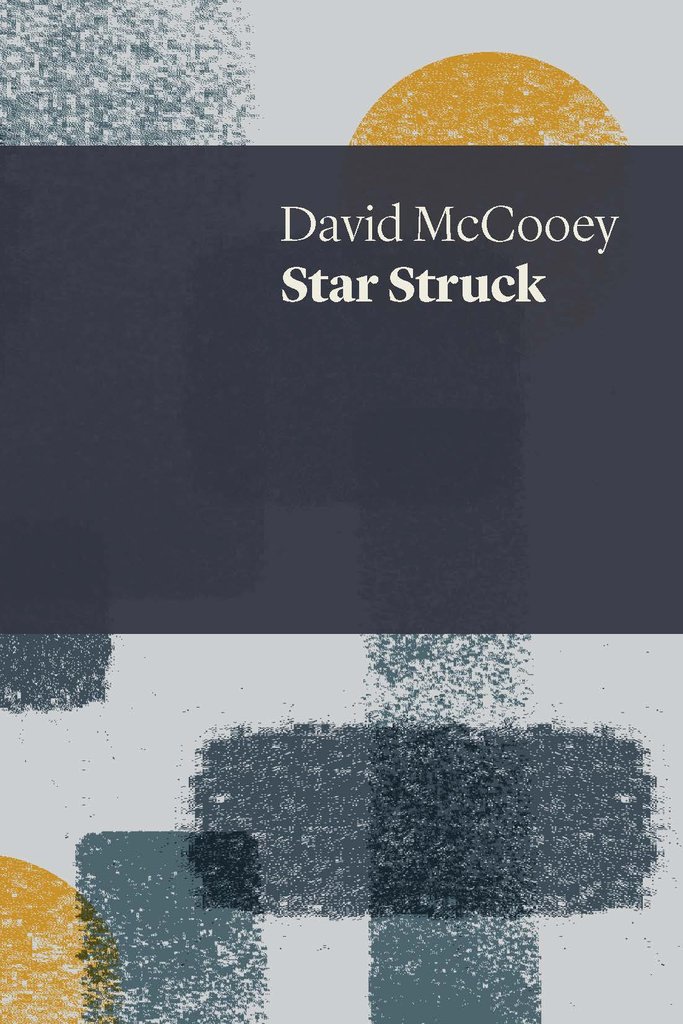
Chloe Wilson Reviews David McCooey

Star Struck by David McCooey
UWAP Poetry, 2016


At first, David McCooey’s Star Struck appears to be a collection comprising four sections, each self-contained and corralled from the others. These sections range from a series of lyric poems meditating on a ‘cardiac event’, to poems investigating light and dark, a sequence of eighteen ‘pastorals’ on pop stardom (and fandom) and, finally, two longer narrative poems. A quotation at the beginning of the pastoral sequence seems to hint at the collection’s attitude. From William Empson’s Some Versions of Pastoral, it reads: ‘Probably the cases I take are the surprising rather than the normal ones, and once started on an example I follow it without regard to the unity of the book.’

This cavalier disregard for the ‘unity’ of the book suggests a lack of concern with overall coher-ence between the poems in a single volume. And yet, there are decidedly consistent threads throughout Star Struck, both thematically (time, light, memory, the knife-edge of comedy and tragedy, how ‘voice’ is inhabited), and also in terms of tone. A mood of what might be called premature elegy suffuses McCooey’s poems throughout this collection. His speakers frequently find themselves alienated, unable to return to old selves, and unsure of what to make of the world they presently live in. They recall the past with nostalgia and sometimes grief (and irony – the atmosphere rarely threatens to become moribund), and view the present with an un-settled detachment.

McCooey’s reader senses that they are encountering a self irrevocably divided from its former incarnation. This is reflected in the use of second person in many of the poems – it would seem that the ‘you’ being addressed is not a different subject, but a past version of the self, an idea McCooey references directly in ‘Second-Person’, where:

you enter the realm
of the second-person singular,

a new you
to ghost the old,

the one on the other side
of a recalibrated life

The first section of Star Struck, ‘Documents’, presents the most literal rendering of this divided state. The speaker finds themselves in the midst and the aftermath of a ‘cardiac event’, and while at times they are able to find amusement in their distress (‘“I’m just labile,” you say, // and the doctor is satisfied. / You are speaking his language’) (‘Speaking the Language’), they nevertheless cannot help but reveal the terror that characterises this period of ill-health, with its moments of crisis and long periods of inertia, when the nervous system becomes ‘a shivering horse within you’ (‘One Way or Another’).

Throughout this sequence the speaker records with a meticulous eye and ear the physical envi-ronments, interpersonal interactions and thoughts that accompany illness and convalescence – at times, going so far as to arranging them into list form. A sense of the uncanny quickly emerges. It’s there in the ‘staring students’ who are ‘graduates / from The Village of the Damned’ (‘Music for Hospitals’); in the ambulances which are strangely unhurried, ‘state-ly’, rather than ‘rushed’ (‘One Way or Another’); and in the speaker’s sense that:

       it is not Death in
his outdated apparel at your 

doorstep, only your boss, doing
the right thing.

(‘Not to Disturb’)

For this speaker, death is omnipresent. As a result, the most blameless and familiar things now appear morbid; during the boss’s visit, even the biscuits are deathly ‘pale’, and the speaker refus-es to eat them.

Of course there is also a deadpan comedy in this that spikes even the most poignant poems. For example, the speaker mentions his wife ‘graphically’ describing the ‘harrowing scenes’ of the ICU (‘Intensive Care (ii)’) ‘so that you were both / gifted with that / pointless knowledge’. This reads as a dry call-back to a more sombre moment in an earlier poem, ‘The Point’, when the speaker’s wife jabs him in the chest during an argument:

There is a finger pressed
against your breastbone,
and left there, long after
the point has been made.

McCooey’s speaker even finds gruesome humour in a male nurse, ‘excellent at taking blood’, who brags about his prowess as a hunter, showing off photos of himself ‘dressed in fatigues / with Apocalypse Now face paint’, the ‘pretty’ corpse of an animal sprawled across his four-wheel drive (‘The Hunter’).

The tone and preoccupations of ‘Documents’ herald what awaits in Star Struck’s subsequent sections. A reader has already become accustomed to McCooey’s fascination with light and darkness prior to arriving at the second section, ‘Available Light’, which announces this as its theme; after all, ‘Documents’ has given us the droll observation that ‘Hospital light, like any other / light, is rarely “lemon coloured.”’ (‘Cardiac Ward Poetics’), and presented the sun as it ‘performs its drawn-out / power down’ (‘Invisible Cities’).

Yet there is a particularly spectral quality to the types of light listed in ‘Available Light’:

the science-fiction lighting
of deserted 7-Elevens;

the out-dated starlight;

a nightwalker passes 
the TV-blue of windows;
	
a phosphorescent Frisbee 
muses on the porch;

The vistas presented in this section are often deserted, with any signs of life – lights, music, va-cant chairs on a patio, figures or cars viewed from a distance – more a reminder of the speaker’s sense of isolation than a comforting indication that others, and the potential for connection, ex-ists. Like ‘The Dolls’ House’ with its mise-en-scène of family members attending to their (dull, gendered) tasks in frozen solitude, the speaker’s world has become distant and static, the ob-served details of domestic and suburban life as strange as the descriptive titles of ‘Early Photo-graphs’ which comprise the section’s first poem: ‘Untitled (two women posed with a chair). / Use of ether for anaesthesia. / Valley of the shadow of death.’

The poems in ‘Available Light’ also remind the reader that it is almost impossible to consider changes in light (and the capture of light through the photographic image) without also consider-ing time; the two move in tandem. Even darkness itself, the speaker of this section’s final poem (‘Darkness Speaks’), acknowledges this:

                                            One day
you will wake up for good,
and there I will be, at last.

Revisiting an earlier poem provides an opportunity to meditate on the interplay of time and light. ‘“Whaling Station” Redux’, presents a speaker who is forced to reconsider their earlier poetic rendering of a memory when ‘My late father’s legacy of 35mm slides, / newly digitised, undoes my poem, with three shots —’. The violence of the word ‘shots’ here seems particularly appro-priate, given the vast yet blasé violence of the images considered. The light stored in these imag-es, which becomes absent, ‘pure black’, at the whale’s centre, creates an occasion both for the speaker to reassess what he saw at the age of five (the images perhaps ‘darker’, literally and fig-uratively, than the memory) and to prevent his six-year-old son from seeing the same thing and this darkness therefore being handed on to the next generation. The poem’s conclusion, where the father flicks to a photograph of an Uncle ‘standing before the Arc de Triomphe’, is not an arbitrary choice of image; the Arc itself is of course another monument to the violent ‘industry of men’, even if it makes for a less confronting sight than the steaming carcass of a whale.

Posted in BOOK REVIEWS | Tagged ,

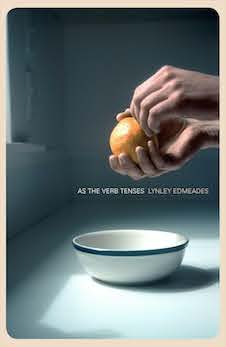
Review Short: Lynley Edmeades’s As the Verb Tenses

As the Verb Tenses by Lynley Edmeades
Otago University Press, 2016


As the Verb Tenses is a rare debut collection of poems that dazzles and delights with a profane, childlike wisdom. Acts of movement and play energise an accomplished performance held together by rare precision and a gentle power. Its author is the poet Lynley Edmeades who was born in Putaruru, a small town that is the home of the renowned Blue Spring and the source of much of the bottled water in New Zealand. Edmeades has travelled, read and published in New Zealand, the US, Ireland and Europe.

One of the great virtues of As the Verb Tenses is that it is not ostentatious; it remains poised in conversation and occasion. The verse is tensed between abstraction and feeling as it observes supposedly banal things: this kitchen pot and orange, and this clear spot on the counter. This everyday quality is some feat given the web of influences on Edmeades: avant-garde modernism, minimalism, and poststructuralism.

Edmeades completed an MA at the Seamus Heaney Centre for Poetry at Queen’s University in Belfast, and is currently undertaking a doctorate in sound in avant-garde poetics at the University of Otago. As the Verb Tenses bears the dynamics of modern Irish, as well as contemporary Asia-Pacific poetry; it plays with words between sounds, geographies, feelings. Edmeades achieves much in the calm irony of poems such as ‘Between Speech and Sound’, which invites us to feel ‘the usual shortcoming / of abstractions’.

This is a collection that refuses to choose between Baudelaire and Marx, and it is all the better for it. Judging from the epigraphs that open the book, Edmeades has structured the collection with at least two experiences of active tension. They are characterised by a mode of nonknowledge that opens us to a simultaneously sensuous and critical modernity. The first experience is that of the child who – as in Cage’s description of a trip to New Zealand that never eventuates – is characterised by a disappointed belief in the discourse of adults. The second experience is one of adult bookishness clashing with an unrecognised reality; or foolishness that makes unliveable promises to children. To open this experience, Edmeades provides an epigraph from one of the pithy sentences in Foucault’s The Order of Things: ‘Don Quixote reads the world in order to prove his books’.

Throughout the collection, Edmeades plays with Foucault’s critique of discourse to continually return to a heterotopic limit: ‘It’s difficult to keep the order alive’. A powerful new dimension is added to Foucaultian modernity through poems such as ‘Towards Whatever it is that Keeps Things Apart’:

This world, with its children and adults,
some ready for it, and some not.

In undertaking her poetic critique of everyday life, Edmeades makes full use of the geography of New Zealand, Belfast, Europe and Russia. Two poems called ‘The Order of Things’ almost but not quite bookend the collection. They plunge us into a kind of coming of age, post-colonial moment in the movement between country and city, from the family farm in New Zealand to the open air of the urban park:

When it was time for me to learn how to drive
I asked how I’d know which gear came next
It’s difficult to keep the order alive
When I get confused with the three, four, five. 

[…]

Red tulips drooping in the park.
Remarkable how quickly things change:
It’s tomorrow.
            It’s today.

The collection continues to dazzle as it moves between London, New Zealand, Belfast, a Siberian lake, and back to the metropolis. The peculiarity of post-colonial experience is evoked in poems such as ‘Second Hand’, or ‘East Belfast’, where ‘Birds sit in trees older than me’. Other poems return more directly to the quixotic theme of the epigraph: living ‘By the Book’, for example, just leads to ‘increased lack of intimacy’ in a poem about relationships. Poems such as ‘Cregagh Road’, ‘Inis Mór’, ‘As if’, ‘Orange Order’ and sketch Northern Ireland from the perspective of an outsider, a post-colonial child who finds wisdom in disorder.

In As the Verb Tenses, Edmeades guides the reader with an expert sense of rhythm and structure through the idiosyncratic itineraries of everyday globalisation. The poetry enchants, capturing the familiar childhood estrangement felt when we are playing with words to apprehend the world. This profanation of verbs is at its best when it approaches, as Walter Pater put it, the condition of music. Make like a verb and read this book.

Posted in BOOK REVIEWS | Tagged ,

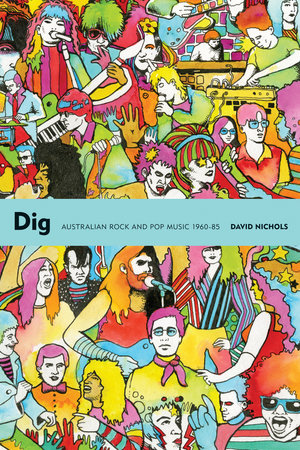
Jen Jewel Brown Reviews Dig: Australian Rock and Pop Music 1960-85

Dig: Australian Rock and Pop Music 1960-85 by David Nichols
Verse Chorus Press, 2016


Isn’t it time we invented a new handle for this ‘rock and pop’ stuff? ‘Rop’, for instance? Alternatively, ‘pock’ surely says ‘acne moonscape’: good for sounds designed to lure teens with condom-snapping haste. Regardless, I must say the droll and often delightfully irritated David Nichols brings a savoury palate to this tasting of Australian sounds. As a historian drawn to such antipodean delights as the subjects of his books, The Go-Betweens (2003) and The Bogan Delusion (2011), Nichols floats well above the bilge water line.

The foreword to Dig comes courtesy of Dave Graney, who notes that Nichols: ‘has experienced the limitations and constraints of the scene on the island and has continued to chase down rumours and will-o’-the-wisp reputations that occasionally spawn mad fevers in the compound.’ It is certainly true that, as this convict nation continues in its convulsive incarcerations, breakouts and last stands, songwriters and performers are the foot soldiers of escape. And with its bristling index and in-text scattering of old posters, cartoons and ads in black and white, Dig has a cannae-tie-kangaroo-down unpredictability. Nichols makes it clear in his introduction that he is not interested in cramming together all the old hack stories about rock stars acting up, or sniggering at historical ‘fashion crimes’. Rather he has rummaged through a range of evidence and conducted many interviews with musos and rock scribblers (including myself, disclaimer here) and others to plant his feet on the territory.

There are entire chapters dedicated to The Bee Gees, The Missing Links, The Easybeats, the strange story of the more obscure Pip Proud, AC/DC, Dragon, The Reels, The Triffids and The Moodists. Daddy Cool and Skyhooks are thrown into the washer together, where Bongo Star’s glitter irretrievably crunches up Ross Wilson’s foxtail. Other chapters explore the changing socio-musical decades. Along the way such interferons as architect Robin Boyd with his ‘Austerica’ (Australia / America) theory, the pianist, composer and free music explorer Percy Grainger and Richard Neville’s Oz Magazine-fueled rambunctiousness shoot through the text. Nichols dips into 1971 Daily Planet magazine to credit columnist Lobby Loyd with this ‘lobbying’: ‘Australian rock is probably the most advanced in the music world because this country has never known success, that perverter of truth and destroyer of progress.’ The crash-and-bash talent, unnerving persistence and musical nous are wonderful to breathe in.

The early-seeding festival scene is explored as a powerful multiplier of rock power. Nichols claims that South Australia’s three-day Myponga Festival in January 1971 only drew ‘an estimated 5,500’; recently, however, Bob Byrne wrote in the Adelaide Advertiser that he attended, and that Myponga, which starred Black Sabbath with many top Australian bands, had at least 15,000 paying customers and another 5,000-plus jumping the fence. Dig reports ‘heavy rain and icy winds no doubt made the experience unpleasant even before the Draft Resister’s Union tried to break down the fence, distributed pamphlets condemning the festival as a money-making concern, and at one point marched onto the stage chanting ‘out, pigs’ and ‘free concert’.’ The highly varied reportage on Myponga is challenging, and Nichols’s account funny, however I feel that his overall picture of Myponga is inaccurate. In the Australian rock festival scene, Myponga has always been quite celebrated as: one of the most impressive early Australian festival line-ups, with much of the weather hot, if dusty; and the birthplace of Daddy Cool’s enormous live success.

More commonly, Nichols has a solid grip on the ever-transforming and widening scene. Chapter Six, ‘Falling off the Edge of the World: The Easybeats,’ makes fascinating reading about the guys who in many ways wrote the bible on ‘How to Succeed in Show Business While Really Trying’, tripping over great cement clumps of failure en route, include Harry Vanda, Stevie Wright and George Young. ‘By 1969,’ writes Nichols, ‘Vanda and Young – at this point jointly the Brian Wilson of the group – were holed up in a flat on Moscow Road that had previously been a jingle studio for pirate radio … Somehow, the last proper Easybeats album, Friends, was made up almost completely of Vanda and Young demos, sung mainly by Young, including ‘St Louis’.’ Nichols quotes Vanda’s admission that, ‘I wouldn’t know what bloody St Louis was like,’ revealing that Friends was just an album to appease the contract while providing a taster of Flash and the Pan hits to come.

Another definitive moment in this sprawling history is when the talented Brian Peacock, known for the arty, rather baroque Procession – whose biggest hit ‘Anthem’, was completely a cappella – underwent a dark night of the soul. By this stage in the very early 70s, Peacock was staying at the Warwick Hotel in New York and road managing the American tour of the much more commercial New Seekers, when he discovered that their record company Warner Bros was owned by the Kinney Corporation, ‘basically car park operators … a heavily mobbed-up, mafia-riddled company.’ His resultant spiritual seizure ‘wasn’t drug-induced,’ says Peacock, ‘just a total paranoia that I was doing exactly the wrong thing, and the whole music industry was doomed and riddled with corruption.’ He told his business partners not to worry, he’d found someone else to take over, and as Peacock sensibly walked out, someone much more equipped to deal with King Kong – Glenn Wheatley – walked in.

There are also spiritual experiences in Dig of a purely musical nature. For instance, MacKenzie Theory (1971-4) were a highly skilled, electric ‘head’ band on the Mushroom label, improvising wordlessly on guitar, viola, bass and drums. Their American-born founding bass player Mike Leadabrand describes one show they played as ‘probably the most memorable event’ of his life. ‘It was as though the music came to us from somewhere else, and we were along for the ride as much as the audience,’ said Leadabrand. ‘When it was over, everyone knew that something had happened that we had no way to talk about.’ The Theory were supporting a popular Brisbane band that night, but that band announced they could no longer go on. Neither Leadabrand nor Nichols spells it out, but the implication is the headliners felt unable to follow the otherworldly experience their support act had conjured up. ‘Nobody complained or wondered why,’ said Leadabrand, about the headliners’ desertion. ‘This happened about three times in my three years with (MacKenzie Theory), and those times formed the person I would be to this day.’

Nichols isn’t always as sympathetic towards his subjects. After following the meanderings of Cold Chisel with attention in Dig, Nichols lets fly at their solo-going singer Jimmy Barnes for ‘the teeth-gnashingly ghastly’ single ‘Working Class Man,’ which, Nichols writes, is ‘written and produced by Journey’s Jonathan Cain, channeling a foetid, parallel universe Bruce Springsteen.’ Whether or not you agree with him, Nichols’s viewpoints are always individual, dodging the paralysing sameness often at work in long form rock-writing styles.

Posted in BOOK REVIEWS | Tagged , ,

John Clarke’s Complete Verse


Image courtesy of Legacy

For many years it was assumed that poetry came from England. Research now clearly demonstrates, however, that a great many of the world’s most famous poets were actually Australians.

So opens John Clarke’s The Complete Book of Australian Verse – later expanded to The Even More Complete Book of Australian Verse – one of the most extraordinary poetry collections in the history of this – as Clarke’s Dylan Thompson would have it, ‘wide brown bee-humming trout-fit sheep-rich two-horse country’.

Clarke introduces a number of Australian poets hitherto unknown, whose work has a huge influence on English poetry. There is Arnold Wordsworth, ‘a plumber in Sydney during the first half of the 19th century … responsible for a good deal of the underground piping in Annandale and Balmain. He lived with his sister Gail and with his mate Ewen Coleridge, who shared his interest in plumbing, and also in poetry and, to a degree, in Gail’. And Emmy-Lou Dickinson, who ‘film devotees will perhaps remember Emmy-Lou as an extra in Witness which was directed of course by her fellow Australian Peter Weir … she lives alone near Lakes Entrance and speaks only to small children on her mother’s side’). And, a personal favourite, W H Auding, who ‘died in 1968, 1971, and again in 1973’. The book is the apotheosis of Clarke’s genius.

As anyone who has waded, stony-faced, through The Faber Book of Parodies will attest, literary parodies are not easy and tend, for the most part, to diminish both the writer parodied and the one doing the parodying. But here Clarke manages, astonishingly, to do the opposite. He reveals himself to be both a writer of extraordinary precision and suppleness (we perhaps knew that already) and listener of great acuity (the former no doubt due to the latter), but is able to reveal truths about the poets – their lives, their times, their form, even – and here is a real skill – their tragedies, their pathos.

Take Sylvia Blath, who ‘wrote quite a lot about illness and death. She sometimes did it ironically but always, behind all the fun, were illness and death. She called it a day in 1963’. Unlike her near namesake, Blath, in ‘Self Defence’ allows herself to reach the limits of language, revealing more about Sylvia Plath than any number of dissertations.

Your daughter you condemned to the oven
Subtle in leather
Der offen, schnell.
Pig, brute, fatso, bastard
Shit, bugger, bum, fuck, poos.

While his Tabby Serious Eliot (‘Old is what I increasingly seem to be’) finishes his poem with as piquant a summary of his namesake as can be imagined.

In the room the women come and go,
Though not, perhaps regrettably, with me.

To do this, one needs more than a gift for parody. The book contains endless examples of Clarke’s brilliant ear form sound and form – from Labour Party leaders who ‘On remote coastlines … beach themselves / Spume drifting from their tragic holes’ in William Esther Williams’ ‘Carnival Music’; to those who would study ancient morals and observe that ‘at least one foot must be on the floor/While towing Hector around the walls of Troy’ in Section IX of Louis ‘The Lip’ MacNiece’s ‘What I Did in the Holidays’.

Clarke, by his own admission, came to poetry late, but became a devotee, writing lovely, revealing pieces – in his inimitable style, blending high and low culture – about a number of poets, including Auden (‘a natural history lesson includes the maxim that in polite company, you should never discuss politics, sex or religion. Auden was cleaning this theory one night when it went off. Almost everything he wrote about, and he wrote about almost everything, was politics, sex or religion’) and Seamus Heaney (‘when Seamus Heaney came to Melbourne in 1994, he had not yet won the Nobel Prize and could still play an away game’).

Poetry, Clarke felt was particularly propitious for parody, noting, in an interview with Justine Sloane-Lees for Radio National’s Poetica series that

… there aren’t very many forms, in writing, that you can adopt and collaborate with the original, but you can in poetry because of its brevity and its concision and because of the understanding that you have with the original because you’re collaborating with it when you first read it. So this is just another permutation of that collaboration, and it’s a pretty wonderful one to try.

This is every poet’s dream of an ideal reader – one who takes the care to ‘live with’ the poem, and to enter into a dialogue with it (the antithesis of the ‘what does it mean’ style of poetry reception taught in schools). For Clarke writing poems in the style of the originals was ‘like wearing someone else’s shoes and clothing, you walk as them, and all sorts of interesting things happen. You catch sight of yourself walking like someone else in the shop window’.

It is not hard to see the relationship between this and Clarke’s work with Bryan Dawe. I would argue that the key difference between satire and other similar forms of humour such as parody or caricature – or maybe just between good satire and bad satire – is that in the former the satirist, to some extent, empathises with the person satirised.

In this – the use of empathy as a way of engaging and satirising – Clarke reveals both his talent and his generosity, and this is, for me, why his political interviews were on a different level to other work in the genre. He didn’t simply mock the politician – an easy enough exercise – instead he asked the viewer to imagine being that politician.

To take as an example his final interview, where he played the Treasurer, Scott Morrison, Clarke doesn’t attack Morrison directly, rather, he imagines what it must be like to be Scott Morrison, having to defend a bad policy, and knowing that he will, almost immediately, be ‘hung out to dry’. Clarke’s ‘characters’ squirm, make desperate phone calls, engage in double-speak, attempt to make ‘Bryan Dawe’ ask easier questions, more intelligent questions, dumber questions, different questions. They are men and women forced to play dress up as politicians, and desperately wanting to be somewhere else – which is why Clarke himself didn’t need to imitate them. He makes the interviewee everyman or everywoman. John Clarke is them. We are them.

Posted in GUNCOTTON | Tagged ,