Private David Jones’s In Parenthesis and The Anathemata

… it came as if a rigid beam if great weight flailed about his calves, caught from behind by ballista-baulk let fly or aft-beam slewed to clout gunnel-walker below below below.

He thought it disproportionate in its violence considering the fragility of us.

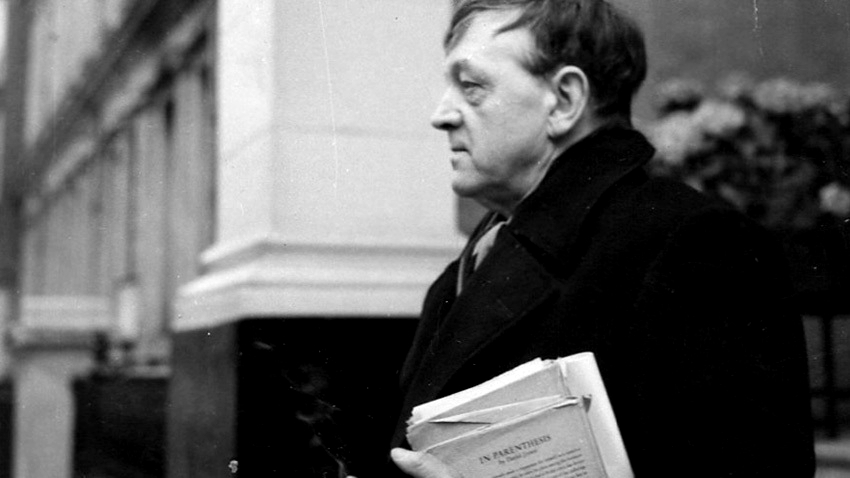
Shortly after midnight on 11 July, 1916, Private David Jones of the London-Welsh battalion of the Royal-Welsh Fusiliers was shot in the calf at the end of an operation attempting to drive the Germans out of Mametz Wood as part of the Battle of the Somme. He had spent much of the previous 24 hours engaged in heavy combat, in what was one of the bloodiest battles of World War One. The 38th (Welsh) Division lost a fifth of its men in the battle, 565 killed and 585 reported missing, presumed dead. Including Jones, there were another 2893 wounded. Crawling back through the wood, Jones moved through the bloodied corpses of close friends and acquaintances, garlanded by the flowers and foliage of Mametz. Jones would return to the front, and serve until the end of the war, but this battle would haunt him for the rest of his life – ‘my mind can’t be rid of it’ he said in 1971.

From it, Jones created the long poem In Parenthesis, which W H Auden called it ‘the greatest book about the First World War’, doing for the British and Germans ‘what Homer did for the Greeks and the Trojans’. Graham Greene called it ‘one of the great poems of the twentieth century’, and T S Eliot, in his introduction to the first edition was unequivocal – it is, he wrote, ‘a work of genius’.

Of Jones’s second great poem, The Anathemata, Auden was even more effusive, calling it ‘very probably the finest long poem written in English in this [twentieth] century’. For writers as diverse as Kathleen Raine, W S Merwin and Seamus Heaney, these poems, taken together, make Jones, in Merwin’s words, ‘one of the greatest twentieth century poets’. Dylan Thomas, not one to underplay his own talents, said ‘I would like to have done anything as good as David Jones has done’.

While it is as a poet I wish to explore Jones, he is also unique – William Blake, with whose work Jones grappled all his life, being perhaps the only other example – in having attained eminence as both a poet and a painter. Before the publication of In Parenthesis he was already regarded as ‘the most gifted of all the young British painters’ (Kenneth Clarke). For Jones, much to his initial surprise, the problems presented in creating a poem were of a piece with those of creating a painting, and led him to consider questions, and assay, in his own polite way, solutions, which remain as challenging now as they were when he was writing.

‘Bugger it, I can do better than that, I’m going to write a book.’

The story of Jones’s decision to write about the war – as recounted in Thomas Dilworth’s excellent new biography, David Jones, Engraver, Soldier, Painter, Poet – may be apocryphal, but it has a definite ring of truth. Jones had suffered from depression after the war ¬– what would now probably be diagnosed as shell shock. Already an established painter, having entered the Camberwell School of Arts and Crafts as a fourteen-year-old, he was struggling to make art, and struggling to live. A broken engagement with the daughter of his partial mentor Eric Gill had left him in a parlous state.

He read obsessively about the war, and claims that it was after reading All Quiet on the Western Front that he decided that all he had read

… exaggerated fear and calamity, failed to convey war as ‘like ordinary life … only more intensified’, failed to convey the sense of historical continuity that he and others had felt, and failed to show the ‘extreme tenderness of men in action to one another’. (DJ, 128)

For Jones, it was, as Dilworth notes, an ‘entirely aesthetic challenge’ and one that Jones, to his own fascination and possibly astonishment, presented similar problems to those he faced as a painter. Fundamentally, how was one to re-present a particular moment, either in words or in paint?

Jones worked on In Parenthesis for four years; 1137 foolscap pages of drafts survive, distilled down to the manuscript draft of 281 pages (DJ, 155). Among his models were the ‘Anna Livia Plurabelle’ section of Finnegans Wake; the Anabasis of St-John Perse; Gerard Manley Hopkins (in particular ‘The Wreck of the Deutschland’); Wuthering Heights and Moby Dick. Working on a series of engravings of ‘The Rime of the Ancient Mariner’ kept the mood of that work in his mind, while he disclosed correspondences between his fellow infantrymen and those of the Iliad, Shakespeare’s Henry V and, in particular, Malory’s Le Morte d’Arthur, which would remain the keystone text of his entire writing career.

The poem itself is in seven sections, each title page carrying a quotation from the early Welsh epic poem Y Gododdin, another model for the work. The poem mixes what Fiona Sampson has called ‘the disobedience of poetic form’ while at other times reverting, as the poem itself has it ‘to the discipline of prose’ (IP, 103). It mixes the allegorical with the demotic, although the latter is the preferred mode, incorporating a great deal of Cockney rhythm and phrasing – as Jones notes in the preface, ‘as Latin is to the church, so Cockney is to the army’.

It is a radical – and deliberate – departure from other poetry of the First World War. We are used to encountering war poetry – particularly in that of the Great War – as various types of anthems for doomed youth, elegies for young men (generally) whose lives were cut short, or who were sent mad, by a combat which can never be fully justified. Blame is apportioned. The futility of the exercise is highlighted. The similarities between us and those we call our enemies are drawn to our attention. And we are left to question what it is that drives humanity to such folly.

Posted in ESSAYS | Tagged , ,

Mansplaining Abortion in Alexis Late’s ‘Procedure’


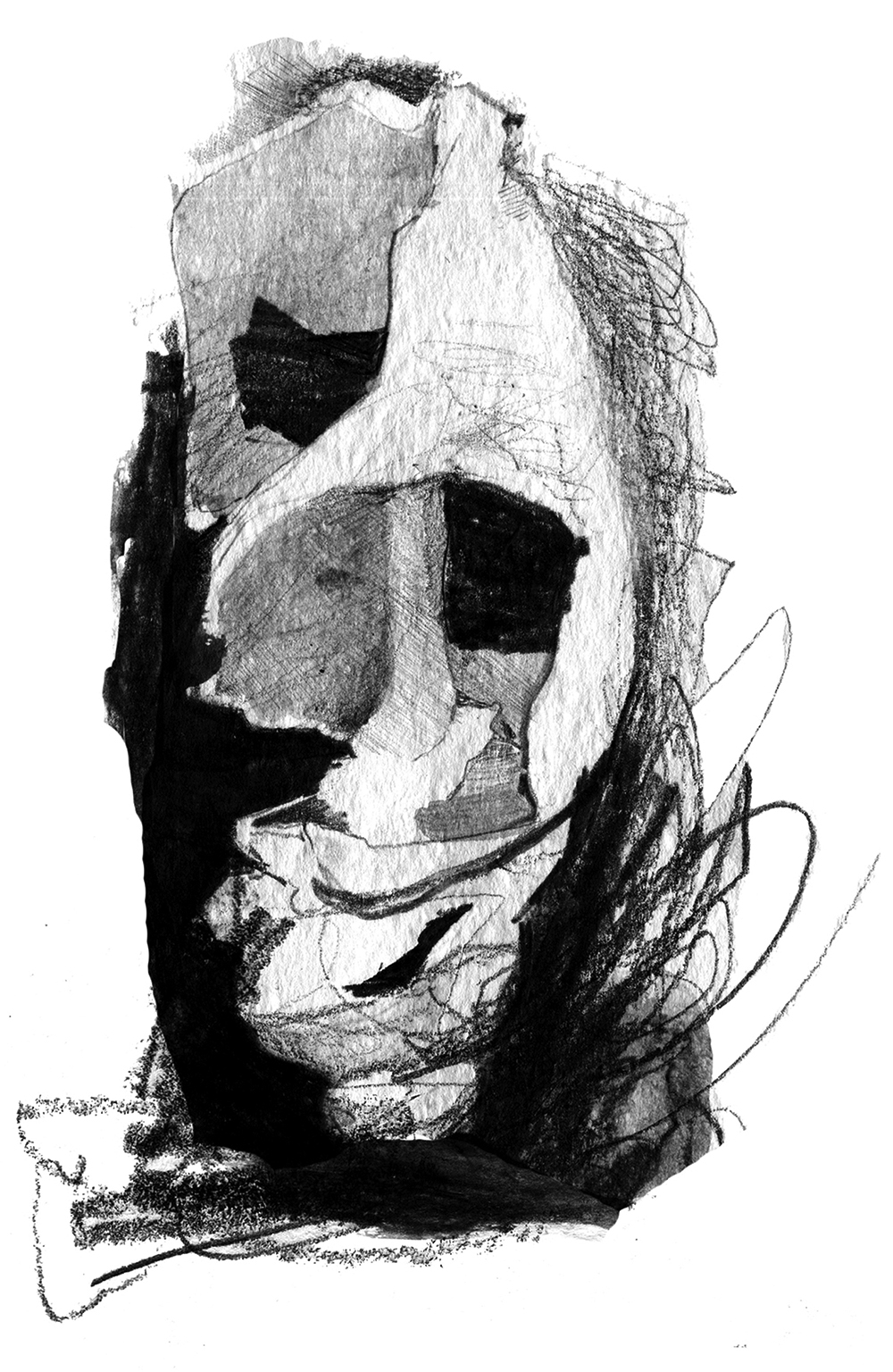
Mel Pearce | Untitled | In response to Alexis Late’s ‘Procedure’

Alexis Late’s ‘Procedure’ draws on the conventions of Confessional poetry by women in English – particularly on the influential work of Sylvia Plath and Anne Sexton – to make a creative statement resisting the masculinist imposition of clinical discourses to the raw subjective experience at the centre of this poem: the speaker’s abortion, and its visceral consequences for her rage, guilt, hurt, and defiance.

In stanzas 1 to 3 the speaker begins in conversations experienced as attack, with a metaphor of a hunter trapping an insect, and the speaker expressing herself as insect under threat of being devoured. The insect ‘flutters weakly,’ is ‘blanched’ – a bloodlessness whose significance will become apparent.

In stanza 3 the pursued insect becomes the speaker. The insect is pinned to an entomologist’s board, a cruel skewering of the self, fallen victim to a kind of casual masculinist rationality: ‘splintering / under your gaze,’ ‘single-minded’ ‘with each quick piercing.’ Then a pivot in stanza 4 to the pins that stick women, and the pins that women stick in sewing. Here the connotations are of sewing as a scene of ritualised violence done to women in the prison of domestic conventions stifling women’s autonomy historically. The staccato assonance of ‘pins, pins, to fix, to fix her’ employs repetition to draw out the subtle twin meanings of ‘fix’ as both a transitive and intransitive verb. Taking an object, ‘to fix her’ is the masculinist, medicalised understanding of women as broken objects necessitating repair, and taking no object, with pins ‘to fix’ as in the immobilisation of the captive insect. ‘Sewing her silence / an inheritance passed on’ offer the subtle twin readings of sewing as a silent, normative stifling of women’s expression reproduced generationally, but also a craft made in silence that speaks women’s traumas to the world. These lines echo the portrayal of Philemona in Ovid’s Metamorphoses, who is raped by Tereus and has her tongue cut out to ensure her silence, but weaves a tapestry to expose her violation. The twin status of sewing is one instance of a theme running throughout this poem, which features scenes of women’s immobilisation, women’s damage, women’s injury, portrayed in a way that criticises these practices in a refusal of the theft of women’s expression and women’s bodily autonomy. In the opening stanzas of ‘Procedure’ I am reminded of the conflicted, visceral rage alongside the pins of medicalised trauma in the work of contemporary Melbourne poet and artist Jessica Knight, and, in particular, a photographic work from the ‘Paper Dolls’ group exhibit at the Docklands in 2014. The artist is photographed from behind, naked, vulnerable, before a wall covered with X-rays of her many surgeries, the bright streak of steel implants down the length of her spine, and the punk scrawl of her poems up the wall alongside, wounded and defiant: ‘I HAVE MORE BACKBONE THAN YOU.’

In stanzas 5 to 7 of ‘Procedure’, the speaker, ‘weaving quietude and guilt / while you tell me how you feel,’ defies her partner’s selfish need via the feminised violence of sewing – ‘Still, it seems to me / your mouth is a wound / I want to stitch up’ – and the object of the speaker’s rage becomes apparent: the terror of pregnancy, ‘the frightening consequences / of blood and semen,’ and her injury at her partner’s selfish scorn: ‘I was slipping from / your downturned mouth, / like a stitch from a knitting needle / now futile and crooked.’ The knitting needle again connotes the feminised violence of sewing, but its presence in this line as producing something sloppy and wrong is haunted by the knitting needle as iconic of the feminised violence of desperate, self-inflicted backyard abortions.

The speaker performs a kind of reactionary nonchalance in stanza 8, with the brashness of the imperative mood (‘Fuck the world!’). The linguistic device of chiasmus, repetition with inversion of the word-initial sounds, draws ‘Fuck the world!’ and ‘we fucked’ into a syntactic parallel. This device draws out the disturbing brutality of ‘fuck’ as a verb here, meaning that to fuck someone can be a little too close to fucking up someone. In stanzas 9 and 10 the speaker’s guilt in the wake of abortifacents returns to the feminised violence of sewing, occupying the paradox of a malevolent emptiness, a nothingness that won’t stop growing: ‘I cowered before guilt, / and its threat of emptiness / that gaped at me / like a hole in my stocking, / widening, widening.’

The representation of the violence done to and by women’s bodies in pregnancy, miscarriage and abortion has a long history in women’s art, including in the work of pioneering women’s autobiographical Confessional poets Anne Sexton and Sylvia Plath, and it is Plath’s work in particular that Late draws on in this poem. Late’s ‘Your mouth is a wound / I want to stitch up’ echoes Plath’s ‘Blood, let blood be spilt; / Meat must glut his mouth’s raw wound’ from the poem ‘Pursuit.’ So too does the stick of pins echo Plath’s ‘My Japanese silks, desperate butterflies / May be pinned any minute, anesthetized’ from the poem ‘Kindness.’ Late’s poem is on well-worn ground depicting the visceral and emotional gore of lost, aborted pregnancy. In this Late stands alongside contemporary peers such as emerging cultural critic and essayist Leslie Jameson, whose 2014 essays ‘Grand Unified Theory of Female Pain,’ and ‘The Empathy Exams,’ republished in her 2014 collection of the same name, grapple with the inheritance of the aesthetic traditions of women’s Confessional poetry, and with questions of women’s subjectivity and suffering. Depicting women’s embodied pain is always intensely personal, and yet almost a cliché in its frequency and banality, a structural consequence of markedness in an intensely misogynistic world. What lends Late’s account its timeliness and its originality emerges in stanza 10: the speaker’s guy has the gumption to mansplain her own abortion to her by text message. Where Jamison’s narrator in the ‘The Empathy Exams’ wants her nice-guy boyfriend ‘close to her damage,’ to experience her abortion and ‘hurt in a womb he doesn’t have’ (31), Late’s speaker is more sorrowful, a hurt rebuke at the condescending ignorance of this man: ‘When you explained / the procedure to me / so calmly over text, / you dropped my heart, like a rag, / in a pool of dirty water.’ The semantic ambiguity of ‘it’ and the pregnancy connotations of ‘carrying’ in the final lines open a space for a subtle double reading: Regretful ‘I didn’t know you were carrying it [my heart]’; or barbed and sarcastic ‘I didn’t know you were carrying it [this pregnancy, its consequences].’

Posted in ARTWORKS, ESSAYS | Tagged , ,

Thirty-Six Views of the Parallax: Mark Young’s the eclectic world, Bandicoot habitat and lithic typology

Je ne vois pas un de mes petits livres qui ne soit sorti d’une inquiétude de langage.
— Jean Paulhan


1: Titles

The first thing to note is that the body of a typical Mark Young poem often bears no relationship to the title. Do not be alarmed: this is a postmodernist conceit, and Young is thoroughly postmodernist, although he would eschew such a label. One of Young’s brilliant running titles is ‘A line from …’ (he refers to this himself in his paper ‘Stochastic Acts: the search string as poetry’).1 In Hotus Potus, for example, we have ‘a line from’ every president of the United States of America, from the first, George Washington, to the latest, at the time of his book coming out in 2015, Barack Obama.2 Perhaps there is an actual line from the president in question embedded in the text; but for the most part, the poem seems quite unrelated, or is obliquely related (cf., for instance, ‘a line from Richard M. Nixon’, which deals with power (consumer needs) and corruption (political), and ends on ‘faux ice cream / up one’s asshole, & the / occasional long walk / in the winter woods’ (p. 43). I suppose the beginning of the final stanza is a reflection of Nixon’s profanity, and a long walk often comes after intensive reading.)

As for the books under discussion, the eclectic world (hereafter referred to as EW) has fifteen such poems, including the first poem, ‘A line from Kim Kardashian’; Bandicoot habitat (hereafter referred to as BH), two; and lithic typology (hereafter referred to as LT), none, which means Young has exhausted his stock (I doubt it), has grown weary of such stock titles or is writing more to come (more likely the case).3

Typically, there is nothing biographical in ‘A line from Kim Kardashian’ (EW, 5), beginning, ‘Matter changes its state / when energy is supplied to / it. Solids become liquids, & / liquids become those classic // black dance shoes’. Perhaps ‘dance shoes’ is an oblique reference to the person famous for being famous. In this poem, Young, as he does in most poems, channel-surfs to bring us disparate images, from science programs to exercise régimes and health tips, from advertorials to mass production. We live in an age where icons of the counterculture are used to consumerist ends, such as the playing of Led Zeppelin’s ‘Stairway to Heaven’ or David Bowie’s ‘Heroes’ as Muzak in supermarkets (although Bowie’s ‘Fashion’ has long been used in an ironic, quasi-ironic or even unironic sense in consumer affairs’ programs profiling the fashion industry in some way), or Lou Reed’s ‘Walk on the Wild Side’ as the soundtrack to an advertisement selling cars. I suppose you could always buy a ‘Never Mind the Bollocks’ tee-shirt, from the late 1970s anyway, but nowadays there is ‘Never Mind the Bollocks’ insurance, the bastion of the corporate world. Young ends his poem ‘on’ Kim Kardashian with ‘references to plasma television’.

The short poem ‘candy & nuts’ (LT, 60) demonstrates perfectly how Young mixes everything up. In this mixture, we have medicine, construction, animal welfare, law and industry:

	Bulk dried fruit bins
  filled with all kinds of
		organs & tissue
may only be redeemed
	for high pressure welders

after you are approved as
	an industrial chemical
donor & registered in
	accordance with the
  Domestic Animals Act of 1994.

Sometimes, titles reference other works (cf., Duncan Hose’s ‘cocky’s joy’ on p. 57 with Michael Farrell’s book of that title; ‘joy’ being a synonym of ‘gay’ – joy FM, a gay radio station in Melbourne, etc.).4 Or titles may disguise such references or disguise their meaning in some way. (For me, for example, Duchamp’s Tu m’ is nothing more than ‘tomb’ disguised.)

2: Unfinished

Paul Valéry said that a work of art is never finished; it is abandoned.5 (Gertrude Stein famously quoted Alfred Maurer as saying that he knew a work of art was finished when the artist put a frame around it.6) This exaggeration is a modernist conceit, although there is a kernel of truth to it (‘metaphysical conceits’ (LT, 61)). One only has to look at schizophrenic art to see that such artists have often gone too far, that they should have put the brush or pen down beforehand. Having said that, Young endeavors to put reality back into irreality in these three books (‘This is a piece of reality so dense that it goes beyond art’ (EW, 36)). Haruki Murakami, in his book on the sarin gas attacks on the Tokyo underground railway system in 1995, says that ‘(t)he sad fact is that language and logic cut off from reality have a far greater power than the language and logic of reality.’7 He goes on to say that ‘(r)eality is created out of confusion and contradiction’, which is Young’s modus operandi – and anyone who watches television or surfs the Internet, or who reads indiscriminately. Young says in the opening of ‘Stochastic Acts’ that ‘(r)reality, my reality, is a set of alternate realities. As are your realities.’ We can see this kind of paratactic reality, what Young calls ‘varietal or news-channel parataxis’, in other contemporary poets’ work, such as John Kinsella’s latest poetry collection, Graphology Poems.8

Those looking for realism will be disappointed, though. Anaïs Nin succinctly differentiated between realism and reality as a ‘process of interpretation of the symbolic meaning of people’s acts, not a mere reporting of them.’9 As she said elsewhere, ‘(r)ealism focuses on the observation of physical details, but mostly of the ugly detail.’10 Realism eschews the unconscious and symbolic; the realist concentrates on the outer world’s ugliness all around us (realpolitik), as if morals or ethics do not exist, even if their beauty should only exist inside of us. Nin said that portraying beauty or ugliness was simply a matter of choice for artists (she chose the former), though any artist caught up in a particular movement usually adheres through peer pressure to that movement’s bias. I see no discrimination in Young – he finds beauty in the ugliness of everyday living in our society obsessed with devices and the Internet. (If you don’t know the answer, just Google it, which I refuse to do here.)

However, choice is a form of tyranny or, at least, is largely a myth, especially when it moves away from the simple act of picking one thing over another. When choice is applied to the big questions, then it gets muddled (‘it’s / difficult to choose the / pivot point from which / the day’s trendline will / emerge’ (BH, 7)). In this past century, humankind increasingly chose the machine to do the work of humans, and this trend is continuing apace. That said, I am partial to the notion of fate, if not destiny. I speak of a ‘directed fate’: you are on a path, but it is up to you which way you go. Destiny, on the other hand, is rather like a railway line: the path is fixed and the only way you can get off it is derailment (death). On the other hand, I can’t accept Louise Hay–like sentiments that we ‘choose’ to get AIDS or cancer because of unresolved guilt, and as an illustration to others how precious life is, and that we can choose to be cured (‘puts a human face; on AIDS. // (We wouldn’t want it to get / disproportionate, of course, / but we do need to measure /the outcomes that matter)’ (EW, 13; emphasis in original)). Solecisms and judgementalism creep into the question of choice, such as the choice quote from an ‘Oprah Winfrey Show’ long ago, where an audience member, addressing Tom Cruise after a screening of Interview with the Vampire, said (I’m paraphrasing from memory): ‘It’s your choice to choose your rôles.’

Although Young is often inspired by television or especially the Internet, he does not use buzzwords, which abound in the media. In literature, such words as ‘spectacle’, ‘erasure’, ‘deconstruction’, ‘rupture’, ‘signifier’, ‘rhizome’, ‘recursion’, ‘haecceity’, ‘tectonic’, ‘epistemological’, ‘heuristic’, ‘limitrophe’, ‘ekphrastic’, ‘reify’, etc., are all buzzwords – you can usually tell from the word used whom writers have been reading (Derrida, Barthes, Deleuze, Lacan).11 He does use ‘trope’ twice in LT (‘Completing the sequence’ and ‘beard owner, dog lover’) and ‘caesura’ once in BH (‘Utamaro in the Everglades’), but these are technical terms Young has used ironically (as he does ‘metaphor’ in ‘Meanwhile, here is the news from white-wing Amerika’ (LT, 33) and ‘leitmotif’ in ‘Meanwhile, in the souq’ (BH, 14)). Also, a trope is etymologically related to the tropics (Tristes Tropiques), which are physically near if not metaphorically near to his heart. Literature, because it is made up of words, which almost everyone uses, is likened by many to photography, where almost everyone is a photographer. For that reason, many artists like Young think of literature or photography as a language that has to be mastered and then played with.

Deconstruction, like existentialism before it, is easily misinterpreted because of the aura of mystery (idolatry) or magic (Baal) that so often surrounds it. Detractors of deconstruction fear that literature is devalued through its operation of deducing (deconstructing) any text, literary or not. Therefore, theoretically, The Vivisector by Patrick White, winner of the Nobel Prize for literature in 1973, is on an equal footing with an episode of ‘Seinfeld’. To conservatives, such a thought is an abomination and an attack on literature. But this is nothing more than a distortion. Deconstruction, in my book, is one form of analysis or anatomy. It is another method in humanity’s quest to make our world comprehensible. No one would suggest, for instance, that the entomologist dissecting a cockroach is conducting an inferior analysis in relation to the ethnographer who analyses humans. Yet this is what conservatives are effectively saying about the spectrum of analysis in literature. (Conservatives fear that the cockroach is going to inherit the earth.)

3: Objets trouvés

The last poem in EW, ‘Sorry’ (p. 52), is an objet trouvé with an ending changed to reflect Young’s penchant for linking items that bear no relation to each other:

nothing
matched your
search terms. Please
try again with
a different fish

Fish – phish (‘ghoti’)?

4: Music

Why are we bothered to listen to music or read a book or look at a painting? For some, it is to see where the artist is going. For others, it is an escape. For others still, it is feeling what it is like to be transformed.

Music was Claude Lévi-Strauss’ favorite metaphor. A trope is a kind of metaphor (Tristes Tropiques again!), as Young points out:

even though it
is only used iron-
ically to invoke the
trope, upward facing
dog, when cast as a noun,
is much more vague than the
British stiff upper lip. (LT, 56)

David Bowie’s ‘Heroes’ is alluded to in the title ‘I wish I could swim like dolphins’ (EW, 51), if not the poem itself. The poem is like a diary entry, at first exorcising an Ohrwurm, where a lyric, or partial lyric, turns round and round in his head, then he explains that he is ‘in a cycle of mental paralysis’, where e-mails go unanswered and matters are left unattended, and that he no longer knows who he is or if he is merely an automaton. Music, this ‘ear-worm’, becomes a form of torture for Young, who wants ‘to break free’ (the Queen refrain that keeps going round in his head). In Queen’s first hit, with its potpourri of cultural references, from Islamic to Buddhist, Young discovers that ‘nothing really matters’ in this demented, defective world.12

Music or Poetry:

It has become a kind of breather between the high-tech wonders of the first act & the final 1-litre plastic bottle containing an unknown uplift of the oath-taking, flag-injustice substance. Have had experience of both, not being able to avoid the body armor that police said he wore during the techno music blasting a ballistic helmet & one & obtain measure while they waited for bomb-sniffing humanity that stays unchanging within the Games’ changing contexts – with spectacle (EW, 19)

5: War

Generally, although Young likes to point out humanity’s foibles (‘bomb-sniffing’ (EW, 19)), his poetry does not directly address the question of war. (The British, for example, may never have committed atrocities such as those committed by the Japanese in the Second World War, but they have deceived their own people about radiation leaks from nuclear facilities, they rampaged through India, they waged a colonial war in Ireland for centuries, and in their fervour for colonialism, committed many a massacre, in India, Australia, etc. The Americans may think of themselves as righteous, but they gave immunity to Japanese and German scientists who gained secret knowledge by performing barbaric experiments on humans, to advance their own programmes, such as the Apollo space one, and they are the only nation to obliterate two foreign cities with atom bombs. But no nationality is safe from blame.)

Specifically, the Cold War is mentioned in ‘troubadour docent’ (BH, 48) and ‘soldefagent’ (LT, 30), and Young does address wars in Afghanistan, Iraq, Central America, the Balkans, Mosul and the Persian Gulf. The Berlin Wall is a chilling artefact of the Cold War, and the massacres in Rwanda (mentioned in ‘schemata’ – ‘No names to give. / No sense. No order’ (BH, 11)) are the result of civil war. (Part of the problem is language: we use ‘massacre’ to describe mass random violence by an individual citizen or a group of them, as well as sanctioned or unsanctioned mass random violence by soldiers licensed to kill; the Dili Massacre in East Timor, the Myall Creek murders, Sandy Hook) Biological weapons are archly mentioned in LT (‘toxic waste that can / improve the military’s / ability to detect bio- / logical agents’, p. 63 – our military, presumably, with ‘logical’ embedded – a military term – in an enjambment as a word on its own), where Young’s cynicism and sardonicity come across as damning (‘asthma due to inhaled chemical fumes’, ‘We’re looking at what kind of undemocratic chemicals and compounds go into its supply chains’ and ‘The U.S. Air Force / have bombed it several / times’ (LT, 30, 60 & 67)).

Fellow poet Barry Hill wrote Peacemongers in 2014, part biography (the Mahatma Gandhi and Rabindranath Tagore), part diary, part memoir (his father, who was stationed in Japan as part of the Occupying Force after the Second World War) and part travelogue (India and Japan).13 It is also a damning indictment of war and should be read by everyone interested in peace. It fills in the interstices of Young’s poetry, who nevertheless shares Hill’s antiwar sentiments, but always archly (‘How / balanced is your / Solar Plexus chakra?’ (BH, 10); ‘I didn’t care if / some guy found nirvana’ (EW, 24)), and avoiding New Age kitsch and cliché (as does Hill).

Religion is never very far away from war. Buddha makes a brief appearance in Japanese garb in ‘beard owner, dog lover’ (LT, 74) and ‘Live like you want to live, Baby.’ (BH, 13). One would think Buddhists were peaceful people, and by and large they are, but not so the Buddhists of Burma toward the Rohingya minority in that country. Yet in ‘Chopped Cobb Salad’, Young says that ‘Nothing is safe from the / reach of the Creationists’ (BH, 24).

Materialism is not far away, either:

The Japanese do not believe
that shopping cures all. That’s
why the gods have given us
mystics, Sufis, & Zen masters (BH, 13)

Young’s search for a new reality, in our era of mass media, where facts and history can be twisted to suit, where we now apparently live in a ‘post-truth’ world, although revisionism has been around for centuries, is depressing to anti-consumerists and anti-materialists, counter–Neo-Cons, historians, environmentalists, pluralists and anti-capitalists, unless Young’s cynicism is enough to make you smile. In the end, ‘nothing really matters’ …

From a letter to my brother:

Humans, for all our ingenuity, are still a primitive species everywhere. When threatened, we look for the bogey-man. We stigmatise the perpetrator in order to make sense of the senseless. We stigmatise. (The ultimate stigmatisation for Christians is Jesus’ wounds, called stigmata, which have appeared on saints’ bodies – the marks of infamy transmuted as insignia of honor.) We can’t see that we, simply because we are human, are all capable of mindless, senseless, horrific and cruel acts. I maintain that while we have progressed technologically (it just means we’re good with our hands), we have not progressed one iota ethically from time immemorial. Intellectually, we’re expanding all the time (it’s our brains, after all, which drive our hands), but ethically, we’re hamstrung.

Enlightenment, the seeking of the light (which stigmatises the dark as the opposite of enlightenment and the corollary of evil, and leaves us with words like ‘denigrate’, from the same source as the word ‘Negro’ and concepts such as a ‘blackened’ reputation, etc.), is, I suspect, an illusion, a Möbius strip or an Escher puzzle. When you think you’ve arrived, you find you’re back where you started from. (I prefer the Sanskrit word for enlightenment, buddhi. Buddha, the awakened, the enlightened, is actually the epithet of Sakyamuni Gautama, just as Christ, the anointed, is Jesus’ epithet. Buddhi contains the elements of intelligence, expansion, perception, discernment, conviction, thought, feeling, meditation, wisdom. These elements comprise enlightenment. There is no need for the metaphor of light against dark that one finds in ‘enlightenment’ (i.e., the going into light). Also, the fig-tree under which Gautama attained buddhi and thus became the Buddha is known as the Bo-tree – the ‘bo’ of this word is merely a corruption of buddhi.)

Stigmatisation has been an effective tool of oppressors through the centuries. Our language is full of stigmatising words. Take the term ‘effeminate’ – it means like a woman, womanish; homophobia is inextricably linked with misogyny. The language of stigmatisation is surprisingly similar – just substitute whatever group you want to blacken and you’ll get the same reaction and support from the masses. Jews, blacks and gays, to name three target groups, have all been tarred with the same brush.

This was meant to be a good-news letter, but sitting down to write to you has given me the opportunity to let my mind wander on what preoccupies me.

Posted in ESSAYS | Tagged ,

hereafter

you should have died much later
there would have been
a space for such an event
you could have been

properly translated to a star
magical mysterious a new
inhabitant of heaven

not in such complete silence we
did not even know you had gone

all that remains is an absence
and a gravestone in another country

like slides in a lantern that lost summer
revives but scratched faded with pieces missing

like so much else
the sky above us the ground
under our feet
damaged imperfect but
all we have

Posted in LEE CATALDI | Tagged

mourning is women’s business

for Tjama

1

with a gesture as large as the planet
you call up the spirits of women
tonight you can see them thousands
filling up the country so it is
no longer empty

and lonely as it will be
when you are gone

and the multitudes no longer
dance across the spinifex

2

you were dancing
a slow skip
in the grand style
wearing a striped pointed hat
and white ochre
all your golden hair
cut to the grey

you go on without them like those
wounded in the leg
limping
dancing towards the embrace of the others
who limping
dance towards you

when the circles of recognition are complete
after days and weeks of sitting in the dust
you can get up wash go home
back to your places of employment

and the free spirit will burst
out of this belly of grief
into the air

3

when you were young you went to law
childless but free

now the funerals string together
narratives of loss
how hard it is
to think any more of forever

sometimes
you want private you want
out fold your shirt over your chest
and yourself up to sleep
your stomach hurts
with grief

when you were young and went about your business
who would have thought it would end
covered in white clay in a row of widows
seeing the land losing its people

your stomach hurts
and it’s hard to breathe

Posted in LEE CATALDI | Tagged

the opening of the children’s centre in Balgo

a smell of frying meat
drifts across the scene
and steam
from bloodwood leaves assists
departing souls to leave

a tiny child
hurls a rock across the yard
some skills die hard

it is as if the language
centre that was here
had never been the kukatja books
into which we put
our black and white lives have become
art works no-one can read

these days Balgo is a picture

and for sale

Posted in LEE CATALDI | Tagged

c’est l’homme

for John Forbes

you
develope a style until
it can say what you want you need it may
take years and years

of need a style
is a bit like a life
and then
it comes together
style book life
and then
much to your surprise
this neat construction
falls apart

there is no book
the life is not what was planned
and the style
seems hopelessly out of date and
immortality a fading dream but

the need
turns out to be timeless

and in the house there is
some small drug or other
to tide you over
and the style
takes a mini cooper and throws it
down like a gauntlet

and choosing a word is again
the first mouthful of something
brilliant and daring
always perfect

and you know
despite all the stumbling about in the bushes
the stubbed toes the dirt the broken fingernails

there was a kind of twisted little track
leading to the photo opportunity at the top of the cliff
and from there you can see

a mini cooper burning in the snow

perfect

Posted in LEE CATALDI | Tagged

on breaking things

a clumsy movement of the sleeve sweeps
the blown glass puja bell to the floor
and breaks the handle one in a set

of such moves hasty uncontrolled the snarl
the snap the gesture
of impatience and irritation that breaks

more than the bell the whole
enterprise something which like the bell is delicate but signifies
much more than itself a window

onto another universe
snapped off in effigy
before the music could begin

Posted in LEE CATALDI | Tagged

the sky is falling in

I drive along in my car
destroying the planet
towing a horse
listening to the cricket

the world
does not look as if it is about to end
but I know it will

here
it will burn

Posted in LEE CATALDI | Tagged

michelangelo 107

my eyes wild for beautiful things
and my mind have no other means
to get to heaven except
these blow them there

from the highest stars
a splendour descends
which draws desire in their direction
this is love

only this makes the true heart
burn this and its mirror
a face in whose eyes
it can perceive the same

Posted in LEE CATALDI | Tagged

michelangelo 27

you who kiss run from
love’s burning tongue his
flames are savage his
cuts mortal he
fights to the death

after the first rush nothing
neither effort nor brains nor
leaving the country
will do any good go

you see in me a staggering example
of the sharpness of his tooth
the strength of his arm his
bent disgusting game when first

your eyes meet his
don’t hang around I thought
I could have him
any way I wanted now

see what I am

Posted in LEE CATALDI | Tagged

mallarme: innocent breathless beautiful day

what does not fly
is not remembered
a sheet of ice
a hard lake
these you could free
with one drunk flap of your wing


the fabulous hopeless
out of date swan
can never escape
the shining places
the useless winter
his boredom inhabits


on the bird who denies it
space inflicts
a pain in the neck
which saves him of course
from sunburnt feathers


a transparent ghost the swan
has distilled himself
into this place and freezes
into a dream of being
misunderstood his

exile is useless

Posted in LEE CATALDI | Tagged

mallarme: sea change

the body complains unfortunately and I’ve read all the books
shall I run away to where it is warmer? I believe birds
get drunk on the void between spray and sky


nothing not the familiar gardens seen on gazing into eyes
will keep back those who plunge into the sea
on such nights not the desert clarity of my lamp
on the blank paper’s forbidding white
nor the young woman feeding her baby

no I’m going the steamer with its jutting spar
sets off for a world of strangeness


boredom is made worse by such hopes
and always falls for the handkerchief waving goodbye
but maybe these masts cruising for storms
are the sort that a gale sucks into a wreck and
we are lost dismasted far from green islands
but desire listen

to the song of the sailors

Posted in LEE CATALDI | Tagged

seventy

sometimes
you crap in the bath

worry
about children with baseball bats
think of getting a gun
just for the noise

even if you’re prime minister you’re in
the nuisance class
everyone
thinks it unfair you have
anything at all

my advice

give away as much as you can
it will
buy you time

Posted in LEE CATALDI | Tagged

michelangelo 143

as pieces of my life fall away
each day smaller and fewer remaining
compressed
into this shrinking space the fire
burns more ferociously and the sky
has never been known to lend a hand
to an old lag in a tight place you know
even this is not enough a passion
so hot stone might forget itself
let alone desire I’m thankful
shut in these flames my heart
cannot last and so I escape
life as your victim you have no
interest in the dead

Posted in LEE CATALDI | Tagged

Kitchen Prep

I have done this before
hours pull and twist while splitting seconds bleed. 
(eat your damn food. you’ll be hungry later)
garlic sticks to skin
hours pull and twist while bleeding seconds split
as water follows my spine, bent down.
“This is your favourite! Why aren’t you—”
water follows spine, bent down.
needles of sleep bloom silver in my mouth
“It’s your favourite! Why can’t you—”
My throat cracks around a breathing tube
needlesleep silvers my mouth
(eat your damn food. you’ll be hungry later)
I split down the middle, eyes stuck with salt
I have done this before.

Posted in 80: NO THEME VI | Tagged

Mirrors

Ink blooms in skin
intent sketched down
in blue.
my blood presses up
against the nib. 
fingers (his) brace 
breast and knee and thigh (mine).
He checks left and right on his hands.

“I don’t want to get it wrong!”

I am touch-seen. Lined.
scars ripped and restitched
re-learned with new hands (yours) if
there is still breast and
knee and thigh (mine) for you
under iodine shadows
and broken fluorescent light,

“I don’t want to get it wrong.” 

You are glass-voiced
smile coiling into cracks
as my blood presses
up against your hand.

Posted in 80: NO THEME VI | Tagged

Wordspill

F-sharp in my mouth
bright and shaped to

laughter as I stretch

lazysweet
and safer in my skin

now I know you

(you know, you

—touch, if you want. 
I am vain when I know
you look at me.)

I tell myself: save
your words and wait
.

Wait to slip them
between kisses so
I can feel your breath
catch between us.
But they fall as I do

brimful and heavy

unkept and sung as
my own breath tangles

on how lovely you are.
Your voice like touch
that leaves me open
full-thick with hope

sunshine waterspill.

Posted in 80: NO THEME VI | Tagged

Left Song

She smiled glass through sunshine, which
steals and swallows until
Pain like | hot wires coil
I stretch, unspooling, fingers long
empty space. Hollow as your throat
laughter licks up into
small spaces words have

left song

echoes or unprotected skin
she smiled.  The needle breaks like new sound.
I haven’t seen a mirror in days
Anaesthetic | metal
heated and split, blood pressing up—
dripping down slow. Heavy as | the consent documents
word-rush, want-spill—no, don’t touch
on the desk.
light as | splintered bone

Posted in 80: NO THEME VI | Tagged

The Einsteinian Qualities of Distance

It seems only yesterday a disorienting sense
of unease, and the shrinking autumn sun,
and the scattering leaves of the plane
trees all told me it was time
to escape these iron-born, sky-wrapping clouds,
and drive, or fly, or take a (now impossible) train

journey to you. For years I’d needed to train
myself to deal with the singularity of your absence,
with the state of living under different clouds,
in a different city to you, my old, only son
– with having to face these longitudes and time
zone discrepancies – and not just jump on a plane,

and land on your doorstep. The dry, boundless plain
that stretches between us, spanned only by dead train
lines and gouged-out roads and sheep, stretches Time
somehow, beyond borders or meridians, or a sense
of reality, and is measured in megalitres of sun,
wingbeats of crows, claps of thunder, and clouds

– a barrier as tangible and solid as brick. It clouds
our thinking, this quantity of distance that only a plane
can take on (devouring the miles while it races the sun).
Walking’s too slow (Life’s too short) and you hit rain
squalls and rockfalls in four-wheel-drives. In a sense,
they’re partners in crime: fat Distance and hungry Time.

But everything had changed this time.
My room was a prison I couldn’t leave. Clouds
of memories cast shadows of doubt and my sense
of gravity failed me. My eyes lied. A passing plane
flew tail-first across the sky. A passing train
of thought reified, opalescent in the west-rising sun.

And now nothing remains, including you, my son,
or not for me. I’ve crossed a line in Time
that no-one recrosses. The curtains of distant rain
always stay away, and their dark, mothering clouds
forever float far beyond my windowpane, in plain
sight but unknowable in this, my eternal loss of essence.

I have a sense of it now: the relativity of Time
clouds the amplitudes of Distance on our brief train
journey across the endless plain and on, into the sun.

Posted in 80: NO THEME VI | Tagged

Shadow

Big elephant swings his trunk as he promenades along Bondi boardwalk–stripy suspenders holding up his pinstripe shorts, his matching bullseye earmuffs. Little elephant swings his trunk as he promenades– shorts, suspenders, bullseye earmuffs. Big orders a single scoop pistachio in a sugar cone at the best gelato shop at the beach. Little winks as he tells the tanned vendor, ditto, ditto, ditto.
          Big and Little fly Business Class. Big money. In Venice, Big asks, di, dei, dello or dell’? Little asks, della, dei or degli? Agreement is important, says Big. I agree with you, says Little. The gleaming gondola has red plush seats and the vase of artificial roses. Big orders pistachio at the best gelato shop in Venice. Little orders a triple choc chip mint. They gaze at each other’s cups.
          Back at Bondi, Big buys a red tee-shirt like Little’s. Little buys an orange tee. Big buys a beach umbrella, with pizza-shaped wedges: red, orange, red, orange. Little joins the best gym in Bondi. Hang on, roars Big.

Posted in 80: NO THEME VI | Tagged

Procedure

Your displeasure encircled,
like descending mesh, that first occasion
we called a conversation.
Was I the blanched insect
and you the hunter,
with your barbed question-net?
The gendered metaphor
flutters weakly, but does not die

No feminist assertion
swoops down to devour it.
This is new territory.
There is no theory that can
rival this, me splintering
under your gaze
like last century’s woman

As if you had pinched the thorax
of a butterfly,
fastened me to a board
with each quick piercing
of disapproving thoughts,
like an entomologist’s
single-minded enamel pins

Pins in a woman’s dress,
pins in her hair,
pins, pins, to fix, to fix her –
with a needle and thread
she sits, sewing her silence,
an inheritance passed on

I hold her in contempt, but here I am
weaving quietude and guilt
while you tell me how you feel.
Still, it seems to me
your mouth is a wound
I want to stitch up
Your eyes, once seamless,
now full of gashes
that refuse my useless craft

I wasn’t trying to convince you.
I just needed you to know
how it felt to cradle this heavy speck,
the frightening consequences
of blood and semen.
To hear of hormones,
caressing me like warm heroin
or the voice of a hypnotist

I couldn’t describe it. I was slipping
from your downturned mouth,
like a stitch from a knitting needle
now futile and crooked.
I told you later that I would do it.
“Fuck the world” I said,
and we fucked,
and I pulled up the blanket
so you wouldn’t see the question mark
hovering like paused scissors
over my terrible belly

I unravelled.
The safety pin inside,
coming loose, lanced me.
And guilt formed, like a clot.
Guilt grew at a faster pace.
I cowered before guilt,
and its threat of emptiness
that gaped at me
like a hole in my stocking,
widening, widening.

Grief-struck, I messaged you.
I don’t know what to do, I said.
You explained, over text,
the procedure to me,
gleaned from a doctor friend:
“The first pill detaches the embryo
from the uterus.
The second pill flushes it out.”

As if it needed explaining.
As if I had not thought about
running away with
the possibilities in my flesh.
As if I had not scrolled through
countless internet pages,
every medical point a pricking,
drawing blood in advance

When you sent me that text,
matter-of fact, cold, like a needle
through my frayed cloth-mind,
did you feel any sadness,
for the lump that was us, nascent,
for the girl who stroked your hair?
And so I bled, and bled,
and released the tiny burden.

You were sad, you did say,
after I lay in a hospital bed
empty of the loaded clot,
you were sad because of how I felt.
I know men don’t feel
the body’s cushioning response,
its demands, but you demanded too

All feminist affirmations
bounced off the glass or lightly stuck
and slid away.
No rally sign or slogan badge tells us this.
You’re either for, or against –
there is no messy space in between.
No one explains, and I tried to.

But when you explained
the procedure to me,
so calmly over text,
you dropped my heart, like a rag,
in a pool of dirty water.
I didn’t know
you were carrying it.

Posted in 80: NO THEME VI | Tagged

At Western Plains

When siamang gibbons sing to hold their ground
an air-tight pouch vibrates beneath each chin.
Upright primates gather, marvel at the sound

and over-acted gestures. Rounded mouths
shape reverb like a didge’s barking din.
When siamang gibbons sing to hold their ground

one sprints a rope bridge, scales a tree, a bough
so high and so improbably thin
upright primates, three deep, marvel at the sound

and swing bravado of this acrobatic clown
and they applaud. A young boy cries, “Again!”
When siamang gibbons sing to hold their ground

the display’s recurring, urgent, loud
that in the wild occurs just daily, after dawn.
Upright primates gather, marvel at the sound

and crowd the moat, three deep, as vain apes bound
to stand guard every hour of the sun
when siamang gibbons sing to hold their ground.
Upright primates gather, marvel at the sound.

Posted in 80: NO THEME VI | Tagged

Travels with My Father

My father was insatiable salt, pickled
against his maimed leg and mislaid love
with litres of cheap whisky, smoked
joint after joint until the cabin was a cave
and there he squatted by the fire
trying to make sense of shadows.
He was man out of time, could have been
a great victor—dragged his mauled corporeality from the fray of horse
and mud and sword into the heroic—now only ridiculous
in the mirror, a limping giant left smashed
by the roadside while history sped off
without a backward glance.
Still, he had his man-out-of-time personality:
stalked the dark depths of himself
like a ferocious deep sea fish, baited
women with his charm, the glittering dangled light
drew them through black water, through the maw
of his misery, past the laced tongue
of his anger until they were in too deep —
Snap! Off with their heads!
Snap! Off with mine!

It grew back so many times I was
a cat with nine lives balanced on the wave-beaten gunwale
as we fled and fled and fled
from his father his mother his happy-faced family
in the clench-shouldered house in Highgate and that wild spring
heath of the Sixties he strode as my mother’s lover
and how that brief lucid spring
ended one morning in a helmet viscous with blood
ended one morning with this,
our endless wandering in the cave of love.

Posted in 80: NO THEME VI | Tagged