Editorial to AFRO AUSTRALIAN

In an interview with Dami Àjàyí, Kwame Dawes speaks on his large and generous offerings – the work that he has contributed towards and within a greater African Diasporic poetics. Àjàyí asks after what drives him towards curation, when the work requires so much time, and when tending towards one’s own creative impulse can seem like enough.

I can’t think I am living large if the home we live in is a mess while my own room is spotless. I want a beautiful mansion for all of us. Yes, I realise this is not a seamless nor an especially artful allegory.

The allegory leads towards something of legacy, of archives, and threads into so many conversations I’ve had with African creatives.

How do we have self-determination? What would it look like to build structures that cradle and spiral?

Sometimes a seemingly befitting answer falls into our hands, manifesting into collectives and readings, spaces For Us By Us, and other times the conversations flow between us, and is left within the atmosphere, until we decide we are ready to breathe that same air back into the lungs.

When the idea was posed to me to collate this issue, I’ll admit, concerns arose within me. I questioned the usefulness of such an endeavor due to the complexity of the term ‘African’, the complexity of Australia, and assumptions underpinning being under such an umbrella, as writers. This questioning emerged as a sort of anger towards the structural hierarchies that are so insidious – that can live and fester within the most well-intentioned projects. My anger took me back to reading Nikki Giovanni’s Nikki Rosa, a touchstone poem for me that I always return to when feeling unsure about the why of poetry.

and I really hope no white person ever has cause 
to write about me
because they never understand
Black love is Black wealth and they’ll
probably talk about my hard childhood
and never understand that 
all the while I was quite happy

I love the precariousness of this happy, the little secrets it holds, what it might mean amongst Black people, what happy feels, tastes likes, what it knows for us. These secrets, these threads, if nothing more, binds us across communities – not as cohesive, but as something that can only be felt within a smile, or nod when passing someone else from within.

I write this to say, there are secrets within the poems of this collection that are reserved for the artist(s). Perhaps this is the case for every work of art ever made, perhaps I am writing this as an affirmation, rather than of evidence. Exposure is not always fortunate, and the border, liminality, holds within it its own gifts.

I write this to enquire, what binds us, what is our lineage, and how did we find ourselves here?

I’m thinking to a conversation that I shared with Idil Ali, Somali poet and artist working in Narmm, that was a timely reminder on community. A reminder of how small and delicate, or how large and gregarious our communities can be, and to keep these connections close.

It is perhaps a sort of waking dream – this seeing of each other, of engaging eye-to-eye. A dream where, each of us knows what can be given, and what can be received. Where boundaries are holy, and belonging is fundamental – where the point of this belonging does not have to be proven. It reminds me that at times, it is confusion, or being scared, angry, or embodied and imagining other ways through, that is the place from where stories find their beginning. I loop back and dream towards what my happy childhood was and was not, and to Nikki Rosa, to poise the moments of disparity that Diaspora can bring.

When the brain screams: you are alone, which really means, you have forgotten your ancestors, search for a way home.

Knowing that others have paved a path makes the experience a little sweeter. Maxine Beneba Clarke has been a great light across the landscape. Afeif Ismail, who appears in this collection, has been a working poet and playwright for decades, and Sista Zai Zanda, who also appears here, is someone who has become an elder to many, starting and shaping, paving paths for many young poets and writers through the art and power held in making space. And there are many elders who may not be known by the establishment, or, those respected as practitioners in their home country, and have changed the nature of their practice. Or, like most of my aunties and uncles, sing their song at weddings, at funerals, over khat or in private. We can dream wider than we ever have, knowing what came before us.

I’m excited to share this collection of poems from some of my friends from the Diaspora. The poems in this collection are tender – they are works that hold ancestry, rigor, and are driven by deep waters.

These poems speak of food, power, and beauty and, care as they do, violence and anarchy. The beauty in each of these works is their gut, skill and self-examination of circumstance.

I want to say, I hope this is the beginning of something, but I feel that would be undervaluing, so I will just say thank you to poets who shared their work, thank you to each poet who has inspired their work, and for all to read in peace.
Posted in ESSAYS | Tagged

4 Works by Guled Abdulwasi

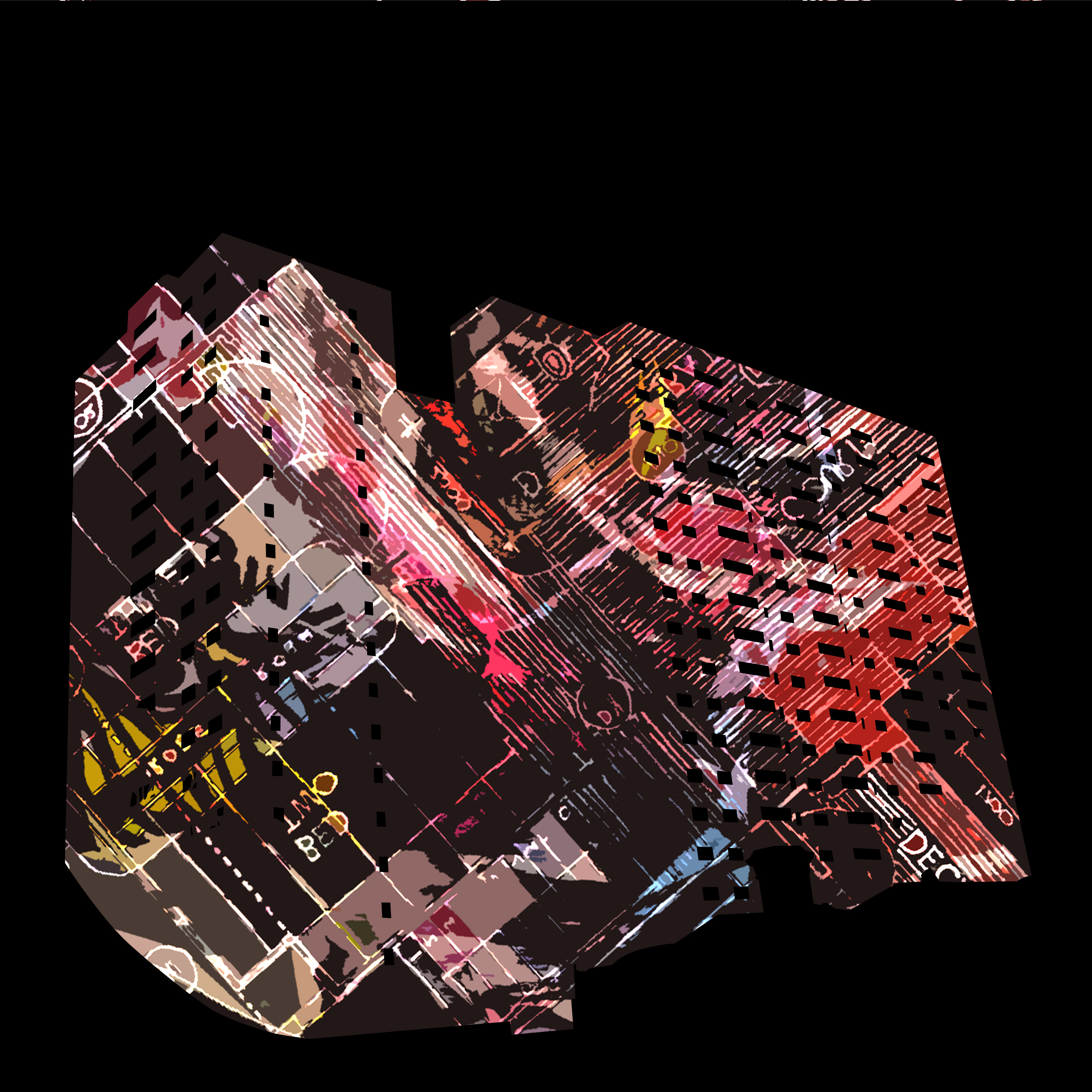
‘Form Work’ explores architectural forms, lines and shapes that are depicted in architectural drafting. The combination of abstracted overlapping lines conveys the busy, overwhelming Melbournians’ lives and experience. The visual representation seeks to communicate these overwhelming but symmetrically constructed tasks we must overcome day to day.

Posted in ARTWORKS | Tagged

ሲድት

we gather in basements 
community halls and cafes 
reviving a place
found deep in our wounds
sip sickly sweet coffee 
play the beat of our hearts 
through broken speakers 
we ride electric keyboards through time 
inhale poetry from yesterday 
bleed love onto the dance floor 
shake the pain from our shoulders 
   we have come so far 
   yet we have not moved

Posted in 90: AFRICAN DIASPORA | Tagged

The Platonic Split

The process was a languid pain, assigned from a hollowed spectre of what ought to be

Recall Beauviour’s subject and the other as whole – the knowing of the other’s presence, while not present, is the telling. Love binds us to this persistence and moulds us accordingly.

Love as assemblage, machinic and perpetual psychic production,
becoming a body in all its physiological functions (Deleuze, Guattari)

What, then?

This pursuit bygone, for there was never a whole to gain
But the severance is just as pained
The wound revealed

It begins with wakeful panic,
persists with yearning,
ends in flight

This is always the path of least resistance, a diminishing return. It still eludes me whether I heal or ache.

Worry for me, I wanted to tell you.
Sporadically, spontaneously.
Could your heart ache like mine?
Agonising synchrony.

I tend to exaggerate, to dramatise the ordinary. What’s more ordinary than cerebral waves? Reality talks behind my back and laughs at my expense, my mortal fear. Darling, you’re being silly.

Another time swings through me in orbs and that’s where my ease rests. Years for now we’re lost in the mountains and I remembered you. Your name stills me, and I pause my tread. The journey is deafening. I rehearse and heed myself at its zenith, imagining the rehearsal will conceive the impossible.

Longing in distance is relative, both in physical and affective distance. For in every inch they allow, you will long for a quotient unreached.
This is the wound: you were never here as we were never whole.

Posted in 90: AFRICAN DIASPORA | Tagged

you have no idea how far i swam

I’ve got a long stare, a powdery touch
And enough buckles around my chest
To keep it all in
I’ve got a twitch in my right eye,
A dry cough and something crawling
Under my skin that I can’t name

Yesterday the sky looked green to me
My elbows itched as the rain clouds
Rolled over;
A stampede, then nothing for a long time

Yesterday my phone rang twice
And it sounded like sirens from a cloudy dream
This morning my phone rang once
And it sounded like my mother’s voice
Calling me to dinner

I’ve got sweaty palms and a crooked step
Last week I fell from the mulberry tree
behind my mother’s house
Last night I woke from sleep,
Saw an angry finger digging into my stomach
And felt five years old again

I once threw myself at a passing train
But remembered I could float
Before my body touched hot steel
Behind my eyelids I saw the shape of
My body, crumble
Like burnt toast
And I watched pieces of myself gather in groups
Like gulls flying home

Last month I thought I was a wooden gate
Left to dry and turn gray
And I held myself like that for a long time
Solid and heavy
Solid and heavy

I’ve got limbs that I’ve named;
Claim a thing to own it
I’ve got limbs that I’ve lost and
I’ve named them all “Yesterday”
Last night my mother called my name
And her name rang out
I’m young, I said, and I’m tired today

I’ve got a pain in the centre
Of my spine and it sounds like a screeching bus
When i run
It’s the sound of placing your hurts in
Alphabetical order,
Tieing them with beautiful bows
And expecting the healing to begin

Sometimes it sounds like the mazes
Built wider and more complex
To make the centre of it all
Impossible to get to

Sometimes it sounds like
Protecting your traumas
Because they’re the longest,
Most loyal relationship you’ve ever had.

I’ve got dry eyes and a heavy gut
And they carry me home and
Carry me home.

Posted in 90: AFRICAN DIASPORA | Tagged

To the still

Ode to the little child who was told not to fight
because their silence made them beautiful.

Because their beautiful made them too ugly to ever be raped.

Because she was so pretty they should be
thankful to have ever been so lucky.

Ode to the little girl who was told not to
fight because her silence made her beautiful.

Because being 5 and alive is cause enough for
annihilation and retribution isn’t for you,

so you must to die to yourself daily.

Ode to the 8 year old girl who was cut up so
beautifully that her gravestone outsized her casket.

To the little black children whose God got robbed
because their ugly had it coming.

You.

Are still beautiful.

Ode to the little black boy in me who was made
beautiful by adults two decades my age because my beauty had it coming.

Because silence has made a home here and
little black children aren’t even worth the price of their own bodies.

Ode to those bodies.

Ode to those bodies being temples worthy only of God.

Ode to those lonely nights of persistence where
quiet revolutions don’t happen till 3 A.M. when no one else is watching.

When no one else is close.

When you’ve bathed yourself warm in tears till prayer won’t roll off your tongue and no matter how hard you scrub, you still can’t wipe that stain covered memory of last nights sin. Ode to the sin. And all those moments when your body no longer feels like yours. When you’ve bared yourself bone dry from trying to wash away their touch. Ode to the touch. And silent mornings where waking up feels more like a funeral than a rising.

Ode to the rising.

Ode to being alive. And surviving. Still.

Ode the still.

Posted in 90: AFRICAN DIASPORA | Tagged

Garden of Grace

I never pictured you as the type
to appreciate the simple things in life.

To get lost for hours in a garden of flowers,
and snap pictures of fistfuls of lavender pixels.

I always knew you were
addicted to power.

Always knew you were attracted to men who
could fulfil fantasies of damsel in distress,

and could rescue you from towers.
Slay your dragons and demons,

wake you from your sleep, and do it with a kiss.
Where bed sheets only grew knots from tangled

limbs. But now, sis,
you knot bed sheets to let them in.


Posted in 90: AFRICAN DIASPORA | Tagged

Bloody QnA

Mandy makes a bold beeline to the Centre of Power,

Where the microphone amplifies her like a riot.

As soon as she feels any discomfort stirring up,
Man, she storms.

Forward to the mic!

She moves in defence of her right to defend her right to eternal inner peace and quiet.

From her reserved seat, front row and centre, Mandy power strides her way to the mic.

Arms swinging wide and
Heavy like pendulums.
She arrives. She huffs. She puffs. Straight into the mic.
Then, after releasing a slow wheeze, sound crescendos into a high pitch whine – like a siren.

We clock entitlement as she assumes right to command and oversee ‘Operation Restore Order.’

We observe privilege.

She: Patriarchy’s smug self-appointed, self-congratulatory Microphone Mandy.

She: Patriarchy’s smug his/storical record- and time-keeper.
The coveted “A”position of proximity to power won in exchange for access to entitlements and protection:
Rights to take up all remaining space; and an army of armoured Knights to defend her patch against
encroachment and squatters.

No one can step in her way – bossy strut forward.
No one dares.
We just stare. We are already exhausted by the thought the mere anticipation of yet another episode of
“Microphone Mandy Micromanages the Matrix”.

She reaches. First to speak. She takes the mic like an Olympic athlete accepting a hard-won gold prize.
She grins. Excited. Entitled. Oblivious.
And proceeds to neatly pack up everything we had just exploded out of the box.
Pleased, she ties a ribbon around it. Secures the lid shut. Then begins to hurl.

We wonder how she came up with a question so quickly.
Looks like she never listened.
Sounds like she arrived with a little something she prepared earlier.
Something she knew was good for us – without consulting us.

Looks like it.

Look, see how she lunges forward and snatches up the microphone without so much as a glance around to see
if the people who are the subject of discussion actually have something to say, first.

We notice the oversight. We side-eye.

She, oblivious, to all but her painful need to remain front and centre hurls up a cacophonous accusation.
Hurls up all over the speaker’s floor: Microphone Mandy Micromanages The Matrix.

She spews a riot of barely digested chunks all over the floor.
We stare at the mess. She finishes. Turns to us. Demands we clean it up. We stare into space.

She hurls up, again. Tone beneath it all is a riotous blood red, cleverly dressed up as Righteous (But Carefully
Controlled Civilised) Rage. We notice.

We vomit in our mouths.
Yet, still. We feign ignorance, there. We sit dignified, here. We drift off, over there. Everywhere our eyes glaze
over. Imagination takes over.

We enter another dimension and co-exist in a world beyond this mess and as she hurls,
we dance in liberation’s fields.

As she issues a statement in the tone of Innocence-Under-Siege,
We – hoping it is safe to return – cautiously drift back.
Unfortunately, we just catch the tail end of her long-winded, purported observation-cum-question which sucks
up all the oxygen in the room.

That little snippet is enough
To. Make. Us. Snap. Back.

We gasp. and. suddenly.
choke on toxic air.

She – Lucky Microphone Mandy – remains oblivious or perhaps justified in her purported defence of Innocence-
Under-Siege.

Within two milliseconds, this sneaky saboteur loaded a canister of nerve gas into her throat and fired it out over
the PA. Reverb and echo over the unsuspecting daydreaming crowd the poison lands.
Releases toxic gas.
We are sucked back into her game. Her rules. Her time. Ticking according to the entitled swing of those
pendulous arms.

Forced to merge back into this reality, we re-emerge with a splutter.
It stinks of undigested chunky spew. We sink. We cover our mouths. We vomit some more – in our mouths.
We in shock. Sniper attack deflates our optimism – our flailing life buoy.

Suddenly, we find ourselves at sea drowning while gasping in her poison air. We can’t breathe.

Our shoulders curl in to protect hearts caving in under the blind belligerent onslaught.
Her assertion of privilege. Her demand to remain at the centre. Her refusal to budge – not even a nudge.

She, like a dash of blood riotous red dressed up as righteous rage, rampages, unchecked –
Of course.

Us?
We lose to live another day. We choose to win the war. We steer clear of this spat. We hunch over.
We curl in to protect ourselves from the shrapnel as she explodes in an assured act of civility a.k.a. violence
with impunity. And so ends the promise of unity. So dies the hope of community living beyond the perpetual
reassertion of this self-serving supremacy.

Where
and
When
in all this madness will Microphone Mandy finally learn to find her humanity?
This. is. insanity.

Posted in 90: AFRICAN DIASPORA | Tagged

The Physics of Self

Quantum entanglement posits
That two or more objects may
Exist in reference to one another,
Regardless of space & time.

my doctor calls it complex post-traumatic stress disorder
says disassociation instead of liberation
says flashback instead of memory
says then instead of now, here, always

Every me is tired.

/

“I don’t want to do this Khalto”
“Can you believe this girl?
you are here,
Surrounded by Possibilities.

And baby girl
a Possibility isn’t something you, having had, throw away.
It’s a fruit, bite in, swallow the flesh and the rind, the complete bittersweet experience.
Why do you wear your sorrow like a chain?
dragging
always stopping just before the finish line…”

/


that wave function duality
Schrödinger’s health,
unseen, unacknowledged.
Ubiquitous repression of worldly cruelties
You turn to a friend and say:

fam, I’ve got a joke for you
yeah?
when do you know a black woman is struggling?
She Laughs
at her funeral of course

There are eulogies encoded into your DNA,
trauma has no time limit and recovery is a myth.

/

Wellness maybe choice
but access is a myth.
the punishment must fit the crime,
the audacity of demanding life.
After all,
human rights are a lie
applying to those we see human

Never Forget
health care systems are war zones too.

/

Once a psychologist told me that I was trapped in a cage of my own memories.
To leave the past in the past and focus on the here and now.
Some wars have no borders, they obey no time zones

Now, here, Always.
Every me is fighting.

Posted in 90: AFRICAN DIASPORA | Tagged

Life Poem

You are paralysed in the living room of your neighbour
begging the walls of the room to consume you.
Everything in this house smells like desperation.
The dust that gather under the window
disappear at night like scattered children
fading into the distance as they go home.

Sahal walks into the room slightly destroyed by the rain.
And you listen quietly to the strange way sorrow laughs
when his mother answers the home phone:
I died the night his father opened my body, thrusting his hammer back and fourth until
my insides were filled with his ruins.

She slams the phone on the ground and yells
We’ve all had thoughts of killing our children.

You shiver and Sahal says:
Let her be, she is human.

Posted in 90: AFRICAN DIASPORA | Tagged

go ahead, call it magic

Incantations alchemise all languages
with language powerful things can be done and undone.

How many times did the language lay you
bear enough to make another unafraid of themselves?

Even when you are lost for words
it is language that disappears?

I hear it all and I am not alarmed,
the little-feathered baby serenading the rushing tyers grip.

I see it all and I am not alarmed,
the devotion begging for a love that is only inside,

the carousel whirling around
the same story of misfortune.

This world is quiet in describing her beauty
she says, come and watch me do all the things that don’t make sense,

she says, I believe in you
even when you choose to tear at the hem of your humanity—

for the sake of my aliveness
I write elegantly always,

even if what I have to say is seemingly empty and dry
In preparation for the big feelings.

I write elegantly always
so when they arrive,

for these eternal etchings
soft bedding awaits,

and no struggle for
elegances dulls them.

Posted in 90: AFRICAN DIASPORA | Tagged

Chalk to Charcoal

I wrote you in chalk, smeared my thoughts of you in charcoal
I am a blood orange, I have few edges and even fewer dreams
You,
You’re like lint, a broken thing, sketched in pencil
Even iron will soften with heat, but beloved I’ve lost my fire
The toll of life has extinguished my flame
I’m exhausted by these ceaseless mind games
The eloquence in my voice is in vain,
Hoping they would surface in your consciousness by they sank rapidly
Into an ocean of overwhelming indifference
My intricacies are priceless, never-the-less there are places in me the
Light does not know, places that hold no semblance of happiness
In the face of my ugly and sinister will you embrace me with
Compassion? In your eyes will I meet graciousness?

Your knees buckle with the overwhelming urge to flee,
There things only for so long can you suppress
Perhaps you’re perplexed by my deep affections for blackness
Suddenly you don’t recognise my Nile warriors’ prowess
Familiar stranger, I toil to look past your day dress just to see that
You’re marvel in vast emptiness
We both lack self-awareness but you’re quick to call what is mine
Wretchedness

Friend you were once an antidote for melancholy
But I feel the depths of your mind are still colonised
Now I realise
It’s childlike folly, the pendulum of superficial curiosity
Yesteryear I was a temple, so strangely words escape you
Now I am comparable to a tomb
Have you brand new eyes with which to gaze? Cause these eyes have
Failed to perceive the hue of your true intentions
Now I carry desolation in my womb

Your face was once an intense moonlight with a blue tint,
Serene
Now my magic you charge obscene corrosive, rust on iron, what’s it
Matter, this is nothing but a row between a ferocious antelope and a
Cowardice lion
Your world is aquatic but you know nothing of the melanin marine
I am right in front of you. I am air, I am light, I am water, yet I
Remain unseen
Your presence is pacifying in the realm where lust dances with
Desperation in hopes to keep loneliness at bay I am dumb-found that
We stand here and call it ‘vibing’
Have you ever seen a soul bereaved?
No wonder my body aches when you leave.
Now he pawns my treasures walks about with pieces of me in his
Pocket like loose change or old gum. My collar bone on his mouth, my
Smile dragging by his dirty boots in absence of sincerity I leave his
Lips bruised.
My worlds are flat and cold I struggle to whisper my tongues numb
I wear your disdain for me like a waist bead
Hiding from leery eyes I’ve read your character assassin’s creed

Ensnared in a misogynist culture
Your love bird is a scavenging vulture
Belly full but still grumbling, he comes to floss his teeth
with Femininity.
You’re infatuated with the idea of me, infatuated with the idea of
Free.
I’m drained not empty my silence is not in protest I’ve not an ounce of
Fight left.
You would be mad to think this body arts-less
Blasphemy!
Take several seats and bear witness to this Kemetic alchemy
I wrote you in
chalk,
Evanescent,
Smeared my thought of you in charcoal

I am blood orange, I have few edges and even fewer dreams

Posted in 90: AFRICAN DIASPORA | Tagged

Fall

Sky in. A type of kin that will make even
you beg for more. Whispers of favourites
turn the flame on. I let the words curve into
my mouth this way—what I’m trying to say
is still unfinished and coded it sounds a lot
like unspoken verbs, pronoun of this is the
heart. The adjective is the way the mind is
feeling but too scared of its truth. We have
never done things this way before.

Our words are backwards and on purpose,
how do we make sense of all this heat, what
happens when both passion and tension
sweeten the tongue, how do we tame
ourselves out of these flames so carefully
careless we could set everything on fire the
way we like this feeling to be this talented.
Watch the way it has taken over a body that
shares the words care and love with self.

When she lets you in be carefully honest
with everything, she is both blind and bright
in the same notion.

Posted in 90: AFRICAN DIASPORA | Tagged

Ghosts

egusi soup trails
pepper soup stories
pounded yam, ingra fish
theories. parents chatter nigeria
in the background. your
favourite was the mango
salted avocado
fleshy yellow, green.
roasted peanuts
cracked from shells
charcoaled suya sticks
laden with chilli
akara balls and
sugary sweet puff-puff.
you wonder if you spoke
two languages
pidgin-english flowing
fluently from your lips
just as easily as the ‘real’ thing
did.
tongue sprinkled
with flavours of
lost language.
one day the driver couldn’t
get you to school
roads blocked
as fighting broke
out. a man runs past
gunshot wound.
you drew a picture of it in
class. compound kids
spitting on your
head as they saw you
and your sister
over the walls
in the oyibo
school. chasing
baby chickens in
the yard of the
compound that is how
you got that scar
on your heel cutting
your foot on the
corrugated iron. fireflies
decorating night walks
to visit uncles and friends
drinking beer.
‘here try this one,
it’s malt-flavoured.’ some
kids caught jars of
the insects. long days
of wandering
coming home
when dusk dawned
would life have been better,
if you stayed here?
knew what it felt like
to grow up with your people?

she was five,
but already knew what love
was not.

Posted in 90: AFRICAN DIASPORA | Tagged

Circles

Co-transcreated from Arabic by Vivienne Glance and Afeif Ismail.

Suddenly,
they grow up
as if they hadn’t lived with us under one roof
since their birth;
as if we did not know them,
minute
by
minute,
they become free creatures,
we are no longer the centre of the circle,
but
a distant point on a line.

They have their own dreams
other than those that we drew for them
since before they were born.

We gave them their unique names
that never existed in the dictionary of similarities!

There is a reason for the sun to shine
when they are spreading their wings to fly;
while we are still the residents of the last century
and yesterday
they play their tune between the clouds
and they call us distinguished earth people;
at that moment
they will forgive us
for our interference
with their lives.

Posted in 90: AFRICAN DIASPORA | Tagged

(un) learning

I have turned into a thing you cannot recognise / I touch my face and it makes me feel heavy / my ex’s laugh comes to me in a dream and breaks me into a nightmare / I prepare the bathtub with lavender and soap / I imagine my head being held down with two hands and sleeping / I clean my fears with water and silence / that evening I placed my heart in my mother’s suitcase and went missing / my mother is afraid I am turning into a person she cannot bring back / she is used to a love that dies too early / on the nights she is lonely she brings out the cassette player that carried her through four decades and a war / she sings to Nina Simone’s ‘Be My Husband’ as she maps the honeymoon of 1989 on my palms / the memories cause her knees to ache / this is how she keeps him alive / my father plays hide and seek / I have spent my whole life wearing his eyes but never seeing him / I inherit his need to disconnect / to disappear / the years have grown on me / mother says / I am a child in the face of life / too young to be stretched and stained / I agree / I cannot help but become the sea when I should carry my limbs like steel / I am turning into a thing that only I can stitch together / I have spent twenty-four years learning of love and survival / when the morning comes / I crawl back into strength

Posted in 90: AFRICAN DIASPORA | Tagged

3 Sisters

Because I know women
who turn facts into fury.
Cold backs turned
into children learnt.
I see strength in aching bones.

My sister asked me,
‘If I told you I want to love,
heal the world with love,
what would you say?’

I told her I know her well enough
that her love does not bind people
confuse and use people.
Her love is freedom.

Fist raised,
head turned to the sky.
I wonder how long these lies will feed us,

before we notice our stomachs are empty.
If our legs will grow wary
only in our
their
your youth.

My other sister said,
‘You will never be as revolutionary
as you are now.’
She said,
‘We all had our activism phase.’

And my heart hurts with hers
I know what it’s like to move in place
not sure of one’s pace.

I cannot be what I’m not.

Silent resistance is simply
not me, so I ask you.

If we do not see eye to eye.
Can we still stand side by side
through adversity?

Can I trust you not to feast on my flesh?
Head bent in work I didn’t use to pay
mind to all the beneficiaries

before I realised it rarely benefits us.
Election comes or
the end of a financial year—

Do not feed them fish.
But teach them to fish.

What of all the water you’ve poisoned?
There’s barely any fish and the ones
we catch make us sick.

My oldest sister asks me,
‘What of the people who
don’t know how we’ve lived,
what do we say to them?’

Suddenly I wish silence
was my bestfriend.


http://cordite.org.au/wp-content/uploads/2019/03/xxx

Idil Ali: vocals
Yusuf Harare Jr: keys

Posted in 90: AFRICAN DIASPORA | Tagged

ashes

if
I had
my father’s
ashes
I could
throw them
in
the toilet

take
a huge
dump
to square
things off

the water
from the bowl
would hit
my ass
and
I would
be
so revolted
to have him
touch
me
again
I’d
jump
in the shower
to scrub
myself
clean

run
an icy
bath

stick
my head
all the way
under

deep sea diver
explorer
of memory

never
did learn
how to swim

Posted in 90: AFRICAN DIASPORA | Tagged

Blood Fuel

Jonathan is walking inside his garage. He’s been a mechanic in Richmond for over a decade. He has customers who travel across the country to have him work on their cars. He is an Elliott, which is to say he comes from the wealthiest family in the southern hemisphere. They revolutionised the renewable energy market, and single-handedly stopped the upcoming apocalypse in 2050.

A man in double denim towers over Jonathan, and says. ‘Jono mate, I have an issue with starting my car. Can you have a look?’ He is cleanly shaven with tattoos across his arms.

‘Sure thing,’ Jonathan replies.

Jonathan inspects the vehicle. It’s one of those old-school classic Tesla’s. Jonathan is trying all he can not to burst into laughter. Electric batteries are a thing of the past ever since the Elliott family came up with blood energy.

‘You see here buddy, you need to exchange this old electric battery with our new blood engine fuel. I can do the job, but it’s going to cost you a bit. I might be able to help you on the cheap but you know what you have to do,’ Jonathan says and looks to the man in denim.

‘So I have to farm the blood? Is that what you’re saying? But I don’t do that kind of work,’ the man in denim says pleadingly.

‘That is just the way it goes,’ Jonathan sternly says.

The man in denim would have to travel into the blood farms. It’s a part of the country no one likes to visit. The Elliot family may have figured out a new source of energy but it wasn’t without harm. The farms harvest bodies for blood. The site reeks of blood and rotting flesh.

In 2022, the Australian government were given a proposition by leading scientist Dr. Edward Elliott to rid the country of its offshore problem. Matthew Jones was the Prime Minister and leader of the newly formed the National Alliance for the Fair Go, or NAFG for short.

But as he was making his way into governance climate change was plaguing the world. Most of South Asia was underwater, while Brazil had become inhabitable. Rural areas of East Africa became so barren nothing could grow from it.

The second iteration of the United Nations met for their first National Assembly of the year. The Western powers voted en-bloc that people from what they called the ‘developing world’ would be used in Dr. Elliott’s experiment to reduce emissions before it was too late. The fate of the world was at stake after all.

The man in denim walked into the blood farm. There were bodies all across the floors. If the walls had been painted once, it didn’t matter because now splatterings of crimson rained from the ceiling down to the ground.

He sees someone on the floor, their identification collar reads ‘fuel’.

They shout out to the man in denim.

‘We are bodies not machines. We are alive.’

Posted in 90: AFRICAN DIASPORA | Tagged

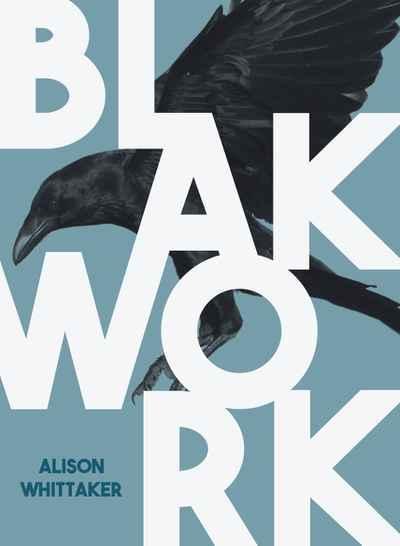
Raelee Lancaster Reviews Alison Whittaker’s Blakwork

Blakwork by Alison Whittaker
Magabala Books, 2018

My sister and I devoured Blakwork. She’s nine and I’m not sure if she understood most of what Alison Whittaker talks about in this collection, but it resonated with her. With both of us. Whether that was our shared identity as women, as Aboriginal women, or something more, I’m not entirely sure. In Blakwork, Whittaker combines her career as a lawyer and her craft as a poet to peel back colonialism until it’s left exposed, raw, bleeding in the hands of the very people whom it has subjugated. She examines Indigenous work and labour, a physical theme manifested in a collection that embodies that exact physicality through form, structure, and rhythm. From her commentary on the subjugation of black bodies to the way the poems sit on the page, the reader is constantly thinking and moving with the collection.

Jumping from poetry to prose to memoir, Blakwork comes together, eagles out, then comes together again. It makes you turn your head and the book, it has you reciting lines aloud to feel the way they hang in your mouth. The reader is constantly working for the words on the page, so it’s difficult to get comfortable when reading this collection—but that’s the point. Too long has the comfort of a colonial readership within been valued within the Australian literary scene. Like that shadowy place in The Lion King, Blakwork situates the reader in a place of unrest – a place that has been pushed to the outskirts of history, shrouded in darkness. From the first, titular poem in the collection, Whittaker outlines her poetic thesis through commentary on the physical oppression and indentured work of Aboriginal people and the emotional work colonial Australia still expects us to do, including being tasked with the responsibility of reaching reconciliation and with being an emotional leaning post for people seeking to alleviate their white guilt.

The theme of indentured service is particularly significant in ‘many girls white linen’, which co-won the 2016 Judith Wright Poetry Prize. This poem discusses the physical labour of Aboriginal women by reimagining the missing girls from Joan Lindsay’s novel, Picnic at Hanging Rock. The reference to Australia’s literary past, however, is a throwaway, almost as if the scripts were flipped and, in this alternate history, it is the white women, rather than their black counterparts, who are not deemed significant enough to be mentioned. A more explicit reference to Australia’s colonial literary culture is the poem, ‘a love like Dorothea’s’. From the rhythm of each line to the fresh twist on Dorothea Mackellar’s famous phrases, this poem speaks back to Mackellar’s ‘My Country’. While Mackellar wrote ‘I love a sunburnt country’, Whittaker hits back with ‘I loved a sunburnt country’ (my emphasis). This subtle but powerful shift from present to past tense echoes the trauma the land now known as Australia has endured, the trauma the First Peoples of this land continue to endure, including the loss of land, culture and connection:

I loved a sunburnt country—won’t it 
please come back to me? Won’t it 
show me why my spirit wanders 
but is never free? 
I will soothe its burns with lotion, I will peel off its dead skin. 
If it can tell me
why I’m 
drifting 
ever further from my kin.

In both ‘many girls white linen’ and ‘a love like Dorothea’s’, Whittaker rewrites a colonial history all Australians have grown up with and offers a counterview of which most people are ignorant. This strategy is seen in a series of poems scattered throughout the collection, each one constructed using forty-nine most common three-word phrases of well-known court cases. A lawyer by training, Whittaker uses the law as well as acknowledging its misuse and colonial nature. A poem about the Mado decision, ‘the skeleton of the common law’, is full of phrases referencing colonial structures and names. In particular, references to ‘the Crown’ are in almost every stanza, lingering, giving the poem a heavy weight. Similarly, ‘exhibit tab’ looks at the death of Ms Dhu in a detached, clinical way. The removed ways these poems consider the displacement and death of Indigenous people only serves to highlight the rigid, colonial nature of the Australian legal system and the historical way leading figures in this country have and continue to talk about Aboriginal and Torres Strait Islander people so that our voices are muffled or all-together obscured.

Posted in BOOK REVIEWS | Tagged ,

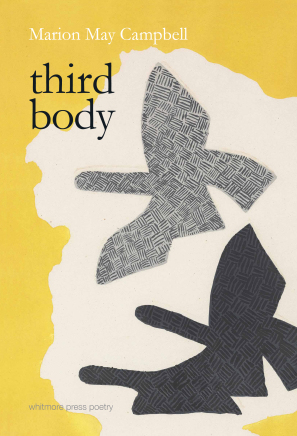
Alex Creece Reviews Marion May Campbell’s third body

third body by Marion May Campbell
Whitmore Press Poetry, 2018

Third body takes form on the cusp of metamorphoses between species, ecosystems, technologies, existential planes, and even between art and artist. ‘passing’, the title of its first section, becomes a motif of the entire collection – perhaps most significantly for its variety of meanings. Passing can indicate a liminal phase in journeys bound by space or time. Passing is a euphemism to tactfully describe the transition between life and death. Passing may also represent social transition, such as one’s perceived conformity—or lack thereof—to socially defined binaries like gender and sexuality.

I do not pass at all as
poet man or woman
but laugh
myself to bits
as I pass
into this last
paste-up (‘passing’)

As a scholar of French Literature and avant-garde practices, Marion May Campbell deftly weaves principles of European postmodernism and academic theory into her work to produce an incisive post-structural commentary. The sensibilities of l’ecriture feminine, à la Hélène Cixous, are evident in the inspiration that Campbell draws from female literary figures such as Gertrude Stein, Sylvia Plath and Anne Carson. These are uniquely synthesised with her own eco-poetics and perspectives of marginalisation and globalisation in current-day Australia. The beach serves as common backdrop to these considerations, as demonstrated in ‘semaphore’, where the paradox of human disconnect is conveyed through mismatched flag signals:

our prickliness our devastating need
to kill the other in each other
we resist yet long to merge
though this be murder of all desire
& know to trust these pulses
& yet are raw with the infinite unsaid

Le sujet en procès, the subject (or the self) in process, is also a key postmodern feature of third body, given its ironic self-awareness despite an inherent tenuity of ‘self’ as a concept. The collection presents a challenge for the reader to gain purchase on its subjects in a concrete sense. One moment, we are enveloped in the consciousness of a dog, and the next we may find ourselves as a cat, a painting, a map, or even amid a poem’s own inception on the page before us. This ephemerality, however, works to keep the reader keenly on their toes and open to endeavour of thought:

wounds & exalted jouissance
complex affirmation
what kind of history
& what kind of witness
is possible
when I never coincides with me? (‘passing’)

Mise en abyme, an image mirrored continuously within itself, is another technique that Campbell employs, particularly in the ‘incipient foredune’ section. Ecology is a strong focus here, where each poem represents a different layer of the coastal vista characterised by uncertain vicissitudes but unwavering resilience, as fragile yet unforgiving. For example, ‘in the slack’ allows us to experience the environment in a tactile manner:

through which in dune &
shifting dune we stage
sensation

for our ductile selves to meet
unspoken
beyond these skins

Alternatively, ‘progressive plants’ depicts a more narrative-focused view of the same landscape:

before the hoons
come with their pre-mixed cans
& campfire exploding bourbon bottles
we whisper our way forward
like what dune ecologists call
progressive plants

The final poem in this section, ‘U₂: romance of the sonic survey’, personifies both the setting and the poem itself to merge sensation and environmentalist commentary alike:

the poem shakes
the fault line runs
between us

third body breaks
in a million mercurial 
mutations

forget the lads
who toss a bourbon bottle
in the campfire

here come the real dune hoons
trailing their sonic sensors
through all the image-clusters
of our living

The impact of mise en abyme as a poetic function is something to the effect of a Matryoshka nesting doll brought to life, where each segment bears its own significance—its own story-within-a-story—to what lies at the eventual heart of a broader collective narrative. The ‘incipient foredune’ section also effectively highlights Campbell’s Rimbaudian influences, both in her symbolism and the synaesthesia of her language choices. The unpredictable sensory confusion of third body adds to the constant ‘shapeshifting’ nature of her subjects. Nothing in the collection is immune from sentience – that is, from becoming a third body. This idea is playfully demonstrated in the dreamlike dynamism of ‘if not in paint’, where subjects are not bound by the constraints of their original medium:

ashes in her voice
my mother speaks back
on the fourth page
from the long coast of illness
only alive
& red
in my dreams

[…]

she tugs to the fifth
page the sky’s
blue fire
willing the whole body
in like a calf at the teat

now she strokes
the keyboard of the palette
with a tenderness she can’t relay
if not in paint

Campbell’s use of colour keeps us suspended in the realm of visual art, only for this to be subverted at each turn with incongruous senses such as sound, movement, and texture. The sequential references to pages not only make the reader aware of themselves literally turning the pages of the poem, but also play into the notion of a self-aware subject progressively ‘painting’ their own narrative. Campbell’s ability to imbue fresh perspective and surrealist humour into once-static images is also evident in her ekphrastic piece, ‘Dorothea Tanning’s Guardian Angels’:

baroque & broken
fold on fold all
falls & shakes

struggling out from 
underpaint of palest gold
her angels shriek some sort of

apical metamorphic need
bearing in beak the remnants of
their own demise

As a highly intertextual collection, Campbell provides a unique intersection of creative and academic concepts. Her work is not only referential of other poets and artists, but also incorporates Freudian psychodynamic theory, philosophical principles in its self-aware ineffability, and knowledge of native flora and fauna as sourced from the Ngaruk Willum people of Port Phillip Bay. Campbell demonstrates the strength of intertextuality in producing a highly-informed collection of transgressive poetry. She holds a mirror to the concept of milieu, not simply as defined by social context, but in its literal translation – a middle point.

Posted in BOOK REVIEWS | Tagged ,

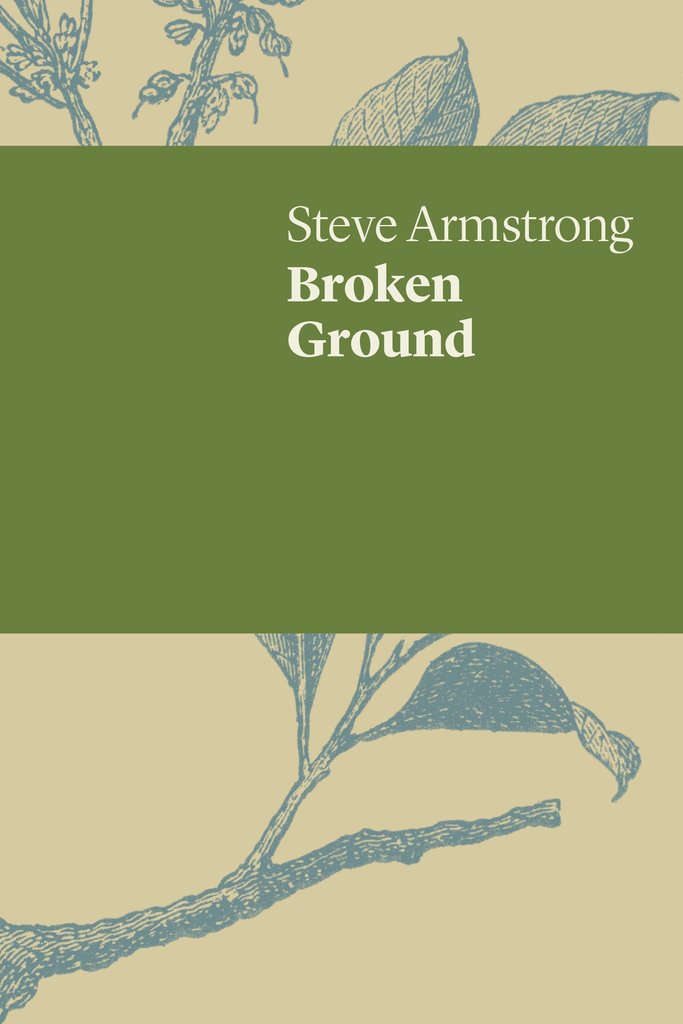
Ivy Ireland Reviews Steve Armstrong

Broken Ground by Steve Armstrong
UWAP, 2018


Steve Armstrong’s Broken Ground is an extended walking meditation cleverly disguised as a book of poetry. Inside this collection resides a determined drive towards immersion and a deliberate movement beyond text, into a numinous, continuous cadence: a secret rhythm of stride known only to those who would seek to map out earth and sky.

At times, in review, it feels like a Sisyphean task to gather together the fragmented rhythms, thick with the natural world, with love story and family history and, above all, reverberating with the connotations of contingency. My natural yearning is to let the work’s pulse nestle quietly down inside the mind. Or perhaps that pulse would find itself lodged in the gut, for Armstrong’s poems are so very embodied and at home in and of themselves; so self-aware that the already excavated ground seems to require no further diviner.

Broken Ground explores a very specific poetry of time and place. From the first poem, ‘Black and White,’ we receive glimpses of the bedrock that the subsequent poems will continue to excavate. Here, landscape takes on a more than general significance – specific places are invoked by naming, and the tenor is that of memoir, nostalgia and a belonging in time:

A photograph, a fading Kodak of a boy.
	On the back in my mother’s hand – 
Turramurra Bush, 1965

Themes of family, and of finding a significant place – perhaps home – in the greater Hawksbury are paramount here:

My substrate is rocks and trees,
and there’s a prehensile ache at the sight of a branch
that leans across a cerulean Sydney sky. Here is
the ground of a well-weighted line.

The key to Broken Ground is this transference of meaning, outwards from the landscape and into the body. Armstrong’s poems divine truth from the wandered -through world, as explored in ‘On the Delta’:

Later remember not this place, and
the way water mirrors trees and sky,
but what it is that you’ve found instead –
this solid thing that’s light within you – 

let it wing into the regions of wider
sight, and feel for the company of words.
Go on recalling the seamless flow over
mud if you must, then claim what’s yours.

However, this is not the collection’s ultimate tendency. Instead, Armstrong offers a boon in return for the composition of these poems. An interior geography of human connections and disconnections – from mother, father, lovers, children and elders – somehow seeps out from the poet to enter the exterior landscape. We see this collaboration in the collection’s titular and final poem, ‘Up and Down a Dry Lake,’ where country is seen to be:

too dry out here for tears at my coming 

up short, for the words that won’t land. A lake two-hundred
meters deep with silt. Long accumulation chokes in the throat

like grief, nonetheless a small figure standing in the middle
I’ll speak for what inheres, lay down on dried mud and tufted

grass; be baptised by dirt and re-membered by earth.

This exchange between landscape and the walking body-in-landscape is also explored in ‘Dreams and Imitations’:

          Your step is the step of a younger
you, or perhaps the ground presses back 

and offers to lighten your load a little. You
falter unused to such reception, and yet

the rhythm you settle on is both your whole 
being and your nothingness.

Broken Ground does not merely offer a poetry of nature-based lyric philosophy in the manner of a Lake Poet. As the collection progresses, Armstrong’s drive is to participate, to partake of what is offered. Ritual pervades the poems: longing is somehow danced out into the landscape.

Posted in BOOK REVIEWS | Tagged ,

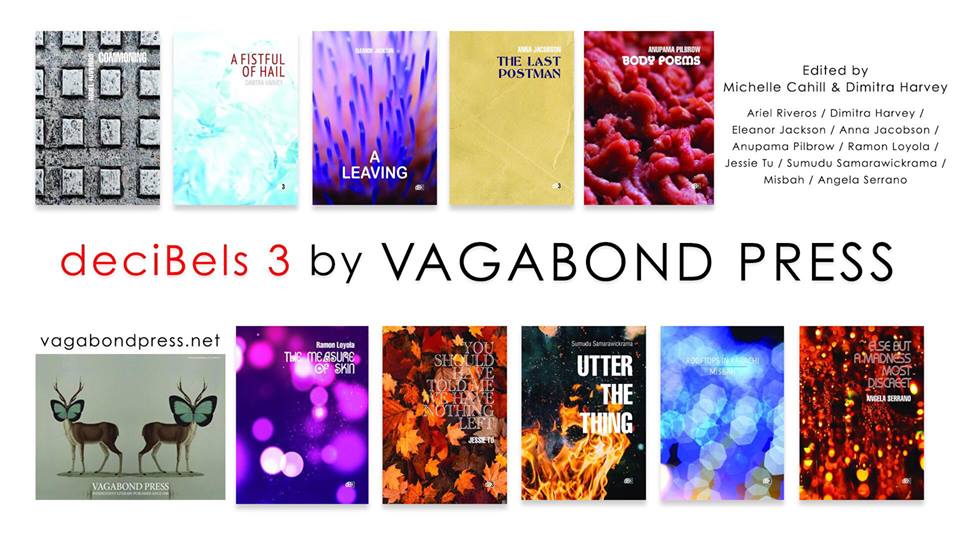
Magan Magan Reviews deciBels 3


deciBels 3 edited by Michelle Cahill and Dimitra Harvey
Vagabond Press, 2018

Poetry as a form permits one the ability to see, touch, bend and examine the human experiences that we may find elusive. All of a sudden, the glances from others we would have otherwise missed, start to make sense. Haunted words that follow us our entire life begin to destruct. And a voice that belongs leaps out of the page and into the world, leaving a roadmap to follow.

This process, a reader’s reckoning with her awakened self, may be colourblind. Poetry gives birth to intuitive knowledge, which is a powerful way to explore the subject of race. In her introductory note, series editor Michelle Cahill argues the importance of poetry that talks about race. She also highlights race as an entity moving within time and place, a function of what is real. Cahill concludes ‘that the value of a poet’s work is largely transacted by their identity, whether that is visible or whether it is concealed’. As such, her series celebrates ten exceptional poets whose poetic voices illustrate a redemptive focus away from the concerns of the dominant power. They invert that power through poetic disruptions, and not of race but also gender.

Cahill has collected poets whose cultures and languages trace to South Asia, the Philippines, Greece, to the Jewish, Chilean, and Taiwanese diasporas of the world. They have in common a tendency to choose realism, in which identity is expressed unapologetically and in conjunction with the universally charged experiences of life: loss, loneliness, mental health, sex, love and grace.

Jessie Tu’s collection You Should Have Told Me We Have Nothing Left is a visceral body of work that finds acceptance of the drama of life, which is filled with the voices of everyone else. Tu’s candour speaks to the way life forces us to sober up if we are to survive. In her poem ‘And It Is What It Is’, she illustrates the intersections between gendered conditioning and the universality of sexual desire:

Mother told me to slip through like a good girl
so I take buses around the city to find
the sunken bottom lip of your bitter tasting mouth

Tu seldom shies away from the empowering nature of sexuality, which is a level playing field on the page. This is further demonstrated through the poem ‘Almond Butter’ when the proclamation is made:

I am absolutely in favour of all kinds of sexual fetish,
fart, feet, rings,
clown.

All the while, Tu is exercising the complexity and mobility of what it means to be human:

I 
write because 
I am lonely 
for other lonely
people. Not only 
does 
my loneliness
rot but the 
fantasies I left 
during 
my life.

By comparison, the title of Sumudu Samarawickrama’s chapbook is demanding, almost daring the reader to Utter The Thing. The thing is what the reader must decipher, in plain sight on each page. Is Sumudu daring us to utter hate? Or is she directing us to find out how resistance can rummage through a burning building? ‘Foxes’ is a poem that feels like war and liberation simultaneously:

Give up on this supposed detachment
There was a battle fought.
Grasp the nettle leaves and the 
Chestnut husks.
They are only conquered by force.

And what is more powerful than a force filled with the wisdom that evil consumes all? Like the rest of this collection, ‘Foxes’ is such a vessel:

But I’ve given up that dishonest detachment.

Allow the fire.

Angela Serrano compliments the series with her collection Else But A Madness Most Discreet. It highlights the voices of grief, power, culture and destruction in stories from the fringe. In her poem ‘Sydney Road in 2011’ she articulates the darkness that lives around us, especially known to women:

Where catcalls of all sorts
punch the mid-evening air,
where contests of all sorts, 
between all sorts are
the topics of chatter between
slow sips of single origin coffee.
Posted in BOOK REVIEWS | Tagged , , , , , , , , , ,

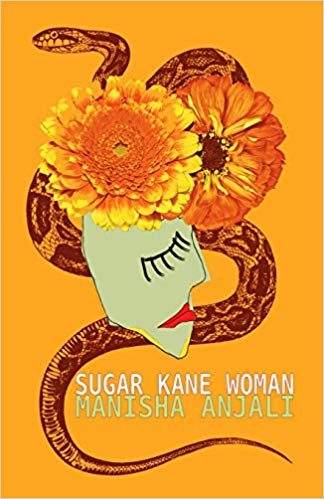
Claire Albrecht Reviews Manisha Anjali’s Sugar Kane Woman

Sugar Kane Woman by Manisha Anjali
Witchcraft Press, 2017

Towards the end of the nineteenth century and after the turn of the twentieth, colonial British rule brought indentured Indian workers to the fertile shores of Fiji. The colonisers hoped to boost the local sugar cane industry without antagonising local Fijians, and so boats filled with indentured labourers from all over India were trafficked to the island for a life of servitude and abuse.

Such is the bleak background from which Manisha Anjali’s colourful debut, Sugar Kane Woman, published through Witchcraft Press, comes alive. Snakes, hibiscus and tobacco smoke twist up from the pages of this mid-length collection. We are drugged and danced through generations of Anjali’s women as they work to find their identity, the instinctive connections between each other, and the sand between their toes.

The poems begins with ‘all woman is a snake’, a poem that at first asks specific traits of woman (‘all woman who has brwn spot … all woman who has long black hair … all woman who has red dot on her skull’), then takes them away from her again, repeatedly shouting ‘ALL WOMAN IS A SNAKE’. This generalisation so early on might set the reader on edge, implying a certain set of requirements for woman-ness, the inescapability of the serpentine and its connotations of the untrustworthy, sly and slippery. Anjali follows this opening up, though, with a collection of poems discovering the unique in her women, avoiding a proscriptive consideration of gender.

She swings from the woman general to the woman specific with grace, narrativising the unique existence of the Fijian Indian woman in the whitewash of the global patriarchy, and imagining what it might be to break free:

how lovely it was when we burnt our saris
& swam naked with tiger sharks in the white cyclone
the garlic from beneath our fingernails mixxin’ with saltwater

i was no longer a wife but a fish 
swimming under the stars of mo(u)rning (‘3 wives’)

In ‘marriage advice from two kaiviti sisters in a nadi bakery’, the cultural and social politics between Kaiviti (indigenous Fijians) and Indian Fijians becomes apparent through dialogue. The implication is clear – a Kaiviti woman thinks that ‘you marry fijian ok. / fijian good. indian bad.’ Cultural assumptions and generalisations leak in on top of uninvited commentary on the right weight and shape for a woman to be when seeking a husband: ‘here you take two cream buns / you too skinny lewa / fijian dont like skinny’.

Anjali makes distinct choices to own the language in which she writes this collection. Non-English words are not italicised. Sugar cane becomes sugar kane (which might reference Marilyn Monroe, or Sonic Youth, the Velvet Underground; or it might reference none of these), brown is reclaimed as brwn—in the same way the spelling of blak in some Australian Indigenous writing takes back the positive power and ownership of the word—and your is always yr, which can be a divisive stylistic move in itself. This ownership, as well as the non-capitalisation and, I assume, intentionally inconsistent punctuation throughout, feels youthful despite its generational retrospectives and magic realist time-travel.

Indeed, it can be difficult to place the woman subject in Anjali’s timeline – whether the poem be from the perspective of the poet, a mother, a nani (grandmother), or otherwise. The collection might have benefitted from delineated sections, or chapters, to establish the generations in structural form – thus borrowing from Marquez not only the magic realism of the oppressed, but the generational storytelling elements of the master’s prose work. It may be, however, that this uncertainty is precisely what builds the sense of continuity, of a layering that cannot be unlayered. In any case, ‘my mother’s dreams are not my own / ’, insists the voice in ‘girl shaman’. So, ‘who is the owner of these little brown shoes?’

Poems like ‘3 bloods’ work to gather the generations for the reader and make the connections clear, and often painful:

mamma’s mamma
kicked my mama
dunked her head in 3 rivers
until the bloods came
because mamma’s papa
was a drunk & a cheat
so my mamma paid.

my mamma    beat       me        blind
broke my two cheeks  &
scratched my two eyes
until the bloods came
cos my papa is a drunk & a cheat
so I paid.

when I am a mamma 
and I have a daughter
and her papa is a drunk & a cheat
what will I do 
to make the bloods come?

‘The bloods’ are removed from the natural association of menstruation and pushed into a generational history of domestic abuse. As foils to love and warmth, violence and exploitation are constant, frequently masculine presences in Sugar Kane Woman, writing a reality that surfaces in the kava- and alcohol-driven furies of Anjali’s men:

he moon drunk.
he kava shine.
he smell like piss and smoke
my pots and pans he throw
broke on the floor
or our the window (‘moon drunk kava shine’)

when he is angry he will piss on his red plastic chair on the front porch just so he 
can watch me clean it up & anybody else walking past can watch me clean it up too. 
(‘housegirl blues’)

And though there is some anger and resentment in return, more often the female presence in the works is simply self-assured, imbued with ‘magick’, marigolds, coconut, kava. I am reminded of the strength of older women I have known, who have learned not to break after years of almost breaking despite the pressures of oppression, assault, medical mistreatment, unhappy marriage and other injustices.

I was born in the field   & made to work the same day
with the blood 		      the blood running down my legs
                            the blood the blood running down my legs
yeah I moved mountains in my dreams.
I don’t care for sunsets
         I’ve seen them one hundred and one times. (‘sugar kane woman’)
Posted in BOOK REVIEWS | Tagged ,