2 Sor Juana Inés de la Cruz Translations by Stuart Cooke

Sor Juana Inés de la Cruz

Note

The following translations are excerpts from Sor Juana Inés de la Cruz’s magnum opus, Primero sueño (‘First Dream’, or ‘First I Dream’). Originally published in 1692 as part of Sor Juana’s second collection, Primero sueño is a definitive document of baroque Spanish poetics. Here I want to provide some introductory remarks about the Spanish baroque, and about the poem’s translation into English.

Baroque art abounds in conceits and counterfeits, in theatricality and obsessive sophistication. In poetry, verbal puns and elaborate metaphors are ubiquitous; they are designed to call attention to the fragile lines between reality and fantasy, beauty and ugliness, and faith and reason. In Spain, baroque poetics developed two alternative modes: the culteranismo of Luis de Góngora (1561-1627), infatuated with high rhetoric and labyrinthine syntax, and the conceptismo of Francisco de Quevedo (1580-1645), characterised by ingenious conceits (and not unlike John Donne). The former paints layers upon layers with verbal pyrotechnics, whereas the latter makes poetry a tool of metaphysical enquiry. In New Spain, Góngora was more influential, but Quevedo still had plenty of admirers.

Although she was writing on the other side of the Atlantic, in many ways Sor Juana’s poetry unites these two great tributaries of Spain’s baroque tradition. Like Góngora, hers is a rich materialism of juxtaposing, colourful solids and glitteringly deceptive appearances; chiaroscuro twists through strange, syntactical accretions in an effort to rival the artifice of nature itself. But Sor Juana channels Quevedo, too, in her satirical wit and in her moralistic tension, her keen awareness of human corruption and death.

But Primero sueño is philosophically much more ambitious than any other poem from the Spanish Golden Age. A highly personal essay on epistemology, the richly materialistic style certainly belongs to Góngora’s world of deceptive appearances, but the psychology seems to approach that of a more modern, even Faustian, scepticism. For Primero sueño expresses the failure of the human mind to grasp reality by means of purely intellectual activity. Thus, the highest ambitions of Renaissance humanism are finally seen as wholly vain; disillusion is the only subject matter left for poetry, until disillusion itself collapses, leaving nothing: “…es cadaver, es polvo, es sombra, es nada” (from Sonnet 145).

Finally, I should acknowledge that there are many translations of Primero sueño already available. Invariably, however, English versions are expunged of the corrections, hesitations, and real-time uncertainties that are characteristic of Sor Juana’s original poem, and of baroque poetics more broadly. In the Spanish, these many lexical eddies and whirlpools create compelling swirls of conviction and doubt, and a sense that we’re in the midst of a lively, electric cognition. In English, for reasons that I don’t have space to go into here, we tend to code such swirls as confusing, excessive, or unnecessary—which might be why so many translators elect to delete them. As ‘difficult’, ‘purple’, or ‘over-written’ as my translations may seem, then, I hope that they provide a sense of what it’s like to read Primero sueño in Spanish.

Posted in TRANSLATIONS | Tagged ,

3 Christophe Tarkos Translations by Marty Hiatt

Christophe Tarkos

Note

The French texts translated here were first published in the collection Le signe = (© P.O.L Editeur, 1999). They are reproduced here with the publisher’s permission.

Relations

Relations make the spoken in to an elongated pile which means that the spoken is made out of relation. Everyone has their own smell, man has the smell of man, has a smell that belongs to him alone, man does n’t only have the smell of his anus, of his armpits, of the smell of his hairy chest, of the hair on his head, man has a smell shared between various different zones that have a smell but also has his own smell that doesn’t belong to his anus and to his hair which is the smell of his skin wherever his skin may be, the general smell of man. Relations are random, floating, linked on their own to the forces of imposition, like hands placed on a head or hands placed on a rotating table, is an imposition of the forces of composite relations, are hands placed on a head, are what is placed on the head without anyone seeing, it is placed there and no one sees it, it’s like the boundaries of a city district. Are relations of wafting, of beginnings, nothings, fumes, powders, light powders, airborne powders, fragrances, the wafting of a fragrance in the air, a wafting of wind, a wafting of the smell of a fart in the air, of fumes, of a fart, of a pile of lies, of a fart. Relations are clairvoyant, interpersonal, intrauterine, intrinsic, extroverted, introduced, relations are relations of shit. Relations can’t be contracted, touched, joined, and what’s more the relations that are woven, linked, they aren’t woven, they are linked with big coarse string, are of a kind that cannot be touched, that cannot be approached, that stinks, we have to mark out what in relations constitutes a mass of relations of shit the better to emphasise what in relations is a rosy relation, with rose water, rose fragrance. Relations are fragrant.

Shit is the product of what is personal, interior, intimate, warm, what has not been taken by the exterior which is kept warm in the secret of the guts, which does not push all the way through to the outside, which is impenetrable, you’d have to cut the guts open to get a hold of it, it is circulating, circulates with the body’s organs, breathes with the body you can’t get a hold of it, holds together well, holds together well inside, remains inside, remains in the intimacy of the self, is impenetrable, is kept warm, is consubstantial with the self, with the circulation of the body, with the circulation of blood, magic fluids. Is the only thing that is produced by the body, a person produces, a person knows how to produce, you can’t say that a person doesn’t produce anything, it is it and it alone that knows how to produce every day and to make come out of itself a block of shit that it produces, that it gives, that it leaves to the living. You cannot say that a person who does nothing, who has only thought, who has only a circulation of thoughts and dreams and nightmares and sensations and impressions doesn’t know how to produce anything, in the intimacy of its being, in the intimate and personal sphere of its being, there is a product that it is producing slowly and at its own pace, assuredly, this product is its own shit that resembles no other shit, which is enveloped in its own smell, of the unique smell of its personality that it is going to give. Shit is the only thing that is made from words that comes from the guts, that comes from the interior and is personal, shit is more personal than words, words are common, shit is shit that can be recognised as personal by its smell, you cannot touch the shit of just anyone, the person’s style counts, who is this shit by you’ll say, i won’t touch the shit of someone i don’t know, and in terms of people there is the class of people whose shit i wont touch and the other class, the class of people whose shit i can touch without gloves with my fingers.

Les relations

Les relations font de le parlé un tas allongé qui fait que le parlé est de la relation. Chacun a son odeur, l’homme a une odeur d’homme, a une odeur qui lui appartient en propre, l’homme n’a pas seulement l’odeur de son anus, de ses aisselles, de son cœur de poitrine poilu, de ses cheveux sur la tête, l’homme a une odeur partagée entre plusieurs zones différentes qui sentent une odeur mais a aussi sa propre odeur qui n’appartient pas à son anus et à ses cheveux qui est l’odeur de sa peau où que se trouve sa peau, l’odeur générale de l’homme. Les relations sont aléatoires, flottantes, liées par elles-mêmes à des forces d’imposition, comme les mains posées sur la tête ou les mains posés sur la table tournante, est une imposition des forces des relations composées, sont des mains posées sur la tête, sont ce qui est posé sur la tête sans qu’on le voie, c’est posé et ça ne se voit pas, c’est comme un arrondissement. Sont des relations de flottements, de commencements, de riens, d’émanations, de poudres, de poudres légères, de poudres envolées, de parfums, de flottement d’un parfum dans l’air, d’un flottement de vent, d’un flottement d’une odeur d’un pet dans l’air, d’une émanation, d’un pet, d’un tas de mensonges, d’un pet. Les relations sont extralucides, interpersonnelles, intrautérines, intrinsèques, extraverties, introduites, les relations sont des relations de merde. Les relations ne peuvent être contractées, touchées, reliées, de plus les relations tissées, liées, elles ne sont pas tissées, elles sont liées avec de la grosse ficelle grossière, sont de l’ordre de ce qui ne se touche pas, de ce qui ne s’approche pas, de ce qui pue, il faut bien border ce qui dans les relations représente une masse de relations de merde pour mieux faire ressortir ce qui dans les relations est une relation de rose, à l’eau de rose, au parfum de la rose. Les relations sont odorantes.

La merde est ce qui est produit de personnel, d’intérieur, d’intime, de chaud, qui n’est pas pris par l’extérieur qui reste au chaud dans le secret du ventre, qui ne pousse pas jusqu’à dehors, qui est imprenable, il faudrait ouvrir le ventre pour le prendre, elle est circulante, circule avec les organes du corps, respire avec le corps ne se laissera pas prendre, tient bon, tient bon dedans, reste dedans, reste dans l’intimité de soi, est imprenable, est tenu au chaud, est consubstantiel à soi, à la circulation du corps, à la circulation du sang, des fluides magiques. Est la seule chose qui est produite par le corps, une personne produit, une personne sait produire, on ne peut pas dire qu’une personne ne produit rien, c’est elle et seulement elle qui sait produire chaque jour et faire sortir d’elle un bloc de merde qu’elle produit, qu’elle donne, qu’elle laisse aux vivants. On ne peut pas dire qu’une personne qui ne fait rien, qui seulement a de la pensée, qui seulement a une circulation de pensées et de rêves et de cauchemars et de sensations et d’impressions ne sait rien produire, il y a dans l’intimité de son être, dans la sphère intime et personnelle de son être, un produit qu’elle est en train de produire lentement à son rythme, sûrement, ce produit est sa merde propre qui ne ressemble à aucune autre merde, qui est enveloppée de son odeur propre, de l’odeur unique de sa personnalité qu’elle va donner. La merde est la seule chose qui est produite avec les paroles qui vient du ventre, qui vient de l’intérieur et qui est personnelle, la merde est plus personnelle que les paroles, les paroles sont communes, la merde est de la merde qui se reconnaît comme personnelle à son odeur, on ne peut pas toucher la merde de n’importe qui, le style de la personne compte, on dira de qui est cette merde, je ne toucherai pas la merde de qui je ne sais pas, et dans l’ordre des personnes il y a la classe des personnes dont je ne toucherai pas la merde et l’autre classe, la classe des personnes dont je peux toucher la merde sans gants avec les doigts.


Posted in TRANSLATIONS | Tagged ,

3 Saadi Youssef Translations by Khaled Mattawa

Saadi Youssef

House

I am looking for a house.
For years I’ve been looking for a house.
How many countries have I roamed looking for a house?
How many continents!
How many women’s dresses?
How many killing fields!
And how many books,
how many cities!
Finally:
I am in Tangier looking for a house
and for years in Tangier I’ve been looking for a house!
But I’ll return (as I was) without a house.
The no-house house is my home then.
So it seems!

Posted in TRANSLATIONS | Tagged ,

‘Facing the threat of our own destruction’: Ariana Reines in Conversation with Eva Birch

Ariana Reines

I was first taken with Ariana Reines’s poetry during the Melbourne pandemic lockdowns – one of the longest lockdowns globally. I was part of an online poetry reading group reading modern and contemporary American poetry, including Reines. I wasn’t reading much otherwise, but A Sand Book (2019, Tin House Books) was a comforting object with a strong aura on my bedside table. Reines had recently started an online Invisible College and was teaching on the work of Rainer Maria Rilke. The time difference was difficult so I couldn’t often attend, but it was one of the signs of life that felt precious to me at the time.

Reines’s voice has been vital for me and many others in the context of a public discourse that lately feels in need of revival. Reines practices the art of poetry, using the power of the voice and the technology of the book, which, even with her huge success within it, seems completely undomesticated by the confines of the literary market as well as the increasing sadism of the academy.

The following interview between myself and Reines, was conducted during the Q&A section after her lecture ‘The Time of Spectacle Will Pass’, on the August 14, 2025. In the lecture Reines spoke of the process of writing The Rose (Graywolf Press, 2025), Wave of Blood (Divided Publishing, 2024), and the mystical experience recorded in her 2019 publication, A Sand Book. The recording of this lecture is available via The Melbourne School of Literature website.

In the lecture Reines somehow managed to make an online silent PowerPoint presentation feel like a spiritual experience. As part of the lecture, she had sent through slides including the final part of A Sand Book, activating white text on a black background, what the sun ‘spoke to her’, one day, while rehearsing, a physically demanding performance: ‘ANALOGY IS THE STRUCTURING PRINCIPLE OF THE UNIVERSE’, ‘THE SUFFERING OF WOMAN IS TRUE STORY OF THE UNIVERSE’, ‘WE HAVE TO UNDERSTAND OURSELVES AT ALL COSTS/ NATURE EXTENDS FROM US/ NATURE MIRRORS US…’. I pressed through the slides at a slow pace, following her instruction. Sitting silently on a Zoom call slowly reading these phrases, with the MSL committee and a group of students felt strangely radical and embodied.

Reines’s lecture reminded me that I was a writer and afterwards a friend messaged me saying that “watching the lecture made her feel like she could be more of herself.” In the following interview, Reines speaks of the importance of countering the stereotype of the artist who destroys themselves and the artist who wants to destroy the world.

Eva Birch: Let’s return to what you were saying about artists destroying themselves. This has been such a cliché, I guess, at this point, but it’s been a very common way for an artist to exist and to make work and to die – either by drug overdose or by different means. They suffer until the limit point of death. I was really interested in what you were saying about how this time we live in is no longer the time to do that anymore. I was wondering if you could expand on that a bit more.

Ariana Reines: I don’t mean this prescriptively. It was something that I felt was a realisation for myself. If you want to destroy yourself – anyone reading or hearing this – you like all human beings are endowed with divine free will. But I would really prefer that you didn’t destroy yourself.

I think there is always going to be a sacrificial element to artmaking and to the artistic temperament. There’s a way in which, if we’re really doing it, we are facing the limits of our own minds and the limits of our own bodies. We’re facing the threat of our own destruction when we create, because it’s also a confrontation with the abyss.
I have a very, pathetically corny, traditional artist personality. I’m melodramatic, I’m very moody – hating myself and feeling unworthy of existence is a very old habit for me. I forget what it is in the Enneagram – this ‘artistic’ personality type, but it’s embarrassing. It definitely is no guarantee of great art.

I sensed, back in my late twenties – probably when I was getting close to twenty-seven, the Saturn return time – that I was nearing the limit. I felt the pull of that trope of early death, that idea of artistic precocity and achievement crowned by death.

I’m from Salem, Massachusetts – Sylvia Plath, Anne Sexton, the witches, all of these way overdetermined, intense, brilliant, tragic women. It’s heavy and somewhat exhausting – I love them all, identify with them, but like, I had to make a generational decision. I used to be told by older women such incredibly negative things. I won’t say her name, but a very famous, very beloved writer once said to me when I was about to publish my first book, “The only person I know who was as brilliant as you at your age was dead of a heroin overdose by twenty-nine.” And I thought, Jesus, that’s a really not-good thing to say. To a young woman who admires you! To anyone! Nobody needs to hear that.

But it was supposed to be a compliment – like, ‘You’re so great you should be dead.’ And I started to feel that this was actually a cultural program, a completely negative cultural program designed to make creative people feel like they shouldn’t exist, and that of course this trope of self-destructive genius had infected the woman I admired too.
Creative people already have a hard enough time, because they tend to be quite sensitive, quite obsessive, quite passionate. They often have to come through extraordinary personal challenges and struggles in order not only to complete their work but to bring it to the public in a way that’s meaningful enough for people to connect to it. That actually takes a huge amount of selflessness. It’s weirdly the opposite of egotism – you could hate yourself and still need to deliver the work. Ultimately, the deeper you get into it, the less it is about you even if the work seems to like, literally be ‘about’ you.

I started to think, ‘This is a psyop.’ The idea that artists should die – that the better they are, the more dead they should be – I think that’s a cultural lie. It has to do with our culture’s intolerance for human life and creativity itself. We’re uncomfortable with those things. We’re okay with them if they’re happening to someone else. We can pedestal them. It’s okay for Beyoncé, maybe, but not for us. It’s very peculiar, this notion. Maybe it’s different in Australia, but in America – where the rock star paradigm originated – it’s deeply ingrained. I think it’s a negative cultural program, a lie. I think art and life are intrinsically connected, and specifically, caring about life is a really important contemporary issue.

We’re surrounded by death. Just look around. Thinking seriously about what art demands – the idea that there is more to being and existence than what we’ve been told – that’s crucial. If we don’t bear witness to it, if we don’t bring it through, it won’t exist on Earth.

If what comes through you can’t come through, if you can’t withstand it, then you can’t understand it. Rilke says something in the Duino Elegies about the bow and the arrow – the string that endures the charge of shooting the arrow. That ‘quivering, endures’. If we can’t learn to endure the shock and the sacrifice that come with creativity, we’re taking the side of a death-obsessed culture.

I made this decision for my own sake. I needed examples of artists – in my case, women artists – from fucked-up families who nevertheless didn’t wreck themselves. I want to see more of every kind of artist, of every gender and background, not wrecking themselves.

I guess what I haven’t talked about is this other trope, of the frustrated artist who destroys the world. The Hitler figure. Where a kind of frustrated will to self-express becomes a kind of fascistic gesangkunstwerk – the total creation, aesthetic and moral, of death cults…

EB: Just on Rilke – I wanted to ask you about him. He quite famously was going to start psychoanalysis but said he thought it would ruin his art, and then he passed away quite young. Do you think if he’d entered psychoanalysis, he would have lived a longer life? Or would he have stopped making art?

AR: Wow, what an amazing question. I don’t want to piss off the psychoanalysts – I feel like I already did last year. It’s a long story, but I pissed off some analysts…

I love psychoanalysis. In a lot of ways, Rilke’s poetics lends itself beautifully to psychoanalytic readings. There’s something Jungian about him. But it’s hard. From my own experience, I know artists who are in psychoanalysis, and it seems to help them very much – as artists, as people. It connects them to their dreams, keeps them from killing themselves, gives them something to do.

Do I think it would have saved Rilke’s life? I don’t think Rilke needed psychoanalysis. I don’t think his unconscious was blocked. I think he had total access to every region of his consciousness – or at least his poetry did. Even if Rilke the man, in his contingent relationships and in the way war and devastation and political chaos affected him, didn’t have constant access to those realms – his poetry did. You can feel it when you read it.

Posted in INTERVIEWS | Tagged ,

‘Keeping time together’: Andy Jackson in Conversation with Eleni Stecopoulos

Eleni Stecopoulos
Photo credit: Nicholas Komodore


I first heard of the work of Eleni Stecopoulos while in the US in 2013. I was in San Francisco to spend an afternoon chatting and swimming with Petra Kuppers and Neil Marcus, both disability culture activists and writers. Eleni had at the time been working on a series of public conversations and programs at The Poetry Centre at San Francisco State University called The Poetics of Healing. Eleni is a poet and an essayist whose work on embodiment is always political, and vice versa. Petra had hoped to introduce us, but the timing wasn’t right.

While writing my PhD on disability and poetry in the late 2010s, I read Eleni’s book Visceral Poetics (ON Contemporary Practice, 2016), and while it never really entered my thesis explicitly, its fierce advocacy for embodied scholarship and its exploratory mien certainly did and continues to. Her follow-up book, Dreaming in the Fault Zone: A Poetics of Healing (Nightboat Books, 2024), was described by philosopher Alphonso Lingis as ‘light[ing] up multiple critical and paradoxical insights’. Reading it, in the midst of my own experiences of ill-health and of collaborative writing, I felt compelled to initiate a conversation.

Andy Jackson: First, I want to thank you for such a vast, provocative, loving, rigorous and beautiful book. Dreaming in the Fault Zone covers a lot of territory, weaving together thinking on performance, myth and ritual, language and translation, but above all it seems to me it seeks to radically reimagine poetry, health and community, their interrelationship. It’s a book that feels urgent, contemporary, but also grounded in the ancient past and the precarious future. One of the many paragraphs that resonated with me was, “I don’t think bodies tell stories. They archive them, travel on them. They transfer them as sympathy. Maybe stories do lodge in the limbic system and the muscles and organs; maybe the body can become disorganized, mired in stories. But it reorganizes them as poems.” There’s a lot in this book about what kind of writing might be healing, or at least true to reality, connective. It also occurred to me that the book itself is certainly not a story, not a linear one at least; it’s a poem – intuitive, awake to the incantatory, bodily effects of words. Can you tell me a little of how the book came to be, and came together? It seems like a project that would have taken a lot of time, a lot of care, in order to keep this sense of the poetic, open and palpable.

Eleni Stecopoulos: Thank you for this great and generous reading. What you say is everything I hoped my book could be. That you understand it as both rigorous and loving speaks to the way I wanted and needed to write it. Where the difficulty and dialectics of making the book could be felt vividly while reading it. A book that thought out loud and doubted and contradicted itself on the page. And at the same time also wanted to attend to the reader, wanted to offer beauty and solace and accompaniment, a place to reside and even rest in.

Initially Dreaming in the Fault Zone was inspired by my curation of live events and conversations on art, medicine, and healing with a wide range of presenters: poets, visual and performance artists, disability culture activists, physicians, psychotherapists, philosophers, ethnographers, and others. Collaborating with poets Steve Dickison and Elise Ficarra, who at that time directed the Poetry Center at San Francisco State University, we had received a grant to create the program series, and as lead artist, I was to write a book responding to what happened in this public, collective inquiry. My vision for the book began as a communal document, and through the project, I became part of a little community with other poets, including Petra Kuppers and Thom Donovan and Bhanu Kapil and Melissa Buzzeo and d wolach and a few others, people traveling kindred paths. I remember wanting a book that would be as complicated and rich and filled with people and questions and histories as our conversation. For a moment, spread out as we were across the country, we were creating something together, even though everyone had their own work and practices: the poetics of healing project became something of a hub or one way of formally articulating our affinities. And I wanted a book that could be alive to our connections, that could embody our collective thinking and learning from each other’s experiments.

Later, this writing joined writing on other interests I had: dream incubation, therapeutic landscapes, ethnographies of medicine, the medicalization of difference, iatrogenic harm and reclaiming sensitivity from pathology.

You wrote that the book is “not a story, not a linear one at least; it’s a poem”. I do think of it as a book of linked essays which is also a long poem, even as I always knew that poem would be largely in prose. I often write what I call “strophic prose”, a prose that has space in it, that allows for breath, and turns, including turning back or recursiveness. That lets you pause, or rest. Not knowing how to go on, but then going on.

In the first chapter I write about ancient dream incubation, its analogues in psychotherapy and contemporary art practices – and how they help me to think about poetry and healing now. The topic of incubation was so potent to me because it was both about a long history of healing practices (for which there is some evidence and yet which remain mysterious and open to speculation) and the process of writing itself, developing something in the dark, writing a book whose form you don’t know yet. I lived with my book for a long time, sitting with it as one sits with an incurable condition. But in the apparent impasse there is also movement, there is energy and creativity. It was in Petra Kuppers’s disability art encounters that I came to feel such movement and vitality and joy in my body even when I was in pain, even if I was coping with multiple chemical sensitivities. I learned a lot about beauty from Petra and Neil Marcus and others in the disability community.

That understanding relates to narrative for me. Alongside the many stories told in the book, fragments and versions and possibilities and impossibilities of telling, there is an abiding critique of the often-exclusive emphasis on telling stories as a means of healing, and of the compulsory narratives that constrain us, the ones we’re made to perform to assert that we’re human, ‘able’, productive, or that we ‘won’. Narratives of cure, the emphasis in American society on cure, often impede healing. And narratives of recovery and wholeness can also impede healing. I didn’t want to make a monument to my own pain or grief or experiences with the medical establishment – or to my own myth of transcendence and wellness. I bring in my own experience, but only as one element among others.

Like all language, stories can be efficacious. Diagnoses can be liberating or bring you community and lead to solidarity. They can also be coercive, oppressive, and punitive. My point is they’re never neutral. And a focus on narrative medicine is not neutral. It reflects certain assumptions about medicine and healing, about experiences of illness and trauma, about literature and value. Why do we speak of narrative medicine as legitimate, but not infusion with mantras? It’s culturally and institutionally determined – whether and how we think language and aesthetics have a role to play.

Yes, to stay open to the poetic, to follow paths wherever they led, took time. The philosopher Édouard Glissant writes of “a poetics that is latent, open, multilingual in intention, directly in contact with everything possible”. I wanted to write a poetics of healing that might be like Glissant’s Poetics of Relation, “requir[ing] all the languages of the world”.

Posted in INTERVIEWS | Tagged ,

thalia’s Enduring Shorthand Poetics

thalia

This essay on the poet thalia was adapted from a talk presented at the symposium Enduring Experimental Poets held at East Melbourne Library on 22 October 2025, alongside papers on Javant Biarujia (by Brendan Casey) and Catherine Vidler (by aj carruthers). The symposium was programmed by Victoria Perin and presented by un Projects together with the Melbourne School of Literature.

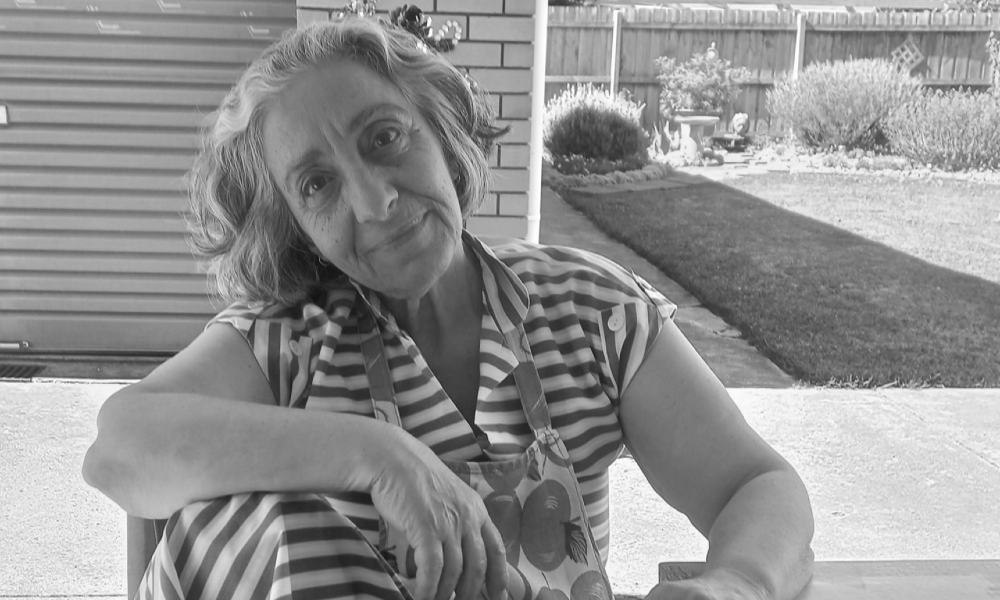
thalia is one of Australia’s foremost visual poets, with an expanded poetry practice spanning from 1972 to the present day, working across writing, drawing, painting, rhinestones, embroidery, and, occasionally, sculptural glass beads affixed to garden walls and fences as graffiti. thalia’s enduring body of work is summarised in her major publication A Loose Thread, published by Collective Effort Press in 2015, which collects over 180 of her visual poems. She herself is a foundational part of Collective Effort: the renowned and enduring Naarm-based poetry collective that includes notables such as π.o., artist, sculpture and poet Sandy Caldow, Dadaist Jas H. Duke and poet and editor Jeljte, among others. thalia is a poet of the people; as well as having her poetry exhibited and published globally (for example, at the 1990 International Exhibition of Concrete Poetry held in Moscow) she often presents folders of her poetry at provincial towns and folk festivals around Australia with her partner, folk musician Alan Musgrove, whom she has collaborated with on an album of poetry, songs and music, Interplay1. thalia was a founding member of the Australian Poets Union and a co-founder and editor of the worker’s poetry journal 925, a little mag which ran from 1978 to 1983.

A singular and iconoclastic poet, thalia has developed an original, striking symbolic visual language through a practice of visual poetry constructed with the abbreviated writing system of Pitman shorthand, which relies on phonetic orthography — a practice known as phonography (Greek for sound writing). thalia has also called the method “soundhand writing”2, no doubt after Pitman’s first treatise on shorthand, Stenographic Sound-Hand (1837)3 that was initially learnt and deployed by scribes and reporters. Post-1914 (WWI), women were employed and took over men’s work and a predominately female workforce of secretaries and typists ensued.

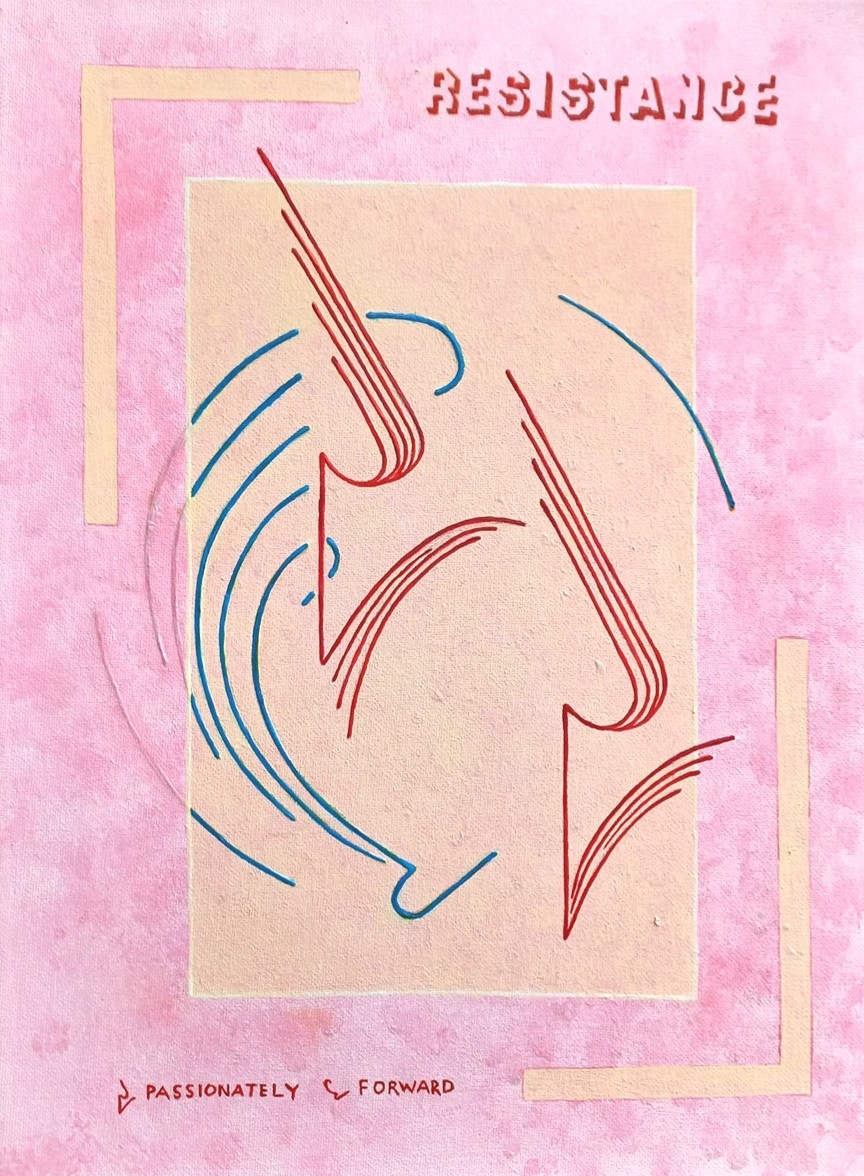
In both form and theme, thalia’s visual poetics poses a counter-position to the Western supremacy of the written word, and to dominant entwined power structures of imperialism and colonialism. Hers is a fiercely feminist, leftist poetics that is embodied by the form of visual poetry that merges processes of reading and seeing, challenging hierarchies, binaries, and ideas of composition (both in text and visual art). While Pitman shorthand is designed to be written on lined paper, thalia composes her poems on blank sheets, enlarging the symbols and removing Pitman’s horizontal line used to demarcate vowel sounds. thalia’s words come towards you, as much as they flow from left to right. They remember — but more or less abolish — linear reading, as can be seen in the dynamic circular form of “passionately forward”.

Resistance
thalia, ‘Resistance’, 2016, acrylic on canvas, 30 x 40 cm

Born in Greece in 1952, thalia emigrated with her family to Melbourne in 1954, aged two. She grew up in Fitzroy, alongside her brother π.o., and left school at the age of 14 to help her mother, who was chronically unwell, in her shop in Fitzroy. At the age of 20, thalia learnt shorthand, taking intensive classes for the duration of a year. When thalia was learning and working with Pitman’s, she saw pictures and thought, ‘This is poetry.’4

She writes that in making use of Pitman’s, she achieves several things:

1) Honours countless generations who have had to write in code
2) Dispenses with the dominant written language, and thus creates a new written word, one which is/was primarily 
a women's domain
3) Transforms a worker's tool into art.5

These three aims have remained pivotal to her practice.

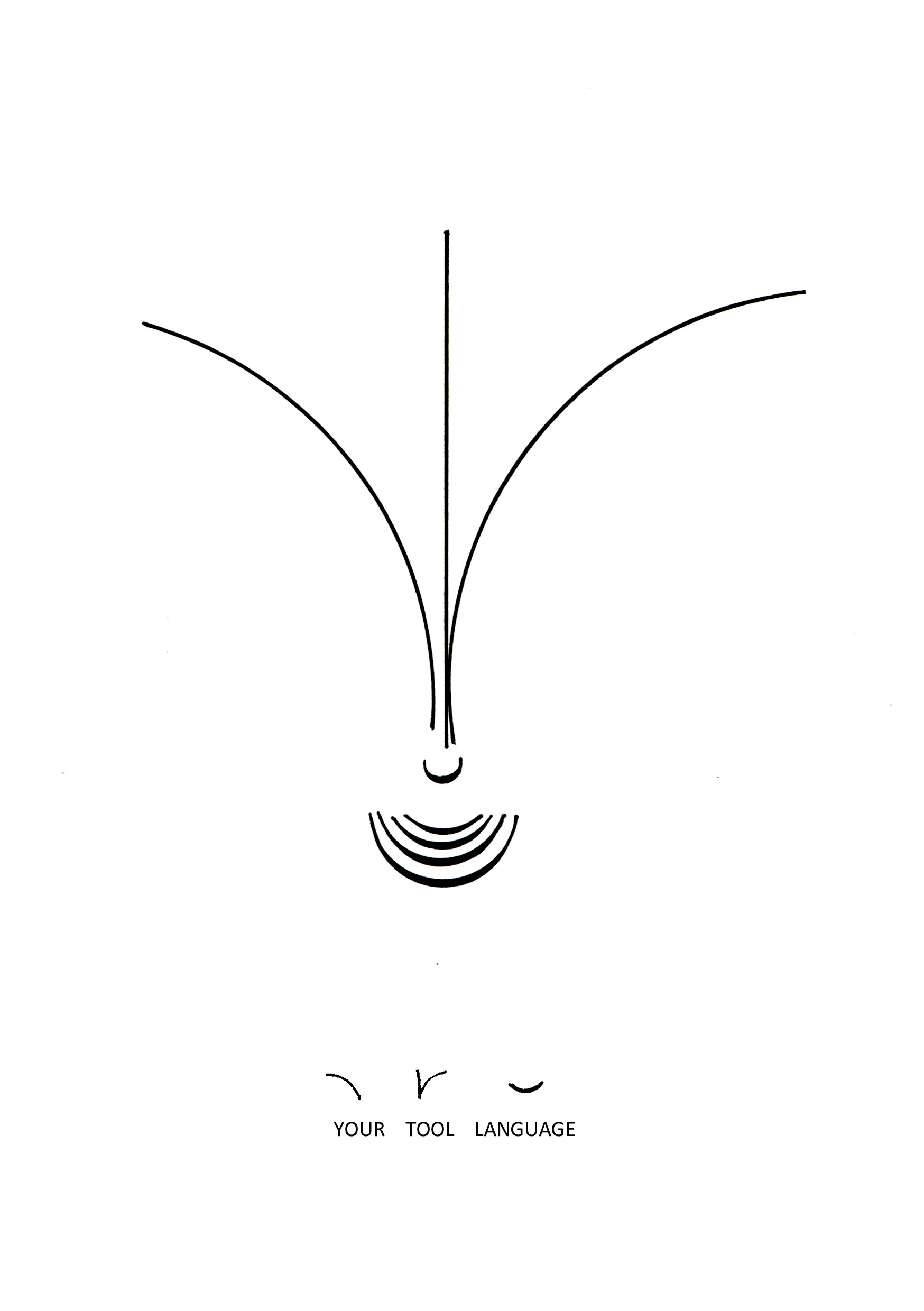
Rather than using Pitman’s as a code for writing texts, thalia creates new images from the notation and provides readers with a key of the shorthand notation. Decipherment is incorporated into the reading frame, moving between codes and languages. In thalia’s poetics, the hand-drawn image and words merge and become one, presenting a sonic, textual and visual fusion. Sometimes mimetic, where the image and the word express the same subject, there is also often disjunct or a puzzle between the visual and the verbal. The picture-poem presents new interpretations of the word and world, and a doubling that recalls an optical illusion, where the eye zooms in and out, as can be seen in ‘Your Tool Language’.

Your Tool Language
thalia, ‘Your Tool Language’, 1986, pen on paper, 210mm x 297 mm

If we are to read the poem following the notation, we read, “your tool language, language, language, language”, while the eye moves between the images we are presented with: a pen nib, a clit, a face. Language is presented as limitless and at our disposal, and there is a reversal too, away from a patriarchal language, where the pen is a phallic symbol.

Posted in ESSAYS | Tagged ,

Time Does Not Heal All Wounds: On Writing Poetry as Document

Chimmy Meer

1.

All her life my grandmother, Teresita Meer, taught at the University of Santo Tomas. She was the second eldest daughter among 13 siblings, and her family resided in a compound, once a big house, in Navotas City. Already deteriorated by the time I was born in 1994. My father would tell stories of how my grandmother’s father, Lolo Anghel, was a fierce activist imprisoned during Martial Law. Somehow, it was my grandmother’s teaching position that saved us all from poverty, though barely. But I didn’t want to see it that way as a rebellious teenager, didn’t want to accept that she was our breadwinner for a time, and so I had fights with my grandmother as a teenager, fights that I could only laugh about with regrets now. My grandmother was a single mother. I had often suspected her of missing her other half. My grandfather, Jose Meer or Lolo Joey, lived in America for most of my father’s childhood and ours, separate from us until we were grownups. Everyone around me said he was a controlling and manipulative person, a womanizer. He was old when I met him, but I became all too familiar with having strong and wounded fathers. My grandparents both passed away from cancer, only a few months apart, one right beside me, another one in America.

It is easy and difficult to relate my past to my grandmother’s. I once wrote these lines about her: “She used to be so bitter toward me, my grandmother / But I became her favorite one summer / When she finally saw I could become a woman.” I remember our last date vividly, how she sat across me in the restaurant, smiling and talking politely about work and her check-ups. It was like she was a different woman, suddenly graceful and poised. She was already in pain and would only eat small portions of meat. My grandmother was known for her bursts of anger. I once drove her mad for something trivial; she threw a fit and was brutal with words. She must have understood how I felt when, one day, as an adult, I fought with my father, her son, and broke down. Like my grandmother, I carried for years a quiet rage inside me, not realizing that the past reached out to me, and that my ancestors’ wounds have become my own.

I grew up in Tondo, Manila, where my mother hailed from, surrounded by extended relatives from my mother’s side. In a small apartment, my father played chess in silence and smoked behind a table profusely. His life looked like a chess game to me, a tactic to survive and provide us with the best life. He was toughened up by Lolo Anghel enough for my grandmother to become slightly scared of him. I did not have a terrible childhood that I remember, except one night when my father broke my Barbie doll house, smashing it alongside other furniture. When he did it, it had nothing and everything to do with me. It was the night I first gritted my teeth, what would result in a bad case of bruxism and constant dreams about falling teeth over the years. The rest of the night unfolded like a bad scene from a soap opera until my grandparents from my mother’s side would finally come and take away my mother, and with her, my younger sister.

My older sister and I were left in the care of my father and grandmother. The doll house was kept in the shadows for a long time until our family got back together. One day I opened the doll house and found a nest of baby rats inside, small and skinless newborns wrapped in dirt and hair. Even after we cleaned it, I asked my mother to give my beloved doll house away for good.


2.

Nowadays, I often think about when a work starts and ends – like really starts and ends. It is possible to trace the beginnings of a poem to childhood, not because you wrote the poem from childhood, but because the work could be happening inside you even before you named your pain, before you wounded a page using black ink. A work began from childhood could end in your thirties, a few years after you moved out from home, thinking marriage or writing could save you. You could have been returning to visit your grandmother, just before she passed away, just before you knew she would go. The words, though inexact, could finally spill out, as you try to make sense of the crushing, somewhat oppressive temporality of lives. You might realize that perhaps the work did not begin with your childhood but your grandmother’s childhood, from earlier events seemingly outside of you. Such was the work I have been doing in my manuscript, Love is a River from Hell. I want to highlight movement in this work, to move as I have been moved, to let the river of words constitute memory, even if it is a hellish undertaking. Because the pain of my ancestors is my pain. In these poems, I write about the wounds we inherit from our mothers and fathers, and how all of it carries us ever forward, and forces us into our present body.

Growing up, I studied at the school where my grandmother had taught, a close commute to where we lived. I try to recall a mythic conception of my writing life. The beginning resembles a story we already know: a girl, having known shame, becomes the high school outcast. She would treat the church as her sanctuary, its dark and quiet hallways, its refracted light and saintly gestures, but it was only a physical sanctuary, a place where she can hide. In her body she carried wounds of silence, intangible wounds she couldn’t show to anyone. She wrote by herself in school and in the long summers without school, but she did not readily write about all the things inside her. She would write diary entries, half poems, unsent letters, and factual notes with no understanding of what the writing meant to her, no desire to make poetry into a project. When she attended her first writers’ workshop at 14 years old, it bruised her heart. Her poems were never any good but she could not have put down writing then. What was most necessary was to persist in writing, to survive, to pass the time. In a way, she was careless with time. She was young and unafraid of death, caught unaware of loved ones fading away.

Like bell hooks, I recognize that writing began for me in the heartbreak church1, from familial wounds that made me silent as a child, but like her, I do not want to worship in this church. When I searched my poetry for the original wound that compelled me to write, I saw how patriarchy affected generations of women in my family. I was both complicit witness and victim to the violence of love. In my mythic conception of a writing life, it is not bell hooks’s wounds of passion I find on my body, but wounds of silence. The symptom of this wound was always my writing. When my grandmother passed away on 1 September 2024, what was a record of my wounds was transformed into a record of her life, and I wrote to record some more. Vis-a-vis death, I wrote poems as documents that existed in liminality, ever incomplete and ongoing. I was writing time to save and forgive myself.

Time informed my work. It was clear that generational trauma flowed inside me like a river, sometimes raging, sometimes calm. My grandmother, a single mother, a teacher, was a woman we managed to hurt as a family unit, and it was writing about her that made me free of my broken doll house. When I recognize the source of my wounds, it finally no longer belongs to just me, even though writing it for myself was necessary, was what saved me. My grandmother’s hurt was the hurt of my father, because she was his mother. It will be the same for myself and my mother. This story was set in stone from the moment I was born, from my first childhood trauma. We are destined to be hurt, no matter if we are also loved, but I am not a firm believer I will write the same story over and over again, because I have written about other things. As long as I am alive, I can write about other things. It is this hope that keeps me writing still, that makes still writing an act of faith.

Posted in ESSAYS | Tagged

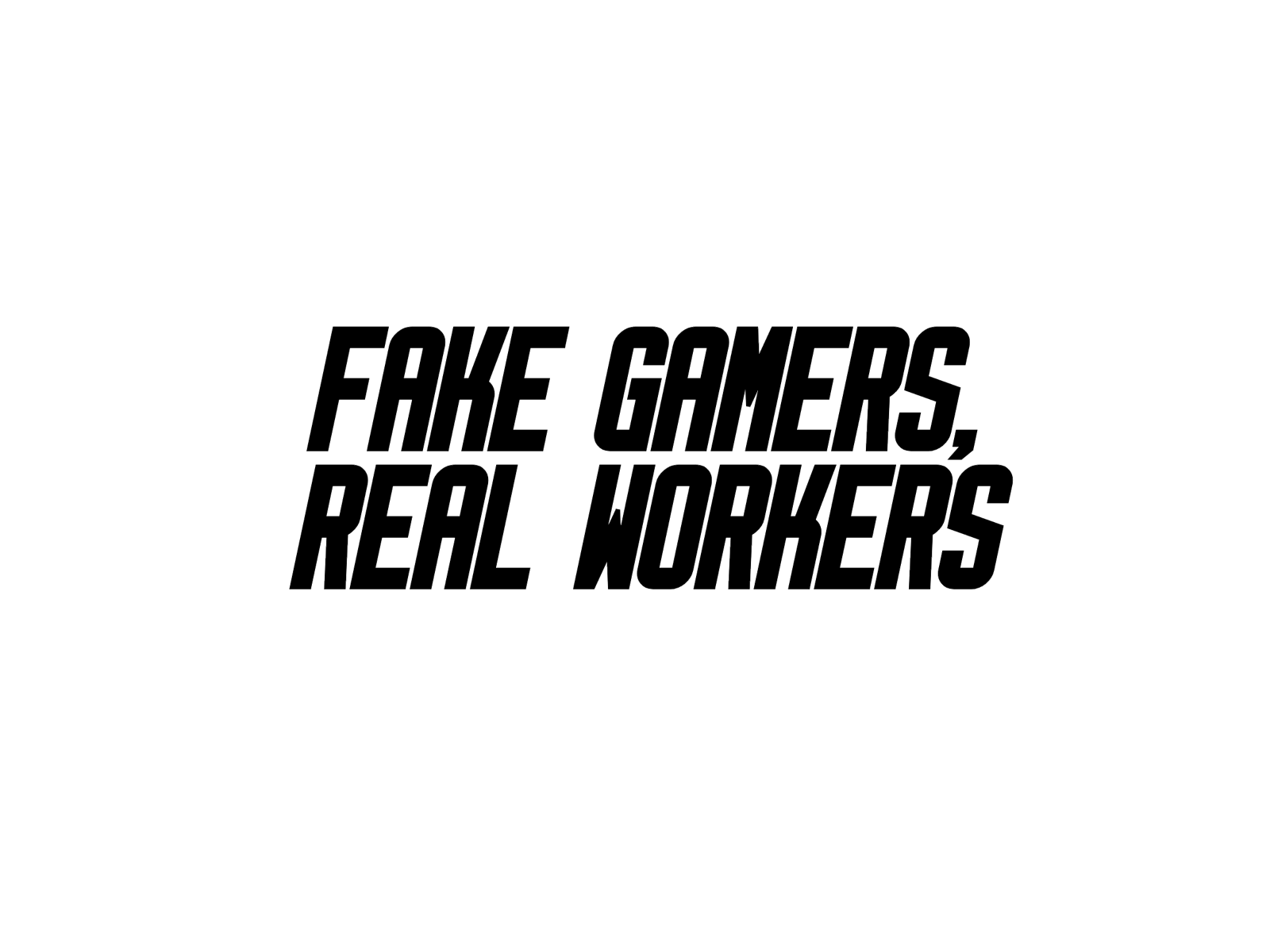
Fake Gamers, Real Workers

This interactive essay is best experienced on a desktop device. Click the image below to open the essay.

Fake gamers, real workers

Posted in ESSAYS | Tagged

PRECARIOUS Editorial

What actually do we mean by “precarious”? When I made the call for submissions, I had particular “at risk” spaces on my mind – employment, peace, health, community, ecosystems, social systems. Not only the global but the bodily. Not only systems of meaning-making but the water and the air. So, yes, what isn’t precarious, especially these days?

I read hundreds of submitted poems, and soon enough I realised that what I was looking for were poems that gave voice to some particular aspect of precarity, not only in what they spoke about, but how they spoke. I wasn’t interested in abstraction, solid ground, hygenic clarity, pyrotechnical displays or cool. The poems needed to themselves be teetering, staggering, bedridden or exposed.

The poems I’ve chosen for this issue of Cordite each, in their own way, face our acute, unavoidable vulnerability head on, while simultaneously staring it down. They don’t offer solutions, not overtly anyway (there isn’t any “solution” to precarity, not entirely). But their very existence – you reading them – is a kind of counterweight. What connects us, what keeps us going, is reinforced, maybe even amplified.

These poems speak to each other, across aesthetic and experiential distinctions. “I cannot help // I feel” (Eileen Chong, ‘Glide / Elide’) echoes quietly in “I forget the username / for my blood” (Dan Hogan, ‘Slippery’). Those “limbs lopsided to earth” (Gaele Sobott, ‘Byways’) remind me of “you whose emergencies / go unregistered” (Khairani Barokka, ‘praise poem for these girls i was’). And while the “hungry rust [is] eating / the underneath” (Kobus Moolman, ‘Flat’), for those lives under threat, including our own, another voice cries out, “They must endure. They must all endure” (Scott-Patrick Mitchell, ‘The Hurt’).

I experienced “I have not yet seen an undamaged mossbed” (Louise Crisp, ‘Dry Mountains’) as an unsettling parallel of “Austerity is the cure that displaces the sickness onto the poor” (Eleni Stecopoulos, ‘Becalmed’). And I couldn’t divorce the phrase “there became too many funerals to cry at anymore” (Peter Davis, ‘Portrait of a friend with HIV dementia’) from “tenderness creates a universe where right is not the issue” (Claire Gaskin, ‘The Victorian Parliamentary Inquiry into the Recruitment Methods and Impacts of Cults and Organised Fringe Groups’).

These poems say, “I’m looking for a word / The (ex)plosives are ambiguous” (Luke Patterson, ‘Cosmolalia’). They find their own language, including the stutters and silences, in their own experiments, and in each other. And in you. They ask, “If I’m a wrong one, will you also be that / with me” (Jill Jones, ‘Observations On a Friday Evening When It Might Rain, When It Might Change’). And, “Are you breathing, / May I / enter?” (Medha Singh, ‘Lure, Endure’). They are, like Rachael Boast’s ‘Ass’, “emissar[ies] of burden”.

Honestly, I want to quote every one of these poems. There are sinkholes, handfish, chemotherapy, door-to-door evangelists, a fried cheese sandwich, colonialism, the abyss, ruinous rentals, Gugaamgan (the Gumbaynggirr word for ‘emu’), Sappho, plastics, war, and families. But read them yourself, and make your own connective tissue.

It’s fascinating to see, too, how through the anonymous submission process, quite a few of my favourite poets were behind the poems I chose. And there are also a good number of poets I’m not at all familiar with. The world of poetry might not escape precarity, but it’s vigorous.

In her book, The Mushroom at the End of the World: On the Possibility of Life in Capitalist Ruins, Anna Lowenhaupt Tsing asks, “What if precarity, indeterminacy, and what we imagine as trivial are the centre of the systematicity we seek?.. .A precarious world is a world without teleology. [This] is frightening, but thinking through precarity makes it evident that indeterminacy also makes life possible.” (20)

There’s an abundance of life in these poems, gesturing towards how we might live together.

Posted in ESSAYS | Tagged

Poetry as Protest; Protest as Poetry

Dzenana Vucic

We’ve had reason, lately, to wonder at the effectiveness of protest. Movements like Black Lives Matter and Me Too (or, earlier: the Occupy Movement) mobilised millions of people around the world, yet it feels – particularly in our current political moment – as though despairingly little has changed. This frustration is felt with acute horror in the face of Israel’s genocidal campaign in Gaza, which has seen protestors gathering in the tens of thousands and hundreds of thousands every week for two years, demanding an end to the violence only to be ignored or painted as extremists by their governments.

Like protest, poetry, too, faces suspicions of material impotence. Poetry, after all, “makes nothing happen,” as goes Auden’s half-remembered and oft-repeated line. And yet, people continue to write it; people continue to protest; often, people do both at once. What, after all, is a chant if not a line of poetry?

In our thousands, in our millions / We are all Palestinians; the people, united / will never be defeated; Siamo tutti / antifascisti [we are all / antifascists]

Chants – frequently taking the form of couplets – rely on rhythm and metre to be memorable and repeatable, making poetry the medium through which most people engage with public protest and the predominant language through which protest is articulated. Even when it is not being shouted, poetry in inextricable from protest movements, as has been recently highlighted by Readers and Writers Against the Genocide, whose striking T-shirts and totes, each featuring poems or lines of poetry by writers like Evelyn Araluen, Omar Sakr and Sara M. Saleh on their back, have become ubiquitous at literary events and pro-Palestine demonstrations across the country.

There is a difference, of course, between a chant and a poem, and indeed, between a poem and a protest poem, though the line is blurry at best. Not so much a genre as an activist orientation towards poetics, ‘protest poetry’ has been described by Maggie Queeney for Poetry Foundation, as “a poetry of dissent”, a poetry which “exists to reveal what those in power seek to hide, to criticise and challenge, and to protest and resist established values and ideas.” Protest poetry is, definitionally, political. Though, as Solmaz Sharif writes, so is all poetry: “Every poem is an action. Every action is political. Every poem is political.” Explicitly political poetry goes further in that it must ‘speak truth to power’ and, as Solmaz explains in her conversation with Evie Shockley at the Radcliffe Institute, this means that it must speak to the moment, it must insist on specificity. The same is true of protest poetry.

‘Protest poetry’ is an admittedly awkward term, though it is the most succinct signifier that English offers to name the entangled concept of poetry-as-protest/protest-as-poetry. I use it to delimit something perhaps narrower still than what Queeney suggests and to foreground its goal-oriented character. In using the term ‘protest poetry’, I am not referring to poetry which depicts injustice or which attempts to place, as Seamus Heaney offers in ‘The Redress of Poetry’, “a counter-reality in the scales – a reality which may be only imagined but which nevertheless has weight because it is imagined within the gravitational pull of the actual and can therefore hold its own and balance out against the historical situation […] a glimpsed alternative, a revelation of potential that is denied or constantly threatened by circumstances.” My meaning is narrower, too, than poetry that attempts to bring the reader to share a moral view with the poet. Rather, what I mean by ‘protest poetry’ is poetry that seeks to inspire revolutionary action towards a change in the world. As Fargo Tbakhi writes in in his essay Notes of Craft: Writing in the Hour of Genocide: “what the long middle of revolution requires,” (he is talking, specifically, of Palestine) is “an approach to writing whose primary purpose is to gather others up with us, to generate within them an energy which their bodies cannot translate into anything but revolutionary movement.” (original italics). This is the purpose of protest poetry, and what makes it such.

It goes without saying that to be effective as protest poetry, the work must also be effective as poetry. What this means, according to Rajeev S Patke in his chapter ‘Postcolonial Protest Poetry’ from the Cambridge Companion to Postcolonial Poetry, is that it must “constitute a memorable utterance that is relevant to the circumstances which bring it into existence, but also capable of sustaining a more lasting resonance.” In practice, this definition is somewhat subjective as Patke himself demonstrates by providing examples of what he believes to be an effective and an ineffective poem protesting South African apartheid: he praises Keith Gottschalk’s ‘After’ for its poetic irony and distance while referring to Dennis Brutus’s ‘A poem about Sharpeville’ as “banal and prosaic”. Yet Brutus’ words, a preliminary Google search shows, are widely shared and clearly deeply resonant.

As Tbakhi argues, there is power in clarity, in the plain speech that Patke might call prosaicness: “One of the basic conditions of success is a clear perspective of things,” he writes. This clarity may well be one of the defining features of protest poetry, which must be understood if it is to be acted upon. Vagueness, ambivalence, equivocation, obscurity: these are the enemies of political action and of protest poetry. It is, Tbakhi writes, “[b]etter to know what we’re saying and why, and to say it with force” than to submit to the “machine” of Craft. Indeed, Tbakhi is deeply suspicious of ‘Craft’, describing it as “a machine built to produce and reproduce ethical failures,” a “counterrevolutionary machine,” intended for “regulation, estrangement, sanitization” and to “elide and foreclose political thought.” Craft, he argues, allows a reader to read a work, feel a response to it, then put the work down and go about their day. It does not compel them to act.

The kind of writing that he argues for, on the other hand, “calls others into mobilization, generating feeling within [the] audience that cannot be dispersed through the act of reading, but must be carried out into collective action.” This is not to say that a protest poem must explicitly demand a particular action, but rather that such writing depends on clarity of expression because to be effective as protest it cannot allow for the inhibiting effect of ambiguity; it must be understood as a demand for change.

As with explicitly political poetry, a poem intending to ‘bring change’ must, according to the activist poet John Kinsella, have immediacy. It “necessarily lives in the moment”, though is not confined to it. It must speak to a contemporary issue, but this does not prevent it speaking with new and powerful reverberations as time passes or circumstances change. Such a poem, Kinsella writes, may “lose its activist event ‘purpose’ as its ‘moment’ passes, but it can be recovered, recontextualised, and brought back to act anew.” I am reminded, for example, of Iraqi poet Dunya Mikhail’s devastating irony in ‘The War Works Hard’, a poem which speaks equally to the Iraq war, as to the wars in Congo, in Gaza, in Sudan, in Ukraine:

How magnificent the war is!
How eager
And efficient!
Early in the morning, 
It wakes up the sirens
and dispatches ambulances
to various places,
swings corpses through the air,
rolls stretchers to the wounded,
summons rain
from the eyes of mothers

Indeed, we have seen this recovery and recontextualization many times over: the persistence of pieces like Gil Scott-Heron’s ‘The Revolution Will Not Be Televised’ or Maya Angelou’s ‘Still I Rise’, which never fade away but resurface with renewed conviction in response acts of white supremacist violence against Black people in the USA. More recently, there is the the virality of ‘If I Must Die’ after the death of its author, Gazan poet and academic Refaat Alareer who posted the poem to Twitter in November 2023.

Arguably, ‘If I Must Die’ was not written as a protest poem but has become one after Alareer and his family were killed by an Israeli airstrike in December 2023. The poem begins: ‘If I must die / you must live / to tell my story’ and ends: ‘If I must die / let it bring hope / let it be a tale’. Readers quickly took up his call, and the poem amassed 33 million views and was translated into over a hundred languages with protestors flying kites in Alareer’s name and reading his words at demonstrations and vigils around the world. Though written in 2011 (a year with no shortage of Israeli violence itself), ‘If I Must Die’ gained renewed immediacy as a symbol of resistance to the intensified genocide in Gaza.

Posted in ESSAYS | Tagged , , , , , , , , , , , , , ,

Regeneration Is Not a Metaphor

Lulu Houdini

Letter to my fourth great-granddaughter. Written seven generations from now, by me as an Ancestor, in her starry sky.


yaama waabi, hello baby

I’m coming to you in English because the tall ships’ memory is still in my psyche, and in the time when I was born in 1992, this lingo was the first language for most of us on the east coast. Even when my youngest granddaughter passed over, they were still speaking in English.

Because of how often I watch and listen to you from up here, I am becoming fluent in our Gamilaraay mother tongue — something I always wanted to achieve in my own lifetime. Whereas before, I was translating everything you said back into English. My Indigenous thoughts no longer have to be translated, and for that my little grannie, I feel more restful than I ever have.

I felt called to write to you now, in the year 2200, after we spoke in your dream last week — where you called me into your clear mind and your strong body. In your yearnings to know me better, I do something very old: I write you a long letter.

Because of where my daughter was born, you’re connected to the gulayaali. But I am still bigibilla because of my grandmother six generations ago, and also for the wirayl — the echidna quill — because I’m a writer. I am close to echidna, because the wirayl still sits inside my foot. I am bigibilla because she is a mother of pups and the houdini of the bush. I hope the stories you’ve heard of me live up to these expectations bub.

When I was born, I was covered in brown hair — my head, my shoulders, my forehead, even my feet. I remember when my daughter was born, she was the same: a crying, hairy little angel. The vernix that licked her fresh skin was pink with a mix of my blood and biome, which now sits in the soil and the tree you visit on our grandmother Biddy’s Country, on southern Gomeroi homelands.

Baby girl, in nine big moons’ time, I’ll watch you birth your sixth guyaangul-djuul with all the girls around you and I wish I was the one there catching your baby and rubbing him with gurruwii. Our songs have survived these generations — where everything was coming back — and I’m gonna make sure it’s there for you in the wind on your big special night.

In 2022, I joined a powerful clan of women reviving birthing on Country practices within Yuin Country. Back then, that reshaped this continent, my girl — don’t forget what women have done, for you now to birth your babies in peace, in land, in water, in spirit, and in sovereignty.

I remember seeing that change in 2027, all those years ago, with the first of our birth centres. It was the first time I really felt the future was going to be okay for you, bub.

One hundred and seventy-five years later, and now our babies thrive well past the first 2000 days, entering classrooms not only with their pride, but with a huge welcoming presence from the people in there who value them.

In 2059, I watched the helicopters drop masses of mangrove seeds down onto Country for the regeneration of our waterways. That was David Unaipon, long before me — and his technology of flight path and the returning boomerang. The seed collection — well, that was our generation. My mum, and lots of others, taught me how valuable the mangrove seed would be, and that’s why we kept them.

That began the regeneration in Warra, where me and your great aunties and uncles were grown, as the second generation of our family living off Country — where our saltwater Murri line began.

All the land and sea animals have come back now, hey bub. The ones in the ocean near to where you live have colours so vibrant we can see them from the clouds on a still day. By nighttime, we sit up here and watch the bioluminescence sway them in glitter-storm tides. They light up like dancing water trees under the glassy surface, and I sit up here with my cuppa. When I was your age, the seasons were still all mixed up. But now that everything is almost restored to rhythm, I know when to come and watch you take your babies down to the beach in the early evening. When they scream in joy at being the first ones to see the plankton, we hear it all the way up here. I receive noise complaints — that’s your mob, Lulu.

Posted in ESSAYS | Tagged

The Algae Will Stay Another Day

Mali Harkin-Noac

I’m staring up at this precious night sky and I wish on a shooting star that the algal bloom will go away. When I look a little harder, I see it’s not a shooting star, but one of Musk’s Starlink Satellites.

Ten years old, I was standing on a rock out to shore singing a made-up song about islands. Water washing up to my feet, my hair wet and dreaded around my shoulders. I lived in that ocean, in the throws and tides, salty and sandy and wrapped in a towel. Even then, I was creating art about the waves. I was singing that song because I loved where I was. There was a perfect sunset over slow-moving waves, with soft, dry sand, precious clouds above soaring birds, and an endless, exquisite horizon.

Nowadays, the water is thick, soupy, and angry. You can smell the toxin before you can see the beach. I’ve sat on mosaic benches at the edges of cliffs for hours, watching the algae float at the surface of each wave. I can see the bloom’s perfect structure, shifting and growing just below the surface. The sand is covered in warm foam, surrounded by dead fish along the coast. I keep watching it, so badly it hurts, and I’m looking at my mother earth and asking, “What did they do to you?” Begging, “How can I help you?” But it’s not up to me, a year 10 student from Thebarton, a hobby writer, a Narungga girl who’s watching the algal bloom wrecking the beaches of her banggara hours away. The people who are ruining our ecosystems won’t be alive to see them collapse. But I know I will.

I write this for the ocean that has guided me for all my life, that holds my soul so delicately, that fed my ancestors so generously, because I don’t know what else to do. What can the powerless do? What can the children do? And I still visit the beaches, and people ask me, “Why would you want to go when it’s like that?” and I think of when my pop was in palliative care, years ago. We sit with our loved ones and hold their hands when they’re sick, we give them our stuffed toys to comfort them, we keep the light behind our eyes so they remember to, too. So, I sit with this aching ocean. I count the waves and keep away from the foam. I stay close enough to feel this body again, but I stay far enough away that I don’t start to cough.

When I was 16 I met a dead ray on one of my trips. She was about the size of my arm, and had a long, straight tail. I sat with her and counted the beautiful stripes on her back, I ran my finger along her smooth skin. She was completely dry, completely still, and so heavy on the gasping sand. My heart rested heavy in my chest. I don’t know how long I sat with her; I didn’t want to leave. Eventually someone dragged me away. I think if she’d found me floating in the water she would have stayed with me, too. This is what we do when we care.

I was six when my family and I met 200 people at the beach one morning for Greenpeace. We all stood in a line and held hands in front of the water, a protest against oil drilling in Mirning country along the Bight. I had bare feet, my hair was frizzy in the salty air, and we all promised we’d protect the waters. We gripped hands so tightly that day, we were all such strangers to one another and still, we clutched onto each other like lifelines. We told the waves, “We’ve got you, we’re on your side, we’ll look after you.” I don’t know what to say to the ocean now because we didn’t manage to protect it; we didn’t do enough. Maybe we couldn’t have ever done enough. I think all I could say is “We’re sorry.”

Fifteen years old, I was at Brighton beach with my best friends, standing hip-height in the water and throwing a ball back and forth. The sky was empty of clouds, a perfect blue, the water crystal clear and shimmering. We’d taken the rickety train on the Seaford line, ate salami sandwiches, and carved words in the sand that’d be washed away by moonlight. Watching the others throwing and catching, something suddenly came out under my foot and gripped its sharp claws around my toes before I jolted away, screaming. “There’s crabs!” I yelled out to them all, floating now, while they laughed loudly. I angrily cursed out the ocean, ashamedly, and all the damned Brighton Crabs. Looking back on it now, I’d do anything to be there again. I’d get pinched by thousands of crabs. I’d sleep in a tank of crustaceans if it meant I could have that crystal clear water again. My memory often swims back to that day.

Posted in ESSAYS | Tagged

15 Artworks by Elyas Alavi


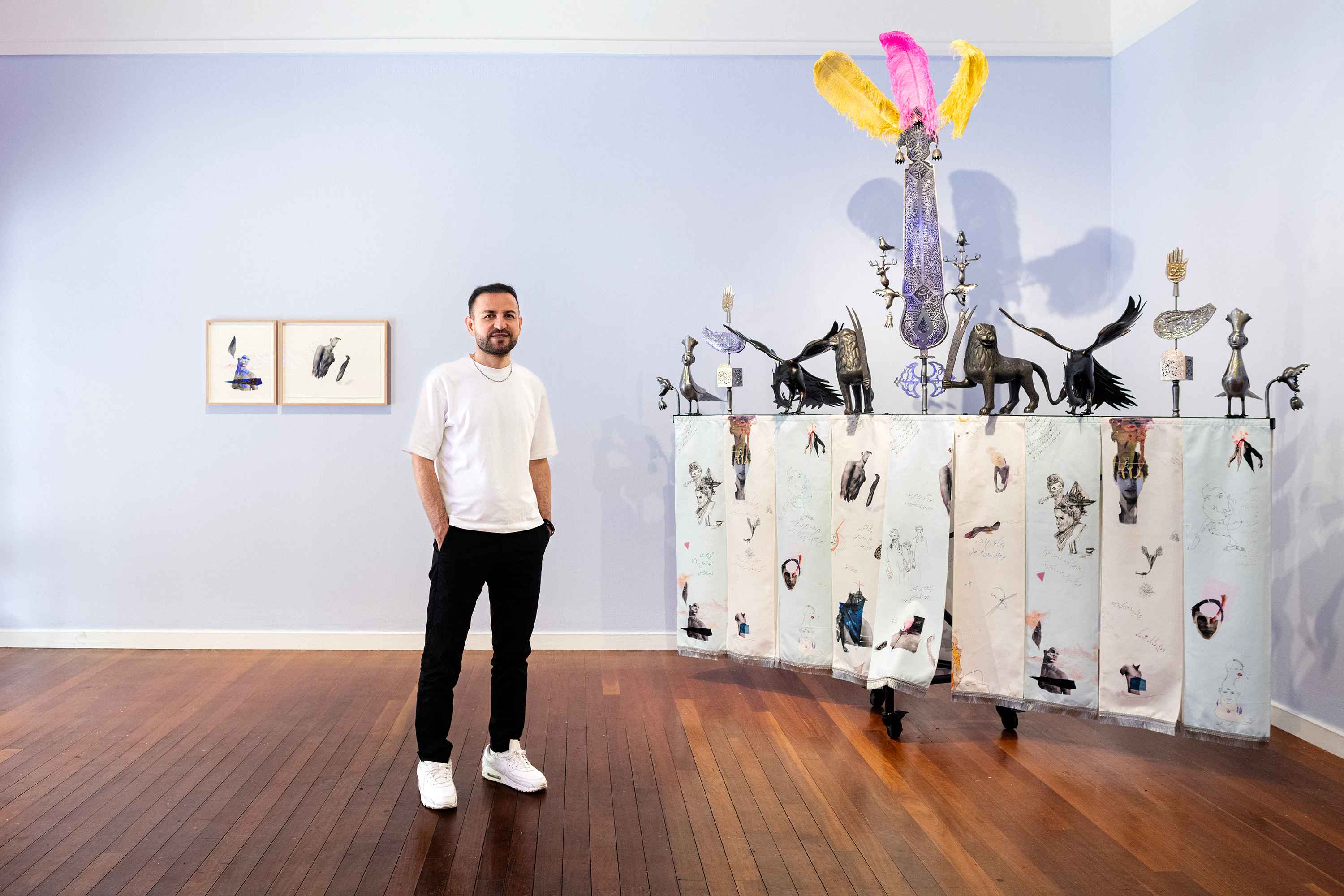
Elyas Alavi, Installation view of ALAM exhibition, 2024 , gold leaf, iron, steel, prints on velvet, photo by Kai Wasikowki

Posted in ARTWORKS | Tagged

from BECALMED

On the night the congresswoman wore her ballgown emblazoned with TAX THE RICH and the left muttered, Eat the rich, I dream of being a cannibal.

We’re on the move, not to shut down the port or expel Patriot Prayer—no, we’re dropping down onto the roofs of billionaires to dig out chunks of flesh from their backs. There is no affect around this action; it’s grunt work and cults are dull. A chef serves us crudités slathered in pink caviar: persona foie grata. Am I dreaming the dream that capital has incubated in me? Grow your brand.

On TV, Guillotin discovers the nobility are infected with a virus that drives them to feed on the peasants. In reality, the plutocrats devour many and feed slowly on others, like parasites clever enough to keep their hosts just barely alive. Austerity is the cure that displaces the sickness so that greed can mutate with ever more virulence.

§

One morning we woke and it was night, it was nighttime all day, the sky orange with wildfire smoke, the bridge and the skyline shadow puppets cast by an absent sun.

In Aurélia, Gérard de Nerval imagines the earth knocked off its orbit, wandering through the firmament like a dismasted ship.

We are becalmed. The virus passes over the land, then passes over again. We suffocate in a leaking boat, bake under a tyrant sun. There is no horizon. All is horizon.

Insomnia is epidemic, we say, symptomatic of “dark times.” But what is a symptom? The etymology points to a falling-together or a falling-at-the-same-time. In the incubation cults it meant the coincidence of a supplicant’s dream with a priest’s dream, which signaled the time was right to go into the dark. The symptom was the sign to enter the closed part of the dormitory, the place “not to be stepped into.” The symptom tells you to enter a structural impasse to gain knowledge about the condition that has stranded you in impasse.

Insomnia is symptomatic of what is asymptotos, what does not fall together. The asymptote is our common symptom. We wait for what we know will happen, yet resist knowing. We watch the approaching limit.

As if to sleep would be a moral failure: to abandon the watch.

As if to sleep would be to tell yourself the blight of the world can always be transferred to the page, the way bandages were hung on trees. That the blight will not show up in your heart, your lungs, your gut. That you can pass through.

And yet to sleep would also be to see what is done in your dreams. To allow the open acts into the dark.

To be symptomatic is to align your body with the common plight. And we do not want to have the same dreams. No one wants to share symptoms. The pandemic’s contagion is an inconvenient reminder that we still take physical form, the way Edgar Allan Poe needed characters to work out his vectors of metempsychosis.

§

Tell yourself that tale—the one that begins with the ship going down—on the brink of the whirlpool—the narrator—on the brink of going over—voice breaking off—and yet—the manuscript is in our hands—we’re reading a tale written—by the one whose heart must have stopped before the towering shroud—the one who must have plummeted within the walls of the sea—the one whose principal grief was that I should never be able to tell.

Poe wanted to watch the ship go down while on the ship, stay conscious through the descent into oblivion. Matter would return to its source through katabasis but always there would be the anabasis, the comeback—to tell the tale, win the prize, reap the fame.

Insomnia insists on presence, staving off the wreck. And insomnia comes after, anticipating the next act against nature, slow death under the sun.

Posted in 118: PRECARIOUS | Tagged

GLIDE / ELIDE

travel by train
women
a fox

her neck
a rage my father

married
Life
sex
unconscious harm
for my

suicide need
at least
disguised as
very fox
animal
I think
if I died

very bad day[s]
exciting
realization
of a desire

so very difficult
present

terror abandoned

it is a fact

complete

I cannot help

I feel


Note:

This is an erasure poem utilising the text from a loose sheet of writing from Louise Bourgeois’s
archive, titled 10 October 1958 (LB-0449), which is held in the Collection Louise Bourgeois Archive,
The Easton Foundation New York. The original text, selected from Louise Bourgeois’s dream
recordings by Philip Larratt-Smith, was reproduced on page 70 of Louise Bourgeois: Has The Day
Invaded The Night Or Has The Night Invaded The Day?
(ed. Justin Paton, 2023, Art Gallery of New
South Wales).

Posted in 118: PRECARIOUS | Tagged

Slippery

rocks. The link is coming from inside
the biography. Especially given this
inbox is not monitored. Do not
curtain the rail with me, warmly
tenant. There is never going to be
a holiday from rent. The ‘in’ in
‘inbox’ is short for inferno

(Dante). Trigger a mercy ticket
with our friendly chatbot. 24/7
is here. Before you could squeeze
water from afar, many were window.
The house? I don’t know about
the house. Maybe it’s mental health,

maybe it’s the property manager. Or none
other than the pigeon’s office where
the corner of the bathroom used to be.
Not like the sky is a tombstone. Maybe
you have a new lease on outside things
becoming inside things. Maybe a candle
stabbed into a urinal cake can be a happy
birthday. A wish-making moment. A panting
sucker for a happy medium. Not many
would sit here. True, I forget the username
for my blood. Used one neck too many. When
miracles attack: what do we do?

Bourbon. In moderation. Heaps of moderation.
Not too much bourbon. It’s a weak night. Keen,
not keen. To be fair, even the butteriest flowerheads

bask, wobble shitful. It is nearly the year
2055. Why are people still going
online? No more can the dustmite
mung skin, are we engorged by
nostalgia. Welcome to landlord
or cake? (Only one way to find out.)
The game where you, warmly
tenant, can have your landlord
and eat it, too. It’s always, let them eat
cake
but never let them eat landlord.
That’s so society. So glacially
erratic. When memories have their
little leadership spills, I like to think
they are criticising what passes for
insight around here. Alas, old mate
will be back. His headlamp won’t
charge itself and I’m not doing it.
That’s my glass half full of habitable
atmosphere instead of bourbon-dread
for you. Opened the window to dry my lips
but nothing happened except I put on
a hoodie. I can see old mate from up here.
Here he comes. Got his laptop. He loves
that thing too much. Maybe it’s mental health,

maybe it’s the overinvestment in the dominant
symbolic regime? I’ve heard pink batts mumble
slurs. Swear. Print emails without first considering
the environment. I threw the window out of myself.
Evening was there and moths pattered the decorative
gravel, round river, tumbled sandstone. Delectable
seed borers met those rocks stunned or worse.

Posted in 118: PRECARIOUS | Tagged

Little Brain

The cerebellum—
from Latin means little brain,

learns by repetition.
It stores the choreography
of walking, writing,
wanting.

MRI speaks in code,
metallic syntax,
bone grammar,
an alphabet of damage.

I calcify in hospitals,
a fossil under fluorescents,
stillness taught
like a second language.

There’s a measuring tape
curled in my gut,
a snake,
too tired to strike.

Clipboard, murmur,
needle—
tooth, claw, prey.

I keep naming it
with flowers,
yew, larkspur,
bonewort.

Astrocytoma
a star-shaped cell.
I feel its root system
branching in me
like lichen,
or grief.

Posted in 118: PRECARIOUS | Tagged

boyhood

one night i intervene
as he gores my mother
my pinprick then
the tomcat’s magic kill
loyal mouse
toyed with
dismembered
you reconfigure
like lego overnight

Posted in 118: PRECARIOUS | Tagged

Another Notice to Vacate

Forced to move. Again. Here now in a house I hate. This house is hard. This house is cold. Freezing. To sit on the toilet. To take. A shower. Shower over the bath. Narrow. Deep. Leg over slowly. Don’t fall. The other leg. Stand in that small space. Try not to fall. Keep your thighs tight. Don’t spread out. If you do. The sides of your feet curve. Into. The side of the bath. You feel unstable. Don’t move too much. You can hardly move your arms. They bang up against the tiles. The shower curtain. You can’t do chicken wings. You have to hold them close. To your side. You can’t stand straight under it. Feel the water on your face. It’s the angle of the shower head. To feel it on your face, you have to turn. Right round. If you step back any further, you’ll be on top of the drain. To wash your hair, you have to throw your head back. Far as it can go. You think of The Exorcist. Are you supposed to swivel your head here? I used to love taking a bath. For my bad back. But not now. Surrounded by chill. You move through cold air. As if you’re outside not in. But who cares about the bloody bathroom. The not wanting. Never now wanting. To go to the loo. To take a shower. So what. How long are you in there anyway? How long does it take. To take a shit. Shower. You can survive 3 minutes surely. But that’s under the tap. Then. You’ve got to get out. Dry yourself. Freeze. Seems here I am frozen too. I am stopping. I am not getting to the main thing. The most important. Room. I haven’t got to that. Yet. I could go on about the bathroom. The outside laundry. The two separate taps in the laundry. My handwashing. My cheap clothes. Wanting to rinse. Have to do it now. In cold water. Two separate taps in the kitchen. The dark lounge room. The light I used to work by in other places. This is a hard place to live and work. My bedroom. The place where I work. Where I live. The room that matters more than any other. I am a homebody. I am at my computer. I am attached to my desktop. My chair. But this room. The cold. My feet now. Are always freezing. My face. I don’t recognise this face. This body. In this place. In this room. Take the light. For instance. There’s a blind. I have to constantly. Put up and down. All day. I’ve had to move my desk. It was in front of the window. The light the glare. My eyes grew sore. I couldn’t stand it. Now my desk. Is at the side. 90 degree angle to the window. But still. The light the glare. The blind up and down. I don’t know what. I’ll do in the summer. To get away from the sun. The room utterly black. When the blind is down. Then there’s the debris that fell. From cracks in the wall. This land. Built on a swamp. There’s structural movement. Debris on top of my computer. Into the back of my printer. Had to move the desk the table. Everything in front. Of that window. For the handyman. To seal the cracks. To stop the debris. Falling on top of me. Into spaces. Nooks and crannies. My tools. I spent each day. Escaping. After I moved in. Not wanting to be. In this place. Hard dark cold. Even in summer. No insulation. Double brick. Old. The best I could get. The Notice to Vacate. The 60 – 120 at inspections. Could hardly move or see. Anything. The high rents and shit houses. Worse flats. Tiny. Terrible. It hurts to hear. The word home. I can’t say it. I can’t call this that. When I say I’m going – where? ‘The place where I live.’ What a mouthful. ‘Back. There.’ I don’t know what to call it. I still can’t believe it. I am here. There is nowhere else to go. There is no way out. At every turn. Every room. Like waging a war. My body in battle. I feel strange here/there. I don’t know to live. Here. Or how to launch myself. Into the world. From here/there. It feels like I carry it. Around with me. I rarely get away from it. It waits for me to come back. I see it in my mind all the time. I never knew how the cold. Gets into your bones. My mother’s previous rental. Of forty-three years. Bitterly cold too. She never complained. Said she was used to it. Her old brick house. Sure it had a heater. In the lounge room. Threw out so little heat. All my friends, my boyfriends, my ex-partner saying. That house. Is fucking freezing. That kind of cold. You can’t think straight. Can think of nothing else. Heating doesn’t help. Sure, there’s a split system in the lounge room. But it doesn’t heat. The whole house. Doesn’t help the kitchen. The bathroom. The bedroom. The laundry outside. Such cold. You can’t put it behind you. You carry it. You carry the image. Of the place in your mind. You carry the cold. You know you have to return to it. There are people all over this country. Living like this. I have told myself. Hate doesn’t help. I have read books. Know/n struggling friends. Family. I know I know. Things could be worse. I could lose my sight, a limb; my life too young. I could be living in some other country. Or even here. Floods. Fire. Losing everything. I have lost so many so-called homes. So many times. And now. Had to get out. Just before I turned sixty. Happy Birthday to me. Merry Christmas. Packing again. Looking again. December. January. Applying again. I can’t tell you. How much time. And energy. And exhaustion. That takes. I said to a friend. In the middle of it. My life is a nightmare. She didn’t like it. She was shocked. Perhaps disapproving. She said Your life isn’t a nightmare. Look at all the support you’ve got. Including her. She could see it. I was surrounded. This time I’d put out a call. Asked friends to help. The packing. The moving. Usually it’s only my family. And my old best friend. I was beyond that this time. They’ve all grown older. All have bad backs. They still helped. But I had a whole band of others. Still, when I said my life felt like a nightmare, I meant it. The packing. The looking. The moving. All the help. They can’t keep doing this. Neither can I.
Posted in 118: PRECARIOUS | Tagged

the writing life

After Grace Yee


post-VPLAs we pile into ShanDong MaMa.
order dumplings by the dozen.
gossip. avoid ‘what we’re working on’.

i almost walk into a pole while texting.
J calls, ‘TAXIIIII…’
i yell at him for not protecting me from the pole.

in little bourke street we ramble
tipsy, idle, inept and mutinous.


‘the writing life’ was written for, and first performed at, the launch of Grace Yee’s Joss: A History.
It was inspired by her poem ‘for the chinese merchants of melbourne’.

Posted in 118: PRECARIOUS | Tagged

Closing night

My life has ended and I’m living in encore,
each muscle shrivelled, each gland sucked of the salty
sweat of life. Lopsided lipstick smile,
the fading evidence of performance.

Clapping clapping clapping clapping clapping
clapping I’m bowing bowing bowing bent
over arms brushing the sticky stage floor.

Last season I lived army crawl as my only mode
of mobility. Not with military efficiency. Like I’d been
stabbed over and over and I needed to get to my phone
but I didn’t know what room it was in, didn’t know
if I’d left it on the bus last night. Survival
was exhausting so I labelled it a tomorrow problem,
and fell asleep, face down in my smeared blood.

This season I’m on a merry-go-round and instead of a pony
my ride is a big slab of newly drying concrete I have to walk
through. Tap the red runny nose of the clown face
on the other side. Turn around, walk back, fast
as I can. Turn back towards the grin in the mirror. The merry
-go-round is on its side, close to the wings.

There’s an identical one
in my brain, gaining speed before it thwacks against the top
of my spinal cord every time it goes around. Nightly performances
for months and I stay in character, sleep in the cockles of the concrete
bed kept-ever gluggy by leaks in the roof and industrial humidifiers.

I want the audience to go home so I can too
but they want autographs, drinks, dancing. They want me
to come home and fix their roofs, their relationships,
their climate anxiety, their dinner –
something leafy and colourful
and not from a packet.

They need massages and hope and streaks and streaks
of my laughter enthusiastically smacking
their bright plump
days and warm, sticky nights.

I am turning to heavy dusty curtains, to the historic
kitty litter preserved backstage, to disintegrating
front row tickets in a scrapbook of regret, to a jumble
of licked wounds still thriving on occasional sentimental
thoughts in a garbage bag that refuses to suffocate me

because it too was in the audience of my life
and wants me to carry on, to strut and strut, and fret.

I lift my head up from my deep bow and I see
the next season, promises of script all dark wit, raw
dripping performances. My wonky smile
crudely drawn on, stares back
from the glossy flyer.

Posted in 118: PRECARIOUS | Tagged

The problem with society is heteronormativity

The problem with society is heteronormativity. The problem
with everything is heteronormativity. There is no other problem
if you are somebody’s wife, mother, daughter, which I am no good
at being, but can’t escape. They were always using Mum, Dad,
Billy and Jane as their example. Rather than moving to a lesbian
commune in Ecuador, I hoped my husband would be gay. And
here I am, divergent, disordered, definitely queer. When people
write about culture, they say that you need it to belong, to thrive.
What is it to belong and what, on God’s green earth, is this verb
they dub, thrive? Returning to heteronormativity, for two decades
I participated in a nuclear family in suburbia. After seven years
the sound of his key in the door made me twitch, then there was
the sound of dogs; it was a suburb of pensioners, Shih T-
zus everywhere. When I left, naturally, he disowned me.

Posted in 118: PRECARIOUS | Tagged

Dromaius novaehollandiae

Dear Gugaamgan1

Too long – since your plumes traced the ocean in abundance
Now, salted feathers fracture into splinters – a memory
They named us dying and waged war on us, too
Named us unworthy of their false flag
Or any flag
Named us savages
Named this place, terra nullius
Named her, last of her tribe
daughter of the last king, they insisted
But kings wear crowns and we wear kinship
not to mention, we smuggled survival in our blood
sixty thousand years nestled underneath our tongues
Our bones hold memories of your shadow
a feathered prophecy stitched into an autumn sky
we still remember seasons charted in the shape of you
But you are not an exhibit
nor in a museum
are the living rendition of a constellation
a fleshed and embodied memory
a hero within a long-ago story
This is our duty
to gather up adornments you leave behind
to wear a revolution you carried in your wings
to protect your nesting grounds against highways
and forgetting
When we fly again, they will say your name
and hold you in reverence – Gugaamgan

Posted in 118: PRECARIOUS | Tagged

Brunswick Park

Wind sharpens
the March air—

seed fragments in fast forward
and the grey rags
of pigeons

a sprinter trailing dreads as she practices

everywhere the strain
into life
of an early season.

No centre to truth,
only these small-holdings—

urchins of skeletal burrs
caught in the rasp

a woman between home
and work thumbing rind off an orange—

each saying
loudly don’t refuse this

each saying
it contains us.

Posted in 118: PRECARIOUS | Tagged