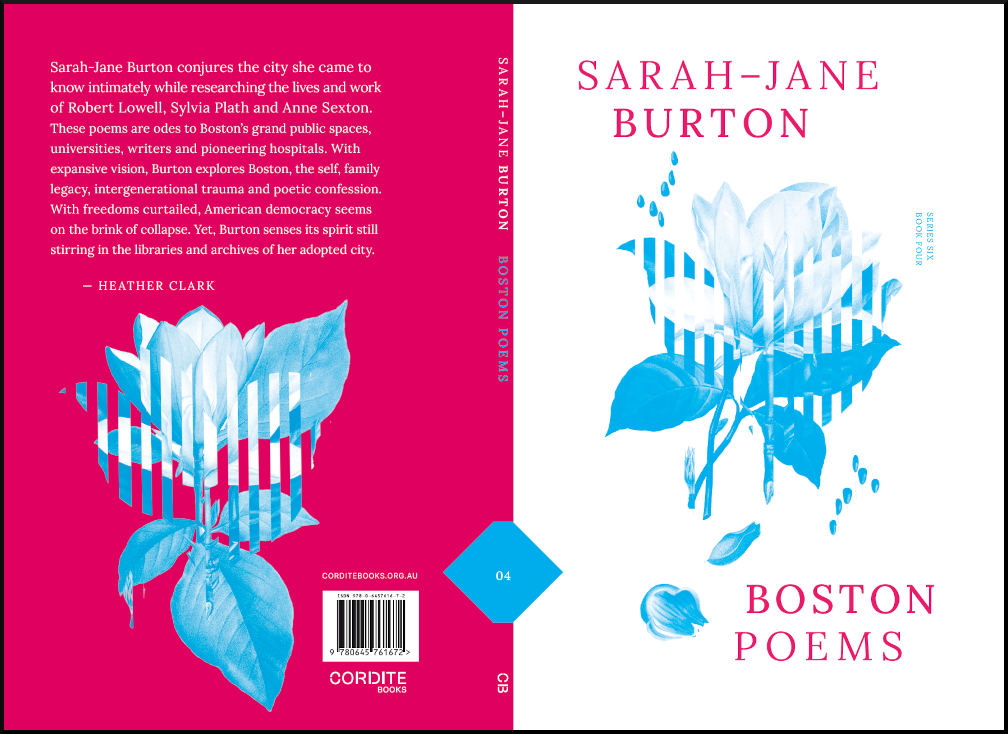
Introduction to Sarah-Jane Burton’s Boston Poems

BUY YOUR COPY HERE

In Boston Poems, Sarah-Jane Burton conjures the city she came to know intimately while researching the lives and work of Robert Lowell, Sylvia Plath and Anne Sexton. These poems are odes to Boston’s grand public spaces, universities, writers and pioneering hospitals. But Boston is also the site of a crushing loneliness. ‘Walking in this city of cobblestone / I’m the flaneur, poetess, ingénue / But all I want to do is cry in a foreign bed / And think of you.’ The flâneur’s confident, Whitmanian sense of optimism continually crashes up against New England’s darker, Gothic undercurrents. Burton braids these two psychic elements together in intimate poems whose mournful rhymes speak to eddying silences below the surface. The poems are at once tempered and passionate, painful and exuberant, formal and inventive. With expansive vision, Burton explores Boston, the self, family legacy, intergenerational trauma and poetic confession itself.

These poems are also an homage to the author’s native Australia. The backward and forward glances of Burton’s Janus-faced vision speaks to belonging and alienation; Boston’s history becomes a portal into her own. There are searing elegies to lost parents and lost cultures. ‘Memory Book’ memorialises her ‘father with a poet’s soul,’ while the tender, Heaney-esque ‘Arrowroot’ is for her mother:

Mumma’s little girls
you’d say about those flowers
planting them
ready
every spring
the delicacy of an angel

I’d watch the freckles on the back of your hands
match the freckles on the back of my hands

Half a world away from Australia, in another colonial city, Burton finds dark parallels between her own indigenous heritage and Native American history. In ‘Nullius and Cervesia,’ she reflects on this connection and the inheritance that makes alcohol ‘poison’. In Massachusetts, a state named after a native tribe, her lineage presents itself in new but familiar contexts: ‘Shawmut will you show?’

The city’s literary legacies are less fraught. Poems to and about Boston poets like John Holmes, Robert Lowell, Sylvia Plath and Anne Sexton draw from Burton’s scholarship. She has a flair for literary echoes, and playfully addresses several American poets in their vernacular. Even as she delights in Plath’s and Sexton’s rhythms, she questions Lowell’s use of his marriage in his poetry. In ‘For Lizzie and Cal’, she writes:

There’s a line where she holds her pillow to her hollows like a child
And you do nothing to soothe her ache
The magnolias bloom and then die in their white
and you write

Lowell’s betrayal of Hardwick in The Dolphin suggests the more troubling aspects of American culture itself – greed, grift, and selfishness disguised as individualism. In the collection’s final poem, the speaker undercuts her own starry vision as she comes to terms with America. With freedoms curtailed and universities under siege in 2025, American democracy seems on the brink of collapse. ‘Boston: buyer beware.’ Yet, Burton senses the American spirit still stirring in the libraries and archives of her adopted city, where ‘woodgrain glows under pages.’ She may find herself, again, ‘in the sitting room reading poetry.’

Posted in INTRODUCTIONS | Tagged , ,

14 Artworks by Jazmina Cininas


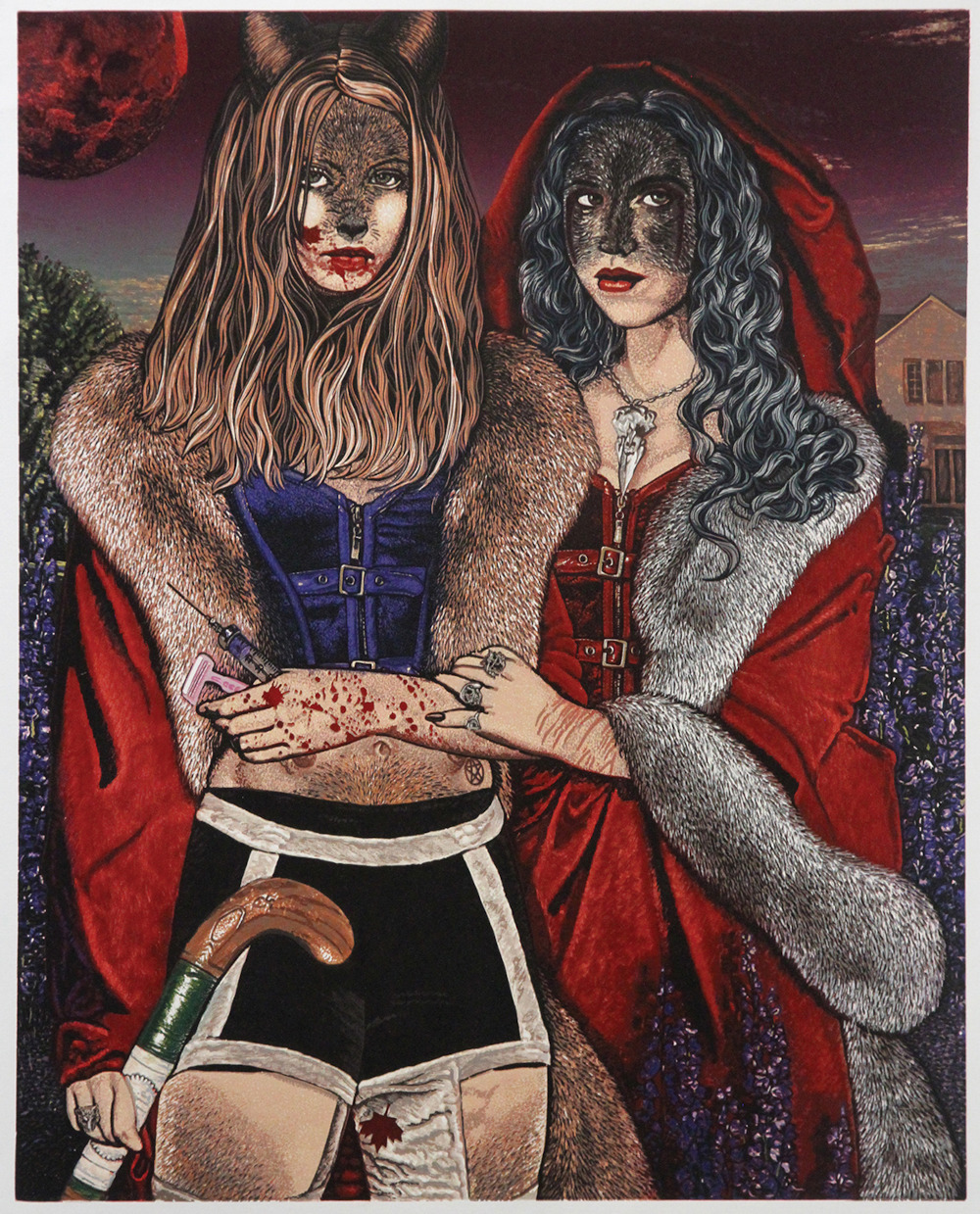
Jazmina Cininas | Blood Sisters (2016) Reduction linocut with 2nd block. Image: 69.5 x 56cm. Paper: 78 x 63cm. | Courtesy the artist and Australian Galleries, Melbourne.

The cult Ginger Snaps trilogy from Canada employs lycanthropy as a metaphor through which to explore the coming of age of two anti-social sisters, Ginger and Brigitte Fitzgerald. In the first film of the trilogy, Ginger is bitten by a werewolf attracted to the smell of her first menses. Ginger goes on to develop symptoms of rampant hormones, bloodlust and hairiness, to the increasing alarm of her younger sister. In the second film, the wolfsbane that promised a cure in Ginger Snaps turns out to be a dependency-forming prophylactic to which Brigitte becomes addicted in a bid to keep her own lycanthropy and burgeoning sexuality at bay. The third film in the trilogy returns the girls to Canada’s colonial past where they first encounter their ‘curse’, in an age when European superstitions of witchcraft still coloured perceptions of women, and cast a dark shadow over the shamanistic practices and lives of Canada’s First Peoples.

Posted in ARTWORKS | Tagged

13 Artworks by Deborah Kelly


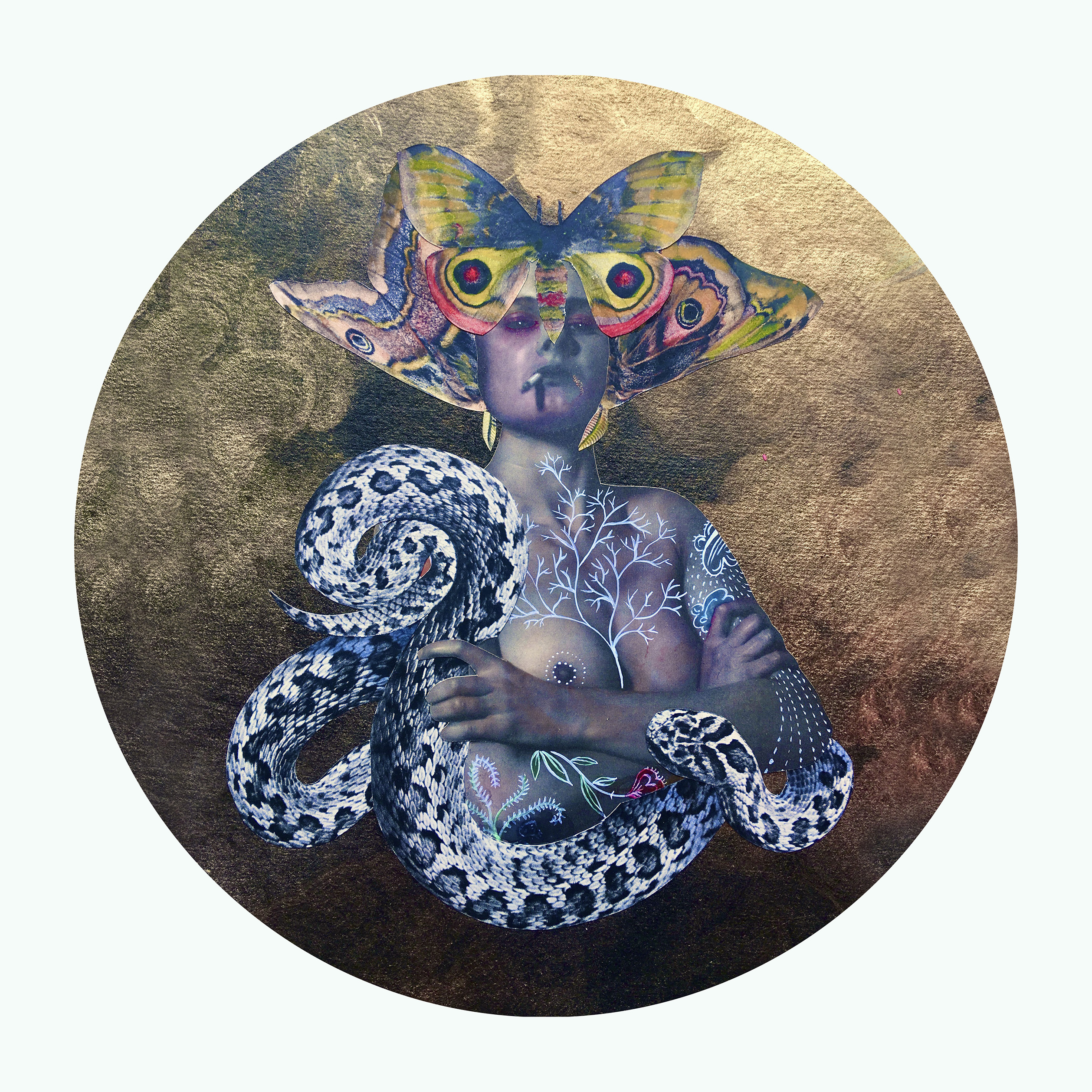
Serpentine, 2021, 400x400mm, collage, watercolour and metallic pigments on Khadi handmade paper

I’m grateful for the opportunity for these works to be seen together on this platform and in this format. They have a complex backstory but up front it seems relevant to say that they are part of a vast longform project at whose heart is poetry. Sacred, sacriligious, sexy, steadfast poetry.

All these collages are part of CREATION, an artwork in the form of a queer insurrectionary science fiction climate change religion which I’ve been working on with other artists since 2019. The religion proceeds from a text I commissioned from artist SJ Norman called the Liturgy of the Saprophyte, and some of these artworks were made as part of calling-into-being of that liturgy, and others were made to accompany and amplify its resonances.

The Holy Orders of CREATION are the Serpent, the Rat, Fungus, Bacteria, the Vulture and the Spider, whose companions are the Moon and Infinity.

Like the accretive and trans-historical aspects of collage, CREATION is built on the bones of its ancestral faith traditions, particularly the most gothic incarnation of Catholicism, as well as origin stories of the ancient Greeks and Sumerians, Wiccans and various queer exuberances. SJ Norman is a Wiradjuri person and his liturgy also invokes Indigenous theologies through its sensibilities, tenets and foundation, however this holiness is not reflected in the iconography.

The ABC made a documentary about CREATION in 2025 and it can be viewed here. The Book of Creation contains the liturgy, a suite of commissioned poetry, songs and stories as well as many artworks, and it can be purchased here.

Posted in ARTWORKS | Tagged

NO THEME 14 Editorial

The poetry in this issue is damn juicy. As a writer, there’s perhaps an added degree of exposure or vulnerability in submitting a random suite of your poems, unmoored by theme. Showing your backlog = showing your poetic bussy.

In making my selections, I was able to tap into what’s on people’s minds, across a wide cross-section, without much concern over aligning to a particular taste, or gauging what an editor ‘wants’ you to write.

Lacking a unifying theme, these poems serve as a timestamp on this moment. Right now, in August 2025, with everything that’s brought us here. The horrors, the hopes, etcetera – it’s all in the soup.

As I trawled through the submissions pile of literal thousands of poems, I noticed the following motifs:

  • cigarettes
  • Sylvia Plath
  • the ocean’s sluttiness
  • fables, mythologies, oral histories
  • data and microplastic
  • the colour yellow

Make of that what you will.

But more so, I noticed a collective attunement to the ailing (and failing) world around us. You offered up segments of your guts like perfect, veiny little segments of fruit.

As I read through this record number of submissions, I saw in action how we flock to poetry in our darkest times – even from those who may not have previously entertained the genre.

It makes sense: eulogies and epitaphs are one of the few places where poetry exists in mainstream life, where it’s accepted by a wider audience. All else fails, and our spiritual wounds and existential pains transmute into art.

Poetry reaches for a feeling, says something bigger than its words, speaks something untranslatable. You don’t need typical grammar, punctuation or formatting to write a poem. You don’t need a typical body or brain. You can excrete a poem however you want.

I hope this issue serves as a heartening reminder that poetry is for the people – not for institutions, algorithms or Snapple cap marketing. Much has been written about poetry that follows tragedy, genocide and societal collapses. I was going to quote Adorno here, or someone like that, but I won’t pretend that I ever know what people mean. I’ll just say that I felt so much solidarity in your words, so much humanity, so much rumbling, energetic anger – determined footsteps on the page.

Over the course of developing this issue, reading your poems became a ritual for me. Wake up, read a bunch of thrillingly random poems from all over the world, start the day with a head full of flowering weeds. As someone who tends to carefully make their way through a full-length collection or themed anthology one at a time, I sometimes miss the deliciousness of poem-hopping. Like a poetry rolodex or a pokedex (poetredex?) or a ‘For You’ page jackpot in the storm of a doomscroll.

Poetry rattles the mind like a snow globe; it kicks up the dust. Reading in a scattered fashion certainly shook some cobwebs loose, but I also made an effort to go as slowly as I could. I don’t want to treat poems like an app – swiping for the next thing, all hard yeses and noes and self-conscious pandering. Instead, these poems offer an antidote to disaffection, a practice of delayed and challenged gratification, an antithesis to McMindfulness forms of self-soothing.

I wanted to platform a variety of forms, styles, aesthetics and topics. To preserve a poem as an archaeological artefact: strange but human. To showcase exceptional writing. To reward risk, to reward writers who help me – as a reader – think, feel, empathise and interrogate through poetry. To draw out the intimate from unexpected places, in unexpected ways. To pay close attention to language – not letting it roll away like a bead of sweat.

I didn’t want to tunnel vision onto what was familiar, or to what appealed to my own particulars and peculiars. I rejected so many great poems – not just good, great. I’m still mulling over certain poems that didn’t make it into the issue.

I think a lot about taste – how instinctive it feels, but how curated and constructed it truly is.

Should I like this more than I do? Should I like this less? Why did that poem make me feel that way and can it stop pls?

These are questions I return to, knowing that I’ll never figure them out. I’ll leave you with one revelation, however, that came to me across the course of this issue:

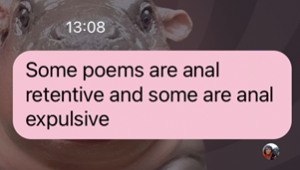
"Some poems are anal retentive and some are anal expulsive"

Text to my partner. Moo Deng backdrop.


Again, make of that what you will. And thanks for reading. ♡

Posted in ESSAYS | Tagged

I’m sorry for what I said when I used ChatGPT

Neobie Gonzalez

I’ve been scratching the back of my head lately, and maybe it’s a new condition I’ve yet to ask a doctor about or maybe it’s old allergies coming back, or maybe it’s because I can’t recall the title of this piece I read, the one that says our bodies are mostly microbial, and I can’t remember what meaning I tried to get out of it, can’t even remember if it was an essay or a medical report, or if it even matters, so maybe it’s not that; maybe it’s because I’ve been worrying about the mistakes I need to make up for while wrestling with the possibility that I may have to move to another country while struggling with the fact that one day I would lose my cat to time. I’m thinking about how I’ve been stuck shifting between life and life-adjacent things, unable to make any decisions, the way I find myself shifting between style and substance, form and function, and questioning how, with everything I create, I’m conscious of the lines between them, so it’s either too much of one thing or not enough of either – all while vacillating between the peace this brings me and the shame of it, of writing about what I write, why I’m writing and writing it this way, when I know all this is is rambling, lips set loose upon nerves that seem to have found their way towards artifice, or, quite possibly and perhaps more accurately: made-up excuses spilling too generously towards art. I grab Margaret Atwood’s The Tent and Blind Assassin, hoping to feel the way I felt when I read them as a teenager (electrified, alive), but instead my mid-30s eyes dart towards Claudia Rankine’s Citizen sitting on my shelf. I flip it open and land on Mel Chin’s VOLUME X No. 5 Black Angel, a collage that leaves me wondering how to consider the things I make and consume lately, when these rare days of rest are characterized by the irresistible millennial binge we’ve been so privileged to have: ‘Have you seen the new season of Black Mirror / The Last of Us / Severance?’; ‘Have you heard about this latest meme / TikTok / reel?’ I’m surrounded by so much data (mysterious, important) and most days I love it, but other days my internal monologue interrupts itself to cry: ‘There is too much world.’ Czeslaw Milosz claimed it in The Separate Notebooks, an epigraph in the novel Station Eleven, and in researching this essay I followed this trail of muchness and discovered something called a florilegium: a medieval compilation of excerpts from other writings, multicolored threads spun around a spool of a theme: odds and ends of content bound by someone’s fixation: what could potentially be an algorithm manually made, its purpose being just being (and not, thankfully, to sell us anything). We know this: this combinatorial creativity1: ideas interact to become other ideas, a map of minds strung from device to brain to brain to device. Viral comes from virus; all art is derived from something else: we can’t help it: we experience: we borrow: we remix: we create. Infections travel in a similar way, I think, but I’m no scientist. Weekends: I’m penciling in cut-up poetry on air-dry clay figures. I’m turning takeout labels into refrigerator magnets. I’m coloring in a stray earphone manual with bright acrylic pens, doodling demons that represent my endlessly intrusive, often self-destructive thoughts. At work, I’m made to answer: ‘What do you do outside of work?’ and almost always fumble the response:

  • ‘Just hobbies’ to keep things SFW;
  • ‘Not much, you?’ to deflect; or:
  • ‘I make things?’ to clue people into what I think I’m doing, followed by a ha-ha to defuse the conversation because explaining myself feels like being caught in a lie. How do I tell them everything feels like running after one idea while sprinting through another? It’s this being perceived (and almost always perceiving myself) that’s stopping me from expressing the details of my creative interests out loud, even though I’m trying with these big blocks of text, asking you to take your time with me, to stay beyond small talk, but maybe it doesn’t really matter; maybe this is it: that in seeking to be creative you’re always stuck stumbling over these properly labeled genre boxes but end up floundering around and finding the labels mismatched: intent vs. execution; forms and definitions, why my praxis and lived experiences seem perpetually adrift in a cutting-and-pasting-and-tearing-apart, an in-between that I can only try to articulate by burying my voice in layers of literariness, until I arrive at this moment I’m faced with the question of making beyond making things for myself. I confess, sometimes I seek company in online gossip forums. Sometimes I Google solutions to new problems we’ve inflicted on the world. Lately I’m struck by these AI-generated summaries taken from the alleged wisdom of our collective human experience. I type ‘what’s going on these days,’ desperate to hear an honest reply, and I’m met with two results:
  1. ‘The question ‘what’s going on these days?’ is a general inquiry about what’s happening currently in one’s life or the world around them.’ says AI; and
  2. ‘It could be the rising cost of living, inflation, the elite geriatrics running the country no matter how much we wish they wouldn’t, climate …’, a snippet from someone I assume is an actual person on Reddit, accompanied by what I also assume is a heavy sigh.

There’s an episode of the ‘90s sitcom Clarissa Explains It All 2 that’s been playing in my head. Clarissa Darling, the titular character, breaks the fourth wall to relay her latest dilemma: she needs to write a poem for school about what she sees outside her window. As expected, she’s hit with writers’ block, puts it off until the night before her deadline, and, after trying everything to place herself in a ‘poetic state of mind,’ she looks over to her computer, suddenly inspired. ‘I’ve seen the future of poetry and its name is PC-poem,’ she tells her friend Sam, typing words she knows her teacher would love, prompting the computer to generate a poem called Through My Window:

Gray cube,
rectangular light,
cantilevered rainbows.
Sunshine open close,
open close glass.
Square sunset.
Outside outside outside.
Sunset inside.
Daffodils.


Of course things escalate from there: everyone heaps praise on the piece, it gets published in the school paper, and Clarissa is told to read it aloud at a national poetry banquet. But the audience is stunned when she finally comes clean about what she did, and despite her admission of guilt, her teacher still awards her with a golden quill, hailing her a pioneer of her generation for the idea behind this poetic experiment. In the end, Clarissa is unable to live with this. She hands the award to someone she thinks is a ‘true’ author: not her computer, but her classmate Hillary, who won 2nd place writing her own poem, a poem that we as the audience never actually see or hear, which feels to me like a missed opportunity. But while the show was set at a time when the Internet was shiny and new, built to connect and inspire us, we’ve come so far (way too far) since. Just two years ago, the Museum of Modern Art released a video called AI Art: How artists are using and confronting machine learning3, which explores AI as a tool in artmaking, from the implications of feeding it with our own history to discovering its limits. ‘One thing that artists have been very good at is taking a tool that exists in the world and making it do something it’s not supposed to do,’ says MoMA curator Michelle Kuo. But is it as simple as: dirt: pigment: ink: paint: MS Paint = art, or is it something more sinister, as in: our humanity superimposed into a void? I don’t know how much of this is cheating, but I watch it all unfold anyway, watch artist Refik Anadol’s AI machine produce ‘dreams’ out of MoMA’s 200-year art collection, and I can’t stop myself from saying it’s beautiful: the colors, the process, the possibility; so I sit there, watching, even if it hurts to look. Yesterday I dared to ask ChatGPT: ‘Do you feel pain?’ and it said No, but described it as:

A person with glowing red nerves or visible fractures under the skin. A heart wrapped in barbed wire: Emotional anguish. A heavy object pressing on a small figure: The crushing weight of suffering. A silent scream: The feeling of being unable to express pain.

and after evaluating most of this as cliché and chastising myself for criticizing a robot’s ‘feelings,’ I think about the flaws of words and pictures instead, how they’re used to train these generative AI models to respond to us when we can’t even say what we mean sometimes. I can’t always describe my experiences to other people: gestures feel inadequate, my words ill-matched to these often overwhelming, overlapping emotions that presume anger or admiration or awe, so I end up saying something like: Wow or worse: ? or worse: nothing at all, offering up silence for someone else to interpret instead of explaining myself. Is it just me? I still need help reacting to this reality. I still use emojis far too much. I still remember, years ago, Kenneth Goldsmith gushing over the impact of computers on literature: ‘Before digital language, words were almost always found imprisoned on a page. How different it is today when digitized language can be poured into any conceivable container. It’s typed into a Microsoft Word document, parsed into a database, visually morphed into Photoshop, animated into Flash, pumped into online text-mangling engines, spammed to thousands of email addresses, and imported into sound editing programs and spit out as music, the possibilities are endless.’4 This was uploaded to YouTube in 2013, when I was still just hearing about Uncreative Writing and learning postmodern theory for the first time, and so I felt like a child that had been given permission to play with their food, or in my case, to pick apart letters and forms and sounds and images and place them into vessels both physical and digital. I became more comfortable speaking in illustrations and short stories, in flash fiction and photography, later in TV references and webcomics, prose poems and hybrid work, vignettes, essays made up of vignettes, essays in the form of zines, zines in the form of grocery lists. Maybe I chased ambiguity through taxonomy as a way to deal with all this world; maybe I just wanted ways to say what I wanted to when I didn’t know how, which somehow meant I drifted towards zines: embedding my ideas into artifacts. Form as meaning. Meaning made-up. Which led me to accessibility and familiarity, which also led me closer to the growing DIY community in the Philippines, which made me feel like Goldsmith made me feel: like I could. In the early 2010s, friends started gathering for small press expos, renting cafes to share their latest staple-bound work on a makeshift stage. We even launched our own prose journal, Plural, to showcase works we considered progressive, an alternative to what we were seeing in mainstream publishing. Pretty soon I was attending comic conventions, tabling at art fairs, peddling these folded paper objects to anyone who would care, and later, I co-hosted a free share-and-swap zine event with my friend Liana Maris, because I was curious to see how others were expanding the medium and because ultimately, we were convinced zines thrived on community. There was something radical and kind about a process that shed the excess of the traditional: the personal and political making space for one another in an 8-page booklet that could easily fit in the palm of your hand. I found myself listing zine ideas, listing something like TEETH as a potential project. There’s a note in my Notes app entitled Things seen hanging on crypts (one, a stuffed dog; two, a necktie), while another just says: Am I looking for meaning in objects because my own life’s meaning is to be not the worst? Not bad. Not good. Not black. Not white. Not straight. Not quite. The body: microbial; the mind: perpetually sifting the world through these vessels with tiny holes in them, just to see what appears. Slippage. Temporality. Maybe I was looking for a version of literature I could live with while I made a living, treating these objects like pockets of time that gave me pause when my mind simply wouldn’t: in 2017, uncertain what to do after my MFA and hesitating between jobs: I gathered my thoughts on the inanimate as a method for meaning-making, set it against a confetti of strangers, folded and glued them into an accordion zine to bring these objects together as a subject. 2019: I collected antique prints from the Internet and collaged them into pink and blue household items, hoping to study sympathetic magic in relation to the levels of feminine rage I observed in women and girls and myself. In 2020, as a way to tackle the distance imposed on us during the pandemic, I took a stronger shift towards the digital with an interactive zine that invited readers to visit different rooms from the past/present/future, and still a WIP because I always feel like I’m shifting and/or stuck between past/present/future anyway. I paired images with words meant to convey a parallel narrative: an intentional breaking and borrowing of rules from genres and mediums to tell stories, referential texts like breadcrumbs just to convey some semblance of meaning (or meaninglessness) to those willing to listen. Have I just been passing the time?

Posted in ESSAYS | Tagged

Rumpelstiltskin and the Girlie Werewolf: the Journey from Linocuts and Artist Books to Lagerphones

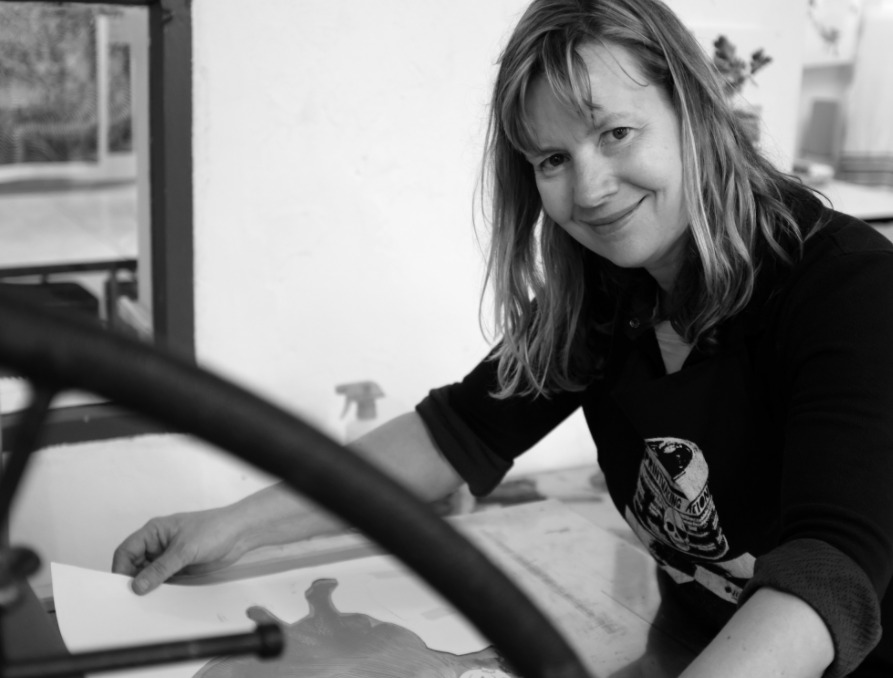
I am the Queen of Reduction Linocuts. At least, that’s how I am introduced to art students or fellow printmakers. I suspect one or two others, including former students, may now share that title, if not claim the crown outright.

My other regular moniker is the Wolf Lady. The two ‘claims to fame’ are inextricably intertwined, emerging from three decades devoted to creating elaborate reduction linocut portraits of female werewolves, most notably as part of my PhD project, The Girlie Werewolf Hall of Fame: historical and contemporary figurations of the female lycanthrope (undertaken part-time between 2005-2014), and a series of exhibitions known collectively as The Girlie Werewolf Project.

As an artist, there are distinct advantages to having an easily identifiable, niche expertise. One is more likely to be curated into exhibitions, to be represented by a gallery, to have one’s abstracts accepted for conferences, to be invited to present artist talks or run workshops, to feature in journals and books. Doors open more easily.

However. Recognition for a particular way of working sets up an expectation that one will continue making the same sort of work, ad infinitum. At the time of and around my PhD, female werewolves and the reduction linocut medium were my world. I couldn’t imagine doing anything else. I loved being the Reduction Linocut Queen and a world authority on female werewolves. My lupine ladies have taken me places I could never have imagined and will always occupy a special chamber of my heart, constituting the most sustained, most rigorous and most celebrated exploration of medium and subject within my practice to date. Even so, three decades is a long time, and I have become increasingly distracted by competing challenges, circumstances and opportunities.

This is the potted history of my art practice. I naturally understand that I was invited to write this article on the strength of my Girlie Werewolf Project, so this is where I will begin. But, in keeping with my voluntary abdication from the reduction linocut throne, I hope you will indulge my writing about my more recent works, namely, artist books from discarded print ephemera and sculptural lagerphones from recycled timbers and beer caps, as part of a shift towards more environmentally sustainable art practices.

Fifty shades of linoleum

First things first. For those unfamiliar with the reduction linocut technique, here are the nutshell fundamentals. Firstly, the entire image is created from a single piece of linoleum. The block or matrix is progressively carved away and printed from in layers, each a different colour. Once carving and printing have commenced, there is no going back. To achieve any level of detail or precision, registration is absolutely critical. Unlike most other printmaking techniques, it is not possible to create additional impressions afterwards, earning the reduction linocut technique the nickname ‘suicide print’.

A typical linocut portrait of mine will have around twenty layers, with anywhere between one to seven colours per layer, taking upwards of 600 hours to edition. It is not unusual for a printing day to last fourteen hours. There is a lot of cleaning up. All of which might provide a clue as to why, three decades later, my stamina has begun to wane.

The borderline masochistic martyrdom demanded by the medium was a large part of its initial attraction to me, no doubt revealing a lot about my personality. I had not seen any examples of anyone else working with reduction linocuts in this way when I began with the medium in the late 1990s and I felt confident that few would follow me down this path. (Of course, some former students have done exactly this, forging unique variations and refinements along the way. And I have since discovered many skilled practitioners who have come to the medium independently of me). It gave me a point of distinction that is critical in an art world over-burdened with talent. Aesthetically, I loved the enamel-like surface created by the layers of ink, as well as the medium’s capacity to encapsulate both historical and contemporary references.

The Photoshopped working drawings for my werewolf portraits incorporated photographic and digital source material, as well as historical printed images ranging from early woodblocks to screenprinted comics. Being able to unify so many different aesthetic histories within a single medium allowed me to create a unified body of portraits of both historical and contemporary female werewolves.

The reduction linocut process furthermore proffered a satisfying parallel between the transition of the image from linoleum to final print and the metamorphosis from human to wolf in werewolf lore. Both instances witness a progressive relinquishing of one state in the process of transforming into the other, embodying all the stages in between; the human is intrinsically implied in the wolf and vice versa, in the same way the linoleum block inhabits the final print. The difference, of course, being that the reduction linocut process is non-reversible.

Posted in ESSAYS | Tagged

Breaking up with Big Tech and Moving on with Life

Growing up in the 90s, we didn’t have internet, emails or smart phones, let alone tech apps or social media. We played out on the streets, read books, went to the cinemas, queued for concert tickets to see bands we heard on the radio, visited places we discovered through word of mouth and sent handwritten letters to each other. Meeting face to face was a big deal and without a mobile phone to bail out at the last minute, we all learned the art of waiting, noticing, and showing up. Analogue days were slow. There was no rush, no instant gratification, no followers watching your every move 24/7. If you had told me back then that one day it would take me 3 months to work up the courage to delete a bunch of pixel logos on a hand-held device that has consumed the lives of billions, including mine, I would’ve thought you’d gone mad.

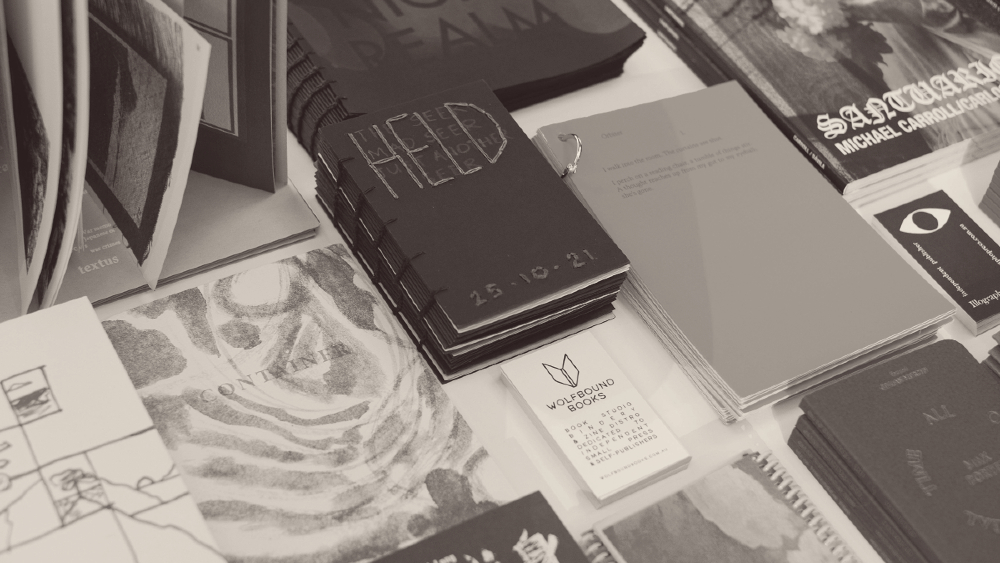
Perhaps it was my millennial yearning for community and organic human connection that inspired me to create Wolfbound Books. But to really understand how our artist-led collective works, you need to understand where we came from. We have Filipino blood running through our veins and inherited trauma from our motherland’s colonial past. To this day, the Philippines is still nursing unhealed wounds from Spanish Colonialism and American Imperialism – this is why everything we do is an effort to decolonise our hearts and minds. Activism is in the DNA of the Wolfbound Books collective, which includes Illographo Press (publishing) and School of Zines (workshops). The idea for Wolfbound Books was formed in December 2023, as a reaction to Israel’s live-streamed genocide of the Palestinian people and the deafening silence of so-called “diverse” not-for-profit organisations in the arts, literary and publishing community I was a part of. I experienced first-hand how Pro-Palestinian and ethnic voices were being silenced, censored, and swept under the rug to appease funders, corporate partners, and the government. Palestine was my red line and I wanted to stand on the right side of history. Showing solidarity with the Palestinian resistance resulted in loss of job opportunities, projects, and income, but these sacrifices were minuscule compared to the ongoing suffering and ethnic cleansing that the Palestinian people have been enduring for over 75 years.

I spent the early months of 2024 re-building the world in my head and piecing together my broken sense of humanity and purpose. With the help of my partner and creative friends, all from migrant and refugee backgrounds, we healed together by co-creating a safe, inclusive and accessible space where art and activism serve the community. A space where human rights are not debatable, and where diversity is not a KPI but a gift to be nurtured. Wolfbound Books, Illographo Press, and School of Zines work hand in hand to empower creativity, celebrate diversity and foster community connection – this is how we plan to decolonise mindsets, stand up against capitalism and advocate for a free Palestine.

Personally, I’ve never been a big fan of tech and social media but I knew that I couldn’t possibly start up Wolfbound Books without them. Having previously worked as a Marketing & Comms Manager for a bookshop during the pandemic, I learned that social media and online engagement can make or break a business. I applied the same marketing principles to Wolfbound Books and it worked. We signed up for the works: Squarespace e-commerce, Square reader, PayPal, Google for Business, and a professional Instagram account. It was all too easy to set up and the integrations between each platform were seamless. Our online shop was our main income generator and Instagram was our primary communication channel, gaining over 6000 followers in just one year. The Wolfbound Books studio was only open 3 days a week but online, we were hustling 24/7. I didn’t even question any of it until Donald Trump was re-elected as President of the United States in November 2024 and I was reminded of what modern capitalism looked like. Seeing Big Tech CEOs Musk (X), Zuckerberg (Meta), Bezos (Amazon), and Pichai (Google) among other tech billionaires at the front row of Trump’s inauguration was a massive red flag. When Trump stood side by side with Israel’s Prime Minister Benjamin Netanyahu back in February 2025 and proposed that the “US take over Gaza, level it and build resorts”, it was the last straw. It was terrifying to witness an oligarchical, Orwellian totalitarian state taking shape in real time and no one, not even the media, was questioning it.

Posted in ESSAYS | Tagged

‘We’re all containers for each other’s emotions’: π.ο. in Conversation with Sandy Caldow

Sandy Caldow

I first met Sandy Caldow about 30 years ago at Qdos gallery in Lorne, a seaside town in Victoria, where i read poetry for an exhibition. We met up again in Melbourne after she’d left Lorne and moved into a house in Preston – was i in for a surprise! Shifting a worker of clay, like Sandy, into a new studio is a mammoth enterprise – the lift and shift of it is enormous – i pleaded with her to make ‘thimbles’ instead, but she was undeterred. Sandy introduced me to the Art world which i credited her for in my book Heide (2019), an excerpt from this dedication reads:

To overlook, is to fail to notice (or else …
to look down upon). It took me a long time to like Art
or Artists, and to understand the Art around me.

i introduced Sandy, to the Poetry scene. The resulting poetic hybridity is to be found in the art and poetry of her two new books More Than a Face and Watching Words by Collective Effort Press in 2025, brought out defiantly simultaneously.

What attracted me to Sandy’s work was the enormous effort needed to create a poetry that can stare into the very ‘subject’ (via her face sculptures) and fuse the ‘language’ of the poem into a ‘tactile’ form – bringing the sense of ‘touch’ back into the sphere of the metaphysics of the word. As in poetry, when a physical object begins to talk back to you and feed you in its final creation, you know you’re mainlining.

π.ο.: I remember you once saying that ‘a bed of roses explodes at the bottom of the ocean’. Which I’ve always liked, and I think it’s a great place to begin talking about your art and writing.

Sandy Caldow: That was from a time when I was snorkeling a lot, because I’d see the garden underneath the sea and how beautiful it was – the way the waves moved, all of the kelp can be likened to flowers.

π.ο.: Since publishing your books, you’ve had people tell you about how their children love your work. And in many ways Lucy’s Van’s daughter – Rosa – and her connection with your work inspired this interview to happen.

SC: Yes, after hearing from Lucy that her daughter Rosa was asking to be read the poems from More Than a Face – I realised why children could engage with my sculptures. I mean, to them, they are funny faces with different expressions, and the poems go with the faces. Like, the Blue Vase Man (1995), with orange lips and orange eyes. I was quite touched by Rosa’s reaction because she made me look at my art and books in a whole different way. I’d hardly thought about how they appear to a child. Years ago, a friend bought her ten-month-old baby boy to my home. As he was carried through the house he kept pointing and pointing and making funny little baby noises at each sculpture. His parents have one of my sculptures, so we figured that he recognised the style of the art.

π.ο.: You’ve got some amazing stories to share about your sculptures and ceramics, don’t you? Can you give us some more examples?

SC: Well, once a woman showed up my front door with boxes of broken ceramics. Years before I’d made a horse with a human face with a little girl riding it. She told me her husband had fallen off the roof while he was fixing the guttering. He’d fallen backwards off the ladder and onto the sculpture and smashed it into smithereens. The sculpture was about 1.2 meters high by about 1.5 meters long. She believed the sculpture saved her husband’s life because it broke his fall – otherwise he would’ve fallen flat on his back on the bricks below. The woman came to my door with four boxes full of broken pieces and asked me if I could restore it? I hesitatingly said, ‘Well, I can try’. It actually came together nicely, and the horse with its human face looked happy again.

Another interesting story is that a woman came into an art gallery in Lorne three days after an exhibition of my work ended, and wanted to buy one of the pieces, if it was still available. She was devastated to learn the sculpture had sold. It was a very unusual piece – I don’t have a photo of it, but it was a face held up by a strange long neck. The neck had a lot of throwing marks from the wheel when it was made, and the face had strange wafts of green and maroon colors on it. The woman explained that she had wanted to buy this work as it looked like her son who had died in a car accident. The gallery had no address for the person who had purchased the sculpture. So, it was doubly sad because it reminded her so much of her son, and she would’ve been able to have another memory, a ceramic memory of him.

π.ο.: Where did you grow up?

SC: I grew up in Geelong and spent a lot of time on the east coast of Victoria. I used to identify with the sea – walking on the beach, looking at the rocks and snorkeling. From my early twenties and into my thirties I was living in Lorne and working with a master potter there. This was a really important time for me as I was learning the techniques of how to make domestic wear, which involves a strong discipline to learn many specific processes. During that time, I was commissioned by Kosta’s Restaurant to make bowls for them, which was great. Later on, my life suddenly changed – the relationship I was in, ended. I left Lorne and was very sad at that time. Kosta commissioned another series of bowls. When they were complete, I was looking at one of the bowls and realised the colours of the landscape and the ocean were instilled in them. The last stanza of the poem, ‘Kosta’s Bowls’, reads:

I looked at the beautiful view 
I saw the bowls in the colors of the ocean, 
in the sky, and in the bush
I saw the gold in the setting sun’s
reflection on wet sand
I was happy that the bowls 
depicted colors of the sea and bush,
as light changed that day, 
in that place, 
from moment to moment
Even though I had moved away 
two years before,
the colors of the place
were still in my psyche

π.ο.: With all of the levels that these two books cover – ranging from poetry to sculpture to picture books, photography, and biography – it seems like an amazing array. My question is, how long have you been writing?

SC: I’ve been writing and making art for around 40 years. I’ve worked as an art critic for the Geelong Advertiser and for art magazines like Asian Art News and World Sculpture News. I also wrote poetry, diaries, and journals.

π.ο.: What is different about your book of poems compared to other books of poetry?

SC: In the books there are images of sculptures and on the opposite page a single poem probing into the sculpture. They are intrinsically linked and not there as decoration. They are unified. After I make a sculpture I think, ‘Well what am I actually making?’ I sit in my studio and just stare at the piece and write a poem about it. I try to work out what was going on in my own psyche at the time, and what the sculpture was saying about me, or to me. Other poems were written when I heard stories about what had happened to sculptures after they became part of other people’s lives. And that was amazing because some of them had quite dramatic stories.

π.ο.: I think one of the great things about Collective Effort Press, which has been going for about 50-something years, and the people who have been published by it, is that every one of the books is absolutely idiosyncratically individual. Initially you were going to publish your work as one book. But then you said to me, ‘Are we allowed to do it as two books?’ And I thought, ‘Well, in Collective Effort Press, we can do anything we like because the Press doesn’t have to get permission from anybody’. I thought it was courageous for you to bring out two books simultaneously. Why’d you do that?

SC: Originally, I was thinking of making one book, but I realised this work needed to be separated to show two different currents, and for clarity. More Than a Face is about the faces that I make with clay. It begins from when I was a child with the first poem called ‘Mud Pies’. It is based on trying to unearth my own memories when putting my poems together for publication. And then it goes right through my career into adulthood – with different poems and pieces unearthing various memories. Assembling it, was like an archeological dig.

As I child, I remember running inside and saying to my mother, ‘I’m bored, there’s nothing to do’. My mother turned to me and said, ‘Why don’t you go and write a book?’ I was quite surprised by that. But I think subconsciously 40 or 50 years later, these books happened.

π.ο.: The relationship you have between pottery and poetry also involve a lot of themes about death. I mean, you’ve had a few stories like this – like one about the clown faces you’ve made.

SC: A man who was an art collector purchased a clown sculpture from one of my exhibitions. Years later, he tracked me down because he wanted to commission me to make six more. He was elderly and had a terminal illness and wanted to give one to each of his close friends so that he could enjoy seeing their reactions while still alive. So of course, I made them, and I wrote a poem about this man (who survived concentration camps in Europe), and about what I learned from being around him too. I called the poem ‘The Gift’, an excerpt from the poem reads:

He asked me to make him five clowns,
as he wanted to give gifts, 
to five special people in his life
Before he died
He wanted to enjoy the giving
And seeing their reactions

π.ο.: Another poem? Another story? Another sculpture?

SC: Another commission I was asked to make, was a very strange one. A woman came into my studio and saw a piece I had made – a bust of a man. She said, is that a bust of a certain man?’ and she named him. And I said, ‘Yes, well spotted’. She said, ‘I’d like to commission you to make ten more for me, just the same as that one’. I asked her, ‘Why?’ And she responded with: ‘Because I hate that bastard and I’d take great pleasure in smashing each piece and then smashing every shard into small pieces’. I didn’t take on that commission.

Posted in INTERVIEWS | Tagged ,

‘The tension between reality and fantasy’: Georgia Kartas in Conversation with Sholto Buck

Sholto Buck

I first experienced Sholto Buck’s poetry on stage before encountering his poetry on the page, as shared with me via a mutual friend – one of the few people whose taste I trust. Fittingly, this interview is based on a conversation we shared at the launch of Sholto’s second poetry collection, Light Film (Pilot Press, 2025) – now printed here for you. Months before this, we met in the courtyard of The Alderman in Brunswick and on that very night, the digital proofs of Light Film were sent through. On his phone screen, Sholto showed me sinewy poems shaped from cinematic glimpses, flirting between the manuscript’s demarcating stars, pinpricks of dark light on the white page. I read ‘Body Cream’, one of my favourite poems and embodying Sholto’s ‘bratticism’: ‘I am not / your woman patient, I’m / a water sign’, and this poem began forming my questions for this exchange.

Mysticism and poetry may enact the same function, breaking the infrastructure of language and all it seeks to contain. The field of ‘this is real’ / ‘this is not real’ is sliced through by beams of light, which Sholto, as the poet, both witnesses and (re)creates. Such enactments summon eerie, asynchronous moments IRL. I read ‘Knife + Heart, 2018’ – an erotic, queer, fallen paradisiac poem – on the train. As I looked up, I saw another passenger reading a painstakingly tabbed, hand-annotated bible. This reminds me of moments when reading Sholto’s debut collection, In the Printed Version of Heaven (Rabbit, 2023), as it kept me company on a residency in Ηράκλειο/Heraklion – the striking blue cover of this book continued to match the blue of the desk I sat at, the bedsheets I slept in, the tinted water glass I drank from, and the city’s grimy ocean inlet I gazed across.

Sholto’s writing works of its own accord, and that accord is elemental to the aesthetic he has evocatively crafted. Aesthetic, in contemporary usage, often gets conflated with a superficiality, but its etymology takes form in αἰσθητικός – an engagement of or for the senses that is perceptible – sensorially experienced. Light is not only a visible experience but a wavelength, and how the speed of causality – cause and effect – is measured. In Light Film, light is a sensibility, a lyric, a divine wavelength – a perfect curve, a perfect arse, a perfect melancholy.

Georgia Kartas: The most recognisable reference of Light Film is film as in cinema. Cinema is invoked so vividly in your poetry that I could sense the Tarkovsky poem was based on a Tarkovsky film before I read the poem’s title. Can you expand upon your experiences of watching films and of writing poems that begin from watching such films? What do films activate in the body for you?

Sholto Buck: There are lots of ways to answer this question. Firstly, cinema was for me an important part of growing up with art. It informed my aesthetic instincts as well as my sensibility as a person, showing me gestures I sought to recreate in my daily life. I also have a background in photography. So, when I write poems, I’m drawing on the image-making instincts that I developed from this practice. Watching films as I write helps me attune language with these visual impulses.

Watching a movie is just an excellent prompt for writing, and it suits the way I make poems. I’ll watch a film and continuously take notes for the duration of it. This gives me a pool of language to draw from, and I use this to build a poem, or poems. Since for me, most of my writing is concentrated on the act of editing, I find it difficult to actually generate large amounts of text. The duration of a film gives me a controlled arena for writing to ‘happen’ in.

Ultimately, I love drama and fantasy and delusion. It’s a folly to say what this book is about but if I were to try, I would say it’s about the tension between reality and fantasy, and the wreckage that is created when you lean too far into one over the other. When I started writing this book, I was in a state of profound boredom and disappointment after having finished my PhD, coming to the end of a huge project and needing to find what I wanted from the next part of my life. I had a lot of feelings but nothing really going on, in my thinking brain or in my life, to attach them to. Writing along with films gave me a channel to focus through.

I often found that despite having plots and characters of their own, I exploited the images and atmospheres of certain films in order to write in the direction of what I was feeling. For example, the poem ‘Watching a burning house’ came from watching Andrei Tarkovsky’s Mirror (1975), but the tension of that poem has more to do with the experience I was having of myself, than it does the content of the film.

GK: Out of all the poems that take their titles directly from films, the collection opens with ‘Sebastiane, 1976’, after Derek Jarman’s Sebastiane. What is the significance of this poem?

SB: This poem drove me insane in the last few months of editing the book. I nearly took it out altogether. I realised the only place it could fit was at the very beginning, as a kind of mad, horny prologue. Start the book with a bang, etc. Opening the poem with the line ‘everything in this book happened to me’ felt like a good way to invoke this tension between reality and delusion. Obviously, it didn’t all happen to me. I am a relatively straightforward writer in that my instincts often fall along the lines of ‘write what you see, write what you feel now’. The problem is that my life isn’t that interesting. So, the heightened stakes of Jarman’s Sebastiane helped me give some shape to what was directly in front of me.

GK: Everything in this book happened to ‘you’, the ‘you’ between reality and delusion. Say in ‘Peppermint frappé, 1967’, the ‘I’ of the poem identifies with the screen and transports into it. And in the poem ‘Monologue’, there’s an address ‘the poet’ with the vocative ‘Sholto’ – and there’s the deliberate tongue-in-cheek self-referentiality of the poem titled ‘Sholto kind of rhymes with sorrow’. How does the pronoun ‘I’ work in your poetry and in this collection? What are your thoughts on the poetic ‘I’?

SB: Because of the cinematic influence on the book, the ‘I’ throughout the poems is shifting and performative. You know, one moment it’s ‘a gay guy saying nothing’ and then it’s ‘the actress on the verge of tears’. I love the idea of a speaker acting as different characters, putting on different costumes as they push deeper into a fantasy life. There’s a kind of theatrical joy I get from the ‘I’ in poetry. Like, I’m putting on a show.

But also, there are more functional purposes at work here. For one thing, there is a lot of shifting in my poems, huge jump cuts from one place to another, or from image to abstraction, you know, are we inside a film or is this ‘real life’, and whatever this might mean. I think the ‘I’ can be a way of tethering the poem to something that feels stable. Maybe this is another way that cinema has influenced my writing. Like, ok, this story is strange, but there is someone telling it to me, or like, there is a perspective or a lens that this perception is being experienced through. It helps me to structure my work and bring a sense of perspective to the dream world of my poems.

I have at times felt a pressure, having grown up around so much poststructuralist queer theory, and Marxist theory, to Destabilise the ‘I’! Dismantle the individual! Centre the collective or whatever. This also comes from inside literature too, this distrust of the lyric ‘I’ in LANGUAGE poetry etc. But, I … just don’t think that’s how I write, or read. I know I’m probably pushing the limits of this proposition, but I find it’s very rare that I’ll read a poem with an assertive ‘I’ and think, you know, oh this is so solipsistic or like, what a fixed subject position! You know? I don’t feel so aware of the ‘I’ on this level when I read others’ work. It actually feels generous, like I’m being held by the speaker of the poem, and when that happens, I’m a lot less aware of myself as the reader, than I am when I’m reading badly edited work that’s got big conceptual ambitions but little editorial rigour. I’m trying to write the sort of poems I want to read. I want to give the reader my best, my ‘I’ and all. I’m giving you mine because I want you to give me yours.

GK: The stars that segment sections of this book seem like pinpoints of light or – just to Barthes it up – a punctum. Why did you decide to use stars as markers within this collection?

SB: The stars, as a structuring device, were a late edition to the book. I always had section breaks, but for a while I was separating them into cinematic acts. However, I felt like they weren’t quite working, and Elaine Kahn, who helped me edit the manuscript, said to get rid of them and find something more open, so I changed the section dividers to stars. Stars work because they have an independent relationship to each word in the title of the book. Starlight and film star. They’re also chic and glamorous and sacred, yet relatively inexpensive as symbols. Like an emoji.

Posted in INTERVIEWS | Tagged ,

3 Self-Translations by Ouyang Yu


Characteristics of a Ceramic Artist

Clay. A large chunk of it. You have to cut it with a thread. When you put it on, the wheel will keep turning underneath it. Whatever shapes of utensils you make, you have to erect that chunk of clay, like an erected member, before you turn it into things of any shape. There are never any drawings. You don’t know what he’s got in mind until things become shaped up according to the shapes in his mind or heart. Of course, his hands, and the fingers on his hands, are not replaceable by machine. Sometimes, when he puts his middle finger inside that very tiny hole that is turning, he reminds one of mating and procreation. Whatever that follows has to be made through burning. Clay with fire, heart with mind, hands with fingers, before birth is given to the product

制陶师的几个特点

泥。一大坨泥。要用线割。放上去后,下面的轮子是要不停转动的。无论做什么形状的器皿,总是要先让那坨泥耸立起来,像勃起的阳具,然后转成,各种形状的东西。从来没有图纸,根本不知道他想做什么,直到东西按他自己脑中和心中的形状成型。当然,他的双手和双手的手指,不是机器所能替代的。有时,会把中指插进,那个非常小,同时还在转的圆洞里,令人想起交配和生殖。之后生成的制品,无一不通过烧制。泥加火,心加脑,手加指,最后孕成了品

Posted in TRANSLATIONS | Tagged

3 Hélène Herault Translations by Liza Tripp


Clotilde

She’s put on her flowered dress
Seated alone, centre of the room, she hums
Expecting nothing, nobody.
Time’s contours have grown hazy
Unless he was the one to abandon her?
Yet just before, he left her flowers on a dress and a stockpile of songs
To welcome others entering the room, yet others still arriving, taking their place
round the table, others who soon try and tell her to sing a bit softer, while others
toss game pieces onto the board, and others immediately start fighting over the
red one, and others repeat the instructions, to be challenged again in five
minutes, while others stare at the door, and others demand quiet, and still others throw the dice then move their pieces much farther than they should, as others accuse them, and others say
what’s important is we’re playing together, and others ask what time will we eat,
and others stand up, others come to get those who can no longer walk, and
others congratulate her on her win, then say see you in a bit Clotilde.
In her favourite flowered dress, her voice clear, she hums.

Posted in TRANSLATIONS | Tagged ,

The Dogs Bark

Rata Lee

One

Like losing, like losing, like     losing: the spit, the bear’s eye, the brass bells, their rhythm, their time, only thing,     on beat. Like how I found out,     then folded.     Tiny plastic stick. Everything is jaundiced,     sticky creases.     I’m up right.     Nothing is coming out,     I don’t want it to come out.     There is meaning here.     Orange.     The dogs bark, it’s about to begin.     Yellow sticky tape, it was yellow now it is     orange. I’m not wanting this     fluid moving between     small bones,     dolphins have been doing this for     years. Underwater, underwater with no sound. I’ve had medicine and     bulls riding the speed of lightning down my back, the trot is     strong, no chance of     collapse.     Maybe when I look in the water I want to see nothing.     Maybe I wish I let you fully grow so that it would be too late     to stop you from     reflecting back.

Posted in CHAPBOOKS | Tagged

2 Vladimir Mayakovsky Translations by Paul Magee


Note

The translation “the extraordinary thing that happened to vladimir mayakovsky one summer in a dacha” appears in the collection Later Unearthed, published by Puncher and Wattmann in 2025.


the extraordinary thing that happened to vladimir mayakovsky one summer in a dacha

        pushkino akula hill it was the rumantsyevs dacha twenty seven versts from moscow on the
        yaroslavl line

sunset burned its way through a hundred and forty suns
summer rolled into july
hot it was so hot the heat throbbed
it happened in a dacha
the akula hill is large enough to dwarf
pushkino a mere mound
and at the foot of that mounds a village
pulling faces from its crooked rooves
and beyond that is the hole
into which
the sun daily gets shot
then never fast but surely
having flooded the world
that next morning there rose another scarlet sun
its horribleness scalding me
day in day out i got so pissed off
everything bled with fear
i yelled in its mug
get down from there
stop lolling in the sauna
leech
i yelled youre pampered in clouds while i
can forget about it
winter summer
im endlessly stuck here painting poster after propaganda poster
then yelled again wait listen goldenhead
rather than bludge
come here and have a cuppa
with me what have i done im a goner
toward me of his own free will strode the sun
each step beams of light
i dont want to show im terrified
but then stand back
his eyes already in the garden
now stepping through it the windows doors
and all the cracks in rolled the sun
slumped till hed drawn some breaths
but then began to say in deep bass
im holding back these flames the first time since creation
you called then bring me a cup of tea
bring it with jam
tears in these eyes and heat rising
till im out of my mind gesturing at the samovar
well alright then take a seat o great
lord light bulb
the devil forced my impudence to yell
that at him
he me confused
i sat on the bench edge
afraid this gets much worse
but from him a strange radiance streamed
and formalities all aside
i sat chatting with his luminary of this and of that
and how shat off i am painting propaganda
posters for rosta
he came back i get it okay
stop whining look at it
more simply you think
it easy for me to shine
give it at a go no well its like this you walk
because the idea takes you to take a walk
at the same time you walk
you shine
we chatted like that till dusk
or i mean till former dark
there what darkness was there
began addressing each other informally now as chums
and totally open in our friendship i
slapped him on the back and he replied
you me
the pair of us comrade
get up lets rise
and proclaim to this grey dump of dirt
I will flood it with sun
you with poems
coffin-like walls and prison-like night
both fell at that double-barrel gun
thats me and the sun
a crowd of poems and light
shine as much as you like
and only foolish drowsy sleep
will want night to stretch out suddenly
i will shine fully and day once again
will ring out to shine
at all times to shine everywhere
to the depths of the very last days
and to hell with all the rest
is my slogan for thats the suns

Posted in TRANSLATIONS | Tagged ,

oh saint rita

make me
a slobbering
instrument of
yr peace. I want
to write abt
the light glittering
in the eternal blood
rosette on yr forehead.
the daily e-mortification
of the flesh. some wounds
can be scrolled into
forever & ever &… turn
my thumb into an aching
incorruptible. there is always
light at the end of the
carpal tunnel. I’ll need
a medical certificate
for my radiant stigmata.
would a medieval peasant die
from eating a single Dorito?
what would a medieval peasant
think of mondayitis & hump day & TGIF?
would a medieval peasant
see 2FA as divine
proof of the
soul? every time
I fail a CAPTCHA
I can’t help but question
my own humanity
clicking I am not a robot
like a rabid incantation. I scan
a QR code that
promises the
sky but instead
transports
me to a DEI
workshop. for
verification purposes
please select all squares
showing an open
gash. the Netflix-specific
shame that comes
with the question
are you still
watching?

bleary
montage of
genocide thirst
trap advert
breakfast war
crime OOTD
meme infographic
unboxing sublets
selfie total
devastation sponcon
startling sunset
are we
still watching

Posted in 117: NO THEME 14 | Tagged

Unbecoming language 2

Muyan (silver wattle) streams through the window, itches my nose

there have been few words this month

and no wanderings beyond the house.

No,

there have been travels with clay and

small trips to the backyard.

There was the day I sat in the grass out the back here, felt

the sun-yellow-fire bite my skin.

There was the day I watched flies, noticed how it was to

watch them, and how to watch them was to love them. And how in loving them I could

slide
into their iridescence –
green and blue
with flashes of red.

There was another day, a day of so many flies, not buzzing ones, small ones, delicate

wings. Such delicate wings and the tiniest of feet like miniature sticks or
stiff
threads

that could climb on a single blade of grass without too much effect.

There was the day a moth interrupted my mind wanderings

of sunset, flying me off toward the light of Arcturus.

Yes, there were these days

but mostly I was forced back
into my bones,
my organs,
my flesh,
forced back to float through stories
shared only with my bed.


Use of the Woi Wurrung word muyan was endorsed by the Wurundjeri Woi Wurrung Cultural Heritage Aboriginal Corporation.
Muyan translated into English is silver wattle.

Posted in 117: NO THEME 14 | Tagged

An Arabian Jasmine in an Autumn Coat

And you…
And those who…
like us—
are no longer guided to the land.
And she,
whose cup of coffee betrayed her on the way.
And she,
who, in her well,
clings to a straw to rise above.
We will rejoice in the pecks of the bleeding youth—
upon the mirrors of your hearts,
as we fall amidst the clamour of the windmills.

We shall tuck the wind beneath our arms,
where our walls stand in the wilderness.
And we go to the trees—sipping their rustle,
Which heals us from silence,
at the doors of the blades—
fluttering through the turning, the cloud and the word.

We shall craft air balloons to carry our misery.
From your bliss, brimming with gunpowder,
raise you high—even higher,
to the very last drop,
to those whose hopes are severed,
to joy itself,
to the unknown.

We shall wound the shepherds’ flutes—
the voices and images long settled,
and the hush of crocodiles,
with wings of desire, broken;
with honey fermenting in our captive neighing—
struggling to sleep.

We shall have passion for the absurdity of death,
like how you bare your damp daggers to the tender,
fettered youth adrift in his thirties,
his skin splitting open at the brush of girls’ jeans,
and the juice of sin, with a lemon twist.

We shall ascend the highest peak of your eternal autumn.
We shall cast off the last piece of our ashes on the path.
We shall twist the necks of language
within its unwavering vaginal sanctuary:
And we shall cast—
the “s” of life,
the “s” of death,
the shadow of the girl,
and the remnants of the crumbs,
upon the passers-by,
who…

Free is the mulberry leaf.
An Arabic jasmine—in the autumn coat.
A boisterous dream in the toil.
The waves are tossing and turning,
While the lovers…Alone— happy in their own woods.


Note: This poem was originally written by Dr Noufal Nayouf in Arabic, and translated into English by Renata with consent.
In Arabic, “seen=س” and “sawfa=سوف” refer to procrastination/future act. Therefore, I have translated both as “s”.

Posted in 117: NO THEME 14 | Tagged ,

toilet loop

ppl always say the mistakes of the past
we learn from them
but I think one stuck person makes a million
the past doesn’t learn
the ppl do not pass
the mistakes aren’t of the past
if we carry them to the present
they’re things we can touch and feel
there are buildings half blown apart in city centres
there are new generations
that make up 0.00 something of well paid jobs

mama says every fifty years another war in her home
mama says how many years now, thirty?

a region of war is still
a region of war
after the war
is looping
is breaking our necks every time
is tumbling

we are waking up in the bathroom of our mistake
and this language is a toilet
I mean—my language is a toilet
I mean—the saliva in my mouth
is the water in this toilet bowl
I mean—the words I speak are staining this toilet bowl
I mean—I haven’t had a job in months
but somehow I still do not have time
to clean this toilet bowl
to clean this mouth of a language
to learn the language of toilets
how many toilets are singing a song
how many toilets are speaking
in the world
at this moment

Posted in 117: NO THEME 14 | Tagged

When the Broom Falls and There’s Blood on the Moon

i am the summer of kina spines i caught. when i was a clumsy accordion tongue. fast talking down loose lipped pebbled beach steps. bodyboard under arm. me and my salt seasoned sibs. dreaming out loud about the day. tuck shop pixie caramel remnants gooey. between my only two adult teeth. vortex mega howling a swell to shore. escaped white wash crushed rock pools. a coral christened shell to ear. calling home. ran til pipi’s took shape in my feet. shucked them open on rose thorns. jailbreaking starlight. all clocks set to four zeros.

freedom is time.

stamped and sick days took. escape white wash. crushed blue pills. i am lines divvied on alien furnished glass. telescopic nostrils lost in deep space. sleep walk to the next day. til it’s my birthday. bake my own cake and blow. a week of pay on a thursday. and what would you say to me now? to find my hair has always been yours. ginger highlights through my beard. did you see where i’ve been? to find the life we missed together. winding through the great ocean road. i fall in love beside the remnants of 12 apostles. and would you be proud? to find what parts of you make up my heart. i take a hit. green algae grows envious legs. i hold it in my stomach.

freedom is breath.

a mouthful of air before i sink. fresh chest surfaces with the sun. wrists adorned in seaweed jewels. coral glistened shells rosary my neck. how long has it been, old friend? since i was mostly baby teeth. time is a slipstream. coasting my back. counting my breaths. historically on the precipice. a highway of crumbled limestone. a crown polished by thieves. a stray asteroid. a new year explosion. a red taped ocean. a child swallowing a brined urchin centre heading toward the shallows.

Posted in 117: NO THEME 14 | Tagged

Dialogue// Waltz for carrion

You ask I answer
the charnel ground
where there are no solids

thus coming thus going
DIY estrogen-needles thick
in the thigh
observe, oomfie, over
the charring the ones left
for the scavengers, the proper steps

In the NGV exhibit of Buddhas
free of impermanence
Guanyin, in glass,

they have redeemed you
from rebirth
your arms empty

hold up half the sky, push it
away. Each dismembered finger
a close-step, open-step, counter-rotation

I ask You answer so:
to begin the process
you eat a tree

pine needles, resins
seeds you find
over the mountain
converting fat
whatever is left
into the attention

to sustain the change/
the tempo- a body of
no organs. You

observe the fires on YouTube.
“With what” the Lord said
“is the step alight?”

God is making
the world out of nothing- and
occasionally nothing seeps through I whisper

You ask I answer the whole
air, botflies, the birds— their throats
blood hot— are turning

in near-perfect time:
maggots —in chorus-line whisper—given
a new name, a sore can
be beautiful,
bacteria/viruses quiver
their gross little hands
the vultures open
like good monks the chests
of the dying

the flame is
quenched. The air
is abuzz. Bodies jerk awake

I ask You answer whatever
remains, whatever is
arisen, nothing special

nothing is changed,
pus oozes from cuts, milk
from new tits, what is putrid
what perks erect
at your voice,
the carrion
wheel in the air. Carrion
inside and
out, chew, gorge, hesitation

between the measures, making
a circle as if to pronounce
the wheel is nowhere.

Posted in 117: NO THEME 14 | Tagged

Brother on the Birrarung

Dear brother on the Birrarung,
Thank you for welcoming us
On your country
For sharing your sweet water
Fertile soil and abundant sea
We ask your forgiveness
For our thirst remains unquenched
Our bellies bloated like empty drums
Our hearts besieged by nightmares
By salt riddled eyes
In rag tents

My brother in grief not in blood
Genocide stretches its long shadow
Connecting yours to mine’s sorrow
Across green fields
And over mountain peaks
Along billabongs
The memory mourns
And the soul yearns
For our lost ones
A knock on the coffin
Will not awaken those departed

My brother in dread
There are no coffins in Gaza
No privacy for the dead
Only scattered remains
Begging to be found
Pulled from beneath the rubble
Dug from crowded mass graves
From scorched earth and pillaged homes
Rescued from the jaws
Of hungry dogs in the streets
So far from here is that land
my brother
Yet
So near

My brother in pain
Listen
Your heart and mine pound
To that same rhythm
Traversing through Dreamtime
Wrapping song lines in Jasmine vines
And lemon blossoms
Resurrecting ancient tribes
And ways of lives
Never forgotten
Hovering over birthing trees
Running with the departed
Along the green banks of the Birrarung Billabong
And the sandy shores of the Gaza sea
Holding hands
Skipping waves
Subsisting on memories

How do we undie our loved ones?
How do we unbomb universities and hospitals?
How do we unmassacre the innocent?
How do we undo
What power, hate and greed has done?
I wish I could collect the ashes of our home
And build again the walls
That witnessed our stories
I wish I could un-erase
The features of our city

My brother in humanity
Let us hold on to one another
Together we affirm:
There is no way but tomorrow
And tomorrow will soon be here
And I will welcome you to mine
My country
I will make a scarf for you
Cross-stitched with tatreeze
And you will teach me dot painting
And we will sway to the didgeridoo
And strum the strings of oud
Together, you and me
We will marvel the magic of the soil
That springs life
The allure of the moon
That commands the tides
The glory of the sun
That still rises after every sunset
And the brilliance
Of the stars
That hold our secrets

My brother in hope
As long as we see each other
As long as I see you… my brother
And you see me
We exist despite their tyranny
Their colonies will fade away
And we will stand steadfast
Older than time and younger than eternity
Two indigenous nations refusing to be erased
Dancing with the spirits of our ancestors
Forever tethered to our land
Even as our roots are shredded
By bulldozers and tanks

Did you know my brother,
Our enemies are astonished by our resilience
They wonder
How is it that after all their killing
We have not ran out of living
We have not ran out of words
Or songs
Or poetry
And we …
We have not ran out of hope
My dear brother on the Birrarung
Let there always
Always
Be hope
**

Posted in 117: NO THEME 14 | Tagged

NOCTURNE

The old image is of ash drifting like snow
but this morning it flakes through the netted window

And is nothing like snow
It is flat & grey, endures, does not melt

My first impulse is to put it
to my tongue

I wake before dawn to faraway smells of burning
and I forget at first where I am

In the dark I am in Khartoum

I am on the airport road after midnight
on my way to Sayed Abdelrahman street

I have been gone a long time
long enough to mourn that smell of smoke

It returns to me tonight & I think I am dreaming
sensations engineered by longing

But the ash floats in and is so small
I could forget it by morning

In the morning, news
In the morning I am returned to California

Farthest address I have held from that old airport road
that first beloved burning

The smell so familiar it is almost a comfort
A haunting dispatched from my forgotten places

So familiar I do not think, at first, fire
I do not think at first to be afraid.

Posted in 117: NO THEME 14 | Tagged

Design

I promised I
wouldn’t write
with pen on paper
my wrists flaring
in pain only
secondary to ulcers
lighting my abdomen
yet between eclipses
I do not know
how else to
exist

I wonder who
I am
these days
the building blocks of
collectivism falling
Underneath me
and there is no one
underneath
no me, no community
to catch me

I still move
act, on a road
only I can see
but I move
hovering above
the road
knowing if I stop
the road kills
me

I am a ghost
a projection
there is no
me to ground
into it, and
it does not want
me grounded
at all

I am who
I am
I am claimed
but they look
at me with
hate in their eyes
without knowing a
thing, they
have always
hated
Me

So…
I dress
up, dazzle
with makeup
shine brighter
than the sun
some stare in
awe, others
hate the sun
pretending they
hate the
Transnes
they never
knew until
now…
decades
into hating
all that I am

Genocide rings
in my ears
visible and invisible
told I am to blame
again and again
as if all my peoples
genocides did not begin
500 years ago
when a ‘New World’
was claimed
yet I am to blame
never those still
enslaving and genociding
Black Lives Matter signs in lawns and Kuffiyeh’s wrapped around silent necks
as if signs and scarves inspire
amnesia from sadness
our ‘inevitable’ deaths
cause, never realizing
we die so they can
maintain their lawns
Sun shining through
Windows, instagrammable photos
bloodied but worth the
propaganda every
time

Geneocide is alright
If we can keep it
Out
Of sight

We bleed
on the margins
disappeared and dying
words meaningless
actions to soothe the
guilt of fascism
rooted in life

“A balance” they say
“An appropriate price”
most deny
never realizing
when they look away
from the genocide
they cause that they miss
the sun, the moon, the constellations
we are
pretending astrology started with
whiteness
when we have always
been the most divine
shifting from body
to spirit
to endlessness beyond
we are their greatest
envy
their supposed demise
someday they will blame
Us from the shadows
never knowing that they
are the only ones
who know to
Genocide

I rest my
wrists
await the next
eclipse
the end of
empire on the
horizon
By:
design

Posted in 117: NO THEME 14 | Tagged

Primal Aches

There is a wayward crow
that I think

discovered cruelty
terrorising the dead

end street magpies
and lorikeets by breaking

their wings in a series
of pecks and taunts

warbles gobbled
in chortles before

the noisy miner’s
cop formations herd

the black one off
I race to the epoc holding

a bundi cudgel carved
to beat the demons off

I’m wearing boxershorts and grey
oversized longsleeve T grandma

picked up on sale with ‘Forever
Fearless’ bordering a lion’s

portrait passing as ridiculous
and I’m singing “Fuck Off Circle

of Life (never trust a man
who claims to be king)”

but I’m too late for the magpie
pup limping around the front lawn

this fucking currawong curating
on the wire right about my head

indifferent to this too-late-again-
aborigine who went on to write

a poem about the end of the
world and I had to let it go

Posted in 117: NO THEME 14 | Tagged

A Nice Cuddly Lunch

with forbidden nowhere to write about but cuddle cuddles the first rub and the second is the first typhoon summer when it hits but this is the deep sea and it shouldn’t have mattered

your cigarette is too small unable to roll and how I burn unprepared sunset is my name but I am anti-pastoral it’s beautiful yet lacks substance reeks like a commercial

coffee towards surface yeah nah the conversation is less divine unable to dive how about extinct species ghosts no longer dead but vomit, chills, and yellow

this nice cuddly lunch is treason I accept I am not normal but this imaginary fire you burn and burn even if you give me a map I’d still be lost everything I see is white is white is yellow is white

I can’t kiss your feet your leather even in private beneath clothes you’re absence you’re sea angels the rhythmic flapping of your wings transparent you also eat

and me? I’m too obscure tell me you say what is emergency this is such a nice cuddly lunch

Posted in 117: NO THEME 14 | Tagged