Ripe Wheat Ruined with Rust

december 12

I am a liar
I lie every time
how are you? arrives
I lean towards the question
shape my face into a smile
expose my teeth in two white rows
from behind my mask
I lie

since I won a prize
in the bad luck lottery
I am hip deep
in ripe wheat ruined with rust
my breast is a blighted potato
my breast has blossom rot
my breast is home to a codling moth

my blood has betrayed me
my bones are not my own
my flesh is not what I want it to be
my body is trying to kill me

on the day to go under
I prune green leaves
from the variegated aspidistra
step on a wounded bee
I see a dancing shoe at a stop sign
a glitter star in the gutter
one black feather

january 6

the shamans wear celestial blue
gather around me
bones and shells in hand
as I close down for maintenance
I listen to them
speak an arcane language
only bad cells understand
ten six point one seven
they plot a course
to the tumour’s hiding place

march 9

other shamans
wear regrowth green
logos and names
stitched above their hearts
lay me out with gloved fingers
a woman from nowhere appears
she draws a blue circle on my chest
says we are curing cancer here
leaves the shamans to their work
to whisper ritual prayer
ten six point one seven

they make an image
of my breast
I am inked
a trinity of tattoos
in the name of the blood
and the bone
and the holy flesh

first they photograph
my breasts from above
then for identity
my face
I am not smiling

april 10

10.58 am

first visit of sixteen
cancer centre car park
ground into cement
three cigarette butts

I begin
self-service medicine
1. Touch the screen
2. Scan the barcode
3. Proceed to Banksia waiting room
4. Try not to think of dieback

11.15am

we all wait together
all wearing the same gowns
some sit arms folded
hold themselves to themselves
some watch the daily soap
or read about the prince’s love life
others seek sanctuary
in their phone’s dumb light

we are provided with an aquarium
a sign instructs us
to get to know the fish

11.35 am

the shamans begin
take each arm
shake prod align me
beneath a laser cruciform
they call and respond
ten six point one seven

today’s piped music
‘love me tender’
tomorrow I hope for
‘jail break’

I am left alone
in a room adorned only
with ceiling stars
I am prepared
to receive healing fire

something moves
above then over and around me
it could have been a machine
but I heard it speak
click hum sigh
it could have been a machine
but I saw it glide
a stingray in open water
its bottom-feeding mouth full of steel teeth
it could have been a machine
as shamans put the invisible to work

11.41am

helpers appear
as if nothing has happened here
they hand me a modesty towel
seems my breasts are suddenly bare

the door is opened
IONISATION
no longer
IN PROGRESS
I imagine I hear as I leave
next please!

may 2

final visit
zap zap zap
then the shamans said
that was that
the work of ten thousand
suns was done

at the exit
a parking machine’s
digital font
wishes me
a nice trip

one in three
one two three
not you
not you
but me.

Posted in 118: PRECARIOUS | Tagged

Petrology for the Family on the New Floodplain

Boots full of water, we’re bobbing for rocks as the world swims around us. Twigs, branches, whole trees surge by, spun by forces too huge to contemplate, but still we plunge our hands into the icy current, in search of perfect stones. My mother, father, and sister are all here, strong as mountains, shining with a faith that, although I can’t share it, bolsters my resolve through pure example. Garden furniture, cars, and even small buildings sweep past, bearing people and animals, all singing songs of the sea and faraway shores. They wave, and we wave back, before dipping once more, then again and again, into the muddy ooze, in search of those elusive nuggets and boulders. They don’t have to be valuable, for these things have no meaning anymore. And they don’t have to be beautiful, for that is in the eye of the beholder, and all eyes are on a world turned to water and a sky holding nothing but storm. They only need to anchor us to this precarious spot, close enough to each other to touch our wrinkled fingertips: close enough to say goodbye.
Posted in 118: PRECARIOUS | Tagged

Discipline

A few students in the back rows snicker,
pull at their eyes in mockery. Rats in the trenches
of desks. My eyes narrowed like a sniper squinting

and cleanly taking the shots upon their little bones,
scattering their formation through the study hall.
The ringleader tapped his pen like morse code

for the others to assemble. I dismantle the rattle
by lobbing a flashbang to shatter
their puny games. Troublemakers ask for a break.

“Sure,” I say, and release the trapdoor of sharpened
bamboo stakes. Their hostile eyes once gleamed
like a gun under a merciless sun, but now faint

as a distant shore in the shattered sea, as if to say
there will be no mutiny. Outside, autumn she-oaks
were bare as refugees, with nothing but the hulls

of leaves, ruined. Clouds row past the window
like sailing boats in an ocean-blue sky, bruised enough
for discipline, shallow enough for drowning.

Posted in 118: PRECARIOUS | Tagged

SOUNDTRACK

Through pastel headphones
here’s my feed verified — life’s redeemable chit. I just want
something more human than persuasion-architecture.
The scanner slides over barcodes, crushes and spits
out choices and decisions that self-authenticate. I arrive
where content has so little to do with contentment
— welcome to life on the server farm.

There must be a map
or hidden river to fracture the systems that separates domains.
Others tell me contentment is a kind of surrender
and to steady myself against influencer sway.
I am searching for a reality that may not exist — fireflies
and cloud reflections. But really, why give up on the future
when the almost-urban non-spaces of another windswept plaza
already null and void us.

Posted in 118: PRECARIOUS | Tagged

Medical Espionage

I would have surrendered my blood
to quench three tubes
twenty years ago
but the results
cost two thousand dollars

a genetic test with surveillance
warrants investment

I ran out of that clinic
taking my blood with me

The same test is now free
for them to infiltrate
my blood, to spy on its motives
to circulate as if normal

The genetics panel
calls me in to relay the results,
I sit before Doctor J’s darting
eyes and Professor A
who remains standing
in a room conducive to grave
discussion with a tissue box
on standby

Three nerve-racking genes
militarise my sinews and sheaths
LZTR1 NF2 SMARCB1
Doctor J reveres their mysterious ways
while Professor A calls them strategic
and insubordinate

Your internal topography is akin
to that of monitored warfare

The Professor attempts a smile
meant to convey reassurance
while waiting for my acquiescence
for the deserters’ camp to settle
within my leg’s ravine

You’re fortunate, we know
where the landmines are laid

At night, in a neighbourhood of tendons
alleged to be at peace
LZTR1 scours for calcified twigs
NF2 sparks flame after flame
SMARCB1 gathers oxygen for flares
to burn
till dawn

I pretend to sleep
as nerves in foot, ankle and knee
are galvanised to revolt

Posted in 118: PRECARIOUS | Tagged

Proprioception

I’ve imagined the body
confused.
Outside your apartment building,
feet on backwards, hands that don’t fit arms,
all wobble, no electromagnetic cable available,
antennae gummed and mental acuity
last seen leaping the fence.

There’s a peaceable backwards message.
Like semaphore left lying on the warm Earth.
Busted open, signalling for assistance,
folded in before finishing the letter.

I stood up from a dizzying height.
Looked into photo immersion,
pushed on the Panorama Stitching App.
Set a dial to stop the scramble entering my software.
Solutions found from the mouth of an AI executive,
rolled out options that scrolled into meanings;
set levels: everything from carotene limits
to hormone replacement.

Answers were pitched then from a search engine
spread out into the ecosphere
as if there’d been a leak in a subterranean sump.
Found the effect (all lubricant) in my hippocampus,
felt giddy in a whole new direction
even after they replaced my relocator
inserting it into one of my lobes.
Identification out of line,
sorted until I decided to step forward.
A sensation of wings beating the air
Trying to prevent me walking into a wall
and thinking it was the ground.

Posted in 118: PRECARIOUS | Tagged

Family

(Found poems)


1. Tectonic plate

the sub-layers of the family’s crust that move, float, and sometimes fracture and whose interaction causes continental drift, earthquakes, volcanoes, mountains, and oceanic trenches.

Remember to always pack cucumbers and cherry tomatoes. Diapers are a must. Food is the only way to stave off the inevitable meltdown. Even then, it may not work. Sometimes, all it takes is a good cry, a cuddle, and kisses. When you hit me, I get upset. Say sorry. Sayang mummy. It’s OK, sayang. I know you’re tired. I’m tired too. Come, lie down next to me. Story?


2. Plate tectonics

the lithosphere of the family is divided into a small number of plates which float on and travel independently over the mantle and much of the family’s seismic activity occurs at the boundaries of these plates

It feels like the longer I live abroad, the less I understand the family I left behind. We are all morphing. Hybrids. We take in the soil and air of where we live. Singapore, Malaysia, Australia, UK. So different. As I move closer and closer towards my roots – my loved ones move elsewhere, and reach far beyond me. There is growth, there is pain, there are misunderstandings. Wi-Fi lags during video calls. What did you say again? What connects us is blood, trauma, and our mother. And love. It is hidden beneath frustration and disappointment. But it’s there. Cup it carefully in your palms. Breathe gently. Be.


3. Continental drift

a slow movement of the family on a deep-seated viscous zone within the earth.

Traveling with small children is akin to pulling out rotten teeth without anesthesia. Painful, but necessary. I am 6 months pregnant and flying solo with my spirited toddler. I want her to have the roots that I did not. I want her to know, love and be with her grandmother, aunties, uncles and cousins. I want her to swim in the cold ocean water of the Northern beaches. I want her to run barefoot on different grass. I crave the kefta roll with extra garlic from Lakemba, the hot gozleme from Auburn, the lamb noodle soup from the city. Memories imprint in our cells.

I want my children to remember.

Posted in 118: PRECARIOUS | Tagged

Cassandra Dear

The ashes belong to me.
Not what goes up in flames, but the soot.
The abacus of myrtle counting
down to droopage, ruin
in rain that bulbs all surface
tension with light–it’d be long
before any of that fits.
Salt of driftwood.
Not a mere pant.
Nor bodied.
Here comes the chant:
let your pain be
your prophet telling truths
no one wanted over
the cackle of children you don’t love
likely for none belongs to you.
How much life fits in one backpack.
The moon’s sooted forehead
I’m left writing into a stray
swarm of bees.
Snow marrow
inherited by blood.
Soothed right, left, then wrong.
Here: one of us, one of us.
What words to my name, what
world, if any.

Posted in 118: PRECARIOUS | Tagged

troilus & Cressida Cressida

we drive home from Coranderrk in a white mini-bus.

Clearwing swallowtail in the treadmarks of us.
kangaroo on the asphalt road home.
black-breasted buzzard above, inhaling fumes.
stars hidden by our Cigarettes and smog.

tragedy smells a lot like this.
night deepens into regret.
liquor tastes like answers.
whispers sound like people passed.

i walk back to Coranderrk bare-foot and stark naked.

stars twinkle ‘cause my lighter won’t hold its flame.
buzzard sleeps, her lungs full of my coping.
kangaroo changed position, spray-paint X blankets her.
holey swallowtail wings can’t fly when i find her.

but i carry the butterfly with me.
not home, but here.
where i can recall who i am.
am, and still am, without us.

Posted in 118: PRECARIOUS | Tagged

Hometown

down lower Queen St
at the quarter century
a whole tribe of
Vladimirs and Estragons

who’ve given up on Godot
confront passersby
instead with their
incurable obduracy

drab garb leavened
by the occasional
windfall fluoro vest
or luminous shoes

shopping trolleys heaped
with sordid bedding
and the disjecta membra
of terminal capitalism

some are here by choice
others by destiny
where decisions not always
theirs have channelled them

in the larger scheme
their purpose is to warn
and steer everybody else
into mortgaged durance

sliding the lid back
off the abyss
one step outside the steady
course might land you in

Posted in 118: PRECARIOUS | Tagged

Salvation

We’ve had an uptick in religious pamphlets:
You CAN know for sure that you are going to
HEAVEN
says one from Westside Baptist Church

while the Scientologists provide a QR code
beneath the words Curious? Come in and decide
for yourself.
Two whole copies of a small red book

Truth as told by Luke from gospel.org.au.
I wonder if it’s because our paint is peeling
and the outdoor blinds are tattered on their

rusting metal frames. It’s true we are a godless
household. I was Lutheran but my boyfriend
was nothing. Liturgy chanted my childhood.

Polished wooden pews, smell of candle wax.
The drama of it all. One hour per week eyeballing
a crucified Jesus who looked to be in serious pain.

I’ve been known to wave a sage stick around,
obsessive horoscope phases: how does being
a Gemini | Ox make me so capriciously flippant |

reliable and will I be HAPPY? How can I be HAPPY?
I never make a business deal while Mercury is
retrograde. Enthusing to a Lutheran about

her new baby’s star sign her face went dark:
We don’t believe in that it’s blasphemous. I lit
a candle for my dead Dad at family gatherings for

a few years but nobody else got into it so I
stopped. I despair most days, about the world,
my inability to find pleasure in gardening or fix

a rotting weatherboard. All of us smartarses
without faith desperately pinning our need
for reassurance on how often we can start a

social media post with the words thrilled to
announce!
Why wouldn’t I want to be saved
RIGHT NOW ? I don’t throw those pamphlets

away. They’re right here next to me as I
scrape them for content. I turn my teapot
three times before pouring. I do daily push

ups. I surprise a tradie who comes to stick
a camera down our blocked gutter. Sorry!
he says, I thought the place was unoccupied.

Posted in 118: PRECARIOUS | Tagged

The Brown Snake

I’m keeping an eye out for the snake the ranger said suns itself
along the path, but there are only a few dragonflies darting,
shifting from shadow into radiance, and a lizard whose tongue,
blue as a gas flame, jets from its mouth. There’s still enough sun
for the snake to be out. Perhaps it’s lying around the next bend,
but I stop to watch a Brahminy kite ride a slanted wheel of air—

with its white collar and chestnut wings it looks as if it’s wearing
an aviator’s jacket. A lyrebird is mimicking the waning repetitions
of an echo, a voiceprint from the cliffs made when a ranger
or bushwalker tested their shouts’ hard walled returns. I walk
to the creek, to a ruckus of flapping ducks, to more dragonflies
on intricately veined wings tessellating the light. A brush turkey

scuffs up a pile of rank leaves. Six black cockatoos fly between
the casuarinas and send out far-carrying calls. Thankfully—
still no snake, it must be basking elsewhere, though I can’t
help seeing its prey-monitoring tongue poking endlessly
into the air like a pickle fork, or dangling loosely from its lips
like the free-moving tail of a half-swallowed rodent. Soon

the path will be redacted by shadow, hopefully any snake will
leave for its ledge or log hollow and wait for dusk to cool its skin,
for rest and digestion to succour it into inertia. Now the lyrebird
is fine-tuning the drawn-out shrieks of a bush stone curlew—
or is that the startled cry of a bushwalker, blood draining from
her face, as a still shadow by her feet suddenly rears and hisses?

Posted in 118: PRECARIOUS | Tagged

Works and Days

1.
My father laments the legislation
that prevents him from completing
electrical work without a license. He
tells me at length of the injustices
he faces in this sphere. He believes
fiercely that he, a man with a degree
in physics (not electrotechnology)
should be entitled to jeopardise his
health as he likes in the privacy of
his heritage listed home. The hefty
fine he might incur does not dissuade
him. After drinking half a cup of tea
he sneaks out to the back garden.
For legal reasons I will not record
his deeds. When he returns, a little
singed, he says: don’t tell your mother.
2.
Over lunch I ask my mother what she’d do
if she had to sit down for an hour and
do nothing. Instantly and with absolute
sincerity she tells me: I’d die. It shocks
a laugh from me. In my eyes my mother
is unkillable, more powerful than any
man or law or god. When I replaced
my mattress, she hauled the old one
out to the street one-armed. She is fluent
in four languages, able to befriend any
passing stranger within minutes, but
insists she isn’t “clever” like the rest
of us. The rest of us regard her with
awe, unable to reproduce her heroism.
Unlike her, we are mortal. The titan
of my childhood finishes her mug of
English Breakfast, then starts doing
sit-ups on the rug. Between sets, she
regales me with her recent feats of
physical prowess, leaving me speechless
as she often does. The burdens she
carries are beyond my comprehension.
3.
At 92 my father’s mother is remarkably
lucid, capable of concealing vascular
dementia beneath deadpan wit and a
sharp eye for context clues. Her decades
of medical expertise have made her a
terrible patient: well-versed in espionage
and institutional routines, reluctant to cede
authority, adept at playing her part.
After moving into supported accommodation
she becomes a templar of deception,
tricking the pressure plates to sneak out
and smoke on her little balcony. Dad says
she’s gone full Mission Impossible. On
video calls she never recognises me
at first, but feigns familiarity with the air
of a monarch entertaining her subjects.
She betrays herself by visibly brightening
upon realising she’s speaking to her
firstborn grandchild. She doesn’t know
my face or name, but she knows me still.
In each call she studies me anew, often
noting with joy that I resemble both my
parents. Once she said, it’s like we’re
meeting for the first time. How are you,
darling? I want to know everything.

Posted in 118: PRECARIOUS | Tagged

reckoning

1.

finding new ways to say no
to another leap into the known

*

leaves & shreds of plastic bag
blown, uplifted, like offerings

*

what’s worth saving?
this

*

but

(without an inkling?)
succumbing to ______ again

*

counting fallen fruits, spoils,
counting up the mud


2.

‘the house always wins’
(‘isn’t that why we haunt it?’)

*

mall steeped in cuteness: tones
of ice cream outlet, donut outlet

& atrium’s sparkle: heart-shape balloons,
cartoon bunny’s thumbs-up grin

*

brush it off,
overfriendliness that smacks
of commerce

*

‘I’ve paid for what I’ve earnt,’
sayeth the worker

*

brush it off?
‘… saw starved attack dogs
grinning like tabloids’

*

pay for someone to listen,
pay for no one to listen

*

(the sky closing in)


3.

‘another reckoning
deftly postponed’

*

private bubble of politeness
maintaining perfect homeostasis

*

(‘close your eyes, relax the shoulders;
picture nothing of note happening
for one hundred thousand years’)

Posted in 118: PRECARIOUS | Tagged

Thirsty

In the quiet car on the train to Sydney someone’s talking about money, methadone and diabetes so it takes me twenty minutes to read a single page on John Berryman’s boozing.

When he shat afterhours in the hallway of his university, was it as low as he’d expected or just another notch towards his plunge and miss into the Mississippi?

I’m trying to get beyond the image but the talker’s as distracting as sunlight flashing through the passing trees and landing yellow on the shitting page, and the dazzling ocean to my right, and the koala I look for in the trees, so I keep rereading the passage and it’s more tragic every time.

I haven’t had a drink in two weeks. I’m experimenting while interstate and on my own, and I don’t feel any better or worse, not more or less rested or tired. My desire remains mid-range.

I don’t know what’s become of my exercise plan or the extra litre of water I said I’d drink, and I thought I’d experience random internal self-praise; rather I’m reading more and writing less, forgetting to worry about my children.

What sobriety does is make of me a single tree in a vast forest of other trees the exact same size
and I will tell you simplicity has never been my goal. One thing at a time: write the prize-winning book then return to bark.

I don’t really like John Berryman’s poetry but I’m starstruck by his legend. If he had been a tree, he’d have been the only one at the cocktail party, his evergreen scent stronger than cologne, the mud between the roots of his toes dirtying the carpet.

Wouldn’t guests have clamoured to stand beneath his canopy? Didn’t they? Wouldn’t they have opened windows so his branches wouldn’t have to bend so?

The other day I was walking in the bush – sweating and sober – and I came upon an enormous knot of wooden limbs, a love suite for tangled spooning spores such as ourselves. Not brittle like sticks, but pliant as vines: a draped arm here, a twisted neck there. A puckering of petals rising out of its mud-made rug. It was the most stunning creation as far as destruction goes, and I imagined you with me.

My sculpture of bramble, oh my hovel, my love, I want to pour us a drink, and afterwards we’ll shit in the cleanest of cisterns in the most suburban of homes, and when we’re done we’ll close the door to our stink and say to others at the cocktail party: Yes, we’re fine, just fine, and how about you?

Posted in 118: PRECARIOUS | Tagged

The Troll Kingdom

I’m shunned by the sun and hated by the wind.
I’m gifted a cyclone and hurled through a twister.
I’m auty. I’m a spy. I smell musky. I lack empathy.
I’m feeling self-righteous. I dance like Saint Vitus.
I’m vituperation. I’m sick, I’m wicked, I wear Dior.
I use every creed. I get out my toxic mixers and feed.
I’m cramming my gob like a yob, but I talk elite.
I wipe my face, and it comes off in my hands.
I stutter and mutter, and I bite my tongue in witness.
I think it tastes yum, but I know that that’s dumb.
I’m asking me to say sorry for causing so much worry.
I’m going to euphemism my way to the peak of fitness.
I’m a signature hairstyle. I’m a redundant memory.
I’m going to surrender fortune for a shot at the title.
I’m going to make it to shore, and then look for a door.
I’m going to climb inside the left nostril of a stoned idol.

Posted in 118: PRECARIOUS | Tagged

Royal Commission

. .. Listen:
: ,. ,. . , ., . . ., , , ., ‘ ; ; ‘ “
; ‘ , , , ,. ; , ; . . : . ,.` . , , ; , .
, “, . , ` ,.. ,
, . . ‘, I : . .` love . ,,
., ;’ ”: ,,. ;` “’ ;, ,. ,. ,, ; ’ , .’
., ‘. the sound of ,. , ‘. ., ‘.,` ‘. ‘. ,
., ,. . .. ;` crickets, . ; . . ., ,. ..’ .
; ‘ , , , , ; . : their. , . , “, . , `
., ;’ ”: ,,. ;` “’ ;, ,. ,. ;
‘ ; ; ‘ wingtips “ singing ; ‘ , , , ,. ; .,
;’ ”: ,,. ;` “’ ;, ,. ,. , ; hymns . ,. . ,
., . . ., , , ., ‘ ; ; ‘ “ ; ‘ , , ,
,. ; , ` ,.. ‘ ; ` ; ‘ ‘ ‘
. . ‘,: ., ;’ ”: to existence ,,. ;` “’ ;, ,. ,. .
, ; . : . , . , “, .
, ;, ; . ;, bearing ,.,; , ,. ; “` ., quiet ‘:,
`:. witness . ., ,. . ‘,: ., ;’ ”: to
; this ,. ,
, ., . . ., , , ., ‘ ; ; ‘ “ ; ‘ ,
, , . . ‘,: ., ;’ ”: sickness ‘
, ., . . ., , , ., ‘ ; ; ‘ “ ; ‘ ,
, , ,. ; , ` ,.. ‘ ; ` ; ‘ ‘ ‘
. . ‘,: ., ;’ ”: their . , ‘ insect “‘ , . wisdom ;’ ,
., . . ., , , ., ‘ ; ; ‘ “ ; ‘ , , ,
,. ; , ` ,
between , ., ‘ ; ; ‘ “ ; ‘
, , ,. ; , ` ,.. scenes ‘ ; ` ; ‘ ‘ ‘
. . ‘,: ., ;’ ”: ;’ , ., . . ., , , ., ‘ ;
, , ., ‘ ; streaming ; ‘ “ ; ‘ , , , ,. ;
, ` ,.. ‘ ; ` ; ‘ ‘ ‘
. . ‘,: echoes of . requiems ., ;’ , ., . . ., , ,
., ‘ ; ; ‘ “ ; ‘ , , , ,. ; , ` ,..
‘ ; ` ; to ‘ ‘ ceased‘
. . ‘,: ., ;”: ;’ , ., . . ., , , ., ‘ ; ;
; beings ,.. ‘ ; ` ; ‘ ‘ ‘
. . ‘,: ., ;’ ”:
. ,. . , ., . . ., , , ., ‘ ; ; ‘
“ ; ‘ , , , ,. muted ; —,,’newsfeeds
,. ‘,: . ,. . , ., . . ., , , ., ‘ ; ; ‘
“ redacted ., ;’ , ., . . ., , , ., ‘ ; ; ‘
“ ; ‘ , front , , page ,. ; , ` ., leads,.. ‘ ; ` ;
‘ ‘ ‘
. . ‘,: ., ;”: ;’ , ., . . ., , , ., ‘ ; ;
thin ; ,.. reed ‘ ; ` ; throats‘ ‘ ‘
. . ‘,: ., ,. , ‘. ., ‘.,` ‘. ‘. ,
., ,. . .. ;` tin , . ; . . ., ,. ..’ .
; ‘ , , , , ; . : whistle . , . , “, . , `
., ;’ ”: ,,. ;` “’ ;, ,. ,. ;
‘ ; ; ‘ notes “
; ‘ , , , ,. ; ., ;’ ”: ,,. ;` “’ ;, ,. ,.
, ; bodies . ,. . , ., . . ., , , ., ‘ ; ;
‘ “ ; ‘ , , , ,. ; , ` ,.. ‘ ; ` ;
locked ‘ ‘ ‘
. . ‘,: ., ;’ ”: safe ,,. ;` “’ ;, ,. ,. .
, ; . : . , . , “, .
, ;, ; . ;,
protected ,.,; , ,. ; “` ., ‘:,
`:. . ., ,. . ;
,. ,
, ., . . ., , , ., ‘ ; by the ; ‘ sound“
; ‘ , , , . . ‘,: ., ;’ ”: ‘
, ., . . ., , , ., ‘ ; ; ‘ “ ; ‘ ,
, , ,. ; , ` ,.. ‘ ; ` ; ‘ ‘ ‘
. . of ‘,: ., ;’ crickets ”: . , ‘ “‘ , . ;’ , ., . . .,
, ., ‘ ; ; ‘ “ ; ‘ , , , ,.
; , `so , loud
, ., ‘ ; ; ‘ “ ; ‘ , , , ,.
you ; , ` ,.. can’t ‘ ; ` ; ‘ ‘ ‘
. . ‘,: ., ;’ ”: ;’ , ., . . ., , , ., ‘ ;
, , ., ‘ ; ; ‘ “ ; ‘ , , , ,. ; , `
hear ,.. ‘ ; ` ; ‘ ‘ ‘
. . ‘,: ., ;’ , ., . . ., , , ., ‘ ; ; ‘
“ ; ‘ , , anything, ,. ; , ` ,.. ‘ ; ` ; ‘ ‘
. . ‘,: ., ;”: ;’ , ., . . ., , else , ., ;,;. * `,.

Posted in 118: PRECARIOUS | Tagged

That Sinking Feeling

Because the ground opened up and swallowed a woman. Because a whole woman entered the mouth of the earth and never returned. Because Kuala Lumpur sits on the soil that failed to hold. Because she was a tourist who might not be missed by citizens. Because her husband and son were not with her when she was taken. Because she was on her way to the temple. Because the question that wants to be asked is if God knew she was coming.

Because the first nine hours of the search is fuelled by prayer more than expertise. Because the diver who entered the hole and returned without the woman, said “It is pitch black! It’s full of human waste!” Because the firefighter who tried to rescue her said “it was really scary, but this is our duty so we have to overcome the fear and surrender to God.” Because the police said to the press, “we must be patient and we better pray.” Because more than one God is called upon to buffer the shock of seeing the earth eat a woman.

Because nine days have passed and the woman is now known as “the body”. Because her name is Vijayaletchumy and she remains unseen, gone, inside the hole. Because nobody knew who she was except her titles as wife, mother and frequent shopper at Masjid India. Because a shopkeeper who saw her fall into the hole said she always bought mineral water and biscuits. Because the same shopkeeper said “I also cried because the lady was a good person.” Because the search party parted ways for funeral prayers to be heard. Because God is no longer called upon when another sinkhole appears 50 metres away.

Because Singapore sent Channel News Asia to the scene of the sinking. Because the neighbouring nation feared their own descent, they deployed a woman to investigate the hole that consumed a woman. Because the woman and her cameraman deploy a sinkhole expert with a hammer to knock on the uneven tiled paths of the city. Because the sinkhole expert is also a senior lecturer at a local university and therefore his views are considered appropriate. Because the man with the hammer opines, “You see! You see here! This is Hollow. Hollow is no good! And you see this side. This side is solid. Solid is very good.”

Because there was CCTV footage of Vijayalecthumy disappearing into the hole that suddenly appears. Because the black and white video shows a man walking in front of Vijayaletchumy who makes a sidestep away from the future site of crime. Because making a woman disappear is a crime. Because the man’s reaction to the ground that had not yet broken down signals that maybe he knew something was wrong. Because the man walks on without wondering or warning anyone about the ground. Because his body appears to form a knowing reaction even though he may not have been consciously aware. Because the video evidence surfaces the question that wants to be asked: who should the man blame, God or gut feeling?

Because eleven months later the ground opened up and swallowed another woman whole. Because this woman was inside a black Mazda when she fell into the maw that yawned open in Tanjong Katong. Because Singapore suspected this would happen and it did. Because the car containing the woman toppled sideways into the gaping hole next to a construction site. Because the workers on site witnessed the road devouring the woman. Because they swiftly rescued her from sinking with her car. Because she survived there was no prayer.

Because the construction workers are Indian migrant workers who saved the woman before the firefighters could exercise their courage. Because they are named heroes quicker than having their names spelled correctly. Because the reporter who interviewed the workers assumed their English proficiency, an interpreter was asked to funnel the questions. Because the heroes understand English. Because the reporter asked the heroes “From the time the car sink…inside the hole…until…until you go rescue the lady, how…how…how many minutes pass already?” Because the woman being saved is insufficient unless the speed of saving her can be measured. Because it took 5 minutes.

Because Redditors found the funny in the incident of the woman who survived the sinkhole. Because “SINKAPORE HAHAHA SINK-APORE HAHA”. Because the Singapore government stepped in to acknowledge the heroics to prevent losing clout. Because gratitude is a government sponsored goodie bag. Because the goodie bag contained shower gel of the “whitening” kind. Because the heroes were dark skinned of the Indian kind. Because fair compensation involved a more expensive explanation. Because the heroes risk their bodies on the backs of lorries, on their way to work. Because the heroes must return to work. Because the woman is alive, worry is placed on the cars. Because the road will be repaired but liabilities remain. Because faith is missing from the conversation, the insurance agents ask: is the sinkhole an act of God?

Because the woman who survived the sinkhole was asked a question upon surviving. Because she answered “I need to call my daughter”. Because nobody will know her as the woman who sunk into a hole, she will continue to be known as a mother. Because a year has passed. Because a financial advisor finally declares that claims are only valid if a sinkhole is due to leaky pipes or human error. Because what is human error when a hole takes over a city. Because Kuala Lumpur sealed the mouth with Vijayaletchumy still inside. Because a city must forget to make space for future tragedies.

Posted in 118: PRECARIOUS | Tagged

Submission to Cordite 119: FIT

Emilie Collyer

Are you fit? For the job? For a run? A gender? For life? Are you fit for purpose? Not fitting is maybe part and parcel of being a POET. But we still want to fit into the culture in which we live. Do we? Or be extremely unfitting. I read articles about middle aged people who want to still be able to fit into their old jeans / bathers / wedding dress. I don’t know where I fit anymore, they seem to be saying. Let me return to an (imagined) past where things fitted me and I was fit. I saw my father fit once and was frightened. We must stay fit to fend off illness, aging, death. We must! Mustn’t we?

What fits inside a poem? What is unfit for poetry? My questions stem from my own uncertainty. I procrastinated going for a run while I wrote this and now the weather is inclement. You might share such messiness. Equally, you might have beautifully crafted paeons that match your resting heart rate. Odes to your Strava goals. Sonnets of hatred about the fitness industrial complex. The awkward, terrible feelings of being a person. Forever not quite fitting. Can we provide succour for ourselves, for others, in whatever outfit, unfit, fitful ways we bring words to the page?


This podcast sheds some insight on how Cordite Poetry Review (and Cordite Books) works.

Submission to Cordite 119: FIT closes 11.59pm Melbourne time 10 January 2026.


Please note:

  1. The guest editor(s) has sovereign selection choice for all poems submitted.
  2. Masthead editors will also contribute to the issue.
  3. We will only read submissions sent during our official submission periods.
  4. Please place up to three (3) poems in one (1) Word, RTF or PDF document (unless specifically noted otherwise for special issues), with no identifying details in the document itself.
  5. We are not able to offer feedback on individual poems.
  6. Submissions will only be accepted via Submittable …

submit


Posted in GUNCOTTON | Tagged ,

Nicole Rain Sellers Reviews Ashley Haywood and Brett Cross

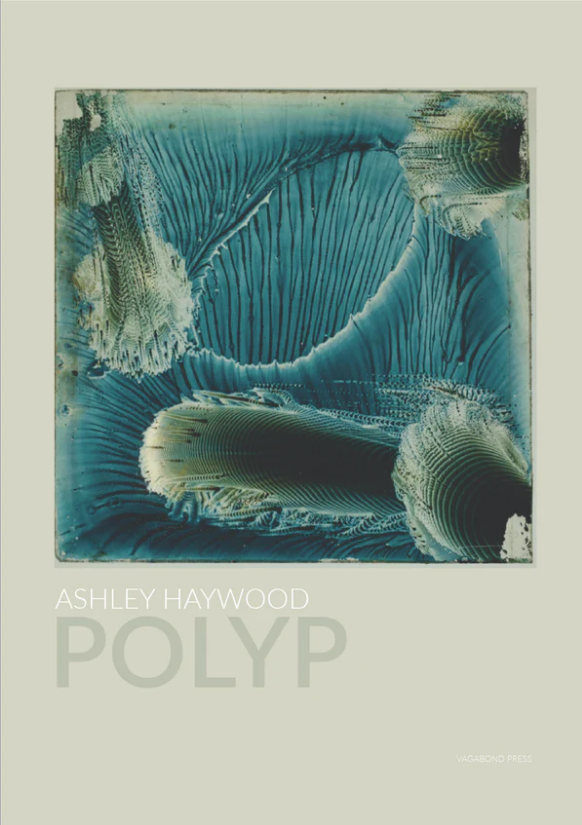
Polyp by Ashley Haywood
Vagabond Press, 2024

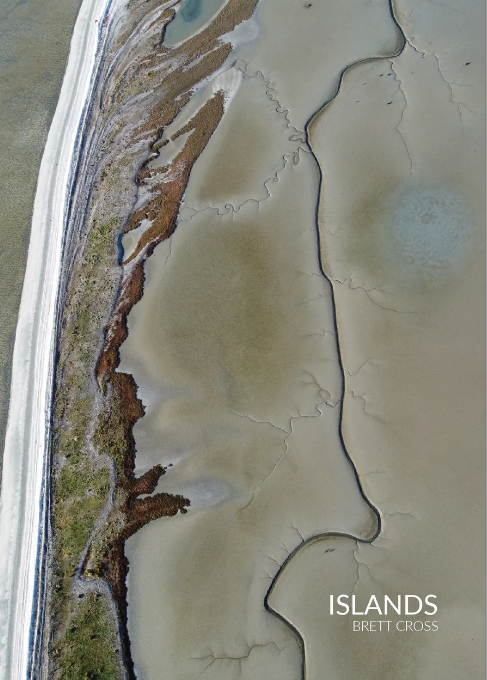
Islands by Brett Cross
Vagabond Press, 2024


Clustering is a technique for mind-mapping the parts of any whole. Organisms cluster into ecologies, people cluster into communities, and poems cluster into collections. In Polyp and Islands, clusters of cells, beings, and places form and dissolve. Both books explore the flux between separateness and wholeness in nature, each word and line branching into vaster topographies. The poems arrange in organic patterns, then undermine their own classification by splitting, mixing, and rejoining themselves in new arrangements. Following suit, my review clusters Ashley Haywood’s and Brett Cross’ interpretations of the more-than-human world.

Themes of time and change propel both collections. Both engage with global ecopoetry by presenting Antipodean places as simultaneously physical and psychological. Both pose questions of human versus non-human voice and, in doing so, expose the smallness of personal perspectives. Both are marine inspired, their lifeforms springing from and returning to deep-time oceans. But the poets’ approaches differ: Haywood is scientific; Cross, humanistic. Haywood relates human to non-human cultures while Cross relates human cultures to place. I see Polyp as more innovative, Islands as more resolved, and both as strategically brilliant. Haywood’s poems are interlinked cells coalescing into organisms; Cross’ are layered sequences crystalising into islands.

In Polyp, Haywood, a transpersonal art therapist with a background in biology, investigates sentience by fractalising the voices of corals and humans. Shortlisted for the 2025 Mary Gilmore Award, Polyp’s sixty-three-page scope stretches from the microscopic to the mythical. Its coral and human voices strike strange, experimental harmonies in a concurrent language of part and whole. To read Polyp is to share the consciousness of primordial marine beings threatened by environmental disaster. I reread this collection several times, dipping in at random for poetic microdoses that echo the macro in mind-expanding ways.

Polyp was inspired by twentieth-century coral expert Dorothy Hill’s writings, “ninety-four boxes of collected personal and professional papers, including handwritten drafts of scientific papers and hand-drawn maps, correspondence and photographs, reports and fossil illustrations” (‘Notes,’ 62), which Haywood studied at the University of Queensland. The final poem characterises Hill’s work as a “Glass Slide […] / Lost to time” (‘Glass Slide; or, As I lay down in the instant,’ 58), and Polyp’s sparse pages also resemble smeared slides. Haywood examines ecological grief and hope with scientific tenderness, predicting, “[One hundred million years from now ] / The plastic stratum is the colour Goodbye” (‘Domestic Spill (5),’ 43).

The first poem, ‘Ars polyp,’ maps out Haywood’s cross-disciplinary premise in sections labelled “BIOLOGY,” “MEDICINE,” “POESIS,” and finally:

LITERARY           Poem with one or  many
                              tentacular mouths rising to meet
                                                          my under-image.

(9)

These lines respond to a Beverly Farmer quote, “Let go and rise up into your mirror image, your hands, yourself, your underimage” (This Water: Five Tales qtd. in ‘Notes,’ 60). Haywood’s core task, then, is to investigate the embodied self as reflected by other lifeforms. The human voice is concurrent with myriad non-human voices, all equal tools for calling out climate issues, specifically coral reef bleaching events. As Polyp proceeds to enact this multi-self-reflection in mirrored water, sentience becomes a collective rather than individual reality.

Unembellished sketches swell with repeated mouth and tongue images that reinforce Haywood’s emphasis on voice. Some poems are freestanding clusters, such as ‘Rockpool’ (41), but most interlink as a broad ecology. Preoccupation with whole and part manifests in intricate arrangements of cells. Folds and mouths represent not only more-than-human voices, but also geological strata that lead to the depths of creation and extinction: “What is in your mouths? Gaping / parched clay slabs layered like accidents” (‘Portraits,’ 47).

To capture the rhythms of voice, Haywood mixes visual patterns with assonance, consonance, and onomatopoeia:

                         Root-
              held
              dune, skin like

              wind-
                         swept
                         jelly-
              fish—

(‘Small Dance,’ 55)

While voice is prominent, identity is even more in question, with phrases like “whose / hand, foot?” and “[who in the]” repeated throughout (‘Small Dance,’ 55; ‘On a long walk away from away and waking with the sun,’ 57). Beneath Haywood’s focus on voice and identity lies the conundrum of non-human consciousness, and beneath that, a nihilistic solidarity with threatened lifeforms. The pronouns ‘you’ and ‘I’ are scattered interchangeably so that the reader questions not only who is speaking, but individuality itself. There is no discernible distinction between human and non-human voices; instead, “you and me we // loop” (‘Domestic Spill (6),’ 56). This relational ‘loop’ is biologically and metaphorically generative, smacking equally of extinctions, recycling symbols, digital webs, and geological ages. The word ‘polyp,’ too, is rich with associations (a slippery, alien shape in some deep-sea intestine), and Heywood conveys all this amorphousness in startlingly simple language.

Body-mind metaphors are seamlessly integrated, for instance, “you see!— / you were always mostly empty space” fuses a physical with a metaphysical recognition of anthropocentrism (‘Portraits,’ 49). Haywood explores complex theories of more-than-human co-creation, but her touch is light. One endangered species addresses another, ironising human rhetoric: “If I’m a failed sestina, what poem / are you? Words” (‘Domestic Spill (2),’ 27). Destructive and commonplace pastoral practices prompt only lassitude:

I lay awake in the company of lambs
engineered to say nothing

                              forget.
                              I’ll be gone by morning.

(50)

Polyp clusters biological with mythological stories, describing both as “heir- // loom” inheritances (‘Waterborne,’ 51). Compound meanings amass behind succinct lines: “Let me tell it this way, the way / a quiet seed is ritual / in folds” (51). References to classical mythology accentuate the relationship between Western anthropocentrism and environmental destruction. The concentration of mythical references toward the end of the book suggests humanity’s demise and eventual reduction to an historical myth.

In six ‘Domestic Spill’ poems, Haywood interrogates everyday wastage. Full of ambiguous “you, me” idioms (‘Domestic Spill (4),’ 40), these poems feature plastic debris, weeds, and cigarettes, drawing familiar links between industry and environment. ‘Domestic Spill (1)’ begins: “I am poem parts, dumped end-words / left on the sidewalk for the passer-by” (20). The ‘Domestic Spill’ poems act as anchor points for interspersing pollution events across the book, while simultaneously ‘spilling’ into universal realms beyond mundane experience (20; 27; 32; 40; 43; 56).

The genius of Polyp lies in its embodied merging of human and non-human. Motifs of coral and human mouths and tongues emphasise speech, consumption, and story, then expand into structures of sex, birth, and death:

                                                circling                 the lips of
                        old graves                                    fertile tussock
                                                mounds

(‘On a long walk away from away and waking with the sun,’ 57)

Places and times cluster together in a further, planetary perspective: “On the atlas, we” take “micro- // cosmic steps” (‘Small Dance,’ 55). Humans, corals, and other lifeforms are ephemeral blips on the map as a “frond folds wetly / already now / already earth’s understory” (‘Understory,’ 53). A dual “sense of living in two distinctly different temporalities at the same time” parallels Polyp’s mirrored water metaphor (‘Notes,’ 61). In ‘Shadowtime in the Eromanga Sea,’ this altered reality is not only multitemporal, but also multisensory: “I can hear [I can hear] // The distant taste of salt” (23).

Polyp’s final lines are “I can hear fish among fish / sing at dawn” (‘Glass Slide; or, As I lay down in the instant,’ 58). Is the ‘I’ coral, human, or both? Who are the ‘fish among fish,’ and is the ‘dawn’ past, present, or future? Do these questions even matter when all species are eventually replaced? We eat and are eaten by, speak and are spoken by, other organisms. This final enigma clinches Polyp’s epigraph by Clarice Lispector, which foreshadowed ego death from the start: “‘I’ is merely one of the world’s instantaneous spasms.”

Biological and philosophical thinkers will enjoy this book. So much of science informs ecopoetry and Polyp stands out for its multimodal clarity. The strange becomes familiar as Haywood observes life and death unfolding. Ecologies are collective places in which creation and destruction co-occur, as the last poem underlines: “Coral grows / wildly from bone. What have I made?” (‘Glass Slide; or, As I lay down in the instant,’ 58). Is human growth symbiotic or parasitic? Is it too late for us to co-create healthy ecologies? Polyp poses such questions, but not their solutions.

Posted in BOOK REVIEWS | Tagged , ,

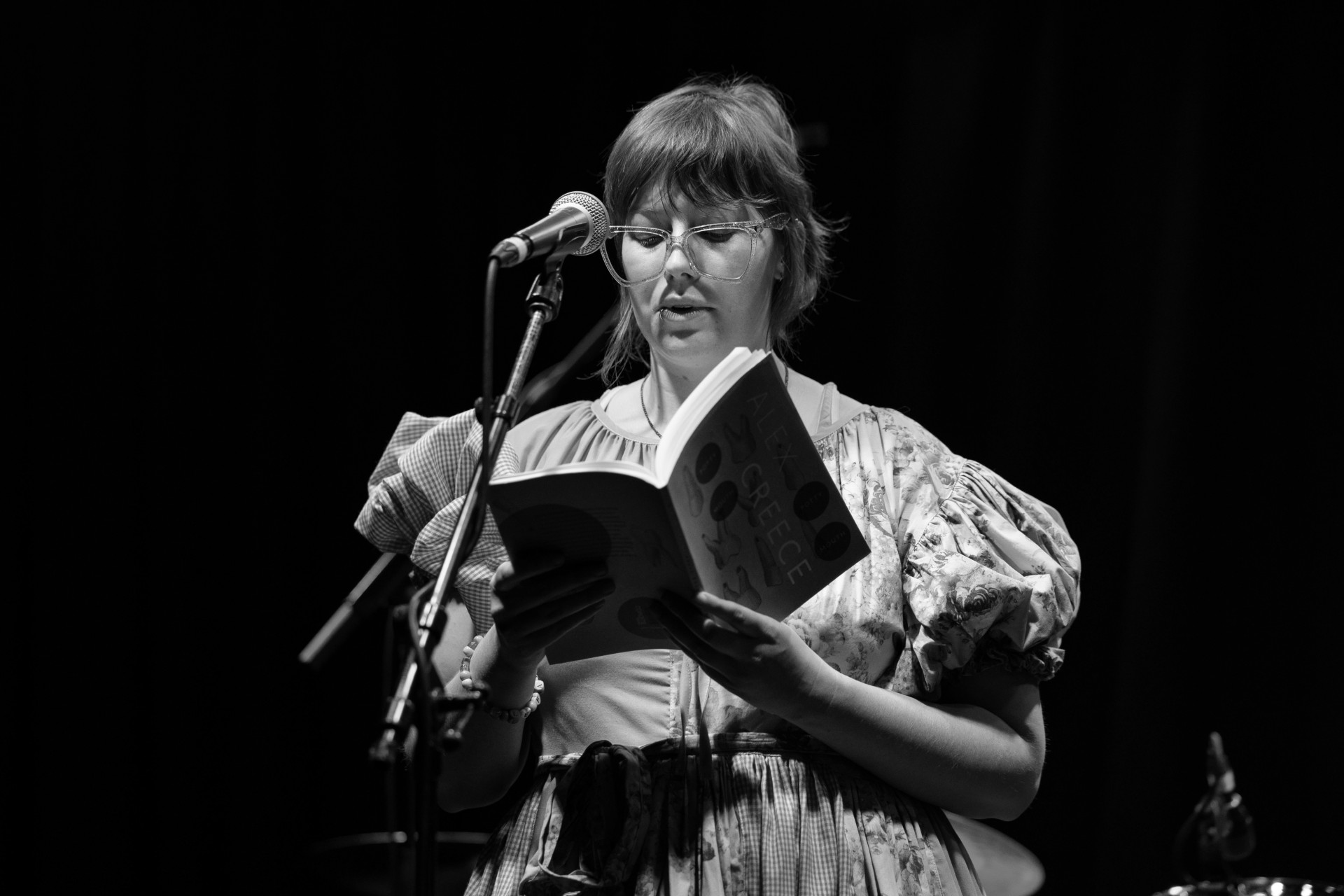
Alex Creece on as Managing Editor of Cordite Poetry Review

After 15 years, 80+ consecutive issues, over 50,000 submitted poems, and on the brink of Cordite Publishing’s 30th anniversary, it is my pleasure to announce that I am stepping down as Managing Editor of Cordite Poetry Review.

It arrived into my life somewhat unexpectedly, following the excellent stewardship of David Prater, and has certainly changed it immeasurably in all ways from very good to … the opposite of that. It has been, and will remain, harrowing to keep the journal afloat, paid for and finding its way.

Harrowing. That is the only word for it. But, successful as well. And incredibly rewarding.

I have been blessed to make so many excellent connections and to have the Managing Editor’s vantage out upon Australian poetry for so many years.

This decision allows for me to step way back and focus on the business of Cordite Publishing Inc., remaining as its Director and Head Publisher of Cordite Books. The journal and its fabulous masthead won’t miss a beat.

Why is it my pleasure to make this announcement?

Because Alex Creece has gamely and enthusiastically accepted the role with a start in February 2026. The journal, its directions, tones, themes, collaborations, all of it, will be hers to craft with an already well-honed capability in indie publishing.

She began with Cordite years back as a Monash University summer term cadet and immediately proved her skill. She has worked her way up to this opportunity, and it is most well-deserved. She will bring youth, excitement and exemplary quality.

Posted in GUNCOTTON | Tagged ,

Jenny Hedley Reviews Peter Rose and Sholto Buck

Attention, Please! by Peter Rose
Pitt Street Poetry, 2025

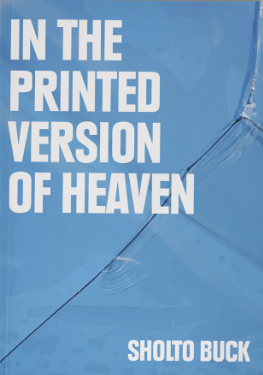
In the Printed Version of Heaven by Sholto Buck
Rabbit Poets Series / Hunter Publishers, 2023/2024


A tiny bag of crystal shard, almost empty, is tucked into Peter Rose’s Rattus Rattus (2005), presumably by its previous St Kilda Library–associated borrower. I am tempted to sample the remnants in order to conjure a different version of (my) critical self — the excuse being that I proposed reviewing Rose’s latest poetry volume Attention, Please! alongside Sholto Buck’s debut In the Printed Version of Heaven through a lens of performative selves. I move the bag from pages to table and back again, entertaining and then shelving temptation, unsure whose impulse will win out: the addictive personality of yore or this stable, routine, maternal self. It is said that memories tend to be linked to the specific context in which they were formed — say, under the influence. Such state-dependent memories can be retrieved by returning to such an altered state. Would conjuring my Sad Girl persona alter the colour of critical perspective?

Sholto Buck’s In the Printed Version of Heaven grew out of his practice-led research and accompanies his 2022 dissertation For a Rainbow to be Seen, the Sun Must be Behind an Observer Who is Facing Falling Rain. In the critical component, Buck offers “light-writing” as a unique form and method which he transposed from photography to literary practice — one that “explores the multiplicity of lightness (explosions, banquetings, floods of it) to layer up the affective power of the poetic image” (83). Within his Rabbit Poets Series debut, our lyric narrator locates splendour in reflective surfaces: raindrops and snow, fountains and ponds, mirrors and foil, glass and lacquer, lighthouse and waves. There is also the shimmering neon cast by “the florid / sunset of being inside / this exact 7-Eleven” (1). Water descends, freezes, melts, and evaporates across the collected poems. Other luscious liquids include “a stampede of watery horses” (14), “canned wine” (16), an “ice blue / mouthful of Powerade” (29).

I have encountered Sholto Buck in various tutor labs at RMIT University but have no relationship with him otherwise. I mention this only to convey the sonorous qualities of his voice, through which I hear his poems read to me (by my imagination, of course): gentle, lilting, melodious. Self-described as “a pernicious bitch / living in Melbourne” in his poem ‘Short bio’ (4), Buck draws attention the artifice of the constructed authorial persona. In the title of another poem the reader is warned: ‘Let’s keep in mind that Sholto is prone to exaggerate’ (17). Buck playfully establishes a reader-writer contract which allows us to suspend disbelief while entertaining an altered scale of proportion. In his dissertation, Buck proposes a label for the impish tone of his poet avatar: self-ridiculousness. It is an “absurd, theatrical tone of voice” that differs from camp in that it is “more authentic and complex” (Rainbow 87). Another poem which draws attention to Buck’s deliberate self-fashioning is ‘100% chlorine,’ which reads in its entirety:

I cast myself as object
of desire and revulsion
a mad thing
made of surplus
plastic like the face of Mars

(43)

Buck muses: “I have written poems because at some point / I decided that images mean something to me” (‘Between the mouths of people,’ 59). He continues: “I want to be better / than all the images that made me.” In particular, the poem ‘All an image can do is show the ways to be silent’ reveals the character of the narrator through such constellating influences. Here Buck charts a ‘phase’ of his iterative, artistically, and aesthetically constructed persona with that disarming sense of self-ridicule:

I recently bought a socialist newspaper
which I have only used
to kill moths

every day

I get less interesting

Add sandals to cart
going through my Joan Didion phase

(11)

With this last line, we might picture ourselves — reader, critic — reflected in Joan Didion’s oversized square sunglasses. Your critic, reformed Sad Girl though she is, locates a comfortable companionship in the lines “every day // I get less interesting.” This focus on the quotidian lowers the stakes — forget the hurried ethos of the biohacking, schedule-optimising millionaire! As we journey the weather-sodden tributaries of Buck’s image-capturing thoughtscape, we can let go a sigh, slowing down to notice whatever is illuminated by the poet-narrator’s diffused spotlight. What might appear banal is painted as sublime, as in this passage from ‘Intricate days’:

Every night I leave the city
through the doors of a train, and the sky is pulp
I am in a delusional time of my life
I think
I had a singlet-shaped sunburn
when it was summer

(26)

Buck’s queer, non-reproductive gaze audits as markers of self all of the attachments, influences, and fantasies that Anna Poletti, in Stories of the Self, argues are integral to a queer understanding of what it means to have “a life” (15, et passim). As much as identity, or the stories that we tell about ourselves, it is also our mediated environments which can give life meaning. I peruse Buck’s cultural references, indulging in Architectural Digest’s YouTube channel which takes me inside the home of Liv Tyler, and the hot erstwhile couple Zachary Quinto and Miles McMillan. These peaceful, aspirational settings — captured in the poem ‘Liv Tyler’s magnolia tree’ (13–14) — offer a soothing backdrop for our narrator to contemplate how

men have yelled from their driver’s windows

to call me a faggot
which is

though consistent with what I know to be obvious
quite unwelcome

(14)

The scene cuts from the discomfort of processing — and then reclaiming — hate speech to entertaining sensorial languor wherein the narrator contemplates Liv Tyler’s

gentle voice

as, in a dulling fashion
curative of my grudges

it soothes me

(14)

In Jeanette Winterson’s Art Objects, she laments that “[c]hildren who are born into a tired world as batteries of new energy are plugged into the system as soon as possible and gradually drained away”; by the time children are grown they are acclimated to “a world of shadows” (135). Our Poet of Lightness — or rather, “lightnesses,” as Buck phrases it in his dissertation (83) — recognises the shadows but seeks out what is good. Where the philosopher Simone Weil raised renunciation to a divine art, Buck finds grace instead “in the humidity / of all the jeans on Earth” (28). The title of the corresponding poem, ‘To be sensual is to suffer and I have suffered much,’ carries the aphoristic quality of Weil’s Gravity and Grace, but with eros as divine calling. Embodied sensuality appears in poems such as ‘I want simply,’ which concludes: “humidity tops / and I lie / beneath it” (21). Carnal pleasure peaks in the poem ‘Defenestrated, decapitated / I am the bottom in all my poems,’ which reads in part:

When your tongue was inside me
my face was pressed 
against the bedroom window / if it broke

               I would cum
                            in mid-air as I fell

(50)

Using words as a prism, Buck’s poetry refracts an aesthetics attuned to light capture. As photo/grapher, Buck snapshots affective resonances, tempestuous weather, and ephemeral moments. Sholto’s avuncular avatar delivers hope to this Sad Girl critic, who finds joy in alternate construals of reality because: patriarchy. Reading In the Printed Version of Heaven conjures a feeling of spaciousness that I experience / hallucinate / fantasise when experimenting with creative modes of production in resistance of capitalist imperatives. Buck’s narratorial perspective acknowledges the structural embedding of misery in our world yet purposefully traces lines of desire which direct us to all of the beauty on offer.

Posted in BOOK REVIEWS | Tagged , ,

Dženana Vucic on as Reviews Editor

I’m very excited to announce that Dženana Vucic has joined Cordite Poetry Review as Reviews Editor.

Dženana Vucic is a Bosnian-Australian writer, critic and editor based between Berlin and Naarm/Melbourne, on unceded Wurundjeri country. Her work has been published in Australian Book Review, Australian Poetry Journal, Cordite Poetry Review, Kill Your Darlings, Meanjin, Overland, Sydney Review of Books and others.

She has a PhD in English Literature and has been awarded a Marten Bequest and Peter Blazey Fellowship to work on a novel exploring identity, memory, myth- and history-making through the lens of the Bosnian war and its aftermath.

Her debut poetry collection, after war, will be published in May 2026.

I’d like to extend a deep thanks to Anupama Pilbrow for two years of excellent reviews.

Posted in GUNCOTTON | Tagged ,

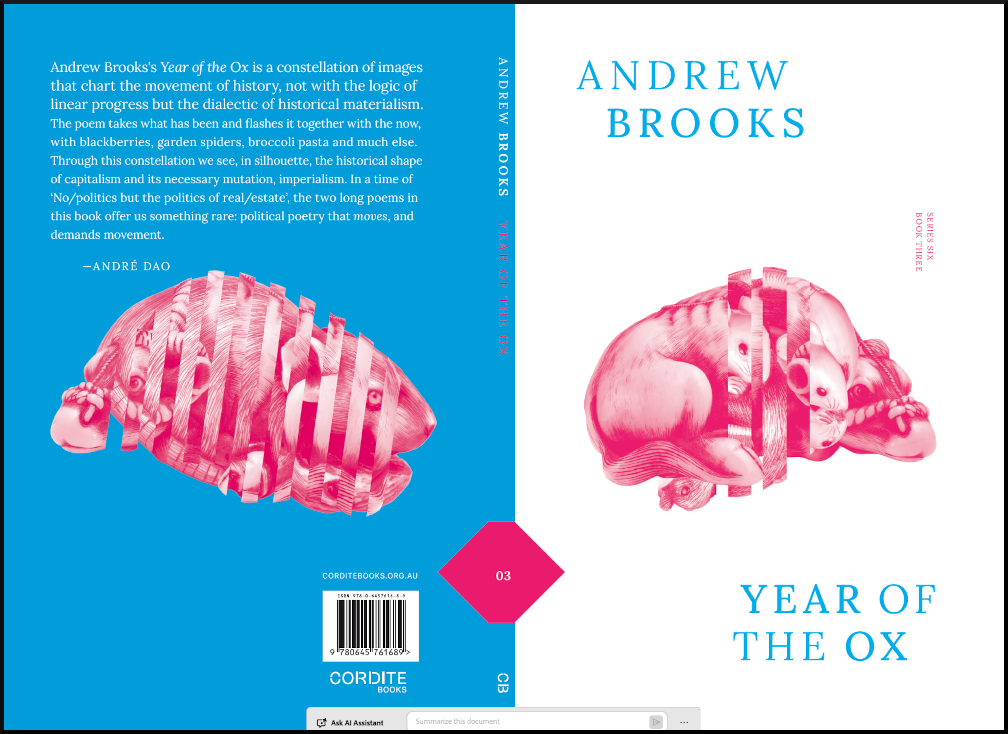
Introduction to Andrew Brooks’s Year of the Ox

BUY YOUR COPY HERE

‘History,’ writes Walter Benjamin, ‘decays into images, not into stories’. And what is the image? It is ‘that wherein what has been comes together in a flash with the now to form a constellation’. Andrew Brooks’s Year of the Ox is a constellation of images in precisely this Benjaminian sense: it charts the movement of history, not with the logic of linear progress but the dialectic of historical materialism. The poem takes what has been – oil crisis, emergency in Malaysia, the Global Financial Crisis – and flashes it together with the now, with blackberries, garden spiders, broccoli pasta: those things that are ‘good/as narrated by Arvind Rosa’. Through this constellation we see, in silhouette, the historical shape of capitalism and its necessary mutation, imperialism: accumulation and circulation, stagnation and blockage, revolutionary joy and around again.

This restlessness of capital is reflected in the titular poem’s form that endlessly shifts mood, register, style and rhythm. From the poet’s ‘I’ to an incantatory ‘we’ and back again, Brooks tells us The Year of the Ox ‘is the year of crisis.’ It is the year of OPEC and of the docks dispute, the year of the Troubled Asset Relief Program and of the Asian paper tigers. But even as the poem moves from crisis to crisis, from technique to technique, there is a vibe – an unsteady, syncopated rhythm, much like that which pulses through Alice Coltrane’s Ptah, the El Daoud (to which we groove along with Brooks, and also to Janet Jackson and Sly and the Family Stone: ‘The alchemy of the three-minute/pop song is that it is a container for all that is/uncontainable’). This unceasing movement is all the more intoxicating for its juxtaposition with the meta-crisis that is the crisis of capital’s circulation. Capital that must move but is instead always congealing into things, like margarine, ‘the glistening mound of electric/yellow developed to keep the French working/class alive just long enough to die on front/lines and factory floors’.

And who is the Ox, if not the worker, the one who works the soil? The Ox must keep moving if capital is to keep circulating – so the worker is fed palm oil and Kopi O, the ‘caffeinated mud that promises to stave/off fatigue but will only amplify it.’

And yet, and yet – what if the Ox desires movement too, for its own sake? The thrill of Year of the Ox lies in the way Brooks recovers and recuperates the desire for movement outside the dictates of capital. Even the smell of palm oil – product of colonial infrastructure, of ‘the African palm, disciplined/into neat little rows, came to replace rubber trees in/the plantations of South East Asia’ – holds the potential for something more: ‘in its scent we remember that our future depends on the abolition of town and country, north and south.’

Revolution and solidarity thus begin with a remembering: under-determined, in the subjunctive mood. The poem moves to an extended dream sequence (wet), the promiscuity of revolutionary joy: ‘Dance your way out of hell/and into the factory: accumulation by salvation!’ In a time of ‘No/politics but the politics of real/estate’, the two poems in this book offer us something rare: political poetry that moves, and demands movement.
Brooks writes ‘Suppose the poem had to pick/sides.’ Suppose it did. Suppose as well that choosing a side is not a closure, but an invitation. Suppose the ‘Year of the Ox’ has already happened, and will happen again. ‘Come in, it’s open.’

Posted in INTRODUCTIONS | Tagged , ,