PROLOGUE, OR DATING ARTIFICE

It is often a quote: dos
por dos and the framing, a toothless knife’s
edgework. Right, anterior to
the hand’s hilt, the heart as truer
organ, the preening happening any
moment behind the bush. You testify
to the blackletter flourish
of scripts. One can hear them bicker from
next door, from the afterlife of bevelled beams
and so many transcriptions of things.
I have come, not so much an announcement
as a dictation in parts: some wild hemming
to underline a bald expression that forgets
I am, I am, I am. Briefly, song is
werd for werd, then tree for forest, forest
for village. Information reads from end
to end—quasar, cave, cerebrum, and too much
light. To verify is to round
those Os as you scream into the last well
to dry up in your neck of the woods, clean
snap, the spine of tomes, the tombs’
synapses sending us this way, to go.
And why in the Islands, tonight, it is practically
tectonic. And so little time it takes.
The lesson of threes is to break
even the writing of fact, for
thee—moribund bard, herd gawker—we review
from the ground, letter by burnt letter, in situ.

Posted in 114: NO THEME 13 | Tagged

ORATIO IMPERATA

Suddenly black skies carrying the stench of rot
had sent us locking our doors
and shutting off the world.
But let it be said— nature is the ultimate butcher,
its bloody cleaver sheathed in flowers and fur.
No one to blacken your name this time,
Almighty Father, tell us where it hurts
and we will show you an abstraction—
we, poor, unworthy stewards of your creation.
We have chopped down mountains
and forests for our steady supply of crosses
for our unending crises, the silver in our pockets
rendered useless, like the shopping carts snaking to nowhere
as black umbrellas swarm the cityscape.

We have learned to ignore the little horrors
we inflict on ourselves daily—
Almighty father, spare us, the weary for what
we refuse to wear, for the last rasping sound
we refuse to make and the prayers we mouth
without conviction nor malice,
for the degrees of which we find it appropriate
to pester God, or to bury him along with
our earthly father whose essence is incoherence
and obsolescence, evoking only murderous mythology
from his own divinities, a warmer but less reassuring word,
like that stainless-steel table on which
the corpse is stretched out, covered in the light of candelabras,
sin peccado concivida floating off
our lips without the tyranny of understanding
tremolo of transmission more problematic
than our half-hearted Latin.

If pathogens are the world’s way of exercising hygiene,

then we warn our children—
Floods are God’s tears for our impenitent souls
Droughts are dress-rehearsals for hell

Until we find ourselves
robed in the thin brown coat of gratitude
and held airborne by wonder.
What we are saying, Almighty Father,
is that we have stopped measuring
the ballistics of rain.

May the winds spread our supplication
throughout the gasping gray cartographies.

May the earth, after its glacial labors,
finally find rest through muddy avenues, drying rivers,
scorched rice fields
cathedrals that burn with silence, the dominance
of broken grass and defaced saints.

These words we write on a white wall,
with a bloody finger.

We are alarmed by mosquitos buzzing in
from the undiscovered country
and television makes things less awkward.
We forget about the rats in the barns,
raw sewage in the grains

To which we say, there is absolutely no reason
to panic.

It is here: the scent of the world
right before it is once again erased,

but the smell of humid soil is upon us.

We don’t know how it ends
but we know how every great story begins —

It begins with a single word and heavy rain.

Posted in 114: NO THEME 13 | Tagged

Civil Fatigues II

Civil Fatigues, II
Brooklyn, 2024

Irreverent Cairo hymn, the chest
retracts unto subterranean ache, rummages up doctrines
of complaints from the unsuspecting digital buttons in my palm,
against the clueless stupid analog heart.
A woman from Egypt sings,
sculpts defiance for my forearms,
as I skin this disenfranchised poem–
a litany to protest. Sunday as Brooklyn naps,
the impervious clouds playing sweet in the startling blue, no sirens
adjudicating on the spiraling death ledgers
of the faraway coastlines we said were bayt.

In New York for the nth weekend of the genocide,
dusk now a list of wonderment
at why the stomach rumbles, still.
Often, in the immigrant rides home, the driver
knows your occupied past, as breaking updates
of other sorrow repeat on the radio
in between the crash stops of refuge.

In the strung out ennui of surviving,
we rely on plants from myriad habitats
for the ribs, for the stomach, for the smoke
in our curling Arabic dialects.
For this poem to happen, we must reverse engineer the breathing.
But in America, we buy boxes numbered,
colored, to collect many necessary new pills.
The coiled snake in our clavicle hibernates,
regardless of spring.
What is this continent of so few words between her people?

I stand guard against the sinking into shhhh.
A wreath of Palestinian idioms from childhood
swirls around the ceilings of this self.

Everywhere we lie, what fables your parents
taught you of liberation, stand.
Alert, at attention for the ongoing,
the incoming, the yet-to-arrive battles.

But, in the middle age of load bearing, the coverings seep.
Perhaps the veins must not electrify
as nails, perhaps the knuckles need a hand.
In the crescendo of wrath, the minute steps
we took to oblivion were invisible to our teachers.

Do you have twenty four hours of silence,
as we recite what a Palestinian has written of cruelty?

Newscast at the hour, every hour,
for as long as the weight of what all suffering is
can be numbered. No Palestinian child is child
for long, and in our breath, we brace
for the pummel, the digits struck, the stuck
records of war ridden possibilities,
the tactics creatively ruining soil, its bones,
its hair, its mangled spirits,
as your company boards erect barracks stacked
on graves, and announce it, anoint it holy.

No you do not, you do not
have twenty four hours
for the list of what a happy, blessed as fuck, Palestinian
such as I has known of the intricacy
of denial, the imminence of collective breaking.

Was it as far back as when they elected George Bush, again?
The ashen aura of my favorite film prof,
softly testing broadway midday, in the sunken glass
of that knowledge, the grey buzzing hiss of defeat in the stink,
so much so his bicycle walking past me drowned out the avenue, his
lips a ruler, the click of chains grating more than asphalt.

Shock and awe. Shock and fucking awe.
We listened to the screamers of no, in the squares of Union,
finished higher degrees as teeth drew fault lines in the snow.

Great set of pearly whites, my dentist once exclaimed.
You will keep them for life. But, for these cracks
in the enamel, please release your jaw to the
starlight, and sleep. The bones of you deserve more.

And still, we traversed oceans to tremble with you.
Every noon, we ground beans for the grinding.
We believed in the spoon flames of boiling, and reboiling, and sugar.

I hugged everyone who would let me– for the sheer slaking
of the desiccation in our breasts,
to enable the decision to routinely cook breakfast,
to wash our face before the meetings, to say howdy at the mall,
to sustain the eyelids for another late night cream routine,
widening the mouth for the tasks of the hour.

When they exploded a third of the arteries of Beirut,
we never went back,
no debris was cleared in this conscience.
Smoke, smoke, all your cigarettes laced hash,
and in this poison, codify the ledgers of the dead anew.
How petite they are, the shrouds of our making.
The glass of every Hamra window is festered in linings,
still jaggedly sewn in the discourse of hope.
Splinters of what lifelines I left there stalk the waistline,
no matter the ships we boarded to ignorant seas.
Every day I did not scream at the shambles of all matter
is a day on a costumed stage, in the great fake
dramaturgy of our resilience.

And through it, we kept pace, we lost Damascus,
muttered good morning, lusted tisba7 3ala alf kheir,
nchalla you all be blessed,
I hope this condolence note finds you.
Said, attached are the bank details,
shukran for the opportunity.
Paid all the bills, owed no one nothing.

Kept skipping, in the murky playgrounds
of any continent I could legally speak in. Woke up
yearly at dawn wondering where I last left the useless passports.
A refugee retains only papers as arsenal,
fragile to the detritus of space, of motion.

Do you ever tear the room apart in the lucidity of being
stateless, panicked at what green ID or blue document
was going to summon the living rooms of your father?
Perhaps you dropped the pages
in the latest exile you gifted yourself,
on the run from the heretic stories of neighbors bereaved.

Every time they killed a love of yours,
week after week for a century,
you sent sonnets to the ones who don’t.
The flowers of their fingers are intact.
You recognized that in the killing, there were spiders as matriarchs
weaving sanctuaries of grace known only to those
with eyes startled by the heat of your presence.
How we adored desperately
in the eras of poets whose tongues were hacked,
in the engines of hijacked planes,
in the envelopes of C4 on our pillows.

How we kept the notes, the receipts,
tatters of the blueprints of the valleys
where our grandparents kissed,
entwined under lemon blossoms, under merkavas.

We were constant in the leaving,
and the cities we abandoned burn rage in our wake,
no prayer for the scorch, no sacred oil on the temple.

A parade of mostly white men in suits delivered the verdicts.
We were guilty of much existence,
our music tormenting those who yelled
out the engagement orders from the hellfire above,
who signed the handshake
of menace, who advised the rotten king,
who poured cement into wells,
who shot my father’s dog at the very beginning.

Every time the named another village disappeared,
you drank fermented fruit to ward off this census.

You kept a chart of what you dared not think about,
out there on the trains, in fields of heather, in the nightclubs
of hasty sweat and you reapplied makeup.

And when alone, the interminable days unveiled epics.
The plot lines were celestial drawings
in the cave of the angry beast that hid in you.

The news outdid itself, compounded the hyperbole.
The statistics of the genocided grew, bit by creeping ivy bit.
Twelve murdered here, seventeen shot down there.
Five in secret, and one by mistake.
A school through misinformed coordinates,
a car at a metal gate too fast,
a boy with the wrong stutter at the door
of the wrong mosque.

The headlines were knives.
Every Palestinian year, a blonde braid by a rock.
Every winter, the rain in the breasts of grandmothers on the run.

We, who took to the books, remembered in our loneliness.
We knew the belly cramps unspoken,
the coughing in the insomnia of drones.

This annihilation by crumbs is an intimate marathon we train for.
We walk along the entrails bloodied in the grass,
and vow, there are bedrooms of ecstasy in our hips,
carnivals of our youth on balconies you can’t imagine.

We bent to the pruning of flowers,
caressed beards, slathered lavender.

Spoke the gibberish of God’s children cooing,
kissed each other harder.
We giggled in the afternoons of sisters like stories,
ululated at the weddings of men we called kindred.
The giggles of mothers were festivals of spice.
We learned what we could of unknown
grandfathers, held their portrait
as steel in the storms.
And, in every morning after, you got a job.
Then another, then another, and here you are.
A lengthy paper testifies to your determination.
You stayed up for the sunrise dances, you
listened in the classes, breathed moans
in the dark of lust to re-twirl
the earth to its natural spin.
All throughout, you sketched plans with those who
shared poems, in the aftershocks of phosphor.

And in the hours that have not yielded,
you flung wide doorways to guests,
took out the trash, washed blankets after the huddle.
In the swamp, you found tunnels of myrrh.

And we replied to the questions,
used the logic we were told appealed to your lawyers,
your printing presses, your pornographic televisions.
And we kept speaking up, and we kept speaking loud,
and did it with grace. Have you learned of our women’s power?

Perhaps what they don’t understand,
in this rancid government of mine here, is this:
The more you torture an entire nation together,
the more they are together.

Almost five decades later of rubble,
tents and resolutions, I no longer wish to be polite.
I doubt I ever really was, but here we are, in tatters.

What does all this take?
To have always kept stride,
in the full gore of dispossession?
To have always understood your place
in the ranked dimensions of privilege, of harbor.
To have detested our resilience,
even managing witness
far from the terror. How we said, enough
of the insistence on acquiescing
to the rigid demands of getting on with it,
with the inevitable day after.
I will mourn over a century if I so desire.
I question the purpose of healing,
here in the slaughterhouse.

I want to call forth the total lack of discretion. An untamed
reflex to the fate of our lovers. To tear at my garb,
unabashedly wail to the heavens, bring down
the sun on the shoulders
of those in the rooms of loss sequestering us.
To scream with no embarrassment until even
the moon arises to our grief. Pull at
the buttons popping, snatch rough the zippers,
rip off entire hemlines,
run naked in the order of things,
as politicians climb podiums of treachery,
as priests preach of tolerance and donations,
past the policemen picking their teeth,
past the sleaze of lawmakers denying justice for peace,
the tax accountants morphing numbers into munitions.

Maybe my curls will shred on the way,
I will be just skin, eyes leaking diesel.
Maybe my tongue will fork,
all the curses translating out,
burning craters where they land.
Maybe anyone touching me will turn to acid,
seeping into the annihilation of weeds.

But I will not terminate the sound,
stumbling in the alleys of mercy.

To lay unmoving in heaps of remembrance,
to unwind the clocks of sanity,
to not budge in the expulsion of reason.
To drop the armor it took to succeed at nothing,
to no longer smile at cameras
in the cacophony of opinions about you.
To empty the face entirely of flashbacks,
to cradle only incendiary ash in my gut.
Thud to knees in the absence of bone,
to collapse, to tumble,
to say I have no skeleton that will not bend.

Allow, then, your injured self to be held.
To be quelled in the holding.
Over and again nestled in the glimmer
of this world– wretched, pining, inconsolable.

And in the stark embrace of of still being here,
in the omnipresent baseline of flat,
in the mud of retinas that squelch Palestinian ache,
in this screech you did not know you had in you,
a nation might inscribe dictionaries in renewable blood.
It remains in the embers, for the wind to sign.

Can you feel it, lifted, explosive in the muted air?
A fire, perhaps, a blaze, yes, a flare.

*Bayt: Our Home
**Tisba7 3ala alf kheir: A Thousand Blessed Goodnights
***Nchalla: God Willing
****Shukran: Thank You

Posted in 114: NO THEME 13 | Tagged

Phenomenology of Return

~ After Remedios Varo, “Exploration of the Sources of the Orinoco River,” 1959

Don’t we all wish to return,
to discover how it is that infinity

reaches across the world in a shimmer
of overlapping circles, unfazed by obstacle?

It simply goes around each tree in the wood,
spreads a filmy veil over every house, falling-

down shed, office building, and church; the sign
above the 24-hour drugstore and pool hall;

the alley where stray cats congregate,
giving rise to rumors about the most delicious

steamed meat buns in the noodle shop next door.
In the story about a fish that grants a boon,

the fisherman’s wife knows that the sweetest
meanings are always closest to the bone.

She tells him to go back and ask a deeper
question, which sadly he interprets as merely

a demand for more. Here she is, setting out to do
the hard work herself then— peeling back the body’s

outer cover, waterproofing the heart, re-rigging
the wings. So much ceremony, in order to arrive

at the spot where the water gushes without
measure, gives before one even thinks to ask.

Posted in 114: NO THEME 13 | Tagged

Et In Arcadia Ego

in tribute to Tom Stoppard

We sing to each other and sing to each other
across a chasm of broken seashells.
We have not met, you and I,
for a long time — or was it never?

One of us always diffuse, escaping
as gas while the other
weatherproofs windows and doors, trying
to keep out cold.

There is still love — there is that —
ethereal, vanishing
known to poets and lunatics
from time immemorial.

Byron’s dream: “there’s poetry for you” –
four lines about a dead earth,
a starless night; our pointless orbit
iterated beyond repair. Out of time,

the song returns to me across the void
and I wonder where we will find space
for what we once dreamed. We sing
at cross-purposes:

discordant, determined.
Isolate in our sanities.
To hear the tune,
you’d have to be insane.

Posted in 114: NO THEME 13 | Tagged

Tell Me Like You Mean It 7


Image by Angélique Moseley

When briefing commissioned poets on what I imagined this volume of Tell Me Like You Mean It to embody, I eagerly told them to simply ‘tell me like you mean it’. I didn’t care if it was a declaration, a meditation, a lyric or an ode but bring me the view, the slant, quirk and queer orientation of where you are in this world.

My aim was to create a space where diverse voices could resonate and find new meanings through their interplay. What emerged was a collection of poems exploring what it means to perceive and be perceived, to interpret and be interpreted. To me, they exemplify a poetics in pursuit of nuance.

As you read through this collection, consider how each poem offers a distinct perspective, a unique way of seeing and interpreting the world, a poetic voice deeply concerned with understanding the where of its annunciation. Through a triangulation of everyday experiences, observations, and reflections, we are given insight to broader conversations about what it means to live, understand and be misunderstood on Aboriginal lands. Through these poet’s words we are invited to imagine the familiar anew and to continue being concerned about the catastrophic- come-all-too-familiar.


Natalie Bühler: I’ve been losing myself at the pool lately

Luoyang Chen: Vegemite

K J Hayward: White Girl

Aries Gacutan: unseasonable

Lay Maloney: mirrors in coffins

Munira Tabassum Ahmed: Blue Is All

Fig Russon-Jorgensen: on drowning

Dakota Feirer: Consult to me

Angélique Moseley: Green Armour

Taylah Cooper: Marana/First

Lucy Norton: the cosmic lament costs extra

Tyberius Larking: Character Shift


Whether at the dinner table, at the wedding, at the public pool, at the boardroom yarning circle, or somewhere else under the glittering cosmos and butt-end of the Anthropocene, these poets make meaning from the seemingly mundane. Their poems challenge the reader to think again about the everyday cultural conditions of self-preservation that sneak us by.

I encourage you to pay particular attention to the spoken and unspoken rituals that constitute an individual and collective Australian mythos. Take note of how poems circulate self-awareness, introspection and immersion dispersing into patterns of relation and difference. Mostly, I encourage you to revel in the sly humour threaded throughout. Poets go about tickling Tiddalik, you could say.

Posted in CHAPBOOKS | Tagged , , , , , , , , , , , ,

Character Shift

I agreed to preserve your double life
That requires
At family dinners
I check with you
Before responding

Homo-speak is a medical mystery
The fluent suffer insidious onset
suffer without suffering

Your grandma’s brain has
dropped lobes
and
therefore volume

But her traditional views
thus far
have not varied

Are not temporal

For a woman in her final days,
She makes tides of bile;

has a lot to spew
about sluts and DNA-errors

I have infinity in compliments
I pay on rotation
to her wedding glory

Remember when your mum’s
Purebred was diagnosed
Metastatic?

I sounded the alarm
Remember – I flagged those lymph studs
It was me who said
“Those nipples look real suspicious”

I took her to the VET
had that dog
put-down
on behalf of you

There’s kibble
embalmed on my flannel
It’s criminal
It’s a crime against nature:
That you complain
about the smell
And the p r i c k l y
texture

It’s criminal
that you snuck your airpods in
when I read you that
ballad by Minnie Bruce Pratt
Did you hear a word of it
Did you hear a word of why
Minnie’s blastoma was entrusted to me?

Why I was awarded custody?

We have the same antigens

Dyke-breath is mutiny
Straight to the
magistrates
for sucking on her tumour
like a gobstopper
I made her poems last years

Still recovering
From the time I exhumed your
mother’s old wedding dress
So your big sister could
Suck-up to tradition
on her wedding day

Every time you blink
your prescription contacts
behind your pokeballs,
I conflict-mediate
My sleeves drenched with saline,
It’s stings when I squirt the secret
Passcode
I know but sit
Sit still,
And you might
get a sticker
A pokemon? Bipedal?
Clefairy or Charmaleon?

Leave tips when you’re serviced
It’s humane
You leave tips for delinquents
Who don’t have ambulance cover
Haven’t been house-trained
Dykes who suck on their thumbs
And get-by on
death-bed poems

You retain the low-stakes
Of the closet
Have homeostasis undercover
Want the lie you’re living to last forever

I will not be mutated
by your anxiety
I’m just too self-sufficient
To be annihilated

And perhaps it’s time I took myself for a check up
Maybe that solvent in my mouth is the
the solution
Maybe the solution to my ails
is integrity

Posted in TMLYMI v7 | Tagged

the cosmic lament costs extra

watched the sky bleed pink last night
would’ve made you crack a smile, man

hope you still get to know beauty where you are
at least enough to see the stars you loved so

maybe you drink auroras in your cuppa now
who knows what celestial shit you get up to

somewhere the angels are combing
the world for strands of your hair

i want to make a deal with them

it could fix things, you know?
to have you back

Posted in TMLYMI v7 | Tagged

Marana/First

ngalga birrung look at the stars /
these stars have seen me and our yarabundis
old, tired elders /
whose gurugal ngubadi long ago love is unlike
anything the whitefellas will ever know /
ngalga birrung look at the stars /
they are ganadinga burning /
ngai dyalgala the barrawal, the burra the bunul.
i embrace the sea, the sky, the sunshine /
ngai nanma bulbuwul. i know their strength

Posted in TMLYMI v7 | Tagged

Green Armour

The ivy
of debauchery / is trimmed and stretched
wound up to fight the rain / or seem thickened across the struts.
I prefer ivy pied and unkempt / troughing water in pelvic cups. /
The variety prestigious / normal,
green and knotted up /
as I would be, / here
at the clinic, / while
the clipboard
tallies
up.

Posted in TMLYMI v7 | Tagged

Consult to me

repetitious tones of consulting are weekly weakening. monotonous Acknowledgments of Country in email signatures. traditional custodians must be rich, been paid that many ‘respects’.
Underwhelming paper-pushing white-guilt-projecting

‘Indigenous Stakeholder Engagement Frameworks’

bunch of white-fulla-jargon, with dot-art-for-margins. How numbingly quick they all are to forget – we are, in constant yarns with past, present and future. I’ve revised anew, consultation framework:

Consult to me, then
Step into my land
Sing out your acronym
Stake hold my hand

Consult me, then
Undress me
Find my scars
Press on them

Mark paperbark
pages on my chest
colour me in
touch me

Call me special,
Acknowledge Country,
reconcile me
–a reckoning fee.

Consult me then,
tear me apart.
Step on my skin,
call it art.


and if I bark, muzzle me,
chain me up, disgrace me
let me sleep, in the dark

help me learn,
to speak in turn
to bite my tongue
til it bleeds

and when I can’t speak
I’ll spit in your mouth
lend you my seat
console you, then

I’ll tighten your tie for you
Look in your eyes as you
Swallow
               the metallic truth
in my blood

then,

               consult to me.

Posted in TMLYMI v7 | Tagged

on drowning

hey, mister lifeguard
watch me
smooth little body
slick haired seal face

not lonely
surrounded (slow in the water)
i love you goodbye
becomes goodbye i love you

thinking of it
thumbing the rabbit on my neck
holding my breath
for a minute at a time

sorry about the house key
i know it was important
i know
i know

a crack in your collarbone
a pretty little smile
a bit of afternoon sun
an open wound in my stomach

miss it i guess
the wet embrace
soaking you through and through
walking you home again

same girl still
so don’t worry
your girl still
so let me know

Posted in TMLYMI v7 | Tagged

Blue Is All

today when the sky wraps around us as blue as memory today when the world is so big
and continues to spin today when the b
irds stutter before beginning their song today when
the trees look too tall st
anding at attention today when you plant a seed into the ground you
remember that plants store memories mostly for survival as they escape the hunger of youth
recalling what to do in a drought and which way to point at
noon when the sun is high in the sky
and the world continues to spin you ask what the seed
is learning today only just buried still
settling into this soft home the hands that planted it could’ve been from a human or a possum
or it is possible that the seed can’t tell whether it is a hand at all that it
feels like a bird’s beak
storing its food over
the winter but of course the seed can tell that it is not winter the earth
is much too warm the seed can tell that it has
rained this week because the soil does not resist
against new sprouts the hands don’t matter in the end though you hope the plant remembers you
months later when you feel how glossy its new leaves are when you pick the first ripe berry

when the world is still so big when care is all we have and all we owe and the sky
feels closer to us
all

blue as stutter and hunger,
I feel winter rain,
again, the world is all.

Posted in TMLYMI v7 | Tagged

mirrors in coffins

Worried what everyone else thinks
Check your hair and makeup,
Stare a little longer for a fault
Search creases, frizz, and pigmentation
Dress down to dress up
Leave something to the imagination
Tick-tock-tick-tock,
You’re running out of time
Eyes on the clock,
Every beat that passes,
Your heart is trying to tell you
You’ll never be the same;
Forced to grow under the knife.

Throw a cloth over the looking glass,
Mourn the person you were,
Again and again,
As the moon rises and wanes,
Grow to your fullest,
Disappear into the darkness.
Nothing blooms all year round,
You wilt – one day, as we all do

Look at yourself.
Acknowledge how you have earned your body.
Every scar that’s faded,
Every knot in your curls,
Every bruise on your arm,
Every callous on your hand,
Accept them.
You are your Ancestors’ gift.
No one else can see your heart –
unless you cut open your chest.
You might be tempted to digress,
And mutilate your body,
For the gaze of many.
Build your perfect mask, and remember
There are no mirrors in coffins

Posted in TMLYMI v7 | Tagged

unseasonable

the warm winds of crisis
have never been so stiff
or urgent. in a sense
it has all already decayed —
the droplets of glass
on the bitumen
crying their lurid song,
dual parts warning
and anticipation.
we are all wound tight
around glass, the memory
of sand rubbing us down
to nubs. each breath
is mosquito bite and tattered
shoe, each meal
is coarse and does not abide.
each day is hurled against the wall
like slop—i see it drip down
in unreal time,
lolloping into open mouths.
jawbones click together
like heels. the past
is kept in an airtight vault
and the safe alone
is symbol—the shapes
behind the background
gestured to only in our dreams.

Posted in TMLYMI v7 | Tagged

White Girl

When the white girl reads the black poem
She is,
Dangerous
Reckless,
Brave, progressive,
Aggressive,
Like a dog who has just discovered how to remove
Her muzzle
She’ll stand here,
Behind microphone shields
She yields,
Her pen
Armed with poetry,
She speaks in tongues weaponised,
With freedom of speech
Each word
Pinpointing the politics
Of her own
White-washed ways
She’ll be deemed,
The ‘white girl who cares’
But I’m just a white girl who stared,
At the pages of a history book
That shouldn’t belong to me,
What is the point of believing,
The world is black and white,
If you only ever get to read
One side to the story
But that’s just white history,
We say we’re for equality,
But we are equally,
Fretting about what the media sees
White girl thinks she’s heroic,
Getting to cherry pick
Which Black voices make the screen,
Make a scene,
One headline invites our black fullas,
To ‘take a seat’
White Australia’s advocacy
For racism
Get that like, tick that box,
Then erase them,
Next time, news time says,
Black youth are terrorising towns,
Yeah, well we terrorised continents,
Take welcome to country,
As a compliment
Say yes to a voice in our government,
Get coverage,
Of stories
As colourful
As the rainbow serpent
But that doesn’t happen does it?
NO,
The campaigns screamed,
For sovereignty never ceded
Yeah, but we did,
YES,
Was a chance to redeem it, to plead forgiveness, because we’ve just figured,
That maybe, white girl’s voice
Has been speaking for too long,
Singing another colour’s song
Taking up space on a stage
Where she doesn’t belong
But where is the line drawn?
Between white girl sticking up for black fullas
And white girl being wrong?

Posted in TMLYMI v7 | Tagged

Vegemite

Your tongue strikes against my teeth

I utter “O”

Where you break in

Fluxing

Transfusing cartilages into my joints

You give me acts

And visceral satisfaction

I breathe in an air of turbulent sweat

You give me phrasal verbs

You give me life

You give me something I cannot digest

You taste like “Australia”

Posted in TMLYMI v7 | Tagged

I’ve been losing myself at the pool lately

and each time the intercom warbles
an unfamiliar name as I search the pool floor,
follow lines that end in crosses
and dive into holes between tiles, live
my entire life in the other pool,
ʎllɐuᴉɟ I lᴉʇun ‘ǝpᴉs ɹǝɥʇo ǝɥʇ uo
spot myself from below, ploughing
through the water, arms and legs
asymmetrical, neck hurting
from jerking up to gasp for breath.
Standing at the bottom, I realise

ƃuᴉɥʇou ɯɐ I
like the frogs we learn from. I am
a drowning May beetle we splash
away as it bobs, helplessly,
towards our mouths. I can’t
keep staring up, have to look
ʞuᴉl ǝɥʇ puᴉɟ oʇ uʍop
joining the lines, seal the grout
between the tiles until a sound
empties the pool and reaches
my depths: cockatoo screeches
ring against the hollow walls,
‘dn ǝɯ llɐɔ
and blend with the intercom, where my own
strange voice, always a little too high,
too nasal, calls my own strange name:
Christmas, as if my presence was a gift
to anyone. Back in water, I glide,
ǝɔɐɟɹns ǝɥʇ spɹɐʍoʇ ‘uʍop ǝɔɐɟ
to meet myself. My hair spreads like kelp
across the turquoise, undulates
on the tiny waves all the other bodies
send out. I turn, by instinct,
towards air: float on my back—
a navy-eyed newborn.

Posted in TMLYMI v7 | Tagged

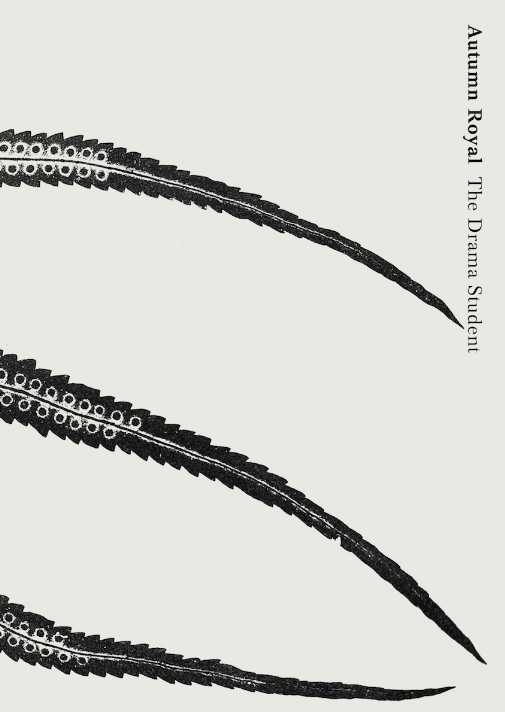
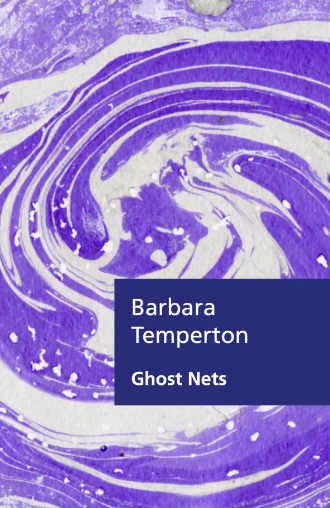
Panda Wong Reviews Autumn Royal and Barbara Temperton

The Drama Student by Autumn Royal
Giramondo, 2023

Ghost Nets by Barbara Temperton
WA Poets Publishing, 2022


Like reverse-engineering a sausage, articulating grief is an impossible task. Autumn Royal’s debut poetry collection The Drama Student (2023) resists this urge for clarity. Instead, she writes towards grief’s inability to be expressed or written, how language scrapes against grief’s edges, a continuation of her practice’s focus on elegy and mourning traditions. Divided into a two-scene act with an interlude and encore (cheekily prefaced with the poem ‘Causing a scene’ (1)) this collection literally and figuratively sets the stage for grief as performance.

In The Crying Book (2019), Heather Christle writes about how emotional tears have higher protein content than reflex tears, making them stickier, allowing others plenty of time to see them running down our faces. A theory for this: how we feel is meant to be seen by others. The Drama Student is an experiment in making grief as visible as possible; mourning is an attempt to translate from interior feeling to exterior gesture. The word ‘attempt’ is important here — spoken or written grief can deeply fail at conveying the reality of the experience (as anyone who has lost someone can attest). Royal echoes this in ‘Raising a subject’—”I’ve flattened myself to fit through scripted / doorways and babbled away my dimensions” (5).

Royal writes about the tensions of these conflicting desires to express and conceal in the poem ‘Versing about no body’: “Do I cover up my tracks or expose the wounds?” (21). The entire collection is perforated with em-dashes (a nod to Emily Dickinson, a historical observer of the hysterical), evoking both the direction line of a track or the cut of a wound. This cutting open of language occurs throughout the collection with Royal’s repetitive and obsessive use of the em-dash. These syntactical cuts carve away the poems’ façades, fragmenting the many gestures towards performance, while building a velocity that carries the reader through to the end.

The speaker’s desire to express grief seeps through but never makes it out whole. In her poems, props, too, are subject to breakage, burning, and smashing. Images of water spilling, nails pressed into a palm, a jar smashed against brick show the inadequacy of language as a container for grief. In the poem ‘O, this thing,’ “O” as anaphora is repeated so many times it loses meaning, puncturing the poem like a gasp, a yawning orifice, or moans (54). Royal deftly embodies the physicality of this absence in her poetry — the form itself becomes a set of props for performing grief.

Performance, however, is not without risk. The mourning woman has often been a problematic image, her grief viewed as self-indulgent, as if a person in pain seeking attention doesn’t deserve attention. Royal’s subversive use of acting and the stage as analogues of grief, however, challenges the mourning woman’s troubling inheritance. Internalised pain is metabolised into theatre, the attention is changed, charged. The reader, the poetic ‘you’ addressed throughout the collection, becomes an attentive audience. The emotion, hysteria, and feeling in an actor’s performance can become iconic, often rewarded with applause and encores. After all, there’s a reason why the Marissa-Cooper-freaking-out-throwing-chair-into-pool video has 6.2 million views on Tiktok. Grief is primal, but what happens when it is translated to performance, an artform where an audience is innate? Through performance as metaphor, it feels like Royal twists a common expectation of grief poetry, that its value lies in how raw, honest, authentic it is. The use of the persona in The Drama Student is not to obfuscate or present an artificial version of grief but to act instead as vessel for emotional release. After all, the actor gives up their own identity to an audience, channelling a story not their own.

‘Poesy’ starts with the epigraph:

’When people speak out in favor of a life of madness, they mean the
cute, nice madness, not the disgusting or dangerous kind. The disgusting
and dangerous kind is prioritised in language but not in life.’— Aase Berg

(53)

The speaker in this poem is a “cornice”, decorative and “disenchanted”, lacking agency (53). Strapped into a hospital bed, a hug is questioned, feedback tumbles into a void — these images of care are soured. Throughout the poem, the speaker marks and marks and marks until this act reaches semantic satiation, a phenomenon where repetition of a word or phrase drains its meaning. Similarly, these duties curdle and lose all meaning. “I promised to be static” contradicts the staccato repetition of “I mark,” charging the poem with dynamism (53). There is a truth to this negation—anyone who has lost a loved one knows about ‘going through the motions’ and how everyday life loses its meaning in the wake of loss. How does one find meaning in this absence?

Royal responds to this question through ‘Soliloquy’, a poem that pursues multiplicity while also challenging the societal containment of grief to specific spaces and timeframes (59-63). With the feeling of a choir, quotes from other writers and artists thread throughout a long, unbroken block of text. This poem grapples with grief’s inarticulability by turning to others instead. Royal gestures to this by quoting folklorist Patricia Lysaght, “lamentation has been a central element of the culture of women in most societies,” situating this collection in a long lineage of lament (60). When reading this manuscript for the first time, I was (pleasantly) surprised to see my ‘orectic poem’ alongside the work of many other poets and artists. Writer and guerrilla theorist Neema Githere’s framework of rigorous citation comes to mind here as Royal acknowledges all the lamenters and mourners that have come before her (and grieve alongside her). The constant imagery of spillage and wateriness in this collection refer to grief’s innate leakiness, how it cannot be held. Royal refuses grief’s relegation to funerals and other socially acceptable spaces to mourn. Instead, she recognises grief’s tradition as a means to connect, share, and express together.

When Princess Diana died, it triggered mourning sickness, a phenomenon of mass, shared grief—maybe her death created a space where the public could channel their own personal grief as a collective, rather than in solitude. In Grief Lessons: Four Plays (2008), Anne Carson writes (as a translation of Greek poet and scholar Euripides’ plays): “Who knows what will happen if I’m alone with my grief” (86). It feels like Royal is writing against this loneliness, her citational approach reframing the soliloquy’s solitary and interior nature into one of dialogue and kinship: “in the end what she did not express shone through me like a sunset” (59). This “practice of beckoning and attuned listening, a practice of linkage,” coined by audio researcher Lu Lin, exists not only within the poem but also beckons outside of it, calling to the reader through the poetic use of ‘you’ (On Deep Breaths and Friends Forever: Im/materiality and Mis/communication in Happy Angels Revisited, 1). It’s funny how writing about this citational methodology has become in turn, heavily citational. As Chelsea Hart writes in Petal (2021):

You might think

you are one unit


enclosed

but loss will show you

that your edges were always

a joint effort.

//

(‘Moss,’ 27)

Hart builds on Robin Wall Kimmerer’s work on moss. In Kimmerer’s research, she writes about moss as an example of mutual support. Water is held best by the moss as a whole, nourishing the whole colony rather than one individual shoot. The making of a person is a group effort, and the loss of a person is a group loss.

In ‘Soliloquy’, Royal considers that maybe it’s not just grief, but also its inexactitude that can be expressed together, maybe “there are many ways to make a cut” (59). ‘Soliloquy’ is the final poem in The Drama Student and feels like it exists over one ragged breath, oscillating through different performances of mourning, moving from earnestness to hysteria (arcing back to reflections on madness in ‘Poesy’). A brick falls from the roof, a tooth is pulled; there is screaming, bad breath, smashing pans. “[L]amb,” “my paws,” and “gallop” nod to the bestial realm (60). And, in fact, animal references rear their tiny heads throughout the collection, a substitute for when human expression is so very lacking. “Hair-matted” and “howl[ing],” the poem gallops toward its end, a deadpoint¬ where it is free for a brief second, all hooves off the ground, fitting for an encore (60).

The poem concludes: “With curtains half drawn and howls of unnatural formation, while I am indebted to this scene, in full mesh I will gallop (63)”. Mesh, full of holes, allows leaks through its many fine loops. Breakage can also be whole. Unbroken and saturating the page, ‘Soliloquy’ and indeed, the whole collection, is loud and unrelenting in its demand for a stage, an audience, a spotlight.

Posted in BOOK REVIEWS | Tagged , ,

Elena Gomez in as Associate Publisher

I’m honoured to announce that Elena Gomez has re-joined Cordite as Associate Publisher of Cordite Books beginning in 2025. Look out for future open periods for manuscript consideration.

Elena Gomez lives on unceded Wurundjeri lands. She is the author of Body of Work and Admit the Joyous Passion of Revolt, as well as several chapbooks and pamphlets. She previously worked as a book editor in trade publishing and has commissioned work as a guest editor for Liminal and Overland.

Posted in GUNCOTTON | Tagged

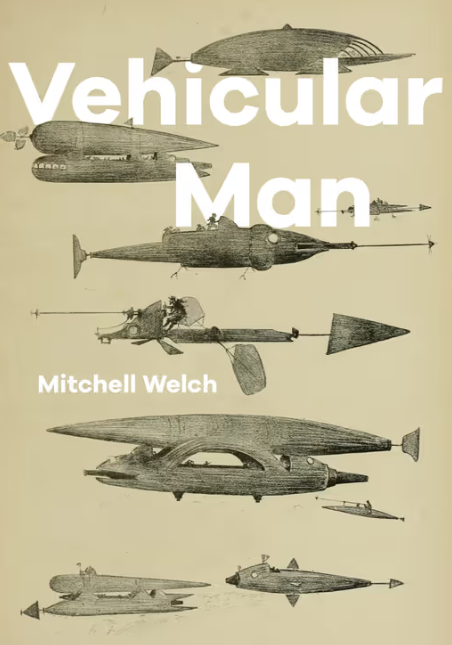
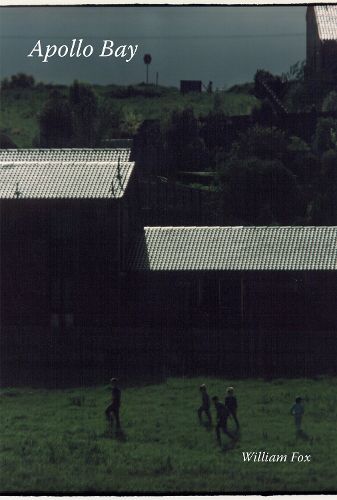
Sam Ryan Reviews Mitchell Welch and William Fox

Vehicular Man by Mitchell Welch
Rabbit Poetry, 2023

Apollo Bay by William Fox
Rabbit Poetry, 2023


Definitions of fiction and non-fiction are slippery. Each contains elements of the other; fiction can be based in non-fiction and non-fiction can include elements of fiction. Reportage, a non-fiction genre which is, by definition, based in truth still contains moments of fiction – not everything you see on the news is true. Biographies, too, are seemingly non-fiction, but the more they tend towards hagiography, the more they begin to engage in fiction. Even science has elements of fiction on a long enough timeline – remember when Pluto was a planet? Is it a planet again?

Rather than being definitions or categories that work on a simple binary, the relationship between fiction and non-fiction is dynamic. Something is always being measured: this account of the war is non-fiction with some fictionalisation; that biography has foundation in truth with some less-than-favourable incidents glossed over; this planet, as we understand it, is indeed a planet – no fiction there.

Non-fiction poetry is a confusing genre. I’m not sure if this very artistic form requires any basis in fact. Did Wordsworth really walk through that field of daffodils or did he simply glance over his sister’s shoulder and let the muse take over? Would ‘The Wasteland’ be any less poignant if the Spanish flu or World War I never happened? In the case of the former, I don’t think it matters. In the case of the latter, perhaps we can see how fact becomes useful to fiction. Or, perhaps, ‘The Wasteland’ is so eclectic and its words so abstract that any basis in fact becomes the realm of scholars while readers make their own meaning.

So why do we use these categories? Other than the obvious sorting utility (when I read a biography I can be sure there is some basis in fact, but when I read science fiction I’m sure most of it never actually happened, even if it is based on some scientific fact), this categorisation allows us to question the nature of truth and bias. How do I know this happened and does it matter if it did? In the case of Wordsworth, when we question the nature of his poem and the real events surrounding its creation, we can appreciate, if we’re being generous, some gender dynamics that arise in literary celebrity. And with Eliot, we begin to understand a poet’s response to world-shifting events. In poetry, non-fiction and fiction can overlap, the boundaries between the two categories more blurred than usual.

Which brings me to the two books being reviewed, Apollo Bay by William Fox and Vehicular Man by Mitchell Welch. They’re both debuts and they’re both published by Rabbit Poetry Journal as part of the Rabbit Poets Series. I don’t need to tell you what Rabbit is known for, but I will: non-fiction poetry.

Apollo Bay and Vehicular Man both work in that most non-fiction of sometimes-semi-fiction genres: biography. Naming these books as non-fiction lets us know that they are based in some truth, or on some true event, but their poetic nature allows us to reach beyond fact as it is and into the more subjective facts of experience and autobiography. That facts and the real are influenced by and interpreted through subjective experience is a realisation which makes this kind of poetry especially affecting.

William Fox’s Apollo Bay reads like a coming-of-age autobiography, exploring the poet’s experiences growing up in that eponymous Victorian coastal town. Non-fiction poetry often works with history and objects – notable figures and events, perhaps brands, objects, etc. Apollo Bay is a great example of this tendency. Fox uses these tangible things to express his own experiences.

The book begins with ‘Anne de Bourgh,’ a heavily anaphoric poem which lists the various excuses the poet, or, more likely, the poet’s parents, offered for his absence from school (1). There are several layers of non-fiction here, some even fiction-like or alluding to known fictions. Anne de Bourgh is that famously sickly character from Pride and Prejudice who is real in the sense that she actually is a character from that novel, even if that novel is fiction (I hope). And the genre of the sick note is of course usually non-fiction (the child seems unwell) with a bit of fiction thrown in (they are very unwell, so much so that they can’t attend school).

Appropriately, the poem plays with truth. It includes lines like “William had a viral headache hence his absence,” and “William had a viral headache, hence his absence” (1). These lines have the same meaning, but the second is split with a comma to suggest that the same excuse has been used twice. The slight modification in the second instance suggests, I think, some level of fiction. The poem is filled with such lines and afflictions, ranging from gastroenteritis to viral bronchitis. It finishes with,

William has recovered from the chicken pox,
but will be picked up at lunch time, i.e.

no sport.

(1)

We doubt the veracity of the excuses throughout, knowing the shaky ground on which the truth of sick notes can be found, before finding the real affliction: an aversion to sport. The fiction of the sick notes allows us to appreciate the non-fiction of the poet’s true feelings toward sports. This flow of doubt to belief and then to truth is a great example of the usefulness of non-fiction poetry as both a classification and a genre.

In ‘Homebrand,’ Fox uses objects from the pantry as a kind of starting point to explore his past and understand, perhaps even come to terms with, his class position (14). His father brings home gifts from people for whom he’s worked. Things like,

cumquat marmalades
labelled in a wobbly script
or brusque and unmarked
bottles of passata,
tall and full-chested
in reds and pinks.

(14)

Perhaps we can assume the poet’s father is a tradesman, receiving homemade gifts for a job well done. But his mother

tended to mock these gifts
as intrinsically dirty
or below the purchasing power
her family had earned.

(14)

These objects and their very tangible features (homemade, labelled in wobbly script, or simply unmarked) act as markers of class. We might assume his father is of a working-class background and his mother is of a middle class one. Or, perhaps they both started as lower class and worked up. Fox ponders these objects and their features – not what he thinks of the features, rather what they are – and his mother’s reaction to them. In doing so, he investigates how these objects become markers of class, but he also investigates the ways in which responses to these objects construct ideas of class. He finishes the poem with “it took me many years / to trust affection / that wasn’t reputable” (14).

My favourite poem in Apollo Bay is much later in the book, and much later in the poet’s life. Titled after the book, or perhaps vice versa, ‘Apollo Bay’ presents the life of a quasi-teenager – of-age, maybe 20 years old – in a coastal town (44). It begins with the “[d]ense, straining headaches” caused by smoking “Reds” (44). He speaks to another patron of the pub, a “flannelette regular,” about the music on the jukebox It’s “unfair how they’re able to eek a melody / from such a demonically nondescript rift” (44). That comment by the poet to the patron brings the whole book into view. This coastal coming-of-age is ‘demonically’ nondescript. Yet somehow, from many non-fiction mundanities, some of which he fictionalises, or plays with in fiction-like constructions, Fox has eked (or should that be eeked) a beautifully melodic book.

Posted in BOOK REVIEWS | Tagged , ,

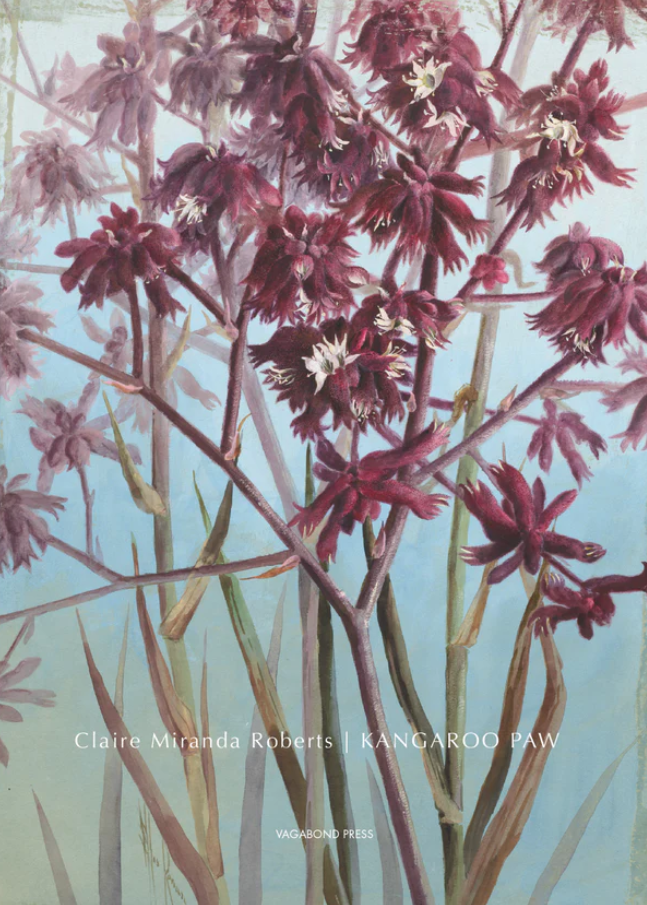
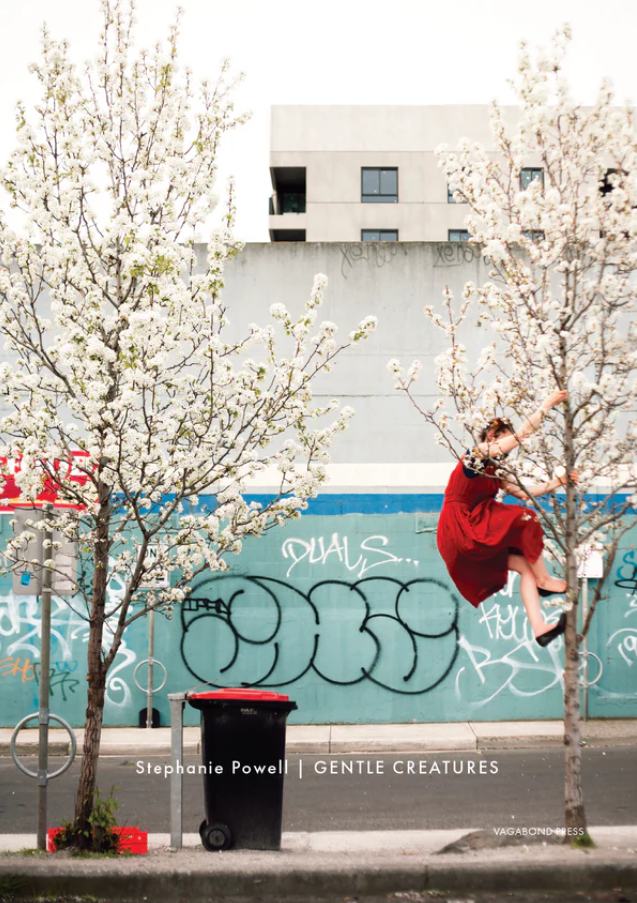
Dior Sutherland Reviews Claire Miranda Roberts and Stephanie Powell

Kangaroo Paw by Claire Miranda Roberts
Vagabond Press, 2023

Gentle Creatures by Stephanie Powell
Vagabond Press, 2023


Two paths unfold. The first, a cut through a mathematically precise study where landscape meets self, transposed over the growth patterns of flora. The second, an expansive suburban saunter through a treatment of identity and memory of place, plotted cartographically. These pathways have names: Claire Miranda Roberts’ Kangaroo Paw; Stephanie Powell’s Gentle Creatures. Both were published by Vagabond Press in 2023. Whichever line one walks one will find that small beauty and close observation dominate the attention of these poets and their intriguing, highly individual collections. For all of their vast differences in style and approach, both share a core fascination with lineage, with landscape. These collections are carried to ends which balance each other and make for a stimulating comparative study. For Roberts, lineage is genealogical and distant, sought after and spun from fragments; landscape is an idea of home obscured by intentional, absent spaces within her formal structures. Powell’s lineage is closer, the second half of her collection is dominated by a study of her own childhood, while the collection opens with a narrative focus on the return home to a familiar landscape after a period of absence.

To begin with Claire Miranda Roberts’ Kangaroo Paw is to become beguiled by sparse, suggestive syntax. In her 19-word opening poem ‘Armillaris’ she conceives a subtle genesis:

duplicate saplings
are shyness—

the extension of
politeness to a stranger.

(9)

There is the possibility that on a first reading, one might rush past what is contained within Roberts’ “clasps / of calyx” without recognising her crisp intentionality (9). But on a second or third reading, the influence of Emily Dickinson becomes apparent, an influence which the judges of the Helen Anne Bell Poetry Award Bequest in 2022 also named. Phenomenologically driven language is paired with tight formal constraints to astonishing effect – of the first 20 poems the longest is only 12 lines, and very few of these lines hold more than 4 words total. Operating as she does in such sparsity, especially in her free verse, Roberts manages to create incredibly vivid images of each flower, tree, and shrub to which she gives her attention. Roberts’ precise language allows her to generate, in so few words, a highly suggestive, emotive tone. Reading between the lines to trace the diffuse, pensive ruminations of the collection, one realises that both content and form mimic unpredictable patterns of growth. Line breaks and white space craft shapes and reveal the poet’s presence. The flora of these poems seem to exist entirely within Roberts’ microscopic observation, but poetic motivations begin to emerge:

If I stay long enough
                                     I may become
everything around me:            many
pinks 
in the dusk

(‘White Jasmine,’ 18)

Roberts’ botanical framework zeroes in on the landscape and its colours, its wider feeling, and is crisp and direct in its force. It discloses much about the observer. Why these colours, these shapes? Why these reflections? There is a somber, melancholy quality to the writing that allows us to feel Roberts’ presence in the field, which is remarkable considering how minimal the interjections of self are within her poems. Yet where contemplations on self and past do appear in Kangaroo Paw, Roberts deftly chooses the moments to interweave them:

Long ago
in a dark land
maternal lineage               twice
             removed
I’m searching for               her
record
in the silt down the           Snowy
River

(‘Tides,’ 12)

My future is                        backward
I should be far from          here
in the opened                     summer

(‘Backwater,’ 11)

The concern in these poems is not only for a feeling of the past, but for familial legacy and its record held by the land. In Roberts’ personal blogspot ‘The Other Beauty,’ she details the genealogical research centered on her third great-grandmother and her extensive search for scraps of family history traced through maritime records. ‘Tides’ translates this research into emotive image creation, “I’m searching for her / record / in the silt down the Snowy / River” (12). This context grants an interesting clarity, but is it essential to understand exactly why Roberts is so intent on observing the natural world around her? I don’t believe so. The mystery adds to the overall effect of reading this wonderful collection, the reader is on their own search for knowledge. Obfuscation and suggestion work hand in hand. There is so much detail which begs for deeper consideration and a vast deal of mystery within the detail, undercurrents of unspoken places. Through a fascination with colour and scent, with shape and impermanence, this collection thrums with life. It is expansive and demonstrates the relevance of tight formal constraints to contemporary poetry. Alongside free-verse, Roberts uses the cento and sonnet forms, as well as erasure. As disclosed in her ‘Notes’ section, she quotes from and interprets other poets’ works, as well as snippets from her mother’s diarised botanical notations, various interviews, the King James Bible, and the Oxford English Dictionary (59, 60). Hidden within this ‘Notes’ section is one revealing disclosure, an allusion “to the correspondence between Walt Whitman and Horace Traubel” (60). To note such an allusion, and work within it, is significant. It demonstrates the certainty with which this work was produced – this is a poet who loves poetry. The collection is at its best when Roberts inserts herself into the botanical world around her, when she engages with the mysticism of the natural world otherwise belied by her tendency towards scientifically slanted presentation:

                       I want to pass
            through trees
into their grey-green
amphitheaters—

their revealing
and concealing effect.

(‘Telling,’ 19)

There is so much at work in Kangaroo Paw which hides below the surface. The past is obscured yet the poet has returned to its locus, previously known to her, and she is changed through methods undisclosed. As we learn in ‘Pact,’ “I thought I knew my past / then I returned / / and I was not / cleared of this place,” we are not privy to the how or the why, only to the familiar dissonance of returning home and being not the same as before (28).

In her ‘Afterword,’ Roberts notes her training as a visual artist (54). As Robbie Coburn discusses in ‘The Human Voices of Flowers,’ his rightfully glowing review for The Rochford Street Review, this training is also, evidently, one of the sources for her mastery over the poetic image. So too the lessons in grammar taught by her mathematician father have evidently contributed to the perfectly punchy use of space on the page. No verbosity here. The artfulness of this debut collection is heightened by Roberts’ level of control. There is a sense of intent which dominates Kangaroo Paw. Claire Miranda Roberts is in total mastery of what she allows us to see, and it makes for a fantastic read. In her own words, “what is a poem? Something we hide the Self within” (‘Afterword,’ 54).

Posted in BOOK REVIEWS | Tagged , ,

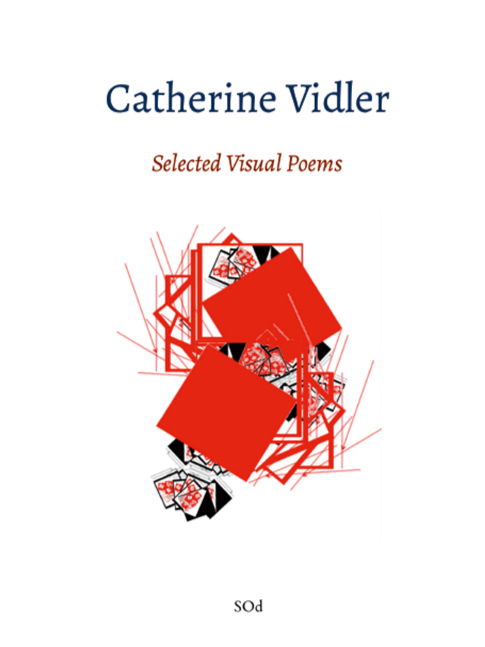
Toby Fitch Reviews Catherine Vidler


Selected Visual Poems by Catherine Vidler
Stale Objects dePress, 2023


In the late Catherine Vidler’s first full-length collection of poetry Furious Triangle (2011), a brilliant book of poems using regular old words, the spores to Vidler’s entirely wordless visual poems can be found. There are experiments in the microscopic, such as through anagrammatic play and her ‘20 one-word poems,’ the latter of which highlights the contradictory and proliferative meanings within single words:

norm wrestle individual nod tribute camouflage whole exquisite intermittent enterprise revelation overtone safari diminish freewheel hear hearing coloured remember footwork (15)

These experiments of “the infinite within the finite,” as Amelia Dale of Stale Objects dePress has subsequently described Vidler’s visual poems, expanded into the macroscopic, through generative experiments in form, such as with sestinas, villanelles, rondelets, and, especially, serial poems (Introduction to Catherine Vidler’s Wings). The first series of poems in Furious Triangle is all about stars, or stars in the absence of stars — a kind of negative suggestion that is at the core of Vidler’s wordless visual poems (where language is disavowed but everywhere). Take, for instance, ‘No stars tonight’:

26: //set the background to no stars
          echo “<ul class=\”star-rating\”>\n”;

*

93: c = *pattern;
          /* Collapse multiple stars. */
          while (c == ‘*’)

*

30: if ($rating->rating == ‘-1’) {
          echo “<li class=\”zero-stars\”><span

(13)

Here, the play with asterisks foreshadows Vidler’s play on Twitter/X, in which she authored the conceptual account The Asterisk Machine (@usefulstars), among other accounts, by posting an asterisk seemingly every day. But more importantly, in this poem, Vidler’s collapsing of multiple stars foreshadows her collapsing of language into a proliferation, or “span,” of shapes, lines, arrows, curls, swirls, and a plethora of other suggestive visual phenomena in her serial visual poetry projects. Moreover, in this poem, as in later poems of Furious Triangle, such as the serial ‘Source code poems,’ there is the emergence of a kind of algorithmic and/or permutational poetics which comes to full fruition in her visual poems (65-67).

Vidler’s poetry has always focused on worlds within worlds, and worlds beyond, and this was picked up on by Bill Manhire in his blurbed description of Furious Triangle:

Somehow she has gained access to a lens which is microscope and telescope at once,
and she arranges what she sees to make poems that are like her own starless night:
‘supple, fantastic, afloat’.

(back cover)

Everything in this quote doubles as a description of her wordless visual poetry: there’s Vidler’s “lens which is microscope and telescope at once.” There’s the way she “arranges what she sees.” And finally, the result of what she arranges: “poems that are like her own starless night: ‘supple, fantastic, afloat’.”

I first began corresponding with Catherine a couple of years after she published a visual poem of mine in 2011 in the online Trans-Tasman literary magazine Snorkel, for which she was the founder and co-editor with linguistics academic and somewhat lapsed poet Nick Riemer. She was its ongoing editor, alongside her husband Nick Smith who did the design and photography. Catherine was always very encouraging of mine and other poets’ work. She once wrote to me about our shared feelings of composing visual poems:

They [the visual poems in question at the time] are a realisation and concretisation and
transformative re-presentation/resolution of one of the most intensely felt personal
experiences that I have had in my life, something which has always been a part of me,
but which intensified and became critically pronounced since having children: It’s the
feeling of being entirely constituted by, and embedded in, the earthy realities of a
corporeal existence, while *simultaneously* being wholly constituted by, and
embedded, in the disembodied ecstasies of the imagination. And as I get older I feel
that this chasm between the two is closing, and I think that in fact the two are actually
one.

(personal email, 2018)

Vidler’s venturing into wordless visual poetry is, from my perspective, an attempt to make one the “earthy realities of corporeal existence” and “the disembodied ecstasies of the imagination,” because, as she wrote, they are one, they occur in and come from the same body, even if our Western philosophies don’t always allow us to accept this reality. In the same email she described experiencing affective states, “flares,” which both triggered and inhibited her creativity.

While Vidler continued to write and publish some lyric poems, her visual poetry went through huge flares from the mid-2010s on. There seemed to be a turning point or transition phase during all the variations of her ‘Chaingrass’ series of poems, the first of which, Chaingrass, published by zimZalla in a spiral-bound notebook in 2016, contains 30 elaborate one-word calligrammes (shaped poems) derived from a Bill Manhire poem called ‘Falseweed’ (excerpted on the title page of Chaingrass):

I saw how breeze in the chaingrass
made the small chains sing,

I began to recall
how the words came knocking.

These shapely and mostly symmetrical chaingrass calligrammes vibrate on the page as if blown by wind, evoking, among other things, memory and music. In an interview with Petrichor magazine, Vidler wrote of the process:

My pieces attempt to respond to ‘chaingrass’ as encountered in its context of meaning
and music […] My personal response to chaingrass is intensely visual. It is also one of
sustained marvelling. The chaingrass pieces try to show this both in their numerousness
and internal permutations. They don’t know what chaingrass is or what it looks like, but
they do know it exists in the world. In this way they celebrate both its mystery and its
presence.

To enhance this mystery and presence, Vidler then took to creating visual permutations of each of these calligrammes, a project that was published later in 2016 as an expansive book in print under the title chaingrass by Stale Objects dePress, who published further permutations in subsequent online chapbooks, chaingrass night & unresolved chaingrass tiling in 2017, and chaingrass errata slips in 2018. The process by which a patterned permutation was made involved the selection of a fragment of text from a chaingrass calligramme using the “snipping tool” (in Microsoft Word and Paint), followed by the application of a range of treatments to that fragment, including multiple pastings, rotations, duplications, re-sizings, re-snippings of fragments of transformed text, re-positionings, and re-arrangements. These permutations were the beginning of her various radical and unique wordless visual poetry series, many of which adorn Stale Objects dePress’s new, and very welcome, compilation of her work, Selected Visual Poems.

Posted in BOOK REVIEWS | Tagged ,

Submission to Cordite 115: SPACE

‘The universe is a grand tapestry of interwoven threads, each one vital to the whole.’ -Katie Mack

What defines space? What are our responsibilities within these boundaries? How do we navigate our surroundings? What are the foundational constructs of our spaces?

I’m searching for multidirectional reflections, poetic and scientific intersections, examination of uncertainties, experimental and theoretical comprehension, lyrical awe, inhabitations and voyages and galactic or distinctive interpretations.


This podcast sheds some insight on how Cordite Poetry Review (and Cordite Books) works.

Submission to Cordite 115: SPACE closes 11.59pm Melbourne time 1 September 2024.


Please note:

  1. The guest editor(s) has sovereign selection choice for all poems submitted.
  2. Masthead editors will also contribute to the issue.
  3. We will only read submissions sent during our official submission periods.
  4. Please place up to three (3) poems in one (1) Word, RTF or PDF document (unless specifically noted otherwise for special issues), with no identifying details in the document itself.
  5. We are not able to offer feedback on individual poems.
  6. Submissions will only be accepted via Submittable …

submit


Posted in GUNCOTTON | Tagged