Scapegoat

I beat my brother with a badminton racket,
bouncing the frame off his calves
until he swings and strikes my temple
with a cricket bat.
My shirt shoots red
so fast it can’t be real. Have I lost
too much? Mum says I need stitches, but
Dad says I got what I gave—I should’ve known my brother
likes a fight.
Mum helps me change:
removes my stained pyjamas, blots blood
with a rag, cups my head
with ice to stop
the weeping.

Later, during morning Mass, I play Christ
speared and limp on the cross. Dressed as disciples,
my classmates cut me down, bind me
in linen and carry me to my tomb
behind the altar.
They deviate
from scripture and drop me
head first onto the floor.
When I rise
to show that sin has been wiped clean,
the blood is real.

Posted in 116: REMEMBER | Tagged

Romances

1.

Remember that Art Deco hotel in Cuba
On the first morning we rose early
before the heat to visit the grave
of that famous poet I forget his name
but he was something of a destination

I can still see the towel you dropped on the floor
the marks your fingers left in the soap
on the shelf in that ornate bathroom
The elaborate plans we made are still there
the lamp beside the bed is still burning

11.

Remember that late-winter weekend in Cork
We’d shunned Guinness for the tart taste of retsina
That small bottle you’d bought in Athens
to drink, you said, on the plane

We sat in drizzle on a damp wooden bench
willing the alcohol to warm us
watched the afternoon’s pallid sunlight
fade in the cloud-crowded sky

It was bitter cold but we both pretended to be delighted

Posted in 116: REMEMBER | Tagged

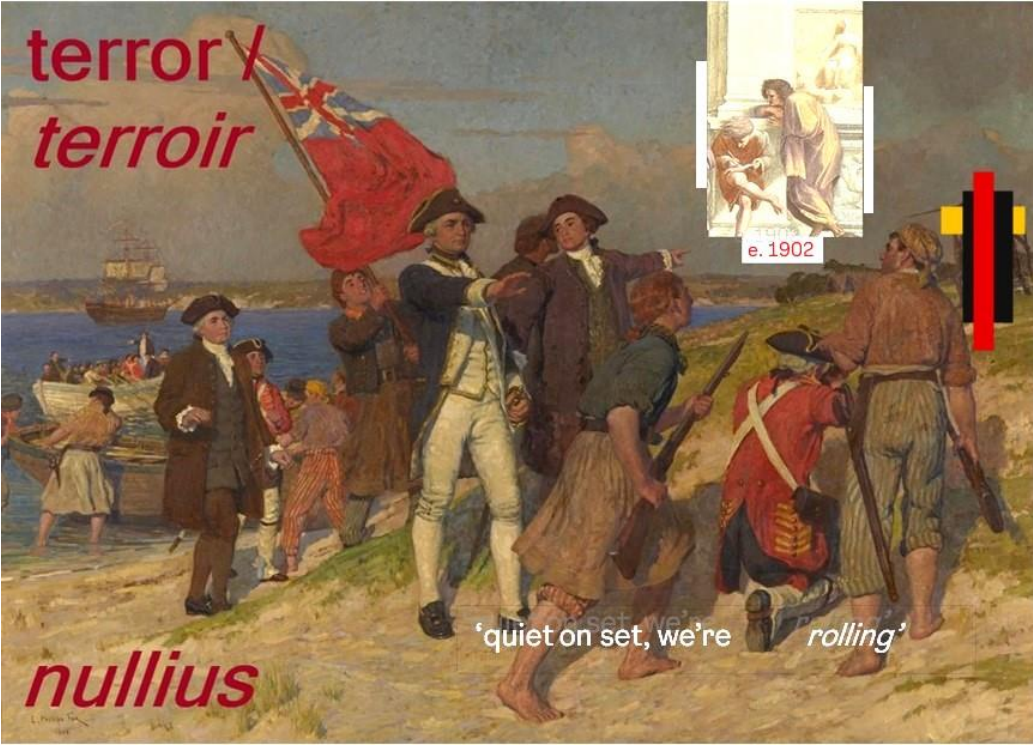
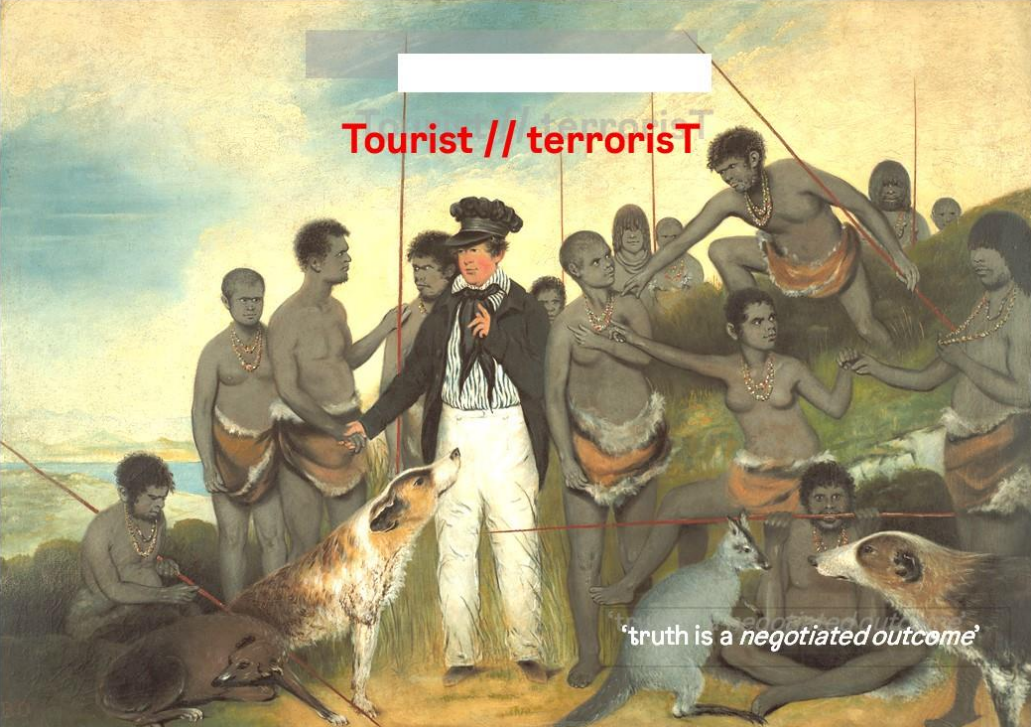
history // painting


*Sources:
E. Phillips Fox, Landing of Captain Cook at Botany Bay 1770, 1902 oil on canvas, 192 x 265 cm, National Gallery of Victoria, Melbourne
(not currently on display, archived in NGV as ‘History and Legend’)
(inset detail) Raphael, The School of Athens, 1508-11, fresco, 500 x 900 cm (approx.), Stanza della Segnatura, Vatican City

Benjamin Duterrau, The Conciliation, 1840 oil on canvas, 121 x 170.5 cm, Tasmanian Museum and Art Gallery, Hobart
(not currently on display, written by art historians as “the first epic historical painting of the colonies”)

(quote) “truth is a negotiated outcome” – Greg Lehman, “Fearing Truganini” Artlink 31.2 (2011)

The font is “Instagram Sans” – a downloadable font used across Meta and associated technologies.

Posted in 116: REMEMBER | Tagged

tha an speur a’ seinn

aroha blooms in wingtaps of rain
(water forgives her sudden vertigo)

the whole world croaks kindness, acacia says
the whole world casts off her tangled net to dream…

a touch that ladles the loss from lungs
a touch that sheds the trenches of time
the slew of subways
the cataracts of forgetting

nighean, river says
(daughter, dreamer)
follow the ministrations of flowers
nighean, mountain says
(daughter, dreamer) nighean, ancestor says
let the ocean wake in you forgive the snow of yesterday

under Monday’s patina, lovers remember their hands
(they touch)
bones remember their birthplace
(they return)
faith remembers her bird
(she sings)
the day carries sky
kisses her on the mouth
(love is a kite in their shared hand)

slowly,
slowly,
life plants seeds in a mother’s palm

& dreams
trickle back to the creek
exhaled from wind
nesting with wheuna
with mother daughter sister sky


note: aroha is Te Reo Māori for compassion; wheuna is Te Reo Māori for land, placenta, where our ancestors lived and breathed and danced

Posted in 116: REMEMBER | Tagged

The Sixth Sister

One of the sculptured female figures, called caryatids, that held up the Erechtheion, an ancient temple on the north side of the Acropolis dedicated to the goddess Athena, was brought to England by Lord Elgin and is presently housed in the British Museum.


‘The wildest of inventions!’ That’s how they describe me after two and a half millennia. A woman, an architectural column, balancing a small temple on my head. A feat, I’ll grant you. But I did not do it alone. We did it together, my sisters and I. We stood on a low wall near the summit of the craggy hill above Athens. We faced south, overlooking our city, head baskets bearing our crown as lightly as the zephyrs that breathed on our cheeks and mussed the folds of our robes. We maidens stood on our porch as in a trance, watching the korai, our earthly sisters, virgins from the best of families as they led the procession, carried the libation bowls and baskets filled with fruits of the forest. Theirs was the honour of carrying the garlands to decorate the bull. Of bearing the sacrificial knife through the city, up the jagged face of the Acropolis to the altar in the Parthenon. And ours, to raise Athena’s temple at its side. My sisters are still there, though now in shelter. They keep vigil over our city, keep watch on the avatars who bear our crown. I am here. Alone in this huge, stony, windowless hall. Tomb, I’d say, if it were not for strangers who stand before me daily, fawning compliments. They whisper about my dreamlike stance—arms clasped behind my back and left leg slightly bent, as if I were relaxed despite the knobbly stump where my left foot should be. They admire my high small breasts, firm beneath my robes clasped at the shoulders by floral brooches. They know my story. Some pity my damaged nose and chin, the gouged-out elbow, the fretted pleats of my robes. Some ponder my abduction, consider me fortunate, safe from the hands of other grasping men. Others marvel at how I lit men’s minds, compelled them to copy me for their own temples. All drift away, drawn to sculptures and friezes prised from the Parthenon, to sun and the scent of rosemary; to the cries of victory that echo in the air.


korai: maiden

Posted in 116: REMEMBER | Tagged

Manifest: Woodbridge, 1843

(for my Great Great Grandmother Sarah)

a bolt of fabric meets a pocket of lace
in Van Diemen’s stolen land

a drunken husband
and children left in Spitalfields

The slip of waves )

o c e a n s of grief wide )
sink
you

setter of sails ) launching )

a new family
patched, from
dregs

& paper boats
billow me

into
being

Posted in 116: REMEMBER | Tagged

Write with What You Have

My mother never was political
One day after six months
our public housing flat olid —
rats cockroaches crooks —
she filled an envelope
addressed to
the Department full with dead roaches.

later we lived in a cul de sac
and sat at night armed with
thrifted hockey sticks
that wouldn’t
protect.

Posted in 116: REMEMBER | Tagged

A History Lesson

In this Mirror World,
this perpetual Freaky Friday,
where colonisers play victim,
and privilege is more sacred than our very Earth,
where guns outweigh the right to a child’s life,
and human rights language
becomes a weapon itself,
where freedom costs lives,
and democracy is bought,
and in the smithy of hate,
wrought into absurd parodies
some kind of Temu Liberty,
justice by Amazon.

But not like the river, no,
nor the forest.
More like that seismic survey vessel
that blasted our seabed in search of oil.
I remember…
when it rocked up to our shores, I thought
“E kii, e kii, Amazon Warrior.
You don’t deserve that name”,
but then I remembered
Amazon is a baptismal name
from a fearful conquistador
confronted by Indigenous women-warriors
on the banks of the mighty Xingu
whom he called Amazons.

And then I remembered
that in their Indigenous tongue,
Amassona means “boat destroyer”.

And thinking back, I remember
how so many said
that in the face of big oil
and Crown power,
there was nothing we could do.
So we prayed to our ancestors for help
and they sent the sharks
who gnarled on them seismic streamers
while we readied our canoe.

And I remember
The words of our people
who sent us to hunt it down
“You must do what our ancestors would have done”
“You must tell it to get out”

I remember,
when we caught up to it,
the sick seismic pulse beneath the deck
Every few seconds
Boom. Boom. Boom.
And so we told them to get out,
as our ancestors would have:
with haka,
we remembered them,
re-calling them
to our side,
and in that moment
we became all of our ancestors
and Tangaroa, too.
And we dwarfed. Their. Ship.
Drowned out their pulse
with our own seismic takahi
to tell Tangaroa
Kei kōnei tonu mātou, e ngunguru nei!
To tell Hinemoana
Ka whawhai tonu mātou, ake, ake, ake!

And I remember
the gift from Tāwhirimātea
of a cyclone
ironically named Cook
(that Atua sense of humour, though!)
And their Amazon Warrior boat fled,
lest it break.

And I remember
how Tāwhiri and Tangaroa
Bore us home safely in their embrace
And that broken-spirited boat never returned

I remember
Two years later, on my birthday celebration
Hearing they’d abandoned their operation
And handed back their licence
And Te Ikaroa was safe, HŪRŌ!

And I thought hmm…
Perhaps you did deserve that name.

In this Mirror World
This perpetual Freaky Friday
Where wrong is right
And peace demands we fight
Just remember when they declare the war won
That in the Mirror World this means
The battle has just begun.
Don’t ever be daunted by Empire
Just remember, across history
It has fallen, many times
To the power
of the righteous many

Remember our histories
Rejoice in our victories
Re-call our ancestors
For across time,
we are the righteous many.
And with our truth
We can shatter
Their Mirror World

(he mihi tēnei ki a Naomi Klein me ōna mahi nānā i ahu mai te whakaaro o te “mirror world”)

Posted in 116: REMEMBER | Tagged

Major Thomas Mitchell passed by this spot on 6 July 1836

Major Thomas Mitchell passed by this spot on 6 July 1936 Major Thomas Mitchell passed by this spot on 6 July 1936 Major Thomas Mitchell passed by this spot on 6 July 1936 Major Thomas Mitchell passed by this spot on 6 July 1936 Major Thomas Mitchell passed by this spot on 6 July 1936 Major Thomas Mitchell passed by this spot on 6 July 1936 Major Thomas Mitchell passed by this spot on 6 July 1936 Major Thomas Mitchell passed by this spot on 6 July 1936 Major Thomas Mitchell passed by this spot on 6 July 1836 Major Thomas Mitchell passed by this spot on 6 July 1836 Major Thomas Mitchell passed by this spot on 6 July 1836 Major Thomas Mitchell passed by this spot on 6 July 1836 Major Thomas Mitchell passed by this spot on 6 July 1836 Major Thomas Mitchell passed by this spot on 6 July 1836 Major Thomas Mitchell passed by this spot on 6 July 1836 Major Thomas Mitchell passed by this spot on 6 July 1836 Major Thomas Mitchell passed by this spot on 6 July 1836 Major Thomas Mitchell passed by this spot on 6 July 1836 Major Thomas Mitchell passed by this spot on 6 July 1836 Major Thomas Mitchell passed by this spot on 6 July 1836 Major Thomas Mitchell passed by this spot on 6 July 1836 Major Thomas Mitchell passed by this spot on 6 July 1836 Major Thomas Mitchell passed by this spot on 6 July 1836 Major Thomas Mitchell passed by this spot on 6 July 1836 Major Thomas Mitchell passed by this spot on 6 July 1836 Major Thomas Mitchell passed by this spot on 6 July 1836 Major Thomas Mitchell passed by this spot on 6 July 1836 Major Thomas Mitchell passed by this spot on 6 July 1836 Major Thomas Mitchell passed by this spot on 6 July 1836 Major Thomas Mitchell passed by this spot on 6 July 1836 Major Thomas Mitchell passed by this spot on 6 July 1836 Major Thomas Mitchell passed by this spot on 6 July 1836 Major Thomas Mitchell passed by this spot on 6 July 1836 Major Thomas Mitchell passed by this spot on 6 July 1836 Major Thomas Mitchell passed by this spot on 6 July 1836 Major Thomas Mitchell passed by this spot on 6 July 1836 Major Thomas Mitchell passed by this spot on 6 July 1836 Major Thomas Mitchell passed by this spot on 6 July 1836 Major Thomas Mitchell passed by this spot on 6 July 1836 Major Thomas Mitchell passed by this spot on 6 July 1836 Major Thomas Mitchell passed by this spot on 6 July 1836 Major Thomas Mitchell passed by this spot on 6 July 1836 Major Thomas Mitchell passed by this spot on 6 July 1836 Major Thomas Mitchell passed by this spot on 6 July 1836 Major Thomas Mitchell passed by this spot on 6 July 1836 Major Thomas Mitchell passed by this spot on 6 July 1836 Major Thomas Mitchell passed by this spot on 6 July 1836 Major Thomas Mitchell passed by this spot on 6 July 1836 Major Thomas Mitchell passed by this spot on 6 July 1836 Major Thomas Mitchell passed by this spot on 6 July 1836 Major Thomas Mitchell passed by this spot on 6 July 1836 Major Thomas Mitchell passed by this spot on 6 July 1836 Major Thomas Mitchell passed by this spot on 6 July 1836 Major Thomas Mitchell passed by this spot on 6 July 1836 Major Thomas Mitchell passed by this spot on 6 July 1836 Major Thomas Mitchell passed by this spot on 6 July 1836 Major Thomas Mitchell passed by this spot on 6 July 1836 Major Thomas Mitchell passed by this spot on 6 July 1836 Major Thomas Mitchell passed by this spot on 6 July 1836 Major Thomas Mitchell passed by this spot on 6 July 1836 Major Thomas Mitchell passed by this spot on 6 July 1836 Major Thomas Mitchell passed by this spot on 6 July 1836 Major Thomas Mitchell passed by this spot on 6 July 1836 Major Thomas Mitchell passed by this spot on 6 July 1836 Major Thomas Mitchell passed by this spot on 6 July 1836 Major Thomas Mitchell passed by this spot on 6 July 1836 Major Thomas Mitchell passed by this spot on 6 July 1836 Major Thomas Mitchell passed by this spot on 6 July 1836 Major Thomas Mitchell passed by this spot on 6 July 1836 Major Thomas Mitchell passed by this spot on 6 July 1836 Major Thomas Mitchell passed by this spot on 6 July 1836 Major Thomas Mitchell passed by this spot on 6 July 1836 Major Thomas Mitchell passed by this spot on 6 July 1836 Major Thomas Mitchell passed by this spot on 6 July 1836 Major Thomas Mitchell passed by this spot on 6 July 1836 Major Thomas Mitchell passed by this spot on 6 July 1836 Major Thomas Mitchell passed by this spot on 6 July 1836 Major Thomas Mitchell passed by this spot on 6 July 1836 Major Thomas Mitchell passed by this spot on 6 July 1836 Major Thomas Mitchell passed by this spot on 6 July 1836 Major Thomas Mitchell passed by this spot on 6 July 1836 Major Thomas Mitchell passed by this spot on 6 July 1836 Major Thomas Mitchell passed by this spot on 6 July 1836 Major Thomas Mitchell passed by this spot on 6 July 1836 Major Thomas Mitchell passed by this spot on 6 July 1836 Major Thomas Mitchell passed by this spot on 6 July 1836 Major Thomas Mitchell passed by this spot on 6 July 1836 Major Thomas Mitchell passed by this spot on 6 July 1836 Major Thomas Mitchell passed by this spot on 6 July 1836 Major Thomas Mitchell passed by this spot on 6 July 1836 Major Thomas Mitchell passed by this spot on 6 July 1836 a j or ho a M tc ell as d y hi ot on ul 1 6 or ho a M tc ell as d y hi ot on ul 1 6 or ho a M tc ell as d y hi ot on ul 1 6 or ho a M tc ell as d y hi ot on ul 1 6 or ho a M tc ell as d y hi ot on ul 1 6 or ho a M tc ell as d y hi ot on ul 1 6 or ho a M tc ell as d y hi ot on ul 1 6 or ho a M tc ell as d y hi ot on ul 1 6 a j hom I t a y h s l 6 ul 1 6 a j hom I t a y h s l 6 6 a j hom I t a y h s l 6 ul 1 6 a j hom I t a y h s l 6 6 a j hom I t a y h s l 6 ul 1 6 a j hom I t a y h i
Posted in 116: REMEMBER | Tagged

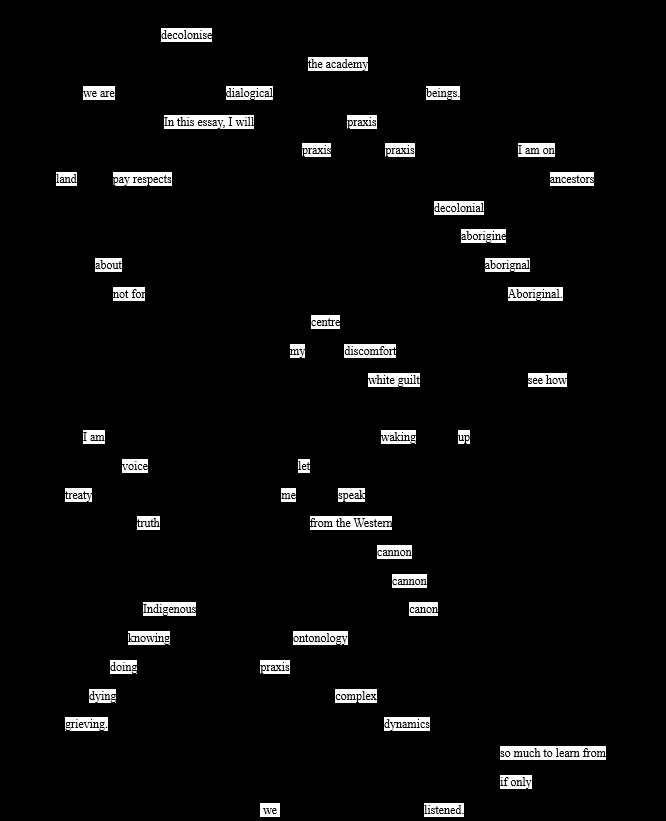
White Gaze

Posted in 116: REMEMBER | Tagged

Palestine as Subtext

Or the things I’d rather write about like…


I. How in Newtown today I paid $22 for a small tub of tabbouleh… and pronounced it ‘tabouly’

II. How thin eyebrows are making a comeback. They should have stayed in the 90s along with the rise of blond boy bands and daytime talk shows (Jerry, Maury, Sally…).
And those ‘boycott halal’ lists? I want to thank them for doing us a solid.

III. How I only know how to drive in Arabic curses…And let’s be honest, Egyptian molokhiye is the one to rule them all. And that whistling: Out Loud. In. Public. is truly unhinged behaviour. IV So is unpacking your bag right after a long flight (every household has one).

IV. I want to write a love poem to the ancestors, first to my grandmother, reassure her that, yes, eventually, I do get married and Teta, you were wrong, because I still don’t cook.

V. My four cats, and how I swear, I swear, each one of them has their own unique personality. My cats are special. And yes, I’d love to show you photos, I thought you’d never ask
How my landlord hiked up the rent…He says, his hands are tied – it’s hard paying mortgage on multiple properties. I sympathise.

VI. Forget thigh gaps. I want an ode to thick thighs. Thighs that rub and chafe, that stretch out jeans and quake the dance floor, thighs you comfortably curl up in, that jog and squat and strike and hold us up with power and pride.

VII. I want to write about Well-meaning White Women™ on NGO boards, and that Julia and Hilary and Kamala are betrayals to feminism, not beacons of it.

VIII. How Mr Big was definitely toxic, how it’s pickles on a burger every time and Team Kendrick over Drake… But also, why is mainstream media obsessed with pitting us racialised artists against each other?

IX. A defence of glamping: a. because you don’t need to worry about plumbing;
b. nor do you need to choose between ‘men or bears’: neither is actually an option.

X. I want to write about my endometriosis, how my doctor said, ‘not to worry about it’ and to ‘put up with the pain’ for five years straight (yes, he is a man). How underfunded it is, how the average time it used to take to diagnose endometriosis in this country was over 12 years (if it affected men, they’d have found a cure).

XI. I want to write about starfish, about crisp, high thread count bed sheets, about rain and rooftoops and roadtrips, and fortune tellers on tiktok and Mariah’s 7 octave range and skincare routines and that single ripe grape, the life-changing Notes app.

XII. Honestly…There are so many things I want to write about, that I’d rather write about.

———————

I. What are words when I’ve never seen so many organs spill onto my screen, into my palm?

II. How does one write about hospital-shaped graveyards? Are bulldozers meant to crush bone?

III. Joseline Hernandez in Ja’Tovia Gary’s The Giverny Document: “What the fuck. Can I live? Can I live?
Can I fucking live?”

Christina Sharpe, Ordinary Notes


IV. Who does this limb belong to?

V. How do you reassemble ripped, shredded, mutilated bodies? How do you count the dead, let alone identify them?

VI. Micaela reminds us no language is big enough for our love for our children, for Ahmed the little farmer who sleeps beside his beloved rescue cat Suzy. Her purrs drown out the drones and the wails, ya mama, ya mama, at night.

Ahmed buries Suzy after they cannot access treatment. We all cry with him.

VII. What is ‘resilience’ when children are skewered on flag poles, their eyes wide open. When a Gazan man desperately digs up his own daughter? She dies an hour later.

VIII. What words when ambulances and aid workers are riddled with 75 bullet holes?
Homes in pieces; somewhere a school bag, somewhere a wedding album, somewhere an empty cradle.

IX. I have all the theory in the world to explain the logics of our erasure, the violence of our replacements and our more palatable Others. […] But no one’s ever asked how we are both colonised by and inheritors of these words.

Evelyn Araluen, “To the Poets”, Dropbear


What are words when poets are assassinated?

X. What’s the word for a son who refuses to leave his mother’s tombstone? He hasn’t stopped conversing with her since.

XI. No words, no euphemisms, no metaphors, no slogans, no semantics, no ALL-CAPS captions, no headlines, no soundbites, no analogies are enough.

XII. Gaza will not be your glossary for a genocide. Gaza is more than a poem.


Acknowledgments
*The first line is a riff off a line by American-Lebanese poet Leah Sammak.

With profound thanks to Micaela Sahhar. I imagine this piece to be in kindred conversation with hers: https://www.liminalmag.com/limifest/inventory

Posted in 116: REMEMBER | Tagged

They don’t remember

they don’t remember
me tied to a tree, rope
serpent constricting
mouth to the sky, tongue praying for rain
later the tree chopped
to make the paper
used to write how their grandfather
was benevolent to me
a loyal servant
highly regarded, smiley
Black name forgotten
imposed name planted in ink
ink that drowned my family,
beneath farmland plowed by my hands
they ripped my grandmother from the ground,
flattened for sheep and wheat
lucky, they tell me,
by a painting in a
golden floral frame
ornate – hung in a gallery
my scars never spoken
by paint, ink, paper, wheat, cane
my welts never protrude enough
to trip passersby
who just eat the wheat they’re served as
it says their grandfather
is a hero who built this town
see his statue so much they forget it is there

Posted in 116: REMEMBER | Tagged

Medicare Wellness Test

Can you tie your shoe, sing a lullaby, draw the face of a clock?

How many times did you miss being younger this week?

How many young people listened when you spoke?

Is there anyone young who still loves you?

Do you have sad thoughts? Do you need help making a meal?

Do you walk around your neighborhood

thinking of everyone that is gone?

Are you unconditionally opposed to building a new stadium?

Do you miss the Institute of Texan Cultures with a fervor

that is almost strange? Do you have trouble remembering

your name, your mother’s name, the name of your

second grade teacher, your shoe size? Do your neighbors

humor you? Have you always had a fervent desire to leave things

on people’s doorsteps? What is that connected to? Do you need

to be liked? Do you miss parking meters? What do you like to do

in your spare time? Is time your friend? Did you draw that clock yet?

Did you give it two hands?

Did you have a desire to make them look like your own?

Posted in 116: REMEMBER | Tagged

crush

How can a body refuse reliving a last great moment of certainty?
I can resist the violence of colonial ideology
but the weight of memory
is another matter.

——————–

your cheeks flush with heat rising toward the sun
so close to God – you tilt at the precipice
of far-right righteous heights

you despise me

my body chills and resists conversations in echo-chambers
and the reverberating hollow spin
of dangerous ideas

I shoot from the hip and absorb the sting
expose all your fallout conditions that officiate
your unconditional love

our foundations crack wide-open
blindsided and no longer so sure-footed
I free-fall into chasms and unfamiliar terrain

enough now – enough!

my line drawn in the sand is bold-font for this particular landslide
a terra-firma erosion to fine-dust
that settles everything

this is a grief story now
I inhale the decay and stifle the choke
the abject that is hate that is heartache that is love

and I love you – but how
do I love you now?

the crush of small epic moments etched deep
absorb future memory as re-memory
of bodies forever on the frontline
to affirm and transcend
and fiercely defend
our flag-flying right
to be human.

Posted in 116: REMEMBER | Tagged

Black Salt

In the space between my fist and my heart
Elongated heart strings
Turn into fish hooks
Pulling me into the space between sand and reef
Between dreams and waking
Between memory and the government of the lived

Here, where we stand against the grinding world of greed
Same colonial plantation bastards
Old enemies wearing new clothes

We hold all that is left in our tired brown hands
We exist, in memory
We exist in vaporous form
In the space between the written and the spoken
In ancestral homelands sitting at the teeth of the hungry ocean

Here, we look to the past
Our eyes fixed to our murky pasts
Before the ships arrived armed with maladies, weapons and with their angry vengeful god
They took our stories out of bodies
And gave it back to written on paper the colour of their skin
The sold us shame and covered our bodies in cloth
Binding us to their phosphides, their tragedies and their unrelenting greed
Now we fight in this untethering

We only dream in the time before
We remember small remnants of who we were
And we sing the same songs
We move to the same dances
Celebrating the loss and trying to remember the essence
We remember in resistance
And we exist in the circular shape of our oceans
Like sharp toothed waves
We roll in and out remembering, forgetting and moving towards the future
Where the colony wont be our reference point
Where our memories and our dreams aren’t tainted by our tortured pasts
Where our gods can sit with us again
And we can sing new songs and dance with our backs strong and faces pressed against the wind

Posted in 116: REMEMBER | Tagged

UNTITLED

The children are still dead. Time
does nothing but keep us alongside, for
time is lonely & jealous for company &
it failed my best boy, left him outside
and stopped in the great solvent, I
wonder if those unseen waves that surge
through the soil ever turned his face
toward her, we didn’t ask her questions,
we trusted our boy with wings, with
golden study & speech, this great country,
our great exhausting hope.
No we burned him.
Put him in a brass box between the
electric candles. My first twenty years
felt like eighty, I look at you and what
do I see. The water is dead. The rock
is dead. We pour out orange juice &
we pour it out. No-one picks you. All
those who have died go on having died,
dying, dying every day.

Posted in 116: REMEMBER | Tagged

Between Memory and Rubble: Returning Home

Rafah, February 2

Mahmoud Al-Sha’er

It is February 2, 2025, which means I have survived long enough to witness a temporary ceasefire. I hold great hope that it will lead to a permanent one.

On this day, my memory is clouded with distortion. What moments could I call normal? If I had to choose between the present and any past moment, I would have to admit that the Israeli occupation has stripped away every infrastructure of normal life I could have had as a Palestinian born in April 1990.

Until October 6, 2023, my challenges revolved around sustaining both personal and professional endeavours—completing the finishing touches on my new home and moving into it, ensuring the continuity of 28 magazine space (the gallery) in Rafah, and maintaining Beit Al-Ghusain, the historic cultural house in Gaza’s old city. I was part of various teams and collectives of writers and artists working to build a Palestinian cultural scene in Gaza despite the Israeli siege imposed since 2007.

Until that October, my dreams and aspirations for the future filled me with hope. I had the power to pursue what I longed for.

Since October 7, 2023, I have been living a life unrecognizable even by the standards of occupation. On May 8, 2024, I was forced to leave my home in northern Rafah after receiving an evacuation order; my neighbourhood had been declared a high-risk combat zone. I carried with me the solar power system, mattresses, blankets, gas cylinders, sacks of flour, bags and suitcases of our clothes, some kitchen utensils, a small table, and our laptops. My sixth displacement was, paradoxically, my return home on January 20, 2025. It now seems like an absurd metaphor—someone re-entering the White House.

What memories do I want to summon now to help me navigate this return? I know the house’s layout, the water and electricity networks. Yet, searching for anything here felt like an exercise in searching my memory for this place.

The moment of return was never imagined—not since I was forced into the unknown, to what the army calls a “humanitarian zone”. On the night of January 20—the night of returning home—I stood for a long time, staring at the ceiling of my room, at the colours of the paint, the curtains, the wardrobes, the bed, the tiles. This moment had never once taken shape in my mind throughout my displacement. The thought of coming back had never accompanied me. Even now, every act within the house feels like an attempt to revive my knowledge of it after eight months of absence.

The house was not present with me while I was forcibly away. I had expected it to be demolished, like more than 90% of Rafah’s buildings, according to municipal statistics. I had expected to be granted the chance to travel while displaced. I appeared reconciled with my experience in every place I lived, spending days and nights imagining futures that did not include the house. This, too, was an essential exercise in surviving the genocide that has lasted over fifteen months.

I remember imagination—imagination as a challenge to the brutal reality of life under the genocide. Fear was a companion to imagination, as were loss, as were bullets, missiles, and shells. In May, imagining the future meant searching for a place within the so-called “humanitarian zone” in Mawasi Khan Younis. I had imagined that as long as I could sleep while fearing the advance of a military convoy, then I would also be able to sleep on the sand, in the street, inside a small makeshift room of plastic sheeting and wood, with a bathroom beside it, facing one of the houses in that zone. I spent the entire month of July there, immersed in dust—dust in my food, on my hands, in my mattress and blankets, on my feet, in the water.

Imagination was my defiance. Imagining a future where the house was no longer an option saved me from the dust that engulfed everything. Imagination was my resistance to reality—it meant claiming life without dust, with dignity, with humanity. Both here and beyond. Imagination always declared peace and shaped pathways toward seizing moments of it. I remember wishing, with the arrival of 2025, that the war would end and that I would survive to experience moments untouched by fire.

By returning home, I dismantled a layer of my existence in that other place—not because the house had collapsed, nor because the genocide had ended. But with the war that had raged from October 2023 to January 2025 now suspended, and with space reopening—except for the 700-1400 meters of restricted zones to the east, south, and north—a layer of existence was peeled away. It was a layer that had encompassed my life and the lives of over a million others in Mawasi Khan Younis, from the places we were forced to inhabit to the makeshift homes, water stations, small stalls, central markets, and transport networks. These were now being dismantled and reconfigured within the limited space made available for people to return to their cities and neighbourhoods—90% of which lie in ruins across all governorates.

I am in the house—my house, my family’s house. This is the moment of surpassing the possible future.

Posted in 116: REMEMBER | Tagged ,

A Memorandum

Ngāti Awa, Ngāti Porou, Tuhourangi


Rememorari from the Latin to re-remember, to re-mind

Memoria memoir from Latin to French to English – memory, the faculty to remember

Membrun membrana membrane from the Latin to middle English- member, limb, part of a body, skin

Memorandum from the Latin – it must be remembered

Treat this as a Memorandum

that will re-mind you of

a time that once existed

of the real

the sensual

the extraordinary

the everyday

record of lives lived before you came to be

a memorandum

from your past

Embrace it in your body

Let it moisten your skin

store it securely in the alcoves of your mind

hold it in your heart, your liver, your stomach

and let it pulsate through your blood and waters

it is in your breath

it is how you belong

it is why you are loved

it is what you must remember

Treat this as a Memorandum

From ancestors

Who lived in a time of recovery

a time of rebuilding

of growth

a time where we felt we could grasp hold of

our futures and heal from the traumas of our past

a time where we felt a turning,

the subtle social change

in those around us and in ourselves

a little bit safer to be who we were

to name ourselves and wear our identities in our skin

our maunga and awa prominent in our pepehā

our reo and mātauranga valued

our creativity and cultural performances

were internationally renowned

when we absolutely came to understand our enemies

and could recognise

the colonial motifs that coursed through their beings

their fear of losing power and status

their arrogance and cowardice

their mean spirits and limited imaginations

of what we could achieve without them

they claimed they had ambition

but it was merely privilege they knew only how to harness for themselves

We came to see the potential of our rangatahi

Those next generations that gave you life

Treat this as a Memorandum

And read alongside the documented records

Listen to the karanga

Allow it to guide you through the grief you will encounter

And welcome you back home

Listen to the poroporoaki

That helped our wairua depart and cared for those who had to bury us

Look at the worlds we created through the arts

That helped our imaginations soar

Watch our performances

Our command of performance on stage

And joy in performing when we were together

Read what we wrote

As testimony and witnessing of past and present

Watch our protests and hear our political discourse

Understand how hard we fought to defend Te Tiriti o Waitangi

How courageous our activists were

Study the institutions we created to protect our language

to educate our people and take care of their well-being

Find out about those who cared for taiao, our whenua, our wai

In the face of constant degradation

Explore the lives of those who struggled to fit in anywhere

Even amongst us

Whose futures were confiscated by colonisation

Who were raised by the state and whose lives were incarcerated

Visit our urupā and read our gravestones

Pay attention to our ages and ask why

Listen to our tangi

When we were embraced by the cloud of pouritanga

Listen to our laughter

When that cloud had dissipated

We laughed

We cried

We talked

We argued

We thought

We dreamed

We loved

We got sweaty

We got angry

We got sad

We became mad

And we became wise

We went to school and to university

We went to court and to prison

We went to parliament and to medical school

We wrote books and made movies

We played sport

We carried our whakapapa within us

We got up as a people

As whānau, and hāpū and iwi and Māori

Everyday, every year, every millenium

Treat this as a Memorandum

For living

Let this memorandum reside in your body

As a memory of who you were and who you will become

Live a life that creates new memories

That will add to who we were and who we will become

Remember

Remember that your ancestors were human beings

They had wairua

They had mana

They did more than survive

Remember

Posted in 116: REMEMBER | Tagged

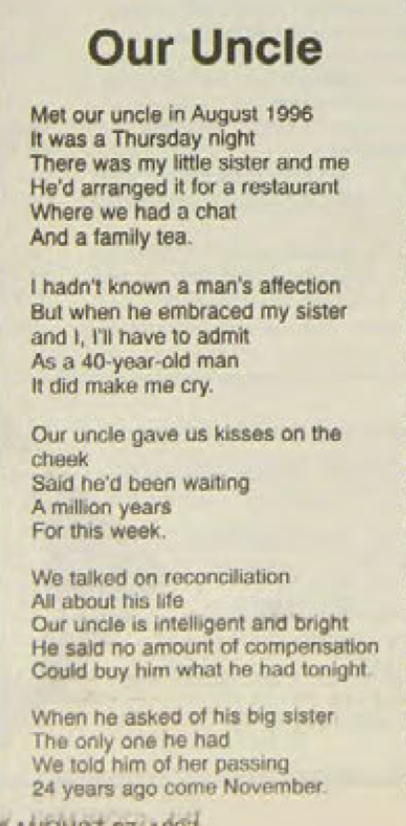
Our Uncles and Old Girls

Our Uncle

Met our uncle in August 1996
It was a Thursday night
There was my little sister and me
He’d arranged it for a restaurant
Where we had a chat
And a family tea.

I hadn’t known a man’s affection
But when he embraced my sister
and I, I’ll have to admit
As a 40-year-old man
It did make me cry.

Our uncle gave us kisses on the
cheek
Said he’s been waiting
A million years
For this week.

We talked on reconciliation
All about his life
Our uncle is intelligent and bright
He said no amount of compensation
Could buy him what he had tonight.

When he asked of his big sister
The only one he had
We told him of her passing
24 years ago come November.

He asked my little sister
For a picture of our mum
So he could remember
He said he had never had one.

He held it to his heart
And wished he’d got to know her
To hold her hand in death
Be with her
In her final hour.

Thanks to the white authorities
60 years has passed
Since our family
Was torn apart.

Kevin ‘Dharug’ Saunders
Koori Mail p.6, no.158, 1997

Posted in 116: REMEMBER | Tagged

Time Wasted

Blinded
Bounded
I waited
Deliberated
And inebriated
I sat in silence for you
Waiting for a hero that would never come
A knight in shining armour
This adventure
Stopped being fun
A long time ago
Timing is of the essence
Time
T.I.M.E
An external force dictating our lives
An excuse for not saving me
Time wasted
Situation abated
My will to not want to play the victim
Was long confiscated
Submerged in my own pool of pity
You stole the plug
absence/ green fairy drug
In your shadow of depth
I learned to strum
A tune played for a fool
I watched an invisible choir
Utilise its glorified tool
I watched them
Hymns anointed
The congregation rehearses
With souls jointed
Singing curses of verses
With feet touching gravel
Confusing the senses
Selling them the gift of flying
While I was slowly dying
In my sleep
Scriptures embellished with
The blood of a king long gone
Wasted love wasted spawn
Wasted memories, though are they ever wasted?
A thought so delicious
That it could be tasted
But who ever really forgets
This princess had not learned to live with her inherited regrets
Her inherited regrets
Paying a debt
of her own not owed
Sins of the father
Seeds well sown.

Posted in 116: REMEMBER | Tagged

A Song for the Māori People

A Song for the Māori People

What sun have you come from, my brothers?
“From beyond death, we’ve come to you.”
What path have you taken
to bring us water, bread, and words?
“We’ve come from the life your people are forging.”
Who are you, sons of the Māori, my brothers?
“We too are from the shores of Gaza,
and from Mount Carmel,
and we too own a share
of the bloodred sunset above Jerusalem’s hills.”

What sun have you come from, my brothers?
I asked them this,
though I knew deep down,
as I saw them coming on threads of dawn,
that they were the sons of the Māori.

***

They said to me:
We believe in your land’s messiah,
the one who was crucified
on your land,
and who, today,
is still being crucified
on your land.
We don’t confuse his mournful voice
—which leads to joy—
with the lies of the evangelists.
And if his voice is mournful now, it’s because
evangelists made it their own
and stole your land.

***

What sun have you come from?
What sun’s heart have you come from, my brothers?
And what sun will fail to bow down, now,
as you take us with you
on lofty paths
to the land of the Māori people?

Posted in 116: REMEMBER | Tagged ,

Can’t Complain

Yeah I can’t complain.

They rely on our ability to forget and forgive. They rely on our batch to disappear so that the next one can be told the same lies they know we’d forget. They force us to forget in order to disconnect and live a life that is thrown at us. Not chosen.

Not chosen, so yeah I can’t complain.

They forget our bodies hold what our minds can’t. Our hearts beat for what our eyes hide. They forget that our brains are not the only memory bank that is left behind. That the blood remembers, and the palm remembers, and the land remembers and…

I can’t remember.

They rely on us having a gold fish’s memory. But did they know that a goldfish can recognise and distinguish between different human beings?

Humans who live to lie and humans who live to die.

Humans who whisper and humans who chant.

Humans who spend and humans who can’t.

Which one are you? Not sure, but yeah I can’t complain.

Don’t complain. If you complain, your name will be in the paper alongside your memory-full brain.

Do you really need a poem to know what we knew hundreds of years ago when the colonies began to grow? How many poems do you need to know to stop a patterned past that leads us to answers they pretend to not know? A cycle of destruction that the weak can ignore but the strong will try and control.

I’m over it all. But I can’t complain, you know…

Actually, maybe I can complain. Maybe I need to complain. It’s essential.

How will the next batch know? Without me, they will not be able to grow because they can’t remember what I remember as much as I don’t know what they will know. In an official statement or out in public cold – I have to let them know.

Yeah I can’t complain because hate and extremism have no place in Australian society. The politicians keep saying, little do they know that we will remember every racist decision and call, no matter if we are here or gone.

Posted in 116: REMEMBER | Tagged

the act

this is a rectangle. it is, i think. i write it around a document that doesn’t exist — the Flora and
Fauna Act
. like a lot of law, you can see only its edges, enforcement, its normative tract. Its
pressed earth impres sive, for an Act that never was.
and yet i rem ember that unreal law, even if i
never ventured into the fog of history to read it. did
you ever? do you? remember its edges or core? i’m getting less sure, less sure.
these rectangles are artless. this poem is artless. i’m trying to get them to certainty. i’m trying
to not contribute to this amorphous wound. i’m trying to not make anyone a fool. it was real to
me, i referred to it before and Aboriginal
parliamentarians h ave read it into Hansard
and others onto events of public formal import.
and i hear it talked about all the time by
people i love and respect and even now
knowing it’s not ‘re al’ i nod along with people
who bring it up at rallies and meetings and
over meals. i only heard it wasn’t real a few
years ago and i went to law school a few times.
and also, maybe it is real in meaningful ways.
growing up, i heard: ‘they treated us
like shit, like animal s’ explaining: ‘we weren’t
human until 1967.’ one of these things is true,
the other one isn’t. so maybe it isn’t true
because we were legally human then, or
maybe it isn’t true because we’re still
dehumanised now. s ay it’s our understandable
suspicion about that law, say it’s gaps in civic
education, say it’s a ctivist rhetoric exploding
into history and memory. does it matter? maybe. when i got surgery on my abdomen, it was
my shoulders that hurt. referral pain, real wound. i writhed in haunt pain. i hurt my neck.
many acts are legal without a law. that’s how their laws work, more often than they don’t. all
things are legal without laws if you have a lot of guns and cars and iron and flour and rot
pointed at increase ingly few people. the Flora
and Fauna A ct
governed their hands. It
doesn’t matter if t hey didn’t codify it and it
doesn’t matter if th e Act was the echo of anti
colonial rhetoric, if you were at the end of
that gun were you m eant to ask as they
ushered you onto a t ruck like cattle: ‘am i
lawfully an animal? a re you authorised to call
me an animal?’? an d years later, how can you
express that de grading power in a way
that made it real? ther e lives its threat, whether
the Act was real or not. ‘sometimes, my girl, you can be made animal’, whenever they want
to. not just intergenerational trauma, not just rhetoric. a parable.
but the Act is still not real. i’m getting less sure lately. i was so sure about the Act, so sure
trauma i s a clumsy word for all
adverse experience, mine anyway. it also makes for a bad archivist, just sometimes, mine
anyway. hedging. unclear. remade ever y time it’s pulled off the shelf, so
sure. a therapist takes me ba ck ‘to the first time’, or tries. i
say: ‘i’m scared of making a human story of my animal fear.’ i’m scared i’ll get the act
wrong, so sure. the scariest thing for me to say is: ‘i don’t know.’
my own lived experience is often useless, like okay. there was no jacaranda around when it
happened
but when i smell it rot now, humectant on your path (an easy and big source
of decay like an infected throat). i get scared. i get a boner i get we t. i animal.
i’m at your very nice house party tr ying not to throw up, trying not to run, trying not
to punch on, cough, hump against my jeans. (he flora on my sensation memory
until i fauna. is this anything?)
please don’t put me on a committee about it. my lived experience advice for almost everything,
like a prey animal, is: forget rest eat forgive fuck run. i already remember
every one. even the ones you love, or i love. i know the y’re special. i know it’s not
fair.
i don’t know. while i’m writing this i’m trying to trace these flies back (did I mention the flies?
no? sorry.), to their maggots, to the dead mouse rotting somewhere in my walls. that’s where
they came from last time. i think.
Posted in 116: REMEMBER | Tagged

I te rua o mahara / In the cave of memory

He kitenga kanohi, he hokinga mahara/ A face from the past brings back emotion.
Tū ana tēnei mātāmua i te tūramarama a Huna/ This eldest child stands under the light of
Huna
Mātai tonu ana ki te whakapākanga o Maurea/ Gazing at the last born of Maurea
He maurea kai whiria/ Perspective is everything
I te ara wairua/ Here in the highway of wairua

Ahu mai ana te kōtiu/The north wind giving directions
Ki te tini o Kirikiri e teretere ana ki tō rātou tāhuahua, ki tō rātou māra pīngao/to the many
grains of sand moving to their dunes and pīngao gardens
Kakano muimui e whakakotahi nei/ tiny particles coalesce.
Me manatū, he iti pou kapua hunga tini whetū ki te rangi/ Keep in mind, a small group
overcomes adversaries

Auē te whakamomori a Ngākau/ Ah the longing of Ngākau
Te kuaka mārangaranga, e rapurapu ana ki te tahuna/ the kuaka circling, seeking the place of
solace
Ahakoa pau te hana i a rātou, he manawa kuaka tonu/ despite being weary they are steadfast
Mā te kōhatuhatu ki te nae/ By way of the pebble in the bird’s gullet
Mā te mahara o Parengarenga/ By the memory of Parengaraenga
Ka whai te au tika, te au pōuri/ they will find the right current, the dark current
Kō atu i Te Ahu/ beyond Te Ahu.

Tū ana te haka o Nakonako/ The haka of Memory begins
Mō tua o te pae maumahara / concerning the dead.

E mau mai ana ngā ture o Pūmahara i te kapu o Te Tai Tamatāne/ West coast tides carry the
rules of Memory in their palm
Mā ngā ngaru e whakaako ēnei kākahu taratara/ These mourning clothes learn from the waves
Mā te kaha a Wareware e pūrua te moko o te onepū/ By the strength of our attempts to forget
the memory is again marked into the beach
E ai ki a Poroa, ka mau tonu te wairua. / As Poroa said, the wairua remains.
E whakapuhorongia ana te kiri ā-mahara e te huene a Takimoana, / The memory skin becomes
puhoro with the ocean swell of Takimoana.

Noho ana au i te rua o mahara/ Sitting in the cave of memory
Kei a au te kau o tō Hinengaro kanohi/ with the pupil of Hinengaro’s eye
E hikohiko pai ana ngā mahara/ memories are fully activated
I te muramura o te ahi, i te aweawe a Maru nōki/ in the glow of the fire, in the influence of Maru
Takahurihuri ana te taihuringa ā-Mahara/ revolving in the movements of Memory
Ka whakatinanangia e tātou te aho tāngaengae o nehe/ we manifest the generations gone by,
Horekau te maumaharatanga mō koutou e ngaro ana i a tātou/ recollection of you all will
never be lost.

Posted in 116: REMEMBER | Tagged