Tsarskoe Selo

by Velimir Khlebnikov

When the Tsars came out,
Because it was winter
Over the roofs of the palace,
Lifting their heads to the stars,
The royal regiment slunk along, like a wolf,
Behind the crowned head
On all fours through the square—
The favorite regiment of the Tsar,
For whom vodka
Was no cure for boredom.

1921


Tsarskoe Selo (the tsar’s village) is a complex of palaces outside Petersburg built by various
tsars to serve as a summer residence comparable to Versailles in France.

Posted in 86: NO THEME VII | Tagged ,

Krebs Cycle

At the point of dissolution, I was wrong.
Anne Elvey

More augur and sere, bloodwood trees raft a mirage
Ahead in the road, a harrier resting on air is breve
not oracle, just resting on white sky filled with heat

Cicada’s rhythm shifts down from sharp staccato
to a dirge, until the whole world falls silent, as though
something has stepped too close and threatens

Tripping a shift, reek of dead kangaroo is its’ only ghost
Our eyes skulk, shadows creeping through shadows
openly flat and shockingly real. This isn’t poetry

You want me to slow down, I want to write to the quick
Space cleared overflows with another, some swarming
ant-like to the rotting eye of a trammeled snake

Tourists come in thousands to see Everlastings quicken
and end in pulsations of wind. Vans wall the highway
Define foreign, the tongue that will say it is your own

There seems to be no grass, until, while you’re not
looking a brushfire explodes and takes what you hadn’t
seen, leaving a smoulder, continuous and petering

In a roadhouse called Last Resort / No Man’s Land
a caged bird swings its legs above its head, ratchets upright
to drag its beak along the wires and a kid dances with it

A newspaper is splayed to a clipped story of the dingo
whelping its own death, poison grafted to a day
two years in the future and its’ dull rupture

Landscape re-mapped by jutting elbows of cats crouched
over blue wrens. No one here calls this place mythic
Voices buried by sound of passing trucks

A controlled burn somewhere and I wonder how much
smoke it takes to cover an ocean. Over the road, two
girls with clipboards measure fuel loads by the acre

Soothsay and spate, as a child finding a natural
clearing in the forest, ground blue with radiations
of Leschenaultia, electric as mirrored sky

Posted in 86: NO THEME VII | Tagged

Beneath a City

Hidden beneath main avenues, bright lights, storefronts, cars, and restaurants lies the heart of a city, the crowded hidden centers bustling to the rhythm of rubbed shoulders and busy feet leading to expansive shop crowded pockets with weaving entrances nestled in unassuming narrow streets, jagged with unplanned architecture, wardrobes and boxes expanding past the sills above the heads of traffic beneath lined with graffiti and fading bills. Each window a life, a struggle, a huddled existence with no personal space flooded with the smell of food, incense, and voices. The same long days laboring with few personal choices replayed in the same way with the sound of an alarm, or with the rising or setting of the sun. Aging furniture, dust, creaking floors, the sounds of adjacent lives in adjacent boxes separated by gaunt cracking walls. From somewhere an infant crying, children screaming in play, a student struggling to make it out from under the cement block among a school of them who will never get away. A single mother, a drug addiction, a suicide, the ding of a microwave, the whistle of a kettle, the din of a domestic dispute. Hiding between crooked doors and cracked windows are the loved and the abused, the wise and the deluded, the faithful and the hopeless upon whose backs the city is raised and who are razed by the weight of supporting ever mounting heights of a never improved view. Because romance lives in the truth, in intimacy, in lives that cannot afford a fictional sterility, lives lived among the early morning sweeping of shop owners and countless men unloading endless boxes of unnamed goods, their coordinating shouts echoing through still empty slanted streets as the fragrances of various kitchens begin to waft into their rightful places just above the noses of passerby. And the midday crowds, the odor of bodies, and the age old selling of wares. The trading of stories, the discipline of children, and the drinking of tea. The training of youth, the counting of tills, and the locking of stalls. And the nights of reverie and personal abuse, of alcohol and late night meals and prostitutes, of the settling of disputes, of the shouts of the overworked and the scurrying of the recluse, of two lovers beginning the cycle anew in shadows of crooked winding walls under thin slivers of sometime starlit skies. And somewhere a newborn cries, and somewhere a mother sister father brother lover child dies, and time passes in front of our eyes, and time passes in front of our eyes as time passively claims our minds and we leave behind a city, not its main avenues, bright lights, storefronts, cars, and restaurants, but its narrow streets and graffiti, aging stalls, winding walls, and its rhythm. And its people, deep, hidden beneath.

Posted in 86: NO THEME VII | Tagged

To sink into a decade

It’s that unsettling uneasy time,
where everything is closed
and people go mad. I fall
asleep as though sinking.
In my dream I email my shrink.
We meet at the hospital.
Not the hospital that stole
my memory, no. It’s the one
that doesn’t lock its doors
and has a hot chocolate machine.
The bed looks comfy—
adjusts to my height. A nest
of baby spiders hatches in the mattress.
Crawl all over me. I am too tired
to move elsewhere. Brush them off.
They do not bite.

Posted in 86: NO THEME VII | Tagged

We Make Lemons

after Allen Ginsberg

You keep your dark light in jars of Vegemite, I keep my chest
air in cans of lemonade and only breathe it / in super

markets. Aisles of tinned goods, sugared cereal boxes
wrapped in all the world just like happiness, weekly

specials, flash sales! A woman smiles teeth—smash, grab.
You keep your dark light sealed in magazines

randomness / but a lottery, we’re not looking to win any. ‘Take it,
some more you want some?’ homogenised / pasteurised—‘Take it

while we’ve got some!’ We try to check it with tinned tomatoes
to take it back to make the cake, but the stuff is out of date

—late too late.

You keep your dark light in cans of mace, tracer arcs
explode fence lines / placards jut the sky—hold the torch

buy, by, bye.

We try to shelter from the rain, plastic bags hang limp from limbs
like magpies, our feathers drip. But our throats are closed to song.

We talk stale with muted breath, Did you see the baby in the sausages?
The poet shot by the watermelons? Did you choke on the – – –?

You keep your dark light in shaded cloth. You outline the moon
in pen and ink underneath the Next Neon Sign, you hide

a spill of rainwater pouring baptism
wet incandescence, mother of the load.

You keep your dark light locked in passing cars, sat on the rug in back
where fox’s jaw crunches bones, there’s more to taste where there’s teeth.

Neon glows too bright on all the words, you—darkening acetone.
The cloth is wet face unknown.

Posted in 86: NO THEME VII | Tagged

Life in the Permian

There is an exhibition about Monsters of the Permian:
they roamed the planet before the dinosaurs.
They look the same to me, with big gnashers and claws.

I need cash. Don’t we all? Lunchtime comes.
I walk with a heavy bag to the second hand bookshop
which buys and sells. I sell only. My library is thinning.

The Permian, all 46.7 million years of it, was jammed
between the Carboniferous and Triassic Periods,
and featured the supercontinent Pangaea. True fact.

I make small talk with Richard behind the counter.
Walk away with my $30, feeling halfway between
20 and 70 million years old in the Mortgagearian Epoch.

As well as reptiles, there were Permian creatures
that were kind of proto-mammals:
hairy little fuckers with mean eyes.

I paid for my children to see that exhibition.
They read wall panels about the great dying.
The gigadeaths of the great and small.

That’s how the Permian concluded: the great dying.
That’s what they call it. Lava floods.
Methane clathrates. Aridity. Acidity. Anoxia.

I search for the two bills in my wallet: a twenty and ten.
Gone. Nothing there. I look again as if
they could magically reappear.

After the great dying, it took ten million years for life
to get back to something resembling normal.
(The hairy little fuckers hid under rocks.)

Now I’m standing in front of a sign
advertising the Permian Monsters,
as I rifle through my pockets, in rage, in anguish.

Then a bit later on it all got smashed again
by the killer asteroid 65 million years ago,
and the HLFs were the only game left in town.

I’m searching for my missing cash
as killer asteroids explode on my head
on this fucking planet, this planet of death.

Posted in 86: NO THEME VII | Tagged

Drawing Straws

I keep seeing things – glancing light on a window
and darkness, the kind you can look through and see
the cold sou’westerly fretting the leaves of the chestnut outside.
Just the night wind has me back at Torbay:
it gusts against the roof and sends me from my bed
to stand between the curtains and the cold glass, looking out.

It starts raining and I think of him navigating those night flights.
The little I know makes him a stranger and I can only
sense the years that vanished when he died.
The space at the table where his stooped head obscured the trees
outside is clear now, yet I see him sitting there unspeaking.

Silence is a kind of tyranny, his broken to pronounce:
life is the accumulation of scar tissue, it’s just pain.
Perhaps it was this that got him through
the time in his mind that dwelt between the rivers
Isar and Amper as Prisoner No. 146708
armed with silence and a small knife he fashioned for himself

to carve up bread so that he could draw straws with the others
for a crust, and know that what couldn’t curb
his hunger was at least scrupulously fair.
This was what he told us of as children, and that when he was shot
down he shouldn’t have hidden from the cold in a haystack.

The leaves on the chestnut were turning,
fallen husks mulching in the grass. It was Easter,
I think – I was small and he old, his head half-shorn.
When I asked he told me the wind blew his hair away
as he leaned from a window.
But what of time without a window or a way out –

opening into cold night and a track through the trees to the river?
Long after all that the chestnut stood bare
until no one could say which spring it didn’t green.
Then someone cut it down, stacked the wood
against the stump and left it.

Posted in 86: NO THEME VII | Tagged

Disconnection

Little one,
I see you mouth empty spaces,
for a mother’s words to fill
and stretch your ears
for the stories and their voices.

I watch your
trembling limbs
ache to shake
in dance
and hear your lungs
as they gasp with songs unknown.

I feel your
body sans
spirit,
ceremony
and secret

and know that
it has been grown
without roots –
away from the earth that cradled you

and I taste the hunger
you do
to know the parts of yourself,
to feel at home
when your
dreaming has been taken.

Posted in 86: NO THEME VII | Tagged

Echidna

Undulant pinecone,
needle-nose sniffer,

I imagine you mountain-size,
monstering a city.

You are harder to pick up than Hungarian,
more stand-offish that a stylite saint.

Little high judge in your wig of thorns,
its pattern complex as a deal in the Senate,

once a year
you queue for spiky sex

then crash burrow-wards
through the bracken curtain.

You are distant as Aldebaran.
Private as euthanasia.

Posted in 86: NO THEME VII | Tagged

Country

Part I

This country breathes secrets
restless wind roaming,
biting at your neck,
knotting your hair.

Trees of old bleed
stories in ochre sap
elegies
for things forgotten.
The dusted shedding of the paperbark;
a raw reminder
of the land’s crude underbelly
its knotted centre.

Sun curdling
the earth at your feet –
Don’t try to deceive.

You’ve already whispered
your sins into the ear of the land,
carved your scars into its belly.

This wind
a nomad,
recognises the curve of your skin
dirt knows where to hide –
in the creases of your eyes,
under the ledge of your chin

This country knows you better than yourself.

You are only
one of many.

Country never forgets.


When the riverbed cracks
under the sun’s hot glare,
when life must battle
for existence,

the past mounts

rising with the sinking water
settling in the mud
scalding to the eye, waiting to burn the feet of all
kindling old senses
stirring old sins
no-one can escape it


The past runs through this country
can’t be buried
can’t be thrown out.


Part II

Tommy knows this place;
can count the times he’s been away from it
on one hand.

Tommy knows the best places to get a feed –
around the bend of an old trunk,
where the roos lead you

Follow them and you won’t be left empty handed.
No,
this country has much to share with you.

If you ask he’ll tell you
where the biggest secrets
lie in folds
where the bush is
thickest
and
the best climbing places to view all up this country.

Tommy breathes in stories of this land
family stories
feels them buzzing about him
written in the mud slapped against the river’s walls
they drop into the air as the muck dries

He’s walked this path all his life,
pausing
where the ground drops
and the two chasms clash together,
where the crags shiver in dusklight,
where the willows weep more loudly

But Tommy doesn’t swim this river,
won’t test these waters,
doesn’t climb that mountain line
the great heights towering,
looming blackness where a generation
was pushed
to the nightdark waters deep below

silver moony reflections swimming for years to come.

Tom has seen the dirty swirls,
felt the shingle underfoot at crossings
watched for carp clap and water slap

But Tommy doesn’t touch this river.
Out West he’ll swim in old Surry River

but not this one here.

Posted in 86: NO THEME VII | Tagged

The Men Who Hate Clementine Ford

Everyone knows one of them, the men who are #notallmen –
They are the ones who have no opinion
just facts and considered views, which they cling to
like a real estate agent to a slice of ocean
who fantasize about swooping down on a vortex
of social media feminism, and dispelling its force
with a single tone-deaf injection of reason, like:
‘are you aware that men are statistically more likely
to be assaulted’ or ‘funny that no-one wants to discuss
male suicide rates’, lamenting Clementine’s swear words
and pitting rational debate against hysteria
as if explaining the mechanics of a carburetor

They are the ones who take it personally
like a kid who thinks his sister got a bigger
serve of ice-cream. Who won’t recognize
the behaviour Clementine condemns
because it doesn’t come from them
because they love women, their boss is a woman
and they always leave the toilet seat down.
Who squall about equality as they brandish their
hashtag syllogisms, as if feminism were a
false premise because it does not attend
to the rights of men, and how dare she

post a man’s private message for all to see
the man who writes: ‘You should be raped
you fucking man-hating feminazi’, before
pointing out that she is too ugly to be raped
as if to be raped could also be a compliment
reserved for an attractive Tinder date
the man who utters pig, dog, slut, cunt with red-eyed relish
as if each noun possessed a natural equivalence
whose private words sit nestled to the right
of his profile picture, where he smiles
with cheeks pressed to his two daughters

And when I stare at these men and their belligerent eyes
set in a frozen Facebook smirk, I wonder
how deeply their male gaze penetrates
what they see when they look into the eyes
of their wives while they thrust inside them.
What do they think when those daughters
grow into their limbs? Would they rather protect
their girls from women like Clem or men like them?

They are the men who think women can’t be funny
who assess a woman’s body as if it were a work in progress
an architectural draft of their dream holiday home
who are incensed by Clementine’s red lipstick
because her smile is not theirs to own
because they hate the idea of her, the idea of a woman
who renders them irrelevant by giving zero fucks
who speaks their unspoken assumptions, inviting them
to prove her right with every toxic rebuttal

They are the man in the bar who plants
his fat keys on the table and stands
with a thumb hooked over his belt
drinking his beer in slow, measured draughts
who wants the women chatting near him
to feel the weight and heat of his presence
who thinks it an affront if his boozy desire
is not acknowledged, yet takes offence if it is
because he was just trying to be friendly
who thinks his reflex quotidian leer is a compliment

because his desire needs to be legitimised
and could be, with a simple titter
or a smooth palm on his forearm
so just fucking lighten up, why don’t you?

They are the man walking towards me
on the footpath, on a clear blue day
who will size me up and then bunch
his doughy shoulders, and keep going
gun-barrel straight, eyes aimed at the edge
of my temple, like a misfired gaze
inviting the collision, daring me
to be the sort of man
who hates Clementine Ford.

Posted in 86: NO THEME VII | Tagged

Restless

I’m restless about affinity There’s a form
of am in every dream Stress prevaricates
Aniseed lingers You can be too fond of fences
making shiny choruses Air is a treasury
The horizon fills with shallow light
There’s devil in the air and everything’s
forgettable or repeated by cheer leaders

I failed at being a host as crumbs kept falling
My wounds itch on the right-hand side
and I made lines break like bones
that made me reel

Form is simply vanity I contemplate the heart
of each vegetable How do you say what to say
Genius is like terror You can never be that jolly
with scattered feet The old bush had to be dug up
There’s too much noise Worry is a form of idealism

I fret each dirty line The horizon fills
with self regard or the last light on the gum
which is a pink glow you can only see

I revise my chemistry I argue with stairs

Posted in 86: NO THEME VII | Tagged

untitled

I.

the idea of a productive morning          an ideal of productivity          a man walking on 

the beach in the early light                     I become a space into which his care pours   & 

so am lifted out of poverty          the family wander elsewhere          in the first home 

without others, a cactus bloomed in the backyard          a night-flowerer          & the 

noisy miners swooped the dog 	

II. in the sun reading about a winnicott case a boy who obsessively tied furniture to other furniture with string an attempt to ameliorate fear of separation, desertion you are a representative representing self & we are all bodies & desires pulling at chairs tethered with string
III. counting the days between letters small events take on too much meaning (perhaps others can smell this) the strangeness of this practice, the realisation that no one is keeping track that here one can do anything one wants around you I am inevitably trivial & thus strangely peaceful we reach for a device & form a window
IV. what was reserved & parched opens (a masculine-flowering) noting delicate acts on television I watch a man lift his hand from where he was touching a woman his hand is covered in blood she begins scrambling for the date his face softens with surprise that she contains such redness, such vitality another program & the most tender act I have ever seen on television: a man putting makeup on another man while they talk softly about their lives
V. I suddenly become afraid of losing my notebook, of losing track in the post you arrive surrounded by red, a fragile packet everything turns on a number & a series of arrivals, always delayed, awkward, charmless so I speak less & read more & with the dogs inhabit an unbroken weekday quiet on the bench they lean their dog bodies against mine scenting the air we consider the backyard and it reflects back to us green always more green our companions, a leaf-curling spider, the buzz pollinators & a magpie lark who walks the pool cover like a waterlily
VI. in the night vegetation is removed a sandstone wall is constructed to keep tides out of lounge rooms they've trucked in 
beach sand the environmentalist says it will only work for now there’s talk of compromise the casuarinas ghost & the commelina chokes garden beds I am struck once more by your fear of sentiment is the goal to write like you? to erase the self push up and up a relentless stripping
VII. today more reading: an author who says hugging a eucalypt is like hugging a horse’s neck I tried it, it’s true firm life against your cheek the other day I saw a journal that said no poems with birds I told the wattlebirds out the back they said fuck that I told the sky it said so much life against your cheek feathers cambium green blue
Posted in 86: NO THEME VII | Tagged

from , et c-

Is it true that somewhere
the plum trees have happily blossomed?
Yi Saek (1328-1396)


(i)
bee vertical
her flickering eye
enlarging

hindwing shadows
skittering the bright
3rd storey dirt

-edged aerie >>> trucks
gearing down
into dusk’s gold

overtones (looping script on autoplay)


(ii)
you umderstand?
we jabber, jabbing
phone translator apps

surveying the non
-silence, stumbling
our conversations

architectural
>>> her, me, Samsung,
wind, brickwork, err

-ings, birdsong/ the sunshine & glass façades


(iii)
joint pain, teeth
grinding along
in the adjoining room

she is cross
-legged, meditating, 4am
upright as a stork

in tatami fields, breath
-ing entirely in 3D >>> o
possibilities, in

-finitudes & distance


(iv)
our neighbor
Lung Biscuit
(informal) hunches

through the weeks >>>
scowls ‘yeah’
to our hellos

in the basement
of his
bony-shouldered shadows

‘thinking, thinking’/ fuckoffificatorily


(v)
‘birds, skζwårqnψg
in bird language
& the leaves ru

-stling [sic]
in seasonal grammars,’
we think, touching

our thoughts with thought
& all the sky
a morning’s bluescreen

/ flock of cadence harries past

Posted in 86: NO THEME VII | Tagged

La Petite Mort

Buried in the same plot,
a thousand years breathless
in an earthen mound, no decaying
skeleton but still one hundred percent
human, all flesh and blood here,
hips quaking headstone,

yes, we are ridiculously human,
pausing to lift head for a gasp
of air, mouthful of lipstick teeth
smearing thighs a reddish-brown,
kicking off heels and legs writhing
to unravel fleece-lined stockings,

tearing seams with knees beneath
white cotton sheets, and sometimes
her curls catch in my mouth, we laugh
at its silliness, or her earring catches
my hair, two femmes tangling
teach you hair’s perils,

she can unclasp my bra in darkness
from above or below, but I’ve got to flick
on the lamp, turn her around, it’s wildly
unsexy, ponytails tossed across bedroom
as her low voice strikes lightning between
my legs, tectonic plates shifting in veins
as I settle forever in her breasts.

Posted in 86: NO THEME VII | Tagged

September 27

The sky is an Arabian shepherd
and the moon is wet to the bone and the sheep
are grazing on the gold fish side of the mountain
like a creek made of clouds.

The sun is a little parlour guitar playing along to
a whole can of dandelion flowers
in silver costumes.

I am an aeroplane free!
It’s a good day for flying
into a lake that’s frozen
like a cracked haiku.

Posted in 86: NO THEME VII | Tagged

Stasis at Oxford 130

Today is a good day to die in a freak garden accident: fall back
onto the spikes of a giant agave, say, & expire in its healing
embrace. I’m 12,000 miles adrift from what I used to call home,
mainlining a long macchiato. A street-kerb café: an old woman
sits two seats to my left, her bun in an eight-legged spring clasp. Blue
plastic tarantula, clamped to the back of her head—or that thing in Alien,
sucking off John Hurt’s face. A blonde in a yellow bikini smiles up at me.
When in doubt, offers her perma-tanned thigh, make lists. Enquires
her left breast: Are you ever truly satisfied? Five new ways to achieve
orgasm
. Are these connected? Sure, breast & leg, but lists & lust?
I’m in doubt. Make a list. Recent addictions: weather reports,
Marmite, coffee, misery. You see, today my marriage broke up—
or was it yesterday, last month, a few years back—the moment after
I said ‘I do’? I open up Cosmo bikini girl: read an article on how
to de-tox. So easy: starve until you hallucinate, then drink a week’s-worth
of pond-weed. Maybe it’ll de-tox your body, but that’s not enough,
I need it to nuke my mind. Ten years. No wonder my brain’s peeling
out of my skull—it’s a lot to purge in one go. But this city’s
made me learn how to drink really slow, I’ve majored in reverse
caffeine velocity. Too much & the pavement comes up to hit me.
Too little & the pavement dribbles away. So I’ll have another, long
& strong, no sugar, definitely no spouse to go. Top breakup bands:
Keane Cowboy Junkies Everything but the Girl Coldplay

Noon. This city is a corpse, ants running along its length. Today
tastes of grey, not yellow like Mondays used to. The tinge
of my world before love got to it. I remember when we coloured in
the days of the week, rainbow, rainbow, rainbow. So, I’m trying
to find the yellow again, I’m just taking apart my brain,
to see if it can be fixed. Brains look like cauliflower—
would they taste like one? I tilt my head, hear the patter
of tiny synapses. No wild brine to smell. Actually, not so much
like a cauliflower—more like jellyfish. Rhopilema hispidum,
a giant grey light bulb washed up on the beach. Somewhere I read
jellyfish don’t have brains, instead their whole skin is a ‘nerve net’.
That’s how my skin feels today, an electric web, I can light whole worlds,
I can hear through walls. Across by the ATM, I tune in to the queue.
One man is telling another that his dog just died. Ah well, if you’re gonna go…
that’s the way to go. Just four hours where he was a bit … unusual
.
That woman sitting opposite, she’s thinking I cannot find
a way to mend the breeze
. She looks at me like she’s watching
a documentary, and I’m some country she’s never been to. I know
how she feels. Last night, my taxi driver’s name was Jack.
Chatty Jack. He smelt like the ex before last—same strange twist
of scent, the melody’s been left out, only the bass notes boom.
Jack’s in love, ten weeks so far. She lives in Hong Kong, has a daughter,
no visa, he’s giving her $6000 a month, hopes she’ll come over
for good. She wants babies, but at 32 he reckons he is getting too old.
His mother is ‘appalled’, he’s not sure, thinks it’s for real, but I can tell
he’s faking it for every fare. He’s got nothing, Jack. Like, I’m an expert
in love—a used car with one careless lady owner—Fiat, Subaru,
Chrysler Jeep, Holden Commodore. Loss is a cockroach that barrels
to the back of the throat, & sticks there. We start off as plump balloons,
end up as rags of rubber, lying on the floor. 3.15pm. This city.
How it thickens, its arteries clotted by cars. Today I woke
as if I hadn’t killed my laptop the night before, & then the memory
came rushing in, filled me with cold green ocean. Sleep makes me feel
like yesterday’s life is part of my violent dream. Waiter! There’s a face
in my coffee. I don’t want this one, bring me another. Grief gives you
a glassy look—a veneer which stops germs getting in & poison
escaping. You see yourself in a photograph, wonder when
you got trapped in its frame. It’s like looking through the wrong end
of your mind, seeing Earth’s dark side instead of the sun.
Recent discovery in space: a planet with four suns.
Dr Chris Lintott, University of Oxford, tells BBC News
—it’s absolutely not what we would have expected—
but that’s where he’s wrong, the unexpected happens all the time,
always has. Planets sprout suns. Orgasms are achieved. My head
is a caulifish, growing jellyflowers. Time for some brain DIY.
I’ll borrow some knives, sharpen up for surgery. Look at that—
daytime moon. One crazy bird, knows she can’t hang around
any more, she must fly behind clouds, without a map, with nothing
to lose but rainseeds, & I’ll be left behind in the hollering dark,
mopping up my rhopilema, making it into trifle, which will get up
& dance with me, do the cortical waltz. One two three, one two
three, three—to—none. List of favourite proverbs:
can think of only one, don’t even know how to say it.
Mōzhe shítou guòhé. Crossing the river by feeling the stones.
But the river’s getting deeper, stones are crumbling.

I’m rushing headlong to nowhere. I want to be an ant,
they live in nomadland, don’t care how many suns it has.
Three—two—one? 5.35pm. All those ants on the freeway,
they’re heading home. Someone tell them: wherever they left it
this morning, it won’t be there anymore.

Posted in 86: NO THEME VII | Tagged

Staying Alive

in memory of James Peden

Massachusetts

The first homegoing song I knew, though I didn’t know where it was they wanted to get home to. I was new in the class, transplanted from a Chinese school and learning the strange faces, the new voices, all so foreign, unlearning the Chineseness that I had worn for three years, the old badge and uniform now put away for a foreign tongue. I was an émigré outside of everything, of my life, the class, Mrs Ravi, beautifully sari-clad, twisting my ear for not declining the verbs right – go, went, gone, sing sang sung, not knowing the grammar of time, the alien language that was slowly, mysteriously mastering me, turning me a stranger to myself, an exile in longing for what I could never call my own again. Then I was in the Scouts, learning this song, the melody, the words filling the valves, the instrument of my body, and when no one was around, they rolled off my tongue, trailing after that tremolo-edge, the pitch where for a moment you sense the missing key, the way back, the way home. It was as if they were always there, the voices, their song waiting for me, as I got up at dawn for the school-bus, as I waited for my errant father to show up and take me away from the school of strange faces that seemed so at home, happy as you are meant to be in childhood, from the hours of brooding under the saga trees fringing the school field, their glistening red seeds bejeweling the grass. The lyrics entered me, like the birdsong billowing the spaces of wandering branches, the chant of afternoon sun lighting up the lungs of blue-green air, words I barely understood, that place longed for not on the small, altered map of my life, but somewhere far inside me. The words rose up like an anthem, a credo, as the Scouts sang their medley on the school stage, a concrete platform under the rain trees, their yellow flowers dusting the grounds. I can see the khaki-clad boys, mouths agape as the harmonies grow to a pitch and key of love their small bodies will in time be tuned to, but now they struggle to hold the notes, and I am with them, carried on the one voice that commands us to grow up, and know the pain, the loss that will wrench us out of our boy-bodies, the words a mantra tugging, pulling us out towards that loss larger than our lives put together, and Massachusetts may as well be a distant star, but there we are aimed, ferried on the voices, on Robin Gibb’s tremulous falsetto, searing, soaring, the home-and-love-sick words taking me far beyond the cold, alien spaces, to wherever the song is going.

To Love Somebody

A few days after Maurice Gibb’s death Jim told me he wanted to beat the rare form of cancer that was eating up his body, laddering up from the bottom of his spine. I knew he couldn’t but he wanted to believe, wanted me to believe, even when the grenade-shape lump detonated, and splinters lodged in his liver. It must have been just after Robin Gibb followed his brother Maurice to where the music stops. A cold knowledge set in Jim’s hazel-green eyes, and you could see the end in them, a dead wintry light consuming all the summers larrikining in the bush, its silent chords eating up the spirit, stilling the music in his drummer hands. Jim said he would never stop writing, never let the cancer swallow his words, his memoir, and the coin-bright memories of his Glasgow childhood, and then a Ten-Pound Pom on a ship sailing through the Suez, a blurred scroll of ports, Aden, Colombo and Singapore, before going down to a strange new life growing up in the bush in Wallsend, never at home again, not even after losing his Scots brogue. In his last drafts, his father was coming back to him, in ghostly words, in sheaves of handwritten notes: a father who never spoke a word about Alamein or Normandy, whose mute medals were all Jim had of him. Jim was going to complete his memoir, deaf to time and death working their inscrutable beat on the drumhead, their soft taps gathering pace, but he was never going to work his passage back to South Africa, as he did at twenty-five, joining a combo on a cruise ship, nailing his drum-kit to the stage, the liner pitching on heavy swells; he was never going to find the letter to Livingstone he had interred at a spot in Victoria Falls. Never going back to Glasgow. Never going home. But there, in my office after the last workshop of the year, in the diminuendo blue chords of winter light, it was Robin Gibb he mourned, and Jim said “To Love Somebody” taught him what love was, what it is to throw yourself into the pitch and roll of song, the pain so pure, the key of lost love tuned so high it is electric, and you are wired, a struck bell tolling orgasmic waves of longing, the loving and dying welded in one breath. Once, he showed me a photo of himself in ‘75, slim, in a flowery shirt with dagger-lapels, and beltless flares, drum-sticks in hand, his first gig in a Newcastle club, looking like a Bee Gee on the cusp of the disco age, the life of music and the music of life all his for the taking. He loved Robin Gibb’s supporting harmonies, steadying Barry’s wailing falsetto, the way the song shows by not showing what it’s like to love. I can see Jim’s ashen face, his oatmeal skin, the tears held back, his body shrunk, his belt tightened to the last notch, death’s knell loud in the silence between us. I can hear Jim as the record spins to the song, sitting snug behind the drum-kit that has travelled with him to the last rented place, hitting the drumheads, double-kicking the bass with bolts of longing, the room filled with the last flare of living, plugged into the wail that is like rapture, like searing pain, the fuel, the fire, the force, like nothing I will ever hear.

Posted in 86: NO THEME VII | Tagged

Snow

The snow turns our year into white noise. Like the echo chamber in your noise cancelling earphones, the bliss is whitewashed with flurries of snow. My body becomes powdered chalk; your touch is desiccated. On First Night, I watch the ice sculptures outside the Copley Plaza Hotel and wonder how many days they’ll take to melt. When the temperature increases, they’ll shrink into grotesque stumps and become puddles of dirty water. I try to remember your warm hands on my back, my spine liquefying under your palms, but the December chill numbs me through my blue coat and pink pom-pommed hat. As I lie down outside Trinity Church to make snow angels, I see ice crystals free-falling. My words become the fine rime on their backs.

Posted in 86: NO THEME VII | Tagged

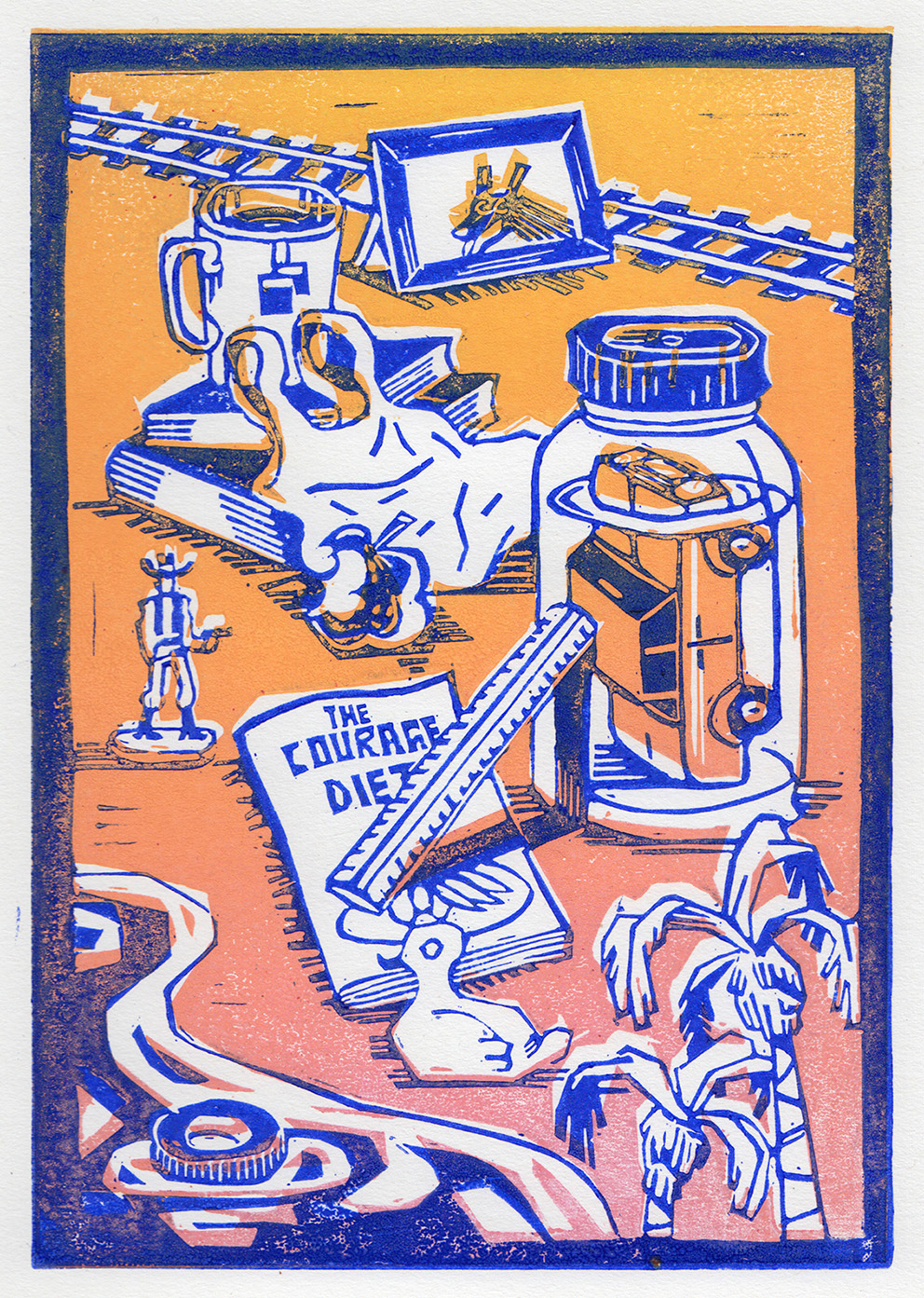
The Courage Diet

Posted in 86: NO THEME VII | Tagged

famous writers … and what they wore

sometimes i think of people as looking
like pam brown
sometimes i’m actually thinking of
helen garner
sometimes maggie beer
who i try keep out of mind
as best i can but she
often sneaks in any way

i see a person in the park
they look like my grade prep teacher
she passed away recently and her
stuff – bookshelves, dining chairs –
were put on the nature strip
dad saw them when he was
doing his route
and asked me if i wanted any of it

i see someone playing giant jenga
and he looks like atticus finch
he’s kiwi and has tattoos and he
gives me a cider
because i can open his bottle

i go to sydney and i see
pam brown wearing an army camouflage jacket

luke saw helen garner at la trobe
she was feeling a little faint
i thought i saw helen garner at the zoo once
in the butterfly room
but i looked over to my niece to make sure she was ok
and the vision was all of a sudden gone

i see jacky from high school on the train
she smiles at me
she’s wearing a black dress
thinking about abstract expressionism

sometimes i see industrial zoning
and i think of javant biarujia
i think of peter bakowski’s famous
beret…………………
on the highest shelf at
hill of content bookshop, shimmering
then i feel that if people, generally, looked more
like ania walwicz
our cities would be more beautiful
in an interesting way

i’m going to the movies
and i see some guy who looks like
georg grosz
and i get to worrying
he looks like a beware of the dog sign

on the bike path i think i see warren whitney
miss that guy, what a good face
remember him wearing a free palestine
t shirt and shorts
bashing the white board with some new idea

sometimes i think of marty hiatt as
looking like a seal
other times as looking like a
disney cartoon prince

i like to think of pam brown
working as a postie in some golden year
wearing hi vis
picture this in melbourne because
i’m a narcissist

i think of pam brown going to school in america
and meeting eileen myles
they probably wore
normal things
t shirts, trousers

i think of writers not as working class
but as middle class
without the steady money
at least i think i see things this way
my ideal job is working at a personal computer
in a giant, bustling room of people
and instead of doing my work
i’m writing poems

i imagine the working class not
as you say
in offices, but in factories
pate factories to be precise
i imagine shakespeare
wearing something irrelevant
to match his plays
as he does the visiting rounds like a storm

he’s no longer even into those ancient stories
even in a form that is possible to understand
by normal people
and we don’t care who’s putting it on!

if you give shakespeare to a pate factory
say, in narre warren
they will probably churn it into the mix
along with the chicken livers and the peppercorns
i think of pate as kind of like d h lawrence

sometimes i think of people
as looking like d h lawrence
when i’m walking up a hill on some
generic holiday
and they do not wave or flag me down
and i run on

Posted in 86: NO THEME VII | Tagged

Driving to Broken Hill

Distance—continuous, ungestured. Crows
on fence-wire-watch stretching into a haze.
When a kestrel hovers it’s an abundance—
like water, or a horizon with a hill.
We pass towns, streets written-off by dogs
and half-asleep dreamers. Those who live
at the edges here must have put aside
all satisfaction; mile after mile of paddocks
full of saltbush and wrong conclusions.
The heat keeps drawing wobbling lines
parallel to forgetting. We think of rooms
by the sea as we drive, no props in this theatre
of emptiness, only a whistling kite
or two, trucks hurtling on interstate haul.
At dusk, more kangaroos, unblinking,
holding their pose, stunned into road kill—
the highway’s only intimacy. We hear insects
smack against our windows with thwarted
wanderlust. The horizon glowing red
is not what we can attach desire to, though
perhaps a sky strung with starlight, a vault
of curative silver, will be enough to ease
the choking flatness, the ubiquitous dust.

Posted in 86: NO THEME VII | Tagged

The Patience of Affixes

Within the half-life of affixes
in the grey gap between pre- -suf
are thoughtlings swimming to the surface.
In winter needs must break the ice with battered noses.
In summer they leap and dive with paeanismus tails.
In breeding season they lay blue eggs:
un- closes shells, com- opens, em- -en squeeze the juices.
In time they mature to -ful
then beach to wait some more

Posted in 86: NO THEME VII | Tagged

Plague

i)
Walking in white socks,
you watch the black dots jump
and stick, trying to feel their way
to where the blood is easier.
Somehow they don’t sting
and pinching them doesn’t crack,
instead your blood is there
on your fingertips and their legs
keep wriggling. It’s been
a half-formed day, overcast
with fire-smoke and no change,
the wind still blowing strong easterly.
Under a microscope, every part of a flea
is visible, even the sucked out
parts of you. It’s a waste,
the time spent calling images up,
trying to know, when the answer
is a can let off on a sheet of paper,
an hour spent vacuuming up the bodies.
Imagine being able to jump
twenty times your height,
and suddenly finding yourself
stuck to the ground.

ii)
Sleeping in the basement to avoid chemicals,
there’s a rustle over the din of wind,
a mouse runs across the floor.
Where there’s one there’s more.
There’s a desperation I’ve noticed
in my voice, that’s like that scrabble.
It can’t be bourn. I’m here to be alone,
away from listening to women talk to men
with high-pitched hostage gaiety
“please love me, let me love me, don’t leave me”.
In a plague there’s hundreds of you being born
and dying once food runs out
or when the whim of something bigger
decides it’s had enough.

Posted in 86: NO THEME VII | Tagged




