The Cracked Vase

The cracked vase
humming its one note to the dust—
te hā slips through its ribs,
the breath of what was held still moves.

Somewhere, a word breaks open:
awa, remembered by water,
reeds recall the pulse
of hands that shaped their name.

Belonging flickers here—
where tongues cross like tides,
the mouth a horizon splitting—
each word a small act of creation.

Each shard sings whakapapa,
each seam holds a name half-remembered.
Ko wai au—
the question and the answering pull.

Even in fracture, sound endures,
hā carrying what light neglects,
a fragile song, broken sing,
a heldness remade in listening home.

Posted in 119: FIT | Tagged

Still Seeds

Daughter, drink the bitter things first:
there is almost always medicine
in what stings most. For instance,
each leaf must steep in boiling water
to do its work. Each blade of grass
must first bruise to become medicine
vervine, soursop, fevergrass:
this is how we teach the tongue.

We are what grandmothers planted
with their eyes closed

arthritic hands already knowing
what they could not yet see.

We are what sprouts up in backyard buckets
unannounced, to spite the concrete,
to spite the hard earth, to spite
history, hurricane and drought
to spite schools and scripture

This is how we survive: root, rhizome, refusal.

They didn’t know we were seeds,

whole histories set in compost and top soil
hands remembering before language does
A civilization of medicine sleeping in asphalt
bitter caraille creeping through chain-link
shining bush pushing through concrete
like a blessing that forgets how to die

Posted in 119: FIT | Tagged

Homes to go to

Sunday afternoon at The Coniston Hotel
we are the worst pool players in the back room
losing slowly.
Black beer and a pressed-tin ashtray.
Ross is setting up.
It doesn’t take long
mic stand, mic, plug in the guitar.
The narrow toes of his boots
point to a corner and a door.
He starts to play and sing
so anxious his throat looks like the trunk of a figtree.
In the future Ross will sound velvet and relaxed
a sound you can roll with, meant to be.
We haven’t heard that yet, we’re getting this
urgent, intent version
while we lean across tables
clacking bigs and littles.
We should go home
you have to go home sometime.
The later, the worse.
Go home before Ross finishes singing
you don’t want to miss a note, but do it
walk out while the blues fill the room.

Posted in 119: FIT | Tagged

Balkon

When I see the stacked balconies
bright with petunias, begonias
I remember ‘balkon’ from German class.
We had to find an apartment
for a character in the textbook
from a set of ads. It must be under a certain price,
and must have a balkon.

Everything here is so neat and tidy, except the graffiti.
Today I see a smiling set of cutlery sprayed on a wall
with speech bubbles, reading
Have a knife day
See you spoon
Fork off

A balkon is desirable
because it is the only three square metres
you can cultivate
when you live in an apartment,
the only outdoors.

Last night I dreamed I was back in German class
which was strangely reassuring
although I had the wrong book with me
and was learning alongside primary school kids
who knew their genitive better than me.
I realise this is not a park for sitting in.
This park has a sole purpose – to walk through.
There are no seats.
And here I am, having failed to grow up,
one child with a bare bum lying in the grass,
the other roaming in the wild flowers.

I have my hair in braids, and have taken off my shoes.
I bought men’s sand shoes, thinking they might fit better,
and men’s socks. But they don’t.
I imagine them being worn by a man.
He would be neat and tidy,
and possibly somewhat creepy.
And you would want him to fork off.

Posted in 119: FIT | Tagged

Lenina Crowne

I’m awfully glad to be a Beta
I swallow my soma like a good girl
(we are such stuff/as dreams are made on)
who wants to be an Alpha?
they work so hard and they’re frightfully clever
they call me pneumatic
what does that mean? I’m just a Beta

I like going to Community Sings and the Feelies
(screen touch on your skin makes me delirious)
I’m glad I’m not an Epsilon or a Gamma
and Deltas wear horrid Khaki
but why doesn’t the Savage like me?
I want to lie with him unzipped
everyone belongs to everyone at the World State

but my incomprehension needs to be preserved
intact at all times I can’t connect I can’t emote
a cold bottle against my flushed cheek to cool
ardour for just one person I am spoonfed longing
never the entire meal never the swell of seduction
if only I were wrapped up in this man’s wild colours
to reach out and kiss the lids of his sleeping eyes.

Posted in 119: FIT | Tagged

Afternoon Blouse

After Winnie Fatovich

beg: begin // before Mum got married in 1950 she had 17 tops that she made for herself // sl ss: slip stitch // hands worn like sandpaper from her work in the market garden // bp: back post // she moved // yoh: yarn over hook // adjusted the gauge of her yarn // trtr: triple treble // increasing and decreasing the number and tightness of her slip stitch and treble crochet // htr: half treble // she knew sometimes you need to hold on tight and other times you need to loosen your grip to ensure the right fit // approx: approximately // she spoke two languages fluently // ch: chain // translated for the whole community // fp: front post // with crochet she spoke another language with her hands // inc: increase // the infinity scarf as Mobius strip // rnd: round // the mathematics and geometry of women’s craft // dec: decrease // Mum and dad didn’t throw anything away. // rep: repeat // When she had children she undid all those 17 tops // rnd: round // because she couldn’t afford to buy wool to make jumpers for us // turn: turn your work to start a new row // afterwards // Winnie dreamt of that afternoon blouse she pulled apart // alt: alternate // the boxes of pencils she had won at school // beg: begin // dancing the kolo at the town hall as a single girl // sk: skip // the life she could have had if educating women // cont: continue // wasn’t thought of as a waste of time // ws: wrong side // Winnie made sure all four of her children (girls and boys) went to school // This was like therapy for her // she would crochet and encourage us to do our homework // join: connect stitches, often with a slip stitch // fo: fasten off //


Quotes are from an interview conducted by Natalie Damjanovich-Napoleon with Joyce Michael, Winnie Fatovich’s daughter on 19, Nov 2025 and A Migrant Story: The Fatovich Family in Australia, by Joyce Michael, self-published, 2025, p. 158, p. 161, p. 373. Used with permission.

Posted in 119: FIT | Tagged

cycling to Ashburton

because of Steppenwolf, I ride my ten-speed
from Christchurch to Ashburton
but really—
ironically—I pedal my pedals towards outskirt-silence.

if I’m honest with the wolf-o-the-steps
it is for the outskirt-silence
howling,
scoff of cogs and wheels, aspiring—

seeking the wanting, wanting the seeking
& almost there . . .I rise,
rise to the work
rise in the morning to the rivet, the rivets—

then I hear the creak of a picket fence by a creek—
its timbre tuned, polished & raw—
its voice—if I’m willing to rub a few kind words
together—sirens a welcome but never lets me in.

so, I quit and dump the bike—
the only spine holding my frame erect
creaks
beneath my skin still—

whimper of the wolf; calcium of the will.

Posted in 119: FIT | Tagged

yoga at home

behold the majestic stream
& the emergence of koi fish.
see the ripples that expand
like years, like the rings of A
giant sequoia tree. deeper
ponds reach for the ocean,
for scandinavian passages
for fjords of greater volume.
the chasm of stress will not
confine you as breath work
lends the passage to climb
up free from the tether now
cut as you ignore the sound
of traffic & the approaching
children as they breach the
hard borderline of A distant
room. & books hit the floor
as they pick up speed down
the hallway slipping on the
carpet runner as one slams
into the linen cupboard and
rises again, surging on like
zombies as their footsteps
get closer, A glass shatters
as they collide with A side
table majestic as they burst
through the partially opened
door & proceed to jump all
over my best ever chaturanga.

Posted in 119: FIT | Tagged

Wild Strawberries

So, after all these years
of wondering about purpose,

after the sex has drained
from our bodies,

and the white hair
has wicked itself to our heads,

we have figured out the great mystery
of why we met.

And while I am not strong,
and am in pain when I bend, walk, or lift,

I bend to pick you up, to carry you
out into the days of tall grasses,

fern, and wild strawberries.

Posted in 119: FIT | Tagged

A Fit of Clothes

each day I change into a
woman my clothes

don’t fit my own quiet I
change into

a woman anyway
even though my head’s

far away I change my
head to look more

human I change
my woman-fitting into

a slipshod set of daily
gear I’m not

clear today as a woman
I’m never clear of

what changing can
do when fitted into

a woman as clothes
or the human as

I woman as a woman
and put on another

day’s shift I’m far away
and have never figured a

fit for clothes or
the undone seams of

a woman into each day’s
pinch of garb into

a faraway split where
my head goes with

the gear change how
I need appear tugging

a zip clear of the ruckus
clothes unravelling

a woman who
slips not quite into

Posted in 119: FIT | Tagged

None of the Furniture Matched

None of the furniture matched.
Months, the mishmash congregated
while the tenants came and went.
We liked the flow: nothing bought and
nothing owned. Streetside, we found
fans, chairs, couches, shelves. One day,
Elliot hauled an old clawfoot bathtub
four blocks to the courtyard. He filled
the tub with dirt, grew bathfuls of basil
all December. Shared it out by the bunch
and jarred the rest as pesto. Once, we
sowed six garlic-moons that grew into
six gripping fists. Six twelve-chambered
hearts, a velvety newborn stink. We crushed
that magnificent stink into a patterned riot
of bowls. Stewed soup in forty-litre pots.
Brewed peppermint tea for ten in saucepans.
Threw blankets on the couches: waffle-knit
and granny-patch, plaid and geometrics.
We studied the clouds, who can’t hoard
the wealth of water and are broken if they try.
We never bought matching crockery, preferred
our own odd medley. A penguin-headed
teaspoon, an Eeyore-topped wine cork, retro
terracotta mugs. Cacophonies of cups had
wended their way to the shelves for years.
None of it looked neat or sorted. Mismatched
plates stack poorly. But what we had was
ornament. Pattern. Stories of who’d brought
what to the house. We kept olive jars for
homemade candles. Hand-clipped wicks
all bent to sniff the scents we’d picked:
Cinnamon and apple. Lemongrass and lime.
A patchwork where each piece was home.

Posted in 119: FIT | Tagged

Adam and Eve hide from the Glyptodon: paleo-art

The sky is ochre to banish
mosquitos. Still there’s
the comet-hole at the apex;
within reeds by one creek
dry from folding
continental shelves — ice
ages at the seams — they
lower their spears,
drop the snake carcass
in a liver-pouch. The basso
of the Lord quivers
the wilted stalks. Their hands
wouldn’t crack the smooth
mountain of body. The Lord couldn’t
digest them, do them harm, even
offer challenge. What’s dangerous rests
still in the voice, low, light
as breath. They feel its tremolo in
bent, unselected ribs. Where
— it echoes, like water
underground — art thou?
They lie, more
still than any tree-root, aware
of their bodies, rumbling
teeth, the air on one’s open
skin. A quiet is wholly
widening. The not-voice
ambles into a nearby clearing
of scrub-forest, almost
a garden, under the sun, red.

Posted in 119: FIT | Tagged

GOING TO THE CEMETERY

         I liked going to the cemetery. Of course I saw an angel face down in a grave. Of course I saw an interesting corruption of my sister’s name. I only grinned. I wandered unspooked. I felt the total chill of unsuperstition. The cemetery winked at me and I winked back.


         I admit I also felt a bit of reverence. Usually I don’t because of being such a little bitch. Spirituality went to me to die, and then I went to the cemetery. I thought about the sweetness of people in the face of the inevitable death of all things. I thought about how human memory is so puny and so defiant, and I smiled like a god even though I was so fuckin mortal. I thought and I thought. I thought about so many lives interlocked, vivid and finished, and I felt some reverence, and that was a relief.


         Then I sat down and immediately five magpies landed in a circle around me. One by one they came very close and inspected me. I was a bit like of course but I was also a bit not like of course. Mostly I was like sheesh because their eyes are really red. And yes, I was also a bit like yes, yes I have been chosen and yes I accept.


         I got up and wandered among the long dead again, smiling my smile. The graves of little children made the bit in the centre of my chest do appropriate things. It did things too about all the headstones still with space left to fill. So many open books, so many dearly beloveds a century dead, next to an empty page.


         On my way out I saw a lady where I’d been sitting before. She was surrounded by magpies, quite at her ease, feeding them bits of her lunch. Then I saw an intact and legible gravestone erected in 1915. I made a mental note of its materials and construction.
Posted in 119: FIT | Tagged

Botanical Gardens

plane trees wear their freckles proudly
cloudy sky smell of loam

i try to walk in heroic couplets
cautious prophylactic rhythm
prescribed by the physio my lord and saviour

i remember malls as excruciating
stop start constant ache
inevitably screaming i don’t even want a hat

the artificiality of learning to walk again

a tropical terrarium in the driest state
a taxonomy of ‘useful plants’

Posted in 119: FIT | Tagged

Identifying Birds

I left the city to think. You were
reflected in the egged knife, the figs
that fell in the rain: the curve of your lip
in the dark, the sip I took
from your glass. A bird called all day
and all night. I tried to find its name
online, but the website only read, repeated
in plain text, IDENTIFYING BIRDS –
as if to ask why it should name
what I already knew.

Posted in 119: FIT | Tagged

Head

Try to explain the days of the week as colours, seen
by the sides of the internal eye, sky fingers becoming
long and thin as they brush the blurring border of
some adjacent shore / Monday coral red, Tuesday
golden and Wednesday umber, Thursday blue and
Friday green like clouded moss, the weekend,
so-called, a mass of burgundy pause / the days of the
week have always been coloured just so, try to
explain it, try to look at them directly and they wither
like sprouts in the hot sun, threaded by root to the
quiet of my lonely girlhood.

Try to explain that numbers can be turned on tongue
like mandala beads, each a different flavour of friend,
some relished while others grit the teeth and quicken
the gum / the fortune of being born on twenty-four, a
piece of pleasure for how many ways it can be
gathered and divided, contained and allocated,
touching fingers together in even rows, twos and
fours, my mother chastising me for dancing that
symmetry in the supermarket / do you see anybody
else doing that?
/ a folder of prizes in the upstairs
cupboard growing like a paper belly, fattened with
high distinctions and dreaded credits, I learn fast with
what to feed it.

Try to explain that the scowl of ceiling light and the
taste of red onion are shaped like bolts that twist slow
until my face drains, the rustle of paracetamol packed
in every pocket, bitter gulp as stomach pleads to
assimilate / at ten the stench of sizzled beef sparkling
in a wave that turned everything black, buckling me
blind behind the sofa, I can’t see, fumbling for hold,
the household laughing in nervous disbelief / a
fainter, succumbed to spells of head tumble,
swooping the sharp corners of washing machines,
fridges and bathtubs, suddenly earth-heavy / to wake,
on blessed occasion, upon my mother’s floral pillow,
clock blinking frigid digits beside.

Try to explain this head and all the ways I have tried
to wrangle it toward the ground / forty three degrees
and the air quivers as sliding door breathes, iridescent
on bitumen and I am late for an appointment again,
again, I squeeze my son’s hand clammy as we weave,
eyes blinking dry beneath the white / slide to rest in
the hands of a grandmother, she rolls my skull with
both palms, moving a rhythm that sighs and recedes
the tide / I am paying by the minute for this touch, her
with money and he with crimped chicken crackers, it
is all priceless for the moment in which I feel my
head free, glittering and suspended in defiant
sensitivity, salt tears coursing knuckles as I pull
existential knees to my chest and love this head for all
its queerness / a momentary levity, and as we step
back through the glass the smell of fire on the wind
makes me spin.

Posted in 119: FIT | Tagged

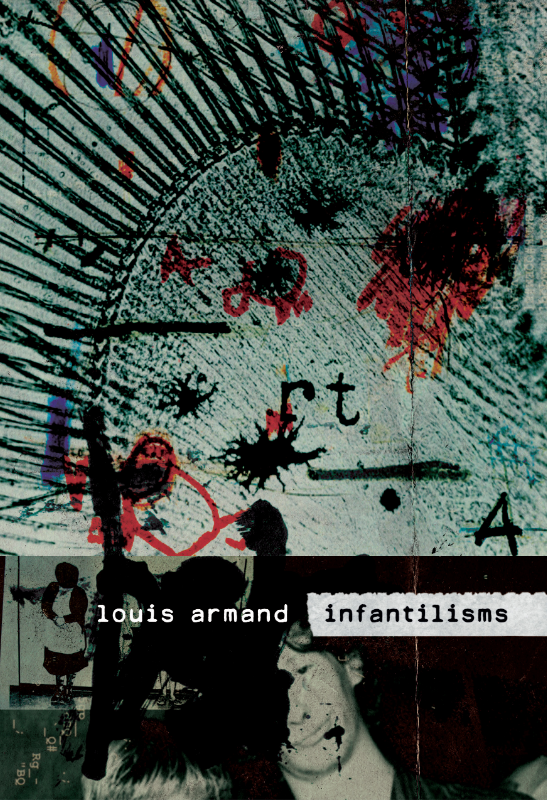
Angela Meyer reviews Louis Armand and Sarah Temporal

Infantilisms by Louis Armand
Puncher & Wattmann, 2024

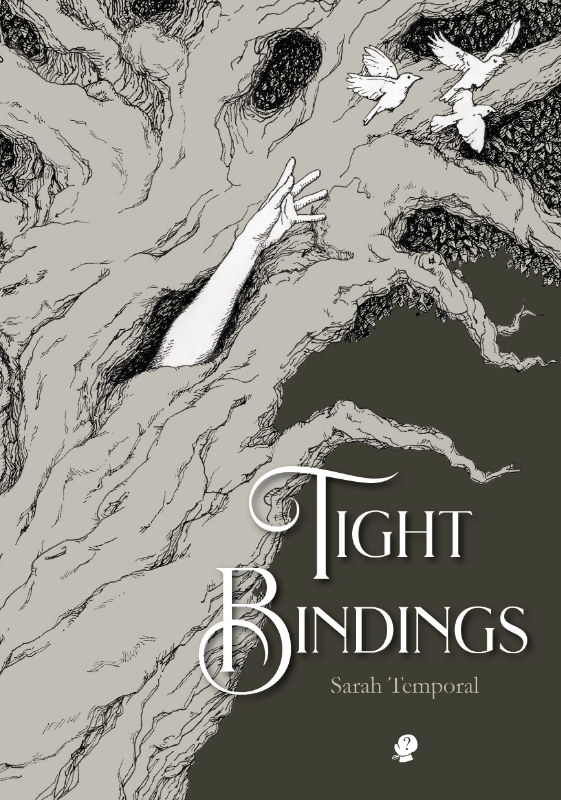
Tight Bindings by Sarah Temporal
Puncher & Wattmann, 2024


Louis Armand’s Infantilisms and Sarah Temporal’s Tight Bindings (both Puncher & Wattmann, 2024) are disparate collections which overlap in their ability to make the parts speak for the whole. Armand’s, in a resistant, disjointed way — allowing the reader to locate cultural, social, historical webs and associated meanings, or just stray off onto rich tangents of their own. In Temporal’s, we’re more gently guided, with its through lines of fairytale, nature (in its various forms), the body, birth, and concepts of girl, daughter, mother, woman.

How to write about Armand’s Infantilisms? About poetry that defiantly wriggles away from being apprehended or at least reduced to singular resonance or meaning? Armand’s large collection of poems has both width and depth and resists linearity. It’s a book you could pick up and scrutinise (rather than ‘absorb’) one poem at a time over months or even years. I found some poems (such as ‘Das Selbstporträt,’ 23) inviting in their rich mystery; others (due to a combination of tone, grammatical de-structure, and syntactic inscrutability) almost kicked me off the page. Armand is a writer, visual artist, and director of the Centre for Critical and Cultural Theory at Charles University in Prague, and the Centre’s interests, evolved “from linguistic structuralism and semiotics,” give me some clues to decisions around form and theme, particularly post-structural interests. A reviewer has responsibility to draw together common features of the poems in the collection, to give an overview, and I’ll do this here, though the collection resists it. I will zone in on some poems to explore their rich play, as this may help potential readers know what they are in for.

Some poems in Infantilisms are concerned with poetry itself and the role of poetry and the poet. The word “poem” or “poetry” often comes late in a poem, muddling the meaning we may be already leaning toward. In ‘Riot at the Hydromajestic’ (77), “the poem” comes in at the last line, complicating a connection between the Turner painting The Fighting Temeraire “halfreflected” in a bar, a barman, “three versions of the protagonist in a lifeboat”, and a possible narrator. In the line, it seems desolation (almost as an additional subject because whose desolation? we do not know) is “ready to leap from the poem’s last line & abandon everything”. Another poem that mentions “the poem” is ‘Statue of Svatopluk Čech, Pond w/ Fountain’ (113), in which “the poem defies gravity insouciant / as a waterspout”. This is nine lines deep with no foreshadowing, and continues “here the bounding black wolf-pelt muzzles the ball. / all for the joy of repetition / & repetition for all!” Which is quite funny, even if the meaning slip-slides away from you.

‘Apophenia’ (54) means the way humans seek meaningful resonance in patterns of unrelated or random objects, data, or ideas. I wondered, is Armand insinuating that the poem itself can throw together unrelated data in the form of unlinked words and/or sentences, references, quotes, and more, and a human will seek in it a pattern? Is the seeking of the pattern an infantilism (humans being an infantile species) or is the infantilism the writing of the poem and the belief that play produces unexpected meaning?

There are boats and ships in the collection, and oceans, seas, rivers. I sometimes connected this to the references to poetry, as vessels on a surface (or on depths: “A sea without chairs” in ‘Beckmannesque’ (25)), deliverers of something (including dominant and colonising somethings). Or the vessels carry us, in the poem, from one time frame to another. In ‘Confessions of Living in Fire’ (84), the final stanza begins,

And though it has many eyes some of them must
sleep – intoxicated by rainfall &
beautiful sinking ships & all tomorrow’s
just conditions.

The final line of this follows that temporal transportation via “sinking ship” with one of what I came to think of as Armand’s micro–epics: “There’s writing on the wall, too” (which can be read both literally and as the expression, originating from the Bible, that prophesies an ending). There are passages in the poems other than across water. The parts of the body I noticed most in these poems were those that substance (food, voice, breath, sound) passes through: throats, lungs, ear canals.

Armand’s grammatical deconstruction, or what I thought of as ‘syntactical halts’, are often related to subject (in the sentence structure sense) shifts or open ends, pronoun confusion, tense shifts, alternating points of view, temporal illogic, and changes between past and present participles. Landscapes and buildings and other non-human objects are also subjectified (e.g., the skyscrapers in ‘That Perilous Night’ (51), which “leap / black arrows & hands / mysteriously from darkness”) and this can stop you short. The fascinating effect of these ‘halts’, for me, was of the brain trying to circle back in on a logical follow-through; struggling to take in the additional, twisting information; and then a kind of frustration when the conclusion never arrived. It’s worth quoting more of ‘That Perilous Night’ at length to give an example:

               I reached the conclusion that
               several winters’
               contemplation boxes
                                       knotholes
                                       of infectious activity
                                       plotting revenge
               but if you don’t change yr mind
               about past art
               as an advertisement of all that’s sick
like stopmotion war footage
or America
or unbreathable 4-colour separation process

Other layering to be found includes that on pandemics and lockdowns (e.g., ‘Custodial Sentences’, 86); speculation and dystopianism, almost pulpy at times (‘Vague Germs of the Unknown’, 22); and references to God/gods and other faith figures and items, as much as references to science, which makes me think Armand is concerned with mystery — that being a property, too, of the discombobulation of deconstruction. The poems are highly intertextual and many are for, after, dedicated to, in memoriam of other thinkers, poets, artists, cultural figures. The spanning of pasts and futures is often done materially — I’ve mentioned boats but there are fossils, formations, through to space junk. The word “cosmic” crops up and the collection does have spatial, along with temporal, dimensions.

Though the form of the poems varies massively — from a six-word poem (‘Quixote’, 67) to a rhyming poem (‘Gulag Blues’, 83) and everything in between — several poems have a similar kind of movement. It’s a mix of containment and explosion, of the aforementioned micro and the ‘epic’. Sometimes the movement is like this, as in ‘The Dream of the Fisherman’s Wife in the Mind of the Fisherman’ (36–7): We’re in always/the before (“always voices whispering”); then there’s one event/moment (“the monster […] / slipping through nets”); the habitual tense comes in (“The days, he came to believe, weren’t long enough”); and then we’re hurtling towards (“Dark energy accelerating the universe”); then there’s moment, moment, moment, moment; and finally a conclusion/projection/future encroaching (“Well every American president / deserves to go hungry at least”). One of the most epic endings could be this one from ‘Monet, Trouville’ (92):

[…] what’s history? Turned
by unoiled wheels that shriek in a night
smothered by cretaceous foliage –
contemplating the evolutionary lilypond.

Perhaps what I mean by epic is ‘all-encompassing’, or maybe ‘panoramic’ (but temporally as well as spatially).

Posted in BOOK REVIEWS | Tagged , ,

Lou Garcia-Dolnik on as Interviews Editor

We are delighted to welcome Lou Garcia-Dolnik as Interviews Editor at Cordite Poetry Review. Lou will join our longstanding Interviews Editor, Autumn Royal.

Lou Garcia-Dolnik is a poet living and working on sovereign Gadigal-Wangal lands. Their poetry has appeared in journals including Overland, Meanjin, LIMINAL, Debris, Un Magazine, Runway Journal, Cordite and Australian Poetry Journal, and they have edited for journals including Runway, Cordite and Voiceworks.

Lou’s work has been awarded Second Prize in Overland’s Judith Wright Poetry Prize, a place on the shortlist for the Blake Prize, Val Vallis Awards, LIMINAL Non-Fiction Prize, the Kat Muscat Fellowship, and an Academy of American Poets University Prize from the University of Texas at Austin. An alumnus of the Banff Centre for Arts and Creativity’s Emerging Writers Intensive, Lou was the 2023 recipient of the Australian Poetry/NAHR Eco-Poetry Fellowship and attended Tin House’s Summer Workshop in the poetry faculty.

Welcome, Lou!

Posted in GUNCOTTON | Tagged

Submission to Cordite 120: DIALOGUE

Eileen Chong
Image by: Travis De Vries

Where do poems come from? Where do they go? Do they ever arrive? Do they end? Do poems talk to one another? Do poets ever listen? Can poems arise from art, history, the present day? Can architecture, design and landscape birth poems? What about objects and memories? Scent and texture? Sound and silence? How do poets respond to form and convention? How do poems become records, explorations and/or explications of such dialogue?

These conversations and exchanges form the shifting, restless basis of poetry. Poetry is alive because we are alive. Poetry is often in dialogue with something else, or maybe even itself. I am interested in what arises when two or more fronts—of language, of the mind, of people, of the world—meet and foment in a poem. I want to eavesdrop on your brain. Please surprise and delight me. Send me your collaborative poems, ekphrastic poems, historical poems, call-and-response poems, after-poems, centos, erasure poems, formal poems, all the poems, as long as they are what you consider to be your best work.


This podcast sheds some insight on how Cordite Poetry Review (and Cordite Books) works.

Submission to Cordite 120: DIALOGUE closes 11.59pm Melbourne time 1 April 2026.


Please note:

  1. The guest editor(s) has sovereign selection choice for all poems submitted.
  2. Masthead editors will also contribute to the issue.
  3. We will only read submissions sent during our official submission periods.
  4. Please place up to three (3) poems in one (1) Word, RTF or PDF document (unless specifically noted otherwise for special issues), with no identifying details in the document itself.
  5. We are not able to offer feedback on individual poems.
  6. Submissions will only be accepted via Submittable …

submit


Posted in GUNCOTTON | Tagged ,

2 Sor Juana Inés de la Cruz Translations by Stuart Cooke

Sor Juana Inés de la Cruz

Note

The following translations are excerpts from Sor Juana Inés de la Cruz’s magnum opus, Primero sueño (‘First Dream’, or ‘First I Dream’). Originally published in 1692 as part of Sor Juana’s second collection, Primero sueño is a definitive document of baroque Spanish poetics. Here I want to provide some introductory remarks about the Spanish baroque, and about the poem’s translation into English.

Baroque art abounds in conceits and counterfeits, in theatricality and obsessive sophistication. In poetry, verbal puns and elaborate metaphors are ubiquitous; they are designed to call attention to the fragile lines between reality and fantasy, beauty and ugliness, and faith and reason. In Spain, baroque poetics developed two alternative modes: the culteranismo of Luis de Góngora (1561-1627), infatuated with high rhetoric and labyrinthine syntax, and the conceptismo of Francisco de Quevedo (1580-1645), characterised by ingenious conceits (and not unlike John Donne). The former paints layers upon layers with verbal pyrotechnics, whereas the latter makes poetry a tool of metaphysical enquiry. In New Spain, Góngora was more influential, but Quevedo still had plenty of admirers.

Although she was writing on the other side of the Atlantic, in many ways Sor Juana’s poetry unites these two great tributaries of Spain’s baroque tradition. Like Góngora, hers is a rich materialism of juxtaposing, colourful solids and glitteringly deceptive appearances; chiaroscuro twists through strange, syntactical accretions in an effort to rival the artifice of nature itself. But Sor Juana channels Quevedo, too, in her satirical wit and in her moralistic tension, her keen awareness of human corruption and death.

But Primero sueño is philosophically much more ambitious than any other poem from the Spanish Golden Age. A highly personal essay on epistemology, the richly materialistic style certainly belongs to Góngora’s world of deceptive appearances, but the psychology seems to approach that of a more modern, even Faustian, scepticism. For Primero sueño expresses the failure of the human mind to grasp reality by means of purely intellectual activity. Thus, the highest ambitions of Renaissance humanism are finally seen as wholly vain; disillusion is the only subject matter left for poetry, until disillusion itself collapses, leaving nothing: “…es cadaver, es polvo, es sombra, es nada” (from Sonnet 145).

Finally, I should acknowledge that there are many translations of Primero sueño already available. Invariably, however, English versions are expunged of the corrections, hesitations, and real-time uncertainties that are characteristic of Sor Juana’s original poem, and of baroque poetics more broadly. In the Spanish, these many lexical eddies and whirlpools create compelling swirls of conviction and doubt, and a sense that we’re in the midst of a lively, electric cognition. In English, for reasons that I don’t have space to go into here, we tend to code such swirls as confusing, excessive, or unnecessary—which might be why so many translators elect to delete them. As ‘difficult’, ‘purple’, or ‘over-written’ as my translations may seem, then, I hope that they provide a sense of what it’s like to read Primero sueño in Spanish.

Posted in TRANSLATIONS | Tagged ,

3 Christophe Tarkos Translations by Marty Hiatt

Christophe Tarkos

Note

The French texts translated here were first published in the collection Le signe = (© P.O.L Editeur, 1999). They are reproduced here with the publisher’s permission.

Relations

Relations make the spoken in to an elongated pile which means that the spoken is made out of relation. Everyone has their own smell, man has the smell of man, has a smell that belongs to him alone, man does n’t only have the smell of his anus, of his armpits, of the smell of his hairy chest, of the hair on his head, man has a smell shared between various different zones that have a smell but also has his own smell that doesn’t belong to his anus and to his hair which is the smell of his skin wherever his skin may be, the general smell of man. Relations are random, floating, linked on their own to the forces of imposition, like hands placed on a head or hands placed on a rotating table, is an imposition of the forces of composite relations, are hands placed on a head, are what is placed on the head without anyone seeing, it is placed there and no one sees it, it’s like the boundaries of a city district. Are relations of wafting, of beginnings, nothings, fumes, powders, light powders, airborne powders, fragrances, the wafting of a fragrance in the air, a wafting of wind, a wafting of the smell of a fart in the air, of fumes, of a fart, of a pile of lies, of a fart. Relations are clairvoyant, interpersonal, intrauterine, intrinsic, extroverted, introduced, relations are relations of shit. Relations can’t be contracted, touched, joined, and what’s more the relations that are woven, linked, they aren’t woven, they are linked with big coarse string, are of a kind that cannot be touched, that cannot be approached, that stinks, we have to mark out what in relations constitutes a mass of relations of shit the better to emphasise what in relations is a rosy relation, with rose water, rose fragrance. Relations are fragrant.

Shit is the product of what is personal, interior, intimate, warm, what has not been taken by the exterior which is kept warm in the secret of the guts, which does not push all the way through to the outside, which is impenetrable, you’d have to cut the guts open to get a hold of it, it is circulating, circulates with the body’s organs, breathes with the body you can’t get a hold of it, holds together well, holds together well inside, remains inside, remains in the intimacy of the self, is impenetrable, is kept warm, is consubstantial with the self, with the circulation of the body, with the circulation of blood, magic fluids. Is the only thing that is produced by the body, a person produces, a person knows how to produce, you can’t say that a person doesn’t produce anything, it is it and it alone that knows how to produce every day and to make come out of itself a block of shit that it produces, that it gives, that it leaves to the living. You cannot say that a person who does nothing, who has only thought, who has only a circulation of thoughts and dreams and nightmares and sensations and impressions doesn’t know how to produce anything, in the intimacy of its being, in the intimate and personal sphere of its being, there is a product that it is producing slowly and at its own pace, assuredly, this product is its own shit that resembles no other shit, which is enveloped in its own smell, of the unique smell of its personality that it is going to give. Shit is the only thing that is made from words that comes from the guts, that comes from the interior and is personal, shit is more personal than words, words are common, shit is shit that can be recognised as personal by its smell, you cannot touch the shit of just anyone, the person’s style counts, who is this shit by you’ll say, i won’t touch the shit of someone i don’t know, and in terms of people there is the class of people whose shit i wont touch and the other class, the class of people whose shit i can touch without gloves with my fingers.

Les relations

Les relations font de le parlé un tas allongé qui fait que le parlé est de la relation. Chacun a son odeur, l’homme a une odeur d’homme, a une odeur qui lui appartient en propre, l’homme n’a pas seulement l’odeur de son anus, de ses aisselles, de son cœur de poitrine poilu, de ses cheveux sur la tête, l’homme a une odeur partagée entre plusieurs zones différentes qui sentent une odeur mais a aussi sa propre odeur qui n’appartient pas à son anus et à ses cheveux qui est l’odeur de sa peau où que se trouve sa peau, l’odeur générale de l’homme. Les relations sont aléatoires, flottantes, liées par elles-mêmes à des forces d’imposition, comme les mains posées sur la tête ou les mains posés sur la table tournante, est une imposition des forces des relations composées, sont des mains posées sur la tête, sont ce qui est posé sur la tête sans qu’on le voie, c’est posé et ça ne se voit pas, c’est comme un arrondissement. Sont des relations de flottements, de commencements, de riens, d’émanations, de poudres, de poudres légères, de poudres envolées, de parfums, de flottement d’un parfum dans l’air, d’un flottement de vent, d’un flottement d’une odeur d’un pet dans l’air, d’une émanation, d’un pet, d’un tas de mensonges, d’un pet. Les relations sont extralucides, interpersonnelles, intrautérines, intrinsèques, extraverties, introduites, les relations sont des relations de merde. Les relations ne peuvent être contractées, touchées, reliées, de plus les relations tissées, liées, elles ne sont pas tissées, elles sont liées avec de la grosse ficelle grossière, sont de l’ordre de ce qui ne se touche pas, de ce qui ne s’approche pas, de ce qui pue, il faut bien border ce qui dans les relations représente une masse de relations de merde pour mieux faire ressortir ce qui dans les relations est une relation de rose, à l’eau de rose, au parfum de la rose. Les relations sont odorantes.

La merde est ce qui est produit de personnel, d’intérieur, d’intime, de chaud, qui n’est pas pris par l’extérieur qui reste au chaud dans le secret du ventre, qui ne pousse pas jusqu’à dehors, qui est imprenable, il faudrait ouvrir le ventre pour le prendre, elle est circulante, circule avec les organes du corps, respire avec le corps ne se laissera pas prendre, tient bon, tient bon dedans, reste dedans, reste dans l’intimité de soi, est imprenable, est tenu au chaud, est consubstantiel à soi, à la circulation du corps, à la circulation du sang, des fluides magiques. Est la seule chose qui est produite par le corps, une personne produit, une personne sait produire, on ne peut pas dire qu’une personne ne produit rien, c’est elle et seulement elle qui sait produire chaque jour et faire sortir d’elle un bloc de merde qu’elle produit, qu’elle donne, qu’elle laisse aux vivants. On ne peut pas dire qu’une personne qui ne fait rien, qui seulement a de la pensée, qui seulement a une circulation de pensées et de rêves et de cauchemars et de sensations et d’impressions ne sait rien produire, il y a dans l’intimité de son être, dans la sphère intime et personnelle de son être, un produit qu’elle est en train de produire lentement à son rythme, sûrement, ce produit est sa merde propre qui ne ressemble à aucune autre merde, qui est enveloppée de son odeur propre, de l’odeur unique de sa personnalité qu’elle va donner. La merde est la seule chose qui est produite avec les paroles qui vient du ventre, qui vient de l’intérieur et qui est personnelle, la merde est plus personnelle que les paroles, les paroles sont communes, la merde est de la merde qui se reconnaît comme personnelle à son odeur, on ne peut pas toucher la merde de n’importe qui, le style de la personne compte, on dira de qui est cette merde, je ne toucherai pas la merde de qui je ne sais pas, et dans l’ordre des personnes il y a la classe des personnes dont je ne toucherai pas la merde et l’autre classe, la classe des personnes dont je peux toucher la merde sans gants avec les doigts.

Posted in TRANSLATIONS | Tagged ,

3 Saadi Youssef Translations by Khaled Mattawa

Saadi Youssef

House

I am looking for a house.
For years I’ve been looking for a house.
How many countries have I roamed looking for a house?
How many continents!
How many women’s dresses?
How many killing fields!
And how many books,
how many cities!
Finally:
I am in Tangier looking for a house
and for years in Tangier I’ve been looking for a house!
But I’ll return (as I was) without a house.
The no-house house is my home then.
So it seems!

Posted in TRANSLATIONS | Tagged ,

‘Facing the threat of our own destruction’: Ariana Reines in Conversation with Eva Birch

Ariana Reines

I was first taken with Ariana Reines’s poetry during the Melbourne pandemic lockdowns – one of the longest lockdowns globally. I was part of an online poetry reading group reading modern and contemporary American poetry, including Reines. I wasn’t reading much otherwise, but A Sand Book (2019, Tin House Books) was a comforting object with a strong aura on my bedside table. Reines had recently started an online Invisible College and was teaching on the work of Rainer Maria Rilke. The time difference was difficult so I couldn’t often attend, but it was one of the signs of life that felt precious to me at the time.

Reines’s voice has been vital for me and many others in the context of a public discourse that lately feels in need of revival. Reines practices the art of poetry, using the power of the voice and the technology of the book, which, even with her huge success within it, seems completely undomesticated by the confines of the literary market as well as the increasing sadism of the academy.

The following interview between myself and Reines, was conducted during the Q&A section after her lecture ‘The Time of Spectacle Will Pass’, on the August 14, 2025. In the lecture Reines spoke of the process of writing The Rose (Graywolf Press, 2025), Wave of Blood (Divided Publishing, 2024), and the mystical experience recorded in her 2019 publication, A Sand Book. The recording of this lecture is available via The Melbourne School of Literature website.

In the lecture Reines somehow managed to make an online silent PowerPoint presentation feel like a spiritual experience. As part of the lecture, she had sent through slides including the final part of A Sand Book, activating white text on a black background, what the sun ‘spoke to her’, one day, while rehearsing, a physically demanding performance: ‘ANALOGY IS THE STRUCTURING PRINCIPLE OF THE UNIVERSE’, ‘THE SUFFERING OF WOMAN IS TRUE STORY OF THE UNIVERSE’, ‘WE HAVE TO UNDERSTAND OURSELVES AT ALL COSTS/ NATURE EXTENDS FROM US/ NATURE MIRRORS US…’. I pressed through the slides at a slow pace, following her instruction. Sitting silently on a Zoom call slowly reading these phrases, with the MSL committee and a group of students felt strangely radical and embodied.

Reines’s lecture reminded me that I was a writer and afterwards a friend messaged me saying that “watching the lecture made her feel like she could be more of herself.” In the following interview, Reines speaks of the importance of countering the stereotype of the artist who destroys themselves and the artist who wants to destroy the world.

Eva Birch: Let’s return to what you were saying about artists destroying themselves. This has been such a cliché, I guess, at this point, but it’s been a very common way for an artist to exist and to make work and to die – either by drug overdose or by different means. They suffer until the limit point of death. I was really interested in what you were saying about how this time we live in is no longer the time to do that anymore. I was wondering if you could expand on that a bit more.

Ariana Reines: I don’t mean this prescriptively. It was something that I felt was a realisation for myself. If you want to destroy yourself – anyone reading or hearing this – you like all human beings are endowed with divine free will. But I would really prefer that you didn’t destroy yourself.

I think there is always going to be a sacrificial element to artmaking and to the artistic temperament. There’s a way in which, if we’re really doing it, we are facing the limits of our own minds and the limits of our own bodies. We’re facing the threat of our own destruction when we create, because it’s also a confrontation with the abyss.
I have a very, pathetically corny, traditional artist personality. I’m melodramatic, I’m very moody – hating myself and feeling unworthy of existence is a very old habit for me. I forget what it is in the Enneagram – this ‘artistic’ personality type, but it’s embarrassing. It definitely is no guarantee of great art.

I sensed, back in my late twenties – probably when I was getting close to twenty-seven, the Saturn return time – that I was nearing the limit. I felt the pull of that trope of early death, that idea of artistic precocity and achievement crowned by death.

I’m from Salem, Massachusetts – Sylvia Plath, Anne Sexton, the witches, all of these way overdetermined, intense, brilliant, tragic women. It’s heavy and somewhat exhausting – I love them all, identify with them, but like, I had to make a generational decision. I used to be told by older women such incredibly negative things. I won’t say her name, but a very famous, very beloved writer once said to me when I was about to publish my first book, “The only person I know who was as brilliant as you at your age was dead of a heroin overdose by twenty-nine.” And I thought, Jesus, that’s a really not-good thing to say. To a young woman who admires you! To anyone! Nobody needs to hear that.

But it was supposed to be a compliment – like, ‘You’re so great you should be dead.’ And I started to feel that this was actually a cultural program, a completely negative cultural program designed to make creative people feel like they shouldn’t exist, and that of course this trope of self-destructive genius had infected the woman I admired too.
Creative people already have a hard enough time, because they tend to be quite sensitive, quite obsessive, quite passionate. They often have to come through extraordinary personal challenges and struggles in order not only to complete their work but to bring it to the public in a way that’s meaningful enough for people to connect to it. That actually takes a huge amount of selflessness. It’s weirdly the opposite of egotism – you could hate yourself and still need to deliver the work. Ultimately, the deeper you get into it, the less it is about you even if the work seems to like, literally be ‘about’ you.

I started to think, ‘This is a psyop.’ The idea that artists should die – that the better they are, the more dead they should be – I think that’s a cultural lie. It has to do with our culture’s intolerance for human life and creativity itself. We’re uncomfortable with those things. We’re okay with them if they’re happening to someone else. We can pedestal them. It’s okay for Beyoncé, maybe, but not for us. It’s very peculiar, this notion. Maybe it’s different in Australia, but in America – where the rock star paradigm originated – it’s deeply ingrained. I think it’s a negative cultural program, a lie. I think art and life are intrinsically connected, and specifically, caring about life is a really important contemporary issue.

We’re surrounded by death. Just look around. Thinking seriously about what art demands – the idea that there is more to being and existence than what we’ve been told – that’s crucial. If we don’t bear witness to it, if we don’t bring it through, it won’t exist on Earth.

If what comes through you can’t come through, if you can’t withstand it, then you can’t understand it. Rilke says something in the Duino Elegies about the bow and the arrow – the string that endures the charge of shooting the arrow. That ‘quivering, endures’. If we can’t learn to endure the shock and the sacrifice that come with creativity, we’re taking the side of a death-obsessed culture.

I made this decision for my own sake. I needed examples of artists – in my case, women artists – from fucked-up families who nevertheless didn’t wreck themselves. I want to see more of every kind of artist, of every gender and background, not wrecking themselves.

I guess what I haven’t talked about is this other trope, of the frustrated artist who destroys the world. The Hitler figure. Where a kind of frustrated will to self-express becomes a kind of fascistic gesangkunstwerk – the total creation, aesthetic and moral, of death cults…

EB: Just on Rilke – I wanted to ask you about him. He quite famously was going to start psychoanalysis but said he thought it would ruin his art, and then he passed away quite young. Do you think if he’d entered psychoanalysis, he would have lived a longer life? Or would he have stopped making art?

AR: Wow, what an amazing question. I don’t want to piss off the psychoanalysts – I feel like I already did last year. It’s a long story, but I pissed off some analysts…

I love psychoanalysis. In a lot of ways, Rilke’s poetics lends itself beautifully to psychoanalytic readings. There’s something Jungian about him. But it’s hard. From my own experience, I know artists who are in psychoanalysis, and it seems to help them very much – as artists, as people. It connects them to their dreams, keeps them from killing themselves, gives them something to do.

Do I think it would have saved Rilke’s life? I don’t think Rilke needed psychoanalysis. I don’t think his unconscious was blocked. I think he had total access to every region of his consciousness – or at least his poetry did. Even if Rilke the man, in his contingent relationships and in the way war and devastation and political chaos affected him, didn’t have constant access to those realms – his poetry did. You can feel it when you read it.

Posted in INTERVIEWS | Tagged ,

‘Keeping time together’: Andy Jackson in Conversation with Eleni Stecopoulos

Eleni Stecopoulos
Photo credit: Nicholas Komodore


I first heard of the work of Eleni Stecopoulos while in the US in 2013. I was in San Francisco to spend an afternoon chatting and swimming with Petra Kuppers and Neil Marcus, both disability culture activists and writers. Eleni had at the time been working on a series of public conversations and programs at The Poetry Centre at San Francisco State University called The Poetics of Healing. Eleni is a poet and an essayist whose work on embodiment is always political, and vice versa. Petra had hoped to introduce us, but the timing wasn’t right.

While writing my PhD on disability and poetry in the late 2010s, I read Eleni’s book Visceral Poetics (ON Contemporary Practice, 2016), and while it never really entered my thesis explicitly, its fierce advocacy for embodied scholarship and its exploratory mien certainly did and continues to. Her follow-up book, Dreaming in the Fault Zone: A Poetics of Healing (Nightboat Books, 2024), was described by philosopher Alphonso Lingis as ‘light[ing] up multiple critical and paradoxical insights’. Reading it, in the midst of my own experiences of ill-health and of collaborative writing, I felt compelled to initiate a conversation.

Andy Jackson: First, I want to thank you for such a vast, provocative, loving, rigorous and beautiful book. Dreaming in the Fault Zone covers a lot of territory, weaving together thinking on performance, myth and ritual, language and translation, but above all it seems to me it seeks to radically reimagine poetry, health and community, their interrelationship. It’s a book that feels urgent, contemporary, but also grounded in the ancient past and the precarious future. One of the many paragraphs that resonated with me was, “I don’t think bodies tell stories. They archive them, travel on them. They transfer them as sympathy. Maybe stories do lodge in the limbic system and the muscles and organs; maybe the body can become disorganized, mired in stories. But it reorganizes them as poems.” There’s a lot in this book about what kind of writing might be healing, or at least true to reality, connective. It also occurred to me that the book itself is certainly not a story, not a linear one at least; it’s a poem – intuitive, awake to the incantatory, bodily effects of words. Can you tell me a little of how the book came to be, and came together? It seems like a project that would have taken a lot of time, a lot of care, in order to keep this sense of the poetic, open and palpable.

Eleni Stecopoulos: Thank you for this great and generous reading. What you say is everything I hoped my book could be. That you understand it as both rigorous and loving speaks to the way I wanted and needed to write it. Where the difficulty and dialectics of making the book could be felt vividly while reading it. A book that thought out loud and doubted and contradicted itself on the page. And at the same time also wanted to attend to the reader, wanted to offer beauty and solace and accompaniment, a place to reside and even rest in.

Initially Dreaming in the Fault Zone was inspired by my curation of live events and conversations on art, medicine, and healing with a wide range of presenters: poets, visual and performance artists, disability culture activists, physicians, psychotherapists, philosophers, ethnographers, and others. Collaborating with poets Steve Dickison and Elise Ficarra, who at that time directed the Poetry Center at San Francisco State University, we had received a grant to create the program series, and as lead artist, I was to write a book responding to what happened in this public, collective inquiry. My vision for the book began as a communal document, and through the project, I became part of a little community with other poets, including Petra Kuppers and Thom Donovan and Bhanu Kapil and Melissa Buzzeo and d wolach and a few others, people traveling kindred paths. I remember wanting a book that would be as complicated and rich and filled with people and questions and histories as our conversation. For a moment, spread out as we were across the country, we were creating something together, even though everyone had their own work and practices: the poetics of healing project became something of a hub or one way of formally articulating our affinities. And I wanted a book that could be alive to our connections, that could embody our collective thinking and learning from each other’s experiments.

Later, this writing joined writing on other interests I had: dream incubation, therapeutic landscapes, ethnographies of medicine, the medicalization of difference, iatrogenic harm and reclaiming sensitivity from pathology.

You wrote that the book is “not a story, not a linear one at least; it’s a poem”. I do think of it as a book of linked essays which is also a long poem, even as I always knew that poem would be largely in prose. I often write what I call “strophic prose”, a prose that has space in it, that allows for breath, and turns, including turning back or recursiveness. That lets you pause, or rest. Not knowing how to go on, but then going on.

In the first chapter I write about ancient dream incubation, its analogues in psychotherapy and contemporary art practices – and how they help me to think about poetry and healing now. The topic of incubation was so potent to me because it was both about a long history of healing practices (for which there is some evidence and yet which remain mysterious and open to speculation) and the process of writing itself, developing something in the dark, writing a book whose form you don’t know yet. I lived with my book for a long time, sitting with it as one sits with an incurable condition. But in the apparent impasse there is also movement, there is energy and creativity. It was in Petra Kuppers’s disability art encounters that I came to feel such movement and vitality and joy in my body even when I was in pain, even if I was coping with multiple chemical sensitivities. I learned a lot about beauty from Petra and Neil Marcus and others in the disability community.

That understanding relates to narrative for me. Alongside the many stories told in the book, fragments and versions and possibilities and impossibilities of telling, there is an abiding critique of the often-exclusive emphasis on telling stories as a means of healing, and of the compulsory narratives that constrain us, the ones we’re made to perform to assert that we’re human, ‘able’, productive, or that we ‘won’. Narratives of cure, the emphasis in American society on cure, often impede healing. And narratives of recovery and wholeness can also impede healing. I didn’t want to make a monument to my own pain or grief or experiences with the medical establishment – or to my own myth of transcendence and wellness. I bring in my own experience, but only as one element among others.

Like all language, stories can be efficacious. Diagnoses can be liberating or bring you community and lead to solidarity. They can also be coercive, oppressive, and punitive. My point is they’re never neutral. And a focus on narrative medicine is not neutral. It reflects certain assumptions about medicine and healing, about experiences of illness and trauma, about literature and value. Why do we speak of narrative medicine as legitimate, but not infusion with mantras? It’s culturally and institutionally determined – whether and how we think language and aesthetics have a role to play.

Yes, to stay open to the poetic, to follow paths wherever they led, took time. The philosopher Édouard Glissant writes of “a poetics that is latent, open, multilingual in intention, directly in contact with everything possible”. I wanted to write a poetics of healing that might be like Glissant’s Poetics of Relation, “requir[ing] all the languages of the world”.

Posted in INTERVIEWS | Tagged ,