Gouache, Sheep Skulls, Fence Bracket

I

Animals in Venetian masks
stare through floral constellations;
a strange surfacing
of herbal machinations
and cloven-hoof memories;
a fondness, somewhere
for droughtless green.

Look closer.
The skulls are singing,
more like bird-beaks than sheep.
Forget-me-nots break
across bone
as if souls commune,
call back,
jigsaw a collective self.

II

This is about a rasp of sheep;
a four-cornered star
shining the sacrament
of limited diagonals,
and yet, in sockets of dark,
a kind of backward birthing.

How to place gouache
and not annul the souls of sheep.
How to stamp passports
of those who dream the inner side
of crates—
a floating, rocking panic.

Their flowers are dispensed.
Ragged edges stumble
into blackened bone.
Quietly, they bleed
in palest pink.


Notes:
In response to Steven Holland, Monaro, 2001 Gouache on sheep skulls,
on welded fencing wire bracket 40 x 40 x 15.0 cm at Canberra Museum.

Posted in 79: EKPHRASTIC | Tagged

Anatomy for the Blind

Beneath the languid nudes of Ingres and Renoir,
the Odalisques and Venus on her couch –
the skeleton is already reclined
against the lectern as the doctor starts:

‘Gentlemen, explore tonight your sense of touch.
Let the warmth of your fingers and palms
caress the cool crest of this ivory planet.

From the summit of this fragile sphere, glide
across the bumps and ridges; understand
the subtle fissures and the secret cracks,

the domed expanse that disappears beneath
itself. Now, press your ear against this blade,
which creaks like a ship on shifting waves:

that’s the sailboat of the scapula
hitched onto the clavicle’s safe cleat.
And here, beneath, as broad as any barrel

the ribs – your maker’s hoops and staves.
This chilly shaft’s the femur, Sir, just like
the cane you’ll use to guide yourself away…’

And when the talk is done, the blind depart
and only the mute skeleton remains,
sole tenant of this vacant gallery
with paintings neither she, nor they, can see.


Notes:
Old black and white photograph of a ‘talk-and-touch’ session for the blind,
about human anatomy, held in an art gallery, 1913.

Posted in 79: EKPHRASTIC | Tagged

The Pioneer

McCubbin, in his great, ambitious, historical-narrative work
The Pioneer, invokes the in-vogue creed of nation-building:
with the colour green (forest/tent/dress/shirt) locking this in,
waltzing across the three big panels —

in the first and left-most of which the young wife is seen,
sitting slumped (dreamy? despondent?)
before a slackly pitched tent; with her husband crouched
setting kindling, behind.

In the second-and-middle panel, the bush is part-cleared:
the husband rests weary on a log with his axe,
while the wife stands before him, shouldering a babe-in-arms,
and a slab-hut smokes in tender contentment to the rear.

Then climactically, in the final-and-third of the painting’s panels
(with a taint of the comic, even,
in its sudden, dramatic, faintly hammy reverse),
the sky leeches blue through the green-dun frameway of the eucalypts
to reveal a distant city-view
which brandishes real estate signs almost …

as an innominate youth (the grown child, or someone entirely else?) —
is crouched parting ferns, to disclose a simple bush grave.
Resting place of the pioneer-husband —
of his wife, their child — or who? …
left behind at the previous century’s turn,
as he kneels in the glittering scar of cleared ground,
pledged to the bright-shiny new.


Notes:
In response to The Pioneer, 1904 by Frederick McCubbin. Oil on canvas, triptych, 225.0 × 295.7 cm, National Gallery of Victoria.

Posted in 79: EKPHRASTIC | Tagged

Interior with Figures

It’s in your mouth corners—
two lips clamped tight
and gently curved to hide it.

It’s in the way you hold your hands
not quite together,
fumbling with an uncertain future
as it clings
to your third finger.

It’s in your glance—
the search for answers
you will not get, perhaps,
until it is too late to go
back.

It’s in the trees
beyond the glass, who
seem to know more, though
they turn their heads
in spite of you.

It’s in his leaning body and
the chair that supports it;
both of you stand –
it’s quite impossible to sit.

It’s the silent conviction
in her hands, rested
half open in her lap.

It’s in the careful crease
of the curtains,
who shake hands with the sun
behind your back:
they make their bets.

It’s in the blue of your dress
that places you, unwillingly,
at the centre of
an unconscious universe.

The only anxiety I know
tingles my teeth
and squats to tie
its laces on my chest. I don’t
know how you feel, though somehow I think
I do.


Notes:
Based upon the painting, Interior with Figures, by Chester Earles, 1872

Posted in 79: EKPHRASTIC | Tagged

Miro’s Eyes

There are sweeping views
from the Gardens of Montjuic,
a city of coral
streaming as far as the sea,
constellations of migrating birds,
spirals of dragonflies,
night, music and stars
webbed in red, blue and black.
They held the balance –
canvases of connection
in the face of war –
carob trees, animals and insects,
emblems of hope
still holding back the melt
of Spain’s corners.


Notes:
In response to Joan Miro’s The Nightingale’s Song at Midnight and the Morning Rain
(Constellations Series) 1940. Miro Gallery, Barcelona, Spain.

Posted in 79: EKPHRASTIC | Tagged

Autumnal Cannibalism

The trouble, the issue in the system

like clockwork,
every orange October.

Comfort is a pillow in his back, unlike
a dentist

pulling. A tooth—

foggy, purple in his gaze.
Nothing.
Can I do nothing?

Blood.
Black bile, the yellow …

And I believe they’re
all
there.

It’s a fork, a knife.
I won’t let it reach for him—

Reversed, a crooked turntable,
and I am his
protector now.


Notes:
Based upon the painting Autumnal Cannibalism by Salvador Dalí

Posted in 79: EKPHRASTIC | Tagged

Narrenschiffen, a Collage Sonnet

Hero? anonymous bosh tacking luffing gulls
Ophelia swims up the river in a swoon
Hades moonsick Hamlet laments captainless coup
reflections sun buttered breasts glutt’nous mutineers
Leander hoiked into his own spittoon sees Light
Old Queen Margot plucks glockenspiel, and albatross
tone characters in search of the phosphorous straits
persimmon masks stretched tight as shaky chandeliers
Karl snaps selfies flush full of Facebook likes
Mary counts voices the origin of consciousness?
days numbers Shostakovitch the archduke trio?
riddles monuments to fear toccata fugue state
And thus thou art my love the Lesser Fool
A swim many one river fishing school


Notes:
Based upon the triptych painting, Ship of Fools, by Hieronymous Bosch,
on view at the Louvre, dimensions: H: 0.58 m, L: 0.33 m.

Posted in 79: EKPHRASTIC | Tagged

Cubed

sit around table silent transparent heads family gather wood together
iron frames exact misery cracked bolt on end fractured coop
cubed cubed cubed
black space condemns trap enacted in through window pain
cubed cubed cubed
rattle the mesh chain above hangs isolate to the power of
perfect smooth round teeth hair skin don’t at hands self portrait

Notes:
Based upon Cell (Glass spheres and hands), by Louise Bourgeois, glass, iron, wood, linoleum, canvas, marble, at the NGV in Melbourne.

Posted in 79: EKPHRASTIC | Tagged

Calling All Shadows

The birds on the brown-and-floral wallpaper in the kitchen at the old folks’ home are someone’s idea of parakeets in repose. Again and again, they stare over one wing at a trailing vine, or look straight ahead at a huge poof of bronzed peonies and more trailing vines. They sit, their wings folded like tuxedos of uncomfortable men at an opera. Outside, the world is framed in snow—slanted, determined and driven snow. Just beyond the window, a bush whose flowers are unknown to February, twitches under the weight of house finches. They come and go, little brown flames scattered up in haste. But one sits a long time at the top of the bush, sways as it holds on, its gaze steady, conscious. In the intense light of sun-on-snow, its shadow seems to multiply and mingle briefly with the shadows of the wallpaper birds, a sort of alchemic dance. I imagine it is calling the wallpaper birds—and me—to come stake our places too, on branches that will soon be piercing green and flecked with yellow stars. I like to think it only takes one to call us back from the edge of the world.


Notes:
This is a notional exphrastic poem, in response to The Dance Lesson, by Edgar Degas, 1879. National Gallery of Art, Washington, D.C.

Posted in 79: EKPHRASTIC | Tagged

Anna Attinga Frafra

the gentle assonance of her name
is there in her castdown gaze,
every repetition chiming its
muted, minor key. She looks at
something outside the frame,
but does she see it? Perhaps
her vision’s reigned by the
thousand a’s—amongst other
letters—which balance on her
head, straighten her posture.
The weight of the books should
ground her but instead, her neck
starts to ache, tilting—ever so
slightly—to the left.


Notes:
In response to Anna Attinga Frafra by Paul Strand, 1964, Medium:
Gelatin silver print, Dimensions:19.4 × 24.4 cm, Philadelphia Museum of Art.

Posted in 79: EKPHRASTIC | Tagged

Swan River

I am metallic in winter
mercurial answer to sky

in me the black swan
lends fragility of feather
pushing webbed feet down
into my warm body steeped deep
with tannin and leaf

I am salt-veined and restless
shadow to your light
the black in the blue day’s
diffuse season

kerbed by cars wild
rush toward sea
I am at the foot
of your face the cliff of it
reading you
leaf by living leaf.


Notes:
Based upon the author’s photograph of the Swan River at foot of Mount Eilza

Posted in 79: EKPHRASTIC | Tagged

In the store-room of antiquities

Lifting a wrecked ship’s amphora, an infant-sized container, skin scabrous and shell encrusted, Feel this hollow, brittle form he said, handing me its dead weight and oh I wanted him to braille my thoughts, discover me in haptic ways. But he described the taxonomy of amphorae, detailed shapes and their uses, how some held wine, others oils or perfumes, even those designed for weddings and funerals. Decanted an archive of types: Kernos Lekythos Lebes Alabastron, the names for orifices convex, tapered, rolled, swollen, bell, decorated, two-tiered, beaded, inverted.

I watched his mouth, envied its intimacy with amphorae lips.


Notes:
Inspired by an amphora, retrieved from a Phoenician shipwreck in the Mediterranean, and shown to the poet by an archaeologist.

Posted in 79: EKPHRASTIC | Tagged

Magnolia

The chandelier of the garden
is the magnolia. Bare elegant
arms stretch to hold the lights.
Finial not above like a waiting
weapon but rooted in earth.
Each cupped hand holds a pale
green bobeche with a bulb
not yet open. Purple outer
sepals protect the luminous
petals within. The magnolia
chandelier could be hung
in the ceiling of a pre-dawn
spring night. Once bloomed
the petals will drop leaving
the stamen, an exposed
filament, orange with pollen.


Notes:
In response to The Door is Open by Nicholas Folland, 2006,
Museum of Contemporary Art, Sydney.

Posted in 79: EKPHRASTIC | Tagged

From Garden to Gallery

In the Garden I cross the threshold of glasshouses
seeking succor with bromeliads
whose leaves are banded
with scales, like blotting paper, to inhale
this morning’s fog:

outside I meander amongst upright
natives: one is shaped
like a pine but with large
glossy leaves and globular masses,
like pom-poms, of yellow and white flowers
brewed long ago, I am told on a sign, against
colds, vomiting and diarrhea; another stately elder
has large prop roots once weaved
into nets and dilly-bags, the strips
of bark chewed
into slings and tourniquets; while another
upholds a central cabbage, eaten raw
or lightly cooked, with the fronds
and flower bracts recycled
constructed containers:

in a cycad grove
I bare witness to ancient symbiosis –
coralloid root structures hosting
blue-green algae for nitrogen – and I read
how highly toxic seeds were once
de-husked and chipped into bite-size pieces
in a pounded baptism administering
coarse smelly flour:

before these gardens grew
asbestos was composted
in a cyclone’s ruins
and I mull over a buried fibre’s bloom:

the gardens and gallery are linked
by a Larrakia Dreamtime Walk
where dot-painted signs award
canoe trees, delicacies and the raw
stuffs for baskets and mats; and amidst signage
warning against camping and public drinking
our countrymen gather
a mountain of casks, prizefighting
and swilling their losses:

in the gallery I enter ‘After Afghanistan’,
another remote colonised community,
where trauma is scraped
and bandaged onto boards; where foot soldiers
are removed of their packaging
and left flailing, broken
and captured on a gallery’s walls; and with eyes
clenched against the blinding expectation imposed
from inside I wait for the seepage
of blood from thighs – a self-mutilation
like the latex collected and heated from milkwood.

Notes:
In response to a day at the George Brown Botanical Gardens, Darwin and Ben Quilty’s,
After Afghanistan, Museum & Art Gallery of the Northern Territory.

Posted in 79: EKPHRASTIC | Tagged

Diego’s Head

‘when[ever] I draw or sculpt or paint a head from memory it always turns out to be more or less Diego’s…’

Giacometti etd in. James Lord, A Giacometti Portrait (New York: The Museum of Modern Art, circa 1964), p. 24.

Brother, in dreams I meet you in the hallway in Paris
and the floor angles like the side of our mountain.
Under my doorway, the light I’ve lit since Venice
washes the ground more than Annette does.
When you lost your fingers the sun fell like this-
an anesthetic against darkness. You never cried.
Every night before I meet you I put my socks and shoes
in order. I can’t make do without this. I sculpt
the spaces where the seams meet, I need
to be able to count the stitches. When I greet you here
you raise a hand and it’s whole. Outside the window
I can hear the bombs coming like the footsteps
of the Green Witch. I won’t sleep long now.


Notes:
In response to Head of Diego by Alberto Giacometti, 1950, Medium: Painted bronze,
Dimensions:127.9 x 10.2 x 8.9 cm.

Posted in 79: EKPHRASTIC | Tagged

Cows and Pulpit Rock

One cow dog-alert, the other
easy in her bones, the foreground
a wash of summer yellow.

Brush-marks above the river:
ferns and rock orchids in the gullies,
wildflowers and gums below

his cerulean sky. In harsh light
or soft, he reveals his caged heart,
the chains, the bride, Nebuchadnezzar,

the tortured lovers, from his war-dreams
and early bible, what we have become
or could. Our hearts chilled,

we cross the river flats in silence.
Today, no boats on the Shoalhaven,
no wind, though the parrots are restless.


Notes:
In response to Cows and Pulpit Rock, Arthur Boyd, 1998,
Collagraph, 70x79cm, Bundanon Trust Riversdale, NSW.

Posted in 79: EKPHRASTIC | Tagged

The Road

the road scars right, across the
palm of land, tumbling, dwindling,
a groove, a history, a way in,
worn and healed slick

the road, oil on linen, bitumen
on peat, with all its gradations
of shadow, bruise to smear to brush

the road, cloud above scuffed and
tugged by wind, rain sifting down,
the ‘haar’ they call it here,
cold breath of wet

the road, its dip and sway, blur
of scrub, the urge, glimpse of roof,
swerve, the early dark, the entrance


Notes:
In response to ‘The Entrance’ by William Rhode. Exhibited in the Sawtooth
ARI Gallery, Launceston, Tasmania, in June, 2014 Exhibition.

Posted in 79: EKPHRASTIC | Tagged

La Tempesta

A lightning flash over the lagoon
displaces me—we’re running again
headlong down
the flight of blinding stone
steps, towards noon,
grabbing a cup of iced red melon
before we adjourn

to the cool interior
of the Scuola della Carità,
straight to the one picture
you insist that I see: La Tempesta.
All I can do is mumble, stutter,
struck first by water
the same thick blue-green texture

of the canal,
and imagine the same smell
drifting from a stagnant pool
five centuries old. Only then do I feel
the centrifugal pull
of the strange, anonymous couple
seemingly in exile

or on the run
—from what?—war-torn
European ruin?—
or Renaissance Eden?
They have no option
but to indulge their own
remaining swagger or quotidian

demands—she to pause,
remove her dress
and lay it on the grass
as if this questionable bliss
were still Paradise.
She sits and outstares
whoever so much as dares

to raise an eyebrow at her wild
demeanour, her excuse the need
to suckle her child
but she’s nude
her legs lazily spread—
with only her shoulders shawled
as if against the cold

or a guard’s approbation,
while her man, urbane,
but with gypsy skin,
cocky in his two-tone
stockings, seems almost to grin
as the storm crackles on,
knowing they must remain

exactly as the artist painted the scene,
their passion
at once revealed and forbidden;
both public domain
and private garden
lit like Golgotha, but serene;
an omen.

*

You came here before, one bone-
chilling winter, with reason
to be alone;
fell for the out-of-season
muted tone
of rich desolation;
fell, like a noble Venetian,

for this painting, its blend
of sky, water and land
in colours illumined
by the storm. Now you stand
in your own footsteps and find,
perhaps, reaching for my hand,
how we might spend

a life of love and subterfuge,
making a silent pledge
to hold our own selves hostage,
venturing to the very edge
of who we are. We enter the image
and wait for the deluge…
The deserted bridge

takes no-one anywhere.
The lightning is little more
than a chalky tear
in the cloud, a razored blur—
but it dragged us here
to witness how the viewer
has most to fear

and we wait, stoic
as that enigmatic stork
on the roof, for the storm to break—
electric baroque
still decades away—stark
staring mad for thinking the crack
in the foreground is a snake,

or giddy still from the vaporetto,
believing there’s a shadow…
a faint, human glow
that lives within the pentimento,
managing to show
how even depicted happenings can flow…
And so

it is that I learn
of the other woman,
the one the artist chose to drown
beneath new layers of green
and brown—
never to explain
why, or elucidate her pain.

We re-emerge from the small room,
stumbling from studied gloom
into day. The storm
has passed but lingers as a dream
in spacetime,
sharpening our sun-blazed form
to a bold continuum.

*

Our planes
leave in different directions
but hit the same turbulence
and we plummet—sense
a simultaneous
veering terror and stolid confidence
as we glance

from separate cabin windows
at the cloud, a canvas
stretched beneath us
into the future, the noise
of the engine relentless
as a rumbling loss
while we advance.


Notes:
Based upon the painting ‘La Tempesta’ by Giorgione,
c. 1509, oil on canvas, 82 x 73 cm

Posted in 79: EKPHRASTIC | Tagged

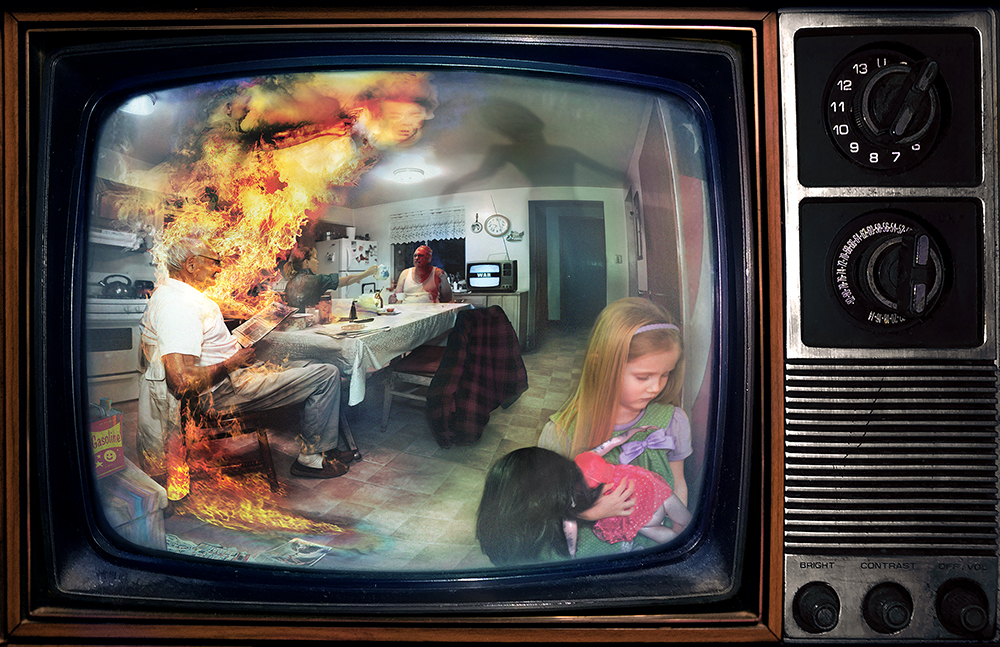
Summary Execution, Execution, Execution


T.V. Dinner | Photograph | 39.5 in x 27 in | Christopher Ruane

In history’s continuum / every beginning is artifice /
every context is partial / every story is fragment /

each iteration a Chinese whisper / transforming /
history sieved and remade /

the way time works a landscape out of recognition /
as when / a camera records a summary execution /

in a Saigon street in 1968 / swift / brutal /
outstretched arm holding a gun / to a man’s head /

and in one frozen moment / image overwhelming context /
speaking to itself / above / the background murmur /

of killings / and retribution / before the spattering /
of every thought / feeling / aspiration /

before the crumple to the road / and the pooling /
blood / terror writ large on a man’s face /

eyes closed / arms tied behind his back /
never knowing or caring /

about the immortality of his death /
broadcast across the world / on televisions /

in kitchens and dining rooms /
the instant of cessation / repeated / on thousands /

of black and white screens /
in front of one of which / a boy / eating dinner /

watches his father’s wild enthusiasm /
his punch in the air / his jubilation /

as if a gold medal was won / in the last instant /
victory snatched from defeat /

death and jubilation clasped together /
in the boy’s heart / the young man’s heart /

the middle-aged man’s heart /
until disgorged in a poem in 1994 /

Remember That Vietnamese Guy They Shot On TV In 1968 /
published in the Pittsburgh Post-Gazette /

and read by thousands more / echoes of echoes /
some readers remembering / others discovering /

neither perpetrator / or victim / now named /
the event / re-imagined / gathering longevity /

rippling through time / and the poem too /
surfacing again / in 2015 / flint sparking /

a photographer’s imagination / prompting /
a response / that goes beyond / event /

and poem / that seeks / to collate /
into one photograph / a whole album /

of brutalities / juxtaposed / images /
of the Vietnam War / with / American domesticity /

an old television set / showing / a dining room /
kitchen / three adults / seated at table /

a plain / white tablecloth / and behind them all /
a television / turned on / a fridge / a wall clock /

in the foreground / a young / blond-haired girl /
carrying / a dark-haired doll / leaving /

the room / her head / and eyes / looking downwards /
whilst / stretching out / behind her /

the height of a door / and onto the ceiling /
an elongated / shadow / arms held out / from body /

signifying / the young / Napalm Girl /
seared / into the collective / consciousness /

of a generation / and a woman / pouring tea /
arm outstretched / towards a man / in a singlet /

echo of the arm / holding the gun / echo /
the third adult / an elderly man / on fire /

flames / at his feet / spreading / across floor /
and rising / in a fireball / above him /

symbolic / of the burning monk /
and what I see / viewing this photo /

at an exhibition / in 2016 / is the insistent /
entry / of conflagration / into our homes /

into our lives / how the fires / of brutality /
burn / into us / make us participants /

complicit / all of us / rats / on history’s wheel /
running / for safety / though there will be none /

if the fires turn / if we find / ourselves /
suddenly / in our own / frozen moment /

with the flames / upon us /
and then / this poem / and then / you / and then


Notes:
Remember That Vietnamese Guy They Shot On TV In 1968 by Chris Yeager,
published in the Pittsburgh Post Gazette May 14, 1994 exhibited
January 16 – February 27, 2016 at PANZA Gallery, and reproduced in the anthology
titled Verse Envisioned: Poems From The Pittsburgh Post-Gazette And Works
Of Art They Have Inspired
.

T.V. Dinner by Christopher Ruane exhibited January 16 – February 27, 2016
at PANZA Gallery, and reproduced in the anthology titled Verse Envisioned:
Poems From The Pittsburgh Post-Gazette And Works Of Art They Have Inspired
.

For more information regarding the original photo of the execution and the
accompanying footage see Wikipedia: https://en.wikipedia.org/wiki/Nguyễn_Ngọc_Loan, https://en.wikipedia.org/wiki/Nguyễn_Văn_Lém, and https://en.wikipedia.org/wiki/Eddie_Adams_(photographer).


Posted in 79: EKPHRASTIC | Tagged

Woman with Red Hair

an abstract woman of 1917,
no fashion plate, no Cézanne, the long-faced strong-chinned woman

(Modigliani’s masked apparition
in a print I got for nothing, one
thrown out of the Library
of the School of Art
and stuck on my bedroom wall for
20 years)

with fire-orange hair,
left forearm perched like
a bibulous pink toucan
on the orange back of the chair,
right arm dangling,
shapeless dress of bluish-grey,
neckline askew,
distinguished mainly by being
darker than the dirty background

the artist’s expressionless model like an ad
for absinthe

head tilted
eyes a limpid tadpole swimming to a black half-moon
neck and right shoulder a pink swan
the very antithesis of hard work
guaranteed to wreak havoc on all that is decent and bourgeois

how often have I felt like her
(how often, as I grow old)
doomed model to a doomed artist,
a gorgeous, grubby wraith on my wall who can never grow old,
hidden hand holding perhaps a paintbrush,
or a dagger or a pistol or a blue flower,
sitter for a dying painter,
a Jew fond of Nietzsche cursed on Mount Parnassus,
an addict hallucinating in a garret within earshot of the Great War,
worth more than Cézanne the day after he died,
and pickled for immortality.


Notes:
Conventional ekphrastic with elements of notional ekphrastic poem, referencing a specific
print I have of Modigliani’s Woman with Red Hair. At the base of the print it
states on one line: ‛AMEDEO MODIGLIANI — Woman with Red Hair — National Gallery of Art,
Washington D.C. (Chester Dale Collection) Published by Shorewood Publishers, Inc.
Distributed by Penn Prints, New York’.

Posted in 79: EKPHRASTIC | Tagged

Corde Pareille

I never had a ladder, I’m the illusionist.
We dance the equilibre. I climb the corde pareille.
You hold out your hand, cupping
a large nail, and tell me it’s sacrificial.
A tight wire, I’m done
with my balancing pole. I climb
to your hand, an aerial act
under the cupola. You offer charee-varie
to help ease my walk. I sweat and strain,
everything harder than yesterday.
You invite me with an open palm –
I swing and pirouette.
Your whole life a smoke with disdain.
Crowds of critical eyes on my safety line.
Snakes form infinities waiting for the fall.
You know it would take a push
and that would be all.


Notes:
In response to After ‘Genesis’ (Genèse) by Yves Tanguy, 1926 Oil,
39 3/8 x 31 7/8″, Collection Claude Hersent, Meudon, France.

Posted in 79: EKPHRASTIC | Tagged

Botero

This curvy horse
will gallop in your dreams.

The fruit so fat,
the watermelon splits
with its own weight.

Can that parrot even fly?
The squishy hands
pluck the strings of the guitar?

The dancers’ heft
makes a slow music.

Family portraits:
the baby adults
hold adult babies,
cross-eyed, porcine.

Nudes with thighs so thick
and pubis small;
oblate bronze
pleading for touch.

Franco like a weird uncle
dressing up and watching himself
in the mirror.


Notes:
This references several sculptures and paintings by Colombian artist Fernando Botero,
including ‘Horse’, ‘Still life with Fruit’, ‘Guitarra’, ‘The Dancers’, ‘The Pinzon Family’,
‘Odalisque’, ‘Franco’.

Posted in 79: EKPHRASTIC | Tagged

La Passagère du 54

You are in love. Yesterday, on the ship
from Le Havre to Lisbon, she walked
on the deck with her husband and child,

her hair a brushstroke of gold. Now,
she is sitting alone. She has been reading,
but the book has slipped from her hand.

She watches the day, that is lifted in the waves,
her clothes the colour of sand. The sea
is black, and the clouds at its edge are black.

Perhaps she will turn, see you sketching.
You will smile, pretend you are elsewhere,
as if she were nothing at all. She will not know

how you shape her, these quick strokes.
There is love in passing. You will love her
forever. Above the ship, the clouds are so close.


Notes:
In response to La Passagère du 54 – Promenade en yacht, 1895
by Henri Toulouse-Lautrec. 60.8 cm x 40.2 cm.

Posted in 79: EKPHRASTIC | Tagged

Glass Flowers

1
Alchemical vessels
imbued with rumours of colour –
a pearly acorn-brown,
tinctures of amber, buff-white:

the Trickster, light,
mixing it up, sheathing
each sculpted bloom in
the glow of other objects;

even the innermost
whorl, the nectary,
endowed with
moody brilliance.


4
A time-lapse camera
would show these flowers
in violent metamorphosis:

tarry with darkness,
slicked by ivory moonlight,
dawn’s lava-red –

always in transit, becoming…
always, even when knifed by sun glare,
sealed, silent.


5
Seeded in fire,
amaryllis, iris, orchid –

sleek-skinned botanical studies

as vacant as living flowers are lush,
as brittle as living flowers are yielding.

Hothouse simulcra,
they lean towards windows

blank with rain;
bronze with day’s last embers.


8
The exquisite can be so cold.

But these sprays,
their silvery leaf-wings poised,

express a sunflower-yearning:
rearing up, opening out,

as is the way of plant life
and of human desire –

so outright;
heroic, in a way

and, in the end, unanswerable.


Notes:
In response to paintings from Dena Kahan’s Glass Garden series.
They are based on The Glass Flowers exhibit at Harvard Museum of Natural
History, which displays botanical studies made by Leopold and Rudolf Blaschka
from 1887 through 1936.

Posted in 79: EKPHRASTIC | Tagged



