Upon Losing One’s Map: Displaced Affects in Fatima Lim-Wilson’s Poetry

Jean Aaron de Borja

The promise of a good life moves people in sure yet complicated ways. Among the people caught in this flow are transnational migrants who navigate the nexus of economic, political, and cultural realities of living elsewhere, where the durability of possibility is tested. But what happens when the certainty of a promise wears away? Here, I briefly ruminate on the emotional lives of the migrant in Fatima Lim-Wilson’s poetry from three collections, namely, Crossing the Snowbridge (CS), From the Hothouse (FH), and Wandering Roots (WR), a body of texts that follow diasporic itineraries between the Philippines and America and a history of cruel desires that map the migrant’s comings and goings, even as they sometimes exceed these affective structures.

The conditions that sustain, accelerate, or impede one’s movement towards a promise, an object of desire, is complicated. The attachment to this promise is what Lauren Berlant calls cruel optimism. Cruel optimism ‘moves you out of yourself and into the world in order to bring closer the satisfying something that you cannot generate on your own but sense in the wake of a person, a way of life, an object, project, concept, or scene’ (2). In this sense, all attachments, Berlant explains, are optimistic, insofar as optimism is an impetus for movement, even though it may not feel optimistic (2, emphasis in original). It is cruel when ‘the very vitalizing or animating potency of an object/scene of desire contributes to the attrition of the very thriving that is supposed to be made possible in the work of attachment in the first place’ (2). In the contemporary moment, cruel optimism characterizes the affect of attachment to the neoliberal fantasy of a ‘good’ life that is actually ‘a landfill for overwhelming and impending crises of life-building and expectation whose sheer volume so threatens what it has meant to ‘have a life’ that adjustment seems like an accomplishment’ (3). Berlant contemplates,

The fantasies that are fraying… particularly, upward mobility, job security, political and social equality, and lively, durable intimacy. The set of dissolving assurances also includes meritocracy, the sense that liberal-capitalist society will reliably provide opportunities for individuals to carve out relations of reciprocity that seem fair and that foster life as a project of adding up to something and constructing cushions for enjoyment. (3)

The center cannot hold, and, for Berlant, affect and emotion provide an illuminating way of comprehending the continual unfolding of this historical collapse: ‘the present is perceived, first, affectively: the present is what makes itself present to us before it becomes anything else, such as an orchestrated collective event or an epoch on which we can look back’ (4). In this scenario, Berlant also points out the workings of the American dream, a fantasy that extends beyond its locale and contributes to the persistence of optimistic attachments to problematic objects as it conceals under the veneer of a good life America’s capitalist and imperialist complicity in the attrition of our collective world. Nevertheless, Berlant notes that ‘certain attachments to what counts as life… remain powerful as they work against the flourishing of particular and collective beings’ (13).

The migrant and their affair with the fantasy of a good life is not a sudden emergence in Philippine literature in English, a literary tradition to which Lim-Wilson belongs. Lim-Wilson wrote poetry from 1978 to 1995 after getting her degrees from Ateneo de Manila University, State University of New York, and the University of Denver. Before settling in America, she worked for the office of former Philippine president Corazon Aquino (Manlapaz 147). Her poetry engages with a range of issues, including Philippine politics and history, colonialism, gender, and sexuality (Clem, 2002; Sabanpan-Yu, 2011) and is praised by Filipino scholars and poets such as Ophelia Dimalanta, Marjorie Evasco, and Epifanio San Juan (Manlapaz 148). Despite critical acclaim, attention and analysis of her poems after her last collection eventually waned (Clem, 2002). Often anthologized in collections of Asian American writing, Lim-Wilson’s work predominantly explores the ‘wandering roots’ of the migrant with acute self-awareness of her position and the circulation of her work across American and Philippine readership.

Lim-Wilson’s work traces how diasporic sentiments and modes of living are historically and convolutedly entangled with Philippine-American relations as Filipino migration to America first happened during the American colonial period. The first Filipino laborers in America were from the Visayan and central region of the Philippines and were recruited by the Hawaiian Sugar Planters’ Association in 1906 (Okamura 36-37; San Juan, “Alias Flips” 24-25). As labor recruitment became more streamlined, more Filipinos were able to go to America. First-generation Filipino immigrants arrived in the country in the early 1930s, during the American colonial period in the Philippines. This wave of migrants were known as ‘manongs’ (literally older brother in Ilokano) who came as labor recruits through the early 1930s, post-World War II arrivals’ (Okamura 35). Life and labor conditions at this time were inhumane. ‘They were victims of racist laws and discriminatory practices. They were hoodwinked by inflated advertisements of wealth supposed to be acquired through honest manual labor, but soon enough they learned the reality of the marketplace: ‘Filipinos and dogs not allowed’’ (San Juan, “Alias Flips” 25).

Harrowing experiences of the Filipino migrant live in Carlos Bulosan’s America is in the Heart, perhaps the most canonical Philippine novel on the Filipino migrant experience and thus forming a crucial part of the literary and historical consciousness of literature on the Filipino diaspora and the American imaginary that this tradition sustains and questions. Bulosan, who himself went to America in the 1930s, writes of the plight of the migrant in his autobiographical novel: “I came to know afterward that in many ways it was a crime to be a Filipino in California. I came to know that the public streets were not free to my people” (123). Bulosan’s Allos, his novel persona, is witness and victim to the banality of violence during this time: ‘“I was talking to a gambler when two police detectives darted into the place and shot a little Filipino in the back…. They left hurriedly, untouched by their act, as though killing we a part of their day’s work’ (130). From these instances, readers of Bulosan’s novel will witness the gradual development of a radical consciousness grounded in the struggle of his fellow peasants. Towards the novel’s end, Allos unites with workers all over America, on a mission to stand against this violence and injustice. ‘I felt something growing inside me again. There was the same thing in each of them that possessed me: their common faith in the working man. I sat with them and listened eagerly…. Then it came to me that we were all fighting against one enemy: Fascism. It was in every word and gesture, every thought’ (310).
Posted in ESSAYS | Tagged ,

14 Artworks by Chunxiao Qu


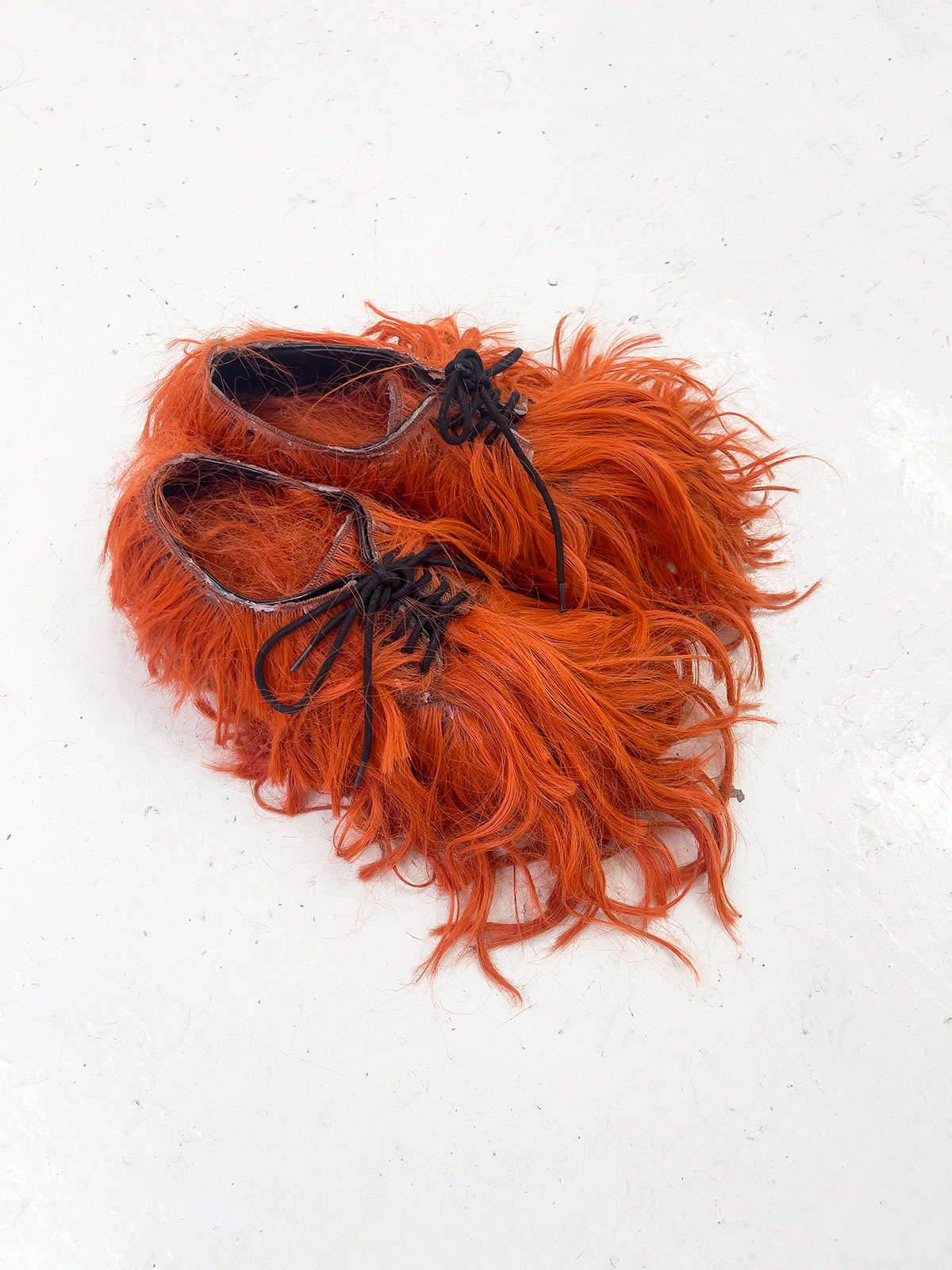
Wig shoes, 2017, shoes, synthetic wig, 45 x 15 x 32 cm

Posted in ARTWORKS | Tagged

12 Artworks by Rona Green


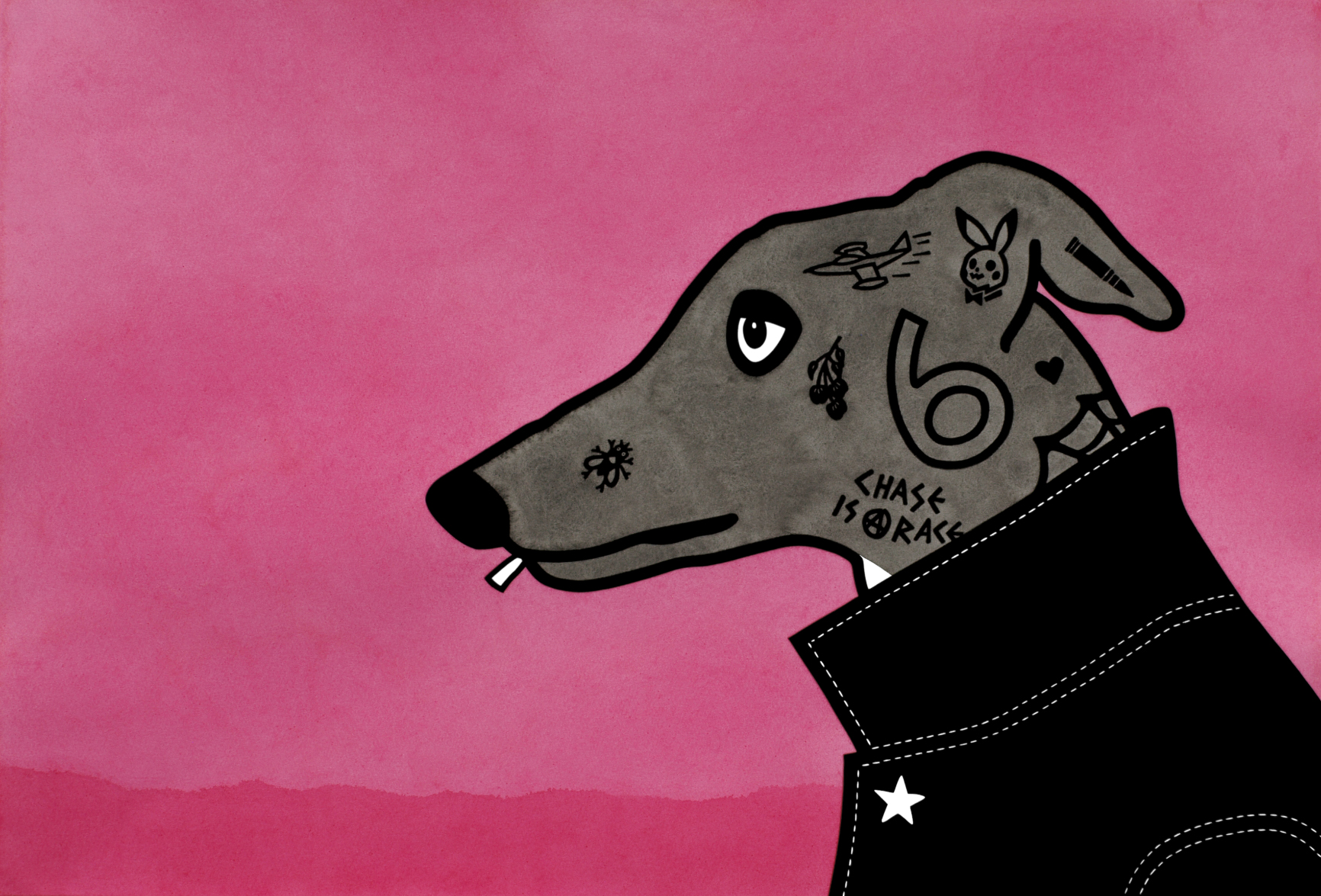
Rona Green | Cola nights | 2022 | hand coloured linocut | 49 x 72 cm | edition of 23

The images of peculiar persons I create delve into the nature of individuality – thoughts about persona, transformation and the absurd. There is a specific interest in how identity is expressed via the body; physical appearance and its capacity for alteration; the skin and its potential to be a site for reinvention – how the body can be a vehicle for communication. This manifests through the use of transformative devices, particularly anthropomorphism and body decoration, which catalyse the conjuring of uniqueness.

Engaging with the animal as a motif is rich in nuance, offering a wealth of possibilities for interpretation. A formative experience was encountering Egyptian art – in particular representations of theriocephaly – and a childhood love of cartoons and comics centred on anthropomorphic characters has significantly influenced my visual expression.

Use of tattoo as a motif is driven by its ability to suggest a story – it can convey information about origin, affiliation, status and proclivities. As a form of communication, tattooing has the power to transcend language barriers. Tattoos can speak to, or be read by, anyone on some level, making them a compelling tool for transmitting ideas.

Printmaking is a captivating medium, and for the past twenty years, I’ve specialised in making hand coloured linocut prints. As a reductive process, linocut technique is conducive with my inclination to want to pare things back to what is essential. The editioned linocuts are printed with intense black ink and then hand coloured using water-based media, resulting in a sense of sameness juxtaposed with subtle variation, which is conceptually appealing.

When my pictures are on exhibition, all going well, they will evoke a sense of connection, perhaps sparking an unspoken dialogue between the viewer and the subjects portrayed.

Posted in ARTWORKS | Tagged

REMEMBER Editorial

Remembering requires an intermediary to obtain a form and a content. It might be a family or here a poet, it is unceasing as a task and not an artefact.

Remembering insists on an arc of happenings, this is connected to that, one day in October is connected to another, contemporary violence is connected to originary violence, January 26 to invasion, genocide to Nakba, this is to that, acts of remembering insist on it.

When Palestine, when Lebanon, when Syria, when. When they are bombed, as they have been bombed, more or less relentlessly this century, what I remember are the lamentations for artefacts of civilisational endurance that this or that actor has effected, after some millennia of preservation, now, instantaneously, evisceration.

What I remember is my office-mate distraught about the millions of body-bags in Homs while we wrote our dissertations.

What I remember is the day I first heard an archive poem, Footnote to a History War, which Tony performed, which commenced a lesson I am always recalling, and that I will always be learning.

What I remember is that it is the work of the living to remember. To treat memory as khazaaen (treasures) but not to hoard them.

What I remember is how I came to write to Mahmoud some years after Mahmoud first published a collective of Blak and Palestinian authors in a magazine he founded, as a triangulated act of solidarity between First Nations people, diaspora Palestinians, and the Palestinians who remained.

What I remember is there are responsible parties and that cultural artifacts (which I lament) are memories, but that lamenting human life is inadequate when you are staring at the forehead of a genocide.

When Mahmoud wrote to accept our invitation to contribute, he wrote a thing we will always be remembering:

I will indeed do my utmost to respond by January 30, if I am still alive by then. I hope to witness the end of this war and to reach that date, January 30, though it feels like an uncertain path into the future. In any case, I am investing my time and energy not merely in survival, but in living. This investment is rooted in the act of continuing to create: writing for memory, writing for the present, writing of attempts to build while the worlds we knew before this genocide continue to collapse. When will it end? It is not the timeline that matters, but that it ends—and that I am still here. “Being alive” has become its own form of time, in which we build a displaced life, a layer of existence that we will ourselves dismantle if the collapse is completed and the genocide ends.

Mahmoud Alshaer, November 4, 2024.

To this editorial Ani offers a whakataukī to conclude:

Kia whakatōmuri te haere whakamua

(I walk backwards into the future
with my eyes fixed on my past).

Posted in ESSAYS | Tagged ,

Colour Theory

Because we once lived in a cotton candy condominium, next to a swimming pool, next to a yellow church, where we sang hymns on Sunday and had hot pockets for lunch.

Because I fell down thrice in childhood, twice at the roller-skating rink, once by the swings. My grandma rubbed a hard-boiled egg in concentric circles against the peony contusion, and the egg nouned so hard it became a verb. And like all good verbs told long enough at dinner parties, it became a legend.

Because in the heat, the sky splashed upwards, like a reverse swimming pool. And I didn’t know rain could caress like the assonance of precedence, of citrus, of susurration, till I was living in a temperate country 4374 miles from home.

Because, age four, I vomited wolfing down a banana split on an idyllic butterscotch Sunday. I once coughed up a cloud of fur from sneaking too many snacks from the cat’s cracker bowel. I once crayoned the bright ruby door of the lockers and married a dijon sandwich till I was king of the jungle at three. How so much of our childhood depended on the memories of others. And what we were told became truth. And what became truth became another lesson on the pitfalls of inception.

Because I thought I could stretch the same lilac sky to embrace my first home at Pasir Ris and my second home at Simei, and I made holes for air till the cling-wrap grew too hot and heavy and I wanted out. That was when I realised the stars, like slivers of parchment, were dead eyes from the past, and the ones that were watching me in Australia were not the same ones that beguiled me back home.

Because the fourth time I fell was into the black hole, its infinite event horizon. Away from a decade of fuchsia school dances and peach gum parties. The distance warped from the years untethered to the ground, as I moved closer towards the centre of ambition.

That spring, I received news of my grandmother’s fall, and on the plane before midnight, her passing. And I held up a prayer, the one I’d incubated in my chest for decades, like a hard-boiled egg to the ends of the world.

Because up until then, I had believed, the way a child believes in bumblebees and daffodils when they were first objects then colours, that, when the object of our desires had superseded the momentum of our leaving, I could kill time and return to the arms of the waiting.

Posted in 116: REMEMBER | Tagged

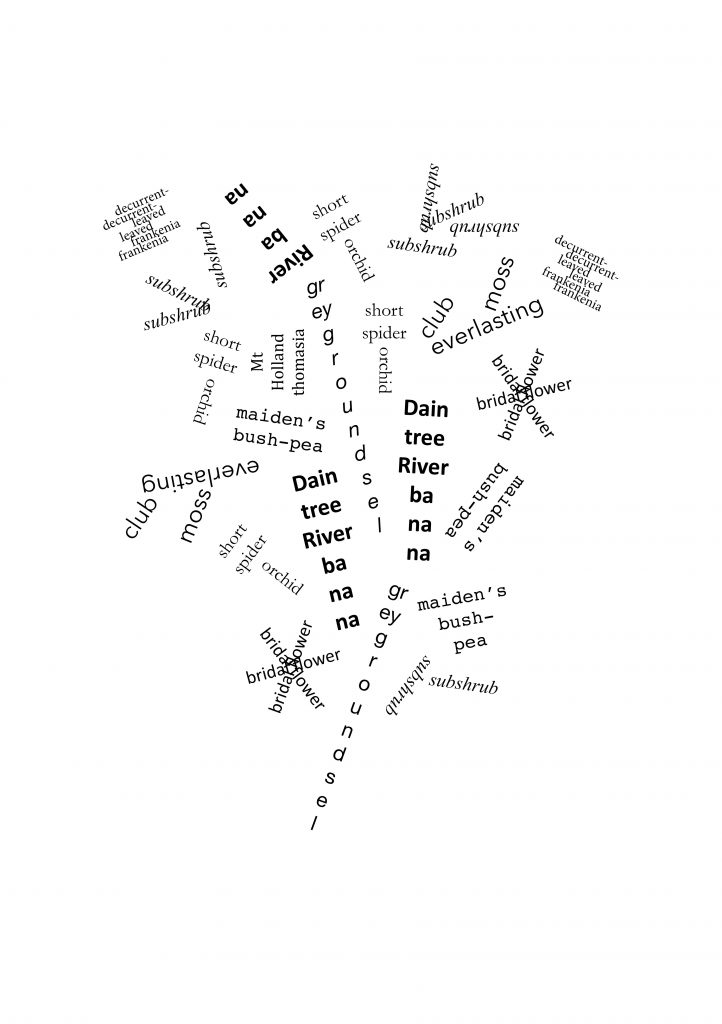
A Bunch of Extinct Australian Flowers

Posted in 116: REMEMBER | Tagged

gossiping in Singlish is a funhouse mirror

my mother’s country
is so close to the equator
everything sticks
my saggy Cantonese
tightens to a snakelike coil
my clothes turn skin-clingy
every uncle ashing
into the gutter outside
an MRT station while
gossiping in Singlish
is a funhouse mirror
vision of all my maybe-futures

the first time I came back here
my bones hummed like a tuning fork
possessed by a perfect frequency
but I couldn’t read the music
the room the pinyin
on any of the gravestones
in that garden where it seemed
I’d arrived a decade too early
or too late to pay my respects

having taught English for a decade
now I know that even handwriting
can carry an accent
the shape of scribed letters
bent irreversibly to the
curves of the mother tongue
being my mother’s son
I know I bear more of her marks
than numbers I can count to
in her language each of her
fingerprints a tiny labyrinth
that has taken me years to solve

how can I make amends
with a country who refuses even to look up
from her phone when I am speaking to her
how might I convince her soil
to recognise my humming bones
in her I am little more than
a plume of cigarette smoke
that lingers in the air
like a string of impossible questions

Posted in 116: REMEMBER | Tagged

Tryptich

The Many Places I Call Home


i am drip-dried chapped-lipped
dusty dropping tracks i
am hot explosion bottlebrush
my snowdrop songs wilt in aromatic
eucalypt i am parched wood and charred
tree trunks perennial red dust beneath
your fingernails i am dry creeks birds
that cry whiplash & rainbow-backed
beetles that visit when evenings
are longer than the shadows
i am wellingtons thick with mud
stiff fingers dirt disbanded
into the creases blackberry juice
staining cracked lips nose nibbled by
frost i am grit salt grabbing onto potholed
tar frigid air puffed around yellow
street lamps puddles dribbling
into my socks settling icy into wellies
too big little legs swallowed as though
by the tannery caves of Nottingham
i am a product of grace and a survivor
of tales you wouldn’t believe i am beaten
until colourful i am scarred beyond
recognition i am boxed in & stretched out
& grateful to people whose names
i do not remember there are things i
cannot recall except in terrors that
overtake me in the dark i am a product
of trauma & love & i do not know
what i am called to do except to live


Grandmother


baju,
i call you crackled sediment
between a crescent and tusked
roamers. you hum birdsong
and scrape sunrise
from your eyelids. you
understand time because the teeth
you lost smatter
hardened ridges and wizened
foliage so deep even sun
light will not glare.


Place Where The Sea Makes A Noise


mottled sunkiss glimmers past wiggly bark glancing into my eyes hazel glows toward end of Country
roar and foamy thunder salted wind brushes my skin bush rustles in tune with chuckling kookaburras
ancestral dust spreads between my curled toes as i approach the brink of this land i am stolen by the
oceans’s breath where mountains touch the sea

Posted in 116: REMEMBER | Tagged

Molo Road

men and women washing clothes in the river


Families wading
and sitting in the water,

taking advantage
of a sunny day with the river

banks behind, barely held together
by the roots of banana trees,

are more than a two persons high.
Mundane tasks involving

so much risk, a people’s faith
in the river in full display.


molo road


The few planted electric
posts are not as high

as the coconut trees

on both sides of the partition
that forms a semblance of

a road made of sand.

The edge of a fishing boat
further revealing the topography

of the Queen City, affluence

from plantations nearby didn’t take root
in this peaceful beach, conduit of empires.


Process Notes:

The University of Wisconsin Digital Collection has over 600 images from the Philippines accessible online to the general public.
The images taken in Iloilo are mostly from a single album titled ‘American expatriate in Iloilo, Philippines.’ Aside from the
years these photos were taken, 1907-1916, there’s very little information about them. Surveying the collection, one can presume
they were captured by an amateur with a combination of curiosity and exoticism regarding the natives of the US’s then new colony
in the Pacific. The poems I’ve written in response to these selected images aims to view them in anti-imperialist and ecocritical lenses,
rather than the conventional ekphrastic mode. The titles for each poem is the exact label on respective photos in the digital collection.

Posted in 116: REMEMBER | Tagged

Smyrna, 1922

Always, near the sea, a floating remnant,
a decision, the inescapable,
ships a way out, a glass cabinet
of sorrow.
For some, Smyrna.

In the Aegean, captains wait.
Masses sink into smoke, disappear in fire,
rot like kelp.
Elsewhere, in hallways, suits talk,
eat plums.
For others, Smyrna.

Posted in 116: REMEMBER | Tagged

The Morrigan

The Morrigan wants her life back. Says she’s sick of all this flying. Says it’s harder than it looks. Says it’s not her fault she was born with hair like venom and mountain dew eyes, not her fault she was hung on every teen’s bedroom wall ever, not her fault that some nights the plasticky sheen of her thighs and soft hands in moonlight would cause them a heat they hadn’t yet known before. Says she didn’t mean to assert providence. Says she never really knew. Says fate clung to her back like a tired child and wouldn’t let go and guess who’s the tired one now? Says she misses playing Mario Kart with her brothers. Says death is overrated. Says war is too. Says men could do better at conflict resolution and maybe they could also try being more chill. Says it would make her job a LOT easier. Says she is large. Says she contains multitudes. Says three isn’t enough – it’s much more than that. Says there was a time when she’d walk the hills and wouldn’t once think about what was beneath them, or whether there was a beneath at all, and if there was a beneath then how far down did it go and then what was beneath that? and so on and so forth. Says age is just a number. Says (controversial opinion) she’d rather her human form over crow. The Morrigan wants her life back. Says she’s sick of all this dying. Says from now on if you want her you can find her in a cottage by the woods making fires and tending the garden and maybe one day she’ll become so irrelevant a soldier will fall on a field and not a single person will look to the sky and wonder if that’s her shadow passing overhead.

Posted in 116: REMEMBER | Tagged

The finally still

Eventually there were too many roosters.
Mum lit the fire and loaded the woodstove
with silver pots that hissed and steamed
like hungry machines.
Dad waited by the woodshed
while we became foxes, caught flapping bodies
as bright as beetle backs
then turned them over to a practised axe.
The cats came to investigate then shrank back
from the witless charge of open necks,
protests spilling silently in red.
The finally still were delivered
to the scalded reek of the kitchen,
lowered into water hot enough
to loosen the pin of every feather,
glossy bibs now clotted
with their last indignant comment.

Posted in 116: REMEMBER | Tagged

The Observer


THE UNDERTAKER’S DIM BACKROOM AND THE HEAVY LONG PRESS-DOWN

Here’s what happens when your ten year old self is sent to collect the obituary notes for your grandfather’s newspaper business – you slowly learn that A devoted mother might mean insatiable cravings veiled while baby bottles of gin lie silently in the cistern He was a gentle and unassuming soul leaves no space for cavorting and beating and leering at pretty young girls with open mouth and fat tongue out Much noted for her remarkable sense of style fails to conjure her raised middle finger rammed back her throat to touch her tonsils until her rib cage heaves and she gags and gags so the little black dress hugs snugly He was a devout Christian paints haze to ravel doubt in local anecdotes of gambling or how he helped himself to the office petty cash and cupped the buttocks of the petty cashier before heaving his groin The death was sudden and unexpected sometimes washes white over the haemoglobin of blown-out brains or the sanguine slash of a left wrist. As years pass you consider it all against the

lone tick tock in the undertaker’s dim backroom behind the bubble-lined glass caught in wartime beige until the white haired ink-suited undertaker stirs you from lull and thumbs the pages of his huge tome to read aloud while you write on a spotless page and later wait, in the newspaper office, for the heavy long press-down of the buttons on the tall linotype machine where circular lettered keys connected by vertical pushrods to escapements in the back compartment compose lines of text until the operator raises the casting lever and casts a line of metal type – a slug – a shiny silver slug – like a thick razor blade – a slug of a sentence to be arranged by your grandfather and father into pages caged by tightly fastened frames punched later onto newsprint as eulogies of the freshly dead.
Posted in 116: REMEMBER | Tagged

Al-Awda

Palestine, July 9, 2024

This is a cloud
This cloud is stitched to sky
This cloud is bleached like an old sheet
This cloud rains dust and pulverised stone
This cloud rains footballs and pencils and children
This cloud hangs over a crater
This cloud hangs like a body
This cloud is a carcass
This was a school

Posted in 116: REMEMBER | Tagged

homebound doubts

encased in an almost-convincing inhale of cotton
(all cerulean blue and burgundy coddled)
is a ritual as ancient as the windcheater
that somehow still smells like you

like salt and surf wax
neoprene and sunscreen

it casts the mind back –

a sunburnt nose
drips sea water
onto carpet

ninja turtles made
from laundry baskets

bike rides to the river
a bridge-crossing like terabithia’s
watching for echidnas

waiting for the riverbed
to swell and break with rain
for all the trash and treasure
to greet the ocean’s maw

a blue-tongue in the garage
almost takes a shovel to the neck,
the danger of another dugite
fades into the concrete
like snakes into the brickwork

a persisting christmas tradition:
plucking chillis to punish
the loser of lawn bowls –
this sharing of fire
resembles friends
breaking bread

bluebottles popped barefoot
translucent jellies tossed underarm
contrast to torpedoed paddy melons,
scattering bruises that fade
to the yellow of their insides

polished abalone, prettier than pearls

Posted in 116: REMEMBER | Tagged

If a Baby Cries

1.
After bellows of gas take the mother’s voice
contract crown expel
a baby
a silence
the nurse holds her breath to find a breath
and a mother wants to be a mother
she shows
a breast
a doctor enters the room of no sound

2.
The newborn decides to cry
as their mother
carries them down
the stairwell
during gunfire
a fleet of soldiers lower their weapons
to recall
the first rule
love and be loved
as they dodge
among the strollers
emptied
and without wheels

3.
The mother is seventy
when she enters
Alzheimer’s door
to outlive her ghosts
she ceases to talk
her brain is busy
running from attic to cellar
the cry gets
louder
her breasts enlarge
with memory

Posted in 116: REMEMBER | Tagged

Patchwork Memories

“good morning,”
sings the doorbell.
“Open up, open up,”
followed by a light
shuffle of feet.
mrs. is a title that fits
now – she ‘misses’ many,
many things. not the least
of which is optimism.
the sewing machine
keeps moving, keeps
building. gets stuck,
and keeps going.
how kind of it.
gingerbread has a
very distinctive smell,
and she will never forget
it. ginger and laughter
– a perfect recipe.
now that it is only
her, she sees the
fragments
differently. tears
them apart, and knits
them back together.
the morning tastes of
many things, and
loneliness is one of
them.
home: tea, milk, no
sugar. the sound of
ceramic as the
teaspoon ricochets
inside it.
she can’t think when
she last cleaned the
window – but she
smiles to see the tiny
fingerprints still on it.
a to-do list, hastily
scrawled, and
dropped in kitchen
flour.
the baubles, never
taken down, have
started to break; like
shattered glass.
shattered glass up
against a tree…
“i’m sorry for your
loss – we came as
soon as we heard.”
a butterfly lands on
the bouquet, and her
hands shake. how
beautiful.
red and blue circle
each other in a
whirlwind dance,
contrasting the
fireworks above.
knitting needles –
another thing that
moves, but goes
nowhere.
scones, like her own
grandmother used to
make. she hasn’t
quite perfected the
recipe yet.
and the rocking chair
goes back-and-forth,
back-and forth,
back-and-forth…
dawn sets the clouds
on fire, and the stars
seem closer than
ever. tomorrow has
arrived yet again.
“how kind of you,”
and the floorboards
creak their grieving
thank yous.
stringing up the
tinsel, and the fairy
lights. red and blue;
and green and
yellow.
the bedsheets feel
colder than usual –
but only until she
remembers why.
Posted in 116: REMEMBER | Tagged

On an Antique Breast Pump

after ‘Breast Pump, London, England, 1870-1901’, Wellcome Collection

The pump, nestled in a cloth-lined
locked box, is made of two parts:
apple-shaped glass bulb,
brass syphon embossed with the names
of its makers, son & son.

The key to the box is long-gone,
not to be used again: the piston missing
its sweet oil, the mouth it fed
a mouth no longer.

Glass has a memory we can only
intimate: skin and heat,
milk blown brightly to a centre.

Salt on the lip
between bowl and brass:
where tears were shed,
the greedy instrument had its fill.

Posted in 116: REMEMBER | Tagged

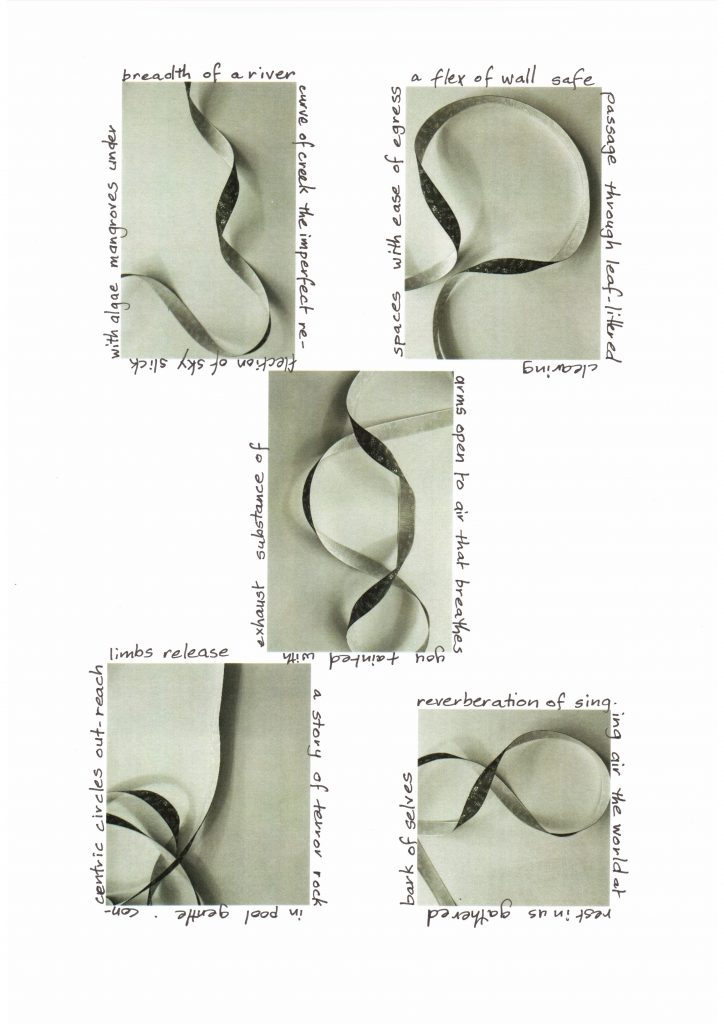
Holding the knowing

Posted in 116: REMEMBER | Tagged

I am Learning Peacefulness

I almost miss her
Told to look for massive tributes,
there are none.

Only a tumble of blue and pink
so voluminous
it covers up her name.

There are no poppies in October.
It’s borage and granny’s bonnet in June.

Snapdragons, and low-growing lemon
roses enfold her edges.

Bees come and go with a soft burr
that sounds like honey.

A single strand of sedge rides the air—
slow Ariel.

Posted in 116: REMEMBER | Tagged

Amygdala hijack

Silverback stride delight neon lime road bike
I can’t ride outside, the cars croak too loud, the magpies swoop too low
in our little cul de sac
Wait till Ba gets home, but he says it’s too dark to practice now
And tucks himself back behind the wheel
I can sleep anywhere except on a bed, he laughs
Fishing boats, sputtering sedans, late buses, full trains, paper planes
Symptoms include fatigue, uneasiness, dizziness and vomiting
If he stays still for too long, the faster and further
away
he is to who he was,
the better.
And so, I fold him into a frog like he taught me all those centuries ago
I tuck him into our letterbox where he can finally sleep
With no return address

I waddle back and forth under the shrinking carport
Throwing bang snap poppers at a head of weeds crowning out a
Split on the concrete patio
Slow down. Always have one foot on the ground
Our backyard is as big as a baby’s thumb, but I go fast until I can’t stop and
Tug the tire out the wall of our granny flat
To find a hole in space and time that I’m sure wasn’t there before
I poke my head through the gash and watch my mum
Hang a husk of my body on the rotary line
my arms and legs flail as she beats me with a tennis racket
I wheel the holy trinity of bins to cover it up

And beg to lie with you on the mesh hammock
I got here first! Wait your turn!
I fan away your tears with a palm leaf
And rock you back
You are eleven, youngest of eleven, lucky last
Nothing to eat but cassava,
even now you miss the taste of cyanide
I rock you forth
You are seventy seven, in bed by seven,
starving for sounds of me,
I try to catch you in the moment, as you are now
Before your tattooed brows fade green, before your brittle hands dry out, before you forget who you are
I tangle myself to you

We are bound
not by the red thread of destiny
pinkies
but connected by the tapeworm of fate
belly buttons
When you become a mum, you’ll understand
Next time
aroundnuora
I’ll make sure
You’re my daughter
So I can finally ununderstand.

Posted in 116: REMEMBER | Tagged

Pyromancy

“[] was only interested in uncovering the subfloor that he imagined would be a map to the fire.”
-Beyler Report

In ’92 they defined the standard of care for fire investigation and confirmed that plastics
can look like liquid spills after a fire. Since plastics captured the market after World War II,
everything we own looks like arson fuel. To live surrounded by your presumed guilt, drink
the evidence, breastfeed the evidence into infants, to be laid down in a crib of suspicion.
Your parents watch with a philosopher’s anxiety of the numinous, torn up floorboards,
a telltale heart. When Thich Quang Duc was candled across that intersection in Saigon,
what was found skulking around his luminous mind? Is this the hard, gem-like flame?
Is this the hard, gem-like light? A spring so silent you could hear the plastic in his organs
crackling like a fireside chat, which your parents hear ears pressed against your new belly.
In ’92 they advised all fires are accidental until proven otherwise. And with his five eyes’
foresight, our angry god dangled us over his furnace to determine whether we would catch.
It was an autumn of orange spiders and orange leaves, deciding to embody the philosophy:
one might as well live combustibly in a burning world. What is burnable will catch beside
a being made of blazing. The marshal will scry anthropology after they fill the final crib
of plastic, in the ground of plastic, in an age of plastic. At the body’s trial, they might argue
the fire tells a story, I am just the interpreter. A terrible point of origin, but how to burn.

Posted in 116: REMEMBER | Tagged

Hamza

What’s weird is that this morning
I woke up with your name in my teeth
I had a dream about you
or maybe it was about a cousin
on the Bugojno side
Someone I’ve never met
just seen
in photos
in front of the rebuilt city hall in Sarajevo
the rebuilt Turkish bridge in the town I was born
Standing
young and earnest
in the face of our history.
Not unlike you,
Hamza Hamza Hamza Hamza Hamza
Until it becomes a purr in the deep belly
of a lion.
I hadn’t thought about you in weeks
Not since you wrote
How bad it is!!
Trying to convince the world that you are dying.

That was months ago and
since then,
you have fallen silent and
since then,
who has been convinced?


On Oct 13 2023, Hamza Ahmed (@hamzahjazar) tweeted these words. He has not tweeted since.
The name Hamza Ahmed Mustafa Al-Jazzar is listed among the dead. He was twenty-four years old.

Posted in 116: REMEMBER | Tagged

Yellow Pressed

after Robert Hass


Yellow was the smell of plump September wattle, dangling over goldfield shale. The colour of my teddy born with a design flaw. He could never sit down. Destined for straightness, arms at right angles, like a fuzzy jesus on the cross. At tea parties, I bounced him on the long dry grass, desperate to re-shape the unbending.

At thirteen yellow was my favourite colour. I wore a daffodil gingham skirt, sewn by my mother. Paired with a giant orange t-shirt, to hide the bumps on my chest. When faced with a difficult moment, I would trace those checked contours like a way out of shy. A yellow brick road to calm.

Oxford yellow was found in kitchens. On buttery walls of the snug or carpeted bathroom. It made summer last through the grey lightless winter. Brought port meadow inside. Pressed shadow fossils of fly honeysuckle and creeping yellow cress, onto ceilings. A reminder of golden Ibiza sands between toes.

Melbourne yellow was the brilliant sun. Molten-wide in the agapanthus sky. The colour for my baby not yet known. A pasty lemon rebellion against pink and blue. The only two colours sanctioned for children.

Yellow was my son’s sons first pair of gumboots. Worn on opposite feet. Splayed with independence. Matched with a nappy and dinosaur singlet, he wrestled the garden hose, watering zucchini flowers, unaware his ureter was pinched top and bottom. Turning him jaundiced. As his kidneys began to fail.

Posted in 116: REMEMBER | Tagged