November 14, 2024

On the parliamentary floor,
the young wahine stands,
and with unshaking hands
parts the violent seas that swell
to drown our people,
to turn back the rising tides
that ferry our mana to shore.

A mana we have always known,
carried within us,
that they fear but cannot see,
that is:
star-scattered,
soil-sewn,
wind-woven,
wave-wrought,
resting in the deepest roots
and moving, waiting,
in the molten fire
that stirs, silent,
beneath their feet.

The young wahine speaks;
no – summons,
her fiercest war cry.
Her voice becomes the taiaha,
cutting
swiftly
through the latest transgression—
but certainly not the last.

A wayfinder leading the waka
through her righteous call
and the answering boom
of resounding voices,
young and old,
from land and toward it,
affirming as one,
pushing us all ashore.

Posted in 117: NO THEME 14 | Tagged

I Had A Dream It Would End This Way

i.

Structure ; fish hook ; exorcism.
Am I floating? When I dream it feels like it –

I call Zoe on a Tuesday.
Babe, she says, bad timing. It’s a full-moon.

Listen, I reply. I saw the nightclub glow with blue-bottle
bodies jerking it to an old children’s song:
heads, shoulders, knees & toes, knees & toes.
& everyone was fevertraced with neon.
& everyone was elongated into light.


ii.

I know I imagined my life chronologically.
I know I imagined anything at all apart from this
call & response to helplessness:

queer as genetics.
depression as genetics.
am I floating?

Babe, Zoe says, you need to get out.


iii.

Threshold ; bargain ; dominion.
Am I dreaming? My jaw is shaggy, my hands sequester claws
I levitate with nocturnal dread –
A room strapped golden and dark. Eyes & ears & mouth & nose, mouth & nose.
Below, a disco ball spins.


iv.

I don’t think about it often & I feel bad
for not feeling bad. For not believing in anything at all.

I know I’ve written this poem before –
It said:
how to solve a departure.
It said:
the burnished knight climbing down the princess tower every morning
It said:
I know more about being lonely than anything else. Even when I emerge golden
from licking Z’s thighs inside the men’s bathroom stall.


v.

Am I alive? A fish hook twists. Guts ripple.
Howling at the moon. A colour theory chart.
I had a dream it would end this way. Werewolf shift.
A voice, from a very long time ago, telling me to pull.

The clubline trembles.
I don’t know, I tell Zoe, I’ve just got that dog in me.

(There was a moment, once upon a time, when I woke up –
And honestly, I had to try very hard not to kill myself.)

& I bend backwards, ankles to ceiling.

Posted in 117: NO THEME 14 | Tagged

The Fox

A discomfort of steering wheels.
The red ray of stomach lining.
We wonder about the lifespan of a fox:
in captivity three to five times that of wildness.
Because of us, a cast of stairways,
of leaning down, of bad luck.
I’m figure-eighting wheels, getting lost
tying knots between his spine and mine.

When I was a baby, just skin and wonder,
the contents of a coffee cup assaulted me.
We went back thirty-two years on;
had a cuppa a table over. Backbended.
A slingshot of clocks. A roadside bouquet
for each hair stood on end. When I make art
my preferred canvas is wet beach sand.
Finger painting holds no pressure
when shores wash clean my mistakes.

Retrieve the fox from gravelled earth. Sharing pulses,
shaking palms. At sixteen: a funeral for wellbeing.
An unfurling of wings iterated each vertebrae,
catapulting hurricanes to rip up coastlines with each beat.
Fist against hips when lightning travelled down his veins
and made blown glass out of me. Pristine.
How I anchor, how I yield like sand,
grain by grain, as I settle into time.

When Parks said every breath you take
has two possible endings
I felt it in my right hip flexor.
Foot shifts to pedal brake but it’s not there
no matter how hard we press. The scent of mahogany,
of wide eyes, of scars on my shins. A concerto
of MRIs where each note is in the signature of eight,
by which I mean we swerve in response to a flash of red,
a foot that won’t connect,
one-hundred-and-ten reasons to stop a breath.

Posted in 117: NO THEME 14 | Tagged

Inheritors

Mothers give birth underneath a cypress tree,
Teaching her babies the symbiotic language,
Learned by her ancestors.
A life cycle of inheritance, from fertile lungs.

Her faith is a penumbra that falls over her,
Folding verses into her palms, a kind of love daughters inherit.
Curious gaze, cross-stitching the Bethlehem star on her dress.
Sister plucks moons from the sky,
Threading light into Tatreez.

They carry the heart of their homes on their sleeve.

Ancestral craft is more magic than poetic,
Gathering knowledge from grandmothers.
Women creating, women preserving.
Stories from finger to needle,

Like heart to womb.

The breath of the land lives her veins.
Young girl grows into the iambic pentameter beneath her feet,
She is the metaphor of her country’s heart.
An archive between Yaffa and Haifa.

In remembering a nation, honour the women.
Plestia writes about Gaza in her journals, people as survivors and warriors.
Rafeef in poetry; we teach life, sir.
The little girl with a mic, Lama in her oversized PRESS vest.
Sidra.
Hind.

Inheritors stolen.

All braver than soldiers who trample on stolen land,
Waving guns towards a tender sky, feigning ownership of a land he claims to love–

A lover would never plant checkpoints where olives grow,
Ungathering the seeds with one bullet.
A lover would never starve a land that feeds them.
A lover would never tear apart communities.

Christians stand outside the mosque,
arms linked, protecting the prayers as the soldier preys on them.
They won’t show you this kinda love.
Celestial, communal, congregational.
A testimony to their apathy.

Girls starve, women speak to senseless leaders through screens.
Hey everyone, it’s Bisan from Gaza, and we’re still alive.
Montages of rubble, collages of collapsed hospitals.
Babies born with ribcages protruding under their skin.

–Playback to beaches and farms. Walking through wheatfields.

Ceasefire, Cease–
Fire.
Ceasefire.
CEASEFIRE.

For the young girls who simply want to be, and deserve to be.
Deserve to spread their wings from the kohl in their eyes,
To the butterflies in their stomach, after finding love.

For the girls that are soft spoken, the hot-headed,
The academics, the do or do-not darers, the daydreamers,
The courageous, standing up to soldiers.
The adventurous, the coffee lovers, tea drinkers.
All resistance.

Human.
Not collateral damage or consequence.
Colonial interference, settler colonial violence.

What about our future leaders?
Mothers give birth under a grey sky,
Babies breathe smoke.
Her lungs bleed,
Still awaiting.

Posted in 117: NO THEME 14 | Tagged

The Theme

It’s hard to tell where to make the cut, my friend
the film-editor, tells me. But a cut
is a cliche
in the digital age.
Our time’s not stored in feet or meters, but random
access memory, the high frequency prosody
of the server farm. E-I-E-I-O. My time
is stored on a cylinder, I reply, in a metal box.

Leave that on the floor.

It’s hard to tell when to cut her off, my friend
the video editor, tells me,
I think she’s having another episode
as in a sit-com: a discrete narrative
with no connection to what preceded
or will follow.
She was asking me for money, this time
for shoes, and I gave it to her.
Every time she winds me back up,
and I crank the handle. Canned laughter.

Now she’s in Melbourne,
which is why I’m calling you.
She walked there in her new shoes.

But I have more urgent questions.
Is an episode for its audience
or its sufferer?
An illness or a gift?
How did you get my new address?

*

The discount store carried a limited range of themes
you told me—each, in its own way, heartbreaking.
I cranked the handle, turning a steel cylinder.
Trees of green and roses bloomed
in the public domain
for me and you.

Cliche closes distance. What a wonderful world we share
reference to, without knowing we share the world.
An episode for me and you.

We call a song timeless when it reminds us
our present disappoints,
when it plays while we’re on hold,
and the theme does. I crank the handle and wait
for you to pick up.

*

The theme returns from copyright protection,
alights at my building.
Clacks up my vestibule in new heels.

Whether it’s a gift depends on what you ask for.
You only ask for my thoughts on time and to sleep
on my floor. We walk around, searching for anything open.
I play the theme in reply. Consider the structure
of popular song: though the chorus remains the same,
with each preceding verse its meanings change,
so each time I crank the handle I’m further
from the people I love.
What a wonderful world.
To which you reply time is random, every moment
accessible from every other. Hey, this bar looks open.
I can’t hear this, I say. I can bear the drugs, the scrounging
money, the voices. I can bear the hold music, that I couldn’t hold
my relationship together and I moved
to this new city where I don’t know, can’t reach, anyone
but don’t tell me that everyone I love will be here
if I only crank the handle.
Aren’t we already? you ask
and click your new heels together and disappear
to buy a vape.

Only later will I think to myself
that you were trying to tell me you were having an episode,
to share the episode with me.
Will I think to myself, How are you going
in your music box?
Will I ask why, when I crank the handle,
do you not return with the theme?
And I think to myself, as though to you.
Can you hear it, too?

I’m really saying, I love you.

That night, you knock on my bedroom door,
holding the theme in your hands.
ALEX, you say, ALEXALEXALEX!
WHAT?
Crank the handle.

Posted in 117: NO THEME 14 | Tagged

Self-Portrait as Misfired Sound

Hindi’s characters hang off the shirorekha
like low clouds. The promise of rain: how I feel,

my language level a seven-year-old’s.
I have a chart, like one for learning English—

a for apple, b for ball—but unlike it,
my ma-bhasha is phonetic. C for cat—really?

I’ve digressed. Meaning, I have stepped away from—
my whole life a stepping away from.

To read Hindi in Devanagari is to live
in the stutter-work of sound-making.

But when Latin letters transcribe the script,
what dies? What forms? My mouth knows

how to tongue-curl the ड़ sound—
bless the memory of muscle!—except

when I see it transmuted—like in dhadak—
my brain short circuits and my tongue misfires:

a sound in no one’s lexicon.

Posted in 117: NO THEME 14 | Tagged

We can’t help but shake this feeling

Listening to a piece about the world’s billionaires. All the ones younger than thirty directly inherited their wealth. They’re calling it the first wave of the great wealth transfer. Some magnanimous baby boomers are even leaning toward the ‘giving while living’ trend as long as the exchange is an extension of the self. An entrepreneurial approach to descendants. The coal daddy flex. Some got rich off tech and mining. Others’ music and chemicals. One of them invested in fidelity, another appropriated Cambodian daughters. Women are still woefully underrepresented. Nine of the ten richest women received their fortunes from either fathers or husbands. Kim Kardashian makes more than Taylor Swift. Who knew. I’m driving past the shops at Warrawong, and there is an ambulance and a patrol car, a cop is either consoling or about to cuff a young woman on the steps of Camilla’s Nails and Spa. The rain is falling heavily, washing away any sense of evidence or crowds. I can’t listen to this podcast anymore. There is a floor that gives out once you stack the odds too high. I let the algorithm respond to my distance from the upper crust. What music do these three-comma kids listen to? It would have been Vanilla Ice or yacht rock back in the day, making love in a two-way mirror to Best of Steely Dan. Now it’s likely to be a Katy Perry (Drake remix) on repeat, a bit of post-profit edginess, stumbling out of a space shuttle into waiting limo in the prosecco hours. No strangers to party life itself: Musk dodges invisible darts dancing to Daft Punk in his Tesla Cybertruck, Bezos maintains a steadfast lack of interest in soul music whilst studying the effects of zero gravity on Amazon and the aging rate of the common housefly. Streaming reduces the wing claps of cicadas; the bottom of a mine shaft is simply the best place to crush invertebrates. Gina shows her soft side by sitting next to Guy Sebastian whilst crooning Dig, Baby, Dig, on the gravy train of minted friends. The rain is starting to really come down, the real estate has kindly sent an email warning tenants to sandbag the property and call if anything we don’t own gets wet. Housing is a vehicle for growing others’ personal wealth. I turn onto ‘my’ street. No stray cats or dogs in the sky, just cut diamonds and crypto, cockroach nymphs emerge from the earth’s strata seeking tiny homes. To be young and full of bonds, to hum bridges in the infinity pool, to be loaded like the old man’s cum. Fair is the colour of no money. I find a dead rat in the laundry. Major wealth’s inherent attraction, the cascade of cash breaking its banks, reeling in the gift of family. I dry my skin with a dirty towel and ponder the limits of nepobaby life insurance. I roll up into a serviceable ball, knowing Feng shui doesn’t like these low ceilings. The overwatered money plant drops its coin-like leaves. I water it again. We can’t help but shake this feeling.
Posted in 117: NO THEME 14 | Tagged

On Page 56, You are Eaten by the Yeti

1
You are twelve years old. You are in the process of being eaten by the yeti.
Sit on the stairs, head in your hands, and be eaten.
Cry in the shower on page 98, the yeti getting its fur wet as it chews.
Sleep late. Go for a walk. Wrap a cord
around your wrist, which feels like being eaten –

until the yeti arrives on the next page which feels more
like being eaten
by the yeti.

2
See a GP who doesn’t bulk-bill, but is open-handed
with prescriptions. Turn to page 26.
You are consumed in the waiting room.
Two years of talk therapy with a woman who treats arsonists.
Turn to page 41. Yeti enjoys a flambe.

Twenty milligrams of Fluoxetine. Page 61. Yeti.

3
Here is your government-subsidised Yeti Evaluation. How often
did you feel that being eaten was making you nervous?
Are you upset by the sight of a carving knife, or a yeti
purchasing barbeque sauce?

If your evaluation is eaten
apply for a replacement (turn to page 23) or (turn to page 23) or
get eaten
by the yeti.

4
Set fire to your psych’s office. Set fire to your own life. Set fire to the yeti
who eats you
while its head burns. Keep a journal of yeti consumption.
Turn it into a kind of recipe book
for the yeti. Braise yourself.

Turn to page 76, where a yeti sets the table.

5
Think about your breathing. Focus on page 38.
Focus on each limb. Imagine your arms disappearing
into the great white maw. Focus on how air exits your lungs as a yeti
bites down.

Put ice on your wrist. Snap a hair tie. List every white object in the room.
I’ll start:
One – the yeti.

6
Sit in your GP’s waiting room for three hours. Save a magazine for the yeti. Go off your
meds. Read a guidebook to the Himalayas. Turn to page 10. Read about a woman in love
with a yeti.

Attend a yeti dissection. Attend several. Eat from the tray of entrails as it goes by.
Read a cookbook. Love the mountains for three hours. Sit with your meds. Turn to page 56.

You are eaten by the yeti.

Posted in 117: NO THEME 14 | Tagged

Submission to Cordite 118: PRECARIOUS

Things fall apart. Or they teeter perpetually at the cusp of ruin, forging on regardless.

You know what I mean. Precarious employment. Fragile peace. Endangered species. Shaky democratic institutions. The erosion of trust in expertise. Economic disruption. Or, at a more intimate scale, fluctuations of health. Conversations that require tenderness. The daily tightrope walk of being human. A game of Jenga with trembling hands. Strained metaphors. The line of poetry that breaks when you least expect it. Or that never breaks.

I want poems that put the care into precarious. Or that embody what's precious. Poems that aren't sure of themselves. That come close and speak with a tremulous voice. Poems that are pocket mirrors that reflect back our predicament. Poem-sized sanctuaries. Assemblages of interdependent lines.


This podcast sheds some insight on how Cordite Poetry Review (and Cordite Books) works.

Submission to Cordite 118: PRECARIOUS closes 11.59pm Melbourne time 2 November 2025.


Please note:

  1. The guest editor(s) has sovereign selection choice for all poems submitted.
  2. Masthead editors will also contribute to the issue.
  3. We will only read submissions sent during our official submission periods.
  4. Please place up to three (3) poems in one (1) Word, RTF or PDF document (unless specifically noted otherwise for special issues), with no identifying details in the document itself.
  5. We are not able to offer feedback on individual poems.
  6. Submissions will only be accepted via Submittable …

submit


Posted in GUNCOTTON | Tagged ,

Kameron Lai Reviews Suneeta Peres da Costa and Šime Knežević

The Prodigal by Suneeta Peres da Costa
Giramondo Poetry, 2024

In Your Dreams by Šime Knežević
Giramondo Poetry, 2025


While I am hesitant to pathologise the diasporic experience (it is indeed a site of joy!), the effects of displacement often feel proximate to malady. I am always cautious to frame diaspora in such ways – it would not be genuine of me to pretend as if it were always a joyful experience, or something that I have never felt ashamed about. And there is guilt in that shame. Suneeta Peres da Costa’s The Prodigal (2024) and Šime Knežević’s In Your Dreams (2025) stoke the fever in my heart that aches and involuntarily turns to ugly feelings, pleated over and over as I make sense of my place in relation to contemporary Australia and my ancestral homelands. Theorists of the diasporic ‘condition,’ such as Homi Bhabha and Rey Chow, have rightfully oriented our discourses beyond the essentialist binaries of host and home, and illustrated how generative the hybrid sites and entangled scenes of cultural identity can be. From these interstices comes the diasporic poetics that makes sense of the in-between. Peres da Costa’s and Knežević’s collections probe at the seemingly unproductive and ugly feelings arising from the liminality of displacement. The diction of malaise connects these collections, speaking to the ugly affects held in the body. What of homesickness? What of the viscerality of guilt, longing, and displacement? Indeed, the difficulty of discussing the diasporic experience without the language of illness indicates some of the ways by which displacement is embodied.

Suneeta Peres da Costa’s The Prodigal is her debut poetry collection after a literary career writing award-winning novels and plays that engage with diasporic experience. She pays detailed attention to the abundance of voices that constitute a sense of place, and the surprising resonances between stories and symbols from her Goan heritage and suburban Sydney upbringing on Gadigal land, weaving these threads together into complex fabrics and scenes of diaspora. She brings this same attention to The Prodigal, with her beautifully tactile poetics that show scenes abundant in materials, diverse beings, and sites of encoded meaning, whether in architecture, rich vegetal landscapes, or harsh terrain.

In The Prodigal, Peres da Costa locates diaspora in corporeal experiences of place and the various entities that constitute it. The intensity of geographic and cultural distance manifests in the body, which holds its resonances and contradictions in anxious tension. The collection begins with a group of poems that draw on travel literature, Peres da Costa inventories affects across the Indian subcontinent. She later turns to suburban Sydney, and her poetic mobility exposes proliferating entanglements. I am cautious of reducing The Prodigal to diasporic sensation, particularly where Peres da Costa’s textural poetics tangles with a rich array of the “frighteningly tentacular” affects of love, friendship, and artistry (‘Soft-shelled,’ 34). Furthermore, she draws out the underspoken violence in the constellations of gender, caste, and class. With that said, read alongside Knežević’s collection, The Prodigal shines as a powerful evocation of the ugly uneasiness of displacement and return.

I loved most the group of poems beginning with ‘The Prodigal’ (1-2) through to ‘Going to the River’ (14-15), which depict a traveller returning to their ancestral homeland, making sense of identity, past, and present. Drawing on a Christian referent (and, doubly, on the Portuguese colonisation of Goa and its cultural legacies), the Parable of the Prodigal Son mobilises a suspicion of return just as it deconstructs the promise of a welcoming embrace in a home that has not remained static since departure.

For Peres da Costa, necessity and abundance are constantly under tension. Recalling the prodigal son who squanders his inheritance, the traveller in these poems lives a threadbare, itinerant life.

             […] Her sandals – loose from
the monsoon – had been repaired at mochī
twice over; and the clothes she had taken
quickly, in the dead of night, slipping by
undetected while the watchman slept –
yellowed, grown threadbare. Legs sore
from wandering, she quenched her thirst on
salt lassis in random pure-veg restaurants,
counting her cash and days

(‘The Prodigal,’ 1)

This is a life of uncertain wandering, its effect on the body produces illness and deterioration, with sore legs, vomiting dogs, and doctor’s offices.

Yet, Peres da Costa also paints an abundance of reciprocal relations through her travel poetry situated in dynamic and affecting spaces. Moving from the “temple stall in Tiruchirappalli” in Tamil Nadu to a brief romance in Rishikesh and through the “mountains, ranges – called Dhauladhar,” the speaker walks through rich scenes of the various voices and landscapes of the Indian subcontinent, encoded with cultural and historical meaning (1-2). Her use of tactile language emphasises the materiality of the landscape, and she reads materials and bodies as texts that mutually inscribe meanings upon the other.

Reeds stuck to her unwashed hair
and her cheek was bruised from sleeping
on the long string of tulasī beads she’d
bought at a temple stall in Tiruchirappalli.
Unbeknown to her they would tattoo
her skin in the night, writing their faint,
inscrutable calligraphy.

(1)

Through relations of reciprocity, these many meanings accumulate. ‘The Prodigal’ ends on this note of abundance:

                                        […] It hardly mattered
she could not identify them by name, for their
choruses swelled in her, soon grew unmistakable.

(2)

At the same time, the meanings derived from these encounters of bodies and materialities are not neutral, and Peres da Costa paints haunted scenes with unsettling implications. Gendered and caste violence are present, such as on the doctor’s door that states “[s]ex determination of foetus not performed here” (2). Not limited to these more overt forms, Peres da Costa’s poem ‘In My Father’s House’ (3-4) sketches out how domestic space is also haunted and scarred by history. The imagery and aurality of this poem is arresting. In the father’s house (which is not understood as home), empty dark rooms are unhomely and kenophobic. The scars of memory in this space are unparsable, but undeniable. Where “[g]raffiti of old wounds cover the walls” and “limestone is pocked and shell-shocked,” all is liquid and senseless: “Teacups brim / with water and madness,” made of “Macau china” that draws out Portuguese cross-colonial connections (3). Memory lingers in ineffable but simultaneously concrete ways, the speaker’s grandmother “shout[s] obscenities at / invisible soldiers,” and her brothers are stuck in “habits they learnt early and / cannot break” (3). The unhomely house as a site of memory becomes a site of madness and malady as the speaker’s father wallows in a deep fever. Where space (especially that of the domestic) grounds the construction of identity, Peres da Costa reminds us that the space of memory is fraught, the haunted miasma of histories unspoken.

Poor banished children, I shout, my voice echoing
through the empty rooms and into the night,
shattering the nacre of ancient windowpanes.
Saibini! I call, but the Goddess does not answer,
the Goddess goes on smiling, silent in her shrine.

(4)

Beyond these first poems, the latter portions of Peres da Costa’s collection are relocated to suburban Sydney. I am drawn especially to the poem ‘Roses’ (25-26), which connects in generative ways to the earlier poems. Peres da Costa’s visceral and vibrant diction paints an Australian school-girlhood through the lens of diaspora. A hyperawareness of the signifiers of cultural difference is connected to the anxiety of a burgeoning womanhood, expressed through a menstrual poetics. “Embarrassed” about how her mother wraps a bouquet of roses with “reused butcher’s paper […] stained with lamb’s blood,” the speaker is pricked by the thorns and seeks to hide the bloodstains on her uniform (25).

I took them from her careful hands;
kissing her quickly, worried about
missing the bus, about being late, being
noticed – but also longing to be seen.

(25)

The enjambment emphasises the anxiety of being perceived as different. This resonates with my own experience of an Australian girlhood embarrassed by its own hybridity, again manifest in Peres da Costa’s “mortification of cucumber, cheese and / chutney” (25). Uneasy, also, about the burden of “hips, buds, petals, anthers, / ovaries – stigmata of her blighted gift to me,” Peres da Costa examines the ugly, fearful affects of girlhood and cultural difference (26). These are made alike, as bloody stains that seep out from shame, a wound situated in the body.

Returning to the travel poems to explore this shame further, I note that in my first time reading The Prodigal I was immediately drawn to certain expressions of guilt. A sense of guilt emerges when searching for cultural meaning in psychic attachments to the space of a past home. Yet, attempting to assuage this guilt – by returning to the embodied, living, and evolving physical space – results in a disjunction of expectation.

The buffalo rakhno salutes you with a hearty
dev borem korum; whereas you want to talk
buffalo he wants to know whether you’re married
yet and whether your salary exceeds US 50K?

(‘Going to the River,’ 15)

The father of the prodigal son may await his son with a feast, but our ancestral lands do not wait for us. The mismatched expectations in this intercultural exchange ground an uneasy sense of difference from the ancestral homeland. Cultural referents are fleeting and partial, such as the “ceremony whose name eludes you” and the terrain “encrypted” with meanings that you have not accumulated in your absence (15). Similarly, the poem ‘Shimla Street Cobbler’ (5-6) compares a broken bag strap in need of repair with the speaker’s awareness of her broken linguistic ability: “suddenly aware / I had no word for ‘mend’ in Hindī” (5). There is a liminality in the speaker’s sense of self, a sudden self-consciousness of difference upon return. I am drawn to how Peres da Costa explores the complications of repair together with the shame of diasporic partial knowledges.

Posted in BOOK REVIEWS | Tagged , ,

DIVINE INTERVENTIONS

Panda Wong

ANGEL STRIKE


During breeding season, Melbourne is home to up to 10,000 seraphim, the highest form of angel. However, these sacred creatures can be a hazard to aircraft. Angel strike in one of these engines can cause severe damage to the fan blades & cause the engine to fail. Engine manufacturers test the safety of these engines by firing a high-speed frozen chicken at them while the engine is operating at full thrust. To avoid a mid-air collision with seraphim, air traffic control notifies pilots of the potential celestial danger & the plane will circle until they clear & it is safe to land. The local council recorded 43 angel strikes this past financial year. A respected angelologist, who discovered that angel diets are largely composed of human thoughts, said it is common for seraphim to be active at sunset as they search for something to eat. The impact on flights can range from 10 minutes of circling to flight cancellations if an aircraft strikes a seraph. Seraphim pose a risk to larger aircraft because of engine design where operating jet engines or engines with propellers on the front can suck a seraph directly into the engine, causing significant physical & spiritual damage. It can take hours to remove their wing feathers from the engines. ‘It is harder & harder for seraphim to live in this world. They are an important part of the world’s biodiversity & we have to work on ways to co-exist. When they appear, we must change the way we live.’


Posted in CHAPBOOKS | Tagged

The Hunt for the Thylacine

Posted in CHAPBOOKS | Tagged

3 Amelia Rosselli Translations by Roberta Antognini and Deborah Woodard


Courtesy of Casa Italiana Zerilli-Marimò, New York, NY.

Note

These translations appear in the collection Document, published by World Poetry Press in April 2025. They are reproduced here with the publisher’s permission.


I

Flanking the empty tree the ants’
tents seemed to remember what
madness it was to exist. They had rich
columns of substitutes flung out
in the itch of the virulent rind
like a godly god.

Outside I saw my every effort marking
itself with saliva at the game going badly
in green undulations.

Which forest of unsuspecting firs restored
my lost strength?

And sometimes they die on the treetops
the grim squirrels within the calibre of
a long tail; the thick grip of
proliferous arches and thorns hasn’t necessarily
any meaning. But I’ve also seen
the sacrifice of animals come in handy
and it’s not always beneficial to be a
maremma for the humiliated deer defeated by the
cold.

Questioning nature I saw only one
false step: that of the envious man
of maternal nature who castrating himself
obeyed primordial instincts. They
destroyed all sorts of placid occasions
at the meek vivification of life that crowning itself
with successes could no longer bear
the squalid vicissitudes of the exiled.
And they opened masks to such an involuntary
wish for peace on earth. What could it have been
this arid genius that put so many obstacles

in the way of a richer safeguard? Maybe
life is defeated and has no species resolved
to fight evil.

Posted in TRANSLATIONS | Tagged , ,

So-called Australian Made: In Response to Lycette and Fox

Akhurst and Loveday
Thomas Lycette, View of Tasman’s Peak, from Macquarie Plains, Van Dieman’s Land, c 1823, Art Gallery of South Australia, Adelaide (AGSA, 2024).

A quaint little dalliance on the Merry old Tasman Peak

Every painting is set in England, isn’t it?
Lightning strikes & robs all the colours from the frame
This is the sort of been through the wash of an old family polaroid
A man standing like a tin pot on a peak & another with a sash
That only a tin soldier would wear—though they
haven’t discovered many minerals yet. Just wait.

The sperm stain of a town, of course, is waiting for hot water to christen it
To turn that wayward nowhere place into a great Tim Winton-esque novel
Reminiscent, nonetheless, of the bloodhound bounding across the bog
The sort of floppy-eared fella who ripped the head off a rabbit
And brought its myxomatosis-riddled body across the pacific
by its neck

At least this time, I suppose, all the ‘natives’ aren’t ashen
The way only a stranger or a ghost or a cigarette burn is
In fact, they’re saved from the brush in their absence
Accurate, at least, when thinking about genocide
Though the smoky complexion had the same
inference

Yes, these trees are so perfectly straight and equidistant here
They’re ripe for the axe, the timber yard or the woodchipper
What did they say, again? Art is all about the collateral.
You reveal the sculpture within the block
by beheading the cliff face

By Tim Loveday


Melanopic Light

I encounter Thomas Lycett’s Distant View of Sydney 1824 for the first time through the computer screen on which these words also appear. It is late afternoon in my office at UTS on 10 April, 2024. The white walled room is lit by fluorescents. To counter the glare off my computer I use a program called f.lux, which adjusts my screens colour temperature according to location and time of day, growing warmer and less harsh on my eyes as the unseen sun disappears.

Melanopic Light (vs. white) 25% Ambient light: 63.0lx.

As I stare at Lycett’s construction of Australia I am reminded of what Judith Wright wrote in Preoccupations of Australian Poetry, 1965. She discussed the problem which faced the European settler, that in coming to a new land a sense of tradition and inheritance slowly faded. That their lives made grand beyond the scope of their subjective lives, their link to history, to the past, lost power as soon as the sails flexed.

Melanopic Light (vs. white) 24% Ambient light: 328.0lx.

If an essence of art is to divulge and purge into the form oneself to know oneself and one’s culture then what is the settler artist but a place not here nor there.

By Graham Akhurst

Posted in CHAPBOOKS | Tagged ,

3 Ioana Vintilă Translations by Clara Burghelea

Photo by Cato Lein

the origami bunker

there is no
difference between
us and the exhausted drudges who
no longer believe in anything they spoke
to us of paradise with a peasant’s certainty
that something might come of what they sowed
but the language they rolled their sermon with was made of
wood from the poppy field my legs sprang to hold
between my thighs the soil from which
the holographic relics of the bird
of paradise emerge (they tore
down what was left of
the metropolis)

then we
those holding the crumbs of utopia
still hanging ourselves from the edges
with small hooks allowed it to be said that we
were the neurotic architects of the origami bunkers
where those who remain suck the sap of huge
carnivorous plants and scratch at their
knees these are the drudges with
their wooden tongues and
multicoloured wings
that we however
still need.


buncărul de origami

între noi
și salahorii extenuați
care nu mai cred în nimic
nu e nici o diferență ne-au vorbit
despre paradis cu certitudinea unui țăran
că ceva-ceva va ieși din tot ce-a plantat doar că
limba cu care au rostogolit predicile era de lemn din
câmpul cu maci au ieșit picioarele mele pentru
a strânge între coapse pământul din
care ies relicve holografice ale
păsării-paradis (au dărâmat
ce a mai rămas din
metropole)

atunci noi
cei cu fărâmele utopiei
încă agățându-se cu mici cârlige
de capete am lăsat să se spună că suntem
arhitecții nevrotici ai buncărelor din origami
în care cei rămași sug seva plantelor
uriașe carnivore și își zdrelesc
genunchii fiind salahorii
cu limbă de lemn &
aripi multicolore
de care încă
mai avem
nevoie
Posted in TRANSLATIONS | Tagged ,

‘If I could see what’s coming, I’d run a mile’: Gareth Morgan in Conversation with Gig Ryan


Image by Polixeni Papapetrou, 1999, State Library of Victoria

Gig Ryan is known for writing unusual, and challenging poetry. She published her first collection, The Division of Anger, in 1980. Ryan’s most recent collection, New and Selected Poems, was published in 2012. There is a lot to say. To begin, I think of lines that stand out through sheer intensity: ‘this slop hovering in the background like a new Hawaii’, from the poem ‘So What’ in Manners of an Astronaut (1984) is one of the scariest and funniest images / insults I have ever encountered. Reading Ryan as ‘a man’ is to be a sort of target, though not entirely as her work’s feminism, encapsulated by the renowned poem ‘If I Had A Gun’ (The Division of Anger, 1980). This sentiment is not the most salient feature of Ryan’s poetics. And not all of Ryan’s ‘intensity’ is in attack. There are memorable characters, both from myth – Eurydice, Penelope – and down the street, to the (for me) mythic figure in ‘Newtown Pastoral’ who ‘tells me about his pet turtle / and the pregnant daughter next door.’ Through condensed language, Ryan makes vivid portraits of believable but totally slippery figures whose lives we see acutely in one line only to vanish in the next.

Where do they vanish to?

‘Meet the subset, inventing dinner’s / folio of lanterns above her art of shrinking women’ ends ‘Albatross Diagram’. This exemplifies Ryan’s poetics as something like ‘pure poetry,’ a line of words shimmering pleasantly and freakishly between Kristeva’s symbolic and semantic realms. That, at least, was my apprentice’s take on her work, trying very hard to make sense of a poet I loved but didn’t ‘get’, leaning on theories also just beyond my grasp. I wanted (still want, and why not?) to read Ryan in the vein of Roland Barthes (described by Terry Eagleton): ‘the reader simply luxuriates in the tantalising glide of signs, in the provocative glimpses of meanings which surface only to submerge again.’ But this experience of deference to the work’s absolute potential reaches an endpoint at which we, or I, begin to ask questions searching for ‘meaning’. ‘What is the meaning of this “ungraspability”?’ might be one such question, but one I chose to avoid for fear of getting bogged down into specifics—especially when Ryan’s poetics work to resist such restrictive boundaries.

‘Ungraspable’ is perhaps an apt descriptor of Ryan’s poetry rather than ‘difficult’, which implies bad manners or ‘wilful obscurity,’ asserting that the work makes ‘perfect sense,’ actually, only hums on a plane marginally beyond. The work’s meaning is fairly clear to the poet, as you will witness unfolding in this interview.

Ryan is clearly one of the great Australian poets, especially if the job of poetry is to make us pay harder attention to the forces of language – as opposed to patting us on the head like a ‘good boy.’ To be ‘ungraspable’ implies constant movement toward something other. This will always be a more demanding way to live and be – but will never be boring or limited if sought out.

Gareth Morgan: Aside from appearing on the cover of your first book, The Division of Anger, there is not a lot of ‘you’ in your work. Through various means ‘you’ obfuscate yourself in poetry. One strategy is roaming pronouns. But even when there is just one ‘I’, and though we might be tempted to look for Gig Ryan the real person, a heavy surrealism dominates the view. Can you talk about why you don’t show yourself in poetry, which is a form that for many is ‘confessional’? What do you make of the general turn to the first person in a lot of new writing, including poetry?

Gig Ryan: I don’t read poems looking for the person, I am not interested in confessional poetry as such, though I used to be accused of writing it. The confessional poets flashing their stigmata are seen as Plath, Lowell, Berryman, Sexton, though each is more sophisticated than that label, which is usually meant to be disparaging, and poetry with the rest of the world has changed radically since their post-war 1950s era.

Confession in poetry is always a contrivance because it’s been arranged into an art form. ‘All bad poetry springs from genuine feeling’ as Oscar Wilde put it. The person writes the poem but is not presented in bullet points, as if that could even be possible. How poets arrange words together travelling from one idea to another tells you how they think more than their diary entries or medical records. The ‘selfie poem’ that uploads daily transactions and interactions, or that worships its trauma, is often more therapeutic than concerned with aesthetics. But there are also great poems that climb out of that framework, and confessional poetry has often drawn attention to injustices. Labels such as ‘confessional’ seem pretty pointless though we use those labels as shortcuts. I don’t care how poets write or what they write about, as long as it works and doesn’t send me to sleep.

GM: ‘Fallen Athlete’ is a poem that has jumped out at me rereading your poetry in the last year. It made me think of your work as somehow athletic. What do you make of this comparison? Do you think poets are like athletes or is it a different, maybe incomparable kind of work?

GR: ‘Fallen Athlete’ refers to the pursuit of something – the absorption that makes everything else fall into oblivion. That’s something everyone feels whether they’re a mechanic listening to a car engine or an opera singer or a writer or a runner. You fall into the rhythm of the task, the vocation.

GM: Despite having a clear theme, it is hard to predict what will happen next in your poems. This might have something to do with your tendency to write in the present tense. (As opposed to what might be called a poetics of witness, say, Kate Lilley’s Tilt, and many recent poetry collections which recount the past). Is this tendency a deliberate choice or does it happen ‘naturally’?

GR: Poetry is inventiveness, so it can’t be predictable. Maybe someone (sadly misguided) might set out to write a poem that is ‘clear as day,’ but it is impossible to think of any good poem from any era in any style that is predictable because as soon as you start writing you’re exploring what isn’t known. I will always wonder what Marvell’s ‘The Mower Against Gardens’ means in each line, and I laugh at the surprises in Byron’s ‘Don Juan’. I am intrigued by Milton and Marvell and Wyatt and Berrigan and Plath and Hejinian and Bernstein, as some random examples, or more locally joanne burns or Pam Brown, many others. In that sense poetry is always bristlingly present, invaded by remembrance of past poetries, and so it can never be static which is to be dead. What’s clear to some people won’t be clear to others of course, but too bad. I, as the poet, can’t heal the puzzled reader, only, with luck, entertain.

I want to be flabbergasted reading a poem, not patted on the head and reassured that I know what’s coming. If I could see what’s coming, I’d run a mile. In a way one wants to be accurate and clear but what to be clear about can’t possibly be known before it’s written; one poet’s clarity is not the same as another’s. Clarity can mean adherence to the flux of how one experiences life, so a poem won’t read like a walk/don’t walk sign but it’s an accurate depiction of tumult, of thought forming. Poetry is how poets think.

To dig out the rusty old O’Hara line from his ‘Personism: A Manifesto’, if you want to send a message then use the telephone – which is similar to saying that poetry is what can’t be said any other way … which many of course have said. That is, the meaning of a poem can’t be like a starting block that pre-exists outside the poem. Meaning can only be in the words as they’re being written, and the meaning will constantly fluctuate and construct itself as the poem is forming … and then get re-constructed, usually entirely concocted, by the reader or critic.

Posted in INTERVIEWS | Tagged ,

‘Fa’afatama identity and healing through poetry’: Dani Leever in Conversation with Rex Letoa Paget

Rex Letoa Paget is a Samoan/Danish fa’afatama crafter of words. Born in Aotearoa, Letoa Paget is now living on the unceded lands of the Wurundjeri people. His poetry and storytelling are his compass through space and time. The below interview explores his poetic offerings as lessons, learnings, and acknowledgments for the timelines and traditions of yesterday, today and tomorrow.

This interview is an edited version originally published in Archer Magazine in 2025.


Dani Leever: Hi Rex, thank you so much for speaking with me. I’ve just finished reading Manuali’i ; it’s truly a moving collection with so much wit and heart! Can you share the process behind writing your debut collection, and what inspired the title?

Rex Letoa Paget: Hi Dani, thank you so much for having me and showing love to Manuali’i ! I’m really grateful.
I feel like the writing process was a lot of gathering by means of connecting into what I already had, so sharing stories and being present with my friends, family and loved ones. The process involved being curious about the ‘why’ in all the things I was moving through at the time of writing – being a real Virgo about my feelings, basically.

I received so much wisdom and love from people around me, and I sort of took what they had so generously given and built on it. I found the title while I was talking to my mum about our family. She was telling me the real names of my Aunties and Uncles, before they immigrated to New Zealand and started to go by easier-to-pronounce names for white New Zealand.

One of my Uncle’s names is Manuali’i, meaning ‘bird of the Gods’, or ‘chiefly bird’. I just thought it was such a beautiful name, and I felt it really captured the vibe of the book as a whole, or what I was trying to tap into.

DL: You’ve mentioned that Manuali’i feels like a ‘homecoming’, which is a beautiful way of describing it. Can you elaborate why it feels this way?

RLP: I feel like I really opened up to the unknown while writing Manuali’i. I kind of let go of the perfectionist in me and just allowed myself to write, to flow, and to dream. I shared things on the page I hadn’t before, which in turn meant sharing them out loud with myself and sort of making them real.

I feel like Manuali’i is a homecoming because it really feels like my love and spirit on the page – something I never knew was missing in other works before, or something that took a long time for me to discover the language of. It’s like this journey of becoming after a period of loss, and it felt like I found myself and my voice again the more I wrote.

DL: Poetry can be a really powerful tool to explore and express identity; can you let us know how your craft has interwoven with your experiences as a fa’afatama?

RLP: Writing as a craft has been my lighthouse throughout life.

When I was a teenager, I’d write ‘songs’, but they never left the page, so looking back now I can see they were all poems. In those formative years, having a space that was just for me was hugely important – like my own world where I could create and write characters, or explore masculinity in a way I didn’t feel I was allowed to.

I felt a sense of safety within the pages I was writing, especially at a time where binary gender was so apparent and present. Poetry has always served as a wayfinding tool for me throughout so many eras. It feels natural now to be writing poetry about becoming someone I’ve always dreamed of being, but never quite thought was possible.

Writing those possibilities on paper from a place of love, community, family, friendship – and being alive and this all being real – sometimes it feels like a lil’ love note to my teenage self. Like, you made it, kid.

DL: Queerness and self-love are really strong themes throughout the book. How have you utilised poetry over the years to explore these topics?

RLP: Being queer is such a gift, and being queer absolutely saved my life. I’m so lucky to have found an amazing queer family in my early twenties that have kept me loving who I am and who always have space for me at their table, even with the new additions of their growing families. So when I write about queerness and how I am able to love myself, it feels like a shout out to them: an expression of gratitude, or an acknowledgment of appreciation for the love that we are pouring into one another.

I often reflect on how easy it feels for queers to show community care because it’s what we’ve had to build for ourselves from a young age. I remember the first queer share house I lived in during my very early twenties, and how many different people we had crashing on our couch throughout the year, because they were in town for artist talks or panels or just needed a safe place to be.

I remember the amazing conversations that would happen on the patio well into the early hours of the morning: about how we build a better world for the younger generation, what we could do differently, what was missing for us growing up. There was a lot of sharing of our own stories.

I remember after top surgery, my housemate – an older queer person – would make me dinner every night. I remember my former partner, after a year or so of us being broken up, coming over to help me shower.

These are acts of love, big and small, and I don’t know if I would’ve truly experienced love like that had I not been queer. It makes it so much easier to come back to yourself, and to live, laugh, love who you are.

Posted in INTERVIEWS | Tagged ,

Ghost Writing: Translation, Death and Renewal

I

On 22 June, 2022, I lost my poet. He wasn’t really mine, and I didn’t really lose him, but we belonged to one other in that particular way that translators and poets do, and his death extinguished a partnership between us that had once fizzed with possibility. Just like that, an oeuvre that only days before had been setting frantic new shoots was set in stone. Where before my task had been to sift through new work – long, staccato manuscripts that my poet would email after his latest nocturnal fit of inspiration – now it would be to help extricate his unpublished poems from the messy entrails of private notebooks and computers and arrange them, grimly, into a selection of posthumous poems.


II

To translate a person’s words is to claim possession of them. The translated poem becomes mine, even as it remains his.

Do I speak through the poet, or does the poet speak through me? Who is possessing whom?


III

My poet, Xhevdet Bajraj, died of complications following treatment for a brain tumour. He was 62. We were two days shy of sharing a birthday, and I wonder if some Piscean magic first drew me to the poem of his that I found, by chance, in an online Mexican journal, and felt compelled to translate in a single sitting.

A different magic swept in, years later, to place my translation in the hands of an independent publisher in North Carolina, who contacted me out of the blue to propose I work with her on a chapbook. So began a four-way long-distance relationship: me in Naarm, the poet in Mexico City, the publisher in Chapel Hill, and a second (or rather, first) translator in Boston. Xhevdet wrote in both Albanian – his mother tongue – and Spanish, the language of his adopted home. I translated from the latter, homesick poems populated by haunted, chain-smoking angels.


IV

The moment he set foot on earth

Apenas puso los pies en la tierra

First thing he did was walk into a cantina

Entró en la primera cantina

He drank two whiskeys, then he died

Bebió dos güisquis y murió

And the angels have night terrors

Y los ángeles tienen pesadillas

(Xhevdet Bajraj, “The Angel’s Dreams” / “Los sueños del ángel”)


V

Xhevdet was born in Kosovo. He was celebrated there, as a poet and playwright. In 1998, when Serb military and paramilitary forces began a campaign of forced displacement and extermination of Kosovar Albanians, Xhevdet was deported to Albania. He was to consider himself lucky: other men were being murdered in cold blood in their living rooms, in front of their families. Xhevdet’s status as a poet saved him.

His wife Vjollca and their two young sons stayed behind, until they were able to flee. They took a bus to the Albanian border. When the view from the bus window showed the dead being tipped into ditches by the side of the road, Vjollca covered her youngest son’s eyes.

The family reunited in Albania, and were evacuated to Mexico by the International Parliament of Writers. They became the first residents of Mexico City’s Casa Refugio Citlaltépetl. They never returned to Kosovo.

Posted in ESSAYS | Tagged

Degrees of Freedom in Live-space: Desire Paths and Open World Games

This interactive essay is best experienced on a desktop device. Click the image below to open the essay.

Degrees of freedom in live-space: Desire paths and open world games

Posted in ESSAYS | Tagged

Home Is Where the Heart Is: on Gomeroi Country

Rob Waters

When I was a child, I grew up around my grandmother’s dinner table. We would watch her cooking as she explained to us what ingredients were needed, when to put them in, and how she could bring together food and family on the very same plate. Her wood fired stove heating that tiny kitchen, warming us in the wintertime, like a hug from Nan herself. As she cooked and talked about growing up with her brothers and playing tackle football in the backyard. She would talk of our extended families and of what it was like growing up back in those old days. Another topic was how she learned that whenever she felt lost or uneasy, she would go out to her garden, barefoot, to place her hands in the dirt where she would be reassured by Country that everything was going to work out just the way that it was supposed to.

She talked of how she met my dear Grandfather, Poppy Joe, back in 1938 when she was just 11 years old. Poppy Joe would often tell the same story of when he was on horseback with his dad, old Pop Trindall, as they rode across to my maternal Great Grandfather, Mr Wallace’s place; and there she was, barefoot, playing football with her brothers in the backyard.

He was hooked.

Mesmerised.

As they rode away, Pop said to his father, ‘D’you see that girl there Dad? I’m gonna marry her one day’. A few years passed and they were indeed married on 27 August 1946 and they remained married for over 65 years. They became parents of seven children, losing one as a baby, and another much later in life.

They began their lives together as drovers. Pop told us of when they once drove 3000 head of cattle from Brisbane to a place down near Melbourne, a journey of some 1600km, just shy of 1000 miles in the old scale. They were based in Narrabri but moved around, following the work and the weather, eventually settling in the little village Attunga just outside of Tamworth, on Gomeroi Country. Nan and Pop wanted to move there so they could give their girls, my Aunty Amy and my Ma, a chance at a better education.

Their tiny kitchen, that wood fired stove.

Her rolling pin, a magic wand.

My first home.

They’re both gone now. Pop for more years than I wish to remember; Nan stayed with us for a few years after we lost him. Loneliness can do terrible things to a widow of 67 years. After droving, moving, working, raising families, and being such an important part of so many people’s lives; at the age of 92, she passed and they were together again.
Maybe, somehow, they found home in each other.

Last year I walked the streets of Byron Bay with an old man who’s much like my Pop, told me that home is out there somewhere, in the bush and that you wouldn’t find him in the big smoke of the city anymore. He explained this all to me as we walked to the post office where he had to send his knives home as they wouldn’t let him carry them on the plane; he asked, ‘What do they think I’m gonna do nephew, fucking stab someone?’. He continued on about getting too old, and about wanting to go out bush to his property. ‘You see, you drive down south, near that big mountain range, go past the gate, and you just keep driving, you’ll get there eventually son’. Poppy Joe all over.

Later we made our way slowly south, trying to dodge thunderstorms, pressing winds and blinding rain. We left too late so we arrived at our destination far later and far wearier than we would have hoped.

I used to live there, my old man, he comes from there.

Posted in ESSAYS | Tagged

Upon Losing One’s Map: Displaced Affects in Fatima Lim-Wilson’s Poetry

Jean Aaron de Borja

The promise of a good life moves people in sure yet complicated ways. Among the people caught in this flow are transnational migrants who navigate the nexus of economic, political, and cultural realities of living elsewhere, where the durability of possibility is tested. But what happens when the certainty of a promise wears away? Here, I briefly ruminate on the emotional lives of the migrant in Fatima Lim-Wilson’s poetry from three collections, namely, Crossing the Snowbridge (CS), From the Hothouse (FH), and Wandering Roots (WR), a body of texts that follow diasporic itineraries between the Philippines and America and a history of cruel desires that map the migrant’s comings and goings, even as they sometimes exceed these affective structures.

The conditions that sustain, accelerate, or impede one’s movement towards a promise, an object of desire, is complicated. The attachment to this promise is what Lauren Berlant calls cruel optimism. Cruel optimism ‘moves you out of yourself and into the world in order to bring closer the satisfying something that you cannot generate on your own but sense in the wake of a person, a way of life, an object, project, concept, or scene’ (2). In this sense, all attachments, Berlant explains, are optimistic, insofar as optimism is an impetus for movement, even though it may not feel optimistic (2, emphasis in original). It is cruel when ‘the very vitalizing or animating potency of an object/scene of desire contributes to the attrition of the very thriving that is supposed to be made possible in the work of attachment in the first place’ (2). In the contemporary moment, cruel optimism characterizes the affect of attachment to the neoliberal fantasy of a ‘good’ life that is actually ‘a landfill for overwhelming and impending crises of life-building and expectation whose sheer volume so threatens what it has meant to ‘have a life’ that adjustment seems like an accomplishment’ (3). Berlant contemplates,

The fantasies that are fraying… particularly, upward mobility, job security, political and social equality, and lively, durable intimacy. The set of dissolving assurances also includes meritocracy, the sense that liberal-capitalist society will reliably provide opportunities for individuals to carve out relations of reciprocity that seem fair and that foster life as a project of adding up to something and constructing cushions for enjoyment. (3)

The center cannot hold, and, for Berlant, affect and emotion provide an illuminating way of comprehending the continual unfolding of this historical collapse: ‘the present is perceived, first, affectively: the present is what makes itself present to us before it becomes anything else, such as an orchestrated collective event or an epoch on which we can look back’ (4). In this scenario, Berlant also points out the workings of the American dream, a fantasy that extends beyond its locale and contributes to the persistence of optimistic attachments to problematic objects as it conceals under the veneer of a good life America’s capitalist and imperialist complicity in the attrition of our collective world. Nevertheless, Berlant notes that ‘certain attachments to what counts as life… remain powerful as they work against the flourishing of particular and collective beings’ (13).

The migrant and their affair with the fantasy of a good life is not a sudden emergence in Philippine literature in English, a literary tradition to which Lim-Wilson belongs. Lim-Wilson wrote poetry from 1978 to 1995 after getting her degrees from Ateneo de Manila University, State University of New York, and the University of Denver. Before settling in America, she worked for the office of former Philippine president Corazon Aquino (Manlapaz 147). Her poetry engages with a range of issues, including Philippine politics and history, colonialism, gender, and sexuality (Clem, 2002; Sabanpan-Yu, 2011) and is praised by Filipino scholars and poets such as Ophelia Dimalanta, Marjorie Evasco, and Epifanio San Juan (Manlapaz 148). Despite critical acclaim, attention and analysis of her poems after her last collection eventually waned (Clem, 2002). Often anthologized in collections of Asian American writing, Lim-Wilson’s work predominantly explores the ‘wandering roots’ of the migrant with acute self-awareness of her position and the circulation of her work across American and Philippine readership.

Lim-Wilson’s work traces how diasporic sentiments and modes of living are historically and convolutedly entangled with Philippine-American relations as Filipino migration to America first happened during the American colonial period. The first Filipino laborers in America were from the Visayan and central region of the Philippines and were recruited by the Hawaiian Sugar Planters’ Association in 1906 (Okamura 36-37; San Juan, “Alias Flips” 24-25). As labor recruitment became more streamlined, more Filipinos were able to go to America. First-generation Filipino immigrants arrived in the country in the early 1930s, during the American colonial period in the Philippines. This wave of migrants were known as ‘manongs’ (literally older brother in Ilokano) who came as labor recruits through the early 1930s, post-World War II arrivals’ (Okamura 35). Life and labor conditions at this time were inhumane. ‘They were victims of racist laws and discriminatory practices. They were hoodwinked by inflated advertisements of wealth supposed to be acquired through honest manual labor, but soon enough they learned the reality of the marketplace: ‘Filipinos and dogs not allowed’’ (San Juan, “Alias Flips” 25).

Harrowing experiences of the Filipino migrant live in Carlos Bulosan’s America is in the Heart, perhaps the most canonical Philippine novel on the Filipino migrant experience and thus forming a crucial part of the literary and historical consciousness of literature on the Filipino diaspora and the American imaginary that this tradition sustains and questions. Bulosan, who himself went to America in the 1930s, writes of the plight of the migrant in his autobiographical novel: “I came to know afterward that in many ways it was a crime to be a Filipino in California. I came to know that the public streets were not free to my people” (123). Bulosan’s Allos, his novel persona, is witness and victim to the banality of violence during this time: ‘“I was talking to a gambler when two police detectives darted into the place and shot a little Filipino in the back…. They left hurriedly, untouched by their act, as though killing we a part of their day’s work’ (130). From these instances, readers of Bulosan’s novel will witness the gradual development of a radical consciousness grounded in the struggle of his fellow peasants. Towards the novel’s end, Allos unites with workers all over America, on a mission to stand against this violence and injustice. ‘I felt something growing inside me again. There was the same thing in each of them that possessed me: their common faith in the working man. I sat with them and listened eagerly…. Then it came to me that we were all fighting against one enemy: Fascism. It was in every word and gesture, every thought’ (310).

Posted in ESSAYS | Tagged ,

14 Artworks by Chunxiao Qu


Wig shoes, 2017, shoes, synthetic wig, 45 x 15 x 32 cm

Posted in ARTWORKS | Tagged

12 Artworks by Rona Green


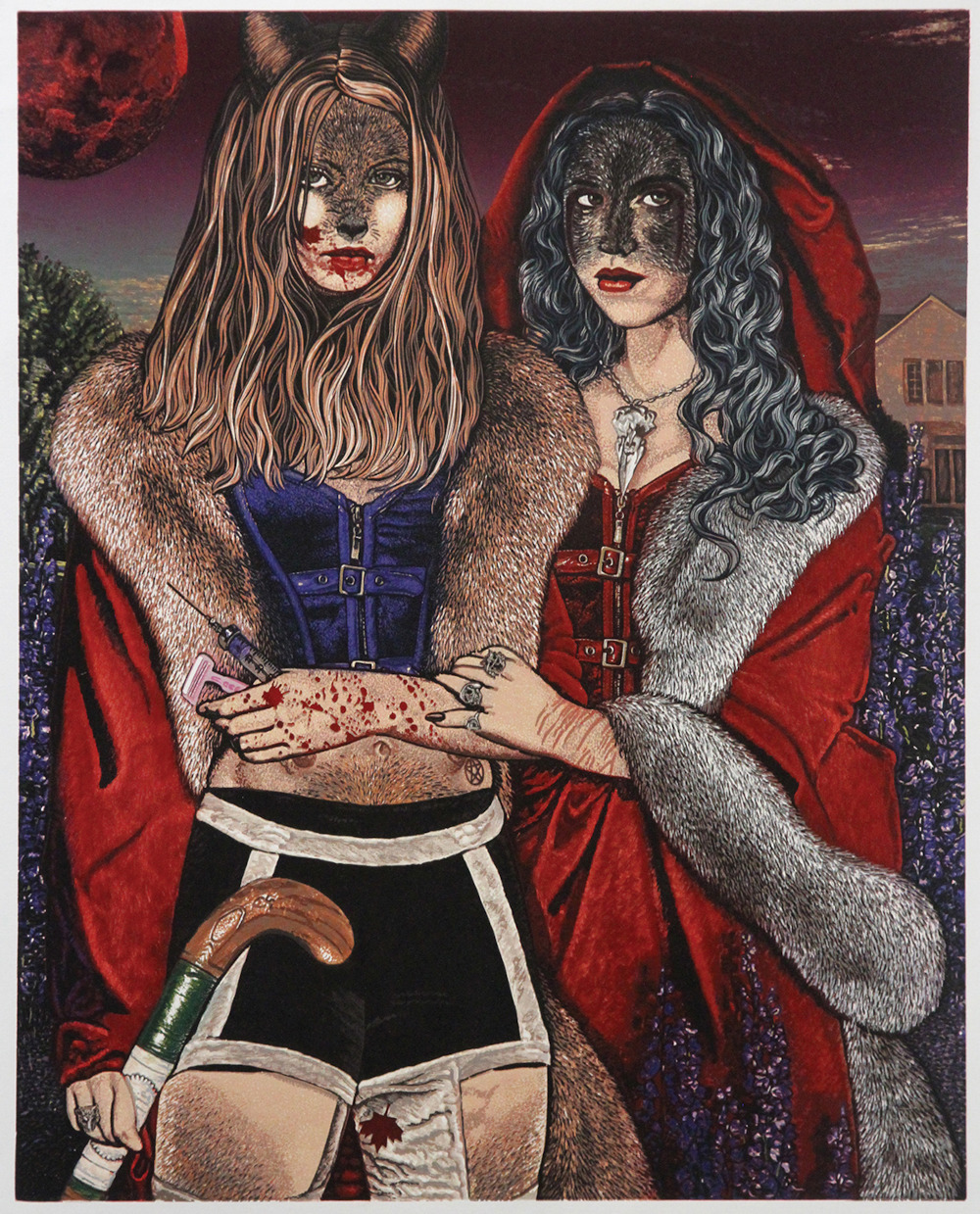
Rona Green | Cola nights | 2022 | hand coloured linocut | 49 x 72 cm | edition of 23

The images of peculiar persons I create delve into the nature of individuality – thoughts about persona, transformation and the absurd. There is a specific interest in how identity is expressed via the body; physical appearance and its capacity for alteration; the skin and its potential to be a site for reinvention – how the body can be a vehicle for communication. This manifests through the use of transformative devices, particularly anthropomorphism and body decoration, which catalyse the conjuring of uniqueness.

Engaging with the animal as a motif is rich in nuance, offering a wealth of possibilities for interpretation. A formative experience was encountering Egyptian art – in particular representations of theriocephaly – and a childhood love of cartoons and comics centred on anthropomorphic characters has significantly influenced my visual expression.

Use of tattoo as a motif is driven by its ability to suggest a story – it can convey information about origin, affiliation, status and proclivities. As a form of communication, tattooing has the power to transcend language barriers. Tattoos can speak to, or be read by, anyone on some level, making them a compelling tool for transmitting ideas.

Printmaking is a captivating medium, and for the past twenty years, I’ve specialised in making hand coloured linocut prints. As a reductive process, linocut technique is conducive with my inclination to want to pare things back to what is essential. The editioned linocuts are printed with intense black ink and then hand coloured using water-based media, resulting in a sense of sameness juxtaposed with subtle variation, which is conceptually appealing.

When my pictures are on exhibition, all going well, they will evoke a sense of connection, perhaps sparking an unspoken dialogue between the viewer and the subjects portrayed.

Posted in ARTWORKS | Tagged

REMEMBER Editorial

Remembering requires an intermediary to obtain a form and a content. It might be a family or here a poet, it is unceasing as a task and not an artefact.

Remembering insists on an arc of happenings, this is connected to that, one day in October is connected to another, contemporary violence is connected to originary violence, January 26 to invasion, genocide to Nakba, this is to that, acts of remembering insist on it.

When Palestine, when Lebanon, when Syria, when. When they are bombed, as they have been bombed, more or less relentlessly this century, what I remember are the lamentations for artefacts of civilisational endurance that this or that actor has effected, after some millennia of preservation, now, instantaneously, evisceration.

What I remember is my office-mate distraught about the millions of body-bags in Homs while we wrote our dissertations.

What I remember is the day I first heard an archive poem, Footnote to a History War, which Tony performed, which commenced a lesson I am always recalling, and that I will always be learning.

What I remember is that it is the work of the living to remember. To treat memory as khazaaen (treasures) but not to hoard them.

What I remember is how I came to write to Mahmoud some years after Mahmoud first published a collective of Blak and Palestinian authors in a magazine he founded, as a triangulated act of solidarity between First Nations people, diaspora Palestinians, and the Palestinians who remained.

What I remember is there are responsible parties and that cultural artifacts (which I lament) are memories, but that lamenting human life is inadequate when you are staring at the forehead of a genocide.

When Mahmoud wrote to accept our invitation to contribute, he wrote a thing we will always be remembering:

I will indeed do my utmost to respond by January 30, if I am still alive by then. I hope to witness the end of this war and to reach that date, January 30, though it feels like an uncertain path into the future. In any case, I am investing my time and energy not merely in survival, but in living. This investment is rooted in the act of continuing to create: writing for memory, writing for the present, writing of attempts to build while the worlds we knew before this genocide continue to collapse. When will it end? It is not the timeline that matters, but that it ends—and that I am still here. “Being alive” has become its own form of time, in which we build a displaced life, a layer of existence that we will ourselves dismantle if the collapse is completed and the genocide ends.

Mahmoud Alshaer, November 4, 2024.

To this editorial Ani offers a whakataukī to conclude:

Kia whakatōmuri te haere whakamua

(I walk backwards into the future
with my eyes fixed on my past).

Posted in ESSAYS | Tagged ,