(Othello’s) Mangrove Song

‘Between these white breasts that my wandering hands fondle, white civilization and worthiness become mine.’—Frantz Fanon 1


Tidal sway unsettles brackish water.
An asp unwinds from mangrove roots, to ask
the moonglade if evening star’s her daughter.
In love with a jewel, he dons a white mask.

His black flesh unfurls to bask in pale light.
Birdsong’s mistaken for the star’s ballad.
His scales are silver coins, his bones are white.
He sheds his darkness for something pallid.

A cloud covers the moon, and night is black.
The saline mirror turns him into mud.
The bird that caws, is perched upon his back,
and when he strikes, he spills her salt and blood.

Foul tides. The moon is veiled by brindle clouds—
dappled light wraps the dead in dappled shrouds.

Posted in 120: DIALOGUE | Tagged

i married you on the trampoline when i was seven, but we met at twelve and this is just a painting

Ekphrasis piece responding to Nadine Christensen “South” (2003) Acrylic on board with cedar stretcher 35.5 x 45.5cm


i still see it telephone wire iv cut off from all others and close to death
baby pink baby rattle ghost of little girl’s giggle we dance across the halls
waves of gravel test the foundations (stony seafoam) of our abandoned home

i still see you you nobody through the no-door entrance wound (oxygen kissed
mouth) i still remember cheapest necklace you could find wearing moss
like residue after all this time rust on a chain lost in a box of birthday cards

i am nothing but an observer the air that whines through what was once a window
even back then all i did was watch through the glass the earth spin on
the birds’ birth the blue speckled eggs above the doorframe you nearly stopped it

almost crushed it in your infant fist when we saw the framed memory (bite of lies)
crunch of bones on the lawn unearthed by the ocean storm and twigs snapped under
bare feet on the evergreen hill we survived it all but now you want to leave

“it’s only canvas” your response to my blame eyes roll down the glassy slope
echoed steps of other patrons you won’t remember with me our false beginning
you move onwards i barrel backwards time spent in the overgrown yard

you never lived there i can’t see it anymore those years spent parallel in suburbia
shoved in other bodies a trip to the gallery you are tired of my goose chases
through imagined tales i can still feel your protest pulsing through the paint

Posted in 120: DIALOGUE | Tagged

Save the planet/love your body

A flock of naked cyclists, plucked and pinking, intercept my tram
to yell this through the tilted-open window as they pass,
looping from Lygon Street onto Elgin with their orange flags
and painted backs, two or three abreast, the little rain
prickling at my earlobe as their words do, their cheers and bells
like water felled in infinitesimal parts; the same stuff cried
by dinosaurs. In thirty minutes, the city will be puddled slick
like a teenage mood in August; all fresh cum and misery,
during which time I’ll pretend to read the four-hundredth page
of Carpentaria, while I really scan the cagey mass of gear and flesh
for interesting bits: scrotum, dimples, bush and wonky nipples;
the communal, marsupial paunch of the cycling postured torso
pressed forward into low, flat flight. Could we really be this simple?
I have told so many people: there is no mode of transportation
on earth more energy efficient than the jump of a kangaroo.

Posted in 120: DIALOGUE | Tagged

For Star

after American Honey


In your name is a miracle’s body that outsurvives
every death. You, the mother of many things—
including yourself. When you leave for the Motel 6,
what becomes of the little ones—their Ma’s offhandedness
and the coward man who slow-dances you into shame? Family,
to you, is but anyone with four walls for you to dream in.
Star, Star, Star—the point of no story should be a group of kids
who go door-to-door for a living, but here you are—alive with fire
on top of the Econoline with the Raveonettes blasting, helium-hearted
as you and your boy-formed love put all lovers
out of business, two young speckles diamonding
the American flag. In no time you learn the difference
between a girl and a crumpled thousand-dollar sum
is none; how the home you carry accepts its trespassing
in an electric green dress. That dancing is by no means
an escape from misery for long, so too are kindnesses
daring you to be a creature unafraid. Sing, Star—out loud, a song
of your soul’s choosing. Set free your laugh long enough
to bend the roads that roll ahead, curling the night’s charred tongue
into welcome. This is a country wearing nothing in the dark.
This bonfire speaks the same orange of your scratch-nails,
baby. Remember how the minute feels afterwards, as you put on
the whole diamond-blue lake. Your shadow disappears awhile
and we almost mistake it for freedom.

Posted in 120: DIALOGUE | Tagged

In Vivo

When you were born I slept
in your bassinet, wishing
it were empty. All night

I am you and you are gone.
In this dream we have long
shoulders, weak ears and low-

set dancing fingers. I am waiting
to learn how to say Please
may we see the doctor, I’m unsure

of myself. I am unsure of myself
and of the meter as our wrists curl.
By morning I walk the hall

and hear Be gentle. You are gentle
with each turn, just like your father,
learning to wait. You tear open

my mouth and every tooth falls out.
We find the doctor sitting limp
(she developed without speech

or strength). She gestures inward
to exhibit her prognosis, towards
an empty notepad, lagging hands.

There you are. My arms spread
and love swarms the gaps
between your eyes and toes,

inflated palate and edema,
every lack and label
of your little body, the ripple
of bent fingers weaving air.

Posted in 120: DIALOGUE | Tagged

Submission to Cordite 121: NO THEME

Maxine Beneba Clarke

Move me. I’m interested in poems that can reach into the chest and still a heartbeat, if just for a moment. I’m searching for poems that seem simple at first, but somehow continue to haunt for days after the reading. Send me poems that will silently enter the bloodstream, and poems that scream with absolute abandon across the page. I want to read gentle poems – poems that hum, like the universe is settling everything in its place. Send me poems that soothe, like a hearty soup in the bitterest of winters, and poems that make the reader take stock of the epic wonder that is this world. In this flash-moment, quick-swipe, soundbite world, move me. And together, we’ll make an edition for dreamers to linger in.


This podcast sheds some insight on how Cordite Poetry Review (and Cordite Books) works.

Submission to Cordite 121: NO THEME 15 closes 11.59pm Melbourne time 1 July 2026.


Please note:

  1. The guest editor(s) has sovereign selection choice for all poems submitted.
  2. Masthead editors will also contribute to the issue.
  3. We will only read submissions sent during our official submission periods.
  4. Please place up to three (3) poems in one (1) Word, RTF or PDF document (unless specifically noted otherwise for special issues), with no identifying details in the document itself.
  5. We do not consider poems that were made, either in part or in full, using generative AI.
  6. We are not able to offer feedback on individual poems.
  7. Submissions will only be accepted via Submittable …

submit


Posted in GUNCOTTON | Tagged ,

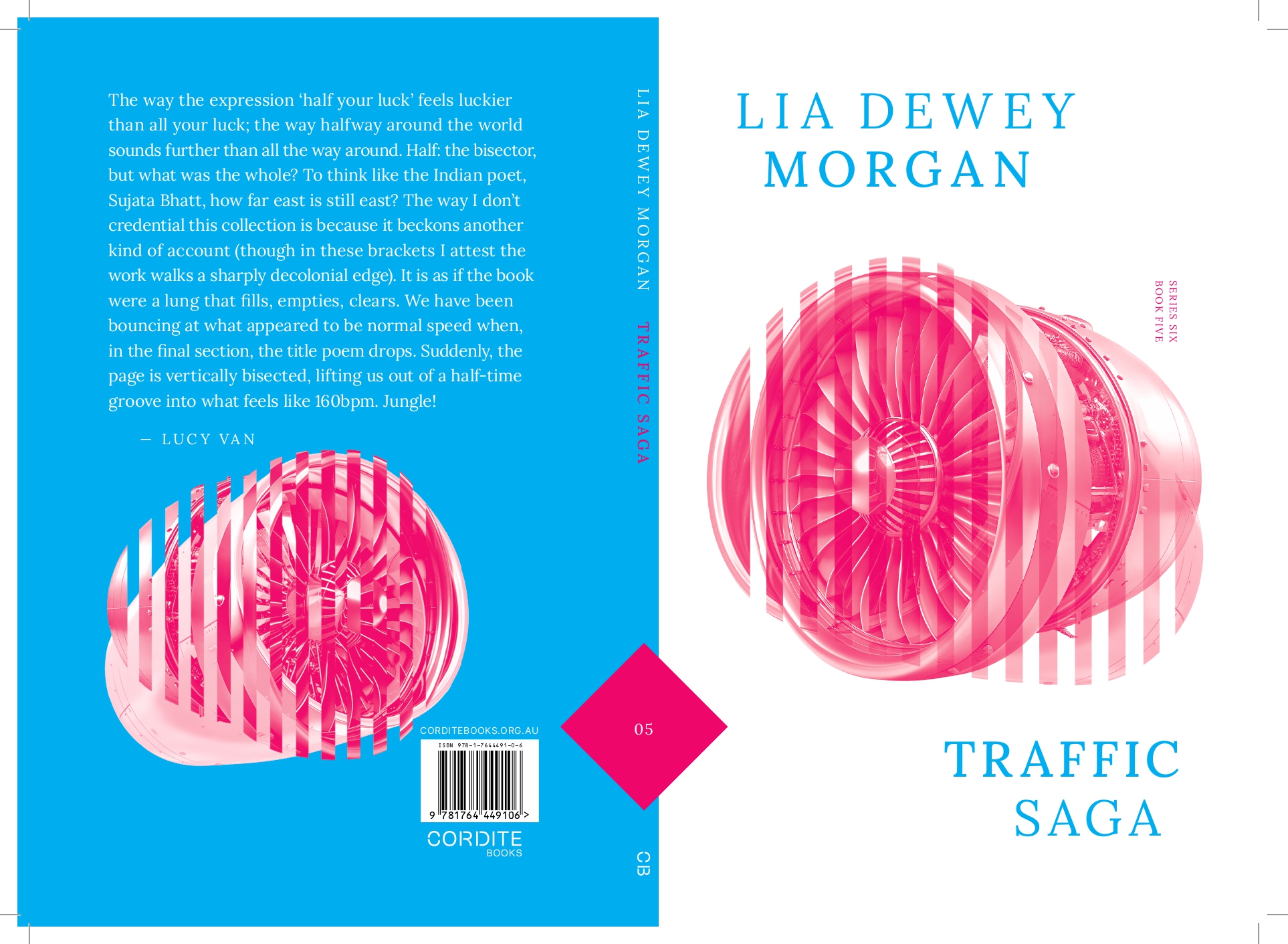
Introduction to Lia Dewey Morgan’s Traffic Saga


The way the expression ‘half your luck’ feels luckier than all your luck; the way half-light falls more beautifully than full light; the way halfway around the world sounds further than all the way around. Half: the bisector, but what was the whole? To think like the Indian poet Sujata Bhatt, how far east is still east? Where is the halfway point, what threshold of receptivity yields to our se¬cret question: staying or leaving? Do we find it in ‘the informal, unlicensed halfway zone of the parking lot’? Do we find it in the precariously unifying contortions of gods:


                    You tell me how Shiva contorted
                    the holy crowd’s judgement by transcending his form
                    uniting with Parvati, becoming half man, half woman
                     (‘the day of consecration in Ayodhya’)


Lunge-stepping magnificently over some abyss, we pause and wonder, why does ‘half woman’ appear womanlier; earlier, why does ‘half-written’ sound more authorising than ‘written’, or ‘half-Pakistani’ sound more emphatically Pakistani? Is the answer in the curved hand of Morgan’s fiat comma, carving up the line: ‘We are both the tourist, we are both the guide’, or in the ‘cigarette apostrophes’ that mark the various intermezzos that stage a long coming home? Both. Half your luck.

The way we hum a child into the half-sleep of a long-haul flight. The speaker and the mother share a complicitous nod, for ‘I feel it, / start humming too, hmmmmmmmmmmmm / (as long as my breath will allow) hmmmmmmmmmmm’. The jet engine rattles to join them, ‘hmmmmmmmm’, and the cabin of the plane becomes another meditating membrane between inner and outer words – here is another cavernous mouth vibrating, for engines hum, too, joining mothers, poets, shamans and droning bees in a worldwide hum in that halfway zone between speech and song. Traffic hums its ‘saga,’ a song that is porous, yes, and chaotic, yes, but never beyond description:


                    and I was
                    politely muttering

                    I was still
                    within the mouth
                    putting words to it
                     (‘central’)


Putting words to it: saga to traffic, sounding a city out, like William Burroughs did when he looked out his window on 7th Street, ‘a place where the unknown past and the emergent future meet in a vibrating soundless hum’. Energy and instinct of this in the suburbs, too, where the membranes bounce between the ‘shrill call of cicadas’ and ‘Distracted, listening / to American politics / thinking I don’t know’. Knowledge half-knows. Memory passes through smoke. Is it deep? Does it breathe?

The way I don’t credential this collection because it beckons another kind of account (though in these brackets I attest the work walks a sharply decolonial edge). It is as if the book were a lung that fills, empties, clears: ‘The novelty had gone – and that was desirable.’ But what mischief! Novelty abounds! We have been bouncing at what appeared to be normal speed when, in the final section, the title poem drops. Big traffic pushes the dial to 160 bpm: jungle! In the exquisite banality of border crossing! In the half-certainty of itinerary! ‘When I say it like that, it sounds both too much and not enough.’ Still trafficking, the ‘night is collapsing like a vacuum’. The saga ‘yanks back to place’. The traffic is ecstatic.

Posted in INTRODUCTIONS | Tagged , ,

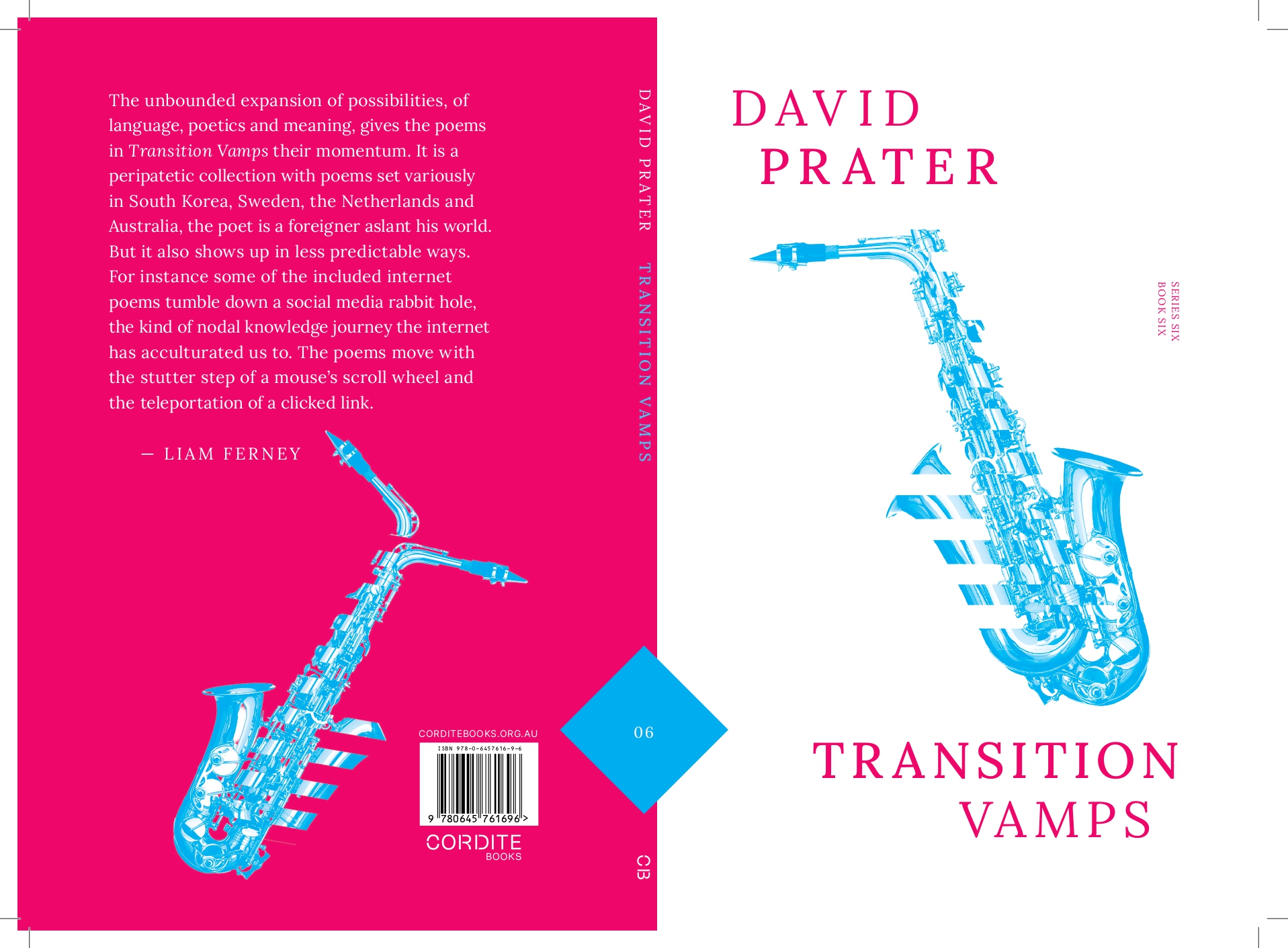
Introduction to David Prater’s Transition Vamps


David Prater’s singular punctuation mark is the parenthesis which Renaissance humanist and theologian Erasmus, an early booster of that particular glyph, dubbed lunulae; translation: little moons. It is a perfectly Praterian coinage that encapsulates the waxing and waning halves intended to quarantine asides or afterthoughts. But in Prater’s work, more often than not, the waning bracket appears without its waxing reflection, fostering ambiguity and opening up a poem’s possibilities, particularly when used in rapid succession:

The first email (never sent
CCed Gaia but bounced. So it goes … (that manual exchange                    
inside a Powerhouse (a museum exhibit etched in charcoal            
rides the lightning (killing composers, developing in still-life. (‘Wireless’)


It is worth considering where the first missing bracket would be placed if punctuation were being used conventionally. Probably after ‘sent’, though the information it would contain is hardly an afterthought, indeed it transforms the meaning of the second part of the sentence. The ambiguity expands with the second missing bracket. Should it be deployed after Powerhouse or is the third (even the fourth?) opening bracket nested inside the second? These questions expand exponentially through the poem, turning into a kind of magic box, a steampunk automaton that, once a mechanism is triggered, takes on a life of its own, all spinning cogs and whirring gears. The possibilities the open brackets create propel the poem towards, as Baudelaire put it, ‘l’expansion des chose infinies.’

The unbounded expansion of possibilities, of language, poetics and meaning, gives the poems in Transition Vamps their momentum. It is a peripatetic collection with poems set variously in Korea, Sweden, the Netherlands and Australia. The poet is a foreigner aslant his world. But it also shows up in less predictable ways.

For instance internet poems, including ‘(On the tomb of) Ephrem Tamiru’, ‘and ‘Victor Garber Blooper Reel’, both of which chart journeys through YouTube comments on videos about, respectively, an Ethiopian pop star and a lead actor in the spy show Alias, tumble down a social media rabbit hole, the kind of nodal knowledge journey the internet has acculturated us to. The poems move with the stutter step of a mouse’s scroll wheel and the teleportation of a clicked link.

In ‘Kus’, a discursive poem à la mid-career John Ashbery, the searching is the desire to ‘really learn’ the Dutch language’s ‘beautiful word for a kiss’. We should, the poem argues, be able to know these words that are ‘not meant/ to live in a dictionary but in/the mouth’. There seems to be a yearning for this knowledge to be a kind of fixed tangible state, a game show prize you can hold in your hands.

Instead, language is ‘like a shiny/spaceship forever tumbling towards/ the kus.’ The line break is telling. Prater’s poetry is often tumbling towards something, in this case the kus, but, just as often, it is just tumbling towards. Maybe the best we can hope for is what Wendy James sang about: ‘I don’t want your car baby/ I want your ah!’

Posted in INTRODUCTIONS | Tagged , ,

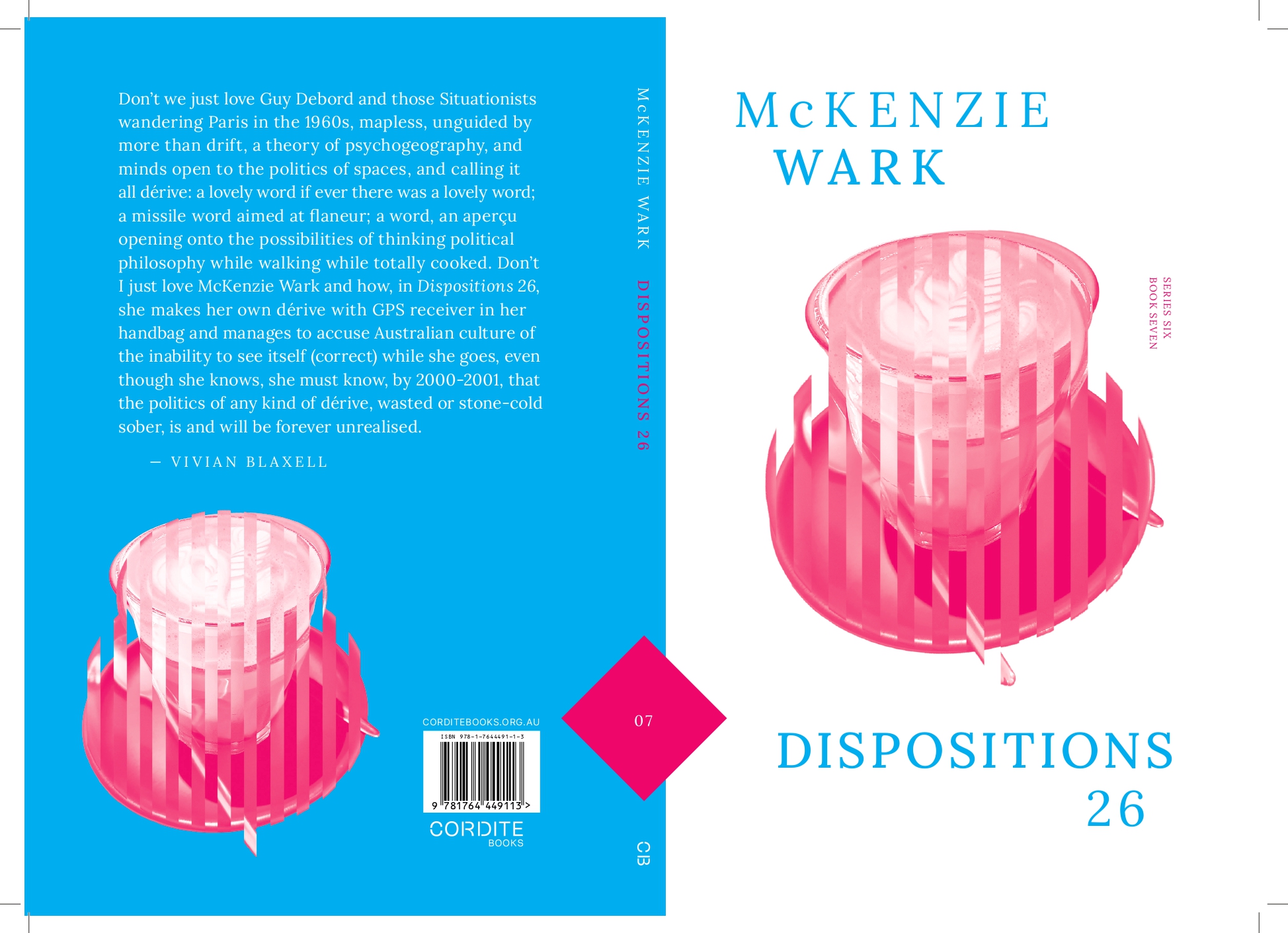
Introduction to McKenzie Wark’s Dispositions 26


Don’t we just love Guy Debord and those Situationists wandering Paris in the 1960s, mapless, unguided by more than drift, a theory of psychogeography, and minds open to the politics of spaces, and calling it all dérive: a lovely word if ever there was a lovely word; a missile word aimed at a flâneur; a word, an aperçu opening onto the possibilities of thinking political philosophy while walking when totally cooked.

Don’t I just love McKenzie Wark and how, in Dispositions 26, she makes her own dérive with GPS receiver in her handbag and manages to accuse Australian culture of the inability to see itself (correct) while she goes, even though she knows, she must know, by 2000–2001, that the politics of any kind of dérive, wasted or stone-cold sober, is and will be forever unrealised. Not unrealised just because ‘All space is occupied by the enemy now,’ as Raoul Vaneigem put it in 1960-something; not unrealised just because the concept of positive hole and constructive destruction fell to the ancien régime conservationist reflexes of revolutionaries themselves; unrealised because of what the GPS unit in Wark’s 2000–2001 handbag augured: the diminishment (almost unto vanishment) of geographical space itself into tiny, thick digital spaces on the screens of 15 billion devices with active GPS chips and maps. Apps charged with AI so that you already know what the enemy wants you to know about the space as soon as, or before, you get there.

Talk about overdetermined. Talk about dérive over. And, please, go on, talk about how and why McKenzie Wark’s Dispositions 26 is of another time by now but is not a relic, not at all. Talk about how and why Dispositions 26 reads as entirely of our post-space times. I, myself, suspect operations of that transsexual witchery everybody would love and fear in equal measure if everybody knew about it. Girls like McKenzie Wark and me, we are good at timeless and spaceless, both. We are good at lasting, and what Wark does in Dispositions 26 that lasts and rings out true now without regard for the years is what she does with what she takes from the spaceless spaces she dérives: how she renders what she takes into poetry of an almost Homeric form, into songs almost Odyssean. Not that Dispositions 26 is always canting toward Penelope, though there is plenty of where-is-what-is-home in it.

What McKenzie Wark does in Dispositions 26 is rove as a new-landed immigrant through alien spaces and extemporise anchors for herself and for us from those spaces: political philosophy at N 40.74389° W 073.98708° and many other places; political economy and squirrels at N 40.71475° W 073.35218°; art all over the place; the new wife who is no Penelope here, there, everywhere; and there, there, there and there, ‘The shame that is waiting. The seed rotting, not sprouting. The body bottled up against itself, against its changes. Containing itself for an event that may not come to release it.’

Every spaceless space in Dispositions 26 is disposed to be thick with all things, even inequities being equal. In it, Wark is thick with transsexual. She is thick with jobless. She has eyes for the uncanny and an uncanny way of showing the uncanny. And yes, she is McKenzie Wark on dérive and thick with a kind of wisdom about why the enemy is winning and the dérive soon to be no more than an Instagram moment.

Posted in INTRODUCTIONS | Tagged , ,

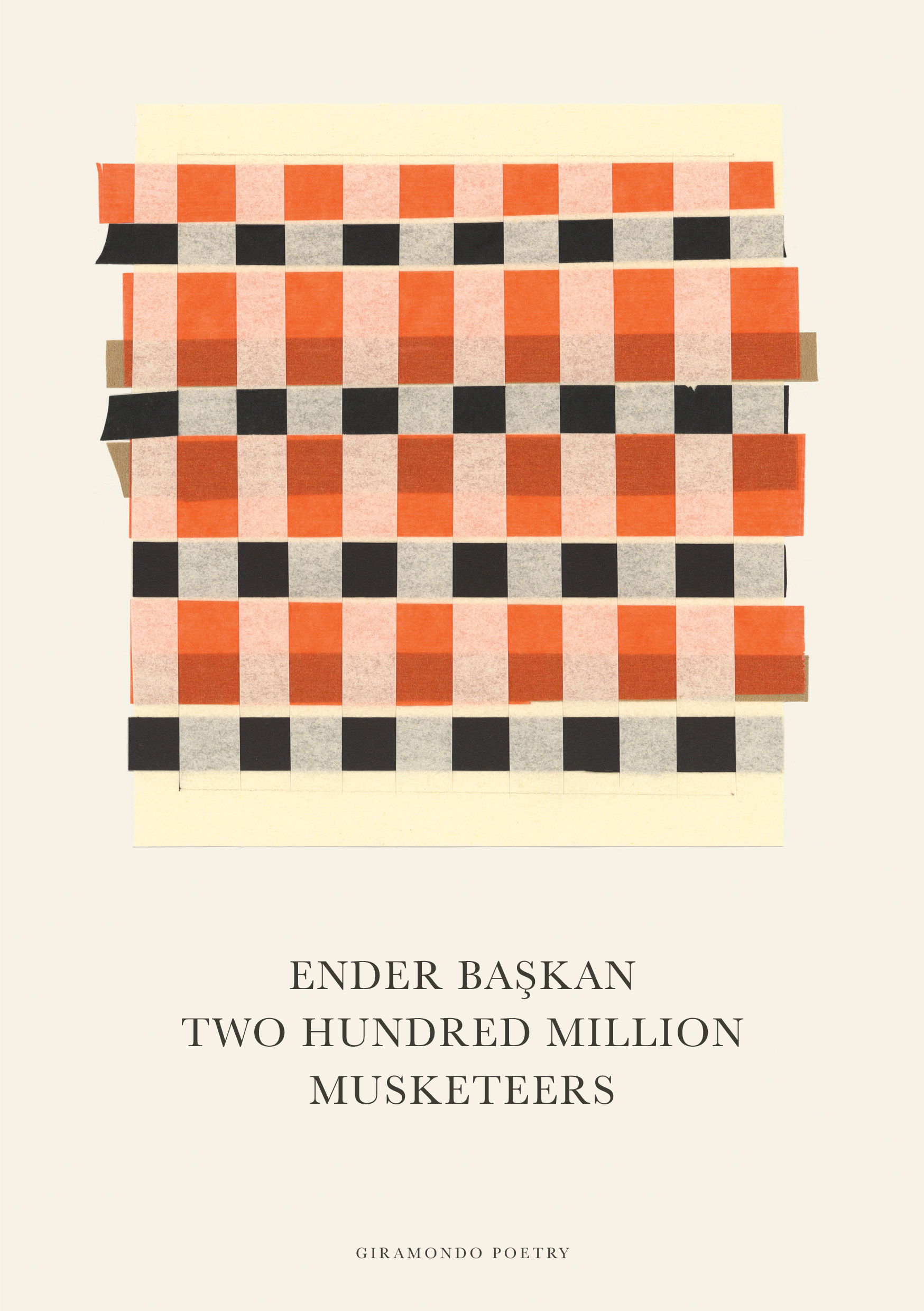
Rawdogging the system: Declan Fry reviews Ender Başkan’s Two Hundred Million Musketeers

Two Hundred Million Musketeers by Ender Başkan
Giramondo, 2025


Ender risks the rawdog. To capture things in mid-flight. It keeps him hungry. Keeps you honest.

What draws Ender to this? Ask Sophia, his partner. She’s 80% rawdog. As in, will “PERFORM ANY ACT RECKLESSLY / OR WITHOUT PREPARATION.” As in: “A MEASURE OF RISK TAKING” (‘Hot Water’, 39).

When I say rawdog, I’m thinking of Carol Jerrems’ portrait of the rawest of all, the Surry Hills “flying dog”:
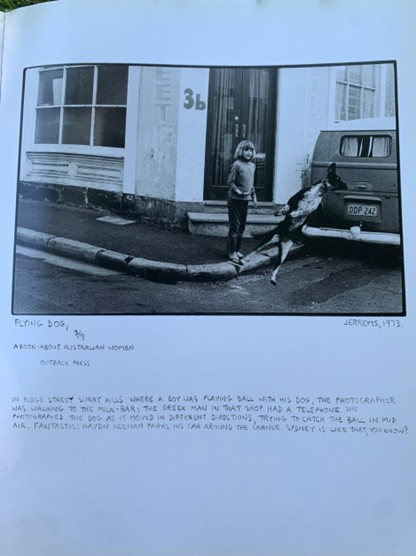
That’s the joy Ender seeks.

But the speaker is not the poet. I know. I know! So let’s separate the poet from the persona. When I say ‘Ender’, I don’t mean Ender – living, breathing out there somewhere, apart from the work, unknown and fundamentally unknowable – but ‘Ender’, the person on the page.

In ‘Here Is The Shirt, (Get) Off My Back / Swimming In The Afternoon’, Ender writes: “the russians have the kremlin / the ottomans had the sublime porte / and both our children have runny noses” (1). It’s a serious political statement. Stare into the abyss of “middle-aged / left-wing melancholia” long enough and the abyss of middle-aged left-wing melancholia stares back (4). Maybe it takes the form of your dad asking when you’ll become a teacher. Maybe it takes the form of your kid, already more radical than you’ll ever be.

Runny-nosed or not, Ender tells his kids, “make your own fun” (Kadiköy, 62). Try to catch the ball in mid-air! Work – but make it unmonetised. Labour according to your own needs. Arguing with his father, Ender philosophises: “fathers have only interpreted the world / in various ways / the point however is to change it” (‘Lion Kink’, 135).

Take risks. Fight capital. Fuck around. Find out.

The child becomes father of the man in these moments, protecting the poet from middle-aged insecurities. Surrounded by former peers at the schoolyard (“prowling hyper-caffeinated / re-financed class-ascendant former schoolmates”), Ender writes:

lucky my kid
is an anarcho-terrorist anti-capitalist critical-theorist
and disarms their line of enquiry with logic
calls them poo-poo heads…
(‘Here Is The Shirt…’, 4)

By this point we’re five pages deep into a seventeen-page long opening poem. But since you can read poetry on the go (easier than a novel!), this is what you might call slow poetry. It’s poetry for folks who read for the breaks rather than trying to make their breaks more productive.

It’s also a brave opening gambit. This kind of runny-nosed run-on length – especially in your debut collection… well. A few publishers and editors might have advised something neater. Tidier. You can picture them pleading: Maybe just a one or two-pager to kick things off?

No, Ender says. Let it run. Go rawdog. Because “of all things to be afraid of im afraid of wanting to / take writing take language to its limit” (6).

The crucible of political awakening in Musketeers is play. Big brother and big father duking it out with bigger dada. Absurdity is inescapable so long as “many of us come from dysfunctional families but all of us / live in a dysfunctional society” (13). Learning to parent, your kid’s runny nose reminds you that systems fail, “an issue of liquidity” can result in class insecurity/judgement, and that the urge to find seven steps to better health, wealth, family, and relationships is doomed. Maths was never your strong suit anyway.

Fail to find these things, though, and you risk entering hell’s seventh circle: fielding the judgement of other parents about how you parent.

you reject a cool dad / bad dad binary
like you reject a rich dad / craw dad
but you have to say sometimes lets go! or come on!
(16)

The family embodies a human need for “food shelter healthcare culture community”. Like the two Kurdish bakers Ender and his daughter buy simit from in Kadıköy, family is praxis. Family can also be a safety net. But mulling over theory and praxis is probably moot if your practice is (mostly) working – or, if not working, simply necessary. Parenting demands pragmatism! If your kid asks, “was phar lap alive when you were a kid dad? / was phar lap alive when frida kahlo was alive?”: that’s theory. If they ask, “whats a career […] whats a wealthy industrialist? whats capitalism? / why do horses work dad?” That’s praxis (‘Phar Lap’, 107).

Whether you enter the grad program or not, whether you wear overalls or fail to, Ender’s here to warn you: be sceptical of parents. (Dads, especially.) The poem ‘Get Your Overalls On’ ends ambivalently, father telling son, “study ender study… you need education”. But what kind? Aesthetic? Class education? No! The kind that facilitates upward mobility. The kind that sees non-crazy John transform into ‘crazy John’, “mobile phone baron / hero of the turkish diaspora” (56).

So what if you’re crazy Ender and not crazy John? If bookselling teaches you anything, it’s that capitalism is pretty tedious and that “the customer is always / the customer” (‘Erotics of Bookselling, 33). Yet tedium has its poetry, too. It lets you telegraph the hive mind looking for its next summer hit:

               its out of print 
                              it was published in 1803
                                           and we last had it in 1997 
if you want to try amazon you know where i stand
(32)

Ender’s practice, in these and other poems, is to give shape to shapeless days. Not just for himself. For his children. For his partner. For his parents. For his younger self entering middle-age. Procrastination? No time for it.

Because what’s a “dad twice over” to do? Swashbuckle through and hope your alarm clock works. If you want your alarm clock to work, Ender writes, place it just out of reach. Parent yourself. Everything worth having is like Tantalus’s prized fruit. Or maybe it’s like the joke about middle age in Martin Amis’s novel The Information: “He didn’t need an alarm – he was already comprehensively alarmed.”


Posted in BOOK REVIEWS | Tagged ,

Tell Me Like You Mean It 8

River Dreams Bird | Meagan Pelham | Studio A


When I was a newborn baby writer, an esteemed figure in the industry told me, five minutes into our first interaction, that I’d be too difficult to work with because I’m loud, verbose and annoying.

“I’m never gonna make it in this town,” I wept to friends over the phone, galloping from the big smoke back to my hovel in suburban Djilang, dirtying my only corporate-adjacent outfit (which I’d bought especially for this meeting) with melancholic goop.

Yada-yadaing forward a few years, I’ve since worked with writers in many roles, and have encountered a range of poets. My early experiences of rejection – particularly related to my personhood – galvanised my belief in platforming courageous and unique voices, ensuring that writers have opportunities regardless of our differences, idiosyncrasies (and boy-oh-boy do we have ’em!) and social compatibility.

When commissioning for this edition of Tell Me Like You Mean It, I gave one prompt to contributors: “Go bonkers! (If you want! So fine if not!)”

Be difficult. Be loud. Be verbose. Be annoying. Or not, if that’s not you. Dammit, just make me feel something new.

In my view, anyone who is privileged to curate the work of others, or handle their dreams and aspirations, needs to behave the way they needed as that so-called emerging writer. Constructive feedback within a suitable context? Sure. Reality checks about the difficulties of the industry? If you must. Discouragement and fear-mongering? No, thank you. Unsolicited comments and unchecked biases? No fucking way.

I was published in Tell Me Like You Mean It many moons ago, and as part of the Cordite masthead for the past eight-ish years and counting, I’ve done production work (aka code monkeying) on many other editions, too. In my everyday life, I read a shitload of poetry: both deliberately and incidentally in work and leisure.

When asked to curate this volume myself, my mind flooded with poets whose work had excited me recently and who filled a vague parameter of not yet having a full-length collection published. I’m proud to present a stellar lineup:

Jamil Badi: dreams where you’re the white kind of queer

Jamali Bowden: A test for the disciple of art

Eartha Davis: kaha, tamawahine / tipuna wahine

Ori Diskett: stat dec (not legal advice)

Merinda Dutton: summer loving

Isabella Eichler-Onus: Spring Clean

Thirangie Jayatilake: New rarest mineral on earth

Joel Keith: To Stella

Ledya Khamou: Love Poem

Maggie Knight-Williams: Begrudging Elegy for a Grief that is Mine

Tim Loveday: Dog Act(or)

Kacey Martin: Aya

August Moulang: The name of a bird is heaven

Mia Nie: if i died and went to heaven

Julian L Palacios: gridlock of queens

S. A. Sisika: Magnetic

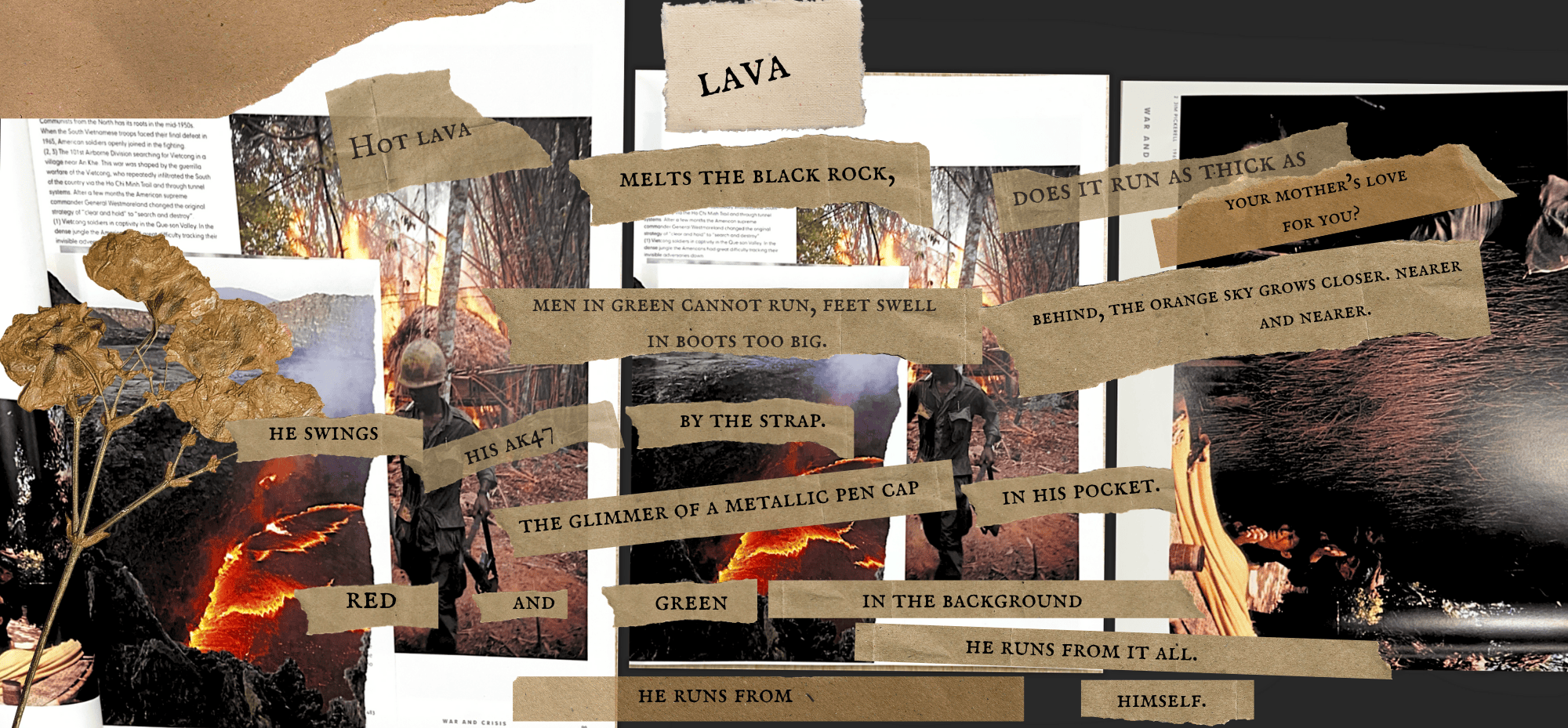
Hà Lâm Tô: Lava

Huyen Hac Helen Tran: use case scenarios

Beau Windon: You Want to Chat with Me on Discord?

Troy Wong: Prosperity Toss

Xiaole Zhan: There are wings – 羽 in the pagewind of translation – 翻


Although we frame this series as one focusing on emerging writers, our definition of emergence is nebulous. What is ‘emerging’? When or where does it end? After all, I still feel emerging in many ways – but does anyone ever feel emerged?

‘Emerging’ seems notably discordant with poetry as opposed to other literatures – unless you’re one of a select few, our work generally remains on the fringes. We don’t tend to land the bestsellers and the beefy advances from Penguin (all shade intended to Penguin for not publishing enough local poetry; I said what I said; I told you like I meant it).

Basically, these are writers to watch out for. I hope you’ll enjoy their spectacular work. If you love their poems, make sure you tell them. We could all do with more support from each other.

Posted in CHAPBOOKS | Tagged , , , , , , , , , , , , , , , , , , , , ,

Love Poem

I know, I know;
I always leave too soon,
I never stay my complete
welcome. But please, for now
drive my car through the ridges
of your childhood.
In the lull of traffic, I sink
into your sweet ordinary.

Cram your CDs into my glovebox
and show me your old high school
your primary school torn down,
your favourite playground
next to your uncle’s old house.
Take me around the lake again
with the pastel cabins taking the brunt
of the temperamental water;
a sleet of gold in rush hour
and choppy in the quiet 11am.

I used to believe love is so short
but I feel endless with you.
Drifting through the rich neighbourhoods
with the hideous modern houses,
I say, “Get rich and marry me.”
The sun pulses cold on the skyline.
You laugh because it’s a joke.
You say, “Of course,
but I need a better job first,”
and we keep pretending that it’s a joke.

You hog the bed and the blankets
and you push me cold against the wall
then, awake, pull me close again,
“You’re falling off the bed.”
You let me sleep through the afternoon,
through two movies and one game,
and you come back smelling like dinner,
checking in, speaking low.
In your bed sleep is deep and crushing,
a child’s slumber, untethered.

I’m trying to say it all,
but it’s bigger than my head—
I heard that in a song once
and now you push me
into the meaning.
I am so afraid to need you,
yet it is the easiest thing
I have ever done.

Posted in TMLYMI v8 | Tagged

Begrudging Elegy for a Grief that is Mine

In conversation with Geoffrey Hill’s September Song and Two Formal Elegies

I know the dead whom you have deposed.

Welcome to New England,
pasture populated with serrated tussock teeth and African lovegrass,
the old ways lined with laurel and birch
crafting the curves of a white woman from my shallow hills.

When all is said and done, you may tread the labour of your predecessors into the clay
underfoot, where our sinew will fertilise the vines of your exports.

I will find you there again, in the cellar below your Headington stone,
or in the dismembered artefact overlooking your life’s work.

Colour me more difficult than all your forefathers combined.

I will turn my hills back to the hunting range your people made them when they came, and I
will fill myself plenty. You will never feel enough.

Posted in TMLYMI v8 | Tagged

kaha, tamawahine / tipuna wahine

The afternoon plays with promises
stung lonelinesses straddling each other
cooking
t i m e
sipping grain from yesterday’s wallpaper

& they say kindness is corrugated
& they say blue horses babble like consonants
& they say palm is the doorknob of heart
(dazed, half-gentle)
patches of lover & mountain
styrofoam moons
rainbow recollection
rioting
against
hours
seeking
silo
shared
strangeness —

& if

( & i f )

i close these eyes, i can hear
dawn’s dinner bell
sun letting the dreamers back in
sun siphoning loss from mothers
grief’s scenery
overbaked stars
petrified palaces
ears guzzling instruments
mouths juniper breath

& there
& there
are two dusks

the dusk l o s s has made

the dusk l o v e has made

& one sun
& one sun

(scuffed
hickory)

look —

cotton mountains comfort eyes
twinned mouths grow wet
in the gloaming
nurse bleating foothills .
bandaged b lu e .
(like this . )
this
like

Posted in TMLYMI v8 | Tagged

Magnetic

Distracting,
Eye catching.
Being magnetic,
Is not free.
It costs hands on your body,
That you did not ask for,
And,
Eyes that only look through you.
It costs the aches and pains,
Of standing up on your own,
And worshipping the fire and the form,
That has attracted parasites,
Over,
And over.

‘You’re very distracting,’
He’ll say,
Looking you up and down,
And,
What he’ll mean is distracting him from finding someone he’ll actually love,
And want to keep around.
It will cost you running to men near and far,
Just for validation and pleasure,
Then realising that your body cannot be all that you are,
When you wake up alone,
Again.

What this charm and confidence cost,
Is taking back your pleasure,
On your own terms,
And practicing loving the things you’ve hidden in dark corners,
Swept under the rug,
Lurking in pitch black,
It takes holding hands with all the complicated,
Messy things,
That refuse to lay flat on their back.

Posted in TMLYMI v8 | Tagged

Spring Clean

Stacks of dusty newspapers
an omission of memories
like the broken shells
shoved under Mum’s mattress
next to her marbles in a chest.

Morsels of salt treasures
that thaw and crackle at midnight
when I long for the sea to knead our thighs
to the soundtrack of the ocean.

Before the estuary of youth,
we were always so close
to finding a shark’s tooth or ancient skull,
to unlocking the secrets
just beneath the surface.

Before your lungs were charred
and the sun revealed his appetite,
we were golden kids
freedom, in shades of brown
while warm bluebottles desiccated in the air.

Don’t shake off your boots
or hang your coat,
memory is a holiday at a glance
but captivates like a siren.

Clear out the bits of shore
and make space for the baby
only the closets remember
what’s locked in this room.

Posted in TMLYMI v8 | Tagged

Aya

the ceasing of the heart
evokes pineal eruptions.

everything that was
is,
will be –
expanding into neurons,
a supernova.

if dying is not your thing,
but you’d like to try it,
hold the lighter to the glass;
sink into the bathwater.

allow his hand to place
the pen
between clenched teeth.

find the endlessness.
peel yourself out
of your human skin.
ringed fingers
caressing collarbones.
drip.

become the holy whore.
and aya will bless you,
and you will bless aya.
it is all the same.

bob in the waves, immortal.
remember indigo flesh
and kinder eyes.
do you see?
it is all the same.

Posted in TMLYMI v8 | Tagged

Prosperity Toss

abundance through the year sliced thinly
good luck and smooth sailing segments, loosely broken

good luck is approaching peeled and julienned
forever young peeled and julienned

progress at a fast pace
peeled and julienned household filled

with gold and silver floor full of gold
and treasures numerous sources of wealth

Arrange the ingredients on a platter and pour out the abundances
to form a ring. Then with family, chosen or inherited, toss high

to maximise your fortunes, chanting lo hei, lo hei, or other
more auspicious wishes according to taste. Recipe notes:

This dish was developed for its wordplay, not its flavour.
Spouses may agree to eat this once a year just to humour you.

Distant cousins may surprise by picking only at selected bits:
We don’t actually like this dish. We just eat the fish.

Posted in TMLYMI v8 | Tagged

The name of a bird is heaven

After a trans reading of Dickinson’s I dreaded that first robin so

I did not attend the robin’s arrival, weary of
its frantic threshing as we both resisted
capture. The fusion of seasons agitated the both of us, and
each negotiated hiding place landmarked
new growing pains – side, chest, throat, wing.

I found myself holding out against an oncoming wind,
epidermal armour poorly matched against a creature born to fly.
For the first time, a dissonant note played out and I allowed myself to be haunted.
Go, the robin pled. I am at sea, and all wrong.

In spring, I begin to ruminate dressings of skin and silk. How can the flowers
know their wake and rest so easily?
I intuit I am also from the sky and soil, shaped by the tides.
Faith governs me, but even so I am struck by it, the dry-mouthed urge
to tip gently, and then decidedly, against the knife.

I lose sight of the robin amongst the looming reeds. Chase me,
he calls. The wind rushes, behind us now and buffeting with a steady intention.
My companion trails amulets to apply and whittle with. Milky eyes loom
out of the muck, warning of my serene and frenetic exposure.

I avert their gaze, and quietly pray to forget. A message
dribbles through the brush cover – foreign letters play undergrowth games
while I spurn the herald’s mirrors.
How will I know him then?

I have boldly supposed to outrun a drowning, stutter then
notice my futures are awash in gloam.
The flowers urge me into sorrow, I won’t I won’t, on my spittle
until the robin’s return.

The chord cradled in sour pitch crawls through the air again,
ripped from recalled windows into episodic infancy.
I begin to author the memories, witness the garnet plume burst into flame alight
against the thrum of history.

Posted in TMLYMI v8 | Tagged

stat dec (not legal advice)

i once signed a stat dec
made of three lonely words
i am queer

what have you declared?

i sign others to
solemnly declare that i
need a little bit of help

so here’s a stat dec
template to use when
you need some evidence

I, chosen name, of my city, do solemnly and sincerely declare that:

Due to transphobia / homophobia / outright bigotry
/ paranoia / advice from my lawyer /
the way he looked at me
(cross-out as applicable)

I am unable to complete my assessment on time / unable to come to work
having to reassess my life / a complete and utter jerk /
often finding it hard to concentrate / losing
my train of thought and for-
getting
(cross-out as applicable)

I need respect / advice / support-
-ing documentation / a break / $10,000 /
international acclaim / a solid eight-to-ten
/ 28g of sun-grown Tasmanian bush weed
(cross-out as applicable)

DECLARED by : you
X

Posted in TMLYMI v8 | Tagged

dreams where you’re the white kind of queer

There used to be this dream we had
of becoming women in a way our
men wouldn’t wanna be. I asked
the boys for a hand but they’re too busy
reminding me that their purpose is fucking
when it’s so obvious they don’t know that
the purpose of fucking is to draw closer, not
erase the body before you.

There was once this dream we had
of diverting the gaze from coloured flesh
to the ways I wore a dress: the way the white
gays do. Forget about the white robes we once
wore, kneeling for a lord to erase the body and
soul of the woman we wanna be. Make sure
that you’re fucking only in a dress because
that’s your sole purpose in this community.

Their confidence is a dream, because
queer joy is a brilliant, slippery surge of something
you can’t possibly pin down, but when your
Blackness is pinned down by a white heavy
weight on first sight, as a mere boy you must
make the choice. I’ll give you a dress so it’s
easier to address me as a man without
coloured flesh. Just let me breathe.

Their wildest dreams consist of protest screams
and if that means reposting screams of protest
as dogs draw black blood in another country then
so be it. The full confidence in selectively fucking
coloured flesh like it is your purpose to save us.
Perhaps I should fetch my prayer dress for you
so you may finally see my queerness and
Blackness while I kneel in worship.

They’re fucking in their dreams like the men they
wanna be, and I wonder whether they see a black dog
in me, pants heavy with that surging sex they wanna
see. Yet what is my purpose when my dress dangles
low and their man is erased? If I could draw a line from
your misery to mine, would it ring loud despite our
differences or remain unanswered because the
question you scream down the line in protest is
are you a man or a woman?

They’re gonna dream up a slur for black&queer so that
straight men can erase my body and divert their gaze
from their misery, and white queers can pin down my purpose
in this community they draw purpose from. Perhaps then
I’ll have the language to express what we feel when we
want to be like women but not the ones the white world
says we should be. Until that perfect word is dangled before
the desperate dog in me, we will continue dreaming of
the person we wanna be.

Posted in TMLYMI v8 | Tagged

Lava

Collage poem, titled 'lava poem', that reads:


Poem note: This poem used photojournalism works from other artists.

Collage image courtesy:
[1] Pickerell, J., & Black Star Picture Agency. (1965). 60 years of photojournalism: The Black Star picture collection. Könemann.
[2] Stone, B. (2018). 1001 walks: You must experience before you die. Cassell Illustrated.

Posted in TMLYMI v8 | Tagged

use case scenarios

@startuml
: I : -right- (kept sitting)
rectangle everywhere {
everywhere —up— : I : : as
}
(kept sitting) -right-> : you : : there
: you : -right-> (were) : maybe
note right of (were): on the other side
rectangle boundaries <>{
(were) -right- boundaries
}
note left of boundaries: nevermind the
rectangle cells <> {
boundaries -down-> cells <>
}
rectangle rain <> {
cells -left- rain : of
}
rain <.left.> (spilling)
rectangle ink {
spilling <.left.> ink
}
ink -left-> (melting)
rectangle feathers {
melting -left-> feathers
}

rectangle garden {
feathers -left-> garden
}
note right of garden : in the
garden -down- (did)
rectangle bird {
(did) -right- bird : a
}
(bird) -right- (die)
(die) ….right…> (happens) : earlier? always
(happens) …right…> : we :
rectangle there {
: we : -right- there : were all
}
there -down-> (laughing)
rectangle something
laughing -left- something : at
(something) -left- (attempting) : else
rectangle recourse {
attempting -left- recourse
}
recourse -left- (forgetting)
rectangle oxygen {
forgetting -down- oxygen
}
oxygen -right- (outruns)
rectangle all {
outruns -right- all
}
rectangle body {
all -right- body : then\nthe
}
body -right- (disappeared)
rectangle aversions {
disappeared-right- aversions : still in other
}
rectangle time {
aversions -down-> time : all the
}
time -left-> : ourselves \n<> :
rectangle remains {
: ourselves \n<> : -left- (remains) : while
}
rectangle gap {
remains -left- gap : of the
}
gap –left– (expanded)
rectangle everywhere {
expanded -left– everywhere :\n out\n of \n into
}
@enduml

Posted in TMLYMI v8 | Tagged

A test for the disciple of art

Are we more arrogant
in putting our suffering over that which is beautiful or
in elevating beauty over the suffering of others?

Every heart has flaws
Each unique in their configuration
What flaws has your heart?

What is Beauty without Justice?

Who are your people,
What are their ways of life,
and how do they clothe your soul?

What collective assertions of self-humanisation
have you seen disfigured into cruel self-obsession?

What is Beauty without Justice?

How do you carry the good that you do:
As guilt, as duty, or as a part of being?

What stock do you put in the rhyming of appearances?
Do you find it reveals or obscures the rhyming of souls?

What is Beauty without Justice?

Posted in TMLYMI v8 | Tagged