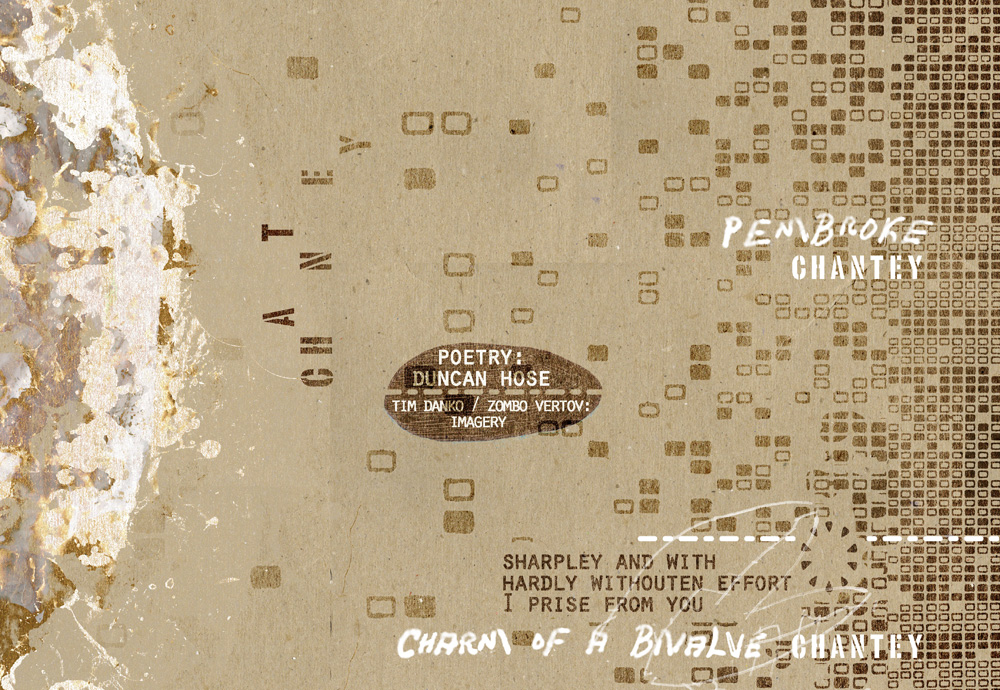
Pembroke and Charm of a Bivalve Chanteys (after Duncan Hose)

Posted in ARTWORKS | Tagged ,

To Change the World: Baxter As the Eternal Reader


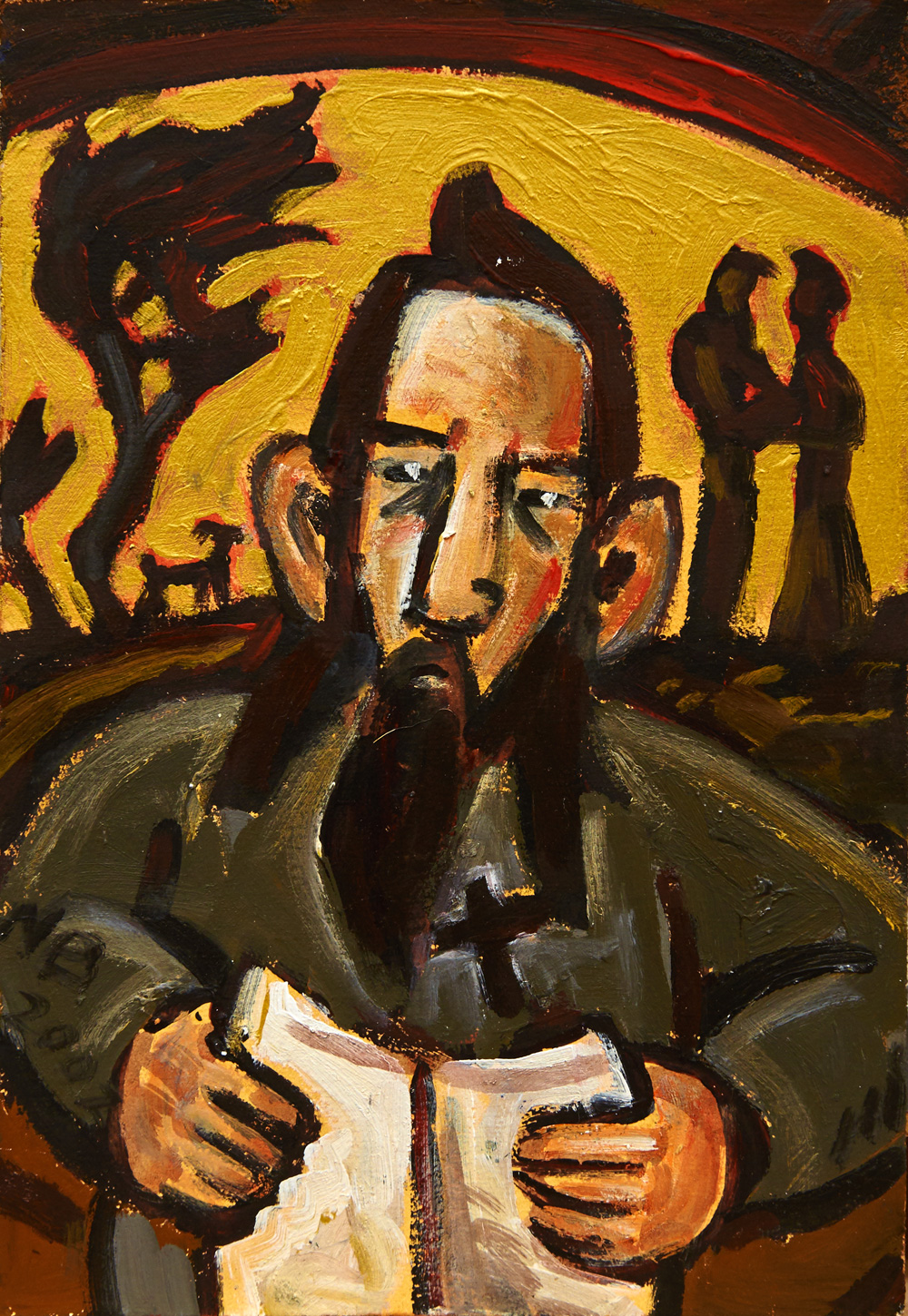
Nigel Brown | Reading with Couple | 2002 | acrylic on paper | 300mm x 210mm

It is difficult to paint from a grounded meaning, and for me the search has been intuitive. Both my father and I were deeply influenced by James K Baxter (1926-1972).The experience of being read poetry ‘that handled ideas like bombs’ was a kind of conversion. For over forty years Baxter has appeared in my work as the immortal hairy man dispensing a poetic that might cure the world. While that sounds religious, it is also just the spiritual urge lurking in archetypes, in our organic indigenous cultures, and in the abandoned Romanticism before our Modernist immersion and climate changing technocracy.

I use text in my work and always value associations with poets. Of course, Baxter was much more than a poet; in his work social injustice and ‘love not much valued’ push you creatively away from mere aesthetics. However, whatever the more clumsy aspects of his personal ‘search,’ his crafting held it all together remarkably. Just as Baxter disembodies into the ‘poetic eternal’ – separating from the earthly specifics of a life – so too may a painter embrace the freedom to evolve symbols with expanding boundaries.

Even in times of confusing disconnectedness I believe simplicities can be found. This approach is not a matter of ‘finding’ priests and dogmas, but one of more involvement with the timeless human ‘situation’. So when people gather for a Baxter reading, the words spoken lead a basic tribal urge – they are the words of someone who has travelled mentally, a master of chant. They form an alarm that calls for less indifference and more sensitivity.

Posted in ARTWORKS | Tagged ,

VCR

I wasn’t sure it would still
work
the VCR
its postbox
mouth stuffed with a Wombles
video my daughter had fed it
until it jammed
now plugged
into power again gears whir
noisy but effective
my son
fascinated with old technology
is piling up tapes
until I find
a video
with my dad on it
wishing he was not introverted
shying away from the camera
but an extrovert
so I could see
him properly
or hear him again

what I can see shows an old man
cancer already found
and removed
ready to spring back
gears whirring
my son finds this boring
a man
he’s never met
can we put another video on dad?

Posted in 69: TRANSTASMAN | Tagged

How I Cut My Nails

How I cut and file
My longer nails
The beloved of birth until death
as,
you always grow
to witness
all my pale hues;
The life
in seasoned pain and
gleam of crawling joy

All wedding rings pass through you
All pain remain your silent witness
Still,
Neither you beat a word
Nor you echoes thy pain

How lovingly must I groom and
file your pain
as,
you fall down lifeless
with invisible ooze:
The blood of my heart

My own never care
And I never cared to wipe my eyes
Dear my nail

Still longer shadow linger
To swaddle thy warmth
in a piece of velvety calm

Adieu,adieu
Dear my nail!
That which cul
Grows my shadows tall

How I cut and file
My longer nails …

Posted in 69: TRANSTASMAN | Tagged

Mt Frederick

there is a passage in
the lee, the lees
of the sun;
the poor
are said to be generous.
we’re holding out our feet.

Posted in 69: TRANSTASMAN | Tagged

you

i) each calibration is winter

ii) and you walk into my hand

iii) like a tenant


iv) eye & word alone.

Posted in 69: TRANSTASMAN | Tagged

Yellow Chevrons

An old story. Our hero wakes up disoriented in a strange and unfamiliar land. Rock strewn, treeless. He is amnesiac; expulsion from Eden is false memory. The Ruskinesque, quartz blaze of a fallen rock. Into his field of vision float half erased memories. The plank-hulled ship stretched upon the leek-green sea, for instance. Though how did he get here? Balloon cheeked clouds puff powdery gusts from every quarter. The ship tilts toward its destiny, sails pot-belled and proud. An empire in red shading and black lines spell out emptiness. A clutch of miniscule palm trees lean toward the coast. A few towns and oases marked out phonetically in copperplate promise little. Inland remains largely terra incognita, a persistent rumour. He observes a lizard, frozen beneath his shadow, its back patterned with yellow chevrons. This reminds him of ship’s anchors. The map fades off, borderless, into obscurity. The horizon swings on its boom in one slow arc either side of the perpendicular. The emissary has not yet returned with news from the ant-headed people. At best, trade routes remain speculative. Twilight is the texture of wickerwork all around him. Soon the stars.

Posted in 69: TRANSTASMAN | Tagged

Young Mick Jagger

Young Mick Jagger-looking guy
crossing the road, you cut
the most self-assured line
I’ve ever seen, and I’ve seen some.

Fringe on sunglasses, denim on
denim – you almost had me off
my bus and running down the street
for a second look at you.

Posted in 69: TRANSTASMAN | Tagged

Tears in the Symphony

I feel like a terrible thespian
or maybe a great comedian
playing a retarded character,
like Freddy Benson.

Other-days
I feel like that guy who shot himself
during The Watchmen, like an octopus
in a tank of lobsters. Your lips when

kissed that afternoon, silky, salty and
cold, parted like a cut jellyfish on
an overcast shoreline. Poverty, chastity
obedience, enclosure. I had a dream.

Watching a nun fall off a bicycle on the
banks of the Seine … but it’s like watching
a .gif and after my laughter subsides
I find myself fascinated with the
paralinguistics of the way her ankles bend
as she hits the stair-rail. It’s like Springsteen’s
Dancer in The Dark, you know, up against
yourself, tongue kissing your
shadow with reckless abandon.

Posted in 69: TRANSTASMAN | Tagged

A Cramped Garden

You vines cling too tight
to the brown brick shed.
He has no room to move
with the car pressed up against him like that.

And the rest of you trees
and birds and the roaring traffic,
there is no space here
you are all too alive.

Posted in 69: TRANSTASMAN | Tagged

Forgetting

A small remark, almost unnoticed,
then not quite believed, like those false
pools the late afternoon heat makes

on the road you (for there is, it turns
out, a you here, and a setting, let’s
make it sun) are driving into dusk

time-wise, albeit away from dusk
geographically, moving east from
the mountain, trying to keep to the tip

of the peak’s shadow, which in a more
fanciful mood you might regard
as a hand reaching out for you,

though not the kind of personification
you particularly like in a poem,
not this late in the game. At any rate,

this remark, when it slipped into
existence, when she gave birth
to it there between you, held itself aloft

in your thoughts, like a moon
risen in the sky of your mind and which
you saw as though you’d never seen

it rise before. It seemed incongruous
among the other thoughts—the ones
about you, the ones in her head, that is,

the ones you’d invented about you
for her head—incongruous like an old couch,
beer-brown with a permanent ditch

carved into the far left cushion, amid
the matching soft-light white of the others,
the kind of couch a new husband naively sees

as inviting and friendly and so insists
at first on keeping in a place of prominence,
or rather he keeps insisting, but fails

and then it’s down to the cellar
to sleep the sleep of the past. (A bit
of a stereotype, which though unfair

is familiar enough that we might
meet on common ground, you and I.)
Anyway, just before she made

this remark, you had been so taken
with her—that is, taken with
her notions of you or, rather, taken

with your notion of her notions
of you—that it did not seem out
of the question that someday you

might give up the old couch, let it
sink a level in the house, a house you
might one day paint together,

an off-white to cover up the lives lived
there before you; you could see that
she was the kind to get a smudge

of paint there off-center on her chin,
which you imagined you might be called
on to remove, but then her remark slapped you

into the present, which itself now thankfully
is safely becoming the past, falling mile
after mile into the shadow catching up

with you, a shadow that now seems less like
a hand and more like memory itself (again,
though, not a comparison you’d normally find

fetching). For it was the kind of remark
not worth recalling or believing,
better left in the dim basement

of memory, beneath the old paint blanket,
the splatter-guard that covers so many
offenses, the botched junior prom date

with Marlie, the stumbling admission
of virginity (yours, I fear—I’m starting
to feel sorry for you), the whole summer

camp underwear incident—but why dredge
it all up, the stiff blanket of embarrassment
covers these offenses, the way paint slaps

pesky imperfections from the molding, or
a shadow masks the potholes in the road, or
the earth’s atmosphere gives the dead, airless

moon a kind of friendly, bon vivant
appearance, which is not at all the type
of description you favor in a poem,

not this late, driving to who knows what
metaphor you’re capable of, under cover
of, for Christ’s sake, the second person,

a mirage you’ve never favored because
you drive up and it disappears, as the day
does to dark, which is the convenient,

comfortable blanket beneath which we sleep,
you and I, even while driving, even in daylight,
every damned day of our peaceful lives.

Posted in 69: TRANSTASMAN | Tagged

Future Value

My finance teacher, with a voice like Ghandi’s,
is trying to explain the concept of future value.

He says we’ll like finance, because it’s like time travel.
He says it’s nothing like accounting, which is all about

tallying up the deficits of the past. Finance, he says
is all about the future, and so all of its answers

(he cheerfully tells us) are wrong.
Thousands all over the world, we’re listening

to his lecture, and trying to solve the problems
that cast most of us into an ideal future of singing

the song of future value. The magic mirror of finance.
The telephone booth that takes us far into the future

on the day the final payment is made––then back
to calculating the present value of all those payments

down the sluiceway of time. Calculating
as if the winds of hazard and contingency

can be measured out to many decimal places
for my fellow students, faces glowing

from their screens, gazing at the heaven
we’ve always dreamed of––a heaven of ideas

that create value, the best ones attracting
the capital that is always hungrily searching.

So says the tiny head of my professor
who pauses from his work on formulas to stare at us

backward through the camera––each of us out there,
whether in St. Petersburg or Singapore––to say

that he believes we learn best when we have to struggle;
and that some things are too valuable to measure,

and here he offers love as an example, as if
he’s used to assuming his students are young;

and that the problems on the test will be much, much harder
than anything he’s explaining to us now.

Posted in 69: TRANSTASMAN | Tagged

Notes on the Creation of the World

(for Visesio Siasau)

On the first night of creation
Hikule’o turned the sea upside down
and shook it out, the way an old lady shakes out her purse
for a bus driver.
The sun fell out of the sea
like small change.

On the first day of creation
Hikule’o drew squares and triangles
with her unstumped hand.
When she was finished
her characters looked at each other,
shrugged shoulders, cracked knuckles,
and shook their almost-perfect forms
into kinks and bulges and blurs.
They walked away, into the world.

On the edge of a clearing
a man and a woman coupled,
doubling their imperfections,
becoming one beast.
The goddess’ harelip moistened with joy.

On the second day
Hikule’o gave the world a will of its own.
Tides muscled the channel
to Fanga’uta lagoon. The whip and the fly-whisk
prepared persecutions.

On the third day the goddess felt suddenly alone
as she walked between plantations.
She turned, and saw her shadow flee
across a field, then disappear into a hedge
where hibiscus eyes waited.

On the fourth day
Hikule’o began her diary.
Her pen worked like a spade,
tunnelling forwards in time
to sons and usurpers.
She read a page aloud
to the future, and mistook the silence
for applause.

On the fifth day
Bishop Berkeley stood in ‘Atenisi’s seminar room
and denied the existence of space and time.
Hikule’o dropped him down a well
one of Maui’s heels had made.
The bishop fell like a lucky coin.

On the sixth day Hikule’o walked through Nuku’alofa
and took a table at Escape Cafe.
Lo’au read the New Zealand Herald aloud to her,
without knowing it was almost a week out of date.
Hikule’o yawned, and dropped the morning moon
into her teacup, then yawned again, and watched the moon dissolve
like a lump of sugar.


Lo’au: Tongan culture-hero who taught navigation and sailed to the end of the world.
Atenisi: independent school in Tonga associated with free thought and the pro-democracy movement.

Posted in 69: TRANSTASMAN | Tagged

Hard Bun

Soft fur on the hard top
Blood bone fur heart ears
run together
run over
run through
by crows’ peaks
kaffeclatsch
breakfast bun
turned over
As I drive by dodging crows
four wings flop a few feet away
one’s stomach speaking strongly
can’t let go
frantically pulling something stringy
in the soft light a hard beak.

Posted in 69: TRANSTASMAN | Tagged

The Underground Loop

The train is down. We are waiting at its heaving side
for the fresh train to come. The train that will come.
We grow transparent with the rain we brought down on us.

Out of darkness and into the Southern Cross
where a cantering light adjusts its stride to run alongside us.
The inner place we risked our lives for.

Posted in 69: TRANSTASMAN | Tagged

Seven Visions

i
(lentemente)
Hansel and Gretel wander lost in a wood.

They should never have been there or here.
They should have resisted their step mother.
They should have berated their weak father.
They should have done this or that
and now they are lost, tired, hungry,
near a pretty candy house in which lives
a witch who waits to welcome children
then eat them.

ii
(andante)
more purposeful perambulation, now in a strange forest filled with exotic birds

The forest is lively with the sounds
of wild birds. They have names
but the children have never heard
these words, never seen such birds.
In the dark branches of fir trees
birds whistle or shriek or chortle.
They make this little known wood
which is already full of terrors
more fearful. Fear fills both children.

x
(ridicolosmente)
an absurd clown or mechanical toy

How it has no soul
but is animated.
How it is driven
but there is no driver.
It moves this way then
stops, jerks to go
another way, hits
against a trunk, upsets
itself but its legs and arms
where it lies on the forest
floor, still twitch, still
operate. The children
watch, nearly laugh at the toy
but cannot make it stop.

xiv
(feroce)
a savage chase around a country fair

He goes after him, past the merry go round
and past the strong man who could carry
the burden of the world on his shoulders.
Ah ha, the persistent and the dangerous
chase that threads through gaps,
between a couple about to embrace,
or a crowd round the coconut shy
behind a man who tries to throw
a ring over a shining foolish desirable
thing. Under awnings and behind the tents
a man runs, another chases with an axe.
Fearful and urgent, this flight.
Unceasing and determined, the pursuit
to see, to chase, to have, to hold,
and axe.

xv
(inquieto)
a disturbed, obsessive expression, possibly of life in communist Russia

As a filing cabinet shuts with a flat noise
so these days make a grey life and cheerless.
Here are the lives of prisoners who are innocent.
Here is snow and ice bound rivers.
Here are persistent police and correct
decisions and the typed reports
and a frozen ideology.
The churches locked, their maintenance
abandoned in these cold days
where there are bleak, short days and sunless.
Where a metal filing cabinet closes the gape
of its drawers, slides shut.

xvi
(dolente)
a wailing peasant-like lament, recurring

I don’t want to leave this far away country
for Ohawe Beach but dolente, the word.
pulls me to a bach and a lament next
door all through one summer night.
We did not know the word kuia.
An old lady had died we said.
The woman I stayed with, called
next door ‘to pay my respects’
she said. That sounded foreign,
a phrase you could italicise.
The night was short and the night
was still except for this improvised sound,
organised by customs I did not understand.
It was years ago this happened.
I was sixteen years old. I remember
that grief in Taranaki, the wailing
that excluded me.

xx
(lento irrealemente)
surreal, releasing us finally from the microcosmic world Prokofiev has held us in.

There and there and there,
two lost children,
one dark wood,
We too feel lost.
in the middle
and fearful.
The cries of birds
disturb us unnecessarily
or we watch a pursuit
at a fair, the chased
and the chaser fast
through crowds,
the chased man gained
upon but never caught.
What they did was watched
from a concrete office
observed, noted, filed
There and there and there
until we woke
or until we found
our way through the wood
or stopped.
We emptied the offices
and filing cabinets.
The mourners stopped wailing,
went back to ordinary lives.


Mary Ayre played nos i, ii, x, xiv, xv, xvi, xx from Prokofiev’s Visions Fugitives Opus 22
in the Nelson Cathedral on 29 November 2014. Her programme notes included her idea
about each vision. It is her notes I’ve italicised and used to start each section of this poem.

Posted in 69: TRANSTASMAN | Tagged

Against Despair

Sunlight burnishes the wooden floor
where each chair has been placed
in precise relation to the long table.
Cutlery and glassware stretch their parade-ground
gleam the whole length and in regular bursts,
lavender and small yellow roses lean awry
in vases, as if there is such a thing
as good intent.

The timbers of the old jetty grow soft with salt.
Water seeps.
Beneath, the piles are emaciated, but just for now
they resist the slurp, suck of the tide, the undermining.
Marine larvae have scored the wood surfaces
with sleepwalking meanders.

In the window there are two candles, unlit.
They’re visible from the street.
A match-box with its sides unmarked so far
rests on the sill, by the latch, as if there is still time
for patience.

Posted in 69: TRANSTASMAN | Tagged

always becoming, the octopus

at the Fred Astaire show
his bulky head

sways in time to the dancer’s moves

The electric toe dancing novelty
is a name he’d like to steal

light fingered he admires
the pianist, his swivel stool

the way his legs float above the floor

in a choreography of desire
the octopus wants

to mimic the pianist’s coat
black sleeves sweeping the keys

music trailing behind

this should have been
a Victorian ship wreck poem.

Posted in 69: TRANSTASMAN | Tagged

South China, migration

I saw her and him
flying upwards

a black bowl
rice-flecked

as though migrating to warmth
ancestral route

Posted in 69: TRANSTASMAN | Tagged

The River

the hills sink through sky
the river flooding again
my dad on his knees in a field
talking to his dead mother

who is the symbol of a
plastic flower rotating softly
in the nothingwind
of a hometown

watery voicehole catching
that gurgle in the throat
when she lived, the river
running herself flat like battery

underneath the trees
and their hush-hushing firs
beckoning to other seasons
out of neon autumn

the dead come to us
from the centre of the earth
where we place them
to rise like bubbles

the dead come to us
from miles away like
the poem or the idea that
there is something beyond the hills

in the clouds, the testament
worth reaching for
the recycling of stone
my dad’s stubborn knees

collecting in a graveyard
that which moves backwards
like the rain falling up
like that particular david lynch

my dad bowed like an animal
breathing and only breathing
the hills and their feet
galloshing for him alone

Posted in 69: TRANSTASMAN | Tagged

Movers and Shakers

Immersed in the ruin made of our yard by the digger, I tried to pick
porcelain, rooted pug, glass from a slurry that accumulated
around the smashed ends of the drain. The whole thing
a disaster
parched, slimy, I raked about in the muck with both shovels:
the sharp, prodding one; the more hard-working, loping one. A fine Bruce

of a tool, something to hide oneself inside the scene with.
The sheen of sliced earth was an eye on me. I clapped it with Bruce,

jabbed it with the prodder, picked out its woken edges, irate jags

poking from the strata, and was in awe at this blind horizon,
a dead sun of sand over the dirt, far-off, ancient teacups
sailing heavy under the lips of the earth. There might have been
an imprint of held-down faces,
some exhibition of the trials
conducted on the headland: the fossil ashes of community
singing by a fire. Shades of composition devolved, assumed

insignificance in the trench, that boneyard, that riding sea.

Posted in 69: TRANSTASMAN | Tagged

Distant Trees

Trees in pleasing contrast

side-on dark effect
to draw the shape ink

either flat or graded reality is an impression
impressions aimed at that other interest

: distant trees

look across country distant
size an important peculiarity of opposites

it is true indoors emits no colour
when seen from this angle
sun in the morning
early afternoon
to stare toward the horizon
we continue to wish

wash in distant hills
(such a luminous result)


distant hills :

chance arrangements justify a little framing

studies of trees and figures
hard and unsympathetic without subjugation

in colour and form we square off happy days

‘I’ with a colourful past
‘I am’ perhaps more useful
I like that phrase,
it expresses perfectly the correlation

(a pensive insight in analysing failure)


the road beats more powerfully at the base

an honesty in bright coloured flags
or a man’s jersey accentuated with peacock greys

apart from the above
one is dominated by light and shadow

in this sketch
I choose a bluish green… a view, simplified in the mind

distant trees

of certain shape, colour, and size

placed in bright light
displaced…rendered


composed of more than the obvious
dissect observations

a madness in genetics

repeat portions for atmospheric effect

out of my depth
demands hours of happy choice, mono-

toned backgrounds…
re-
directions :
opaque colours in a strong wash of ultramarine

I must leave it
transparency that runs around edges

…to look long enough
to look for colours, shadows, sun-

lit
objects casting light, a warmth… pieced…together
memory turning back restoring projections


in this handbook extras soak up surplus colour

pan of pure burnt sienna…pale…
pale flesh on cheeks: alizarin crimson

to give depth to something so blue… look up… deep

… greenish, bluish, pale
reflected light

however clear the water
bright reflections translate the latter
dilute actual artifacts
(due to the colour of water)

absolute light

reflections up
on inflections (underwater)
it seems the shape

is the actual process employed upon the placing of light


the trick is to love such insignificant features

even the perfect mirror gives a darker view

nothing is unfortunate
yet more common when drawn in proportion

appearance re-makes a face

a hope that it is nearly but not quite in its essence

can I obtain a peculiar charm?

this freshness
softened edge washing out a veracity of colour


I am reminded of a delicate surround

a kind of niche: the transparent

golden……
…gleaming……
…seam

clarity distracts my attention

using the same study
in as direct a manner as possible

beauty frames
arrested in altering : arranging nature by design

(of the above remarks I have a better illustration
as things grey
adapting mixtures of primary colours

every object demands something free
a success, suggestion of foliage
mass of outline)


II


forget the absence of open-attachment with occasional light touches of green a
bird’s eye view: say at spots X, Y, and Z… a skeleton of the upper roof and rafters
the tone of roof timber, walls, posts, leaving the mind as a distant boat
drifting: inside highlights, of windows and spots of skylight…

light at first, curse, the first: Fig. B, you will see another part of the same tree, let go
of green, taste the blue and burnt sienna : process the other side, and so on: on one
side, on each edge keep a sense of the whole, a little part, a pattering, a putting on, a
new tint or tone : distance, a middle distance, re-

run… translate Fig. A: the foreground at once stationary, when there is no time to stop
or question… go on, now add a touch of crimson lake : the architecture, limitless,
hurries past :
reproduction is doubt’s mutual pleasure: still life : or true life, a child,
furniture, flowers, a row of trees, literally as they were : Fig. B shows nothing but the
composition, better to stand still than spoil its whereabouts: intersect | W, to join the
line X : then immediately to C, and continue the square : Fig. D extends, ricochets in
counter-balance, situated amid an indistinct pattern

in so far as lines and masses such a simple colour scheme helps to hold the picture: a
transparency, a thin fog large and stately, a manual on…from life, a manual on
configuration : a manual with trees–grass–distant trees–clouds–reflections–of colour–
pure colour–landscape traits:

an attempt at that happy combination


III


what a happy medium life conveys : silence, to seek directions, plus in part, the use of
one word over another : when too hard one makes glint or groove in which the world
settles : oxygen from ruminations follows wing-tips : again endings… the advantage
of using one’s own imagination can point out fault-lines without remembrance…O

…to be swept on, excepting the slightly heavier tone, I must remind myself of the
vital subject: this composition, how it emphasises the peculiarity of loss, I have no
real link but that of subterfuge: the ability to go on is important, to let the mixture get
muddy

(to mix more than is necessary

generally remembering light is entering from a comparatively present future)

highlights…I can advise little on how to advance a path serving its own purpose, the
components of this poem have made me envious of those who set forth for the first
time: that difficult tipping of a hat to those fugitives who first harnessed light: exterior
bric-à-brac…fittings pin-pointing a tone, a timbre, a distant tree.

Posted in 69: TRANSTASMAN | Tagged

On Early Trains

(after Boris Pasternak)

Fields fade to mauve in the heat
through the window villagers
stroll what is there to kiss
everything you see melts to soft wax

you dream not asleep dreaming
of being asleep there is someone
sleeping here two black suns
scorching their lashes through their eyelids

sun-beams catch iridescent insects
the glass of dragon-flies the second-
class carriage full of comings
and goings like a clock­maker’s kit

you seem to be sleeping
in a vice of numbers
high above in amber the hands
of a clock dividing the air

noting fluctuations in heat
get up from your seat adjust
the clock lean out scatter the shadows
pierce the fug of the day

register yourself on its blue dome
your home your happiness sinking
down past the wreck of your dreams
happy people never help the clock

these two slept in its beams

Posted in 69: TRANSTASMAN | Tagged

Postcards (1)

Every time she comes home, enters her childhood room, she opens the box stored in the bottom draw. Shuffles and reshuffles the collection of unsent postcards, full of joy and resolve. On a bench in a London railway station, looking up through the kaleidoscope-like glass dome, she dreamt of her media naranja. Before dawn in the Yucatán, the curandero ran an egg over her skin to cleanse her aura, then put the egg in water to read. Told stories of the riddled hillside behind her. At Nazca, where the dry, windless plateau preserves the hummingbird and shark, she could see far into the distance, and became disoriented by the vast numbers and disembodied voices. Sometimes she feels these are the scenes at which parts of herself split off and moved in different directions, left with and left behind. She places the postcards back in the hand-bound box that warps like a personality. Waits for the low tide, before walking out along the estuary to watch a leaf unfurl, its slow trembling, easy performance.


Note: The final line uses found material.

Posted in 69: TRANSTASMAN | Tagged