“World’s largest chlorinated pool”
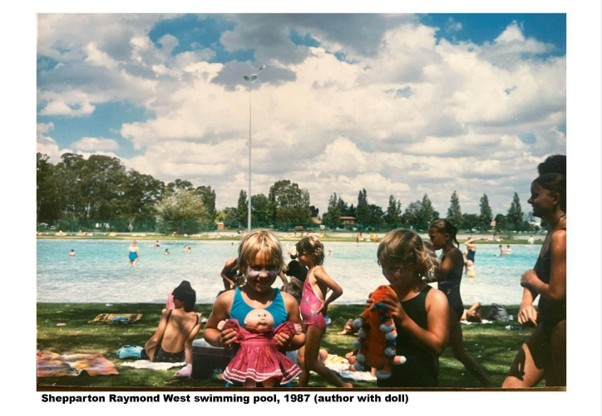
One of my earliest memories is being trapped by an uncomfortably safe seatbelt into the back of a 1980s-hot family van and seeing a gigantic swimming pool come into view. This pool emerged, mirage-like, from a hazy horizon of eucalyptus trees and melting bitumen. I don’t remember first seeing the ocean, but I remember thinking the water at this place was similarly vast. Decades later, trying to place this vivid but untethered memory, I’m almost certain this was the Raymond West swimming pool – or swimming lake – in Shepparton, northern Victoria.
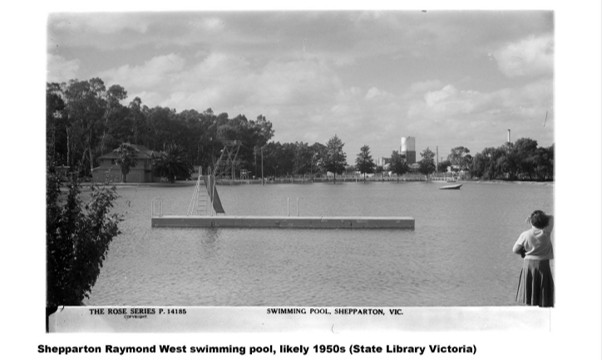
My memory of this huge pool is so distant it’s possibly a composite of other hot cars and pools and faded photos. But the Shepparton swimming lake did exist, and it was vast. It was known as ‘Raymond West’ or ‘Lake Victoria’, and referred to as a swimming pool, swimming lake, or swimming beach. A postcard from the 1960s shows a pontoon and diving boards set in expansive green-blue water, with the caption “RAYMOND WEST SWIMMING POOL, WORLD’S LARGEST CHLORINATED POOL”. In other postcards, the claim is downgraded to the largest chlorinated pool relative to that very Australian benchmark: “THE SOUTHERN HEMISPHERE”.
The former Shepparton pool, at 250 metres long and 75 metres wide, was several times larger than a standard Olympic sized pool. Its unheated water was treated with chlorine, but it had walk-in beach entries and a sandy floor, enormous diving towers, and a volunteer lifesaving squad. For several decades it had no fences, entry fees, or closing hours. In 1970s correspondence about the pool, a Shepparton clerk explained simply that “the area is not fenced, and the public enjoy the facilities free of charge”. A 1993 report stated that “for decades, the Raymond West swimming pool complex at Lake Victoria has been a jewel in Shepparton’s tourist crown”. The timing of that report is significant: the 1990s were a time of change for many of Victoria’s public swimming pools, including Raymond West.
In 2026, you can still see this pool. Sort of. It is now a facility named Aquamoves. The former pool has been partly filled in and landscaped. The site also houses an indoor leisure facility, with a 25-metre pool heated to 29 degrees, leisure pool (31 degrees), hydrotherapy pool (warmer still), water slide, warning signs about the water slide, café, and gyms. The facility is securely fenced, has defined opening hours, no diving board, and costs $19.50 for a family to swim. To quote someone called ‘Buddha’ who once rode his bike off the old diving tower, it’s “really different now – they’ve done it all up”.
Aside from its sheer size, the metamorphosis of Shepparton’s Raymond West Pool is representative of changes to public pools in Victoria since they first became common a century ago. Franz Kafka famously bought new connotations to the term Metamorphosis in his 1915 novel of the same name. It begins with the protagonist waking up “from uneasy dreams” inexplicably transformed into a giant insect. Somewhat incongruously, Kafka was a lifelong swimmer. Kafka – or anyone – being a swimmer is partly an accident of history and gender. The OECD reported in 2022 that over half (55 per cent) of adults in the world today cannot swim – a figure much higher for women in low-income countries. As detailed in histories of swimming, swimming abilities and opportunities have varied enormously over time and continue to differ by wealth, race, and gender.
Eurocentric histories skip from Roman baths across over a millennium without any apparent bathing or swimming. Despite so-called ‘nuisance’ swimming by naked boys and young men, it was only in the last quarter of the 19th century that public bathing then swimming became normalised in Europe and in Australia, and the first places recognisable as swimming pools were established. Hundreds of public swimming pools in Victoria were built, rebuilt, and sometimes unbuilt over the 20th century. Some underwent multiple reinventions: from informal open-air ponds, to engineered concrete structures, to complex aquatic centres (more buildings than pools). Mirroring this reinvention has been the precarity and closure of other, older pools.
Over the past decade I have visited hundreds of public pools, fascinated both by their decline and their potential as public places. I have interviewed volunteers and Save Our Pool advocates, to understand what people value about pools. I have reviewed archives to try to understand how public pools have changed, and why people often have to fight to keep them. In this essay, I trace a century of change in what a public ‘swimming pool’ has involved in Victoria, a place which once had an abundance of inland public pools. I tell much of this story through examples in and around Ballarat, Castlemaine and Bendigo which I have memories of; and through the small town of Elmore where in 2019 I became a lifeguard and where I am currently chair of the volunteer pool committee.