
Unbuilding era 3: “Even drowning was irrelevant”, risk management
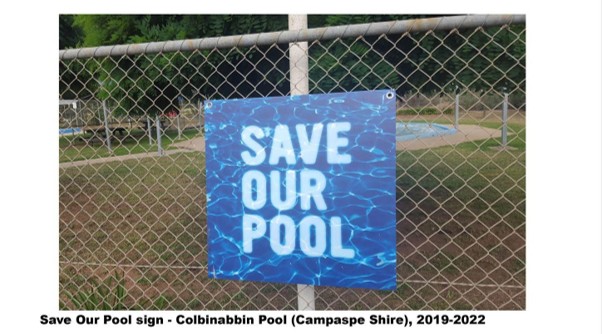
Entering the 21st century, risk management had an increasing effect on public pools in Victoria. In the 20th century, public pools had been built out of a sense of shared responsibility for learning to swim. Framed as responses to drowning in local waterways, they emphasised swimming skills, and in rural areas were run by volunteer committees and clubs. This model now sits awkwardly within the logic of professional risk management: a context in which fewer Australians can swim, and the public pool itself becomes the problem. Competing models of safety and responsibility have restructured pools such that the concern is often to not drown in a specific place, where liability might be incurred. Hence Lockington Pool advocates in 2016 despaired that: “There was no argument we could pull up – even drowning was irrelevant”.
Theories of an ethic of care, and care as an alternate infrastructure help interpret this shift. In early versions of swimming in Australia, responsibility for everyday swimming spaces was widely distributed, comparatively informal, and embedded in local social relations around education, sport, reciprocity and leisure. This attitude continues in shared norms of maintenance and surveillance: with interviews referring to multiple “sets of eyes on the pool”.
Responsibility for modern pools, by contrast, is both individualised and outsourced: with swimming spaces only permissible under controlled conditions set by regulators and professionals, and focused on financial and legal liability. Pools employ many lifeguards, whose training involves pointing out pool rules and possible legal nightmares. This frontline position is fraught: lifeguards enforce rules based on risks to and by patrons, and experience increasing violence doing so. Thus, the conversation I recently overheard at Elmore Pool, two mothers chatted and supervised each other’s children, musing that “I had thought about training as a lifeguard again, but it’s too much responsibility now”. Being a public swimming pool now almost by definition means professional supervision, which is also what introduces a duty of care, and a liability distinct from and higher than other water like beaches, hotel or backyard pools, or surviving pre-Olympic pools.
More lifeguards increase supervision but perversely, can change behaviour in unhelpful ways: with visible ‘experts in charge’ fostering illusions of safety that undermine personal awareness. This was a finding of the inquest into the 2014 fatality at Greensborough WaterMarc, consistent with earlier theories (‘Normal Accidents’). Community pool volunteers report feeling compliance is written by and for these large centres whose size, anonymity and complexity bring different social dynamics and types of risks: “The big centres with indoor pools, gyms, saunas: those are very different propositions to community pools”.
While rural pools and community-run pools have very good safety records1, risk management emphasises central oversight, ratios, worst case scenarios, and auditing. When combined with unsupportive councils, this brings reduced community involvement, and closures:
“[There was an] overriding risk management focus. Risky things – liability and insurance – rather than community connection.”
“The goal posts kept moving.”
Save Our Pool campaigners tell me it took years of their life, burning out against financial and legal calculations stacked against keeping local swimming pools going:
“I am still passionate about it but it was ‘my pool life’ for years, and it is very exhausting even thinking about it.”
“Everything was hard won. I was shocked at how persistent I had to be.”
In one example of pressures on pools with a volunteer history (see also e.g. Quambatook, Glenthompson, Golden Square, Olinda, Chewton), in 1994 the newly amalgamated Campaspe Shire inherited the former Waranga Shire’s volunteer pools – Colbinabbin, Rushworth, Stanhope and Tongala; and Rochester Shire’s two volunteer-run pools Rochester and Lockington. All had been built as alternatives to irrigation channels, dams and rivers. Until at least the 1990s, committees managed the pools, with local governments providing grants and technical support. Rochester’s Committee ceased after amalgamations, but Lockington’s had a roster of 25 volunteers until around 2010. Lockington accommodated changing expectations by combining professional with volunteer lifeguards, or kiosk volunteers. However, an interviewee in 2025 recalled:
“There had been a strong committee, but unfortunately it was passed back to the Shire, with litigation changes they were told – ‘if someone dies, it’s on you’. Fifteen years ago, we kept the pool open with committee volunteers and with no or one lifeguard. Now we can only open if there’s two lifeguards. We were told ‘this is the way’.”
In 2016, Campaspe Shire proposed closing all 7 of its outdoor pools, and keeping only Echuca indoor pool. Years of Save Our Pool campaigning followed. Protestors emphasised local assets, distance, pools as community spaces, and safety risks from dams and channels. Pushbacks stalled demolitions, but the issue re-escalated in 2018 with regulatory changes. In 2019, Campaspe Shire argued that with pools no longer able to operate with one lifeguard plus volunteers, “changes to the public pool operating guidelines [would] financially impact Campaspe Shire Council by around $145,000” annually. In 2022, the Shire again recommended closing its outdoor pools. In 2022, the town of Rochester was flooded, and the damaged pool never opened again. In real terms, it cost more to demolish Rochester Pool in 2024 than it had to build it in the 1960s. New councillors support the idea of a replacement, but calls for matched state and federal funding for a relatively modest pool ($12 million) have, four years later, been slow in materialising.
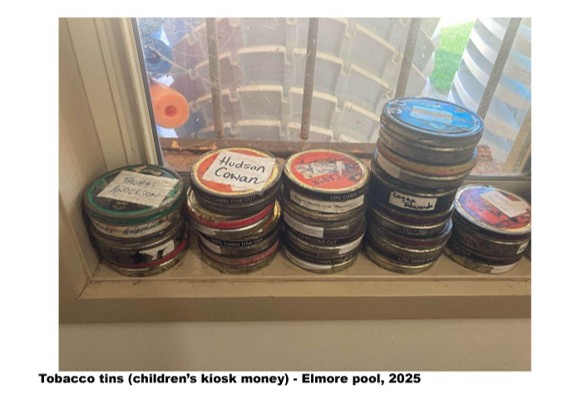
At nearby Elmore, in the City of Greater Bendigo, I qualified as a lifeguard in 2019 because the pool would often not open when two lifeguards could not be found. Now I am chair of a committee that navigates safety audits 100+ pages long, and signs warnings against diving into the ankle-deep wading pool. The small slide hangs onto legitimacy: two lifeguards need to actively supervise it for the hose to be turned on. Elmore Pool’s earlier incident books refer to a springboard – “cause of incident: stupidity” – long since removed, symbolic of other changes. A 1988 Elmore Swimming Pool Party report noted it cost $16,500 a year to keep the pool open, with $2,500 (15 per cent) from Huntly Shire, and an ‘adults only’ party (with paddle pool dancefloor and tube races) raising much of the rest. It is hard to imagine discos or alcohol today. Reliance on council support for lifeguard wages has grown to over 60 per cent of costs. Elmore still benefits from high levels of local volunteering through events like the Field Days. The pool is 65 years old, and tobacco tins of kiosk money remain, with parents’ names replaced by their children’s. It is still a volunteer pool. Kind of.
Meanwhile, almost by definition, pools cost more to run commercially than voluntarily. These costs are borne by councils, who have varying ability or willingness to support pools that only made sense to local volunteers. One response is to reduce hours and seasons and introduce weather-based policies, meaning pools are open and used less. This dynamic brought Brown Hill Pool in Ballarat to an end, despite long-discouraged “enthusiasm” of supporters. In a 2021 article, ‘Cool summer keeps gates locked on loved community pool’, residents complained that with reduced opening hours, lifeguard shortages, and weather policies, “the pool has been ‘closed on more days than it has been open’ this year”. The Brown Hill Progress Association handed control back to the City of Ballarat because “increasing compliance regulations were a burden on the group, it was becoming harder to keep track of safety legislation, and public liability insurance was rising”. In a perfect Kafka move, the following year Ballarat council closed the pool because of low attendance and high running costs. It was demolished in 2023 and replaced by a splash park – a form of aquatics popular with councils because without any water depth, lifeguards are not required. While the new park was welcomed in December 2025, the demolition left some residents “devastated”: “the area doesn’t need a splash park, it needs a swimming pool for the public”.
- Research by Staines (2013), Bugeja (2004), LSV and news reports indicate there have been seven fatal drownings at non-metropolitan public pools in Victoria in 75 years between 1949 and 2025. These occurred in roughly equal numbers before and after the 1991 GSPO. The fatal drowning at Port Fairy indoor pool in 2021 is seemingly the only fatality at a volunteer facility. It has since closed, in part due to the lawsuit and insurance implications. ↩