Why swim at all? “On paper, it doesn’t make sense”
In this essay, I traced how swimming pools in Victoria have changed over a century: from unregulated ponds, to crisp concrete, to multifunctional buildings. Community pools and on-site caretakers have come to seem quaint, at best. Viewed individually, the newer pools are obviously better. Chlorine and filtration bought clarity – and safety. Heated pools brought comfort. Indoor pools brought all-year use. Aquatic centres bought a wider range of facilities. They clearly make “more sense on paper”.
Viewed at other scales, the calculations are not so obvious. While there was a steep decline in drowning deaths in Australia across the 20th century, helped by swimming education and infrastructure like pools, in the 21st century drowning deaths have instead increased in numbers and rates. In one year (2024-25), 357 people drowned in Australia, 77 per cent at beaches and waterways. Reports indicate a 1300 per cent increase in drowning risk for young Australians due to lack of skills. Nearly half of Australian children cannot swim 50m when they finish primary school. Modern teenagers have less swimming experience than their 20th century counterparts – a trend compounded by COVID lockdowns. While public pools have been a focus of risk management, natural waterways are the front line for drowning. People are exposed to risks at rivers, creeks, beaches and backyard pools. For non-swimmers, including migrants from countries with low swimming abilities, these can have fatal consequences. In a warming, drying climate, the appeal of Australia’s waterways is not going to decline. But enjoying these places is contingent on baseline swimming ability, which is contingent on access to infrastructure that often “doesn’t make sense on paper”.
The earliest ‘pools’ were constructed in months. Olympic pools took some years. Modern aquatic centres take five or more years to plan but can – as in suburbs like Mernda – remain unbuilt for decades, while entire childhoods elapse. Aquatic centres take longer to build and, like other complex buildings, require more expertise to maintain. Indoor leisure pools seem to have shorter lifespans: routinely redeveloped after 20 years. I say “seem to” because once-ambitious pool projects leave scant public records. The only historical information on the 1983 “space age” Norlane pool came from my aunt’s swimming club records. Retrieving information on Kew’s multi-million-dollar reinvention in 1989 – demolished 30 years later – required digging through historical society newsletters. Northcote Pool’s $64 million remake in 2024 referred to the 1968 pool, but not to the 1990 “state of the art” redevelopment. At the time the “very old and rundown” Footscray Pool was demolished in 2008, it had been redeveloped as an indoor facility barely 20 years earlier. The Maribyrnong Aquatic Centre is undergoing a $16 million renovation 13 years after opening.
Shorter lifecycles reflect rising standards and expectations, and scope creep toward bigger projects chasing ad-hoc state and federal funding. They also relate to warmer water: English book Great Lengths suggests indoor baths used to be heated to 20 degrees Celsius. This increased to 22-24 degrees in the 1960s. Today’s norms are warmer – often above 30 degrees. Building air temperatures must be kept warmer than water, meaning specialised materials and ventilation for punishingly corrosive conditions. Cue substantial renovations at 20 years, “ageing” at 30 years, “unsaveable” at 40. Kilsyth Pool, heated and covered with a dome in 1989, was too hot, and was demolished due to maintenance challenges in 2023. Current proposals are for “a major integrated aquatic and leisure hub”, in 10 years, in another town. But, campaigners argued, “Kilsyth did not need a state-of-the-art recreation hub… we want a community pool”. (Some) people still value local pools, for place-specific reasons, even if they know (as at Golden Square): “On paper, it doesn’t make sense to keep the pool open”.
Spatially, aquatic centres need larger catchment areas, sometimes a 30-minute drive. They don’t make financial sense in rural areas where pools were community facilities. In new suburbs, they are further apart when they do arrive. For one pool to be modernised, others are often closed. The only pools now common in Victoria’s new suburbs are private swim schools. Some of the largest aquatic centres are built by private schools in Melbourne’s east, where public and home pools are more widespread, compounding socio-economic disadvantages.
In 21st century Victoria, you may be waiting a whole childhood for a dream pool. You may live a long way from any public pool, or be a young person who can’t get there without costs for your parents, for whom the impact is shaped by their affluence and suburb. If you are in a wealthy suburb, you are more likely to have a pool at home, an amazing public pool passably resembling Disneyland, and a pool at your private school. Lucky. But from the view of a town or suburb without a pool, or an individual who can’t easily get to one, the main place the unequal erosion of Victoria’s public pools makes sense is on paper.
Changes in pools also reflect and reinforce dramatic shifts in childhood norms: a retreat from public spaces, with increasingly sedentary, car-based lives and few unprogrammed outdoor times. Needing to drive, and further, to reach a pool means direct costs to parents. A 2025 article about much-reduced swimming skills described parents struggling to pay for and drive children to commercial lessons: “the weekly grind was exhausting”. The rare freedom of children and adolescents to travel to local pools is frequently cited in interviews as a reason people to try to save them:
“Kids ride into the pool themselves, or parents drop them off from out of town. If they were not at the pool – they would be sitting at home. The pool is fun for kids not on devices.”
“Why this pool? Because you could walk to it. Kids could come by themselves.”
Urban planners and designers, historically, similarly thought of pools as child-centred, walkable community spaces. In Towards New Towns for America (1949) swimming pools were “centres of outdoor life in the summer”. Australian Architect Robin Boyd argued suburbs should have “…two or three acres at the crest of the hill … set aside for community use and a few communal amenities such as a swimming pool of swimmable proportions” (1960). In The Death and Life of Great American Cities (1961) the popularity of public pools is one of the few things urbanist Jane Jacobs seems to agree on with Planning Commissioner (and lifelong swimmer) Robert Moses. Best-selling architectural book A Pattern Language (1977) gives the advice that “in every neighbourhood, [you should] provide some still water – a pond, a pool – for swimming”. Latham and Layton (2019) list public pools as examples of social infrastructure: “libraries, laundrettes, and lidos. Pizzerias, plazas, and play-grounds. Sidewalks, swimming pools, and schools. These are just some of the kinds of spaces and facilities that contribute to the public life of cities”. Pools are like other (increasingly rare) ‘third’ places outside work and home that people visit regularly. Hence:
“[The pool] functioned like the best kinds of local pubs – somewhere you knew you would meet someone. And kids liked this part too – they didn’t call, they would bump into each other, have casual encounters.”
Save Our Pool campaigns frustrate policies viewing existing local pools as interchangeable with – inferior to – larger facilities further away, in the future. For Chewton pool advocates: “The view was – tough luck about the cost of the new centre, tough luck getting there, too bad about [the] pool but no-one goes there – that was the attitude”.
Different kinds of pools are valued for different reasons: leisure centres as modern, diverse spaces, yes; but also small indoor pools like Heidelberg West for quiet familiarity; suburban Olympic-style pools like Coburg as summer oases; rural pools as community hubs. There is still specific appreciation for local pools. Where available, over half of swimmers walk to pools. Many of Victoria’s rural communities have been willing to undertake the infrastructures of care for public swimming pools in a largely voluntary way, because they see them as local community hubs. Financialised, professionalised, risk-focused systems are increasingly hostile to this embedded care for social infrastructure. The financial pressures are perverse (with similarities to live music venues), even before considering the impacts of pool closures. Tomaney et al’s (2024) work on Social infrastructure in Left Behind Places showed how while social infrastructure can be quickly unmade by economic changes and centralised decisions, people and places experience its loss in lasting ways. This “root shock” degrades civic life, reducing routine places to meet others, and feeding isolation and disaffection. The practical and symbolic impact of losing routine places to encounter others is profound.
Pools are public spaces – but of course ‘public’ has not always been truly public. Access to public pools is deeply political. In the US, Wiltse’s Contested Waters (2007) detailed how gender-segregated but racially integrated baths became mixed-gender, racially segregated pools. With race riots over desegregation, America’s many enormous interwar leisure-era pools were largely abandoned in favour of club and private pools. The UK’s public pools lurched between expansive civic investment (in ponds, outdoor lidos, and indoor baths), and savage financial austerity, with class divisions to which pools survived. In Australia, ‘Freedom Rides’ protested the exclusion of Indigenous people from NSW pools including Moree in the 1960s. The sites and waters of Australia’s pools are all on unceded Indigenous Country. The national image of swimming has not always been welcoming. But whereas post-war Olympic pools are remembered as at least aspiring to a democratic and multicultural ubiquity, increasingly unequal access to pools is sharpening barriers to participation today.
Public pools have also been casually gendered, violent, even predatory. A 1978 Shepparton pool report was pleased to record that, thanks to police, that season “there was only one or two girls molested”. A redesign sought to “stop boys from getting under the catwalk and pulling the girls under”. In the 1970s, the Eureka Pool where I later trained on 1990s mornings was the site of alleged “pool impropriety” by Catholic priests including later-Cardinal George Pell. In 1946, a 54-year-old man drowned himself in the pool at night to avoid facing “serious charges involving a five-year-old-girl”. At the Eureka Pool today, a sign above the changeroom reads, underlined with unsettling emphasis – “please supervise all children in and around the changing areas.” Around public pools, I try to hold two contradictory ideas of freedom: that you learn to swim so you do not drown, and because water is a kind of freedom. For migrant women travelling from Western Sydney to the Ladies Baths, “to be able to float in water is the closest to freedom that a lot of the women have felt.” Or to an eight-year-old girl at a remote pool, “being outside the water is like being trapped in a jail … but when you’re in the water, you’re free.”
And what happened to that “world’s largest” (or Southern Hemisphere’s largest) swimming pool, Shepparton’s Raymond West? Built in 1953, the giant pool had the chlorine of an Olympic pool; but access and material typical of pre-Olympic pools. Not following standard formats was an escalating challenge, as the sandy floor meant “an exemption by the Health Department from compliance with the Swimming Pool Regulations was necessary which has not been without its problems”.
Archives from the 1950s to 1990s show Shepparton’s pool being spatially and financially enclosed. By the mid-1970s, an Olympic pool was sectioned off. In 1979, the city introduced entrance fees and security fences, and in 1980 a substantial upgrade was undertaken. There were (ultimately, justified) concerns that “to close the area off will detract quite considerably from its appearance and its name as the biggest swimming area in the Southern Hemisphere”. The 1980s version was still a beach-style pool, but had concrete lining, fencing and entry fees, and paid rather than volunteer lifeguards. Photos from this time suggest a cigarette ad atmosphere – white processed sand, white pants, palm trees. This is the stretched-out pool of my memory and photos. Internet posts remembering the place refer with mixed incredulity and nostalgia to this “best pool ever”, “like a beach”.
The new fences and entry fees were unstated background to, in 1993, critical reports on declining attendance: when “consultants … urged council to adopt a business-like approach”. In the early 1990s, the pool metamorphosised into Aquamoves. By the logic of 1990s “exciting and commercially viable” leisure centres, it “had to be treated as a business with a new management approach geared to attracting the maximum number of people”. Today, heritage photos of the diving boards are displayed near the hydrotherapy pool. The title of largest swimming pool in the southern hemisphere is, meanwhile, now held by the Hayman Island Resort in the Whitsundays.
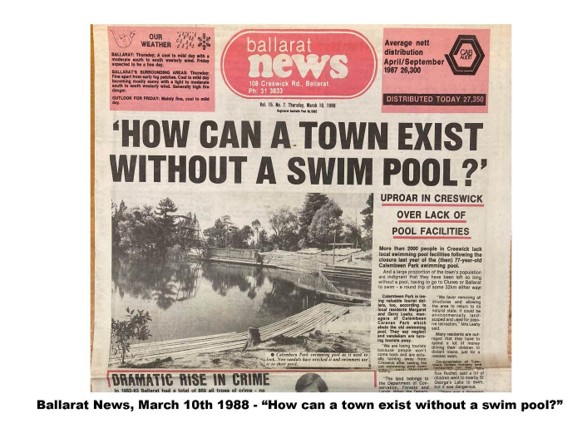
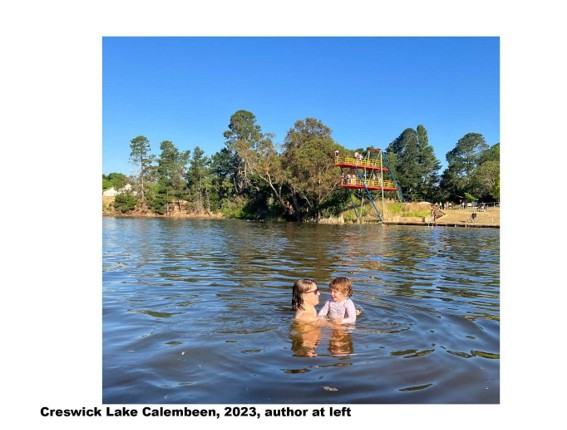
Despite a century of change, there are still outdoor pools across Victoria, including some run by volunteers. There are even strangely enduring pre-Olympic pools, like Buchan Caves, and Creswick’s Lake Calembeen. Creswick’s swimming hole was closed in 1986 due to Crown land insurance issues, fuelling petitions and protests from locals and visitors, with a 1988 headline asking pointedly: “What is a town without a swim pool?” The twist is that, while Shire and state officers tried to permanently close Calembeen for non-compliance with pool regulations, they found it was too big to be legally defined as a pool – an internal note reported that the Health Department advised: “Creswick Pool is a ‘natural swimming ‘area’, so land is not subject to regulations. Regulations apply to all pools with a 2000sqm surface i.e. 2 x Olympic Size”.
Calembeen’s boardwalks were renovated and reopened in 1988. Its diving tower has its own history but since 2017, two layers of this heritage-listed structure have been open without formal supervision. The chlorinated toddler pool – which does need to meet guidelines – seems perpetually busted and closed off. Crowds of people, many of them young, flip noisily into the dark cold water. There are no fences, no known bottom, no operating hours. I’m glad I’m not a lifeguard there. I return every summer.
Victoria’s pools could again be local hubs – like Iceland, where a town isn’t a town without a pool, and public swimming pool culture is OECD heritage-listed. They could be combined with schools; or parks. Or AI data centres? New suburban pools could be reimagined with migrant cultures. They could be the best bits of Australia’s quintessentially public beaches: but more affordable to live near. Penrith Lakes is a model for new, free public access to water in less advantaged areas. Pool closures during COVID lockdowns saw take-up of “wild”, cold swimming. Building on improved water quality, movements like Melbourne’s Swimmable Birrarung could reimagine urban pools on natural waterways.
Simplifying Australia’s uncertain funding for aquatics could mean a new future for ‘ageing’ pools prized by communities, if grimly tolerated by cash-strapped local councils. Hundreds of local pools could be modestly replaced or renewed for decades at a cost comparable to a few new leisure centres. Operational changes could make smaller pools more accessible and financially sustainable. New designs, heating and filtration technologies are within reach. Especially if Australians learn to shower first.
Swimming at all is against the historical odds. The 20th century saw an implausibly widespread swimming culture in places like Victoria (and Vienna, where Kafka spent his last days swimming). Not so long ago, the worker town Cocoroc – literally inside Melbourne’s Werribee sewerage farm – had a “much loved” pool as centrepiece. It was possible to live inside a poo farm and feel privileged by a community pool. Artwork at the now-abandoned town, projecting faded footage of children swimming, evoked fond memories for some but also the nostalgia of lost futures: unsettling the idea that things have only improved over time. All infrastructure requires care to maintain, repair and continue. Yes, some public pools are now a bit shit. But in retreating from risk, from repair, we lock the gates. We forget how to swim. One of Kafka’s famous diary entries is a micro-study in somehow keeping swimming, anyway: “Germany has declared war on Russia. Swimming in the afternoon”.