Case study: “Casual Gang for Harcourt Pool”
Another example of historically volunteer-run rural pools is Harcourt, near Castlemaine. Archive boxes from the pool’s committee include a 2004 publication celebrating 75 years of swimming in the town, acknowledging:
“… there have been more than 400 committee members and volunteers on record who through their tireless efforts in assisting with the operation, fundraising and maintenance of the pool, have given us this wonderful community asset.”
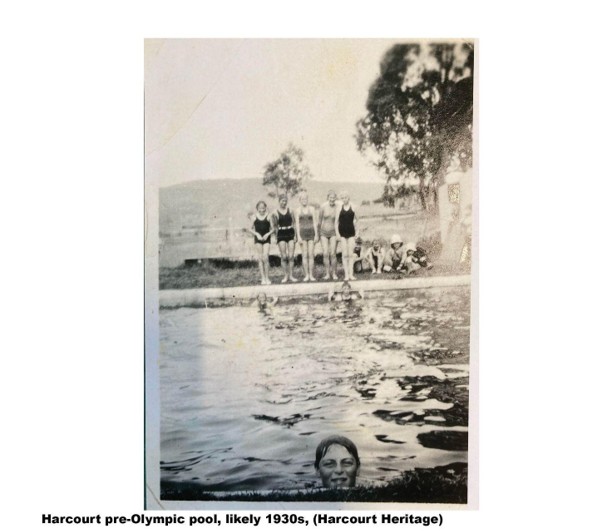
Health regulations meant Harcourt’s 1928 pre-Olympic pool needed to be replaced with a filtered chlorinated pool following critical inspections in 1960. From 1964 to 1973, the Harcourt Progress Association, Harcourt & District Swimming Pool Committee, and “ladies’ auxiliary” committee fundraised for a replacement pool. To qualify for state grants, land had to be owned by a council or school, or be on reserved crown land: the former Harcourt cricket ground was purchased in 1965 and “granted to the Shire with the view of receiving a three to one grant”. Pool plans were copied from Chewton and Newstead. When Metcalfe Shire was “unable to offer financial assistance” and documents not lodged, a 1970 “letter was sent to the shire from the committee calling them incompetent”.
Harcourt progress groups lobbied the state government directly, raising $10,000 to match a $30,000 grant. Fundraising records capture the aesthetic of rural pools: apple juice sales, fishing bonanzas, Tupperware parties, pork leg raffle, popular girl quest, beard-a-thon, pushing a wheelbarrow to Bendigo, white elephant sale, car raffle, Miss Tiny Tot, Master Tiny Tot, social nights, treasure hunt. When the pool finally opened in 1973, a headline claimed “the pool committee would be hard pressed to continue its efforts to provide a valuable amenity, without the assistance of the ladies”. In a different form of gendered unpaid labour, the pool was constructed by men from nearby Castlemaine Prison. A letter from the Prisons division described arrangements for the “Casual Gang for Harcourt Pool”. In a grim addendum, the officer asked permission to pick up windfall apples as: “…Fruit is of great value in this institution, and we would be only too pleased to clean up any apples that were not required by the growers.”
Records then show decades of mundane pool operations at Harcourt: punctuated by sump pump (“men from shire coming tomorrow”) and “attitude” problems (“he has an attitude problem” on the same page as “order icy poles!!”). The Committee attempted to give up management “with much regret” in 1983 after new regulations, with concerns “…such a small Committee as ours would be required to shoulder the growing responsibilities, as well as the cost.” But the committee appointed a trained caretaker for some roles, with Shire help.
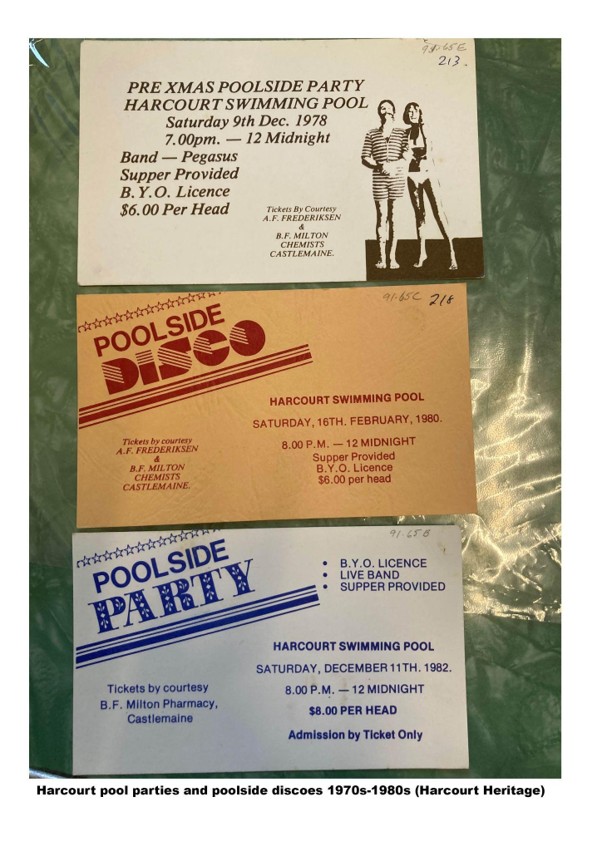
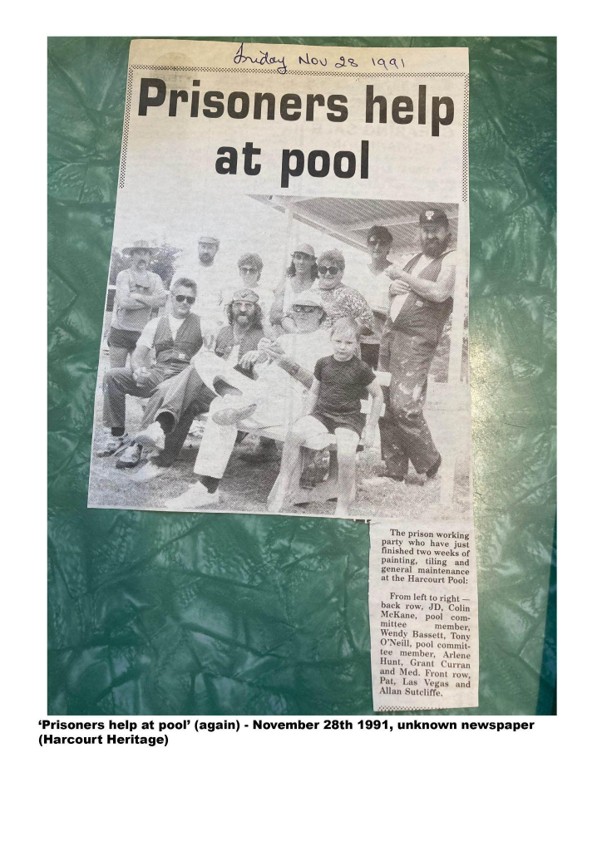
Other income came from catering, club hire, entries, and events including BYO licensed poolside discos with live bands. From the 1970s to 1990s, Harcourt, like other volunteer pools, raised half their annual budgets through social events. In 1989, an intermediate pool was added – with prison labour used for that project, too. A 1991 article ‘Prisoners help at pool’ showed prisoners – “JD” and “Las Vegas” – undertaking maintenance. A norm of unpaid labour – prisoners, unemployed, ‘ladies auxiliary catering’, clubs, committees – had been routinised at rural pools.
Through the 1990s, however, the Harcourt committee needed to fit increasingly professional standards. Metcalfe Shire was amalgamated, and plans for an indoor heated pool were hinted at. By 2000, Harcourt pool’s maintenance, kiosk and cleaning work was still by volunteers – but a note read, with generous sarcasm, that: “Lots of thanks need to go to those who gained or updated their CPR qualifications so they were able to run the kiosk (and clean the toilets!!)”
In 2004, a Mount Alexander Shire letter referred to the importance of the area’s volunteer pools, but implied there were too many of them and they would be closed should they require further funding:
“Council acknowledges the vital role that volunteers play in the operations of its six swimming pools, as well as the fact that it would be virtually impossible for Council to financially sustain all six swimming pools without the assistance of such volunteers.”
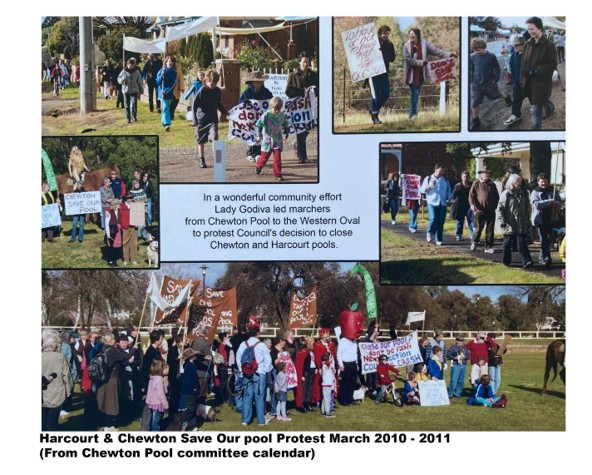
In 2007, council accepted a critical report on the shire’s pools, from consultants who later prepared an Indoor Aquatic Centre Feasibility Study. The proposed centre (costed at $14 million in 2011, $20 million today) came with a series of proposals to close outdoor pools at Harcourt, Chewton, Castlemaine, Maldon and Campbells Creek. Harcourt and Chewton campaigned together against the closures – describing themselves as “tiny towns”. The campaign over 2010-11 included an “ugly man competition”, sit-in tent embassy, Lady Godiva march, and “no-pool pool party”. Chewton Pool was nearly demolished in 2010, but returned to being volunteer-run with partial Shire funding. It is self-described as the “best little community-run outdoor pool in the world”. Harcourt Pool was retained, but has been YMCA-managed since 2014. I’m not sure what the final straw for volunteers was, but something can be inferred from a 2015 newsletter: “The plan to engage volunteers at the pool has proved more difficult than expected, with the Bendigo YMCA requiring strict regulative compliance…”
The indoor leisure centre was not built in Castlemaine. Campbells Creek pool, volunteer-run for nearly a century, was demolished in 2009.