
Building era 2: Olympic-style pools
Although it had been popularised in lakes and rivers, swimming in open freshwater became discouraged in places including Australia by the second half of the 20th century. By the 1970s, most of Victoria’s hundreds of pre-Olympic pools had either been modernised or demolished: a trend shaped by pollution, fears (incorrectly) linking polio to freshwater, standardised regulations, and aspiration toward Olympic pools. Engineered pools promised a medicalised, technological fix for abandoning polluted natural waters. One earlier example of an Olympic-standard pool – with clear, cool water – was the Beaurepaire pool replacing baths on the Yarra in 1935. However, the boom years for Olympic-style swimming pools were the decades following the second world war.
Enthusiasm for straight concrete pools with filtered, recirculated, chlorinated water was buoyed by the 1956 Melbourne Olympic Games. Loans and grants were available from 1945, including for pools as war memorials, and around 200 of Victoria’s public pools were (re)built between then and the 1970s. The Victorian government provided matched funding with few hurdles beyond having a public site (which was often donated) and plans (which were often copied).
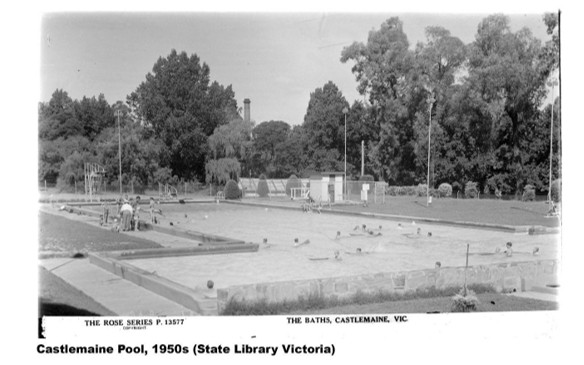
Given their ubiquity in the late 20th century, these pools and their associated intensities of cold water, hot concrete, melting icy poles and chlorine are entwined with Australian nostalgia. One example, for me, is the main Castlemaine pool. This 50m concrete pool with diving boards opened in 1951 (costing 12,000 pounds – about $854,000 today). I have layers of memories of it: the earliest, sometime in the 1980s, pine needles underfoot, aware of my own childish size in relation to the depth of the diving board end. I could not yet swim but felt a familiar draw to the water. I was given to understand from an early age, almost by osmosis, that my grandfather had built this pool with a team of men and horses; that my grandmother had painted the cartoon shapes on the floor; that time and space occupied scales I was yet to occupy. (Construction photos at the State Library suggest the claims were true.)
In Bendigo, earlier sprawling baths were drained, filled and rebuilt as an Olympic pool complex in 1958 for 50,000 pounds ($1.96 million today). Further north, the smaller Elmore pool was constructed in 1959, by a committee supported by Huntly Shire. A local recalls being warned by her father not to swim in the Campaspe River anymore as “we worked bloody hard to get that pool, so that’s where you’ll swim”. Nearby Rochester’s War Memorial Pool opened in 1959, after months of volunteer labour, superseding the river. Lockington Pool, also in Rochester Shire, opened in 1966. Land for Lockington Pool was donated, and two thirds of residents contributed to the 21,000-pound construction cost ($700,000 today). Ballarat’s Lake Elsworth was replaced relatively late, 1972, by the Eureka Swimming Complex. Most of the $94,000 cost ($1.1 million today) was raised by a committee. A tourist report in 1974 conceded “the present complex is no longer free” but was “filtered and chlorinated, floodlit for evening swimming and attended all the time”.
Most Olympic-style upgrades were pushed for enthusiastically. Some were forced: while lifesaving and regulatory bodies at first only encouraged chlorinated water, they soon strictly required it, sometimes filling in non-compliant pools. Harcourt’s pre-Olympic pool became non-complaint in 1960 when “the Department [was] not favourably inclined toward the existing arrangement”. The replacement Harcourt and District Pool opened in 1973, costing $40,000 ($460,000 today). The project was lucky to have crossed the line before funding changed to favour heated indoor pools.
In suburban Melbourne, the Coburg Olympic Pool replaced the earlier weir pool in 1965. Increasing industrial pollution gave impetus for the pool built alongside, but secured from, the Merri Creek. Similarly, Sunshine Swimming Pool replaced the Koroit Creek swimming hole in 1961. Pollution meant swimming in the Yarra became marginal or illegal, and Deep Rock swimming hole was partly buried by the Eastern Freeway in the 1970s. This was an era of widespread pollution, and optimistic public pool building: e.g. Greensborough and Preston both became Olympic-style complexes in 1964. Some older urban baths like Kew, North Melbourne and Sebastopol had filtration retrofitted. At Brown Hill near Ballarat, “[s]wimming at the pool had been free until the pool was fenced off”, but after upgrading in 1964 it became a leased council asset. Collingwood’s baths were already considered outdated in 1936 and, after a 1956 tragedy, were demolished. Olympic-style pools formed part of a post-war construction and baby boom. Like the open pools they replaced, however, they would be considered outdated within a few decades.