Building era 4: Leisure centres
A more substantial change in public pools in Victoria began to take hold during the 1980s, and accelerated in the 1990s. Local and state governments – advised by a nascent professional aquatics industry – aspired toward large-scale leisure/aquatic centres. These predominantly indoor complexes were regional in scale: destinations to drive to. With ‘dry’ spaces added on – gyms, cafes – part of their appeal is that, while they cost more to build and operate, they can make money through economies of scale. They cater for more diverse users by consolidating services. Showcasing architectural and technical advances, they are open daily, year-round. They are usually built by Victoria’s local governments plus competitive state or federal funding, and contracted for management by specialised aquatics companies. Public pools still matter in Victoria, but have changed into complex buildings (with surrounding car parks), routinely the largest capital projects councils undertake.
The first leisure centres appeared in the 1980s: e.g. Footscray pool was remodelled with attached gyms for $3.6 million ($12 million today) in the mid-1980s. Since then, projects have become ever-larger, serving larger catchment areas, with more features. Shepparton’s remake from swimming lake to Aquamoves in 1993 cost around $3.5 million ($8 million today). Maribyrnong Aquatic Centre, opened in 2006, cost $18 million ($29 million today). Casey RACE, opened in 2009 to replace the derelict Cranbourne Indoor Pool, cost $37 million ($55 million today). When Greensborough WaterMarc, a “top-of-the-range” “multi activity regional centre” opened in 2012 for $42 million ($57.6 million today), it replaced the former Greensborough Olympic Pool because (quoting councillors in 2012) “anything would be better than what it looks like now”. Recent aquatics projects average between $50 million and $100 million dollars in construction costs, but above $100 million is normal: a $116 million Melton facility is under construction. Plans for a centre in Melbourne’s north are estimated at $366 million.
Leisure centres of the 1980s and 1990s are now ‘ageing infrastructure’. In Adelaide, a centre built in 1985 was in 2023 “hideous”, “unsavable, unrepairable and unusable” ahead of a $135 million replacement. An early leisure centre, South Barwon, cost $1.2 million in 1979 ($6.9 million today), and was rebuilt as Belmont Leisurelink in 2010 for $31 million ($44 million today – six times as much) – “a drastic improvement on the old one – the gym and the pools are twice as big”.
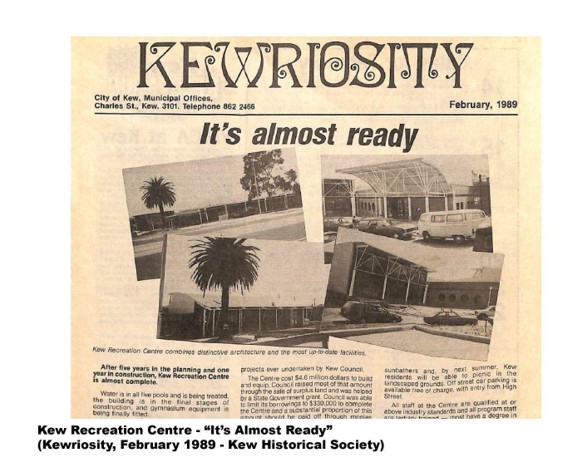
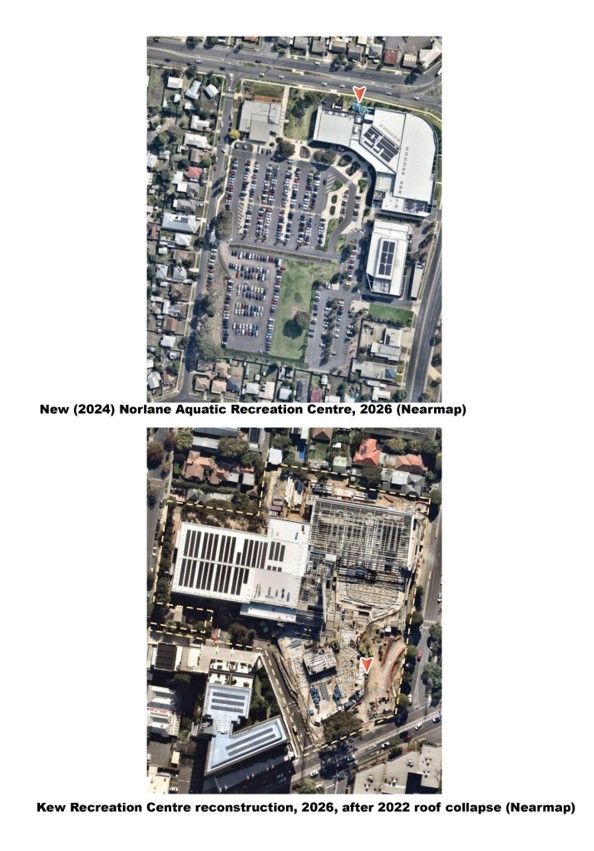
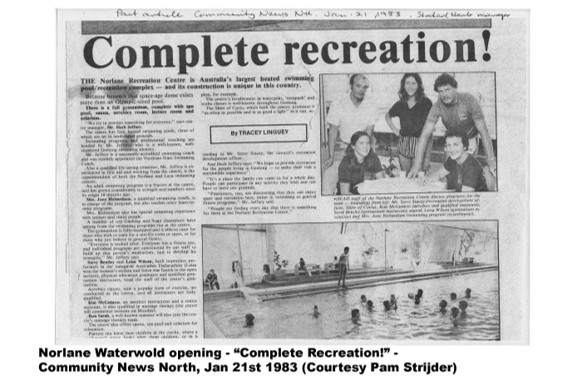
Kew Recreation Centre replaced the baths in 1989 after five years of planning. Its five indoor pools and associated facilities boasted “distinctive architecture and up-to-date facilities” and cost $4.6 million ($12 million today). The centre was demolished 30 years later in 2020 to “transform it into a modern facility”. During construction of the $73 million centre (costing six times as much as in 1989), the huge roof span collapsed, and as of 2026 it is still closed. When Norlane Waterworld replaced the 1965 Norlane Olympic Pool in 1983, it was described as Australia’s largest complex. Headlined “Complete Recreation!”, it cost $700,000 ($2.7 million today) with a “space age” design. I recall the thrill of visiting Waterworld in a 1990s winter. It felt like a glamorous tropical theme park. It was demolished about 20 years later and is now the car park of its replacement, the Northern Aquatic and Community Hub, which opened in 2024 after a six-year $65.6 million construction (23 times as much).
With the growth in scale and cost, aquatic centre projects often require state and federal funding, hence are disproportionately located in marginal electorates. Infrastructure Victoria pointed to a critical inequity in aquatics facilities in Melbourne’s new suburbs. It’s a long way from a local pool. Keeping one going is a whole other story.