
Building era 1: Pre-Olympic pools
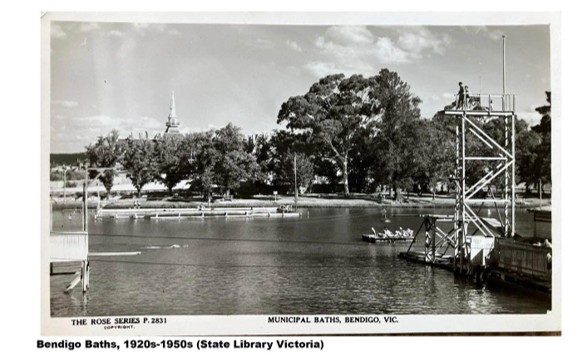
Public swimming pools had a few precursors. One was the “bath” or “wash house” – a type of facility constructed in inner cities for public health reasons from the mid-19th century. These were usually indoors, gender-segregated, and focused on hygiene (literally having a bath), but became recreational over time. Roughly in parallel, enclosed sea baths began as a health fad but by the late 19th century were adapted as swimming spaces, including for competitions. Mixed gender public swimming places – pools, beaches, pools at beaches – did not become legal or common until the first decades of the 20th century, with the invention and legalising of bathing costumes, and changes to by-laws which had restricted public bathing to nighttime. Public health, garden city, corporate welfare, public schooling and labour movements were among the changes instigating a leisure culture around swimming in many parts of the world.
There were specifically Australian factors: recent colonisation, with its violent upheaval of Indigenous peoples and their lands and waters, polluted and reshaped rivers. Gold mining created extractive landscapes, and spaces left behind filled with water. The prevalence of drowning by settler children was one reason swimming education was established in Australia, channelling unease about the colonised landscape into nationalist and sporting ambitions. By including swimming instruction in the school curriculum from 1898, Victoria’s suburbs and towns needed to improvise swimming spaces. The Royal Life Saving Society of Victoria, established 1904, Herald Learn to Swim program, amateur swimming associations, and promotions by Olympic medallist Frank Beaurepaire helped swimming and pools become widespread for education, sport, safety and leisure. Over 300 “pre-Olympic” swimming enclosures were built across Victoria in the early decades of the 20th century, with enclosed sea baths supplanted by freshwater swimming locations. “Pre-Olympic” refers to swimming areas not standardised for competition, and in Victoria to pools built before the 1956 Melbourne Olympic Games.
In inner urban areas, earlier pools were typically hygiene-focused baths. As in an 1895 image of naked schoolboys advertising the new Collingwood Baths, these were initially gender segregated. They were sometimes substantial municipal buildings (e.g. Melbourne Baths). Others were prosaic outdoor basins of timber or concrete, filled by adjacent waterways or by piped water, with basic circulation (e.g. weekly changes at North Melbourne baths, Free Corporation Baths on the Yarra, Kew Baths, Preston Baths).
Other early pools in Victoria, in suburban and rural areas, included enclosures along rivers and lakes (e.g. Echuca, Rochester, Deep Rock, Coburg, Sunshine, Greensborough) former quarries and mining holes (e.g. Bert Leister’s Dam in Castlemaine, Creswick’s Lake Calembeen, Sebastopol near Ballarat, Surrey Dive in Box Hill), ocean baths (Geelong’s Eastern Beach), and basins (e.g. Bendigo East, Golden Square). Rose Stereograph postcards in the State Library of Victoria’s catalogue showcase bucolic open pre-Olympic pools, often with young people perched on wooden diving towers in garden surrounds (e.g. Daylesford, Werribee, Bairnsdale). Some, like Bendigo’s Baths, were of a grand scale. When first opened in 1912-13 Bendigo’s lake-pool was separated into larger men’s area (about 3.5 times the size of a modern Olympic pool), smaller ladies’ area, and ‘paddling paddock’. Costing 1,460 pounds ($155,866 today) it had beach entries and elaborate elevated pavilions. Ballarat had Eureka Stockade swimming pool – also known as Lake Elsworth, described in hindsight as “notable for its weeping willows, its muddy waters and the fact that it was free”.
Other rural pre-Olympic pools would have been best described as “swimming holes”, local DIY spaces organised by returned servicemen, amateur swimming and diving clubs, progress associations, workers’ clubs, and unemployment relief. The town of Harcourt’s original pool opened in 1928 on donated private land, fed by an irrigation water race, and emptied once a fortnight. Costing 149 pounds ($14,500 today), it was built over a few months using unemployment grants and local fundraisers. It was a popular site for decades, albeit semi-fondly dubbed the “slime bowl”. This was the teetotalling town my maternal grandmother grew up in: archives show her father listed as pool secretary. School children had free entry to Harcourt’s pool, which was closed on Sundays during church hours (or you had to be quiet).
The popularity – or acceptance – of swimming in cool water was part of the modernist aspiration of swimming. Equating invigoration outside with physical, even moral, health was one reason freshwater swimming was more popular in cool climates (like Tasmania and England) than might be expected today – the recent popularity of ice and “wild” swimming notwithstanding. That water was in varying shades of muddy was taken for granted.