Building era 3: Indoor heated pools
An early discontent with public pools in Victoria was the shift toward heated water, and heated indoor pools. After 1972, the Victorian government established a “Youth, Sport and Recreation” ministry, moving pools from public works. Funding switched to an explicit preference for new indoor heated 25-metre pools, or enclosing and heating existing pools. The arrival of state-run piped gas supply in Victoria possibly influenced thinking – cheap gas, and people looking for new ways to use it. Unlike previous reliance on civic groups, the new system emphasised professional expertise. Funding became targeted, with criteria like “the catchment area for the proposed pool and overall recreation planning for the Shire”. Fewer public pools were built in Victoria in the 1970s and 1980s, and of those that were, the more common were indoor heated 25-metre pools. Humble by today’s standards, they were substantial projects for their times.
While Harcourt squeaked across the line with their unheated outdoor pool in 1973, a rural township near Ballarat, Smeaton, fell short. Records show volunteers earlier (1966) buying and donating land and making plans for a small outdoor pool. By the time they sought matched funding through Creswick Shire in the 1970s, funding favoured indoor heated pools, which needed larger populations to justify. The committee were told there was “no use case” for their pool, and it was never built.
Heated indoor pools were sometimes pushed for locally, but additional costs meant less predictable outcomes. Groups in Creswick campaigned for a heated indoor pool from the 1970s – calling Lake Calembeen, the incongruously surviving pre-Olympic pool, a “doubtful mudhole” – but never succeeded. One reason was because by the time the Shire sought funding, plans for a larger scale aquatic centre in Ballarat were taking precedence.
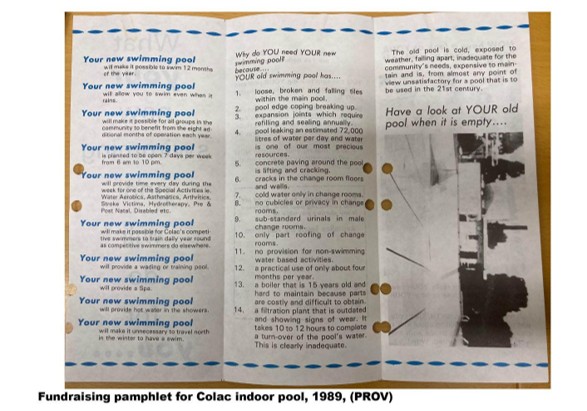
Colac in 1989 “embarked upon the most ambitious (and the most costly) project in its history” by “attempting to finance the construction of a 25 metre Heated Indoor Pool with a total estimated cost of $1.8 million” ($4.8 million today). A funding pamphlet unreservedly criticised the existing outdoor pool, giving insight into wider sentiments: “Why do YOU need YOUR new swimming pool? Because… YOUR old swimming pool is cold, exposed to weather, falling apart, inadequate for the community’s needs, expensive to maintain and is, from almost any point of view, unsatisfactory for a pool that is to be used in the 21st century.” Concerns about the limits of unheated pools were prominent in the 1993 report catastrophising the Shepparton Raymond West pool – consultants issued a “shock report on swim pool” with “the vexed issue of a heated pool … a cornerstone of one of the recommendations”.
Nunawading was a benchmark early indoor heated pool in Victoria, referred to enviously in Ballarat council files. In 1976, Collingwood replaced its baths with the indoor Centenary Pool in Clifton Hill. The Footscray Baths were enclosed and heated in the mid-1970s, as were other pools including Eaglehawk, and Kilsyth covered by a dome in 1989. Cranbourne’s indoor heated pool opened in 1979. One early gas-heated pool in Victoria was Ballarat’s outdoor Eureka pool, where I used to train on foggy sub-zero mornings. Youth and Christian groups helped establish indoor heated pools, like the 1969 Ballarat YMCA pool inside a converted brick building where training was held in winter. Melbourne’s Beaurepaire pool, dubbed derelict in 1972, was rebuilt as the indoor state swim centre in 1980. In the 1990s, I was in a relay team who won a medal there and were later photographed at the Ballarat YMCA pool. Hinting at changing standards and rapid obsolescence, both the YMCA pool and the state swim centre were each demolished by the end of the 1990s.