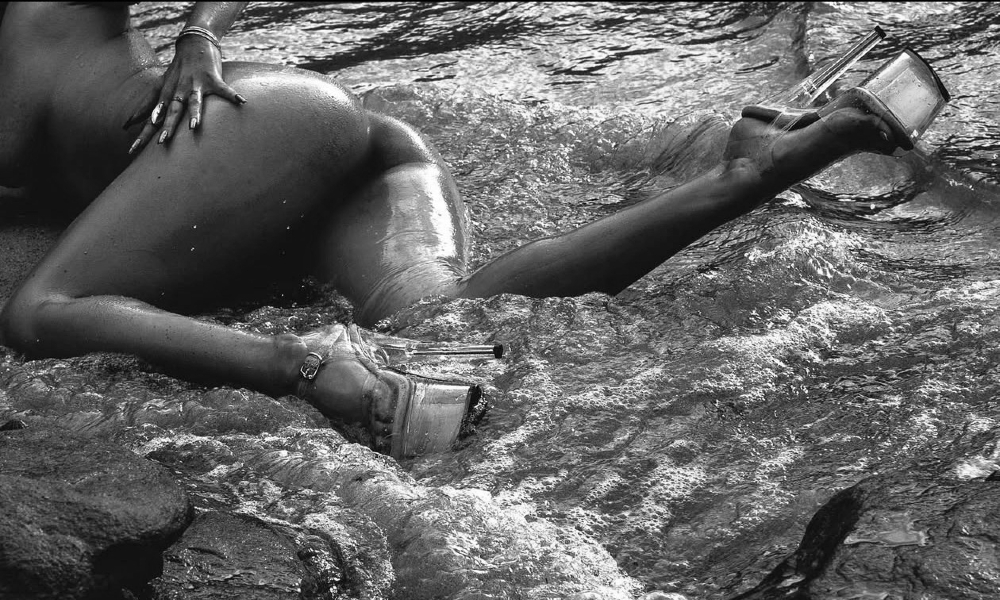
Image by: Viscera Studios
Poet Paz Deol and artist Moonyeka had a conversation about the role of the whore and how workers transmute collective and individual rage. Paz writes with mythopoetic multiplicity, strangling men with umbilical cords, and nymphs with balloon tits devouring masculinity and mothers as eight-legged spiders. Paz surrenders to humanness of being a sex worker, in body and mind, off duty and in love, family and community.
In listening to Paz talk, I was reminded of the sacred role of sex worker as care worker, and the ways sex workers and so many of us move through a spectrum of consent that is more accurate to our living conditions (choice-circumstance-coercion) that is impossible to the third wave feminist sentiment of constant (read: privileged ability to be in) “enthusiastic consent”.
Paz harnesses and evolves the stories of her South Asian and East Asian ancestry and mythology to untangle the tangled root systems of their clients and the violences their bodies and the land of so called “Australia.”
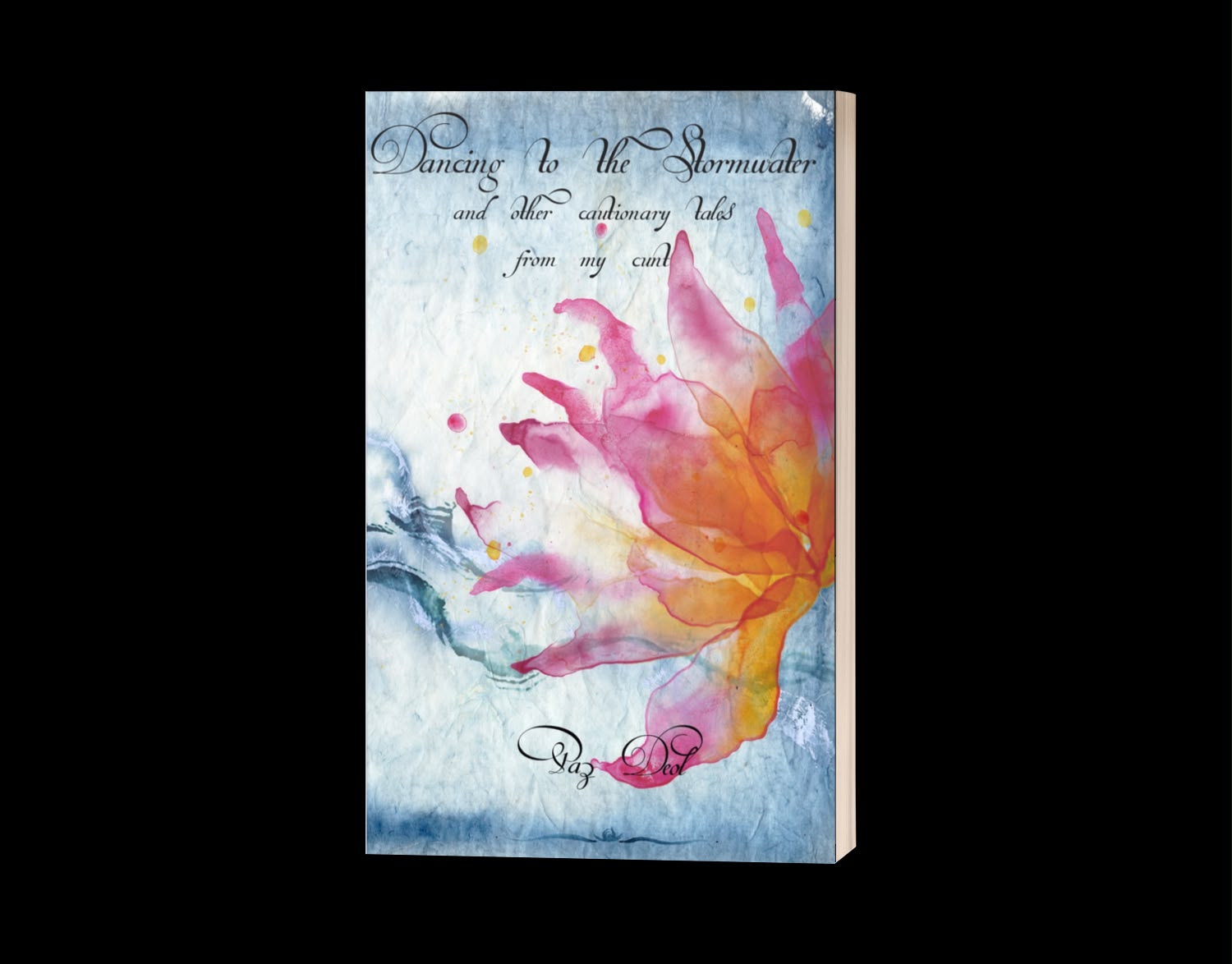
Paz’s chapbook, Dancing to the Stormwater, and other cautionary tales from my cunt will be out in 2026 with Working Girls Press.
Paz Deol: My working name is Paz Deol and I’ve been a sex worker for 10 years – since 2016. It’s been a journey.
Moonyeka: Oh yeah – there’s been so much that’s shifted in our landscapes and I’m so glad to be here with you as a fellow worker and writer. Can I dive in with some questions?
PD: Yeah, dive right in! You can get nice and comfy with the book.
M: I read through Dancing to the Stormwater and it’s so beautiful. I have millions of questions, but I want to know, from your personal experience of writing books and then marketing them: what do you want to your readers to focus on, what are some anchor points you want to start with?
PD: The biggest through lines I explore in this chapbook are the stories of white feminism and Savarna feminism. Race is a really big component of what I live through, and what I choose to write about. There is no other space as accessible and uncensored as writing in describing how invasive colonialism is to personhood, relationships and sex work.
I’m interested in rage from the context of femme rage, non-masculine rage and how we might absorb masculine rage in our work. I’m interested in that exploration of rage through sex work, and I touch on rage through listening to and unlayering my bloodlines and lineage, especially my maternal lineage.
Rage is many different things, whether you choose to see it as an action, or see it as a feeling, or if it’s something that is chronically impeding on your life and the way you walk through the world. That’s something that’s been really big for me through my own mother and my maternal bloodlines, and how we carry that on through the generations.
Rage through sex work is very complex, because rage comes from different spaces of violence, including injustice, fetishisation, objectification, erasure, and being taken advantage of – whether it’s physically, emotionally or financially – which is rooted in the systematic political oppression that we face. In Australia, which is stolen Indigenous Aboriginal land, we are lucky to have decriminalisation in most states. I’m grateful to be working in New South Wales (NSW), which is the first jurisdiction in the world to decriminalise sex work and implement safer working laws, which makes the scope of working for us far easier. We are far more privileged and that’s something to be very conscious of because that is not the experience of so many sex workers around the world. Especially Indigenous, Black, Brown workers, migrant workers, and that includes marginalised sex workers in the colony of so-called Australia.
I would like to name the writers, fighters, activists and sex workers that have inspired my writing and/or are referenced in the chapbook: primarily Nalini Jameela (Kerela), Corrinne Sullivan (Meanjin-based Wiradjuri Elder) and Mona Eltahawy (Egypt). Rage is something that I write a lot about. And then I also write about rage in mythology from different mythos around the world. South Asian mythology is what interests me the most because of my heritage and roots.
I think there are a lot of beautiful, important, raw retellings of rage through a lot of the femme goddesses and deities that we maybe worship or pray to, draw strength from, or who are a part of our ancestral history. My mythological poems also have that through line of rage and power over machismo and presentations of masculinity. Rage is not one distinctive feeling. It’s also very dirty, because I’m a slut. I think of rage in perverse ways, and how my background in BDSM informs those heavier emotions.
For me, rage in the context of professional BDSM work and sex work, allows for this temporal space to unfold in the background of densely informed consent, boundary-informed curiosity and safe exploration rather than shame and repression. Rage, and the many complex micro-emotions and experiences attached to that, are allowed to manifest and transmute safely into a session, and we’re allowed to be full-frontal with the parts of us that are ‘grey’, vulnerable and raw. The parts that are socially condemned as ‘impure’, ‘perverse’ or ‘unconventional’ in both rage and kink, one is allowed to be seen.
Power and rage are very interesting to experience in the context of kink and S&M, particularly in the interplay between the subconscious and the power dynamic unfolding in the session (or scene). The reversal of power in a South Asian/East Asian queer Dominant – peeling deeper into the raw fantasy of (largely) white cis men, who walk through their day-to-day with more tangible structural power, failing upwards. I think rage wears a mask in kink work and sex work alike, carefully filtered through power-play, roleplay, humiliation and objectification, the way we speak to our clients and script them through a scene and manage boundaries.
M: What does that look like?
PD: It’s being able to co-exist with white and Savarna feminism, upper class feminism, and predominantly co-existing with the patriarchy in these intimate spaces.
M: I really felt that in reading, especially in ‘Sindoor Marionettes’. I love this piece, especially the part where you talked earlier on taking on the masculine or masculine rage.
Slit, slit!
Find me in the bloom of garnets, sir!
Head untucked in its scoliotic structure, peeking out
of my slit. The agenda of three husbands
a tradesman, a comic book writer, a taxi driver and
an accountant all in one sitting, saps me.
It’s defeating to carve out a hole in a cunt where
there is nothing.
PD: I wrote the book and I choose write because of the overwhelming loneliness and isolation that can be attached to being a Brown-Asian queer femme sex worker in a deeply colonised space, which modern sex work in Australia is – colonised. And that loneliness is attached to many complicated and intersecting experiences of wanting to be heard and seen for our labour, skill, worth and pain that comes along with being a hustler. To be seen for our richness, deep capacity for care and humanity in the face of unending stigma and oppression.
M: Talk to me about ‘Sindoor Marionettes’. I saw a couple things that really struck me. First of all, the lineage of mother and womb:
Sindoor marionettes play a game in āmā’s womb.
Whispering tongues fiddle with fire, a cenacle is
building a mine in āmā’s sleeping womb.
And so the question remains,
how do you kill a man in the womb?
I danced around mama’s u-chord, and then once
more under her wet weep
Dancing to the storm water.
Mother asked, “Can you fly?”
How do you kill a man in the womb? I’m so interested in the way that you’re blatantly naming the way rage can show up backwards and forwards. Later in the poem, I also love the description of “I’m biting my finger like a glazed cherry before you / bury muscle inside me, / eat from my hand first.” And there is a domineering voice throughout.
PD: ‘Sindoor Marionettes’ interweaves different perspectives from my life, from cultural and intergenerational perspectives on the ‘subservient’ Asian woman or wife and unlearning those toxic cultural norms, to me as a real and flawed person reckoning with a world that doesn’t acknowledge the full humanity and rights of sex workers, and exploring that personally, verbatim at times. I write from the perspective of rebellion, curiosity and questioning of masculine figureheads in our personal spaces and micro-communities, and unlearning many teachings from my mother about how Nepali-Indian/Indo-Chinese women are socialised to be submissive and accommodating. In ‘Sindoor Marionettes’, I explore the many facets of being a sex worker as a trade or service labour, as a performer or actor, and as a role that requires masking.
Sindoor is the red dye that South Asians, typically Indian-Nepali women, wear on their forehead, like a Tikka, to indicates one’s martial status. There is symbolic resonance to passion, fertility and love – as well as deep inner awareness, or Ajna chakra (the third eye).
It’s a very holy symbol that also carries the weight of social stigma for unmarried or widowed women. In this poem, I wanted to interweave different dialogues that I’d had with my mom, my grandma, my clients, my counsellor. I don’t like to write cleanly; I use a lot of very blunt descriptions. Some of them, like, “dirty, lust animal needs saving” and “So, what race should we put you down as, you know?” are things that have been said to me in different forms, over and over. These are words that are used towards us as sex workers to dehumanise us and reduce us for consumption and profit.
Often civilians (non-sex workers) – including clients themselves – will degrade us to shift their internalised shame and whorephobia onto us because they have not done the internal work that utilises empathy to see us a humans and independent workers doing their job. There are many facets to a client’s own shame that are rooted in misogynistic, anti-SW thinking, which is then adopted and normalised by a larger society that polices and oppresses us. So those degradations or projections often make it into my poems as an archive of how much hatred society projects onto sex workers – and how in turn, we sex workers remain loving, open, critical and creative because we are surviving the odds, micro and macro, through and through. The brash and honest dialogue interwoven with lullaby-like prose and poetry signifies how the sex worker is both hard and soft, and that we can hold the complexity of stigma, shame and oppressive structures with strength worth its weight in gold.
The centre of the poem [‘Sindoor Marionettes’] is this “I told my counsellor that I wear the mask of every / man who has been inside me, / I take a part of their torment and they take a part / of my peace.”
This piece also focuses on how much energy we give to our (largely cis male) clients. That we give a part of ourselves – even if we’re faking it, even if it’s performance that we do for the money. We are stretched thin in the way we must be patient and empathetic, and the way we have to sit and perform for someone we could not give two fucks about, to be honest. To demonstrate that type of care, if it’s through a sexual service, or listening and taking on the client’s energy and their problems. Whether they are there for a fuck, a rant or a cry, and everything in between – whatever it is – we are taking a part of their torment that they cannot share with others.
M: Yeah.
PD: They only feel comfortable to share that with a sex worker, whether they’ve seen us before or haven’t.
M: There is an odd type of security there for them in the anonymity behind paying and transacting for sex services. To be able to do that.
PD: I also have this reoccurring image of strangling a man with my mother’s umbilical cord. I think because a lot of rage does come from cis men in various aspects of my life, professional and personal. Life is not clean cut and all of that, and I don’t feel I dilute any of my writing to make it more graceful or palatable. You’ll find quite a few of my poems – not the mythological ones, but all of the others are largely based on lived experience – contain quite a bit of dialogue that is taken directly from life. These are things that people have said to me, or I’ve said to others. People just say this shit, like a client directly telling me “I would crawl on broken glass to suck the dick of / the last man / who fucked you.” and I’m like, wow.
I talk a lot about the performance of sex work – you know, “biting my finger like a glazed cherry”, like, I am looking perfect, I am dolled up, I am a sweet cherry, I’m that piece of dessert that I have meticulously constructed. And then further down the poem, I shift tones – “gawking, profiling, fleshing out the cumslut’s saga” like, what’s her story?
Clients often use the ‘rescue industry’ language with us, and I wanted to write about that as I reject it wholeheartedly because our lived experience in the room with clients is often ripe with ‘good intentioned’ men who can’t even respect the full humanity of the sex worker they’re taking time skill and trade from.
It’s almost like there’s nothing poetic about the performance of sex work, ultimately. I write this not as a part of the foreplay to humanise me – and clients want to know more about you. I write about the fact that this sex worker persona is a character, and that clients often attempt to humanise us in the wrong way, it’s exotifying and objectifying. I write “it’s corruptive to the / character I am employed to embrace.”

Image by: Viscera Studios
M: Clients want us to break the performance, and get into our life story. They want to make a narrative out of the sex worker that pleases them. And suddenly it’s not a job anymore – it’s an invasive or failed attempt to humanise us.
Your poetry has these layers of respectability politics – like how to position your softness, especially when you’re a femme and women are more marginalised. And also, what actually makes money in the industry.
PD: Yeah.
M: I see this excavation in your work around revealing what is underneath the mask and underneath this. It makes me wonder, where does rage and horror get to go? And how do you suggest we move with rage through this world as a whxre?
I’m curious about the spirit of your book, yourself and your heart in this book. How do you think this book opens the road towards the whoretopia? This is a term I have been thinking about ever since I took Tina Horn and Jaye Elizabeth Elijah’s Whxre Singularity class. And what does whoretopia look like?
Where does this sex worker rage, femme rage, get to exist in this unashamed way? In this non-repressive way? In a way that resists repeating patterns of violence and harm and unlearning the process? I see the ways BDSM is utilised to be a restorative space to explore pain, pleasure.
PD: I speak to the whoretopia and the whorerachy in many poems, predominantly in three poems, ‘White Sluts’ (Part 1 and 2), ‘A Marigold Kills Modi’ and ‘Resurrection of the Working Girl’. I give voice and energy to acknowledge, respect and remember the Dalit and Bahujan women and sex workers across India, immigrant and undocumented sex workers, honouring both my familial and whore roots. We need open dialogue in collective space, working space, relational space for whores to attack and disrupt the whorerachy that disproportionately affects heavily marginalised sex workers, femmes, non-binary and trans sex workers. I speak a lot about class-caste privilege, white and Savarna privilege and able-bodied privilege through real anecdotes and stories from myself, my family and my peers.
There needs to be so much more amplification and justice for the people that have really been fighting the hardest for sex work rights for the longest time, which we know are Black and Brown, Indigenous, migrant workers, street and survival sex workers. Added to modern day online censorship laws, SESTA/FOSTA – which is still ongoing in its detrimental impacts for hustlers trying to survive in this economy – and of course, honouring and remembering the sex workers that don’t have a platform whatsoever.