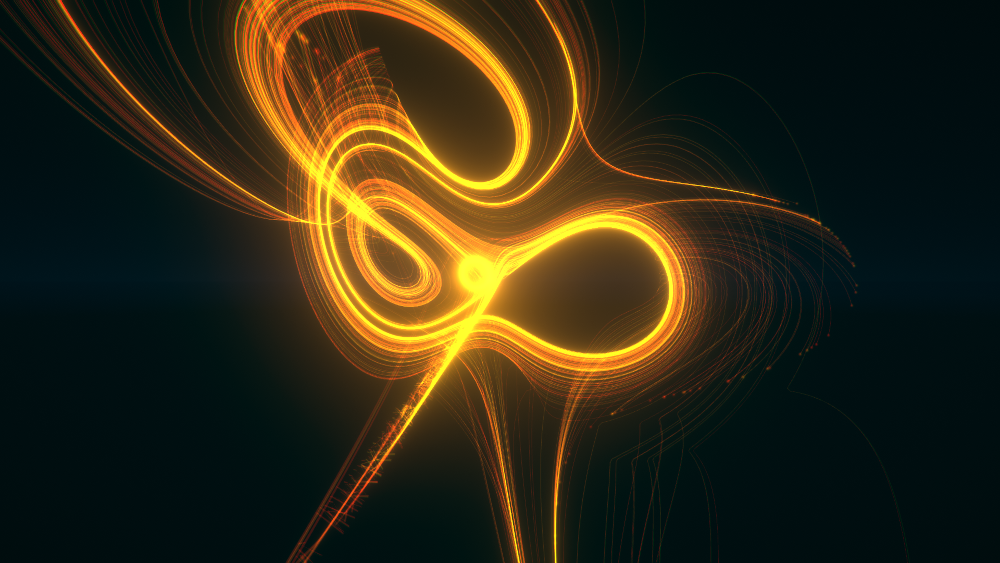
Strange attractors | 2019
Various strange attractor equations were used to drive particle motion to reveal their beautiful mathematical forms.

Strange attractors | 2019
Various strange attractor equations were used to drive particle motion to reveal their beautiful mathematical forms.
It happened in the sand dunes, so I’m told. I don’t remember.
But it’s said I came back claiming I’d converted to a broken-
nosed God I didn’t know the name of, from a museum long ago.
I don’t know why he stuck, like childhood, tiny events the family
turn into stories, told round the table until you’re pretending
they’re your memories, laughter, in your cowboy hat, photos
of the art critics who hovered round, quite forgotten, who asked
if you wanted to draw horses, and the cold dust of the pews,
no divinity there, but too young to read the prayer book. I woke
sober the next morning, bruised knees, sand-filled shoes, but
she had seen him, so I asked her if he had tattoos. He didn’t. Now
my revelation’s secondhand, reported back in whispers, unreliable,
and the question of what next, discipleship perhaps, standing
in the market square alone, handing out self-printed tracts, rain.
I asked her if anyone else got spiked, as I assumed I had, she said
no. I checked my medication leaflet, maybe I’d had an interaction,
but I hadn’t consumed anything unusual, no grapefruit, no Chianti,
no pills you had to take the dealer’s word for, and I asked her: like
a boxer? thinking of the nose, and she said no, not really, thinner,
then her sister called, she left. I stared at the ceiling, wondered
if I should pray, but to whom, for the grace I’d lost, repeated.
**
***
***
***
***
I watch the blaring tv,
the sound of some news reporter showing dead people across the road.
Words like ‘justice’ and ‘freedom’ scribed on posters toppled over them.
–
My Dad and I are in the garden,
It’s a typical Sunday morning – bright and sunny
in the tepid wintry sun planting the winter harvest.
Beside us, a flock of birds swoop at the ground where we sprawled seeds and grains for them to eat.
‘When we are given food, we should always thank three things’ Pappa always said.
one – the Creator; the one light
two – kudrat (nature); hence, feed the birds
three – kisaan (farmers), we don’t get any food without them bearing it all for us
droughts, bushfires, bad crops, income, urbanisation
everything.
–
We sow the mustard, spinach, carrots and beet.
I monitor the crops every week.
Week 1 – nothing
Week 2 – a little green shrub
…rain, rain, rain…
–
I watch the blaring tv,
the sound of some news reporter showing flooded expanses of land in the state,
words like ‘climate change’ scribed on posters everywhere.
–
After twelve weeks, the crops have grown, rot and decomposed in the same soil
in our little 200 square metres of land
it’s nothing.
But I know it – we’ve failed our proud ancestor farmers.
In the boggy soil, I saw the rich umber tones turn into ochre and khaki
The same khaki of my Dadda ji’s uniform – he knew the fate of the farmers
My Dad left his homeland, sold his land
Now I can’t even manage to grow a few crops in our backyard.
Now I know why we left.
–
I watch the blaring tv,
378 days and the protest has finally ended.
Water wells in my eyes as I yell in fury and hurt
the tv blares images of elderly people screaming excitedly; going home to resume their endless cycle of
farming and fighting
–
I watch the blaring tv,
people’s belongings and homes destroyed
water wells in my eyes as I yell in fury and hurt
the tv blares images of sunlight, the worst of the flood has ended and we all go back to resume this endless cycle of
climate change
cultural identity
and confusion.
this was the year i changed my bio from writer to poet
this could be our year we said
id won a prize and youd come into form
so we submitted two poems each to the anthology
best australian poems 2022
there had been an open call
three poems each was the limit but we were being humble
we waited to hear back
we were chill about it
the top 100 poems in the land
a big deal
but no big deal
we are just upstarts
we really want to get in tho
someone said theyd received 5000 submissions
thank u editors for your labour
5000! G-WHIZ
either poetry is back! again
or a malicious state-based actor launched a cyber attack
on australianpoetrys servers
laugh all you want BUT
some regimes, those with long memories, know that
poetry is a weapon
know that the revolution is linguistic
know that poetry fractures regimes
plato knew
and the despots know too
i often think of
turkeys national poet nazim hikmet
a communist in a nato country
he died in soviet exile
turkey used him up for the secular revolution then jailed him and jailed him and drove him away
revoked his citizenship then restored it after hed died
fifty years later
i sat and wrote in a cultural centre named in his honour made of stone and timber
there was a drama school
a tea garden under tall trees
they sold books in turkish, russian and spanish
people were always writing there, studying, pondering, speaking and listening with their whole
bodies, wielding big ideas everyday
they talk now of journalists in jail
but no one mentions the poets anymore
remember Lorca, Neruda and others
somewhere poets still go to jail, get killed
here they send poets to university
poets as tinkerers and bureaucrats
poetry as pathology, as ornate junk, poetry not seen at all
since settler capitalism, in its plunder
could not be bothered to take it, to absorb it
to list it on the exchange
and so WE pick it up, use it, our weaponry
poets as guerillas
waiting for our acceptance emails
i can attest
that the mobilisation is linguistic
riffs poems chants graffiti are the oxygen of revolt
solidarity is sung and punned into minds and lands
it happens at home, in schools, in work, in publics, tea gardens, mountains
i was there in istanbul at the siege of gezi park
in the crowd that resisted then seized bulldozers
dodged water canons and withstood tear gas
we sung of revolution, we practiced it
a newfangled oneness
that disastered the legitimacy of the government
and opened a horizon of possibility
that ten years later becomes the end of not only a tyrant
but the tyrannical mode
all ours liberations are bound up in one another
when we are not killing we might be healing
believe me when i tell you that i found my voice then
a mass movement refusing the authorities that govern everyday life
saying we can do it ourselves
by the people for the people we the people
i think that
best australian poems 2021 was a bumper year
cos it had that energy
we love that edition
you bought it for my birthday but i already had it
we sung its praises to all
at the bookshop i sold dozens
wrote a shelf-talker saying
‘to everyone who reads or wants to read poetry
this is the place to start
100 poems from all walks of the continent
theres radical stuff going on’
i say this now because i felt proud for poetry!
for us
strange to say it but honest
no document i can imagine would speak to the state of this troubled nation better
and so when you were in melb housesitting my place
and i was at the salvos in alice springs
i lit up when i found 2009 and 2013 for two bucks each
leni shilton written in blue ink on the first page
i read them right away, loved them
thought of leni, thank u leni
ill buy your book too
there was something special about encountering 2021
dedicated to my friend and teacher the great Ania Walwicz
the editors did an excellent job
the poets of course did too
and maybe it came at the right time for me, morale was high
or maybe poetry is the technology that generates joys and agonies most freely and directly now
the marginalised poet can storm the top 100
difference in the charts
in a way that the sculptor, the film director, the musician
might not
we feel like were in permanent crisis
its post-truth and plato changed his mind
called us back
the social body exhausted
the earth in arrears
poetry is needed
a jolt straight in the vein
poetry, my friend
poetry
My father calls me late one night. He’s
building a boat, gathering sticks of balsa
wood and grainy plans printed off the internet.
Expecting rain? I ask and he laughs
agreeably: a dazzling Bengal light
over the 5,163 nautical miles
of Indian Ocean.
He tells me then that we have mariner
blood, that his great-great-grandfather spent
his days on the fractious waves of Durban Bay –
in a careful choreography of ships seeking
safe harbour. He’ll test the boat in my
brother’s swimming pool; he’s not quite
sure if it will carry one person or two.
It’s physically the most complex of
the three oceans. I feel I should warn him
before he sets sail, it’s a perilous swathe
of water between us. He’ll have to schedule
his voyage meticulously, aligned with the
trade winds and monsoon rhythms that
could make or break him, because
I’m not picturing my father bobbing
in his balsa wood boat in my brother’s
suburban pool. He’s crossing the ocean instead,
eyes on the horizon, cap pulled low, he’s
Larry Taylor’s Birdseye. And he’s bearing
tea chests and lanterns, lifebuoys and blankets –
he’ll whisk me from these waves.
And maybe I say it all out loud because
he’s silent, and then he says
gently: does it always have to go
like this. And when he sighs, it’s a kindly
sound, a rustling ebb and flow of his breath
over the 5,163 nautical miles
of Indian Ocean.
I see you and think Australia,
Bunya Pine. You’re less Christmassy
than the Norfolk—they get all the
gifts, praise and beachfront real estate.
Yet you provide timber floors for
Queenslander homes and pine soundboards
for fine guitars. You stand tall, your
wiry, fishbone frame, laddered. Straight
branches—paralleled—skeleton
brocade on a trooper’s breast. Like
plantation regiments; your bursts
of evergreen gunfire right at
the end. You’re dropping deadly bombs
without warning—ten-kilo seed
cones falling on unsuspecting
walkers. But you’re food for thought. You
fed the dinosaurs, too—wise old,
ancient you. And just ask those who
know their bush tucker, they’ll tell ya:
“Fella, no tree coulda outdone
ya.” Yeah, you’re a good stick, Bunya.
I
don’t worry kid, i used to want
to be like shane warne too. bit left
out now i’m off spin and on the bottle
hunt. one night my boss caught me searching
his yellow bin for return-and-earns. the next
day at work he’d bought me a headlamp to make it
easier to look through his garbage. my Human R.
colleagues passed along pamphlets all day
about how it isn’t too late for me
to book a spot in the next office well
being seminar on how to delete my
mental health to focus on my productivity
performance. the only productive thing ive done
today is be a troll posting poop on pig’s
balls to bring down free speech
sites in retaliation for my school bullies
knowing i was queer before i did. this, de
spite me supposedly being the ‘gifted’ kid. my
new headlamp makes me lit like a cigarette
butt in your mouth. i do the grind and
work 80 hour weeks so
i need all the “me time” i can get. either
i collect bottles for 10 sense each
or i screen shoot your NFT’s. up to you, boss.
II
my last grindr date invited me to a party but it turned
out to be the Communist Party. at the meeting
the tankies kept saying to me, “I want
you to know that I personally have no
problem with you being here tonight.” my
neurodivergence melted down with the
change of plans so i left early and cleaned my room even
tho nobody was coming over for sex. i’d liked
my previous crush a lot but they had dreams of
being a Land Lord. time for a break, time for a
seroquel induced dopamine rush from switching
between three apps to stop the bad thoughts.
III
when alone in my sharehouse (i usually live with
17 other 20 somethings
who also have a drinking problem they think is totally
normal) i imagine i am no longer piloting a skeleton
wrapped in a meat suit, but am a shipping container
in the suez canal. stuck on purpose. nothing can move
if they don’t dance to my groove. like the Parisian streets
of May ‘68, i too am a collage. a barricade against
the society of cringe rotating through 70’s, 80’s &
90’s nostalgia, delivered as a regionally curated
monthly subscription box of artisinal apocalypses. why does
my generation want to die? it’s a neo-Dad joke, sure, but
also a very real feeling. when i’m a boat in the suez canal
all that is productivity melts into my new headlamp.
I’m a bright ‘gifted’ expression
of powerlessness and dread, letting rip
a world turning leg break.
Thank you for your submission
We look forward to reading it
Thank you for your interest
We cannot survive without it
Your work has been received
Your work is in-progress
We will get back to you, if we can
To let you know how busy we have been
How many manuscripts we have seen
Like delirious skies drowning in rivers
We are grateful for the opportunity
To have waded through the slush pile
And plucked you from obscurity
For a moment we paused to ponder your style
But really, and don’t take this personally
It’s just not for us, it’s not quite right
It’s not that we think your work is shite
It’s just that we know what we like
And we would like to wish you the very best
Yes, the very best, in placing this elsewhere.
What kind of things
can go inside a poem
then? well
draperies and
fine cut marble
dressed with flowers and
the ribbon
from your hair
No one wears ribbons
anymore, no one
Not even you
I made up the ribbon
because it seemed
like the poem
was asking for it
They said later
he was asking for it
after the accident that
cut up his face
A disfiguration
seems to suggest that
the language used
to describe something has
failed
It couldn’t be figured
as in to draw a figure
or to draw blood
Aren’t we all just
asking for it
But there was no accident
and no one’s
face was
cut
up
I made it up
Why, I wonder, is this poem
asking these things
Posing them here
a ribbon, your hair
a thin ribbon of blood
from a face I can’t see
and you can’t see
None of this is real
There must be something
I’m getting at
otherwise why
write at all
What I’m asking is for
some neat summation
or turn of phrase
to save me here
To rescue me from this poem
A couplet that gives you
a flutter like something has
come alive inside you
I want to be alive inside you
but I can’t, because
you
are not real, you wear
ribbons and the accident
was on purpose
A thin ribbon of blood
on old stone
If you rub your hand
on the stone
you can still feel the ridges
where the chisel cut
It hasn’t been smoothed out
The stone is red marble
your hand rests on an edge
You think this is your body
old stone, old words
cut out of you
I wanted to figure you
out
But I can’t
for K.S.
Hak Kyung Cha, Theresa, Dictee, Berkeley, CA: University of California Press, 2022, 18.
Derrida, Jacques, ‘Force of Law: The “Mythical Foundation of Authority,”’ in Cornell, Drucilla, Rosenfeld, Michel and Carlson, David, Deconstruction and the Possibility of Justice, New York: Routledge, 1992, 26.
i think that: this love is continental
some historic mainland narrative
open fields and svelte ravines of fresh water
but also, politics, and confrontation, and
the occasional warring city-state
differences of opinion about desire, jealousy,
the colour when buying new window shades
and togetherness, as a collective organism
coaxed from the gummy pools of a cambrian
explosion – an antediluvian fondness for violence
dirty sex whistled into the picture
hair pulling and slackened jaws
and unlike all my other loves
this eye contact – moored planets
gravitating moons anchored down
never flinching, in even the gaudiest light
unperturbed by my ugliness, my despair
by this cargo taxed with bitterness.
shall i call this: ignorance or just
plaster my criticism in the papers
wait for the unrivalled knife
keep my chest unprotected for slaughter
or does this earthly love come without
a death date? no mayan calendar to abide
and when the earth splits and cracks
i’ll just look at you, at those cosmic giants for eyes
the comfort of a satellite gaze unwilling to look away.
1400 words give or sell / i opened a fruit stand
just to squeeze these blue cherries between the sunlight
& my splintered thumb. behind the fruit stand: bendigo or
something like it / catholics in tracksuits / dusty bookshops
tearful pergolas / real estate agents chatting to jane
on a night out
in ballarat & dodging the swollen footpaths at 2 am
we took the mild party back to the airbnb / that was
another night you weren’t around / you were closer
to yass & mild hills caressed by the tractors / lined up
like lovers in the 70s / before drones. next to babbling
creeks. tv was more straightforward then
sometimes you were on it
rattling up old anglican ladies like bags of plain
salt chips. i can imagine standing there too but i wasn’t
we were more watching it from a lecture theatre / unimelb 2009
how many hearts are seared on the grill. how many eyes
are closed in the heat. in newcastle
your white shirt catches
a coal tan & you decline the benevolent scholarship
the thing is we don’t understand institutions / they’re as
populated as buildings / just as susceptible to dry winds
wicked storms. i’m a pile of essays punctured with
wine marks & staples & you’re the
master of grills. later on
springsteen spends 21 mins
dancing with rosalita & we’re the nicest people there
no / just a bit high / just a small dream in the clouds crowding
ngannelong / just a little unfinished museum business in the
far-off drought-struck carpark / that’s an ancient creek bed
no wait it’s just a ditch & laugh at the blue jeans
falling over in the dark. on tuesday
djokovic’s camped out at fed square
clare land orders gyoza / johnno shane me & the
constabulary & you float neatly above the shaken-out
semi-tragic cult-status street / it’s called swanston
actually / called every parrot down to the
front pews / jimmy watson’s
to break nuts pizzas spritzers straws on the table cracking up
under the weight 14 laughs & 28 hands thumping it in a
sunny friday-night wind. we take some snaps
wild cars coarse by
The process of decay is at the same time a process of crystallisation…
Arendt
I’m reading about the man under the ash
whose brain was made black glass by Vesuvius.
Not from his hot stinking breath
but the sudden change as he galloped away:
flank greasy and foamed, heat-mane unfurled,
streaming behind him like an insignia.
Am I meant to draw comfort that the man
died instantly while asleep?
That his skin boiled, fat steamed, nerves dissolved
to sound with one final shout?
Did he dream the heat or its lack?
Feel its wet kiss or cool alien untouch?
Maybe he’s still asleep, still falling
with the ash. Maybe he goes through
the ash: peeking, feeling, then begging entry
into the starred rips in the Universe’s cloak
until the whole body, mind, slips
and is falling and fell and fallen all at once.
rubber lasso
stretched thin
as three bodies.
borderline. net.
that day we
walk the hose
across the field.
the herd, yellow grass
slogging in slack jaws.
mean sun, regurgitated
egg. cockies watching.
dad out far as line
of hakeas. shadow
of man. mum’s ham
in the sandwich.
i’m first baseman.
each step, door slam,
crunching limbs.
that day, billy goat’s
staring, got air in his
belly. hair pricks is
filthy erections. herd
backs behind him.
teeth, bad westerns.
gums dribbling. all
eyes swimming.
kid cowering
in cage of
nanny’s limbs.
air thick. dad’s barking
instructions. cockies
spewing from ghost
gums. leaves hurling.
billy’s kicking earth,
nostrils flaring. throat
open, no screaming.
no one’s taking his
woman. nanny’s
licking shit
from kid’s bum.
that day my dad
charges forward.
yanks nozzle. ‘keep
it taut,’ he’s gulping.
mum hissing, holds
back. holds line. left
leg, oesophagus. drags
wake. breathless.
‘fucking hell
jane! can’t ya
fucking keep up?!’
then. mad dash
is mallee of limbs.
dislocating wings.
dust jumps. necks spin.
sick bleating. tongues,
birds flailing. ears
ringing. sun softening.
throat’s thinning.
billy goat coming
at me. like a dad with
a belt or a baseball.
that day billy
fakes a lefty. goes
right past me. dad
sees an opening.
‘go balls and all!’
screams dad,
yanking hose
like throat.
we’ve got the
nanny on the ropes.
eyes discharging.
but my mum’s down
for the count. the
line is fractured. the
hose, a broken lip.
the nanny’s got
a slip. she’s taken
it. muscle thick as
porcelain, always
covered in shit. then kid
tottles over, oblivious.
gives me a little lick.
that day i shoo that kid
away. my dad there trying
to tie a hose into a lasso.
a neck. a nucleic noose.
‘you two are fucking useless,’
he says, fixing a knot crook
as gut. spaghetti spew cowboy.
‘you some sorta poofta son?’
mum on ground, hissing,
heaving, grieving with
laughter. stops sudden.
‘you’re a mean old thing,
don,’ says mum, in an act
braver than any man. yet
there’ll be no trophies, no
cover stories, just eulogies.
she helps herself up with my
hand. and dusts herself off,
never reaching for guns.
just stands there staring
with the grace of a bird
that’ll never take flight.
‘son,’ says dad, dropping the
knot that’s a hose, sweeping
his arm out as if for a moment
he’s holding open the cage. this
world an exponential baseball
that never comes home. and footy
two men spilling into love. and the
guns corroded are lowered. the
dust almost settled. the billy off
gnawing on grass. then. his smile
thickens. ‘be a man—get that goat.’
and i can’t explain it. it’s a
metabolism. it’s that urge to
shove things into my body.
that need to gag because i
deserve to be empty. a danoz
direct ad where i buy the lie of
hard abs because every day is a
lie, from birth to inception, that
thins and thickens. a toilet bowl
clogging. a bruise on a throat.
a hose that we use like a rope.
so i go like greg inglis 1. like
duke on the frontier. like a
baseball with the velocity
of a machine gun. i’m
flying. goddamn rambo.
topgun. that guy making
a woman choke on her own
vomit while he throat fucks
her on the internet. i did not have
sexual relations… a nuclear code.
a hard-on with a mind of its own.
snap a few shots then
dad locks them up.
big corroded bird cage.
safe from night fox.
mum calls this happy
families. her photo-op
crouch, birdsong teeth.
‘what about snakes?’
i say, going balls
deep in fireweed
and feeling frigid.
‘the only snake here,’
says dad, grinning,
‘is the one in me
trousers.’
mum leans close.
whispers, ‘it’s more
like a centipede.’
before. i follow dad.
headed for field. our old
overgrown diamond. first
pitches, first swings of the
howdy peasants. if only
duke could see my dad.
out on the range in his
finest camo pyjamas.
old man always said,
‘i need wide open
spaces to thrive.’
‘we’ll never do it
with that,’ says mum
waiting at gate, hands wed.
‘don’t you have rope?’
‘what would you
know, jane?’ says
dad, giving me the
tap. ‘you’re a woman.’
mum looks at me,
at dirt. silent. scream
of gate is split womb.
before. dad says,
‘the kid is easy.
but the mum, she’s
bloody feral.’
he looks through
shed, capillary of
bird cages. comes
up empty.
in eggshell house
mum once said,
‘keeping birds is evil’
mum peels yellow
gloves from fingers.
holds limp like birds
with broken necks.
‘tim,’ mum says, ‘are
you alright? there’s
sick round the sink. did
you throw up last night?
‘no,’ i say. swallow back
battery. ‘i’m fine… what are
those marks on your neck?
before. after breakfast.
dad’s eyes out window.
counting magpie’s
stock exchange.
‘you know,’ he says,
‘this’ll all be yours
one day. when i’m
gone, you’ll be rich.’
eyes thicken. ‘reckon
you’ll miss your dear
old dad? i know i did.’
‘if we don’t get
the nanny for her
milk,’ says mum,
thumbs thick with suds,
‘foxes will eat that kid
alive.’ steam rising. scour
her silver pistol. in control,
like a season washed out.
‘it’s only right.
we’ve got to convince
your father to help him.’
before. last night. get away,
host catriona rowntree, the
entrée. screaming’s friday
night footy. mum’s allowed
leave, but i’m expected to stay.
dad tells me how good his father
was at nrl. robbed of a legacy.
all cause of money. couldn’t make
trip across city. but i know better:
this ten-gallon western! gramps.
the myopic visage of heaven.
outside, looking up at stars,
those watery diamonds.
like the one where a dad
threw a baseball, his tender
uppercut. because i’d seen
field of dreams like dad could
recite every line from true grit.
and me being his favourite, dad
bought me a glove. ran four hoses
across a field. so every arvo was
breathless, leather beaks clapping.
before. don’t want to look
back. suck on plastic throat
outback. hand thickens, choking
life from smoke. not nightingale’s
song. but gurgle, eagle’s snoring.
hot bubble. did you know teeth can
sail like baseballs, land in the hands
of sons? forget origin? these teeth
being gold from the bellies of caves.
and then the bellies sit dormant.
waiting. years sometimes.
the only real truth is a throat.
how it opens. how it closes.
examine the fabric of a body.
a liquid fist refracted. teach
it. learn it up. built like a brick
shithouse. a fair go mate so
sick with faith he’s tactically
chucking. see this belly, it thins
like wings but swings like gramp’s
thick fists. ending an nrl career.
gran told me: shipped him off navy.
it’s porcelain’s reprieve, wisdom’s false
exit. when the gurgling scream. the hose
between mum and me. her jumping behind
bedroom door. dad’s arvo vulture lurk.
eggshells shattered on the floor. please
no, never quite wingless. i’m cramming
fingers into the feathers. multicoloured
grated gag hole. porcelain thick lips. still.
memory of mother’s spaghetti. but it’s me
clogging like ten generations of shit. hear
them. knowing, what that man is doing.
There’s no sighing our way out of this — the mundanity of a flat liveable city,
long drives late at night to swing legs over the concrete aqueduct and listen
to the freeway sing. A slow breath blooms on the mirror. One thing’s certain:
mirrors are no substitute for desire. In dreams I eat the silverware, my pupils
turn into dinner plates, rivers stream down my bare arms into an overflowing
percolator. A great many changes keep occurring and I’m surprised to find
I can tolerate them all. A cloud is also other things: rain droplets, ice crystals,
a sheep; an old photograph that stares and stares at itself. Someday, I will know
what it’s like to love a beautiful thing for itself first, rather than for what my
looking transforms it into. I rise at first light and pluck a fresh roll of film from
the nightstand. My eyes are twin bulbs already flashing, becoming and becoming
and becoming. Here I go, sockless, into the garden again.
It’s bird bingo, he said, looking at the sheet.
I tried not to beat the ten-year-olds who were also keen.
You had to really listen.
And there they were.
Tūi, playing chase, fighting rivals:
blue-black, green glossy, white.
Puffed up to double his size to impress a mate
who flapped off over trees.
Puffed up to fight the kākā for sugar water,
but the kākā, all curved beak and red underwing, held his perch.
A saddleback’s flash of chestnut:
akin to the huia, flashes swerving through trees.
At the top of the dam and over the suspension bridge,
we have the eye of God.
Walking under canopies, I see a kākā soar high, ka-aa.
Beneath mamaku: the feather of wings and the feather of ferns.
If you’re over fifty you can’t hear the rifleman, he said.
Even the noise of the stream sounds like chatter.
A clear call; less a bell, more
the note of singer with perfect pitch.
I’d nearly cried seeing the film of the death of huia.
Then again, I nearly cried when I saw it –
steadily eating grass, as if
the most natural thing in the world.
Takahē, back from the dead:
royal blue, peacock blue, green;
a sharp red beak –
like watching a miracle.
I have five, I said.
I have four. Oh, I forgot the tūi.
But I counted the duck.
I found birds that were not on the sheet.
There are too few of those to include, he said.
But we saw them anyway.
after Bron Bateman
1. Our circadian rhythms–
your texts shadow my fingers
day and night, doorpost and gates.
2. On Saturday mornings
as Miles finishes “Blue in Green”
the cadence of your kisses
chants a prayer of renewal
down my stomach and thighs
and I stand on the crown of my toes
calling kadosh, holy, holy
to the ceiling
3. You tell fables of unhappy desire
populated by beast & sweat,
moon & thicket & blood,
beautiful thunder,
humming light.
In your dreams,
I worked the fields
seven years & seven more
just to see your flesh,
& you gleaned the sheaves
& vowed to follow me home
fierce as death
4. As a baby they called you boy,
hoping & wishing it be so
but you named yourself
queen of my heart,
scrubbing yourself clean
to emerge fresh from the water
like a newborn into the hands of a midwife
5. Our bed is a re-dedicated temple,
a weekly unavowable altar where
I drink your wine & dip your bread in salt
& when you kiss me
& tell me “remember this,”
I laugh & call you kohen gadol,
& this our holy of holies
The sweet bitterness of quenched thirst,
a midrash of longing,
a sabbath table of flesh & feeling
naked, delicious,
A taste of the world to come amen v’amen.
Unsteady now on those once-famous feet.
Damn those rugs on top of worn carpet en
route chest of drawers that connected with
forehead when he tripped and fell.
Retired dancer, elderly neighbour,
an oak taken down, not by a gale
but timing and a nondescript rug.
Dancing Goliath once held ballerinas
aloft: Paris, London, cities of Australia.
Adelaide boy-become-butterfly became
devil/god of the stage with a world
in his strong hands. Giant in silver paint
upon whom dancing swans depended.
Near naked girls were entirely safe,
audiences entirely in awe.
Today, in a small Melbourne upstairs flat,
Lew has almost come to rest, cautiously
leaving sofa to make his way to kitchen
or toilet. Tea and toast. Avoid sweets, old boy.
That outdoor flight of stairs must be negotiated
despite having lost ability to fly and two toes.
Diabetes. Leading man now leads with ‘good’ leg.
Bit of shopping, appointments with doctors
then back to photo albums, knickknacks,
pot plants, ageing costumes in the closet.
What’s become of Lewis? This, of course,
but what of it? The sun, our favourite star,
will burn out. Every star dims eventually
but not many shine so brightly
before their fuel is spent.
androgynous archangel
gabriel watches the automatic pen
i hold whispers in my ear
“queerness forever my religion”
through astral projection
conjure the new interpretation
a non-binary mary magdalene
a reborn fairy fagdalene
their burgundy undercut
coils their entire body
the magenta flame
smokes their earth-tone eyes
ascended genderless saint adorned
a metallic lilac robe
behold the gayest muse strutting
glitzy sunset boulevard
fairy fagdelene protects me
in the city of angels
thriving on extreme polarities
a dawn of violet skies
crystal cumulous clouds
fairy fagdalene impenitently floats
a resplendent fuchsia ray
their opalescent aureole shines
compassion and mutual aid
opens blissful platinum gates
toward sumptuous heavens
their clairvoyancy guides
the sacred trans community
ecstatic cherubim surround
their patronx fairy fagdalene
safeguarding lavender orbs swarm
their archangel michael gifted broadsword
pulled out from their thighs
the cisgender cannot handle
genderless saint fairy fagdalene
their divine sword reflects prismatic light
lucifer’s crimson eyelids
shed holy kaleidoscopic tears
transphobic demons evaporate
baptized by purple rain
an earth without gender
fairy fagdalene dreams
Every morning starts pretty much the same.
Take the 30 minute drive into town by shuttle bus or private driver. The same roads, maybe speed up and overtake the scooters on the straights. Hesitate around the bends and the dogs covered in sores that scuttle like crabs to avoid being hit. The driver will usually ask about breakfast, and you will say how good it was, because you think that’s what they want to hear. And they will smile and say how good that is, because they think that’s what you want to hear, to know they’re happy you are so pleased. And the transaction goes on much like this until you are no longer taking up space in their backseat.
How can Bali survive? This woman from Australia wears bindis on her forehead and a traditional kebaya and is late to the forum she organised. The conversation soon turns to tourism, the types of tourists. Apparently more Chinese have been visiting her restaurant here. They spend only enough for one-third of a brownie. They are so loud that she seats them on the bottom floor to keep them away from the other tourists. She says all this in a manner that makes it seem easy for half the room to laugh alongside her, and they do.
Two stray dogs fucking on the roadside. Your greatest fear is to look down and see a mosquito on the fleshy part of your arm or leg, its belly pulsing to the rhythm of your heartbeat. Swipe it away like a scabies dog tail.
Today there’s a new driver named Jo. He is young and the conversation flows more naturally, even from the backseat. He preaches the value of silence and identifies which leaves can be used to salve a wound when you’re injured in the jungle. Here he is at home but in Java he is scared. Borderlines of the mind, of belief. Many many years ago we escaped Java to come here, he says. To go back is to feel alien. To speak out is to go missing like the sarcophagus in the caves; nobody is interested to study the original tribes so it’s as if they are not even there. All the time telling you this and calling you mister, sir. What he thinks you want to hear.
How can Bali survive? A local writer apologises for not speaking much English, then returns to his native tongue so he can be most direct. Men praying once and then gambling, then going to a cock fight, then looking at a woman’s cleavage. This is his concern. I wonder if it’s my fault.
There are always these tensions and inattentions, he explains. Like how enough water flows from the rainforests but there isn’t the means to contain it properly. What can be contained flows to Nusa Dua, the resort towns. The rice fields miss out sometimes so maybe look for work elsewhere, where other people’s bellies pulse more often and they don’t wait for you to pass on the footpath. Where the water flows but you can’t seem to catch it. Where this woman from Australia will employ you to her restaurant, promote you, then mock you for wanting your old job back. They are all the same, she tells us. They don’t want to be better. It’s simple, a simple life to enjoy and forget.
Jo’s mother is a farmer. She is his treasure and he will take her away from here one day, but probably not one day soon. Maybe after he’s done studying economics. Think about the economics of how 1.2 million can choose to visit every year, to live cheap and ignore four zeroes. We pass a papaya or some other fruit fallen from a tree. Jo can eat this, he says, even if it’s not on his land. If he’s hungry he can eat it but he cannot sell it. This is an unwritten law. And, if it’s in his way, he can get out of his car to move someone else’s scooter off the road with no commotion. It’s there and then it isn’t.
But back in Melbourne, when your mum puts her hand out to stop traffic so your dad can reverse safely, she is in the road five seconds before this man leans out his car window to yell at her. Maybe he sees the road as something he can own, something that can be conquered. Maybe he has a claim on it, and this confident Chinese woman is in his road. Get off my road. And soon even his passenger reflects his anger, because maybe she knows to be seen as agreeable is better than to not be seen at all. Invisible women often go missing.
Like at the temple, this old woman gives me a free banana and tells me to find her in the car park on the way out so I can buy more. But on the way out I can’t find her. She’s nowhere to be seen. Maybe because I put the free banana in the bin.
Maybe she existed only for me in that moment, and me for her. But to look away isn’t to vanish her. To look away from a little girl begging out the mouth of an alleyway as her pregnant mother breastfeeds behind her. Breastfeeding in a dirty hoodie behind the garbage, tit out.
Water from the temple: to drink from it can bring back the dead; not recommended. Take fruit from this tree, bite into it. Look down at the rot. Black juice in your teeth and lie down.
Jo tells of corruption, of baron kings that do nothing and collect tax from the people born of unroyal blood. Back in our room, you look up the history away from the poolside meals and the fake-brand markets and the haggling with taxi drivers. You read how a raja once stood in front of the invading Dutch army and put a dagger in his own chest before hundreds more did the same behind him. Puputan: if you don’t leave we will die anyway. They throw their coins and jewellery at the Dutch, to mock them, and afterwards the army loot their corpses for whatever else is left.
This man is named Agung like the mountain volcano. He says it is not as simple as the woman from Australia suggests. For his people, there are two truths: seen and unseen. To devote more time to physical duties is to ignore the duties of the afterlife. A temple in each home, several more in each village.
But how can Bali survive? A woman in the audience asks this almost furiously. The question is the title of the forum, after all, and the answer has yet to be provided. The Balinese writer, head like a monk’s, responds in his language and the moderator translates gleefully: Do nothing. He says it directly to her.
We drive past a pink sun. It peaks out between buildings and treetops every so often. You say it’s the same sun from yesterday. And tomorrow and the next. And again it’s gone.
Your father’s tie
has come undone.
Please tie his tie.
Your father is
unravelling,
please take his hand
and tie his tie.
Your father is
a machine.
He is an engineer,
he wears a dust coat
and high-vis colours.
Your father is
a man
who rarely wears a tie,
will you tie his tie
and hold his hand?
Your father
watches the street
from the veranda,
staring at nothing,
swaying in the wind
and leaning on his bad hip.
Please tie him down.
Your father brings
a plate of cut up fruit
to your room.
He forgets to say
I love you
in so many words.
He rarely laughs,
your father,
he smiles with his eyes.
Please tie his tie.
He will not ask.
Your father
gives you fifty dollars
when he remembers,
and tells you to
put it to petrol.
He bends down
so you can reach around
his neck
and tie his tie.
Kiss his head
like he used to do to you
when you were young.
Slide silk and linen
around his neck,
pulling the collar straight,
and look into his face.
Notice how your eyes
share the same space
and colour.
You have watched him grow
and grey,
tucking you in every night
and rising for work
at 4 a.m. daily, as routine
as the sun.
Please tie his tie,
the way he has dressed you
since the day
you arrived
bare
and found home in his arms.
You knot the tie
pressed flush
against his button-up.
He looks
so small,
your father.
You kiss his cheek,
and he smiles.
You look so handsome,
you tell him.
Would you tie his tie
for the rest of his life,
when his hands have crippled
and his back has folded in?
He has orbited you
for so long.
Please stay nearby
and hold him close.
He will not ask.
But when you see
it come undone
do tie his tie,
please tie his tie,
keep his tie tied.