SD: Building on that cyclical relationship with bodies and language, bodies and narrative, while reading ‘2005 Today’, I was struck by the relationship between this poem and the epigraph – by this idea that the calendar wants to be a thing which illuminates the everyday, that time wants something from this world, and is spending us the way we think we’re spending time. How much time would you say you spend thinking about temporality in terms of your poetry? Do you think of time as an “I”? What are your favourite representations/description of time in your poems? I would love to hear about some of the poetry that has influenced you – which poets produce time in the most interesting ways for you?
NA: わたしたちは、時間をうまく認識できていないことに、気づく練習をすべきだと思っています。「時間」は日本語で時の間(ま)と書きます。これまで人々が時間を意識させるためにつくってきた規範、農耕や狩猟、放牧のため、宗教行事のため、産業化による機械のため、いまではサブスクリプションとして過去を未来に部分的に移行する方法によって時間を捉えていますが、どの考え方も一方向のタイムラインがあることに変わりはありません。しかし、「間」であるということは、方向それ自体が存在せず、イメージだけを内包した見えない塊であると言えるのではないでしょうか。そして、イメージを認識するために芸術表現があり、そのひとつとして詩があると考えます。わたしの詩集が「暦物語」をテーマにしているため自明ではありますが、ヨハン・ペーター・ヘーベル、ベルトルト・ブレヒトは、個々の時間をどう考えるかを更新してくれた詩人です。2022年に出した詩集『そだつのをやめる』のなかに「蚊にさされ」という詩があるのですが、これは言葉によって「間」をあえてなくすことで時間そのものを考えました。三十分、十分、五分、一分、3日…と、時間を細分化して言葉と意味を重ねることで多層化した時間に隙間を与える試みでした。これは英文学者である吉田健一が時間そのものを書いた「時間」を思い起こしながら書いたものです。時間は間であり、わたしはそのなかに含まれる存在であると考えます。
We should practice realising that we haven’t been adept at recognising time. In Japanese, “time” is written as “Toki no MA”, meaning kronos + MA. Over time, norms have been established to make people aware of time, whether for agriculture, hunting, herding, religious ceremonies, industrialisation with machinery, or now transitioning the past into the future partially through subscriptions. Whichever the mode of thought, unchanged here is the fact of a one-directional timeline. However, with the “MA”, directionality in itself being absent, perhaps we can say that there is an invisible cluster which connotes time through the image alone. And to perceive imagery, there is artistic expression, with poetry being one such form. While it’s evident that my poetry collection revolves around the “calendar story” as a theme, Johann Peter Hebel and Bertolt Brecht were poets who revised how individual temporalities might be thought. In my poetry collection Sodatsu no wo yameru (Done Being Nurtured) released in 2022, there is a poem titled ‘Mosquito Bite’ where I deliberately eliminated the “MA” using words, pondering time itself. It was an attempt to create a multi-layered time by subdividing it into increments like thirty minutes, ten minutes, five minutes, one minute, three days, overlaying words and meanings to create gaps within time. This was written while recalling ‘Time’, a piece by the English literature scholar Kenichi Yoshida, who wrote about time itself. Time is MA, and I believe I exist within it.
SD: I know you’re a visual artist, as well as having deep relationship with architect Arata Isozaki-san. I think often about the relationship between physical space and language – how in English we use the loanword ‘stanza’ to describe a ‘paragraph’ in poetry, or a section of verse surrounded by white space, and how stanza in Italian means ‘little room’. I’m curious about how you visualise that ‘little room’ in poetry more broadly as well as how you built the little rooms in this collection to create its houses. Are there similar or perhaps very different symbolic associations in Japanese poetic traditions? Do you draw regular inspiration from architecture in your practice or is this collection unique in its architectural metaphors?
NA: スタンザと比較して考えるのに、こちらでも間(MA)、の考え方はとてもおもしろいです。間、には、一部屋を示す「一間(HITOMA)」という言い方もありますが、空間、時間など、「ある」ものではなく、「ない」ことを指し示す言葉でもあります。たとえば、沈黙や、気配、廃墟のことも間と言えるかもしれません。要するに、間は、囲われていることを示すのではなく、部屋ではない部分を立ち上げることで囲いのない部屋を露顕してしまうものなのだと考えています。詩としての言葉で描くものは、言葉が意味する通りの場やできごとではなく、その詩に触れることで描かれなかった部分が自ずと浮かび上がってくる。日本の詩というのはそうした「間」とともにあると思います。こうした考えはまさに、わたしは磯崎さんから学びました。わたしと磯崎さんの出会いは、2013年の都市ソラリス という展覧会だったのですが、展覧会の秩序のなかに、どこの馬の骨とも知らぬ若いアーティストが落書きをしにくる。それを磯崎さんが面白がり、わたしは会期中10回以上行われたシンポジウムに参加し、それを漫画で記録することになったのです。そのときのシンポジウムは、磯崎さんがこれまでやってきた仕事をもとに、毎回異なるパネリストたちがやってきて討議する。知をそなえてしまった都市が、都市論を討議し続ける場としてつくられていました。わたしはただただ毎週のように浴びるように討論を聞き手を動かす。わたしの手からは、思考する「都市」の言葉が漏れ出ていました。そういう経験をしたわたしにとって磯崎さんの存在は「建築家」ではなかった。まだなにであるかわからない得体のしれない存在だけれど、小さな個である自分を極大化した思考のかたまりとして捉え直す考え方を与えてくれる存在である、ということははっきりとわかります。わたしが詩や、詩集をつくるときは、言葉を紡ぐよりも、そうして、この思考をいままでみたことのない形で表現することにこだわっています。
When comparing it to the stanza, the concept of “MA” here is quite intriguing. “MA” can also refer to a room as in “hitoma” (一間), but it’s a word that denotes not just space or time but also the absence of something. For instance, silence, atmosphere, or ruins might also be considered as “MA”. Essentially, I think that “MA”, rather than indicate what is enclosed, is an unenclosed space disclosed by inaugurating the part that isn’t a room. I believe what is realised as poetry through words isn’t places or events, that which accords with how words signify, but rather the unwritten parts that surface naturally when felt by this poetry. What is called Japanese poetry carries with it this “MA”, I think. It is these thoughts precisely that I learned from Arata Isozaki. My encounter with Arata was during the 2013 exhibition ‘ISOZAKI Arata: SOLARIS’.
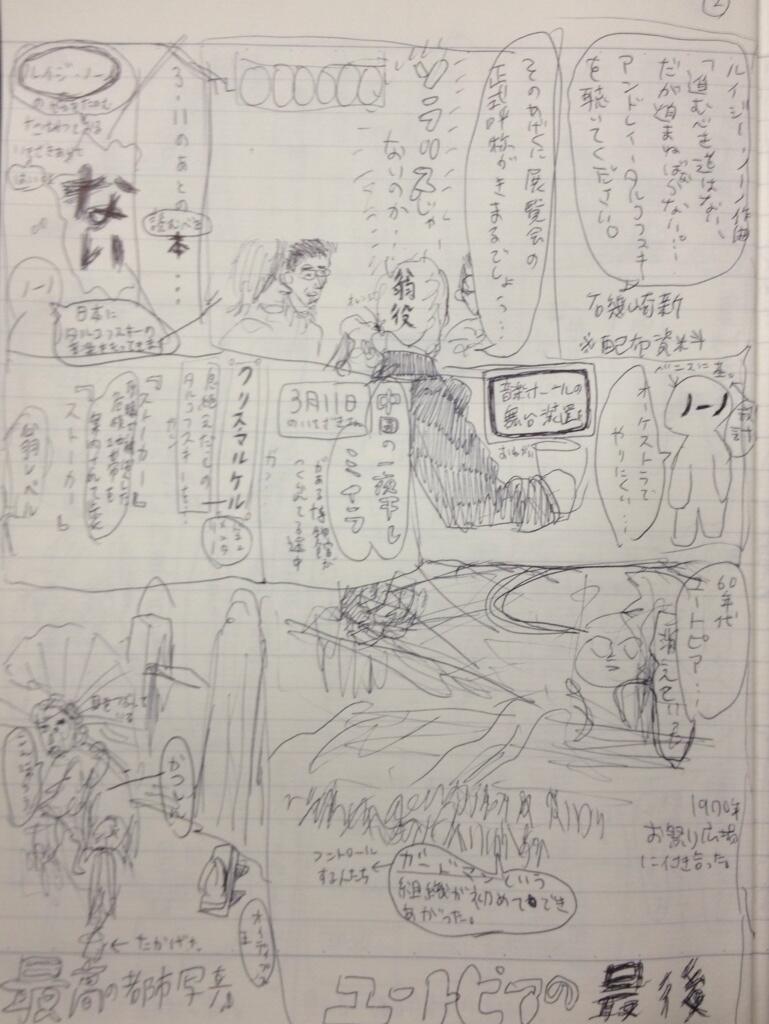
datsuo (Natsumi Aoyagi), ISOZAKI Arata: SOLARIS MANGA (2013)
Amidst the order of the exhibition, this young artist, a “horse’s bone from nowhere” (i.e. “a nobody”), would come to graffiti it. Arata found this intriguing, and I ended up participating in the symposium held more than ten times during the exhibition period, recording it all in manga form. The symposium at the time was based on Arata’s past work, with different panellists coming on each occasion to discuss. It was an attempt to create a space where cities armed with knowledge could continue debating urban theory. I just basically soaked up the debates every week. Then, from my hands words about the “city” being contemplated poured out. For me, Arata’s presence didn’t amount to that of an “architect”. I clearly understand him as someone whose existence provided me a way to rethink myself, despite being an unknown entity that didn’t know what it was, as a cluster of thought maximizing a minor individuality of the self. When I create poetry or poetry collections, I’m more concerned with expressing such thought in a form that I’ve never seen before, rather than just spinning words.