
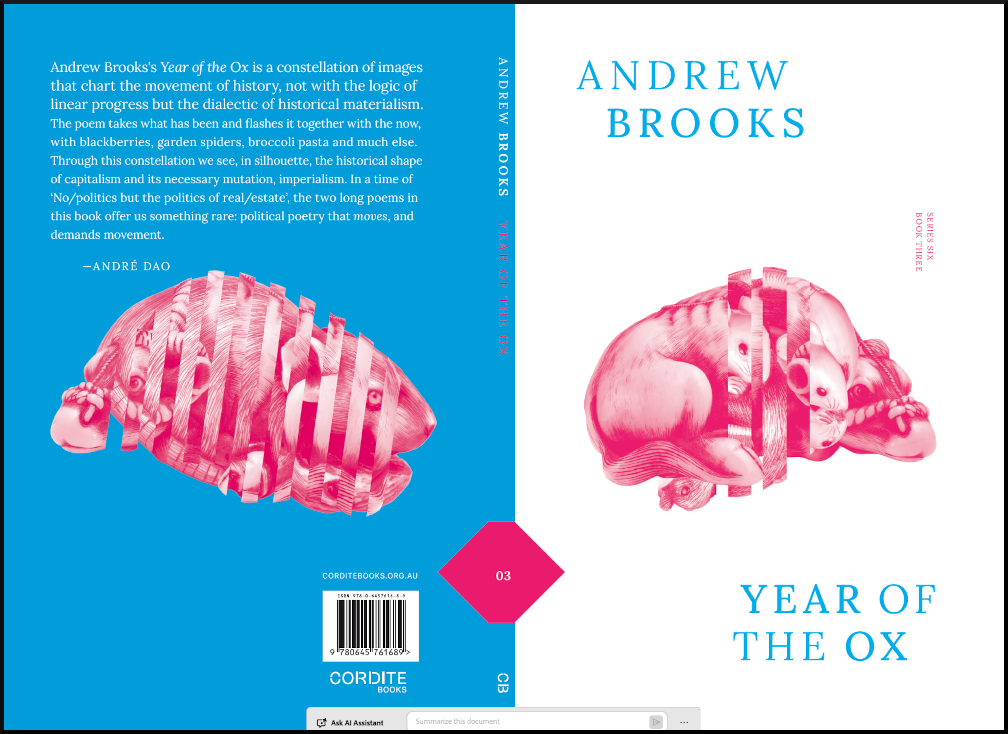
‘History,’ writes Walter Benjamin, ‘decays into images, not into stories’. And what is the image? It is ‘that wherein what has been comes together in a flash with the now to form a constellation’. Andrew Brooks’s Year of the Ox is a constellation of images in precisely this Benjaminian sense: it charts the movement of history, not with the logic of linear progress but the dialectic of historical materialism. The poem takes what has been – oil crisis, emergency in Malaysia, the Global Financial Crisis – and flashes it together with the now, with blackberries, garden spiders, broccoli pasta: those things that are ‘good/as narrated by Arvind Rosa’. Through this constellation we see, in silhouette, the historical shape of capitalism and its necessary mutation, imperialism: accumulation and circulation, stagnation and blockage, revolutionary joy and around again.
This restlessness of capital is reflected in the titular poem’s form that endlessly shifts mood, register, style and rhythm. From the poet’s ‘I’ to an incantatory ‘we’ and back again, Brooks tells us The Year of the Ox ‘is the year of crisis.’ It is the year of OPEC and of the docks dispute, the year of the Troubled Asset Relief Program and of the Asian paper tigers. But even as the poem moves from crisis to crisis, from technique to technique, there is a vibe – an unsteady, syncopated rhythm, much like that which pulses through Alice Coltrane’s Ptah, the El Daoud (to which we groove along with Brooks, and also to Janet Jackson and Sly and the Family Stone: ‘The alchemy of the three-minute/pop song is that it is a container for all that is/uncontainable’). This unceasing movement is all the more intoxicating for its juxtaposition with the meta-crisis that is the crisis of capital’s circulation. Capital that must move but is instead always congealing into things, like margarine, ‘the glistening mound of electric/yellow developed to keep the French working/class alive just long enough to die on front/lines and factory floors’.
And who is the Ox, if not the worker, the one who works the soil? The Ox must keep moving if capital is to keep circulating – so the worker is fed palm oil and Kopi O, the ‘caffeinated mud that promises to stave/off fatigue but will only amplify it.’
And yet, and yet – what if the Ox desires movement too, for its own sake? The thrill of Year of the Ox lies in the way Brooks recovers and recuperates the desire for movement outside the dictates of capital. Even the smell of palm oil – product of colonial infrastructure, of ‘the African palm, disciplined/into neat little rows, came to replace rubber trees in/the plantations of South East Asia’ – holds the potential for something more: ‘in its scent we remember that our future depends on the abolition of town and country, north and south.’
Revolution and solidarity thus begin with a remembering: under-determined, in the subjunctive mood. The poem moves to an extended dream sequence (wet), the promiscuity of revolutionary joy: ‘Dance your way out of hell/and into the factory: accumulation by salvation!’ In a time of ‘No/politics but the politics of real/estate’, the two poems in this book offer us something rare: political poetry that moves, and demands movement.
Brooks writes ‘Suppose the poem had to pick/sides.’ Suppose it did. Suppose as well that choosing a side is not a closure, but an invitation. Suppose the ‘Year of the Ox’ has already happened, and will happen again. ‘Come in, it’s open.’







