
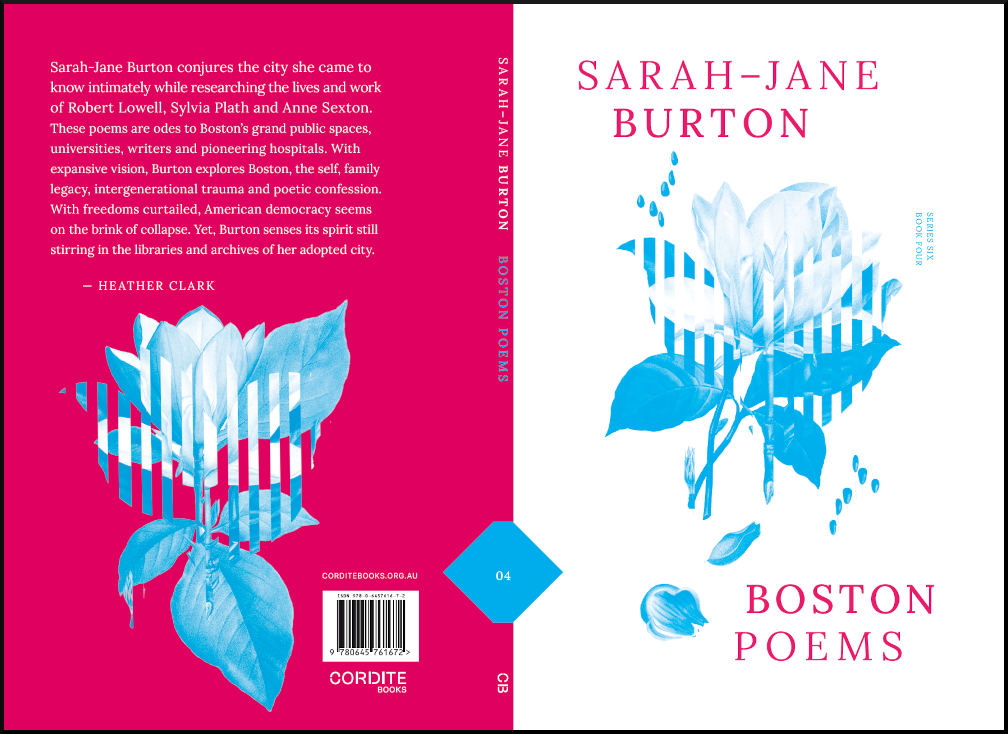
In Boston Poems, Sarah-Jane Burton conjures the city she came to know intimately while researching the lives and work of Robert Lowell, Sylvia Plath and Anne Sexton. These poems are odes to Boston’s grand public spaces, universities, writers and pioneering hospitals. But Boston is also the site of a crushing loneliness. ‘Walking in this city of cobblestone / I’m the flaneur, poetess, ingénue / But all I want to do is cry in a foreign bed / And think of you.’ The flâneur’s confident, Whitmanian sense of optimism continually crashes up against New England’s darker, Gothic undercurrents. Burton braids these two psychic elements together in intimate poems whose mournful rhymes speak to eddying silences below the surface. The poems are at once tempered and passionate, painful and exuberant, formal and inventive. With expansive vision, Burton explores Boston, the self, family legacy, intergenerational trauma and poetic confession itself.
These poems are also an homage to the author’s native Australia. The backward and forward glances of Burton’s Janus-faced vision speaks to belonging and alienation; Boston’s history becomes a portal into her own. There are searing elegies to lost parents and lost cultures. ‘Memory Book’ memorialises her ‘father with a poet’s soul,’ while the tender, Heaney-esque ‘Arrowroot’ is for her mother:
Mumma’s little girls
you’d say about those flowers
planting them
ready
every spring
the delicacy of an angel

I’d watch the freckles on the back of your hands
match the freckles on the back of my hands
Half a world away from Australia, in another colonial city, Burton finds dark parallels between her own indigenous heritage and Native American history. In ‘Nullius and Cervesia,’ she reflects on this connection and the inheritance that makes alcohol ‘poison’. In Massachusetts, a state named after a native tribe, her lineage presents itself in new but familiar contexts: ‘Shawmut will you show?’
The city’s literary legacies are less fraught. Poems to and about Boston poets like John Holmes, Robert Lowell, Sylvia Plath and Anne Sexton draw from Burton’s scholarship. She has a flair for literary echoes, and playfully addresses several American poets in their vernacular. Even as she delights in Plath’s and Sexton’s rhythms, she questions Lowell’s use of his marriage in his poetry. In ‘For Lizzie and Cal’, she writes:
There’s a line where she holds her pillow to her hollows like a child
And you do nothing to soothe her ache
The magnolias bloom and then die in their white
and you write
Lowell’s betrayal of Hardwick in The Dolphin suggests the more troubling aspects of American culture itself – greed, grift, and selfishness disguised as individualism. In the collection’s final poem, the speaker undercuts her own starry vision as she comes to terms with America. With freedoms curtailed and universities under siege in 2025, American democracy seems on the brink of collapse. ‘Boston: buyer beware.’ Yet, Burton senses the American spirit still stirring in the libraries and archives of her adopted city, where ‘woodgrain glows under pages.’ She may find herself, again, ‘in the sitting room reading poetry.’







