
Soon after dinner I retire, at half past eight am finally back in my cottage. Then before me is the vast blossoming starry night, and below, in front of the window, the gravel path climbs a small hill, upon which, in tremendous silence, a Buddha-portrait rests, in quiet reticence imparting the unsayable containment of his gestures under all the skies of day and night. C’est le centre du monde, I said to Rodin. And then he looks at me so endearingly, in utter friendship. That is very fine and a great deal.
–Rilke to Clara Rilke-Westhoff, Meudon, 20.09.1905. Rainer Maria Rilke, Auguste Rodin, Der Briefwechsel und andere Dokumente zu Rilkes Begegnung mit Rodin, ed. Rätus Luck (Frankfurt am Main: Insel Verlag, 2001), pp. 111-112.
Rilke wrote three poems on the Buddha that appear at different places within the two parts of his New Poems (Neue Gedichte), which were published in 1907 and 1908 respectively and include some of his most cherished poems – among them ‘The Panther’ and ‘Archaic Torso of Apollo’. The first two poems in these translations are contained in the first part (Neue Gedichte). The third poem on the Buddha assumes a special importance in that it concludes the second part (Der Neuen Gedichte anderer Teil) and thus the collection.
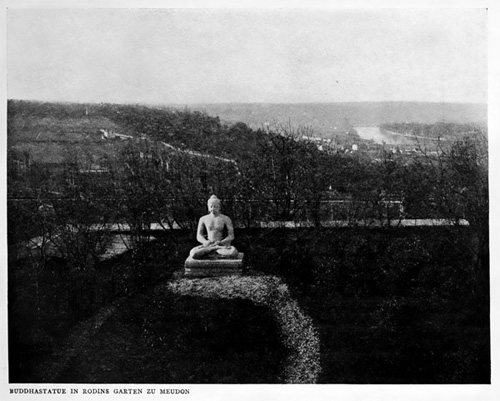 Photograph from Georg Treu, ‘Bei Rodin’, in Kunst und Künstler 3 (1905), p. 17.
These poems instantiate a significant cross-cultural and intermedial dialogue between West and East, Europe and Asia, sculpture and poetry, the founder of Buddhism and a Modernist poet. Rilke’s interest in the Buddha was stirred by an Indonesian statue in Auguste Rodin’s garden in Meudon, which the French sculptor had procured (along with other Buddha statues) from the 1900 World Expo in Paris. From September 1905 until the spring of 1906, Rilke lived in a cottage in Rodin’s garden and worked as his private secretary.
Translation continues the process of intercultural dialogue. It engages in a conversation with the original text and calls for interpretation and sacrifices. Unlike a prosaic or scientific text, every aspect of a poem contributes to its meaning: diction, images, rhythm, form, tone etc. Due to the unique complexity of a given poem, its translation cannot render a perfect equivalent in the target language.
Rilke’s Buddha poems, like most of his poetry, are written in formal verse (a sonnet and rhyming quatrains). Translations that aim to reproduce rhyme schemes and meter at any cost generally relinquish semantic precision and introduce additional material. We have chosen to translate the form of the poems more freely while accurately seeking to convey other distinctive qualities of his verse.
BUDDHA
Als ob er horchte. Stille: eine Ferne …
Wir halten ein und hören sie nicht mehr.
Und er ist Stern. Und andre große Sterne,
die wir nicht sehen, stehen um ihn her.
O er ist Alles. Wirklich, warten wir,
daß er uns sähe? Sollte er bedürfen?
Und wenn wir hier uns vor ihm niederwürfen,
er bliebe tief und träge wie ein Tier.
Denn das, was uns zu seinen Füßen reißt,
das kreist in ihm seit Millionen Jahren.
Er, der vergißt was wir erfahren
und der erfährt was uns verweist.
BUDDHA
Schon von ferne fühlt der fremde scheue
Pilger, wie es golden von ihm träuft;
so als hätten Reiche voller Reue
ihre Heimlichkeiten aufgehäuft.
Aber näher kommend wird er irre
vor der Hoheit dieser Augenbraun:
denn das sind nicht ihre Trinkgeschirre
und die Ohrgehänge ihrer Fraun.
Wüßte einer denn zu sagen, welche
Dinge eingeschmolzen wurden, um
dieses Bild auf diesem Blumenkelche
aufzurichten: stummer, ruhiggelber
als ein goldenes und rundherum
auch den Raum berührend wie sich selber.
BUDDHA IN DER GLORIE
Mitte aller Mitten, Kern der Kerne,
Mandel, die sich einschließt und versüßt, –
dieses Alles bis an alle Sterne
ist dein Fruchtfleisch: Sei gegrüßt.
Sieh, du fühlst, wie nichts mehr an dir hängt;
Im Unendlichen ist deine Schale,
und dort steht der starke Saft und drängt.
Und von außen hilft ihm ein Gestrahle,
denn ganz oben werden deine Sonnen
voll und glühend umgedreht.
Doch in dir ist schon begonnen,
was die Sonnen übersteht.








Pingback: Rilke’s “Buddha in Glory” – Mirror of Zen