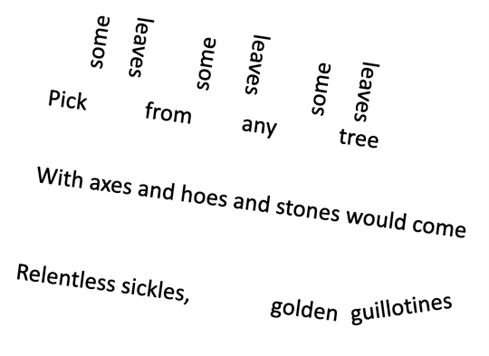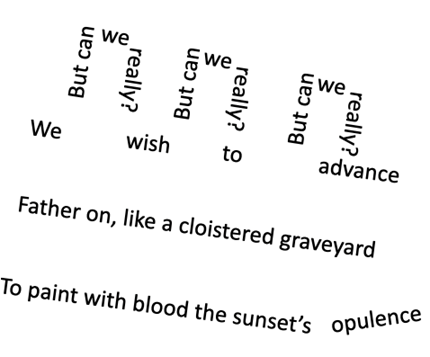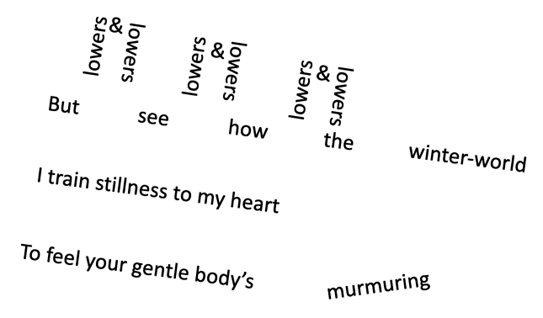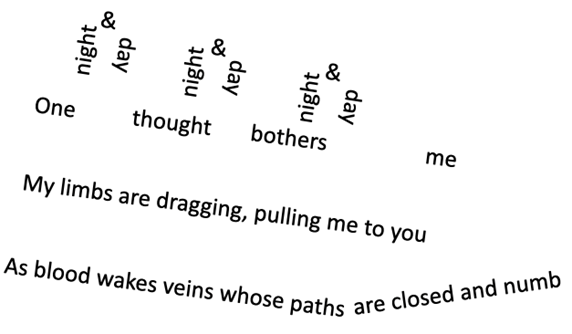
In which I haunt scholar poet William Empson

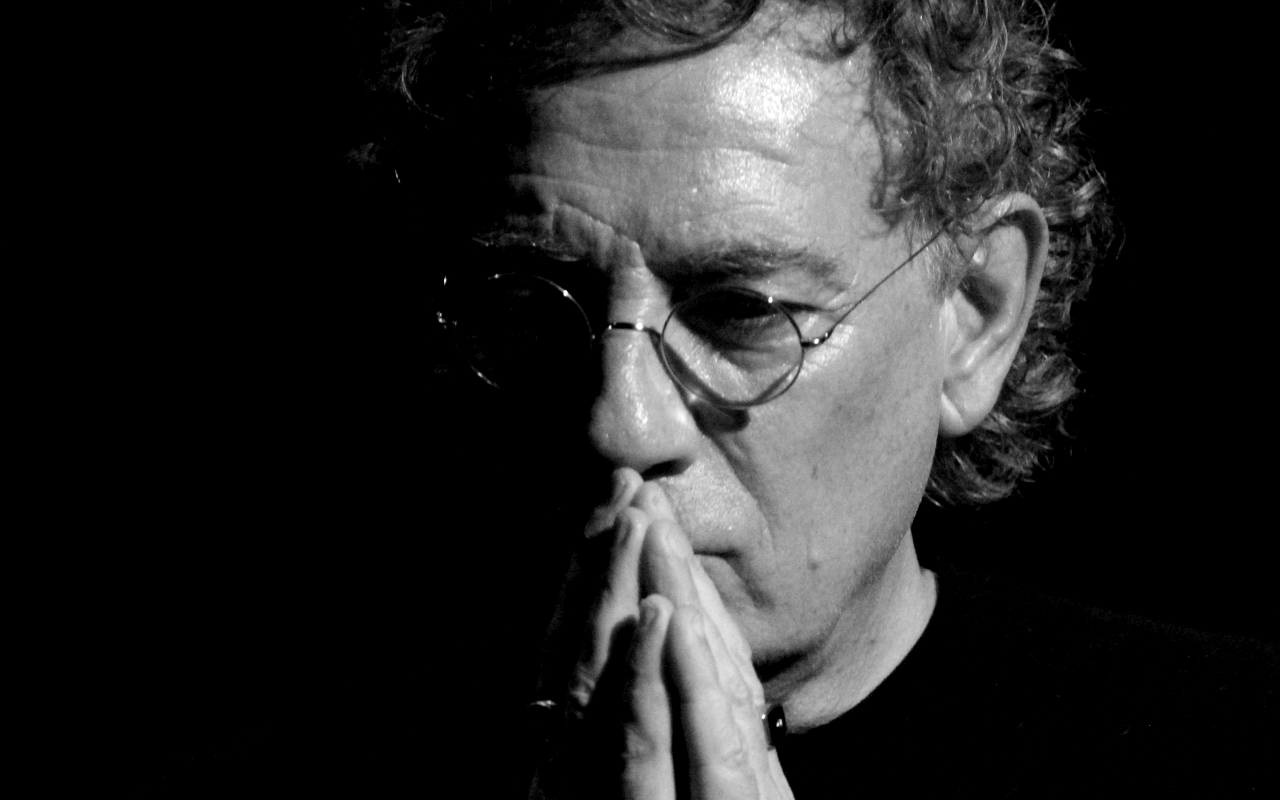
William Empson stands at the basin to shave.
His face in the small mirror becomes
a series of surmountable practical problems for the hand and eye.
Every visitor describes his digs as ‘squalid’
but in this imagined moment he stands in a rhombus of sunlight
steam rising from the water.
Scents of soap and an orange only beginning to mould.

William Empson, I want to write about a Lake.
I thought of you, who wrote “lack of conversation
makes it hard to write anything”.
I’m making this fictional visit to talk it over.

How do I write about a place that’s stolen
from the people who know it and live with it still
through cedar and whales cut and made away
cattle occupying land
the violent outrages
Mr Throsby, the 40th of Foot
his majesty’s blankets
the trawling and dairying
the spoiling of the water
sand dug up and stirred into concrete
children taken
pea picking race hate
acacia planted for a tannery
breakwaters the new suburb without a sewage system
slag poured into the saltmarsh?
The rubbish traps across the creeks catch plenty.

William Empson is only half-listening
as he stands in sunshine that suggests warmth, but doesn’t provide it
with the idea of a drink already lapping at his mind.
It’s only when he’s softened by the concentration needed to soap and scrape
fine bubbles of lather, the pleasure of hot water on a cold morning
that he decides to wait
for his walk to the lecture hall
to work out how to make the letter he’s writing to the TLS
funnier, less hurt, and attend to
my hovering presence, a ghost from the future.

William Empson meets my eye in the mirror while he pats dry his face
and quotes from his book, Some versions of Pastoral, written in 1935
the year before the Windang Bridge was built across the lake mouth.
The pastoral is “felt to imply a beautiful relation between rich and poor”.
The pastoral is “any work about the people but not by or for them”.
The pastoral is a process of “putting the complex into the simple”.

The pastoral, a gilty frame that leaves out labour, sex, milk, nest hollows, undergrowth, a shoulder smashed by musket fire,
dried fish, strips of calico, tobacco, overseers, avoiding the lobsters, drowning in sawdust, cockles, butter shipped to old gold
mountain, a woman growing grain, the incinerator on the island, banqueting, the cop’s pleasure boat, the man who needed
to get away, coal, a delegation to Macquarie Street, goats, absconders, miners, machinists, drivers, shopgirls; favouring
instead the poeting Bishop D’Arcy Irvine’s “white boats”, “purple hills”, a “flat sheet of water” and “the busy town” in
“mellow light”.

William Empson puts his spectacles back on.
The shaving water, grey and scummed, drains and runs through pipes into the River Soar.
William Empson’s soap and stubble will be – was – dispersed and digested
by the microscopic lives of the river, but he does not think of this as he swings on his coat
feels for tobacco in the pocket, picks up his papers and lets himself out.
William Empson has had enough of me. I can take what I need and leave what I don’t.

I’ll take his delight in ambiguity, fluid misquotation, I’ll take his naming of the lie of the beautiful relation and bring it to the
plaques and inscriptions, the paintings, poems and photographs, the stories repeated, the works performed, the plans and
programs, the lie, bright and sharp in some guises, in others, heavy scattered churning settling.

Posted in 114: NO THEME 13 | Tagged

Ravioli

I used to think there was loneliness
in the fabric of the American soul;
a matter of great distances,

an aspect of being scattered
across boxes of drywall and vinyl siding,
being conveyed in velvet-steel cages—

I felt there were traces of solitude
so I read Travels with Charley to see
what Steinbeck discovered, on the road.

Aloneness, then, was a presupposition:
reared at a distance, without siblings,
counting migrant friends on thumbs.

When someone learns I’m an only child,
their face flickers like a smiling flipbook,
depicting: “that explains a few things.”

I figured they caught a glimpse
of this far-off mark on my skin
like a long, straight scratch on the moon.

“I want to be your one and only,” I croon
once again, to a faceless every-mannequin
who too remarks: “that explains a few things.”

Somehow I began to think
I would be repaid for it all,
as if I held some holy IOU.

Reading Travels with Charley back then,
huddled aside, isolated, telling nobody—
something essential had been jumbled.

Yet, Steinbeck: he was rarely alone
on his journey, sharing each meal,
coupling words to unsaid feelings.

A red sun sets over the Atlantic
saying, pain knows no nation
and closeness is fleeting.

Tony makes me ravioli. I mumble—
“Something in here is broken.”

But Tony knew. He is broken too.
Long, straight scratches on the moon—

astronomers call them lineae.
I’m just glad they have a name.

Posted in 114: NO THEME 13 | Tagged

Laverton Ghost

They are gone now. Fled, banished in death or exile, lost, undone.
– Cormac McCarthy

see him now wandering still
through the Truganina marsh
in tattered tracksuit, broken baseball cap,
bad walking cane scratching at the paths
before the slow shuffle
of his tiny, duct-taped runners.

he was here before I was, before my folks migrated.
they used to say he was stuck out of time;
this old geezer forever on the one route
from West Altona across the swamps to Laverton
then back again, every day – rain, hail, or shine.
they called him the Ghost.

I’d hang out with the neighbourhood kids
on the Reschke Court cul-de-sac, skateboards in tow.
at the mouth of the street you’d see
the Ghost cross: this tiny, clunky thing
wobbling to and fro, the way a child
pretends to walk a toy figurine.

the younger kids, the meaner ones
would skate after the Ghost, wheeling behind.
they’d taunt him, chucking bark bits and bottle caps:
50 points if ya knock off his hat!
he’d brush away the barrage like it was houseflies
and press on, undisturbed.

here the rumours grew of the Ghost’s past.
Colin Sheedy spotted the Starry Plough
embroidered on the sleeve of his bomber jacket,
so told us all he was an Irish National
loyal to the Ursa Major, haunted by the Troubles
thoughts now doused in blood of the dead.

but then Nick Portello reckons he saw
a genuine Hell’s Angels tattoo on the Ghost’s neck;
Nick’s old man, up in Pentridge, had one.
we didn’t buy that the Ghost was a bikie,
he was of a horse and cart era
and to me, he just seemed too gentle.

my Dad drank with the fogies at the bottle-o
and they all thought the Ghost was a crim in hiding.
Mum was more sympathetic. she thought him
to be Saint Roch reincarnated, and he trekked
that route across the swamp each day
because he was looking for his lost dog.

I’d see him, riding around the streets at dusk,
the loneliest time in Laverton back then.
it’d be 40-something degrees and the ghost would be
wrapped up in his scruffy black garb;
his ashen moustache trembled and dripped with sweat.
his old, squirreled eyes set on the path ahead.

see progress shove itself into the unlikely nook,
unwanted, refused. the suburb then sprawled
and the train station was refurbished;
the Māori and poor whites were edged out
and those old bogan loons of Bruno’s bottle-o
were nipped by creatures and cancer.

all this change around so that Laverton
soon caught up to the 21st century.
blocks of medium density dwelling
for the new, rosy families.
the bottle-o evolved to a cheeky café
and the pot-holed roads were remade.

still there would be the skyline of Melbourne
seen from the top of the station’s overpass.
and there would be a graceful cool change
come in off the swamp to break the stifled air,
and the dusk streets still retained the peace
of scattered kids whose imaginations flared.

and you’d think along with the old vanguard
that the Ghost would be gone,
but there he was, come up from a
graveyard of construction,
tottering that bad cane, the slight breeze
that rocked his tiny frame.

nowadays, though, he moved slow;
He was stuck out of time, said Mum.
he was alone, more so. those that taunted him either
moved away, went to prison or died.
in the streets the Ghost would pause to rest.
just stand there still, and rest.

the milk bar, post office and Polish butcher
were all abandoned, boarded up and chained.
back in the day, the wood and shutters
would have been tagged in crude graffiti scrawls
thrown up by the silly, vulgar gangs of yore
I’d have been part of them.

I’d visit my father at the nursing home.
docile and hunched in a reading chair,
brushing bent fingers over the page of a book
I recognised from childhood.
in the shaft of warm windowlight
the few stray hairs on his head glinted.

I’d come to know quite a few people
buried at the Altona Memorial Park, a resting place
surrounded by freeways and warehouses.
we laid my mother there.
the priest’s prayer boomed over
the blow of a Kenworth’s dual-exhaust.

now he was all but bone, the Ghost.
pure relic of the streets and swamp.
he exchanged his walking route for the train.
on the platform, he’d hear
a horn sound and wince in fright
as though it was a trumpet of death.

he was always marching on, persistent.
you’d see it fixed on his face.
his perseverance was so humble. no jonesing
for grog or junk, that manic desperate gait.
he was craving home, I reckoned.
a place to be still, and feel good.

I would like to imagine he had
someone waiting for him after his treks.
he’d wander against the fiery sky, wreathed in smog
push through the front gate at final light
and be seated at a table before a plate,
across from someone who loved him.

ordinary legend of no real weight or gravitas
whose rumours diminished a small, dignified life;
to have haunted the mind of a suburb
and not even know it, a fixture of the streets
as much as the architecture, now gone
in a past that slowly fades with us.

Posted in 114: NO THEME 13 | Tagged

Easter Weekend, Saint Kilda

Deathwish bar and tattoo parlour personnel in their themed tees
stand shopfront to review an El Camino Chevrolet
and brace of Hogs. The deep end of Acland Street.
You see a skateboard matador who turns a V8 off loose jeans,
you pass the sign for tarot and an impromptu boxing clinic,
pass Italians, fish n chips and four éclair shops, Readings
booksellers impasto gelato smear and palette knife
scrapings of dog, walk on past ghosts of genuflecting seniors
whose spook bowls indulge their biases on grown-over greens
where co-op veggie beds are raising ropey sunflowers
and scrap metal whimsy to keep out rough sleepers,
coming at last to Luna Park’s impassable tramline knot,
the giant mouth Edvard Munching dental tools awhirr.
Look through the rollercoaster formwork to the pink sun
setting on a fake west coast. A number 16 tram departs
like a spat pill while patron Saint Paul looks on from his mural
on the Espy, harmonising guilt-cred with nostalgia for 13
hours on a bus, the Cross, this promenade both he and I prefer.

Posted in 114: NO THEME 13 | Tagged

Prove that you are human

Select all squares with crossings.

The blue wheel goes round.

This park looks familiar
and I had a bicycle just like that.
I wonder where the motorbike rider is going?
Maybe to his long-lost mother’s house.
They’ve only just rediscovered each other
after a lifetime of separation.

Select all squares with traffic lights.

That woman sitting on the bench
behind the stop sign,
she’s a refugee who’s spent years
trying to prove she’s human.

Select all squares with clouds.

including clouds with silver linings
and clouded judgements.
Every square has clouds.
Is that a metaphor?

Prove that you are a human.

Do something lovely
or vicious
or both.

Select all images with stairs.

The young man going up those back stairs
is on his way to a click farm,
a windowless building in
a street without a minimum wage.
He’s paid a pittance to plant
likes and follows and five-star reviews.

To continue, type the characters
you see in the picture.

What language is this?
Those twisted cat scratchings
look like my failed drafts.

The blue wheel goes round
and round.

‘I’m not a robot.’

Please believe me.

Posted in 114: NO THEME 13 | Tagged

Mt Mueller

a duel in snow,
so many seconds
and sunken paces;
are these brigades
drunken with laughter
and wild aims?
if he chooses,
he can thicken the air
with grapeshot from the
south, but it is clear:
with such clumps
of bold weather
cuddling his back,
the mountain loses.

Posted in 114: NO THEME 13 | Tagged

papatūānuku

Now, I worship
an empress of
solitude / I do not
know
how to bloat
slow / feather
like bird-stunned
truths / river says
we are stories
furred with
pulse / dreaming
cinders / twinned
geographies
of breathing
hinterlands / earth holds
our wintered
hands / imagines
a life without
living / a love
without
losing / unstrings
the nerves of
now / but I loved you
a mountain
ago / & I loved
you,
body, an ocean
ago / a-
go: heart’s
tracery / a juddering
caesura / the goddess
still asleep
inside
herself, inside
our harvest of
gentleness,
singing:
we all turn
to mountain
sometime / we all turn
to throbbing
estuaries of
days—

Posted in 114: NO THEME 13 | Tagged

ALTAR GIRL

and God said


i will give you such a sweet taste blood in the lap of pleasure


& too ripe a heart a name


for every body that drowned


& tears for cells still living in the water


& the color blue to make you forget


i will give you beauty for ashes but first ashes

Posted in 114: NO THEME 13 | Tagged

Museums of Temporary Art

for Sam

A. FORESTS

In the forest, there are two boys, one ditch, and they crawl into it together.

Now flesh of a madrone tree serpentines two boys in its filament of viridescence—

In the forest, an anxious family of flies wrap around their peach-fuzzed faces,

fades into fingertips slicked with their crushed bodies.

In the forest, miniature sparrows switch into leaves and refuse the boys’ brown,

outstretched arms, their elbow skins lotus pads in puddles of wind and recognition.

This must be the place. They hoist each other into endless flight,

two skies acquiring the sounds for falling into forest.

I admit, I still pick and choose when to see the forest for the trees.

And noble trees, enduring weights and revolutions, growing wilder, recasting

burrowing insects, the little, impervious, and numerous legs for new ones—

The forest rings, then into grain and knots, the forest continues––

A stringed instrument, ukulele made of wood and nylon.

I was an eternal perch of dawn, while the other boy’s strum

An aubade to proximity.

A madrone relies on fires. So much of what shouldn’t be burned is,

a coniferous longing for the forest.

Like eucalyptus, he’s thick-skinned.

Like eucalyptus, he’s burned to a hallowed core.

We placed our ears to it. You said you heard the forest.

Once, you showed me how, eyes closed, chanting:

When the forest is quiet, that is when you should really worry.

We climb to the canopy with our imaginary canoes.

There’s a forest on top of the forest, silence tidal against our song.

B. THE LAMENT OF GUAVA

Well, the fruit warmed in your palm,
wept its juices out as you whispered Guava

into my ear. It was so ripe.
Your saliva, shimmering fish

caught in tidepools
we hold each other in.

I offer it. I offer it. I offer it to Sam,
pressing it to his mouth to cease his singing.

Your dying.
Your estuary, where lulls and grief mix,

Your ukulele,
Your thighs straddled around me.

Your guava pieces like pink jewels as you spat them out
onto the bed of your thick palms,

and basking there,
and as if Sam did this all the time,

crushes them behind a piece of cloth,
polishes his ukulele with its essence.

You’re telling me, Look at it!
Taste it!
Shouting with the certainty of excitement and aggression

the way adolescent boys always seem
to possess.

C. THE SWIMMING HOLE

In the dream, there’s a lake forming between fingers

and my god: He could be so plump
full of muscular water

and salt, iron, cement: At night, the lake and
a gracious downpour of gold coins

bouncing, then, spinning on the floor—
when we wake, the sun so pure,

morning, a hue-less brightness,
the backs of fish, scythes of silver

breaking and riding the surface, our lake,
day after day, a reluctance that takes

well to a satisfied face
and fills an eyelid—

The forest walls surrounding us,
I hear ponderosa pines

stomping in the air,
and when we’re done,

his wet fingers
soaking

the chords of my throat
with indignation,

Open, he says.
And I know which parts to open—

D. GRAVE // GROVE

It said it burned like a steady flame,
and the boy was extravagant.

It said the word “suicide,”
but I only know the word “energy,”

the word “forceful,” the word “choke.”
I admit I tried to forget him and the town,

which is wanting to fail
to remember our shared fruit.

Suicide stands himself in the corner of my room,
as hopeful as solemn

Guava staining both our lips,
only wanting

sweetens our letting go.
But why?

I wanted to linger around a bit longer
than what I was allowed, to keep those words

to myself, the light, tumbling
of fruit like

his name—I wish it were so simple:
Oils I use to rub grieving stomachs,

learning to play an instrument enough,
such as love—the

tethers of a human to a soul,
and thus, to this one material world.

Posted in 114: NO THEME 13 | Tagged

Ruins

On the wall, an old Ottoman carpet,
a white curtain over the window. Only two days ago
we arrived on a late ferry.
A man plays a bouzouki,
its name given after the Turkish word bozuk,
meaning broken. You left
with a story I still don’t understand.
In 1922, during the Greco-Turkish war,
port workers went on strike,
and the Greek government ran out of money.

An empty rattan chair.
A painting of a boat.
We went to Monastiraki, past ancient ruins
you didn’t care for, painted blue tables,
clothes hanging from balconies.
Moses was given the ten commandments on Mt Sinai,
the same mountain
where he came across a burning bush.

The room is quiet.
You left, and I didn’t get to say
farewell. No, fare well.
When the Greeks were driven out of Asia Minor,
cypress and plane trees,
women thrust on stakes.
The city of Smyrna on fire,
allied boats in the harbour.

Posted in 114: NO THEME 13 | Tagged

Sydney, 2018

We sit in front of chefs gutting amberjack, black intestines
unspooling memory to the tune of Yoasobi and Korean,
knives turning red as they gouge white-pink flesh open.

Salmon, sea bream, squid pass us by in shells of plastic,
are squeezed between oily chopsticks. Waitresses laugh
when blowtorches, like stars, light up the winter wind.

Newtown sleeps in the distance, dreams in the dark blue
of the sea. Trattorias and izakayas etch neon words on the sky,
angler fish drawing the drunk and nameless in.

Alan from Perth, not yet twenty, dreams of escape.
He’s learning Japanese, leaving after his studies
to stay forever in the land of anime, onsens and ramen.

He’s thinking of the abuse he suffers under his parents,
the walks around Haymarket, the echoes of empty streets,
the nightjars and wattlebird singing their goodbyes.

Under fluorescent lights, camellias and crocuses bloom
in his mind. In his eyes, his pilgrimages to the Blue Mountains:
he brings only a sleeping bag, seeking out answers.

Now, the steady koan of bronzewings guide our fingers
to furikake-topped gyudons. To eat is to forget, to share
the world on our tongues. Huddled in this dingy corner,

we swallow our words, content to read each other’s faces.
In his parka, I smell orange-scented coffee, the wind
of the cities he’s searched in for a home.

At midnight we slurp on tonkotsu and drink sencha,
purple rays dancing and spilling into our cups,
dark clouds floating by like horses kissing.

Alan, who ate snow off mountaintops,
hurled himself off sandstone mesas,
drank the yellow glow of arroyos,

listens to the lullaby of the Clock Tower,
watches the orange lights of Central Station go,
the cooing cockatoos, the morning rose.

Posted in 114: NO THEME 13 | Tagged

Phosphenes

Maybe it’s part of being a mother
to haunt after the 3am feeding:

feet planted in my dreams
in the middle of the produce aisle arguing
about how many onions we need for dinner.

She was never one to tiptoe
around what she was thinking
despite her slight frame, now bones?

I teach my son to be gentle with the earthworms,
sliding through decomposition,
what masses they’re responsible to digest.

How long will I be out?
As long as needed, now lean back.

Protocol involves sealing valuables,
rings and glasses, in a bag
and naming next of kin.

As I drift off
they say the process will be easier
if I shut my eyes and picture my happiest place.

So it had to be you, leaping
along the shore with wild excitement
only a toddler can have.

That season you were eye level
to the Atlantic’s boundless waves
swelling and breaking into a hiss of foam.

Our favorite days were quiet and gray,
inspecting seaweed and chasing gulls,
the sky blanketed in clouds,

and no other mats on the sand but our own,
laid out carefully before the rising tide.

Posted in 114: NO THEME 13 | Tagged

Weathervane

for S.K. Strandlund

Wind-scrivener, penning its ongoing
revisions, the copper schooner spins
upstream (parrying the day’s
against-us). Moored to the weathered-tin
and pigeon-shit.

Scudding clouds; a loosed,
rusted arrow. Finger of execution, the
blackjack dealer rotates like
a revolver—another card? Do you
want another card?

Crowsnest—the next war or next
beautiful thing! The way life pursues
aptitude; sniffing-out the invisible
beginning.

A boat drives into the wind—the
stubbled captain, replete with
manifests. The wind speaks fluently
every language, pursuant to bathymetric
rumors.

Pleated epoch—stitching time like
a bullet; deliberate as the
footfalls and tipped vodka-bottles
of a Shostakovich Waltz. Pointing to
the bloodred Soviet flag.

Brisk, fingering wind, like a
sightless hand learning a new
face. Circumspect, I and others build
the promise of home.

Our fathers have taught us, and
our flags, that the wind—which is no
more than time—conquers
by attrition. Or, one could say, conquers
by untiring fixation.

Poet—antagonist—tacking into the
gusts; like a compass-needle,
confident, but never reaching home.

In the ruderal willows, in the
Rembrandt light. In the fading yard, a
dead barn—poet of echoes—its
weathervane still pointing to where
it will come.

Posted in 114: NO THEME 13 | Tagged

Grasslands

What’s left? You ask. Strips akin to Freddy’s promenades. Visibility pushed to the peripheries, something not equal to but greater than resilience. Still we don’t fuck here—shame. Three untenable public spaces, oft observed, rarely trod, thrum with intercession. You flew across the track despite the oncoming traffic. A phrase book might prove useful to interpret your interpretations while the referents resist classification, are unstable and subject to adaptation. Hazard a guess, maybe, on the verge. Does the number increase its value? You, afraid of profundity, chose to close your eyes—unfortunate. Note the line between curiosity and awe with your wide-angle lens, she with the macro peers for the micro to draw a line in the ash—felt with the tip of your tongue the differences in reflection. Here is pasture carved out for our departed, teeming. And the hectares adjacent, white space, save for a few errors with thanks to historical land management. Code: your four fathers demanded this place be productive, simple and silent—for the best.
Posted in 114: NO THEME 13 | Tagged

kuia

For Hape

Ages after I left your house and the lawn where it had all taken place

I dreamed about her, e Hape.
her karanga strong
her hands ā wiri

She waved me through the running kids – one looked like you, past
the upturned washing basket,
the whistling kettle,
the dripping vase,
the scattered scones,
the shattered bread plate
the melting butter
the missing knife

to where she lay.
the side of her face tilted just so.
eyes like a taxidermy rabbit.
her mouth in a fixed O.

that’s when I yowled

for her, for you, for those here, those yet to be
for an unwanted inheritance
for the telling that only ever ends this way

as my anguish fell upon your kuia
she let it
a month, a week, a year, a century, a moment later

I
stood

refreshed the flowers
re-bake dscones
re-filledthe kettle
re-fol ded the washing

gathered you held tight
kissed you wiped away
urged you kia kaha

all the while looking out

auē e Hape

very time I go past your house now
her karanga strong
her hands ā wiri

she waves me on

Posted in 114: NO THEME 13 | Tagged

The impasse

In his fifty-fourth year of waking on time,
of taking a shower and not a bath,
of drinking his coffee with NPR,
of checking his collar, the white sleeves,
before putting the shirt on,
of hiding a stain with his tie,
of driving to work while placing a call
to his mother, neighbor, plumber, Verizon,
sometimes his father,
and then not to his father
and then not to his mother,
of parking under the nameless tree,
of trying hard not to be dragged,
entangled in it all, not
to be late, at home, at work, to bed,
for another reticent date,
ignoring with a pill his sciatica,
his sexuality, his insomnia,
the birthday of a friend with a gift card,
one day in his fifty-fourth year
he stops in a bookstore
and opens a book
and does not read,
“Whoever cannot seek
the unforeseen sees nothing.
The known way is the impasse.”


Note. Heraclitus: “Whoever cannot seek the unforeseen sees nothing for the known way is an impasse.”
Fragments, p. 94. University of Toronto Press.

Posted in 114: NO THEME 13 | Tagged

Flashback to Forster

For James

An unmasked day, the cloudbank skips
across the morning;
gulls weigh and wheel.

The waves pump, rhythmic roll,
beyond spilling shoals.
Your first day with a body board.

A time to learn; we stir
through shallows,
through the channel rush.

Immutable moon heeds the trackless
tideways; synopsis of sapphires.
Flathead dither in sprawling fathoms.

The breeze builds on willing water.
We push out towards the break.
You cling to the buoyant cork

as you have been taught; I help
you position for the next set.
An elemental drive, a surge

swells and vaults. Instruction:
Paddle like mad, go boy go.
With my thrust you are flung

with force, you are fused
with the seam of the sea.
You will take a turn to teach your daughter

about the depths and dangers.
In my imagination a synthesis
of spray as you tack across the tide.

Posted in 114: NO THEME 13 | Tagged

Home

is not what you arrived at:
fluid, it moves lava in a lamp
shapes change pieces of time
breaking through –

the spaces of remembering dark
underground for years –
now unpeeled accretions
of memory – hard and lonely

yet familiar: you reach into
the straight streets bleak
like brittle cracked leather
the edges of suitcases you didn’t pack –

memory a finding again of losing –
the sadness was there black lives
crushed like leaves –
each day they’d place
one foot in front of the other.

How much we did or did not do –
eyes averted to the ground
not seeing their faces
as we passed –
holding the boundaries
of our bodies too close.

Home: what was lost, yet known,
roads, pavements, houses
built only in designated
White Group Areas the outer fences
obscure as smoked glass maps unseen,
the legal prose of Ordinances –

Acts of declaration: this is how the spaces
of the country will be allocated –
ratios of tens to thousands
the widest planes, the richest rock and water,
trees, the mountains in purple light –
given to the minority –

a home unmerciful –
white power tearing
at its own skin the itch
of not belonging.


Influenced by David Goldblatt’s photographs in his published photo essay ‘In Boksburg,’ which includes extracts from the relevant
South African Group Areas Act of 1961; and the exhibition ‘Dreamhome’ AGNSW, August 2023.

Posted in 114: NO THEME 13 | Tagged

Protective Measures

i’m planting poems between
the cracks of legal verbiage
after the Department classifies
its redactions as absolute disclosure
that I have a right to information
circumscribed by negative space

bureaucratic knowing takes
precedence over limbic resonance
& when those faithful witnesses
have journeyed, absence becomes
testament. your death germinates
sentences of serrated consequence

for i am the generous steward
of splintered grief herewith excised:
without access to further information
our client is not able to verify the truth of her
childhood & so is deprived
of her own
personal story

Posted in 114: NO THEME 13 | Tagged

Parable of Pinnacles

too bad if one shows up late
however earthmarked muscled

sure there was that party last week down the coast
& a finetuned lover in the nest

wanted to be a god
but on arrival the only portfolios left
were Garbage & Misplacement

to be some clerk of inevitabilities
seemed hardly worth the immortality

had the coming been sooner
could have picked up the popular Pestilence

restlessly thinks back to that beach hut

seems delays turned out more precious
than the destination

Posted in 114: NO THEME 13 | Tagged

She Sent me an Animated GIF

of a bunny eating a frog which now takes up my waking moments unexpectedly takes up bandwidth in my global connection tool takes up space in my buzzing shackle worn only in my left pocket the pocket check keys wallet phone is a new invention a symptom of modern solutions begetting modern problems. I sent the bunny to my group chat. There is a man watching me breathe it tastes like he wants me to do something but all I can think about is animals eating animals and how alike unlike my experiences are to those of John Don Passos sitting in a trench weeping shitting dying hoping similar but with more selfies and less self-awareness. Global warming is another symptom of global upheaval we’ve lived this all before but with more ignorance and less steps. X = YZ to the power of 2 I was never a maths guy despite finally having a calculator on my person at all times. I forget how to spell colleague so much you’d think I was attending college. Everything I copied over because a new copy sent to a cloud that sprinkles it all over the chest of some mute piece of equipment in Colorado that I imagine enjoys too much things that I know too little about. Add Candy as a friend for sexy pics and wanton noodles. Your IG is tainted. Your only fans are rotating and pushing air in stagnant underused bedrooms that smell of dust and cursed moments. Frogs eat flies but flies eat dead frogs circle of life Simba seems to keep coming back the front of my cortex; my amygdala keeps sending signals but all I keep thinking is run and say nothing else. Cringe is my default printer setting despite my appearance of non-appearance. No one makes party CD’s anymore and the old ones in my glovebox don’t work in my car. I remember the ping and grrrrrrrr bong of getting onto the internet and the frustration of being 50 minutes into a WOW instance and someone picks up the phone. MUM. Despite the facebook feed this generation is the luckiest and will live the longest with the most opportunity. Are more options not taken better then few options wholeheartedly lived? Within your mind space, there is a series of serfs tilling fields and backbreaking sacks of knowledge for your ego monarch. The debt system in my mindscape forced me to look up manorialism. There is a series of symbols that have replaced written language, but only the general feeling of it: right brain approves. Though second reading suggests both brains approve: right the negative left the positive emotions. Bleck. Not even my left/right brain knowledge can survive scrutiny and a google search. The frog croaks (lucky bastard). Disassociation is the best form of flight/flight/flight response: I clean until everyone goes to sleep. How can sleep take over unresolved issues and bunnies eating frogs, the frog smiles and says “finally I’m done with this mess”

Posted in 114: NO THEME 13 | Tagged

Fotó

To photograph someone is a subliminal murder,
says Sontag. I believed this. It is known a camera
will steal your iré. How it is first to eat at
restaurants, my mother snapping up amala, ewa,
a bed of efo tete. Scentless, 2D, each meal
collaged in a Facebook album. Reading Nietzsche, I
wonder if the aperture is a starved eye that needs to
be fed. My mother takes more photos now—not of
food, but portraits: my grandmother in her care
home, clutching a bag of agbalumo. Her steel-ribbed
walker, X-rays of her chest. There’s a video of her
slurping peppersoup, flashing smiles for her
daughter, a fragment I replay as I enter her ward,
my camera the only machine that can save her.

Posted in 114: NO THEME 13 | Tagged

Demiurge

Baby you’re a prism, the world splits
into rain bow through your eyes. So
why do all our colours mix to mud?

Steel corrodes, stress fractures, concrete
degrades. All science is applied science.
The tapped-out well booms hollow.

And yet, and yet
And yet—

A shiver passes through the solid block.

Posted in 114: NO THEME 13 | Tagged

nonbinary poem

at that beach where gusts
from the heavy south scattered
terns into the sky rocks
tumbled up and down the shoreline making
eggs of one another

the beach was laid with these eggs
and the timber too was boneround

at that beach the ocean hazed up
into mountains or was it the mountains
dissolving back down

because of the wind because of the salty clatter
we didn’t
have to talk didn’t
have to say again
it’s so beautiful

some moments in some days birds
fold into light or water gulls inside
bright grey clouds or swallows
shifting the careful placement of evening
light

my baby hands me an apple
and says for me

she waves hello and goodbye to rocks
and spiders and cutlery or just this one

byebye this one

our shared me is the warm apple
browning in our hands we graze
its edges with our teeth

also truthful is the singular and cloudy they

just one person or a group?

yes a flock of people

they keep taking flight whenever I get close

Posted in 114: NO THEME 13 | Tagged