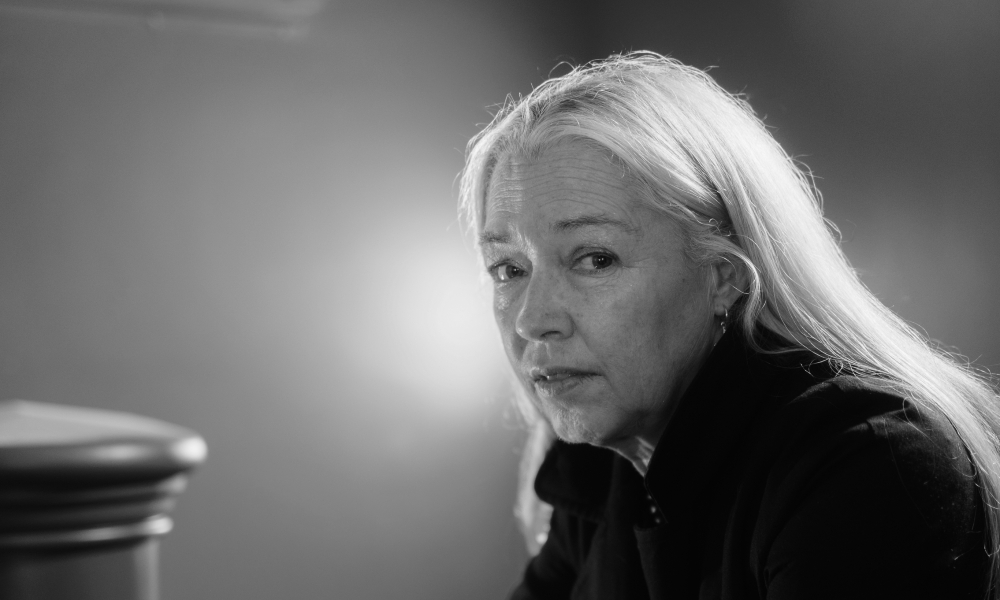
Image by: Hashem McAdam
In her debut poetry collection, these memories require (Puncher & Wattmann, 2025), Jacinta Le Plastrier responds to extraordinary thinkers whose work on trauma, survival and resistance has created communities, nationally and globally, for writers and audiences alike. The volume took 12 years to create, based on a lifetime’s engagement. Addressing the extreme, unsettling themes of familial gendered and sexual abuses, this is what she ‘writes back to’ when speaking on the book as ‘incestuous violence’. In so many nuanced and adept ways Le Plastrier’s poetry navigates these ‘unspeakables’ by a fervent commitment to poetry’s power to dissent. Stephen Romei’s recent review of Le Plastrier’s collection published in the Australian Book Review linked the collection to the (still partially classified and redacted) Epstein files. The volume also has a range of poems on the supernatural, an area of passion and intention of the poet.
Despite the complexities of uniting poetic expression with the ‘indescribable’, as Le Plastrier potently states in the poem ‘impossible’ this recent body of work desires and forges ways: “to reach, each, back / from the brinks of dissolutions. // to allow the deaths cyclical, of selves, / which can be substantial.”
Together, we converse on these memories require, speak to the connection between poetry and magic, and whatever-else arising throughout this intimate exchange.
Melinda Bufton: The poems of your poetry collection seem to claim specific space between the bodily state – grounded, earthly – and psychical realms. These realms seem to be symbiotic as well as engaged in a push-pull tension. Is that the case? Are those the terms you would use? Names of things are important, so I would love to hear your thoughts.
Jacinta Le Plastrier: Names of things? This makes me think immediately of Hélène Cixous: “… causes and consequences of giving the name. Not giving it. One can’t not. If you don’t name it, you kill it. The name kills, all the words around it are contaminated.”
Melinda, I wish to ask you a question now, as in your work, across all three books, Girlery (Inken Publisch, 2014), Superette (Puncher & Wattmann, 2018), and Moxie (Vagabond Press, 2020) and when I think of these memories require, the idea of words as kinds of witching is enunciated plurally, and freely.
For myself, and I never impose anything I think or do on another, my writing is a practice of my human and supernatural self/ves combined and in conversation with each other continually.
Words of poems are for me also both etheric and physical – they have a grounded sense because, when brought into form, presence, imprint, shape – there is an interchange varying on the poetic elements being conjured. But my poetry always seems to me, for me, also to arise from ‘somewhere else’, another else not of the so-called ‘three-dimensional’ earthly plane, they wing in, parachute in, knock on portals, mutter themselves into being across thresholds. Consciousness and thinking/feeling create a connective bridge, one which poetry wanders or explodes across.
Another question for you, M., Cixous also writes of being “inspired, driven…follow[ing] the spirits of writing.” In your three volumes, there are instances such as: “ . . . It’s dark / it’s only when we reach / Whatever’th floor that we / engage the spell” in the poem ‘Signature Enclosed’ (Superette) alongside another stirring line in the poem: “I have a skull tingling time-bomb amongst my garters . . .”. This also makes me think of your words: “Short emails are like sending out spells” from the poem ‘Dealbreaker’ in Girlery.
Do you think the commonality we share, and from which the idea for this interview sprang, is specifically feminist? I know for a very long time I felt the need to conceal my supernatural orientations and beliefs, so as not to be written off ‘mad’ by the rationalists who so often govern academic, media and literary thought. Also, the idea that language as magic can transmute even the highly suffered, because we are both writing at times about quite specific forms of abuse and their censorship.
MB: Yes, I do think this! It is witching as feminism … when I describe myself as a feminist poet, this is the more formal title of the same thing. Because yes, as you describe, it is all too easy to be written off. For me, feminism is a deeply held ethics because I was self-taught; growing up in the 1970s and 1980s, I was surrounded by strong women who eschewed and feared formal feminisms. They were not joiners! But I was watching and calculating how things went down if you were a woman. I was coming up with my own blueprint and there was a lot of time to think (growing up in the country, which you and I both also did). And like you, I wrote poetry from a young age which ensured that it was all entwined; politics, philosophy, lived realities and then – as its output – poetry. But my poetry is not always intended to land directly, or it may not, and that is how the spell works from my writing.
So, we have Dickinson’s “telling it slant” as a means of transmission, and I think often of Margaret Atwood’s metaphor of “negotiating with the dead” to describe writing practice. Also, the poet Annie Finch’s “decentred self”. Finch has described this as understanding “my own selfhood is not a clear and simple unit separate from everything else in the world”. She sought a feminist strategy to deal with the lyric I, to displace it and write otherwise to it; to create a more fluid subjectivity within the poetry, dodging readerly assumptions.
One thing that strikes me is that your strategies in these memories require look more like placing yourself, firmly, in the poetry to write the truth . . . to bring it to bear, and to cast the magic and distribute the energy via the intensity of this act. That’s the intensity and urgency I feel, from the work.
So, as a feminist my strategy is poetry, but as a poet it is witching (though perhaps all of these are interchangeable depending on the context). We – poets – all know what it is to tell someone you’ve just met that you’re a poet (nervous laugh, a blurted admission that they’ve never understood poetry, etc.). It can become awkward, pretty quickly, just the word ‘poet’. But it takes care of itself, as there is another channel of allowing the poetry to go ahead and do the work in your stead.