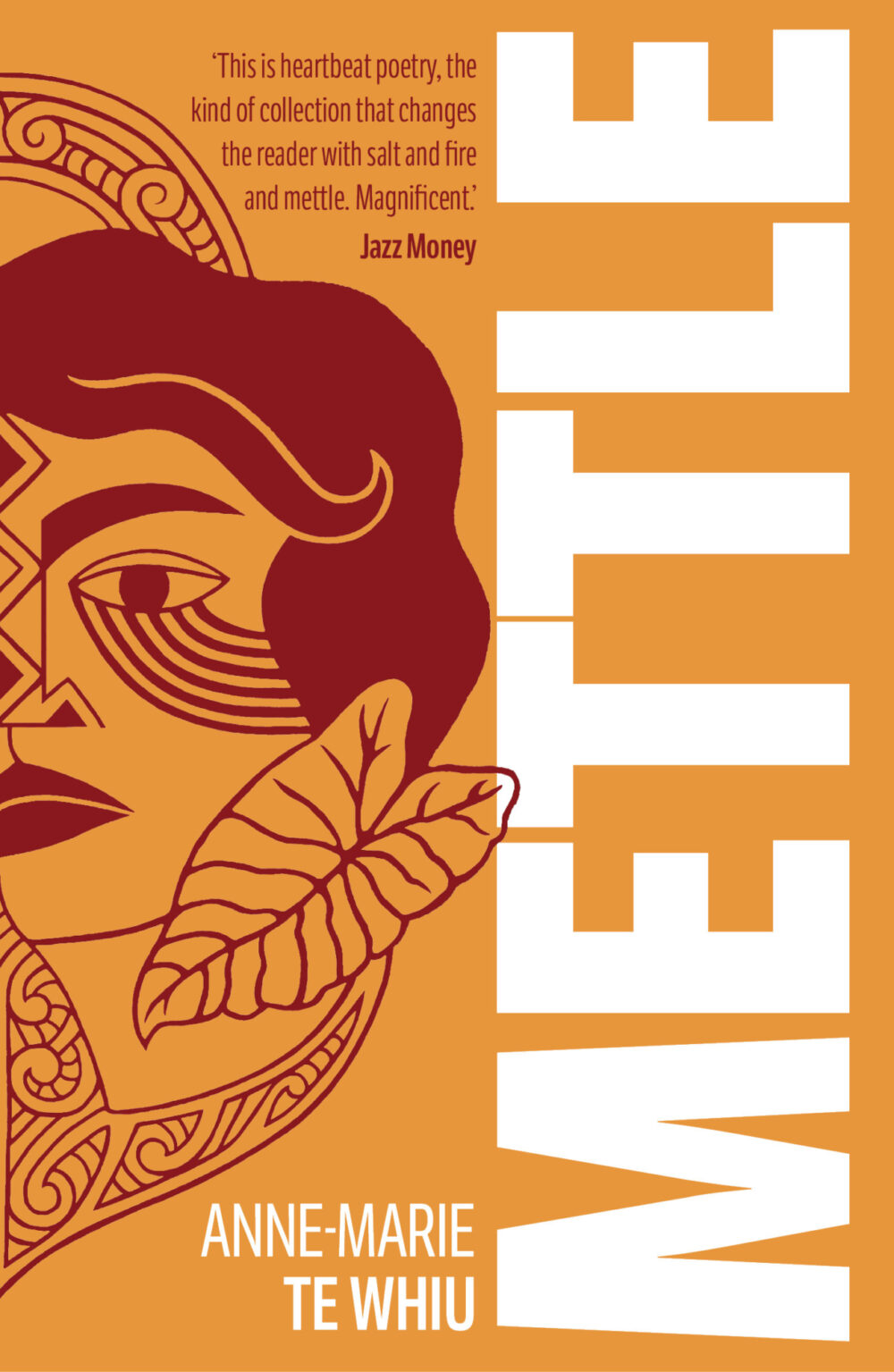
 Mettle by Anne-Marie Te Whiu
UQP, 2025
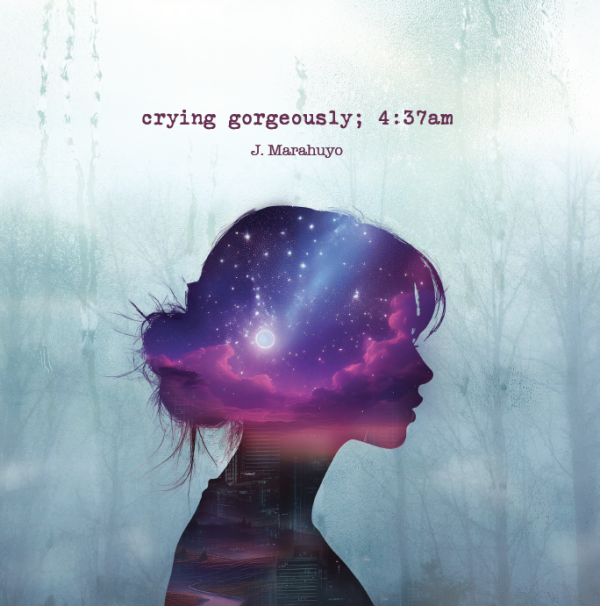
crying gorgeously; 4:37 am by J. Marahuyo
WestWords Books, 2025
Two debut poetry collections stuck with me as outliers in the 2025 publishing landscape: Mettle by Anne-Marie Te Whiu and crying gorgeously; 4:37 am by J. Marahuyo, both of which stand apart in their eclectic subject matter and formal experimentation. Cleaving apart taboos and encrypting them into emojis, concrete poems and ancestral languages, these collections deal with everything from the ongoing COVID-19 pandemic to deep sea phenomena, the messiness of sex to family violence. In a departure from the disaffected tone that has become popular across prose genres in recent years, Te Whiu and Marahuyo embrace the emotional catharsis of lyric poetry with seeming abandon to craft works that are, to borrow from Te Whiu’s ‘Love Letter to Keri Hulme’, “sparse and full all at once / shapeless and totally contained / wild and almost unkept” (52). These poems are alive, their subjects complex and contradictory, nurturing and discomfiting. Their speakers give away too much at times, and at others, nothing at all. They blend the confessional with the joyful, displaying grief alongside love, weaving the future through personal history.
Released in May of 2025, crying gorgeously; 4:37 am immediately situates the reader in a heightened state of mind. We know from the title that we’re in for a wild ride: it’s a verb and adverb, without a subject, followed by a semicolon, followed by a specific time in the early morning – the kind of time well past the witching hour, when one might reach for a bedside jar of melatonin or cast into the depths of the internet for an oddly specific sleep playlist. From the jump, we’re thrust into a world shaped by the almost-jittery quality of sleep deprivation, but too, by a deeper, more engrossing hum: to be marahuyò is to be enchanted, enticed, fascinated. It’s in the vein of this Tagalog concept, captured in the poet’s name, that crying gorgeously; 4:37 am explores the night world of emotions lying beyond the surface.
These feelings find expression in hyper-specific fixations and cyclic ruminating, or “overthoughts” as the narrator calls them in ‘I’m an anxious caterpillar’ (23). Such overthoughts come in many forms. They could be a mask created by the wearer as a byproduct of constant surveillance. They could be the voice of an inner critic, a mode of self-abasement internalised through repetition. Or they could simply be the thoughts that arise when all cognition is channelled into a small space sealed off from the chaos, compartmentalised for functionality in the absence of the means to sit with one’s emotions. Marahuyo puts it much less clinically than this: she writes that the narrator is “unable to let thoughts bathe,” which has a soothing ring to it (page 25). We should all be able to let our thoughts bathe, to marinate in thought without compulsive rumination. For many, this idea is aspirational at best and crying gorgeously; 4:37 am is about the places people go when they can’t be present, and the fantasy worlds they carve out of compensatory tunnel vision.
The poems in this collection range wide, exploring ideas as far-spaced as the squirrel in the Ice Age movies, black holes that emerge in the everyday, or the captivating mother (in the sense that she is both controlling and alluring). “The mother places questions of dark matter on the child,” Marahuyo writes, referring to the invisible substance thought to emit its own gravitational pull (‘whisper thank you to their king-sized bed for not swallowing them’, 22). There is a heaviness to this elevated language, reflecting the unseen weight of all that is to be considered in interactions with an overbearing parent, in which the responsibility to placate the adult looms over the child. The speaker takes a similarly philosophical turn in ‘A charming squirrel’s acorn’, where “an ear-inserted funnel can / annex reality only so long as a constant stream of debris gushes to overpower what is already known” (31). While light-hearted in its subject, the poem is concerned with how much information one can hold without imploding, the weight of awareness folding in on itself.
When describing one’s childhood universe, a sense of unreality can set in quickly where there is no authoritative figure able to confirm the facts of what happened, or where the person in a place of authority is a source of uncertainty themselves. There is a danger, when writing about childhood memories, that they will swallow themselves because there is no language to describe what happened in a way that feels at home in the world of the adult writer. Without description, the reality of physical harm threatens to appear inchoate and unprocessed. Yet to reproduce it in text is a kind of encryption too. To convey the weight of the reality while removing the reader from the immediacy of the pain depicted, Marahuyo centres the aftermath of violence and turns to imagery of outer space to describe injuries sustained. It is easy to imagine younger readers with similar experiences finding relief upon reading Marahuyo’s descriptions of maternal violence. As a teen, I sought out books to help me feel less alone when I was beaten unconscious or had hanks of my hair torn out, but I found few stories that explored these kinds of conflicts. Certainly, none like crying gorgeously; 4:37 am, which represents violent episodes with candour and without judgment, as, for example, in ‘Living within the Accretion Disk’, a cerebral poem in which the narrator describes a mother’s pinches with nebula-like imagery: “Left curved flickers of red / Next to yellow-haloed, purple- / black / voids” (4). Undoubtedly, this collection will help others experiencing similar treatment feel less alone, less small and more expansive.
Like in the life writing of poets like Patti Smith, the experiences Marahuyo writes about are not framed as deficits or impoverishments, nor are they normalised. Instead, they are made into points of departure from the ordinary, each with its own shape and texture. In such a way, language becomes a means of escape. A bruise evokes a distant night sky. Yet the bruiser is not depicted without compassion; she too is a complex character, unable to be pigeonholed, someone who evades the contours of reality to make sense of the chaos around her. Someone who is themselves haunted, “[t]he mother whose eyes / see infinite monsters,” as Marahuyo puts it in ‘whisper thank you to their king-sized bed for not swallowing them’ (19). What’s unsaid runs deep between the speaker and their mother, finding expression through paranoia and vigilance: “Always checking / checking, checking,” as an internal monologue mutters in ‘I’m an anxious caterpillar’. Marahuyo doesn’t attempt to explain away these compulsions or fill the negative space unnecessarily and the strength of the poem is in the places where ambiguity lingers, leaving the reader to draw their own conclusions.
The fractured domesticity of the collection’s first section gives way to a more fantastical approach in the second, where cliché is mobilised to satirical ends in poetry about princes and blank canvases. An otherworldly romanticism surges through poems like ‘oceanic kink’ in which bong hits and lesbian trysts take place in a kind of parallel universe, where the narrator is “suckling on a man made of smoke” (45). In the titular poem, a nostalgia-tinged memory replays a lover receiving an “un-fished compliment”, “You’re gorgeous” (49). The poem’s sentimentality is undercut by its self-conscious humour before it doubles back on its premise: “I release the ultramarine / butterfly-memory; then I / grab it / mid. – flight” (49). Such sensory language charges the poem with sharpness, bringing its subject back into focus. In a similar way, ‘Workplace Boundaries’ depicts a romantic scene with a mixture of longing and hilarity: “its potential spurs my fantasies / during my solitary winter afternoons / handcuffing me to / my vibrator” (51).
These poems play with the buzz of yearning, satirised through memes and expressive forms native to the internet, to the point where erotic charge becomes an actual mode of expression: “it makes me – ? ! :): @#\%asdfghj” (‘crying gorgeously; 4:37 am’, 49). Here, it’s not clear if the speaker is suggesting that the memory makes them come or something deeper: that memory is incapable of preservation beyond revivification as a fantasy, just as an orgasm cannot be depicted within traditional grammar conventions. In ‘Fistfuls of Sand’, a climax is heralded by the onomatopoeic rendering of a moan as “mm-nnnnnnnnngggg”, before the explosive “OHMYGODFUCK!” of orgasm (60). Language is both compressed and expanded here. The spaces between words disappear, yet all-caps means that the letters are taller and wider than they would normally be, evoking a feeling of breathlessness and outsized pleasure that pushes at the confines of language. Such use of the page’s white space is everywhere in Part II, ‘Break Me, I Bought It’, which desires to make poetic expression act on the reader’s embodied experience. In another instance, for example, Marahuyo dilates the space between words, drawing out how long it takes to read the line and, through this, slowing down time:
He     lifts someone     who     bears     my     likeness

(‘Fistfuls of Sand’, 61)
The longing that accompanies desire is not merely described, but, through its textual enactment, experienced by the reader. Moreover, and perhaps more strikingly, the collection refuses to classify desire prescriptively. Wants are anything but straightforward and Marahuyo’s poetry is as playful as it is lachrymose, as unserious as it is trenchant in its observations. Propelled by a stoner’s impulses, her poems brim with frank hungers: “Q: Why are you crying into your pillow, again? / i want to / smoke a joint, hidden inside / a bobby pin container”, she writes in ‘2:22 pm, crying. Dramatically’ (53), and then later, in ‘Fistfuls of Sand’: “Half a joint / later he’s talking / when she should / be touching” (56).
Exploring stoner time measured against joint length, karaoke as a coping mechanism and the mnemonics of orgasm, these poems are vessels for oceanic feeling, bobbing across pages teeming with apostrophes, emojis and other typographic jetsam. Not all of these visual elements work – “a fountain / of kisses / marooned my cheeks” is peppered with dots and wingding circles that feel like unnecessary embellishments – but when used effectively, they add dimension to the underlying text (‘2:22 pm; crying. dramatically.’ 52). For example, in ‘Meeting Amihan’, phrases are pasted into text with the slight smear of a photocopy, Tagalog as a ghostly shadow: “Reassuring me / mayroong lakas at kagandahan [there is strength and beauty] in teetering steps / in the netted wings of a damselfly” (72). The distortion of the image makes the words bend and blur, evoking the buzz of the damselfly’s wings mid-flight. Through such formal experimentation, crying gorgeously; 4:37 am concretises the searing, impossible feelings that attend our humanity, providing a medium for sensations that crawl like insects across the page, soon to be discharged into expression and take flight.